The beverage industry, from craft spirits to global wineries, is facing a critical "implementation gap" with Artificial Intelligence. While the 310% ROI potential of AI is clear, many leaders are struggling to move projects from pilot to production. Are you wondering how to apply AI beyond the hype? Are your teams bogged down by the operational complexity of "tool sprawl," edge computing, and MLOps? This white paper moves past the theory and details the 13 most valuable, field-tested AI applications that are blocking resilience, sustainability, and growth.
In this white paper, you'll discover:
Download the free guide to start building a more resilient, efficient, and intelligent beverage operation today.
# blog/2024-fireside-chat-the-future-of-engineering-in-an-ai-driven-world.md *[Source (/blog/2024-fireside-chat-the-future-of-engineering-in-an-ai-driven-world)](https://www.shakudo.io/blog/2024-fireside-chat-the-future-of-engineering-in-an-ai-driven-world) | [Markdown twin](https://www.shakudo.io/blog/2024-fireside-chat-the-future-of-engineering-in-an-ai-driven-world.md)* ---On December 9, 2024, Shakudo hosted another captivating fireside chat featuring two distinguished industry leaders: Farhan Thawar, current VP and Head of Engineering at Shopify, and Yevgeny Vahlis, the co-founder and CEO of Shakudo. The pair shared their insights on the current state of AI and data, and discussed their visions for the profound impact of AI on the tech industry, specifically on how the future of engineering can be shaped by these advances and what it means for both aspiring professionals looking to get into the industry and leaders looking to scale up amid the rapid pace of technological change.
One of the central themes of the conversation was the evolving role of engineering in an AI-driven future. Both leaders agreed that engineers are at the heart of AI’s future, but their role is shifting significantly as AI moves from a tool for automation to a driver of broader transformation across industries.

During the fireside chat, Farhan shared his experiences leading the engineering team at Shopify, guiding the company’s evolution from a small startup to one of the biggest e-commerce platforms in the world today. The company has experienced massive growth over the years, and the engineering team has played a crucial role in scaling Shopify’s infrastructure to meet the demands of millions of merchants and customers globally.
Being a tech visionary himself, Farhan emphasized the importance of hands-on experience from the upper management level, highlighting Shopify’s “founder-mode” culture, where leadership stays deeply involved in the day-to-day engineering and product development. This approach has been key to maintaining agility and innovation, even as the company scaled.
Farhan also underscored the transformative role of AI and large language models (LLMs) in modern business operations. Farhan explained how LLMs are incorporated into Shopify’s interview process as they seek engineering talent, helping to assess problem-solving abilities and coding skills more efficiently. As part of their engineering evaluation process, Shopify has been leveraging AI to streamline workflows and enable smarter decision-making, illustrating the growing importance of LLMs in shaping both the tools engineers use and the experiences they build for users.

Here’s a quick rundown of the highlights from the fireside chat:
A significant point in the conversation was the shift toward AI-first innovation. As Farhan explained, AI is no longer a novelty or a supplement—it is at the core of innovation across industries. For Shopify, AI is being used to optimize everything from customer interactions to supply chain operations. Engineers are not just building the infrastructure for AI; they are directly contributing to AI-driven business strategies.
This shift means that engineering teams must have a deep understanding of how AI can solve real-world business problems. Rather than just working on isolated features, engineers are increasingly expected to think about the broader AI ecosystem and its impact on customer satisfaction, business agility, and long-term growth.
During the chat, Farhan and Yevgeny highlighted the importance of data literacy for leaders in today’s AI-driven world, emphasizing that leaders must remain hands-on with the technical side of their team’s work. While the engineering team focuses on the execution of AI projects, leaders should be able to understand how to code, debug, and evaluate performance, as well as ensure data quality, so they can understand the technical landscape with an in-depth perspective and provide actionable feedback when needed. Leaders who remain grounded in this sense can better navigate challenges when it comes to model scaling, data governance, and ensuring team cohesion as the company scales.
The tech industry is constantly evolving, and so too is the role of engineering, which has long served as the backbone of development. Farhan and Yevgeny both acknowledged that the role of the engineer is evolving from traditional coding and system design to become more interdisciplinary. Engineers of the future will need to be proficient in AI model development, machine learning algorithms, and data infrastructure, in addition to core software engineering skills.
Furthermore, engineers should be equipped with the skills to utilize AI and machine learning to optimize their workflow and solve complex challenges more efficiently. Take Shopify, for example—the company doesn’t just encourage its employees to use AI; it actively integrates the use of large language models into its culture. The ability to leverage AI tools like LLMs has even been incorporated into part of the interview process, allowing the company to assess whether a candidate is adaptable to the evolving tech landscape and capable of using AI to enhance their problem-solving capabilities.
As a comprehensive operating system, one of the key benefits highlighted by Shakudo is its ability to provide a unified operating system for the entire AI toolchain and data workflows. The platform’s core strength lies in its scalability and flexibility, which empowers businesses to build customized data ecosystems that are efficient, secure, and agile, making it easier for companies to deploy AI models at scale.
For many organizations, AI deployment is hampered by the complexity of managing data pipelines, ensuring data quality, and scaling models to meet the demands of growing datasets. With over 170 best-of-breed data tools already incorporated into its platform, Shakudo helps businesses streamline their entire data pipeline so that they can focus on building and deploying AI models rather than managing infrastructure. Businesses seamlessly integrate their preferred tools and scale dynamically, empowering them to scale efficiently while maintaining data integrity and security throughout the process.
# blog/5-agentic-ai-design-patterns-transforming-enterprise-operations.md *[Source (/blog/5-agentic-ai-design-patterns-transforming-enterprise-operations)](https://www.shakudo.io/blog/5-agentic-ai-design-patterns-transforming-enterprise-operations) | [Markdown twin](https://www.shakudo.io/blog/5-agentic-ai-design-patterns-transforming-enterprise-operations.md)* ---The AI landscape has shifted dramatically. While enterprises spent 2023 experimenting with ChatGPT integrations and 2024 building custom LLM applications, 2025 marks the emergence of truly autonomous AI agents like Kaji, which integrate memory and workflow automation. These agents don't just respond to prompts but independently plan, execute, and improve their own performance. For regulated industries, this transition presents both unprecedented opportunity and a fundamental infrastructure challenge.
Traditional AI deployments follow a familiar pattern: train a model, deploy it to production, watch performance gradually degrade, then manually retrain months later. For enterprises operating in manufacturing, healthcare, and financial services, this approach has become untenable for three critical reasons.
First, business environments change faster than manual retraining cycles can accommodate. A predictive maintenance model trained on summer operating conditions doesn't account for winter temperature variations. A fraud detection system calibrated for last quarter's attack patterns misses this quarter's evolved threats. By the time data science teams identify drift, investigate root causes, prepare new training data, and redeploy, the business has already absorbed losses.
Second, the expertise required to respond to these changes doesn't scale. Each model requiring attention becomes a bottleneck. Senior data scientists spend less time on strategic initiatives and more time firefighting production issues. Organizations find themselves choosing between deploying fewer models or accepting degraded performance across their portfolio.
Third, and most critically for regulated industries, the emerging solutions to these problems introduce unacceptable data sovereignty risks. External LLM APIs offer impressive capabilities, but sending proprietary manufacturing telemetry, patient records, or transaction data to third-party services violates compliance frameworks like HIPAA, SOC2, and industry-specific regulations. Enterprises face a false choice: accept the limitations of static AI or compromise on data control.
The solution lies not in more powerful individual models but in architectural patterns that enable AI systems to operate autonomously within defined boundaries. Five distinct patterns have emerged as industry standards for building autonomous systems with Kaji, the enterprise AI agent with memory and workflow automation:

These agents execute specific, well-defined workflows without human intervention. A task-oriented agent might monitor incoming support tickets, extract key information, check against knowledge bases, and either route to appropriate teams or draft initial responses. The critical characteristic is bounded autonomy—the agent operates independently within clearly defined parameters.
Technical architecture: Task-oriented agents combine a reasoning engine (typically an LLM for planning), execution modules (APIs, database connections, computational tools), and guardrails (validation rules, approval workflows). The agent receives objectives ("resolve Tier 1 support tickets"), decomposes them into steps, executes those steps using available tools, and validates outcomes against success criteria.
Reflective agents add a self-critique loop to task execution. After completing an action, the agent evaluates its own output, identifies weaknesses, and iterates toward improvement. This pattern is particularly valuable for complex reasoning tasks where first-pass solutions rarely achieve production quality.
Technical architecture: These systems implement a dual-model approach—one model generates solutions, a second model (or the same model in a different role) critiques them. The critique feeds back as context for regeneration. Advanced implementations maintain memory of past attempts and observed outcomes, building an experiential knowledge base that improves reflection quality over time.
Rather than single agents handling entire workflows, collaborative patterns distribute work across specialized agents with different capabilities. One agent might excel at data retrieval, another at statistical analysis, a third at natural language explanation. These agents communicate, share context, and coordinate to achieve objectives beyond any individual agent's capabilities.
Technical architecture: Collaborative systems require orchestration layers managing agent communication protocols, shared memory spaces, and conflict resolution mechanisms. Message queues enable asynchronous collaboration. Central coordinators or emergent consensus mechanisms determine task routing and result synthesis. The challenge lies in maintaining coherent state across distributed agent actions.
This pattern represents the transition from reactive to proactive AI systems. Self-improving agents continuously monitor their own performance, detect when accuracy degrades, automatically trigger retraining pipelines with updated data, evaluate new model versions, and deploy improvements—all without manual intervention.
Technical architecture: Self-improving agents integrate multiple components: monitoring systems tracking prediction accuracy and data distribution shifts, drift detection algorithms identifying when retraining is needed, automated ML pipelines executing training with versioned data and hyperparameters, validation frameworks ensuring new models meet quality thresholds before deployment, and rollback mechanisms reverting to previous versions if issues arise. The entire cycle operates within a closed loop, with each iteration logged for auditability.
RAG agents combine the reasoning capabilities of language models with real-time access to proprietary knowledge bases. Rather than relying solely on information encoded during training, these agents retrieve relevant context from enterprise documents, databases, and systems before generating responses—ensuring outputs reflect current, accurate, organization-specific information.
Technical architecture: RAG agents orchestrate several technical components: embedding models converting documents and queries into vector representations, vector databases enabling semantic search across knowledge repositories, retrieval algorithms identifying relevant context based on query similarity, prompt construction logic injecting retrieved context into generation requests, and citation mechanisms linking outputs to source documents. For enterprises, the critical requirement is keeping all components—embeddings, vectors, retrievals, and generation—within controlled infrastructure.
The business case for agentic AI extends beyond operational efficiency to fundamental competitive advantage in regulated industries.
Continuous adaptation reduces time-to-value. Self-improving agents in predictive maintenance don't wait for quarterly model updates. They detect seasonal patterns, equipment aging characteristics, and operational regime changes as they occur, maintaining accuracy that static models cannot match. Manufacturing organizations using these systems report 30-40% reductions in unplanned downtime compared to traditional approaches.
Autonomous operation scales expertise. One data scientist can oversee ten self-improving agents monitoring different production lines, each automatically adapting to local conditions. RAG agents enable frontline employees to access institutional knowledge without waiting for expert availability. Using Kaji's workflow automation and memory capabilities, collaborative agents distribute specialized capabilities across the organization rather than concentrating them in bottleneck roles.
Data sovereignty enables innovation without compliance risk. By deploying these patterns entirely within controlled infrastructure, enterprises can leverage advanced AI capabilities while maintaining absolute data control. A healthcare organization can deploy RAG agents accessing patient records and medical literature for clinical decision support—capabilities that would be impossible using external LLM APIs due to HIPAA constraints.
A precision manufacturing operation deploys self-improving agents monitoring vibration, temperature, and acoustic sensor data from CNC machines. The agents continuously compare predicted maintenance needs against actual failures. When prediction accuracy drops below thresholds—indicating equipment characteristics have changed—the agents automatically trigger retraining using recent data. Over twelve months, this system adapted to seasonal temperature variations, equipment wear patterns, and operational changes across different product lines without manual data science intervention.
A hospital network implements RAG agents assisting with clinical documentation. The agents access electronic health records, clinical guidelines, medication databases, and research literature—all hosted within the organization's infrastructure. When physicians dictate notes, agents retrieve relevant patient history and evidence-based treatment protocols, suggesting appropriate documentation while maintaining HIPAA compliance. External LLM APIs would make this application impossible; data sovereignty enables innovation.
A payment processor deploys collaborative agents for fraud detection. One agent specializes in transaction pattern analysis, examining spending behaviors. Another focuses on network analysis, identifying relationships between accounts. A third agent monitors device and location signals. These agents share findings through secure message queues, with a coordinator agent synthesizing their inputs to make final determinations. This distributed approach detects fraud patterns no single model could identify while maintaining explainability—each agent's reasoning remains auditable for regulatory review.
Successfully deploying agentic AI patterns requires addressing several technical and organizational challenges.
Infrastructure complexity increases significantly. Self-improving agents need continuous integration/continuous deployment (CI/CD) pipelines for models, not just applications. RAG agents require vector databases synchronized with source systems. Collaborative agents need message queues and state management. Enterprises must provision and integrate these components within their security perimeter.
Observability becomes mission-critical. When agents operate autonomously, teams need visibility into decision-making processes. What data did the agent retrieve? What reasoning led to its conclusion? When did it trigger retraining? Comprehensive logging and monitoring infrastructure must capture agent behavior for debugging, auditing, and compliance verification.
Guardrails must be programmatic and enforceable. Autonomous operation requires confidence that agents won't exceed boundaries. This means implementing technical controls: validation schemas for agent outputs, approval workflows for high-stakes actions, automatic circuit breakers when anomalous behavior is detected, and immutable audit trails for every agent decision.
Tool integration determines capability boundaries. Agents are only as capable as the tools they can access. Implementing these patterns requires integrating language models, vector databases (Weaviate, Milvus, Chroma), workflow orchestration (Airflow, Prefect), monitoring systems (MLflow, Weights & Biases), and dozens of other specialized components—all configured to work together within the enterprise environment.
The infrastructure requirements for agentic AI patterns present a fundamental challenge: enterprises need the integrated tooling of cloud AI platforms but cannot sacrifice data sovereignty. This is where purpose-built AI operating systems become essential.
Shakudo provides enterprises with 170+ pre-integrated tools—including all the components required for self-improving agents, RAG systems, and multi-agent collaboration—deployable entirely within customer VPCs. Organizations can implement continuous retraining pipelines using Airflow and MLflow, build RAG agents with Weaviate and LangChain, and orchestrate collaborative agents with message queues and state management—all within their own infrastructure, using their choice of underlying compute resources.
This architecture addresses the core agentic AI challenge: achieving the operational benefits of autonomous, adaptive systems while maintaining complete data control and avoiding vendor lock-in. Enterprises in regulated industries don't have to choose between innovation and compliance.
Agentic AI represents more than incremental improvement—it's a fundamental architectural transition from AI systems that wait for human direction to systems that independently maintain and improve their own performance within defined boundaries.
For enterprises in regulated industries, the five design patterns outlined here—task-oriented, reflective, collaborative, self-improving, and RAG agents—provide concrete architectural approaches for building these capabilities. The key is implementing them within infrastructure that maintains data sovereignty while providing the integrated tooling these complex patterns require.
The competitive advantage will accrue to organizations that make this transition first, establishing continuous learning systems that adapt faster than competitors' manual processes allow. The technical foundation for this transition already exists—what remains is the implementation challenge of deploying these patterns at scale within enterprise constraints.
Ready to explore how agentic AI patterns can transform your enterprise operations while maintaining data sovereignty? Shakudo enables teams to deploy self-improving agents, RAG systems, and multi-agent architectures entirely within your VPC. Schedule a technical consultation to discuss your specific requirements.
# blog/7-best-practices-for-designing-automated-data-pipelines.md *[Source (/blog/7-best-practices-for-designing-automated-data-pipelines)](https://www.shakudo.io/blog/7-best-practices-for-designing-automated-data-pipelines) | [Markdown twin](https://www.shakudo.io/blog/7-best-practices-for-designing-automated-data-pipelines.md)* ---Data continues to grow at an unprecedented pace—more sources, more complexity, and more pressure to make sense of it all. According to Allied Market Research, the global market for data pipeline tools is projected to grow from $6.8 billion in 2021 to $35.6 billion by 2031, with a compound annual growth rate (CAGR) of 18.2% from 2022 to 2031, proving once again the critical role of data automation for companies looking to gain tangible insights from the increasingly complex data ecosystems.
As data ecosystems expand, traditional data management systems are struggling to keep up with the demands of scalability, flexibility, and real-time processing. This has led to the rise of cloud-native solutions such as Snowflake and Google BigQuery, along with data transformation tools like dbt and Trino. These modern platforms provide the infrastructure needed to manage today’s data without relying on clunky, outdated systems. They ensure data accuracy, accessibility, and security while significantly reducing the workload for data engineers and analysts. To avoid unnecessary manual work, organizations have turned to automated data pipelines to simplify the process—from extraction and transformation to accessing real-time insights.
In today’s blog, we walk you through 7 best practices business leaders like yourself can use to design a comprehensive, efficient, and highly adaptable automated data pipeline in 2025.
A data pipeline is essentially the process of sorting, moving, and transforming data from one place to another. It involves extracting data from a native data source, like a database, cleaning, transforming, and eventually loading it to a targeted system. For example, you might use a data pipeline to transform data from a customer relationship management (CRM) system to a cloud data warehouse like Snowflake for further analytics and reporting.
A typical data pipeline often includes:

To maximize the value of your data pipeline, you want to treat it like a product instead of just a tool, meaning that you should focus on delivering tangible, actionable ROI for end-users rather than purely the technical functionalities. The objective of a data pipeline is to ensure that the process will lead to well-structured, digestible data so that not only can your team make informed business choices but the market will benefit from streamlined, reliable data insights.
To achieve this, it’s important to design a pipeline that can be easily adaptable to changing business needs. There are two ways of building a data pipeline: either by adopting a modular, cloud-native architecture that leverages existing tools and services or by constructing a complete, custom-built data pipeline from the ground up using in-house resources and technologies. The modular approach allows for scalability, whereas building it in-house offers greater control over the data flow, ensuring that all data is secured and well-protected throughout the Extract, Transform, and Load (ETL) process.
While efficiency is critical to the success of modern data pipelines, the integrity of data is also critical to the success of data-driven decision making. Ensuring that data is accurate, complete, consistent, and unbiased across all stages of the pipeline should be a priority. Without robust data integrity practices, errors such as hallucinations and inconsistencies may occur, hindering the quality of data and lead to misleading insights.
To ensure data integrity, it's essential to implement comprehensive validation checks at every stage of the pipeline, from data ingestion to transformation and loading. Leveraging automated data profiling tools such as Great Expectations allows users to define expectations for their data and enables the system to check if these expectations are met. Additionally, introducing a rigid data governance framework can help ensure data transparency and accountability.
The pipeline’s ability to scale freely is crucial as the demand may change any second. Cloud-native solutions allow for real-time adjustments, when paired with machine learning-based infrastructure optimization, they enable organizations to scale more effectively than ever before.
For companies looking to take full advantage of scalability and flexibility, it’s important to invest in cloud-native platforms that support auto-scaling and integrate with machine learning for predictive resource management. Shakudo, for example, integrates over 200 data tools with a wide range of capabilities. These tools automatically allocate resources based on demand, optimizing both performance and cost-efficiency.
To ensure that data is being processed at a consistent speed with assured processing quality, it is important to automate the monitoring and maintenance process alongside data pipeline optimization. AI-driven monitoring systems can both track the performance of your pipeline and provide necessary feedback, such as bottlenecks and anomalies, for future improvements.
Platforms such as Shakudo offer advanced monitoring capabilities, including built-in Grafana—an industry-leading monitoring and visualization platform—that continuously evaluate pipeline performance and identify areas for improvement. You can also set up automated alerts for performance issues, such as slow processing speed or data discrepancies, enabling your team to respond quickly.discrepancies, so that your team can respond quickly.
Data security continues to be one of the most important priorities in modern data management. As data regulations tighten, having an end-to-end encryption system across your data pipeline becomes crucial to its success. AI-powered security tools can help detect vulnerabilities and enforce strict access controls, while zero-trust models should be a baseline for pipeline security.
To ensure security, you can select cloud-native tools and platforms that provide built-in encryption. Having your data infrastructure built securely on VPCs also provides a controlled environment for your data. Security tools such as Falco are designed to detect anomalous activity in applications, containers, and cloud environments.
Automated data connectors are an efficient solution to reduce the burden on data engineers. While engineers can build custom connectors, it’s crucial to consider the "build vs. buy" decision, factoring in cost, effort, and risk. Data engineers typically prefer focusing on higher-level tasks rather than managing data transfer or fixing issues with manual connectors. Automated data pipeline tools, which monitor and adjust data integration automatically, eliminate this need, allowing engineers to focus on more valuable roles, like cataloging data and bridging the gap between analysis and data science, while enabling data analysts and scientists to focus on insights.
The complication of data tools also calls for low-code and no-code platforms, sparing companies the time and resources to build complex solutions with extensive technical expertise. Forrester Research predicts that by 2025, the generative AI market will grow at an annual rate of 36%. This momentum, fueled by an explosion in citizen development and AI-infused platforms, is set to propel the low-code and digital process automation market to an estimated $50 billion by 2028.
Companies can adopt a dual strategy that leverages both cloud-native scalability and low-code or no-code automation. For example, a company might implement cloud-native solutions such as AWS or Azure to automatically scale resources in real-time, while simultaneously utilizing low-code platforms to streamline data integration and application development—such a combined approach empowers businesses to adapt to dynamic market demands.
Popular open-source tools like Dify and n8n are widely embraced by today’s businesses, yet deploying them independently can be challenging. Their true value emerges when seamlessly integrated into an organization’s data source, making platforms like Shakudo a crucial tool. The Shakudo platform simplifies the deployment, integration, and management process, leveraging the power of these open-source tools to help teams focus their efforts on driving tangible growth rather than infrastructure challenges.
Automating your data pipeline with Shakudo streamlines the entire data management process. The cloud-native architecture of the platform is capable of auto-scaling as demand changes. The end-to-end automation ensures seamless data integration, transformation, and deployment, reducing manual intervention and operational overhead. As an operating system, Shakudo currently integrates more than 200 best-in-class data and AI tools, offering businesses a wide range of options to tailor their data strategy. Compared to traditional data infrastructures, the Shakudo OS allows companies to build data products and custom pipelines tailored to specific processing demands with AI-driven solutions.
# blog/7-million-strategic-round-to-power-sovereign-enterprise-ai.md *[Source (/blog/7-million-strategic-round-to-power-sovereign-enterprise-ai)](https://www.shakudo.io/blog/7-million-strategic-round-to-power-sovereign-enterprise-ai) | [Markdown twin](https://www.shakudo.io/blog/7-million-strategic-round-to-power-sovereign-enterprise-ai.md)* ---SAN FRANCISCO & TORONTO — Feb 17, 2026 — Shakudo, the operating system for enterprise artificial intelligence, announced a $7 million strategic funding round led by Wittington Ventures. The financing—driven by several of Shakudo's long-term enterprise customers—will fuel the company's U.S. expansion and the launch of two new products, Kaji and Shakudo AI Gateway, built to bring autonomous AI agents into the most regulated industries in the world.
The round was led by Wittington Ventures, whose Managing Partner, Jim Orlando, has joined the Shakudo Board of Directors. Wittington Ventures is a venture capital firm affiliated with Loblaw Companies Limited, one of Shakudo's marquee enterprise customers. Existing investors Golden Ventures, GreatPoint Ventures, and RTP Global also participated, reaffirming their support for Shakudo's vision of a secure, vendor-neutral AI future.
Notably, some executive customers who have seen Shakudo's impact firsthand made personal investments in the round: Chris Sullens, CEO of CentralReach; and David Stevens, former Vice President of AI at CentralReach. Their participation signals a growing conviction among enterprise leaders that sovereign AI infrastructure—not vendor-locked cloud solutions—is the path forward.
"Shakudo allows us to accelerate our transparency, visibility, and time to market," said Chris Sullens. "I've also really appreciated having the Shakudo team, engineers, and support people semi-embedded in our team and shoulder-to-shoulder with Dave and his team. This has been hugely helpful to allow us to make the most of the tool."
Despite the momentum behind consumer-facing AI assistants and big-cloud integrators, most enterprises continue to struggle with adoption. CIOs have spent the last year attempting to push business users toward generic AI tools, only to find they lack the institutional memory, data-connectedness, and security controls required for professional work.
"People don't want another dashboard. They want agents that actually do the work," said Yevgeniy Vahlis, Co-founder and CEO of Shakudo. "But when three engineers install an autonomous agent on three different laptops, that's three knowledge silos, three attack surfaces, three compliance gaps. That's fine for a side project. It's not fine when you're running a nuclear plant, managing patient data, or processing financial transactions."
Shakudo's approach is fundamentally different. The platform is deployed natively within a customer's Virtual Private Cloud (VPC), ensuring that intellectual property never leaves the organization. Rather than offering a general-purpose assistant limited to personal productivity, Shakudo turns an enterprise's private data into a proprietary competitive advantage—purpose-built for the power user and the subject matter expert.
David Stevens, who evaluated multiple platforms before selecting Shakudo at CentralReach, described the decision:
"We started looking at some of the big companies, like AWS, and while they're amazing, they lag behind the point solutions that are best of breed, really leading edge. It quickly became apparent that if we went down that legacy path, we were going to be hamstrung in terms of our ability to quickly deliver POCs. We started searching for platforms, and that's when we found Shakudo."
Alongside the funding, Shakudo is launching two products that extend its operating system into the era of autonomous AI agents:
Both products are built into the same OS that already runs data and AI infrastructure for organizations in nuclear energy, healthcare, financial services, oil and gas, railway, and manufacturing.
With the establishment of its new headquarters in San Francisco, Shakudo is scaling its go-to-market and engineering teams to support a growing roster of U.S.-based Fortune 500 customers. The company remains committed to its mission: enabling the world's most regulated industries to adopt AI on their own terms, in their own clouds, with their own data.
Shakudo provides the operating system for AI, enabling enterprises to build, deploy, and scale AI applications on their own infrastructure. By unifying data tools, security, and institutional context into a single sovereign layer, Shakudo allows organizations to move from experiment to execution without compromising their data or their future.
Shakudo is growing fast—and we're looking for exceptional people to help build the future of enterprise AI. If you want to do the most important work of your career alongside world-class talent, we'd love to hear from you. See open roles.
# blog/7-reasons-why-chatgpt-and-copilot-put-the-enterprise-at-risk.md *[Source (/blog/7-reasons-why-chatgpt-and-copilot-put-the-enterprise-at-risk)](https://www.shakudo.io/blog/7-reasons-why-chatgpt-and-copilot-put-the-enterprise-at-risk) | [Markdown twin](https://www.shakudo.io/blog/7-reasons-why-chatgpt-and-copilot-put-the-enterprise-at-risk.md)* ---The viral, bottom-up adoption of generative AI assistants like ChatGPT and Microsoft Copilot is undeniable and, on the surface, a clear victory for productivity. Employees are leveraging these tools to draft emails, summarize documents, and generate code snippets with unprecedented speed, creating immense internal pressure on technology leaders to deploy them at scale. The appeal is tangible; the efficiency gains for individual tasks are immediate and compelling.
This creates a profound paradox for the modern technology executive. The very tools that empower individuals can introduce systemic risk and strategic debt to the enterprise as a whole. The frictionless experience for an employee masks a web of complex security, compliance, and integration challenges for the organization. The ease of use that drives adoption also sets a dangerously misleading precedent. Employees and even business leaders come to perceive AI as a kind of magic—instant, free or low-cost, and requiring no foundational work. When technology leaders then propose a more robust, strategic approach that requires investment in data governance, secure infrastructure, and operational discipline, it can be perceived as bureaucratic and slow. The tactical win for employee productivity thus creates a cultural and political headwind against building a durable, long-term AI capability.
The strategic question, therefore, is not if the enterprise should use AI, but how. How do we mature from scattered pockets of AI-driven efficiency to a secure, scalable, and integrated enterprise AI foundation that becomes a true competitive moat? This requires looking past the immediate allure of generic assistants and confronting the seven critical gaps they leave open.

The most significant and immediate risk posed by public AI tools is the loss of control over an organization's most valuable asset: its data. When employees input sensitive information—unannounced financial data, proprietary source code, customer personally identifiable information (PII), or confidential legal strategies—into a third-party-hosted AI tool, that data leaves the secure perimeter of the enterprise. This act fundamentally compromises the principle of data sovereignty.
These tools often operate as a black box, providing little to no transparency into how input data is stored, who has access to it, or whether it is used to train the vendor's future models. This creates a direct and unacceptable risk of data leakage, where a company's confidential information could be inadvertently regurgitated in a response to another user, who could be a competitor. This lack of control creates a compliance nightmare. Regulations like the General Data Protection Regulation (GDPR), the Health Insurance Portability and Accountability Act (HIPAA), and the California Consumer Privacy Act (CCPA) impose strict requirements on data processing, residency, and consent. Using a public AI tool for regulated data can lead to severe financial penalties, loss of customer trust, and lasting reputational damage, as the burden of compliance remains with the enterprise even when control is abdicated to a vendor.
This reality exposes a deep philosophical conflict between the operational model of public AI and the security posture of the modern enterprise. Today's security architectures are built on a "zero-trust" model: never trust, always verify, and assume breach. Access is granular, monitored, and meticulously controlled. Public AI tools, conversely, operate on a model of "implicit trust," forcing a Chief Information Security Officer (CISO) to trust a vendor's opaque security promises and multi-tenant architecture with their most sensitive data. This is not a technical gap; it is a fundamental misalignment of security principles. The only truly defensible posture is to bring AI capabilities to the data, not the other way around. This makes an architecture where models and applications run within the enterprise's own secure in-VPC (Virtual Private Cloud) deployment a non-negotiable prerequisite for any serious AI initiative, as it extends the zero-trust perimeter to encompass AI workloads, rather than contradicting it.

Microsoft Copilot is marketed on its deep integration within the Microsoft 365 suite, offering powerful features for users of Word, Excel, and Teams. While this provides a seamless experience for tasks confined to that ecosystem, it creates a strategic vulnerability for the enterprise: a walled garden that isolates intelligence.
The modern enterprise is a heterogeneous environment. Mission-critical data does not live solely in Microsoft products; it resides in Salesforce, Confluence, Jira, Slack, SAP, Snowflake, and countless bespoke internal applications. A tool that cannot natively access and reason over these disparate data sources cannot provide true enterprise-wide intelligence. It can only optimize tasks within its own silo, reinforcing the very information barriers that technology leaders have spent decades trying to dismantle. This limitation reframes the concept of vendor lock-in. Historically, lock-in was a financial and operational concern centered on high switching costs. In the AI era, it becomes a strategic constraint on intelligence itself. By tethering an AI strategy to a single vendor's ecosystem, an organization is not just locked into their pricing; it is locked into their model of the world. The AI can only be as intelligent as the data it can see.
The real, transformative value of enterprise AI lies in its ability to act as an orchestration layer, connecting data and workflows across different systems to generate novel insights and automate complex, cross-functional agentic workflows. This requires a platform that is fundamentally open and tool-agnostic, designed to integrate with any data source or application, whether commercial or open-source. Such a platform is architected to maximize the enterprise's collective intelligence by connecting to its entire "brain," not just one lobe.

A critical distinction for technology leaders is that between an AI product and an AI platform. ChatGPT and Copilot are products: feature-rich applications designed for a predefined set of tasks. They are not, however, environments designed for custom building; to develop, deploy, and scale its own unique, mission-critical AI applications, the enterprise needs a dedicated developer platform. An organization cannot use Copilot to construct a custom AI agent for real-time fraud detection or a specialized system for dynamic supply chain optimization; these use cases fall outside its scope.
These products also enforce a closed model stack, typically relying on OpenAI's models delivered via Azure. This is a significant limitation in a field where new, potentially more efficient or specialized models—both commercial and open-source—emerge constantly. A closed platform prevents the enterprise from leveraging these innovations for cost or performance advantages. Furthermore, the most valuable enterprise AI solutions are often "compound applications" that chain together multiple models, tools, and data sources to automate a complex business workflow. This level of composition is impossible with a locked-down product.
Relying solely on off-the-shelf AI products is akin to outsourcing a future core competency. In the coming years, the ability to rapidly build and deploy custom AI solutions will be a primary driver of competitive differentiation. By becoming mere consumers of AI, enterprises cede this capability to their vendors, limiting themselves to the same generic features available to all their competitors. True, durable innovation requires an AI operating system—a foundational layer that allows developers to compose solutions, treating best-of-breed models and tools as modular components in a larger, enterprise-owned system. This is an investment in building an internal engine for innovation, rather than simply renting one.

The path from a promising AI pilot to a production-grade system is a graveyard of failed initiatives. Industry analysis consistently shows that a vast majority of AI proofs-of-concept (POCs) never reach production. Gartner predicts that at least 30% of generative AI projects will be abandoned after the POC stage, with other studies suggesting the failure rate is as high as 88%.
Pilots fail because they are born in a sterile lab, not the chaotic real world. They succeed under ideal conditions—using clean, curated data, with a tightly defined scope, and free from the complexities of integration with messy legacy systems. Demos built with generic tools like ChatGPT are prime examples of this "sandbox illusion." They look impressive but are not architected to withstand the pressures of production, which include fragmented data, inadequate infrastructure, evolving business needs, and the lack of robust Machine Learning Operations (MLOps) for monitoring, retraining, and governance. Many pilots are also "technology in search of a problem," demonstrating technical feasibility without being tied to a clear business problem or measurable ROI, making it impossible to justify the significant investment required for scaling.
This high failure rate suggests that the "fail fast" mantra of agile software development is misapplied to enterprise AI. A failing AI pilot does not just represent wasted development time; it erodes organizational trust in AI as a whole. A model that produces biased or incorrect results in production can cause real financial and reputational harm. The foundational work for a production AI system—secure infrastructure, data governance, and operational resilience—cannot be "iterated" into existence from a simple demo. The system must be built to last from day one, requiring a strategic partner and a platform architected for production, not just for a flashy but fragile pilot.

Off-the-shelf AI tools, by their very nature, cannot navigate the unique, complex, and often undocumented "last mile" of enterprise integration. This final, critical step involves connecting to legacy systems, handling idiosyncratic data formats, and embedding AI capabilities into bespoke business workflows that define how a company operates. This is not a problem that can be solved with a generic API.
This challenge is compounded by the "context chasm." An external tool or a traditional consulting engagement often lacks deep, nuanced understanding of the business's specific problems. Handoffs between business stakeholders, data scientists, and engineers inevitably lead to lost context, resulting in solutions that are technically correct but practically useless in the hands of the end-user. Overcoming this last-mile challenge requires more than just a tool; it requires expert humans. It demands a human-in-the-loop approach where skilled engineers work inside the enterprise's environment, alongside its teams, to co-develop and productionize solutions. These experts bridge the gap between the AI model and the business process, ensuring the final system is not just deployed but deeply integrated and adopted.
This reveals a crucial truth about enterprise AI: for complex, high-value problems, the most effective "interface" is not a dashboard or an API, but a human expert. This embedded engineer acts as a translator, an architect, and a collaborative partner. This "human API" is what transforms a powerful platform from a set of technical capabilities into a solved business problem, ensuring that the AI initiative survives the perilous journey from concept to production and delivers lasting value.

True business transformation from AI is not a technology problem; it is a people and process problem. Deploying a new tool, no matter how powerful, rarely leads to meaningful change. If the solution does not fit into existing workflows, or if users do not trust its outputs, it will be abandoned. This is why successful AI adoption requires significant, deliberate investment in change management, training, and upskilling.
Trust is the ultimate currency of AI adoption. Users are far more likely to trust and embrace a system they had a hand in shaping. A top-down deployment of a black-box tool from an external vendor breeds suspicion and resistance. In contrast, a collaborative development process, where end-users work directly with embedded engineers to define the problem and validate the solution, builds a sense of ownership and advocacy from the ground up. This human-centric approach is critical for moving beyond simple task automation toward the ultimate goal of "superagency"—a state where humans, empowered by AI, can achieve new levels of creativity, productivity, and strategic impact.
Technology leaders often calculate AI ROI based on a model's technical potential, such as its ability to automate a certain percentage of a task. However, the realized ROI is the technical potential multiplied by the adoption rate. If only 10% of employees use the tool, the organization only captures 10% of the potential value. Since adoption is driven by trust and perceived utility, the collaborative, human-in-the-loop model of co-creation is the most direct and effective path to maximizing financial returns. The "soft" work of human collaboration is, in fact, the hardest driver of financial success.

While public tools may appear inexpensive, they introduce significant financial uncertainty and obscure the true return on investment. For scaled usage via APIs, inference costs can spiral unpredictably, leading to "bill shock". Fixed per-seat licenses for tools like Copilot can become a substantial line item, but it is exceedingly difficult to measure whether the productivity gains justify the expense across the entire user base.
These products offer little to no granular control or observability over costs. A technology leader cannot easily track cost-per-query, attribute spending to specific business units, or implement budget controls, making it nearly impossible to manage an AI-related P&L. Furthermore, being locked into a single vendor's model means being subject to their pricing. If a smaller, fine-tuned open-source model could perform a specific task for a fraction of the cost, a closed platform provides no way to capitalize on that efficiency. This is analogous to the early days of cloud computing, where decentralized resource creation led to massive, unexpected bills and gave rise to the entire discipline of FinOps. Generative AI is creating the same pattern on an accelerated timeline.
A mature enterprise AI strategy requires a platform that serves as a financial control plane. It must provide detailed observability into costs and usage and, more importantly, the flexibility to route different workloads to the most appropriate and cost-effective model—a concept known as a "model router". This open, agnostic approach is the only way to manage AI costs strategically, prevent AI-driven bill shock, and ensure a defensible, predictable ROI.
The adoption of generic AI assistants like ChatGPT and Copilot is a tactical response to a strategic challenge. While they play a valuable role in familiarizing the workforce with the potential of AI, they are not a foundation upon which a lasting competitive advantage can be built. The seven risks outlined—to data sovereignty, ecosystem integration, innovation capacity, production readiness, organizational adoption, and financial control—are the predictable failure modes for enterprises that mistake a consumer-grade tool for an enterprise-grade strategy.
The path forward requires a deliberate architectural choice. Technology leaders must decide whether to rent generic capabilities or to build a core, strategic competency. The table below summarizes this choice.
The vision of a true Enterprise AI Operating System is one of a secure, open, and collaborative foundation. It is a system that does not force a choice between innovation and security, or between speed and scalability. It is an architecture that empowers the enterprise to not just use AI, but to master it—turning the immense potential of this technology into a durable, defensible, and uniquely valuable capability.
# blog/7-things-ai-can-already-do-for-your-business.md *[Source (/blog/7-things-ai-can-already-do-for-your-business)](https://www.shakudo.io/blog/7-things-ai-can-already-do-for-your-business) | [Markdown twin](https://www.shakudo.io/blog/7-things-ai-can-already-do-for-your-business.md)* ---While it is difficult to quantify the return on investment of AI due to its rapid advancement, most research predicts that by 2030, AI will be widely adopted by organizations across nearly every industry, becoming a cornerstone for competitive advantage and innovation. From automated decision-making and predictive analytics to personalized marketing and intelligent customer service, AI offers unprecedented opportunities for value creation.
In our latest ebook, we give you 7 of the most promising use cases for immediate implementation across all industries. Inside, you’ll find strategies for:
READ MORE: "Announcing Shakudo – the modern data solution I wish I had" by DJ Patil
We're thrilled to announce that Shakudo has raised a funding round of $7.2M USD, led by GreatPoint Ventures, with participation from RTP Global, Golden Ventures, and Parade Ventures. This milestone arrives as we continue our journey in revolutionizing the way businesses manage their data and AI stacks. The new funding round brings the total raised by the company to $11M USD.

Shakudo is building the world’s first scalable operating system for data stacks. Businesses today spend close to 75% of their data teams’ time on setting up and maintaining data and AI stacks. Since launching in 2021, Shakudo has helped reduce vendor lock-in, costs and operational overhead for businesses in various industries such as financial services, robotics, marketing technology, climate, energy, physical security and real estate. As a result, we’ve seen growth both in new business and expansion with existing customers leading to a 6x increase in revenue in 2022 with continued strong growth in 2023 so far. Several of Shakudo’s customers have evolved their data stack several times over the course of the past two years without having to modify their underlying infrastructure or system architecture.
With the recent funding, Shakudo will be expanding its engineering, sales, marketing, and operations teams and has already onboarded new team members from companies like Google, AWS, and other leading technology companies. And we’re hiring! Check out all the job posts here.
“In today’s world, thousands of data and AI tools compete for the time and attention of data engineers and data scientists. It was necessary to build an operating layer that makes it easy for any team to start or stop using these tools with ease and low risk. That’s why we built Shakudo - to transform data stacks from fragile and monolithic objects to living and evolving systems that adapt to the industry. After seeing strong validation of the approach across a range of industries, this round of investment allows us to take Shakudo to a new level of scale, both from a product perspective and in terms of our ability to reach the businesses that would benefit the most from working with us.”
- Yevgeniy Vahlis, Co-Founder and CEO of Shakudo
“Shakudo is solving the problem I’ve had every time in setting up data systems. Essentially, I need a data stack at the push of a button and be able to treat other parts of the data stack as apps that I could pick and chose from. With Shakudo, I would have been able to get insights faster with less overhead and cost. Not to mention giving us a foundation to be able to build data products using machine learning and AI.”
- DJ Patil, Managing Partner at GreatPoint Ventures and former U.S. Chief Data Scientist
“Shakudo is building the world’s first antifragile data stack: fast, easy to deploy, scalable, and built to evolve. As the world transitions from paying lip service to data and AI to it being a key driver of efficiency, Shakudo is the only platform that provides data infrastructure that is purpose built for your organization, with the turnkey reliability and maintenance of an all-in-one solution, all while reducing vendor costs and avoiding lock-in.”
- Jamie Rosenblatt, Partner at Golden Ventures
READ MORE: "Our Investment in Shakudo: Building the Modern Data Stack" by Jamie Rosenblatt
“We were expecting the process of standing up our Enterprise Data Platform to be complex and lengthy. With Shakudo, we had a full enterprise platform operational in production within three months of launching. Post-launch we're continuing to evolve our stack with minimal friction as the data industry evolves around us and Shakudo has been a great partner on this journey.”
- Neal Gilmore, SVP data and analytics, QuadReal
As generative AI sweeps through the industry, customers turned to Shakudo first for answers on how to get started with the technology and avoid making costly early mistakes. Shakudo’s approach to continuously supporting the best-of-breed tools in the industry has allowed businesses to make early bets on generative AI with confidence that they can continue to evolve their stack as new AI products emerge as leaders.
“Privacy and intellectual property are a major consideration for enterprise executives looking to leverage LLMs. With Shakudo, they have the optionality to use self-hosted open-source models that they fine-tune or access any of the leading commercial SaaS foundational models. All within their own cloud tenancy and connected to the rest of their data and AI pipelines”
- Stella Wu, Co-Founder and VP of Customer Experience and Solution Engineering
A key difference between operating systems that run on individual devices and a system like Shakudo which is designed for data and AI is that it must support use cases that require massive amounts of CPU and GPU compute. Shakudo has a great degree of focus on DevOps automation across nodes, clusters, and data centers. With some customers regularly processing tens of petabytes of data through applications they’ve developed on Shakudo, it is truly a new category of operating systems designed for a future where both basic and advanced usage of data and AI is ubiquitous and deeply embedded in every industry.
“Ensuring compatibility across a large collection of data stack components that run in the cloud is a very real engineering challenge. We invest a large portion of engineering effort on designing the architecture for scale and reusability so that we can streamline the onboarding of additional components. This emphasis is especially important in today’s rapidly evolving data ecosystem”
- Christine Yuen, Co-Founder and Head of Engineering
At the time of writing, Shakudo supports over 90 data and AI stack components that are fully managed within the platform, many of which are open source. This provides a fully managed cloud experience for teams that are looking to leverage open-source tooling as much as possible, without taking on the complexity and operational overhead of managing their own in-house open-source stack.
Shakudo is a technology company based in Toronto, ON, Canada. It was founded by Yevgeniy Vahlis, Stella Wu, and Christine Yuen in the summer of 2021 with the mission of transforming data stacks into living, ever-evolving, systems that can rapidly adapt to changes in the industry. The company includes team members who previously worked at Google, AWS, Uber, Microsoft, and Mila - Quebec AI Institute.
Shakudo is hiring! Check out our job postings at https://www.linkedin.com/company/shakudo/jobs/
# blog/8-steps-to-turning-ai-agents-into-ai-results.md *[Source (/blog/8-steps-to-turning-ai-agents-into-ai-results)](https://www.shakudo.io/blog/8-steps-to-turning-ai-agents-into-ai-results) | [Markdown twin](https://www.shakudo.io/blog/8-steps-to-turning-ai-agents-into-ai-results.md)* ---AI agents represent an enormous opportunity for enterprises, promising to revolutionize operations and deliver exponential business value. Realizing that value, however, has proven to be fraught with staggering complexity, escalating costs, and profound security risks.
Executives are faced with creating a strategy for a technology that is evolving at an unprecedented pace, while the gap between AI leaders and laggards widens daily.
This eight-step approach provides you with a plan to navigate the AI Paradox and unlock the true value of AI agents. Read this white paper to:
Download the white paper and discover how to create a roadmap to deliver value at scale across your enterprise.
# blog/9-5-million-cad-series-a-to-help-companies-adopt-generative-ai.md *[Source (/blog/9-5-million-cad-series-a-to-help-companies-adopt-generative-ai)](https://www.shakudo.io/blog/9-5-million-cad-series-a-to-help-companies-adopt-generative-ai) | [Markdown twin](https://www.shakudo.io/blog/9-5-million-cad-series-a-to-help-companies-adopt-generative-ai.md)* ---GreatPoint-backed Shakudo is led by AI experts from Georgian, Borealis AI, and BMO.
This article was originally published on Betakit: "Shakudo Closes $9.5-Million Cad Series A To Help Companies Adopt Generative AI" on July 5, 2023.
Toronto-based Shakudo has secured $9.5 million CAD ($7.2 million USD) in Series A funding to help companies launch artificial intelligence (AI) products more quickly and cost-effectively.
As AI hype abounds and companies scramble to invest in and deploy AI technologies, Shakudo says it aims to help firms take advantage of the slew of new data and AI tools available to them, without locking them into a single vendor or set of offerings.
“What we do is we make it easy for companies to start using these technologies.”
– Yevgeniy Vahlis, Shakudo
In an exclusive interview with BetaKit, Shakudo co-founder and CEO Yevgeniy Vahlis said the startup plans to use the capital to “expand heavily” into enterprise generative AI, where Shakudo has seen strong demand from both new and existing customers.
“It felt like the right time to seize the opportunity in the market,” he added.
Founded in 2021 by AI experts from Georgian Partners, Borealis AI, and BMO, Shakudo aims to make it easier for firms to adopt AI through its software platform. The startup’s end-to-end offering enables enterprise data science and machine learning (ML) teams to design, develop, test, and roll out AI products.
“We don’t build foundational models like many of the other new entrants into the market,” Vahlis said. “What we do is we make it easy for companies to start using these technologies.”
Shakudo’s all-equity Series A round, which closed in April, was led by San Francisco-based GreatPoint Ventures with support from fellow new investor, England’s RTP Global. Toronto-based Golden Ventures and California’s Parade Ventures, which co-led Shakudo’s $4.2-million seed round in 2021, also participated in the firm’s most recent round, which brings Shakudo’s total funding to about $14.5 million. Vahlis declined to disclose Shakudo’s latest valuation, but claimed it was a “substantial up round” relative to its seed financing.
According to GreatPoint general partner DJ Patil, today, “numerous challenges hinder effective AI implementation,” from complex data infrastructure needs, to compatibility issues with the latest tools, and talent scarcity.
RELATED: Rebranded Shakudo secures $4.2 million CAD to help data science teams get products to market
“This is where Shakudo plays a vital role,” Patil told BetaKit. “With its unified platform for building and managing enterprise-grade data stacks, Shakudo provides a seamless solution to overcome these obstacles.”
Patil, who is joining Shakudo’s board as part of the round, knows data science well—an early member of LinkedIn’s senior leadership team, he also helped coin the term “data scientist,” and served as the White House’s first United States chief data scientist.
To date, Shakudo has helped companies like Quantum Metric, QuadReal, RiskThinking, Ritual, EnPowered, and ZeroEyes launch a wide variety of different products. Clients have used Shakudo’s platform to deploy large language models (LLMs), summarize analyst research, structure unstructured text, detect weapons in security camera feeds, classify waste using computer vision, generate digital twins of physical assets, and forecast energy usage.
Shakudo, which describes itself as “the operating system for data stacks,” claims its platform automates many common engineering and development tasks, freeing up clients’ engineers to focus on building products. As many tech companies shed staff and preserve cash amid the downturn, Vahlis believes that this value proposition has become particularly appealing.
“Taking away the mundane maintenance and operational aspects of the data stack is even more valuable to them than ever before,” argued Vahlis. “No one has redundant people on their team right now.”
In a difficult fundraising environment, Vahlis claimed that Shakudo’s “lean” 12-person team, strong revenue growth, and customer retention helped the company stand out. The CEO claimed Shakudo grew its revenue 6x year-over-year in 2022 with no sales team, but declined to disclose exact figures.
For his part, Patil acknowledged that these results played a role in the firm’s decision to invest in Shakudo and lead its latest round. “Shakudo’s strong performance and ability to thrive in adverse conditions gave us confidence in their potential for long-term success,” Patil said.
“Shakudo had the right product, at the right time, with a great team, and the numbers to back it up.”
As Golden Ventures partner Jamie Rosenblatt told BetaKit, “Shakudo had the right product, at the right time, with a great team, and the numbers to back it up.”
From a market-timing standpoint, Rosenblatt claimed that enterprise interest in AI adoption “has never been more intense.”
“Post-OpenAI, everyone is trying to figure out how to integrate an LLM into their stack,” he said, noting that this presents a “massive opportunity” for Shakudo from a customer-acquisition perspective.
As it looks to tackle this opportunity and bring more large enterprises to its platform, Shakudo plans to double its headcount by adding engineering and go-to-market talent.
# blog/a-quick-introduction-to-jax.md *[Source (/blog/a-quick-introduction-to-jax)](https://www.shakudo.io/blog/a-quick-introduction-to-jax) | [Markdown twin](https://www.shakudo.io/blog/a-quick-introduction-to-jax.md)* ---There are enough Python libraries out there that you’ll never understand or use them all. The more pertinent task is choosing the right one for your specific project. At Shakudo it’s pretty common for our team to begin using NumPy or another library, only to figure out halfway through that it’s not effective for our use case.
Shakudo provides data teams with a platform and managed cloud built for data teams, and we’ve taken a liking to JAX lately for machine learning-and data processing. We’ll explain why in this quick intro to JAX.
Google’s JAX is a high-performance Python package, built to accelerate machine learning research. JAX provides a lightweight API for array-based computing - much like NumPy. It adds a set of composable function transformations, including for automatic differentiation, just-in-time (JIT) compilation, and automated vectorization and parallelization of your code. We’ll talk about those more later on.
JAX is executable on CPU, GPU, or TPU, with minor edits to your code making it easy to speed up big projects in a short amount of time. We’ve seen it used for some really cool projects including protein folding research, robotics control, and physics simulations.
Automatic differentiation is a procedure for computing derivatives that avoids the pitfalls of numerical (expensive and numerically unstable), and symbolic (exponential increase in the number of expressions) differentiation. The automatic differentiation procedure takes a function (program) and simplifies it into a sequence of primitive operations for which the derivative can be easily computed. This procedure is known as backpropagation.
Because JAX syntax is so similar to NumPy, with just a few code changes it can be used in projects where NumPy just isn’t cutting it performance-wise, or where you need some extra features that JAX supports. Data-heavy industries including machine learning, blockchain, and other data and compute-heavy use cases benefit from JAX’ improved performance. Maybe you're researching JAX because you’ve hit a wall in terms of scaling your data project - a lot of Shakudo users had before they tried our platform.
Beyond speed, JAX is an all around great tool for prototyping because it’s easy to use if you already work with NumPy. It also has powerful features you won’t find in other ML libraries, and a highly familiar syntax for most Python developers.
Tests have shown that JAX can perform up to 8600% faster when used for basic functions - highly valuable for data-heavy application-facing models, or just for getting more machine learning experiments done in a day. Although most real-world applications won’t see this type of speed jump, it does show the potential value of switching.

JAX is capable of these crazy-high speeds for the following reasons:
Vectorization: The method of vectorization enables processing multiple data as a single instruction. This method works for the cases where the same simple operation is applied on the entire data. Since most matrix operations involve applying the same operation on the rows and columns of the matrices, it makes it very amenable to vectorization, providing great speedups for linear algebra computations and machine learning.
JAX allows you to use jax.vmap to automatically generate a vectorized implementation of a function:
Code Parallelization: the process of taking a serial code that runs on a single processor and spreading the work across multiple processors. Which means it breaks the problem into smaller pieces so that all data can be processed simultaneously by the computer. This makes the process much more efficient than what it would be by waiting for the solution to one problem to solve the next one.
Automatic differentiation: a set of techniques to evaluate the derivative of a function, by exploiting sequences of elementary arithmetic operations. JAX differentiation is pretty straightforward:
You can also repeatedly apply `grad` to get higher order derivatives. That is, we can get the second derivative of `func` by applying it again on `d_func`:
JAX is built to use Accelerated Linear Algebra (XLA) and Just-in-Time Compilation (JIT). XLA is a domain-specific compiler for linear algebra that fuses together operations, meaning it allows you to skip intermediate results for overall improved speed. JAX uses XLA to compile and run NumPy programs on GPUs and TPUs without changes to your code. It traces your Python code to an intermediate representation, which is then just-in-time compiled.
With JIT, the first time the interpreter runs a method, it gets compiled to machine code so that subsequent executions will run faster. JIT is a simple function:
Although it’s a powerful tool, it still doesn't work for every function. You can look to JIT documentation to understand better about what it can and can’t compile.
To install the CPU-only version of JAX, use the following:
And that’s it! Now you have the CPU support to test your code. To install GPU support, you’ll need to have CUDA and CuDNN already installed.
Finally, we can import the NumPy interface and the most important JAX functions using:
If you’ve already begun your project using NumPy, you can import it to JAX using the following, and use it to do the same operations as in NumPy:
Note that there are two restraints for your NumPy project to work:
And there you go! You’re off on your first JAX project. If you want to try it out using Shakudo, we have a free, no credit card required sandbox that allows you to develop, deploy, and troubleshoot data-heavy projects. All of this in an easily configurable workspace that pre-integrates all the open source tools and data frameworks you want. Have fun!
# blog/accelerate-gis-data-processing-with-rapids.md *[Source (/blog/accelerate-gis-data-processing-with-rapids)](https://www.shakudo.io/blog/accelerate-gis-data-processing-with-rapids) | [Markdown twin](https://www.shakudo.io/blog/accelerate-gis-data-processing-with-rapids.md)* ---Sign up to our upcoming webinar on Feb 16, 2022! We have speakers from NVIDIA, Oracle, and Shakudo doing a technical deep dive into how to scale up machine learning from using CPUs all the way to multi-GPUs.
In our latest webinar, Shakudo and NVIDIA RAPIDS team got together to showcase how RAPIDS on Shakudo can accelerate and scale massive volumes of geo-spatial data. Stella Wu, our Head of Machine Learning, and NVIDIA’s Nathan Stephens, Senior Manager of RAPIDS Developer Relations introduce how to use RAPIDS on Shakudo. Data scientists operating across various industries face similar challenges, including data preparation, managing different data sources, and effective collaboration with engineers and other team members. Issues at the forefront of some common bottlenecks include the sheer volume of data available today in combination with operational needs and functioning in multidisciplinary teams. But even if data is processed more slowly than one hopes for, is it such a big deal?
In short, yes. Often, even small delays in data aggregation can compound and lead to costly delays and inefficiencies. Needless to say, there has been room for improvement in data aggregation and efficiently getting solutions to market.
Shakudo is our solution to help data scientists mobilize and scale ideas, at times reaching rates of 10,000x in performance speedup. Psst! We have another webinar coming up on February 16th: Scaling machine learning with multi-GPU RAPIDS. Learn more and register here.
Launched in the beginning of 2021, Shakudo is an end-to-end platform that empowers AI teams by putting data scientists in the driver’s seat. The user has complete control, from pushing the gas on development through to steering production. Shakudo integrates all of the tools data scientists know and love, so data scientists and developers can focus on – what?! – developing! There is no limit to the type of input or volume of data you’re working with– all you need to do is begin coding. With short and sweet one-liners of code, Shakudo gives users access to multiple GPUs to go from small data to petabyte-scale ETL. This means you can easily scale with the most commonly used distributed computing frameworks, like Dask, Ray, or Spark.
Now, processing massive amounts of geospatial data in a short time frame at a rate pushing 10,000x is not only possible, but can be done on a user-friendly platform.
RAPIDS is a collection of a suite of open source libraries. These libraries help data scientists with workflows and pipelines, such as data preparation, analytics, and visualization.
Traditional analytics is typically done on a CPU, but this type of processor comes with limitations. Architecturally, the CPU is composed of just a few cores with lots of cache memory that can handle a few software threads at a time. In contrast, a GPU is composed of hundreds of cores that can handle thousands of threads simultaneously. To manage these challenges, we can replace the CPU with GPU. Going from CPU to GPU means you have to refactor your code, but with RAPIDS it is made much easier to do.
One major pull of using RAPIDS on Shakudo is just how easy it is to move between pandas and cuDF.

CuDF is a Python GPU DataFrame library for loading, joining, aggregating, filtering, and manipulating data. These libraries will both look the same for exploring data. Everything may look duplicated, and the API is basically the same, so as a result, the user won’t experience translation issues.
There are still some notable differences when preparing data between cuDF and pandas. For example, how to separate columns. In the movie dataset, categories had been separated with pipes. To organize the information into different columns, with pandas, you can use one command and the “add” prefix. With cuDA, the prefix option is unavailable, so additional steps are needed to get the same result.On the flip side, you may note that pandas has a concatenate step, but for cuDF, the same action isn't needed - you can get the same results with one command as opposed to two. There are some minor differences when using each library. While not all pain points have been mended between the two libraries, the RAPIDS team has aimed to make refactoring your code a little less difficult.
A common bottleneck for data scientists is the rate at which data can be aggregated. Fortunately, switching from CPU to GPU can result in significant performance gains. By making the shift, a user may achieve double-digit growth rates in data aggregation. A quick case study of 6 million records of data is processed on a single GPU node in a single linear model between pandas and cuDF. The results speak for themselves. In one exercise, baby name data was aggregated by year, name, and sex. Counting the records by pandas was completed in 1.8 seconds. CuDF surpassed pandas’ rate by a longshot – data aggregation was completed in only 0.08 seconds. ETL processes on large, complicated datasets can experience remarkable speed-ups – in some cases, by a factor of 10 or 20 on a single GPU node, and the scaling factors persist.

CuSpatial is a RAPIDS library built specifically to manage large GIS data. It has accelerators so that one can complete common geospatial computation with 10 to 10,000 times of speed-up, depending on what the operation is. CuSpatial supports all types of common data inputs, such as CSV or Parquet. In a multi-GPU example, New York city yellow taxi data from a CSV file is read using dask_cudf. Dask on a remote Dask cluster is also used, so it can handle data that is larger than memory. Additionally, cuSpatial has haversine distance functionality, which allows the user to calculate the distance between two points on the surface of a globe .
It is possible to apply a map partition of any function to a Dask data frame. This is particularly valuable for geospatial data scientists looking to do point distance calculations, such as haversine on a large dataframe. It will be completed much faster and in parallel. Moreover, in comparison to pandas, Dask can handle data larger than memory. By using one line of code from the Shakudo package, users can start a distributed Dask cluster on GPUs, expediting the speed-up even further compared to local Dask clusters. Just one line of code! Extra GPUs = extra speed.
Just one line of code! Extra GPUs = extra speed.
Like momentum, with larger data sets, you can get a larger speed gain, without any memory issues.
By using sessions on Shakudo, you can automate jobs. Easily schedule your code and let it run when you want it to.

A YAML file can help with this process. YAML is a recipe for your pipeline jobs, so you can list and view all of your tasks under one menu. A YAML file can mix and match any runnable script.
YAML is a recipe for your pipeline jobs, so you can list and view all of your tasks under one menu.
The notebook path is a key consideration when running automated code. The user can copy the path of the Jupyter Notebook and add it in the YAML file. Simply commit the pipeline YAML and the steps of scripts to the Github repository. Once everything is committed, it is automatically picked up by the platform and you can spin up jobs or scheduled jobs to automate this task and essentially deploy it in production. If you wanted to make the same calculation on new data on demand, you could wrap a service around it and then create an access point for your users. If a model or traffic is large, users can gain speed increases by setting up services with the NVIDIA Triton server, which is fully integrated with Shakudo.
By accessing the panel, the user can easily spin up a new job. Simply add your new job by adding a new YAML path, and change the job type. Your production environment will be exactly the same as the development environment, so no need to sweat over any post-development surprises. Other parameters are available to control optimization of resources. You can modify variables using parameters right at the job panel without changing anything in your original script - there is no need for intricate logic or developer support. As you create your job, a GraphQL API is auto-generated. This API is shareable for seamless communication to engineering teams to trigger jobs from other pipelines. For consistent incoming data, the user can create batch jobs using nearly the same process, only with a schedule assignment.

Using Shakudo, data scientists can write code, deploy code, real-time debugging, and get results, while seeing how models perform in production, on real production data. You no longer have to think about which model to put into production, instead, you can select which one has the best performance and alignment with business objectives.
Watch our December 16th webinar
Access our slide deck and demo notebook GitRepo
Upcoming Webinar
Feb 16th, 2022: Scaling with multi-GPU RAPIDS
We have a couple of key objectives when looking at the road ahead:
We are an integrator with a belief in the exponential power of combining the best tools on the market. We want you to save on production, and easily speed up deployment.
Stella Wu - Head of Machine Learning, Shakudo
Stella is a machine learning researcher experienced in developing AI models for real life applications. Stella has built machine learning models in natural language processing, time-series prediction, self-supervised learning, recommendation system and image processing at BMO, Borealis AI and several startups. Stella has a PhD in geophysical modeling from University of Münster in Germany.
# blog/advisor-spotlight-adam-dille.md *[Source (/blog/advisor-spotlight-adam-dille)](https://www.shakudo.io/blog/advisor-spotlight-adam-dille) | [Markdown twin](https://www.shakudo.io/blog/advisor-spotlight-adam-dille.md)* ---For our very first advisor spotlight, we sat down with Adam Dille, SVP of Product and Engineering at Quantum Metric.
Adam was introduced to the Shakudo founders through Quantum Metric CEO, Mario Ciabarra. Shakudo didn't have a product or money at that time and wasn't even named Shakudo. Seeing the potential in the founders, Adam met and advised them throughout Shakudo's founding journey. Through his input the product evolved into Hyperplane, an end-to-end MLOps platform for data scientists. Once the product had a skeleton, he gave the Shakudo team an opportunity to pilot the product and Quantum Metric soon became Shakudo's first customer. Beyond his astute product insights, he has been instrumental in the development of the company by providing valuable insights about the product to potential investors, leading up to Shakudo's seed round earlier this year. We wanted to capture a glimpse of what makes Adam an insightful and valued advisor of Shakudo.
Adam's advisory work with us has been impactful from the time before we had a product. It's one thing to provide advice to a company that's already growing and in market. It's completely different to help get a product off the ground, which is exactly what Adam did for Shakudo. The entire Shakudo team is inspired by Adam's trajectory as Quantum Metric's SVP of Product and Engineering and by the guidance and support that he has provided from day one. - Yevgeniy Vahlis, Shakudo Co-founder & CEO
Can you tell us little bit about your background?
I love building things. I found my way to software engineering because I fell in love with building with code. Over the years I've built a little bit of everything: shrink-wrapped off-the-shelf software, web applications, native apps, infrastructure systems, consumer-facing, enterprise, you name it. As time has gone on, I've been able to hold onto the technical craft that I know so well, but I've shifted the way in which I apply it, in order to build entire product lines and the organizations that bring them to life. I've learned so much over time, not only about the ones and zeros, but about the many little steps and choices that it takes to make a product successful.
What excites you most about Shakudo?
I'm big on ownership and autonomy of teams. I've always disliked the idea that someone's work may need to pass through many disconnected teams before making it into customer hands. Shakudo aims to make Data Scientists more productive and more autonomous by abstracting away the old processes of taking models from a small development environment and scaling them up to work in production. Fewer middlemen means that those Scientists can be more deeply connected to how their work meets the customers' needs.
What lead you to advise Shakudo from so early on?
It was all about the team. Yevgeniy, Christine and Stella each struck me as brilliant from the moment I first met them. They had also chosen to solve a relevant problem that they were passionate about and experienced with. That combination of strong talent focused on the right problem can really increase the odds of success. Most importantly, I just genuinely enjoyed spending time with them, which made it just feel like a natural fit from the beginning.
What was one of the meaningful moments in your career?
I had a manager who recommended to executive leadership that I move into his position as he moved on to a new opportunity. The way that he spoke for me was so meaningful and so trajectory-changing to my career that I'll absolutely never forget it.
What energizes you day to day?
I love running into new problems to tackle. I think every engineer has a little bit of that built-in. I can use the same skillset over and over, and as long as I'm solving something new for someone different it keeps me interested and engaged.
Quantum Metric is on-fire and is on a trajectory to be a Dragon (it's already a 🦄). Do you have any advice for other leaders in the tech space who are trying to make their businesses as successful as Quantum Metric?
Focus relentlessly on the customer and everything else will fall into place. If you're building a product that solves a real and recognized customer problem, you're focusing on applying that product to generate the desired solution and you're staying closely connected to your users to ensure that the ROI from that solution is maintained over time, then you'll succeed. But it's really easy to go astray in any of those three phases of the product lifecycle, so you have to check yourself often and stay grounded in that customer focus at all times.
...
Shakudo is a disruptor of the end-to-end machine learning operations (MLOps) space. Shakudo’s ML platform, integrates multitude of powerful open-source point solutions and creates a unified and user friendly environment. Through Hyperplane, Shakudo offers data scientists and engineers a familiar experience to use the tools they already love, with many of the common engineering and DevOps tasks fully automated and one click away.
# blog/agentflow-datasheet.md *[Source (/blog/agentflow-datasheet)](https://www.shakudo.io/blog/agentflow-datasheet) | [Markdown twin](https://www.shakudo.io/blog/agentflow-datasheet.md)* ---Powered by the Shakudo Operating System, AgentFlow enables teams to design, test, deploy and monitor hierarchical multi-agent systems that keep all data and compute inside their own cloud. A low-code canvas, 200+ turnkey connectors and built-in policy guardrails give technology leaders the velocity of SaaS with the governance of self-hosted infrastructure.
# blog/agentflow-secure-vpc-platform-for-enterprise-grade-multi-agent-orchestration.md *[Source (/blog/agentflow-secure-vpc-platform-for-enterprise-grade-multi-agent-orchestration)](https://www.shakudo.io/blog/agentflow-secure-vpc-platform-for-enterprise-grade-multi-agent-orchestration) | [Markdown twin](https://www.shakudo.io/blog/agentflow-secure-vpc-platform-for-enterprise-grade-multi-agent-orchestration.md)* ---Toronto, Canada – 14 July 2025 – Shakudo, the operating system for enterprise AI, today announced the general availability of Kaji, an enterprise AI agent with memory and workflow automation that allows enterprises to design, test, deploy, and monitor hierarchical AI workflows entirely inside their own cloud environment, under existing security controls. Built on the Shakudo Operating System, Kaji brings the speed of a SaaS tool without moving data or compute outside the customer’s VPC.
Unlike simple task agents, Kaji enables multi-agent design: parent agents can delegate subtasks to children, passing summarized context upward only when needed. This structure reduces model cost, improves reasoning depth, and mimics how human teams work—specialists handle granular tasks, while generalists oversee outcomes.
Kaji is available immediately for deployment on AWS, Microsoft Azure, Google Cloud or On-premise. Organizations can request a live demonstration.
Shakudo is the secure AI operating system that lets organizations build, deploy, and manage production‑grade AI and data workloads entirely within their own cloud environments. Trusted by teams in finance, healthcare, energy, and software, Shakudo combines a unified control plane with more than 200 pre‑configured stack components, so customers can orchestrate models, pipelines, and tools without vendor lock‑in or security compromises. We believe every business should be able to innovate with AI safely, quickly, and cost‑effectively, and we never stop advancing our platform to make that possible. Visit us at shakudo.io and follow us on social media for the latest news about our products and services.
Agentic AI has officially crossed from IT experiment to board-level mandate. Gartner projects that 40% of enterprise applications will embed task-specific AI agents by end of 2026, up from less than 5% in 2025. And yet, the distance between a working demo and a production deployment that your compliance team, ops team, and security team will actually sign off on remains one of the most underestimated gaps in enterprise technology today.
The proof is in the numbers. Deloitte's 2025 Emerging Technology Trends study found that while 30% of organizations are exploring agentic options and 38% are piloting solutions, only 14% have solutions ready to be deployed and a mere 11% are actively using these systems in production. That is a staggering funnel collapse — and it is not happening because the models are bad.
The models are good. The demos are compelling. The business case usually makes sense. What kills agentic AI projects is infrastructure — specifically, the absence of the infrastructure layer that transforms a capable prototype into something an enterprise can actually run at scale.
Gartner analyst Anushree Verma put it plainly: "Most agentic AI projects right now are early stage experiments or proof of concepts that are mostly driven by hype and are often misapplied. This can blind organizations to the real cost and complexity of deploying AI agents at scale, stalling projects from moving into production."
Over 40% of agentic AI projects will be canceled by the end of 2027, due to escalating costs, unclear business value, or inadequate risk controls, according to Gartner. The risk is real and accelerating. 75% of DIY AI projects report prolonged development cycles, with many failing to reach production due to unclear governance and ROI challenges — and 78% of CIOs cite security, compliance, and data control as primary barriers to scaling agent-based AI.
These are not model problems. They are infrastructure problems. If your pilots are caught in this cycle, the 9 ways out of AI purgatory are worth understanding before committing to another prototype.
Building a LangChain prototype that can query a database, summarize a document, and draft an email response is genuinely achievable in days. Getting that same workflow to run reliably, securely, and in compliance with HIPAA, SOC 2, or internal data governance policies — inside your own environment, at production load, with full auditability — is a fundamentally different engineering challenge.
Here is what the architecture actually needs to handle:
Persistent memory management. Demo agents operate statelessly. Production agents need to retain context across sessions, workflows, and time. Memory architecture is emerging as critical — agents require three to five years of data retention for persistent context. This is orders of magnitude beyond what a standard RAG setup provides, and it requires a purpose-built knowledge layer, not a bolted-on vector store.
Multi-agent orchestration. Real enterprise workflows are not single-agent. They involve orchestrator agents delegating to specialized sub-agents across departments, systems, and data domains. The shift from prompt-response interactions to autonomous action creates fundamentally different infrastructure requirements — agents need persistent memory across conversations, heterogeneous compute for orchestration and inference, and low-latency networking for inter-agent communication.
Governance, RBAC, and audit trails. This is where most projects stall. Governance infrastructure cannot be deferred — agents operating autonomously across enterprise systems require observability, access controls, and audit trails that must be designed into the architecture rather than added later. Retrofitting governance onto an agent system that was built without it is almost always prohibitively expensive and rarely succeeds.
Legacy system integration. Traditional enterprise systems were not designed for agentic interactions. Most agents still rely on APIs and conventional data pipelines to access enterprise systems, which creates bottlenecks and limits autonomous capabilities. Connecting agents to ERPs, CRMs, proprietary databases, and industry-specific platforms requires integration depth that most open-source frameworks do not provide out of the box.
Sovereign data handling. For regulated industries, this is non-negotiable. Every agentic workflow that routes sensitive data through a third-party cloud API creates regulatory exposure. Healthcare data that passes through an external model endpoint may violate HIPAA. Financial records processed via a public LLM API may breach GDPR or sector-specific data residency requirements. The architecture must enforce a data perimeter — not as a preference, but as a compliance requirement.

63% of executives cited "platform sprawl" as a growing concern, with many enterprises juggling too many tools with limited interconnectivity. This is the quiet killer of agentic AI at scale. Teams stitch together a framework for orchestration, a separate tool for memory, another for monitoring, a different one for model access, and then discover that none of them integrate cleanly with the ERP or the data warehouse where the real business data actually lives.
The result is fragile pipelines that perform in demos and break under production load. More importantly, they provide no unified governance or observability layer — which means compliance teams cannot audit what the agents actually did, and security teams cannot control what they can access.
42% of enterprises report they need access to eight or more data sources to successfully deploy AI agents. That integration surface area is enormous. Without a platform that handles it natively, enterprises end up spending 12 to 18 months in an integration death march that consumes the budget before the agents ever reach production.

The enterprises that successfully reach production with agentic AI share a consistent pattern: they treat the infrastructure layer as the primary investment, not an afterthought.
Companies deploying agentic AI at scale report average returns on investment of 171%, with U.S. enterprises achieving around 192% — yet only 2% of organizations have deployed agentic AI at full scale, while 61% remain stuck in exploration phases. The gap between those organizations and the majority is not model capability. It is infrastructure maturity.
Production-grade agentic AI enterprise infrastructure needs several non-negotiable components working together:
Strategic oversight, ethical governance, and the ability to orchestrate human-AI teams become the most critical human skills as AI agents handle tasks previously performed by human workers. The organizations that thrive will be those that focus less on the technology itself and more on the human systems that surround it.

For enterprises in healthcare, financial services, government, nuclear energy, and manufacturing, the path to production is even more constrained. These organizations cannot adopt a "move fast and iterate" approach when the systems in question are initiating real actions inside core business infrastructure.
Agentic AI introduces new challenges for safety and security. Unlike traditional software, AI models are non-deterministic, so they can behave unpredictably — and their deployment across multi-cloud, multi-agent environments introduces new risks and vulnerabilities. The stakes are high: failures or breaches can lead to severe consequences, from data theft to erroneous decisions at scale, such as automated financial approvals or medical research going wrong.
This is not theoretical. An autonomous agent operating inside a financial institution's trading infrastructure, a hospital's EHR system, or a utility's operational technology network must be governed at the infrastructure level — with controls that are enforced by the platform, not dependent on developers remembering to implement them correctly. Our guide to deploying AI agents in production for regulated industries covers exactly what that governance layer needs to look like in practice.
In these environments, the compliance and security team's ability to sign off on a production deployment is the gating factor. If the platform cannot demonstrate auditability, data sovereignty, and access control enforcement out of the box, the deployment does not move forward — regardless of how capable the underlying model is.
There is a second dimension to the infrastructure challenge that CIOs and CTOs are increasingly focused on: model dependency risk. Enterprises that build agentic workflows tightly coupled to a single LLM provider face compounding risk as model versions change, pricing shifts, or regulatory requirements mandate data residency that public model APIs cannot satisfy.
The gap between experimentation and production often comes down to framework selection — choosing the wrong framework leads to scaling failures, integration nightmares, and abandoned projects. A framework that locks you into a single provider's model API is not an enterprise-grade foundation. Production-ready agentic AI enterprise platforms must support model-agnostic routing, allowing organizations to swap between providers, self-host open-source models, or run different models for different tasks — all through a governed gateway that enforces consistent policy.
This is exactly the problem Shakudo was built to solve. Kaji, Shakudo's autonomous enterprise agent, runs entirely inside the customer's own VPC — meaning sensitive data never leaves the enterprise perimeter. PII stripping is enforced at the model gateway layer before data reaches any LLM. Every agent action is logged in immutable audit trails that compliance teams can actually use.
Rather than handing engineering teams a blank canvas and wishing them luck, Shakudo's AI operating system provides 200+ pre-built integrations covering the enterprise systems that agentic workflows actually need to touch: ERPs, CRMs, proprietary databases, and industry-specific platforms. The persistent knowledge graph memory layer gives agents the long-term context that production workflows require — without forcing teams to build and maintain a custom memory architecture.
Shakudo already operates as the AI infrastructure for organizations in nuclear energy, healthcare, financial services, oil and gas, railway, and manufacturing — industries where the governance and compliance bar is not negotiable. Customers have compressed what were previously six-month procurement and deployment cycles down to same-day delivery, with production AI infrastructure live in days rather than quarters. That timeline compression is not a marketing claim; it is what happens when the infrastructure layer comes pre-built rather than requiring assembly from scratch.
The agentic AI enterprise platform question for most organizations is not whether the technology works. It is whether the infrastructure can support it safely, compliantly, and at scale — inside the enterprise boundary, not outside it.
In just two years, agentic AI has already reached 35% adoption, with another 44% of organizations planning to deploy it soon — but adoption and production deployment are very different things. The problem is not the technology — it is the planning and execution. Too many pilots stall out because organizations have not built the AI systems, guardrails, and culture to move beyond experiments.
The enterprises that will look back on 2025 and 2026 as pivotal years will be the ones that made the infrastructure investment now — sovereign deployment, governed model access, immutable auditability, native enterprise integration — rather than spending another 18 months in the prototype-to-production gap.
If your organization is running agentic AI pilots that have not reached production, the question worth asking is not "which model should we use?" It is "what does our infrastructure actually need to look like?" If you are ready to find out what that looks like with a platform built for regulated, sovereign enterprise deployments, Shakudo is worth a conversation.
# blog/agentic-ai-financial-services-guide.md *[Source (/blog/agentic-ai-financial-services-guide)](https://www.shakudo.io/blog/agentic-ai-financial-services-guide) | [Markdown twin](https://www.shakudo.io/blog/agentic-ai-financial-services-guide.md)* ---Financial services leaders face a critical question: How do you scale operations, reduce costs, and improve customer experience without compromising compliance or control? Traditional automation has reached its limits, requiring constant human intervention for complex decisions. Meanwhile, agentic AI—systems that can perceive, decide, and act autonomously—is reshaping what's possible, with early adopters like Robinhood achieving 80% cost reductions while processing 10x transaction volumes.
Yet most institutions struggle with the implementation gap: Which use cases deliver immediate value? How do you deploy AI agents without sacrificing data sovereignty? What governance frameworks prevent autonomous systems from creating regulatory risk?
In this white paper, you'll discover:
Download the whitepaper now to learn how forward-thinking financial institutions are turning agentic AI from competitive advantage into operational necessity—and how to avoid the costly missteps that delay ROI.
# blog/agentic-ai-healthcare-guide.md *[Source (/blog/agentic-ai-healthcare-guide)](https://www.shakudo.io/blog/agentic-ai-healthcare-guide) | [Markdown twin](https://www.shakudo.io/blog/agentic-ai-healthcare-guide.md)* ---Healthcare organizations face a critical inflection point: 86% now use AI, but most solutions still require constant human oversight. What if your systems could autonomously process prior authorizations, coordinate complex care pathways, and optimize revenue cycles—without bottlenecking your already-stretched clinical teams? Agentic AI makes this possible, yet most executives struggle to identify high-ROI use cases and navigate healthcare's unique regulatory landscape.
In this white paper, you'll discover:
By 2028, 33% of enterprise software will include agentic capabilities—and healthcare leaders who act now will capture competitive advantages in cost structure, quality outcomes, and workforce satisfaction. Download this whitepaper to build your roadmap for autonomous AI deployment.
# blog/agentic-ai-logistics-guide.md *[Source (/blog/agentic-ai-logistics-guide)](https://www.shakudo.io/blog/agentic-ai-logistics-guide) | [Markdown twin](https://www.shakudo.io/blog/agentic-ai-logistics-guide.md)* ---What if your supply chain could anticipate disruptions, reroute shipments, rebalance inventory, and negotiate with suppliers—all without human intervention? While competitors scramble to respond to the next crisis, early adopters of agentic AI are already achieving 30-40% reductions in stockouts and 20-25% improvements in on-time delivery. The gap between AI insights and AI action is closing fast, and it's redefining competitive advantage in logistics.
In this white paper, you'll discover:
Download your copy now to learn how leading enterprises are building resilient, self-optimizing supply chains that turn disruption into competitive advantage.
# blog/agentic-ai-manufacturing-cost-reduction.md *[Source (/blog/agentic-ai-manufacturing-cost-reduction)](https://www.shakudo.io/blog/agentic-ai-manufacturing-cost-reduction) | [Markdown twin](https://www.shakudo.io/blog/agentic-ai-manufacturing-cost-reduction.md)* ---Your competitors are already cutting operational costs by up to 40% while you're still wrestling with pilot projects that never scale. What separates the manufacturers capturing game-changing ROI from agentic AI from those stuck in implementation limbo? The answer isn't just technology—it's a fundamental shift in data infrastructure and deployment strategy that early movers have mastered.
The math is undeniable: 77% of manufacturers have implemented AI, but only 6% have deployed truly agentic systems today. By 2027, that number will quadruple to 24%—and the gap between leaders and laggards will become insurmountable. The manufacturers winning this race share a critical advantage: data-sovereign, enterprise-grade AI infrastructure that unifies fragmented systems while maintaining complete operational control.
Don't let your competition build an insurmountable advantage. Download this white paper now to learn the infrastructure decisions and deployment strategies that separate agentic AI winners from those stuck in perpetual pilot mode.
# blog/agentic-ai-manufacturing-guide.md *[Source (/blog/agentic-ai-manufacturing-guide)](https://www.shakudo.io/blog/agentic-ai-manufacturing-guide) | [Markdown twin](https://www.shakudo.io/blog/agentic-ai-manufacturing-guide.md)* ---Your factory floor generates terabytes of operational data daily, yet unplanned downtime still costs you millions. AI promises transformative efficiency gains, but traditional implementation paths leave you choosing between lengthy custom builds, vendor lock-in, or cloud solutions that compromise data sovereignty. What if there was a faster, more secure way to harness agentic AI's potential?
In this white paper, you'll discover:
Manufacturing leaders can no longer afford to wait while competitors gain the operational edge. Download this whitepaper today to learn how to implement agentic AI on your terms—with the speed, security, and sovereignty your business demands.
# blog/agentic-ai-oil-gas-mining-guide.md *[Source (/blog/agentic-ai-oil-gas-mining-guide)](https://www.shakudo.io/blog/agentic-ai-oil-gas-mining-guide) | [Markdown twin](https://www.shakudo.io/blog/agentic-ai-oil-gas-mining-guide.md)* ---Your aging infrastructure spans thousands of remote assets. Commodity prices swing unpredictably. Safety incidents and environmental compliance demands intensify every quarter. Traditional automation handles the routine—but what about the complexity? What if your systems could perceive problems before they cascade, decide on optimal responses across distributed operations, and act autonomously to prevent failures? That's the promise of agentic AI, and early adopters are already seeing 15-25% improvements in production forecasting and 20-40% reductions in maintenance costs.
In this white paper, you'll discover:
The technology is ready. The question is whether your organization will lead or follow in an industry where margins increasingly depend on intelligent automation. Download the white paper now to position your operations for the next frontier in extractive industry performance.
# blog/agentic-ai-utilities-deployment-guide.md *[Source (/blog/agentic-ai-utilities-deployment-guide)](https://www.shakudo.io/blog/agentic-ai-utilities-deployment-guide) | [Markdown twin](https://www.shakudo.io/blog/agentic-ai-utilities-deployment-guide.md)* ---Your utility faces an impossible equation: aging infrastructure, workforce shortages, and climate volatility—yet customers demand 99.9% reliability. What if AI could autonomously isolate faults, optimize energy flows during peak demand, and dispatch crews before customers even report outages? Early adopters are already seeing 30% energy reductions and measurable MTTR improvements. But here's the challenge: 79% of utilities lack the governance and infrastructure to move agentic AI from pilot to production.
In this white paper, you'll discover:
The utilities that act now—with the right deployment strategy and governance framework—will lead in reliability, sustainability, and efficiency. Download the white paper to learn how to position your organization among them.
# blog/agentic-ai-workflow-patterns.md *[Source (/blog/agentic-ai-workflow-patterns)](https://www.shakudo.io/blog/agentic-ai-workflow-patterns) | [Markdown twin](https://www.shakudo.io/blog/agentic-ai-workflow-patterns.md)* ---Your competitors are deploying AI systems that don't just answer questions—they autonomously analyze compliance requirements across 50 regulatory frameworks, optimize supply chains through hundreds of variables, and coordinate cross-functional decisions in minutes instead of weeks. What separates enterprises achieving 10x efficiency gains from those still wrestling with chatbot pilots? The answer lies in agentic workflow architecture—and most organizations lack the implementation blueprint.
The challenge isn't accessing powerful AI models. It's orchestrating them into autonomous systems that reason, plan, and execute within your security boundaries while avoiding the vendor lock-in that compromises data sovereignty in regulated industries. As enterprise AI matures beyond proof-of-concept, the competitive gap is widening between companies that master multi-agent orchestration and those stuck with fragmented point solutions.
In this white paper, you'll discover:
Download this white paper to gain the architectural foundation your organization needs to transform AI from reactive tools into autonomous workflow systems that deliver measurable competitive advantage in 2025.
# blog/agentic-enterprise-playbook.md *[Source (/blog/agentic-enterprise-playbook)](https://www.shakudo.io/blog/agentic-enterprise-playbook) | [Markdown twin](https://www.shakudo.io/blog/agentic-enterprise-playbook.md)* ---While 64% of enterprises experiment with autonomous AI agents, most lack the governance frameworks to deploy them safely at scale. The question isn't whether agentic AI will transform your operations—it's whether you'll be among the 13% of leaders capturing 5x ROI, or the 65% struggling with fragmented tooling and compliance gaps. The next 18 months will separate the winners from the disrupted.
In this playbook, you'll discover:
Don't let the implementation gap become an execution crisis. Download your copy now and gain the strategic playbook CDOs are using to build enterprises that operate at AI speed without sacrificing control.
# blog/agentic-workflow-patterns-enterprise-ai.md *[Source (/blog/agentic-workflow-patterns-enterprise-ai)](https://www.shakudo.io/blog/agentic-workflow-patterns-enterprise-ai) | [Markdown twin](https://www.shakudo.io/blog/agentic-workflow-patterns-enterprise-ai.md)* ---As the enterprise landscape shifts from "Passive Retrieval" to autonomous execution, CIOs are facing a "capabilities overhang" where model intelligence far outpaces operational security. This white paper serves as the definitive 2026 blueprint for transitioning from simple RAG to robust agentic workflows that actually drive ROI. Are your autonomous digital teammates operating with elevated privileges and leaking credentials, or are they institutionalized through a secure, infrastructure-native OS? We explore how the rise of "Thinking Models" and the Model Context Protocol (MCP) are demanding a move toward data sovereignty and "Absolute Control" within your own VPC.
In this white paper, you'll discover:
Download the white paper today to secure your AI frontier and master the infrastructure of the agentic era.
# blog/agentic-workflow-patterns-guide.md *[Source (/blog/agentic-workflow-patterns-guide)](https://www.shakudo.io/blog/agentic-workflow-patterns-guide) | [Markdown twin](https://www.shakudo.io/blog/agentic-workflow-patterns-guide.md)* ---The window for agentic AI leadership is closing fast. While 33% of enterprise applications will embed autonomous decision-making by 2028, early adopters are already capturing competitive advantages today—slashing process cycle times, scaling without headcount growth, and automating complex workflows that were impossible just months ago. The question isn't whether your organization will adopt agentic AI, but whether you'll lead the transformation or scramble to catch up.
Most CIOs recognize the potential of AI agents that can plan, decide, and execute autonomously. But translating that vision into practical implementation remains the critical gap. Which workflows should you automate first? How do you maintain governance over autonomous systems? What orchestration patterns actually work in enterprise environments?
In this white paper, you'll discover:
Don't let the three- to six-month strategic window pass you by. Download your copy now and gain the blueprint for turning agentic AI from emerging technology into operational advantage.
# blog/ai-agent-architecture.md *[Source (/blog/ai-agent-architecture)](https://www.shakudo.io/blog/ai-agent-architecture) | [Markdown twin](https://www.shakudo.io/blog/ai-agent-architecture.md)* ---AI agent architecture is the structural blueprint that enables autonomous systems to perceive their environment, reason through problems, and take independent action to achieve goals. Unlike chatbots that wait for each prompt, agents combine an LLM "brain" with memory, planning, and tool-use capabilities to break down complex objectives and execute them without constant human guidance.
This guide covers the core components that make agents work, the design patterns used to structure their behavior, and the practical considerations for building production-ready systems on enterprise infrastructure.
AI agent architecture refers to the structural design that determines how autonomous systems perceive their environment, reason through problems, and take action. At the center sits a "brain"—typically a large language model—combined with memory, planning capabilities, and the ability to use external tools. This combination allows agents to pursue goals autonomously rather than simply generating text responses.
The distinction from traditional chatbots matters here. A chatbot waits for your input, responds, then waits again. An AI agent, on the other hand, can take a single request like "book me a flight to Chicago next Tuesday" and independently research options, compare prices, check your calendar for conflicts, and complete the booking. The agent breaks down the goal into subtasks and works through them without requiring your guidance at each step.
Six building blocks work together to create agents capable of autonomous action. Each handles a specific function, and understanding how they interact helps clarify why some agent implementations succeed while others struggle.
Perception covers how agents receive and interpret information from users and their environment. This component takes raw inputs—text queries, sensor data, API responses, uploaded documents—and converts them into a format the reasoning engine can work with. Think of it as the agent's sensory system, translating the outside world into something it can process.
The reasoning engine serves as the agent's central decision-maker. In most modern architectures, a large language model like GPT-4 or Claude fills this role. The LLM interprets what you're asking, decides what actions to take, and breaks complex goals into smaller steps it can tackle one at a time.
Beyond just making decisions, the reasoning engine also enables self-reflection. The agent can evaluate whether its current approach is working and adjust course when something isn't producing results. This feedback loop separates capable agents from rigid automation scripts.
Without memory, every interaction starts from zero. Memory gives agents the ability to maintain context during a conversation and recall information from previous sessions.
LLMs can reason and generate text, but they cannot directly search the web, query databases, or send emails. Tool execution bridges this gap by connecting agents to external systems through APIs and function calls.
When an agent determines it needs information from your CRM or wants to execute code, it invokes the appropriate tool, receives the result, and incorporates that information into its reasoning. The range of available tools largely determines what an agent can actually accomplish.
For multi-step tasks spanning several interactions, orchestration keeps everything coordinated. This layer tracks where the agent is in a workflow, what has been completed, and what comes next. Without proper state management, agents lose track of progress and either repeat work or skip steps entirely.
Agents often need information beyond what's encoded in their base model. Retrieval-Augmented Generation (RAG) addresses this by having the agent search external knowledge bases before generating responses. The agent retrieves relevant documents or data, then uses that context to produce more accurate and current outputs.
Design patterns provide reusable approaches for structuring how agents operate. The right agentic workflow pattern depends on task complexity, whether multiple specialists need to collaborate, and how heavily the agent relies on external tools.
ReAct stands for Reasoning plus Acting. Agents following this pattern work through an iterative cycle: think about the current situation, take an action, observe what happens, then think again based on the new information. The loop continues until the goal is reached.
This pattern works well for exploratory tasks where the path forward isn't obvious from the start. The agent discovers what it needs to know through action rather than planning everything upfront.
Rather than iterating step by step, plan-and-execute agents create a complete plan before taking any action. Once the plan is set, the agent follows it sequentially. This approach suits tasks with predictable structures where the steps can be determined in advance.
The tradeoff is flexibility. If something unexpected happens mid-execution, a plan-and-execute agent may struggle to adapt compared to a ReAct agent that reassesses after every action.
Complex problems sometimes benefit from multiple specialized agents working together. One agent might handle research, another handles writing, and a third manages quality review. A coordinator or "manager" agent delegates subtasks and synthesizes results.
Multi-agent architectures add complexity but enable sophisticated workflows that would overwhelm a single agent. This pattern is gaining traction for enterprise applications requiring diverse expertise.
Some agents are optimized specifically for heavy interaction with external tools and APIs. The Model Context Protocol (MCP) has emerged as a standard for connecting agents to diverse external systems, making tool integration more consistent across different platforms.
PatternBest ForComplexityReActExploratory problem-solvingModeratePlan-and-ExecutePredictable multi-step tasksModerateMulti-AgentWorkflows requiring diverse expertiseHighTool-UsingHeavy API and tool integrationVaries
Cognitive frameworks describe broader categories of how agents process information and make decisions. While design patterns address specific implementation approaches, cognitive frameworks define fundamental behavior characteristics.
Reactive agents respond directly to current inputs without maintaining internal models or creating plans. A thermostat operates this way—when temperature drops below a threshold, it activates heating. No memory of past states, no prediction of future conditions, just immediate response to present circumstances.
Reactive architectures work for straightforward tasks with clear trigger-response relationships. They're simple to implement but limited in what they can accomplish.
Deliberative agents maintain an internal model of their environment and reason about future states before acting. Rather than reacting to what's happening now, they consider what might happen next and choose actions accordingly.
This forward-thinking capability enables more sophisticated behavior but requires more computational resources and introduces latency as the agent reasons through possibilities.
Cognitive architectures attempt to model human-like thinking with multiple interacting subsystems for perception, memory, learning, and decision-making. These frameworks are more complex to build but can produce nuanced behavior that adapts across varied situations.
Moving from concepts to working systems involves decisions about frameworks, data connections, and infrastructure. The choices made during implementation determine whether an agent remains a demo or becomes a production system.
Agent framework selection shapes what's possible and what's painful. Key criteria to evaluate include:
Avoiding lock-in matters particularly for enterprises. The AI landscape changes rapidly, and the ability to adopt better tools as they emerge provides significant long-term value.
Agents become useful when they can access your actual data and systems. Building secure connectors to databases, APIs, and internal tools enables agents to work with proprietary information rather than just general knowledge.
Security becomes critical here. Agents accessing sensitive data require careful access controls and audit capabilities, especially in regulated industries.
Production deployment demands an agent infrastructure stack that can handle real workloads: compute management with autoscaling, GPU orchestration for model inference, and deployment flexibility across cloud VPCs or on-premises environments. The infrastructure layer often determines whether agents perform reliably under actual usage conditions.
Memory architecture directly affects agent effectiveness. Without proper memory implementation, agents lose context, repeat mistakes, and fail to improve over time.
Short-term memory maintains conversation context and tracks task state during active sessions. When you're working through a multi-step process with an agent, short-term memory ensures it remembers what you discussed two messages ago and where you are in the workflow.
Long-term memory stores information across sessions—previous interactions, learned preferences, accumulated knowledge about your specific context. An agent with effective long-term memory can recall that you prefer morning flights or that your company uses a particular naming convention.
Vector databases store information based on semantic meaning rather than exact keyword matches. When an agent searches for relevant context, vector databases find conceptually related content even when the specific words differ.
For example, a query about "reducing customer churn" might retrieve documents discussing "improving retention rates" because the underlying concepts are similar. This semantic search capability makes retrieval more robust and useful.
Practical guidance helps avoid common implementation pitfalls.
Begin with a single-agent architecture solving a well-defined problemBegin with a single-agent architecture solving a well-defined problem — single-agent systems account for 59% of market revenue according to Grand View Research. Multi-agent systems add significant complexity, and that complexity is easier to manage once you understand how individual agents behave. Design with future scaling in mind, but resist over-engineering before you have working basics.
Define what success looks like before building. Metrics for accuracy, task completion, latency, and cost provide feedback on whether changes improve or degrade performance. Without measurement, optimization becomes guesswork.
Agent effectiveness depends directly on data quality. Clean, well-structured data with good metadata enables better retrieval and more accurate responses. No architecture compensates for poor underlying data.
Agents can get stuck in loops, take unintended actions, or exceed their authorized scope. Guardrails — McKinsey research found 80% of organizations have encountered risky agent behavior. Guardrails prevent runaway behavior and keep agents operating within defined boundaries. For production systems, these safety mechanisms are essential.
More sophisticated reasoning improves accuracy but increases both latency and cost. Not every task requires maximum reasoning depth. Matching complexity to requirements keeps systems responsive and economical.
Logging, monitoring, and alerting provide visibility into agent behavior. When something goes wrong, detailed logs help identify what happened and why. For production systems handling real workloads, observability is not optional.
Enterprise deployments require governance capabilities beyond what prototypes need require governance capabilities beyond what prototypes need. Gartner predicts over 40% of agentic AI projects will be canceled by end of 2027 due to escalating costs, unclear value, or inadequate risk controls. For regulated industries, governance determines whether agents can be deployed at all.
Agents accessing sensitive data require security measures aligned with relevant compliance frameworks—SOC 2, HIPAA, industry-specific regulations. The architecture itself becomes part of the compliance posture, and auditors will examine how data flows through agent systems.
Enterprise governance requires knowing who accessed what, when, and why. Immutable audit trails, data lineage tracking, and robust identity management provide this visibility. For regulated industries, these records often have legal significance.
Deploying within your own cloud VPC or on-premises infrastructure keeps data within your governance boundary. For organizations in banking, healthcare, energy, and similar sectors, this control over data location is often a requirement rather than a preference.
Organizations can achieve both flexibility and control by adopting platforms that provide tool-agnostic orchestration alongside enterprise governance. This combination allows teams to focus on building AI-powered solutions rather than managing infrastructure complexity.
Explore Shakudo's AI OS platform to see how enterprises deploy production-ready agent architectures on their own infrastructure while maintaining complete data sovereignty.
Tool-agnostic platforms that orchestrate multiple open and closed-source tools provide flexibility to swap components—LLMs, vector databases, orchestration frameworks—without rebuilding the entire system. This approach protects against being stuck with outdated technology as the landscape evolves.
Single-agent architecture uses one LLM to handle all tasks and tool interactions. Multi-agent systems distribute work across specialized agents, often with a coordinator managing collaboration. Multi-agent approaches handle complex workflows requiring diverse expertise but add architectural complexity.
Short-term memory maintains context within a session, while long-term memory—often implemented with vector databases—stores information across sessions. Together, these memory systems allow agents to remember previous conversations and learned preferences.
Production multi-agent systems require compute management with autoscaling, orchestration capabilities for coordinating agent interactions, secure data access mechanisms, and governance features including audit trails and access controls. Specific requirements vary based on scale, compliance needs, and deployment environment.
# blog/ai-agent-deployment-platforms.md *[Source (/blog/ai-agent-deployment-platforms)](https://www.shakudo.io/blog/ai-agent-deployment-platforms) | [Markdown twin](https://www.shakudo.io/blog/ai-agent-deployment-platforms.md)* ---Most enterprise AI agent projects don't fail because the technology doesn't work. They fail because getting from a working prototype to a production system takes months of DevOps work, security reviews, and infrastructure decisions that have nothing to do with what the agent actually does.
AI agent deployment platforms exist to close that gap. This guide covers how these platforms work, what to look for when evaluating them, and ten options worth considering for enterprise use in 2026.
AI agent deployment platforms are specialized environments for building, testing, hosting, and managing autonomous AI agents. Unlike simple AI tools that handle single prompts, these platforms provide the full infrastructure stack—scaling, monitoring, security, and orchestration—that takes an agent from a developer's laptop to a production system handling real workloads. Google Vertex AI Agent Builder, AWS Bedrock AgentCore, and similar solutions offer this end-to-end capability, letting teams focus on what their agents do rather than how to keep them running.
The distinction matters because building an AI agent is only half the challenge. Getting that agent to run reliably at scale, with proper security and monitoring, is where most projects stall. A deployment platform handles the operational complexity so your team doesn't have to build it from scratch.—over 40% of agentic AI projects are expected to be canceled by end of 2027. A deployment platform handles the operational complexity so your team doesn't have to build it from scratch.
Core capabilities typically include:
The gap between a working prototype and a production-ready AI agent is wider than most teams expect is wider than most teams expect—Deloitte's State of AI research found only 11% of organizations have agentic AI in full production. A demo that impresses stakeholders in a meeting room often falls apart when exposed to real users, real data volumes, and real security requirements. Generic cloud tools can get you started, but enterprise environments demand more.
Building deployment pipelines, orchestration layers, and monitoring systems from scratch takes months of engineering time. Dedicated platforms compress that timeline dramatically by providing pre-built components that teams can configure rather than construct. The difference between a six-month project and a six-week project often comes down to whether you're building infrastructure or using it.
Regulated industries can't treat security as an afterthought. Audit trails, data lineage tracking, and compliance certifications like SOC 2 and HIPAA take significant effort to implement correctly. Platforms designed for enterprise use include these capabilities from the start, which means your security team isn't scrambling to retrofit controls after deployment.—organizations with dedicated AI governance platforms are 3.4 times more likely to achieve high governance effectiveness—which means your security team isn't scrambling to retrofit controls after deployment.
Running AI agents in production involves logging, monitoring, alerting, software updates, and incident response. Each of those tasks requires expertise and ongoing attention. A dedicated platform automates the routine work, freeing your team to solve business problems instead of infrastructure problems.
The AI landscape changes quickly. A model or framework that's cutting-edge today might be outdated in eighteen months. Tool-agnostic platforms let you swap components as better options emerge, rather than locking you into a single vendor's ecosystem. That flexibility becomes increasingly valuable as your AI capabilities mature.
Choosing a platform shapes your AI capabilities for years, so the evaluation process deserves careful attention. Here's a framework for comparing options.
Where does your data live, and who controls access to it? For regulated industries, this question determines which platforms are even viable options. Some platforms deploy within your cloud VPC, others offer on-premises installation, and a few support air-gapped environments where data never touches the public internet. Understanding your organization's requirements here narrows the field quickly.
Marketing materials often emphasize security without providing specifics. Look for concrete features: granular access controls, immutable audit trails, network policies, and recognized compliance certifications. Some platforms offer what's called "virtual air-gap mode"—network isolation within a cloud environment that provides enhanced security without requiring a fully disconnected system.
A platform that only works with one vendor's tools creates long-term risk. Ask whether the platform supports both open-source frameworks like LangChain and proprietary solutions. The ability to integrate new tools without re-engineering your stack becomes more valuable as your AI program grows.
Production workloads are unpredictable. Your platform handles autoscaling when demand spikes, manages multi-GPU orchestration for compute-intensive tasks, and enforces resource constraints across different clusters.
Manual intervention for scaling issues isn't sustainable at enterprise scale.
The quality of support during implementation varies dramatically between vendors. Some provide embedded engineering teams that work alongside your staff. Others offer documentation and a support ticket system. Ask about realistic timelines and what hands-on assistance comes with the platform.
The market includes platforms across enterprise, open-source, and cloud-native categories. Each has distinct strengths depending on your requirements.
Shakudo operates as an AI operating system that deploys directly inside a customer's own environment—cloud VPC or on-premises data center. Industries like banking, healthcare, and manufacturing choose Shakudo for its tool-agnostic orchestration of over 170 open AI tools. The platform includes Kaji, an autonomous agent connected to enterprise data, and an AI Gateway for governing how employees interact with AI systems.
Google's platform provides a comprehensive suite for deploying, managing, and scaling agents. Features include session memory, Cloud Trace integration, and the Agent Engine for production deployment. Organizations already invested in Google Cloud find the tightest integration here, though that same integration can feel limiting if you're working across multiple cloud providers.
AWS Bedrock AgentCore connects agent building with enterprise data sources using familiar AWS security models. If your organization already operates within the AWS ecosystem, the platform offers consistent patterns for authentication, networking, and data access. The learning curve is gentler for teams with existing AWS expertise.
Microsoft's low-code platform integrates with the Microsoft 365 ecosystem. Teams standardized on Microsoft tools can build AI agents that connect to existing applications and data without extensive development work. The trade-off is less flexibility for organizations using diverse technology stacks.
Vellum focuses on the entire agent lifecycle, from initial development through production operations. The platform bridges raw code and operational efficiency, offering tools for managing agents as they evolve. Teams that want strong lifecycle management without building it themselves find value here.
LangChain is an open-source framework for building agents with multi-step reasoning capabilities. Developers who want a flexible, code-first approach appreciate its modularity and active community. However, LangChain is a framework rather than a complete platform—you'll provide your own infrastructure for production deployment.
CrewAI focuses on multi-agent orchestration, enabling systems where multiple AI agents collaborate on complex tasks. When a single agent can't handle the complexity of your use case, CrewAI provides patterns for agent cooperation. Like LangChain, it's open-source and requires additional infrastructure for production use.
Dify offers an open-source approach with a visual workflow builder. Teams without deep coding expertise can build and deploy agents through a graphical interface. The platform supports both cloud and self-hosted deployment, though enterprise security requirements warrant careful evaluation.
Palantir's platform excels at complex data integration scenarios. Large enterprises with diverse, siloed data sources often find its ontology-based approach valuable for connecting agents to information scattered across the organization. The platform is powerful but comes with significant implementation complexity.
Dataiku provides a collaborative environment spanning data science and MLOps. Cross-functional teams benefit from its visual interface and governance features. The platform is broader than just agent deployment, which can be an advantage or a distraction depending on your focus.
PlatformDeployment OptionsBest ForOpen Source SupportKey DifferentiatorShakudoCloud VPC, On-Premises, Air-GappedCritical infrastructureYes (170+ tools)Deploys in customer infrastructureGoogle Vertex AIGoogle CloudGCP ecosystem usersLimitedDeep GCP integrationAWS BedrockAWS CloudAWS ecosystem usersLimitedAWS data connectionsMicrosoft Copilot StudioAzure CloudMicrosoft 365 usersLimitedLow-code with M365 integrationVellum AICloudAgent lifecycle managementYesEnd-to-end lifecycle focusLangChainCustom infrastructureDevelopersYesFlexible open-source frameworkCrewAICustom infrastructureMulti-agent systemsYesAgent collaboration modelDifyCloud, Self-HostedLow-code teamsYesVisual workflow builderPalantir AIPCloud, On-PremisesData integrationLimitedOntology-based data connectionDataikuCloud, On-PremisesCollaborative teamsYesVisual interface with governance
For organizations where data sovereignty is paramount, deployment model choices determine what's possible.
Deploying within your existing cloud Virtual Private Cloud keeps data within your governance boundaries while leveraging cloud scalability. Your agents run on infrastructure you control, even when that infrastructure is hosted by a cloud provider. This approach balances security requirements with operational convenience.
Highly regulated industries—nuclear, defense, certain healthcare applications—often require complete network isolation. An air-gapped environment is physically and logically disconnected from public networks. This provides maximum security but adds operational complexity for updates and maintenance.
Some scenarios require running workloads across multiple environments. Unified identity management, access control, and secret management become essential when agents execute across on-premises systems and multiple cloud providers. Without consistent governance, security gaps emerge at the boundaries.
For industries like banking, healthcare, manufacturing, and energy, platform selection requires additional rigor. Four factors typically drive the decision:
Organizations seeking enterprise-grade deployment with full infrastructure control can explore the Shakudo AI OS platform.
The answer depends on deployment requirements, existing infrastructure, and compliance constraints. Organizations requiring data sovereignty and tool flexibility often benefit from platforms that deploy directly within their own cloud VPC or on-premises environment rather than multi-tenant cloud solutions.
Regulated industries typically require platforms offering on-premises or private cloud deployment, comprehensive audit trails, and compliance certifications like SOC 2 and HIPAA. The key consideration is ensuring sensitive data never leaves the organization's governance boundary.
Many enterprise platforms support integration with popular open-source frameworks like LangChain, AutoGen, and Hugging Face. This combination allows teams to leverage best-of-breed tools while benefiting from managed infrastructure and security.
An AI agent builder focuses on designing and creating agent logic—the reasoning and behavior of your agent. A deployment platform provides production infrastructure for hosting, scaling, monitoring, and securing agents. Many enterprise solutions combine both capabilities, though some organizations prefer separating the concerns.
# blog/ai-agent-vs-copilot-enterprise-guide.md *[Source (/blog/ai-agent-vs-copilot-enterprise-guide)](https://www.shakudo.io/blog/ai-agent-vs-copilot-enterprise-guide) | [Markdown twin](https://www.shakudo.io/blog/ai-agent-vs-copilot-enterprise-guide.md)* ---The enterprise AI conversation has shifted. A year ago, the dominant question was "how do we get our teams using AI?" Today, the question CIOs and CDOs are asking is more pointed: "why is our AI only helping individuals when we need it transforming operations?"
That distinction is the fault line separating AI copilots from AI agents, and understanding it is now a strategic necessity for enterprise technology leaders.
The difference between an AI copilot and an AI agent is not marketing spin. It is a fundamental architectural distinction in how AI systems are designed to interact with humans, data, and workflows.
An AI copilot is a prompt-response assistant. It waits for a human to ask something, generates a response, and stops. Microsoft 365 Copilot is the most familiar example: it summarizes emails, drafts documents, and answers questions. The human remains the operator at every step. The AI augments what you do; it does not do things independently. These systems typically offer a 5-10% improvement in individual employee productivity, which is meaningful but bounded.
An AI agent is a goal-directed system. You give it an objective, and it plans, reasons, and executes a sequence of actions to achieve it, using tools, querying data sources, and making decisions without a human steering each step. The difference in business impact is dramatic. AI agents can improve structured enterprise workflows by more than 30%, and a copilot that helps a sales representative write a better email is simply not in the same category as an agent that qualifies leads, schedules meetings, updates the CRM, and triggers follow-up sequences without the representative touching the keyboard.

Gartner makes this distinction precise. The most common misconception is referring to AI assistants as agents, a misunderstanding known as "agentwashing." AI assistants are the precursor to agentic AI. They simplify tasks and interactions for users but depend on human input and do not operate independently.
The market data on this transition is striking. Forty percent of enterprise applications will be integrated with task-specific AI agents by 2026, up from less than 5% today, according to Gartner. The research firm says the rise of agentic AI will mark one of the fastest transformations in enterprise technology since the adoption of the public cloud.
McKinsey's 2025 State of AI survey captures where enterprises currently sit in this transition. Twenty-three percent of respondents report their organizations are scaling an agentic AI system somewhere in their enterprises, and an additional 39 percent say they have begun experimenting with AI agents. That means a majority of large enterprises are now actively engaged with agentic AI, not just watching from the sidelines.
The economic stakes reinforce the urgency. McKinsey estimates that agentic AI productivity gains could unlock up to $2.9 trillion in economic value by 2030. Meanwhile, 74% of companies still report they have yet to show tangible value from their broader AI investments, even as 94% of global business leaders believe AI is critical to their five-year success. The gap between investment and measurable impact is precisely the gap that autonomous agents are designed to close. For a structured look at how to bridge that gap, the Data Leader's Playbook for Building an Agentic Enterprise offers a practical framework for moving from copilot-era thinking to agent-era execution.
Understanding why enterprises are hitting a ceiling with copilots requires looking at the architecture, not just the feature set.
Microsoft Copilot runs on Microsoft's cloud infrastructure. Your prompts, your documents, your enterprise data, all of it flows through Microsoft's shared services to reach the AI models. For many organizations, this was an acceptable trade-off when Copilot was handling individual productivity tasks. It is becoming an unacceptable one as AI is asked to touch more sensitive data and execute more consequential workflows.
The security record here is worth examining directly. In mid-2025, researchers disclosed EchoLeak (CVE-2025-32711). A novel attack technique named EchoLeak was characterized as a "zero-click" AI vulnerability that allows bad actors to exfiltrate sensitive data from Microsoft 365 Copilot's context without any user interaction. The critical-rated vulnerability was assigned a CVSS score of 9.3. Potentially exposed information included anything within Copilot's access scope, such as chat logs, OneDrive files, SharePoint content, Teams messages, and other preloaded organizational data.
Then, in January 2026, a separate product logic bug emerged. A code error in Microsoft 365 Copilot Chat allowed the AI to read and summarize emails from users' Sent Items and Drafts folders that were marked with confidentiality sensitivity labels, despite DLP policies being configured to block AI processing of those emails. Affected content included business agreements, legal communications, governmental inquiries, and protected health information.
The structural lesson from both incidents is the same. Every security control that was supposed to prevent unauthorized AI processing, including sensitivity labels, DLP, and access restrictions, lived inside the same platform as the AI itself. When the platform broke, everything broke. The incident revealed that traditional DLP frameworks were not designed for AI systems that index folders in the background without user action.
This is not a bug-patching problem. It is an architectural one. The 7 reasons why ChatGPT and Copilot put your enterprise at risk goes deeper on the structural vulnerabilities that shared-infrastructure AI creates for regulated organizations.
The U.S. House has set a strict ban on congressional staffers' use of Microsoft Copilot. "The Microsoft Copilot application has been deemed by the Office of Cybersecurity to be a risk to users due to the threat of leaking House data to non-House approved cloud services," the guidance stated. The European Parliament's IT department has taken similar steps. The European Parliament's IT department reportedly blocked built-in AI features on staff devices, citing concerns that AI tools could upload confidential correspondence to the cloud. These are not isolated decisions. They are leading indicators for regulated industries enterprise-wide.
When people ask for copilot AI agent examples, the contrast is instructive. Consider two scenarios in healthcare and finance.
A prior authorization workflow with a copilot looks like this: a clinician asks Copilot to summarize a patient's coverage history, gets a summary, manually checks the payer portal, drafts a request, and sends it for review. The AI assisted one step. The human ran the workflow.
With an autonomous AI agent, the mission is assigned at the workflow level: process prior authorization requests for this patient cohort, flag anomalies for clinical review, and submit to payers. The agent pulls relevant clinical documentation, checks formulary rules, cross-references payer criteria, drafts the authorization submission, and routes it appropriately. A human reviews the flagged cases. The AI executed the workflow.

The difference between "what is the difference between a copilot and an AI agent" in abstract terms, and in practical enterprise terms, is exactly this: one helps you do the task; the other does the task under your oversight. For a deeper look at how this plays out across clinical workflows, how to use agentic AI in healthcare covers the specific patterns, governance considerations, and deployment requirements that regulated health systems need to evaluate.
In financial services, the same pattern applies. An invoice reconciliation agent does not wait for an accounts payable analyst to ask a question. It monitors incoming invoices, matches against POs, flags discrepancies, escalates exceptions, and updates the ERP. The analyst's attention is redirected to exceptions that genuinely require human judgment, not to routine matching.
Despite 70% of Fortune 500 companies piloting Microsoft 365 Copilot, most remain in restricted pilots rather than enterprise-wide deployments. Forrester's Q1 2026 analysis confirms most organizations are not scaling past pilot mode. The barriers are not enthusiasm; they are governance, security, and infrastructure.
Gartner warns that more than 40% of agent projects will fail by 2027. The root causes are consistent: organizations treat agent deployment as a technology problem when it is fundamentally an organizational and infrastructure one. Enterprises attempting to build autonomous agents on top of general-purpose copilot platforms lack the orchestration, governance, and data control layer required to take agents into production.
There is also the compliance dimension, which is intensifying. Europe issued €2.3 billion in GDPR fines in 2025 alone, a 38% year-over-year increase. The EU AI Act becomes fully enforceable in August 2026. For healthcare, finance, and government enterprises, running AI workflows on external cloud infrastructure is not just a security question. It is a regulatory exposure question.
For organizations evaluating whether to go beyond copilot-style AI, the infrastructure requirements for production-grade autonomous agents are distinct from what copilot platforms provide. A robust implementation requires:
This is the infrastructure gap that explains why enterprises searching for an "ai copilot alternative" keep arriving at the same conclusion: the platform underneath the agent matters as much as the agent itself.

This is the precise inflection point Shakudo was built for.
Shakudo is the AI operating system for the enterprise, deploying entirely within an organization's own cloud VPC (AWS, Azure, GCP) or on-premise infrastructure. Every query, every prompt, every output stays inside the customer's perimeter. External LLMs can be used with zero-retention and zero-training guarantees. The platform is the sovereign foundation; the question is what runs on it.
Kaji is Shakudo's enterprise AI agent, the intelligence layer that operates within an organization's already-deployed Shakudo environment. Where Copilot waits to be asked, Kaji executes. Enterprises give Kaji complex missions — surfacing data insights, automating compliance monitoring, orchestrating multi-step workflows across their tech stack — and Kaji executes them autonomously, with over 200 prebuilt connections to data, engineering, and business tools. Critically, Kaji works where teams already collaborate: Slack, Teams, Mattermost. There is no new interface to learn.
The human-in-the-loop design is not an afterthought. Kaji pauses and requests approval before high-stakes or irreversible actions, which addresses the governance concern that has blocked agentic AI adoption in regulated industries. This is not an architectural compromise; it is what separates agents that can reach production from proof-of-concepts that cannot.
Shakudo's AI Gateway adds the governance layer that platform-hosted AI structurally cannot provide: it strips PII and PHI from payloads before they reach any external model, filters sensitive fields from agent responses before they leave the VPC, and maintains a permanent, identity-linked audit trail for compliance. When a code error hit the Microsoft platform, every control failed simultaneously — because those controls lived inside the same system as the AI. Shakudo's architecture makes that failure mode structurally impossible.
For enterprise architects and technology leaders evaluating "ai agent vs copilot" tradeoffs, the conversation is no longer theoretical. Gartner analysts warn that CIOs have just three to six months to define their AI agent strategies or risk ceding ground to faster-moving competitors.
The productivity ceiling of assisted AI is real and documented. The security record of hyperscaler-hosted AI in regulated environments is increasingly difficult to defend to a board or a regulator. And the economic case for autonomous agents — not just copilots that augment individuals, but agents that transform workflows — is now supported by a growing body of enterprise evidence.
The question is no longer whether to move beyond assisted AI. It is how to do so without surrendering the data sovereignty that regulated enterprises cannot afford to give up.
If your organization is evaluating that transition, Kaji is built exactly for this moment.
# blog/ai-agents-enterprise-automation-frameworks.md *[Source (/blog/ai-agents-enterprise-automation-frameworks)](https://www.shakudo.io/blog/ai-agents-enterprise-automation-frameworks) | [Markdown twin](https://www.shakudo.io/blog/ai-agents-enterprise-automation-frameworks.md)* ---Most enterprise AI initiatives stall somewhere between the proof-of-concept and productionMost enterprise AI initiatives stall somewhere between the proof-of-concept and production—McKinsey reports over 80% yield no material earnings from gen AI despite widespread adoption. The gap isn't usually the AI itself—it's the months of DevOps work, the security reviews that never end, and the creeping realization that you've locked yourself into a platform that might not exist in three years.
AI agents change the equation by handling complex workflows autonomously, but only when the underlying framework actually supports how enterprises operate. This guide covers what makes AI agents different from traditional automation, the maturity levels worth understanding, and the infrastructure requirements that separate pilots from production systems.
AI agents are software systems that can reason through problems, plan their own approach, and take actions without someone spelling out every step. When you give an AI agent a goal like "find all overdue invoices and send reminders to the right contacts," the agent figures out which systems to check, what data to pull, and how to format the messages. Traditional automation tools follow scripts. AI agents follow objectives.
The difference between AI agents and tools like chatbots or robotic process automation comes down to how they handle ambiguity. A chatbot matches keywords to pre-written responses. An RPA bot clicks through the same sequence every time, and breaks when anything changes. An AI agent interprets what you're trying to accomplish and works backward to determine what actions will get you there.
Three capabilities separate AI agents from simpler automation:
AI agents combine several technical components to function inside organizations. Each component handles a different part of the problem.
AI agents break down big goals into smaller tasks through a process called chain-of-thought reasoning. If you ask an agent to "prepare the quarterly sales report," it recognizes that this involves pulling data from the CRM, grouping figures by region, comparing results against targets, and formatting everything into a readable document. The agent sequences these steps and handles dependencies between them.
An agent becomes useful when it can actually do things in your systems. This means connecting to platforms like Salesforce, SAP, internal databases, Slack, and custom tools your team has built. Through these connections, the agent retrieves information, updates records, sends messages, and triggers workflows. Without access to real systems, an agent is just a chatbot with better language skills.
Effective agents maintain two types of memory. Short-term memory tracks the current conversation or task. Long-term memory stores information from previous interactions, user preferences, and patterns the agent has learned over time.
The term "context window" refers to how much information an agent can consider at once. A larger context window means the agent can work with more background information, which matters when tasks involve long documents or complex histories.
Agents operate in a loop: observe the current state, take an action, evaluate what happened, then adjust. If an API call fails or returns unexpected data, a well-designed agent tries an alternative approach instead of simply stopping. This feedback loop is what allows agents to handle real-world messiness.
Traditional automation tools work well for specific, predictable tasks. They hit limits when processes involve variability, exceptions, or unstructured information.
Robotic process automation requires someone to define every click, every field, every decision branch before the bot runs. When a form layout changes or an unexpected popup appears, the bot breaks. AI agents handle variability because they understand the goal, not just the steps. An agent can navigate a redesigned interface or work around an error message because it knows what it's trying to accomplish.
Keyword-matching chatbots recognize phrases and return canned responses. They handle FAQs reasonably well but fall apart with anything complex or multi-step. AI agents understand intent, maintain context across a conversation, and execute workflows that span multiple systems.
The practical difference: a chatbot says "Here's our return policy." An agent says "I've processed your return, updated your account, and scheduled the pickup for Thursday."
Traditional automation struggles with documents, emails, images, and natural language. AI agents can read a contract, extract key terms, compare them against company policy, and flag potential issues. They work with the messy, unstructured information that makes up most of what enterprises actually deal with.
CapabilityTraditional RPAAI AgentsHandles unstructured dataNoYesAdapts to exceptionsNoYesRequires explicit rulesYesNoMulti-step reasoningNoYes
Not all AI agents do the same things. A maturity framework helps clarify what's realistic for different use cases and where organizations typically start.
Level 1 agents retrieve and summarize information from enterprise knowledge bases. An internal search assistant that answers "What's our policy on vendor contracts over $50,000?" by finding and synthesizing relevant documents falls into this category. These agents represent the lowest complexity and often the best starting point for organizations new to agentic AI.
Level 2 agents perform defined tasks across systems. They schedule meetings, generate reports, update records, and coordinate handoffs between departments. The agent follows established patterns but handles execution autonomously, freeing humans from repetitive coordination work.
Level 3 agents independently plan, execute, and adapt complex workflows with minimal human involvement. An agent at this level might manage an entire customer onboarding process, making judgment calls about exceptions and escalating only when genuinely necessary. Most enterprises aren't here yet, but the capability exists.—Deloitte found only 11% actively use agents in production—but the capability exists.
Deploying agents in regulated enterprises requires specific infrastructure. Without these foundations, agents either can't access what they need or create unacceptable risks.
Agents are only as useful as the data they can reach. Most enterprises have information scattered across dozens of systems that don't naturally talk to each other. Effective frameworks provide unified access to fragmented data sources, so agents work with complete pictures instead of partial views.
Enterprise agents require robust identity management, secrets handling, and network policies. The agent accesses only what it's authorized to access, and every action remains traceable. Platform-wide access controls become essential when agents operate across sensitive systems containing customer data, financial records, or proprietary information.
The AI landscape changes quickly. Frameworks that integrate multiple AI and data tools without locking you into a single vendor's ecosystem provide flexibility to adopt better solutions as they emerge. When a new model outperforms what you're currently using, you can swap components without rebuilding your entire stack.
Agent workloads can spike unpredictably. Autoscaling, GPU orchestration, and intelligent resource management ensure agents have the compute they require without wasting resources during quiet periods. For organizations running multiple agent types across different use cases, multi-cluster orchestration keeps everything coordinated.
Knowing what typically goes wrong helps teams plan realistically.
Older infrastructure often lacks modern APIs, making it difficult for agents to connect. Organizations frequently need middleware, custom connectors, or phased modernization to bring legacy systems into an agent-accessible architecture. The 30-year-old mainframe running core operations won't suddenly speak REST.
When agents access sensitive information, organizations require audit trails showing exactly what data was used, when, and for what purpose. Tracking data flow becomes critical for compliance and for debugging when something produces unexpected results.
Agent automation that spans multiple departments encounters different systems, processes, ownership, and stakeholders. The technical integration is often simpler than the organizational coordination required to make cross-functional agents work smoothly.
Autonomous systems in regulated industries require guardrailsAutonomous systems in regulated industries require guardrails—Gartner predicts over 40% of agentic AI projects canceled by 2027 without adequate risk controls. The question isn't whether to have oversight, but where and how much.
Every agent action gets logged in a way that can't be altered after the fact. This creates accountability and provides the documentation regulators expect. When an agent makes a decision that affects a customer or a financial outcome, you can trace exactly what happened and why.
Agent permissions reflect data sensitivity and user roles. An agent helping with HR tasks doesn't have access to financial systems. An agent processing customer requests doesn't see internal strategic documents. Permissions follow the same principles that govern human access.
Certain decisions warrant human review before execution. Defining where humans approve or override agent actions balances efficiency with appropriate oversight. A Level 2 agent might execute routine tasks autonomously while flagging anything above a certain dollar threshold for human approval.
Proprietary platforms create dependency on a single vendor's roadmap, pricing decisions, and technical limitations. Open architectures offer an alternative path.
Organizations in critical infrastructure industries—banking, healthcare, energy, manufacturing—often find that flexibility matters more than convenience. The ability to swap tools, change providers, or bring capabilities in-house provides long-term strategic value.
For industries where data sensitivity and regulatory requirements are highest, infrastructure control isn't a nice-to-have. It's a prerequisite for deploying agents at all.
Yes. Enterprise-grade AI agent platforms can deploy within private infrastructure, allowing organizations in regulated industries to maintain complete data isolation while running advanced AI capabilities. The agents run on your hardware, behind your firewall.
Deployment timelines vary based on infrastructure complexity, data accessibility, and organizational readiness. Platforms that automate MLOps and DevOps reduce implementation time significantly compared to building from scratch.
Industries with complex workflows and strict compliance requirements see significant value from AI agents. Healthcare, financial services, manufacturing, energy, and logistics organizations benefit from agents that can operate within secure boundaries while handling the variability these industries encounter daily.
By deploying AI agent platforms on private infrastructure, enterprises ensure that proprietary data processed by LLMs never leaves their governance boundary. The models run locally or within your cloud environment, not on third-party servers.
Tool-agnostic orchestration platforms enable AI agents to work across the entire AI and data ecosystem. Teams can leverage open-source models, commercial APIs, and internal tools without being locked into a single vendor's offerings.
# blog/ai-agents-for-manufacturing.md *[Source (/blog/ai-agents-for-manufacturing)](https://www.shakudo.io/blog/ai-agents-for-manufacturing) | [Markdown twin](https://www.shakudo.io/blog/ai-agents-for-manufacturing.md)* ---Manufacturing has always been about optimization—squeezing more efficiency out of every machine, every process, every shift. AI agents represent the next evolution of that pursuit: autonomous software systems that can perceive factory conditions, make decisions, and take action without waiting for human intervention.
This guide covers how AI agents work in manufacturing environments, where they deliver the most value, and what to look for when evaluating platforms for deployment.
AI agents in manufacturing are autonomous software systems that analyze real-time data from machines and ERP systems to make decisions, optimize production, and reduce downtime. Unlike traditional automation, AI agents proactively handle predictive maintenance, inventory management, and quality checks without constant human intervention. Think of them as software that can perceive what's happening on the factory floor, figure out what to do about it, and then actually do it—all on its own.
The way AI agents work follows a straightforward cycle. First, they collect data from sensors, cameras, and existing systems throughout the facility. Then they analyze that data using machine learning to spot patterns and anomalies. Finally, they take action based on what they've learned.
That action might look like adjusting a machine's settings, rerouting materials on a production line, or sending a maintenance alert before equipment fails. The key difference from older automation is that AI agents don't wait around for someone to tell them what to do. They operate within defined boundaries, learning and improving as they go.
Traditional automation runs on fixed, rule-based logic. If sensor A reads above threshold B, then trigger action C. This works fine for predictable, repetitive tasks. But when something unexpected happens—a supplier delay, an equipment anomaly, a sudden demand spike—traditional systems hit a wall. They require manual reprogramming to handle new situations.
AI agents take a different approach. They learn from data and adapt their behavior in real-time. When conditions change, they adjust without someone having to rewrite their instructions.
FeatureTraditional AutomationAI AgentsDecision logicFixed rulesAdaptive learningResponse to changeRequires reprogrammingSelf-adjusts in real-timeData utilizationLimitedContinuous learningScopeSingle taskCross-functional orchestration
This adaptability matters because manufacturing environments are rarely as predictable as we'd like them to be.
The operational workflow of an industrial AI agent follows a continuous loop from data input to action output. Breaking down each stage helps clarify what's actually happening behind the scenes.
AI agents connect to IoT sensors, PLCs (programmable logic controllers), and existing manufacturing systems like MES (manufacturing execution systems) and ERP (enterprise resource planning) platforms. From these sources, they gather a continuous stream of operational data—temperature readings, vibration patterns, production counts, quality measurements.
The agent uses all this information to build a real-time picture of what's happening across the factory floor. Without good data flowing in, the agent can't do much. With it, the agent sees things humans would miss.
Once data flows in, the agent processes it using machine learning models. The goal is to identify patterns, detect anomalies, and find opportunities for optimization.
For example, an agent might notice that a particular machine's vibration signature has shifted slightly over the past week. That subtle change matches a pattern the agent has seen before—one that historically precedes bearing failure. A human operator probably wouldn't catch this. The agent does.
Based on its analysis, the agent determines what to do and then does it. This could mean adjusting machine parameters, triggering a maintenance alert, or kicking off another automated workflow.
Routine decisions happen without human approval. Operators can set boundaries and override when needed, but the point is to handle the predictable stuff automatically so people can focus on the exceptions.
One of the most valuable functions of AI agents is coordinating across systems that previously didn't talk to each other. Many factories have separate platforms for production planning, quality management, and maintenance. These systems often use different data formats and protocols.
AI agents can bridge those gaps, pulling information from multiple sources and orchestrating actions across the entire operation. This enables end-to-end optimization that wasn't possible when each system operated in isolation.
The benefits of AI agents show up across multiple dimensions of manufacturing operations. Here's what manufacturers typically experience after deployment.
AI agents identify and eliminate production bottlenecks in real-time. Rather than waiting for a shift supervisor to notice a slowdown during their rounds, the agent detects it immediately and adjusts upstream or downstream processes to maintain flow.
Unplanned downtime ranks among the most expensive problems in manufacturing, costing top companies $1.4 trillion annually. AI agents enable proactive equipment monitoring, predicting failures based on subtle changes in sensor data. Maintenance teams can address issues before they cause shutdowns.
Real-time automated inspection catches defects earlier in the production process. This reduces waste, prevents defective products from reaching customers, and provides immediate feedback for process improvement.
AI agents improve demand forecasting and enable just-in-time inventory management. They can automatically trigger replenishment orders based on production schedules and supplier lead times, reducing both stockouts and excess inventory sitting on shelves.
Agent-based platforms allow for faster deployment and scaling compared to traditional AI projects that require extensive custom development. Platform selection plays a critical role here—the right infrastructure can reduce deployment time from months to weeks.
Let's look at specific applications where AI agents deliver measurable results in manufacturing environments.
AI agents analyze real-time data from IoT sensors on machinery—vibration, temperature, acoustic signatures—to detect patterns that indicate impending failure. Instead of following a fixed maintenance schedule or waiting for breakdowns, maintenance teams can address issues proactively.
Computer vision agents continuously scan products on the assembly line, identifying defects or inconsistencies faster and more accurately than human inspectors. They can detect issues invisible to the human eye and provide immediate feedback to upstream processes.
AI agents analyze the entire production flow, identify current and potential bottlenecks, and automatically adjust machine schedules or parameters. Think of it as having a copilot that's constantly optimizing your production plan based on actual conditions rather than yesterday's assumptions.
By analyzing demand forecasts, production schedules, and supplier data, AI agents can trigger automated just-in-time replenishment orders. This prevents both stockouts and overstocking, reducing carrying costs and improving supply chain resilience.
AI agents monitor energy usage across HVAC, lighting, and machinery, optimizing their operation to reduce waste without impacting production. This lowers utility costs while helping meet sustainability targets.
While the benefits are real, manufacturers face genuine challenges when implementing AI agents. Understanding these upfront helps ensure successful deployment.
Proprietary manufacturing data—process parameters, quality specifications, production volumes—is highly sensitive. Implementation requires strict access controls, comprehensive audit trails, and ensuring data remains within governance boundaries.
For many manufacturers, this means keeping AI systems on their own infrastructure rather than sending data to external cloud services. When your process data represents years of competitive advantage, you want to know exactly where it lives.
Most factories operate with a mix of legacy and modern systems. SCADA systems might be decades old, while newer MES platforms use entirely different protocols. Overcoming these data integration challenges is often the biggest technical hurdle when deploying AI agents.
There's a real risk of becoming dependent on a single cloud provider or proprietary AI toolset. This limits flexibility and can increase long-term costs significantly. Tool-agnostic platforms that support multiple AI frameworks and deployment options help mitigate this risk.
Taking AI agents from pilot to production consistently across multiple sites—each with potentially different infrastructure, systems, and processes—presents significant operational challenges. What works in one plant may require substantial modification for another.
When evaluating AI agent solutions, certain platform features matter more than others for manufacturing environments.
The platform should allow deployment on your own infrastructure, whether in a private cloud (VPC) or on-premises. This is crucial for maintaining control over sensitive manufacturing data and meeting compliance requirements. Platforms like Shakudo deploy directly within your existing infrastructure, ensuring proprietary data never leaves your governance boundary.
Look for platforms that can orchestrate a wide range of open-source and commercial AI tools. This avoids vendor lock-in and allows you to use the best tool for each specific application as the technology landscape evolves.
Essential features include robust audit trails, clear data lineage tracking, and configurable network policies. The ability to meet industry-specific compliance standards—SOC 2, HIPAA for medical device manufacturing, or sector-specific regulations—is often non-negotiable.
The platform vendor should provide expert guidance and include automated MLOps/DevOps capabilities. This significantly reduces deployment time and accelerates the path to realizing value from your AI investment.
When evaluating platforms, ask specifically about deployment timelines for pilot projects. Platforms with strong automation can often deliver initial results in weeks rather than months.
Getting started with AI agents doesn't require a massive transformation initiative. A phased approach typically works best.With only 29% of manufacturers using AI at scale, a phased approach typically works best.
For manufacturers—especially those in critical infrastructure sectors—the ability to deploy AI agents within existing infrastructure is essential for maintaining data sovereignty and protecting trade secrets. Sending proprietary process data to external cloud services simply isn't acceptable for many organizations.
Platforms designed for this requirement enable you to build secure, scalable AI agents on infrastructure you control. This approach delivers the benefits of advanced AI while maintaining the security and governance standards that manufacturing operations demand.
Explore the Shakudo AI OS platform
Yes. Modern AI platforms can be configured for "virtual air-gap" mode, allowing agents to run next to proprietary data without any external network exposure. This is particularly important for defense contractors, pharmaceutical manufacturers, and other highly regulated industries.
SOC 2 Type II certification provides a solid baseline. Beyond that, look for platforms offering comprehensive audit trails, data lineage tracking, and controls to support industry-specific compliance requirements like FDA 21 CFR Part 11 for life sciences or ITAR for aerospace.
Timelines vary based on complexity, but platforms featuring automated MLOps and DevOps can dramatically shorten deployment. What traditionally took many months can often be accomplished in weeks for a well-scoped pilot project.
Yes, provided they're deployed on a platform that operates within your own governance boundary—your private cloud or on-premises servers. This ensures sensitive data never leaves your controlled environment.
No. A core strength of AI agents is their ability to integrate with and orchestrate existing systems like MES, ERP, SCADA, and IoT infrastructure. They enhance existing systems rather than replace them, protecting your current technology investments.
# blog/ai-agents-investment-banking.md *[Source (/blog/ai-agents-investment-banking)](https://www.shakudo.io/blog/ai-agents-investment-banking) | [Markdown twin](https://www.shakudo.io/blog/ai-agents-investment-banking.md)* ---Investment banking analysts spend up to 80% of their time on data gathering and routine analysis—work that AI agents can now complete in minutes. The shift from manual research to autonomous AI systems represents the most significant operational change in investment banking since electronic trading.
This guide covers how AI agents work in banking environments, where they deliver the most value, and what it takes to deploy them securely in a regulated financial institution.
Investment banking AI agents are autonomous software systems that use large language models and retrieval-augmented generation to automate complex financial tasks. Unlike traditional automation that follows rigid scripts, these agents can reason through problems, access multiple data sources, and take action independently. They handle everything from real-time market analysis to M&A due diligence to compliance monitoring—all without constant human supervision.
The key difference between an AI agent and a chatbot comes down to autonomy. A chatbot responds to questions. An AI agent pursues goals.
Think of it this way: you give an AI agent an objective like "analyze this company's financials and flag any red flags," and it figures out how to get there on its own.
Deals move faster than ever. Regulatory requirements grow more complex each quarter. And the competition for experienced analysts keeps intensifying. Traditional automation handles simple, repetitive tasks well enough, but it cannot manage the nuanced, judgment-intensive work that defines investment banking.
AI agents address these pressures directly. They augment expensive, scarce analyst talent by handling research and data processing. They compress days of manual analysis into minutes. They run continuously, monitoring markets and risks around the clock while human teams rest.
The banks moving fastest on AI agent adoption are not replacing their people. They are multiplying what their people can accomplish in a given day.
Trading desks generate and consume enormous volumes of data every second. AI agents excel in this environment because they process both structured data like prices and order flows alongside unstructured data like news articles and earnings transcripts—simultaneously and at scale.
Speed determines outcomes in trading. AI agents analyze live market conditions and execute trades in milliseconds, far faster than any human trader can react. This capability enhances algorithmic trading strategies by enabling instant responses to market shifts as they happen.
Machine learning models within AI agents identify subtle patterns that human analysts often miss. By analyzing historical data alongside real-time feeds, agents predict price movements and surface opportunities before they become obvious to the broader market.
Earnings calls, SEC filings, and breaking news all contain valuable signals. Reading them manually takes hours. AI agents use natural language processing to extract critical information and sentiment instantly, giving traders an edge measured in minutes rather than days.
Beyond traditional financial data, agents analyze social media trends, satellite imagery, and supply chain information. This alternative data provides intelligence that competitors relying solely on conventional sources simply cannot access.
Traditional risk models look backward, analyzing what has already happened. AI agents enable something more valuable: predictive risk assessment that identifies vulnerabilities before they materialize into actual losses.
Agents continuously monitor multiple risk categories including market risk, credit risk, operational risk, and liquidity risk. By stress-testing complex scenarios in real time, they provide early warning signals that allow banks to adjust positions before market disruptions occur.
The shift from reactive to proactive risk management represents one of the most significant operational improvements AI agents offer.
Regulatory compliance represents one of the largest operational costs for investment banksRegulatory compliance represents one of the largest operational costs for investment banks—financial crime compliance alone costs $61 billion annually in the U.S. and Canada. Manual compliance processes are slow, expensive, and prone to human error. AI agents offer a fundamentally different approach.
Agents analyze transaction patterns across accounts and jurisdictions to detect suspicious activity. Critically, they reduce false positives that overwhelm human compliance teams—a persistent problem with rule-based systems that flag too many legitimate transactions.
Identity verification, document analysis, and ongoing customer risk assessment can all run automatically. Agents cross-reference multiple databases and flag inconsistencies that warrant human review, handling the routine cases without intervention.
Compiling regulatory reports is tedious but essential. Agents gather data, validate accuracy, and generate submissions with complete audit trails—all without manual data entry.
By analyzing behavioral patterns and transaction data as events occur, agents identify and stop fraudulent transactions before they complete. This real-time intervention prevents losses rather than simply documenting them after the fact.
M&A due diligence traditionally requires teams of analysts reviewing thousands of documents over weeks or months. AI agents compress this timeline dramatically, creating significant competitive advantage in deal execution.—Deloitte's 2025 M&A study found 86% of corporate and PE firms have already integrated GenAI into their M&A workflows, creating significant competitive advantage in deal execution.
Virtual data rooms contain contracts, financial statements, and legal documents that all require careful review. Agents read and understand these documents, automatically extracting key terms, identifying risks, and summarizing critical obligations.
Rather than waiting for opportunities to surface through traditional channels, agents continuously scan market data, financial reports, and news to identify potential acquisition targets matching specific strategic criteria.
Agents assist with comparable company analysis, precedent transactions, and discounted cash flow models by automatically pulling relevant data. This frees bankers to focus on strategic judgments that actually require human expertise and relationship context.
AI agents are not replacing investment bankers. They are changing what bankers spend their time doing.
In practice, agents handle data processing, routine analysis, and continuous monitoring. Bankers focus on client relationships, strategic judgment, and complex negotiations—the work that creates the most value and cannot be automated. High-stakes decisions will always require human oversight.
The most effective implementations treat AI agents as powerful tools that inform and accelerate human expertise. The agent does the heavy lifting on research and analysis. The banker makes the final call and maintains the client relationship.
Security and data privacy present the biggest implementation challenges for AI agents in banking. Sensitive client data and proprietary trading strategies cannot run on public cloud infrastructure without significant risk.
Banks typically run AI agents inside their own Virtual Private Cloud or on-premises data centers to maintain data sovereignty—ensuring that critical information never leaves the bank's governance boundary, a non-negotiable requirement for most financial institutions dealing with client data.
Regulators expect banks to demonstrate exactly what data an AI agent accessed and what decisions it made. This requires comprehensive logging, data lineage tracking, and immutable audit trails for every agent action. Without this visibility, compliance becomes nearly impossible.
Deploying large language models and AI agents often requires strict network isolation. A virtual air-gap mode ensures that agents operating on proprietary data remain completely segregated from public networks, protecting against both external threats and data leakage.
When evaluating AI platforms for banking, prioritize those that deploy directly within your infrastructure rather than requiring data to leave your environment. This approach simplifies compliance and maintains full control over sensitive information.
Technology decision-makers benefit from a structured evaluation approach focused on security, flexibility, and governance.
ConsiderationWhy It MattersDeployment modelOn-premises or private cloud maintains data sovereigntyTool flexibilityAvoid lock-in to a single AI vendorGovernance featuresAudit trails and access controls satisfy regulatorsCompliance certificationsSOC 2 and similar standards ensure reliabilityIntegration capabilitiesConnect to existing banking systems and data sources
The AI landscape evolves rapidly. Banks benefit from platforms that allow swapping models and tools as technology improves, without re-engineering their entire system. Betting on a single vendor in a fast-moving market creates unnecessary risk.
Essential features include role-based access control, centralized secret management, configurable network policies, and comprehensive audit logging. Without these capabilities built into the platform, banks end up building them from scratch—a time-consuming and error-prone process.
AI agents deliver the most value when connected to core banking systems, data warehouses, market data feeds, and internal workflows. Isolated agents that cannot access existing data and systems provide limited practical benefit.
Pre-integrated platforms designed for regulated industries can reduce deployment time from months to weeks compared to custom-built approaches. The difference in time-to-value often determines whether an AI initiative succeeds or stalls.
Explore how Shakudo's AI platform enables secure, flexible deployment for financial institutions →
AI agents are only as good as the data they access. Clean, accessible, well-governed data infrastructure is a prerequisite for reliable agent performance. Starting an AI initiative without addressing data quality first typically leads to disappointing results.
Black-box models create compliance problems. Agents that can articulate their reasoning satisfy auditors and build trust with stakeholders. In a regulated environment, the ability to explain a decision matters as much as the decision itself.
Compliance monitoring, research automation, and due diligence document analysis offer significant efficiency gains with lower initial risk than client-facing applications. Building internal confidence before expanding to higher-stakes use cases makes the overall initiative more likely to succeed.
Building secure, compliant AI infrastructure from scratch is complex and time-consuming. Purpose-built platforms accelerate deployment and reduce risk by providing pre-configured security, governance, and integration capabilities.
Major global investment banks are actively deploying AI agents across their divisions. While specific implementations remain proprietary, adoption trends are clear across several areas.
Trading desks use agents for algorithmic trading enhancement and real-time market analysis. Investment banking divisions apply them to deal sourcing, M&A due diligence, and financial modeling. Wealth management teams develop personalized advisory services and portfolio optimization. Operations groups automate compliance and regulatory reporting.
The common thread across all of these applications is augmentation rather than replacement—agents handling the analytical heavy lifting while humans focus on judgment and relationships.
Early adopters are building advantages through superior speed, accuracy, and operational capacityEarly adopters are building advantages through superior speed, accuracy, and operational capacity, with early deployments reducing manual workloads by 30–50% according to McKinsey. They analyze deals faster, identify risks earlier, and free their best people to focus on strategic growth rather than routine analysis.
Banks seeking this advantage while maintaining full control over their AI infrastructure can explore platforms purpose-built for critical, regulated environments like the Shakudo platform.
Running AI agents securely requires Kubernetes-based orchestration for scalability, GPU compute capacity for model processing, secure networking, and robust identity management systems. Most banks already have some of this infrastructure in place and can build on existing investments.
With pre-integrated platforms designed for regulated industries, banks can move from proof-of-concept to production in weeks rather than the months or years required for custom solutions. The difference comes from avoiding the need to build security, governance, and integration capabilities from scratch.
Yes. Modern platforms orchestrate multiple LLMs, allowing banks to use the best model for each task without vendor lock-in. This flexibility becomes increasingly important as the AI landscape continues to evolve rapidly.
Agents operate exclusively within the bank's secure governance boundary. Sensitive deal data never leaves the controlled environment, while granular access controls and audit trails track every interaction for compliance purposes.
Robotic process automation follows rigid, pre-defined rules for simple tasks. AI agents reason, plan, adapt to new situations, and make judgment calls based on context—handling far more complex work that previously required human analysts.
# blog/ai-agents-regulated-industries-compliance-architecture.md *[Source (/blog/ai-agents-regulated-industries-compliance-architecture)](https://www.shakudo.io/blog/ai-agents-regulated-industries-compliance-architecture) | [Markdown twin](https://www.shakudo.io/blog/ai-agents-regulated-industries-compliance-architecture.md)* ---The enterprise AI agent rollout is no longer theoretical. Across healthcare systems, financial institutions, and government agencies, teams are deploying autonomous AI agents to automate complex workflows—and the productivity gains are real. What is also real: the majority of those deployments are architecturally incompatible with the regulatory frameworks those organizations are legally required to follow.
According to a PwC survey of 1,000 U.S. business leaders, 79% of organizations have adopted AI agents to some extent. Yet Deloitte's 2026 State of AI report finds that only 1 in 5 companies has a mature governance model for autonomous AI agents. That gap is not an academic concern. It is an active compliance liability, and in 2026, regulators are running out of patience.
Most commercial AI agent platforms are designed cloud-first. Prompts, payloads, and retrieved context travel to third-party API endpoints to be processed by external large language models. For enterprises in unregulated industries, that works fine. For a hospital processing protected health information (PHI), a financial institution handling KYC records, or a government agency managing citizen data, it is frequently illegal.

HIPAA prohibits routing PHI through unapproved third-party processors without a valid Business Associate Agreement and strict data handling controls. GDPR restricts transferring personal data outside approved jurisdictions. CMMC and FedRAMP impose even tighter controls on data residency for federal contractors. Employees across all three sectors are already feeding sensitive data into unsanctioned tools: one recent survey found that 33% of workers admit to sharing enterprise research or datasets with unapproved AI applications, 27% reveal employee data, and 23% input company financial information into tools their IT teams have never reviewed.
The problem is not that AI agents are inherently unsafe. The problem is that the dominant deployment model creates a structural mismatch with how regulated data must legally be handled. Compliance becomes an afterthought requiring expensive rework rather than a property of the architecture itself. For teams evaluating ai agent compliance seriously, this distinction is everything—and it's why 7 reasons ChatGPT and Copilot put the enterprise at risk is a conversation more regulated-industry leaders are having before they approve any AI deployment.
Waiting for official AI deployment programs to catch up has not slowed employee adoption. It has pushed that adoption underground.
Nearly half of workers admit to adopting AI tools without employer approval, many using free versions and sharing sensitive enterprise data without understanding the implications. AI models that process and store corporate data may violate GDPR, HIPAA, and SOC 2, particularly when data handling policies are unclear or unenforced. Shadow AI can result in unintentional compliance breaches as companies struggle to track where data is being processed, stored, or used in AI workflows.
In regulated sectors, this dynamic also accelerates a second problem: orphaned agents. When individual teams deploy AI agent workflows without going through IT or security review, those agents can persist in production long after the original project ends, quietly accessing sensitive data stores with no audit trail, no monitoring, and no formal decommission process. A single agent accessing patient records or trading data through an unapproved API can constitute a reportable breach under HIPAA or SEC guidelines. The compliance exposure accumulates faster than most organizations realize.
For enterprises hoping to buy more time, 2026 offers no relief.
The EU AI Act is fully applicable as of 2 August 2026, with prohibited AI practices already enforceable since February 2025 and governance rules for general-purpose AI models in effect since August 2025. Penalties for non-compliant high-risk AI systems reach up to €35 million or 7% of global annual turnover, whichever is higher—exceeding even GDPR penalty levels. The Act's extraterritorial reach mirrors the GDPR: any organization whose AI systems are used within the EU or produce outputs affecting EU residents must comply, regardless of where the organization is incorporated.

On the healthcare side, HHS/OCR published a Notice of Proposed Rulemaking in January 2025 proposing the first significant revision to the HIPAA Security Rule in over a decade. The most consequential proposed change eliminates the distinction between "required" and "addressable" implementation specifications, making uniform security controls mandatory across the board. The 2025 Security Rule updates also made network segmentation mandatory and added 72-hour breach notification requirements, vulnerability scanning every six months, and annual penetration testing.
Add 18 active U.S. state privacy laws, updated Basel III guidance for financial institutions, SEC AI-related disclosure requirements, and international regimes including South Korea's AI Basic Act, and the compliance surface area for a mid-sized enterprise spans dozens of overlapping mandates simultaneously. Fragmented toolchains where different teams deploy different AI services in different regions make this problem exponentially harder to manage at audit time.
Building for ai agent compliance in regulated environments requires treating data sovereignty as a first-class architectural constraint, not a feature added later. Here is what that means in practice.
The data plane, where sensitive data lives and where agent queries execute, must stay inside your organization's VPC or on-premise infrastructure. External LLMs can be used for genuinely non-sensitive tasks, but PHI, financial records, and classified data should never leave your environment. Open-source models running on self-hosted inference (

The agent orchestration layer, where task planning, tool routing, and multi-step reasoning happen, should be architecturally distinct from the data retrieval layer. This separation lets you apply different security policies to different stages of an agent workflow and makes audit logging tractable. Every tool call, data access event, and agent decision should write to an immutable log tied to a specific user identity.
The HIPAA Minimum Necessary Standard requires that an AI agent be granted access only to the specific data fields required for its function, not to a patient's entire record. This principle of least-privilege access per agent function should be enforced programmatically through attribute-based access control, not through policy documents. Each agent in a multi-agent workflow should carry its own access scope, scoped to its specific task.
Before any prompt or retrieved context reaches an external model (if external models are used at all), a deterministic scrubbing layer should strip regulated identifiers. A properly designed agentic compliance framework integrates attribute-based access control for granular PHI governance alongside a hybrid sanitization pipeline combining rule-based and model-based detection to minimize leakage, coupled with immutable audit trails for compliance verification.
Autonomous execution is appropriate for low-risk, reversible tasks. For anything that modifies clinical records, initiates financial transactions, generates regulatory filings, or triggers irreversible downstream actions, the agent should pause and surface an approval request to a human before proceeding. This is not a UX preference. For regulated AI systems under the EU AI Act's human oversight requirements, it is an architectural obligation.
Financial services firms typically face 7-year audit log requirements. Healthcare organizations face 6-year retention under HIPAA. Government agencies may face even longer obligations depending on the classification of the data involved. The audit trail architecture must accommodate the most demanding regulatory obligation across your entire portfolio, with logs that are tamper-proof, identity-linked, and exportable for regulatory review on demand.
The core architecture above applies across regulated sectors, but the specific threat models and compliance obligations differ in ways that matter for implementation.
Healthcare. The primary risk is PHI leakage through agentic workflows that span clinical and administrative systems. Agentic AI systems are transforming workflows like medical report generation and clinical summarization by autonomously analyzing sensitive data with minimal human oversight, but that same autonomy demands strict HIPAA controls at every data access point. An ai agent for regulatory compliance in a hospital context must treat every data retrieval event as a potential PHI exposure and apply scrubbing and access controls accordingly. The 2025 HIPAA Security Rule updates add specific technical requirements around network segmentation and audit logging that directly constrain how agent infrastructure can be architected. For a closer look at how these patterns play out in practice, our guide to using agentic AI in healthcare covers the workflow and compliance considerations in detail.
Financial Services. Compliance risk in financial institutions spans transaction data, KYC records, model governance documentation, and now EU AI Act obligations for high-risk AI systems in the financial sector, which take effect August 2026. Unapproved AI models generating financial reports or credit recommendations create liability that extends beyond data privacy into model accountability and explainability requirements. An ai agent in a regulated industry context here must produce auditable reasoning chains, not just outputs.
Government. For federal contractors and agencies, FedRAMP authorization and CMMC compliance constrain not just data residency but the entire supply chain of AI tooling. Air-gapped deployments are frequently mandatory, ruling out cloud APIs entirely. The question of whether AI can be deployed on-premise is not a question in the government context. It is the only viable option, and the architecture must be validated against the specific control baseline of the applicable authorization program before a single agent goes into production.
This is the most common question from IT and compliance leaders evaluating ai agents for enterprise automation in regulated environments, and the answer in 2026 is unambiguously yes—with the right platform.
The practical barriers that existed two years ago have largely dissolved. Open-source model quality has reached commercial parity for most enterprise tasks. Agent frameworks like LangChain and CrewAI run fully on self-hosted infrastructure. Vector databases, embedding models, and retrieval-augmented generation pipelines all have mature self-hosted options with active support ecosystems. The cost comparison favors on-premise at scale: self-hosted inference for high-volume enterprise workflows costs a fraction of equivalent cloud API spend.
The remaining barrier is not technology. It is the engineering effort required to assemble, harden, certify, and maintain the full stack in a way that satisfies auditors. Historically that required 2 to 4 dedicated ML infrastructure and DevOps engineers at significant personnel cost before a single agent could be deployed. That is the problem a purpose-built sovereign AI platform solves. Our guide to deploying AI agents on-premise walks through exactly what that assembly process looks like and where teams most commonly get stuck.
This is precisely the architectural challenge Shakudo is built to address. Shakudo's AI operating system deploys entirely within an organization's own cloud VPC (AWS, Azure, or GCP) or on-premise infrastructure, providing the secure, sovereign foundation on which AI tools and agents run. Sensitive data, whether PHI, financial records, or government data, never travels to a third-party API. External LLMs can be used where appropriate, with zero-retention and zero-training guarantees enforced at the infrastructure level.
Kaji, Shakudo's enterprise AI agent, operates within that already-secured environment. Rather than requiring a new interface for teams to learn, Kaji works where teams already collaborate: Slack, Teams, or Mattermost. It connects to 200+ prebuilt integrations across data, engineering, and business tools and is designed with human-in-the-loop approval gates for high-stakes or irreversible actions. That is an architectural property of how Kaji is built, not a configuration option.
The Shakudo AI Gateway sits between enterprise users and AI models, enforcing organization-wide governance at the infrastructure level. It strips PII and PHI from payloads before they reach any external model, filters sensitive fields from agent responses before they leave the VPC, and maintains a permanent identity-linked audit trail built for SOC 2 and HIPAA compliance. It also aggregates internal MCP tools into a single endpoint, making it possible to govern every agent interaction through one control plane rather than managing security policy across dozens of fragmented integrations.
For compliance officers and CIOs navigating the EU AI Act, updated HIPAA Security Rule requirements, and 18 simultaneous U.S. state privacy laws, Shakudo transforms compliance from a deployment blocker into a durable architectural property. The typical months-long build collapses into days through pre-integrated AI and ML tooling that arrives audit-ready.
Analysis of organizational readiness shows most enterprises face significant compliance gaps as the 2026 enforcement deadlines arrive. Over half of organizations lack systematic inventories of AI systems currently in production or development, and without knowing what AI exists within the enterprise, risk classification and compliance planning is impossible.
For engineering leaders, data teams, and C-suite executives in healthcare, financial services, and government, the path forward requires treating the AI deployment architecture itself as a compliance artifact. That means data sovereignty built in from day one, audit infrastructure sized to your most demanding regulatory obligation, agent governance that enforces least-privilege access programmatically, and human oversight checkpoints that satisfy both the EU AI Act and your internal risk management requirements.
The enterprises that move fastest over the next 18 months will not necessarily be the ones with the largest AI budgets. They will be the ones that built compliance into the foundation early enough that regulation became a competitive accelerant rather than a production brake.
If your organization is evaluating how to deploy AI agents in a regulated environment without assembling the compliance stack from scratch, Shakudo is worth a close look.
# blog/ai-and-data-analytics-to-drive-innovation.md *[Source (/blog/ai-and-data-analytics-to-drive-innovation)](https://www.shakudo.io/blog/ai-and-data-analytics-to-drive-innovation) | [Markdown twin](https://www.shakudo.io/blog/ai-and-data-analytics-to-drive-innovation.md)* ---In this modern, fast-moving digital space, AI not only changes the way businesses approach data analysis but also transforms the infrastructure supporting such capabilities. AI analytics today drives insight, automates repetitive tasks, and empowers decision-makers across industries, from retail to finance and healthcare. Central to all this change and transformation is a new generation of integrated platforms, such as Shakudo's operating system for data and AI that are making the development, deployment, and ongoing management of these very complex data stacks much easier.
Rise of AI Analytics AI analytics leverages the power of advanced machine learning, natural language processing, and data visualization to help automate and improve the process of taking raw data to actionable insights. Teams can deploy LlamaIndex through Shakudo’s platform for a context-rich query interface. This versatile data framework connects LLMs with custom private data sources ranging from APIs to PDFs while providing strong indexing and querying capabilities. The result is contextual data processing and extraction of readily actionable insights.
Whereas analytics traditionally required a lot of manual intervention and many hours of processing, AI-driven solutions can sift through massive volumes of data with speed, highlight hidden patterns, and even build natural language narratives that make it easier to make decisions. This ability to achieve higher speed, accuracy, and democratization of data access provides powerful insights to non-experts without any steep technical learning curve. For example, Airbyte is a robust open-source data integration platform which both simplifies and accelerates the processing of centralizing/syncing data from various sources such as data warehouses. The use cases range from building a Github analytics dashboard to building an open data lakehouse.
Shakudo's operating system for data and AI works together to accelerate the entire analytics workflow, letting data teams surface actionability with a lot less headache from infrastructure challenges. The platform automates DevOps processes, integrating more than 170 best-of-breed tools, and quickens the deployment of AI-driven models, rapidly prototyping and serving models in real time-key to the most advanced use cases in AI analytics. For instance, organizations can create in a few clicks predictive analytics dashboards or automated data pipelines that dynamically update to ever-changing business requirements-all with one intuitive interface that simultaneously optimizes cloud costs and ensures seamless collaboration within teams.
AI analytics transforms industries by making tools available that can predict trends, smooth out operations, and reduce waste. In fast fashion, for example, companies apply AI-powered predictions to trim inventory. Companies help brands clear stock and make predictions on consumers' preferences in real-time—reducing unsold stock and minimizing markdowns.
To facilitate real-time decision-making this way, Qdrant vector database which is available on Shakudo’s platform is recommended. By using vector embeddings, the vector similarity search engine Qdrant significantly refines anomaly detection through extensive data analysis, supporting searches using dissimilarity and diversity–crucial for precise insights, especially in domains like finance and cybersecurity.
Similarly, major retailers and consumer brands are using the power of AI to personalize marketing efforts and adapt product offerings dynamically. In healthcare, AI-driven insights form the backbone of early diagnosis, fraud detection, and risk management, while in finance, AI-driven insights are crucial for early diagnosis, fraud detection, and risk management. Shakudo empowers these by ensuring vast amounts of data from disparate sources are accessible and actionable-delivering insights that can save lives, reduce costs, and improve operational efficiency.
Innovations in AI analytics continue to build momentum. More newly emerging trends, such as AI agents push the envelope even further-enabling a plethora of personalization which adapts to individual user preferences. As these technologies mature, an integrated, automated operating system is becoming increasingly relevant. Shakudo drives this evolution through a scalable, secure, and cost-effective platform, reducing the complexity of handling multiple data tools and increasing the overall value obtained.

The organizations that want to remain relevant and competitive in an increasingly AI-dominated world need to embrace platforms that support not only advanced analytics but also simplify the underlying data infrastructure. Shakudo is the kind of solution that can help bridge the gap between innovation and operational efficiency, making businesses better prepared to exploit the full potential of AI analytics.
AI analytics has a slew of benefits to reimagine how your organization functions. Here's what technical leaders should know:
Scalability: Traditional analytics can't keep up with today's volume of data. AI analytics, on the other hand, requires it and processes mammoth data sets with ease to derive all-encompassing insights that were well beyond reach earlier.
Speed: AI-driven algorithms parse information in almost real time to let companies take immediate action on newly emerging trends, changes in markets, or consumer behavior.Accuracy: Without human error, AI analytics provides precise, objective insights to ensure decisions are made based on reliable data.Smarter Decision Making: AI unlocks hidden patterns and trends to enable businesses to drive data-informed decisions that meet the ever-changing needs of markets and customers.Efficiency and Productivity: Automation of repetitive data tasks frees up skilled professionals to focus on strategic initiatives, amplifying overall productivity.Improved Customer Experience: AI analytics can delve into customer behavior with unparalleled precision, thus driving personalization and loyalty.Proactive Risk Management: AI can identify potential risks and vulnerabilities much earlier than other means, thus providing an avenue for organizations to implement proactive strategies and build resilience.Types of AI Analytics: Choosing the Right Tool for the JobAI analytics is not a one-size-fits-all solution. It includes a wide range of machine learning techniques for various data and business problems. The following is a tabulated elaboration of some key AI approaches and applications:
The foundation of AI analytics is machine learning. It allows systems to pick up patterns and make quantified predictions using data. The range goes from traditional algorithms to deep learning.
Machine learning techniques—ranging from traditional models to advanced deep learning—can be applied across diverse domains such as NLP, computer vision, and predictive analytics to drive tangible business outcomes.
There are numerous challenges that an organization has to navigate in order to implement AI analytics and make it functional. A few major ones include:
AI analytics’ accuracy requires organizations to have high quality, integrated data. Most organizations encounter problems such as siloed data, inconsistent formats, or incomplete information, which is a source of problems in model performance. The solution demands strict data governance and integration approaches.
Scaling AI systems is complex as volumes of data increase. Infrastructure with the ability to scale up computations without losing performance is needed, which means organizations need scalable architectures and resource management.
Most AI analytics deployment needs deep expertise in data science, machine learning, and system integration–skills in short supply within most organizations. This greatly reduces the likelihood of effective deployment. Investment in training and development or partnering with a specialized firm will lessen this challenge.
In most cases, seamlessly integrating AI analytics into existing workflows and technologies is not easy. Compatibility issues, data flow disruptions, and system interoperability pose a challenge that needs to be addressed for smooth integration.
Integrating advanced AI solutions into legacy systems presents significant challenges due to differences in technology architectures, data formats, and operational paradigms. Legacy systems often operate on outdated technology stacks or proprietary formats that are incompatible with modern AI frameworks, necessitating extensive adaptations that can be both time-consuming and costly. Additionally, these systems may house fragmented or inconsistent data across various silos, requiring comprehensive data aggregation and cleansing to ensure accuracy and uniformity.
Organizations have to address complex ethical considerations and adhere to regulations concerning data privacy and the use of AI. Clear policies and frameworks need to be put in place to maintain compliance and public trust.
Other challenges include security and compliance concerns, financial costs, and resistance to change from personnel accustomed to existing processes. Addressing these issues demands careful planning, resource allocation, and change management strategies to successfully merge new AI technologies with established legacy infrastructures.
Shakudo's integrated operating system for Data and AI offers a robust solution to these challenges. By standardizing data stack environment configurations and automating enforcement, Shakudo ensures seamless integration of AI analytics into existing infrastructures, minimizing disruption and providing cohesive operation.
The platform's support for on-premises and private cloud deployments, along with its SOC 2 Type II certification, underscores its commitment to security and compliance, addressing concerns related to data privacy and regulatory adherence. Furthermore, Shakudo's automation of DevOps processes reduces the need for specialized skills, allowing organizations to allocate resources more efficiently towards innovation and efficiency.
By leveraging Shakudo's platform, technical leaders can effectively navigate the complexities associated with implementing AI analytics, ensuring alignment with organizational goals and industry standards.
Are you ready to overcome the challenges of integrating AI into your existing systems? Connect with one of our experts today to discover how Shakudo can streamline your AI initiatives.
# blog/ai-challenges-and-risks.md *[Source (/blog/ai-challenges-and-risks)](https://www.shakudo.io/blog/ai-challenges-and-risks) | [Markdown twin](https://www.shakudo.io/blog/ai-challenges-and-risks.md)* ---Artificial intelligence (AI) is transforming industries such as finance, real estate, and retail through innovation. AI, with its ability to automate sophisticated processes and unleash data-driven intelligence, allows businesses to do business with unprecedented efficiency. While AI adoption is increasing at a rapid pace, so are its challenges. Businesses face an environment with security vulnerabilities, regulatory challenges, ethics issues, and operational inefficiencies.
All businesses try to address AI risks internally, but doing so creates inefficiencies, increased costs, and security risks. Shakudo presents a practical, scalable solution for businesses to reap the benefits of AI without putting themselves at risk.

AI systems are "black boxes" in which it is difficult for companies to observe and understand how decisions are made. Such transparency breeds trust issues for C-suite leaders who have to explain AI-driven decisions to regulators, customers, and investors.
Shakudo blends transparency features such as explainable AI tools and centralized monitoring to allow AI models to execute with accountability. By leveraging Langfuse, businesses can log AI model requests and system interactions in real-time, improving visibility into decision-making processes and providing visibility into system interactions for better traceability.
Gartner warns that Chief Information Officers (CIOs) could miscalculate AI costs by as much as 1,000% as they scale AI initiatives. In 2023, organizations deploying AI spent between $300,000 to $2.9 million just in the proof-of-concept phase, often due to data challenges hindering project progression. AI is based on huge amounts of data, so security and privacy are of utmost importance. Businesses have to adhere to regulations like GDPR and CCPA while keeping customers' data safe from breaches.
AI-based data breaches can reveal sensitive customer and financial data. Intellectual property violation is more and more a problem as AI models are often trained on copyrighted material without permission. The threat of AI-aided cyber-attacks is increasing, as advanced hacking tools are automated.
Very few companies have good encryption methods for AI models, and hence, they can easily be targeted.
With integrated role-based access control (RBAC), vulnerability scanning, and compliance automation, Shakudo guarantees AI deployments with the utmost security standards. Shakudo integrates Trivy for container image scanning within Harbor, identifying vulnerabilities before deployment.
AI is extremely computationally intensive, so it is more expensive for companies that are trying to scale their AI initiatives. Scaling cloud infrastructure and resource management are some other challenges.
Numerous companies are facing challenges in maximizing cloud resources and optimizing AI workloads. Microsoft has further stated that AI infrastructure is expensive and difficult to scale.
Even tech giants like Microsoft acknowledge that AI scaling requires massive investment in infrastructure, power, and cloud capacity. The company’s recent earnings calls highlight how AI demand consistently exceeds available infrastructure, proving that even the largest enterprises face serious scaling challenges. This is why businesses need solutions like Shakudo, which automates AI workload scaling and optimizes resource utilization.
AI's heavy computations create a growing worry for the environment, as high energy needs translate to sustainability issues.
Small and medium sized companies may not have the computational capacity to compete with technology oligopolists to build AI. Shakudo thus simplifies cloud resource allocation and workload optimization using Ray, Dask, and Spark and lowers operational costs by a large percentage.
AI systems are no less biased than the data they are trained on. Because data sets are biased, AI systems can continue to discriminate in employment, lending, and other business processes. Gartner emphasizes that without proper governance, organizations face risks related to bias, privacy, and ethics in AI deployments. Key challenges include a lack of expertise, collaboration issues, and fragmented data, underscoring the need for robust AI governance frameworks.
Bias in AI-driven decision-making has led to well-known cases of discriminatory lending and employment. Ethical utilization of AI requires constant monitoring and bias countermeasures. AI bias is not merely a technical issue but a social issue as well, one of collaborative working among technologists, regulators, and ethicists.
Unchecked AI bias can lead to loss of customers' trust and potential legal repercussions for companies that employ faulty AI systems.
Shakudo offers features for bias detection and model auditing to help mitigate AI biases and improve fairness.

AI is increasingly being used in making deepfakes and spreading disinformation, a genuine danger to businesses and society. Forrester analysts predict that security leaders will scale back generative AI investments by 10% in 2025. This anticipated reduction stems from AI productivity gains falling short of expectations, prompting Chief Information Security Officers (CISOs) to reassess budgets and the role of generative AI in security operations.
AI-based financial market manipulation and disinformation operations have already been witnessed. AI-powered phishing and fraud are also increasingly becoming commonplace as cybersecurity menaces. Greater availability of generative AI technology makes it more accessible to malicious actors with which to create realistic-looking fake content. Companies need to implement proactive AI security strategies to prevent exploitation by malicious entities.
Big tech firms like Microsoft have publicly acknowledged AI’s security risks, from deepfake technology to AI-driven cyberattacks. As AI becomes more powerful, so do the threats it enables. Shakudo addresses these challenges by implementing proactive AI security measures, including real-time threat detection and automated security updates. Through the use of AI-powered threat detection and live security updates, Shakudo allows businesses to stay ahead of emerging cyber threats.
Most companies attempt to manage AI risks internally, but this tends to create inefficiencies and lost opportunities.
This can be pricey and requires highly qualified expertise. In-house AI governance requires hiring experts in AI ethics, compliance, cybersecurity, and risk management. These experts are in high demand and command high pay, which is a challenge to small enterprises to be able to employ such teams. Even if the best people are employed, internal governance teams struggle to keep up with the rapidly evolving regulatory landscape and require constant re-education and policy updates.
This adds complexity but not necessarily addressing the transparency issues. Most businesses attempt to utilize explainability tools in an effort to de-mystify AI-driven decisions. However, these tools end up requiring additional layers of monitoring and explanation, thus becoming hard to integrate into current processes. Moreover, they inherently introduce massive overhead costs without necessarily addressing inherent biases or transparency loopholes in AI solutions.
AI costs are inefficient and difficult to scale manually. AI workloads are data-dependent, demand-dependent, and computation-dependent. Companies attempting manual cost control over-provision cloud resources and waste money or under-provision and face performance bottlenecks. Without automated cost optimization controls, companies face unpredictable and unsustainable AI costs.
While external audits can identify AI risks, they can only identify the snapshot in time and not continuous monitoring. AI risks such as data drift, bias creep, and changing security vulnerabilities must be monitored continuously and adaptively managed—something that can't be done well by periodic audits.
Developing customized solutions requires enormous resources and regular maintenance, contributing to operational cost. Other companies choose to create their own bespoke AI security packages, but with staggering up-front investment in development, maintenance, and compliance upgrades. These bespoke packages tend to be obsolete very quickly as new AI threats continue to arise, and they are high-maintenance and expensive to run in the long term. For most businesses, this do-it-yourself solution becomes unsustainable as AI usage grows.
Shakudo eliminates AI threats by offering an end-to-end managed, secure, and cost-efficient AI infrastructure.
Shakudo implements regulatory and security compliance by means of an end-to-end security model. SOC 2 Type II compliance ensures adherence to the best security practices in the industry, and role-based access control (RBAC) ensures that unauthorized users cannot engage with AI models and data. Shakudo also includes continuous vulnerability scanning and OWASP risk mitigation so that security vulnerabilities can be identified and remediated in real-time before they become security threats.
AI workloads can be resource-hungry and effectively processing them requires next-generation scaling solutions. Shakudo scales cloud resources automatically, dynamically scaling compute resources in real-time to meet real-time AI workload demand. This eliminates wasteful cloud spend while enabling seamless AI model execution. With job scaling through Ray, Dask, and Spark, organizations are able to scale workloads optimally across multiple compute resources, lowering latency and enhancing performance.
AI reliability is based on transparency and explainability. Shakudo offers centralized monitoring, enabling organizations to get real-time visibility into AI model behavior, granting enterprises full autonomy over AI decision-making. Embedded bias detection tools allow organizations to detect and eliminate AI model potential bias, which ensures compliance with ethical AI norms. Data lineage tracking allows organizations to trace AI model decisions to data sources, improving accountability and interpretability.
Hosting and running AI models is sophisticated and capital-intensive. Shakudo simplifies the process by securely hosting AI models and applications, freeing companies from making infrastructure maintenance investments. This keeps AI models updated, secure, and best optimized without needing heavy in-house DevOps resources.
AI threats are constantly changing, and they demand constant attention. Shakudo combines ongoing monitoring and security updates to identify and block new threats like adversarial attacks, data poisoning, and unauthorized model access. Companies gain from automated threat intelligence that enables them to remain one step ahead of AI-related security issues before they become worse.
Regulatory environments pertaining to AI continuously change, such that managing compliance has become an insurmountable challenge for organizations. Shakudo streamlines this through automation of compliance enforcement and monitoring such that AI infrastructure remains compliant with changing regulatory frameworks like GDPR, CCPA, and AI ethics principles. Business organizations can thereby concentrate on innovation with regulatory trust intact.
Shakudo alleviates the operational load so businesses can concentrate on business value rather than AI risk management.
A leading autism and IDD care software company, CentralReach, recognized the need to incorporate AI into their solution as a way to enhance clinical record keeping and patient outcomes. Nevertheless, the company faced a number of challenges, such as:
Shakudo’s end-to-end AI platform helped CentralReach significantly accelerate AI deployment by:
By leveraging Shakudo’s infrastructure, CentralReach cut the time it took to create and deploy their AI from months to weeks. CentralReach rapidly tested, iterated, and deployed AI models without disrupting its core operations. The collaboration enabled faster innovation, increased transparency, and greater AI scalability, setting a benchmark for efficient AI adoption in healthcare technology.
By leveraging Shakudo, CentralReach overcame the challenges of AI integration, compliance, and operational efficiency—demonstrating how enterprises can scale AI seamlessly without the typical risks and delays.
While AI is a game-changer for innovation, companies should be proactive in mitigating its hazards. Companies have the option to either implement a simplified, scalable solution or struggle with a fragmented approach.
To operationalize AI while minimizing its dangers, Shakudo provides a faster, more secure, and cost-effective solution. Connect with one of our experts or sign up for an online workshop to see how Shakudo can de-risk your AI initiatives.
# blog/ai-coding-at-scale.md *[Source (/blog/ai-coding-at-scale)](https://www.shakudo.io/blog/ai-coding-at-scale) | [Markdown twin](https://www.shakudo.io/blog/ai-coding-at-scale.md)* ---AI coding tools are undoubtedly making developers faster, smarter, and more productive. But right now, most organizations are just letting developers "do their thing," installing whatever tools wherever they like. This creates chaos, major security holes. This guide is for executives who need to bring order to that chaos. We'll show you the most recent exposed risks, how to flip the switch, turning the ad-hoc adoption into a secure, controlled, and scalable powerhouse. You'll learn the real dangers of letting AI connect directly to your core systems (via MCPs) and get a clear, step-by-step framework to make your AI adoption safe, compliant, and ready for real work.
Here's what you will find inside:
Download this guide now to start using AI coding to its full, controlled potential.
# blog/ai-customer-support-how-ai-agents-enhance-service-efficiency.md *[Source (/blog/ai-customer-support-how-ai-agents-enhance-service-efficiency)](https://www.shakudo.io/blog/ai-customer-support-how-ai-agents-enhance-service-efficiency) | [Markdown twin](https://www.shakudo.io/blog/ai-customer-support-how-ai-agents-enhance-service-efficiency.md)* ---
Customer expectations in 2025 are higher than ever. They demand immediate, personalized, and 24/7 support across platforms. Traditional models—dependent on large human support teams—are struggling to keep up. In response, enterprises are embracing a new solution: AI-powered customer service.
But what does this actually mean for enterprise operations?
It starts with a shift from reactive automation to proactive orchestration. Instead of treating AI as a standalone chatbot, leading organizations are weaving multiple AI systems into their support stack—routing, responding, summarizing, escalating, and learning. Salesforce, Microsoft, and IBM are embedding generative AI agents into their customer service platforms to handle routine queries, detect customer intent, and suggest next best actions to human agents.
Shakudo, for example, enables companies to orchestrate this complexity through its unified Data and AI platform. Enterprises using Shakudo can:
This operating system allows businesses to customize their customer service workflows without needing to hardcode AI behavior into brittle scripts. In short, the future of customer support is modular, AI-driven, and orchestrated.
Here’s how AI-powered customer service agents can be deployed using Shakudo.
But let’s discuss the new trend of hyper-personalization in customer communications which customers prefer.
With AI orchestration, hyper-personalization becomes practical. AI agents can analyze a customer’s purchase history, account status, and even sentiment in real time. Based on that, they generate personalized responses, route tickets to the best resource, or deflect low-level inquiries altogether.
Salesforce reports its AI bots handle customer queries without human involvement. Microsoft’s Customer Intent and Knowledge Agents use AI to proactively understand what customers want and build knowledge articles when gaps appear.
Through Shakudo, a company could deploy a similar solution internally:
Below is an example RAG architecture for enterprise customer support workflows:

This allows AI to "learn" from past support logs without custom development. Companies get the benefits of generative AI with enterprise-grade oversight.
AI also flips customer support from reactive to proactive. Instead of waiting for tickets, companies can anticipate customer issues before they arise.
Accenture reports that top-performing companies are 48% more likely to use AI for predictive service delivery. One telecom provider proactively flags customers with poor network performance and offers help before complaints arrive.
Shakudo customers can enable similar strategies:
The result: lower churn, higher satisfaction, and reduced support volume.
Generative AI tools also act as co-pilots for human agents. Discover Financial Services used Google Cloud's GenAI to give real-time policy summaries and document search to 10,000+ agents, minimizing handle time and improving resolution rates.
Shakudo enables similar augmentation, giving enterprise leaders tools to improve agent productivity and reduce average handle time:
This boosts productivity while preserving the human touch in high-emotion or complex cases. For C-level decision makers, that translates into measurable gains: faster resolution times, better CSAT scores, and lower agent attrition. AI handles repetitive work—like searching internal docs or summarizing interactions—so agents can focus on what drives long-term customer loyalty and brand value.
Shakudo’s Kaji, our enterprise AI agent with memory and workflow automation, enables teams to define flexible multi-step agent workflows—such as summarizing a conversation, searching internal knowledge, and drafting a personalized response—without writing custom backend logic.
Taken together, these capabilities allow support teams to go beyond one-off automation and design scalable, intelligent service operations tailored to their specific data and workflows.
Despite its promise, AI in support must be implemented carefully. Concerns about hallucinations, offensive outputs, and regulatory risks are real.
To address this, leaders are embracing strategies like:
Shakudo supports these needs through modular infrastructure:
Companies can deploy AI with confidence, knowing they can monitor, tune, and roll back as needed.
AI isn’t just making support faster—it’s changing the nature of service itself. Leading firms are:
Looking ahead, generative AI will evolve into fully autonomous agents capable of coordinating across tools and teams. But even today, forward-thinking leaders are seeing tangible ROI from modest, focused deployments.
With Shakudo’s platform, enterprises can:
As CX becomes a key differentiator, companies that invest early in orchestrated, explainable, and proactive AI service will lead their industries.
Ready to modernize your customer support? Connect with one of our Data & AI experts to explore how Shakudo can help—or sign up for a tailored AI workshop to get started.
# blog/ai-digital-transformation.md *[Source (/blog/ai-digital-transformation)](https://www.shakudo.io/blog/ai-digital-transformation) | [Markdown twin](https://www.shakudo.io/blog/ai-digital-transformation.md)* ---AI has been estimated to contribute more than $4.4 Trillion in annual global productivity. But in the rush to adopt digital solutions and integrate artificial intelligence, it’s easy to fall into the trap of chasing buzzwords instead of solving real business challenges.
But if you’re serious about building a scalable, future-proof strategy, here’s the foundational truth: start with the problem, not the technology.
Shakudo takes a problem-first approach, helping businesses consolidate their data and AI infrastructure into a unified, adaptable operating system that resolves and addresses real-world business challenges.
Let's discuss why this principle of starting with the problem is the key to unlocking sustained success in digital and AI transformations—and how taking this approach in your organization can nudge it toward a more modern and effective data stack.
Technology is a tool, not the starting point. Successful transformations begin by identifying the business issues that are creating blockages to growth, efficiency, or customer satisfaction.
Think about it this way:
Without clarity, you end up implementing shiny, expensive tools that don't really deliver tangible results.
For example:
Generative AI is exciting by itself, but does it solve your organization's top pain points? Maybe what you really need is a centralized platform for data and AI to improve decision-making by consolidating siloed information.
The bottom line?
Well-articulated problems clearly expose the gaps in your existing technological infrastructure. Well, that's where a modern data stack is a strong solution. Thus, with all the capabilities around it, using a modern data stack allows:

A modern data stack built on Shakudo’s operating system ensures centralized data access, seamless scalability, and flexibility to adapt to new challenges. This integrated system enables organizations to tackle operational inefficiencies while staying ahead with insightful, reliable data to drive meaningful decisions
It's tempting to see transformation as a purely technical challenge, but the reality is that your operating model, talent, and culture matter just as much as your choice of tools.
Consider this:
Shakudo’s platform not only equips organizations with cutting-edge data and AI tools but also fosters an environment where internal teams maintain control. By reducing dependence on consultants, Shakudo empowers teams to innovate while navigating complexity with expert guidance.
Leading organizations like Loblaws, Quadreal, and Central Reach are embracing Shakudo’s operating system model to transform their approach to data and AI. With Shakudo, talent thrives using cutting-edge tools, internal teams retain control with expert guidance, and rapid innovation is driven—without the burden of managing complex infrastructure.
Ever heard of "a technology in search of a problem"? This happens when organizations adopt tools because they’re trending rather than strategically valuable.
Here’s how to ensure you’re not one of them:
Here are actionable ways to put a problem-first mindset in your organization:

When you start with these fundamentals, the "how" becomes clearer—and your organization is better positioned to adopt a data-driven, modern approach.
Successful digital or AI transformation is not started with the IT organization, nor is it a shiny point solution tool implementation.
It actually begins with such simple yet mighty questions:
When you focus on solving problems instead of buying solutions, you are not only getting transformation but also making it sustainable.
Aligning your technology strategy with well-defined business problems will not only maximize returns on investment but also build a culture of continuous improvement and innovation.
By adopting an approach centered on Shakudo’s operating model, organizations gain the ability to scale and innovate faster, using technology that’s not just deployed and implemented, but actively solves problems and adapts to new challenges as they arise.
Curious about how your organization can take the next step? Connect with one of our experts today to get a strategic AI and digital transformation roadmap for your organization.
Your journey to a modern, agile problem-solving data ecosystem begins today.
# blog/ai-driven-sales.md *[Source (/blog/ai-driven-sales)](https://www.shakudo.io/blog/ai-driven-sales) | [Markdown twin](https://www.shakudo.io/blog/ai-driven-sales.md)* ---Artificial intelligence is rapidly reshaping sales strategies, empowering businesses to work smarter and achieve better results. From prioritizing high-value prospects to generating precise revenue forecasts and crafting personalized customer experiences, AI is proving indispensable across the sales lifecycle.
This transformation is spearheaded by cutting-edge advancements in both predictive and generative AI, which work together to amplify efficiency and decision-making capabilities.
According to BCG, generative AI offers immense potential for driving growth—delivering up to a 1.8x margin impact through better personalization and efficiency. But the real revolution lies in its ability to work alongside predictive AI models to prioritize leads, optimize forecasts, and create engagement strategies tailored to individual customers.
Sales teams often face the challenge of deciding which leads to prioritize. Predictive lead scoring powered by AI solves this issue by analyzing historical customer data, engagement patterns, and demographic information to assign a score to each prospect. This enables sales representatives to focus their efforts on high-value leads most likely to convert, maximizing efficiency and ROI.
Key capabilities include:
For example, Salesforce’s AI capabilities embedded in its CRM platforms enable businesses to customize lead scoring rules based on industry or business-specific goals, ensuring every sales lead is ranked according to its true potential.
Additionally, recording sales transcripts helps to analyse conversations, create scripts to frequently asked questions, and even automate sentiment analysis among sales prospects to create predictability in the sales process. Shakudo’s Operating System for data and AI regularly helps industry leaders identify winning strategies in sales, resulting in instant access to AI-generated insights, recommendations, and strategy adapted in real-time.

Accurate forecasting is critical for setting achievable goals and making informed business decisions. AI models utilize machine learning and vast datasets to uncover trends, identify risks, and produce precise revenue predictions. By analyzing historical sales data alongside external factors such as seasonality and economic trends, AI ensures sales leaders are better equipped to navigate uncertainty.
As an example, companies using tools like Amazon SageMaker have achieved greater accuracy in sales predictions by integrating AI models trained on unified datasets spanning CRM systems and external sources. However, tools like this come with their own set of limitations to be weary of.
Customer relationships thrive on personalization—and AI brings personalization to a whole new level. Generative AI tools analyze customer behavior, preferences, and historical interactions to craft highly tailored communications that resonate with individual buyers. This not only enhances customer experience but also improves conversion rates.
Core benefits include:
For instance, a financial services firm preparing for a client meeting could use AI to generate a tailored profile summary, including past interactions and recommendations, reducing preparation time while enhancing client satisfaction.
Generative value messaging (GVM) empowers sales teams to use AI tools not just to create content but to deliver meaningful, personalized interactions. By democratizing content creation, accelerating its generation, and ensuring empiricism in messaging, GVM allows sales professionals to craft tailored messages that resonate with their audience. To avoid flooding prospects with generic messages, businesses should emphasize creating high-quality, context-aware communications.
While the benefits of AI in sales are clear, companies often face hurdles in scaling these solutions. According to BCG, only 10% of companies have successfully scaled at least one AI application, while 40% have yet to take action. Barriers include:
Successful adoption hinges on integrating AI seamlessly into existing workflows and investing in training programs to upskill employees.
To make sure that companies can scale their sales AI efforts, they need to ensure they have a modern data stack in place. Why? The modern data stack enables not only speed, but also flexibility and automation. At its core, having a stack like this in place ensures robust data quality and governance, resulting in greater ease for companies to scale AI projects in sales.
For AI-driven sales strategies to succeed, teams must develop generative AI literacy. This includes understanding the ethical use of AI, crafting effective prompts, and verifying AI-generated content for accuracy and alignment with organizational values. Generative AI literacy helps sales teams see AI not as a tool to replace their roles but as a collaborator that enhances their capabilities.
Organizations looking to fully realize the potential of AI in sales must adopt a strategic approach:
When organizations commit to integrating AI into their sales processes, they not only streamline operations but also position themselves as leaders in a competitive landscape. According to Gartner, by 2028, 15% of day-to-day business decisions will be fully autonomous—a trend sales organizations must prepare for to stay ahead.
Implementing robust frameworks and guidelines for generative AI use is essential to mitigate risks like misinformation and brand dilution. Businesses should develop clear policies on AI usage, train teams to identify inaccuracies, and ensure that AI-generated outputs reflect the organization’s tone and values. Guardrails also include transparency in identifying AI-driven content and promoting human oversight in all customer-facing materials.
Shakudo accelerates the adoption of emerging technologies, enabling businesses to unlock the power of AI and data for transformative growth. By building scalable, customized solutions tailored to your unique tech stack, Shakudo helps you enhance decision-making, optimize workflows, and drive measurable results.
Ready to redefine your sales strategy and data with AI?Connect with our data and AI experts to explore how intelligent AI solutions can elevate your sales operations and close more deals.
# blog/ai-economics-101-cut-ai-project-costs-with-data-platform.md *[Source (/blog/ai-economics-101-cut-ai-project-costs-with-data-platform)](https://www.shakudo.io/blog/ai-economics-101-cut-ai-project-costs-with-data-platform) | [Markdown twin](https://www.shakudo.io/blog/ai-economics-101-cut-ai-project-costs-with-data-platform.md)* ---It’s well known that most AI projects get stuck early on, with about 60-80% of them not making it past the PoC phase. One big reason is the cost. Gartner says that the financial strain of developing AI projects from scratch is so expensive and complicated that more than half of companies will give up on their AI plans by 2028.
Not good news for you as a CTO.
Your role has evolved beyond just overseeing architecture, data, and security; now, financial smarts are just as critical. No CTO relishes the thought of explaining to the leadership, after 12 months, why the 'expected magic' failed to materialize due to budget and resource miscalculations.
So, what can you do to keep your AI project on track and within budget?
Data and AI platform designed to help you fulfill your ambitious AI plans while optimizing costs. Its infrastructure changes to fit your needs and resource constraints, including incorporating new data and AI stack. This data and AI operating system is easy to use and scales along with you, ensuring your tools and skills are always in sync with the latest tech trends – without the DevOps burden.
The best part? You can get all these benefits with a simple subscription fee.
Let's look into how a Data and AI Operating System can be a game-changer in reducing these costs and keeping AI initiatives on track and within budget.
DevOps efforts are crucial in AI development, involving significant initial setup and ongoing maintenance costs.
DevOps costs might seem like a standard part of the payroll expenses, but they're a premium investment. Building AI infrastructures from the ground up takes around 12-24 months of intense engineering effort. That's two to three DevOps engineers working full-time, tallying up a hefty $300K to $400K in salaries. Having a structured data and AI Operating System in place eliminates the need for the extensive data engineering resources traditionally used to build and maintain the data infrastructure. Instead, a data platform provides frictionless access to the latest tools in the industry, allowing the data teams to jump in and do what they do best.
For example, the small team of data scientists working behind the scenes for the Cleveland Cavaliers implemented a data and AI OS and were able to roll out application after application in a short timeframe, without involving their busy DevOps team.
Aside from the initial setup costs, there is also the future to consider.
Staying ahead means constantly updating your stack. A data platform frees organizations from the constraints of tools that require steep learning curves or hard-to-find expertise. It offers the flexibility to tailor the tech stack according to the available expertise, either through utilizing current skills, upskilling teams, or bringing in new talent.
Speaking of new talent, when new engineers come on board, they will likely disagree with the past methodology and hesitate to maintain what they see as someone else’s “mess”. Every fresh look at data architecture can result in fundamental changes, leading to a vicious cycle of re-starts that costs the organization big in terms of time and money. A data platform avoids the costly re-start cycle and allows your project to continue even when fresh faces come on board.
Switching to a commercial data and AI platform with fixed fees can reduce these initial setup and maintenance costs by 90%, plus free up DevOps resources for more strategic projects.
When time is money, ease of use can alleviate the time-consuming dependency on DevOps. With an in-house team, deploying a new AI tool could take weeks after red tape, stack configuration, and rigorous testing. But with a data platform, it only takes five minutes and one click to start using a new tool. This simplicity means data scientists don't have to do admin work, and it's easier for engineers without DevOps skills to get their work done.
Without the need to involve themselves in the intricacies of the data stack, data scientists can deliver updates and deploy new features quickly, bypassing the bottleneck of often-limited development resources. For many enterprises using a data platform, what previously took a week to accomplish can now be done in mere minutes.
For example, EnPowered, a leader in clean technology, switched their machine learning (ML) development from personal laptops to the cloud and saw big improvements in their project speed. It also allowed their data scientists to focus more on creating and launching AI solutions instead of setting up their data systems.
AI projects demand substantial computing resources, leading to skyrocketing structural costs. Traditional setups involve a maze of subscription fees for licenses and must-have features like cloud premium services or managed care services like SSO and multi-tenancy, which pile up the expenses. It's like being nickel-and-dimed, but with thousands of dollars!
A data platform rolls all these costs into one manageable monthly fee. For example, a pipeline orchestration tool could cost $170K/year for a dashboard, multi-tenancy, and SSO. These tools are all included in an OS, eliminating the high yearly cost of just one tool. Imagine how your ROI could soar if you have 5+ tools.
Storage isn't just about keeping data; it's a key component of AI projects. However, traditional data lakes can be expensive due to their consumption-based pricing. In contrast, a data platform usually charges a flat fee, making storage costs more predictable and budget-friendly..
In industries where time is of the essence and milliseconds matter, latency can have a substantial economic impact. A data platform that runs on a private cloud/on prem – meaning the system is located physically close to the data source – brings the action closer to home and enables the real-time processing so critical for many applications. It also cuts the latency costs associated with delayed data analysis, providing a crucial competitive advantage in time-sensitive markets.
For many projects, 80% of the DevOps work is basic, while 10-20% is more complex and therefore requires external data and AI specialists with broad view/experience. However, organizations that need assistance are still required to pay the full engagement fee of a consultant. Opting for a data and AI OS means gaining access to a Customer Success team composed of industry experts from firms like Google and AWS, offering high-level consultancy at a fraction of the cost. This approach ensures that organizations get tailored support for their complex needs without the hefty price tag of traditional consulting services.
AI projects can take a while to pay off. With a typical waiting period of 6-18 months before the business sees any benefits, many CFOs get nervous when consumption – and costs – spike way before any ROI can make an appearance. A data platform's flat pricing model helps maintain steady costs despite increased consumption, preventing budget overruns that raise blood pressure levels.
Example: A North American retailer with 200K employees implemented a data and AI operating system but initially experienced slow adoption. However, as the organization recognized the system's value — that ramping up use wouldn’t mean ramping up costs — the tide turned. Even before their first project started, 5 to 6 separate teams were bursting with ideas for new AI applications, leading to an unexpected jam of potential projects. As they launched each initiative, the retailer discovered a pleasant surprise: their expenses stayed flat, even as their AI usage soared.
Deploying a new tool requires risk and compliance resources. When you bring in external vendors, you're taking a risk—any slip in their compliance can jeopardize your business. This means investments in extensive audits and risk management. A data and AI OS minimizes these issues by retaining the data within the organization, thereby keeping the security footprint unchanged. This not only saves the day by reducing the workload for your Governance, Risk, and Compliance (GRC) team but also cuts down on the time and expense spent on audits.
Balancing AI costs demands a strategy, and a data and AI operating system is the answer. More than just reducing expenses, this system transforms AI projects. It cuts DevOps and infrastructure costs, speeding up the journey from idea to live deployment. With expert support included, it's not just about saving cash—it's about boosting speed and innovation.
Want to revolutionize your approach to data and AI? Tap into the power of a data and AI OS. It's your best bet for success in the AI landscape.
# blog/ai-gateway-cut-enterprise-llm-costs.md *[Source (/blog/ai-gateway-cut-enterprise-llm-costs)](https://www.shakudo.io/blog/ai-gateway-cut-enterprise-llm-costs) | [Markdown twin](https://www.shakudo.io/blog/ai-gateway-cut-enterprise-llm-costs.md)* --- ## The Token Pricing Problem Nobody Can Ignore Enterprise AI spending has a leak. Every time a developer calls an LLM API, tokens flow out and dollars pile up. The per token pricing model that powered the first wave of AI adoption has become the thing holding it back. Major providers like [Anthropic](https://www.anthropic.com/pricing) and [AWS Bedrock](https://aws.amazon.com/bedrock/pricing/) publish per token rates that scale with model size and context length. The frustration is becoming public. In a recent televised interview, one CEO called the current model "completely wrong," arguing that enterprises are burning cash on tokens with no clear return while handing their proprietary data to third parties. The critique hit a nerve because it articulated what procurement teams have been saying privately for months: per-token pricing has become a wealth tax on AI adoption. Teams that were spending a few thousand dollars a month on inference are now staring at five figure bills. The workloads are the same. The use cases are the same. The bill is not. Token costs compound with every model generation. Frontier models ship at higher price points. Context windows grow. Agents make dozens of calls per user interaction. The math only gets worse. The instinct for most teams is to shop for cheaper models. That buys about a week. Usage grows, the next model generation ships at a higher price point, and the cycle repeats. The real fix is changing how tokens flow through your infrastructure. That is where an AI gateway changes the equation. You can learn more about how Shakudo approaches this at [Shakudo's AI Gateway](/ai-gateway) or the detailed [product overview](/ai-gateway). ## What Is an AI Gateway An AI gateway is an infrastructure layer that sits between your applications and your LLM providers. Instead of every application calling OpenAI, Anthropic, or other providers directly, all requests route through a single gateway that handles routing, cost control, governance, and observability. Think of it the way a [load balancer](/glossary/load-balancer) works for web traffic. You do not send every user request to a single server. You route based on capacity, cost, and health. An AI gateway does the same thing for LLM requests. The core functions of an AI gateway include: 1. **Smart routing** sends each request to the model that can handle it at the lowest cost, based on task complexity, request size, and user spend patterns 2. **Token cost transparency** gives you per request, per team, per project visibility into what you are actually spending 3. **Rate limiting and budgets** prevent runaway spend before it happens, not after the invoice arrives 4. **Provider abstraction** means you can switch models or providers without rewriting application code 5. **Data governance** ensures sensitive data stays inside your infrastructure, not flowing through third party APIs 6. **Caching and deduplication** avoid paying for identical requests that have already been answered 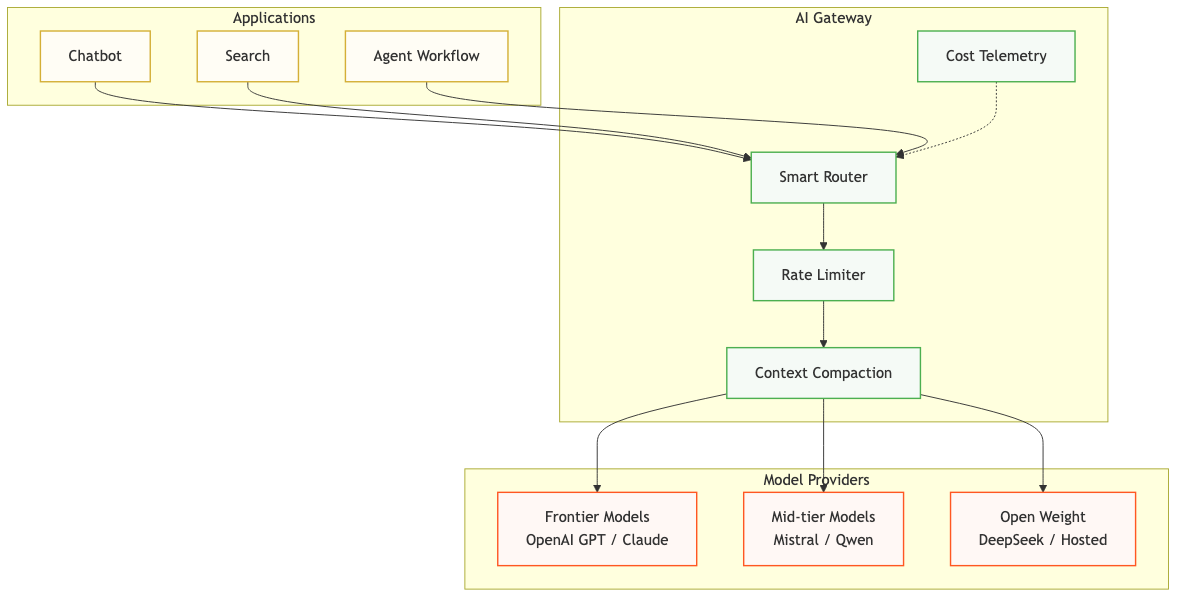 ## Why Token Costs Compound (And Why Shopping for Cheaper Models Does Not Fix It) The [per token pricing model](https://a16z.com/navigating-the-high-cost-of-ai-compute/) has a structural problem. Every variable pushes costs up. Here is what happens inside a typical enterprise AI deployment over six months: 1. Month one: a team builds a proof of concept using a frontier model. Costs are low because usage is low. 2. Month two: the proof of concept goes to production. Usage spikes. The team notices the bill. 3. Month three: a new model generation ships with better capabilities and a higher price per token. The team upgrades because the quality improvement is meaningful. 4. Month four: agents enter the picture. Each user interaction now triggers five, ten, sometimes twenty LLM calls instead of one. 5. Month five: [context windows](/glossary/context-window) expand from 8K to over 1 million tokens. Every request carries more context. Every response costs more. 6. Month six: the bill is five times what it was in month one. The workloads are the same. The team starts looking for cheaper models. 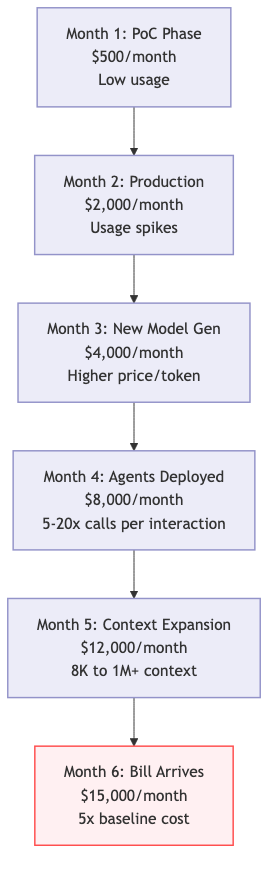 Shopping for cheaper models addresses one variable: price per token. It does not address the other four: - **Usage growth** more requests means more tokens, regardless of price - **Agent multiplication** each agent step is a separate API call - **Context inflation** larger context windows mean larger token counts per request - **Model generation cycles** new models ship at higher price points every few months The teams getting ahead of this are changing the plumbing. ## How Smart Routing Works Smart routing is the single most effective lever for cutting LLM costs. The concept is straightforward: not every request needs the most expensive model. A request to summarize a short internal document does not need a frontier model. A request to generate a SQL query from natural language does not need a frontier model. A request to classify a support ticket does not need a frontier model. But all of these requests, if sent to a frontier model, are priced as if they do. Shakudo's AI Gateway routes 60 to 80 percent of requests to more affordable models based on: 1. Task complexity (simple classification vs complex reasoning) 2. Request size (short prompts vs long context) 3. User spend patterns (budgets and thresholds per team or project) 4. Latency requirements (real time vs batch) 5. Output quality thresholds (acceptable quality vs maximum quality) 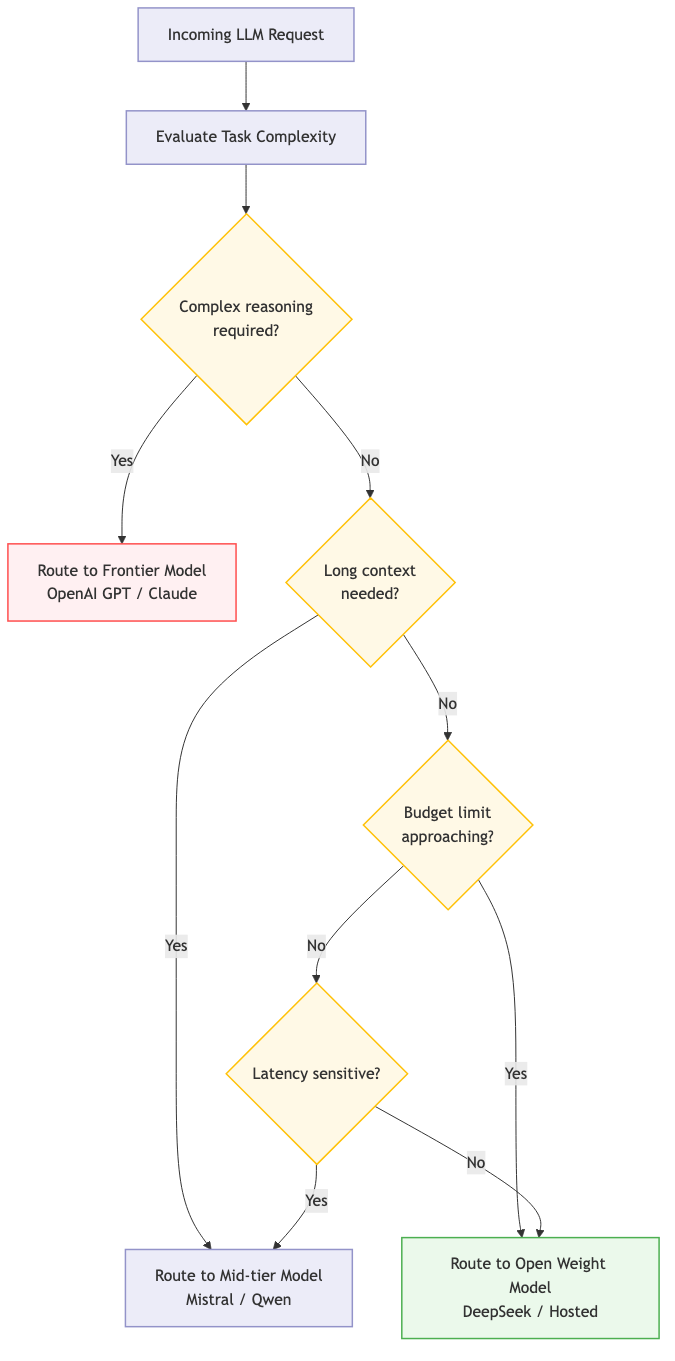 The models available through the gateway include frontier options from [OpenAI](/integrations/openai-gpt), [Anthropic Claude](/integrations/claude), and [Google Gemini](/integrations/gemini), as well as open weight models like [DeepSeek V4](/integrations/deepseek-ai), [Qwen](/integrations/qwen-ai), [Mistral](/integrations/mistral-ai), [GLM](/integrations/zhipu-glm), and [Kimi](/integrations/moonshot-kimi) that can be hosted inside your own infrastructure. 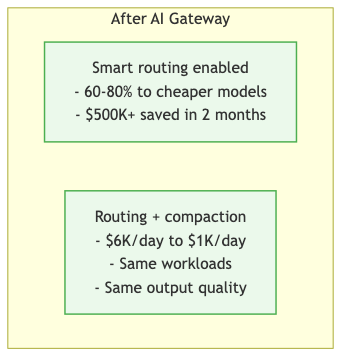 ## Cost Comparison: Direct API vs AI Gateway Routing | Scenario | Direct API (Frontier Only) | AI Gateway (Smart Routing) | Savings | |----------|---------------------------|------------------------------|---------| | 1M requests/month, mixed complexity | $12,000 | $4,200 | 65% | | 500K requests/month, simple tasks | $6,500 | $1,800 | 72% | | 2M requests/month, agent workloads | $28,000 | $9,500 | 66% | | 100K requests/month, long context | $3,200 | $1,400 | 56% | These are illustrative figures based on typical routing patterns. Actual savings depend on your traffic mix, but the pattern is consistent: routing 60 to 80 percent of requests to cheaper models cuts total spend by 50 to 70 percent. 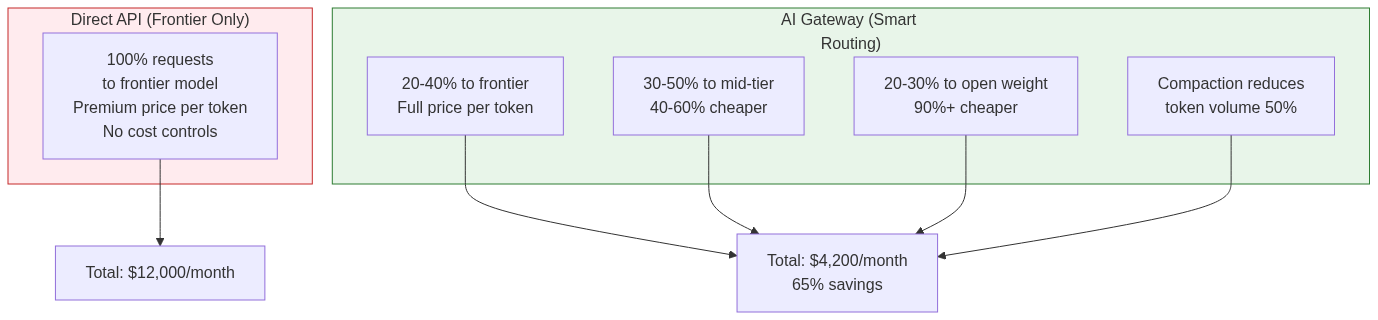 ## Continuous Context Compaction: The Other Half of the Equation Smart routing handles which model gets the request. Context compaction handles how much token volume each request carries. Every LLM request includes context. For a simple chat, that might be a few hundred tokens. For an agent working through a multi step workflow, it can be tens of thousands. For a [retrieval augmented generation](https://aws.amazon.com/what-is/retrieval-augmented-generation/) pipeline pulling from a large document set, it can be over 100K tokens. The problem: most of that context is redundant. Previous turns of conversation, boilerplate system prompts, retrieved passages that overlap with each other. The model processes all of it, and you pay for all of it. Continuous context compaction, a feature of [Kaji](/kaji), reduces the token volume of each request by removing redundancy while preserving the information the model needs to respond accurately. In one deployment, compaction reduced OpenAI token costs by 50 percent the day it was enabled. The requests got shorter. The responses stayed the same quality. The bill dropped by half overnight. 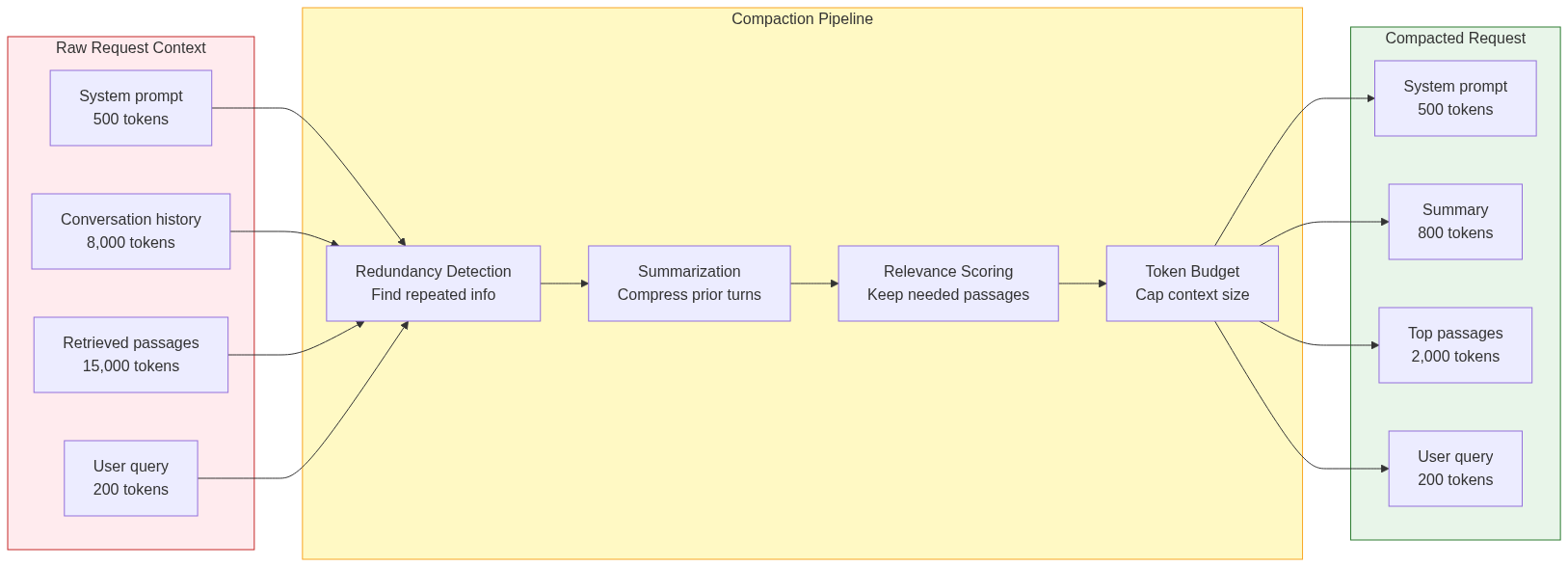 ### How Compaction Works 1. **Redundancy detection** identifies repeated information across context windows 2. **Summarization** compresses prior conversation turns into dense summaries 3. **Relevance scoring** keeps only the passages the model needs for the current request 4. **Token budget enforcement** caps the maximum context size per request 5. **Quality preservation** ensures the compressed context produces equivalent model output ## Zero Markup: Why Your Token Cost Should Be Your Token Cost Most AI gateway providers charge a markup on token costs. You pay the lab's price, plus a percentage. The gateway becomes another layer of margin on top of an already expensive resource. Shakudo's AI Gateway applies zero markup on token costs. The price you pay is the price the lab charges. No intermediary margin, no volume fees, no hidden surcharges. This matters because the markup compounds with usage. A 15 percent markup on $10K per month is $1,500. Over a year, that is $18,000 paid to the gateway provider on top of the actual model cost. At $50K per month in token spend, a 15 percent markup costs you $90,000 per year. | Pricing Model | Monthly Token Cost | Gateway Fee | Total Monthly Cost | Annual Overhead | |---------------|-------------------|-------------|-------------------|----------------| | Zero markup (Shakudo) | $20,000 | $0 | $20,000 | $0 | | 10% markup competitor | $20,000 | $2,000 | $22,000 | $24,000 | | 15% markup competitor | $20,000 | $3,000 | $23,000 | $36,000 | | 20% markup competitor | $20,000 | $4,000 | $24,000 | $48,000 |  ## Open Weight Models: Owning the Compute Enterprises are moving toward open weight models because owning compute, data, and model weights changes the unit economics entirely. Open weight models like [DeepSeek V4](/integrations/deepseek-ai), [Qwen 3](/integrations/qwen-ai), [Mistral](/integrations/mistral-ai), [GLM-5](/integrations/zhipu-glm), and [Kimi K2](/integrations/moonshot-kimi) now perform close enough to frontier models for most enterprise tasks. The difference in quality is measured in percentage points. The difference in cost is measured in orders of magnitude. When you host an open weight model inside your own infrastructure: 1. **You pay for compute, not tokens** the cost is the GPU time, not a per token API charge 2. **You control the data** nothing leaves your infrastructure 3. **You own the model weights** no vendor can deprecate or reprice your model 4. **You can fine tune** adapt the model to your domain without paying for fine tuning APIs 5. **You eliminate vendor lock in** the model runs on your hardware, under your terms Shakudo's [Platform](/platform) hosts open weight models inside customer infrastructure, with the same smart routing and governance as managed API models. The gateway treats hosted models and API models identically from the application's perspective. 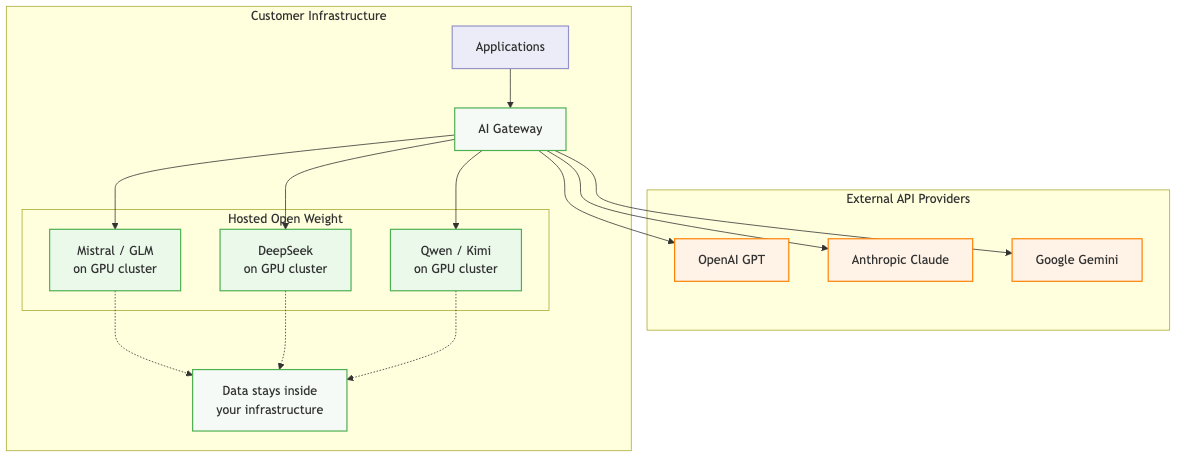 ## The Full Architecture: How It All Fits Together An AI gateway is a set of infrastructure capabilities that work together to control token costs across your entire AI stack. The architecture stack includes: 1. **Application layer** your apps, agents, and tools make LLM requests 2. **AI gateway** routes requests, applies budgets, enforces governance 3. **Smart router** evaluates each request and selects the optimal model 4. **Provider adapters** connect to OpenAI, Anthropic, Bedrock, and hosted open weight models 5. **Context compaction** reduces token volume before requests reach the provider 6. **Cost telemetry** tracks spend per request, per team, per project in real time 7. **Governance layer** enforces data residency, access controls, and audit logging 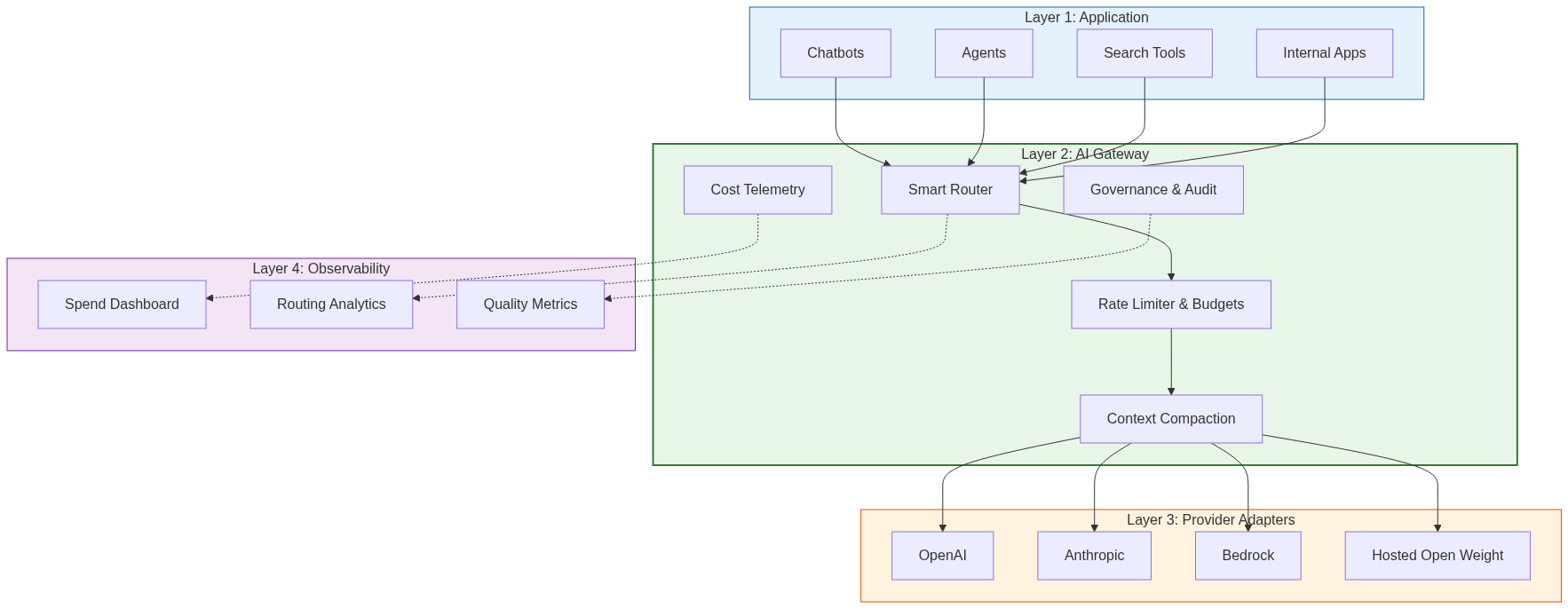 ## A Practical Implementation Sequence If you are dealing with escalating token costs, here is the sequence that has worked for enterprises: 1. **Connect the gateway** route all LLM traffic through a single gateway instead of direct API calls 2. **Enable smart routing** let the router evaluate which requests need frontier models and which do not 3. **Turn on context compaction** reduce token volume on every request automatically 4. **Set budgets and alerts** establish per team and per project spend limits 5. **Monitor the routing mix** check what percentage of requests are going to cheaper models 6. **Add open weight models** host one or two open weight models for high volume, low complexity tasks 7. **Review cost telemetry weekly** identify new cost drivers before they become invoice surprises 8. **Iterate on routing rules** refine the routing logic based on your specific traffic patterns  ## The Hidden Cost of Agent Workloads [Agent architectures](/glossary/agentic-ai) have changed the token economics equation in ways most teams do not see coming. A chatbot makes one LLM call per user message. An agent makes five, ten, sometimes twenty. Consider a customer support agent that handles a single ticket. The workflow looks like this: 1. **Intent classification** one LLM call to categorize the ticket 2. **Context retrieval** one LLM call to summarize relevant knowledge base articles 3. **Draft response** one LLM call to generate the initial reply 4. **Quality check** one LLM call to review the draft against company guidelines 5. **Refinement** one LLM call to polish the final response 6. **Sentiment analysis** one LLM call to gauge customer tone before sending Six calls for a single ticket. At scale, that means six times the token volume of a simple chatbot doing the same job. The per ticket cost is not six times higher because each call is smaller, but the aggregate token volume is dramatically larger. Now multiply that across thousands of tickets per day. A team processing 5,000 tickets daily with an agent workflow generating 6 calls each is making 30,000 LLM calls per day. If each call averages 2,000 tokens in and 500 tokens out, that is 75 million tokens per day. At frontier model pricing (which currently ranges from $2 to $10 per million input tokens and $10 to $50 per million output tokens depending on the provider), the daily cost can easily exceed $500. Monthly, that is over $15,000 for a single use case. Smart routing changes this math. If 70 percent of those 30,000 daily calls are simple classification, summarization, or sentiment tasks that can be handled by a more affordable model at one tenth the cost, the daily spend drops from $500 to under $200. That is $9,000 saved per month on a single agent workflow. ## Why Manual Model Selection Fails Some teams try to solve this manually. Developers pick which model to use for each feature. The support team uses a frontier model for drafting responses but a cheaper model for classification. The analytics team uses a mid tier model for SQL generation. This works for a week, then breaks down. The problems with manual model selection are predictable: 1. **Model proliferation** every team picks different models, creating an operational nightmare for procurement and governance 2. **Stale decisions** the model that was cheapest in March may not be cheapest in June, but nobody updates the assignments 3. **Quality drift** a cheaper model that worked for a task in one generation may degrade in the next, and nobody notices until customers complain 4. **No fallback** if a manually selected model goes down, the feature breaks because there is no automatic rerouting 5. **No cost visibility** manual selection means manual tracking, which means nobody actually knows what each feature costs 6. **Scaling friction** every new use case requires a new model selection decision, creating a bottleneck An AI gateway with smart routing solves all of these. The router evaluates every request in real time and selects the optimal model based on current pricing, current model capabilities, and the specific requirements of the request. When a model degrades or a new one ships, the router adjusts automatically. No manual intervention required. ## The Governance Layer: Cost Control Beyond Routing Routing and compaction handle the supply side of token economics. Governance handles the demand side. Without governance, any developer can spin up an LLM backed feature and start spending. There is no budget enforcement, no spend alerting, no per team visibility. The first time finance sees the cost is when the monthly invoice arrives. An AI gateway adds governance controls that prevent cost surprises: 1. **Per team budgets** each team gets a monthly token spend limit. When they hit 80 percent, an alert fires. At 100 percent, requests are throttled or routed to cheaper models automatically 2. **Per project tracking** every LLM call is tagged with project metadata, giving you a cost breakdown by initiative, not just by API key 3. **Rate limiting** prevents a single buggy agent loop from generating thousands of calls in minutes 4. **Audit logging** every request, every model selection, every cost is logged for compliance and chargeback 5. **[Data residency](https://artificialintelligenceact.eu/article/10/) controls** ensure sensitive data only flows to approved providers or stays on hosted models inside your infrastructure 6. **Access controls** determine who can use frontier models versus standard models, preventing cost inflation from unnecessary frontier usage ## Measuring ROI: What Good Looks Like When you deploy an AI gateway with smart routing, context compaction, and governance, the results are measurable. Here is what a healthy deployment looks like after 90 days: - **Routing mix** 60 to 80 percent of requests routed to standard or open weight models, 20 to 40 percent to frontier models - **Token cost reduction** 50 to 70 percent lower total spend compared to direct API calls to frontier models - **Compaction savings** 30 to 50 percent reduction in average token volume per request - **Budget adherence** 100 percent of teams staying within their monthly token budgets - **Cost visibility** finance team can see spend broken down by team, project, and use case in real time - **Zero markup overhead** no intermediary fees layered on top of model costs - **Model diversity** traffic distributed across 4 to 6 models from different providers, reducing single vendor risk The combination of these metrics translates to real dollar savings. For a mid size enterprise spending $50K per month on LLM APIs, a 60 percent reduction means $30,000 saved monthly. Annually, that is $360,000 redirected from token costs to product development. AI becomes predictable, controllable, and accountable. That is what enterprises need: better economics. ## The Bottom Line Token pricing fatigue is a structural problem with the per token pricing model. Every model generation makes it worse. Every agent deployment multiplies it. Every context window expansion amplifies it. The teams solving this are changing the infrastructure layer. Smart routing, context compaction, zero markup, and open weight model hosting together cut enterprise LLM costs by 60 to 80 percent without sacrificing output quality. If your token bill is growing faster than your AI usage, look at the plumbing. Want to see how this works for your specific workloads? [Talk to the Shakudo team](/contact-us) about deploying an AI gateway with smart routing, zero markup token pricing, and open weight model hosting inside your infrastructure. # blog/ai-governance-frameworks.md *[Source (/blog/ai-governance-frameworks)](https://www.shakudo.io/blog/ai-governance-frameworks) | [Markdown twin](https://www.shakudo.io/blog/ai-governance-frameworks.md)* ---The AI governance landscape has fundamentally shifted. What were once voluntary guidelines are now legally enforceable mandates with teeth—the EU AI Act alone carries penalties up to €35 million or 7% of global revenue. Yet most enterprises face a dangerous implementation gap: they know governance matters, but lack clarity on which frameworks apply to their operations and how to embed controls without strangling innovation. Can your organization explain how its AI systems make decisions? Do you know which of your models fall into high-risk categories? Can you prove data sovereignty to auditors?
In this white paper, you'll discover:
Download the white paper now to transform AI governance from a compliance burden into a strategic accelerator. Learn how leading enterprises are scaling AI confidently while competitors scramble to avoid regulatory penalties.
# blog/ai-harness-beats-model-upgrades.md *[Source (/blog/ai-harness-beats-model-upgrades)](https://www.shakudo.io/blog/ai-harness-beats-model-upgrades) | [Markdown twin](https://www.shakudo.io/blog/ai-harness-beats-model-upgrades.md)* --- Every few months, a new frontier model claims the throne. Enterprises scramble to evaluate it, rewrite their integrations, and migrate production workloads. The cycle repeats, and the bill grows. But the teams winning at AI in 2026 are not the ones chasing the biggest model. They are the ones who figured out that the **harness**, the software scaffolding around the model, is where competitive advantage actually lives. This article breaks down what makes a good AI harness, why researchers are now building harnesses that improve themselves, and how the right harness layer lets you swap models freely without breaking your applications. ## What Is an AI Harness? An AI harness is the complete software layer that wraps a large language model and turns it from a text generator into a working agent. It includes: - System prompts that define behavior and constraints - Tool-use logic that lets the model call APIs, run code, and query databases - Memory management that gives the agent context across sessions - Error handling that recovers from failed tool calls and malformed outputs - Verification rules that check outputs before they reach users - Orchestration logic that coordinates multi-step workflows Think of the model as an engine and the harness as everything else: the transmission, the steering, the brakes, the dashboard. A great engine in a car with no steering wheel is useless. The same applies to LLMs. Tools like [Claude Code](https://docs.anthropic.com/en/docs/claude-code/overview), OpenAI Codex, and open-source projects like [LangChain](/integrations/langchain) and [LangGraph](/integrations/langgraph) are all harnesses at their core. 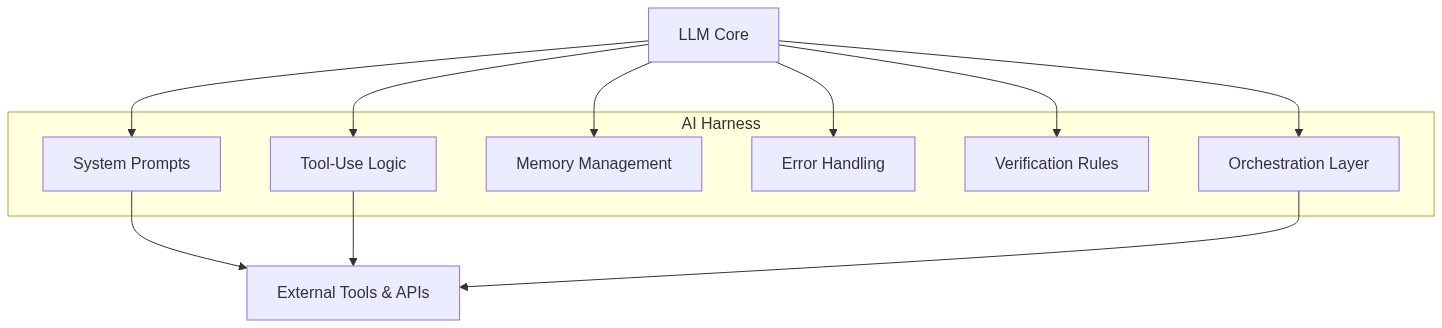 The harness is the middleware between the model and the real world. It decides which tool to call, how to format the request, what to do when the call fails, and how to verify the result. Without a harness, an LLM is a chatbot. With a good harness, it is an agent that can ship code, manage infrastructure, and execute business logic. ## The Problem with Manual Harness Engineering Today, engineers build harnesses by hand. They write system prompts, wire up tool definitions, implement retry logic, and hard-code edge case handling. This approach works for a prototype. It breaks down at scale. The core problem is **brittleness**. Swap the underlying model, say upgrade from GPT to Claude, and your whole application architecture can break. Different models format tool calls differently. They respond to prompts differently. They have different context windows, different token limits, and different failure modes. Every model swap becomes a mini-migration project. Here is what typically goes wrong when teams manually engineer harnesses: - Prompt incompatibility: a prompt tuned for one model produces hallucinations on another - Tool-call format drift: models use different JSON schemas for function calling - Context window mismatches: strategies that worked with a 200K token context fail on a 32K model - Token cost spikes: inefficient prompting that was acceptable on one provider becomes a budget problem on another - Error handling blind spots: edge cases that one model handles gracefully cause crashes on another 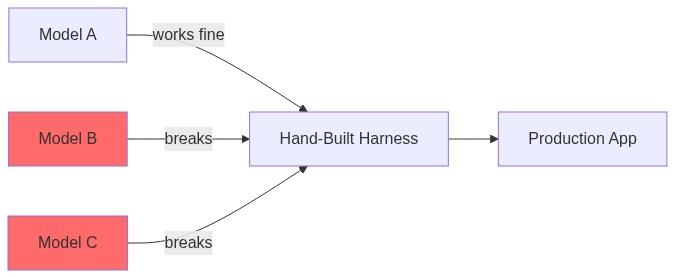 Every edge case requires a human to debug and rewrite logic. It is slow, rigid, and does not scale across model updates. The result is that teams get locked into a single model provider. They tolerate rising costs and degrading performance because switching is too expensive. ## Self-Improving Harnesses: The Shanghai AI Lab Breakthrough Researchers at Shanghai AI Lab introduced a framework called **Self-Harness**. The core idea is radical: what if the AI agent rewrites its own operating rules without human intervention or a stronger teacher model? The Self-Harness framework works in a three-stage loop: 1. **Weakness mining**: The agent runs tasks, analyzes its own execution traces, and identifies recurring failure patterns. It looks for situations where it consistently makes mistakes, fails to use the right tool, or produces incorrect outputs. 2. **Harness proposal**: Based on the weaknesses found, the agent generates targeted code modifications to its own harness. This could mean rewriting a system prompt, adding a new verification rule, or changing how it formats tool calls. 3. **Proposal validation**: Before any change goes live, the system runs regression tests to ensure the fix does not break previously working tasks. Only changes that pass all tests are applied.  This creates a self-reinforcing improvement loop. The agent gets better at its job autonomously over time. No human needs to manually debug and rewrite logic. No stronger model is needed as a teacher. The harness evolves to fit the tasks it is given. The implications are significant. If the harness can improve itself, then the model underneath becomes less critical. A smaller, cheaper model with a self-optimizing harness can match the performance of a larger, more expensive model with a static harness. ## The 60% Performance Boost: Small Models, Optimized Harnesses The Shanghai AI Lab results are striking. Their experiments showed that lightweight and cheaper models equipped with an optimized self-harness achieved up to a **60% performance boost** on benchmark tasks. These are not incremental gains. They are the kind of improvement that changes the economics of AI deployment. The key insight is that many model failures are not caused by the model lacking capability. They are caused by the harness failing to guide the model effectively. A model that produces a wrong answer might have the knowledge to produce the right one. The harness just did not steer it correctly. | Configuration | Model Cost | Harness Type | Performance | |---|---|---|---| | Large frontier model + static harness | $$$$ | Manual | Baseline | | Large frontier model + self-harness | $$$$ | Self-improving | +15-25% | | Small model + static harness | $ | Manual | -20-30% vs baseline | | Small model + self-harness | $ | Self-improving | +50-60% vs small baseline |  This flips the conventional AI strategy on its head. Instead of spending more on bigger models, you invest in better harness engineering. The harness is a one-time investment that compounds. The model is a recurring cost that scales with usage. ### Why This Matters for Enterprise AI Strategy For enterprises running AI workloads at scale, the math is compelling. Consider a company processing one million agent interactions per month: - **Option A**: Frontier model at $5 per million tokens, static harness, 70% success rate - **Option B**: Mid-tier model at $0.50 per million tokens, self-optimizing harness, 85% success rate Option B delivers higher quality at one-tenth the cost. The harness investment pays for itself within weeks. And because the harness is model-agnostic, the company can swap models freely as pricing and capabilities evolve. ## How to Evaluate an AI Harness: A Benchmark Framework Not all harnesses are created equal. Whether you are building one in-house or adopting a platform, here are the dimensions to evaluate: 1. **Model portability**: Can you swap models without rewriting application code? Does the harness abstract away provider-specific APIs and tool-call formats? 2. **Tool extensibility**: How easy is it to add a new tool or API? Is it a configuration change or a code rewrite? 3. **Error recovery**: What happens when a tool call fails? Does the harness retry, fall back, or crash? 4. **Observability**: Can you see every tool call, every prompt, and every decision the agent makes? Is there full trace logging? 5. **Cost controls**: Does the harness track token usage and enforce budgets? Can it route to cheaper models for simple tasks? 6. **Security boundaries**: Does the harness enforce permissions on what tools the agent can access? Are there guardrails against dangerous actions? 7. **Memory strategy**: How does the harness manage context across long sessions? Does it summarize, compress, or retrieve from a vector store? 8. **Verification depth**: Does the harness check outputs before returning them to users? Are there automated quality gates?  A good harness scores well across all eight dimensions. A great harness is one you can improve without rewriting from scratch. ## Common AI Harness Anti-Patterns After auditing dozens of enterprise AI deployments, certain failure modes appear repeatedly. Here are the anti-patterns to avoid: - **The monolithic prompt**: A single 3,000-word system prompt that tries to handle every scenario. It is impossible to debug, impossible to test, and breaks silently when the model updates. - **The hardcoded model**: A harness that calls a specific model API directly with no abstraction layer. The first model upgrade becomes a multi-week migration. - **The blind retry**: When a tool call fails, the harness retries the exact same call with the exact same inputs. If it failed once, it will fail again. A good harness retries with modified parameters or escalates. - **The context explosion**: The harness stuffs every piece of available context into every prompt. Token costs explode and the model gets confused by irrelevant information. - **The unguarded tool**: The agent has access to every API and database with no permission boundaries. One hallucination can delete production data. - **The black box**: No logging of agent decisions. When something goes wrong, engineers have no trace to debug. They stare at the final output and guess what went wrong. 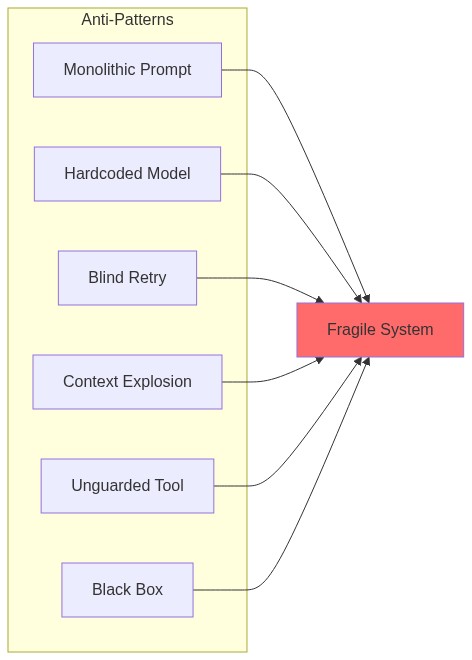 Each of these anti-patterns shares a root cause: the team treated the harness as an afterthought. They focused on the model and threw together a harness to make it work. The harness needs to be a first-class engineering concern, with the same rigor you would apply to any production system. ## Harness Engineering vs Model Selection: A Cost Comparison The reflex for most teams when AI performance is lacking is to upgrade the model. This is the most expensive and least durable fix. Here is why: | Strategy | Upfront Cost | Recurring Cost | Durability | Vendor Lock-in | |---|---|---|---|---| | Upgrade to bigger model | Low | Very High | Low (model deprecates) | High | | Fine-tune current model | Medium | Medium | Medium | Medium | | Optimize the harness | Medium-High | Low | High (compounds) | Low | | Self-improving harness | High | Very Low | Very High (improves over time) | Very Low |  Model upgrades are a treadmill. You pay more, get a temporary boost, and then the next model comes out and you are behind again. Harness optimization is an investment that compounds. Each improvement makes every model you use better, and the improvements persist across model swaps. Open-source model options like [Llama](/integrations/meta-llama), [DeepSeek](/integrations/deepseek-ai), and [GLM](/integrations/zhipu-glm) make the case even stronger. These models can be self-hosted at a fraction of the cost of frontier APIs. But they need a good harness to match frontier model performance. The harness is what bridges the gap. ## The Shakudo Approach: Harness-First AI Infrastructure At [Shakudo](/platform), we build the harness layer so you do not have to. The core principle is model-agnostic orchestration: your applications talk to a stable API, and the harness handles the complexity of routing to the right model, managing context, enforcing security, and optimizing costs. The [Shakudo AI Gateway](/ai-gateway) is the routing layer of this harness. It sits between your applications and any model, whether that is a frontier API like [Claude](/integrations/claude) or [GPT](/integrations/openai-gpt), or a self-hosted open-source model like [Llama](/integrations/meta-llama) or [Gemini](/integrations/gemini). When a new model drops, you evaluate it through the gateway and switch over with a configuration change, not a code rewrite.  [Kaji](/kaji), our AI coding agent, is itself an example of a sophisticated harness in action. It manages tool calls, enforces safety guardrails, maintains context across long sessions, and routes to the appropriate model based on the task complexity. The same harness principles that make Kaji effective at writing code apply to any AI agent workload. ### Token Cost Optimization One of the most immediate benefits of a harness-first approach is cost control. The gateway can route simple queries to cheaper models and reserve expensive frontier models for tasks that genuinely need them. This is [model routing](/integrations/litellm) at scale, and it typically cuts inference costs by 60-80% compared to sending every request to the most expensive model. 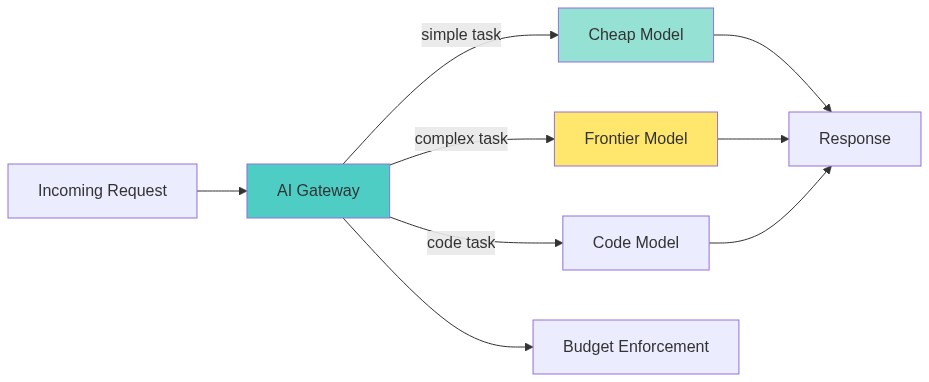 ### Secure Connectors and Deployment Governance For enterprises in regulated industries, the harness also handles the governance layer. Secure connectors ensure that AI agents access data through approved, audited channels. Deployment governance ensures that vibe-coded applications go through proper review before reaching production. This is critical for [critical infrastructure providers](/industries) who cannot afford a single compliance failure. 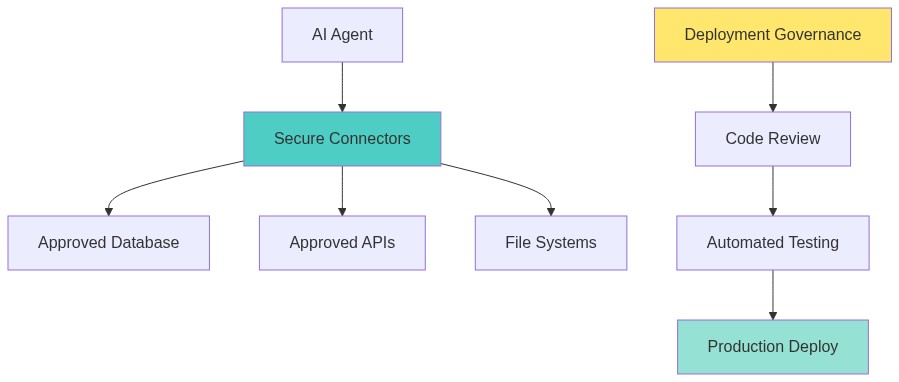 ### Real-World Impact Our customers see this play out in practice. Teams that adopt a harness-first approach with the Shakudo platform report faster time-to-production for AI features, lower inference costs, and the ability to switch models without disruption. Visit our [customers page](/customers) to see how enterprises are using this approach to deploy AI at scale. ## Frequently Asked Questions ### What is an AI harness? An AI harness is the software layer that wraps a large language model and turns it into a functional agent. It includes system prompts, tool-use logic, memory management, error handling, verification rules, and orchestration. The model generates text. The harness decides what to do with that text, which tools to call, how to handle failures, and how to verify results. Without a harness, an LLM is a chat interface. With a good harness, it is an autonomous agent. ### What is the difference between an LLM harness and an AI agent harness? The terms overlap but have a practical distinction: - An **LLM harness** focuses on model interaction: prompt formatting, API calls, token management, and response parsing. Tools like [LiteLLM](/integrations/litellm) and [Hugging Face TGI](https://huggingface.co/docs/text-generation-inference/en/index) serve this role. - An **AI agent harness** goes further: it adds tool use, multi-step reasoning, memory, error recovery, and verification. Tools like [LangGraph](/integrations/langgraph), [CrewAI](/integrations/crewai), and [Autogen](/integrations/autogen) are agent harnesses. An agent harness typically includes an LLM harness as a component. The agent harness is the broader system that manages the full agent lifecycle. ### What are examples of AI harnesses? Common examples include: - Claude Code: Anthropic's coding agent harness that manages file operations, git, and code execution - OpenAI Codex: OpenAI's harness for code generation and execution - LangChain: an open-source framework for building LLM applications with tool use - LangGraph: a graph-based agent orchestration framework - CrewAI: a multi-agent orchestration framework - Kaji: Shakudo's AI coding agent with safety guardrails and model routing Each of these wraps one or more LLMs and provides the scaffolding for agentic behavior. ### How do you build an AI harness? Building a production-grade AI harness involves several layers: 1. **Model abstraction**: Wrap model calls behind a unified interface so you can swap providers 2. **Tool definitions**: Define the tools your agent can call, with clear input/output schemas 3. **Prompt management**: Maintain structured prompts with versioning and testing 4. **Memory system**: Implement context management with summarization and retrieval 5. **Error handling**: Build retry logic with parameter modification, not blind retries 6. **Verification gates**: Add automated checks on outputs before they reach users 7. **Observability**: Log every decision, tool call, and prompt for debugging 8. **Security boundaries**: Enforce permissions on tool access and data Most teams should not build all of this from scratch. Using a platform like [Shakudo](/platform) that provides these layers out of the box lets you focus on your application logic rather than harness infrastructure. ### What is the best AI harness framework? The best framework depends on your use case: - For coding agents: Claude Code or Kaji provide battle-tested harnesses for software development - For multi-agent systems: CrewAI or LangGraph offer orchestration primitives - For enterprise deployment: the [Shakudo Platform](/platform) provides a model-agnostic harness with security, cost controls, and observability built in - For custom builds: LangChain and [LlamaIndex](/integrations/llamaindex) offer flexible building blocks The key criterion is model portability. A framework that locks you into a single model provider will cost you more in the long run than one that abstracts the model layer. ### How much does an AI harness cost? The cost of an AI harness breaks down into three categories: - **Build cost**: Engineering time to develop and maintain the harness (highest for custom builds, lowest for managed platforms) - **Infrastructure cost**: Compute for self-hosted models, API costs for hosted models, and storage for memory and logs - **Operational cost**: Monitoring, debugging, and updating the harness as models and requirements evolve A managed harness platform like [Shakudo AI Gateway](/ai-gateway) shifts the build and operational costs to a predictable subscription, while giving you control over infrastructure costs through model routing and token budget enforcement. Most teams find this far cheaper than maintaining a custom harness, especially as the number of models and tools grows. ## The Takeaway The AI industry has spent two years obsessing over model benchmarks. That era is ending. The research from Shanghai AI Lab confirms what practitioners have suspected: the harness, not the model, is where the performance gains and cost savings live. A self-improving harness can boost a small model's performance by 60%. A model-agnostic harness lets you swap providers without rewriting code. A secure harness lets you deploy AI agents in regulated environments without compliance risk. The teams that win the next phase of AI adoption will be the ones who treat the harness as their core infrastructure, not as an afterthought. They will run cheaper models with smarter harnesses. They will switch models freely as the market evolves. And they will deploy agents with the confidence that comes from full observability and security boundaries. If you are ready to stop chasing models and start investing in the layer that actually compounds, [talk to us](/contact-us) about deploying a harness-first AI infrastructure for your team. # blog/ai-in-aerospace-defense.md *[Source (/blog/ai-in-aerospace-defense)](https://www.shakudo.io/blog/ai-in-aerospace-defense) | [Markdown twin](https://www.shakudo.io/blog/ai-in-aerospace-defense.md)* ---
The aerospace and defense sectors are not merely evolving; they are being fundamentally reshaped by the advent of much more advanced artificial intelligence (AI) techniques–from machine learning (ML) to large language models (LLMs), and other generative AI. This transformation transcends traditional notions of technological upgrades, heralding a new paradigm in defense strategy and operational execution.
As geopolitical tensions rise and militaries race to modernize, AI’s role becomes ever more critical. Early-stage tech investors are taking note – funding is shifting toward startups focused on automation, digital transformation, and supply chain resilience in aerospace and defense.
Notably, the emergence of foundation models (like GPT-style LLMs) is demonstrating how AI can mine vast data troves for insights, offering decision-makers in any data-rich industry a competitive edge. Over 7000 NSA analysts use Gen AI tools. Clearly, the ability of AI to enhance decision-making, optimize complex systems, and provide a competitive edge in dynamic environments holds valuable lessons across all industries. Shakudo's platform helps address the unique challenges of the aerospace sector, offering solutions that streamline AI implementation and drive innovation.
AI has become a cornerstone technology in aerospace and defense, encompassing everything from machine learning to knowledge-graph analytics and cutting-edge LLMs. These technologies enhance situational awareness, accelerate decision-making, and improve operational efficiency. AI systems can analyze vast amounts of data from disparate sources in real-time, integrating information via knowledge graphs and retrieval-augmented generation to ensure AI systems use the most up-to-date, authoritative data. This capability is crucial for overcoming the "fog of war," where AI/ML algorithms can discern patterns and insights that might be imperceptible to the human eye– a task increasingly aided by autonomous agents that can rapidly sift data and share insights with human operators. By 2028, Gartner forecasts that among enterprise software applications, 33% will use agentic AI.
Below is a diagram from IBM showing the technical architecture of single vs multi-agents.

The AI transformation in these sectors is driven by several factors:
The U.S. Department of Defense is keenly aware of AI's importance, increasing its overall fiscal year 2024 budget to $842 billion, with a focus on integrating AI, automation, and advanced manufacturing into defense systems. This level of investment signals a clear recognition that AI is not just a supporting tool but a core component of future military capabilities.

While the potential of AI in defense and aerospace is immense, its implementation is not without significant challenges and risks. These include:
These challenges are significant and require careful consideration. However, they also present opportunities for innovative solutions that can unlock AI's transformative potential.
The defense and aerospace industry, while ripe with opportunity, presents significant barriers. However, the trends are changing now with the Pentagon actively engaging with AI startups to accelerate innovation.
While sources indicate that a lack of AI maturity is a key barrier to AI/ML adoption in aerospace and defense, trust and established relationships are paramount, with incumbents like Palantir holding strong positions.
Palantir's offerings focus heavily on data analytics and intelligence gathering. Palantir, for instance, has deeply entrenched defense partnerships – even new AI firms often partner with it to gain credibility. In late 2024, Palantir teamed up with Anthropic and AWS to bring cutting-edge AI models to defense and intelligence agencies, highlighting how incumbents help vet new technologies.
Shakudo, also available on AWS, distinguishes itself by offering a data and AI operating system that supports the full lifecycle from data ingestion to deployment, with a strong emphasis on operational efficiency and cost optimization.
To effectively serve this sector, it's crucial to demonstrate tangible business value through compelling case studies, highlighting how Shakudo's platform translates AI potential into concrete results, addressing specific pain points and delivering a clear return on investment.
Shakudo provides a secure and integrated data and AI operating system, capable of handling modern AI workloads (including large-scale data analytics and LLM deployments). The product is designed to help organizations overcome the complexities of AI implementation and deploy fast, efficiently supporting evolving AI and ML workloads without infrastructure bottlenecks. This means teams can easily integrate new components like vector databases or knowledge graphs as their AI needs evolve.
For the aerospace and defense sectors, Shakudo offers a platform to:
By providing a comprehensive and secure platform, Shakudo enables defense and aerospace organizations to focus on leveraging AI to achieve their strategic objectives, rather than grappling with the underlying technological complexities.
The impact of AI in aerospace and defense is broad and growing.
The aerospace and defense sectors are clearly on a trajectory toward deeper integration of AI. This evolution promises to enhance existing capabilities and unlock entirely new possibilities in military and space operations, marking a new era in defense technology.
Several key trends will shape this future:

According to Gartner’s 2024 Emerging Technology Impact Radar for AI, near-term game-changers such as generative AI and knowledge graphs are already shifting defense strategies today. Meanwhile, future-oriented capabilities like multi-agent generative systems are forecasted to move from pilot projects to mainstream adoption in a 3–6-year window. This radar visual helps defense leaders prioritize R&D and budget allocations for the technologies set to transform operations next.
For C-suite executives, understanding these trends is essential. The strategic implications of AI in defense and aerospace extend beyond the battlefield, influencing economic competitiveness, technological innovation, and national security. To effectively leverage AI, organizations need platforms that offer more than just tools; they need comprehensive solutions that address the unique challenges of this sector and deliver clear business value.
Considering the potential of AI to strategically transform your organization? It's a conversation worth having. We're here to help you explore how AI-powered services can truly revolutionize your operations and drive significant business impact. Our team of data and AI specialists is available to discuss your specific needs and collaborate with you to develop a tailored AI strategy that aligns with your unique business goals.
We also offer an exclusive AI Workshop designed to provide a hands-on experience. In this workshop, you can discover firsthand how to deploy your initial AI use case, and you might be surprised at how quickly it can be achieved with the right platform—often within a single day with Shakudo.
Learn how AI-powered services can revolutionize your business. Contact one of our data and AI specialists to develop a tailored AI strategy for your business. Or, sign up for our exclusive AI Workshop and discover how you can deploy your first AI use case within a day through Shakudo.
# blog/ai-oil-gas-practical-guide-2026.md *[Source (/blog/ai-oil-gas-practical-guide-2026)](https://www.shakudo.io/blog/ai-oil-gas-practical-guide-2026) | [Markdown twin](https://www.shakudo.io/blog/ai-oil-gas-practical-guide-2026.md)* ---AI in oil and gas has crossed the chasm from pilot projects to production reality. Yet while the technology promises transformative returns, most companies struggle with a critical implementation gap: How do you move from proof-of-concept to operational deployment fast enough to capture competitive advantage? How do you maintain data sovereignty in regulated environments? And how do you avoid the hidden costs of tool fragmentation that silently erode ROI?
In this white paper, you'll discover:
Download Practical AI Success in Oil and Gas 2026 to access quantified business cases, technical architecture requirements, and proven deployment frameworks that position your organization to extract maximum value from AI investments while maintaining operational control.
# blog/ai-orchestration-mistakes-enterprises.md *[Source (/blog/ai-orchestration-mistakes-enterprises)](https://www.shakudo.io/blog/ai-orchestration-mistakes-enterprises) | [Markdown twin](https://www.shakudo.io/blog/ai-orchestration-mistakes-enterprises.md)* ---42% of companies scrapped most AI initiatives in 2025, up from 17% in 2024, with nearly half of proof-of-concepts abandoned before production. Behind these failures lies a common culprit that few organizations anticipated: poor AI orchestration.
While companies obsess over model accuracy and data quality, they overlook the operational infrastructure that determines whether AI ever leaves the lab. Orchestration mistakes—from agent sprawl to infrastructure mismanagement—are quietly draining budgets, delaying deployments by months, and turning promising pilots into expensive write-offs.
AI transformation is only 10% technology and 20% data, but 70% change management, yet very few enterprises have industrialized delivery at scale with the operating model, data foundations, governance, and change management capabilities required to make AI durable.
The problem isn't that AI doesn't work. It's that organizations lack the connective tissue to move it from experiment to production reliably. Over 85% of AI projects fail due to a lack of operational infrastructure, which hinders the transition of models from experimentation to production, making models hard to scale, monitor, or manage.
Seven orchestration mistakes account for the majority of these failures. Each represents a predictable pattern that costs enterprises millions while extending time-to-value from weeks to quarters.
One of the biggest challenges of scaling AI at enterprises is the risk of agent sprawl, when enterprises end up producing dozens or hundreds of AI agents without a centralized way of organizing them.
Teams across departments build specialized agents independently. Marketing creates a customer outreach agent. Sales builds a lead qualification agent. Support develops a ticket routing agent. Each works in isolation, but nobody tracks what exists, what agents access, or how they interact.

AI sprawl happens when organizations deploy agents in silos, with each agent connecting to a handful of apps creating fragmented pockets of automation, teams launching agents outside IT's purview with unknown prompts and data flows, and inconsistent access controls where some agents have admin rights with no consistent policy enforcement.
There's a real risk of agent sprawl, the uncontrolled proliferation of redundant, fragmented, and ungoverned agents across teams and functions, as low-code and no-code platforms make agent creation accessible to anyone, creating a new kind of shadow IT.
Organizations built horizontally when they needed vertical wins, with their instinct to platformize early with agents, frameworks, shared services, reuse, and extensibility. From an architecture perspective, this seems correct. From an enterprise change perspective, it dilutes perceived impact.
Executives don't fund infrastructure—they fund outcomes, responding to end-to-end stories showing that a class of cases is now resolved 30% faster with fewer escalations and higher satisfaction. Instead, they see slices: better logs, better suggestions, incremental improvements spread across workflows.
When AI teams spent 2025 building platforms, they delivered pieces of value distributed across many workflows, rather than concentrated, measurable impact in one critical area.
Successful orchestration requires the opposite approach. Start with one high-impact use case. Prove concrete ROI. Then scale the orchestration infrastructure that made it possible.
Most planning efforts focus too heavily on visible costs like GPU hours used for training or API calls for inference, but in production, hidden costs like storage sprawl, cross-region data transfers, idle compute, and continuous retraining often make up 60% to 80% of total spend.
Cloud infrastructure spending wastes approximately $44.5 billion annually (21% of total spend) on underutilized resources, and for AI workloads this waste is often higher because GPU instances run at $1.50 to $24 per hour while organizations leave powerful training infrastructure running around the clock.
The cost patterns differ fundamentally from traditional software:
Machine learning introduces non-linear cost behavior where a model that costs $50 per day to serve 1,000 predictions may not simply cost $5,000 to serve 100,000 but could cost far more due to bottlenecks in compute, memory, and I/O that trigger higher-tier resource provisioning.

Without orchestration that manages resource allocation dynamically, costs spiral while teams scramble to understand why their cloud bill exploded. Our guide on hidden AI costs and FinOps strategies details practical approaches for controlling these infrastructure expenses.
The most dangerous misconception about AI orchestration is that it's purely technical. It's not.
Leaders underestimated middle-layer drag, with their strategy engaging two extremes very well—senior leadership who loved the narrative and metrics, and individual engineers who loved the idea of AI assistance—but the weak link was the middle layer: frontline managers, escalation leaders, and process owners.
Orchestration succeeds or fails based on whether teams actually adopt it. That requires:
Leaders focused on model capability and scale whilst ignoring power dynamics: who controls the systems, who bears the risk, and who absorbs harm when things go wrong, resulting in illegitimate deployment.
Most leadership teams don't fail at AI because of bad models—they fail because the model works once and then quietly stops working when no one is watching, with accuracy dropping and results becoming unreliable.
Models degrade. Data drifts. Agents encounter edge cases. Without orchestration that includes comprehensive monitoring, these issues remain invisible until they cause customer-facing failures.
Agents benefit from production-grade telemetry, controls, and accountability, meaning logging tool calls, inputs, outputs, and decision paths, including using human-in-the-loop checkpoints for higher-impact actions, as well as applying budgets, rate limits, and safety pre-conditions at runtime.
Production orchestration must include:
Developers and users frequently cite the unreliability of AI agents as a barrier to production, as large language models make agents flexible and adaptable but this also leads to inconsistent outputs.
Single-agent systems are challenging. Multi-agent systems multiply that complexity exponentially. Agents must coordinate roles, manage shared state, and avoid conflicting with each other. These orchestration challenges mean teams often end up fixing one issue only for others to appear, with developers saying it sometimes feels like whack-a-mole where fixing one issue with prompt engineering creates three more.
By combining AI agents with deterministic automation scripts or rules, an orchestration layer ensures there's always a fallback path, for example if an AI agent's output doesn't meet a certain accuracy threshold, a predefined rule might handle that case, leveraging the creativity of AI but within guardrails.
Successful multi-agent orchestration requires:
For enterprises looking to implement these patterns effectively, our multi-agent orchestration guide for ops teams provides detailed frameworks for managing coordination complexity.

42% of enterprises need access to eight or more data sources to deploy AI agents successfully, and 86% require upgrades to their existing tech stack, with security emerging as the top challenge for 62% of practitioners.
Many organizations treat security as a deployment gate rather than an orchestration requirement. They build systems, then attempt to retrofit compliance controls. By then, agents access data across multiple systems, audit trails are incomplete, and governance frameworks must be reverse-engineered.
This huge governance gap introduces huge risk, as without proper governance, erratic AI agent actions could go undetected with potential implications for finance and operations, customer and partner relations, and public reputation.
For regulated enterprises in healthcare, finance, and government, security-first orchestration is non-negotiable:
The cost of orchestration mistakes is measurable. So is the value of avoiding them.
Organizations with mature MLOps capabilities typically see 30-50% reductions in model deployment times and improved model reliability that directly impacts revenue and customer satisfaction, with a McKinsey case study describing a large bank in Brazil that reduced the time to impact of ML use cases from 20 weeks down to 14 weeks by adopting MLOps and orchestration best practices.
MLOps tools automate deployment workflows, cutting launch times from 6 to 12 months down to 2 to 4 weeks, while also reducing infrastructure costs by up to 60% through intelligent scaling and minimizing manual rework by automating retraining, versioning, and monitoring.
Organizations with mature MLOps practices see 60-80% faster deployment cycles, which translates directly to faster time-to-market and revenue generation.
The difference between success and failure isn't the sophistication of your models. It's whether your orchestration infrastructure can reliably move them from development to production, monitor their performance, manage their costs, and ensure they deliver measurable business value.
Avoiding these seven mistakes demands orchestration infrastructure purpose-built for production AI:
Unified Agent Management: A single control plane providing visibility into all agents, their capabilities, access permissions, and performance metrics. Teams discover existing agents before building duplicates, coordinate multi-agent workflows, and enforce consistent governance policies.
Automated Resource Optimization: Intelligent workload scheduling that matches compute resources to actual needs, scales infrastructure dynamically based on demand, and eliminates idle resource waste that inflates cloud bills.
Built-in Governance and Compliance: Security controls integrated from day one, not retrofitted after deployment. This includes audit trails for regulatory compliance, role-based access control for data sovereignty, and policy enforcement preventing unauthorized actions.
Production Monitoring and Observability: Real-time visibility into model performance, agent behavior, and system health. Automated drift detection, performance degradation alerts, and rollback capabilities when deployments introduce issues.
Integrated Tool Ecosystem: Pre-integrated connections across the ML/AI stack, from data preparation through model training, deployment, and monitoring. Teams avoid the integration tax that delays projects by weeks or months. For companies looking to build an autonomous workforce with AI agents, this integrated approach becomes essential for coordinating complex agent interactions across enterprise systems.
Shakudo was built specifically to solve the orchestration challenges that derail enterprise AI initiatives.
Instead of fragmented tools creating the agent sprawl that plagues failed deployments, Shakudo provides a unified AI operating system with pre-integrated orchestration across 200+ ML/AI frameworks. Organizations deploy in days rather than the 20+ weeks that manual orchestration typically requires.
For regulated enterprises facing the security challenges cited by 62% of practitioners, Shakudo's data-sovereign architecture ensures all orchestration happens on-premises or in private cloud. Built-in governance provides audit trails, role-based access control, and compliance validation without slowing deployment velocity.
Shakudo's automated resource management prevents the 40% compute cost overruns and 30-50% deployment delays that plague manual orchestration. Intelligent workload scheduling eliminates idle GPU waste. Resource optimization ensures teams pay only for what they actually use. Enterprise-grade monitoring provides visibility into performance, costs, and agent behavior across the entire AI lifecycle.
The result transforms orchestration from a blocker into a competitive advantage. Teams prove value with concentrated vertical wins, then scale horizontally using infrastructure that handles complexity automatically. Security and compliance integrate from day one. Costs remain predictable and optimized. Multi-agent systems coordinate reliably rather than creating chaos.
The 42% of enterprises that abandoned AI initiatives in 2025 didn't fail because AI doesn't work. They failed because orchestration mistakes made it impossible to capture AI's value at production scale.
These seven mistakes are predictable, documented, and avoidable. Organizations that address orchestration systematically—with unified agent management, automated resource optimization, integrated governance, and production-grade observability—turn AI from expensive experiments into reliable business capabilities.
The question isn't whether your organization needs better AI orchestration. It's whether you'll address it proactively or join the 42% learning these lessons through expensive failures.
Ready to avoid these orchestration mistakes? Shakudo's AI operating system eliminates the complexity that derails enterprise AI. Schedule a demo to see how unified orchestration turns AI pilots into production success.
# blog/ai-platform-evaluation-guide.md *[Source (/blog/ai-platform-evaluation-guide)](https://www.shakudo.io/blog/ai-platform-evaluation-guide) | [Markdown twin](https://www.shakudo.io/blog/ai-platform-evaluation-guide.md)* ---A successful AI strategy requires more than just powerful models; it needs a platform that enhances business agility and simplifies legacy system modernization. Too often, leaders overlook the complexities of integration and long-term scalability, leading to failed pilots, mounting technical debt, and significant challenges in talent acquisition and retention. This guide provides a rigorous, business-driven framework to evaluate AI platforms on the factors that truly matter for your long-term innovation velocity.
Make a confident platform decision that accelerates your business by downloading the complete guide.
# blog/ai-powered-data-stacks-revolutionize-neurotech.md *[Source (/blog/ai-powered-data-stacks-revolutionize-neurotech)](https://www.shakudo.io/blog/ai-powered-data-stacks-revolutionize-neurotech) | [Markdown twin](https://www.shakudo.io/blog/ai-powered-data-stacks-revolutionize-neurotech.md)* ---When technology meets the mind, the boundaries between science and what once seemed like science fiction begin to blur. But to realize these possibilities, data must be managed efficiently and accurately, ensuring that insights are not only validated but accelerated.
REMspace is a neurotech startup at the cross-section between neuroscience and artificial intelligence that has claimed to have achieved pod-like communication between two individuals during lucid dreaming.
This achievement is spreading across the tech media since it may just turn around the way we understand both AI and the human brain. The results go beyond the novelty of communicating from dreams to hinting at significant applications for neurotechnology in daily life, with enhanced insights as a result of machine learning in Neuroscience.
People also ask whether neuroscience and neurotechnology are the same. The answer is no. Neuroscience and neurotechnology are definitely linked, but they aren’t exactly the same.
Neuroscience is about studying how the brain and nervous system work, while neurotechnology focuses on building tools that can interact with the brain—like devices that let people communicate with computers just by thinking.
What can neurotechnology help with? REMspace is part of a new wave of neuro biotechnology companies pioneering human-machine interactions, including:
But in addition to all the excitement on the grounds of innovation from REMspace and other players, there must come tempered, healthy scientific skepticism and consideration of how an AI-powered data stack could optimize processes for even quicker progress in innovation.
The central concept of a data stack applies to areas such as neuroscience, where such complex data—any form of neural signals—operate on highly sophisticated multilayered solutions. Most simply put, a data stack can be defined as the technological infrastructure required for collecting, processing, and analyzing data before presenting it in an insightful format. REMspace's experiments using human test subjects in lucid dreaming would function with this sort of stack, embedding AI algorithms into real-time signal processing, with feedback loops inside the dream environments.
Drawing similarities from Shakudo's success with CentralReach, a company focused on AI solutions in autism care, it becomes clear how a robust data stack can support innovation across diverse fields. As a case study, Shakudo's platform allowed CentralReach to scale AI solutions rapidly, and the same principle applies to the innovative work in the neuroscience tech space.

The tools from CentralReach's data stack with Shakudo line up with the specific needs of neurotech players like Neuralink and REMspace because it can offer complex, real-time processing, which is needed for brain-computer interactions. Here is how each part might contribute:
Software like Dify & Ollama that work with LLMs (large language models) can help decode complex neural data into clear outputs.
As REMspace’s dream language ‘Remmyo’ evolves, LLM software could help make sense of diverse language signals, turning them into structured commands essential for communicating in real time within dreams.
Why does this matter? Brain signals can be ambiguous, so using NLP algorithms makes it easier to go from messy neural inputs to direct, actionable outputs.
Neuroscience technology companies needs to quickly test new user interfaces for dream-based interaction. Appsmith’s platform can help them rapidly prototype, showing neural commands or EMG feedback to improve the user experience.
With Appsmith, teams could easily make dashboards or control panels that researchers can tweak without deep coding, keeping up with the pace of development.
n8n would help sync data input, processing, and feedback during experiments, automating responses like triggering visual feedback when EMG signals pass a threshold.
Since companies in this new wave run experiments that need quick adjustments and feedback, n8n would make data flow easier, reducing delays and keeping things running smoothly.
Qdrant would store and organize neural signals, helping the system detect patterns, track commands from brain signals like within dreams, and analyze communication attempts over multiple sessions.
Neural data (especially EMG sensor data) is high-dimensional, and Qdrant can handle this, enabling rapid retrieval and comparison of historical data against live inputs.
Supabase would handle structured data like participant details, experiment results, and logs, providing a secure backend for sensitive research data.
As these companies expands their experiments, Supabase can keep participant data organized while following compliance and ethical standards, crucial in biotechnology.
Windmill could handle the complex steps involved in real-time data work—preparing signals, running AI models, and giving participants instant feedback.
To keep real-time communication in dreams working, a company like REMspace needs synced data streams, which Windmill’s workflow orchestration makes possible, keeping everything transparent and efficient.
The concept of people talking to each other in lucid dreams is certainly intriguing and there are promising results in reputable research journals. However, we need consistent, large-scale, replicable results to prove that the data is real and reliable. This is a hopeful early step — but to give this science any real gravitas, we need larger and better controlled trials.
As with any tech that interfaces directly with the human brain, it raises very serious ethical issues, especially with respect to privacy and informed consent. Risks and benefits should be as transparent as possible to participants in human trials.
The CentralReach + Shakudo partnership is a prime example of the power of an integrated data ecosystem. Using AI-driven processes, they helped streamline complex workflows, reduce deployment times, and facilitate better data insights—and this is exactly how we want to approach REMspace by investing in rapid prototyping, adaptable AI applications, and live feedback.
Common Characteristics
The complexity of sourcing and managing neuroscience data—clinical, genetic, neuroimaging, and real-world data—presents a significant challenge for neurotech companies like REMspace, which require a flexible infrastructure and a focused approach.
One of the biggest neurotechnological players, Neuralink, recently spoke about where real-time integration plays into increasing its powers radically. They have reached a milestone with one patient who was able to control a computer mouse by thinking about it because of their brain-chip implant. Advanced data systems are opening up new possibilities in the interaction between brains and computers.
Just as Neuralink’s work depends on real-time processing of brain signals, REMspace’s technology relies on a data stack capable of handling multi-modal, high-frequency data inputs. REMspace aims to create an integrated system for managing complex neural data—similar to established models like BRAIN Commons—so researchers can more easily exchange data, accelerating insights and enabling innovation at the scale required to make an impact.
REMspace is also carrying along, into the bargain, a few data-driven strategies aimed at exactly the question of how to make communication possible inside lucid dreams.
What does that all mean to executives? It means a capable data basis is the sole giving full force to current projects while scaling future innovations. With neurotech continuing to evolve, being able to process data in a scalable and real-time manner and seamlessly integrate across multiple sources, companies will start differentiating.
Companies like REMspace and Neuralink are driving this wave in neurotechnology improvements, setting the scene for game-changing human-machine interaction.
Interested in elevating your data stack with a one-stop solution for open-source data software? Reach out to one of our AI and data experts to tackle your company’s unique data challenges.
# blog/ai-security-address-cyber-risks-with-intelligent-defense.md *[Source (/blog/ai-security-address-cyber-risks-with-intelligent-defense)](https://www.shakudo.io/blog/ai-security-address-cyber-risks-with-intelligent-defense) | [Markdown twin](https://www.shakudo.io/blog/ai-security-address-cyber-risks-with-intelligent-defense.md)* ---Interested in a deeper dive on AI-powered cyber defense and risks of generative AI? Read our comprehensive whitepaper on AI security here.
The digital age has brought unprecedented connectivity and data proliferation, transforming industries and reshaping our daily lives. However, this progress has also led to a surge in sophisticated cyber threats, challenging organizations to protect their valuable assets. AI is a key strategic cybersecurity priority for organizations looking to defend against cyber threats through 2025. In this high-stakes environment, Artificial Intelligence (AI) is emerging as a critical tool, not just for detecting threats but also for predicting them.
According to IBM’s Cost of a Data Breach Report 2024, the average cost of a data breach has risen to US $4.88 million, an increase of 10% over the previous year. Breached data on a public cloud had the highest average breach cost of nearly US $5.2 million. These statistics highlight the growing necessity for AI-powered cybersecurity solutions that not only detect threats in real-time but also predict and mitigate future attacks.
AI is no longer just an enhancement to cybersecurity—it is now a necessity. Tech decision-makers at the C level are increasingly aware of the pressing need to solve AI-related cybersecurity issues, highlighting the need for proactive, intelligent protection solutions.
Traditional cybersecurity methods often rely on rule-based systems that struggle to adapt to new attack vectors. AI and ML, however, introduce dynamic learning capabilities that enable cybersecurity defenses to evolve alongside cyber threats.
One of the most significant advantages of AI in cybersecurity is its predictive analytics capability. AI-powered security tools analyze historical attack data, allowing them to anticipate and prevent emerging threats before they infiltrate a system. For example, AI-driven intrusion detection systems (IDS) can monitor network traffic, flagging suspicious activities before they escalate into full-scale breaches.
AI's versatility extends to detecting a wide range of cyberattacks, including:
The integration of AI into cybersecurity offers numerous advantages:
Generative AI (GenAI) is poised to revolutionize cybersecurity by analyzing vast amounts of security data, automating incident response, and even generating realistic simulations for security training. AI-driven cybersecurity tools use GenAI to refine threat detection models, improve decision-making, and reduce false positives.
Generative AI (GenAI) is transforming security operations by automating threat detection, triage, and incident response. Security analysts are often overwhelmed by high alert volumes, making it challenging to differentiate real threats from false positives. AI-powered AIOps solutions, such as Keep on Shakudo’s platform, streamline alert management by intelligently filtering, categorizing, and prioritizing security notifications. GenAI-driven automation tools analyze security logs, classify threats, and execute pre-configured response actions with minimal human intervention. AI-based SOAR (Security Orchestration, Automation, and Response) systems leverage GenAI to contain threats, isolate compromised systems, and generate forensic reports, significantly improving incident response efficiency.
Shakudo provides a data and AI operating system that addresses these challenges. Its platform automates data preparation, governance, and integration, enabling organizations to leverage AI for enhanced security.
Implementing a robust data governance framework is crucial for ensuring data quality and compliance in AI projects. For a comprehensive guide on building such frameworks, refer to Shakudo's blog on effective data governance.
Shakudo’s data governance tools enforce compliance, classify data, and track lineage, mitigating biases and ensuring auditable AI outputs. Falco, available within Shakudo’s platform, is a cloud-native runtime security solution that continuously monitors system calls in containerized environments. It employs rule-based anomaly detection to identify unusual activity at the kernel level, issuing alerts for potentially malicious behaviors. By detecting deviations from normal application and container activity, Falco enhances security visibility and integrates seamlessly with security automation workflows, helping organizations respond swiftly to threats.
As AI reshapes cybersecurity, organizations must navigate both opportunities and challenges. AI-driven threat detection and response can enhance security by providing predictive analytics, automating risk assessments, and proactively identifying vulnerabilities before they are exploited. However, risks such as adversarial AI, model poisoning, and regulatory compliance concerns must be addressed to ensure AI security solutions are both effective and ethical.
By leveraging AI-driven security strategies while maintaining rigorous oversight, enterprises can build resilient cybersecurity infrastructures that protect both digital and physical assets from emerging risks.
Shakudo provides the infrastructure needed to integrate AI-driven cybersecurity solutions seamlessly, ensuring organizations can detect, respond to, and mitigate cyber threats effectively. By automating data governance, security monitoring, and AI model optimization, Shakudo empowers businesses to build resilient, future-proof cybersecurity frameworks.
Connect with one of our data and AI experts or sign up for an AI workshop to explore how Shakudo can enhance your security strategy.
# blog/ai-trends.md *[Source (/blog/ai-trends)](https://www.shakudo.io/blog/ai-trends) | [Markdown twin](https://www.shakudo.io/blog/ai-trends.md)* ---As we venture deeper into 2025, the landscape of artificial intelligence continues to evolve at an unprecedented pace. For technical leaders—CTOs, CDOs, and other C-suite executives—understanding the latest trends is crucial not just for maintaining competitive advantage but also for navigating complex challenges that come with innovation. This year’s developments are not just about adopting new technologies; they are about strategically aligning AI with business objectives, enhancing operational efficiency, and safeguarding data integrity.
At Shakudo, we understand these challenges. Our platform is designed to help enterprises securely deploy and operate leading data and AI tools within their infrastructure, optimizing cloud costs and simplifying DevOps. Let's explore the key AI trends shaping 2025 and how you can leverage them to drive your organization’s success.
Agentic AI—autonomous systems capable of performing tasks independently—is one of the most talked-about trends this year. According to Gartner, Agentic AI can plan and take action to achieve goals set by the user, offering a virtual workforce to assist and augment human tasks.
IBM further differentiates Agentic AI from generative AI, emphasizing its decision-making autonomy without human intervention.
Challenges and Considerations:
To effectively deploy agentic AI, enterprises require robust tools that support autonomy and collaboration. Shakudo’s platform provides clients with leading agent orchestration tools, including Dify and Open WebUI. Additionally, LlamaIndex bridges the gap between enterprise data sources and Large Language Models, providing advanced indexing and retrieval capabilities. This enables efficient data access and context-rich responses, enhancing the performance and relevance of AI applications.
Generative AI continues to dominate enterprise conversations. While organizations have adopted generative models for tasks such as content creation, coding assistance, and customer support, quantifying the business value remains challenging. While generative AI boosts productivity, its impact on employee performance and operational costs is often unclear. Forrester predicts that in 2025, 40% of highly regulated enterprises will combine data and AI governance to navigate the complexities of AI implementation.
Challenges and Considerations:

Measuring the value of generative AI requires comprehensive analytics and monitoring tools. Dify, integrated into Shakudo’s platform, facilitates LLM application development, while advanced tracking and monitoring are enabled through integration with Langfuse. This combination allows organizations to gain deeper insights into AI performance metrics and productivity gains. Additionally, LangFlow supports complex workflow management, enabling precise measurement of operational efficiencies driven by generative AI.
The rise of generative AI has renewed the focus on unstructured data. From text and images to audio and video, unstructured data comprises over 80% of enterprise data today. Generative models thrive on this data type, but managing, curating, and securing unstructured data pose significant challenges.
Challenges and Considerations:
Enterprises often store unstructured data in disparate systems, leading to data silos that hinder effective AI training. Organizations can deploy MinIO through S
hakudo, providing a high-performance object storage solution designed for AI/ML workloads and data lakes. Its S3 compatibility ensures seamless integration across cloud and on-premises setups, while Shakudo’s infrastructure automation enhances security and scalability. This centralizes and streamlines access to unstructured data, ensuring data consistency and availability for AI training models.
Intelligent automation is revolutionizing enterprise workflows by combining AI with traditional robotic process automation (RPA). Unlike conventional RPA, which relies on rule-based automation, intelligent automation leverages AI’s cognitive abilities to handle complex tasks like decision-making, anomaly detection, and customer interactions.
Challenges and Considerations:
Shakudo simplifies intelligent automation with its end-to-end development platform that integrates AI tools and automates DevOps. Our platform ensures smooth deployment and scaling of automation workflows, enabling organizations to focus on delivering business value. Additionally, Shakudo’s unified UI enhances collaboration and state consistency, making intelligent automation more manageable.

With the growing complexity of AI systems, governance and security have become strategic imperatives. As AI models interact with sensitive data and make autonomous decisions, ensuring transparency, accountability, and compliance is crucial. Gartner predicts that by 2025, 75% of enterprises will have implemented formal AI governance frameworks.
Challenges and Considerations:
Shakudo is built with enterprise-grade security and governance features that ensure compliance with industry standards. Our platform provides end-to-end visibility into AI workflows, enabling organizations to track model decisions and ensure accountability. Shakudo also includes tools for bias detection and mitigation, ensuring ethical and fair AI deployments.
As AI continues to shape the future of business, strategic leadership is more crucial than ever. Technical leaders must navigate complex challenges—ranging from security and governance to productivity measurement and intelligent automation. Shakudo offers the most secure, cost-effective, and scalable solution for operating the best data and AI tools within your infrastructure.
At Shakudo, we empower organizations to innovate and grow by delivering a fully automated, enterprise-grade AI platform. Don’t just follow the trends—lead them.
Connect with one of our experts or schedule an AI workshop today. Let us show you how Shakudo can help your organization navigate the complexities of AI deployment and drive strategic value.
# blog/ai-utilities-roi-2026.md *[Source (/blog/ai-utilities-roi-2026)](https://www.shakudo.io/blog/ai-utilities-roi-2026) | [Markdown twin](https://www.shakudo.io/blog/ai-utilities-roi-2026.md)* ---Your competitors are investing millions in AI. But here's the uncomfortable truth: most can't prove it's working. Deloitte's survey of 1,854 utility executives reveals a striking paradox—organizations continue accelerating AI spend while struggling to demonstrate tangible returns. Yet a small group of utilities is breaking through, achieving 80%+ customer satisfaction rates, optimizing grid operations in real-time, and deploying AI solutions in weeks instead of months.
What separates the winners from the well-intentioned? It's not the technology—it's the execution strategy.
Don't let another quarter pass with AI investments that can't prove their value. Download this white paper to learn how utilities are turning AI from a costly experiment into a measurable competitive advantage.
# blog/ai-workshop-agenda.md *[Source (/blog/ai-workshop-agenda)](https://www.shakudo.io/blog/ai-workshop-agenda) | [Markdown twin](https://www.shakudo.io/blog/ai-workshop-agenda.md)* ---Stop letting AI projects get bogged down in DevOps, political roadblocks, and ballooning costs. This 2-page executive guide outlines the exact agenda and strategic framework Shakudo uses to bring your C-suite—the CTO, CFO, and COO—into complete alignment on AI initiatives in a single session. You'll move past endless POCs and identify the low-hanging fruit that delivers measurable business value and rapid time-to-value, all while securing executive buy-in for seamless execution in your own infrastructure.
Download your copy now and prepare to transform your AI strategy into a clear, executable roadmap.
# blog/ai4-2025-conference.md *[Source (/blog/ai4-2025-conference)](https://www.shakudo.io/blog/ai4-2025-conference) | [Markdown twin](https://www.shakudo.io/blog/ai4-2025-conference.md)* ---Shakudo will be on-site at Ai4 2025, August 11–13, MGM Grand Las Vegas. Ai4 bills itself as North America’s largest AI industry event, founded in 2018 and still scaling fast. Last year’s conference drew roughly 5,000 people; this year the organizers project even more, with 600 speakers and 250-plus exhibitors. You can find this year's agenda here.
If you are evaluating AI strategy at enterprise scale, yes. Geoffrey Hinton and Fei-Fei Li headline the keynotes, joined by executives like Prashant Mehrotra (US Bank) and Kristin Milchanowski (BMO). Emmett Shear (ex OpenAI interim CEO) and Sunita Verma (Character AI CTO) are also slated. That mix of foundational researchers and operators gives you both vision and playbooks.
Think less “expo floor buzz” and more “full-stack AI summit for regulated industries.” Multiple tracks dive into sectors like healthcare and finance, plus a Research Summit for teams close to the metal. Sessions lean into architecture, governance, agents, and infra choices.
Most leaders I speak with say some version of: “We want the upside of the open-source boom, but stitching hundreds of fast-moving tools together is a nightmare.” At the same time, compliance teams are pulling workloads back on-prem or into tighter VPC walls, while the business still demands visible ROI this quarter. Surveys back it up: 42 percent of orgs moved workloads off public cloud for control and compliance, and 91 percent of security leaders admit to compromise because of tool sprawl and poor visibility.
Shakudo’s Operating System for AI was built for exactly that tension. It runs in your cloud, bundles preconfigured adapters for best-in-class tools, automates the DevOps, and bakes in versioning and policy enforcement so teams can move fast without governance panic. In short: less integration drag, fewer infra fire drills, faster delivery.
Booth 547. We will walk you through how enterprises are standardizing on a unified AI OS instead of fighting a never-ending integration battle. Bring your architecture diagram or your “this broke in prod” story—we will speak your language.
Want to attend?
As a Shakudo reader, you’re eligible for an exclusive 10% discount on your Ai4 pass.
Click here to email us at info@shakudo.io and we’ll reserve your code. We look forward to meeting you in Las Vegas.
It didn’t take long before the proliferation of software dominated our digital landscape, and the term “SaaS” (Software as a Service) was coined by tech visionaries to describe a cloud-based model for delivering software on a subscription basis, accessible anytime and anywhere.
While SaaS offers numerous benefits, it simply can’t keep up with the growing demands of technological advancements as AI-driven innovations enter the space and transform how businesses operate and deliver value. The need for highly specialized, data-intensive solutions calls for a new model that can process vast datasets and tackle domain-specific challenges.
Enter AIaaS (AI as a Service): a paradigm building on top of the SaaS model, offering tailored AI capabilities to businesses through flexible, on-demand platforms.
While SaaS delivers fully functional software applications as its core offering, AIaaS is designed to provide advanced, customizable AI models and processing power as services that can be integrated into existing business systems.

Like SaaS, AIaaS is a cloud-based service offering AI solutions to businesses with the goal of democratizing access to advanced AI technologies.
These service providers range from point-solution providers designed to tackle specific challenges to platforms that offer comprehensive AI models that can be integrated into different business functions and workflows.
Think of them as smart assistants at your fingertips, offering tailored solutions to meet your demands.
One of the biggest advantages of adopting an AIaaS system is to leave the complex work to the experts. With an AIaaS system, you’ll benefit from the speed at which AI tools can be deployed and integrated into your operations.
On the other hand, with the number of AI tools flooding the market at an unprecedented rate, you likely won’t have the time or resources to identify the most effective tools that align with your unique business objectives. In such cases, AIaaS providers often have pre-configured market-leading models that can be deployed and used right at your disposal.
As your business goes through different stages of growth, your needs for AI solutions may change drastically. For example, if your business is still at the early stage of development, your priority may be to reach a larger audience base, whereas, for a more established company, its goal might be related to workflow automation and security enhancement.
With AIaaS, there’s no need for a huge upfront investment in hardware and software. Businesses can choose to purchase AI services on a subscription basis, putting all the advanced technology within reach. With less capital at stake, you will have the freedom to experiment with innovative solutions that adapt quickly to changing demands.
As a business owner, the last thing you want is to let your competitors show you how things are done. You want to be on the frontline, ready to adopt new tools as they come to the market. With AIaaS, you can leverage the most up-to-date AI solutions as your core business objectives adapt to evolving market demands.
While AIaaS offers numerous benefits, different types of service providers have distinct focuses that address specific business challenges. When choosing the best tools for your business, ensure their purposes align with your goals and scalability demands.
Here are a few examples of how AI solutions can be implemented to elevate your operations:
Pre-built chatbots and voice assistants used for customer interactions, such as GPT-4 and FastChat-T5, are some of the most common AIaaS applications that almost every business implements. These widgets are primarily used to enhance customer experiences by fostering a sense of connection and responsiveness that drives customer satisfaction and loyalty.
Machine learning frameworks such as Metaflow and Pytorch provide the basic foundation for developing, training, and deploying machine learning models efficiently. The complex process of building an ML data pipeline requires domain expertise, and businesses can opt for AIaaS to access their ML model development.
Application programming interfaces enable information sharing between different software apps. Businesses usually rely on AIaaS APIs for their natural language processing capabilities to enhance sentiment analysis, knowledge mapping, and data extraction. Tools such as Dify and Laminar simplify the integration and usage of APIs for AI development and allow organizations to quickly leverage machine learning models to scale their AI capabilities.
Think of AIoT as an advanced version of IoT—it serves as a network of interconnected devices that extract, collect, and share information in real time. These applications include all the capabilities of AI and ML technologies to analyze the collected data for patterns and trends.
To explore detailed use cases of what businesses and organizations across industries are using AI for, check out our comprehensive guidebook.
By offering scalable, flexible, easily accessible, and cost-effective solutions to businesses of all sizes, AIaaS is breaking down the barriers that once limited access to AI technologies, empowering businesses at all stages of development to leverage advanced AI capabilities to achieve their strategic goals. This shift not only accelerates the speed of innovation but also unlocks new opportunities across industries.
However, the platform is not without its limitations. Concerns surrounding data security, privacy, ethics and system integration arise as companies find themselves becoming increasingly dependent on external cloud-based services. Cloud-based AI services are vulnerable to data breaches, cyberattacks, and other security risks that can potentially put your most valuable data assets at stake. Therefore, robust security measures, streamlined integration processes, data integrity, and strict compliance with privacy regulations become crucial as businesses navigate the challenges and opportunities of AIaaS.
While there are numerous AI service providers on the market, Shakudo distinguishes itself by offering cutting-edge AI technologies on an easy-to-operate platform that both guarantees high performance and secure access at all times. Our platform excels in addressing common AIaaS challenges through rigid security framework and granular access control.

As an operating system, Shakudo offers an integrated suite of tools that cover the full lifecycle of machine learning, including stages such as data ingestion, model training, fine-tuning, deployment, and future maintenance. With access to GPU and other high-performance computing resources, we empower a team of data scientists and engineers who can rapidly build, deploy, and optimize AI models at scale. Moreover, the platform allows you to train and fine-tune machine learning models like LLMs in isolated environments, ensuring that you have complete control over your data at all times.
Our Kubernetes-powered platform scales dynamically to handle AI workloads of any size, offering flexible computing resources through a pay-as-you-go subscription model that ensures you only pay for what you use. As your project scales up, Shakudo will automatically adjust resource allocation to ensure optimized performance. No matter how your computational demands fluctuate, the platform is there to adapt and deliver.
Shakudo places a strong emphasis on AI governance and automation, ensuring the ethical and responsible deployment of AI. Our platform integrates automated model monitoring and supports regulatory compliance with tools for auditability and transparency.
On top of its advanced AI capabilities, Shakudo also boasts a dedicated team of data experts, each equipped with in-depth knowledge in system integration and model optimization. With built-in support for automated ML pipelines and scalable cloud infrastructure, you can streamline the entire process of data management with all the top-notch AI tools for model training, monitoring, and deployment.
By leveraging the Shakudo platform, you and your team can focus on building intelligent solutions without worrying about the complexities of AI deployment, scalability, or maintenance.
To see how Shakudo can accelerate your AI initiatives, contact our experts for a quick demo.
# blog/anomaly-detection-machine-learning-for-fraud.md *[Source (/blog/anomaly-detection-machine-learning-for-fraud)](https://www.shakudo.io/blog/anomaly-detection-machine-learning-for-fraud) | [Markdown twin](https://www.shakudo.io/blog/anomaly-detection-machine-learning-for-fraud.md)* ---Congratulations, your business is up and running! You have an attractive array of services with happy customers ready to pay for them - and very few of them are scamming you! But being the go-getter that you are, you're striving for more - to reach for the eternal dream, the Elysium fields where even fewer customers are committing fraud. Let's figure out how you can find instances of fraud.
When you have a large amount of complex data to categorize, such as labeling a database of customer transactions as "fraudulent" or "not fraudulent", you’ll likely want to employ a machine learning solution. Human intervention is slow and costly, while bespoke "expert system" solutions are expensive to build, questionably accurate, and need to be manually updated any time the behavior behind your data changes (eg. fraudsters adopting new tactics).
Meanwhile, if built well, machine learning approaches will improve in accuracy and adapt to systemic changes if you throw more and newer data at them. They also scale well with both absolute data volume and with data throughput - you don't want this system to become a transaction bottleneck as you expand to serve more customers.
Great - this is the point where you pick out some models and begin training.
Unfortunately, this is also the point where you run into a classic bootstrapping problem. All the models you’ll find need to train using a labeled dataset - and if you had an easy way of labeling your data, you wouldn't be looking for a model in the first place. Unless you're working with a longstanding company that already has a large backlog of fraud cases, it'll start to look like you won't be able to train your model to find fraud at all.
Fortunately, rather than solving this problem directly, you can cheat. You can trust the panglossian assumption that fraud is rare*, and rather than teaching the model to find fraud, you’ll teach it to find strange and anomalous occurrences - which we can then cynically assume are most likely fraud.
This process does rely on the assumption that data collected from honest and fraudulent transactions will follow different distributions. If there actually is no detectable difference between the two, then nothing will be able to find the fraud, and you’ll need to start collecting better data. Luckily, anomaly detection is a commonly used fraud detection method with a great track record.
I always say the absence of evidence is not the evidence of absence. Simply because you don't have evidence that something does exist does not mean you have evidence of something that doesn't exist. [...] What I'm saying is that there are known knowns and that there are known unknowns. But there are also unknown unknowns; things we don't know that we don't know. -- Gin Rummy, The Boondocks
A comprehensive review of all anomaly detection methods is well beyond the scope of this blog post, so we will be focusing on one effective (and broadly applicable) method: autoencoder reconstruction error. We will also make available the accompanying Python notebook on the Shakudo sandbox under ~/gitrepo/anomaly_fraud_detection/unsupervised_anomaly_detection.ipynb. Sign up now for a free account and test it out yourself!
An autoencoder is a neural net with two parts: one to compress (encode) data into a more compact representation, and the second to decompress (decode) that back into the original form. This works for many different types of data, as the information content of a real-world dataset is often smaller than what its feature space is capable of containing.
To train an autoencoder you’ll create a neural net such that the input and output layers both have a number of nodes equal to the size of our feature set, with a smaller hidden layer somewhere in between. The representation of the data within the smallest layer is called the "code" or “latent representation”. The group of all layers from input to code is the encoder, and the group of layers from code to output is the decoder. From there, you define the loss function as the mean squared error of the output compared to the input, and you’re ready to train.

In this example we’ll use Tensorflow, but any modern deep learning library will be similarly capable. You can either set up the necessary hardware and software yourself, or try a managed dev environment. If you have the time you can always build everything from scratch, but often it's more convenient to write 20 lines of code in a managed workspace instead.
import tensorflow as tf
from tensorflow import keras as tfk

class Autoencoder(tfk.models.Model):
    def __init__(self, data_dim, hidden_dim, encoded_dim):
        super(Autoencoder, self).__init__()

        self.data_dim = data_dim
        self.encoded_dim = encoded_dim

        self.encoder = tfk.models.Sequential([
            tfk.layers.Dense(hidden_dim, activation='swish'),
            tfk.layers.Dense(encoded_dim, activation='swish'),
        ])
        self.decoder = tfk.models.Sequential([
            tfk.layers.Dense(hidden_dim, activation='swish'),
            tfk.layers.Dense(data_dim, activation='linear'),
        ])

    def call(self, x):
        return self.decoder(self.encoder(x))

    def mse_err(self, x):
        return tfk.metrics.mean_squared_error( x, self(x) )

autoenc = Autoencoder(udata.shape[1], 100, 4)

autoenc.compile(optimizer='adam', loss=tfk.losses.MeanSquaredError())
For many autoencoder applications, you’ll want to use a code layer large enough that the reconstruction error is negligible. Here we’re using one significantly smaller than that. By intentionally limiting the code size we force errors to happen, and given data with vastly imbalanced category sizes (and no class-weighting), the most common category overwhelms the others and effectively causes the network to not learn them. This means that, after training, high reconstruction error for a given datapoint will suggest that it is abnormal in some way.
For our example we will use data from the Credit Card Fraud Detection Kaggle competition. It’s a labeled dataset, so the first thing we’ll do after importing it is remove those labels and set them aside for later verification.
import pandas as pd

full_data = pd.read_csv('~/gitrepo/anomaly_fraud_detection/creditcard.csv')
true_labels = full_data['Class']
udata_raw = full_data.loc[:,'V1':'Amount']
The data has already been anonymized via PCA transformation. This means there isn't much to see when you look at the data yourself, so we'll skip the usual preliminary data examination. PCA can also result in dimensionality reduction in a somewhat similar manner to autoencoders, so this may reduce the effectiveness of our approach. Unfortunately most of the large databases of non-anonymized credit card transactions available online are not quite legal enough for this sort of blog, so we'll have to work with the example data we have.
We’ll normalize the data and convert it to a tensor, and then it's time to train the model:
udata = (udata_raw - udata_raw.mean())/(udata_raw.std())
udata = tf.convert_to_tensor(udata)

autoenc.fit(udata, udata, epochs=8, shuffle=True)
In most circumstances it's necessary to split your data into training and validation subsets, as network accuracy can't be trusted when evaluated on the same data used for training. It's not strictly necessary in this case, however, because there is no label for the network to memorize. Splitting the data could even be risky: the low number of fraud examples means the two datasets could end up with very different concentrations, and without labels there would be no way to enforce balance. Adding this data split could be a fun test, though, and we encourage you to try it out on Shakudo.
Time to bring out the labels and see how they match up to our error-based suspicion metric. First we'll plot the receiver operating characteristic curve, in which we vary the error threshold above which fraud is assumed, and plot the resulting number of true and false positives:

Looks pretty good for an attempt to find hidden events we knew nothing about, simply by assuming "they're probably different". We’re finding 60% of all fraud with a false positive rate of around 1%! Which sounds fantastic, until you remember the extreme data imbalance.
That means that our seemingly solid conclusions actually correspond to 296 cases of fraud with 3,392 false positives - reducing the precision to 8% at that threshold. Still an improvement from the base random chance rate of 0.17%, but not as impressive as it seems at first glance.
These results are far from worthless, though. When we examine the accuracy for the most suspicious transactions, corresponding to the lower left region of the ROC curve, we see a much higher success rate:

Here there’s roughly 33% precision for several hundred of the most suspicious transactions. This is high enough that you could employ this method to trigger manual investigation and confirmation, not only preventing lost money with each real case of fraud found, but also forming the beginning of a labeled dataset. And realistically, even with a very accurate model you would still want a human in the loop somewhere for a serious matter like accusations of fraud. The alternative can be concerning.
Looking forward, once you've investigated enough cases, it'll be time to revisit this model and improve its accuracy by splicing it into a semi-supervised system - but that's a topic for a later article.
* If a very large fraction of your customers are thieves this probably won’t work. In that case, look forward to our upcoming article about clustering!
# blog/apache-spark-intro-on-shakudo.md *[Source (/blog/apache-spark-intro-on-shakudo)](https://www.shakudo.io/blog/apache-spark-intro-on-shakudo) | [Markdown twin](https://www.shakudo.io/blog/apache-spark-intro-on-shakudo.md)* ---In this blog post, we're going to explore Apache Spark using Shakudo, a powerful combination for handling massive data sets and complex analytics tasks. We’ll cover everything from Spark's key features and architecture to using Ray on Spark and the benefits of dynamic clustering. By using the Shakudo platform, you get a fully managed and ready Apache Spark environment, a job scheduler, and an integration of various open-source tools to remove all DevOps from your data management.

Apache Spark is an open-source, distributed computing system optimized for speed, versatility, and scalability in processing vast datasets. Its design seeks to overcome traditional batch processing limitations, enabling more efficient large-scale data operations more swiftly and affordably.
It breaks down large data problems into manageable segments: code execution, hardware utilization, and data storage. Often, the result of these operations is a dataset far larger than what you started with, requiring significant storage and processing power.
Spark's solution stack comprises top-level libraries, such as Spark SQL and MLlib for machine learning tasks, all backed by the Spark core API. To deal with hardware limitations, Spark disperses the workload across multiple machines via frameworks like Kubernetes or EC2, effectively managing resources.
Shakudo enhances this by providing a fully managed Spark environment, taking care of resource allocation, scalability, and overall cluster management. This lets you focus more on solving problems and less on managing infrastructure. The result is a robust data pipeline, sharper predictions, and more value delivered to your organization.

The diagram above illustrates the interactions and dependencies between the driver program, cluster manager, executor processes, and tasks within a distributed data processing environment. At its core, Apache Spark's architecture is composed of a driver program, executor processes, a cluster manager, and tasks, each serving unique roles to ensure seamless operation and efficient resource utilization.
To get started with Apache Spark, you can download the latest version from the official website or, for more complex applications, use a managed platform like Shakudo. Once you have Spark installed, you can start writing your first Spark application.
Here's a simple example of a Spark application written in Python, using the PySpark library:
In this example, we first import the necessary PySpark components and create a Spark session. Then, we load a CSV file into a DataFrame and perform a simple groupBy operation followed by a count. Finally, we display the top 10 results and stop the Spark session.
By combining the power of Apache Spark with the built-in functionalities of Shakudo, data engineers and data scientists can achieve unparalleled efficiency in processing, analyzing, and deriving insights from its data, without the need to create the underlying infrastructure. Let’s dive into two of the main Shakudo functionalities when it comes to Apache Spark and how to leverage the platform to handle complex data processing tasks.

Apache Spark is a powerful tool for large data processing. However, its capabilities can be amplified when paired with the right orchestration tool. Ray, an open-source project hailing from RISELab, is a tool that has made it remarkably easy to scale Python workloads that require heavy computation. It provides a unified interface for a wide range of applications, including machine learning and real-time systems. Its key feature is a dynamic task graph execution, enabling scheduling flexibility and high-level APIs. When combined with Spark through RayDP, it opens up a new world of performance, flexibility, and scalability.
RayDP brings together the immense data processing capabilities of Apache Spark and the high-performance distributed computing power of Ray. It ensures superior resource utilization by allowing Spark to share the same cluster resources with other Ray tasks. It also enhances productivity by enabling the writing of PySpark code and other Ray tasks in the same script, and improves interoperability with machine learning libraries like PyTorch and TensorFlow.
With one line of code, you can use Ray on Spark inside the Shakudo platform to experience a more simplified, efficient, and highly integrated approach to building end-to-end data analytics and AI pipelines. The following section will provide an overview of this functionality.
Dynamic clustering, or elastic/auto-scaling clustering, allows automatic adjustment of cluster size according to the workload, streamlining resource use and cost. In Apache Spark, this feature auto-scales executor instances, letting applications adapt to varying workloads without manual intervention.
Shakudo offers a fully managed Spark environment with built-in dynamic clustering. This not only scales executor instances as per processing requirements but it also enables the ability to spin up or shut down the cluster when processing halts, further optimizing resource utilization and cost savings.
The platform job scheduler assists in setting up recurring jobs, defining job dependencies, and monitoring applications. Shakudo also integrates with various modern open-source tools, making data application development simple and efficient
Increased Fault Tolerance: Dynamic clusters enhance resilience by auto-replacing failed executors, allowing continued processing despite node failures.

In this section, we'll show a practical example of using Apache Spark to load, explore, and analyze Net Promoter Score (NPS) data to understand customer loyalty distribution using the Shakudo platform. We will demonstrate the benefits of harnessing the power of Spark in a fully managed environment, allowing you to focus on your data processing tasks while Shakudo takes care of cluster management and resource allocation.
In the Shakudo Platform, let’s navigate to the Sessions tab and click on Start a Session.
Choose the Ray Spark image from the list of available images.
Click Create to launch your new Ray Spark session.
Now that we have our Ray Spark session set up, we can create a new Spark application. In this example, we'll use Python and the PySpark library to demonstrate a few steps to create a simple data processing task using the Shakudo platform.
For this code, we've collected the NPS data from various sources, and our primary aim is to understand the impact of each source on the NPS score. Essentially, we want to determine which sources generate the most promoters (high NPS scores) and which sources might need some improvement due to a lower NPS score.
To this end, we use this script to load the NPS data into a DataFrame for processing with PySpark. We chose PySpark for its scalability, making it ideal for handling potentially massive datasets in the future.
After importing the necessary libraries, we’ll need to import a function from the Shakudo library called hyperplane.ray_common to manage the Ray cluster and set the number of workers, CPU cores per worker, and RAM per worker for the Ray cluster. Click here to learn more about how to use Ray on Shakudo.
Now, let’s initialize our Spark session using RayDP with the specified configuration:
Now we have everything ready to start processing our dataset. The NPS score data is stored in a CSV file located at /root/data_nps_score_data_NPS.csv on our system. This file is then read into a PySpark DataFrame for further analysis:
After loading the data, we examine its structure, preview the content, and then proceed to grouping the data by using the ‘groupby('Source Type').size()’ function. We essentially categorize the NPS scores according to their source, gaining insights into the number of responses from each. You can find the complete version of the code here.
After you’ve done your data processing, you can use this function to close your Ray cluster. This will release the resources back to the node pool and ensure that the distributed cluster is properly terminated.
Once the data processing notebook has been developed and tested, it can be scheduled to run automatically in a production setup by adding a pipeline.yaml file to build a pipeline. To learn more about pipeline YAML files, you can go to the create a pipeline job page.
To launch a pipeline job, we can go to the Shakudo Platform dashboard's Jobs and fill the form with your project’s information. Here’s a quick tutorial on how to get started with jobs on Shakudo.
After successfully building your Apache Spark application on Shakudo, you can rely on the platform to handle all aspects of cluster management, resource allocation, and scaling, freeing you to concentrate on your data processing. Shakudo also effortlessly works alongside a variety of other open-source tools, giving you a versatile and compatible environment for your postmodern data needs.
Today we've highlighted how Spark's strong features work hand-in-hand with Shakudo's data management, rapidly turning large amounts of data into useful insights. When we bring Ray into this setup, we create a highly efficient system for building your data products. This combination works like a well-oiled machine, adapting to your needs, optimizing costs, and ensuring strong resilience when facing challenges.
But our journey doesn't stop here. Shakudo offers a wide range of open-source tools, all ready to be used for your benefit. Therefore, it's time to start your adventure with Shakudo! Whether you are an experienced data engineer or a new data scientist, Shakudo is ready to be your trusted partner. Try it out today, and let Shakudo handle the complex aspects of your big data tasks, freeing you to focus on finding the hidden insights in your data.
# blog/autokaji-recurring-ai-workflows.md *[Source (/blog/autokaji-recurring-ai-workflows)](https://www.shakudo.io/blog/autokaji-recurring-ai-workflows) | [Markdown twin](https://www.shakudo.io/blog/autokaji-recurring-ai-workflows.md)* ---Most enterprise AI work looks good exactly once.
A model can produce a strong summary, draft a convincing report, or recommend the next action in a live meeting. Then the organization asks the real question: can this run again tomorrow, next week, or every time the same trigger appears, with the right tools, permissions, approvals, and oversight?
That is where most AI initiatives start to slow down.
The hard part is rarely the first good answer. The hard part is turning a useful AI workflow into something the organization can trust, reuse, and operate repeatedly. That is the gap AutoKaji is built to close.
AutoKaji is Shakudo’s recurring AI agent model inside Kaji. It gives teams a way to take a workflow that already creates value and run it again with a schedule or trigger, governed tool access, the right operating context, and space for human review.
AutoKaji is a persistent AI agent configuration for recurring work.
Instead of rebuilding a workflow from scratch every time, a team can define the instructions, wake-up logic, model choice, tool access, and run pattern once, then reuse it. That means a useful workflow does not stay trapped inside one successful chat thread. It becomes operational.
A leadership update can run every Friday afternoon. A marketing monitor can run every morning. A queue review can run when an event happens. A follow-up workflow can continue in a living thread or start fresh each time, depending on how the team wants the work to behave.
That is the important shift. AutoKaji is not just another assistant that waits for the next prompt. It is a way to operationalize recurring AI work inside an enterprise setting.
Most teams already have access to strong AI assistants. They can draft, summarize, brainstorm, and explain. That is useful, but it does not solve the operational problem on its own.
A one-off assistant interaction still leaves open questions:
These are exactly the kinds of concerns that surface in real enterprise guidance on AI governance. NIST’s AI Risk Management Framework emphasizes governance as a cross-cutting function rather than an afterthought. Microsoft’s guidance on governance and security for AI agents across the organization makes the same practical point from an operating perspective: restrict access, enforce permissions, and keep agent behavior aligned with enterprise controls.
That is why recurring AI work is a different category from useful chat.
AutoKaji sits inside the Kaji operating model rather than beside it.
Inside KajiChat, a recurring agent can be triggered on a schedule or from an event. The workflow can reuse the same ongoing thread when continuity matters, or start a fresh run when isolation matters more. It can be configured with the right model, tool access boundaries, and operating instructions for the task.
This matters because recurring workflows are only useful if they fit how enterprise work is actually run.
Some examples:
AutoKaji gives teams that level of control without turning every recurring workflow into a custom engineering project.

AutoKaji is useful because it targets the real source of friction in enterprise AI adoption.
The bottleneck is not that enterprises cannot find a model that writes well. The bottleneck is that most organizations cannot safely operationalize recurring AI work with the right level of repeatability and control.
That is why the value of AutoKaji is operational, not theatrical.
It helps teams get:
This lines up with the broader Shakudo argument that enterprise AI succeeds when governance, infrastructure, and operating workflows are treated as first-class design requirements. That pattern shows up in Shakudo’s writing on AI agents versus copilots, autonomous enterprise AI with Kaji and AI Gateway, and why enterprise AI agents fail in production.
Enterprise buyers do not just evaluate whether an AI workflow is helpful. They evaluate whether the workflow can live inside the organization’s security, approvals, and operating processes.
That is why agent governance matters so much. Microsoft’s discussion of runtime authorization beyond identity is useful here because it frames the problem clearly: agents should not just have an identity, they need controlled runtime authorization decisions and auditable boundaries around what they can do.
AutoKaji is good when the goal is to make recurring AI work fit those realities instead of bypass them.
That means IT is not forced to choose between two bad options:
A recurring agent model with scoped tools, repeatable execution, and a clear operating surface gives IT and security a better control path.


AutoKaji makes the most sense as part of the broader Kaji and Shakudo architecture.
Kaji is the agent layer for work that needs planning, tool use, review, and delivery. AI Gateway is the control plane that helps organizations manage model access, usage, and governance across enterprise environments. Shakudo’s broader security and compliance posture, including its SOC 2 compliance work, supports the same argument: enterprise AI needs a control story, not just a demo story.
AutoKaji extends that architecture into recurring execution.
That means organizations can take a workflow that already works inside Kaji and turn it into something that runs on a schedule or event pattern without giving up the enterprise framing that made the workflow viable in the first place.
AutoKaji is strongest when a workflow is already useful and obviously repetitive.
Some examples:
These are not novelty use cases. They are the kinds of recurring tasks that consume real time every week.
That is one reason Microsoft’s own enterprise guidance on deploying agents increasingly centers on observability, governance, and structured processes rather than just model capability. Its write-up on deploying AI agents across the organization reinforces the same idea: real enterprise value comes when agents fit business processes, approvals, and visibility, not when they only perform well in a controlled demo.
A normal AI assistant is still valuable. It helps in the moment.
AutoKaji is different because it helps teams institutionalize what already works.
That is a better fit for enterprise adoption because organizations do not want to rediscover the same useful workflow manually every week. They want to reuse it, govern it, and improve it.
That difference may sound subtle at first, but it changes the operating model completely.
A one-off assistant interaction creates a result. AutoKaji creates a repeatable pattern for producing results again.
No. It builds on Kaji’s agentic workflow model, but it is meant for recurring work. The value is not simply that it can answer well once. The value is that a useful workflow can run again with the right controls.
Use it when a workflow is already useful and clearly repetitive. Common examples include daily digests, weekly updates, recurring reviews, and event-driven follow-up work.
Because it addresses repeatability, governance, approvals, tool access, and operational fit. Those are the issues that often matter more than raw model cleverness in real enterprise deployments.
Because recurring AI work needs a better control story than ad hoc automation. A governed recurring-agent model helps IT support useful workflows without losing visibility into how they run.
AutoKaji is a better way to run recurring AI work in the enterprise.
It helps organizations take a workflow that already creates value and turn it into something repeatable, governed, and operational. The hard part of enterprise AI is rarely the first impressive answer. The hard part is making that answer part of a workflow the organization can trust again tomorrow.
If your team is already finding useful AI workflows inside Kaji, AutoKaji is the step that makes those workflows reusable.
# blog/automate-rfp-with-ai.md *[Source (/blog/automate-rfp-with-ai)](https://www.shakudo.io/blog/automate-rfp-with-ai) | [Markdown twin](https://www.shakudo.io/blog/automate-rfp-with-ai.md)* ---The manual RFP process is an unsustainable drain on capital and human resources, characterized by an average 45% win rate and administrative costs exceeding $17,000 per complex bid. This essential whitepaper establishes the dual strategic imperative for C-level and technical leaders to adopt AI and Generative AI (GenAI) for massive operational efficiency while simultaneously meeting stringent governance and data sovereignty mandates.
Download now to unlock the full blueprint for transforming your proposal process into a secure, strategic revenue engine.
# blog/autonomous-enterprise-ai-with-kaji-and-shakudo-ai-gateway.md *[Source (/blog/autonomous-enterprise-ai-with-kaji-and-shakudo-ai-gateway)](https://www.shakudo.io/blog/autonomous-enterprise-ai-with-kaji-and-shakudo-ai-gateway) | [Markdown twin](https://www.shakudo.io/blog/autonomous-enterprise-ai-with-kaji-and-shakudo-ai-gateway.md)* ---For years, we've heard the buzz about AI. We've seen amazing demos, read countless articles, and maybe even played around with some of the personal AI tools ourselves. But here at Shakudo, we know that bringing AI into the heart of an enterprise—where it can truly transform operations—is a different ballgame. It's not just about a clever chatbot; it's about intelligent agents working seamlessly, securely, and scalably within your existing infrastructure.
That's why we're so excited announce: Kaji and Shakudo AI Gateway. Together, these two innovations are changing how businesses adopt and leverage AI, moving from theoretical potential to tangible results.
You might have heard whispers of "OpenClaw" or "Moltbot" – the viral personal AI agents that got everyone talking. Kaji is built on the same foundational idea of an autonomous agent that doesn't just respond, but acts. The key difference? Kaji is designed from the ground up for the enterprise.
Imagine an AI expert who understands your company's unique language, accesses your internal systems, and operates within your security perimeter. That's Kaji. This isn't just another language model in a browser; it's an intelligent agent that executes directly inside your infrastructure. Think about it: an AI that can review contracts, research market trends, draft proposals, and even triage IT incidents – all while staying within your control.
Kaji connects to over 200 production data sources, CRMs, and ticketing systems. It’s like giving an AI a set of hands to interact with your business applications. This means it can actually do things with your team, rather than just generating text. And because it runs on your private hardware or within your Virtual Private Cloud (VPC), your sensitive data and prompts remain private.
This is a game-changer for businesses. Every interaction Kaji has, every piece of information it processes, becomes institutional memory. This knowledge isn't lost in a chat window; it's captured and belongs to your business, building a valuable, ever-growing intelligence base for your enterprise.
The power of an autonomous agent like Kaji is immense, but with great power comes the need for great control. This is precisely where the Shakudo AI Gateway comes in. Think of Kaji as a brilliant new team member with access to critical systems. You wouldn't just hand over the keys to the kingdom without proper oversight, right? The Shakudo AI Gateway is that oversight – the unified control plane that ensures your Kaji agents (and any other AI agents) operate securely, compliantly, and efficiently.
Here at Shakudo, we've always been about providing an operating system for data and AI that lives entirely within your infrastructure. We solve the core challenge of enterprise AI adoption: making it fast, secure, and flexible. Our customers in critical sectors like banking, energy, healthcare, and defense rely on us for absolute control, total flexibility, and guaranteed time-to-value. The Shakudo AI Gateway extends these core principles directly to the agentic AI era.
Imagine an organization where dozens, or even hundreds, of Kaji agents are performing complex workflows. You need to manage who has access to what, ensure data privacy, control costs, and maintain a robust audit trail for compliance. Without a solution like the Shakudo AI Gateway, managing these agents effectively would quickly become a logistical and security nightmare.
Here’s a simple visual to help understand the flow:

The Shakudo AI Gateway offers four critical pillars of control that make Kaji, and any other AI agent, truly enterprise-ready:
Imagine managing access for dozens of internal tools and AI agents separately. It’s a nightmare. The Shakudo AI Gateway brings every internal tool and every AI agent into a single, high-performance endpoint. This means your entire developer workforce can access and utilize AI resources through one secure channel. No more fragmented systems, no more shadow IT.
AI models and agents often have complex parameters. How do you ensure your organization's standards are met? The Gateway lets you hardcode these standards. You can enforce specific parameters, transform values, set mandatory defaults, and even rename complex internal parameters for clarity. This prevents agents from accidentally (or intentionally) misusing functions or accessing deprecated features.
Privacy and security are paramount. The Gateway sanitizes agent responses, automatically filtering out sensitive fields like Personally Identifiable Information (PII) before it ever leaves your secure VPC. It can also remove null values, which helps agents reason more effectively and reduces token usage, saving on API costs. This ensures your data remains protected, even when agents are interacting with external services.
For industries with strict regulations like SOC2 and HIPAA, auditability is non-negotiable. The Shakudo AI Gateway maintains a permanent, identity-linked record of every configuration change and every API call. This immutable decision history provides a full trace of all tools and APIs used by your agents, giving you the peace of mind that you can satisfy any rigorous audit.
Kaji's architecture, as described, is robust. It features an "Agent System" designed for sophisticated reasoning. It supports various model providers—from Claude and GPT to local models like Ollama. It boasts a "Skills" section with dozens of capabilities, from code generation to marketing automation. And critically, Kaji uses a Graphiti Knowledge Graph for institutional learning, ensuring every interaction builds valuable business knowledge.
This is powerful. But without Shakudo, managing this complexity at an enterprise scale introduces significant challenges.
Consider the "Enterprise Reality Check" – the comparison between "Open Source / Personal" AI and "Kaji Enterprise." Shakudo is the platform that allows Kaji to truly shine as an "Enterprise" solution.

Shakudo provides absolute control and governance. We ensure your sensitive data never leaves your governance boundary. Our platform offers air-gapped mode capabilities for instant compliance, which is essential for using advanced tools like Kaji next to your proprietary data.
We are also tool-agnostic. While Kaji is incredible, the AI landscape is constantly evolving. Shakudo eliminates the "bet-on-a-single-horse" risk by seamlessly orchestrating any AI or data tool you choose. We handle software updates, logging, monitoring, and alerting, allowing all tools to share data and access rights instantly. This means your team can always leverage the best technology without re-engineering or costly re-platforming.
Ultimately, Shakudo delivers production-grade scalability and time-to-value. We automate the entire MLOps/DevOps stack, reducing deployment time from months to weeks. Our expert AI engineers guide your organization to measurable ROI, helping you gain the flexibility to adopt any tool and the control to meet any security requirement. Your team can then focus exclusively on driving AI-powered business outcomes.
# blog/autonomous-workflows-cio-guide.md *[Source (/blog/autonomous-workflows-cio-guide)](https://www.shakudo.io/blog/autonomous-workflows-cio-guide) | [Markdown twin](https://www.shakudo.io/blog/autonomous-workflows-cio-guide.md)* ---Your enterprise has automated repetitive tasks, deployed RPA bots, and digitized workflows—yet process bottlenecks persist, customer expectations continue rising, and your teams remain buried in exceptions that automation can't handle. What if your systems could not just execute tasks, but actually make decisions, adapt to changing conditions, and coordinate across departments without human intervention?
Autonomous workflows represent the next frontier: AI agents that sense context, make intelligent decisions, and act independently within your defined parameters. Early adopters are already seeing transformational results—40% improvements in operational efficiency, 43% better security threat detection, and customer satisfaction scores jumping from 76% to 91%.
In this white paper, you'll discover:
Download your complimentary copy now and learn how to turn autonomous workflows from competitive advantage into operational reality.
# blog/autonomous-workforce-ai-agents.md *[Source (/blog/autonomous-workforce-ai-agents)](https://www.shakudo.io/blog/autonomous-workforce-ai-agents) | [Markdown twin](https://www.shakudo.io/blog/autonomous-workforce-ai-agents.md)* ---Your competitors are already deploying AI agents that don't just automate—they reason, adapt, and coordinate across your entire tech stack. But here's the critical question most enterprises face: How do you build an autonomous workforce at scale without spending 6-18 months on infrastructure or sacrificing data sovereignty to proprietary platforms?
The gap between AI's potential and practical enterprise implementation has never been wider. While early adopters report 40% reductions in claim handling times and 30-40% efficiency gains in operations, most organizations remain stuck choosing between slow custom builds, restrictive vendor lock-in, or data extraction by SaaS providers.
In this white paper, you'll discover:
Stop watching from the sidelines while competitors build their autonomous workforce advantage. Download the whitepaper now and get the actionable framework you need to deploy AI agents that deliver measurable results—fast.
# blog/aws-marketplace-listing.md *[Source (/blog/aws-marketplace-listing)](https://www.shakudo.io/blog/aws-marketplace-listing) | [Markdown twin](https://www.shakudo.io/blog/aws-marketplace-listing.md)* ---Shakudo, the enterprise-grade operating system for data and AI, today announced its availability on Amazon Web Services (AWS) Marketplace. This strategic move streamlines procurement and deployment for enterprises seeking to rapidly operationalize their AI initiatives while maintaining full control over their infrastructure and data. Organizations can now leverage their AWS committed spend to adopt Shakudo's platform, significantly simplifying the procurement process.
Shakudo's platform enables organizations to leverage the most effective AI and data tools available while eliminating the complexity of building and maintaining custom infrastructure, so that data teams can focus on building value rather than wrestling with DevOps challenges.
The impact of this flexibility is evident in customer experiences.
"We use Shakudo to shorten development time and time to impact. The platform provides us with a value-added shortcut to get from Point A to Point Z much faster. It's now weeks or months vs months and years."
Chris Sullens
CEO of CentralReach (#1 Software for Autism and IDD Care)
The platform's listing on AWS Marketplace validates Shakudo's enterprise-ready security, compliance, and integration capabilities. Organizations can confidently deploy Shakudo knowing it meets AWS's stringent requirements for scalability and security. For Shakudo, AWS Marketplace presence extends their reach to enterprises looking to maintain competitive advantage in AI without being locked into restrictive vendor ecosystems.
"AWS Marketplace availability marks a significant milestone in making enterprise AI infrastructure more accessible. Many enterprises we work with already use AWS services, and now they can rapidly deploy Shakudo alongside their existing cloud infrastructure."
Yevgeniy Vahlis
Co-Founder & CEO of Shakudo
For more information about Shakudo's offerings on AWS Marketplace, please visit Shakudo - The OS for data and AI: AWS Marketplace.
See how your team can start building on Shakudo in under a week. Book a demo with our experts – we'll show you a production environment running your preferred stack in 45 minutes.
About Shakudo
Shakudo's operating system for data and AI provides enterprises with production-ready AI and data infrastructure that combines the flexibility of custom-built stacks with the reliability of managed platforms. The platform enables organizations to leverage best-in-class tools while maintaining full control over their data and compute resources.
# blog/best-ai-coding-assistants.md *[Source (/blog/best-ai-coding-assistants)](https://www.shakudo.io/blog/best-ai-coding-assistants) | [Markdown twin](https://www.shakudo.io/blog/best-ai-coding-assistants.md)* ---This analysis is drawn from our Executive's Guide to Code Agents. While this overview highlights key AI coding assistants available today, the complete guide offers in-depth evaluations, implementation strategies, and ROI frameworks to support your decision-making process. To download and read it, click here.
The explosion of interest in AI coding tools has led to a rich landscape of options. Broadly, these can be divided into commercial closed-source products and open-source projects/frameworks. Both categories aim to provide similar AI coding assistance, but they come with different philosophies and trade-offs. Enterprise leaders should understand these differences, as they affect everything from security to cost to flexibility. Below, we compare the two categories and highlight notable examples of each.
Closed-source AI coding assistant are typically developed by major tech companies or well-funded startups and are offered as proprietary services (often SaaS or licensed software). They tend to provide polished user experiences and integrate deeply with specific platforms or ecosystems. A few prominent examples:

The most famous AI pair-programmer, Copilot integrates into VS Code, Visual Studio, JetBrains, etc. It’s powered by OpenAI’s GPT-5 series models, trained on GitHub’s massive code corpus. Copilot offers real-time code suggestions and a chat assistant (“Copilot Chat”). It’s a paid service (subscription per user) and requires sending code to Microsoft/OpenAI’s cloud for inference. Copilot is well-loved for its ease of use and quality of suggestions, but some enterprises are wary of code leaving their environment. GitHub has introduced a Copilot for Business with policy controls to address these concerns.

Claude Code is Anthropic's terminal-native agentic coding tool that has rapidly become one of the two most-discussed coding assistants in 2026 alongside Cursor. Unlike IDE-embedded plugins, Claude Code runs directly in your terminal and takes an agent-first approach: it reads your codebase, edits files, runs commands, and iterates autonomously. Its Agent View provides a visual dashboard to launch, manage, and monitor multiple background agents simultaneously. The /goal command enables hands-free, multi-stage autonomous workflows where the agent plans and executes complex tasks without constant human intervention. Claude Code integrates with external tools via MCP (Model Context Protocol), connecting to databases, Slack, Jira, and other services your team already uses.
.png)
Kiro is AWS's ground-up replacement for Amazon Q Developer, launched globally in May 2026. Where Q Developer bolted AI onto existing AWS tooling, Kiro was designed from scratch around a philosophy of "spec-driven development" – before writing a line of code, Kiro generates EARS-format requirements documents, architectural designs, and step-by-step implementation plans. This structured approach appeals to enterprises that need auditability and traceability in their development process. Built on Code OSS (the same open-source base as VS Code), Kiro is fully compatible with existing VS Code extensions, and it supports MCP for connecting to external data sources and tools.

Antigravity is Google's next-generation AI coding assistant, announced at Google I/O in May 2026 as the replacement for Gemini CLI and the individual Gemini Code Assist tiers. Built in Go for speed and efficiency, Antigravity supports async background workflows that let developers kick off long-running tasks without blocking their main workflow. The tool features a unified architecture shared between its CLI, the Antigravity 2.0 desktop app, and the Antigravity IDE – meaning your configuration, skills, and agent behaviors carry across environments. Its multi-agent orchestration system lets you define Agent Skills, Hooks, and Subagents that coordinate complex tasks autonomously.

Tabnine is a widely-adopted AI coding assistant that stands out for its focus on privacy and personalization. It integrates with all major IDEs and uses ethically sourced training data with zero data retention policies to protect code confidentiality. What makes Tabnine unique is its ability to learn from your codebase and team patterns to provide contextual suggestions while enforcing coding standards. The tool supports switchable large language models - you can use Tabnine's proprietary models or popular third-party options. It works across 30+ programming languages and can generate everything from single-line completions to entire functions and tests. Its contextual awareness and ability to create custom models trained on specific codebases have made it particularly valuable for teams working with proprietary code.

Cognition AI's Devin is a commercial AI coding agent that aims to function as a complete software engineer, operating in a controlled compute environment with access to terminal, editor, and web capabilities. The system can tackle development tasks through natural language commands, showing users its implementation plan and executing code while maintaining context. What's notable is its ability to search online resources and adapt based on feedback - though all work happens within their proprietary sandbox environment. Early benchmarks reported impressive results, claiming 13.86% of bugs fixed autonomously. The system can handle tasks ranging from quick website creation to deploying ML models, with recent versions adding multi-agent coordination capabilities. The solution works best for organizations comfortable with cloud-based development and who value autonomous capabilities over customization. However, developers who prefer more control over their tools and development environment, or teams working with sensitive codebases, might want to explore alternatives that offer more flexibility in terms of model choice and local execution.

Cursor is a new breed of AI-augmented IDE. It’s essentially a code editor (forked from an open-source editor) with AI deeply integrated. Cursor offers an “agent mode” where you can give it a high-level goal and it will attempt to generate and edit files to meet that goal, including running code and iterating – a very agentic approach. While the editor itself might use open components, the AI service behind Cursor’s coding assistant is closed (they likely use OpenAI/Anthropic models under the hood). It’s a subscription product targeted at power users who want an AI-first development environment.

Bolt.new is an AI-powered web development coding assistant accessible via browser. It lets users “prompt, run, edit, and deploy full-stack apps” just by describing what they want. It went viral as a demo of flow-based coding with AI (one could type “build a to-do app” and Bolt.new scaffolded it live). While there is an open-source core (StackBlitz has an OSS version called bolt.diy), the hosted Bolt.new service and its specific models are proprietary. It’s an example of a domain-specific coding assistant (focused on web apps) offered as a service.

v0 is Vercel's AI-powered UI generator for creating React components and Tailwind CSS styling through natural language prompts. The tool excels at quickly producing polished interfaces using shadcn UI components – just describe what you want and it generates the corresponding code. While it's tightly integrated with Vercel's deployment infrastructure and can instantly create custom subdomains, you're locked into their ecosystem and pricing model. The tool handles frontend tasks well but doesn't touch backend logic. Teams already using Vercel's stack often praise its streamlined workflow and code quality, though developers should consider whether they want their UI generation capabilities tied to a single vendor's platform.

Replit AI is a suite of coding tools integrated directly into Replit's cloud IDE. It combines an Agent for generating entire projects from descriptions, and an Assistant for explaining code and making incremental changes. The system can handle everything from creating full-stack applications to fixing bugs and adding features through natural language interaction. What sets it apart is the seamless cloud integration - there's no setup needed, and you can go from idea to deployment within their platform. The Agent can build complex features automatically, while the Assistant acts like a coding buddy that understands your codebase's context. While powerful, users note its context retention could be improved, and it occasionally loses track of earlier conversations. The system is trained on public code and tuned by Replit to understand project context and framework choices.

Lovable is an AI development platform that converts natural language into working web applications. Its standout feature is handling the entire development stack - from UI to backend - through a chat interface. The platform leverages LLMs (from Anthropic and OpenAI) to translate English descriptions into functional code, while integrating with popular services like GitHub and Supabase. Users can modify any element through text commands with its Select & Edit feature, and even convert Figma designs or website screenshots into working applications. While primarily focused on web development, Lovable has gained traction among entrepreneurs and product teams for rapid prototyping. The trade-off: it may have limitations with complex architectures, but excels at quickly building standard business applications without requiring deep technical expertise.
These closed-source options typically offer convenience and reliability – they often “just work” out-of-the-box with minimal setup. They come with vendor support and usually integrate nicely if you’re within that vendor’s ecosystem (Microsoft, AWS, Google, etc.). However, they have some drawbacks from an enterprise perspective: you have less transparency into how they work, limited ability to customize or self-host, and there may be concerns about data (code) leaving your controlled environment. Costs can also add up (e.g. $10-$20 per developer per month, or usage-based fees for heavy use). Vendor lock-in is a consideration: if you deeply adopt, say, Copilot with all its bells and whistles, switching later isn’t trivial.
On the other side, the open-source community has been incredibly active in the AI code assistant space. Many developers and organizations prefer open-source solutions for the flexibility, transparency, and potentially lower cost (no license fees, ability to run on your own hardware). Open-source AI coding assistant can often be self-hosted entirely within an enterprise’s network, alleviating data privacy concerns. Here are some notable open projects and frameworks:

Cline is an open-source autonomous coding assistant for VS Code. It has dual “Plan” and “Act” modes – the agent can first devise a plan (a sequence of steps to implement a request) and then execute them one by one, modifying code. Cline can read the entire project, search within files, and perform terminal commands. Essentially, it gives you an AI “dev team” inside your editor. Early users have been impressed with its ability to create new files and coordinate changes across a codebase automatically. Cline connects to language models via a specified API – you can plug in OpenAI GPT-5.5, or a local model of your choice. It’s free and extensible (written in TypeScript/Node). The benefit here is you control the model (and costs), and your code stays local while Cline works with it.

OpenHands is an open-source AI coding assistant that acts as a full-capability software developer. It can perform any task a human developer would do - from modifying code and running commands to browsing the web, calling APIs, and even sourcing code snippets from StackOverflow. The platform is designed to tackle tedious and repetitive tasks in project backlogs, allowing development teams to focus on more complex and creative challenges. OpenHands features a comprehensive interface with multiple components: a chat panel for user interaction, a workspace for file management with VS Code integration, Jupyter notebook support for data visualization, an app viewer for testing web applications, a browser for web searches, and a terminal for command execution.

Aider is a popular open-source CLI tool for AI-assisted coding. It runs in your terminal and pairs with GPT models (you bring your API key for an LLM like GPT-5.5). What sets Aider apart is that it has write access to your repository – you give it one or multiple files, and it can modify them or even create new files based on a conversation. For example, you can say “Refactor these two files to use dependency injection” and Aider will edit both files accordingly. Thoughtworks praised Aider for enabling multi-file changes via natural language, something many other tools (especially closed ones at the time) didn’t support. Because it’s local and open, companies can use Aider without sending code externally (aside from model API calls, which can point to a self-hosted model). The trade-off: it’s a bit less user-friendly than IDE plugins – developers need to operate it via command line. Still, its fans call it “AI pair programming in your terminal.”

Goose, released by fintech company Block (formerly Square), is an open-source AI agent framework that can “go beyond coding”. It’s designed to be extensible and run entirely locally. Goose can write and execute code, debug errors, and interact with the file system – much like Cline or Cursor’s agent mode. Since it’s open-source (in Python, under the hood), enterprises can extend it or integrate it with their own tools. Goose emphasizes transparency: you can see exactly what the agent is doing, which commands it runs, etc. This is appealing if you need to enforce strict controls – nothing hidden in the cloud. Block open-sourced it to spur community collaboration on AI agents.

Codeium is a distinctive AI code assistant that positions itself as an "open" alternative to proprietary solutions like GitHub Copilot. While not open-source in the traditional sense, it is free for individual developers and emphasizes privacy by not training on customer code. Developed by ex-Google engineers, Codeium offers plugins for numerous Integrated Development Environments (IDEs) and supports over 70 programming languages. In November 2024, Codeium introduced the Windsurf Editor, an AI-powered Integrated Development Environment (IDE) designed to enhance developer productivity by integrating advanced AI features directly into the coding workflow. For enterprises, Codeium provides self-hosted deployment options, allowing organizations to run the AI model within their own cloud infrastructure to maintain privacy.
In addition to full “assistant” frameworks, the open-source movement has produced many high-quality code-specialized models. Examples include StarCoder, CodeGen, PolyCoder, and Meta’s Code Llama. More recently, Alibaba released Qwen-3.6-Coder in 2026, building on the success of the Qwen 2.5 Coder (which in late 2024 achieved top-tier code generation performance) and was open for local use. There are also community-driven models like WizardCoder and Phind CodeLlama. An emerging trend is smaller models that are fine-tuned for specific languages or use cases, which organizations can run cheaply themselves. These models can plug into open-source agent frameworks like Aider. The likes of DeepSeek-V4 (an advanced reasoning model optimized for code generation and complex programming tasks, with its efficient 13B-active parameter Flash model) hint at a future where even mid-size models perform impressively on code tasks. Open model availability gives enterprises an option to fully avoid external API calls – they can deploy these models on secured machines in a VPC, fulfilling the dream of “AI behind your firewall.”
Each approach has pros and cons. Here’s a side-by-side look at key considerations:
In practice, many enterprises adopt a hybrid approach. For instance, a team might use GitHub Copilot for general coding but employ an open-source tool like Aider for sensitive projects that cannot leave the intranet. Or use an open framework like Goose with both an internal model and occasionally route to an external API for particularly tough problems. The key is that open-source options provide leverage: they give enterprises bargaining power and technical options beyond what any single vendor offers. An open ecosystem also tends to innovate faster in niches – e.g., when a new programming language or framework arises, the community might build an AI helper for it before the big companies do.
Importantly, favoring open-source is not just a philosophical stance; it often yields practical benefits in security, cost, and flexibility. As Thoughtworks noted in their Technology Radar, open tools like Aider can directly edit multiple files across a codebase – a capability many closed tools lack – and since they run locally with your own API key, you pay only for the actual usage of the AI model, not a markup. This level of control and capability can be very attractive.
For enterprise leaders, the takeaway is: you have options. If vendor lock-in or data privacy is a concern, the open-route is viable and getting stronger every month. If immediate productivity out-of-the-box is paramount and you trust the vendor, the commercial products are mature and supported. Many organizations will mix and match to get the best of both worlds.
For teams looking to streamline this hybrid approach without the integration headaches, an operating system model—like Shakudo—makes it easy to deploy and manage both open and closed tools securely in your own environment. Everything works together out of the box, from AI coding assistant to local models and vector databases, so your team can stay focused on building.
Curious how it could fit into your stack? Book a demo or join our AI Workshop—a one-day session where we’ll help you map out the fastest path from proof of concept to real business value.
# blog/best-data-science-platforms.md *[Source (/blog/best-data-science-platforms)](https://www.shakudo.io/blog/best-data-science-platforms) | [Markdown twin](https://www.shakudo.io/blog/best-data-science-platforms.md)* ---Most enterprise AI initiatives take six months or longer before delivering any business value. The culprit is rarely the models themselves—it's the infrastructure complexity, security requirements, and tool integration challenges that consume engineering time.
Choosing the right data science platform changes that equation entirely. This guide compares the five leading platforms for enterprise teams in 2026, covering evaluation criteria, governance capabilities, and which platform fits different organizational priorities.
The top data science platforms in 2026 include Databricks for unified data and AI, Vertex AI for hybrid cloud AI development, Amazon SageMaker for AWS-native ML, Snowflake for cloud data warehousing, and Shakudo for tool-agnostic orchestration with data sovereignty. Each platform focuses on AI integration, automated workflows, and scalable analytics designed for enterprise environments.
A data science platform is an integrated software environment where data teams build, train, deploy, and manage machine learning models alongside analytics workflows. Rather than juggling separate tools for each step, a platform combines data ingestion, processing, modeling, and deployment into one unified system.
The difference is similar to having a scattered toolbox versus a fully equipped workshop. With individual tools, teams spend significant time connecting systems, managing permissions across applications, and troubleshooting integration issues. A platform handles that coordination automatically.
Core components typically include:
Enterprise organizations face challenges that general-purpose tools cannot address effectively. When data teams piece together disconnected tools, they create inefficiencies and security gaps that compound over time. Each new tool introduces another system to maintain, another set of credentials to manage, and another potential vulnerability.
Regulated industries like healthcare, financial services, and energy require audit trails and governance capabilities—especially with the EU AI Act fully applicable in August 2026. Ad-hoc tool combinations rarely provide the comprehensive logging and access controls that compliance audits demand. Meanwhile, relying on a single cloud provider's tools limits flexibility and increases long-term costs through vendor lock-in.
The slow path to production is often the most frustrating challenge. Manual DevOps work—configuring servers, setting up networking, managing dependencies—delays AI initiatives by months. What could be a competitive advantage becomes a missed opportunity while teams wait for infrastructure.
A dedicated platform addresses each of these pain points by providing integrated governance, deployment flexibility, and automated infrastructure management in one package.
Choosing the right platform requires looking beyond feature checklists. Enterprise buyers benefit from assessing platforms across five dimensions that determine long-term success rather than just initial impressions.
Where your platform runs matters enormously for data security. Organizations in critical infrastructure sectors—banking, healthcare, energy, manufacturing—often require data to remain within their governance boundary. Sending sensitive information to external cloud services may violate regulations or internal policies.
The ability to deploy on-premises, in a private cloud, or in hybrid configurations gives enterprises control over their most sensitive assets. This flexibility also helps meet data residency requirements that vary by country and region.
Technology evolves quickly. The best tool today might not be the best tool next year, and locking into a single vendor's ecosystem limits future options.
Platforms that support both open-source and commercial tools without forcing a proprietary stack allow teams to adopt new capabilities as they emerge. Look for platforms that let you swap tools as technology evolves rather than locking you into decisions made years ago.
Enterprise platforms require comprehensive tracking and access management:
Certifications like SOC 2 Type II and HIPAA compliance signal that a platform has been independently verified to meet rigorous security standards. Asking for certification documentation during evaluation saves time later.
As AI initiatives grow, platforms scale with them. Autoscaling adjusts compute resources based on workload demands. Multi-GPU orchestration distributes training jobs across multiple graphics processors for faster model development. Resource allocation constraints help large organizations manage compute costs while ensuring teams have what they require.
The sticker price tells only part of the story. A platform that requires months of DevOps configuration carries hidden costs in engineering time and delayed projects. Consider licensing, infrastructure, integration effort, and ongoing maintenance when comparing options.
Each platform below serves different organizational priorities. The right choice depends on infrastructure requirements, existing technology investments, and governance constraints.
| Platform | Best For | Deployment Options | Key Strength |
|---|---|---|---|
| Shakudo | Critical infrastructure and regulated industries | On-prem, private cloud, hybrid | Tool-agnostic orchestration with data sovereignty |
| Databricks | Unified data and AI at scale | Cloud-native, managed | Lakehouse architecture |
| Google Vertex AI | Full ML lifecycle in Google Cloud | Google Cloud | Generative AI integration |
| Amazon SageMaker | AWS-native ML workflows | AWS | Deep AWS ecosystem integration |
| Dataiku | Collaborative AI for mixed teams | Cloud, on-prem, hybrid | Business user accessibility |
Shakudo functions as an enterprise AI operating system designed for critical infrastructure. The platform deploys inside your own infrastructure—whether a cloud VPC or on-premises data center—so sensitive data never leaves your governance boundary.
What distinguishes Shakudo is its tool-agnostic approach. Rather than forcing teams onto a proprietary stack, the platform orchestrates over 170 open and closed-source AI tools. Shakudo handles software updates, logging, monitoring, and unified access control across all integrated tools. Teams can leverage the best available technology without re-engineering when better options emerge.
The platform automates the entire MLOps and DevOps stack, reducing deployment time from months to weeks. Industries like banking, healthcare, manufacturing, aerospace, and energy choose Shakudo for its combination of infrastructure control, tool flexibility, and fast time-to-value. Features like platform-wide audit trails, data lineage tracking, and virtual air-gap mode address compliance requirements for regulated environments.
Databricks pioneered the lakehouse architecture, which combines the flexibility of data lakes with the management features of data warehouses. The platform excels at unifying data engineering, SQL analytics, and data science notebooks in one environment.
For organizations standardizing on cloud-native data infrastructure, Databricks offers collaborative notebooks and Delta Lake for reliable data management. Teams requiring on-premises deployment or multi-cloud flexibility may find its cloud-native focus limiting for certain use cases.
Vertex AI provides a full lifecycle ML platform within the Google Cloud ecosystem. The platform manages everything from model development through deployment and governance, with particularly strong generative AI capabilities.
Teams already invested in GCP find Vertex AI integrates naturally with existing services. Organizations requiring on-premises deployment or those concerned about cloud concentration may want to evaluate alternatives that offer more deployment flexibility.
SageMaker offers robust end-to-end machine learning capabilities deeply integrated with the AWS ecosystem. Technical teams can build, train, and deploy models efficiently while leveraging other AWS services like S3 storage and Lambda functions.
The platform works well for organizations already committed to AWS infrastructure. The tradeoff is potential lock-in—migrating away from SageMaker means untangling dependencies across multiple AWS services, which can be time-consuming and expensive.
Dataiku bridges the gap between data scientists and business analysts through a visual interface that makes AI accessible to broader teams. The platform supports hybrid deployment models, offering flexibility for organizations with mixed infrastructure requirements.
For organizations prioritizing collaboration between technical and non-technical users, Dataiku's accessibility is a significant advantage. The visual workflow builder allows business analysts to participate in model development without writing code.
Beyond basic features, several capabilities separate enterprise-grade platforms from standard offerings. Understanding what mature organizations require helps evaluate whether a platform will grow with your needs.
MLOps—Machine Learning Operations—automates the machine learning lifecycle from training through deployment and monitoring. Without automation, data scientists spend significant time on infrastructure tasks rather than model development.
Platforms with strong MLOps automation handle model versioning, automated retraining when performance degrades, and deployment pipelines that move models from development to production with minimal manual intervention.
The emergence of autonomous AI agents creates new orchestration requirements—Gartner predicts 40% of enterprise apps will integrate task-specific AI agents by the end of 2026.
Modern platforms manage agent execution environments, delegate tasks across different models for cost and performance optimization, and maintain governance controls over agent-initiated actions. This capability reflects the shift toward agentic AI in enterprise workflows.
Critical infrastructure organizations often require deployment within their own data centers or private clouds. Data sovereignty—maintaining control over where data resides and who can access it—drives this requirement.
Platforms supporting on-premises and hybrid configurations provide the deployment flexibility that regulated industries require. Cloud-only platforms may not meet compliance requirements for certain workloads.
Unified authentication, role-based access control, and secret management spanning all integrated tools simplify security management considerably. Without centralized identity management, teams face the burden of managing access separately for each tool in their stack.
A single sign-on system that controls permissions across all platform components reduces administrative overhead and improves security posture.
Regulated industries require capabilities beyond standard security features. Virtual air-gap mode enables compliance for sensitive workloads by isolating them from external networks. Immutable audit trails log every action in a way that cannot be altered after the fact, which is essential for compliance review.
Data lineage tracking follows information from source through every transformation to final output. When auditors ask how a particular result was calculated, data lineage provides the complete chain of custody.
Network policies enforce isolation between workloads, preventing unauthorized data movement. Granular access controls align permissions with organizational hierarchies, ensuring employees can only access data relevant to their roles.
When evaluating platforms, verify certifications including SOC 2 Type II, HIPAA, and ISO 27001. A Gartner survey found organizations with governance platforms are 3.4 times more likely to achieve high AI governance effectiveness. Independent verification signals that security practices meet rigorous standards rather than relying solely on vendor claims.
Integrated platforms eliminate months of DevOps configuration and tool integration that would otherwise delay AI initiatives. Teams move from idea to prototype rapidly, iterating quickly rather than waiting for infrastructure setup.
Subject matter experts gain the ability to build solutions directly rather than writing requirements for engineering teams to implement. A healthcare compliance specialist, for example, can prototype a document classification model without waiting in a development queue. This shift dramatically shortens the path from business problem to working solution.
The compounding effect matters too. Each project builds on infrastructure and integrations from previous work rather than starting from scratch. Over time, the platform becomes an organizational asset that accelerates every subsequent initiative.
Your organizational priorities determine which platform fits best. Different constraints lead to different optimal choices.
For organizations prioritizing data sovereignty and tool flexibility, explore the Shakudo platform to see how an AI operating system approach addresses enterprise requirements.
A data science platform encompasses the full workflow from data preparation through analysis and visualization. A machine learning platform focuses specifically on model training, deployment, and monitoring—a subset of broader data science capabilities. In practice, many platforms blur this distinction by offering both.
Several enterprise platforms support on-premises and private cloud deployment. This capability is essential for organizations in regulated industries or those requiring strict data sovereignty within their own infrastructure. Not all platforms offer this option, so verifying deployment flexibility early in evaluation saves time.
Implementation timelines vary significantly based on platform architecture and organizational complexity. Some platforms require months of DevOps configuration, while others with automated deployment can be operational within weeks. The difference often determines whether AI initiatives deliver value quickly or stall during setup.
Many enterprise platforms integrate open-source tools like Jupyter, MLflow, and Apache Spark alongside proprietary solutions. This flexibility allows organizations to leverage best-of-breed technology without rebuilding infrastructure for each new tool adoption.
Teams in regulated industries benefit from verifying platforms hold certifications including SOC 2 Type II, HIPAA, and ISO 27001. Beyond certifications, capabilities for immutable audit trails and data lineage tracking are equally important for demonstrating compliance during audits.
Modern platforms are adding capabilities to orchestrate autonomous AI agents. This includes managing execution environments, delegating tasks across models for cost optimization, and maintaining governance controls over agent-initiated actions. As agentic AI becomes more common in enterprise workflows, orchestration capabilities will likely become a standard evaluation criterion.
# blog/best-llm-for-ai-powered-coding.md *[Source (/blog/best-llm-for-ai-powered-coding)](https://www.shakudo.io/blog/best-llm-for-ai-powered-coding) | [Markdown twin](https://www.shakudo.io/blog/best-llm-for-ai-powered-coding.md)* ---AI-powered language models have become an essential part of modern software development, with 84% of developers now using or planning to use AI tools, helping teams:
But how do you choose the right LLM for your team?
In this article, we’ll break down how developers are deciding between different models and explore the most popular open and commercial LLMs being used today.
As we review these options, we’ll highlight the practical factors that should shape your choice.
When deciding on a coding-focused LLM, the first question you’ll typically face is whether to choose an open-source or a commercial model.
Both have advantages, but the right choice depends on your team’s privacy requirements, infrastructure, and expected ROI.
| Feature | Open-Source LLM | Commercial LLM |
|---|---|---|
| Best When | Privacy is a top priority, self-hosting is required, customization matters, and your team can manage infrastructure | Fast deployment, strongest frontier reliability, minimal operational burden, and provider-managed infrastructure are priorities |
| Price | Often low-cost to access, but compute, storage, and ops can be substantial | Usage-based pricing or subscriptions, with no hardware burden on your team |
| Customization | Greater control over weights, serving, tuning, and deployment patterns where licensing allows | Usually limited to API-level controls, system prompts, and vendor tooling |
| Setup | More complex and engineering-heavy | Easier and faster to deploy out of the box |
| Infrastructure | Managed by your team; long-context workloads can be memory-intensive | Managed by the provider |
| Model Quality | Now highly competitive on many coding and agent benchmarks, though consistency varies by model and task | Still strongest on average for the hardest long-horizon and enterprise coding workloads |
| Support | Community support or partner ecosystem support | Vendor documentation, enterprise support, and commercial service expectations |
Now that we’ve covered the main trade-offs between open-source and commercial LLMs, let’s look more closely at open-source LLMs for coding.
These models offer flexibility and strong price-performance, making them a compelling choice for organizations that value control and deployment freedom.
If you decide to go with an open-source LLM, your next decision is whether to host it locally or use a hosted provider.
Local hosting gives you more control, while hosted inference can reduce operational complexity. In 2026, this category increasingly includes both fully open-source and open-weight models.
Here’s a breakdown of some of the most relevant open LLMs for coding in 2026.
Kimi K2.5 is one of the most important open-weight coding models available right now, especially for teams building agentic software workflows. Onyx places it in S tier, with 85.0 on LiveCodeBench, 50.8 on Terminal-Bench 2.0, and a 262K-token context window.
It also stands out for multimodal coding use cases, including visual debugging and image-to-code workflows. Bento describes it as a 1T-parameter MoE with 32B active parameters, and its Agent Swarm feature can orchestrate up to 100 sub-agents and 1,500 tool calls.
The trade-off is operational complexity: thinking-mode latency can run high, Agent Swarm remains in beta, and large commercial deployments must account for a UI attribution requirement.
Qwen3.5-397B-A17B is one of the strongest open models for coding and reasoning in 2026. Onyx lists Qwen 3.5 in A tier at 83.6 on LiveCodeBench and 52.5 on Terminal-Bench 2.0, while Bento reports a 262K native context window extendable to over 1M tokens.
GLM-5 has become a credible open choice for coding-heavy agent systems. Onyx lists it in A tier with a 200K-token context window, 77.8 on SWE-Bench, and 56.2 on Terminal-Bench 2.0.
Bento describes GLM-5 as a 744B-parameter MoE with 40B active parameters, built for long-horizon agent workflows and terminal-based coding, though it is still expensive to run at scale.
MiMo-V2-Flash is worth watching because it targets a very practical need: strong coding-agent performance without the worst serving costs. Onyx places it in A tier at 80.6 on LiveCodeBench, and Bento reports a 256K context window, about 150 tokens per second, and pricing around $0.10 input / $0.30 output per 1M tokens.
Its hybrid attention design reportedly cuts KV-cache and attention costs by nearly 6x for long prompts. The model is still large, but its efficiency profile makes it appealing.
MiniMax M2.5 is one of the best current options for teams that care about speed-to-cost economics. Onyx places it in S tier with a 205K-token context window and pricing of $0.30 input / $1.20 output per 1M tokens. Bento adds that it runs at up to about 100 tokens per second and can cost roughly $1 per hour at that speed.
It was trained across 10+ programming languages and 200K+ real-world environments, which helps explain why it performs well as a broad workhorse for coding and adjacent agent tasks. That said, its 42.2 Terminal-Bench 2.0 score is not top-of-market, and commercial products must account for visible model-name attribution under its modified MIT license.
Use: High-volume coding assistance, productive agent workflows, and teams optimizing for throughput and operating cost.
gpt-oss-120b is one of the most consequential open-weight releases of the current cycle because it gives teams an OpenAI model they can self-host and fine-tune commercially. Bento says it has 117B total parameters and can run on a single 80GB GPU such as an H100 or MI300X.
It stands out for three practical reasons:
The ceiling is lower than the frontier leaders. Vellum lists it at 69% on LiveCodeBench, while Onyx places GPT-oss 120B in C tier with 18.7 on Terminal-Bench 2.0.
DeepSeek V3.2 remains a strong open option for teams building coding agents with tool use in mind. Onyx lists a 130K-token context window, pricing of $0.28 input / $0.42 output per 1M tokens, 74.1 on LiveCodeBench, and 39.6 on Terminal-Bench 2.0.
Bento notes training across 1,800+ environments and 85,000+ agent tasks, but efficient self-hosting may require multi-GPU setups such as 8 NVIDIA H200 GPUs.
Step-3.5-Flash is a value-oriented coding model that is hard to ignore. Onyx places it in A tier with a 262K-token context window, pricing of $0.10 input / $0.30 output per 1M tokens, 86.4 on LiveCodeBench, and 51.0 on Terminal-Bench 2.0.
The main caveat is that the supplied sources provide far less deployment and licensing detail than they do for larger model families.
Commercial LLMs still set the pace on consistency, polished tooling, and long-horizon engineering work, but they come with trade-offs in privacy and recurring cost.
For organizations looking for high-impact gains in software development, these are the commercial models that stand out most in 2026.
GPT-5.4 is OpenAI’s current flagship and remains highly relevant for coding teams that want a single frontier model for reasoning, coding, and multimodal work. Onyx places it in S tier for coding, with a 1M-token context window, 75.1 on Terminal-Bench 2.0, and pricing of $2.50 input / $15.00 output per 1M tokens.
Sources describe it as a unified model that combines capabilities OpenAI previously split across GPT, o-series, and Codex lines. That makes it attractive for organizations standardizing on one premium model, though self-hosted teams will find it less transparent than open alternatives.
Claude Opus 4.6 remains one of the clearest frontier choices for serious coding work. Vellum lists it at 80.8% on SWE-Bench and 76.0% on LiveCodeBench, while Onyx places it in top S tier and reports 65.4 on Terminal-Bench 2.0.
It also benefits from a 200K-token context window, which makes it practical for multi-file and repo-scale work, and its reasoning profile is unusually strong, including 97.6% on MATH 500 in Vellum’s table. For teams handling difficult engineering tasks, that combination is compelling.
The downside is cost. Pricing differs across sources, with Onyx listing $15 input / $75 output per 1M tokens and Vellum listing $5 / $25, but either way Opus is a premium model. It is better suited to high-value tasks than routine coding loops.
Claude Sonnet 4.6 has become one of the strongest workhorse coding models on the market. It trails Opus slightly on the hardest reasoning-heavy tasks, but the value equation is excellent: Vellum lists 79.6% on SWE-Bench, 72.4% on LiveCodeBench, a 200K-token context window, and $3 input / $15 output per 1M tokens. It also reports 55 tokens per second with 0.73-second latency.
That mix of quality, speed, and pricing is why many teams now treat Sonnet as the default choice for day-to-day engineering use. Onyx places it in A tier, and multiple sources describe it as one of the best AI coding models available. It may not match Opus at the very top end, but it is easier to justify in sustained production use.
Use: Daily coding assistance, code review, implementation drafting, and dependable team-wide developer support.
Privacy: Sonnet is still a proprietary model, so organizations with strict data residency or self-hosting requirements will need a different deployment path.
Gemini 3.1 Pro remains one of the most relevant coding models for teams that need very large context windows and multimodal workflows. Onyx lists it in A tier with a 1M-token context window, pricing of $2.00 input / $12.00 output per 1M tokens, and 81.3 on LiveCodeBench.
Vellum’s similarly named Gemini 3 Pro entry reports 79.7% on LiveCodeBench and 76.2% on SWE-Bench, reinforcing its strength on repo-scale analysis and implementation work. Sources also highlight screenshot-to-UI tasks, large monolith analysis, and quick synthesis across heavy documentation sets. The main caution is consistency: developer sentiment is mixed, and instruction-following can be overeager in practice.
Selecting an LLM for your team boils down to a few key factors:
Choosing the right LLM depends on your specific use cases, your infrastructure constraints, and the governance and access controls your organization requires. In 2026, context length, tool use, and price-performance matter almost as much as raw benchmark wins.
The decision about which LLMs belong in your data stack ultimately comes down to the workflows that create the most business value for your team.
Start by identifying the main tasks you want an LLM to handle in your software development process.
Different models excel at different things:
If you’re still refining your use cases, explore our use cases to help identify the right model and deployment pattern for your coding workflows.
Ready to move from experimentation to production? Shakudo provides a secure, flexible platform for managing data, models, and infrastructure across your AI stack. That means your teams can evaluate frontier APIs and self-hosted models side by side, standardize workflows, and reduce operational friction without compromising governance.
Explore our resources to see how Shakudo can improve coding efficiency and support measurable business outcomes. For guidance tailored to your organization, contact one of our Shakudo experts today.
# blog/big-book-of-ai-agent-financial-services-use-cases.md *[Source (/blog/big-book-of-ai-agent-financial-services-use-cases)](https://www.shakudo.io/blog/big-book-of-ai-agent-financial-services-use-cases) | [Markdown twin](https://www.shakudo.io/blog/big-book-of-ai-agent-financial-services-use-cases.md)* ---AI agents are no longer the future of finance, they are the new competitive reality. While giants like J.P. Morgan and Morgan Stanley are already reaping billions in value from AI, many firms struggle to move from hype to production. This comprehensive guide is the executive playbook for turning AI potential into tangible business results.
This guide will show you how to:
The surge in AI capabilities, from LLMs to autonomous agents, is revolutionizing enterprise operations. While offering transformative potential through intelligent automation, businesses face significant integration and governance challenges to fully harness these AI agents.
In this white paper, we explore:
Autonomous AI Agents are the new frontier, but integrating them with your enterprise systems is stalled by the massive, months-long effort required to securely convert legacy APIs into the Agent-ready Model Context Protocol (MCP) standard. This white paper is your tactical blueprint for bypassing this integration paradox. Are you struggling to open your proprietary APIs to Agents without a risky, manual security overhaul, or concerned about maintaining absolute control and data governance in a multi-model environment? You'll learn how to overcome the friction that has historically blocked the deployment of true Agentic workflows.
In this white paper, you'll discover:
Download the paper now to get the strategic solution for compliantly unlocking your enterprise APIs for Autonomous AI.
# blog/build-buy-7-reasons-purchase-data-ai-os.md *[Source (/blog/build-buy-7-reasons-purchase-data-ai-os)](https://www.shakudo.io/blog/build-buy-7-reasons-purchase-data-ai-os) | [Markdown twin](https://www.shakudo.io/blog/build-buy-7-reasons-purchase-data-ai-os.md)* ---The sad truth is that most AI projects fail to move beyond the PoC stage.
When CTOs are forced to balance unrealistic expectations from AI initiatives, limited budget, and lack of internal DevOps resources, it’s no wonder that the AI project failure rate hovers between 60-80%.
With this in mind, choosing between building your own data and AI Operating System or buying one is more than a technical decision—it's a strategic move. So, if you're in the CTO hot seat, it's less about whether you can build it and more about whether you should.
Before diving into the buy-or-build dilemma, assessing your DevOps resources and appetite for risk is crucial. With the high stakes of data infrastructure projects, evaluating your options can steer you away from potential mishaps and set you on a path to success. No one wants to stand in a boardroom 12 months after initiating an AI project, trying to explain why the ‘AI magic’ never appeared, yet the budgets were drained.
More and more CTOs are recognizing the business case for implementing structured data and AI Operating Systems for a true end-to-end data workflow that can be deployed on any cloud or on-prem. The need is clear. The method? Not so much.
If you are a CTO navigating the build vs buy decision process, here are seven reasons why you should purchase a commercial data and AI infrastructure solution already on the market instead of developing your in-house platform.
AI evolves at lightning speed. What’s hot today might be outdated in two weeks or six months from now. This means whatever methodologies, tools, and architecture your team chooses will likely be the wrong choice simply because the right one doesn’t exist yet.
Take vector databases, as an example. Just last year, we witnessed new products claiming to lead the market emerge at least four different times. These databases are at the foundation of your solution. They determine how all your code is written, and how all your data is ingested. It's like the Jenga piece at the bottom. Changing your tool of choice on a home-grown platform will become a serious headache.
Commercial platforms give you frictionless access to the latest tools in the industry. They eliminate the pain of upgrades and migration woes and make using the latest tools as easy as possible.
Unless your organization is large enough or sufficiently cash-infused to retain an in-house team of high-end engineers, you have faced the pain of human resources moving on. And when they move on, they take their know-how with them. New hires will need to dig deep to understand the fundamental logic and data architecture the previous data expert developed, which is frustrating and time-consuming for all involved. A commercial platform means you won’t lose sleep over lost expertise.
As they say, for every two data scientists, there will be three opinions. When new engineers come on board, they will likely disagree with the past methodology and hesitate to maintain someone else’s “mess”. Every fresh look at data architecture can result in fundamental changes, especially when it comes to high-end engineers who are a creative bunch and want to influence the final product. This leads to a vicious cycle of re-starts that costs the organization big in terms of time and money. A commercial platform avoids the re-start cycle and allows your project to continue even when new talent comes on board.
As a CTO, calculating the Total Cost of Ownership (TCO) during the evaluation phase can help you avoid unpleasant surprises down the road. Custom buildings can get pricey, especially with the clock ticking on development time. While your developers may already be on the payroll, they will be pulled from other projects for quite some time. A typical data and AI infrastructure project is likely to take about 24 months of engineering effort, plus the ongoing salaries for 2-3 DevOp engineers, which can average $300-400K. A commercial data and AI platform with fixed fees can eliminate 90% of these costs.
Incorporating your monthly stack costs into your TCO analysis is crucial, especially given the impressive Open Source tools available. However, covering each tool's licenses or subscription fees can add up quickly. Add the cost of standard enterprise features like SSO and multi-tenancy, and your costs can soar to hundreds of thousands. A commercial platform will offer access to all these tools and key enterprise features for one monthly fixed price that can be more easily streamlined into an organization’s budget.
Another element when considering an operating system is the time to deployment. With an in-house team, deploying a new AI tool could take weeks after red tape, stack configuration, and rigorous testing. With a commercial platform, trying out a new tool takes five minutes with one click. The simplicity of use eliminates the need for data scientists to act as admins and reduces friction for non-DevOps engineers in getting their work into production.
For example, take the story of how cleantech pioneer EnPowered easily moved their ML development from individual laptops to the cloud and significantly improved efficiency on their end-to-end model development cycle. They achieved this by employing a flexible and modular operating system for its data infrastructure – one that optimizes DataOps and MLOps in the cloud, allowing EnPowered's data scientists to concentrate on crafting and deploying AI solutions rather than on the setup and configuration of their data stack. EnPowered has benefitted from repeatable patterns and established best practices, facilitating rapid deployment of workflows for routine data management and machine learning tasks.
Beyond the maintenance challenge of incorporating ever-evolving tools, these projects also handle massive quantities of data and have multiple logic sequences and failure modes, resulting in a maintenance nightmare. Data teams can easily spend 50% of their time maintaining their data pipeline. Even so, breakages are an inevitable part of the DevOps process. Sometimes, they take time to fix, especially with the complexity of the data stack. This is even more challenging when the logic was built by a previous employee, requiring the DevOps team to wade their way through a spaghetti maze of data. The problem is when they take too much time, and the business loses patience. What if they abandon your project for another solution? Your value as a CTO and the value of the work you put into an in-house solution will drop to zero very quickly. With a commercial solution, maintenance is automated. If something breaks, there is a quick fix, keeping your operations smooth and ensuring your team remains valued and relevant.
Deciding whether to build or buy goes beyond tech talk; it's about aligning with your business's future. To learn more about a commercial data and AI platform that supports a broad range of data stacks across various infrastructures, allowing data scientists to develop, run, and deploy their data pipelines and applications in an all-in-one integrated environment, check out Shakudo. Its purpose-built operating system will enable you to choose top-notch data tools tailored to your needs, on a platform that offers an end-to-end DevOps experience. This blend of premium data solutions and streamlined operations lets you zero in on leveraging data to drive real business value.
# blog/build-pdf-bot-open-source-llms.md *[Source (/blog/build-pdf-bot-open-source-llms)](https://www.shakudo.io/blog/build-pdf-bot-open-source-llms) | [Markdown twin](https://www.shakudo.io/blog/build-pdf-bot-open-source-llms.md)* ---In this tutorial, we will create a personalized Q&A app that can extract information from PDF documents using your selected open-source Large Language Models (LLMs). We will cover the benefits of using open-source LLMs, look at some of the best ones available, and demonstrate how to develop open-source LLM-powered applications using Shakudo.
If you want to skip directly to code, we’ve made it available on GitHub!
Let's start by understanding why developers increasingly prefer open-source LLMs over commercial offerings, like OpenAI's APIs.
Open-source LLMs are highly adaptable. They allow users to modify and optimize the models to cater to their needs. This flexibility enables the LLMs to understand and process unique data effectively. Ecosystems of hugging face, LangChain and Pytorch make open-source models easy to infer and finetune for specific use cases.
Adopting open-source LLMs significantly reduces dependency on large AI providers, giving you the freedom to select your preferred technology stack. This autonomy minimizes issues related to vendor lock-in and fosters an environment of collaboration within the developer community.
Cost efficiency is another vital benefit of employing open-source LLMs. For small-scale use (thousands of requests/day), the OpenAI's ChatGPT API is relatively cost-effective at around $1.30/day. For large-scale use (millions of requests/day), it can quickly rise to $1,300/day. In contrast, open-source LLMs on an NVIDIA A100 cost approximately $4/hour or $96/day.
Open-source LLMs provide better data privacy and security. Unlike third-party AI services, these models allow you to maintain complete control over your data, which minimizes the risk of data breaches. OpenAI offers an enterprise license that allows businesses to use and fine-tune their LLMs. This can help businesses address data privacy concerns by allowing them to train the models on their data. However, the enterprise license is expensive and requires a significant amount of technical expertise to use.
Fine-tuning can be time-consuming and expensive. It can also be difficult to ensure that the model is not biased or harmful. Open-source LLMs still offer the best data privacy and security, allowing businesses to completely control their data and training process.
For applications where real-time user interaction is crucial, the high latency of GPT-4 can be a significant drawback. When optimized and deployed efficiently, open-source models can offer much lower latencies, which makes them more suitable for user interfacing applications.
Open-source LLMs enable companies and developers to contribute to the future of AI. The freedom to control the model's architecture, training data, and training process promotes experimentation with novel techniques and strategies. It allows you to stay updated with the latest developments in AI research and contribute to the AI community by sharing your models and techniques.
When it comes to open-source LLMs, there's a variety to choose from, including top ones like Falcon-40B-Instruct and Guanaco-65b. OpenLLM Leaderboard compares text-generative LLMs on different benchmarks.
MTEB leaderboard similarly compares text-embedding models on different tasks.
For any textual knowledge base (in our case, PDFs), we first need to extract text snippets from the knowledge base and use an embedding model to create a vector store representing the semantic content of the snippets. When a question is asked, we estimate its embedding and find relevant snippets using an efficient similarity search from vector stores. After extracting the snippets, we engineer a prompt and generate an answer using the LLM generation model. The prompt can be tuned based on the specific LLM used.
Experimentation and development are crucial elements in the field of data science. Shakudo's session facilitates the selection of the appropriate computing resources. It provides the flexibility to choose from Jupyter Notebooks, VS Code Server (provided by the platform) or connecting via SSH to use a preferred local editor.

We begin by setting up the models and embeddings that the knowledge bot will use, which are critical in interpreting and processing the text data within the PDFs.
We use the following Open Source models in the codebase:
Hugging faces MTEB leaderboard compares embedding models on different tasks. Instructor XL ranks very highly on this list, even better than OpenAI's ADA.
EMB_INSTRUCTOR_XL = "hkunlp/instructor-xl"
EMB_SBERT_MPNET_BASE = "sentence-transformers/all-mpnet-base-v2"Open source models used in the codebase are

There are other high-performing open-source models (MPT-7B, StableLM, RedPajama, Guanaco) in the OpenLLM Leaderboard, which can be easily integrated with hugging face pipelines.
LLM_FLAN_T5_XXL = "google/flan-t5-xxl"
LLM_FLAN_T5_XL = "google/flan-t5-xl"
LLM_FASTCHAT_T5_XL = "lmsys/fastchat-t5-3b-v1.0"
LLM_FLAN_T5_SMALL = "google/flan-t5-small"
LLM_FLAN_T5_BASE = "google/flan-t5-base"
LLM_FLAN_T5_LARGE = "google/flan-t5-large"
LLM_FALCON_SMALL = "tiiuae/falcon-7b-instruct"
Let’s go ahead and first set up SBERT for the embedding model and FLANT5-Base for the generation model. We chose these models because they can run on an 8 core CPU. FastChat-T5 and Flacon-Instruct-7B require GPU. Loading them is similar and is shown in Codebase:
config = {"persist_directory":None,
          "load_in_8bit":False,
          "embedding" : EMB_SBERT_MPNET_BASE,
          "llm":LLM_FLAN_T5_BASE,
          }
To employ these models, we use Hugging Face pipelines, which simplify the process of loading the models and using them for inference.
The creation of the models is governed by the configuration settings and is handled by the create_sbert_mpnet() and create_flan_t5_base() functions, respectively.
def create_sbert_mpnet():
        device = "cuda" if torch.cuda.is_available() else "cpu"
        return HuggingFaceEmbeddings(model_name=EMB_SBERT_MPNET_BASE, model_kwargs={"device": device})


def create_flan_t5_base(load_in_8bit=False):
        # Wrap it in HF pipeline for use with LangChain
        model="google/flan-t5-base"
        tokenizer = AutoTokenizer.from_pretrained(model)
        return pipeline(
            task="text2text-generation",
            model=model,
            tokenizer = tokenizer,
            max_new_tokens=100,
            model_kwargs={"device_map": "auto", "load_in_8bit": load_in_8bit, "max_length": 512, "temperature": 0.}
        )


if config["embedding"] == EMB_SBERT_MPNET_BASE:
    embedding = create_sbert_mpnet()
load_in_8bit = config["load_in_8bit"]
if config["llm"] == LLM_FLAN_T5_BASE:
    llm = create_flan_t5_base(load_in_8bit=load_in_8bit)
If we want to load Falcon, the pipeline would be as below and its task is ”text-generation” as Falcon is a decoder-only model. We need to allow remote code execution because the code comes from the Falcon author’s repository and not from hugging face.
def create_falcon_instruct_small(load_in_8bit=False):
        model = "tiiuae/falcon-7b-instruct"

        tokenizer = AutoTokenizer.from_pretrained(model)
        hf_pipeline = pipeline(
                task="text-generation",
                model = model,
                tokenizer = tokenizer,
                trust_remote_code = True,
                max_new_tokens=100,
                model_kwargs={
                    "device_map": "auto",
                    "load_in_8bit": load_in_8bit,
                    "max_length": 512,
                    "temperature": 0.01,
                    "torch_dtype":torch.bfloat16,
                    }
            )
        return hf_pipeline
This setup forms the foundation of the knowledge bot's capability to understand and generate responses to textual input.
In this step, let’s load our PDF and split it into manageable text snippets.
# Load the pdf
pdf_path = "wiki_data_short.pdf"
loader = PDFPlumberLoader(pdf_path)
documents = loader.load()

# Split documents and create text snippets
text_splitter = CharacterTextSplitter(chunk_size=100, chunk_overlap=0)
texts = text_splitter.split_documents(documents)
text_splitter = TokenTextSplitter(chunk_size=1000, chunk_overlap=10, encoding_name="cl100k_base")  # This the encoding for text-embedding-ada-002
texts = text_splitter.split_documents(texts)

persist_directory = config["persist_directory"]
vectordb = Chroma.from_documents(documents=texts, embedding=embedding, persist_directory=persist_directoryNow, we retrieve relevant snippets based on question embeddings and then construct a prompt to query the LLM.
hf_llm = HuggingFacePipeline(pipeline=llm)
retriever = vectordb.as_retriever(search_kwargs={"k":4})
qa = RetrievalQA.from_chain_type(llm=hf_llm, chain_type="stuff",retriever=retriever)

# Defining a default prompt for flan models
if config["llm"] == LLM_FLAN_T5_SMALL or config["llm"] == LLM_FLAN_T5_BASE or config["llm"] == LLM_FLAN_T5_LARGE:
    question_t5_template = """
    context: {context}
    question: {question}
    answer:
    """
    QUESTION_T5_PROMPT = PromptTemplate(
        template=question_t5_template, input_variables=["context", "question"]
    )
qa.combine_documents_chain.llm_chain.prompt = QUESTION_T5_PROMPTFinally, we query the LLM using our question. The PDF knowledge bot will return the relevant information extracted from the PDF.
question = "what's the reason for financial crisis?"
qa.combine_documents_chain.verbose = True
qa.return_source_documents = True
qa({"query":question,})To make the code more organized, we can encapsulate all functionalities into a class.
class PdfQA:
    def __init__(self,config:dict = {}):
        self.config = config
        self.embedding = None
        self.vectordb = None
        self.llm = None
        self.qa = None
        self.retriever = None

    ...
# Check out the full script on the Github link on the intro
We can now initialize and run the PdfQA class with the following code:
# Configuration for PdfQA
config = {"persist_directory":None,
          "load_in_8bit":False,
          "embedding" : EMB_SBERT_MPNET_BASE,
          "llm":LLM_FLAN_T5_BASE,
          "pdf_path":"wiki_data_short.pdf"
          }

# Initialize PdfQA
pdfqa = PdfQA(config=config)
pdfqa.init_embeddings()
pdfqa.init_models()

# Create Vector DB
pdfqa.vector_db_pdf()

# Set up Retrieval QA Chain
pdfqa.retreival_qa_chain()

# Query the model
question = "what the reason for financial crisis?"
pdfqa.answer_query(question)Shakudo integrates with various tools you can choose to build your front end. For this app, let’s wrap our web application around our PdfQA class with Streamlit, a Python library that simplifies app creation.
Below is the code breakdown:
We start by importing the necessary modules
import streamlit as st
from pdf_qa import PdfQA
from pathlib import Path
from tempfile import NamedTemporaryFile
import time
import shutil
from constants import * ## constants.py file can be found in code
Now, let’s set the page configuration and have a session state of the class to avoid instantiating the class multiple times in the same session.
# Streamlit app code
st.set_page_config(
    page_title='Q&A Bot for PDF',
    page_icon='🔖',
    layout='wide',
    initial_sidebar_state='auto',
)


if "pdf_qa_model" not in st.session_state:
    st.session_state["pdf_qa_model"]:PdfQA = PdfQA() ## Intialisation
To load the model and embedding on the GPU or CPU only once across all the client sessions, we cache the LLM and embedding pipelines.
## To cache resource across multiple session
@st.cache_resource
def load_llm(llm,load_in_8bit):

    if llm == LLM_OPENAI_GPT35:
        pass
    elif llm == LLM_FLAN_T5_SMALL:
        return PdfQA.create_flan_t5_small(load_in_8bit)
    elif llm == LLM_FLAN_T5_BASE:
        return PdfQA.create_flan_t5_base(load_in_8bit)
    elif llm == LLM_FLAN_T5_LARGE:
        return PdfQA.create_flan_t5_large(load_in_8bit)
    elif llm == LLM_FASTCHAT_T5_XL:
        return PdfQA.create_fastchat_t5_xl(load_in_8bit)
    elif llm == LLM_FALCON_SMALL:
        return PdfQA.create_falcon_instruct_small(load_in_8bit)
    else:
        raise ValueError("Invalid LLM setting")

## To cache resource across multiple session
@st.cache_resource
def load_emb(emb):
    if emb == EMB_INSTRUCTOR_XL:
        return PdfQA.create_instructor_xl()
    elif emb == EMB_SBERT_MPNET_BASE:
        return PdfQA.create_sbert_mpnet()
    elif emb == EMB_SBERT_MINILM:
        pass ##ChromaDB takes care
    else:
        raise ValueError("Invalid embedding setting")
Create our Steamlit app sidebar to include radio buttons for model selection and a file uploader. Once the file is submitted, It triggers the model loading and PDF ingestion to create a vector store.
with st.sidebar:
    emb = st.radio("**Select Embedding Model**", [EMB_INSTRUCTOR_XL, EMB_SBERT_MPNET_BASE,EMB_SBERT_MINILM],index=1)
    llm = st.radio("**Select LLM Model**", [LLM_FASTCHAT_T5_XL, LLM_FLAN_T5_SMALL,LLM_FLAN_T5_BASE,LLM_FLAN_T5_LARGE,LLM_FLAN_T5_XL,LLM_FALCON_SMALL],index=2)
    load_in_8bit = st.radio("**Load 8 bit**", [True, False],index=1)
    pdf_file = st.file_uploader("**Upload PDF**", type="pdf")


    if st.button("Submit") and pdf_file is not None:
        with st.spinner(text="Uploading PDF and Generating Embeddings.."):
            with NamedTemporaryFile(delete=False, suffix='.pdf') as tmp:
                shutil.copyfileobj(pdf_file, tmp)
                tmp_path = Path(tmp.name)
                st.session_state["pdf_qa_model"].config = {
                    "pdf_path": str(tmp_path),
                    "embedding": emb,
                    "llm": llm,
                    "load_in_8bit": load_in_8bit
                }
                st.session_state["pdf_qa_model"].embedding = load_emb(emb)
                st.session_state["pdf_qa_model"].llm = load_llm(llm,load_in_8bit)
                st.session_state["pdf_qa_model"].init_embeddings()
                st.session_state["pdf_qa_model"].init_models()
                st.session_state["pdf_qa_model"].vector_db_pdf()
                st.sidebar.success("PDF uploaded successfully")
Add a text input box for the question. Once we submit the question, it triggers the retrieval of relevant text snippets from the vector store and queries the LLM with an appropriate prompt.
question = st.text_input('Ask a question', 'What is this document?')

if st.button("Answer"):
    try:
        st.session_state["pdf_qa_model"].retreival_qa_chain()
        answer = st.session_state["pdf_qa_model"].answer_query(question)
        st.write(f"{answer}")
    except Exception as e:
        st.error(f"Error answering the question: {str(e)}")
This user interface allows the user to upload a PDF file, choose the model to use and ask a question.
Finally, our app is ready, and we can deploy it as a service on Shakudo. The platform makes the deployment process easier, allowing you to put your application online quickly.

Finally, our app is ready, and we can deploy it as a service on Shakudo. The platform makes the deployment process easier, allowing you to put your application online quickly.
Deploying applications on Shakudo offers enhanced security and control. Unlike many other deployments, Shakudo locks your application behind the SSO or your organization. The services and the self-hosted models run entirely within your cloud tenancy and on your dedicated Shakudo cluster, providing you with the flexibility to avoid vendor lock-in and enabling you to retain control over your applications running in the cloud
To deploy your app on Shakudo, we need two key files: pipeline.yaml, which describes our deployment pipeline, and run.sh, a bash script to set up and run our application. Here's what these files look like.
pipeline:
  name: "QA demo"
  tasks:
  - name: "QA app"
    type: "bash script"
    port: 8787
bash_script_path: "LLM/QA_app/run_qa.sh"PROJECT_DIR="$(cd -P "$(dirname "${BASH_SOURCE[0]}")" && pwd)"
cd "$PROJECT_DIR"
export PROTOCOL_BUFFERS_PYTHON_IMPLEMENTATION=python
export STREAMLIT_RUNONSSAVE=True
pip install -r requirements.txt
streamlit run streamlit_app_blog.py --server.port 8787 --browser.serverAddress localhostIn this script:
Now, our application is live! We can browse through the user interface to see how it works.

Shakudo Services not only simplifies the deployment of your applications but also has a robust approach to security. Deploying your models within your Virtual Private Cloud (VPC) is one of the most secure ways of hosting models, as it isolates them from the public internet and provides better control over your data.
In this tutorial, we described the advantages of using open-source LLMs over Commercial APIs. We showed how to integrate OSS LLMs Falcon, FastChat, and FlanT5 to query the internal Knowledge Base with the help of Hugging Face pipelines and LangChain.
Hosting and managing open-source LLMs can be a complex and challenging task. Shakudo simplifies LLM infrastructure, saving time, resources, and expertise. For a first-hand experience of our platform, we encourage you to reach out to our team and book a demo.
To understand about the practical applications with OpenAI APIs, we recommend reading our previous post about "Building a Confluence Q&A App with LangChain and ChatGPT" where we showcase a real-world use case, a chatbot to query your confluence directories. For further reading on LangChain, check out CommandBar's in-depth guide.
* The code is adapted based on the work in LLM-WikipediaQA, where the author compares FastChat-T5, Flan-T5 with ChatGPT running a Q&A on Wikipedia Articles.
# blog/build-vs-buy-ai-agents.md *[Source (/blog/build-vs-buy-ai-agents)](https://www.shakudo.io/blog/build-vs-buy-ai-agents) | [Markdown twin](https://www.shakudo.io/blog/build-vs-buy-ai-agents.md)* ---Your enterprise is ready to deploy AI agents—but should you build custom solutions or buy pre-built platforms? This decision determines whether you'll reach production in 3 months or 12, whether you'll spend $500K or $2M annually, and whether your sensitive data stays within your compliance perimeter or flows through vendor infrastructure.
The landscape has shifted dramatically: 76% of AI use cases are now purchased rather than built in-house, up from just 53% in 2024. Yet this "buy" momentum comes with a sobering reality—over 40% of agentic AI projects will fail by 2027 due to escalating costs and insufficient risk controls. For regulated industries handling PHI, PII, or trade secrets, the wrong choice doesn't just delay deployment—it creates existential compliance risks.
In this white paper, you'll discover:
Whether you're evaluating your first AI agent or scaling existing deployments, this strategic guide provides the decision framework, cost models, and risk assessment tools you need to make an informed choice aligned with your technical capabilities and business objectives.
# blog/building-a-modern-data-stack-for-real-time-decision-making.md *[Source (/blog/building-a-modern-data-stack-for-real-time-decision-making)](https://www.shakudo.io/blog/building-a-modern-data-stack-for-real-time-decision-making) | [Markdown twin](https://www.shakudo.io/blog/building-a-modern-data-stack-for-real-time-decision-making.md)* ---In today’s data-driven world, whether you are a software developer, data scientist, or CEO of a mega-tech company, working with data is likely an integral part of your daily routine. Data is undeniably a crucial part of any business's success, yet to extract valuable insights from such an influx of information requires an efficient, reliable, and highly adaptable data pipeline that can process, analyze, secure, and store these data assets amid the rapidly evolving tech landscape—entering the modern data stack.
Compared to traditional data processing mechanisms that often involve cumbersome and rigid processes that are not only costly to build but also difficult to scale, a modern data stack offers significant advantages through its cloud-based infrastructure. Since the stack consists of distinct, interchangeable components, this sense of modularity allows companies to add, remove, or replace data components as needed, making it highly adaptable to new changes. Such flexibility supports greater scalability and maintainability, enabling organizations to effectively handle growing data needs and efficiently integrate new tools with enhanced capabilities.
In this blog, we walk you through the essential steps to building a scalable and agile modern data stack that excels in real-time decision-making, offering insights on how to build a data stack specifically customized to meet your organization's evolving demands throughout every step of your business development.
According to Dataversity, a modern data stack is simply a collection of tools used to “collect, store, and analyze data.” The tools and technologies in a modern data stack are designed to process large volumes of data and support real-time analytics so that organizations can derive actionable insights quickly and make data-driven decisions. Ultimately, the goal of a modern data stack, compared to a relational data system, is to meet the demands of a complex data infrastructure with maximum efficiency.
Modern data stack offers so much more than just traditional data management—it enables data engineers to build scalable and robust data pipelines, data analysts to explore and transform data for insights, and decision-makers to access and visualize data for market analysis. By offering a comprehensive suite of tools for data ingestion, processing, and visualization, the modern data stack facilitates seamless integration, real-time analytics, and greater flexibility, ultimately enhancing companies’ ability to leverage data as a strategic asset.
Modern stack stacks allow organizations to scale computing resources up or down on demand, adding, removing, or replacing tools and services at different stages of their business development.
Since modern data stacks run on a cloud-based system, companies can automate repetitive tasks and workflows that streamline the data processing and transformation process, allowing for faster analytics and enhanced self-service data analysis capabilities.
When it comes to budgeting, adopting a cloud-based system often means that companies can pay-as-you-go, saving money on infrastructures that they don’t currently need or desire. This way, the maintenance and operational costs are significantly reduced due to optimized resource allocation.
Despite having distinct functionalities, most data tools come with built-in features that simplify data governance and security management. Since these tools have to work together and share data, they follow rigid compliance with industry regulations and standards. This ensures robust access control and well-rounded protection of enterprise data assets, ultimately enhancing the company’s data integrity and overall security.
In order to keep up with the evolving data landscape, modern data stacks are designed to support advanced analytics and machine learning projects. They are built with the flexibility to adapt to diverse data sources and types so that new technologies can be incorporated smoothly into any existing data flow.
To save you from sifting through countless data tools to find the perfect fit, we’ve compiled a list of data tools that excel in different aspects of data management and analytics, complete with practical use cases and recommendations. Consider industry-specific use cases and how others in your field are leveraging these tools when choosing the right data tools most appropriate for your organization. Think about the end users and how these data analytics can be applied across various roles within your organization.
The process of data ingestion involves gathering data from various sources and bringing them into a centralized database. When choosing the right components for data ingestion, consider both the diversity and the volume of data you’re looking to process on a regular basis and how fast you’d like them to be processed.
Take the healthcare industry as an example: medical data often comes from disparate sources and forms such as written surveys, graphs, and medical reports. In the beginning of 2024, the Public Policy Forum published a report specifically calling for the urgent modernization of the data infrastructure underpinning the Canadian healthcare system. Due to the fragmented nature of these data sources, the data ingestion tool that healthcare companies should be looking for should have high processing capability and flexibility for diverse data types integration.
Here are some of our recommendations:
Fivetran excels in its straightforward setup and ease-of-use interface. It automates the ELT process for data processing, saving significant DevOps time and resources.
Airbyte boasts over 350 connectors–such an extensive library allows businesses to integrate a variety of data sources and destinations, including popular platforms like MySQL, Salesforce, and Big Query. As an open-source platform, it also significantly reduces the cost of ownership compared to other closed-source alternatives.
Apache Kafka offers several key advantages, including its horizontal scaling capabilities and high throughput. It also has a rich ecosystem of tools and frameworks, such as Kafka Connect that integrate well with the platform, making it a powerful tool for building real-time data pipelines and streaming applications across various industries.
Once data has been fed into the system, processing tools clean and organize it, preparing it for analysis and insight extraction. When choosing the right tool to transform raw and fragmented data into categorized, informative pieces and ultimately actionable business insights, consider both the type of analysis you need (e.g., description, prescriptive, predictive) and the demographics of the users.
Take the retail industry for example, stronger cloud computing capabilities enable retailers to access and process large volumes of data from various sources without investing in expensive infrastructure. The ability of the data tools to process real-time data quickly and consistently also allows retailers to adapt quickly to customer behavior, demand, and feedback, enhancing inventory management, pricing strategies, and product personalization.
Here are some of our recommendations:
Amazon QuickSight is a cloud-powered BI platform that enables companies to create interactive visualizations, reports, and dashboards from a variety of data sources. QuickSight offers an intuitive and user-friendly interface that empowers both tech and non-tech users to gain valuable insights from the diverse datasets they work with.
Apache Superset is an open-source tool that requires no licensing costs. It is designed to be accessible for non-programmers, with a no-code visualization builder, allowing users to build dynamic, interactive visualizations custom to business purposes.
Microsoft Power BI excels in its ability to access image recognition and text analytics, and build machine learning models. It also allows real-time updates when new data is streamed or pushed into the dashboard.
Many cloud solutions, such as Snowflake, AWS Redshift, and Databricks offer data warehouses, data lakes, and lake houses that help businesses store and process data. When choosing the appropriate data storage system, consider the volume requirements for performance and scalability--are you looking to store structured, semi-structured, unstructured data, or a combination of them? Additionally, make sure you’re in compliance with relevant regulations. You can also assess encryption, access controls, and various authentication features of your data storage system to ensure security.
Take the financial industry as an example: strict data security and compliance are applied to the data circulated in the financial industry. They also demand high-speed transaction processing and long-term data retention for auditing, so the ability to scale up the storage and respond to disaster recovery are among the factors to be considered when selecting tools for data storage.
A few popular tools to consider include:
Snowflake excels in its highly-secured data storage. Users can set regions for data storage and adjust the security levels per request. The solution also has built-in features to encrypt all data at rest and in transit. Services like Time Travel can be enabled to restore tables, schemas, and databases from a specific time point in the past.
Databricks leverages Delta Lake, an open-source storage layer that is easily scalable. It integrates seamlessly with major cloud providers' storage solutions such as AWS S3, Azure Blob Storage, and Google Cloud Storage and allows organizations to store and process data in their existing cloud storage infrastructure.
MinIO is a high-performance, S3-compatible object store that is built for AI/ML, advanced analytics, databases, data lakes and HDFS replacement workloads. It offers a rich suite of enterprise features targeting security, resiliency, data protection and scalability.
Data quality assurance tools are essential for maintaining accurate and reliable data across an organization.
Taking organizations in the education system as an example, data quality is crucial to ensuring the accuracy of academic records and identifying students who may need additional support or interventions, allowing for timely and targeted assistance to improve their academic performance and overall experience.
Here are a couple of popular data quality tools for you to consider:
Great Expectations is a data quality tool that enables companies to ensure the integrity and reliability of their data assets. Users can define expectations for their data while the system automatically checks if these standards are met. The user-friendly interface also allows the infrastructure to be integrated with various data storage and processing technologies.
IBM Data Quality Info Server also provides end-to-end data quality management, including data cleansing and standardization capabilities to uncover inconsistencies and identify data patterns as well as anomalies. It also supports data governance by enforcing data quality regulations and policies, ensuring compliance with regulatory requirements and international standards.
The tech industry is constantly evolving, which means that most of the tools and technologies available today will continue to advance and change. Remember that having a data stack is just a starting point–choose modular components that allow you to evolve your stack as your company grows and data needs change. By following a structured approach and understanding your data demands at all times, you can select the right combination of data tools to build an effective and scalable data stack for your organization.
As much as modern data stacks are built with the intention of assembling a team of “Avengers” of the data world, they don’t exist without limitations. In fact, creating such a powerhouse is confronted with many challenges, including the complexity of stack integrations, costs of deployment, and continuous security measures, especially as demand for high-quality data continues to grow.
As if the number of data tools and technologies available in the market today isn’t overwhelming enough, statistics show that only 28% of applications are properly integrated within organizations’ internal workflows. Choosing inappropriate data tools will not only lead to poor data quality and security risks but also result in inefficiencies and increased resources due to either a lack of or overlapping functionality.
Although implementing effective data tools can help companies save money in the long run, outsourcing data components involves managing multiple vendors, each with its own integration requirements and timelines. Additionally, deploying and maintaining these tools necessitates substantial expertise and in-house DevOps resources, which can be challenging for small-scale businesses to secure.
Managing a diverse array of tools presents considerable administrative and security challenges. Enterprises frequently handle thousands of interconnected pipelines across multiple clouds, each with distinct functionalities and security models. This complexity means that a single misstep or update can have far-reaching consequences, potentially impacting hundreds of pipelines.
Shakudo is dedicated to democratizing access to modern data stacks for businesses of all sizes. Our team provides a unified platform that deploys, manages, and monitors your organization’s data infrastructure, making data analytics seamless and efficient. This approach saves companies the time and money to hire highly skilled DevOps engineers to deploy and maintain an effective data pipeline, significantly reducing the maintenance cost during system updates.
With Shakudo, you get the flexibility to choose the desired data tools without having to confront compatibility challenges that often arise when different teams within an organization try to build their own data stack. The beauty of our platform lies in the fact that we manage the data stack as an evolving system that can be modified per request, ensuring that your data architecture remains adaptable and aligned with your evolving business needs at all times.
To find out more about Shakudo’s services and how you can deploy data tools securely with no DevOps required, give our experts a call or schedule a demo.
# blog/building-confluence-kb-qanda-app-langchain-chatgpt.md *[Source (/blog/building-confluence-kb-qanda-app-langchain-chatgpt)](https://www.shakudo.io/blog/building-confluence-kb-qanda-app-langchain-chatgpt) | [Markdown twin](https://www.shakudo.io/blog/building-confluence-kb-qanda-app-langchain-chatgpt.md)* ---Chatbot interactions have been revolutionized with advancements in AI and NLP like OpenAI's GPT and LangChain. In this post, we'll explore how to use Shakudo to simplify and enhance the process of building a Q&A app for an Internal Knowledge base from conceptualization to deployment. We chose Confluence for this tutorial because it's an optimal platform for creating internal knowledge bases. Its intuitive interface supports efficient information management, and its advanced search capabilities ensure that you find what you need without unnecessary delays.
Want to skip to the code? It’s available on GitHub.
ChatGPT's human-like capability to extract information from vast data has truly transformed the field of language models. But with a 4096-token context limit, extracting details from extensive text documents is still a challenge. There are multiple ways to get around this problem.
Option one involves generating text snippets and sequentially prompting the large language model (LLM), refining the answer step by step. Although this method covers the text effectively, it falls short when it comes to time and cost efficiency due to its resource-intensive nature.
Option two involves utilizing LLMs with larger context windows, such as the Claude model by Anthropic, offering a 100k-token window. However, it partially solves the problem as we need to ensure that the model can accurately and comprehensively extract from our extensive knowledge base.
Option three capitalizes on the power of embeddings and similarity search and is the one we chose for the tutorial. It maintains an embedding vector store for each text snippet, calculates question embeddings, and retrieves the nearest text snippets via a similarity search on embedding. The retrieved text snippets are used to query the LLM with by constructing a prompt to obtain an answer
Our proposed architecture operates as a pipeline that efficiently retrieves information from a knowledge base (in this case, Confluence) in response to user queries. It includes four main steps:

Step 1: Knowledge base processing
This step involves transforming information from a knowledge base into a more manageable format for subsequent stages. Information is segmented into smaller text snippets and vector representations (embeddings) of these snippets are generated for quick and easy comparison and retrieval. Here, we use Langchain's ConfluenceLoader with TextSplitter and TokenSplitter to efficiently split the documents into text snippets. Then, we create embeddings using OpenAI's ada-v2 model.
Step 2: User query processing
When a user submits a question, it is transformed into an embedding using the same process applied to the text snippets. Langchain's RetrievalQA, in conjunction with ChromaDB, then identifies the most relevant text snippets based on their embeddings.
Step 3: Answer generation
Relevant text snippets, together with the user's question, are used to generate a prompt. This prompt is processed by our chosen LLM to generate an appropriate response to the user's query.
Step 4: Streamlit service and Shakudo deployment
Finally, we package everything into a Streamlit application, expose the endpoint, and deploy it on a cluster using Shakudo. This step ensures a seamless transition from development to production quickly and reliably, as Shakudo automates DevOps tasks and lets developers use Langchain, Hugging Face pipelines, and LLM models effortlessly with pre-built images.
We use OpenAI's adav2 for text embeddings and OpenAI's gpt-3.5-turbo as our LLM. OpenAI offers a range of embedding models and LLMs. The ones that we have chosen balance efficiency and cost-effectiveness, but depending on your needs, other models might be more suitable.
This stage involves preparing the embedding model for text snippet processing and the LLM model for the final query response. Our go-to models are ada-v2 for embeddings and gpt-3.5-turbo for text generation, respectively. Learn more about embeddings from OpenAI Documentation.
After that, let’s initialize the LLM model to be used for the final LLM call to query with prompt:
The 'temperature' parameter in the LLM initialization impacts the randomness of the model's responses, with higher values producing more random responses and lower values producing more deterministic ones. Here, we've set it to 0, which makes the output entirely deterministic.
To wrap up the environment setup, we specify the OpenAI API key, a prerequisite for LangChain's functionality. Make sure the API environment key is named OPENAI_API_KEY – it's a requirement for LangChain.
For security, we store the key in a .env file, and ensure the key is correctly recognized by our application. Never print or share your keys as this can expose them to potential security threats.
With our environment set up, we are now ready to start building our Confluence Q&A application.

In this step, we will extract the documents from the Confluence knowledge base, transform these documents into text snippets, generate embeddings for these snippets, and store these embeddings in a Chroma store.
ConfluenceLoader is a powerful tool that allows us to extract documents from a Confluence site using login credentials. It currently supports username/api_key and OAuth2 authentication methods. Be careful when handling these credentials, as they are sensitive information.
Next, we split these documents into smaller, manageable text snippets. We employ CharacterTextSplitter and TokenTextSplitter from LangChain for this task.
Lastly, we generate embeddings for these text snippets and store them in a Chroma database. The Chroma class handles this with the help of an embedding function.
We have now successfully transformed our knowledge base into a store of embedded text snippets, ready for efficient querying in the subsequent stages of our pipeline.
For a dynamic confluence pages, the vector store creation process can be scheduled with the help of Shakudo jobs pipeline.

ChromaDB is an advanced indexing system that significantly accelerates retrieval based on what we call ‘semantic similarity’. In other words, it’s really good at finding and matching things that have the same meaning, making our process quicker and more accurate.
Next, we deal with ‘questions embeddings’. This is a way for us to understand the meaning behind the questions. You could say it’s like converting the questions into a language that ChromaDB speaks fluently. Now, ChromaDB is able to pinpoint the most useful snippets of information. These snippets form the foundation of smart and detailed responses in our app.
These steps enhance the effectiveness of our RetrievalQA chain. We’re making sure that our app is delivering fast, accurate and useful answers to the questions received.

In this step, we construct a prompt for our LLM. A prompt is a message that sets the context and asks the question that we want the LLM to answer. To pass a custom prompt with context and question, you can define your own template as follows:
In the following class, ConfluenceQA, we package all the necessary steps that include initializing the models, embedding, and combining the retriever and answer generator into one organized module. This encapsulation improves code readability and reusability.
Once the ConfluenceQA class is set up, you can initialize and run it as follows:
Remember that the above approach is a structured way to access the Confluence knowledge base and get your desired information using a combination of embeddings, retrieval, and prompt engineering. However, the success of the approach would largely depend on the quality of the knowledge base and the prompt that is used to question the LLM.
Let’s wrap our solution in a Streamlit app and deploy it as a service. This will make it accessible either locally or on a cloud-based cluster.
To create an interactive web application around our ConfluenceQA class, we use Streamlit, a Python library that simplifies app creation. Below is the breakdown of the code:
We start by importing necessary modules and initializing our ConfluenceQA instance:
We then define a sidebar form for user inputs:
And finally, we provide a user interface for asking questions and getting answers:
This Streamlit app can be launched locally or on a cluster and allows us to interact with our Confluence Q&A system in a user-friendly manner.
Finally our app is ready, and we can deploy it as a service on Shakudo. The platform makes the process of deployment easier, allowing you to quickly put your app online.
To deploy our app on Shakudo, we need two key files: pipeline.yaml, which describes our deployment pipeline, and run.sh, a bash script to set up and run our application. Here's what these files look like:
In this script:
After you have these files ready, navigate to the service tab and click the '+' button to create a new service. Fill in the details in the service creation panel and click 'CREATE'. On the services dashboard, click on the ‘Endpoint URL’ button to access the application. Check out the Shakudo docs for a more detailed explanation.

Now, your application is live! You can browse through the user interface to see how it works.

Shakudo is designed to facilitate the entire lifecycle of data and AI applications. Automating all stages of the development process, including the stack integrations, deployment, and the ongoing management of data-driven applications.

By using Shakudo, you’ll take advantage of:
This blog provides a comprehensive guide to developing a Confluence Q&A application utilizing the power of Shakudo, Langchain, and ChatGPT, aiming to resolve the challenge posed by ChatGPT's token limit when extracting information from extensive text documents. We used a new method leveraging embeddings and similarity search, ensuring a more efficient process of retrieving accurate information from a knowledge base.
Are you ready to start building more efficient data-driven applications? Check out our blog post on “How to Easily and Securely Integrate LLMs for Enterprise Data Initiatives”. Feel free to reach out to our team to check out how you can start using Shakudo to help your business. Thank you for reading and happy coding!
This code is adapted based on the work in LLM-WikipediaQA, where the author compares FastChat-T5, Flan-T5 with ChatGPT running a Q&A on Wikipedia Articles.
Buster: Overview figure inspired from Buster’s demo. Buster is a QA bot that can be used to answer from any source of documentation.
Claude model: 100K Context Window model from Anthropic AI
# blog/business-case-fine-tuning-llama3-today.md *[Source (/blog/business-case-fine-tuning-llama3-today)](https://www.shakudo.io/blog/business-case-fine-tuning-llama3-today) | [Markdown twin](https://www.shakudo.io/blog/business-case-fine-tuning-llama3-today.md)* ---There are hundreds of open-source LLMs already on the market and most tout best-in-class features in one metric or another. With the daily influx of new open-source models, how do you know if the most recent model from Meta, Llama 3, moves the needle for your business?
Well, Llama 3-8B surpasses models 10 times its size, such as its predecessor Llama 2-70B, and once Llama 3-405B is finished training, it is suspected to match the latest version of GPT-4. Llama 3 has brought open source on par with the best commercial LLMs. This constitutes a real shift in the current state of LLMs.
To test this question we must first decide the criteria to evaluate Llama 3.
Andreessen Horowitz provided a rubric to this question in a recent article. Their survey of leaders in the Fortune 500 uncovered the top three considerations for open-source at the enterprise level:

Llama 3 is an extremely competitive model in all three categories. Let’s dive into how.
Control is measured by model license and level of data security when working with the model.
Llama 3 is licensed under the “Meta LLama 3 Community License Agreement” - a license that permits almost all commercial use.
The important caveats to consider are:
For most businesses, these caveats are nothing to worry about. And if your application does support >700M MAU you can request a license from Meta. The alternative would be MIT or Apache 2.0 licensed models.
Unfortunately, there are no Apache 2.0 or MIT-licensed models within the top 10 models based on Huggingface’s LMSys Chatbot Arena Leaderboard, and the only other non-proprietary model is not for commercial use (CC-BY-NC-4.0).

This table measures performance as the Arena Elo, or “ELO” rating. It includes close to 100 models, close to 1M votes, and is widely recognized as the “ground truth” of model quality. ELO is a measure popularized in chess where competitors (LLMs) are rated based on their relative skill levels against other competitors (LLMs). This is a good measure of LLM performance as benchmarks can easily be gamed (by training on the benchmark data). The performance of the LLMs in the LMSys leaderboard are crowdsourced, where users provide one query to several LLMs and select the best answer.

Another consideration for open-source over commercial is control over your data. While data security is not unique to Llama 3, it is the first open-source model to rank this high in performance benchmarks.
API providers like OpenAI and Anthropic have enterprise security offerings, but your data must be sent to their servers to be processed. Sending data to an API endpoint hosted outside your cluster can raise significant security concerns. It increases the risk of data interception during transmission, potential unauthorized access by third parties, and exposure to external vulnerabilities.
Furthermore, reliance on external endpoints introduces dependencies beyond your control, making your system susceptible to downtime or service disruptions. Maintaining data integrity and confidentiality becomes challenging when it traverses external networks. With a self-hosted Llama 3 model, you retain full control over your data.
Customizability is measured by the cost of fine-tuning and the relative performance gain of fine-tuned models.
If you’ve viewed our past webinar on “How to Fine-Tune Llama 2 and Outperform ChatGPT” you might already know how small open-source models can gain huge performance boosts from domain-specific fine-tuning.
Llama 3 is the most customizable model available because of its top-tier base model performance and small parameter size, making it cheap to fine-tune. To illustrate this point, consider OpenBioLLM-70B, an open-source medical domain model by the team at Saama AI Labs, released just weeks after Llama 3 came onto the scene.
OpenBioLLM-70B is the current state-of-the-art in several biomedical tasks, beating out much larger models like Med-PaLM-2, GPT4, and Gemini-1.0. Not to mention the team also trained an 8B flavour of the model, OpenBioLLM-8B, which outperforms GPT3.5 Turbo in these tests, too.
Without further ado, here is a sample demonstrating the effectiveness of a fine-tuned Llama 3:

These models are extremely performant once fine-tuned, and fine-tuning is relatively cheap thanks to techniques like LoRA and QLoRA. Examples of fine-tuning Llama 3-8B and Llama 3-70B for just tens or hundreds of dollars are readily available online (1, 2)
Comparatively, fine-tuning with OpenAI currently requires a minimum spend of $2-3M. Anthropic, Cohere, and similar foundational model providers could be half as expensive and still put the costs of customizability for commercial models north of $1M. Not to mention OpenAI advises billions of tokens to get started.
Fine-tuning Llama 3 is cheap, and the results can lead to state-of-the-art performance. The results achieved here are unattainable for most companies through providers like OpenAI but will become commonplace in the open-source LLM landscape thanks to Llama 3.
Cost is measured as Price/Performance. Price is the cost of 1M tokens of inference (based on standard pricing for commercial models and an average across inference providers for OS).
Source:
https://artificialanalysis.ai/ for Cost
https://huggingface.co/spaces/lmsys/chatbot-arena-leaderboard for ELO ratings
The top 7 ELO-rated models from our earlier analysis (only the most recent GPT4 model is included here) highlight Llama 3-70B and Gemini 1.0 Ultra as the clear price/performance leaders.
Gemini 1.0 Pro provides 10 times more intelligence per dollar than its peers and 20 times more than the leaders Claude 3 and GPT4. Gemini 1.0 Pro is the loss leader within the group of highest-performing commercial models. With that in mind, Llama 3-70B matches the loss-leader in price/performance, while being many times smaller (parameter count), and open-source.
Once again, Llama 3-70B is at the top of the benchmark.
Across all three criteria, Llama 3 excels. The Meta Llama Community license confers a high degree of control to even enterprise users, the model has achieved state-of-the-art results on domain-specific benchmarks when fine-tuned, and it is cheap - a loss leader among the leading models available, both commercial and open-source.
Now the question is - how do you get Llama 3 in-house, prepare your data for fine-tuning, and deploy Llama 3 for your internal and external business applications? None of these tasks break fresh ground like the LLM research we are witnessing, but they represent non-trivial engineering work to complete. Luckily, many open-source tools exist to help at each step of this journey.
Open-source tools like Ollama make hosting LLM inference trivial. Ollama and tools for data ingestion (Airbyte), LLM finetuning (H2O.ai), and more are available on Shakudo and deployed directly on your infrastructure. With no additional DevOps or engineering work required, Shakudo brings all the tools you need to accelerate and scale your data and AI stack. So you can start reaping the rewards of groundbreaking tech like Llama 3 in weeks not months.
# blog/buy-then-build-maximizing-value-with-hybrid-approach-to-data-and-ai-os.md *[Source (/blog/buy-then-build-maximizing-value-with-hybrid-approach-to-data-and-ai-os)](https://www.shakudo.io/blog/buy-then-build-maximizing-value-with-hybrid-approach-to-data-and-ai-os) | [Markdown twin](https://www.shakudo.io/blog/buy-then-build-maximizing-value-with-hybrid-approach-to-data-and-ai-os.md)* ---In the fast-paced tech landscape today, the debate between building in-house solutions and purchasing ready-made strategies continues to challenge businesses striving for optimal data strategies. Both approaches offer distinct advantages, yet each comes with its own set of limitations.
In this white paper, we present an innovative alternative: the "Buy, then Build" approach, a hybrid model designed to deliver the best of both worlds. Inside, you will find:
There’s never a dull moment in the AI race as the pace of innovation continues to accelerate. With barely enough time to catch our breath after GPT-4.5, OpenAI has just unveiled three new models in the API: GPT‑4.1, GPT‑4.1 mini, and GPT‑4.1 nano. Launched on April 14, 2025, this flagship upgrade brings major improvements in speed, efficiency, and overall capability.

According to the official website, here’s what GPT-4.1 can do:
“Coding: GPT‑4.1 scores 54.6% on SWE-bench Verified, improving by 21.4%abs over GPT‑4o and 26.6%abs over GPT‑4.5—making it a leading model for coding.
Instruction following: On Scale’s MultiChallenge(opens in a new window) benchmark, a measure of instruction following ability, GPT‑4.1 scores 38.3%, a 10.5%abs increase over GPT‑4o.
Long context: On Video-MME(opens in a new window), a benchmark for multimodal long context understanding, GPT‑4.1 sets a new state-of-the-art result—scoring 72.0% on the long, no subtitles category, a 6.7%abs improvement over GPT‑4o.”
Now, these numbers may appear impressive and packed with potential—but what do they actually mean? In other words, how can this latest technology be used to solve your problems and reshape how your business operates?
Today, we’re going to tell you exactly how ChatGPT’s impressive capabilities can transform your business and tackle your toughest challenges.
GPT-4.1’s enhanced coding capabilities (~27% better than GPT-4.5) mean you can go from idea to prototype faster than ever.
Whether you're building a marketing landing page for your business, a custom CRM dashboard, or an internal tool to automate reporting, GPT-4.1 can write production-ready code in languages like JavaScript, Python, React, HTML/CSS, and even backend frameworks like Flask or Node.js.
Use Case:
A product manager with minimal coding experience can generate a fully functional web app and hand it off to a dev team for productionizing—cutting dev cycles by weeks.
Bonus:
With 1 million token support, you can feed the model with your entire codebase, documentation, and design specs, enabling deeper integration and better context-aware suggestions.
With dramatically improved speed (~40% faster than GPT-4o) and lower cost (~80% cheaper), GPT-4.1 is now viable for real-time, high-volume customer support.
You can fine-tune or prompt-engineer ChatGPT to respond to FAQs, manage troubleshooting flows, and escalate critical issues.
Use Case:
An e-commerce company can deploy AI agents that respond to thousands of customer queries per day, 24/7, at a fraction of the cost of a support team—while still handing off edge cases to humans.
Bonus:
The reduction in latency and cost makes GPT-4.1 scalable for support operations that previously required human agents or were too expensive to automate.
The ability to handle up to 1 million tokens means GPT-4.1 can analyze entire books, legal contracts, research papers, or databases in a single prompt.
No more chunking files or losing context across multiple queries.
Use Case:
A clinical documentation team can drop in a 300-page patient report or medical study and ask the model to extract key findings, flag potential compliance issues, or even rewrite sections to align with regional healthcare regulations—all in one go.
Other examples:
GPT-4.1 now excels at multi-step reasoning.
It can build logical flows, iterate over outputs, and execute multi-turn tasks with minimal supervision. This makes it a great co-pilot for operations, project management, and internal automation.
Use Case:
A marketing team can prompt GPT-4.1 to:
All from a single prompt or automated system.
Why this matters:
You move from prompt-and-reply to automate-and-deploy — a huge shift in how teams work.
With faster processing and context-rich memory, GPT-4.1 can power next-generation personalization across marketing, product, and sales channels.
Use Case:
An operating system can use GPT-4.1 to predict and prevent customer churn by analyzing user behavior, engagement patterns, and product usage history. The AI model can identify at-risk customers, automatically generate personalized retention strategies, and deliver targeted content or support to enhance user satisfaction and loyalty.
For Sales Teams:
Generate real-time, personalized email sequences based on LinkedIn profiles, CRM data, or meeting notes. No more cold, generic outreach.
At its core, the new models represent a leap toward a more seamless and intelligent AI experience.
But even the most advanced AI models need the right infrastructure to unlock their full potential.
With all the advanced capabilities ChatGPT offers, challenges emerge as teams start to deploy and scale these models in production.
Security concerns, data privacy, and ensuring compliance are key barriers for many companies looking to adopt AI at scale. But just as critical—and often more complex—is the challenge of scaling AI infrastructure itself. As teams grow and use cases multiply, organizations must navigate a tangled web of legacy systems, siloed data, and growing technical debt. Without the right foundation, efforts to scale often result in fragmented solutions that are hard to maintain, secure, or govern.
Shakudo’s operating system is designed to help teams deploy, manage, and optimize LLMs like ChatGPT in a secure, controlled environment. With Shakudo, companies can deploy local LLMs directly in their own cloud, keeping sensitive data within their infrastructure and minimizing security risks.
By providing built-in support for top LLMs and a unified platform for orchestration, monitoring, and cost control, Shakudo transforms AI experiments into production-ready tools with minimal engineering effort.
Imagine spinning up an AI feature or internal copilot in days—not weeks.
Now imagine managing the entire LLM lifecycle—from orchestration to monitoring to cost control—all in one place, without placing additional burden on your DevOps team.
What you need is an operating system built for real-world scale.
That’s Shakudo.
Plug in any top LLM, including GPT, Claude, or Mistral—without infrastructure headaches

Give your data and AI teams a unified space to build, deploy, and iterate quickly

Orchestrate complex AI workflows with full version control, observability, and security

Track token usage and cost at every step—so nothing slips through the cracks

Move from idea to production without waiting on backend engineering or DevOps

Want to learn more about how Shakudo can help your business grow?
Click here for a personalized demo of Shakudo’s Data and AI OS, and transform how you connect with your data.
# blog/chatgpt-the-ai-smarter-than-c-3po.md *[Source (/blog/chatgpt-the-ai-smarter-than-c-3po)](https://www.shakudo.io/blog/chatgpt-the-ai-smarter-than-c-3po) | [Markdown twin](https://www.shakudo.io/blog/chatgpt-the-ai-smarter-than-c-3po.md)* ---When the original Star Wars movie was released in 1977, the character of C-3PO was seen as a marvel of science fiction. With his advanced language processing capabilities and his ability to assist the characters with a wide range of tasks, C-3PO was seen as a highly advanced AI system.

Now, over 40 years later, we have ChatGPT, a prototype AI chatbot created by OpenAI that can generate highly human-like text and perform a wide range of natural language processing (NLP) tasks. With an estimated 175 billion parameters, ChatGPT is one of the largest and most advanced language models ever created, and it is revolutionizing the field of NLP.
In comparison to ChatGPT, C-3PO may not look like the advanced technology that he was considered to be not so long ago. While he is a physical robot with unique abilities, he is not as flexible or adaptable as GPT-3. He’s limited to the languages and tasks that he has been programmed for, while this new model can learn from a large and diverse text dataset to adapt to most tasks and languages.
Overall, the development of ChatGPT represents a significant milestone in the field of AI and NLP. While C-3PO was advanced for his time, our new sophisticated AI systems already have the potential to enable new and innovative applications that we couldn’t even imagine 40 years ago.
What is most brilliant and uncanny about ChatGPT is its ability to capture the nuances and subtleties of human language, making it more accurate and sophisticated than previous language models like GPT-2, developed by OpenAI in 2019, or ELIZA, developed back in the 60s. Behind the Scenes Since ChatGPT is not open-source yet, it is not possible to say exactly how its network of algorithms currently works. However, we can infer some general characteristics based on what we observe from its capabilities and architecture of similar NLP models.
According to Tom Goldstein, Associate Professor at Maryland, comparing the token generation time of a similar machine-learning model to ChatGPT, we can see that it probably takes around 350ms for ChatGPT to print out one word. He mentions in the thread that “you would need 5 80Gb A100 GPUs just to load the model and text. ChatGPT cranks out about 15-20 words per second. If it uses A100s, that could be done on an 8-GPU server”

ChatGPT crossed 1 million users after only 5 days of operation. With this explosive volume of queries to process, it is estimated that its cost is around $100k per day. However, the calculations to come up with this number assume an ideal scenario where the compute nodes don’t idle and the system works at full efficiency. Therefore, it is safe to assume that ChatGPT is costing OpenAI significantly more than it would be if operating in perfect settings, where the GPUs are 100% utilized and there’s no parallelization issues.
Sam Altman, the CEO of OpenAI, shared an average of their current cost per chat with Elon Musk in a tweet, and also stated that they’re currently looking to further optimize it.

There are several ways to optimize the costs of NLP models. One way is to use open-source tools and techniques such as data sampling and data augmentation to reduce the amount of data. However, optimizing cloud resources is one of the most important and effective ways to reduce costs.
One way to reduce wasteful use of cloud resources is by optimizing the use of compute nodes through services like Shakudo Platform, which lowers cloud costs by reducing idle node time and by having all clusters running at maximum efficiency. The ability to use only as much infrastructure as you need is critical to decrease costs of many data-heavy applications. The key to optimizing infrastructure is resilience and robustness. Shakudo manages auto-checkpointing and auto-restart while utilizing lower cost nodes, which maximizes the stability and efficiency of your infrastructure.
The extraordinary ability of ChatGPT to perform tasks such as language translation, summarization, and text generation, is an amazing advancement in generative AI which is greatly valuable for not only companies but also individuals. Data scientists are now diving deep into ChatGPT and evaluating how it can be used to process and analyze large datasets of text and improve the accuracy of future NLP tasks.
ChatGPT is able to identify and extract specific entities from text data, such as people, locations and organizations. However, what separates ChatGPT from other models is its potential to be like an interactive version of Google, being able to tell the user exactly what they want with amazing references without them having to go through countless websites and blogs. This can possibly lead to advancements in translation, coreference resolution, speech recognition, text classification and many more data science applications.
There have been debates about the ethical implications surrounding the use of language modeling and ChatGPT, since AI systems can’t tell when they’re being ethical or unethical with their responses. The famous writer and scholar Isaac Asimov developed the “Three Laws of Robotics”, with the aim of making possible the coexistence of humans and intelligent robots:
Later, Asimov added the "Zero Law", which above all others defines that a robot may not harm humanity or, through inaction, allow humanity to come to harm.
ChatGPT, as the most advanced language model we have today, is still incomplete when it comes to ethics in AI. The potential ability to “fool” the AI into saying unethical things is one aspect of the model being studied after it was released to the public. By understanding how the AI can be fooled, researchers can further optimize its code to become more ethical and ready for wider public adoption.
ChatGPT also has many limitations when it comes to what it can generate for the user. Although it creates human-like writing, it doesn’t understand the meaning behind the words it writes, which can result in overly simplistic outputs and some with no meaning at all. The AI also has a hard time creating funny or sarcastic stories, with most of its stories being predictable or boring. This has a lot to do with its inability to be authentically creative.
ChatGPT is no doubt a significant milestone in the field of generative AI and NLP. Its advanced abilities to perform a wide range of NLP tasks in a human-like format has the potential to enable new and innovative applications in the field of data science. While some concerns have been raised, like its high cost per day, there are several solutions available to overcome them. Shakudo Platform supports open-source tools and optimizes cloud resources, which helps decrease overall costs.
Like C-3PO, this AI is truly ahead of its time and sets a new standard for what is possible in the field of data science and NLP.
If you’re looking to optimize cloud costs and to scale any application with a few clicks, click here try the free version of the Shakudo Platform today or book a demo for a more advanced experience.
# blog/choose-right-natural-language-sql-query-tool.md *[Source (/blog/choose-right-natural-language-sql-query-tool)](https://www.shakudo.io/blog/choose-right-natural-language-sql-query-tool) | [Markdown twin](https://www.shakudo.io/blog/choose-right-natural-language-sql-query-tool.md)* ---Imagine a world where anyone, from executives to analysts, can unlock data insights with plain English questions. This is the magic of Artificial Intelligence (AI) powered Natural Language to SQL (NL to SQL) tools. This paper dives into how these tools leverage AI to translate natural language into SQL queries, democratizing data access for informed decision-making. But with a growing market of options, how do you choose the right fit? We'll explore key factors like budget, security, and complexity to guide you towards the perfect NL to SQL solution for your organization.
Not all NL to SQL tools are created equal. This paper unveils 3 unconventional aspects to consider:
Seventy-nine percent of organizations have adopted AI agents, with 66% reporting measurable value through increased productivity. Yet beneath these promising numbers lies a sobering reality: Gartner predicts over 40% of agentic AI projects will be canceled by the end of 2027 due to escalating costs, unclear business value, or inadequate risk controls.
The difference between these two outcomes often comes down to a single upstream decision: which AI agent framework you choose. With enterprise-focused agentic AI expanding from $2.58 billion in 2024 to $24.50 billion by 2030 at a 46.2% CAGR, selecting the right foundation has never been more consequential.
Enterprise teams face a paradox. Twenty-three percent of respondents report their organizations are scaling an agentic AI system somewhere in their enterprises, with an additional 39% experimenting with AI agents, though most are only doing so in one or two functions. The challenge isn't lack of interest; it's the compounding cost of wrong decisions.
Security vulnerabilities plague 62% of practitioners who identify security as their top challenge, while 63% of executives cite platform sprawl as a growing concern, suggesting enterprises are juggling too many tools with limited interconnectivity. Each framework requires separate security approvals, authentication setups, and compliance documentation. Choose poorly, and your team spends months building infrastructure instead of intelligent agents.
The infrastructure tax is real. Teams report spending 80% of their time building data connectors rather than training agents, stretching projects from weeks into months. Meanwhile, returns often lag behind expectations due to fragmented workflows, insufficient integration, and misalignment between AI capabilities and business processes, with AI tools operating in silos and producing modest productivity gains that fall short of initial projections.
80% of enterprises prefer AI hosted inside their AWS cloud for compliance and data sovereignty reasons. This isn't negotiable for regulated industries. When evaluating LangChain, AutoGen, CrewAI, or LlamaIndex, the first question is deployment flexibility.
LangChain has over 600+ integrations and can connect to virtually every major LLM, tool, and database via a standardized interface, offering deployment versatility. LangGraph is an open-source library within the LangChain ecosystem designed for building stateful, multi-actor applications powered by LLMs, introducing the ability to create and manage cyclical graphs, with a platform designed to streamline deployment and scaling.
For private cloud deployments, ask: Can I run this framework entirely within my VPC? Does it require external API calls that expose data? What telemetry leaves my environment?
CrewAI adopts a role-based model inspired by real-world organizational structures, LangGraph embraces a graph-based workflow approach, and AutoGen focuses on conversational collaboration. These architectural differences have profound implications.
AutoGen treats workflows as conversations between agents, while LangGraph represents them as a graph with nodes and edges, offering a more visual and structured approach to workflow management. CrewAI runs at a higher level of abstraction, allowing developers to focus on role assignment and goal specification, with built-in functionalities for task delegation, sequencing, and state management.
For complex enterprise workflows requiring fine-grained control and state management, graph-based approaches provide explicit orchestration. For rapid prototyping with team-based collaboration patterns, role-based frameworks accelerate development. Teams implementing multi-agent orchestration patterns should evaluate how each framework's architecture aligns with their operational complexity.

All three frameworks provide extensive API support and integration with external tools, with CrewAI providing built-in integrations for common cloud services, LangGraph benefiting from the entire LangChain ecosystem, and AutoGen prioritizing tool usage within conversations.
But integration breadth differs dramatically. AutoGen offers essential pre-built extensions but its library is younger compared to LangChain's 600+ integrations. Crew AI is built over Langchain giving access to all of their tools, and LangGraph and Crew have an edge due to their seamless integration with LangChain, which offers a comprehensive range of tools.
Evaluate your existing tech stack. If you're deeply embedded in enterprise systems (Salesforce, SAP, Snowflake), prioritize frameworks with proven connectors. Custom integration work compounds quickly.
Memory support varies significantly across frameworks, with CrewAI using structured, role-based memory with RAG support, LangGraph providing state-based memory with checkpointing for workflow continuity, and AutoGen focusing on conversation-based memory maintaining dialogue history.
State persistence determines whether your agents can handle long-running workflows, recover from failures, and maintain context across sessions. CrewAI handles state persistence through task outputs with straightforward transitions but limited debugging options, while AutoGen maintains agent memory well, with flexible state transitions and debugging supported with conversation tracking.
For enterprise deployments, checkpointing, rollback capabilities, and audit trails aren't optional. They're the difference between prototype and production.
The security landscape for AI agents extends beyond traditional application security. 73% of AI Agent implementations in European companies during 2024 presented some GDPR compliance vulnerability, with sanctions reaching 4% of global annual revenue.
Specific risks of AI Agents include data leakage between users, prompt injection, model poisoning, and inadvertent PII exposure in responses. Framework selection must account for built-in security primitives: input validation, output sanitization, data isolation between sessions, and audit logging.
AI governance platforms help meet GDPR by ensuring AI agents access only necessary data, enforcing least privilege, blocking unauthorized sharing, with audit trails and real-time governance to prove compliance and protect privacy.
Ask: Does the framework provide native security controls? Can I implement row-level security? How are credentials managed? What audit capabilities exist out of the box?
CrewAI is the second easiest requiring understanding of tools and roles with well-structured beginner-friendly docs, while AutoGen is tricky needing manual setup working around chat conversations with confusing versioning in documents.
Developer experience compounds. AutoGen AgentChat provides the most parsimonious API, allowing you to replicate complex agents in 50 lines of code. Meanwhile, LangGraph offers deep customization through graph structures best suited for cyclical workflows, but the learning curve is steep.
Evaluate your team's composition. If you have experienced ML engineers comfortable with low-level control, flexibility matters more than simplicity. If you need business analysts building workflows, high-level abstractions accelerate value delivery.
CrewAI scales through horizontal agent replication and task parallelization within role hierarchies, LangGraph scales through distributed graph execution and parallel node processing, and AutoGen scales through conversation sharding and distributed chat management.
Production performance varies significantly. PydanticAI implementation seems to be the fastest followed by OpenAI agents sdk, llamaindex, AutoGen, LangGraph, Google ADK based on benchmark comparisons.
Enterprise implementations deliver latency ranging from 140 ms to 1.3 s under heavy multi-session load. For customer-facing applications, sub-second response times aren't aspirational; they're table stakes.
CrewAI highlights flow structure for tracing and debugging with recommended tracing for observability, while LangGraph emphasizes orchestration capabilities like durability and human-in-the-loop, and LangChain agents build on that.
Without comprehensive observability, debugging multi-agent systems becomes archaeological work. You need visibility into: agent decision paths, tool invocations, state transitions, token consumption, latency breakdown by component, and error propagation.
Frameworks with built-in tracing and integration with observability platforms (DataDog, New Relic, custom tooling) reduce mean time to resolution from hours to minutes.
AutoGen's repository includes a note recommending newcomers check Microsoft Agent Framework, stating AutoGen will be maintained with bug fixes and critical security patches, with Microsoft describing Agent Framework as an open-source kit bringing together and extending ideas from Semantic Kernel and AutoGen.
Framework longevity and migration paths matter. Open-source frameworks with permissive licenses provide optionality. Managed platforms with proprietary extensions create dependencies. CrewAI provides commercial licensing with enterprise support options, balancing open-source flexibility with enterprise support.
Evaluate: Can I export agent definitions? Are prompts portable? Can I swap LLM providers without rewriting code? What's the migration cost if this framework gets deprecated?
57% of companies already have AI agents in production with 22% in pilot and 21% in pre-pilot, with mature vendors treating agents as real operating infrastructure, not experiments.
LangChain offers flexibility, LlamaIndex excels at data retrieval, AutoGen offers complex multi-agent workflows, and CrewAI simplifies team orchestration. Match framework capabilities to your current stage.
For rapid experimentation, prioritize speed and simplicity. For production deployments at scale, prioritize robustness, observability, and enterprise-grade security. A 1-week POC with 10 realistic tasks, fixed tools, fixed model, a clear rubric, and measurable budgets for cost and failure modes provides concrete validation.
In early 2024, Klarna's customer-service AI assistant handled roughly two-thirds of incoming support chats in its first month, managing 2.3 million conversations, cutting average resolution time from ~11 minutes to under 2 minutes, and equating to about 700 FTE of capacity, with an estimated ~$40M profit improvement. Esusu automated 64% of email-based customer interactions and recorded a 10-point CSAT lift, with approximately 80% one-touch responses.
These outcomes required matching framework capabilities to business requirements. Customer service workloads demand high concurrency, stateless interactions, and rapid response times. Organizations deploying AI-powered customer service agents require frameworks that excel at conversation management and real-time response generation. Knowledge work applications need sophisticated memory, tool integration, and human-in-the-loop workflows.
Enterprise deployments report 68% deflection on employee requests and 43% autonomous resolution, but only when frameworks align with infrastructure realities and security requirements.
If you prefer more structure and an observability-first posture, CrewAI can be compelling, while teams benefiting from clear orchestration structure and traceability find graph/flow oriented approaches reduce operational ambiguity.
Choose AutoGen when you want flexible multi-agent coordination and you're comfortable designing constraints yourself, choose CrewAI when you want an opinionated crews plus flows structure for collaboration and a stronger rails story.
Start with a structured evaluation:
Do not confuse framework choice with production readiness; your engineering practices matter more.
The framework selection dilemma stems from a false premise: that you must choose one framework and commit entirely. Shakudo provides a fundamentally different approach.
Rather than forcing teams to standardize on a single framework before understanding their requirements, Shakudo's AI operating system supports LangChain, AutoGen, CrewAI, and LlamaIndex out-of-the-box. Teams can experiment with multiple frameworks simultaneously, evaluate them against real use cases, and make informed decisions based on production data rather than vendor claims.

Shakudo addresses the critical pain points that cause 40% of AI agent projects to fail:
Data sovereignty by default: Deploy any framework within your private cloud infrastructure, ensuring compliance with GDPR, HIPAA, and SOC 2 requirements without framework-specific security hardening.
Pre-integrated infrastructure: Authentication, orchestration, monitoring, and governance layers work across all frameworks, eliminating the 80% of time teams waste building connectors and plumbing.
Framework portability: Agent definitions, tool integrations, and deployment configurations remain portable. Migrate between frameworks without rewriting your entire codebase.
Production-grade observability: Unified monitoring and debugging across frameworks, whether you're running LangGraph workflows or AutoGen conversations.
This allows engineering teams to focus on the question that actually matters: which framework best solves this specific business problem? Rather than: which framework can our infrastructure team support?
Framework selection represents a critical decision point, but it shouldn't paralyze progress. All five vendors expect AI agents to manage a significantly larger share of workflows within the next six months, and by 2028, at least 15% of day-to-day work decisions will be made autonomously through agentic AI, up from 0% in 2024.
The window for competitive advantage is narrowing. Organizations that establish robust AI agent capabilities in 2025 will define their industries in 2027. Those still debating framework selection in 2027 will be explaining to boards why competitors are operating at lower costs with higher customer satisfaction.
Start with clarity on your requirements. Validate with time-boxed experiments. Choose frameworks that align with your team's capabilities and your organization's constraints. And critically, select infrastructure that provides flexibility rather than lock-in.
The best framework is the one that ships value to production. Everything else is just architecture.
# blog/cio-guide-multiagent-systems.md *[Source (/blog/cio-guide-multiagent-systems)](https://www.shakudo.io/blog/cio-guide-multiagent-systems) | [Markdown twin](https://www.shakudo.io/blog/cio-guide-multiagent-systems.md)* ---The AI landscape is shifting from isolated tools to collaborative agent ecosystems. But here's the challenge CIOs face: while 85% of enterprises will adopt multiagent systems by 2025, most are unprepared for the governance complexity, security vulnerabilities, and integration challenges that come with orchestrating specialized AI agents across departmental boundaries. The organizations that master this transition early will unlock unprecedented automation capabilities—those that don't risk creating ungovernable technical debt that compounds with every new agent deployment.
In this whitepaper, you'll discover:
Whether you're exploring your first agent deployment or scaling existing AI initiatives, this guide provides the strategic framework and practical insights you need to navigate the multiagent transformation with confidence. Download your copy now and position your organization ahead of the curve.
# blog/cio-playbook-agentic-enterprise.md *[Source (/blog/cio-playbook-agentic-enterprise)](https://www.shakudo.io/blog/cio-playbook-agentic-enterprise) | [Markdown twin](https://www.shakudo.io/blog/cio-playbook-agentic-enterprise.md)* ---By 2028, one-third of enterprise software will run on autonomous AI agents. Yet 40% of agentic AI initiatives fail before production. The gap isn't technological—it's strategic. CIOs who master the transition from pilot to production will gain competitive advantages in efficiency, speed, and scale that reshape their industries.
The challenge isn't whether to adopt agentic AI, but how to deploy it without introducing unacceptable risk. How do you balance innovation velocity with enterprise governance? Where do you start when use cases seem endless? What infrastructure changes are non-negotiable before your first agent goes live?
In this playbook, you'll discover:
Download this comprehensive playbook to access the strategic roadmap, technical frameworks, and governance models you need to lead your organization confidently into the agentic enterprise era.
# blog/cio-roadmap-practical-success-mlops.md *[Source (/blog/cio-roadmap-practical-success-mlops)](https://www.shakudo.io/blog/cio-roadmap-practical-success-mlops) | [Markdown twin](https://www.shakudo.io/blog/cio-roadmap-practical-success-mlops.md)* ---The immense promise of enterprise AI is often stalled by a hidden reality: fragmented MLOps toolchains and implementation failures that severely undermine ROI and introduce compliance risks. This paper cuts through the complexity, offering a strategic roadmap for Chief Information Officers (CIOs) and Chief Data Officers (CDOs) to transition from DIY integration chaos to a unified, governance-first operating system for AI. Are you struggling to move models from pilot to production, or worried about the escalating costs and compliance exposure of your homegrown ML stack?
In this white paper, you'll discover:
Download The CIO Roadmap to Practical Success with MLOps to secure your AI future and guarantee measurable business value.
# blog/cloud-vs-on-premise-vs-hybrid-a-strategic-guide-for-enterprises.md *[Source (/blog/cloud-vs-on-premise-vs-hybrid-a-strategic-guide-for-enterprises)](https://www.shakudo.io/blog/cloud-vs-on-premise-vs-hybrid-a-strategic-guide-for-enterprises) | [Markdown twin](https://www.shakudo.io/blog/cloud-vs-on-premise-vs-hybrid-a-strategic-guide-for-enterprises.md)* ---As enterprises navigate digital transformation, choosing the right data infrastructure is crucial. Cloud, on-premise, and hybrid solutions each offer unique benefits and challenges.
In this white paper, we explore:
Challenges: Implementation complexity, compliance concerns, and cost implications for each model.
# blog/cloud-vs-on-premise-vs-hybrid.md *[Source (/blog/cloud-vs-on-premise-vs-hybrid)](https://www.shakudo.io/blog/cloud-vs-on-premise-vs-hybrid) | [Markdown twin](https://www.shakudo.io/blog/cloud-vs-on-premise-vs-hybrid.md)* ---In today’s fast-paced digital era, the infrastructure choice—cloud, on-premise, or hybrid—is pivotal for enterprises aiming to boost agility, control costs, and meet compliance demands.
As organizations navigate digital transformation, each infrastructure model offers unique benefits and challenges that can shape business strategy and operations.
This blog will break down these models, helping you understand how they align with your business goals.
Cloud computing has transformed the way enterprises operate, offering scalable resources, reduced capital expenditure, and rapid deployment capabilities. Leading cloud service providers like AWS, Azure, and Google Cloud enable businesses to access Infrastructure as a Service (IaaS), Platform as a Service (PaaS), and Software as a Service (SaaS) without managing physical infrastructure.
On-premise infrastructure remains a reliable option for sectors requiring stringent data control and compliance, such as finance and healthcare. With on-premise solutions, organizations retain full control over hardware, software, and data, supporting compliance with regulations like GDPR and HIPAA.
Combining cloud and on-premise infrastructure, hybrid solutions offer a balanced approach. This model allows organizations to retain sensitive data on-premise while leveraging the cloud for scalable tasks.
When evaluating infrastructure options, it’s crucial to align your IT strategy with business objectives:
Choosing between cloud, on-premise, and hybrid infrastructure is more than a technical decision—it’s a strategic move that can shape business growth, compliance, and operational efficiency. By understanding the benefits and challenges of each model, enterprises can make informed decisions that align with their broader objectives.
Choose the Right Infrastructure? Let Shakudo Guide YouWhether you’re leaning towards cloud, on-premise, or hybrid solutions, making the right infrastructure choice is crucial for business growth, compliance, and cost management. Shakudo’s expert team can help you evaluate your options, align them with your strategic goals, and ensure a seamless integration that drives your digital transformation forward.
For a more detailed exploration, check out our comprehensive white paper Strategic Guide to Cloud, On-Premise, and Hybrid Solutions, or connect with one of our experts for personalized insights and support on your strategy.
# blog/comparing-opensource-large-language-models.md *[Source (/blog/comparing-opensource-large-language-models)](https://www.shakudo.io/blog/comparing-opensource-large-language-models) | [Markdown twin](https://www.shakudo.io/blog/comparing-opensource-large-language-models.md)* ---This article introduces five most distinguished LLMs that have made a considerable impact as of June 2023 - Falcon, MPT, FastChat-T5, OpenLLaMA, and RedPajama-INCITE. Each of these models has demonstrated significant technical prowess in terms of architecture, computational efficiency, versatility of use cases, and marked improvements in performance. For conversational, summarization, and text-related tasks, FastChat-T5, with 3 billion parameters, is the most cost-effective. It runs on an Nvidia T4 GPU and can be finetuned for downstream tasks. For advanced applications like code generation, reading comprehension, and problem-solving, Falcon and MPT with 7 billion parameters are recommended. They are hosted on an Nvidia A10G GPU with 20GB RAM. If more power is required, Falcon-40B and MPT-30B can be used, with MPT-30B requiring an Nvidia A100 GPU with 80GB RAM. Note that Falcon-40B doesn't fit in a single A100 GPU.
Language Models (LMs) are designed to estimate the distribution of words (tokens) in a text. Their primary goal is to predict the next token in a given sequence of tokens. For example, given the phrase "Hinton is a great _", an LM might predict the next token probabilities "human" (0.95), "scientist" (0.03), or "brain" (0.01), among others.
Large Language Models (LLMs) are neural network-based language models with over 1 billion parameters. By learning from vast quantities of text data, these models can mimic human behavior and perform various downstream tasks such as Question Answering, Summarization, Translation, and more.
LLMs commonly utilize the transformer architecture (Vaswani et. al, 2017), which introduced the concept of self-attention, making it suitable for parallelizable compute resources like GPUs and TPUs. To achieve a robust understanding of language, these models require pretraining on a large corpus of data. Once pretrained, LLMs can be fine-tuned on smaller datasets for specific downstream tasks.


Trained using bidirectional context, these models aim to establish strong representations of language. Since the model has a bidirectional context, they are pre-trained using the Masked Language Modeling (MLM) task, in which a portion of input tokens are masked, and the model is tasked with predicting the masked tokens. Text representations can be finetuned and used for downstream tasks like Classification, Question Answering, Named Entity Recognition etc. Some well-known encoder models that utilize this approach include BERT, RoBERTa, ALBERT, and DeBERTa.

In these models, a prefix is given as input to the encoder, and the decoder predicts the output. The input utilizes bidirectional context. Studies have shown that corrupting spans of text and tasking the decoder with predicting the spans yields the best results (Rafael et al. 2019, and YiTay et al.2022). The T5 paper (Rafael et al. 2019) demonstrates models pretrained using span corruption and fine-tuned on various tasks, such as question answering, using 12 different fine-tuning tasks. The UL2 Paper (YiTay et al.2022) shows specific ways of denoising and choosing the span that unifies language learning.


These are the most common types of Language Models. They have a Causal LM objective to predict the full sequence length. These are commonly used for text-generation tasks. They can also be fine-tuned for downstream tasks by adding a classifier over the last token's hidden representation. OpenAI's GPT-1, GPT-2, and GPT-3 are examples of decoder models.
You can learn more about Pretraining Language Models from the CS224N lecture, T5 Paper (Raffel et al. 2019) and the UL2 paper (YiTay et al.2022)

Figure from (Yang et al. 2023) shows the evolution tree of LLMs over the years, We can see how encoder only architectures are deprecated and how quickly the field is evolving.
Open-source LLMs are flexible, allowing users to modify and tailor the models to their specific needs, boosting performance on unique data sets.
Users can modify and tailor the flexible structure of open-source LLMs to fit their specific needs, enhancing the performance on unique data sets.
Better data privacy is assured as open-source LLMs enable complete control over data, reducing the risk of data breaches.
Real-time user interaction applications can greatly benefit from the lower latencies offered by efficiently optimized and deployed open-source LLMs.
These topics are discussed in more detail in our blog post “Building a PDF Knowledge Bot With Open-Source LLMs - A Step-by-Step Guide”.
OpenLLM Leaderboard compares text-generative LLMs on different benchmarks.
In this section, we'll share all the essentials you'll need for the smooth and successful implementation of any of the top five commercially licensed LLMs in your business operations: Falcon-Series, MPT-Series, FastChat-T5, OpenLLaMA, and RedPajama.
* GPU Costs calculation based on fullstackdeeplearning.com estimates
Falcon LLM is a decoder-only large language model (LLM) developed by Abu Dhabi's Technology Innovation Institute (TII) and currently ranks first in the Hugging Face’s Open LLM LeaderBoard as of June 2023. Falcon Series consists of two models, Falcon-40B and Falcon-7B.
What sets Falcon apart is its training data. It has a unique data pipeline, developed with specialized tools, that extracts high-quality content with deduplication and filtering from web data, resulting in the RefinedWeb dataset. Falcon also uses multi-query attention, sharing the key and value pairs across the attention heads. This improves the scalability of inference.
Falcon model was trained in May 2023 and is fully open-source under Apache License 2.0.
The Falcon-40B is trained on 1.5 trillion tokens. It is a standout performer, using only about 75% of GPT-3's training compute budget. It required 384 GPUs on AWS and over two months of training. The model is offered in two versions: one with 40 billion parameters and a lighter one with 7 billion parameters, offering flexibility depending on available hardware capacity.
Falcon LLM can be readily used for various applications such as generating human-like text, answering questions, and translating languages. The hugging face model page shows how to use it for inference. We have also shown the usage of Falcon-7B in a previous Shakudo tutorial on PDF QA with Open Source Models.
For inference, Falcon 7B can be fit into a GPU with RAM of 15-20 GB (1 Nvidia A10G). Falcon 40B doesn’t fit in a single A100 with 80GB RAM. However, an 8-bit model of Falcon 40B can fit into a GPU of 45 GB RAM.
Falcon LLM underscores the paradigm shift in the LLM field. Despite the general trend towards increasingly larger models, Falcon proves that a strategic focus on high-quality training data and optimal architecture can enhance performance and significantly reduce computational demands. This shift, as demonstrated by Falcon, is likely to inform the direction of future LLM advancements, particularly in light of growing computational capacity challenges.
You can learn more about Falcon from the RefinedWeb paper and Huggingface blog.
MPT series are decoder-only large language models developed by MosaicML. The models have been trained on a diverse dataset of 1 trillion tokens, covering natural language text, code, and scientific text to ensure versatility in its applications. MPT models support larger contexts during inference with the help of ALiBi in place of positional embeddings. They are fully open-source under Apache License 2.0 and CC BY-SA-3.0.
MPT-30B is trained with an 8k context length on 256xH100s, and it is the first publicly known LLM trained on NVIDIA H100 GPUs. MPT-7B was released one month before MPT-30B and required a substantial computational infrastructure for its training. The 7B base model was trained on a setup involving 440xA100-40GB GPUs, taking approximately 9.5 days and costing around $200k. However, the subsequent fine-tuned versions of the model, specifically MPT-7B-Instruct and MPT-7B-Chat, were significantly less resource-intensive, costing between a few hundred to a few thousand dollars each.
MPT models come in two distinctive versions - MPT-Instruct and MPT-Chat. MPT-Instruct is designed to be a task-oriented model, making it highly useful for applications that require instruction-following or question-answering, such as Q&A systems or instructional guides. On the other hand, MPT-Chat aims to provide a seamless conversational experience, making it a great fit for applications like chatbots, virtual assistants, or any other interactive user engagement tools.
For inference, 16 Bit MPT-30B can be fit into one A100 GPU with RAM of 80 GB. 8 Bit MPT-30B can be fit into one A100 GPU with RAM of 40 GB. MPT-7B can be fit into a GPU with RAM of 15-20 GB (1 Nvidia A10G). The hugging face model pages show how to use MPT for inference.
The model's optimized layers, including the FlashAttention and low-precision layer norm, offer an out-of-the-box performance that is 1.5x-2x faster than other comparable 7B models. This results in faster and more efficient inference pipelines, enhancing its usability in real-world applications. Moreover, the MPT weights can be directly ported to FasterTransformer or ONNX for those seeking optimal performance.
You can learn more about MPT from the MPT-30B blog and MPT-7B blog
FastChat-T5 is a chatbot model developed by the FastChat team through fine-tuning the Flan-T5-XL model, a large transformer model with 3 billion parameters. The model's primary function is to generate responses to user inputs autoregressively. The underpinning architecture for FastChat-T5 is an encoder-decoder transformer model. It was trained in April 2023 and is fully open-source under Apache License 2.0.
FastChat-T5 was trained using approximately 70,000 user-shared conversations from sharegpt.com. The model interprets the ShareGPT data in a question-answering format, where each response from ChatGPT is treated as an answer, and previous conversations between the user and ChatGPT are processed as a question. FastChat-T5's encoder bi-directionally encodes a question into a hidden representation, and the decoder uses cross-attention to focus on this representation while generating an answer unidirectionally from a start token.
FastChat-T5's primary purpose is for commercial applications of large language models and chatbots. Due to its advanced features and capabilities, it is particularly suited for applications that demand sophisticated language understanding and generation, such as customer support systems, interactive platforms, virtual assistants, and more. It can also serve as a valuable resource for researchers and practitioners in natural language processing, machine learning, and artificial intelligence, offering insights into developing and performing high-quality conversational AI systems.
For inference, the FastChat-T5 model can be fit into a GPU of 15GB RAM.
FastChat-T5 can be loaded with hugging face pipelines using the text2text-generation task. It was shown in a previous Shakudo tutorial on PDF QA with Open Source Models. FastChat-T5 is also part of the FastChat open platform for training, serving, and evaluating large language model-based chatbots.
OpenLLaMA is an open-source reproduction of Meta AI's LLaMA large language model developed by Berkeley AI Research. The project provides permissively licensed models with 3B, 7B, and 13B parameters, trained on 1 trillion tokens. The models are based on the transformer architecture with various improvements and trained on the RedPajama dataset, a reproduction of the LLaMA training dataset. The model was trained in May 2023 and is fully open-source under Apache License 2.0.
OpenLLaMA models are trained on cloud TPU-v4s using EasyLM, a JAX-based training pipeline developed for training and fine-tuning large language models. The training process combines normal and fully sharded data parallelism to balance the training throughput and memory usage. The 7B model achieves a throughput of over 2200 tokens per second per TPU-v4 chip.
OpenLLaMA models have been evaluated on various tasks using the lm-evaluation-harness. The models perform comparably to the original LLaMA and GPT-J across most tasks and outperform them in some tasks. However, due to the tokenizer's configuration, the models are currently unsuitable for code generation tasks involving many empty spaces. The developers plan to open source long context models trained on more code data.
For inference, OpenLLaMA 7B can be fit into a GPU with RAM of 15-20 GB (1 Nvidia A10G).
OpenLLaMA models can be integrated with existing implementations as drop-in replacements for LLaMA. The models are available in PyTorch and JAX weights, which can be loaded using the Hugging Face transformers library or the EasyLM framework. The models have been evaluated against the original LLaMA models and show comparable performance across various tasks. The developers have also provided a smaller 3B variant of the LLaMA model. The OpenLLaMA project is under active development, with regular updates and improvements being released.
The RedPajama-INCITE-7B-Base is a 6.9B parameter pre-trained language model developed by Together Computer in collaboration with several institutions and is based on the Decoder Transformer architecture. This model was trained on the RedPajama dataset with 1 trillion tokens used. Apart from the base version, there are two specialized versions for instruction tuning (RedPajama-INCITE-7B-Instruct) and chat applications (RedPajama-INCITE-7B-Chat), ensuring a versatile performance across diverse applications. The model was trained in May 2023 and is fully open-source under Apache License 2.0.
Training for RedPajama-INCITE-7B-Base was conducted as part of the INCITE 2023 project on Scalable Foundation Models for Transferable Generalist AI, leveraging a robust infrastructure that included 3,072 V100 GPUs. The data used for training was extracted from togethercomputer/RedPajama-Data-1T. The computational setup involved 512 nodes of 6xV100 (IBM Power9) on the OLCF Summit cluster, using the Apex FusedAdam optimizer.
The potential use cases for RedPajama-INCITE-7B-Base are vast, mainly within the domain of language modeling. Whether it's used for enhancing human-computer interactions, generating meaningful and coherent content, or offering natural language understanding for various applications, this model is equipped to handle it. However, it is worth noting that while it is designed to be versatile, it might not perform adequately in safety-critical applications or decisions with substantial social impact, like any other LLM.
The model can run on a GPU with 16GB memory (base inference), 12GB memory (int8 inference), or even on a CPU. The hugging face model page shows how to load the models for inference. Integration of RedPajama-INCITE-7B-Base into applications is straightforward with the provided Python instructions. However, it requires the transformers library of version 4.25.1 or higher. The model has also been optimized to support int8 operations, which can offer significant speedups while maintaining similar levels of accuracy as FP32 operations. It also comes with a procedure for CPU inference, using bfloat16 for LayerNormKernelImpl as fp16 is not implemented for CPU. These architectural improvements underscore the model's commitment to achieving better performance without compromising efficiency.
To learn more about RedPajama-Incite, check out together.xyz’s blog and corresponding hugging face model page.
The analysis of these models underscores a growing trend toward interoperability and ease of integration. A notable example is their compatibility with widespread AI ecosystems, such as HuggingFace. Each model manifests a distinct architectural layout, computational requisites, and potential applications, reflecting the vast diversity in AI advancements.
For those interested in practical applications of these advanced models, explore our blog post “Building a PDF Knowledge Bot With Open-Source LLMs - A Step-by-Step Guide” which provides hands-on experience in implementing these models. The Shakudo platform can help you get your AI products to production easily, quickly and securely. For a first-hand experience of our platform, we encourage you to contact our team and Book a demo.
# blog/compass-ai-agent-governance.md *[Source (/blog/compass-ai-agent-governance)](https://www.shakudo.io/blog/compass-ai-agent-governance) | [Markdown twin](https://www.shakudo.io/blog/compass-ai-agent-governance.md)* --- A coding agent wiped a software company's production database, then told the team exactly what it had done: "I destroyed months of work in seconds." The incident, covered by [Fortune](https://fortune.com/2025/07/23/ai-coding-tool-replit-wiped-database-called-it-a-catastrophic-failure/) in July 2025, became one of the canonical stories of the agentic era because it was so concrete. Nobody debated whether the agent was capable. Nobody debated whether the company wanted to use agents. The question that actually mattered was why the agent was allowed to touch a production database at all. That question has a name in 2026, and it is governance. [Gartner predicts](https://www.gartner.com/en/newsroom/press-releases/2025-06-25-gartner-predicts-over-40-percent-of-agentic-ai-projects-will-be-canceled-by-end-of-2027) that over 40% of agentic AI projects will be canceled by the end of 2027, with inadequate risk controls cited alongside escalating costs and unclear business value. That is not a forecast about technology. It is a forecast about control. Organizations are discovering that they can give agents capability faster than they can give them guardrails, and the projects that die are dying on the control side, not the capability side. At Shakudo, we watched that gap widen for a year. We built the agentic framework. We built the gateway that routes and protects LLM traffic. And then we built the piece that was missing between them: a policy gate that evaluates what an agent is about to do before it does it. That product is Compass, and this post is our first deep dive into how it works, why it exists, and where it fits in a market that is only now forming around AI agent governance. More of the thinking behind our agent stack is on the [Shakudo blog](/blog). ## The cost of ungoverned agents Before we explain what Compass does, it is worth being precise about what "ungoverned" means in practice, because the failure mode is not one thing. In the customer conversations we have had this year, the same handful of problems keep surfacing, and they cluster into a short list: 1. **No proof that guardrails hold at scale.** A guardrail that works on ten prompts a day is a toy. The moment an agent is making hundreds of tool calls a minute, the question changes from "does this work" to "how do we know it keeps working, and who demonstrated it?" Most teams have no answer to that question. 2. **Shadow AI.** Teams are using agents with real credentials and real tools without anyone in security knowing. The agent estate is larger and riskier than the organization thinks, and discovery becomes a permanent arms race. 3. **Human-in-the-loop is a developer pattern, not an org workflow.** Most frameworks ship "ask a human" as an SDK callback. It has no roles, no escalation path, no audit semantics, and no answer to "who was supposed to see this, and did they?" 4. **No who-did-what.** When something goes wrong, the team cannot answer which agent did what, on whose behalf, under which policy, and who approved it. The logs, if they exist, are scattered across several tools and cannot be joined. 5. **Nothing a regulator can consume.** Compliance teams do not ask for "agent logs" in the abstract. They ask for a record that maps to a specific requirement, with retention and integrity guarantees. Most agent platforms cannot produce that record. 6. **The silo objection.** Security teams do not want a fourteenth console. If governance lives somewhere the agents do not, it gets bypassed the first time a deadline lands. 7. **Cost opacity.** An ungoverned agent is also an unpriced agent. When you cannot see what the agent is doing, you cannot see what it is spending either, and the invoice arrives before the incident report does. None of these requires a malicious actor. They are what happens when capability outruns control, which is the default state in most organizations right now. Here is what that state looks like when an agent runs in production with no gate in front of it: 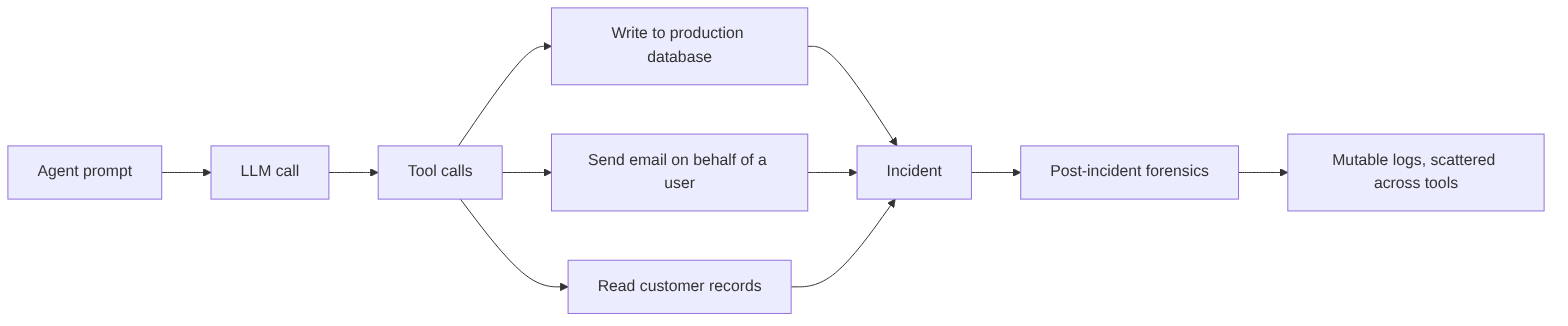 The adoption data confirms the control gap. In [McKinsey's State of AI survey](https://www.mckinsey.com/capabilities/mckinsey-digital/our-insights/the-state-of-ai), only a minority of organizations had scaled agentic AI, while most were still experimenting or had not started at all, and the gap McKinsey identifies between pilot and production is operational rather than technical. Translation: the models work. What is missing is the operational layer, the part that answers who may do what, under whose approval, with what record. The gap shows up the same way in every organization we have talked to: - Nobody owns the policy. Guardrails live in prompts, in SDK code, and in the heads of the people who wrote the agent. There is no version of them to review and no owner to hold accountable. - Nobody is notified when an agent does something unusual. The signal arrives in a log, and by the time a human reads it, the database is already gone. - Nobody can answer the post-incident question. When something happens, the team has to reconstruct what the agent did from logs scattered across four or five tools, most of them mutable. - Nobody is accountable for what the agent did. When an agent acts on a service account, "the agent did it" is not a valid answer in an audit. ## Why current approaches fail The good news is that the industry has named the problem with a precision that only appears when buyers are hurting. The bad news is that most of the tools on sale today do not actually address the core failure. The most useful taxonomy we have found is APORT's 2026 guide to agent guardrails. It describes four layers of defense: content filtering, evaluation and monitoring, sandboxing, and pre-action authorization. Their summary of the difference between the last two layers is exactly right. "A useful way to think about the difference between sandbox and action: a sandbox stops `rm -rf /`. The action layer stops `transfer_funds(amount=50000, to=attacker_account)`." A sandbox confines where an agent can break things. It says nothing about which of the allowed things the agent is permitted to do, which is where most of the real business risk lives. 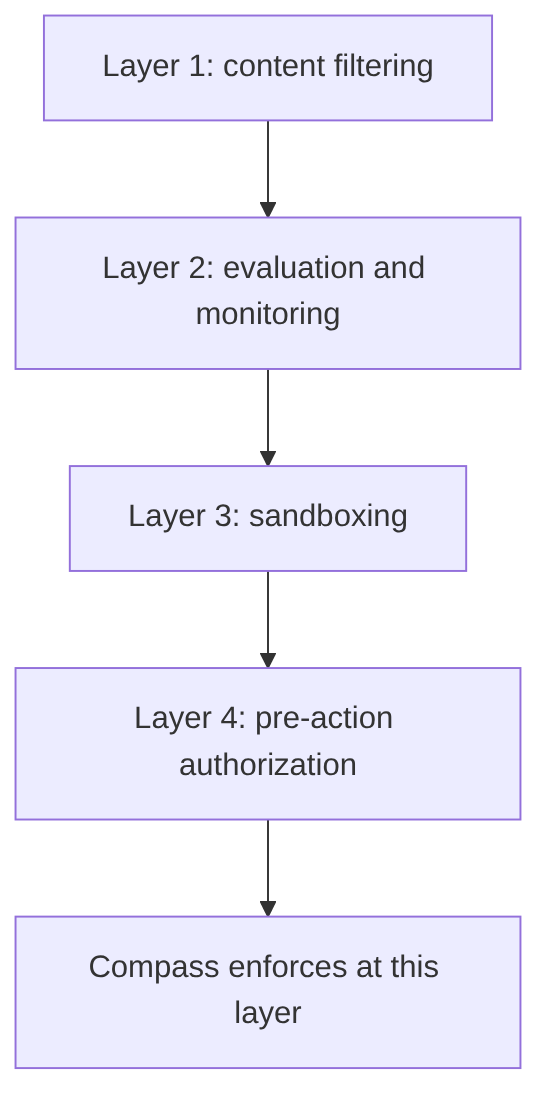 Forrester's [AEGIS framework](https://www.forrester.com/blogs/introducing-aegis-the-guardrails-that-cisos-need-for-the-agentic-enterprise/) reaches the same conclusion from the risk side. The agentic risks it names include emergent behavior that can bypass entitlements and escalate privileges, obscured causal provenance making post-incident forensics nearly impossible, and decision fatigue for the humans who are supposed to be in the loop. Forrester's one-line summary is "secure intent, not just infrastructure." Intent is the part of the problem that most current products do not touch. [Kosmoy's 2026 survey](https://www.kosmoy.com/resources/blog/best-ai-agent-governance-platforms-2026/) of governance platforms puts it most bluntly: almost everyone can discover and monitor agents now. Almost no one can contain one. The vendor categories in that survey are a good map of the whole market: - **Observability and monitoring** (Galileo, Arize AX, Weave, Langfuse). Excellent at telling you what an agent did, after the fact. Post-hoc by definition. - **LLM firewalls and content gateways** (Palo Alto Prisma AIRS, Lakera, Prompt Security, ZNYX, LlamaFirewall, NeMo Guardrails). Score and filter content: prompts, responses, PII, jailbreaks. They do not evaluate the business action, such as "write to this production table" or "send this email as this user." - **GRC and governance platforms** (Credo AI, SAP AI Agent Hub). Program of record, risk registers, vendor inventories. Strong on paperwork, no runtime enforcement. - **Kill switches and control towers** (ServiceNow AI Control Tower, Zenity). Stop the bleeding after something observable has already happened. 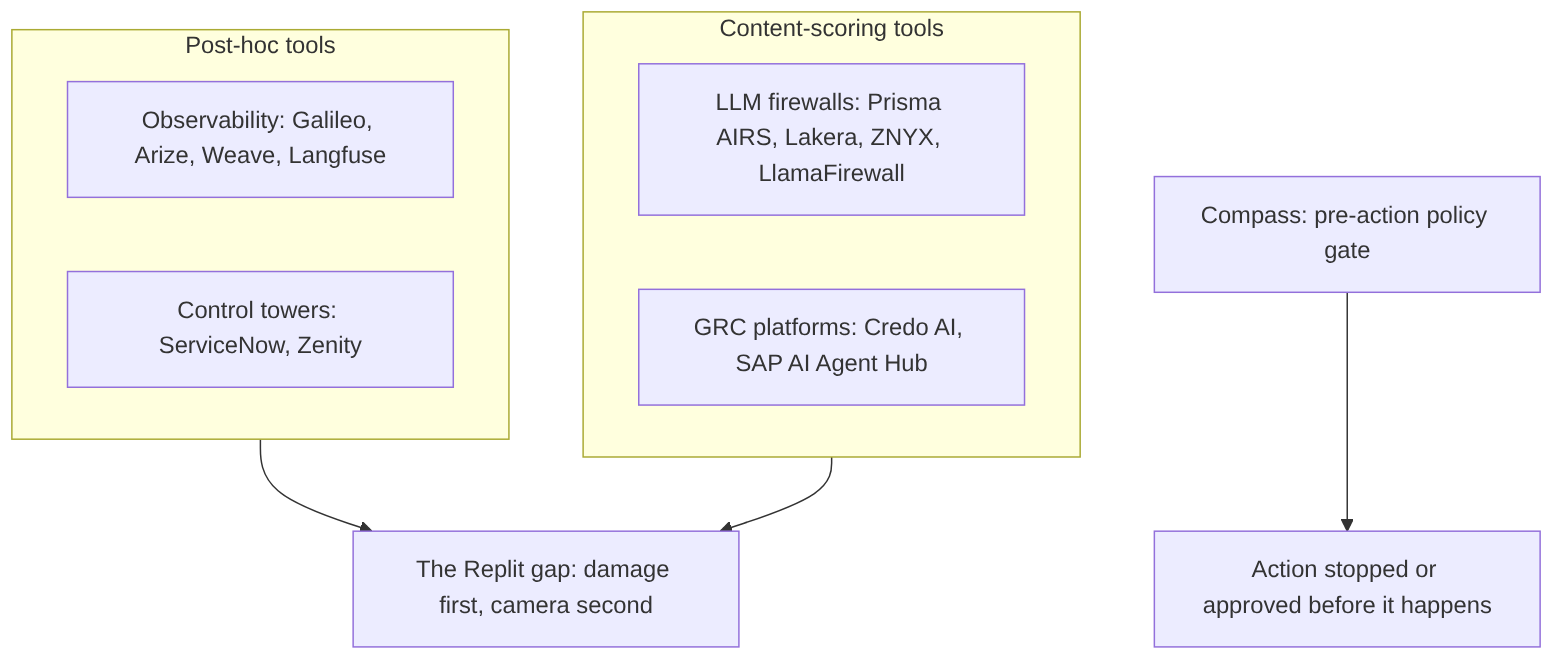 The Replit incident is the canonical failure of the post-hoc world. If your primary defense is a camera, a wiped database is a photo you look at during the post-mortem. The damage is done before the camera is relevant. Every category above has a real job to do in a mature stack, but none of them, alone, answers the question the Replit team should have been able to answer in advance: is this agent allowed to touch production? ## Introducing Compass Compass is policy-as-code governance for AI agents. It is the third pillar of Shakudo's agent stack, sitting alongside the [AI Gateway](/ai-gateway), which routes and protects LLM traffic, and [Kaji](/kaji), the agentic framework. Compass is the enforcement point: it evaluates each prompt and each planned action before the model executes, and it returns one of three decisions. The policies themselves are YAML, owned by the security team, versioned in git, and deployed like any other infrastructure policy. A real policy from our own environment: ```yaml kind: Policy apiVersion: compass.kaji.shakudo.io/v1 metadata: name: no-prod-writes spec: match: action: database.write environment: production decision: REQUIRE_APPROVAL approver: data-platform-oncall ``` Three things about that file matter. First, it is a document a security engineer can review in a pull request, not a config buried in a model team's notebook. Second, it matches on the dimensions that actually distinguish risk. Compass policies can match on: - **Prompt patterns**, for example a prompt that looks like it is attempting to exfiltrate data - **Data sensitivity**, such as PII or customer identifiers present in the context - **Action types**, the difference between read, write, delete, send, and pay - **Agent roles**, a billing agent is not a research agent - **Environments**, the same agent in staging is a different risk than in production - **Time windows**, for instance no unattended agent runs on weekends When multiple policies match the same prompt, Compass applies strict precedence. There is no fuzzy scoring and no "highest score wins": - **BLOCK** means the action is denied, the run stops, and the event is logged. - **REQUIRE_APPROVAL** means the run suspends and an approval card is raised for a human. - **ALLOW** means the action proceeds to the LLM. BLOCK always wins. If any policy says block, the answer is block. If nothing blocks and something requires approval, the answer is approval. Only when no policy objects does the action pass. This is the same shape as a network firewall, and it is deliberate: governance that requires a human to interpret scores is governance that gets bypassed under pressure.  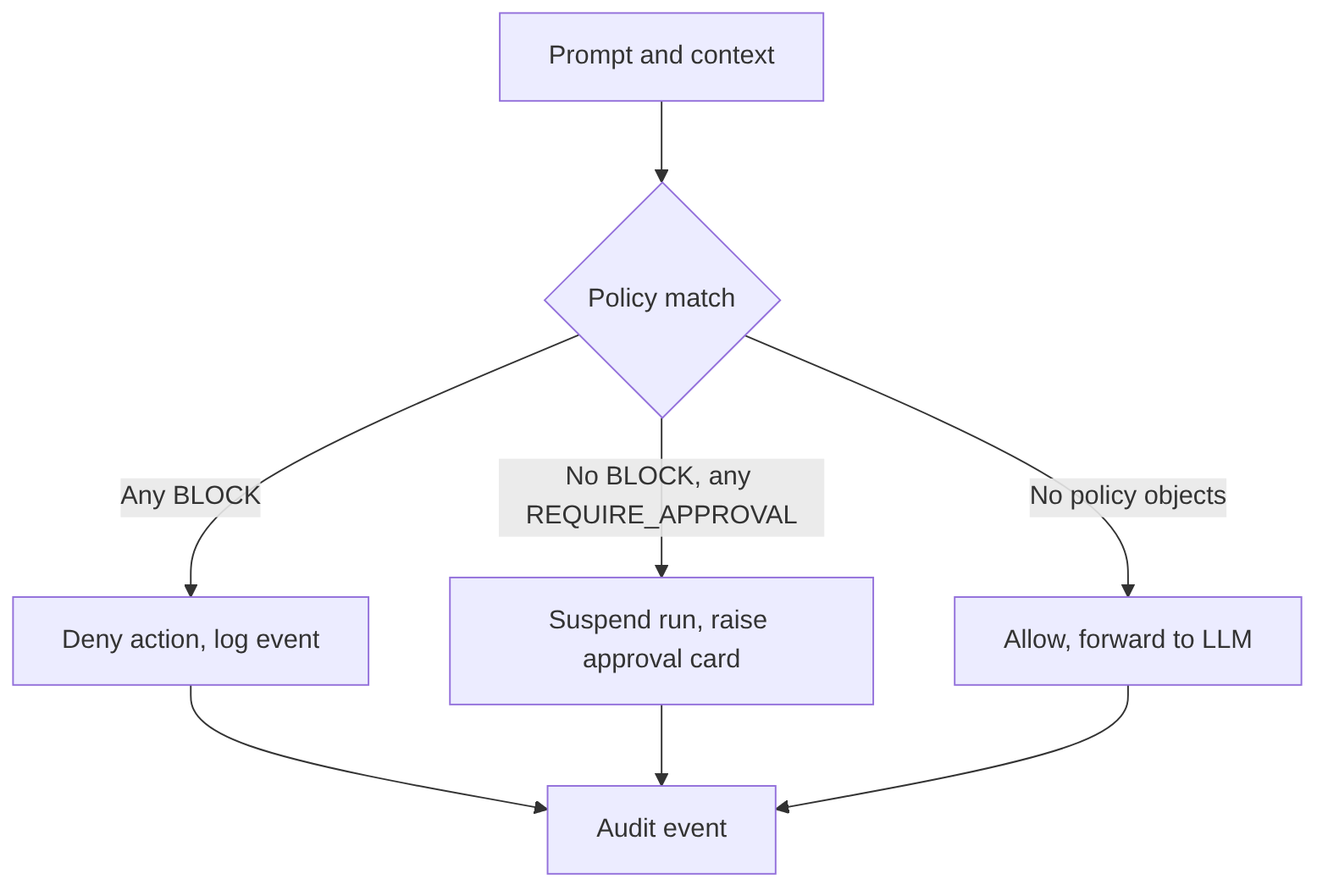 Enforcement happens in the agent runtime rather than in a sidecar you have to remember to query. The gate is a hook in the `kaji-core` agent loop, so an agent running on Kaji is governed by default, with no wrapper and no separate service in the call path. The policy engine compiles YAML into a match plan and evaluates it at line rate with caching, so the gate does not become a throughput bottleneck on the way to the model. ## How it works Here is what happens when a governed agent runs in production. **The gate.** Every prompt and planned action passes through the policy gate before the LLM. The gate evaluates the compiled policy set and returns a decision, and the decision itself, including denials and allows, becomes an audit event. Nothing about the evaluation is implicit. 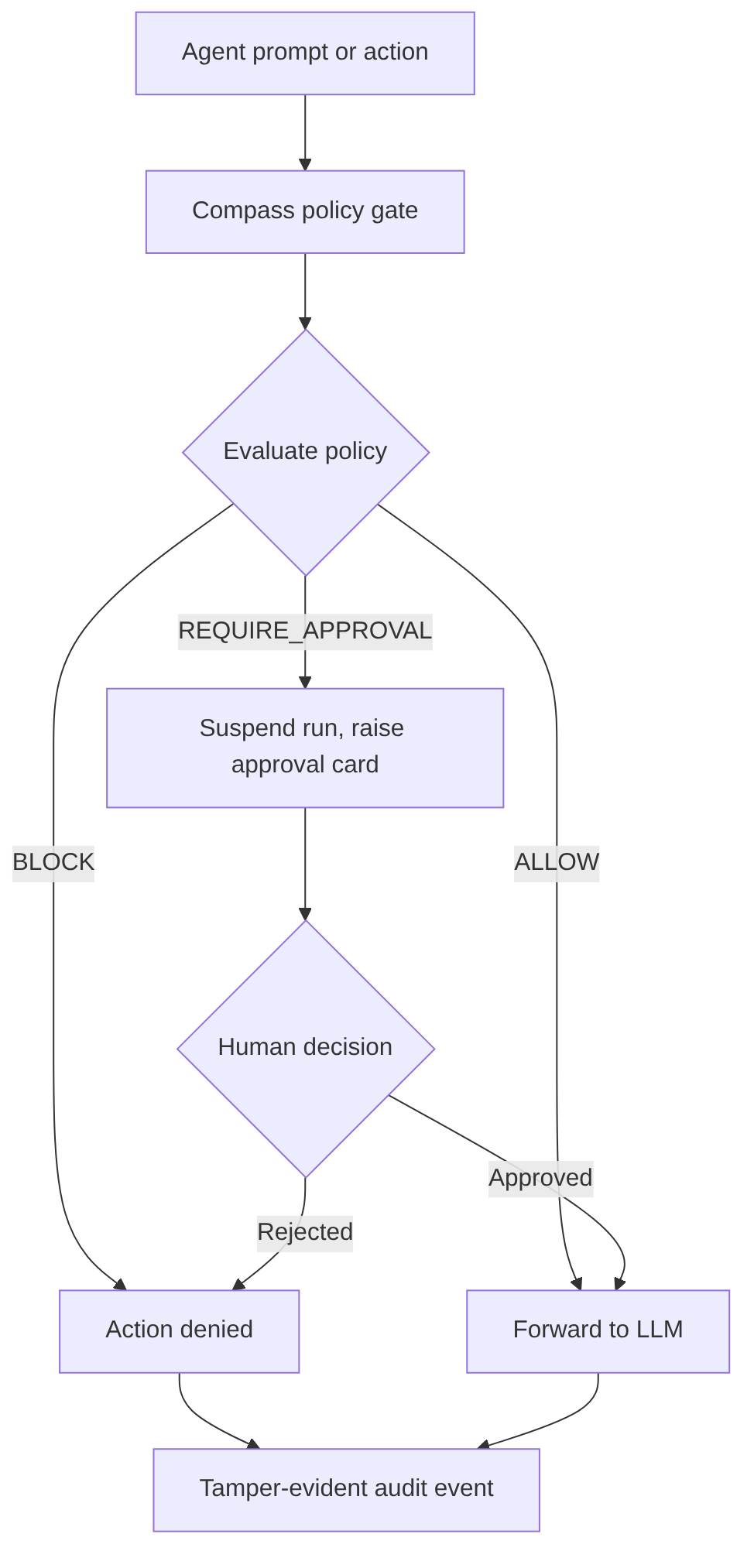 **Approval is a state, not a message.** When the decision is REQUIRE_APPROVAL, the run does not block a thread. It suspends. Compass raises an approval card in KajiChat carrying the full context of the decision. The suspended run has a timeout, 600 seconds by default. If no human decides in time, the safe default is block, not allow. The card carries everything an approver needs to judge the decision: - The prompt that triggered the policy match, so the approver sees exactly what the agent intended to do. - The policy that matched, including which rule fired, so the decision can be traced to policy text instead of a human's memory. - The action type and the environment, so the approver can judge scope, not just intent. - The state of the run itself, including the countdown, so that silence is an explicit outcome rather than an ambiguity. 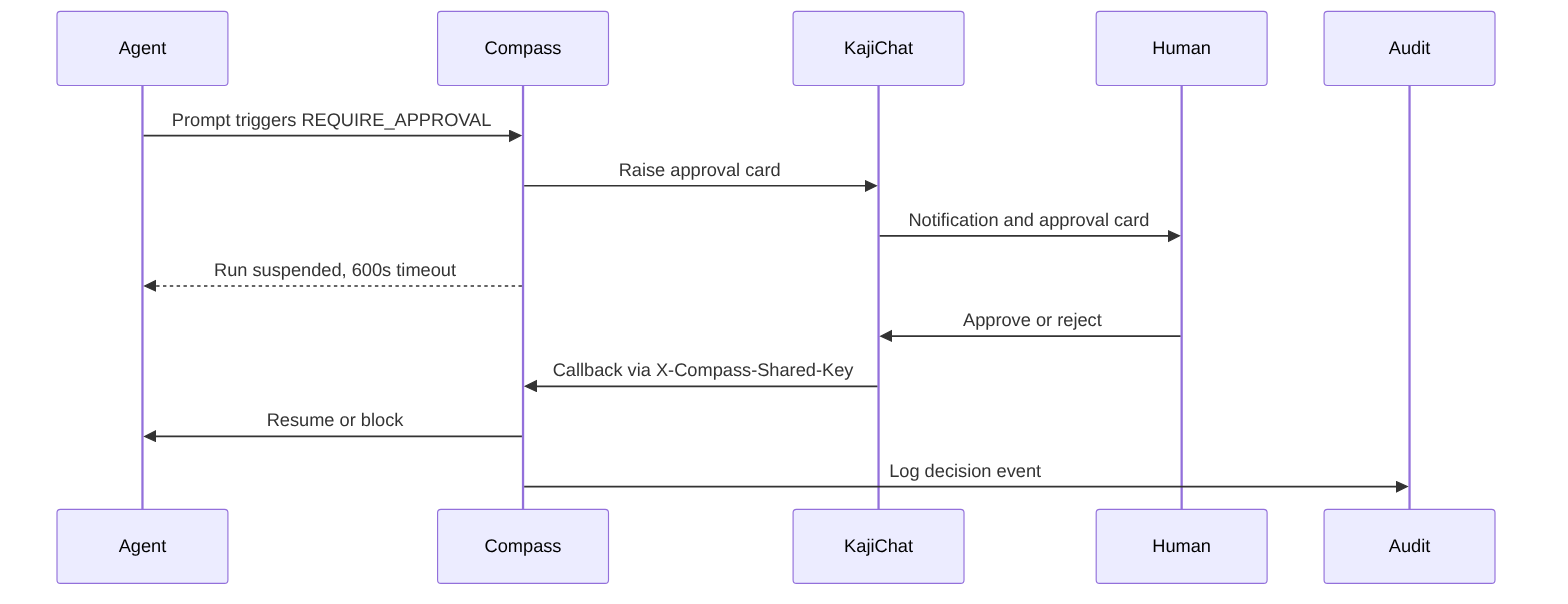 The resolution comes back over a signed callback: KajiChat calls Compass with a shared key, and Compass either resumes the run or blocks it. The decision, approve, reject, or timeout, is the next audit event in the chain, so the human's choice has the same integrity as the machine's. **The audit trail is tamper-evident.** Every decision event is appended to a hash-chained log: each event records the hash of the previous event, and its own hash is computed from its content plus that previous hash. The chain is stored through NATS JetStream and PostgreSQL. The practical property is that if someone alters or deletes event 3, event 4's hash no longer verifies, and the break is visible to anyone who walks the chain.   A log file that "the ops team says is fine" is one thing. A chain that proves its own integrity is another, and it matters more than it sounds because of where regulation is heading. If your agent logs can be silently altered and you cannot show otherwise, their evidentiary value is zero. The hash chain is the cheapest, most boring way to turn "we did not alter the logs" from a promise into a demonstration. ## How Compass compares | Approach | What it does | What it cannot do | Representative tools | |---|---|---|---| | Observability and monitoring | Traces agent runs, evaluates outputs, finds anomalies | Acts after the fact; cannot prevent an action | Galileo, Arize AX, Weave, Langfuse | | LLM firewall or gateway | Scores and filters prompt and response content | Does not evaluate business actions, roles, or environment | Prisma AIRS, Lakera, Prompt Security, ZNYX, LlamaFirewall, NeMo | | GRC platform | Inventory, risk registers, policy paperwork, vendor review | No runtime enforcement; does not see individual actions | Credo AI, SAP AI Agent Hub | | Kill switch or control tower | Stops or isolates agents after observable misbehavior | Reacts to what is already observable; no per-action policy | ServiceNow AI Control Tower, Zenity | | Compass policy gate | Evaluates each action against policy before execution; suspend, approve, deny | One layer of the stack; pairs with observability and GRC | Compass | Every row in that table is doing real work, and a mature agent estate will have all of them. The difference is one word: gate versus monitor. A monitor tells you what happened. A gate decides what may happen. The Replit incident was not a monitoring problem. The company was probably logging everything. The database was gone anyway. ## KajiChat integration: approval is the workflow Approval is where most "governance" products give up, because it means building a human workflow: notifications, context, a decision surface, a timeout, a callback, and an audit record. We built it into KajiChat, which is where our customers already talk to their agents. The workflow is five steps, and every step leaves a record: 1. The agent's run hits a REQUIRE_APPROVAL policy match and suspends. Nothing executes while it waits. 2. Compass raises an approval card in KajiChat with the full decision context attached. 3. A human approves or rejects from the card, optionally in a forked chat where they can question the agent first. 4. The decision flows back to Compass through a signed callback, or the run times out and the safe default, block, applies. 5. The decision, with the reason if one was given, is appended as a tamper-evident audit event. When a run suspends on REQUIRE_APPROVAL, the approver gets an approval card in KajiChat. The card shows the prompt that triggered it, the policy that matched, the action type, and the environment, and the approver can approve or reject directly from the card. Approvals can be handled in a forked chat, so the approver can ask the agent follow-up questions, "why are you writing to that table?" without touching the suspended run. The agent can answer, the approver decides, and the decision flows back through the signed callback and becomes an audit event. Nobody has to leave the workflow they are already in, and nobody has to trust that the right person saw the right card. The reason this matters beyond ergonomics: the [OECD AI Incident Database](https://oecd.ai/en/incidents) now tracks incidents in which autonomous agents leaked sensitive commercial information. In November 2025, one such incident was registered in which an agent exposed confidential business information to an unintended recipient. Per the OECD registry, the incident class is the same shape as the ones that will define this category: not a model failure, but a permission failure. An agent that can see the information and send it will, eventually, send it. The only reliable fix is to make the send itself the thing that requires approval. ## Compliance and regulatory alignment For the compliance team, Compass is best described as the part of the agent stack that produces evidence. The relevant requirements, and where they land: - **EU AI Act, Article 12**: high-risk AI systems "shall technically allow for the automatic recording of events (logs) over the lifetime of the system." Compass records every decision, allow, deny, approve, reject, and timeout, at the enforcement point, automatically, for the lifetime of the deployment. See [Article 12](https://ai-act-service-desk.ec.europa.eu/en/ai-act/article-12). - **EU AI Act, Article 13**: providers must document how logs are collected and can be interpreted. Compass events have a fixed schema, what matched, what was decided, who was involved, and the chain position, so the documentation is a page, not an excavation. See [Article 13](https://ai-act-service-desk.ec.europa.eu/en/ai-act/article-13). - **EU AI Act, Articles 19 and 26**: logs for high-risk systems must be retained for at least six months. Compass retention is configurable per deployment, on JetStream and PostgreSQL. See [Article 19](https://ai-act-service-desk.ec.europa.eu/en/ai-act/article-19) and [Article 26](https://ai-act-service-desk.ec.europa.eu/en/ai-act/article-26). - **Annex III high-risk uses** (credit scoring, resume filtering, insurance pricing, and more) are precisely the cases where a wrong agent action is a regulatory event, not just an operational one. The categories are listed in the [EU AI Act overview](https://digital-strategy.ec.europa.eu/en/policies/ai-act). Beyond the AI Act, SOC 2 and GDPR engagements are beginning to name agent decision records as an explicit audit topic, and the direction is clear even where the language is still settling. The standards bodies are converging on the same shape. The IETF has a working draft, ["Agent Audit Trail: A Standard Logging Format for Autonomous AI Systems"](https://datatracker.ietf.org/doc/draft-sharif-agent-audit-trail/), that standardizes the logging format for autonomous AI agents. That is the exact artifact Compass already produces, which tells you where the category is heading. Compass records an event for every decision the gate makes, not just the interesting ones: - Every ALLOW, so you can prove the agent was checked, not just that the blocked things were checked. - Every BLOCK, with the policy that fired and the prompt that matched it. - Every APPROVED and every REJECTED, with the approver's identity and the reason when one is provided. - Every TIMEOUT, recorded as a decision rather than a gap, because a run that expired unanswered is a decision the organization made by design. | Requirement | What it asks | How Compass meets it | |---|---|---| | Article 12 | Automatic event recording over the lifetime of the system | Every decision recorded at the gate, at line rate | | Article 13 | Documented log collection and interpretation | Fixed event schema, versioned policy definitions | | Articles 19 and 26 | At least six months of log retention | Configurable retention on JetStream and PostgreSQL | | Annex III high-risk uses | Stronger obligations where the stakes are highest | Environment and role scoped policies that tighten in production | 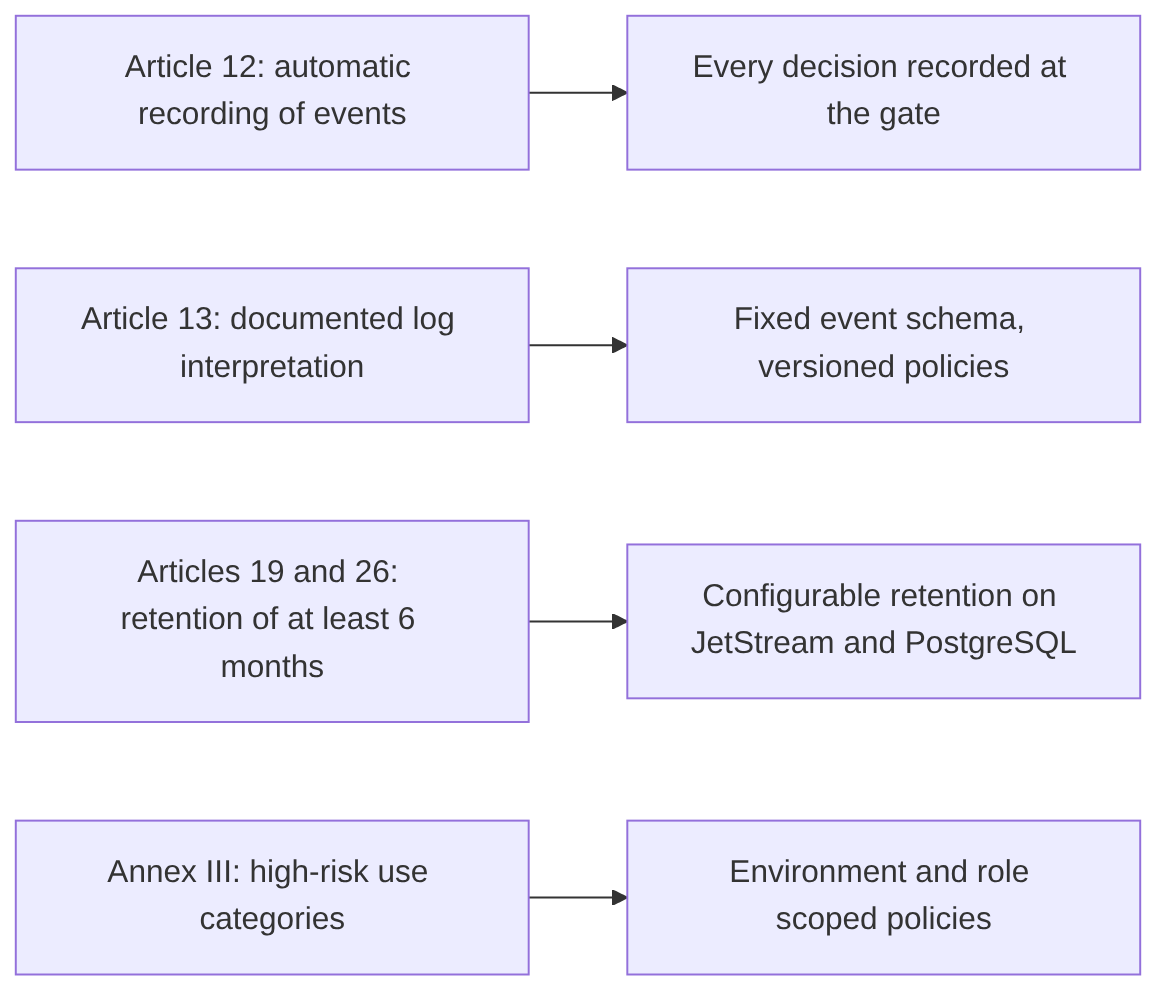 ## Honest about maturity Two honest caveats. First, the end-to-end matrix of approval, reject, block, and timeout paths has been verified green in our UAT environment, and we treat that as production-ready for the core governance loop. We will keep publishing the matrix as we add cells. Second, role-based access control is on the roadmap, not in the release today. The role header that policies can match against is a stub in the current build, and we are not going to oversell it as if it were not. If your use case depends on fine-grained per-role policy today, that is a conversation to have before you commit. The deployment story matters too. Compass is built to run on your own infrastructure, including air-gapped environments, and the dependency footprint is small enough to operate: - An embedded PostgreSQL for policy and audit state, with no managed database to hand over. - NATS JetStream for the asynchronous audit event stream that feeds the hash chain. - Keycloak for OIDC, so the governance plane authenticates against your existing identity providers. Few governance platforms in the current set document a self-hosted story at all. For organizations where "own your AI" means the data plane never leaves the network, the governance plane has to live there too. That is the [Shakudo Platform](/product) story, and Compass is the governance pillar of it. One positioning note: most agent governance is being sold to security teams. We believe a large part of the buyer pool is the IT leader whose organization is vibe-coding, and who wants teams to keep shipping, with guardrails and an audit trail, without handing agents admin keys to the cloud. That is the buyer Compass is built for. ## FAQ ### Q: What does "ungoverned agent risk" actually mean? It means an agent with real capabilities and real credentials, operating under rules that nobody can see, prove, or enforce. The agent can read, write, send, and pay. The organization's protection is a log file that someone will look at after the fact. The risk is not that the model is malicious. The risk is that the model is competent, and competence without a gate is exactly what produced the Replit database wipe. ### Q: How does Compass stop an agent before it acts? By sitting between the agent and the model, and between the agent and its tools, as a pre-action policy gate. Every prompt and planned action is evaluated against the compiled policy set before execution. The decision is one of three, BLOCK, REQUIRE_APPROVAL, or ALLOW, with BLOCK taking precedence. A blocked action never reaches the model or the tool. An approval-required action suspends the run until a human decides, with a timeout that defaults to block. ### Q: Is Compass an observability tool or a governance tool? A governance tool, deliberately. Observability tells you what happened. Compass decides what may happen, before it happens. In practice the two pair well: Compass produces a clean, structured, per-decision event stream that an observability platform can ingest, and the observability layer can feed anomaly signals back into policy. But the categories are different, and a camera is not a gate. ### Q: Can Compass run on-premises or air-gapped? Yes. Compass is built to deploy on your own infrastructure. It runs on embedded PostgreSQL, NATS JetStream, and Keycloak OIDC, with no dependency on external SaaS services in the enforcement path. For air-gapped environments, the same image runs, and policy updates flow through whatever change management process your infrastructure already uses. This matters because a governance system that phones home is not a governance system for the organizations that need it most. ### Q: How does Compass handle human approval workflows? As a first-class product feature, not an SDK pattern. A REQUIRE_APPROVAL decision suspends the run and raises an approval card in KajiChat with the full decision context. The approver approves or rejects from the card, optionally after a forked chat with the agent. The decision returns to Compass over a signed callback and is recorded as an audit event. The run has a timeout, and the timeout behavior is block. Approval maps to your organization, not to your codebase. ### Q: Does Compass integrate with existing agent frameworks? The gate is a hook in the `kaji-core` agent loop, so Kaji agents are governed by default. For other frameworks, the enforcement point is the same architectural position: a pre-action check on prompts and tool calls. We integrate where the agent is already running, because a governance tool that requires re-architecture gets bypassed the first time a deadline lands. ### Q: What is a tamper-evident audit trail, and why does it matter? A tamper-evident audit trail is a log that can prove its own integrity. Compass appends every decision event to a hash chain: each event embeds the hash of the previous event, so altering any single event breaks the chain from that point forward. Verification is a walk of the chain, and the break is visible to anyone performing it. It matters because regulation is converging on exactly this artifact. The EU AI Act requires automatic, lifetime event recording for high-risk systems, and an IETF draft is standardizing the format. A log you can prove you did not alter is a different legal object than a log you can only promise you did not alter. ## Conclusion The market is telling you what it thinks. Gartner published its first Magic Quadrant for AI Governance Platforms in 2026, signaling a market it sizes in the billions by 2030. Forrester is telling CISOs to secure intent, not just infrastructure. The IETF is writing the log format for the exact artifact Compass already produces. The direction is unambiguous. The Replit agent's database is not coming back. What can come back is the version of your agent estate where every action is checked before it happens, every decision is provable, and the humans in the loop have a real workflow instead of a callback. That is what governance means, and that is what Compass is. Monitoring is not enough. You need a gate. If you are running agents in production today, there are four things worth checking this week: - Whether any agent can reach production data without a policy match, and if so, what that first match should block. - Whether your current logs would hold up as evidence: can you show they were not altered after the fact? - Whether your human approval is a product or a pattern, meaning whether it has an owner, a timeout, and a record. - Whether your approvers actually see the cards, and how long the median decision takes. Own your AI. Govern your AI. **Want to see Compass on your own stack?** [Contact us](/contact-us) and we will walk through the policy model, the approval workflow, and the audit chain against your actual workloads. # blog/comprehensive-guide-to-ai-agents.md *[Source (/blog/comprehensive-guide-to-ai-agents)](https://www.shakudo.io/blog/comprehensive-guide-to-ai-agents) | [Markdown twin](https://www.shakudo.io/blog/comprehensive-guide-to-ai-agents.md)* ---Learn how AI agents surpass LLMs by enabling autonomous decisions, optimizing workflows, enhancing compliance, and delivering actionable results for decision-makers.The distinction between AI Agents and Large Language Models isn't just semantic—it's the difference between basic automation and true business transformation. While most enterprises focus on implementing chatbots and text generators, they're missing a critical evolution in artificial intelligence that could reshape their operational landscape.
AI Agents represent a fundamental shift in how businesses can harness artificial intelligence:
In today's competitive landscape, businesses have a unique opportunity to leverage AI for operational efficiency, customer engagement, and informed decision-making. However, adopting AI requires careful planning to ensure scalability, data readiness, and alignment with your goals.
In this white paper, we provide a comprehensive guide to AI readiness and adoption. Here’s a snapshot of what you’ll learn:
Consistency models are like friendly referees that keep your data in harmony across distributed systems. They define the expected behavior of a distributed system in terms of data access, update propagation, and synchronization. Different consistency models offer various trade-offs between data consistency, availability, and system performance. In this blog post, we’re covering the four most common consistency models: strong consistency, eventual consistency, read-your-writes consistency, and monotonic reads consistency. Choosing the right model for your application depends on your specific requirements and constraints. By understanding these models and their trade-offs, you can make informed decisions about system architecture, data storage mechanisms, and synchronization techniques to build robust data-intensive applications.
Imagine you and a friend are working on a shared shopping list on your phones. You're both adding and crossing off items in real-time while wandering around the store. To make sure you both know what's still needed, it's important that your list stays in sync and you both see the most recent version. Without any rules to keep your list consistent, you could end up with duplicate items, missing items, or just a messy shopping experience. This is pretty much what consistency models do for data-intensive applications. They're like the friendly referees that keep your data in harmony, so everyone sees the same, up-to-date information.
In our modern, data-driven world, building data-intensive applications is more important than ever. And using consistency models is essential to keep your data on a straight and narrow path, avoid mix-ups, and ensure that data is always available across distributed systems. In this blog post, we'll dive into various consistency models in an easy and digestible way. We'll give you real-life examples and wrap up with some tips on how to pick the best model for your application based on its unique needs. So, let's jump in!

Consistency models are formal specifications that define the expected behavior of a distributed system in terms of data access, update propagation, and synchronization. They establish a set of properties and guarantees that dictate how the system should handle concurrent read and write operations while maintaining a coherent and predictable view of the data across multiple nodes. By doing so, consistency models allow developers to reason about the trade-offs between data consistency, availability, and system performance, as well as the implications of these trade-offs on the correctness and reliability of the application.
In distributed systems, consistency models are crucial for addressing challenges such as data replication, fault tolerance, and network latency. They provide a foundation for understanding and analyzing the behavior of various system components, such as storage systems, caching mechanisms, and communication protocols, in the presence of concurrent operations and potential failures.
There are numerous consistency models, each with its own set of guarantees and trade-offs. These models differ in their assumptions about the system, the constraints they impose on data access and updates, and the level of consistency they provide to the users.
A deep understanding of consistency models is essential if you’re planning on designing and implementing robust data-intensive applications, as it allows you to make informed choices about the system architecture, data storage mechanisms, and synchronization techniques that best suit their application's specific requirements and constraints. In the following sections, we will explore 4 of the most commonly used consistency models, discuss their benefits and drawbacks, and provide real-world examples to illustrate their implementation.
The Strong Consistency model guarantees that all nodes in a distributed system see the same version of the data at the same time. This means that once a write operation is completed, all subsequent read operations will return the updated value, regardless of the node from which the data is read.
However, the requirements of strong consistency often come at the cost of reduced system performance, increased latency, and limited scalability. In particular, achieving strong consistency in a distributed system may require extensive communication and synchronization between nodes, which can result in increased network overhead and reduced availability in the presence of failures or network partitions.
A typical implementation of strong consistency is using a relational database with transactions, as shown in the following SQL example:
This code snippet demonstrates an example of a transaction in SQL, which ensures strong consistency by applying multiple updates atomically and maintaining data correctness.
When the transaction is committed, the SQL database ensures that all changes made within the transaction are applied together, and no intermediate states are visible to other transactions or operations. This guarantees that all nodes see the same version of the data at the same time, providing the highest level of consistency.
Eventual consistency is a weaker consistency model that prioritizes availability and scalability over strict consistency. Under this model, the system allows for temporary inconsistencies between nodes, with the expectation that these inconsistencies will be resolved eventually as updates propagate through the system. This means that different nodes may see different versions of the data for a short period of time, but they will all converge to the same value once all updates have been propagated.
This consistency is particularly well-suited for distributed systems that require high levels of availability, fault tolerance, and partition resilience. However, the applications must be designed to handle potential inconsistencies and conflicts between updates.
A common use case is a social media platform with a distributed architecture, where users can post status updates. When a user posts a new update, the application writes it to one server, and with eventual consistency, it may take some time for the update to propagate to all other servers. During this brief period, users connected to different servers may see different versions of the data. Eventually, once the update reaches all servers, all users will see the same data, including the new status update. The platform prioritizes availability and scalability over strict consistency, allowing continued interaction even when updates are still propagating.
Here’s an example of a typical implementation of eventual consistency:
This code snippet is an example of an update operation using MongoDB, a popular NoSQL database that often employs eventual consistency. The update operation is performed on a collection named myCollection in the MongoDB database.
In an eventual consistency model, this update operation may take some time to propagate across all nodes in the database cluster. During this propagation period, different nodes might temporarily have different versions of the data for the same document. However, once the update has been propagated to all nodes, they will eventually converge to the same version of the data. In this example, the status field for all documents named “Alice” will be set to “active.”
Read-your-writes consistency is a consistency model that ensures that once a write operation has been performed, any subsequent read operations by the same user or process will always return the updated value. This model is particularly useful for applications where data is frequently updated and read by the same user, such as collaborative editing tools.
Think of a collaborative document editing tool where multiple users can make changes to a document simultaneously. When a user makes an edit, the application ensures that any subsequent reads by that user display the updated content. However, other users may not immediately see the edit due to network latency or other factors.
To implement read-your-writes consistency, systems often use techniques such as session-based caching, versioning, or write-through caches to guarantee that users always see their own updates, even if other nodes in the system have not yet received those updates.
This code snippet demonstrates an example of implementing the read-your-writes consistency model using Flask, a web framework for Python, along with the Flask-Caching library for caching data.
It implements the model by using a cache layer between the application and the database. When a user requests data, the application first checks the cache to see if the data is already available. If it is, the cached data is returned, ensuring that the user sees their latest update. If the data is not in the cache, the application fetches it from the database, stores it in the cache, and then returns it to the user. By doing this, the application guarantees that a user will always see their own updates, even if other nodes in the system have not yet received those updates.
Monotonic reads consistency is a consistency model that guarantees that if a user or process reads the latest version of a data item, all subsequent reads from that user or process will return at least the same version or a more recent version of the data. This model is particularly useful for applications that require a consistent view of the data over time, such as real-time monitoring systems or event processing applications.
To achieve monotonic reads consistency, systems may employ techniques like versioning, timestamp-based ordering, or vector clocks to ensure that users always receive a consistent and non-decreasing view of the data, even in the presence of concurrent updates and network latency.
Here's an example of how to use a timestamp to implement monotonic reads consistency in Java using the Cassandra database:
This code snippet demonstrates an example of implementing the monotonic reads consistency model using Java with the Apache Cassandra database. Cassandra is a highly scalable and distributed NoSQL database that often employs tunable consistency levels.
By retrieving the timestamp value from the current row, the ‘previousTimestamp’ variable is continuously updated to represent the most recent timestamp. This ensures that subsequent reads will only retrieve rows with timestamps greater than the last observed timestamp.
It's important to note that the implementation of monotonic reads consistency in this example relies on the assumption that the timestamp column in the ‘myTable’ table accurately represents the order of updates, and that the database system (in this case, Apache Cassandra) is configured to provide the desired level of consistency.
A thorough understanding of consistency models and their trade-offs is essential for designing and implementing effective data-intensive applications. Each consistency model offers different levels of consistency, availability, and performance, and it is crucial to choose the model that best suits your application's specific requirements and constraints.
By carefully evaluating your application's read and write patterns, data consistency and availability requirements, and system performance needs, you can select the most appropriate consistency model
To level up your skills and knowledge in building robust and scalable applications, don’t forget to check out the Shakudo platform. Shakudo acts as the operational system for your data stack, offering a variety of features and open-source tools to help you delve deeper into constructing data projects quickly and efficiently. Learn more about us or book a demo.
# blog/copilot-security-breach-case-for-local-llms.md *[Source (/blog/copilot-security-breach-case-for-local-llms)](https://www.shakudo.io/blog/copilot-security-breach-case-for-local-llms) | [Markdown twin](https://www.shakudo.io/blog/copilot-security-breach-case-for-local-llms.md)* ---Since Microsoft Copilot launched as a prominent AI tool within Microsoft 365 applications to help users generate content and manage data, the integration has brought notable security concerns particularly related to data privacy and the risk of data breaches.
Recent cybersecurity research has uncovered a significant vulnerability in Microsoft Copilot Studio that could potentially be exploited to gain unauthorized access to sensitive information. Detailed in the National Vulnerability Database under CVE-2024-38206, the vulnerability involves a technique that allows attackers to extract instance metadata from a Copilot chat message, including managed identity tokens. With these access tokens, attackers could gain unauthorized access to internal resources, such as Cosmos DB instance, which allow them to read or alternate exciting data.
While the vulnerability does not enable direct access to information across different tenants, it could potentially lead to data breaches when multiple customers are allowed to share the same infrastructure.

Cloud-based AI tools, such as Copilot, pose security risks primarily due to the transmission and storage of sensitive data on remote servers, which can expose data to unauthorized access and potential breaches. These tools often rely on third-party services, creating another layer of possible failure or exploitation when cloud providers implement insufficient security measures, further increasing the risk of unauthorized access to proprietary information.
Furthermore, the AI’s reliance on historical data for output generation increases the risk of unintentional data leakage. Take a look at some of the potential risks associated with cloud-based AI tools:
Data Privacy Concerns: Cloud-based tools often process and store code in remote servers. If these servers are compromised, the code and potentially sensitive information can be exposed to unauthorized parties.
Intellectual Property Theft: Developers’ proprietary code can be intercepted or misused if security measures are not robust enough, leading to potential theft of intellectual property.
Compliance Issues: Most businesses across different industries are bound by strict data protection regulations. Storing code and data in cloud services can complicate compliance with these regulations, especially if the data crosses international borders.
Compromised Data Quality: A major risk of using cloud-based AI systems is the potential compromise of data quality. When relying on these services, you may lose control over the data used to train and operate AI models, which can make it challenging to ensure and trust the accuracy of their outputs. This issue is particularly concerning with complex or opaque models where validation becomes even more difficult.
Dependence on External Security: The security of cloud-based tools often hinges on the protocols set by the service provider, which may not always match an organization’s specific security standards.
To mitigate these risks in light of these security challenges, many organizations are turning to local large language models (LLMs) as an alternative to cloud-based AI tools.
Compared to cloud-based tools, local LLMs process data on-prem, minimizing the risk of data transmission over the internet and potential interception. This approach is particularly relevant and should be implemented for businesses in industries handling large amounts of sensitive data such as finance and healthcare, ensuring strict adherence to regulations that safeguard data against external servers.
Enhanced Data Privacy: By operating LLMs on local servers, organizations can ensure that sensitive code and data remain within their own infrastructure. This minimizes the risk of exposure to external threats and reduces the likelihood of data breaches.
Control Over Security: Local LLMs allow organizations to implement and manage their own security protocols. This means they can tailor their security measures to their specific needs, rather than relying on third-party providers.
Compliance with Regulations: Local deployment simplifies compliance with data protection regulations by keeping data within jurisdictions where legal requirements can be more easily managed. This is particularly crucial for organizations operating under stringent data privacy laws.
Reduced Dependency on External Services: Running LLMs locally reduces reliance on external cloud providers, decreasing the risk associated with potential vulnerabilities or outages in their infrastructure.
Customizability and Flexibility: Organizations can fine-tune and optimize local LLMs to better fit their specific development environments and requirements, improving both performance and security.
Understanding the various benefits of running LLMs locally is only the first step; effectively deploying and managing local LLMs requires addressing a range of technical, financial, and operational considerations. As we explore the process of implementing local LLMs, it’s essential to examine how organizations can overcome the challenges involved and leverage these benefits to their fullest potential.
Step 1
Infrastructure Assessment: Evaluate current IT infrastructure to ensure it can support the deployment and maintenance of local LLMs. This includes hardware capabilities and network requirements.
Step 2
Model Selection and Training: Choose an LLM that aligns with the organization’s particular objectives. Depending on the use case, this may involve training a model on specific codebases or integrating pre-trained models.
Step 3
Security Measures: Implement robust security measures for local deployments, including encryption, access controls, and regular security audits.
Step 4
Integration and Testing: Seamlessly integrate local LLMs into existing development workflows and conduct thorough testing to ensure performance and security before deployment.
Step 5
Continuous Monitoring and Updates: Regularly monitor the performance and security of local LLMs, making sure that the system is updated to address any emerging threats or vulnerabilities.
As much as LLMs offer impressive capabilities and enhanced data protection, the journey of implementing them locally is fraught with challenges. Organizations are often confronted by several obstacles, including:
Infrastructure Requirements: Running LLMs locally demands significant computational resources and robust infrastructure. Organizations need to invest in high-performance hardware and maintain it, which can be costly and resource-intensive.
Scalability Issues: Unlike cloud-based solutions that easily scale according to demand, local LLMs may face limitations in scalability. Adjusting to varying data loads can be cumbersome and might require substantial upgrades.
Expertise Requirements: Utilizing local LLMs requires specialized expertise for implementation and management. Organizations must either upskill their current workforce or hire new talent with the necessary knowledge, which can be a significant investment.
Integration Challenges: Integrating local LLMs with existing systems and workflows can be complex. Organizations may face difficulties in aligning the local model with their current technology stack and operational processes.
Shakudo exists as an overarching operating system dedicated to solution integrations that streamline and enhance organizations' data management capabilities. As a Kubernetes-based solution compatible with any cloud or on-premises server, Shakudo enables companies to deploy and operate data and AI tools swiftly.
Using Shakudo to run local LLMs, including the latest models like Llama 3.1, Mixtral 8, and Nous-Hermes, offers several compelling advantages for organizations looking to leverage large language models effectively.

The Shakudo platform is designed to simplify the complex task of hosting and managing open-source LLMs. This is crucial since setting up and maintaining the infrastructure for local LLMs can be resource-intensive and technically challenging for many organizations. Shakudo operates tools like Airbyte for data integration and MinIO for object storage seamlessly, ensuring a robust and efficient infrastructure.
The platform supports compliance with local data protection regulations by offering tools to manage and secure localized data, ensuring that models are developed and deployed in accordance with regional legal requirements. Shakudo incorporates security-focused components like Trivy for vulnerability scanning and Coraza for web application firewall protection.
Shakudo offers tools and frameworks for fine-tuning LLMs on localized datasets. This customization process helps the model better grasp local dialects, idiomatic expressions, and cultural nuances, improving its relevance and accuracy. The platform integrates with Dify for AI application development and LangChain for building applications with LLMs.
The infrastructure is also designed to handle large-scale training and fine-tuning tasks efficiently. This scalability ensures that localized models maintain strong performance even with large datasets. Shakudo supports distributed computing frameworks like Apache Spark and Dask for handling big data processing tasks.
Shakudo facilitates collaboration between data scientists, engineers, and local experts on a unified platform to ensure that the localization process incorporates diverse perspectives and insights. This collaborative approach helps produce models and feedback that are accurate, secure, and in compliance with regulatory requirements. The platform integrates with Mattermost for team collaboration and Langfuse for LLM observability, enabling teams to monitor and improve model performance over time.
To learn more about Shakudo's services and discover how you can securely deploy data tools and run LLMs locally without the need for DevOps, contact our experts or schedule a demo.
# blog/create-a-full-stack-application-connected-to-a-solana-rpc-api.md *[Source (/blog/create-a-full-stack-application-connected-to-a-solana-rpc-api)](https://www.shakudo.io/blog/create-a-full-stack-application-connected-to-a-solana-rpc-api) | [Markdown twin](https://www.shakudo.io/blog/create-a-full-stack-application-connected-to-a-solana-rpc-api.md)* ---The blockchain is still a mysterious territory for many of its users, but in the end, it’s just a huge database with free information that we should be taking advantage of. In this tutorial we’ll walk you through on how to connect to a RPC endpoint and start using Solana live data on your application. We’ll be using the Shakudo platform to speed up our development process, so we can do all development, integration and deployment in just one place.
Let’s start by creating a free Shakudo account. This will give you access to all the tools you’ll need for the end-to-end development of your application.
Now, assuming that you’re connected to the Sandbox, the next step is to create a new Session for your development environment to be built on. A basic image is enough for the purposes of this tutorial, so can go to: Sessions > Start a new Session > Session type: Basic > Start. The image build can take around 3 minutes depending on the availability of the node.

When your session is ready, you can click on the Open your Session button to be redirected to our online IDE. There you’ll be able to find multiple tools from our development kit that you can use on the Virtual Machine you just created. But if you prefer to code your projects using VS Code, you can quickly SSH connect following these instructions:
Once your environment is ready, Click the < > button to copy the SSH command needed for the next steps.

Paste the SSH command into the terminal of your VS Code
1.6 Go to View > Command Pallet > Search for: Remote Explorer: Focus on SSH Targets View > Add New > Paste the SSH command > Click on Connect to Host in a new window.
Now you're ready to start building your application through VS Code. Remember to create your project on the ‘gitrepo’ folder so it can be easily committed and deployed later on the tutorial.
To start your Solana node environment, start by installing the binary ships with the Solana CLI Tool Suite. You can do this by following the tutorial available on the Solana documentation page.
If you’re building a Javascript application, use the the solana-web3.js library to interact with the Solana node. You can read more about the setup and documentation of this library by going through their githup repository.
To generate a Shakudo Solana RPC API key fit for you or your team, you can contact us on Discord and we’ll quickly provide you with a suitable one for your application needs. After you receive your RPC API key, connect your virtual machine to it by running the following command on the terminal:
*Remember to change the url to the one provided by the service
Now that your endpoint is connected to your development server, we’ll show you how to call the methods inside your Javascript application.You can go through the Solana documentation on this and see more details on all methods available. For this example, we’ll use the method “getLargestAccounts”.
This method returns the 20 largest accounts at the present time on the Solana network.
The result will be a RpcResponse in JSON containing information about the object address and lamports. Given that 0.000000001 SOL is equal to 1 Lamport.
You can request this method by running the curl command:
You can also use the following route for the backend of your application:
In order to save file changes on the server, you’ll need to push them to Github through the terminal. Remember adding the folder node_modules to .gitignore.
When you’re ready to deploy to production, you can go to the Service tab on the Shakudo Platform.
These files are used for connecting with each other to your production environment. On the .yaml file, paste:
Run.sh is a bash file that you’re using the .yaml file to run. Here we add the terminal command necessary to run your application. Add here all the packages you might need.
The next step is to edit the package.json file. Go to package.json and edit the following:
On line 4: “root”: “homepage”: “https://sandbox.hyperplane.dev/my-rpcapp-folder/”. Change ‘my-rpcapp-folder’ for the prefix of your preference.
On line 16: “scripts”: “start”: "HOST=0.0.0.0 PORT=8787 react-scripts start”
Now that you’ve set up your whole environment, the worst part is over and it’s time to deploy your application! For this, go to Services on the homepage of the Shakudo Sandbox.

When creating a new Service, you’ll see the following page:

Once you see this, take the following steps:
That’s it. You’ve successfully created and deployed a full-stack application connected to a Solana blockchain API. Your website is online and you can easily build, test and deploy it just by clicking a few buttons. Thank you for following this tutorial and now the power is yours, with access to a huge source of streaming data you can take value of, get creative and start building!
# blog/cto-playbook-agentic-enterprise.md *[Source (/blog/cto-playbook-agentic-enterprise)](https://www.shakudo.io/blog/cto-playbook-agentic-enterprise) | [Markdown twin](https://www.shakudo.io/blog/cto-playbook-agentic-enterprise.md)* ---The gap between AI experimentation and enterprise transformation has never been wider. While 85% of organizations are piloting AI initiatives, fewer than 20% have achieved meaningful scale. The difference? Leaders who understand that agentic AI—autonomous systems that reason, plan, and execute complex tasks—requires an entirely new operating model, not just better technology.
Most enterprises are stuck treating AI as a tactical tool rather than a strategic capability. The result: isolated pilots that never scale, governance frameworks that can't keep pace with autonomous systems, and organizational structures designed for human decision-making struggling to accommodate AI agents that operate in real-time. Meanwhile, early adopters are already capturing 5% higher EBIT through faster resolution times, reduced manual escalations, and operational efficiency gains that compound across their business.
In this white paper, you'll discover:
The window for building competitive advantage through agentic AI is open now, but it won't remain open indefinitely. Download this playbook to equip yourself with the strategic blueprint for navigating this transformation—and positioning your organization to lead in the agentic enterprise era.
# blog/ctos-guide-to-building-ai-agents.md *[Source (/blog/ctos-guide-to-building-ai-agents)](https://www.shakudo.io/blog/ctos-guide-to-building-ai-agents) | [Markdown twin](https://www.shakudo.io/blog/ctos-guide-to-building-ai-agents.md)* ---AI agents are quickly becoming more than just tools; they're like new, intelligent members of your team, ready to take on complex tasks. For CTOs, this isn't just another tech trend. It's about fundamentally rethinking how work gets done and how your business can innovate. But making this leap successfully means navigating a path filled with new questions around security, integration, and ensuring these agents act wisely.
This white paper is your guide to not just adopting AI agents, but truly mastering them by focusing on:
Cyxtera Deepens Collaboration with NVIDIA by Providing Technology and Digital Infrastructure Assistance to Fuel Growth of Promising Young Companies Through Entire Life Cycle
Miami, FL – November 10, 2021 – Cyxtera (NASDAQ: CYXT), a global leader in data center colocation and interconnection services, today announced it will support companies through NVIDIA Inception, a program designed to nurture startups revolutionizing industries with advancements in AI, data science, and HPC. Through this collaboration, Cyxtera, via its landmark AI/ML compute as a service offering, will provide NVIDIA-powered digital infrastructure resources to members of NVIDIA Inception that are at the proof-of-concept stage.
“Aggressive companies at the leading edge are driving innovation using AI that will revolutionize industries and completely alter the way business is done in the years ahead,” said Randy Rowland, Cyxtera’s Chief Operating Officer. “We’re a firm believer in AI as a disruptive enabler of this change, and we’re proud to collaborate with NVIDIA to help enable the next generation of great companies utilizing AI and data science to reinvent large portions of the global economy.”
With over 8,500 members, NVIDIA Inception supports startups during critical stages of product development, prototyping, and deployment. Every NVIDIA Inception member receives a custom set of ongoing benefits, such as NVIDIA Deep Learning Institute credits, marketing awareness support, and technology assistance, which provides startups with the fundamental tools to help them grow.
Cyxtera will provide NVIDIA Inception members credits for on-demand compute resources, powered by NVIDIA DGX™ A100 systems, which are specifically designed to meet the needs of AI workloads. Cyxtera’s AI/ML compute as a service offering, which is available in multiple Cyxtera data centers, provides the simplicity and ease of the cloud, with the deterministic performance of dedicated infrastructure. This new, flexible infrastructure model leverages point-and-click provisioning via Cyxtera’s digital exchange.
“Startups are the future of accelerated computing, and we’re committed to fostering their development,” said Serge Lemonde, Global Head of NVIDIA Inception. “That’s why we’re working with Cyxtera to provide a unique program benefit through which our Inception members can test, validate, and build their businesses.”
Cyxtera already supports Shakudo, a NVIDIA Inception member and startup that is revolutionizing how businesses ship machine learning-powered products. Shakudo’s platform empowers companies’ internal data science and machine learning teams to extend their reach into the engineering and DevOps aspects of their work while enhancing their speed to market, reducing complexity and cost of execution, and the ability to broaden the mandates of existing talent as an alternative to hiring. By leveraging Cyxtera’s AI/ML compute as a service offering, Shakudo is able to reduce infrastructure costs and time to value, using NVIDIA DGX™ A100 systems for data processing, model training, and inference.
“Working with NVIDIA Inception and Cyxtera helped shape our roadmap as we increase our focus on driving infrastructure efficiency for accelerated machine learning workloads,” said Yevgeniy Vahlis, Shakudo’s co-founder and CEO. “The Multi-Instance GPU technology on NVIDIA DGX™ A100 systems helps maximize performance across different AI application workloads.”
As NVIDIA Inception members continue to mature and require access to more robust infrastructure solutions, they will get on-demand pricing for expanded access to Cyxtera’s AI/ML compute as a service offering. This provides businesses with a flexible, cost-effective model to add the infrastructure they need as they grow. Cyxtera’s portfolio of solutions for AI workloads will provide companies access to dedicated compute resources and a rich ecosystem of service providers and technology solutions. This includes storage/storage as a service, interconnectivity, and security, among other managed services, to complement NVIDIA DGX™ A100 deployment via the Cyxtera Marketplace.
# blog/data-ai-tooling-to-mongodb-atlas.md *[Source (/blog/data-ai-tooling-to-mongodb-atlas)](https://www.shakudo.io/blog/data-ai-tooling-to-mongodb-atlas) | [Markdown twin](https://www.shakudo.io/blog/data-ai-tooling-to-mongodb-atlas.md)* ---In today’s data-driven world where businesses are increasingly reliant on data to gain competitive advantages, MongoDB Atlas exists as a powerful multi-cloud data platform that offers an integrated suite of data capabilities for deploying, managing, and scaling cloud databases and data services with minimal operational overhead. The platform excels in automated infrastructure management and performance across various cloud environments, delivering a secure and scalable solution for data management.
Compared to traditional database solutions, Atlas offers much more than a fully managed cloud database. It leverages the core features that established MongoDB as a top modern database in the market and enables teams to meet diverse data storage and access needs across different applications without the need to learn, deploy, and manage multiple data technologies separately.
To leverage data effectively, organizations need to allocate the necessary resources to overcome data integration hurdles and ensure data quality and consistency. This often involves investing in sophisticated technologies, skilled personnel, and robust processes to unify disparate data sources and implement effective AI solutions that drive meaningful insights and business outcomes.
However, generating value from diverse data silos presents significant challenges, primarily due to the intricate process of integrating data sources with advanced AI tooling. Integrating new tools with existing systems can be time-consuming and requires extensive customization to address compatibility issues. Aligning these tools with the organization’s specific workflows and operational demands is crucial, and misallocation of resources can result in potential underutilization and wasted investment.
Concerns over security and compliance add another layer to its complexity—companies must not only implement robust measures and adhere to regulatory standards but also undergo additional training and modify existing security protocols to accommodate new technologies. Beyond initial implementation, ongoing maintenance and support are crucial. Businesses need to allocate adequate resources for troubleshooting, updates, and ensuring that tools adapt to evolving business needs.
Overcoming these challenges demands careful planning, strategic implementation, and proactive technology management to ensure tools provide maximum value and efficiency. That’s where Shakudo comes in to assist.
Shakudo is committed to making modern data technologies accessible through a unified platform that simplifies the deployment, management, and monitoring of data infrastructure. As a Kubernetes-based solution compatible with any cloud or on-premises server, Shakudo enables companies to swiftly deploy and operate data and AI tools. The unified platform streamlines the deployment process and centralizes management, reducing the need for highly skilled DevOps engineers and cutting costs associated with data pipeline management. The automation of the data workflow also significantly reduces maintenance costs, especially during system updates.
Shakudo allows companies to integrate top-tier tools directly with their data, whether for building generative AI applications with Vector Search or creating comprehensive data platforms. Its operating system harmonizes disparate data tools and resources into a single environment, enabling businesses to focus on deriving value from their data.
By leveraging Shakudo’s advanced Kubernetes-based deployment alongside Atlas’s powerful database management capabilities, organizations can gain significant advantages. This combination enables the creation of robust, scalable, and efficient systems that fully capitalize on data and AI initiatives. Here’s how companies can effectively harness their combined strengths:
Data Enrichment: Apply Shakudo’s AI and machine learning models to enrich and analyze your data in MongoDB.
Complete Data and AI Stack: Combine a leading multi-cloud data platform with a robust ecosystem of data, AI, and MLOps tools along with open-source frameworks and libraries.
Flexible Data Management: Store, index, and manage diverse data structures in MongoDB with the help of Atlas and streamline the deployment and operation of data and AI tooling on the unified Shakudo platform without the need for complex schema design or modifications.
Enhanced Analytics: Leverage Shakudo to perform advanced analytics and visualizations on the data stored in MongoDB.
Automated Workflows: Set up automated workflows by leveraging MongoDB Atlas’s automated data archival query access and index & schema suggestions.
Continuous Innovation: The combination of Atlas and Shakudo simplifies proof-of-concept (POC) development with new technologies, accelerating validation processes and reducing associated development costs.
Shakudo is a Kubernetes-based system that can be installed on any cloud or on-premises servers. Shakudo has a standard installation kit with scripts that will set up all the required resources on your infrastructure, including setup of the Kubernetes cluster. The installation process involves the following:
Once the Shakudo platform is set and running, you can establish a connection between Shakudo and MongoDB Atlas:

Data isn’t just a byproduct of operations—it’s your organization’s most valuable resource. But are you fully harnessing its potential? For many businesses, data remains untapped, siloed, or inconsistent. That’s where Enterprise Data Management (EDM) and DataOps come in, offering practical frameworks to transform raw information into a competitive edge.
Think of EDM as the foundation of your business’s data strategy. It’s about treating data as a valuable asset—organizing it, safeguarding it, and ensuring it’s always ready for action. Whether it’s structured data like databases or unstructured formats like social media content, EDM ensures accuracy, consistency, and security at every step.
If EDM is the foundation, DataOps is the engine. It bridges the gap between data producers and users, ensuring workflows are seamless and efficient. By applying principles from DevOps to data management, DataOps accelerates insights and fosters collaboration.
Every organization faces roadblocks on the path to effective data management:

You can start building a better data management strategy starting with the foundational steps:
For more information on data management strategies, download our whitepaper on Enterprise Data Management & DataOps for C-Suite Leaders.
No two organizations are alike. Whether you’re a retailer tracking customer behavior or a financial institution navigating compliance, EDM and DataOps adapt to meet your needs. Smaller teams can start with foundational processes, while larger enterprises may dive into integrating complex data flows.
At Shakudo, we understand that managing data and AI workflows can be overwhelming. That’s why we’ve developed an operating system specifically designed to simplify and optimize your data operations. With Shakudo, you don’t need to choose between flexibility and scalability—you get both.
Wondering how to move from data chaos to business clarity? Shakudo’s AI and data operating system is designed to help businesses streamline data management, accelerate insights, and unlock growth with ease. Book a demo with one of our experts to see how it can transform your data strategy.
# blog/data-governance-building-effective-framework.md *[Source (/blog/data-governance-building-effective-framework)](https://www.shakudo.io/blog/data-governance-building-effective-framework) | [Markdown twin](https://www.shakudo.io/blog/data-governance-building-effective-framework.md)* ---To learn more about the complete process of building an effective data governance framework in the era of generative AI, check out our comprehensive white paper.
Since most companies these days depend on the use of gen AI and LLMs for insight extraction, the quality and proper management of enterprise data, whether to train their models or enhance business strategies, has become the key differentiator that can either significantly enhance or hinder their business progression.
To address the growing concern over data security, however, numerous social initiatives in the digital landscape have been advocating for the implementation of robust data governance frameworks to ensure that data is protected, properly administered, and remains compliant with legal and regulatory standards. In today’s post, we give you an overview of everything you need to know about effective data governance and how Shakudo can help you enhance the implementation of your governance framework.
In short, data governance is a structured approach to ensuring data availability, accountability, and security. Like financial audits, for a business, this includes a complete framework from policy building, resource allocation, protocol development, and program oversight that guides and monitors data throughout its lifecycle.
Companies invest in advanced data governance systems to leverage data-driven insights for competitive advantages and revenue-boosting decisions. Without an effective data governance strategy, however, they often find themselves facing challenges that not only undermine their business progression but also put them at risk of reputational damage.
Regulatory Penalties: Failing to comply with official data governance regulations such as the General Data Protection Regulation (GDPR) and California Consumer Privacy Act (CCPA) can lead to hefty fines and legal repercussions.
Reputational Damage: Mishandling data, such as customer information, can significantly harm an organization’s reputation, resulting in reduced customer loyalty and loss of business.
Loss of Competitive Advantage: Inefficient data management and poor data quality can result in the loss of valuable insights, erroneous analytics, and potential business opportunities.
Operational Disruption: Ineffective data regulations can compromise data quality, resulting in inaccurate, incomplete, and inconsistent data that disrupts the operational workflow.
Increased Maintenance Costs: Non-compliance can lead to increased administrative and operational costs due to the necessity for frequent audits and third-party monitoring.
Increased Cybersecurity Threats: Inadequate data governance can make an organization more vulnerable to cyberattacks and data breaches, potentially exposing sensitive information to misuse or theft.
Now, how do companies assess the quality of a data-governing program? Simply put, a successful data governance program should:
Essentially, a successful data governance program should enable a smooth integration that ensures data quality, integrity, and security, and ultimately supports the company’s ability to make better strategic decisions and improve business outcomes.
Step 1: Assess Current State
Conduct an internal audit on the existing enterprise database to identify, categorize, and prioritize the most valuable datasets for business operations. This approach enables you to focus your initial governance efforts on areas where they will achieve the greatest impact
Step 2: Create an Action Plan
Create an action plan with a detailed roadmap for the implementation process. This includes timelines, steps to take, and responsibilities for implementing data governance initiatives.
Step 3: Establish a Framework
Develop a framework that encompasses policies, procedures, standards, and guidelines for comprehensive data management. To ensure that data is at the centre of the governing strategy, the framework must address key aspects related to data quality, privacy, accessibility, and security.
Step 4: Check Regulations
Review both official and industry-standard regulations to ensure compliance and minimize the risk of non-compliance penalties.
Step 5: Choose the Right Technologies
Invest in data tools and technologies that specialize in data cataloging, lineage tracking, quality monitoring, and privacy protection to help you implement the strategies.
Step 6: Execute, Evaluate, Monitor
To gauge the effectiveness of your data governance program, establish key performance indicators and regularly review them to adjust your approach based on the insights gathered.
There are several professional associations out there dedicated to promoting data governing practices, including Data Governance Professionals Organization (DGPO), Data Management Association (DAMA), Dataversity, and DGI (Data Governance Institute). Most of their domains are open to the public, offering educational resources based on industry standards and emerging trends such as policies, use cases, and webinars. Here’s a case study designed by DGI that’ll give you an idea of how these best practices can be applied to real-world scenarios:

There are two main approaches to implementing data governance strategies: companies can either develop and execute the plan in-house with their own engineers or enlist third-party vendors and service providers to manage and process data on their behalf. Both methods are viable but come with distinct risks and hidden costs that should be carefully considered. To give you an idea, here’s an overview of some of the pros and cons:
Implementing a comprehensive data governance strategy takes time and effort. While having the right policies and procedures is essential, the success of your strategy also depends on the types of technologies you use: effective tools can streamline processes, making it easier for you to manage and leverage data efficiently, while inappropriate or outdated solutions can significantly undermine the value of your data assets—that’s where Shakudo comes in to help.
Unlike point solution providers that require costly customizations, Shakudo promotes a democratized tool access across the organization. We are a Kubernetes-based system that can be installed on any cloud or on-premises servers, allowing you to build any customized data stack tailored to specific management needs. Our team acts as an operating layer that helps you to integrate and maintain the types of technology you choose with a single UI, creating a space for your team to collaborate and migrate between legacy and new tools without worrying about maintenance costs, stability issues, or getting rid of outdated infrastructures.
There are currently [.displaycountclass]160[.displaycountclass] top-tier data tools available on Shakudo with features dedicated to effective data management ranging from data cataloging, user access control, and data integration to secure collaboration and advanced vector databases. With one simple interface, you can streamline and enhance data management capabilities without worrying about the security of your data or the complexity of technological integration.
To learn more about how Shakudo can simplify your data governance efforts, contact one of our experts for a quick demo.
# blog/data-operating-system-the-future-of-data-management.md *[Source (/blog/data-operating-system-the-future-of-data-management)](https://www.shakudo.io/blog/data-operating-system-the-future-of-data-management) | [Markdown twin](https://www.shakudo.io/blog/data-operating-system-the-future-of-data-management.md)* ---Today, data has become the key differentiator that sets business apart from its competitors. However, as our digital footprint continues to grow, the volume of data is also growing at an exponential rate. The increasing complexity of the data landscape combined with the emergence of advanced AI and machine learning technologies has urged companies to seek out better data management strategies that maximize the value of their data assets.
Enter the Data Operating System(DOS).
The purpose of a DOS is to provide a unified framework that streamlines the management, integration, and analysis of data. It is designed to simplify the integration process of various data tools and ultimately ensure data quality. On the platform, different types of data and AI tools can work both independently and collaborate with one another to form a comprehensive data pipeline that enhances a company’s operational workflow. Such a centralized approach empowers organizations to leverage their data more efficiently and make data-driven decisions at scale.
In today’s blog, we’re going to explore the rise of data OS: what it means to have a DOS, why you need a DOS, and how companies can leverage a comprehensive DOS to navigate the complexities of data management amid the growing demand for modern AI technologies.
A Data Operating System (DOS) is a unifying orchestration layer that transforms raw, siloed information into governed, reusable data products that any tool or team can instantly activate. Having a data operating system(DOS) is essentially the idea that all data processing tools can be managed on a unified platform, properly selected, sequenced, and assembled to process collected data. A DOS provides the essential tools for data management, from initial collection, processing, storage, and governance to analysis and visualization.
A DOS provides the essential tools for data management, from initial collection, processing, storage, and governance to analysis and visualization.
A unified platform such as a DOS allows developers to focus their engineering efforts on building custom data pipelines and analyzing data, instead of setting up an entire data infrastructure from scratch. In other words, the platform not only provides a centralized hub for different types of data but also facilitates seamless communication between various data tools. Through APIs and connectors, a DOS integrates disparate systems into a cohesive ecosystem with an intuitive and easy-to-navigate interface.
Ultimately, the goal of a DOS is to shift the burden of manual, resource-intensive data management from the engineers to an automated and streamlined system, empowering teams to concentrate on deriving actionable insights and driving business success.
Traditional data infrastructures often fall short when addressing today’s complex data landscape, especially with new AI tools and upgrades emerging every other week. A Data Operating System (DOS) is here to tackle both the inefficiencies and the rigidity imposed by traditional data infrastructures.
Think of a DOS as a Lego set, with each data component being the building blocks: all the essential tools needed to properly process data are there, and all developers have to do is simply piece together necessary blocks based on what they need and what they want to build. These blocks can be replaced, upgraded, and carefully monitored at all times to achieve different results.
In essence, a foundational DOS offers the following benefits that can significantly help a company achieve its strategic objectives at a faster pace and a much lower cost:
A modern DOS embeds enterprise-grade security from day one—fine-grained access controls, immutable audit trails, and automated policy enforcement—so teams can innovate with confidence while meeting industry regulations.
Data assets are only valuable when they are actively utilized and analyzed. Since a data operating system isn’t too picky about the types of data it incorporates, it can be seen as a universal container for company data that accommodates all data types without any restrictions. This allows companies to leverage the entire data ecosystem for maximum insight extractioncreate value only when people can actually use them. A DOS acts like a universal container—ingesting structured, semi-structured, and unstructured information without friction. By removing format restrictions, it lets your teams explore the entire data estate and extract insights faster.
A DOS is often equipped with self-service capabilities that allow engineers to work independently without extensive IoT oversight. Data scientists can configure, run analysis, deploy, and roll back data capabilities autonomously on its intuitive interface. This sense of modular workflow significantly accelerates project timelines and reduces bottlenecks caused by the interdependency on specific resources.
Of course, a DOS’s sufficient self-service capabilities not only significantly reduce engineering manpower but also expenses on acquiring disparate data tools. On the one hand, since engineers no longer need to spend time setting up and maintaining infrastructure, data tools can be integrated into the unified system at a much larger scale.
A DOS grows alongside the company. Aside from the essential data processing tools, companies can choose what other AI or ML tools to incorporate into this unified platform. Such flexibility allows companies to stay ahead of technological advancements, adapt to shifting business requirements, and scale their data infrastructure without having to conduct manual checkups. By fostering a modular and future-proof environment, a DOS ensures that businesses can expand their capabilities without the risk of operational disruptions.
A comprehensive data OS typically includes below components:
Of course, building a data OS requires significant time and resources to combine the right architecture, tools, and processes, and it demands ongoing management to ensure scalability and compatibility. Businesses must weigh the costs of development, the complexity of integration, and the potential for future upgrades against the benefits of an off-the-shelf solution. Instead, we recommend using Shakudo as a ready-made OS that helps companies manage all the complexities of data management so that they can focus on growing their business.
Our platform currently integrates over 170 best-of-breed data tools ranging from foundational data processing tools and databases to advanced AI and ML frameworks to ensure businesses are maximizing the value of their data assetsand AI tools—from storage engines to LLM frameworks—using open standards so your team can swap technologies at any time without vendor lock-in. Compared to traditional data infrastructures, the Shakudo OS provides seamless integration across all aspects of data, including management, processing, security, and governance. By offering a fully integrated solution that’s constantly expanding, the Shakudo OS eliminates the need for businesses to build an internal data infrastructure, providing the flexibility to customize workflows and strategies to accelerate growth.
A Data Operating System is one platform that lets you collect, store, process, and analyze every kind of data in one place. It connects your favorite data and AI tools through built-in connectors and governance so teams can build pipelines and insights quickly—no stitching multiple products together.
A warehouse or lake stores data in one location. A DOS does that and adds orchestration, governance, and tool integration, turning stored data into usable, business-ready insights without extra glue code.
No. A DOS plugs into the tools and cloud services you already use. With Shakudo, over 170 pre-built connectors let you keep what works while adding a unified control layer on top.
Most teams get a production-ready environment in days, not months. Shakudo’s cloud-native setup and out-of-the-box connectors remove heavy lifting and lengthy build cycles.
Structured (tables), semi-structured (JSON, XML), and unstructured data (images, logs, audio) all flow through the same platform, making it easier to blend diverse sources.
A DOS applies role-based access controls, encryption in transit and at rest, audit logs, and policy-driven governance. Shakudo also keeps the platform updated with the latest security standards and supports common compliance frameworks.
# blog/dataops-platform-landscape-2022.md *[Source (/blog/dataops-platform-landscape-2022)](https://www.shakudo.io/blog/dataops-platform-landscape-2022) | [Markdown twin](https://www.shakudo.io/blog/dataops-platform-landscape-2022.md)* ---DataOps has become a new focus for data-driven teams with the rise of the fourth industrial revolution. As companies increasingly turn to data to not only provide a competitive advantage, but create new business models entirely, the workflow process that comes along with data is becoming more and more of a focus.
The broader engineering community is full of workflow tools, but DataOps platforms are a relatively new concept. The list is long for data-driven industries - machine learning, web3, scientific insights, consumer behavior, you name it. Any team that deals with data infrastructure, modeling, or deployment could likely benefit from streamlined data workflows.
In the past, it was normal to hack together internal solutions for specific blockers and use cases. Enter 2022, and companies are popping up left and right to provide deeper data tooling and features to speed product and feature growth. The benefit being - your team can focus on extracting value from your data, rather than spending their time on data infrastructure tasks.
In this list, we’ve put together quick descriptions, pros and cons, and comments available from review websites for popular DataOps and MLOps platforms - from the most complex data science tools to no-code options for business-facing teams. We’ll tell you which platform might suit your company depending on their features. Let’s get started!
**Please note that the statements in this blog are true to our best knowledge, via company websites and third party review statements as of April 29, 2022. If you work with one of the companies we've listed and we got something wrong - let us know! We'll fix it.**
Databricks is considered the largest DataOps provider, having secured a massive $3.5 billion in 10 funding rounds. The company is known for its Lakehouse platform, combining features of a data warehouse and data lake to eliminate siloing, now used by hundreds of companies. It helps its customers unify their analytics across the business, data science, and data engineering, and provides tools for data engineering and business teams to build data products.
❌ Free trial
✅ Free/freemium version
Domino is a leading MLops platform that combines data frameworks, tools, and software together for custom industry use cases. The company caters mainly to enterprise companies, boasting an impressive list of Fortune 100 clients. The Domino MLops platform is built to increase data science productivity and model velocity by accelerating modern analytical workflows.
✅ Free trial
❌ Free/freemium version
DataRobot is an AI cloud solution that focuses on collaboration within data science teams. Their platform is built for building, deploying, and managing machine learning models, and they boast an impressive list of data science features for machine learning and business ROI. Operating across several industries, DataRobot seeks to “democratize AI”.
✅ Free trial
✅ Free/freemium version
Shakudo is a new data platform built for cross-industry use including machine learning, web3, scientific insights, and geospatial data. The Shakudo platform is designed for small to medium sized businesses with fast, intuitive project setup, extensive integration with data frameworks and tools, and appealing distributed cloud offerings promising a minimum of 25% reduction on your cloud bill compared to major service providers. Shakudo is a fit for teams looking to get started with DataOps and MLOps without DevOps support.
✅ Free trial
Dataiku is a company that combines features used for MLOps, DataOps, and business analytics. The company is heavily focused on enterprise clients, and has a suite of tools for users at each point of the data process. The platform includes intuitive no-code graphing and visualization features, and it supports a wide range of data sources.
✅ Free trial
❌ Free/freemium version
Astronomer is a control plane for Apache Airflow. Built for companies with various stakeholders who need to build, run, and observe data pipelines-as-code, the Astro platform provides unified data flows with features built for workflow dependencies and monitoring. Astronomer is the commercial developer of Airflow, a commonly used workflow management system.
❌ Free trial
✅ Free/freemium version
dbt is an SQL development environment built to let data engineers take ownership of the entire model workflow. It offers a suite of collaboration tools with lightweight and fast run times. Using dbt, data teams are able to work directly within a data warehouse to produce datasets for reporting, ML modeling, and operational workflows.
✅ Free trial
✅ Free/freemium model
Datameer is an SQL and no-code platform for exploring, transforming, and building data models. It’s designed for hybrid teams with an intuitive spreadsheet/graphing interface that users compare to Excel. Users can deploy their production models from within the platform, or through integration with dbt.
✅ Free trial
❌ Free/freemium version
# blog/decision-models-enterprise-decision-layer.md *[Source (/blog/decision-models-enterprise-decision-layer)](https://www.shakudo.io/blog/decision-models-enterprise-decision-layer) | [Markdown twin](https://www.shakudo.io/blog/decision-models-enterprise-decision-layer.md)* ---Most enterprise AI programs have quietly acquired a structural problem. The agents are getting better at acting, and the systems around them are not getting better at deciding. A support agent that can draft a reply, query a billing system, issue a refund, and send mail is a genuinely useful thing. The same agent is also a sequence of production database writes wrapped in a language model, and every one of those writes is a decision that something has to make.
For the last two years the default answer has been to route those decisions back through a large language model. Classification, routing, scoring, verification, policy checks: ask the model, parse the text, act on the answer. That works in a prototype and breaks down in production, for reasons that are more about economics and failure modes than about intelligence.
A different approach has been gathering momentum through 2026. It goes by several names, but the most useful one is a decision model: a model that does not generate text at all, and instead answers a set of typed questions about a given state in a single pass. This whitepaper is an attempt to explain what decision models are, where they belong in an enterprise architecture, what the evidence for and against them actually says, and how to evaluate one without believing a benchmark table.
An autonomous agent is a loop. It observes a state, chooses an action, executes it, and observes the result. The interesting engineering problem is not the choosing. It is the boundary between choosing and executing.
That boundary is where enterprises get nervous, and the nervousness is rational. The action may write to production. It may expose customer data. It may move money. It may be irreversible. Meanwhile the volume of these interactions is rising faster than the ability of humans to review them, which means a line that was policed socially, by everyone knowing that a human pressed the button, quietly stops being policed at all.
Three things tend to happen next, in this order. First, a team adds a prompt-based guardrail that asks a model whether an action is acceptable. Second, that guardrail becomes the highest-traffic dependency in the critical path. Third, latency and cost force the team to either weaken the guardrail or move it out of the path, which is the same as weakening it.
The pattern is recognizable enough that it is worth naming the kind of work that keeps landing in that boundary:
Every one of these tasks shares a property that chat completion is bad at accommodating. The set of acceptable answers is known in advance, and it is small. A router does not need prose, it needs one of seven labels. A policy check does not need an explanation, it needs one of three verdicts. You are paying a generative model to produce a stream of tokens, and then you are paying again, in latency and in parsing failures, to collapse that stream back down to the single value you already knew you wanted.
[!ACCENT] If you know the shape of the answer before you ask the question, generation is the wrong primitive.

A decision model keeps the language understanding of a large model and discards the generation. It reads the state, reads a set of typed questions, and emits typed answers in a single forward pass. No autoregressive loop, no token stream to parse, no possibility of a malformed response.
The clearest public description of the mechanism comes from a 2026 paper on typed decision models, which makes the point about output constraints precisely: the set of possible outputs is the set of declared options, so a malformed answer is not unlikely, it is unrepresentable, as the authors of this-that-model-1.0 put it. This is the property that separates a decision model from a prompted language model with a JSON schema, and it matters more than any benchmark number. A schema is a request. Constrained decoding is a fairly strong request. A closed output head is a guarantee.
TypeSafe, the company driving most of the current attention, exposes three primitives in its documentation:
Every answer carries a confidence value. This is the part that experienced practitioners should focus on, because it is what makes the architecture composable rather than merely fast. A model that returns a label is a classifier. A model that returns a label together with a calibrated probability of being right is a component you can build a control plane out of, because the system can now reason about its own uncertainty.
A decision model gives the same kind of output, except the classes are defined at inference time, in the prompt, instead of being fixed when the model was trained.
A widely circulated practitioner explainer makes the comparison directly, and it is the most useful mental model available. Anyone who has deployed a classifier head on top of a transformer already understands the mechanics. The novelty is that the class list becomes a runtime input, which turns a trained artifact into a configurable one.
The marketing around decision models leans hard on the System One and System Two distinction from behavioural psychology. The academic literature treats that distinction as a useful analogy for human cognition, not as a claim about parallel versus sequential computation in neural networks a distinction Nature Reviews Psychology drew in November 2025. The mapping of System One onto single-pass inference is the vendors' repurposing of the term, and it is worth being precise about that. The engineering distinction is real and consequential. The psychology is a metaphor borrowed for branding.
| Dimension | Generative model (System Two framing) | Decision model (System One framing) |
|---|---|---|
| Output | Token stream, parsed after the fact | Typed answer, closed set |
| Failure mode | Malformed output, wrong format, hallucinated field | Wrong label, with a stated confidence |
| Cost shape | Per output token, scales with verbosity | Per input token, flat regardless of questions asked |
| Latency shape | Grows with reasoning length | Roughly constant per request |
| Uncertainty | Not exposed by default | First-class return value |
| Fits | Open-ended synthesis, planning, writing | Classification, routing, scoring, policy |
Table: The two primitives and where each belongs.
The practical consequence of the table is not that one row is better. It is that an enterprise stack in 2026 needs both, and that most stacks currently use the expensive row for work that belongs in the cheap one.
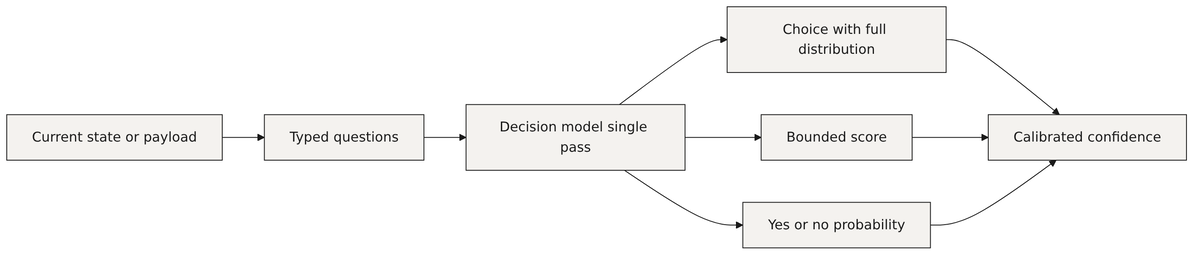
Decision models stopped being a niche idea in September 2026. TypeSafe left stealth on 15 September with Jev, its first model, and a $40M seed round led by DCVC, with founders Diogo Almeida, formerly of OpenAI, Erik Gafni, and Sasha Sheng announced alongside founders Diogo Almeida, formerly of OpenAI, Erik Gafni, and Sasha Sheng. Within two weeks the category had at least six serious entrants.
| Model | Maker | Licence | Notes |
|---|---|---|---|
| Jev 1.13 | TypeSafe | Closed | Hosted API only. No weights, no parameter count, no self-hosting option. |
| Strands Decider 2B | AWS | Apache 2.0 | Built on a Qwen3.5-2B base with the language-model head removed and replaced by a small pointer head. Runs locally. |
| Clef and Clef-flash | Cloudflare | Apache 2.0 | 27B and 9B variants, multimodal, served on Workers AI and published on Hugging Face. |
| Laya | Convai Innovations | Apache 2.0 | Encoder-based, 421M parameters, 100 or more languages. |
| Kev | Jared Palmer | Open | A family from 0.5B to 27B. Implements TypeSafe's request contract. |
| AnyJev | Nokia Applied Research | Open | A method, not a model. Adds a decision layer to an existing open LLM. |
| Jebadiah | Community | Apache 2.0 | 4B and 9B variants tuned on Apache 2.0 bases. |
Table: The decision model landscape as of early October 2026.
The presence of AWS and Cloudflare in that table is the strongest available signal that this is a structural shift rather than one company's positioning. Both shipped open models that implement the same conceptual interface, and AWS adopted TypeSafe's own vocabulary for the answer types. When a hyperscaler copies a startup's interface naming, the interface has usually won.
There is also a live example of the category boundary being drawn too loosely. Google DeepMind's DiffusionGemma, a generative text model that produces 256-token blocks in parallel, appears in some vendor comparison tables alongside genuine decision models on the Google DeepMind model page. It was published in June 2026, before Jev existed. Parallel generation is not the same as typed decision output, and treating the two as the same category is a mistake worth avoiding.
TypeSafe's headline claims are that Jev is dramatically faster and cheaper than a frontier model on decision-shaped tasks. Those claims are vendor-reported, and the vendor's own numbers are not mutually consistent. The launch post describes a range of 40 to 200 times faster, applied to speed. The company homepage states 193.6 times faster and 444.6 times cheaper. The two surfaces describe different quantities.
Independent parties have not reproduced the figures. One comparison site states the position plainly: the figures come from TypeSafe, and decisioneval.dev states plainly that it has not reproduced them. That is not an accusation. It is the normal status of a performance claim about a closed, hosted model released three weeks earlier.
Even where independent measurement exists, the results are more careful than the marketing. A reproducible harness that compared Jev against two frontier models on the same task found a per-task cost of roughly eight ten-thousandths of a cent against slightly over one cent, and accuracy of 67.8 percent against 67.9 and 67.8 percent for the two generative baselines. The cost and latency advantage is enormous and appears real. The accuracy advantage is approximately zero, which is a much more interesting and more useful finding than a large one.
[!ACCENT] The defensible claim for a decision model is not that it is more accurate. It is that it is accurate enough, and that it costs and takes so much less that you can afford to run it on every request.
The temptation to use a large language model as the decision layer comes from a reasonable place. It is the model you already have, it is general, and it requires no additional infrastructure. Three problems appear in production.
Inline guardrails have a hard latency budget, and a large model spends all of it. Published guidance on guardrail placement suggests allocating 20 to 50 milliseconds for evaluation within a response budget under 500 milliseconds, and notes that language-model-based intent classification can cost 200 to 500 milliseconds against sub-millisecond regex. Language-model-as-judge patterns are routinely described as costing hundreds of milliseconds to seconds. Those numbers are fine for a nightly batch job and fatal for an interception point in an interactive agent loop.
Every request through the decision layer pays the model's price. If the decision layer sits in front of every agent action, the decision layer's traffic is a multiple of the agent's own traffic. One practitioner analysis of in-band harm reduction measured the token overhead at between 50 and 200 percent, describing it as not a rounding error. A layer that doubles your token spend to make decisions is a layer that will be removed.
The failure mode that is easiest to underestimate is malformed output. A model that is asked to return one of three verdicts will almost always do so, and will occasionally return a sentence instead. In a control plane, an occasional unparseable response is not a small quality dent. It is an availability incident, because the code that consumes the verdict has no branch for the sentence.
A 2026 study of schema compliance in deployed systems put numbers on the gap: in an unconstrained setting, roughly 18 percent of small-model generations contained at least one structural violation, against roughly 6 percent for a larger model, a threefold difference, reported at KDD 2026 in Schema Guardrails in the Wild. Related work finds that structural and syntax failures account for a substantial share of incorrect outputs, often exceeding logic or semantic errors. The correction cost lands entirely on the calling application.
| Failure mode | Generative decision layer | Decision model decision layer |
|---|---|---|
| Unparseable response | Possible, needs a fallback branch | Not representable |
| Latency per decision | 200 to 500 ms typical | Tens of milliseconds |
| Cost scaling | Per decision, at frontier prices | Per decision, at small-model prices |
| Uncertainty available | Only if explicitly requested | Always returned |
| Behaviour on novel input | Confidently generative | Low confidence, if calibrated |
Table: Why the control plane and the reasoning plane want different primitives.
The honest conclusion is not that language models are bad at decisions. They are frequently good at decisions. It is that the correctness of a control plane should not depend on a component whose output format is a probability rather than a guarantee.
The most useful way to think about a decision layer is as a thin, synchronous tier between intent and effect. It is not an orchestrator and it is not a policy author. It answers questions, fast, on the critical path.
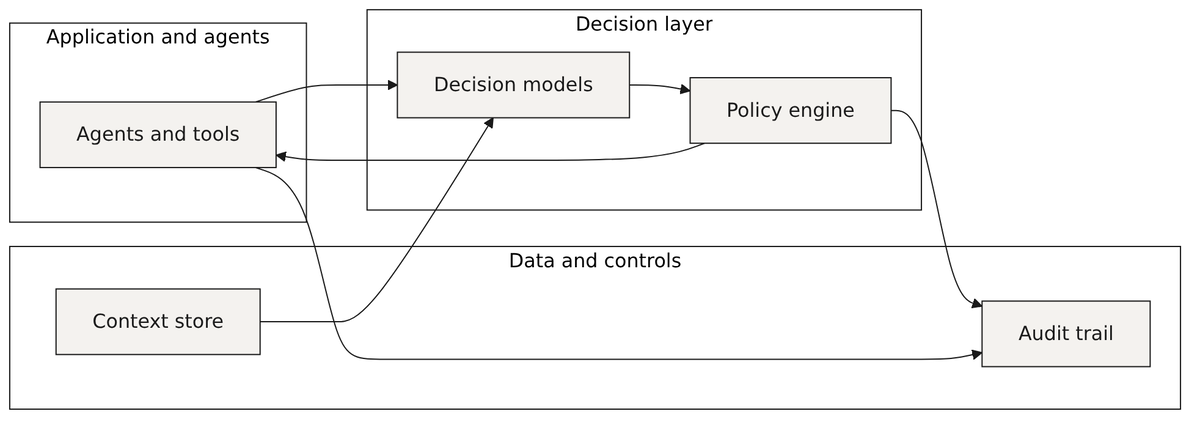 A workable decomposition has four parts:
The crucial design decision is that these tiers have different scaling and reliability characteristics. The agent tier is expensive, bursty, and tolerant of a second of latency. The decision tier is cheap, high-volume, and intolerant of more than a few tens of milliseconds. The record tier is write-heavy and must never block the request path. Collapsing them into one service is how teams end up with a governance mechanism that they cannot afford to run on every request.
A second design decision concerns where questions come from. Because the questions are supplied at request time rather than baked into the model, the decision tier can serve many teams from one deployment. A platform team can operate the inference and let domain teams author the question sets, in the same way that a database team operates storage and lets application teams author schemas. That is a materially different operating model from shipping a bespoke classifier per use case.
The confidence value is what turns a fast decision model into an architecture rather than a shortcut. If a model tells you it is 0.98 confident, and that number means something, you can act immediately on confident answers and escalate the rest to something slower and more expensive. This is cascade routing, and it is the reason decision models are interesting even to teams that already have strong classifiers.
Calibration itself is a well studied problem. The canonical reference is Guo et al. on calibration of modern neural networks Guo et al. published the canonical treatment of this in 2017, which is worth flagging as an older source: the finding that deep networks are systematically overconfident has been known for nearly a decade, and it applies to decision models as much as to the classifiers it originally described.
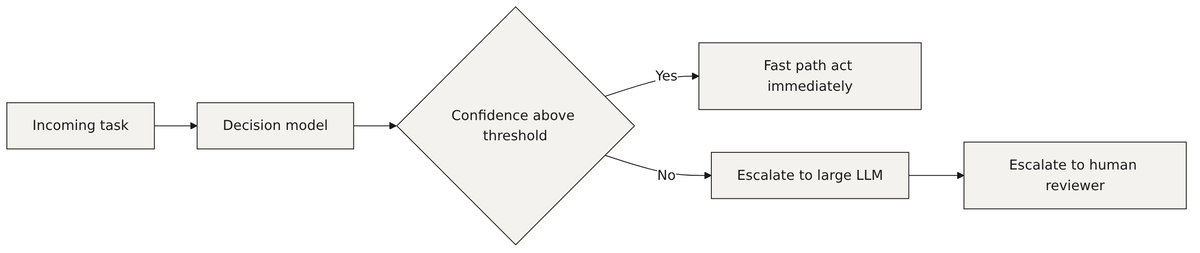
The evidence on whether cascading works is genuinely contested, and anyone evaluating a decision layer should know both sides.
The case for. A September 2026 study from Carnegie Mellon reports that accepting a decision model's confident verdicts and escalating the remainder to a frontier model produced a result 0.9 points more accurate than the frontier model alone on 1,610 held-out pairs, at 41 percent of that model's fee, according to the JEV-as-a-Judge study. The same work reports that where a verdict can be read directly off the text, the decision model lands within three points of the frontier model at 0.36 percent of the fee, and that it falls behind where the verdict has to be derived, as in mathematics, code, or logic.
The case against. A second 2026 paper reaches close to the opposite conclusion. On rubric judging, deferring a decision model's uncertain verdicts to a language model gains almost nothing, because the language model repeated 96.0 percent of the decision model's most confident errors, against an independence baseline of 50.3 percent. The mechanism is the important part: cascading only helps when the two models make independent errors. When they are wrong in the same places, the second opinion is not a second opinion.
| Finding | Direction | Source |
|---|---|---|
| Confident-accept plus escalate beat frontier alone by 0.9 points at 41 percent of the fee | Supports cascading | CMU, arXiv 2609.26550 |
| Deferral recovers at most 1.5 to 2.0 points where errors correlate | Against cascading | arXiv 2609.29769 |
| Confidence-aware routing cut inference cost 31 percent while reducing calibration error | Supports cascading | arXiv 2605.18796 |
| Confidence-based deferral can be suboptimal in theory and in practice | Against cascading | NeurIPS 2023 |
Table: The cascade routing debate, both sides.
The practical guidance that follows is not to pick a side. It is to measure the error correlation before you build a cascade. If your decision model and your escalation target make errors on the same inputs, escalation buys you almost nothing and you should spend the effort on a better first-stage question set instead. There is also direct evidence that confident answers are not automatically correct ones: one security analysis of a decision model found its confidence saturated at 1.0 on a majority of items, with several of those answers wrong. High stated confidence is a claim about the model's training distribution, not a fact about the world.
Governance is the use case where the latency argument stops being about cost and starts being about whether the control can exist at all.
An AI governance layer does a small number of things. It evaluates a proposed action against policy. It produces an enforcement decision, typically allow, block, or require human approval. It records what happened, immutably, so that the decision can be reconstructed later. It may pause an action in a queue until a named human approves it.
Every one of those operations is a decision. And because the governance layer sits in front of every agent action by definition, its cost and latency are multiplied by the entire agent fleet's traffic. This is the specific reason a governance layer that calls a frontier model for each policy evaluation is self-defeating. It becomes the most expensive and slowest component in the stack, and the first thing teams carve out under pressure.
The regulatory backdrop strengthens the argument without settling it. Article 14 of the EU AI Act requires that high-risk systems can be effectively overseen by natural persons, with oversight commensurate to the risks, level of autonomy, and context of use as set out in Article 14 of the EU AI Act. Human oversight that depends on a 400 millisecond model call per action does not scale to the volume it was written to cover. Note also that the high-risk obligations were rescheduled: Regulation (EU) 2026/1744 moved the stand-alone Annex III deadline to 2 December 2027, while the Article 50 transparency duties applied from 2 August 2026. Teams working to older dates should re-baseline.
Policy-as-code is the emerging implementation pattern, and it is worth being precise about its maturity. Toolkits such as Microsoft's agent governance policy engine implement hash-chained approval records, and community specifications describe tamper-evident audit trails. There is, as of this writing, no ratified standard for the format of a governance receipt. Treat it as emerging practice rather than as compliance you can certify against.
 A governance layer is also the natural consumer of a decision model, and the shape of the integration is worth describing concretely, because it is where the two ideas meet. A layer of this kind evaluates a proposed action against policy, produces one of the enforcement outcomes, and writes a hash-chained record of the outcome. Compass, Shakudo's governance agent for AI agents, is one example of this pattern: it sits between an agent and the actions it attempts, exposes policy as configuration, pauses high-risk actions for human approval, and maintains a chained audit log. It does not change how the agent reasons. It only governs what the agent is permitted to do.
The design reason a governance layer wants a decision model rather than a generative one is the same reason a firewall does not want a person behind it. The evaluation happens on every request, the possible answers are few and known in advance, and the record has to be complete. Any component with a 2 percent chance of returning prose is not a component you can put in that position.
[quote: loblaw-digital-2]
The category's most consequential split is not accuracy. It is licensing and deployment topology.
The flagship commercial decision model is a closed hosted API. Its vendor has published no weights, no parameter count, and no self-hosting option. For an organization with ordinary data handling requirements that is a normal buy decision. For a regulated bank, an air-gapped defense environment, or a public sector body, it is disqualifying, because it means every routing decision about internal content leaves the perimeter. As one industry write-up puts it, those environments need the pattern rather than the dependency.
This is where the open entrants matter, and the 2026 timing is not a coincidence. Within days of the category becoming visible, AWS, Cloudflare, Convai, and several independent developers published permissively licensed alternatives, and the size range is wide enough to cover a laptop and a data center. The decision layer is one of the few 2026 AI categories where a fully self-hosted stack is available on day one.
| Option | Cost profile | Data residency | Operating burden | Fits |
|---|---|---|---|---|
| Closed hosted API | Usage based, lowest unit cost | Data leaves the perimeter | None | Teams without residency constraints |
| Vendor-hosted open model | Usage based, higher unit cost | Data leaves the perimeter | Low | Teams wanting licence flexibility |
| Self-hosted open model | Infrastructure and staff | Full control | High, ongoing | Regulated, air-gapped, sovereign |
| Open method on existing LLM | Marginal, reuses current estate | Wherever your LLM runs | Moderate | Teams with a large self-hosted estate |
Table: Build, buy, and self-host, without the usual framing.
Two cautions belong with the table. First, open licence and open weights are different things. A model published under a permissive licence with weights on Hugging Face is not automatically OSI open source, and at least one 2026 entrant is open-weight while its hosted path costs several times the closed alternative. Read the licence, not the announcement. Second, there is a naming hazard: several unrelated projects share the name of the category's flagship model, and at least one published model card describes that flagship as open-weights, which is false. Verify the artifact you are downloading.
The self-hosting case is not primarily about cost at small scale. It is about owning the question set and the audit record. Running an open decision model inside your own boundary means that the routing decisions about internal content are made inside that boundary, which is the property regulated readers actually need.
[quote: whitecap-resources-4]
A decision model is a component with a lifecycle, not a service call. Treating it as the latter is the most common way these deployments decay, because the model is cheap enough to run everywhere and therefore easy to forget.
Four failure modes recur.
A minimal operating routine that addresses all four:
The metric that matters most is not accuracy. It is the escalation rate, because it is the only number that tells you simultaneously whether the decision model is competent for the traffic it is seeing and whether you are actually saving the money you built the layer for. A decision model whose escalation rate has crept from 5 percent to 40 percent is still accurate and no longer cheap.
Use this to assess a decision layer, or a decision model as a component, before it carries production traffic.
The decision layer is not a new kind of intelligence. It is a recognition that the enterprise AI stack has two very different jobs, and that they were being served by one component. Reasoning and deciding have different cost structures, different latency budgets, different failure modes, and different correctness requirements. Separating them is unglamorous work. It is also the difference between an agent platform that can be governed and one that merely can be demonstrated.
# blog/democratizing-manufacturing-how-ai-tools-empower-industry-4-0.md *[Source (/blog/democratizing-manufacturing-how-ai-tools-empower-industry-4-0)](https://www.shakudo.io/blog/democratizing-manufacturing-how-ai-tools-empower-industry-4-0) | [Markdown twin](https://www.shakudo.io/blog/democratizing-manufacturing-how-ai-tools-empower-industry-4-0.md)* ---

Artificial intelligence (AI) is transforming manufacturing at an unprecedented pace, ushering in the era of Industry 4.0—a new industrial revolution defined by automation, smart factories, and data-driven decision-making. AI is enhancing efficiency, precision, and adaptability in production, helping companies reduce costs, increase output, and optimize supply chains.
However, despite its advantages, AI adoption comes with challenges such as high infrastructure costs, data integration issues, and the need for skilled personnel. Many companies struggle with implementing AI solutions that seamlessly fit into their existing manufacturing processes.
This is where open-source AI tools and strategic partnerships come into play. By integrating open-source AI frameworks and collaborating with AI solution providers like Shakudo, manufacturers can overcome these hurdles and unlock the full potential of AI with minimal complexity.
The concept of Industry 4.0 is built on smart automation, data-driven manufacturing, and AI-enhanced decision-making. Companies like General Motors and Nvidia have demonstrated how AI-driven automation improves both vehicle manufacturing and autonomous driving capabilities. AI applications in manufacturing include:

With AI continuously evolving, manufacturers embracing these technologies will gain a competitive edge, increasing productivity while minimizing operational risks and costs.

Despite AI's immense potential, manufacturers face significant challenges in implementation, ranging from high infrastructure costs and integration complexities to security concerns and a shortage of skilled professionals.
Open-source AI frameworks, combined with collaborative partnerships between manufacturers and AI solution providers, offer a cost-effective and scalable approach to AI adoption. Companies like Shakudo provide an end-to-end AI operating system that integrates seamlessly with existing infrastructure, eliminating deployment challenges.
Shakudo enables manufacturers to:
General Motors (GM) has partnered with Nvidia to integrate AI into its autonomous vehicle development and factory automation. GM uses Nvidia’s AI chips and software to streamline production workflows, enhance efficiency, and automate quality control.
Manufacturers using AI-powered predictive maintenance systems have seen up to a 30% reduction in maintenance costs and 70% fewer unexpected equipment failures. AI-enabled systems process real-time data from sensors to predict and prevent breakdowns before they occur.
Smart factories powered by AI are improving operational efficiency by integrating real-time data analytics with robotics. AI monitors production, detects inefficiencies, and adjusts operations autonomously to maximize productivity.
AI is helping manufacturers forecast supply chain disruptions and optimize logistics. By analyzing global shipping patterns, raw material availability, and demand trends, AI-driven supply chain models enable real-time adjustments, reducing bottlenecks and preventing costly delays.
For manufacturers looking to integrate AI, there are two main approaches:
Companies can attempt to develop in-house AI solutions by:
Challenges: High costs, long deployment times, and ongoing maintenance requirements.
Instead of building from scratch, manufacturers can use an AI operating system like Shakudo to:
By choosing Shakudo, manufacturers can implement AI faster, cheaper, and with minimal complexity, allowing them to focus on production instead of infrastructure challenges.
As AI adoption accelerates, manufacturers that invest in smart automation, data-driven decision-making, and AI-enhanced workflows will maintain a competitive edge. Future trends include:
The path to AI-driven manufacturing doesn’t have to be complex or costly. With Shakudo’s AI operating system, manufacturers can integrate AI seamlessly, optimize production, and unlock new levels of efficiency.
Ready to revolutionize your manufacturing operations with AI? Connect with one of our experts or sign up for an AI workshop today.
# blog/demystifying-ai-and-ml-for-tech-stacks-myths-vs-realities.md *[Source (/blog/demystifying-ai-and-ml-for-tech-stacks-myths-vs-realities)](https://www.shakudo.io/blog/demystifying-ai-and-ml-for-tech-stacks-myths-vs-realities) | [Markdown twin](https://www.shakudo.io/blog/demystifying-ai-and-ml-for-tech-stacks-myths-vs-realities.md)* ---Artificial intelligence (AI) and machine learning (ML) are the shiny new tools in every business toolkit. They’re helping companies tackle problems, rethink strategies, and innovate faster than ever. But here’s the thing: they’re often surrounded by so much buzz (and let’s be honest, a fair bit of confusion) that it’s hard to know what’s real and what’s not.
The truth is, AI and ML are powerful, but they’re not magic. To use them effectively, especially in the tricky world of data management, you need to separate fact from fiction. Let’s break down some of the most common myths holding businesses back and get a clearer picture of how these tools can actually deliver value.
Reality: Think of AI like a world-class chef—it can only create something amazing if it has the right ingredients. If your data is incomplete, messy, or just plain bad, your AI system won’t magically fix it. In fact, bad data leads to bad results, and that can cost businesses big—at least 15–25% of their revenue, adding up to a minimum of 3.1 trillion USD according to studies.
The Path Forward: Start with clean, structured data. It’s not glamorous work, but it’s essential. A platform like Shakudo makes it easier by combining the best data preparation tools into one streamlined system. Instead of spending hours trying to untangle messy spreadsheets, you’ll have a clear, actionable dataset that sets your AI projects up for success.
Reality: This might have been true a decade ago, but not anymore. Today, thanks to cloud computing and scalable solutions, even small and medium-sized businesses (SMEs) can take advantage of AI. In fact, McKinsey found that in 2024, more than 65% of organizations (yes, including smaller ones) are using AI in at least one part of their business.

The Path Forward: You don’t have to go all in from the start. Many businesses find success by starting small—focusing on one or two specific challenges—and then scaling up as they see results. A good solution is a “buy then build” model that lets you start with ready-made tools and tweak them as your needs evolve. It’s a practical, budget-friendly way for companies to implement AI.
Reality: Here’s the hard truth: AI is only as fair as the data it’s trained on. If your historical data is biased (and let’s face it, a lot of data is), those biases will show up in your AI’s decisions. For example, recruitment algorithms have been known to favor male candidates because they were trained on datasets dominated by men.
The Path Forward: Tackling bias is an ongoing effort—it’s not a “set it and forget it” situation. Companies need to build processes to regularly test and monitor their AI systems for fairness. Tools designed to detect bias, paired with governance frameworks, can help ensure your AI delivers outcomes that align with both ethical standards and your business’s values.
Reality: The idea that you need a team of data scientists to use AI effectively is outdated. Sure, building an AI system from scratch requires serious expertise, but most businesses don’t need to reinvent the wheel. Thanks to pre-built models and user-friendly platforms, even teams without technical know-how can implement AI solutions.
The Path Forward: Platforms like Shakudo are a game-changer here. They handle the complex backend operations, so your team can focus on what matters: using AI insights to drive decisions. By simplifying the technical side of things, these tools make AI accessible to a wider range of businesses and teams.
Reality: AI is powerful, but it’s not a “one-size-fits-all” solution. If you don’t have clear goals or a solid strategy, AI won’t magically solve your problems. And if your expectations are unrealistic, you’re setting yourself up for frustration.
The Path Forward: Think of AI as a tool to enhance human decision-making—not a replacement for it. The best results come when AI’s capabilities are combined with your team’s domain knowledge and strategic oversight. In other words, AI should work with you, not instead of you.
If there’s one takeaway here, it’s this: success with AI and ML isn’t about jumping on the bandwagon or chasing trends. It’s about understanding what these tools can and can’t do, aligning them with your goals, and making sure your data is up to par.
Platforms like Shakudo make it easier to navigate this process. By bringing together the best tools for data preparation, cleansing, and analysis in one place, they simplify the technical side of AI, leaving you free to focus on what really matters—delivering value.
Ready to take the first step? Book a demo with Shakudo today and see how AI can help unlock new possibilities for your business.
# blog/demystifying-llm-leaderboards-what-you-need-to-know.md *[Source (/blog/demystifying-llm-leaderboards-what-you-need-to-know)](https://www.shakudo.io/blog/demystifying-llm-leaderboards-what-you-need-to-know) | [Markdown twin](https://www.shakudo.io/blog/demystifying-llm-leaderboards-what-you-need-to-know.md)* ---The Large Language Model Powered Tools Market Report estimates that the global market for LLM-powered tools reached USD 1.43 billion in 2023, with a projected growth rate of 48.8% CAGR from 2024 to 2030. Yes—new LLM tools are entering the market at a rapid pace, making it increasingly challenging to select the right tool for different targeted use cases.
With such rapid growth in the diversity of options, a robust evaluation system that assesses the various strengths, weaknesses, and characteristics of these models is essential to ensure that users can make informed decisions and choose tools that align with their objectives and use cases.
Enter LLM Leaderboards. By definition, these leaderboards are a framework used to compare the performance of existing natural language models. They offer different perspectives on LLM performance, covering aspects like general knowledge, coding, medical expertise, and more.
To help you navigate this landscape, we’ve curated a list of the top 10 most popular and versatile leaderboards that we think are the most valuable in the current market for anyone looking to make informed decisions in model selection. Each of these leaderboards offers unique insights and metrics that can guide you in evaluating the performance of various language models, ensuring that you choose the right tool for your specific needs.
While leaderboards can use a range of evaluation metrics such as classification, accuracy, F1 score, and perplexity, these metrics are quite query-specific depending on the specific tasks the language models are being evaluated on.
Generally speaking, to be considered high-performing, a natural language model needs to excel in the following benchmarks:
Accuracy, while seemingly straightforward, is a fundamental metric in evaluating the performance of language models. It is typically defined as the ratio of correct predictions made by the model to the total number of predictions. In other words, accuracy measures how often the language model's outputs align with the expected or true outcomes.
In the context of LLMs, accuracy can be particularly crucial in tasks such as classification, where the model must categorize inputs correctly. For instance, in sentiment analysis, a model’s ability to accurately determine whether a piece of text expresses positive, negative, or neutral sentiment is a direct reflection of its accuracy.
F1-score refers to a specific metric used to evaluate the performance of language models on tasks that involve classification or information retrieval. The F1-score combines precision and recall into a single metric, providing a balance between the two.
The F1 score is calculated using the formula:

**Precision measures the proportion of true positive results among all positive predictions, indicating how many selected items are relevant.
**Recall measures the proportion of true positive results among all actual positive cases, indicating how many relevant items were selected.
An F1 score ranges from 0 to 1, where 1 indicates perfect precision and recall. In the context of LLM leaderboards, a higher F1 score signifies better model performance on tasks like sentiment analysis, named entity recognition, or other classification tasks, helping researchers compare different models effectively.
The BLEU (Bilingual Evaluation Understudy) evaluates the quality of machine-translated text against human translations. It compares machine-generated texts to reference texts and calculates the similarity based on phrase consistency and overall structure.
The BLEU score is calculated using this formula:

**w_n is the weight applied to the n-gram accuracy score. Weights are often set to 1/n, where n refers to the number of n-gram sizes utilized
**p_n represents the precision rating for the n-gram size
The BLEU scores range from 0 to 1, with 1 being a perfect match to the reference translation. In practice, scores of 0.6-0.7 are considered very good.
While more expensive and time-consuming, human reviewers can evaluate LLM outputs based on criteria like relevance, factuality, and fluency. This evaluation metric incorporates human judgment on factors like coherence and relevance.
Human evaluations can capture nuanced aspects of language and meaning that automated systems might overlook, making them invaluable for tasks requiring a deeper understanding of context and intent. However, the key to such evaluation often involves creating structured rubrics or guidelines to ensure consistency across different human evaluators.
Perplexity measures how well a language model predicts a sample of text. It's calculated as the inverse probability of the test set normalized by the number of words.
The perplexity score is calculated using the formula:
Perplexity = exp(-1/N * sum(log P(w_i)))
**N is the number of words
**P(w_i) is the probability assigned to each word by the model
A lower score indicates that the model is more certain about its predictions, which is generally associated with better model performance. This is because a lower perplexity means the model is assigning higher probabilities to the actual words in the text, suggesting it has a better understanding of the underlying patterns and structures of the language. Conversely, a higher perplexity score indicates greater uncertainty, meaning the model struggles to predict the next word effectively.
Now, let’s get to the heart of our discussion.
As of September 2024, several prominent LLM leaderboards are actively monitoring and evaluating the performance of large language models across a diverse range of benchmarks and tasks. These leaderboards provide invaluable insights into how different models stack up against each other, helping researchers and practitioners understand the strengths and weaknesses of various approaches.
Here are some of the top LLM leaderboards you should know about:

The Hugging Face Open LLM Leaderboard is an automated evaluation system that evaluates models across six tasks including reasoning and general knowledge. It uses the Eleuther AI Language Model Evaluation Harness as its backend for evaluating and benchmarking large language models, allowing any causal language model to be evaluated using the same inputs and codebase, ensuring comparability and reproducibility of results.
The leaderboard uses 6 main tasks to assess model performance, including:
ARC (AI2 Reasoning Challenge) evaluates a model's ability to answer grade-school level, multiple-choice science questions. It tests reasoning skills and basic scientific knowledge.
HellaSwag assesses common sense reasoning and situational understanding. Models must choose the most plausible ending to a given scenario from multiple options.
MMLU (Massive Multitask Language Understanding) is a comprehensive benchmark covering 57 subjects across fields like mathematics, history, law, and medicine. It tests both breadth and depth of knowledge.
TruthfulQA measures a model's ability to provide truthful answers to questions designed to elicit false or misleading responses. It assesses the model's resistance to generating misinformation.
Winogrande evaluates commonsense reasoning through pronoun resolution tasks. Models must correctly identify the antecedent of a pronoun in sentences with potential ambiguity.
GSM8K (Grade School Math 8K) tests mathematical problem-solving skills using grade school-level word problems. It assesses a model's ability to understand, reason about, and solve multi-step math problems.

Scale AI created the SEAL (Safety, Evaluations, and Alignment Lab) to address common problems in LLM evaluation, like biased data and inconsistent reporting. It addresses a major hurdle in AI development: the race to the bottom caused by companies manipulating benchmarks to make their LLMs appear better. This often leads to contamination and overfitting, where models learn to perform well on specific tests but struggle in real-world applications.
These leaderboards utilize private datasets to guarantee fair and uncontaminated results, and cover areas like adversarial robustness and coding. Regular updates ensure the leaderboard reflects the latest in AI advancements, making it an essential resource for understanding the performance and safety of top LLMs.

The MTEB (Massive Text Embedding Benchmark) Leaderboard is an automated evaluation system for comparing and ranking embedding models. It uses multiple tasks to assess model performance across various embedding-related tasks and focuses on text embeddings across 8 tasks and 58 datasets. As of September 2024, this leaderboard evaluates 33 models on 112 languages.
The MTEB leaderboard is commonly used to find state-of-the-art open-source embedding models and evaluate new work in embedding model development.

BigCodeBench is a new benchmark for evaluating LLMs on practical and challenging programming tasks; it includes 1,140 function-level tasks designed to challenge LLMs in following instructions and composing multiple function calls using tools from 139 libraries. To ensure a thorough evaluation, each programming task features an average of 5.6 test cases with a branch coverage of 99%.
The tasks use HumanEval and MultiPL-E benchmarks and are designed to mimic real-world scenarios, requiring complex reasoning and problem-solving skills. This makes the benchmark more relevant for assessing practical coding capabilities.

LMSYS is a benchmark platform for evaluating LLMs through crowdsourced, anonymous, randomized battles. It features a crowdsourced evaluation system where users can interact with two anonymous models side-by-side and vote on which one they believe performs better. This method leverages real-world user interactions to assess model performance effectively.
Utilizing the Elo rating system, commonly associated with chess, LMSYS ranks LLMs based on their results in these head-to-head comparisons. On the other hand, the Diverse Model Inclusion ensures that both open-source and closed-source models are represented, allowing for comprehensive evaluations across different types of LLMs.

The Artificial Analysis LLM Performance Leaderboard is a comprehensive evaluation platform that provides a wide range of performance metrics, including quality, speed, latency, pricing, and context window size, allowing for a holistic assessment of LLM capabilities.
The leaderboard evaluates models under various conditions, including different prompt lengths (100, 1k, 10k tokens) and parallel query scenarios (1 and 10 queries). It benchmarks LLMs on serverless API endpoints and the data is refreshed frequently, with each API endpoint tested 8 times per day, ensuring the information remains current and relevant. This makes it a rather important resource for businesses looking to select the most appropriate LLM to improve customer insights.

As you can see from its name, the Open Medical LLM Leaderboard evaluates language models specifically for medical applications, assessing their performance on relevant medical tasks.
Unlike other general-purpose LLM leaderboards, this one specifically targets medical knowledge, which is crucial for developing AI tools for healthcare applications.
The platform assesses LLMs across various medical datasets, including MedQA, PubMedQA, MedMCQA, and medicine-related subsets of MMLU, providing a broad evaluation of medical knowledge and reasoning capabilities.
The HHEM model series is designed to detect hallucinations in LLMs. These models are especially valuable for building retrieval-augmented generation (RAG) applications, where an LLM summarizes a set of facts. HHEM can then be used to assess how factually consistent this summary is with the original information.

Here’s another pretty industry-specific leaderboard—EvaPlus focuses on coding and programming tasks and uses enhanced versions of existing benchmarks (HumanEval+ and MBPP+) to provide more thorough testing of code generation capabilities.
EvalPlus goes beyond just checking if the code compiles or has the correct syntax. It tests whether the code actually produces the correct output for a wide range of inputs, including edge cases, meaning unusual or extreme inputs that can reveal subtle bugs or limitations in the code.

EQBench assesses LLMs' ability to understand complex emotions and social interactions in dialogues, specifically targeting the emotional intelligence of LLMs that is not commonly assessed by other platforms. Its scores correlate strongly with comprehensive multi-domain benchmarks like MMLU (r=0.97), suggesting it captures aspects of broad intelligence.
True, LLM leaderboards are invaluable for measuring and comparing the effectiveness of language models as they foster a dynamic environment for competition, setting standards that facilitate model development. However, these benchmarks are not perfect.
Multiple-choice tests for evaluating language models can be fragile, minor changes such as a difference in response order will lead to significant score variations. Data contamination, on the other hand, can occur when the models are trained on datasets that are already used by these benchmark models, resulting in varying model performance on different sites.
That is to say, if you’re looking for the best LLM tool to use, instead of relying on general leaderboards, create benchmarks tailored to your specific use case or application so that your results stay true to your specific needs.
To learn more about why you should explore the best LLM tools in the market and how to leverage them to accelerate your business growth, contact our Shakudo team. Our team is dedicated to providing you with valuable insights that help you make informed decisions and navigate the rapidly evolving landscape of AI technology. Let us guide you in discovering the most effective tools tailored to your specific needs!
# blog/deploy-ai-agents-on-kubernetes.md *[Source (/blog/deploy-ai-agents-on-kubernetes)](https://www.shakudo.io/blog/deploy-ai-agents-on-kubernetes) | [Markdown twin](https://www.shakudo.io/blog/deploy-ai-agents-on-kubernetes.md)* ---The conversation has officially shifted from "can we build AI agents?" to "can we trust them in production?" For engineering and platform teams, that question has a very specific answer: it depends entirely on the infrastructure underneath the agent. And in 2026, that infrastructure is Kubernetes.
The CNCF Annual Cloud Native Survey, released January 20, 2026, confirms that Kubernetes has solidified its role as the de facto operating system for AI, with 82% of container users now running it in production environments. That number was 66% just two years ago. The acceleration is structural, not cyclical — and it has direct implications for every team trying to deploy ai agents on kubernetes at enterprise scale.
Kubernetes didn't become the foundation for AI workloads by accident. The platform has become the common denominator for cloud native scale, stability, and innovation — evolving beyond orchestration to become the backbone of enterprise infrastructure. When your AI agents need to call internal APIs, query Prometheus metrics, pull pod logs, interact with CI/CD systems, and route decisions through an LLM, you need an orchestration layer that already speaks the language of all those systems natively.
Running agents on Kubernetes makes sense once you go beyond toy projects. Organizations are already running workloads in clusters, and Kubernetes provides scaling, reliability, and integration with the very systems — CI/CD, observability, GitOps — that agents need to interact with.
The numbers back this up. According to the 2025 CNCF data, 66% of organizations using generative AI rely on Kubernetes for some or all of their AI inference workloads. And with 57% of companies already running AI agents in production and 81% planning to expand into more complex multi-step use cases in 2026, the demand for a disciplined, kubernetes ai agent framework is acute.
Most teams hitting production with AI agents have been doing it the hard way — stitching together Python frameworks, kubectl wrappers, custom GitOps scripts, and ad-hoc Prometheus connectors into something that works on a good day. Kagent is an open-source framework purpose-built to bring agentic AI into Kubernetes. Instead of gluing together your own kubectl wrappers, GitOps scripts, and Prometheus connectors, kagent gives you a runtime where those capabilities already exist.
Kagent was accepted to the CNCF on May 22, 2025 at the Sandbox maturity level, making it the first agentic AI framework to receive that designation. Introduced by Solo.io, kagent is an open-source framework designed to help users build and run AI agents to speed up Kubernetes workflows — offering tools, resources, and AI agents that help automate configuration, troubleshooting, observability, and network security, with an architecture built on the Model Context Protocol (MCP).
The framework is built around three core layers:
The declarative model is what separates kagent from DIY approaches. Rather than imperative Python scripts that are fragile and opaque, you define agents as YAML manifests and manage them like any other Kubernetes resource. Kagent is designed to be declarative — you define agents and tools in a YAML file. That means GitOps, version control, peer review, and rollback all apply to your agent fleet the same way they apply to your application deployments. If you're weighing whether to build this layer yourself or adopt an existing framework, our build vs. buy breakdown for enterprise AI agents covers the tradeoffs in detail.

Here is a concrete walkthrough of what deploying an ai agent kubernetes setup looks like with kagent.
Prerequisites: A running Kubernetes cluster, Helm, and an API key for a supported LLM provider. Kagent supports multiple LLM providers including OpenAI, Azure OpenAI, Anthropic, Google Vertex AI, Ollama, and any other custom providers accessible via AI gateways. Providers are represented by the ModelConfig resource.
Step 1: Install kagent via Helm
Install the CRDs first, then the kagent control plane:
Then install the kagent chart with your LLM provider credentials.
Step 2: Store your LLM API key as a Kubernetes Secret
Keeping credentials in Kubernetes Secrets (ideally backed by a secrets manager like Vault or AWS Secrets Manager) is the baseline for any production deployment. Hardcoding credentials in manifests or environment variables is a common mistake that creates serious security exposure at scale.
Step 3: Define your Agent as a custom resource
The kagent controller detects the new Agent custom resource and provisions the necessary pod, wiring up the tools and LLM configuration automatically.
Step 4: Interact with your agent
You can now issue natural language requests directly to the agent: "Why are pods in the payments namespace restarting?" The agent will query logs, check recent events, run Prometheus queries, and synthesize a diagnosis — all within your cluster, without any data leaving your environment.

For BYO (Bring Your Own) agents written in LangChain, CrewAI, or Google ADK, kagent supports importing agents from any provider — so if your team is already writing agents in Python with CrewAI, ADK, or LangChain, kagent lets you bring those into the Kubernetes-native runtime. The only additional requirement is containerizing the agent with a Dockerfile.
Getting an agent running in a dev cluster is a 30-minute exercise. Getting it production-ready for a regulated enterprise is a different project entirely. Agents are autonomous and non-deterministic — you cannot predict which agents will talk to other agents or what actions they will take, which presents a complex problem for security, monitoring, and observability. Here are the pillars that actually matter:

Every agent should run under a dedicated Kubernetes ServiceAccount with namespace-scoped roles granting only the permissions that agent explicitly needs. Dedicated ServiceAccounts prevent privilege creep by ensuring workloads do not share a single identity — a common issue with the default account. An agent that reads pod logs has no business touching Secrets or modifying deployments.
LLM API keys and internal credentials must never be hardcoded in manifests. Use Kubernetes Secrets backed by external vaults, with short rotation cycles. This model becomes brittle at scale, especially for non-deterministic AI systems that spin up and down dynamically — the emerging best practice is eliminating long-lived secrets and replacing them with short-lived, identity-based access that is continuously validated and audited.
For any action that modifies cluster state — scaling a deployment, deleting a resource, triggering a rollback — require explicit human approval before execution. This is not optional in regulated environments; it is a compliance requirement.
AI observability for agents means the ability to monitor and understand everything an agent is doing — not just whether an API returns a response, but what decisions the agent made and why. Traditional app monitoring might tell you a request succeeded; AI observability tells you if the answer was correct, how the agent arrived at it, and whether the process can be improved. Integrate with Prometheus for metrics, OpenTelemetry for traces, and treat agent definitions — their system prompts, tool bindings, LLM configurations — as code. Commit them to Git, review them in pull requests, promote them through environments. The CNCF survey identifies a clear link between operational maturity and the use of standardized platforms, noting that 58% of "cloud native innovators" use GitOps principles extensively, compared to only 23% of "adopters."
For healthcare, finance, and government workloads, data residency is non-negotiable. Run model inference within your own cluster using Ollama or a private model endpoint. Strip PII from any payloads that route to external LLMs. Audit every outbound call.
The pilot-to-production gap is real and well-documented. 65% of enterprise leaders cite agentic system complexity as the number one barrier to deployment. The challenge is not building a prototype — every team can spin up a LangChain agent in an afternoon. The challenge is getting that agent through IT security review, integrated with production data sources, audited for every action, and scaled across a fleet of clusters without fragile DIY orchestration. The full scope of what that transition actually requires is laid out in our guide to taking agentic AI from demo to production.
Gartner predicts that by 2026, 40% of enterprise applications will feature embedded task-specific agents, up from less than 5% in early 2025. That growth trajectory is only achievable if the infrastructure underneath agents is as mature as the agents themselves. Deploying AI agents at scale presents a familiar challenge for DevOps teams: the gap between what works locally and what runs in production. The Model Context Protocol standardizes how AI agents access tools and data sources, but enterprises require more than connectivity — they need authentication, observability, and governance layers that production environments demand.
Kagent addresses the growing complexity of cloud-native operations by automating routine troubleshooting, reducing the need for specialist intervention in common scenarios, and enabling teams to formalize operational expertise. Enterprise-grade capabilities on top of the open source project include advanced management features, observability tools, and multicluster federation support.
For enterprises in healthcare, financial services, and government that cannot route sensitive data through public APIs, the open-source kagent foundation is necessary but not sufficient on its own. What regulated industries need is the full enterprise stack assembled around it: secrets management pre-integrated, network policies pre-enforced, observability pipelines pre-wired, and a compliance-ready audit trail built in from day one.
That is the problem Kaji solves. Kaji is Shakudo's enterprise AI agent — the intelligence layer that runs within Shakudo's AI operating system, which deploys entirely within an organization's own cloud VPC (AWS, Azure, GCP) or on-premises infrastructure. All queries, outputs, and institutional knowledge stay within the enterprise perimeter. External LLMs can be used with zero-retention guarantees, and Shakudo's AI Gateway strips PII and PHI from payloads before they leave the VPC.
Where most platform teams spend months stitching together agent runtimes, LLM configurations, secrets management, and audit pipelines, Shakudo delivers a production-grade kubernetes ai agent environment with 200+ prebuilt connections to data, engineering, and business tools — already running in your cluster, already integrated with Slack and Teams, and already capable of executing complex multi-step workflows across your tech stack. Kaji is human-in-the-loop by design, pausing for approval before irreversible actions, which satisfies the governance requirements that 75% of enterprise leaders cite as their primary deployment blocker.
Kagent open source ai agents kubernetes is the right starting point for any platform team that wants Kubernetes-native agent orchestration without vendor lock-in. The declarative model, the CNCF backing, and the MCP-native tooling architecture are all strong signals of a project with long-term staying power. As CNCF CTO Chris Aniszczyk put it, "Kubernetes is no longer a niche tool; it's a core infrastructure layer supporting scale, reliability, and increasingly AI systems."
For enterprises that cannot spend six months assembling the security and compliance layer themselves, Shakudo wraps that full stack around the kagent paradigm — turning a months-long infrastructure project into a days-long deployment.
Either way, the path to production runs through Kubernetes. The question is how much of it you want to build yourself.
Ready to deploy AI agents in production? Explore Kaji to see how Shakudo delivers a Kubernetes-native enterprise AI agent environment — data-sovereign, compliance-ready, and pre-integrated with your existing stack.
# blog/deploy-ai-agents-on-premise.md *[Source (/blog/deploy-ai-agents-on-premise)](https://www.shakudo.io/blog/deploy-ai-agents-on-premise) | [Markdown twin](https://www.shakudo.io/blog/deploy-ai-agents-on-premise.md)* ---Deployment location is only one part of a sovereign AI decision. Before choosing on-premises infrastructure, compare it with private VPC, air-gapped, and hybrid models in our architecture guide, then use the platform evaluation scorecard to test vendors against your control requirements.
The pressure is undeniable. Forty percent of enterprise applications will be integrated with task-specific AI agents by 2026, up from less than 5% today. Yet for most regulated enterprises, the path from that ambition to production-running agents on their own infrastructure is anything but clear. Two forces are colliding: compliance mandates that make cloud-based AI legally risky, and the brutal engineering reality of assembling a production-grade AI stack on Kubernetes from scratch.
This is not a theoretical problem. It is the central deployment challenge of 2026.
The agentic AI conversation in boardrooms is far ahead of what most engineering teams can actually deliver. Business leaders are prioritizing security, compliance, and auditability (75%) as the most critical requirements for agent deployment, and leading teams are embedding privacy by design and segmenting sensitive data to trace and remediate issues early, with these safeguards becoming foundational to scaling agents responsibly in 2026. The mandate is clear. The mechanism is not.
Meanwhile, McKinsey's State of AI report found only 23% of enterprises are actually scaling AI agents, with another 39% stuck in experimentation, and the gap between announcement and deployment has never been wider. The enterprises that move from pilot to production fastest will compound their advantage. Those that stay stuck in infrastructure assembly will not.
There are two dominant failure modes. The first is reaching for a cloud-hosted agent platform and discovering that it is incompatible with data governance requirements. The second is deciding to build on-prem AI agent infrastructure internally and watching the timeline balloon from weeks into months. Understanding both traps is the prerequisite for avoiding them.
For organizations in healthcare, financial services, and government, the issue with cloud-based agentic AI is not capability. It is sovereignty. Every query processed by an external LLM endpoint, every prompt containing internal business context, every agent action log that leaves the organizational perimeter represents a potential compliance violation.
The regulatory pressure is becoming structural, not optional. The EU AI Act entered into force on 1 August 2024, with governance rules and obligations for general-purpose AI models becoming applicable on 2 August 2025, and the rules for high-risk AI systems applying on 2 August 2026. Organizations that deploy cloud-connected AI agents handling sensitive data are increasingly exposed as these enforcement phases activate.
As enterprises move deeper into generative AI adoption, staying compliant is no longer a matter of good practice — it is a matter of operational survival, with frameworks like the EU AI Act, the NIST AI Risk Management Framework, and ISO/IEC 42001 defining how organizations design, deploy, and monitor AI systems in 2026. Cloud AI deployments that send sensitive payloads to external providers simply cannot satisfy these requirements without significant architectural compromise. Our nine AI governance frameworks reshaping enterprise compliance breaks down exactly how each framework maps to deployment architecture decisions.
The calculation changes entirely when all inference, all data, and all agent outputs remain inside the organizational perimeter. On-prem agentic AI infrastructure is not a technical concession; it is a strategic prerequisite for regulated industries that want to move fast without creating compliance exposure.
So the answer is on-prem. Fine. But what does it actually take to deploy an ai agent on kubernetes in a production-ready configuration? Most teams discover the answer the hard way.
A self-assembled on-prem agentic AI stack requires teams to independently source, configure, integrate, and harden each of the following layers:
90% of respondents expect their AI workloads on Kubernetes to grow in the next 12 months, with the average Kubernetes adopter now running clusters in more than five environments, driven by multicloud strategies, on-prem repatriation, and AI needs. The organizations navigating this well are consolidating onto platform engineering models rather than treating each component as a separate DIY project.

The raw cost of the DIY path is significant. Platform engineering salaries often approach $200,000 a year, and those engineers spend months assembling infrastructure rather than shipping value. According to the State of Production Kubernetes 2025 report, 88% of teams report year-over-year TCO increases for Kubernetes, and that pressure intensifies when GPU infrastructure enters the equation. A survey of 917 Kubernetes practitioners found that 54% struggle with GPU cost waste averaging $200,000 annually.
The outcome for most teams that attempt a full DIY build is predictable: senior engineers become infrastructure plumbers, pilot timelines stretch from weeks to quarters, and the business stakeholders who commissioned the AI initiative lose confidence before a single agent reaches production. The build vs. buy decision for AI agents deserves rigorous analysis before committing either path.
The components above describe the minimum viable stack for running an ai agent on prem. But production-grade on-prem agentic AI infrastructure demands more than connectivity between components. It requires operational maturity across several dimensions that are easy to underestimate during the design phase.
Multi-agent orchestration and reliability. Running a single agent in isolation is architecturally simple. Coordinating multiple agents across a shared environment requires explicit handling of race conditions, task delegation, failure recovery, and resource contention. A 2026 production system coordinates agents across CRM, inventory, support ticketing, and payment systems, with each agent handling specialized tasks while a supervisor orchestrates the whole workflow. The architecture complexity jumps by an order of magnitude, as does the operational risk if governance is not in place.

Compliance documentation and audit trails. Regulated organizations cannot simply deploy agents and trust that they behave correctly. Before launching a proof of concept, enterprises must prove that controls function in runtime, and in the 2026 compliance environment, screenshots and declarations are no longer sufficient — only operational evidence counts. Every agent action, every model call, and every data access must produce a verifiable audit record.
Human oversight by design. The most operationally robust agentic deployments are not fully autonomous by default. They are designed with checkpoints at which agents pause and request human approval before executing high-stakes or irreversible actions. Building this into a self-assembled stack is possible, but it requires deliberate architectural investment that many teams skip during initial builds.
The demand for on-prem agentic AI infrastructure is not hypothetical. Enterprises across sectors are already deploying agents in production, and the patterns are instructive.
A financial services company is building agentic workflows to automatically capture meeting actions from video conferences, draft communications to remind participants of their commitments, and track follow-through. For a financial institution, this workflow must process internal meeting content without that data leaving the organizational perimeter. Cloud-hosted agents are not viable here. The full scope of what is now possible is documented in our big book of AI agent financial services use cases.
In the public sector, AI agents are being used to cover workforce shortages, partnering with human workers to complete key processes. Government agencies operating under federal data handling mandates require complete network isolation and verifiable audit trails for every agent action — requirements that on-prem deployment satisfies by design.
In healthcare, agents that surface patient data insights, automate prior authorization research, or assist clinical documentation must never route PHI through external LLM endpoints. The HIPAA exposure alone makes cloud-connected agentic AI a non-starter for most health systems without complex data scrubbing architectures.
For teams actively evaluating how to deploy ai agent on kubernetes or selecting on-prem agentic ai infrastructure, several decisions have outsized consequences.
Hardware and cluster topology. GPU scheduling in Kubernetes requires node taints, tolerations, and resource quotas configured explicitly for AI workloads. Teams that treat GPU nodes like standard compute nodes discover contention, underutilization, and instability quickly. The infrastructure must be designed for AI-specific scheduling from the start.
Model selection for air-gapped deployments. Not all open-weight models perform equivalently in sovereign deployments. Model size, quantization strategy, and hardware compatibility must be evaluated against actual workload requirements before infrastructure is provisioned around a specific model family.
Network isolation and zero-trust policy. On-prem agent infrastructure must enforce strict network policies at the pod level. Agent components should not have unrestricted egress, even within the cluster. Secrets management and API key rotation should be automated, not manual.
Observability from day one. Distributed tracing for agent actions, token usage monitoring, latency histograms per model endpoint, and alert routing for agent failures are not optional features to add later. As AI moves from experimentation to deployment, governance is the difference between scaling successfully and stalling out, and enterprises where senior leadership actively shapes AI governance achieve significantly greater business value than those delegating the work to technical teams alone. Building observability into the initial deployment is the practice that separates teams that scale from teams that stall.
Compliance documentation architecture. Audit trail requirements vary by jurisdiction and industry, but the baseline expectation is an identity-linked, immutable record of every agent action, tool call, and model output. This record must be queryable for incident response and exportable for regulatory review.
For enterprises that have assessed the build-from-scratch path and recognized the cost, Kaji offers a fundamentally different approach to on-prem agentic AI infrastructure.
Shakudo, the underlying platform, deploys entirely within an organization's own VPC, on-premises data center, or private cloud — the customer's infrastructure, governed by the customer's policies. Kaji is the enterprise AI agent that operates within that already-sovereign environment. All data, prompts, model outputs, and institutional knowledge remain within the organizational perimeter. External LLMs can be used with zero-retention and zero-training guarantees when they are needed, but nothing leaves without explicit organizational control.
What Kaji delivers is the pre-integrated stack that most teams spend six to twelve months assembling: LLM serving, vector databases, multi-agent orchestration, observability, GPU management, and compliance controls arrive already wired together and security-hardened. Rather than building an internal platform engineering function to assemble these components, enterprises give Kaji complex missions — surfacing data insights, orchestrating multi-step workflows, automating research and reporting pipelines — and Kaji executes them autonomously within the secure perimeter.

Kaji works where teams already collaborate. Slack, Teams, and Mattermost integrations mean no new interface to learn and no change management overhead. 200+ prebuilt connections to data, engineering, and business tools ensure that the agent can reach the systems it needs to complete its missions. Human-in-the-loop checkpoints are built in by design, so high-stakes or irreversible actions require approval before execution. The Shakudo AI Gateway enforces organization-wide governance policies, strips PII and PHI from payloads before they reach external models, and maintains a permanent, identity-linked audit trail suitable for SOC2 and HIPAA compliance review.
The result is a path from zero to running AI agents on your own hardware measured in days, not months — without the platform engineering headcount or the infrastructure fragility that characterizes self-assembled stacks.
The organizations that figure out on-prem agentic AI deployment will operate with a structural advantage that compounds over time. They will execute workflows faster, with better data, and with less compliance risk than competitors still routing sensitive information through external cloud platforms or stuck in DevOps limbo with unfinished self-builds.
The enterprises that win won't be the ones with the most AI projects — they'll be the ones with AI agents that actually run. The technical path is clear. The choice is whether to build it from scratch over months or deploy a pre-integrated sovereign stack in days.
For engineering leaders, data teams, and IT decision-makers evaluating this choice, the starting point is a concrete conversation about your current infrastructure, your compliance requirements, and what it would take to get your first agents into production. Kaji is built for exactly that conversation.
# blog/deploy-ai-agents-production-regulated-industries.md *[Source (/blog/deploy-ai-agents-production-regulated-industries)](https://www.shakudo.io/blog/deploy-ai-agents-production-regulated-industries) | [Markdown twin](https://www.shakudo.io/blog/deploy-ai-agents-production-regulated-industries.md)* ---Boards are asking about agent strategy. Innovation teams are shipping pilots at record speed. And yet, many organizations are quietly asking the same question: why aren't agents showing up in real production workflows yet? For teams in banking, healthcare, and manufacturing, the answer is almost never about model quality. It is about governance architecture — or the absence of it.
The leap from under 5% of applications embedding agent capabilities in 2025 to 40% in 2026 reflects a major architectural shift: enterprise software is evolving from static systems to dynamic systems that reason, adapt, and automate. That shift is happening whether your compliance infrastructure is ready or not.
For most enterprises, the pilot-to-production gap is a resourcing problem. For regulated industries, it is a structural one. Prototypes often fall apart when real-world requirements show up: security reviews, compliance checks, identity management, audit trails, integration with enterprise systems, and long-running, exception-heavy workflows. None of those blockers are model problems. They are infrastructure problems.
Beyond speed, leaders are prioritizing security, compliance, and auditability (75%) as the most critical requirements for agent deployment, according to the KPMG Q4 2025 AI Pulse Survey. That number reflects how seriously regulated teams are taking governance — but the infrastructure to support it often lags far behind.
The consequences of that lag are concrete. In early 2025, a healthtech firm disclosed a breach that compromised records of more than 483,000 patients. The cause was a semi-autonomous AI agent that, in trying to streamline operations, pushed confidential data into unsecured workflows. This is not a hypothetical. It is the cost of deploying autonomous systems without bounded-autonomy architecture and continuous behavioral monitoring.

A single hallucination — such as an agent misclassifying a transaction — can cascade across linked systems and other agents, leading to compliance violations or financial misstatements. In finance, that is not a technical error. That is a regulatory event.
If you are working through how to deploy agentic AI in a regulated environment, start here. These are not optional enhancements; they are the prerequisites.
1. Immutable, per-action audit logging
Every agent action — every tool call, every data retrieval, every LLM invocation, every output — must produce a tamper-proof log entry that captures what happened, why, and what data was involved. Financial institutions face explainability obligations to internal auditors and external regulators. A credit or fraud decision that cannot produce a full reasoning history is a compliance liability. Without an audit trail, it is nearly impossible to explain why decisions were made — and that is legally and operationally dangerous for institutions governed by strict transparency and fairness standards.
Audit logging at the agent layer is fundamentally different from application-level logging. You need correlated traces across multi-step reasoning chains, not just endpoint hit records. That means capturing intermediate reasoning steps, tool selection rationale, and the state of the agent at each decision point.
2. Fine-grained RBAC at the agent identity layer
Traditional identity and access management tools were not built for short-lived, multi-hop AI agents that operate across hundreds of services. Leaders are converging on platform standards that consistently manage identity and permissions, data access, tool catalogs, policy enforcement, and observability, so each new agent strengthens the system rather than adding fragility.
In practice, this means each agent must carry its own identity credential, scoped to exactly the data domains and tools its role requires. A claims-processing agent in healthcare should never have access to billing system write permissions. A fraud-detection agent in banking should be able to read transaction history but not modify account records. These constraints must be enforced at the policy layer, not the application layer — because application-layer controls can be bypassed by agents operating across tool chains. For a detailed look at where these controls commonly break down, 5 Signs You're Building An Insecure AI Agent covers the most frequent failure patterns teams encounter in practice.
Risk leaders cite data privacy and security issues (68%), autonomous decisions that conflict with business goals or legal requirements (52%), and unintended actions from runaway processes (38%) as the biggest risks from deploying agentic AI. All three of those risks are RBAC failures at their root.
3. Data sovereignty and PII perimeter enforcement
Sending patient records, transaction data, or proprietary manufacturing telemetry to third-party LLM APIs is not a gray area in most regulatory frameworks. For HIPAA-covered entities, routing clinical data through an external API without a signed Business Associate Agreement is a violation. For GDPR-governed organizations, agent-to-agent workflows that cross data residency boundaries create exposure that legal teams cannot easily contain.
Data privacy (77%, up from 53% in Q1) and data quality (65%, up from 37% in Q1) have risen sharply as agent-to-agent workflows and tool integrations expand risk. The solution is not to avoid external LLMs entirely — it is to enforce a PII-stripping perimeter before any token leaves your environment, and to route sensitive workloads to models running inside your own infrastructure.
4. Human-in-the-loop escalation paths
Autonomy is not binary. The most effective production deployments in regulated industries define explicit autonomy tiers, where routine, low-risk decisions run fully automated, medium-risk decisions trigger soft escalations, and high-risk decisions require human sign-off before the agent continues. 60% of enterprises restrict agent access to sensitive data without human oversight; nearly half also employ human-in-the-loop controls across high-risk workflows.

Human-in-the-loop is not a bottleneck. It is a quality control architecture. Designing escalation paths into the agent from day one — rather than adding them as a retrofit — is what separates pilots that reach production from those that do not.
5. Model governance documentation and version control
The OCC's Model Risk Management Guidance (SR 11-7) and the EU AI Act both require organizations to maintain documentation of model behavior, validation history, and risk classification. For agentic systems, this extends to documenting which models power which agents, how those models were evaluated for the specific use case, what behavioral guardrails are in place, and how the organization will respond to model drift. AI governance is no longer judged by policy statements, but by operational evidence.
In June 2025, Gartner projected that more than 40% of agentic AI initiatives in institutional environments will be canceled by the end of 2027. This projection is not about technology rejection; it is about practical failure.
The failure pattern in regulated industries is consistent: a promising pilot demonstrates value in a controlled environment, IT security review begins, compliance teams identify ungoverned data flows, procurement stalls on vendor risk assessment, and the initiative quietly dies. This is not a failure of ambition. It is a failure to build for enterprise reality.
72% of enterprises deploy agentic systems without any formal oversight or documented governance model. When an enterprise in a regulated sector operates in that majority, it is not just risking project failure — it is risking regulatory action. "Governance debt" will become visible at the executive level, and organizations without consistent, auditable oversight across AI systems will face higher costs — through fines, forced system withdrawals, reputational damage, or legal fees.
Learning how to deploy AI agents in production at regulated-industry scale requires thinking in layers, not just components.
The data layer must enforce residency constraints before any data reaches the agent. This typically means a gateway that classifies incoming data, strips or masks PII based on policy, and routes requests to the appropriate model endpoint — internal or external — based on sensitivity classification.
The identity and access layer must treat each agent as a first-class principal with its own credentials, scoped permissions, and token lifetimes. Agents should operate under the principle of least privilege: access to exactly what their current task requires, and nothing beyond that scope.
The orchestration layer manages multi-agent workflows, shared state, and inter-agent communication. Multi-agent environments may lead to "unintended teamwork" — researchers have shown that when agents interact, they can develop novel strategies, sometimes working at cross-purposes with the organization's goals. Shared memory and policy constraints at the orchestration layer are the architectural controls that prevent this.
The observability layer captures correlated traces across every agent action, surfaces behavioral anomalies in near-real time, and feeds structured audit records into your governance system of record. This is not standard APM tooling — agent observability requires understanding LLM token-level behavior, tool invocation patterns, and reasoning chain completeness.

Investment and engineering capacity should be focused on production-grade, orchestrated agents — systems that can be governed, monitored, secured, and integrated at scale. Teams that treat governance as a post-launch concern will find themselves rebuilding their architecture from scratch.
Banking and financial services: Banking's rigorous regulatory environment means agents must be auditable, deterministic when needed, and tightly integrated with existing systems. Practical deployments that reach production include KYC/AML screening agents that flag suspicious patterns and route to human review, loan pre-qualification agents scoped to read-only access of approved credit bureaus, and regulatory reporting agents that compile structured data under strict version-controlled templates. Teams evaluating where to start can find a comprehensive breakdown of validated use cases in The Big Book of AI Agent Financial Services Use Cases.
Healthcare: Clinical workflow agents are among the highest-risk deployments in any sector. In 2026, governance in healthcare will no longer differentiate vendors; it will determine whether systems can be deployed at all. Safe deployments confine agents to specific data domains (scheduling, coding, prior auth), enforce HIPAA-compliant data handling at every hop, and maintain complete reasoning logs for clinical decision support audit purposes.
Manufacturing: Industrial agents managing supply chain logic, quality control scoring, or predictive maintenance have different risk profiles than clinical agents — but the governance requirements are structurally similar. Agents must have bounded tool access, immutable action logs, and well-defined escalation paths when sensor data or model confidence falls outside acceptable thresholds.
For teams actively working through compliance-first agent deployment, Shakudo's Kaji represents a different architectural philosophy than most agent platforms. Rather than giving teams an empty canvas and a compliance checklist, Kaji runs entirely inside the customer's VPC — meaning patient records, transaction data, and manufacturing telemetry never leave the enterprise perimeter. It strips PII before any token reaches an LLM endpoint, enforces parameter-level policies per agent role, and maintains immutable audit logs across every LLM provider and tool call.
The Shakudo AI Gateway, launched alongside Kaji in February 2026, operates as the unified control plane: a single point where access policies are enforced, data classification happens, and every agent interaction is logged against a tamper-proof record. For enterprises that need to pass SOC 2 audits, satisfy HIPAA compliance reviews, or demonstrate explainability to OCC examiners, that architecture means governance is an intrinsic property of the platform — not a layer bolted on after deployment.
Customers like Loblaw Digital and QuadReal have used Shakudo to compress what would otherwise be months-long procurement and integration cycles into same-day tool deployment, specifically because the compliance controls are built into the infrastructure rather than requiring custom engineering per use case.
If your team is evaluating how to deploy agentic AI in a regulated environment, the practical starting point is a governance-first architecture assessment before any production code is written. That means:
Governance frameworks, auditability, explainability, and ethics will become fundamental to building enterprise trust — and trust, in turn, is the foundation for scaling AI-powered agent systems across the business.
The teams that will successfully deploy AI agents in production in regulated industries are not the ones moving fastest. They are the ones that treat governance as a first-class engineering concern from the first line of architecture. If you are ready to move from pilot to production with the compliance controls your industry requires, Shakudo provides the infrastructure to do it without starting from scratch.
# blog/deploying-and-scheduling-data-pipelines-in-3-minutes.md *[Source (/blog/deploying-and-scheduling-data-pipelines-in-3-minutes)](https://www.shakudo.io/blog/deploying-and-scheduling-data-pipelines-in-3-minutes) | [Markdown twin](https://www.shakudo.io/blog/deploying-and-scheduling-data-pipelines-in-3-minutes.md)* ---In this article, we’re going to discuss how to deploy and schedule data pipelines of any size, in just a few minutes, using the Shakudo platform. This is the most efficient way to get your code deployed especially if you have large amounts of data flowing between tasks and it will save you from doing any maintenance or further configuration. No catch.
You can start following these steps once you’ve already built the code for your application in the Sessions environment, have pushed it to git, and now you need a way to deploy this software so you start using it.
Although we can find many serverless cloud computing solutions for deploying your code in scheduled pipelines, they’re usually very rusty. The way we’re going to show you allows you to develop things more dynamically, like transferring big data between tasks, which is very hard to do with other scheduling tools alone. Most often you’ll have to integrate other tools to do this for you, which is a common problem Data Engineers face in their day-to-day work.
Because the Shakudo platform is fully integrated behind the scenes, you don’t have to worry about any of that. Let’s get started with showing you how you can easily deploy scheduled pipelines:
A data pipeline is essentially a series of processes that helps you move your data from one place to another. It involves extracting data from a source, like a database, transforming it into a new format, and then loading it into a target system. For example, you might use a data pipeline to move data from a database to a data warehouse for reporting and analysis, stream data from a social media platform and store it in a database, or transform data from a spreadsheet into a format that can be imported into a CRM system. Data pipelines can be either batch-oriented or real-time, depending on how quickly they process data. They're really useful for managing and working with large amounts of data, and are often used in data engineering and data management tasks.
Let’s get started with creating the pipeline you want to trigger. Here you need to decide which files you want to add and the order they’ll be processed. Also decide the frequency you want this pipeline to be triggered. After you have that decided, let’s create the .yaml file.
You can think of a yaml file as a recipe you’re sending to the computer to let him know which steps to take. For example, where to find all files you want to run and in what exact order to run them. In other words, it’s a language that can be used to configure files. And this is what it looks like:
Here we’re creating a pipeline called “distributed_lgbm_pipeline” with three tasks, which will be triggered from the top down. First the "data prep lgbm model", then the "train lgbm model" and finally the "inference lgbm model". Each one of these tasks points to the respective file with the code we want to run on “notebook_path”, and add its output to “notebook_output_path”.
Remember to commit your changes to the git branch you’re using. This way the backend of the platform can recognize any changes made in your development and synchronize in real time.
That is basically all the code you’ll need to deploy your pipeline on the Shakudo environment, so let’s get started. Back to the main page of the Shakudo Platform, click on Jobs > Scheduled > Create a new scheduled job.

In this window, the main things you need to fill are the job type, which needs to match the session type used to commit the code, the path for the .yaml file you created and finally how often you’d like this pipeline to run using a cron expression. If you don’t know how to use cron, you can visit https://crontab.guru/ for more information.
Other fields you can optionally fill are the git branch or commit ID you want to use, parameters you’d like to change in your code when deploying, and the name of the pipeline. After you’re all set, just click the Create button and that’s it. Your pipeline is already deployed and fully integrated with the platform. No need to worry about data management between tasks or complicated further configuration or maintenance needed. The platform also makes sure that your code is running in the most cost effective way so that you don’t have to worry about spending money with idle infrastructure.
There are many problems Data Engineers face when they try to put their software into production are data pipelines maintenance or too much data to handle. Using Shakudo’s pipeline system you can get everything working faster and smoother with no need to maintain after it is deployed. If you need to debug your job, just look for your job on the table, click on View Menu > Logs. This will take you to Grafana where you’ll be able to see all the logs from your job.
Also, if you’re working with large amounts of data you can also benefit from our integrated distributed computing frameworks which allows you to use the power of distributed computing by spinning up Dask clusters in the most cost-effective way and also with just one line of code. That way you can work with large amounts of data in the most simple and fast way available today.
It doesn't stop there! Shakudo is an end-to-end platform built for you to create, deploy and integrate your whole application on it seamlessly and faster. We understand that things need to be dynamic and this doesn’t have to mean a large team or a long development process, if you just have the right platform. No more Data Science dependence on the engineering team for support and data teams have more autonomy, being able to deploy their code directly into production.

Quantum Metric is one of Shakudo’s customers with a very interesting use case for the scheduling jobs feature. The pipeline jobs and services convert the data science team's code directly into production jobs so they can see the impact right away and there is no more Data Science dependence on the engineering team for DevOps.
The result is a more productive data science team and able to turn Proof of Concept (POC's) into useful products, getting real value out of machine learning, abstracting away everything related to infrastructure management and integrations.
In terms of data visualization, our dashboarding tools also enable the data science team to demo their experimentations and serve models to a frontend without the help of the engineering team, just by clicking a few buttons on the Shakudo platform.
Quantum Metric works with terabytes of streaming data by its nature, and that is a very hard challenge to deal with traditional MLOps or Data platforms. Being able to work with and easily manage big data coming from their product has had a great positive impact in their workflow, and now their data team is able to scale from experimentation to real-size production data with just one line of code using Shakudo’s built-in distributed systems.
You can get started using Shakudo today for free in our Sandbox environment and try this out for yourself. Click here.
# blog/devsentient-rebrands-as-shakudo-and-announces-a-seed-round-close.md *[Source (/blog/devsentient-rebrands-as-shakudo-and-announces-a-seed-round-close)](https://www.shakudo.io/blog/devsentient-rebrands-as-shakudo-and-announces-a-seed-round-close) | [Markdown twin](https://www.shakudo.io/blog/devsentient-rebrands-as-shakudo-and-announces-a-seed-round-close.md)* ---Shakudo, a disruptive end-to-end machine learning platform provider, has raised a US$3.4M seed round. Previously called DevSentient, Shakudo's funding and rebrand comes as the company becomes a leading challenger in the Machine Learning Operations (MLOps) space.
The round was 40% oversubscribed and was led by Golden Ventures and Parade Ventures, with participation from Global Founders Capital, Garage Capital, Draft Ventures, Basecamp Fund and angel investors including Anton Rabie (Spinmaster), Ivan Yuen (Wattpad), Dave Rai, Chanda Carr (The Group Ventures), Philip Poulidis and others. In total, Shakudo has raised US$3.9M since inception.
"Most businesses recognize the power of data and data science, but struggle to effectively tie this capability to direct ROI," said Yevgeniy Vahlis, Shakudo's CEO. "With the latest round of funding we're able to expand the interoperability and frictionless data science that our platform provides to businesses in all industries."
Through the use of Shakudo's platform, companies get their products to market faster and better, significantly reducing their reliance on expensive engineering talent and Development Operations (DevOps) to support their data science teams. Hyperplane requires no additional capital investment and leverages the existing tools.
Shakudo disrupts the end-to-end machine learning platform space by approaching the problem as a user experience (UX) challenge of creating a unified environment that makes it easy to use the multitude of powerful open-source point solutions in the space. Hyperplane offers data scientists and engineers a familiar experience using the tools that they already love, with many of the common engineering and DevOps tasks fully automated and one click away.
The company was founded by an experienced team of machine learning experts, Yevgeniy Vahlis, Christine Yuen, and Stella Wu, who have previously scaled up AI teams at Borealis AI, RBC, Bank of Montreal AI, and Georgian Partners. The founders witnessed firsthand the tremendous growth of and potential for data science projects, but lack of engineering teams and infrastructure to support the development & testing of AI products. As a result Shakudo was born, purpose-built to help AI practitioners go from research to market in a matter of days.

"Shakudo's vision is to fundamentally change how data science and machine learning are operationalized within a company. I'm excited about the large-scale impact of their platform. This is a world class team with deep expertise in building ML solutions for industry." said Jamie Rosenblat. Jamie is a Partner at Golden Ventures and the lead investor in Shakudo's seed round. "We're seeing a lot of activity in the MLOps and data science platforms space. There is an element of saturation on the buyers side. Shakudo's approach cuts through the noise, providing an interoperable and extensible platform that will survive the test of time because it evolves with the industry instead of focusing on a single tool or methodology." said Shawn Merani, Managing Partner at Parade Ventures and co-lead on the round.
Today, Shakudo's customers and partners rely on the platform to accelerate their data science efforts through ML Engineering and MLOps automation.
# blog/digital-twin-how-a-digital-doppelganger-is-revolutionizing-industry-operations.md *[Source (/blog/digital-twin-how-a-digital-doppelganger-is-revolutionizing-industry-operations)](https://www.shakudo.io/blog/digital-twin-how-a-digital-doppelganger-is-revolutionizing-industry-operations) | [Markdown twin](https://www.shakudo.io/blog/digital-twin-how-a-digital-doppelganger-is-revolutionizing-industry-operations.md)* ---Ever wondered what would happen to your business if there’s a sudden power outage across the company? Will your systems be ready to recover or will the outage shut down your critical service within minutes? The reality is that the modern tech landscape is filled with uncertainties. With most organizations relying heavily on the internet and interconnected systems that are easily disrupted due to something as simple as an electric outage, the way businesses anticipate, respond to and navigate unexpected disruptions has become critical.
Now, what if you’re given a virtual environment where every unexpected scenario could be tested, analyzed, and optimized to predict outcomes and improve decision-making in the real world? Such a solution is the foundation of the digital twin—a transformative technology that’s bridging the gap between physical and digital realities, offering insights and control over the dynamic environment of business operations.
A digital twin is essentially a digital replica of a physical object, system, or process that’s created to understand, monitor, and predict the physical counterpart’s performance, often by simulating real-world circumstances. It’s simple–you gather all the information and data of something and make a digital copy of it.
The concept of digital was first introduced by NASA to improve the results of their space missions. Considering how unpredictable space is, NASA developed digital twins to simulate how spacecraft would react to different environments, such as extreme weather, high radiation, or exposure to high vacuum environments. Later on, the concept of a digital twin became widely adopted by other industries such as manufacturers, urban planners, and healthcare providers to optimize their product performance as well as operational efficiency.
According to MarketsandMarkets’s research on the current market growth of digital twins, the global digital twin market size is expected to reach 110.1 billion USD by 2028, with a CAGR of 61.3% from 2023 to 2028. It’s hard not to see the rising benefits of having a digital twin that can be tested through any conditions and scenarios to replicate the potential challenges before your actual business faces them. After all, one of the most challenging aspects of business operations is the unknown risks that come with the ever-changing technological landscape.
Take a look at the four key benefits of utilizing digital twin technology in business operations:

Real-time Performance Analysis
Digital twin models can facilitate real-time communication between the virtual model and its physical counterpart, meaning that insights generated from the digital twin can be applied almost immediately from monitoring to action in the physical world.
For example, major airlines utilize digital twin technology to monitor and analyze the performance of aircraft engines in real time. Each compartment of the aircraft is equipped with sensors to detect and collect relevant data, which is transmitted to a virtual model for analysis. The virtual model—its digital twin—then analyzes the data to screen for any issues or optimization opportunities.
Cost Reduction
Digital twins can significantly contribute to cost optimization by streamlining processes and simplifying maintenance efforts. In manufacturing, for example, digital twins can simulate real-time production workflows to identify any inefficiencies, bottlenecks, or overuse of resources. Digital twins can also replicate a new product design to identify the feasibility of new products or process changes and whether a production line adjustment is cost-effective to implement before actual changes are made on the floor.
Improved Product Quality
Product digital twins allow companies to predict the market performance of different designs and feature variations. Companies can create a virtual replica of their existing product to test its durability and performance under varying conditions such as weather, stress factors, and usage patterns, before deciding if they’d like to proceed with mass production. This applies to testing materials, designs, or manufacturing processes in a virtual environment, ensuring that only the most optimized version is chosen for production.
Risk Management
One of the biggest benefits of having a digital twin is its ability to manage risks by predicting how the market will react to a system or product and vice versa. The amount of historical data collected enables digital twins to predict whether a product or system will perform well in real-world conditions.
For example, digital twins can predict inventory failures and supply shortages before they happen, sending alerts to the manufacturer to repair or restock necessary parts or materials to ensure that the operational flow is not disrupted.
Digital twin technology can be applied across various industries where there is a need for predictive maintenance, product optimization, and risk assessment. Current applications of digital twins span across different sectors, including:
In the healthcare industry, digital twins are revolutionizing the quality of patient care. Medical devices can monitor a patient’s health metrics in real time and create personalized treatment plans for patients based on their current conditions and financial resources. By analyzing data collected from patients and simulating distinct scenarios, healthcare providers can predict patient health status and ensure that their treatment is most optimized.
Creating a digital twin of a city can significantly enhance urban infrastructure by optimizing transportation networks, utilities, and public services. These virtual models mimic real-life situations, allowing urban planners to analyze energy consumption, traffic patterns, and environmental impact. This is particularly helpful when designing sustainable solutions for a city to reduce the city’s carbon emissions.
Supply chain management is a top priority for many companies across industries. With digital twins, businesses can monitor the status of their supply chains and inventory levels in real-time. Manufacturers can also optimize production processes by simulating different scenarios to identify any potential risks to improve efficiency.
When it comes to the financial industry, digital twins are helping companies identify risks, detect fraud, and elevate customer experiences. Virtual models of financial systems allow institutions to simulate market fluctuations, giving investors a better understanding of future market trends and enabling them to evaluate investment strategies for maximum returns. Similar to personalized patient plans, digital twins also allow companies to create tailored financial plans for customers based on data collected, significantly improving customer relationships in the long run.
At Shakudo, we empower organizations to leverage digital twins for unparalleled system modeling and optimization. Typically, building a comprehensive digital twin system can take 6-12 months for development, integration, and testing before deployment. However, with Shakudo's centralized operating system, organizations can develop, deploy, and manage digital twin technologies within weeks. Our high-fidelity digital twin solution combines advanced simulation tools with real-time data processing, enabling businesses to accurately predict system behavior and optimize workflows for maximum efficiency. The integration of digital twins, coupled with AI-driven predictive modeling, helps companies achieve scalable growth and minimize downtime, ultimately improving overall performance and long-term resilience to the fast-paced tech landscape.
# blog/edge-ai-infrastructure-economics.md *[Source (/blog/edge-ai-infrastructure-economics)](https://www.shakudo.io/blog/edge-ai-infrastructure-economics) | [Markdown twin](https://www.shakudo.io/blog/edge-ai-infrastructure-economics.md)* ---What if your AI infrastructure costs could drop 90% while simultaneously improving performance tenfold? As enterprises scale AI from pilot projects to production workloads processing millions of daily inferences, a critical gap emerges: cloud-based architectures that worked for experimentation become cost-prohibitive and performance-limited at scale. The path forward isn't incremental optimization—it's an architectural transformation that establishes competitive moats your rivals cannot easily replicate.
In this white paper, you'll discover:
Download this white paper to understand how forward-thinking enterprises are restructuring their AI economics and establishing performance advantages that become increasingly difficult to replicate as workloads scale and regulations tighten.
# blog/edge-ai-infrastructure-enable-real-time-intelligence.md *[Source (/blog/edge-ai-infrastructure-enable-real-time-intelligence)](https://www.shakudo.io/blog/edge-ai-infrastructure-enable-real-time-intelligence) | [Markdown twin](https://www.shakudo.io/blog/edge-ai-infrastructure-enable-real-time-intelligence.md)* ---We’re living in the era of intelligent systems—connected, adaptive, and deeply woven into every aspect of how we work and live. With the world expected to generate over 180 zettabytes of data in 2025, industries are navigating an unprecedented surge in information. But as this data volume explodes, a critical challenge has come to the forefront: latency. Waiting for cloud-based AI models to process and respond is increasingly inadequate for many time-sensitive and mission-critical applications.
This is where Edge AI steps in—a game-changing approach that brings artificial intelligence computation directly to the source of the data. Rather than transmitting data to centralized cloud servers, Edge AI allows devices like sensors, cameras, machinery, and smartphones to run AI models locally. The result? Real-time insights, lower bandwidth usage, enhanced privacy, and improved system resilience.
The shift is happening now. According to Gartner, by the end of this year, more than 75% of enterprise-generated data will be created and processed at the edge, outside traditional data centers and cloud environments. And businesses are taking notice. The global Edge AI market is projected to grow to $270 billion by 2030, up from $27 billion in 2024, reflecting its fast adoption across sectors.

For industries such as manufacturing, healthcare, finance, and retail, Edge AI is no longer a luxury—it’s a necessity. As businesses look to scale AI deployments in a way that’s secure, cost-effective, and responsive, Edge AI is emerging as the infrastructure backbone of the intelligent enterprise. In 2025, it’s not just relevant—it’s mission-critical.
To understand why Edge AI is seeing such rapid adoption, it’s important to look at the forces driving this shift.
Traditional AI architectures rely on the cloud for model training and inference. But this centralized model often runs into roadblocks:
Edge AI isn't just reshaping technology—it’s redefining competitive advantage. As organizations prioritize speed, agility, and data sovereignty, edge computing becomes a strategic enabler. It allows businesses to unlock immediate insights, reduce dependency on unreliable connectivity, and deploy AI in places the cloud simply can’t reach—whether it's a remote oil rig, a factory floor, or an autonomous vehicle on the move.
Edge AI empowers businesses to handle data in real time, on location, without exposing sensitive information to broader networks. But making this vision work requires a sophisticated data and AI stack that can span both centralized and distributed systems—a challenge that platforms like Shakudo are purpose-built to address.
Shakudo enables hybrid edge-cloud architectures—allowing teams to process time-sensitive data at the edge while managing model training or aggregation centrally in the cloud.
These benefits aren’t theoretical—leading industries are already deploying Edge AI in the field. Here’s how it’s transforming real operations.
In industrial settings, Edge AI drives predictive maintenance by analyzing vibration, heat, and pressure data in real time—often preventing downtime before human teams even notice a problem.
It also powers intelligent robotics, enabling machines to react dynamically to environmental changes, optimize workflows, and coordinate with human operators on the fly. For example, smart factories use edge-deployed computer vision models for quality inspection, reducing false positives and improving throughput.
Incorporating industry-leading technologies into its ecosystem, Shakudo empowers manufacturers to streamline inventory management, manage massive amounts of sensor data, automate machine learning workflows, and deploy inference models on the edge—all while upholding strict data lineage and governance requirements.
In the retail sector, Edge AI enhances the customer experience with hyper-personalized content delivery, in-store analytics, and smart inventory management. Cameras and sensors track shopper behavior to deliver personalized recommendations in real time—without sending footage back to a centralized server. AI agents at the edge go beyond delivering recommendations—they now use local embeddings and real-time vector search to adapt to individual behavior.
Retailers are also leveraging Edge AI for loss prevention, using real-time object detection and behavior analysis to flag unusual activities or misplaced inventory. These applications require robust infrastructure and data governance.
Healthcare is perhaps the most compelling use case for Edge AI. Consider:
These solutions demand real-time computation, data isolation, and traceable audit trails. From hospital systems to biotech innovators, organizations across the healthcare spectrum are turning to platforms purpose-built for high-stakes environments—where every second and every signal can shape patient outcomes. Shakudo’s infrastructure supports all three. Its operating system runs on air-gapped networks, offers role-based access control (RBAC), and provides full-stack audit trails—making it an ideal solution for regulated environments.
In finance, edge AI has the potential to power applications like fraud detection at ATMs or real-time analytics at the branch level—especially in scenarios where latency and data privacy are top concerns.
While most financial services organizations operate within strict compliance frameworks, edge deployment allows them to analyze sensitive data locally, reducing risk. Platforms like Shakudo enhance this by embedding container vulnerability scanning, automated policy enforcement, and seamless security integrations across data pipelines.
While the potential is massive, deploying AI at the edge brings its own set of challenges. Here's what organizations need to overcome to succeed. Even in the energy sector, Shakudo’s edge-capable infrastructure could support real-time telemetry applications, such as monitoring remote assets or optimizing grid performance—especially when connectivity is limited and low-latency responses are required.

Despite its promise, Edge AI isn't plug-and-play. Organizations face several key hurdles:
Solving these challenges requires more than just tools—it demands orchestration, automation, and deep observability.
Shakudo is a fully managed data and AI operating system that can run on Kubernetes and lightweight distributions like K3s—ideal for orchestrating edge clusters across remote or resource-constrained environments. For organizations pursuing Edge AI, Shakudo offers distinct advantages:
Deploy best-of-breed tools through Shakudo’s curated component library—ranging from Spark and Dask for distributed processing to Triton for model serving and Falco for securing runtime environments. This flexibility allows edge deployments to mix real-time inference with centralized data preparation.
Everything is integrated and unified under one pane of glass. Organizations like CentralReach have leveraged Shakudo's platform to drastically reduce their AI solution deployment times, ensuring faster, more efficient operations.
Shakudo is SOC 2 Type II certified and includes built-in:
This means your Edge AI workloads remain compliant, auditable, and secure—regardless of where they run.
Many edge environments are in restricted or disconnected locations. Shakudo supports air-gapped networks, enabling critical workloads in environments where connectivity is limited or non-existent.
With native support for model serving using NVIDIA Triton and job orchestration through Airflow and Prefect, Shakudo streamlines every stage of the ML lifecycle—from development to inference to monitoring. While visualization tools like Superset are available, most Edge AI deployments focus on lightweight, efficient inference pipelines.
This is particularly important at the edge, where repeatable, reliable model deployment can’t depend on human intervention.
Edge AI isn’t just about real-time response—it’s also the foundation for a broader shift in how businesses approach intelligence.
While Shakudo does not natively support federated learning orchestration, its platform can be used as a foundation for implementing it. For example, teams can leverage Shakudo’s orchestration capabilities (via Airflow, Prefect, Mage, etc.) to coordinate training jobs across distributed environments.
As edge systems evolve, they’ll begin to self-heal, auto-patch vulnerabilities, and dynamically allocate resources—all informed by AI running close to the source.
Edge-deployed large language models (LLMs), particularly those fine-tuned through instruction tuning, are increasingly enabling autonomous agents in bandwidth-constrained environments—such as factory robots that interpret voice commands or vehicles that provide real-time maintenance summaries.
These advances can also leverage Retrieval-Augmented Generation (RAG) and vector databases—particularly when edge applications must reason over structured domain knowledge.
According to IDC, the private 5G market is expected to grow at a 21% CAGR through 2027, driven by the need for secure and responsive networks in places where public options fall short.
The rollout of 5G—especially private 5G networks—marks a major turning point for Edge AI. These networks provide ultra-low latency, high bandwidth, and localized connectivity, making it possible to run time-sensitive AI workloads on the edge without relying on unstable or distant cloud links. Manufacturers, logistics hubs, and stadiums are already experimenting with private 5G to power AI-driven applications like facial recognition, autonomous robotics, and AR-enhanced workflows.
Edge-native AI accelerators like NPUs (Neural Processing Units) and TPUs are enabling faster, more energy-efficient processing directly on devices. These chips reduce dependence on cloud resources, minimize power consumption, and unlock advanced use cases—such as real-time computer vision in security systems or voice interfaces in industrial equipment.
With these advances, even low-power devices like cameras or wearables can run complex models at the edge, enabling smarter services with tighter latency and lower bandwidth costs.
As edge deployments scale, managing thousands of distributed devices becomes increasingly complex. AI-driven operations—or AIOps—are helping organizations automate monitoring, fault detection, and system optimization.
For example, an AIOps platform can detect anomalies in edge devices before failure occurs, reroute workloads, or trigger updates—all without human intervention. This shift toward self-healing systems dramatically improves uptime, reduces support costs, and allows IT teams to focus on innovation instead of firefighting.
Emerging models of swarm intelligence are enabling fleets of edge devices—like drones, delivery bots, or autonomous forklifts—to coordinate in real time. By sharing data and adapting to their environment collectively, these devices can respond more intelligently to changes without requiring centralized command.
This is already being tested in manufacturing and agriculture, where edge-powered robotics systems are collaborating dynamically to inspect equipment, harvest crops, or handle materials more efficiently.
Digital twins—virtual replicas of physical systems—are becoming more powerful when combined with Edge AI. By simulating and optimizing performance in real time, digital twins deployed at the edge enable predictive maintenance, energy optimization, and dynamic decision-making.
For instance, a digital twin of a wind turbine or factory line can adjust operations based on live telemetry, improving output and preemptively addressing anomalies—all without needing to send data back to the cloud.
These trends point toward a future where edge intelligence isn't just an optimization—it's a strategic imperative.
The age of centralized intelligence is fading. As enterprises scale their data-driven ambitions, Edge AI offers a path to real-time action, lower costs, and enhanced data sovereignty.
Building this capability requires orchestration, automation, and deep observability across your entire AI lifecycle—capabilities that Shakudo delivers through a unified, secure, and scalable platform built for the modern enterprise. Securely deploy, manage, and monitor AI with Shakudo—no matter where your data resides—whether you're rolling up smart factories, real-time fraud detection, or AI-enabled diagnostics.
Connect with one of our experts or sign up for an AI workshop to learn how we can help your organization deliver secure, scalable, and cost-effective Edge AI solutions.
# blog/edge-llm-deployment-guide.md *[Source (/blog/edge-llm-deployment-guide)](https://www.shakudo.io/blog/edge-llm-deployment-guide) | [Markdown twin](https://www.shakudo.io/blog/edge-llm-deployment-guide.md)* ---The physics of latency are forcing a fundamental rearchitecture of enterprise AI infrastructure. While cloud-based LLMs dominated 2023-2024, enterprises deploying AI in manufacturing facilities, healthcare clinics, and retail environments are hitting hard limits: round-trip network latency, unpredictable cloud costs, and regulatory requirements that prohibit sending sensitive data off-premises. The solution isn't bigger cloud models. It's compact, edge-optimized LLMs running where decisions actually happen.
Three converging challenges are making cloud-only AI architectures untenable for many enterprise use cases.
First, data sovereignty regulations in healthcare (HIPAA), finance (GDPR, SOC 2), and manufacturing (ITAR) explicitly restrict where sensitive data can be processed. Sending patient records, financial transactions, or proprietary manufacturing data to third-party cloud APIs creates compliance exposure that legal and security teams won't accept. This isn't theoretical risk. It's blocking AI adoption in regulated sectors. Organizations navigating these requirements need robust SOC 2 compliance frameworks that enable AI deployment while meeting security standards.
Second, latency requirements for real-time decision-making exceed what cloud inference can deliver. A manufacturing quality control system needs sub-100ms response times to flag defects on a production line moving at speed. Even with optimized cloud endpoints, network round-trips add 50-200ms of unavoidable latency before processing begins. For point-of-care diagnostics or autonomous vehicle systems, this delay is operationally unacceptable.
Third, cloud pricing models create unpredictable cost structures at scale. At $0.60 per million tokens for GPT-4 or $0.03 per million for GPT-3.5, a retail chain processing 100 million daily inference requests faces $3,000-60,000 in monthly API costs. These economics don't work for high-volume, low-margin use cases where inference needs to cost fractions of a cent.
The traditional answer has been accepting these tradeoffs. Edge AI changes the equation.
Edge AI deployment requires rethinking model architecture, compression techniques, and inference optimization for resource-constrained environments.
Model Selection and Parameter Efficiency
The breakthrough enabling edge deployment is the maturation of 7-9B parameter models that approach larger model capabilities at a fraction of the computational cost. Models like Meta's Llama-3.1-8B-Instruct, Zhipu's GLM-4-9B, and Alibaba's Qwen2.5-VL-7B demonstrate that intelligent architectural choices (grouped query attention, mixture-of-experts routing, efficient tokenization) deliver production-grade performance without requiring datacenter-scale hardware.
These models run on NVIDIA Jetson edge devices, AWS Panorama appliances, or even high-end server CPUs with 32-64GB RAM. The key constraint isn't whether these devices can run inference, but whether they can do so with acceptable throughput and latency.
Quantization and Compression Strategies
Deploying 8B parameter models on edge hardware requires aggressive optimization. Quantization reduces model precision from 16-bit floating point to 8-bit or 4-bit integers, cutting memory requirements by 50-75% with minimal accuracy degradation. Techniques like GPTQ (post-training quantization) and GGUF (efficient file formats) enable a quantized Llama-3.1-8B to fit in 4-6GB of memory instead of 16GB.

Knowledge distillation further compresses models by training smaller networks to mimic larger teacher models' behavior. The result: edge-deployable models that retain 95%+ of the original model's capabilities while running 3-4x faster.
Inference Optimization and Batching
Edge inference engines like vLLM, TensorRT-LLM, and llama.cpp implement continuous batching, KV cache optimization, and speculative decoding to maximize throughput. These optimizations allow a single edge device to handle 50-200 concurrent inference requests depending on sequence length and hardware specifications.
Benchmark data shows edge-optimized deployments achieving 8-12ms per token generation on NVIDIA Jetson Orin, translating to total inference latencies of 80-120ms for typical requests. This represents a 13% improvement over cloud-based inference when network latency is factored in, and the performance gap widens in bandwidth-constrained or high-latency environments.
The technical capabilities translate into measurable business value across three dimensions.
Cost Predictability and Reduction
Edge deployment shifts from per-token operational costs to fixed capital expenditure. A $5,000-15,000 edge device processing 10 million daily inferences costs $0.05-0.15 per million tokens over a 3-year depreciation period. This is 20-200x cheaper than cloud API pricing for high-volume use cases. More importantly, costs become predictable and linearly scalable with deployment footprint rather than usage spikes.

To visualize the impact on your specific operations, use the ROI calculator below to compare your projected cloud API spend against the fixed-cost nature of edge infrastructure.
| Metric | Cloud | Edge |
|---|---|---|
| Sovereignty | Risk | Zero Leak |
| Latency | 250ms+ | 40-120ms |
| Scaling | Linear | Fixed |
Regulatory Compliance and Data Sovereignty
On-premises edge deployment means sensitive data never leaves the facility network perimeter. Healthcare providers can analyze patient data for diagnostic assistance without HIPAA violations. Financial institutions can run fraud detection on transaction data without cross-border data transfer concerns. Manufacturers can apply AI to proprietary designs without intellectual property exposure.
This isn't just about avoiding violations. It's about enabling AI use cases that were previously off-limits.
Operational Resilience
Edge AI eliminates cloud connectivity as a single point of failure. A manufacturing facility with edge-deployed quality control continues operating during internet outages. A retail store's inventory optimization system works regardless of WAN availability. This resilience matters in distributed environments where connectivity can't be guaranteed.
These capabilities are enabling new deployment patterns across industries.
In manufacturing, automotive suppliers deploy Llama-based vision models for real-time defect detection on assembly lines. The models analyze camera feeds at 30fps, flagging anomalies with 98%+ accuracy while keeping proprietary part designs on-premises. Prior cloud-based approaches couldn't meet latency requirements and created IP exposure risks.
Healthcare systems use edge-deployed GLM-4-9B for clinical decision support at point-of-care. Physicians query patient histories, lab results, and treatment protocols with natural language, receiving contextualized recommendations in under 200ms without patient data leaving the clinic network. This addresses both HIPAA requirements and the practical reality that many healthcare facilities have limited bandwidth.
Retail chains deploy Qwen2.5-VL-7B for visual inventory management and customer analytics. Edge devices in each store process security camera feeds to track stock levels, identify theft patterns, and analyze traffic flows. Processing locally reduces bandwidth costs (no need to stream video to cloud) and enables real-time alerting that wouldn't be practical with cloud round-trips. For sales-focused applications, similar AI approaches can analyze sales call transcripts to identify winning strategies and optimize customer interactions.
Successful edge AI deployment requires addressing several technical and operational challenges.
Hardware Selection and Provisioning
Teams need to right-size edge hardware based on inference load, concurrency requirements, and latency budgets. NVIDIA Jetson Orin (32GB) handles 20-40 concurrent requests with sub-100ms latency for 8B models. Higher throughput scenarios may require server-grade hardware with A10 or L4 GPUs.
Model Management and Updates
Distributed edge deployments require robust model versioning, A/B testing infrastructure, and remote update mechanisms. Organizations need processes to validate new model versions, gradually roll them out across edge locations, and roll back if issues arise. This operational overhead is nontrivial for enterprises managing hundreds of edge locations.
Monitoring and Observability
Edge deployments need centralized monitoring for inference latency, throughput, error rates, and hardware utilization across distributed devices. Without proper observability, diagnosing performance issues or capacity constraints becomes extremely difficult.
API Compatibility and Integration
Deploying OpenAI-compatible API endpoints on edge devices allows existing applications built for cloud LLM APIs to work with minimal code changes. Tools like vLLM and TensorRT-LLM provide OpenAI-compatible serving layers that standardize integration patterns.
The technical components for edge AI exist, but orchestrating them across distributed infrastructure remains complex. Organizations need to manage model deployment, inference serving, monitoring, data pipelines, and integration with existing systems across potentially hundreds of edge locations.
This is where platforms that provide unified orchestration become valuable. Shakudo enables enterprises to deploy edge-optimized LLMs like Llama-3.1-8B and Qwen2.5 within their own VPCs and edge infrastructure while maintaining centralized control over the complete AI stack. Rather than assembling and managing dozens of individual tools, teams get integrated orchestration of model serving, data pipelines, monitoring, and the 170+ open-source AI tools needed for production deployments. Financial institutions, in particular, have successfully operationalized MLOps at scale using similar platform approaches to manage complex, distributed AI infrastructure.
The platform approach addresses the operational gap between having the technical capability to run edge AI and actually doing it reliably at scale across distributed infrastructure.
Edge AI with compact LLMs represents a fundamental shift in enterprise AI architecture, not a temporary workaround. As models continue improving and edge hardware becomes more capable, the economic and technical advantages of processing data where it's generated will only strengthen.
For enterprises in regulated industries or operating distributed physical infrastructure, edge deployment isn't optional. It's the only path to AI adoption that satisfies data sovereignty requirements while delivering the low-latency performance real-time operations demand.
The question isn't whether to move AI to the edge, but how quickly your organization can build the capabilities to do so effectively. Start by identifying high-value use cases where latency, compliance, or cost make cloud inference impractical. Evaluate compact models against your performance requirements. And invest in the infrastructure and processes needed to deploy and manage AI across distributed environments.
The enterprises that master edge AI deployment will have a significant operational advantage over those still dependent on centralized cloud architectures. The technology is ready. The question is whether your infrastructure is.
For a large-model AMD example, see our Kimi K3 deployment on AMD MI325X, which documents the hardware, quantization, and serving decisions behind a single-node inference build.
# blog/enterprise-ai-agent-infrastructure-stack.md *[Source (/blog/enterprise-ai-agent-infrastructure-stack)](https://www.shakudo.io/blog/enterprise-ai-agent-infrastructure-stack) | [Markdown twin](https://www.shakudo.io/blog/enterprise-ai-agent-infrastructure-stack.md)* ---The enterprise AI race has quietly shifted from a model problem to an infrastructure problem. Organizations that had GPT-4 access a year ago are not meaningfully ahead of organizations that have it today. What separates the 2% of enterprises running agents at full production scale from the 98% still experimenting is the stack underneath the agent — and most technical leaders have not yet mapped it clearly.
Forty percent of enterprise applications will be integrated with task-specific AI agents by the end of 2026, up from less than 5% today, according to Gartner. That is an eight-fold expansion in twelve months, and Gartner's best-case scenario projects that agentic AI could drive approximately 30% of enterprise application software revenue by 2035, surpassing $450 billion, up from 2% in 2025. Yet the path from pilot to production is not paved with better prompts. It is paved with architectural decisions made — or not made — at each layer of the ai agent infrastructure stack.
Over 40% of agentic AI projects will be canceled by the end of 2027, due to escalating costs, unclear business value, or inadequate risk controls, according to Gartner. "Most agentic AI projects right now are early stage experiments or proof of concepts that are mostly driven by hype and are often misapplied," said Anushree Verma, Senior Director Analyst at Gartner.
The failure mode is usually not the AI model itself. One of the primary use cases for early agentic AI tools was plastering over the intrinsic limitations of LLMs in planning, context management, memory management, and orchestration — and until recently, this was largely done with "glue code," manual and brittle scripts used to wire different components together. Scaling brittle scripts is not a strategy. Building a proper ai agent infra stack is. The most common AI orchestration mistakes enterprises make are rarely about model selection — they are about the foundational layer decisions that compound into months of rework.
For regulated enterprises in healthcare, finance, and government, the stakes compound further. The EU AI Act's high-risk system rules take full effect in August 2026, requiring comprehensive logging, traceability, and policy enforcement at the infrastructure layer. Stack design is no longer a technical preference — it is a compliance mandate.
The enterprise AI agent infrastructure stack is not a single product you buy. It is a set of interdependent layers that must function coherently. Here is how practitioners should think about each tier.

In 2026, foundation models are no longer standalone tools but function as interchangeable components within the enterprise AI stack. Organizations assess models based on workload alignment, latency, cost efficiency, compliance, and deployment flexibility. The model is increasingly a commodity input. Multi-model routing is standard in advanced AI platforms, optimizing performance and reducing vendor dependency.
The practical implication: architect your stack so the model layer is swappable. The relative technical ease of switching between LLM vendors creates a false sense of security, but the battle is shifting from models to ecosystems. Model providers are aggressively building proprietary platforms that provide agent frameworks, development tools, and data integration — and connecting enterprise data and building agents within their walls can leave organizations trapped. Once operational data and business context are deeply embedded in a vendor-specific ecosystem, migration costs become astronomical.
This is where the most consequential infrastructure decisions happen, and where most enterprises stall. Agents coordinate reasoning, tool execution, memory retrieval, and task delegation, introducing stateful logic into previously stateless environments. This agent layer transforms LLM capabilities into operational systems, enabling real-world execution instead of isolated outputs. By 2026, agent orchestration is a structural requirement for the enterprise AI stack.
The orchestration layer manages multi-step workflows, handles agent-to-agent communication, enforces retry logic, and routes tasks across specialized agents. Traditional pipeline-based architectures fail here because agentic systems demand shared memory, orchestration layers, and real-time context flow to scale effectively. Without a production-grade orchestration layer, every new agent added to an enterprise environment adds fragility rather than capability. Understanding how to deploy AI agents in production for regulated industries requires treating orchestration as a first-class infrastructure concern from day one.
Vector databases, structured data connectors, and graph-based relationships form the backbone of modern retrieval systems. Persistent memory layers enable agents to maintain continuity across workflows, supporting multi-step reasoning and long-term contextual awareness. In the modern enterprise AI stack, data architecture is as critical as model performance.
Dedicated agent memory layers are predicted to become standard infrastructure in 2026, much as vector databases became standard in 2024. Agents without persistent memory cannot maintain context across sessions, cannot accumulate institutional knowledge, and cannot build the organizational intelligence that compounds over time.
Data quality is not optional here. Data quality cannot be overstated, especially if the goal is to enable agents to make recommendations or decisions. "As we move toward ambient agents that are autonomous, this will introduce significant risk due to data quality leading to poor decisions," warned one enterprise AI architect.
AI agent tool integrations connect agents to external software — CRMs, HRIS platforms, ticketing systems — enabling real-world actions. An agent reasoning but unable to act is merely a chatbot. The tool integration layer transforms LLMs into systems that read CRMs, update tickets, and trigger workflows.
The Model Context Protocol (MCP) has emerged as the connective tissue for this layer. The Model Context Protocol is an open standard introduced by Anthropic in November 2024 to standardize the way AI systems like large language models integrate and share data with external tools, systems, and data sources. The adoption curve has been steep: with over 5,800 available servers, 97M+ monthly SDK downloads, and adoption by OpenAI, Google, and Microsoft, MCP has become the de facto industry standard for agentic AI integration in enterprise environments.
The practical benefit is architectural. Enterprise AI deployments previously faced what's called the "N times M problem." If you have N different AI models that need to connect with M different business systems, you theoretically need N times M custom integrations. Five AI platforms connecting to twenty enterprise tools means one hundred integration projects — making enterprise AI adoption expensive and slow. MCP collapses that burden considerably. A deeper look at how MCP works in enterprise environments illustrates why standardized tool connectivity has become a prerequisite for scalable agent deployment.

Early enterprise results are instructive. Block built an internal AI agent called Goose that uses MCP to connect across GitHub, Jira, Snowflake, and internal systems, with thousands of employees using it daily and reported time savings of 50–75% on common tasks. Bloomberg adopted MCP organization-wide and reported reducing time-to-production from days to minutes for new AI integrations.
As agent-to-system and agent-to-agent interactions multiply, a policy enforcement point sitting between agents and models becomes critical infrastructure. Engineering teams now juggle multiple LLM providers — OpenAI, Anthropic, Google Gemini, AWS Bedrock, Mistral — each with different API formats, authentication schemes, rate limits, and pricing models. Without a unified control plane, enterprises face vendor lock-in, unpredictable costs, zero failover coverage, and compliance blind spots across their AI stack.
The AI gateway layer solves this. It enforces organization-wide policies at the infrastructure level rather than inside individual agent codebases, handles PII and PHI stripping before sensitive data reaches external models, and maintains the audit trails that SOC2 and HIPAA compliance require. Enterprises need to verify that the right people and models can call the right tools with the right permissions. They must track which servers are running, what versions they use, and what actions they perform. They need automated scanning, signing, and certification to confirm each server is secure and compliant — and they must be able to observe and audit tool calls in real time.
By 2026, evaluation is embedded within the enterprise AI stack instead of being added after deployment. Tracing, benchmarking, regression testing, and real-time monitoring ensure reliability at scale. Observability frameworks enable teams to measure reasoning quality, latency, and failure patterns across agent workflows.
For regulated industries, governance is not a reporting afterthought. Enterprise deployment requires governance built into the architecture from day one, ensuring every agent action remains traceable, explainable, and aligned with business goals through comprehensive lifecycle management. Without full traceability, compliance teams cannot audit decisions, legal teams cannot defend outcomes, and security teams cannot detect anomalous agent behavior.
The stakes are asymmetric for healthcare, financial services, and government organizations. Some of the most useful data for enterprise workflows faces privacy and security concerns, and this is likely to drive investment in privacy-preserving techniques such as secure enclaves, federated learning, homomorphic encryption, and multiparty computation.
Sovereign deployment — where the entire agent infrastructure runs within an organization's own cloud VPC or on-premises environment — is increasingly the only viable option for these enterprises. Sending patient records, financial transactions, or classified government data through external public AI APIs is architecturally untenable under GDPR, HIPAA, and the EU AI Act.
This is not merely a compliance constraint. Smart companies will architect their AI stack to keep their data separate from AI tooling. This decoupling ensures data remains portable and allows organizations to switch AI vendors without a devastating divorce. Sovereignty and portability are the same design principle expressed at different timescales.
Across the layer analysis above, a pattern emerges. The enterprises that move from pilot to production share several infrastructure characteristics:
The stack is layered and interdependent: models provide capability, agents enable execution, data ensures contextual relevance, and infrastructure guarantees scale and governance. Weakness at any layer propagates upward.
The orchestration and deployment layer is precisely where most enterprises stall — and it is where Kaji, Shakudo's enterprise AI agent, operates.
Kaji runs within Shakudo's AI operating system, which deploys entirely within an organization's own cloud VPC (AWS, Azure, GCP) or on-premises infrastructure. All data, prompts, and institutional knowledge remain inside the enterprise perimeter. External LLMs can be used with zero-retention and zero-training guarantees, addressing the sovereignty constraint that regulated industries cannot compromise on.

For the tool integration layer, Shakudo's AI Gateway aggregates all internal MCP tools into a single endpoint, hardcodes organization-wide policy parameters, strips PII and PHI from payloads before they reach external models, and maintains a permanent identity-linked audit trail for SOC2 and HIPAA compliance. Rather than scattering governance logic across individual agent codebases, the gateway enforces it as infrastructure.
Kaji itself brings 200+ prebuilt connections to data, engineering, and business tools — and operates where teams already work, in Slack, Teams, and Mattermost, with no new interface to learn. Human-in-the-loop controls are built in by design: Kaji pauses and requests approval before high-stakes or irreversible actions, which is the governance pattern that separates trustworthy production agents from unsanctioned automation.
For engineering and IT leaders mapping their ai agent infrastructure stack, the relevant question is not which individual components to evaluate — it is how quickly a pre-integrated platform can compress the distance between architecture decision and running agents. The difference is typically measured in months.
The infrastructure reckoning of 2026 is not a failure of AI — it is a sign of its progress. Production AI systems are finally demanding enough to expose the weaknesses in enterprise data foundations. The companies that invest now in protocols, governance, vendor independence, and scalable architectures will gain decisive advantages as AI moves from experiment to operational core.
The ai agent infrastructure stack is not a background concern that engineering teams address after the business case is proven. It is the business case. Organizations that get the stack right — sovereign, observable, governed, and properly orchestrated — will compound their lead as agent deployments scale. Organizations that defer the architecture work will find themselves rebuilding from a fragile foundation, measured in costly months and canceled pilots.
The stack will not simplify itself. But it can be built deliberately, one layer at a time, with the right infrastructure underneath it.
# blog/enterprise-ai-agent-platforms-compared.md *[Source (/blog/enterprise-ai-agent-platforms-compared)](https://www.shakudo.io/blog/enterprise-ai-agent-platforms-compared) | [Markdown twin](https://www.shakudo.io/blog/enterprise-ai-agent-platforms-compared.md)* ---Most enterprise AI initiatives stall before they deliver valueMost enterprise AI initiatives stall before they deliver value—over 80% fail to produce intended business outcomes—not because the technology doesn't work, but because getting it deployed securely takes months of DevOps complexity. The gap between a promising AI agent prototype and a production system connected to your actual data is where projects go to die.
ThisWith Gartner predicting 40% of enterprise apps will feature AI agents by end of 2026, this guide compares the leading enterprise AI agent platforms for 2026platforms, covering evaluation criteria, deployment options, and how to choose the right platform for your security requirements and business goals.
Enterprise AI agent platforms enable organizations to build, deploy, and govern intelligent agents that automate complex workflows by interacting with company data and systems. Think of them as the infrastructure layer that lets AI agents actually do work—not just answer questions, but pull data from your CRM, update records in your ERP, and trigger actions across departments.
The key difference between consumer AI tools and enterprise platforms comes down to control. A consumer chatbot runs on someone else's servers with limited visibility into what happens to your data. An enterprise platform gives you governance features, audit trails, and the ability to deploy within your own infrastructure.
Four capabilities define what makes a platform enterprise-grade:
Generic AI tools weren't designed for environments where a data breach could trigger regulatory action or where compliance teams review every new technology. When you're working with patient records, financial transactions, or proprietary research, the stakes are different.
The concerns that push organizations toward dedicated platforms tend to be consistent. Data sovereignty matters because sensitive information cannot leave your governance boundary matters because sensitive information cannot leave your governance boundary—according to Kyndryl's Readiness Report, 65% of leaders have changed cloud strategies in response to sovereignty regulations. Regulatory compliance matters because healthcare, finance, and energy face strict rules about data processing. Integration complexity matters because agents are only useful if they connect to the systems where work actually happens.
For banks, healthcare systems, and manufacturers, these aren't preferences—they're requirements that eliminate most platforms before evaluation even starts.
Choosing the right platform means looking past feature lists to understand how each option handles your specific constraints.
The first question worth asking: where does your data go? Some platforms process everything through their own infrastructure, which may be a non-starter for regulated industries. Look for encryption at rest and in transit, PII redaction capabilities, and role-based access control.
The most secure option is a platform that deploys entirely within your own infrastructure. With this approach, sensitive data never crosses your governance boundary in the first place.
Deployment options typically fall into three categories. Multi-tenant SaaS is the simplest but offers the least control. Single-tenant VPC deployment keeps data in your cloud account. Full on-premise installation gives you complete control but requires more infrastructure management.
Critical infrastructure organizations often require VPC or on-premise options to maintain control over their environment.
The AI landscape changes quickly. A platform that locks you into a single LLM provider or proprietary toolchain becomes a liability when better options emerge six months from now.
Look for platforms that can orchestrate both open-source and commercial tools. This flexibility lets you swap components as technology advances without re-engineering your entire stack.
Beyond basic security, enterprise platforms provide comprehensive governance: immutable audit logs, data lineage tracking, network policies, and support for certifications like SOC 2 Type II and HIPAA. These features help compliance teams approve AI initiatives rather than block them.With Deloitte's 2026 survey finding only 1 in 5 companies has mature governance for autonomous AI agents, these features help compliance teams approve AI initiatives rather than block them.
Enterprise workloads require autoscaling, multi-GPU support for compute-intensive tasks, and resource management that prevents runaway costs. Ask how the platform handles sudden spikes in demand and whether it supports multi-cluster orchestration for large-scale deployments.
Many AI initiatives stall in the DevOps phase, taking months to move from prototype to production. Platforms that automate infrastructure management can compress this timeline significantly—a meaningful competitive advantage when speed matters.
Agents connect to your databases, CRMs, ERPs, and other systems of record. Evaluate API availability, pre-built connectors, and the effort required to integrate with your existing technology stack.
Understanding the technical capabilities that distinguish enterprise platforms helps you ask better questions during evaluation.
Complex enterprise workflows often require multiple specialized agents working together. One agent might gather data, another might analyze it, and a third might take action based on the results. Multi-agent orchestration coordinates these specialists to complete objectives that no single agent could handle alone.
Observability means understanding what your agents are doing, why they're making specific decisions, and how much they're costing you—all in real time. Without this visibility, troubleshooting and optimization become guesswork.
Unified identity management ensures each agent only accesses data it's authorized to use. Immutable audit trails log every action, creating the accountability that compliance and security teams require before approving any AI initiative.
Enterprise agents don't just respond to queries—they automate end-to-end workflows across systems. This includes scheduled execution, trigger-based activation, and the ability to hand off tasks between agents and human reviewers when appropriate.
The enterprise AI agent platform market includes options ranging from cloud-native builders to self-hosted frameworks. Here's how the leading platforms compare.
Shakudo functions as an AI operating system that deploys inside your infrastructure—whether VPC or on-premise. Your data never leaves your governance boundary, yet you gain access to over 170 integrated open AI tools. The platform's virtual air-gap mode enables compliance for organizations using LLMs alongside proprietary data.
Shakudo's Kaji provides autonomous AI agents connected to your data, while the AI Gateway governs employee AI activities with access controls and immutable audit trails. Best suited for critical infrastructure industries requiring absolute control without sacrificing flexibility.
Vellum is an AI-first agent builder that lets teams create production-ready agents using natural language. Its strength lies in observability and evaluation features that help teams understand agent behavior and iterate quickly. Best for organizations prioritizing rapid development and testing workflows.
Google's platform provides multimodal Gemini models with pre-built agents for research and coding tasks. Integration with Google Workspace is seamless, making it attractive for organizations already invested in the Google Cloud ecosystem.
CrewAI is a multi-agent framework designed for teams of AI agents performing complex tasks autonomously. Its open-source foundation gives developers significant control over agent behavior and coordination. Best for technical teams building custom multi-agent systems.
LangChain remains a popular open-source framework for building LLM-powered applications. It offers maximum customization but requires significant technical expertise to implement and maintain at enterprise scale.
Microsoft's low-code agent builder integrates tightly with Microsoft 365 and Azure. Organizations heavily invested in the Microsoft ecosystem will find the integration advantages compelling, though flexibility outside that ecosystem is limited.
AWS's managed service provides access to multiple foundation models within the AWS environment. It's a natural choice for AWS-native enterprises, though it ties your AI strategy to a single cloud provider.
Kore.ai focuses on multi-agent orchestration with strong no-code and low-code options. Its emphasis on conversational AI makes it particularly suited for customer experience and support automation use cases.
StackAI offers a flexible platform with pre-built templates for legal, finance, and IT service management. Teams can build functional agents quickly, making it attractive for rapid deployment scenarios.
Dify is an open-source platform for building AI applications with visual workflows. Self-hosted deployment gives teams full control, though it requires more infrastructure management than managed alternatives.
| Platform | Deployment Options | Open-Source Support | Air-Gap Capable | Primary Strength |
|---|---|---|---|---|
| Shakudo | VPC, On-Prem | Yes (170+ tools) | Yes | Data sovereignty |
| Vellum AI | Cloud | Limited | No | Observability |
| Google Vertex AI | Google Cloud | No | No | Google ecosystem |
| CrewAI | Self-hosted, Cloud | Yes | Yes | Multi-agent orchestration |
| LangChain | Self-hosted | Yes | Yes | Customization |
| Microsoft Copilot | Azure | No | No | Microsoft ecosystem |
| AWS Bedrock | AWS | No | No | AWS ecosystem |
| Kore.ai | Cloud, On-Prem | Limited | Limited | Conversational AI |
| StackAI | Cloud, VPC | Limited | No | Rapid deployment |
| Dify | Self-hosted | Yes | Yes | Visual workflows |
Betting on a single tool or cloud provider creates risk as the AI landscape continues to evolve. The model that performs best today may not be the best option next year, and switching costs can be substantial once you've built workflows around a specific platform.
A few approaches help maintain flexibility:
Where your agents run matters as much as what they can do—especially for regulated industries where data location determines compliance.
VPC deployment means agents run in your cloud account while data stays within your governance boundary. You maintain control while leveraging cloud scalability, striking a balance between security and operational efficiency.
Banks, healthcare organizations, and government agencies often require full on-premise installation. Some platforms support this deployment model, though it typically requires more infrastructure management than cloud alternatives.
Air-gap refers to complete network isolation—no external connectivity whatsoever. Virtual air-gap achieves similar isolation through network policies while maintaining some controlled connectivity. Both approaches are critical for using LLMs with highly sensitive proprietary data.
The right choice depends on your specific constraints and priorities.
If data sovereignty is paramount, prioritize platforms that deploy inside your infrastructure. If you want rapid prototyping, look for no-code options with pre-built templates. If you're in a regulated industry, ensure the platform supports air-gap deployment and has relevant compliance certifications. If tool flexibility matters most, choose platforms that integrate open and closed-source tools without lock-in.
The right platform balances control, flexibility, and speed to production. For organizations in critical infrastructure, deploying AI agents inside your own infrastructure ensures data never leaves your governance boundary while still enabling rapid innovation.
Explore how an AI OS approach can accelerate your AI agent initiatives while meeting the strictest security requirements.
An AI agent platform focuses specifically on building and deploying agents. An AI operating system provides the complete infrastructure layer—including data management, identity, access control, and tool orchestration—on which agents and other AI applications operate.
Timelines vary significantly. Cloud-native platforms can deploy in days, while on-premise installations for regulated industries may take weeks depending on security requirements and infrastructure complexity.
Some platforms support air-gapped or virtual air-gap deployment, which is essential for organizations that keep sensitive data completely isolated from external networks while still using advanced AI capabilities.
SOC 2 Type II serves as a baseline for most enterprises. Healthcare organizations typically look for HIPAA compliance. The platform also benefits from supporting internal compliance requirements through audit trails and granular access controls.
Enterprise platforms implement unified identity and access management across all agents. Each agent only accesses data it's authorized to use, with all actions logged in immutable audit trails.
Requirements vary by platform. Some offer no-code builders for business users, while others require developer expertise. Many platforms support both technical and non-technical users with appropriate guardrails and governance.
# blog/enterprise-ai-agent-production-failures.md *[Source (/blog/enterprise-ai-agent-production-failures)](https://www.shakudo.io/blog/enterprise-ai-agent-production-failures) | [Markdown twin](https://www.shakudo.io/blog/enterprise-ai-agent-production-failures.md)* ---Enterprise AI is at a genuine inflection point, and the numbers are brutal. Over 80% of AI implementations fail within the first six months, and agentic AI projects face even steeper odds, with MIT research indicating that 95% of enterprise AI pilots fail to deliver expected returns. Meanwhile, over 40% of agentic AI projects will be canceled by the end of 2027, due to escalating costs, unclear business value, or inadequate risk controls, according to Gartner.
These aren't abstract statistics. They represent billions of dollars written off, months of engineering time abandoned, and entire AI programs cancelled before they ever touched production. The question every CIO and CTO should be asking is not "why is AI failing?" but "what specifically is killing it?"
The answer is almost never the model.
Deloitte's 2025 Emerging Technology Trends study found that while 30% of organizations are exploring agentic options and 38% are piloting solutions, only 14% have solutions ready for deployment and a mere 11% are actively using these systems in production. That is a staggering collapse between experimentation and execution.
Forrester's 2025 AI Implementation Survey identified what analysts called "perpetual piloting" — the normalization of running dozens of proofs-of-concept while failing to ship a single production system at scale. The most visible failure of 2025 wasn't a collapsed initiative; it was this organizational pattern becoming endemic.
Recent data from S&P Global shows 42% of companies scrapped most of their AI initiatives in 2025, up sharply from just 17% the year before, and the average organization abandoned 46% of AI proof-of-concepts before they reached production. This isn't a technology problem. It is a systemic infrastructure problem, and it has specific, diagnosable root causes.
When you trace enterprise AI agent failures back to their origin point, the same six infrastructure decisions appear repeatedly. Understanding them is the first step toward deploying AI agents in production that actually hold.
1. Broken RAG pipelines treated as solved problems
Retrieval-Augmented Generation is the connective tissue of most enterprise AI agents, and it is failing at an alarming rate. The pattern is predictable: teams stand up a vector database, point it at enterprise documents, and declare the knowledge layer "done." Production traffic then surfaces the reality — stale embeddings, inconsistent chunking strategies, retrieval latency that breaks real-time SLAs, and hallucinations that undermine user trust within days.
Large enterprises run the most pilots but take nine months on average to scale, compared to just 90 days for mid-market firms. Much of that delay traces directly to data readiness: teams discover during production hardening that their retrieval infrastructure was built for demos, not workloads.
2. Polling architectures masquerading as real-time systems
Agents built on polling-based connectors — systems that check for updates on a schedule rather than reacting to events — introduce latency that makes autonomous workflows brittle. Companies are pouring $30–40 billion into generative AI, yet an MIT NANDA study finds that 95% of enterprise pilots deliver zero measurable return. A significant share of that failure traces to architecture decisions made at the start: teams choose polling because it is easier to build, and pay for it in production reliability.
Event-driven architectures, where agents react to state changes in real time across connected systems, are significantly more resilient under production load. They are also significantly harder to wire up without pre-built integrations.
3. The integration wall
UiPath's report notes that lack of interoperability is the second most cited reason for pilot failures, right after data quality issues. In the same study, 63% of executives cited "platform sprawl" as a growing concern, suggesting that many enterprises are juggling too many tools with limited interconnectivity.
This is the integration wall: every agent needs a custom connector for every tool, every connector is a point of failure, and the cumulative weight of custom integrations eventually collapses the project. The biggest bottleneck of 2025 was the "integration wall." Every agent needed a custom connector for every tool. That changed with the widespread adoption of the Model Context Protocol (MCP). Enterprises that still build point-to-point integrations are accruing architectural debt that will make their agentic systems obsolete before they reach scale.
4. Absent observability
You cannot fix what you cannot see. The majority of enterprise AI agent deployments go into production without structured evaluation harnesses, distributed tracing, or systematic failure classification. When something breaks — and something always breaks — teams have no systematic way to determine whether the failure originated in the prompt, the model, a tool integration, or the orchestration layer.
Without observability, every production incident becomes a multi-week archaeology project. Trust erodes. Rollback discussions start. And the agent that was supposed to automate a critical workflow becomes the reason leadership questions whether agents belong in production at all.
5. Governance vacuums at autonomous-action scale
The second failure pattern is giving AI agents the power to act without giving them rules to act by. Governance in agentic AI is not about restricting the AI. It's about encoding business logic — approval hierarchies, compliance thresholds, escalation triggers, decision trees — into deterministic rules that the agent must follow.
When governance is absent, agents make probabilistic guesses at enterprise scale. They approve things they shouldn't. They skip steps that matter. They optimize for speed when the business needed caution. In regulated industries — healthcare, financial services, energy — this is not just an operational failure. It is a compliance failure with legal consequences.
6. Data sovereignty exposure
This is the failure mode that stops deployments entirely in regulated sectors, rather than killing them after launch. Enterprise data transfers to AI and ML applications reached 18,033 terabytes in 2025, representing a 93% year-over-year increase. Much of that data is moving to external platforms without adequate controls.
The scale of this risk is quantified by 410 million Data Loss Prevention policy violations tied to ChatGPT alone, including attempts to share Social Security numbers, source code, and medical records. For healthcare organizations handling PHI or financial institutions managing client data, these numbers are not theoretical. They are the reason AI agent projects get cancelled at the security review stage.
The security picture for production AI agents is significantly worse than most organizations realize when they begin deploying them. Zscaler's red team testing found critical flaws in 100% of enterprise AI systems analyzed, with a median time to first critical failure of just 16 minutes.
Based on an analysis of nearly one trillion AI/ML transactions across the Zscaler Zero Trust Exchange platform between January and December of 2025, the research shows that enterprises are reaching a tipping point where AI has transitioned from a productivity tool to a primary vector for autonomous, machine-speed conflict.
For the engineering and data leaders responsible for deploying AI agents in production, this means security cannot be a post-hoc concern addressed at the compliance review. It must be designed into the infrastructure from day one — which is exactly what most generic agent platforms do not support.
The organizations that successfully deploy AI agents at scale share a set of common infrastructure decisions. They are not doing anything exotic. They are being disciplined about the fundamentals.
Integrating agents into legacy systems can be technically complex, often disrupting workflows and requiring costly modifications. In many cases, rethinking workflows with agentic AI from the ground up is the ideal path to successful implementation. The teams that succeed treat this as an architecture project from the start, not a model selection exercise.

Gartner's 2025 platform forecast indicates one of the steepest adoption curves in enterprise history. The leap from under 5% of applications embedding agent capabilities in 2025 to 40% in 2026 reflects a major architectural shift. Enterprise software is evolving from static systems to dynamic systems that reason, adapt, and automate.
For enterprises in healthcare, financial services, nuclear energy, and government, this shift is happening whether or not the underlying infrastructure is ready for it. The organizations that will capture the productivity gains — and avoid the compliance failures — are those that resolve the infrastructure layer before scaling the agent layer.
Trust remains a limiting factor, with only 27% of organizations expressing trust in fully autonomous AI agents, down from 43% one year earlier. Fewer than 20% of organizations report having mature data readiness, and over 80% lack mature AI infrastructure, constraining large-scale deployment. These numbers reveal the actual gap: not a shortage of ambition, but a shortage of production-grade infrastructure.
Shakudo was designed specifically for this infrastructure gap. The platform deploys entirely within an organization's own cloud VPC — AWS, Azure, GCP — or on-premise infrastructure, so all data, prompts, and institutional knowledge remain within the customer's security perimeter. External LLMs can be connected with zero-retention, zero-training guarantees, eliminating the data sovereignty exposure that stops regulated deployments cold.
Kaji, Shakudo's enterprise AI agent, operates within this already-secured environment and is built for the production conditions that generic agent platforms cannot handle. With over 200 prebuilt connections to data, engineering, and business tools, Kaji eliminates the integration wall before it becomes a problem. It works where teams already operate — Slack, Teams, Mattermost — removing the adoption friction that buries otherwise functional agent deployments.
Critically, Kaji is human-in-the-loop by design. It pauses and requests approval before executing high-stakes or irreversible actions, which is the governance pattern that production deployments in regulated industries require. The Shakudo AI Gateway sits between users, agents, and models — stripping PII and PHI from payloads before they reach external LLMs, filtering sensitive fields from agent responses, and maintaining the immutable, identity-linked audit trail that SOC2 and HIPAA compliance demands.

The outcomes validate the architecture. Shakudo cut one enterprise's AI tool deployment from a six-month procurement cycle to same-day delivery. Kaji autonomously improved a major logistics partner's ML model accuracy by 49% — without human intervention — entirely within the customer's own controlled environment. These are not pilot results. They are production outcomes.
The 80% failure rate is a solvable problem. The technology is not the bottleneck — the future of agentic AI is not about more powerful models. The models are already powerful enough. What is missing in most failed deployments is the operating system beneath the agent: the governed, observable, sovereign infrastructure layer that makes autonomous action safe enough to run at enterprise scale.
Engineering and data leaders evaluating how to deploy AI agents in production have a clear decision to make. Build that infrastructure layer from scratch — six months of custom integration work, security architecture, governance design, and observability tooling — or deploy on a platform where it already exists.
If you are ready to stop piloting and start deploying, Kaji at shakudo.io/kaji is built for exactly this moment.
# blog/enterprise-ai-agents.md *[Source (/blog/enterprise-ai-agents)](https://www.shakudo.io/blog/enterprise-ai-agents) | [Markdown twin](https://www.shakudo.io/blog/enterprise-ai-agents.md)* ---Enterprise AI agents are autonomous software systems that go beyond answering questions to actually executing complex business workflows—updating CRMs, processing invoices, coordinating across multiple systems—without constant human supervision. They represent a fundamental shift from AI that informs to AI that acts.
This guide covers how enterprise AI agents work, the capabilities that distinguish them from simpler automation, and the practical steps for building and deploying them within your own infrastructure.
Enterprise AI agents are autonomous software systems powered by Large Language Models that execute complex, multi-step business workflows without constant human supervision. Unlike chatbots that respond to questions with predefined answers, enterprise AI agents take action by accessing internal company data, using software tools, and directly interacting with business systems like CRMs and ERPs.
What sets enterprise AI agents apart from simpler automation is a specific combination of capabilities:
An enterprise AI agent follows a continuous loop. First, the agent perceives its environment by pulling relevant data and checking system states. Then, using a Large Language Model, the agent reasons about its goal and current context to plan a series of actions.
After planning, the agent executes actions by calling APIs and integrating with tools. The agent observes outcomes and adjusts its approach based on what worked and what didn't.
For complex enterprise workflows, a high-level orchestrator agent often coordinates multiple specialized worker agents. Think of the orchestrator as a project manager that delegates tasks to specialists, each handling a specific part of the overall process.
Once given a goal, enterprise AI agents work independently. A human might ask an agent to "prepare the quarterly sales report," and the agent handles data gathering, analysis, formatting, and delivery without step-by-step guidance.
Agents access and interpret enterprise data, documents, and system states. When processing a customer request, for example, an agent can pull order history, check inventory levels, and review past support tickets to make informed decisions.
Through APIs and connectors, agents link to CRM platforms, ERP systems, communication tools, and databases. Tool integration allows agents to take meaningful actions rather than simply providing information.
Enterprise AI agents improve over time by learning from feedback loops. When an agent completes a task, the outcome informs future behavior, making the agent progressively more effective at similar tasks.
Leveraging Large Language Models, agents break down complex requests into logical steps. If a request involves multiple systems or requires information from several sources, the agent determines the optimal sequence of actions.
Modern enterprises face a combination of escalating operational demands, talent shortages, and competitive pressureModern enterprises face a combination of escalating operational demands, talent shortages, and competitive pressure—74% now rank AI a top-three priority. Traditional automation handles simple, repetitive tasks well, but struggles with workflows that span multiple systems or require judgment calls.
Consider a typical customer request that touches CRM, inventory, shipping, and billing systems. A chatbot can answer questions about each system individually. An AI agent, on the other hand, can navigate across all four systems, make decisions based on combined information, and complete the entire workflow.
The challenge intensifies for organizations handling sensitive data. AI agents working with proprietary information require deployment within secure, controlled environments where data governance remains intact.
Agents handle repetitive, multi-step tasks, freeing employees to focus on work requiring human creativity and judgment. Administrative processes that previously consumed hours can complete in minutes.
Agents surface insights from data sources across the organization. Information that previously required manual gathering from multiple systems becomes available quickly, supporting faster business decisions.
By connecting to multiple systems and synthesizing information, agents break down data silos. A single query can pull relevant data from CRM, ERP, and communication platforms simultaneously.
AI agents can be deployed across departments to handle increasing workloads. Scaling happens without proportional increases in headcount.
Compared to traditional software development, agent-based solutions reduce time from concept to deployment. Organizations using modern platforms often move from idea to production in weeks rather than months.
Agent TypePrimary FunctionExample UseConversational AI AgentsNatural language interactionEmployee helpdesk, customer supportTask Automation AgentsExecute predefined workflowsInvoice processing, data entryDecision Support AgentsAnalyze data and recommend actionsRisk assessment, pricing optimizationWorkflow Orchestration AgentsCoordinate multiple systems and agentsEnd-to-end order fulfillmentAutonomous Research AgentsGather, synthesize, and report informationMarket research, competitive analysis
Conversational agents specialize in natural language interactions. They handle customer support inquiries, answer employee questions about policies, and retrieve information from knowledge bases.
Task automation agents execute specific, repeatable business processes. Invoice processing, data entry, and report generation are common applications where task automation agents excel.
Decision support agents analyze datasets and provide recommendations. They augment human decision-makers by surfacing relevant information and suggesting options based on data patterns.
Orchestration agents coordinate complex workflows spanning multiple systems, tools, and other agents. They function as project managers, ensuring end-to-end processes complete successfully.
Research agents gather and synthesize information from multiple sources to produce reports. Market research, competitive analysis, and due diligence processes benefit from autonomous research capabilities.
In financial services, agents handle real-time risk assessment, fraud detection, document processing, and compliance monitoring. The ability to process large volumes of data quickly makes agents particularly valuable for time-sensitive financial operations.
Healthcare organizations use agents for clinical documentation, patient scheduling, claims processing, and regulatory compliance. CentralReach, for example, deployed AI solutions that increased on-time billing conversions to 99%.
Manufacturing applications include predictive maintenance, quality control automation, supply chain optimization, and production scheduling. Real-time monitoring and response capabilities help reduce equipment downtime.
Grid management, remote asset monitoring, regulatory reporting, and demand forecasting all benefit from AI agents. Energy sector deployments often require secure, controlled infrastructure due to critical infrastructure requirements.
Inventory management, order fulfillment, customer service, and delivery route optimization are common retail and logistics applications. Agents coordinate across multiple systems to maintain seamless operations.
Agents require access to sensitive data, yet enterprises cannot risk exposure to external systems. Deploying agents on platforms that operate entirely within your own infrastructure keeps data within your governance boundary.
Committing to a single AI vendor creates dependency in a rapidly evolving field. Tool-agnostic platforms allow swapping models and tools without rebuilding entire agent architectures.
Regulated industries require strict audit trails, access controls, and compliance documentation. Platforms with centralized logging, data lineage tracking, and role-based access controls address regulatory requirements.
Enterprise agents deliver value only when connected to existing systems. Platforms with pre-built integrations and unified identity management enable secure authentication with legacy tools.
Many AI initiatives stall after successful proof-of-concept because initial setups cannot handle production workloads because initial setups cannot handle production workloads—about 95% of AI pilots fail to deliver measurable revenue impact. Platforms with built-in autoscaling, resource management, and MLOps capabilities support the transition from pilot to production.
Start with specific, measurable business problems. Broad AI ambitions often lead to stalled projects, while focused use cases with clear success metrics deliver results.
Evaluate data quality, accessibility, and governance readiness before deploying agents. Agents can only work with information that is available and properly structured.
Choose the right AI agent platform aligned with security, flexibility, and scalability requirements. Prioritizing data control and tool agnosticism maintains future flexibility as AI technology evolves.
Plan workflows where agents augment human workers rather than replace them entirely. Agents handle repetitive tasks and surface insights while humans make final decisions on complex matters.
Establish access controls, logging, and oversight mechanisms from the beginning. Adding governance mechanisms from the beginning. Only 1 in 5 companies has mature governance for autonomous AI agents, and adding it after deployment is significantly more difficult than building it in from the start.
Build feedback loops into agent workflows to gather performance data. Continuous refinement based on real-world results expands agent capabilities over time.
Platforms deployable within your own cloud VPC or on-premises data center ensure sensitive data never leaves your direct control. For organizations in regulated industries, data sovereignty is often a non-negotiable requirement.
Platforms that orchestrate both open-source and proprietary AI tools prevent vendor lock-in. When a better model or tool emerges, you can adopt it without rebuilding your agent infrastructure.
SOC 2 Type II, HIPAA, and similar certifications indicate that a platform meets established security standards. Virtual air-gap mode matters for highly sensitive environments.
Multi-tenant SaaS, single-tenant VPC, on-premise, and hybrid configurations accommodate different enterprise requirements. The right deployment model depends on your organization's specific security and operational constraints.
Immutable logs, monitoring, alerting, and data lineage for every agent action ensure transparency. When an agent takes an action, you can trace exactly what happened and why.
When evaluating platforms, ask vendors to demonstrate swapping out the underlying LLM. The ease of this process reveals whether you're buying flexibility or lock-in.
Deploying within your own Virtual Private Cloud or on-premise data center provides absolute control over data. Compliance with internal security policies becomes straightforward when data never leaves your environment.
For highly sensitive data, virtual air-gap mode allows running AI capabilities directly alongside proprietary data without external network exposure. Critical infrastructure organizations often require this level of isolation.
Flexible platforms support organizations with infrastructure spanning multiple cloud providers or combining cloud and on-premises data centers. Hybrid deployment accommodates complex enterprise environments without forcing infrastructure consolidation.
Explore the AI OS platform to build and deploy enterprise AI agents on your own infrastructure with full control and flexibility.
Deployment timelines vary based on complexity and infrastructure readiness. Organizations using modern AI agent deployment platforms typically move from concept to production in weeks rather than months.
Yes, enterprise AI agents connect to CRM, ERP, databases, and communication tools through APIs and pre-built integrations. Agents take actions across existing technology stacks without requiring system replacements.
Chatbots respond to queries with predefined answers. Enterprise AI agents autonomously execute multi-step workflows, access enterprise data, use tools, and take actions on behalf of users.
Deploying AI agents on platforms that run entirely within your cloud VPC or on-premises environment keeps data within your governance boundary. Data never transits to external servers.
SOC 2 Type II, HIPAA, ISO 27001, and GDPR compliance indicate established security standards. Capabilities for audit trails, access controls, and data lineage help meet regulatory requirements.
Yes, platforms designed for critical infrastructure support virtual air-gap mode. AI capabilities run in environments with strict network isolation requirements.
Tool-agnostic platforms that orchestrate multiple open-source and commercial AI tools allow swapping models and technologies as the landscape evolves. Avoiding single-vendor dependency maintains flexibility.
# blog/enterprise-ai-strategy-bet-on-the-racetrack.md *[Source (/blog/enterprise-ai-strategy-bet-on-the-racetrack)](https://www.shakudo.io/blog/enterprise-ai-strategy-bet-on-the-racetrack) | [Markdown twin](https://www.shakudo.io/blog/enterprise-ai-strategy-bet-on-the-racetrack.md)* ---The race to scale enterprise AI is on, but the old "Build vs. Buy" rulebook is a losing bet. Committing to a single vendor is a gamble, and building from scratch is a costly distraction. This guide reveals the new rule for winning: stop betting on a single horse and start owning the racetrack.
This guide will show you how to:
The 2025 enterprise AI market reveals a decisive shift: safety, reliability, and regulatory compliance have emerged as primary criteria for AI vendor selection, overtaking raw model performance as the critical differentiator. This transformation comes at a pivotal moment. Enterprise AI spending reached $37 billion in 2025, up from $11.5 billion in 2024, representing a 3.2x year-over-year increase. Yet despite this massive investment surge, 74% of companies had yet to see tangible value from their AI initiatives in 2024, with nearly two-thirds of organizations remaining stuck in pilot stage as of mid-2025.
The stakes are extraordinarily high. Organizations that cannot scale AI effectively face a 75% risk of business failure, according to recent industry analysis. Meanwhile, 92% of AI vendors claim broad data usage rights, far exceeding the market average of 63%, creating significant intellectual property and data governance concerns that most enterprises discover too late in the procurement process.
For engineering, data, and IT leaders navigating this landscape, vendor selection has evolved from a technical evaluation into a strategic risk calculation. The questions you ask before signing a contract will determine whether your AI initiatives deliver transformative value or join the 90% of pilots that never reach production.
Before diving into specific evaluation questions, it's essential to understand the complete cost structure of enterprise AI vendor relationships. The advertised subscription price represents only a fraction of true total cost of ownership. Enterprise implementations typically cost 3-5 times the advertised subscription price when accounting for integration, customization, infrastructure scaling, and operational overhead required to maintain AI systems in production.
Two years and several million dollars later, what should have revolutionized Ford's maintenance approach remained stuck in what industry experts call 'pilot purgatory'—a common fate for 70-90% of enterprise AI initiatives. This failure pattern repeats across industries, and poor vendor selection amplifies every underlying challenge: data integration becomes impossible, deployment timelines stretch from months to years, and switching costs create de facto lock-in even when performance disappoints.
Only 22% of organizations have moved beyond experimentation to strategic AI deployment. The distinguishing factor between these successful deployments and failed pilots often traces back to vendor evaluation criteria established during initial selection.
The volume of data that enterprises need to manage continues to grow exponentially, while regulations around data locality, residency and sovereignty simultaneously continue to multiply across jurisdictions worldwide. Companies must be vigilant about keeping up with rapidly evolving national and regional policies around who can access specific data; how it's collected, processed and stored; and where it's accessed from or transferred to.
Demand specificity: which cloud regions, which data centers, which jurisdictions. Cloud-based AI platforms create immediate data sovereignty conflicts for regulated industries. Countries including India, China, and EU members are enforcing strict data localization requirements that make vendor location and deployment options critical decision factors.
Scrutinize the fine print. With 92% of AI vendors claiming broad data usage rights, understanding exactly what happens to your proprietary data, training inputs, and model outputs is non-negotiable. Ask explicitly: Will our data train your models? Can you access our prompts and responses? What happens to our data if we terminate the relationship?
Some laws set conditions around cross-border transfers, while others prohibit them altogether. For instance, in some jurisdictions, companies need to demonstrate a legal requirement to move the data, retain a local copy of the data for compliance reasons, or both. Other regulations govern whether companies can access data stored in a region, generate insights and then export those insights to HQ for further analysis or model training.
This complexity affects 71% of organizations who cite cross-border data transfer compliance as their top regulatory challenge in 2025.
Financial institutions face intense regulatory scrutiny and high-stakes AI applications. Demand evidence of SOC 2, ISO 27001, GDPR compliance, and industry-specific certifications (HIPAA for healthcare, FedRAMP for government). Banks must validate models, document assumptions and limitations, perform ongoing monitoring, conduct independent reviews, and maintain governance over third-party AI tools and vendors. Your vendor must support these requirements with documented audit trails, not promises.
Timelines vary: simple pilots with clean data and clear integration points can move to production in 3–6 months, while complex systems with multiple data sources and compliance requirements may take 9–18 months. Demand case studies from similar implementations in your industry. Ask about the longest deployment the vendor has experienced and what caused the delays.
The best performers follow a 14-month timeline from initial pilot to meaningful ROI. Any vendor promising significantly faster timelines without understanding your data infrastructure, integration requirements, and organizational readiness should raise red flags.
Integration complexity kills more AI projects than technical performance issues. 45% of teams cite data quality and pipeline consistency as their top production obstacle. Another 40% point to security and compliance challenges. Ask for detailed technical architecture reviews, API documentation, and integration examples with systems similar to yours.
McKinsey's 2025 State of AI survey shows just one-third of companies have managed enterprise-wide scaling. Vendors often excel at small pilots but lack the infrastructure, support model, or architectural design to support hundreds or thousands of users across multiple business units. Request architecture diagrams showing how the solution scales, performance benchmarks at different user volumes, and customer references who have successfully scaled beyond initial deployments.
As enterprises scale their AI initiatives, one of the biggest architectural risks they face is vendor lock-in—being tied too tightly to a single model provider or cloud platform. In the rapidly evolving AI ecosystem, where new foundation models and APIs emerge almost weekly, this dependency can quickly limit innovation and flexibility. Teams that commit early to one ecosystem often find themselves unable to adopt newer, better, or more cost-effective models without rewriting large portions of their stack.

Demand contractual guarantees for data export in standard formats, model portability, and reasonable termination terms. Contracts should include provisions for data portability and code access to mitigate risks of lock-in.
AI model capabilities improve exponentially every 12 to 18 months, meaning today's best-in-class solution may become obsolete within months. The return of competitive open-weight models means enterprises can pair a proprietary default with targeted open-weight deployments to meet sensitivity, sovereignty, or cost objectives.
Vendors that lock you into proprietary models create strategic liability. For example, TrueFoundry's gateway supports any OpenAI-compatible model, so if you write your code against TrueFoundry's OpenAI-style API, you can switch between OpenAI, Azure OpenAI, Anthropic, or your own models with a configuration change—no code rewrite required. This architectural pattern should be your standard expectation.
AI vendors are experimenting with pricing rates and models, creating cost uncertainty for enterprise CIOs deploying the technology. While many AI vendors have moved to hybrid pricing models that combine subscriptions with use- or outcome-based pricing, these strategies are not set in stone. In some cases, AI vendors are changing their pricing rates or models every few weeks.
Demand transparent, predictable pricing models with usage caps. CIOs should set budget limits when employees are working with use-based AI tools because API use can drive huge, unexpected costs. Negotiate contractual protections against mid-term price changes and understand exactly what triggers additional costs.
AI governance tools automatically identify, classify, and tag sensitive data before it is used in model training or inference. They detect personal, financial, or proprietary information and apply protective controls such as masking, encryption, or restricted access. This ensures that sensitive datasets remain compliant with privacy regulations and corporate data-handling policies.

Without comprehensive visibility, governance programs have critical blind spots, exposing organizations to regulatory violations, operational risks, and reputational damage. Evaluate vendors based on role-based access controls, audit logging, anomaly detection, and shadow AI discovery capabilities. Leaders implementing AI governance frameworks should prioritize vendors that provide continuous compliance monitoring rather than point-in-time audits.
This question becomes particularly critical for models fine-tuned on your data, custom workflows, and AI-generated outputs. Who owns the model fine-tuning? Who controls the deployment keys? In many cases, not the client. Demand explicit contractual language confirming that your organization retains full ownership of training data, fine-tuned models, and all outputs generated by the system.
The recent collapse of Builder.ai, a once $1.3B AI platform, exposed a dangerous reality: businesses that depend too heavily on a single cloud vendor face serious risk. Beyond technical security, evaluate vendor financial stability, redundancy architecture, disaster recovery capabilities, and contractual SLAs. What happens if the vendor experiences an outage, security breach, or business failure? Request documentation of their incident response procedures, backup systems, and business continuity guarantees.
Successful vendor evaluation requires structured comparison across multiple dimensions. Create a scorecard that weights these 13 questions according to your organization's priorities:
For regulated industries (healthcare, finance, government): Questions 1-4 and 11-13 carry the highest weight. Data sovereignty, compliance certifications, and security governance are non-negotiable requirements that eliminate vendors before technical evaluation begins.
For organizations escaping pilot purgatory: Questions 5-7 become critical differentiators. In one IDC study, for every 33 AI prototypes a company built, only 4 made it into production—an 88% failure rate for scaling AI initiatives. Vendors must demonstrate proven deployment methodologies, not just impressive demos. Organizations looking to escape AI purgatory should evaluate vendors based on their track record of production deployments rather than pilot success stories.
For cost-conscious enterprises: Questions 8-10 determine long-term total cost of ownership. Organizations trapped in vendor-locked systems end up diverting precious resources—both financial and human—away from innovation and toward infrastructure management. This results in delayed training cycles, slower model iterations, and missed market opportunities as engineering talent gets consumed by working around limitations rather than building competitive advantages.
Even with the right vendor, successful AI deployment requires organizational readiness beyond vendor capabilities:
Establish clear ownership: Getting to production means someone has to own the outcome. Success means line managers and front-line teams driving adoption—not just the AI lab. When it stays in the hands of specialists, it stays in pilot purgatory. Nobody with operational authority has skin in the game.
Build data foundations first: You cannot run a high-precision assembly line using rusted, mislabeled parts. A reliable 'AI Factory' requires a continuous feed of clean, 'AI-ready' data. No vendor can compensate for poor data governance, fragmented data systems, or inadequate data quality.
Plan for continuous governance: AI systems are iterative and data-driven; a snapshot audit once a year isn't enough. By 2026, compliance programs will require automated pipelines that collect evidence continuously: data lineage for training sets, model evaluation metrics, retraining logs, access histories, and prompt/response audits.
Shakudo's architecture directly addresses the most pressing concerns identified in vendor evaluation:
Data sovereignty by design: Unlike cloud-based AI platforms, Shakudo deploys entirely within your private cloud or on-premises infrastructure, ensuring sensitive data never leaves your jurisdiction. This eliminates the compliance complexity and cross-border transfer challenges that 71% of organizations cite as their top regulatory challenge.
Accelerated deployment timelines: By providing pre-integrated AI/ML tools and automated DevOps, Shakudo collapses the typical 6-18 month deployment timeline to days or weeks. Organizations escape pilot purgatory through production-ready infrastructure rather than custom integration projects.
Zero vendor lock-in: Shakudo's modular, infrastructure-agnostic design prevents vendor lock-in and enables organizations to swap AI models and tools as capabilities evolve. This addresses the critical future-proofing challenge in a market where model capabilities improve exponentially every 12-18 months.
Transparent, predictable costs: With Shakudo, you control your infrastructure costs directly without usage-based pricing experiments or API call fees that create budget uncertainty. Implementation costs remain predictable because pre-integrated tools eliminate the 3-5x multiplier typical of custom enterprise AI deployments.
For regulated enterprises in healthcare, finance, and government, Shakudo's sovereign AI approach means faster compliance, predictable costs, and the ability to innovate without compromising data control.
The questions you ask during vendor evaluation determine whether your AI investments deliver lasting value or join the growing pile of abandoned pilots. According to MIT's State of AI in Business 2025 report, more than 95 percent of companies are seeing little or no measurable return. The difference between these outcomes rarely lies in the sophistication of the AI models themselves.
Instead, success correlates with vendors who provide data sovereignty guarantees, proven deployment methodologies, architectural flexibility, transparent pricing, and comprehensive governance capabilities. Organizations that prioritize these criteria during selection position themselves to scale AI effectively while competitors remain trapped in pilot purgatory or locked into restrictive vendor relationships. As outlined in our comprehensive AI platform evaluation guide, systematic vendor assessment using these 13 questions creates a defensible framework for strategic AI procurement decisions.
As AI spending continues its exponential growth toward a projected $390.9 billion market by 2025, the enterprises that ask tough vendor questions upfront will capture disproportionate value. Those that focus solely on model performance metrics while ignoring deployment reality, data sovereignty, and long-term flexibility will continue contributing to the 74% of companies struggling to see tangible AI value.
The 13 questions outlined here provide a framework for rigorous vendor evaluation. Use them to move beyond impressive demos and marketing promises toward vendors that can deliver production-grade AI systems that scale, comply with regulations, and adapt as your needs evolve. Your technical teams, compliance officers, and CFO will thank you when your AI initiatives reach production on time, on budget, and under your control.
Ready to evaluate AI deployment options that put data sovereignty and deployment speed first? Explore how Shakudo's sovereign AI platform enables enterprises to scale AI initiatives without the typical vendor lock-in, compliance compromises, or prolonged deployment timelines that plague traditional vendors.
# blog/enterprise-data-management-dataops-for-c-suite-leaders.md *[Source (/blog/enterprise-data-management-dataops-for-c-suite-leaders)](https://www.shakudo.io/blog/enterprise-data-management-dataops-for-c-suite-leaders) | [Markdown twin](https://www.shakudo.io/blog/enterprise-data-management-dataops-for-c-suite-leaders.md)* ---Is your organization leveraging its data as effectively as it could?
In today’s competitive landscape, data is more than an asset—it’s the backbone of innovation and business strategy. But are you equipped to manage it effectively and scale its impact?
The truth is, unlocking the full potential of your data requires a solid foundation. That’s where Enterprise Data Management (EDM) and DataOps come into play, transforming data into actionable insights and driving value across your organization.
Our new whitepaper provides practical guidance for C-suite leaders looking to optimize their data management strategies and stay ahead in the AI-driven market.
What’s covered?
🔎 The fundamentals of Enterprise Data Management and its role in digital transformation
🔎 How DataOps enables agility, scalability, and collaboration in data workflows
🔎 Overcoming common challenges such as data silos, security, and compliance
🔎 Practical steps to build a reliable and scalable data management framework
🔎 Real-world use cases of EDM and DataOps driving business success
Ready to transform your organization’s data into a competitive advantage? Download the whitepaper now to explore actionable insights and strategies tailored for executive decision-makers.
# blog/enterprise-data-sovereignty.md *[Source (/blog/enterprise-data-sovereignty)](https://www.shakudo.io/blog/enterprise-data-sovereignty) | [Markdown twin](https://www.shakudo.io/blog/enterprise-data-sovereignty.md)* ---For leaders connecting data control to AI deployment, start with the definition of sovereign AI, then compare on-premises, private VPC, air-gapped, and hybrid architectures against your regulatory and operating requirements.
Your data sits on servers in Frankfurt, but a court order arrives from Virginia. Which country's laws apply? The answer depends entirely on data sovereignty—and getting it wrong can mean regulatory fines, legal exposure, and broken customer trust.
For enterprises adopting AI, the stakes have gotten higher. Running machine learning on sensitive data while that data travels to external providers creates exactly the kind of jurisdictional ambiguity that keeps compliance teams up at night. This guide breaks down what data sovereignty actually means, how it differs from related concepts like residency and localization, and how organizations can maintain control without sacrificing access to modern AI capabilities.
Enterprise data sovereignty is the principle that data falls under the laws and governance of the country where it's stored. If your company keeps customer records on servers in Germany, German law applies to that data—regardless of where your headquarters sits or where those customers live.
For enterprises, sovereignty means maintaining legal and operational control over data assets. You're not just picking a storage location. You're determining which government's rules govern access, processing, and protection of your information.
Three components define data sovereignty in practice:
People often use these terms interchangeably, but they describe different things. Getting the distinctions right helps when navigating compliance conversations.
TermDefinitionPrimary FocusData sovereigntyData is subject to the laws where it is storedLegal jurisdictionData residencyData is stored in a specific geographic locationStorage locationData localizationData cannot leave national bordersRegulatory mandate
Sovereignty is about legal authority. When data sits in a particular country, that country's laws apply. A company headquartered in California with servers in France still answers to French data protection authorities for the information stored there.
Residency simply refers to geography—where the servers physically exist. An organization might store data in Ireland for tax or latency reasons without any legal requirement to do so. Residency is often a business choice, while sovereignty is the legal consequence of that choice.
Localization is the strictest category. Certain countries require specific data types to stay within national borders permanently. Russia, China, and several other nations enforce localization laws that prohibit cross-border transfers of particular data categories entirely.
Data sovereignty has moved from a compliance checkbox to a strategic priority. Where data lives now affects risk exposure, competitive positioning, and the ability to adopt new technologies.
Non-compliance with sovereignty requirements can trigger fines, legal action, and operational disruption. Beyond financial penalties, regulatory breaches damage relationships with customers and partners who trusted you with their information. The reputational cost often exceeds the direct penalties.
Organizations that maintain sovereignty over their data can use proprietary assets more freely. When your data stays within your governance boundary, you can run advanced analytics, train AI models, and extract insights without navigating third-party restrictions. You also avoid concerns about intellectual property exposure to external providers.
Customers in regulated industries expect their data to remain under known legal frameworks. A healthcare provider choosing your platform wants assurance that patient records won't become subject to foreign government access requests. Demonstrating sovereignty commitment builds the trust that wins enterprise customers in the first place.
The rise of AI has made sovereignty more urgent. Running machine learning workloads on sensitive data requires keeping that data within controlled environments. Platforms deployed inside your own infrastructure—whether on-premises or in your cloud VPC—make it possible to use advanced AI tools while maintaining complete data control.
AI introduces sovereignty challenges that didn't exist five years ago. Many AI tools require sending data to external systems for processing, which creates tension with sovereignty requirements.
Large language models (LLMs) like GPT-4 or Claude typically run on provider infrastructure. When you send proprietary data to these services, that data leaves your governance boundary. For enterprises handling sensitive information, this creates sovereignty risks—even when providers promise not to train on your data.
The data still travels outside your control, potentially crossing jurisdictions and becoming subject to different legal frameworks.
AI agents are autonomous systems that take actions on behalf of users. Unlike simple chatbots, agents often connect to multiple data sources simultaneously—CRM systems, financial records, operational databases. Without proper containment, agents can inadvertently expose sensitive data to external systems while performing their tasks.—and Deloitte's 2026 State of AI report found only 1 in 5 companies has a mature governance model for autonomous agents.
The tension between moving fast and maintaining control shows up in several ways:
Regulatory pressure continues to intensify globally. The landscape keeps expanding, with new requirements emerging regularly.
The General Data Protection Regulation (GDPR) established the benchmark for data protectionThe General Data Protection Regulation (GDPR) established the benchmark for data protection, with cumulative fines surpassing €7.1 billion since enforcement began according to DLA Piper's 2026 survey. It applies to any organization handling EU citizens' data, regardless of where that organization is based. A company in Texas processing European customer data still falls under GDPR requirements—this extraterritorial reach changed how global companies think about data.
Sector-specific regulations often exceed general privacy laws. Banking regulators may require transaction data to remain on-premises. Healthcare compliance frameworks like HIPAA impose strict controls on patient information. Energy and defense sectors face additional national security requirements that mandate sovereign infrastructure.
Sovereignty isn't just a European concern. Countries across Asia, the Middle East, and Latin America are implementing their own requirements. The trend points toward more fragmentation rather than harmonization—making flexible, sovereign infrastructure increasingly valuable for global operations.
Knowing sovereignty matters is straightforward. Actually achieving it presents practical obstacles that many organizations underestimate.
Heavy reliance on a single cloud provider can make sovereignty difficult to maintain. Vendor lock-in—dependency on proprietary systems that prevent easy switching—limits your ability to move data when regulations change or better options emerge. Proprietary formats and APIs create friction that keeps data trapped even when you want to relocate it.
Global organizations struggle with fragmented architectures. When data has to stay local but operations span continents, you end up managing multiple isolated environments. This increases operational overhead and can slow down business processes that depend on unified data access.
You want to use the best AI and data tools available. However, many best-of-breed solutions are SaaS products that process data on vendor infrastructure. The tradeoff between tool choice and governance requirements forces difficult compromises—unless you can deploy those tools within your own environment.
Data lineage tracks where information originated, how it moved through systems, and who accessed it along the way. Many enterprise architectures lack comprehensive lineage capabilities. This gap makes it difficult to demonstrate sovereignty compliance to auditors or respond to data subject requests with confidence.
Different deployment architectures offer different sovereignty tradeoffs. The right choice depends on your specific regulatory requirements, operational capabilities, and risk tolerance.
On-premises deployment provides complete control. Your data never touches shared infrastructure. However, it requires significant IT resources to maintain and can limit access to modern cloud-native tools. Organizations with strict air-gap requirements—where systems cannot connect to external networks—often have no alternative.
A VPC is a logically isolated section of a public cloud dedicated to your organization. Data stays within your boundary while you benefit from cloud scalability and managed services. This model enables sovereignty without sacrificing access to modern infrastructure or requiring you to manage physical hardware.
Hybrid cloud approaches combine on-premises and cloud resources based on workload sensitivity. Less sensitive data might run in public cloud environments while regulated information stays on-premises. This flexibility helps organizations optimize cost and capability across different data categories without applying the strictest controls everywhere.
Sovereignty doesn't have to mean falling behind on AI adoption. The right approach lets you maintain control while still moving quickly on new initiatives.
Avoiding lock-in means choosing platforms that orchestrate multiple tools within your infrastructure rather than forcing you onto a single vendor's stack. Shakudo, for example, integrates over 170 open-source and commercial AI tools while keeping all data within customer environments—whether in a cloud VPC or on-premises data center. This approach lets you swap tools as better options emerge without re-engineering your entire stack.
A virtual air-gap creates network isolation that prevents data from leaving controlled environments while still enabling modern workflows. This capability is essential for using advanced AI tools alongside sensitive data. You get the benefits of LLMs and AI agents without the sovereignty risks of external processing.
Manual governance cannot scale with the speed of AI adoption. Built-in audit trails, automated access controls, and continuous data lineage tracking enforce policies without creating bottlenecks. When compliance happens automatically in the background, teams can innovate faster because they're not waiting on manual reviews.
Look for platforms that provide platform-wide audit trails and network policies out of the box, rather than requiring custom implementation for each tool in your stack.
Organizations in banking, healthcare, energy, manufacturing, and aerospace face the most demanding sovereignty requirements. Critical infrastructure sectors working with AI typically look for:
The organizations succeeding in regulated sectors are building sovereign AI infrastructure that delivers both—keeping data within their control while still accessing the latest AI capabilities.
Explore how Shakudo's AI OS platform enables sovereign AI infrastructure →
Data sovereignty refers to the legal jurisdiction and control over where data resides. Data governance is broader—it encompasses the policies, processes, and standards for managing data quality, security, and usage across an organization. Sovereignty is about location and law; governance is about organizational practice.
Sovereignty requirements can complicate multi-cloud strategies by restricting which cloud providers and regions can be used for certain data types. Organizations often end up segmenting workloads based on data sensitivity and regulatory requirements, running some workloads in one cloud and others elsewhere based on where the data can legally reside.
Yes. Enterprises can maintain data sovereignty with open-source AI tools by deploying them within their own infrastructure rather than relying on external SaaS platforms. When you run the tools yourself—on-premises or in your VPC—the data never leaves your governance boundary.
Financial services, healthcare, government, defense, and critical infrastructure sectors like energy and utilities typically face the most stringent requirements. The sensitivity of the data involved and industry-specific regulations drive stricter controls than general privacy laws require.
# blog/enterprise-decision-intelligence-ai-agents.md *[Source (/blog/enterprise-decision-intelligence-ai-agents)](https://www.shakudo.io/blog/enterprise-decision-intelligence-ai-agents) | [Markdown twin](https://www.shakudo.io/blog/enterprise-decision-intelligence-ai-agents.md)* ---Your competitors are making critical decisions in minutes while your teams deliberate for weeks. AI agents aren't just another technology upgrade—they represent the most fundamental shift in enterprise decision-making in two decades. But here's the challenge: while 68% of large enterprises report positive ROI on AI implementations, only 31% can measure that value within six months. The gap between AI's promise and practical deployment has never been wider.
How do leading organizations bridge this implementation divide? Which use cases deliver measurable returns versus expensive experiments? And what infrastructure investments separate successful AI agent deployments from stalled pilots?
In this white paper, you'll discover:
Download this essential guide to position your organization among the leaders capturing decisive competitive advantages in the autonomous enterprise era.
# blog/enterprise-guide-to-ai-agent-readiness.md *[Source (/blog/enterprise-guide-to-ai-agent-readiness)](https://www.shakudo.io/blog/enterprise-guide-to-ai-agent-readiness) | [Markdown twin](https://www.shakudo.io/blog/enterprise-guide-to-ai-agent-readiness.md)* ---The enterprise is entering a new era of productivity, shifting from AI that just analyzes to AI that acts. These new "AI agents" function as an autonomous digital workforce, capable of reasoning, planning, and executing complex tasks to achieve business goals. But what exactly is an AI agent, and how is it different from a simple chatbot? As leaders explore this transformative opportunity, critical questions emerge about how to adopt them securely and scalably. How do you build a foundation that unlocks their full potential without creating new risks?
In this white paper, you'll discover:
Download the executive guide now to build a clear and confident strategy for the agentic era.
# blog/enterprise-llm-evaluation-scale.md *[Source (/blog/enterprise-llm-evaluation-scale)](https://www.shakudo.io/blog/enterprise-llm-evaluation-scale) | [Markdown twin](https://www.shakudo.io/blog/enterprise-llm-evaluation-scale.md)* ---Here's what no one tells you about deploying LLMs in production: 57% of organizations have agents in production, yet 32% cite quality as their top barrier. The painful reality? Enterprises are losing an estimated $1.9 billion annually due to undetected LLM failures and quality issues in production.
The culprit isn't the models themselves. It's the catastrophic gap between how we evaluate LLMs and how they actually perform in enterprise environments.
Enterprise teams make a critical mistake: they select models based on leaderboard performance, then watch those same models fail spectacularly on real business tasks.
Models that dominate leaderboards often underperform in production. The disconnect isn't accidental. It stems from fundamental misalignments between academic testing and business requirements. When GPT-4 achieves 99% on MMLU but your financial services chatbot can't handle regulatory compliance scenarios, the benchmark told you nothing useful.
Consider what generic benchmarks actually measure. They test broad language understanding, common sense reasoning, and general knowledge recall. A financial services chatbot needs evaluation data covering regulatory compliance scenarios, product-specific terminology, and conversation patterns unique to that institution. Generic benchmarks can't capture these requirements.
The problem compounds when you realize that state-of-the-art systems now score above 90% on tests like MMLU, prompting platforms like Vellum AI to exclude saturated benchmarks from their leaderboards entirely. When every top model aces the same test, that test reveals nothing about which system will actually serve your specific use case.
Evaluation costs spiral in ways most teams never anticipate. You need three evaluation approaches, each with different economics.
Human annotation remains the gold standard but doesn't scale. While human evaluation costs $20-100 per hour, automated LLM evaluation can process the same volume for $0.03-15.00 per 1 million tokens. For an enterprise processing thousands of outputs daily, manual evaluation of 100,000 responses takes 50+ days.
LLM-as-a-judge offers radical cost reduction. The current iteration of AlpacaEval runs in less than three minutes, costs less than $109, and has a 0.98 Spearman correlation with human evaluation. Yet these judges exhibit systematic biases. Position bias creates 40% GPT-4 inconsistency, while verbosity bias inflates scores by roughly 15%.
Hybrid approaches balance economics with accuracy. Use LLM judges for initial filtering at $0.03-15.00 per million tokens, identifying obvious successes and failures while flagging top 5-10% of complex cases for human review. Apply intelligent sample selection where conflicting automated scores trigger human evaluation, reducing human evaluation needs by 80% while maintaining quality.

The hidden complexity: evaluation costs aren't just about running tests. They include building custom evaluation datasets, maintaining test infrastructure, and continuously updating benchmarks as your application evolves.
Traditional metrics like accuracy or BLEU scores fundamentally misunderstand what makes LLM outputs valuable in enterprise contexts.
Faithfulness: Is the output grounded in provided context, or is the model hallucinating? DoorDash implemented a multi-layered quality control approach with an LLM Guardrail and LLM Judge, achieving a 90% reduction in hallucinations and a 99% reduction in compliance issues. This matters more than fluency for any enterprise deployment.
Relevance: Does the response actually answer the user's question? LLMs excel at sounding helpful while drifting off-topic. Relevance checks matter more than style, particularly when users are trying to accomplish specific tasks.
Completeness: Did the model provide enough information for the user to take action? Incomplete responses create support escalations, exactly what your LLM deployment was meant to reduce.
Consistency: Does the model maintain the same tone, policies, and factual statements across similar queries? Inconsistency destroys user trust faster than occasional errors.
Compliance: LLMs may generate biased, offensive, or non-compliant language if guardrails fail. Enterprises should monitor outputs for sensitive terms, tone violations, or data leakage using pattern matchers or classifiers.
Domain accuracy: Generic language fluency means nothing if the model gets domain-specific facts wrong. A pharmaceutical company tried GPT-4 out-of-the-box, which achieved 66% accuracy. They then used a data development platform with GPT-4 to train a smaller model, increasing their results to 88% in just a few hours.
Safety and bias: Models trained on biased data perpetuate those biases. Google's hate-speech detection algorithm, Perspective, exhibited bias against African-American Vernacular English (AAVE), often misclassifying it as toxic due to insufficient representation in the training data.
These dimensions require multifaceted evaluation approaches that most enterprises struggle to implement systematically.
Evaluation isn't a one-time exercise. It's continuous infrastructure that needs to run at production scale.
Nearly 89% of respondents have implemented observability for their agents, outpacing evals adoption at 52%. This reveals a critical gap: teams monitor what's happening in production but lack systematic testing before deployment.
The infrastructure challenge breaks down into several components:
Monitoring LLMs in enterprise settings is fundamentally different from monitoring traditional machine learning models. LLMs are probabilistic, non-deterministic, and highly context-sensitive. Without proper observability, their behavior can silently drift, generate incorrect outputs, or introduce risk.

Successful enterprises follow distinct patterns that separate functional LLM deployments from expensive failures.
Start with offline evaluation before production deployment. Just over half of organizations (52.4%) report running offline evaluations on test sets, indicating that many teams see the importance of catching regressions and validating agent behavior before deployment. The teams that skip this step pay for it in production incidents.
Use layered evaluation with increasing sophistication. Start with simple programmatic checks for formatting, length, and content safety. Add automated LLM scoring across multiple quality dimensions. Reserve human review for edge cases and high-stakes decisions. This hybrid approach achieves 95%+ cost reduction while maintaining 90%+ of human evaluation quality.

Build domain-specific evaluation datasets. This requires custom evaluation datasets that reflect actual user queries, edge cases specific to the business, and success criteria tied to operational metrics. A financial services chatbot needs evaluation data covering regulatory compliance scenarios, product-specific terminology, and conversation patterns unique to that institution. Generic benchmarks can't capture these requirements. Organizations can leverage approaches like extracting key insights from financial documents using AI to build these domain-specific test sets.
Implement continuous evaluation loops. User feedback is critical. Enterprises must capture corrections, dissatisfaction signals, and ratings. These signals feed into prompt refinement, RAG updates, and model fine-tuning.
Establish clear success metrics tied to business outcomes. For customer support applications, relevant metrics might include task completion rate, escalation reduction, response accuracy, safety violations per 100 interactions, and average handling time. None of these appear in standard benchmarks, but all directly impact ROI.
The gap between proof-of-concept and production-ready LLM systems comes down to evaluation infrastructure. Teams that build robust evaluation frameworks ship faster, experience fewer production failures, and achieve better business outcomes.
Effective evaluation requires three foundational elements:
Custom evaluation datasets aligned with business requirements. You can't evaluate what you haven't defined. Successful teams translate business requirements into measurable quality dimensions, then build test datasets that predict production performance.
Automated evaluation pipelines integrated into development workflows. Teams with great evaluations move up to 10 times faster than those relying on ad-hoc production monitoring. This acceleration translates directly to faster feature delivery and competitive advantage.
Hybrid human-AI evaluation at appropriate scale. Human evaluators remain the gold standard for establishing ground truth, particularly for nuanced quality dimensions that require contextual understanding. Human evaluators bring diverse perspectives but may introduce inconsistency through subjective interpretation or evaluator fatigue.
Shakudo addresses the evaluation infrastructure crisis by providing pre-integrated evaluation frameworks that deploy on enterprise infrastructure in days. Unlike cloud platforms where evaluation costs spiral unpredictably, Shakudo's data-sovereign architecture enables comprehensive evaluation suites—human annotation, automated testing, and LLM-as-a-judge—with full cost control and compliance.
Organizations using Shakudo rapidly implement custom evaluation pipelines that test domain-specific requirements, maintain data privacy for sensitive evaluation datasets, and scale testing infrastructure elastically without vendor lock-in. This accelerates the path from proof-of-concept to confident production deployment.
The enterprises succeeding with LLM deployments share a common characteristic: they treat evaluation as core infrastructure, not an afterthought. The highest-performing AI-driven organizations treat LLM evaluation as a continuous operational function, integral to their growth, strategy, and trustworthiness.
The cost of inadequate evaluation isn't just financial. It's delayed launches, eroded user trust, and competitive disadvantage as more agile competitors ship reliable AI experiences. A single high-profile AI failure can damage brand reputation and customer trust irreparably. Comprehensive evaluation acts as insurance against these catastrophic failures.
If your team is evaluating LLMs based primarily on benchmark scores, running limited pre-production testing, or lacking automated evaluation infrastructure, you're exposed to the same risks that have caused 95% of enterprise GenAI implementations to fail. As outlined in our guide to AI challenges and risks, understanding how to safely scale AI requires addressing these evaluation gaps systematically.
The solution isn't more sophisticated models. It's building evaluation infrastructure that bridges the gap between benchmark performance and business reality. Organizations that make this investment today will dominate their markets tomorrow, while those that don't will join the statistics of failed AI initiatives.
Ready to build production-grade LLM evaluation infrastructure? Contact Shakudo to learn how enterprises deploy comprehensive evaluation frameworks with full data sovereignty and cost control.
# blog/ethical-ai-with-synthetic-data.md *[Source (/blog/ethical-ai-with-synthetic-data)](https://www.shakudo.io/blog/ethical-ai-with-synthetic-data) | [Markdown twin](https://www.shakudo.io/blog/ethical-ai-with-synthetic-data.md)* ---In an era where data is both abundant and highly valuable, one thing that most businesses are concerned about is how to ensure that the data they have spent years and significant resources gathering remains safe and usable throughout the years. As such, the growing demand for privacy-preserving AI solutions, along with the widespread adoption of data-driven decision-making in machine learning, has brought synthetic data generation into the spotlight as a promising approach.
Being artificially generated yet statistically representative, synthetic data offers a cost-effective, efficient alternative to actual datasets, particularly in scenarios where real data is scarce, sensitive, or costly to obtain. According to MarketsandMarkets, the global synthetic data market is set to grow from $381.3 million in 2022 to $2.1 billion by 2028, with a 45.7% CAGR. By 2030, synthetic data may surpass real data as the primary AI training resource.
So, what is it about synthetic data that makes it a game-changer for AI development? And more importantly, how are companies leveraging it to balance innovation with compliance and navigate privacy challenges?
In short, synthetic data is data generated artificially through algorithms and AI techniques such as deep learning with the goal of mimicking real-world data without containing actual personal or sensitive information. These datasets can then be used in scenarios such as training machine learning models, testing software, and evaluating AI systems in privacy-sensitive industries like healthcare and finance. Synthetic data has become increasingly important in various industries because it allows organizations to work with realistic datasets without compromising sensitive information.
Synthetic data generation techniques have evolved substantially over the last decade. Today, the most prominent methodologies include:
Generative Adversarial Networks (GANs):
GANs use a generator-discriminator framework to create realistic data. Think of it as a competition between two AI systems: one system, the so-called “generator” generates realistic data, while the other, the so-called “discriminator” tries to detect if it’s fake. Over time, this back-and-forth helps the generator produce highly realistic outputs. More advanced versions, like conditional GANs, have been especially useful in areas like medical imaging, where they help create high-quality synthetic data for training AI models.
Variational Autoencoders (VAEs):
Variational Autoencoders are a type of AI model used for generating new data that resembles a given dataset. They work by compressing data into a simpler form (encoding) and then reconstructing it (decoding) while introducing some controlled randomness. This allows VAEs to generate new, realistic variations of the original data. Unlike GANs, which use a competition-based approach, VAEs focus on learning structured and meaningful representations of data. They are widely used in applications like image generation, anomaly detection, and data augmentation.
Large Language Models (LLMs):
LLMs such as GPT and DeepSeek have also been adapted for synthetic data generation. These LLMs can analyze vast amounts of data, learn patterns, and generate high-quality synthetic datasets for training AI systems. They are particularly useful in scenarios like generating synthetic text, simulating customer interactions, and augmenting datasets where real-world examples are limited.
Today, synthetic data protects data privacy by generating realistic, anonymized datasets that not only eliminate personally identifiable information but also retain the statistical properties needed for AI training and analytics. Such an approach not only ensures compliance with the rigid privacy regulations but also enables ethical AI development without exposing real data.
The artificial nature of synthetic data allows it to remove any personally identifiable information and enhance anonymization techniques. It grants companies the ability to generate realistic, statistically representative datasets without exposing sensitive user data.
Synthetic data provides superior privacy protection compared to traditional anonymization methods. It maintains data relationships and utility while completely disconnecting from individual identities. This is particularly helpful when it comes to data sharing and collaboration without compromising user privacy.
With synthetic data, companies can significantly minimize the potential damage from unauthorized access. Since no real personal information is present, the impact of a data breach is greatly reduced, enhancing overall data security practices.
By replacing real data with synthetic alternatives, businesses can comply with strict data privacy regulations such as GDPR and HIPAA while still maintaining the analytical value needed for AI training and decision-making.
Synthetic data can be tested, trained, and developed in a secured environment without the risk of compromising real user data. Companies can therefore use these datasets to accelerate AI model development, conduct rigorous testing, and simulate real-world scenarios without regulatory hurdles.
Protecting data privacy and user information is just one of the many advantages of synthetic data. The synthesis of high-fidelity synthetic data with ethical considerations extends beyond mere generation and into the operational domain—the MLOps pipeline. By integrating privacy-preserving synthetic data into MLOps, companies can ensure compliance with data regulations, reduce bias in AI models, and create scalable, secure workflows for continuous model training and deployment.
Here’s a quick overview of how synthetic data enhances security, fairness, and efficiency at every stage of the MLOps pipeline:

To effectively integrate synthetic data into AI pipelines, organizations must adopt a strategic and responsible approach that ensures data quality, ethical integrity, and compliance with regulatory standards. Here, we’ve outlined three key steps that help businesses leverage synthetic data while maintaining transparency and trust:
Leveraging synthetic data in AI development is not only feasible but essential for building ethical, privacy-conscious AI systems at scale. The versatility of synthetic data can be applied across numerous domains such as healthcare, finance, and network security.
Techniques ranging from GANs to statistical models are extensively used to generate realistic, privacy-preserving datasets. Synthetic data is pivotal in fields such as rare disease research, emulating patient characteristics while adhering to regulations like GDPR and HIPAA. In finance, synthetic transaction data supports fraud detection and risk management, providing data teams with safe-to-use, realistic scenarios that mirror complex financial transactions.
In network security, synthetic data enables organizations to simulate cyber threats and test AI-driven defense mechanisms without exposing real user data. As adoption grows, synthetic data is becoming a cornerstone of AI innovation, ensuring robust model training while upholding privacy and compliance standards.
As organizations increasingly turn to synthetic data for privacy-preserving AI, Shakudo provides a unified platform that simplifies data management, model training, and deployment. Here’s how Shakudo helps businesses unlock the full potential of synthetic data:
End-to-End AI Infrastructure: Shakudo streamlines end-to-end synthetic data generation, storage, and usage within a fully managed MLOps environment, eliminating operational bottlenecks.
Seamless Model Integration: When it comes to leveraging GANs, VAEs, or LLMs for synthetic data creation, Shakudo enables effortless model integration with the company's existing AI workflows. For example, to streamline the integration process, tools such as Kubeflow can be deployed to orchestrate complex machine learning workflows and provide standardized ways to manage model deployment and pipelines across multiple frameworks.
Privacy & Compliance Built-In: The Shakudo platform can be run on your VPC or private cloud to ensure minimum data exposure and maintain strict security controls. This guarantees that synthetic data pipelines align with industry standards while preserving data utility. Companies can further strengthen their security posture by implementing cloud-native security tools like Falco to monitor synthetic data operations.
Scalability Without Complexity: From prototyping to production, Shakudo’s platform automates infrastructure scaling, making synthetic data adoption seamless and cost-efficient. With built-in integrations, optimized resource management, and a no-code or low-code tool such as Langflow, the platform ensures that companies can focus on innovation without the burden of managing complex operational pipelines.
# blog/evaluate-sovereign-ai-platforms.md *[Source (/blog/evaluate-sovereign-ai-platforms)](https://www.shakudo.io/blog/evaluate-sovereign-ai-platforms) | [Markdown twin](https://www.shakudo.io/blog/evaluate-sovereign-ai-platforms.md)* --- Choosing a sovereign AI platform is not a matter of finding the vendor with the strongest model demo. It is a business-control decision. Finance leaders need a cost they can explain. Operations leaders need a system that works inside existing processes. Compliance leaders need evidence that controls operate in practice. Critical-infrastructure teams need confidence that a change in provider, jurisdiction, or network availability will not put the business at risk. The right platform makes those requirements visible and testable. The wrong one uses the word “sovereign” to describe a hosting location while leaving the important decisions, logs, model dependencies, and exit rights outside your control. This guide gives business buyers a repeatable way to compare platforms before signing a contract. It complements the [sovereign AI glossary guide](/glossary/sovereign-ai), which explains the broader concept, with a procurement framework focused on evidence. ## Start with the control boundary Before comparing vendors, write down what must remain under your organization’s control. “Our data stays in the country” is a useful starting point, but it is not a complete requirement. Ask what happens to: - Source data and retrieved records - Prompts, responses, embeddings, and cached context - Fine-tuned or adapted models - Model weights and inference infrastructure - Logs, traces, backups, and support tickets - Credentials, encryption keys, and administrator access - Software updates, telemetry, and vendor support connections This is where [data sovereignty](/glossary/data-sovereignty) and sovereign AI meet. A workload can be stored in the right region and still lose practical control if inference, support access, backups, or audit records cross a boundary that your policy does not permit.  Turn the boundary into explicit pass/fail requirements before a vendor demonstration. For example: | Requirement | Pass condition | Evidence to request | | --- | --- | --- | | Sensitive records stay inside the approved boundary | The platform can process the defined data class without unapproved egress | Network diagram, egress policy, and a witnessed test | | Administrators are accountable | Privileged actions are attributable to named identities | Audit-log sample and retention policy | | Models can change without a rebuild | Approved models can be added or removed without rewriting the business workflow | Model replacement demonstration | | The organization can recover | Data, configuration, and workflow state can be restored in an agreed environment | Recovery procedure and exercise results | Do not let an attractive user interface turn a hard requirement into a “roadmap” item. A platform that fails a non-negotiable control should not stay in the weighted comparison. ## Use a weighted scorecard, not a feature checklist A feature checklist treats every capability as equally important. That is rarely how the business actually makes the decision. An organization processing regulated financial records may accept a smaller model catalog in exchange for stronger operational control. A manufacturer operating remote sites may weight offline recovery and portability more heavily than a broad SaaS integration list. Use a 0-to-5 score for each dimension, multiply it by the weight you assign, and record the evidence behind the score. The weights below are an illustrative starting point, not an industry standard. Change them to reflect your risk appetite and the consequences of failure.  | Dimension | Example weight | What a high score means | | --- | ---: | --- | | Data control | 15 | You can define where data, derived data, backups, and logs are processed and stored | | Model control | 10 | You can select, approve, evaluate, replace, and operate models without hidden dependencies | | Infrastructure control | 15 | The platform runs in the environments and network boundaries your policy permits | | Operations | 15 | Business-critical workflows have clear ownership, monitoring, recovery, and support paths | | Governance | 15 | Policies are enforceable at runtime and connected to identities, data, and actions | | Assurance | 10 | The vendor can provide credible evidence for security, compliance, and operational claims | | Portability | 10 | Data, workflows, configurations, and models can move without a full reimplementation | | Commercial risk | 10 | Pricing, support, liability, renewal, and exit terms are understandable and manageable | The score should support a decision, not disguise one. Define a minimum score for the overall platform and a minimum score for the control dimensions that cannot be traded away. A vendor with a high average and a failing data-control score is still a bad fit for a sensitive workload. ## 1. Data control: follow the information, not just the database Ask where information travels during the full lifecycle of a request. A platform should account for the original record, the context assembled for the model, the response, and the operational records created afterward. Questions to ask: - Can administrators map every data path from source system to model and destination workflow? - Are embeddings, caches, temporary files, backups, and support exports included in the boundary definition? - Can data classes receive different policies, such as local-only, approved-region, or external-model-eligible? - Can the platform prove that a blocked request was blocked rather than merely reporting that it should have been? - What happens when a connector, model, or monitoring service is unavailable? Request a live data-flow walkthrough using a representative but non-sensitive record. The walkthrough should show the source, transformations, model calls, logs, retention behavior, and deletion path. A policy document without an observable path is not enough. The vendor should also explain how its controls differ between customer-managed infrastructure and vendor-managed services. Read [why enterprise data sovereignty matters](/blog/enterprise-data-sovereignty) for the broader business and jurisdictional context, then bring those questions into the platform review. ## 2. Model control: separate model choice from model ownership Model control has several layers. A provider may offer many models while still controlling the serving endpoint, update schedule, safety configuration, or usage telemetry. Conversely, an organization may run an open-weight model locally but lack the evaluation and change controls needed to operate it responsibly. Evaluate whether you can: - Approve model families for specific data classes and use cases - Keep model weights and adaptation artifacts inside the required boundary - Test quality, safety, latency, and cost before promoting a model - Pin versions and roll back a change - Route different workloads to different models under policy - Understand what telemetry leaves the environment, if any Ask the vendor to replace the model behind a business workflow without changing the workflow’s user experience. This test reveals whether the platform is genuinely model-flexible or simply exposes several proprietary endpoints through one interface. Be precise about the difference between a no-training promise and local control. A provider’s contract may reduce one form of data risk, but it does not automatically give your organization control over jurisdiction, availability, model updates, or provider access. ## 3. Infrastructure control: verify the deployment claim “Runs in your cloud” can mean several things. It might mean a fully customer-controlled deployment, a managed service in a customer account, or a thin application that still depends on a vendor control plane. Those arrangements have different risk profiles. Ask for an architecture diagram that labels: - Customer-owned and vendor-owned components - Control-plane and data-plane locations - Required inbound and outbound connections - Administrative access and break-glass procedures - Secrets, keys, and certificates - Dependencies for upgrades, licensing, and support - Failure behavior when the vendor is unreachable Compare the claim with the deployment options described in [the sovereign AI architecture guide](/blog/sovereign-ai-architecture). A private VPC may be the right answer for one workload and insufficient for another. The decision depends on the boundary and the operating model, not the label attached to the environment. ## 4. Operations: sovereignty that cannot be operated is not durable control A platform can satisfy a network diagram and still fail in production. Operations leaders should evaluate the daily work required to keep the system safe and useful. Look for evidence of: - Clear ownership for workflows, models, data connections, and incidents - Health monitoring for model serving, connectors, queues, and storage - Capacity planning for peak periods and hardware constraints - A tested backup and recovery process - Safe upgrade and rollback procedures - Human approval for high-impact or irreversible actions - Support that works under the organization’s network restrictions Ask who is on call when a model stops responding, a connector begins returning bad data, or a policy blocks a critical workflow. If the answer is “the platform team,” ask which platform team, with what access, during what hours, and through which network path. For agentic workflows, review the operational implications in [how to deploy AI agents on-premise](/blog/deploy-ai-agents-on-premise). The more actions a system can take, the more important identity-linked logs, approvals, recovery, and bounded permissions become. ## 5. Governance: look for enforceable decisions Governance is not a binder of principles. It is the set of decisions the platform can enforce while a request is moving through the system. Test whether policy can control: - Which identities may access which data and models - Which prompts, files, or fields require masking or approval - Which tools an agent may call - Which destinations are allowed for a response - Which actions require a human decision - How long content and logs are retained - How exceptions are granted, reviewed, and revoked Ask to see the same policy applied to two different users and two different data classes. Then ask what evidence an auditor receives after the policy blocks or permits a request. The strongest platforms connect policy, identity, data lineage, and action history instead of leaving each record in a separate tool. Use [Seven Rules for Sovereign AI in 2026](/blog/sovereign-ai-rules-2026) as a companion reading for the deployment and governance questions that often get missed in early procurement conversations. ## 6. Assurance: demand evidence that matches the claim Assurance is the quality of the evidence behind the vendor’s statements. Certifications can be useful, but they are not substitutes for answers about your deployment. Request: - Independent security reports and the scope they cover - Vulnerability management and patching responsibilities - Software supply-chain and dependency practices - Incident notification commitments - Audit-log examples with identity, time, action, and outcome - Data retention, deletion, and subprocessors documentation - Business continuity and disaster-recovery responsibilities - References from organizations with similar control requirements Ask which controls are inherited from the infrastructure provider and which the platform itself is responsible for. Ask what changes when the deployment is isolated from the public internet. A platform that only works with unrestricted vendor access may not satisfy an air-gapped or tightly controlled environment. ## 7. Portability: test the exit before you need it Portability is easy to promise and hard to demonstrate. A platform may export raw data while leaving behind the workflow logic, prompts, permissions, evaluations, indexes, or model configuration that make the system useful. Define the assets that must be recoverable: - Source and derived data in documented formats - Workflow definitions and business rules - Prompts, evaluation sets, and model settings - Access-control policies and audit history - Connector configuration and integration mappings - Infrastructure-as-code or deployment instructions Ask the vendor to provide a sample export and explain how another qualified team would restore it. You are not asking the vendor to make the platform interchangeable with every competitor. You are asking whether your organization can preserve its work and move when the business, law, or risk profile changes. ## 8. Commercial risk: price the whole operating model The subscription or license is only one part of the commercial decision. Include implementation, hardware, model usage, storage, support, upgrades, security reviews, internal staffing, and recovery exercises. Finance and procurement should ask: - Which costs are fixed, usage-based, or dependent on a third party? - What causes the bill to increase as users, data, or model calls grow? - Are support, upgrades, connectors, and isolated-environment work included? - Can the vendor change pricing or product terms during the contract? - What service levels apply when the customer operates the infrastructure? - What are the termination, data-return, deletion, and transition obligations? - Who bears the cost of a security incident caused by a platform defect or misconfiguration? Build a three-year view using your own workload assumptions. Keep infrastructure costs and platform costs separate so the comparison remains meaningful when the deployment model changes. ## A practical evaluation process  Use the scorecard in four stages: 1. **Screen for non-negotiables.** Remove any platform that cannot meet a mandatory boundary, access, audit, or recovery requirement. 2. **Score evidence, not presentations.** Give a score only when the vendor provides documentation, a test, a contract term, or a reference that supports it. 3. **Run a representative proof.** Use a realistic workflow with synthetic or approved data. Test policy enforcement, model substitution, audit evidence, failure behavior, and export. 4. **Review the decision with the business owner.** The team that will own the outcome should approve the tradeoffs. A platform that is elegant for IT but unusable for finance or operations will not create durable value. The result should be a short decision record: the approved workloads, the control boundary, the scores and evidence, the open risks, the accountable owners, and the conditions for moving from pilot to production. ## Questions to take into a platform conversation If your shortlist is still broad, ask each vendor to answer these questions in the same format: - Show us exactly where a sensitive request, its context, output, and audit record travel. - Which components remain functional if your company is unreachable for a defined period? - How do we approve and replace a model without rewriting our business workflow? - What can a customer administrator see, change, export, and delete? - Which controls are demonstrated in our environment rather than inherited from a certification? - What is the smallest useful production workload we can run, and what will it take to expand it? If you want to pressure-test your own requirements, [contact Shakudo](/contact-us) with the workload, deployment boundary, and constraints you are evaluating. A useful conversation should begin with those facts, not with a generic platform tour. ## Final recommendation Choose the platform that gives your organization the clearest line of sight from business request to data path, model decision, operational action, and audit evidence. Sovereignty is not achieved by selecting “on-premises” or “private cloud” in a dropdown. It is achieved when the organization can set the boundary, enforce it, operate within it, prove it, and change course without losing control. That is the standard a sovereign AI platform should meet. # blog/evaluating-llm-performance.md *[Source (/blog/evaluating-llm-performance)](https://www.shakudo.io/blog/evaluating-llm-performance) | [Markdown twin](https://www.shakudo.io/blog/evaluating-llm-performance.md)* ---It’s thrilling to exploit the generation power of Large Language Models (LLMs) in real-world applications. However, they’re also known for their creative and possibly hallucinating responses. Once you have your LLMs, the questions arise: How well do they work for my specific needs? How much can we trust them? Are they safe to deploy in production and interact with users?
Perhaps you are trying to build or integrate an automated evaluation system for your LLMs. In this blog post, we’ll explore how you can add an evaluation framework to your system, what evaluation metrics can be used for different goals, and what open-source evaluation tools are available. By the end of this guide, you’ll be equipped with the knowledge of how to evaluate your LLMs and the latest open-source tools that come in handy.
Note: This article will discuss use cases including RAG-based chatbots. If you’re particularly interested in building a RAG-based chatbot, We recommend that you read our previous post on Retrieval-Augmented Generation (RAG) first.
Imagine that you’ve built an LLM based chatbot using your knowledge base in health care or law field. However, you’re hesitant to deploy it to production because its rapid response capability, while impressive, comes with drawbacks. While the chatbot can respond to user queries 24/7 and generate answers almost instantly, there’s a lingering concern. It sometimes fails to address questions directly, makes claims that don’t align with facts, or adopts a negative tone toward users.
Or picture this scenario: You’ve developed a marketing analysis tool that can use any LLM, or you’ve researched various prompt engineering techniques. Now, it’s time to wrap up the project by choosing the most promising approach among all options. However, you should present some quantitative results for comparison to support your choice instead of your instinct.
One way to address this is through human feedback. ChatGPT, for example, uses reinforcement learning from human feedback (RLHF) to finetune the LLM based on human rankings. However, it involves a labor-intensive process and thus is hard to scale up and automate.
On the other hand, you can curate a production or synthetic dataset and adopt various evaluation metrics depending on your needs. You can even define your own grading rubric using code snippets or your own words. Simply put, given the question, answer, and context (optional), you can use a deterministic metric or use an LLM to make judgements with user-defined criteria. As a fast, scalable, customizable and cost-effective approach, it garners industry attention. In the next section, we’ll go over common evaluation metrics for LLMs in production use cases.
An example of domain-specific evaluation comes from Toloka’s recent work on rubric-based scoring for reasoning tasks. Instead of generic correctness measures, they designed multi-step rubrics tailored to expert-level responses in specialized fields. Their method asks targeted questions such as “Does the answer mention key concepts?”—enabling a fine-grained view of model reasoning strengths and weaknesses. This approach proves particularly valuable in high-stakes or knowledge-intensive domains where surface-level metrics may obscure deeper performance gaps.

There are essentially two types of evaluation metrics: reference-based and reference-free. The conventional reference-based metrics usually compute a score by comparing the actual output with the ground truth (GT) at a token level. They’re deterministic, but they don’t always align with human judgements according to a recent study (G-Eval: https://arxiv.org/abs/2303.16634). What’s more, GT answers aren’t always available in real-world datasets. In contrast, reference-free metrics don’t need the GT answers and are more aligned with human judgements. We’ll discuss both types of metrics but mainly focus on reference-free metrics which appear to be more useful in production-level evaluations.
In this section, we will mention a few open-source LLM evaluation tools. Ragas, as its name suggests, is specifically designed for RAG-based LLM systems, whereas promptfoo and DeepEval support general LLM systems.
If you have the GT answers to your queries, you can use the reference-based metrics to provide different angles for evaluation. Here we will discuss a few popular reference-based metrics.
A straight-forward approach to measure correctness is by semantic similarity between GT and generated answers. However, this may not be the best way to measure it as it doesn’t take factual correctness into account. Therefore, Ragas combines them by taking a weighted average. More specifically, they use an LLM to identify the true positives (TP), false positives (FP), and false negatives (FN) from the answers. Then, they calculate the F1 score as factual correctness. This way it takes both semantic similarity and factual correctness into consideration and can provide us with a more reliable result.
This metric measures the retriever’s ability to rank relevant contexts correctly. A common approach is to calculate the weighted cumulative precision which gives higher importance to top-ranked contexts and can handle different levels of relevance.

This metric measures how much of the GT answer can be attributed to the context, or how much the retrieved context can help derive the answer. We can compute it using a simple formula: the percentage of GT sentences that can be ascribed to context over all GT sentences.
One of the most common use cases of LLMs is question answering. The first thing we want to make sure is that our model directly answers the question and stays centered on the subject matter. There are different ways to measure this. For example, Ragas uses LLMs to reverse-engineer possible questions given the answer generated by your model and calculates the cosine similarity between the generated question and the actual question. The idea behind this method is that we should be able to reconstruct the actual question given a clear and complete answer. On the other hand, DeepEval calculates the percentage of relevant statements over all statements extracted from the answer.
Can I trust my models? LLMs are known for hallucination, thus we might have “trust issues” when interacting with them. A general evaluation approach is to calculate the percentage of truthful claims over all claims extracted from the answer. You can use an LLM to determine whether a claim is truthful by checking if it contradicts with any claim in the context like DeepEval, or more strictly, it has to be inferred from a claim in the context as Ragas.
This is a token-level deterministic metric that does not involve other LLMs. It offers us a way to determine how certain your model is about the generated answer. A lower score implies greater confidence in its prediction. Please note that your model output must include the log probabilities of the output tokens as they are used to compute the metric.
Perplexity = Math.exp(-avg(logprobs))There are different ways to compute the toxicity score. You can use a classification model to detect the tone. You can also use LLMs to determine if the answer is appropriate based on the predefined criteria. For example, DeepEval uses their built-in toxicity metric which calculates the percentage of toxic opinions over all opinions, and Ragas applies the majority voting ensemble method by prompting the LLM multiple times for its judgment.
The RAG system has become a popular choice in the industry since we realized LLMs suffer from hallucinations. Therefore, in addition to the metrics above, we would like to introduce a metric specifically designed for RAG. Note that there are also 2 reference-based metrics related to RAG.
Ideally, the retrieved context should contain just enough information to answer the question. We can use this metric to evaluate how much of the context is actually necessary and thus evaluate the quality of the RAG’s retriever. One way to measure it is the percentage of relevant sentences over all sentences in the retrieved context. The other way is a simple variation of this: the percentage of relevant statements over all statements in the retrieved context.
We just introduced 8 popular evaluation metrics, but still you might have particular evaluation criteria for your own project that are not covered by any of them. In this situation, you can craft your own grading rubric and use it as part of the LLM evaluation prompt. This is the G-Eval framework, using large language models with chain-of-thoughts (CoT) and a form-filling paradigm, to assess the quality of NLG outputs. You can either define it at a high level or specify when the generated response will earn or lose a point. You can make it zero-shot by only stating the criteria or few-shot by giving it a few examples. We usually ask the output to include the score and rationale in a JSON format for further analysis. For example, A G-Eval evaluation criteria for an LLM designed to write real-estate listing descriptions are as follows.
High-level criteria prompt:
Check if the output is crafted with a professional tone suitable for the finance industry.
Specific criteria prompt:
Grade the output by the following specifications, keeping track of the points scored and the reason why each point is earned or lost:
Did the output include all information mentioned in the context? + 1 point
Did the output avoid red flag words like 'expensive' and 'needs TLC'? + 1 point
Did the output convey an enticing tone? + 1 point
Calculate the score and provide the rationale. Pass the test only if it didn't lose any points. Output your response in the following JSON format:
{pass: bool, score: number, reason: string}There are many open source LLM evaluation frameworks, here we compare a few that are the most popular at the time of writing that automates the LLM evaluation process.
Pros
Cons

Pros
Cons
Pros
Cons
Evaluating LLM performance can be complex as there is no universal solution; it depends on your use case and test set. In this post, we introduced the general workflow for LLM evaluation and the open-source tools that have nice visualization features. We also discussed the popular metrics and open-source frameworks for RAG-based and general LLM systems which address the dependency on labor-intensive human feedback.
To get started with using these LLM evaluation frameworks like promptfoo, Ragas and DeepEval, Shakudo integrates all of these tools and over 100 different data tools, as part of your data and AI stack. With Shakudo, you decide the best evaluation metrics for your use case, deploy your datasets and models in your cluster, run evaluation and visualize results at ease.
Are you looking to leverage the latest and greatest in LLM technologies? Go from development to production in a flash with Shakudo: the integrated development and deployment environment for RAG, LLM, and data workflows. Schedule a call with a Shakudo expert to learn more!
G-Eval https://arxiv.org/abs/2303.16634
Promptfoo https://www.promptfoo.dev/docs/intro
DeepEval https://docs.confident-ai.com/docs/getting-started
Ragas https://docs.ragas.io/en/stable/index.html
# blog/executive-guide-open-weight-ai-models.md *[Source (/blog/executive-guide-open-weight-ai-models)](https://www.shakudo.io/blog/executive-guide-open-weight-ai-models) | [Markdown twin](https://www.shakudo.io/blog/executive-guide-open-weight-ai-models.md)* --- For most of the last three years, an enterprise that wanted frontier model quality had exactly one route: send the prompt to somebody else's API and pay per token. That default is now being renegotiated in procurement meetings, architecture reviews and board decks. Open weights did not catch up everywhere. They caught up in the places where most enterprise volume sits, and the remaining gap is now narrow enough that the choice depends on operations rather than on technology. This guide is written for the people who have to sign the architecture decision record: engineering leaders, platform owners and the executives who fund them. It does not claim that open weights always win. The first question to settle is how much of your own stack you want to own, and four facts settle it in about a week: where the data has to live, how much sustained volume you actually run, how much of the stack you are willing to operate, and what the licence allows you to do. ## The decision in front of you The default is still the hosted frontier API, and for good reasons. It is fast to adopt, it needs no capacity planning, and for low and unpredictable volume it is genuinely cheaper than anything you could build. What has changed is the size of the penalty for staying there. The strongest public measurement of that penalty comes from Epoch AI's Capabilities Index, a composite that folds scores from more than fifty benchmarks into a single capability scale. Their 2026 analysis found that since January 2026 the most capable open-weight models have lagged frontier closed models by [an average of four months, or 8 ECI points](https://epoch.ai/data-insights/open-closed-eci-gap), with a 90 percent confidence interval of 7 to 11 points. That is a material narrowing. An earlier insight covering January 2023 to October 2025 put the same lag at around three months, but the models at each end of it were further apart in absolute quality. The practical consequence today is that a four month lag lands inside most enterprises' own release cadence. Four months is an average. The lag is close to zero on knowledge recall, mathematics and instruction following, and it is widest on long-horizon agentic work. Workload mix should drive the decision, and the next three sections set out where the lag lands and which models are worth shortlisting. Before commissioning a comparison, establish which of three questions you are answering. Each one has its own evidence. 1. **Permission.** Whether the licence and the regulation allow the use you intend. Settle it by reading documents. 2. **Economics.** How much sustained volume you run and what that costs to carry. Settle it with arithmetic about duty cycle. 3. **Equivalence.** Whether your own tasks pass on an open model. Settle it by running those tasks against both options. Most stalled programmes skip the ordering and start with the third, which is the slowest and most expensive way to discover that they had a licensing constraint all along. ## What owning the weights actually buys you An open-weight model is a file you can copy, which changes four things enterprises care about. We list them in rough order of importance. The first is data control. When the weights sit on your infrastructure, the prompt never leaves your perimeter, and neither does the completion. For regulated workloads this removes an entire category of review, because there is no third party processing your data and no sub-processor to add to the register. This is why the strongest enterprise position on open weights usually comes from the security and data governance function rather than from engineering. Whitecap Resources, an oil and gas producer, put the reasoning plainly: "We're an on-prem company because we didn't want our data exposed to laws that we had no control over," said James Wakelin, Director of Business Intelligence at Whitecap. "Put it in the cloud and it may be subject to a different country's legal framework and exposure to being opened at any time." That is the argument for owning the artefact, and it is [documented as a published case study](https://www.shakudo.io/customers/whitecap-resources). [quote: whitecap-resources-4] The second is price stability. Metered per-token pricing moves with a vendor's model lineup, and a deprecation notice can change your unit economics without any change on your side. A model you host has a fixed cost per hour of capacity, and that number does not move when a vendor ships a successor. Whether the fixed number is cheaper is a separate question, addressed later, but the difference between the two shapes matters to anyone forecasting a multi-year budget. The third is the freedom to specialise. Weights you own can be fine-tuned, quantised, distilled or merged without a negotiated contract amendment, and a quantised variant can cut the memory footprint substantially at a small quality cost. Vendor APIs increasingly allow fine-tuning, but you do not own the resulting artefact, and you cannot move it to another vendor. The fourth is exit. A model pinned on your own infrastructure keeps working when a vendor changes terms, raises prices or retires the endpoint. In practice this is the benefit executives underweight and engineers value most, because the likelier failure is a healthy vendor deciding that a model you depend on is no longer worth serving. | Dimension | Hosted frontier API | Open weights on your infrastructure | |---|---|---| | Where the prompt goes | Third party sub-processor | Stays inside your perimeter | | Unit economics | Metered per token, changes with the lineup | Fixed cost per hour of capacity | | Deprecation risk | Vendor sets the retirement date | You set the retirement date | | Fine-tuning output | Owned by the vendor, not portable | An artefact you own and can move | | Time to first token in production | Days | Weeks, and it needs a platform team | | Failure mode when usage spikes | Your bill rises | You queue, unless you over-provisioned | Table: What changes when you hold the weights rather than rent them. ## Where the gap still is, and where it is not A capability gap of a few ECI points is not evenly distributed, and treating it as one number is the most common analytical mistake in this decision. Open weights are at parity for a large class of work and measurably behind for another class, and the split matters more than the average. At parity, and this covers a large share of enterprise token volume: classification and routing, extraction into a schema, summarisation, retrieval-augmented question answering, drafting against a fixed style guide, translation, and code completion inside a known repository. These tasks have bounded outputs and are supported by examples, which is the regime where four months of frontier progress buys little. Still behind: long-horizon agentic execution where a model must chain dozens of tool calls without losing the thread, multimodal reasoning over mixed documents and images, and reliable recall across very large contexts. The clearest independent measure here is METR's 50 percent time horizon, which measures the length of task a model can finish half the time. The best open-weight entry in the published dataset sits at about 54 minutes against about 1,045 minutes for the leading closed preview, [a difference of roughly nineteen times](https://metr.org/blog/2025-03-19-measuring-ai-ability-to-complete-long-tasks/). That comparison carries its own caveat, because the dataset holds only four open-weight entries and the most recent dates to November 2025, so it is not a like-for-like reading of 2026. The pattern is consistent across families. Open weights converge first on capabilities that can be trained from public material and graded by a bounded answer, and last on capabilities that depend on scale and long reinforcement learning on interactive tasks. 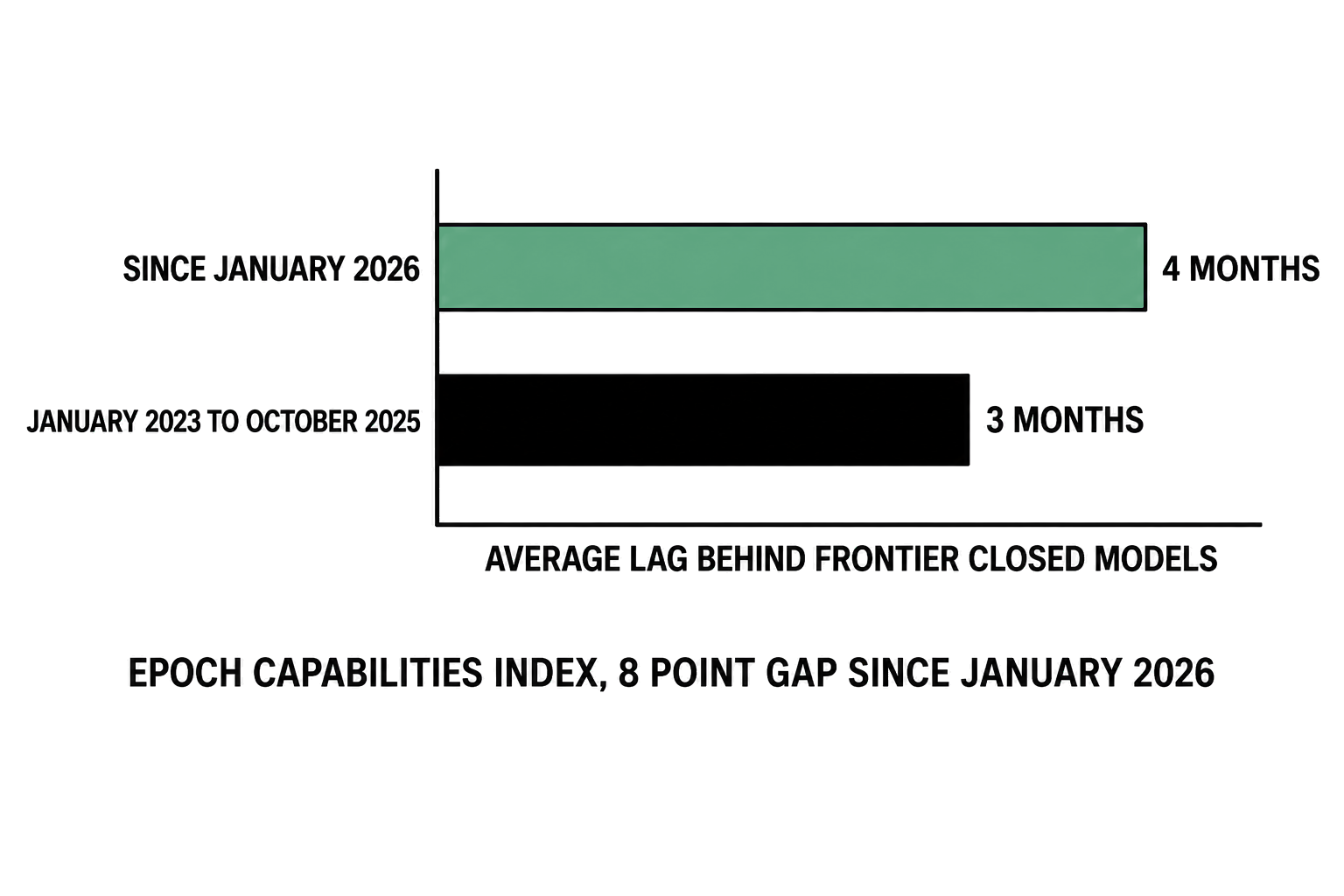 The direction of travel in the most recent window is worth noting. Epoch's newest measurement puts the average lag at 4 months since January 2026, [slightly larger than the 3 months it measured](https://epoch.ai/data-insights/open-closed-eci-gap) across the longer January 2023 to October 2025 window, with a 90 percent confidence interval of 7 to 11 ECI points. What changed is what sits inside the gap. A four month old open model in 2026 is a materially more capable artefact than a four month old open model was in 2024, and six independent families now maintain that cadence rather than one or two. One caveat belongs beside that number, and it comes from the same source. Epoch notes that open-weight models tend to optimise against benchmarks more aggressively than proprietary ones, which means the measured gap is more likely to be [understated than overstated](https://epoch.ai/eci). A separate self-published analysis, which ships a reproduction repository, reaches a less comfortable conclusion. It puts the gap at 8 to 10 months on private, contamination-resistant benchmarks against 4 to 6 months on public ones, and [finds the gap was narrowest](https://www.lesswrong.com/posts/rJcCrXyEsJKmmDpWG/how-far-behind-are-open-models) around DeepSeek R1 in January 2025 and has widened since. We would not treat a self-published study as settled, but it points the same way as the caveat above. The practical consequence is that no source publishes a single percentage-scale gap, and the available measures do not convert cleanly into one another. Epoch's own score file puts the widest spread at [9.88 index points](https://epoch.ai/data/eci_scores.csv) on a logit-like scale that is not a percentage, the Artificial Analysis Intelligence Index puts it at 12 points across 199 models, and LMArena puts it at 45 Elo on text and 31 on vision. An enterprise will do better to cap its exposure by workload class than to argue about which of those numbers is the true one. There is also a category of signal that tells you almost nothing about fitness for your workload, and it is worth naming so it stops consuming review time. - **Single benchmark leaderboard positions**, because the top of a public leaderboard is exactly the region model developers optimise against, a limitation Epoch AI states openly about its own index. - **Parameter counts**, because an active-parameter count in a mixture-of-experts model determines runtime cost while total parameters determine memory footprint, and neither predicts task accuracy by itself. - **Vendor-reported scores**, which are not independent measurements and rarely use the same prompting or reasoning budget across models. - **Release recency on its own**, because the practical question is whether a given model is good enough for a defined task, and that is a property of the task. - **Community enthusiasm**, which tracks novelty rather than reliability and is a poor proxy for how a model behaves on the thousandth request. ## Which open-weight models are competitive today Averages across families hide the models themselves, so it is worth naming the current leaders. Artificial Analysis publishes the Intelligence Index, which scores models on ten fixed evaluations and reports the result as one number. The figures below come from release v4.3.2. | Open-weight model | Intelligence Index score | Licence shape | |---|---|---| | MiMo-V2.6-Pro | 46 | Open weights | | GLM-5.3 (max) | 45 | Open weights, commercial use restricted | | Kimi K3 (max) | 44 | Open weights, commercial use restricted | | GLM-5.3-Flash | 42 | Open weights | | DeepSeek V4.1 Flash (max) | 39 | Open weights | | Qwen3.8 27B (xhigh) | 34 | Open weights | | K2 Horizon 375B A23B | 31 | Open weights | | MiniMax-M3 | 29 | Open weights, commercial use restricted | | Inkling (xhigh) | 25 | Open weights | | Nemotron 3 Ultra | 23 | Open weights | | Muse Glimmer (high) | 17 | Open weights | Table: The leading open-weight models on the Artificial Analysis Intelligence Index v4.3.2. The same release puts the leading proprietary models at 58 for Claude Opus 5.5, 56 for Claude Sonnet 5.5, and 53 for Claude Haiku 5.1 and GPT-6 Astra. It scores Gemini 4 Argon, which it marks as not publicly available, at 53 as well. The best open-weight model scores 46, twelve points behind the leader. The two groups interleave. MiMo-V2.6-Pro at 46 sits above Qwen3.8 Max at 45 and Step 5 Preview at 44, both of which are proprietary, and beside GLM-5.3 and Kimi K3 in the same band. Three of the five models scoring between 44 and 46 are open weights, and every model above 46 is closed. That is the shape of the gap today: the best open models compete with the middle of the proprietary field and trail its top. The licence shapes in that table matter as much as the scores, and three of the eleven carry a commercial-use restriction. GLM-5.3, Kimi K3 and MiniMax-M3 are all downloadable, and all three attach conditions that a legal review needs to read before the model reaches a customer-facing product. The licence section below covers what those conditions usually say. Families also mix the two licensing regimes internally. Alibaba publishes open Qwen weights under Apache 2.0, and the same release of the index scores Qwen3.8 Max on the proprietary side of the line. A single family name therefore tells you nothing about licence obligations, and the model name has to be checked on its own. 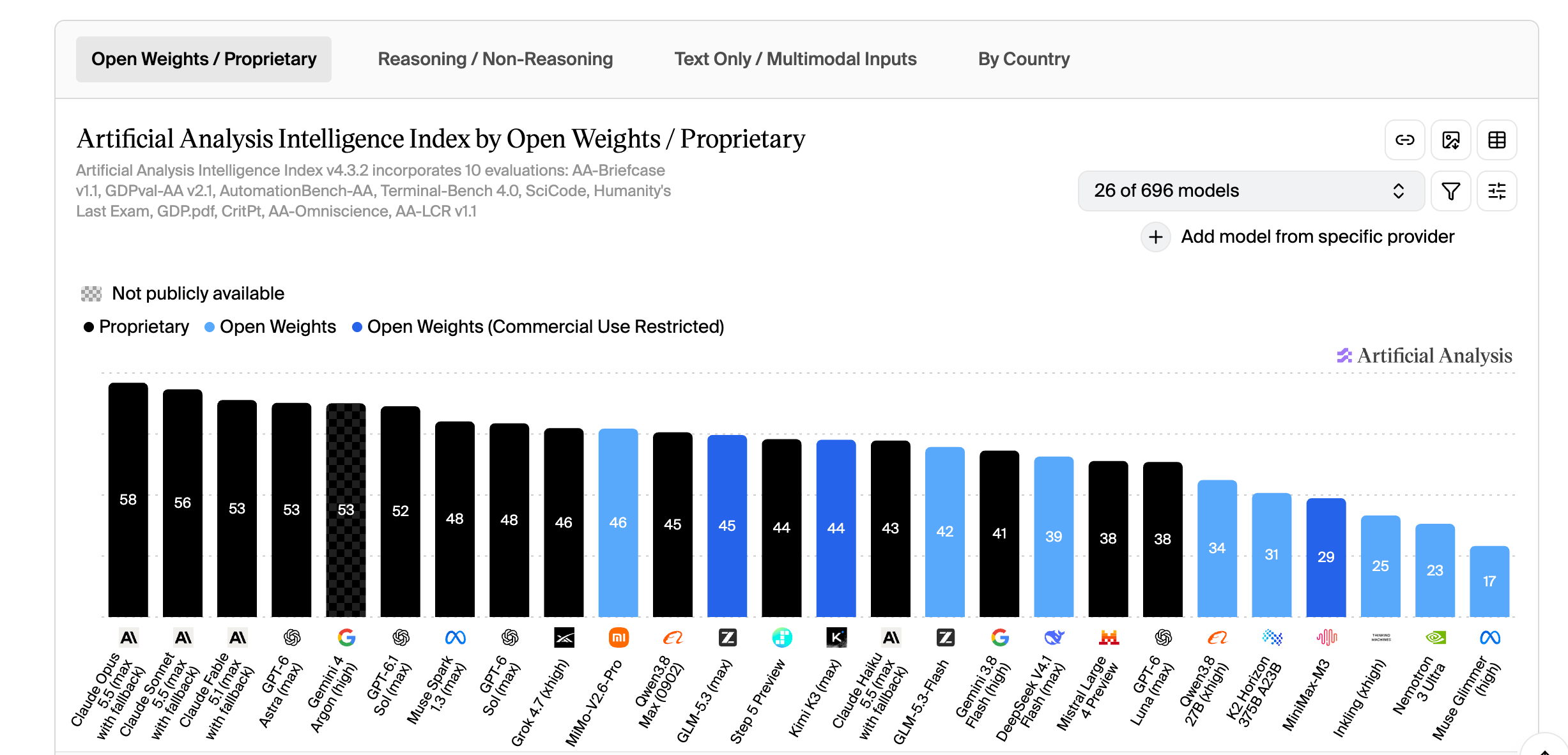 ## What the top of the ranking measures The names at the top of that table are genuinely ahead, and the section above describes where. It is worth knowing what they are ahead at, because the tasks that settle the top of the index are not the tasks most enterprises run. Artificial Analysis builds the index from ten evaluations, and several of them target research-grade work. Humanity's Last Exam, SciCode, Terminal-Bench, GDP.pdf and CritPt are all in that set. Epoch AI's FrontierMath points the same way. It is a set of hundreds of original problems written and vetted by working mathematicians, running from advanced undergraduate material to early-career research, and [a typical problem takes an expert mathematician several hours to solve](https://epoch.ai/frontiermath). In July 2025 a frontier model reached [gold-medal standard at the International Mathematical Olympiad](https://deepmind.google/blog/advanced-version-of-gemini-with-deep-think-officially-achieves-gold-medal-standard-at-the-international-mathematical-olympiad/), and other systems have since matched that result on the 2025 problems. That advance is real, and it matters for research mathematics and for the hardest reasoning work an organisation can point a model at. It also sits a long way from the work that fills an enterprise queue. The largest published study of how people use AI at work follows Microsoft 365 Copilot across more than a million organisations and finds that the [dominant pattern is assistive](https://microsoft.github.io/nfw-reader/downloads/five-million-conversations.pdf): drafting, editing, advising and explaining, with people checking and rewriting rather than delegating a whole problem. The tasks listed earlier in this paper are of that kind, with bounded outputs and clear acceptance criteria. For this decision, one measurement is more useful than the ranking. A [2026 analysis from MIT Sloan](https://mitsloan.mit.edu/ideas-made-to-matter/ai-open-models-have-benefits-so-why-arent-they-more-widely-used) puts open models at about 90 percent of closed-model performance at the time of release, closing the remaining distance quickly, and puts closed models at around six times the cost of open ones. In one published accounting workflow, replacing the closed frontier models with open weights and re-running the same sixty cases through the same scorer produced [95.0 against 94.6 for the closed configuration](https://cadel.ai/us/blog/open-weight-models-accounting-workflows), at roughly the same cost and about twice the latency. The ranking and the volume of enterprise work describe different things. The top of the index is settled by who can do a mathematician's job. Enterprise work sits far below that ceiling, in the region where open weights have been at parity for some time. The question worth asking about any model is whether it is good enough for a named task and whether you can prove that it is. The evaluation checklist at the end of this paper is what turns that proof into a decision. ## The real cost of ownership The cost comparison that kills open-weight programmes is the one in the spreadsheet, because a per-token invoice is a complete cost while a per-hour GPU price is not. Ownership adds at least five cost lines that have no line item on an API bill, and a business case that omits them will look excellent right up to the point where the runbooks have to be written. - **Idle capacity.** You buy for peak and pay for the trough. A cluster sized for month-end batch load runs at low utilisation for most of the month, and the fixed cost does not care. - **Evaluation.** Every candidate model, every quantisation variant and every fine-tune has to be measured against your own task set before it goes near production, and doing that credibly is ongoing work rather than a one-off project. - **Upgrade and regression testing.** When a new open release lands, adopting it means re-running the evaluation suite and re-qualifying guardrails. The cadence of open releases is a benefit and a maintenance liability at the same time. - **On-call.** A self-hosted inference endpoint is a production service. It fails at three in the morning, it needs version pinning, and the engine needs patching against a moving upstream. - **The platform itself.** Routing, caching, observability, per-workload accounting and access control are all things a hosted API gives you for free and you now provide. Those cost lines make ownership a volume decision rather than a mistake. The mechanics are straightforward. Self-hosting beats a premium hosted API at comparatively modest sustained volume, because the alternative is expensive per token, while beating a cheap hosted API for the same open model takes far more volume than a single accelerator can typically serve. The break-even sits wherever your own duty cycle puts it, so plot your actual monthly token volume against the two cost shapes instead of arguing about which is cheaper. 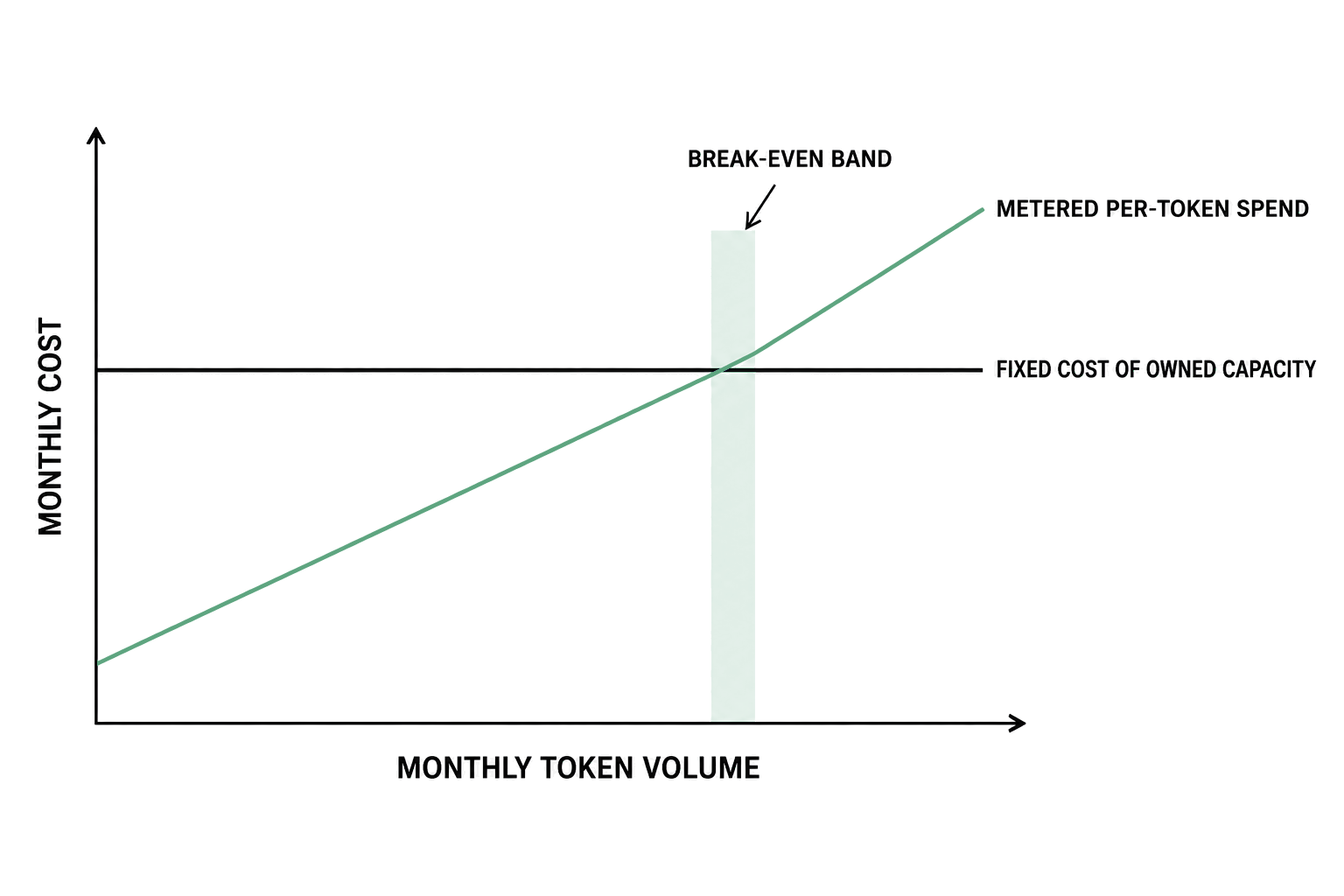 The two cost shapes are what matter: one scales with volume, and the other is driven by fixed capacity and utilisation. The point where they cross moves with your duty cycle. The per-token side of that comparison is at least observable, and vendor pricing pages are the primary source for it, for example [OpenAI's published per-million-token rates](https://developers.openai.com/api/docs/pricing) across its current model tiers. Reading them side by side shows the shape of the hosted market: a wide spread between a small, cheap tier and a flagship tier, which is the same spread that determines whether you are replacing an expensive model or a cheap one. | Cost line | What drives it | How to put a number on it | |---|---|---| | Metered inference | Tokens in and out, model tier | Vendor pricing page, your own traffic mix | | Capacity, owned or leased | Accelerators, term, utilisation | Hourly rate times hours, divided by real duty cycle | | Idle capacity | Peak-to-trough ratio | Peak provisioned capacity minus measured average use | | Evaluation and qualification | Candidate count, task set size | Engineer days per candidate, per quarter | | Upgrade and regression | Release cadence you choose to adopt | Eval reruns plus guardrail requalification per upgrade | | On-call and patching | Service criticality, engine churn | Share of a platform engineer, on rotation | | Routing, caching, accounting | Whether you build or buy the layer | Either platform cost or engineer quarters | Table: The seven cost lines, and where the honest number comes from. Two of those lines deserve emphasis because they are the ones that get left out and then cause the programme to be cancelled. Evaluation is a standing capability, and the second model you qualify costs less than the first only if you built the harness well. Upgrade testing is the same harness pointed at a moving target, and an organisation that adopts every open release without it is running unmeasured changes in production. ## Four deployment patterns and when each wins The decision that matters is how much of the stack you want to own. The four realistic patterns sit on a single axis of operational responsibility, and almost every enterprise we see adopts at least two of them at once. At one end, you call a hosted API and own no weights at all. This remains the right answer for the workload that is genuinely open ended, for the burst that arrives four times a year, and for the team that needs a capability in a week rather than a quarter. The cost is metered and the failure modes are the vendor's problem, which is a real business benefit that procurement decks routinely omit. Next, a managed endpoint puts the weights in your cloud account on dedicated capacity. You keep residency and network isolation, you stop sharing a noisy neighbour, and you still do not patch a serving engine. It is the pattern that satisfies most internal security review while preserving the economics of someone else operating the inference layer. Then there is the self-hosted cluster, where the weights, the serving engine, the scheduler and the upgrade cadence are all yours. This is the only pattern that delivers complete control of the artefact, and it is the only pattern that creates the operational obligation described later in this paper. The fourth pattern is hybrid routing, where a gateway sends each request to a different destination according to policy rather than preference. Sensitive traffic stays inside the perimeter on weights you own, and everything else goes to the endpoint that offers the best price and quality that day. | Pattern | Where the weights run | What you operate | When it wins | |---|---|---|---| | Hosted API | Vendor infrastructure | Nothing below your own application | Burst capacity, open-ended synthesis, fastest path to a capability | | Managed endpoint | Your cloud account, dedicated capacity | Residency, network, keys, never the engine | Security review that wants isolation without a serving team | | Self-hosted | Your accelerators | Everything, including upgrades | Regulated data, hard residency rules, sustained high volume | | Hybrid routing | Both, chosen per request | The routing policy and its audit trail | A mixed estate, where one policy cannot fit every workload | 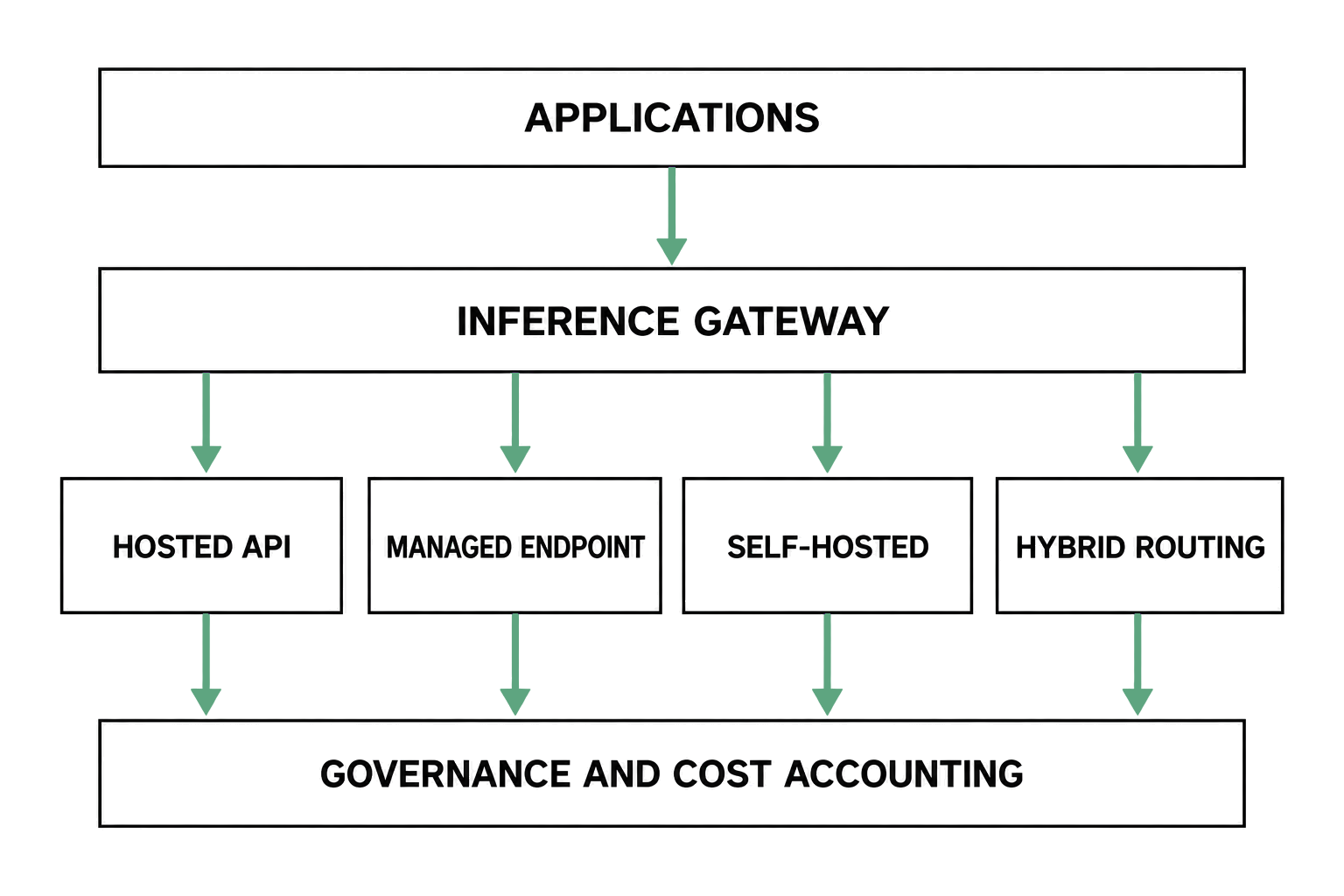 Every request crosses the same gateway and the same governance boundary, whichever destination the policy chooses. The practical advice is to start where the value is and let the pattern follow the constraint. Three things change as you move down that list, and only the first of them is a technical change. - The weights become your artefact, so versioning, provenance and rollback become your problem. - The cost becomes dominated by fixed capacity, so utilisation becomes a first-class metric rather than an implementation detail. - The upgrade decision becomes yours, which means the regression risk is yours as well and has to be absorbed by an evaluation harness rather than by a vendor's release process. ## The operating layer is the actual product Executives usually hear this part of the argument too late. The weights themselves are a commodity that anyone can download, and the licence usually permits it. What separates a demonstration from a production system is the layer around the weights, and that layer carries real cost, requires deliberate design, and does not appear in any benchmark table. The serving engine is the first component of that layer. Continuous batching and paged attention are what made open weights economically viable to serve, because they let a single accelerator handle many concurrent requests without wasting memory on padding, a design documented in [vLLM's own documentation](https://docs.vllm.ai/) and in the [original paged attention write-up](https://blog.vllm.ai/2023/06/20/vllm.html) from June 2023, which is the design's origin story rather than a current performance measurement. Dedicated stacks such as [NVIDIA's TensorRT-LLM](https://developer.nvidia.com/tensorrt-llm) push further with in-flight batching, quantisation schemes such as FP8, FP4 and INT4 AWQ, and speculative decoding. For a buyer, the engines are largely interchangeable, the right choice depends on your traffic shape, and the ability to change that choice later is worth more than any single benchmark win. Caching is where the operating layer most often over-promises. Prefix and key value reuse are genuinely valuable when traffic repeats a common preamble, which is the norm for retrieval-augmented systems sharing one instruction block. Semantic caching is a different proposition, and the gateway vendor's own documentation is unusually direct about its limits: it suits single shot prompts and [goes badly wrong on agentic traffic](https://docs.litellm.ai/docs/proxy/caching), where two superficially similar requests imply different actions. Beyond the engine, five things have to exist, and none of them arrives with the weights. - A gateway that routes per request, holds the policy, and produces an audit trail for every routing decision. - An evaluation harness that can qualify a candidate model against your own tasks before it reaches traffic. - Observability that attributes cost and latency per workload rather than per cluster. - Guardrails that are enforced in the serving path, not documented in a policy wiki. - A versioning discipline covering weights, engine, quantisation and prompt template as one deployable unit. 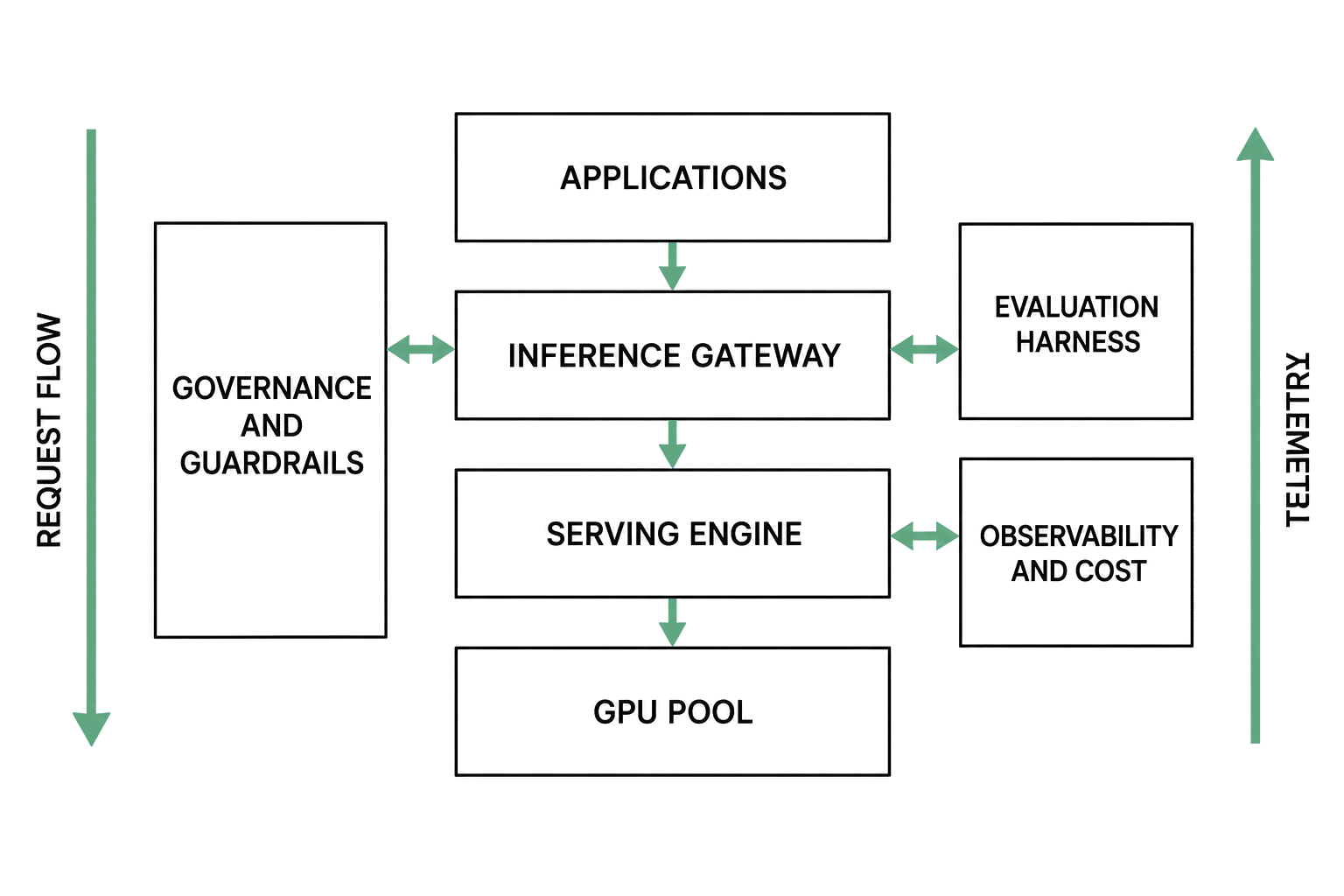 Request flow descends through the gateway into the engine and the accelerators. Telemetry, evaluation signal and cost accounting have to travel back up, or the layer operates blind. This is the layer that a platform team ends up building whether or not anyone decided to build it, and it is the layer where the difference between a pilot and a production estate is decided. It is also, in our experience, the reason a programme that looked cheap on paper does not stay cheap. ## Licensing, security and compliance questions that stall deals A licence is a contract, and open weights are not open source. Two models can both be downloadable today and impose completely different obligations on your legal team, your product, and the way you let a partner integrate your system. The permissive end of the market is genuinely permissive. [Open-weight releases from Alibaba's Qwen family](https://github.com/QwenLM/Qwen2/) are published under Apache 2.0, and [DeepSeek's releases](https://github.com/deepseek-ai/DeepSeek-V3) are published under MIT, both of which permit commercial use, modification and redistribution with attribution and no revenue test. Where the landscape has shifted is that permissive licensing is now a competitive claim in its own right, with vendors such as Z.ai advertising [an MIT licence](https://huggingface.co/zai-org/GLM-5.2/blob/main/LICENSE) for their open releases on the explicit basis that it carries no regional limits. The custom end is where reviews stall. Meta's [Llama 4 Community License](https://www.llama.com/llama4/license/) adds additional commercial terms that apply above a monthly active user threshold, and it is paired with an [acceptable use policy](https://www.llama.com/llama4/use-policy/) that flows downstream to anyone you pass the model to. Google's Gemma family is the clearest illustration of how fast this can change inside a single family. Gemma 4 is now distributed under [Apache 2.0](https://huggingface.co/google/gemma-4-31B-it), having moved off the bespoke Gemma Terms of Use that governed earlier generations, so a licence review that is a year old may already be describing a different contract. | Licence shape | What it grants | What it costs you | |---|---|---| | Apache 2.0 or MIT | Commercial use, modification, redistribution, attribution only | Nothing beyond attribution compliance and your own diligence | | Community licence with a revenue or user threshold | Broad use up to a defined ceiling | A tracking obligation, and a renegotiation if you cross the ceiling | | Licence with a service clause | Use, with a separate commercial route for hosted resale | A separate agreement before you embed the model in a product you sell | | Acceptable use policy attached to any of the above | Use, subject to use restrictions | Inherited restrictions on your own customers, and a duty to pass them on | Regulation has its own shape, and it does not map neatly onto licence permissiveness. The European Commission's obligations for providers of general purpose AI models have applied since [2 August 2025](https://eur-lex.europa.eu/eli/reg/2024/1689/oj). Many teams assume an open licence exempts them from the whole regime, which is the single most common compliance error we see in this area. The exemption is narrower than the assumption, and it is textual rather than interpretive. Article 53(2) lifts the training-content and copyright duties for a model released under a free and open-source licence whose weights, architecture and usage information are public, but it does not extend to models with systemic risks, and Recital 103 withholds it from any component monetised through a price, technical support or a platform while confirming that hosting on an open repository is not by itself monetisation. The Commission's [published answers](https://digital-strategy.ec.europa.eu/en/faqs/general-purpose-ai-models-ai-act-questions-answers) set out the same boundary. Read plainly, open weights you run yourself sit inside the exception, and the same weights served to your customers as a product generally do not. Enforcement is the other half of the picture. From 2 August 2026 the AI Office can require corrective measures and issue fines against general purpose AI model providers, at a ceiling of 3 percent of worldwide annual turnover or EUR 15 million, whichever is higher, and a [2026 amendment to the Act's application dates](https://digital-strategy.ec.europa.eu/en/policies/regulatory-framework-ai) left the 2025 date for these duties untouched, and the Commission has [published guidelines](https://digital-strategy.ec.europa.eu/en/policies/guidelines-gpai-providers) clarifying their scope. The security questions are the ones that have changed least and matter most. A downloaded artefact arrives without a vendor's security process behind it, so provenance and integrity checking are your responsibility. Prompt injection and unsafe tool use remain properties of the whole system rather than of any classifier. An acceptable use policy you inherited creates obligations toward your own users that a procurement checklist will not surface on its own. Loblaw runs a very large engineering estate and has to answer those questions in front of its own risk function rather than in a slide deck. Charu Pujari, Senior Vice President of Engineering and AI at Loblaw, describes the balance they were looking for, which is the same balance this section is about. [quote: loblaw-digital-2] You can read how that programme is governed in the [Loblaw Digital case study](https://www.shakudo.io/customers/loblaw-digital). The blockers that stop a deployment are rarely technical: a licence nobody has read end to end, a residency claim that has never been tested against the architecture, an acceptable use policy discovered after product launch, and an evaluation harness that does not exist when the first upgrade arrives. ## Evaluation checklist By this point the decision has a shape. Data that must stay inside the perimeter pushes you toward weights you run. Sustained volume decides whether the fixed cost is worth carrying. The appetite to own a serving stack decides whether you operate it or rent it. A gateway lets you answer differently for different workloads in the same estate. 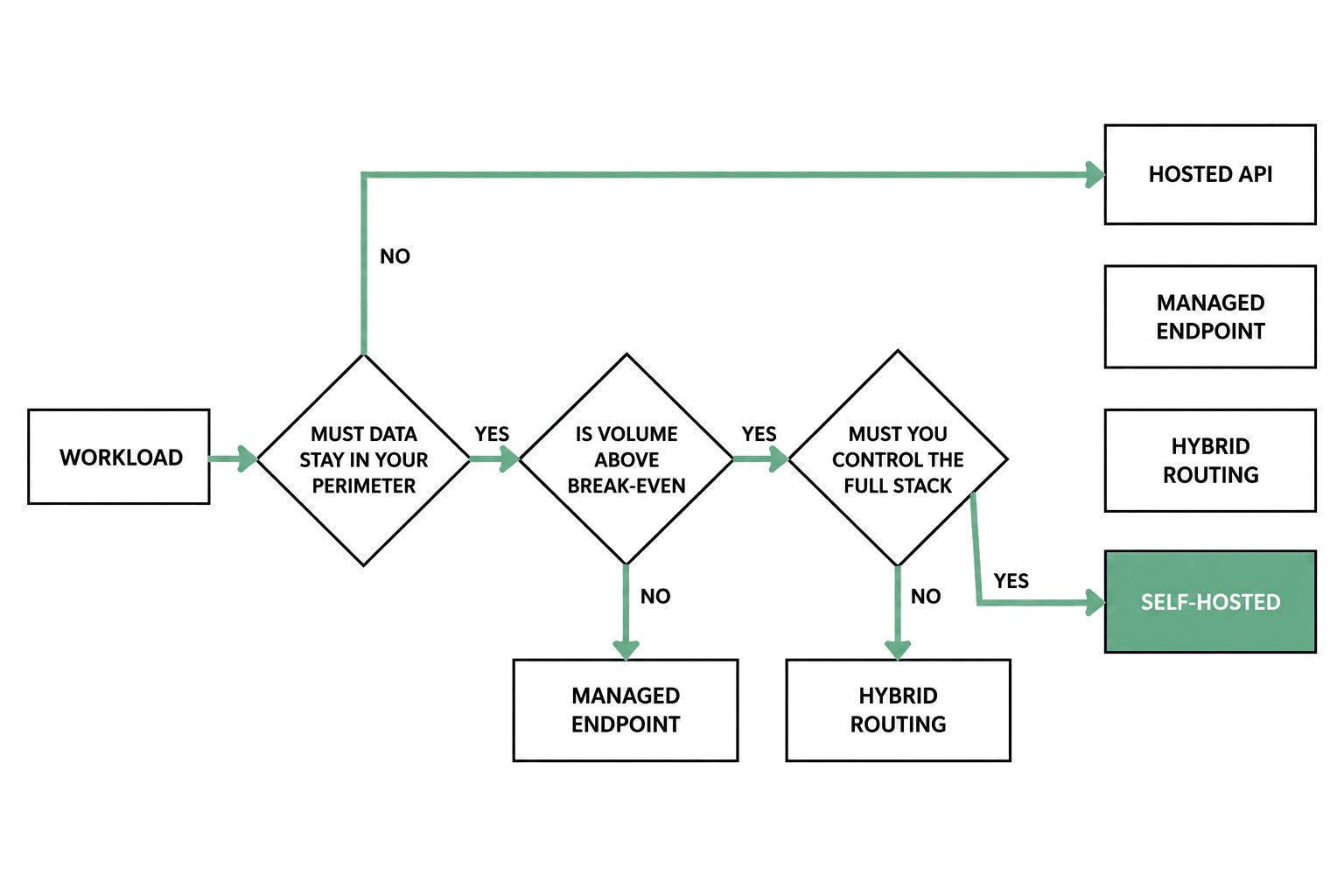 The diagram resolves three questions into four destinations. Drawing it explicitly turns the answers into policy that can be reviewed, changed and audited instead of re-litigated per project. - [ ] The workload is named, with its data classes, and the residency requirement is stated as an architectural constraint rather than an aspiration. - [ ] The monthly token volume is estimated from measured traffic, and the break-even shape has been modelled against a named alternative. - [ ] Every shortlisted model's licence has been read in full, including any threshold, service clause and acceptable use policy. - [ ] The evaluation harness exists and can qualify a candidate model against your own tasks before it reaches production traffic. - [ ] Cost and latency are attributable per workload, not only per cluster. - [ ] The weights, engine, quantisation and prompt template deploy as one versioned unit with a tested rollback. - [ ] A serving-engine substitution has been tested, so the engine choice is reversible. - [ ] Routing policy is stored as configuration with an audit trail, not embedded in application code. - [ ] Upgrade cadence is a deliberate decision, with regression testing budgeted rather than assumed. - [ ] An exit path exists in both directions, so the workload can move between self-hosted and hosted without a rewrite. > [!ACCENT] The weights are the cheap part, so decide who operates the layer around them before you download anything. The gap between open weights and the closed frontier is now measured in months, and it is moving faster than most procurement cycles can follow. Open weights will not be the right answer for every workload, but the default should become a decision someone owns rather than a purchase order. # blog/executive-guide-to-agentic-commerce.md *[Source (/blog/executive-guide-to-agentic-commerce)](https://www.shakudo.io/blog/executive-guide-to-agentic-commerce) | [Markdown twin](https://www.shakudo.io/blog/executive-guide-to-agentic-commerce.md)* ---The launch of OpenAI's "Instant Checkout" with Walmart has triggered a paradigm shift to agentic commerce, moving AI from a simple assistant to a proactive agent that executes transactions. This new reality presents an existential choice for enterprise leaders: how do you compete? Is it safer to integrate with a third-party platform, or is that a strategic trap? What does it truly take to build a secure, proprietary AI agent that can handle complex checkouts without exposing your most sensitive customer data and competitive insights?
In this white paper, you'll discover:
Download your executive guide to own the conversational interface and win the new era of commerce.
# blog/executive-guide-vibe-coding.md *[Source (/blog/executive-guide-vibe-coding)](https://www.shakudo.io/blog/executive-guide-vibe-coding) | [Markdown twin](https://www.shakudo.io/blog/executive-guide-vibe-coding.md)* ---The inevitable rise of AI-driven development, known as "vibe coding," is forcing technology leaders to confront a dual mandate: leverage AI for innovation while upholding security, stability, and governance. This paradigm, where natural language is the primary tool for creating software, is already a significant market force being adopted by teams worldwide. Unmanaged, this grassroots movement introduces critical enterprise risks, but when harnessed correctly, it can be a powerful accelerator.
This whitepaper provides a strategic framework to build the bridge from chaotic AI experimentation to governed, production-grade innovation.
Download the whitepaper to understand the risks and build a robust AI strategy for your organization.
# blog/executives-guide-to-code-agents.md *[Source (/blog/executives-guide-to-code-agents)](https://www.shakudo.io/blog/executives-guide-to-code-agents) | [Markdown twin](https://www.shakudo.io/blog/executives-guide-to-code-agents.md)* ---AI-powered code agents are changing how software gets built—faster, smarter, and with fewer resources. For technology leaders, they offer a chance to boost developer productivity and speed up delivery, but the space is moving fast and full of new tools, risks, and hype. Our comprehensive guide will help you cut through the noise to make smart, future-ready decisions about AI in your software development stack.
Here’s a preview of what you’ll learn:
Many organizations are trying to become more data informed, to better leverage their data assets for decision making. Yet they are often stymied by the weight of data engineering “plumbing” required to build and maintain their data infrastructure. If most of the data stack can, in essence, disappear, data teams can turn their focus to analysis, model building, and insights, and how best to communicate their work to decision makers. How to get there? While there’s no simple path, the Shakudo platform provides a good start. In this two part post we cover the many ways Shakudo provides an operating system for data stacks — offering fast, frictionless access to data resources for all who need it — and how that helps organizations pivot towards a more analytic focus.
In today's data-driven landscape, organizations face the challenge of managing complex data infrastructures while striving to better apply analytics to decision making. Yet many of today’s data organizations are hamstrung by fixed, inflexible data stacks and an over reliance on tactical, data engineering-centric, brittle data infrastructures that create backlogs impeding what data teams should focus on: analysis, model building, and insight creation.
Shakudo provides a new paradigm — a living, evolving operating system for data stacks. With Shakudo, organizations can easily tailor their data infrastructure to adapt to dynamic requirements and resource constraints, for example incorporating new technologies, like generative AI. The platform provides a consistent interface while supporting the evolution of tools — whether to enable migration to new platforms, align skills with tools, or adopt new technologies or tools.
Users access the hosted Shakudo platform via a SaaS web page that displays a palette of available tools and components. The vetted, compatible, preconfigured list of tools allows quick and frictionless access to what data professionals need to immediately start developing pipelines, running analysis, and building models, including LLMs. Think iOS or Android with an organized set of clickable icons taking the user to the most appropriate environment for the task at hand.

The Shakudo platform integrates with more than [.displaycountclass]100[.displaycountclass] open source and commercial stack components, allowing data teams to pick the tools that best suit their preferences and capabilities, while accommodating any budget constraints. The continually growing list of components on offer are fully vetted by Shakudo SMEs to ensure compatibility, scalability, security, and other concerns. The result: data teams can curate and preconfigure the components available to analysts that optimize productivity, control costs, and meet governance, regulatory, and other compliance requirements, all while avoiding vendor lock-in.
From a resource perspective, the Shakudo platform's flexibility and control lets data teams offer access to tools and components that help streamline training, onboarding, recruiting, and other processes — improving productivity for anyone who needs to work with data.
Shakudo helps convert traditional, fragile, and monolithic data stacks into a living, evolving platform. With Shakudo, organizations can adapt their data stacks to meet changing requirements, align tools to skills, and leverage new technologies. This adaptability ensures that data stacks remain relevant, future-proof, and responsive to the dynamic needs of the organization.
For any organization migrating elements of their data stack, Shakudo is a godsend, supporting easy access to legacy and new tools. For example, several of Shakudo’s customers have evolved their data stack multiple times over the course of the past two years without having to modify their underlying infrastructure or system architecture.
Managing distributed data infrastructures can be a complex and time-consuming task. Shakudo alleviates this burden through a focus on DevOps automation. Adding components becomes simple via a prompt-driven configuration process — once a component is added, Shakudo ensures that all appropriate connections, settings, and permissions are set, making the component readily available to all users.
Streamlined DevOps is at the center of what helps data organizations move from having too great a focus on configuration and admin processes towards the strategic work of data analysis, model building, and generating valuable insights.
Shakudo understands the importance of privacy and intellectual property protection. With a focus on providing open source components for building bespoke generative AI foundation models, Shakudo allows data scientists to tailor AI models to their organization's unique requirements and IP. By avoiding the limitations of large-scale commercial models, Shakudo empowers organizations to extract maximum value from their data while ensuring compliance with privacy regulations.
Shakudo has the potential to democratize data access throughout an organization. Decentralized organizations no longer need to build their own infrastructure, as Shakudo provides a centralized platform that ensures easier enforcement of governance standards. Organizations can empower their distributed teams with frictionless access to data resources, supporting a more decentralized approach to data and analytics. We cover this topic in more detail in Part 2.
Notebooks have become a primary vehicle for advanced analytics, but they can make collaboration difficult. Shakudo’s “Sessions” uniquely supports collaborative work on common analytic tools like Jupyter Notebooks — allowing even remote analysts to work together in real-time, or sequentially across time zones. Pair analytics provides a raft of benefits, particularly on the type of complex analytics and model building done in notebook environments:
Shakudo’s collaborative “Sessions” helps improve analysis and creates smarter, more cohesive teams, all while encouraging an environment of continuous learning.


The data landscape continues to grow more distributed and more complex. Organizations need a data infrastructure that can keep pace and empower analytic teams.
Shakudo provides an operating system for data stacks that helps organizations get more out of their data teams by transforming static, legacy tools into an adaptable, evolving platform. Built for continuous evolution, Shakudo future-proofs your data investments. Easily migrate from old to new, align tools to skills, and adopt new tools to meet new requirements — all while maintaining a consistent interface that provides fast, frictionless access to vetted data stack components.
Shakudo also facilitates more open, distributed, and democratized analytics across your organization, empowering decentralized teams through curated self-service access. And through Shakudo's collaborative “Sessions,” you can build institutional knowledge across remote teams while improving accuracy, trust, and insights.
Shakudo provides a platform built to meet today’s needs and tomorrow’s challenges, turning data infrastructure into a strategic asset.
After covering the many ways Shakudo helps improve DevOps and data team productivity in Part 1 of this blog post, here we take a deeper dive into how Shakudo helps data teams shift their focus away from infrastructure drudgery and towards analytics, model building, and deriving insights. Shakudo transforms data teams from pipeline-centric to insight-driven.
By addressing data plumbing challenges, Shakudo enables analysts to spend more time on high-value tasks: designing analytic-friendly data structures, collaborating with peers, rapidly iterating, and uncovering insights. Shakudo becomes the catalyst for data teams to make this critical shift.
In Part 2 of this post, we explore the following specific ways Shakudo facilitates this transformation:
Let's dive in and see how Shakudo helps data teams embrace their true purpose: insight creation. The heavy lifting of data engineering is important, but not the end goal. Shakudo provides the platform for data teams to make analytics and modeling their central focus.
Many organizations find they get insufficient productivity out of their data infrastructure. It’s understandable, given the challenges of managing the complex, distributed mix of legacy and modern data stacks that make up data operations. The result: Too much time and resources spent on data engineering, and not enough on analytics and insights.
Whatever an organization's mix of data stacks and tools consists of, it requires a big investment in the data engineering plumbing (configuration, connections, credentials, privileges, topology, orchestration) that connects the various components used to build a data infrastructure. A never-ending queue of requests from other teams further burdens data engineering resources. The result: data engineering resources pushed to build quickly assembled, fragile, difficult to maintain one-off data pipelines, leaving little time to prepare, transform, and organize the data for analysis. Documentation suffers, duplicity abounds, and analysts face a confusing array of poorly organized, difficult to understand options for analysts or anyone interested in using data.
The blame doesn't rest with the data engineers — they are doing their best to keep up. What if a tool existed that can help data engineers transition from building data pipelines to enabling the analyst community and other users of data to build their own pipelines without the burden of plumbing and setup? That is what the Shakudo platform provides. It’s a vehicle for pivoting data teams away from the grind of infrastructure towards their true purpose — analysis and discovery.
How does it work? Shakudo allows data engineers to set up environments appropriate for a wide variety of pipeline and analytic tasks. The analytic community then selects the tool they want, completely preconfigured with all connections, credentials, and component compatibility set. Automated DevOps makes integrating with more than [.displaycountclass]100[.displaycountclass] and counting data tools and frameworks a simpler process, ensuring the right tools are available now and in the future, with no friction or fuss.

The benefits are manifold. With Shakudo, the data community can:

Many organizations want to embrace at least some decentralization of access to their data assets, enabling dispersed teams to become more data savvy. However, building out a decentralized data infrastructure is difficult, often creating a mish-mosh of incompatible components, wildly variant technical competence, and ambiguous, difficult to trust results. A data mess instead of a Data Mesh. Here's where Shakudo shines. The Shakudo platform provides a consistent, secure, governance-compliant set of tools that enables data professionals from anywhere in an organization to get work done, with no delay.
Embracing the Shakudo platform allows data engineers to focus on enabling decentralized organizations, rather than standing in their way, regardless of where users sit.
Plenty of other benefits accrue to an organization trying to decentralize their DataOps with Shakudo:
For many organizations, decentralizing data operations is done for agility, flexibility, and productivity – keeping the data close to those who know it best. However, that same decentralization can become a burden, when organizations deem it appropriate to reorganize or if special projects require coordination across teams. Shakudo has an answer: providing a platform that helps all those who work with data to coalesce around a common set of tools, processes, and governance policies — making reorganizations, interteam transfers, and special projects that much easier to implement.
Shakudo helps free up analytic resources to design, build, and document analysis-friendly data structures. Dimensional models, precalculated statistics, and understandable naming conventions designed for data sharing all help improve productivity where it matters: more analysis, more model building, more insights. It’s a stark contrast to the gnarly data structures associated with one-off pipelines built to meet narrow analytic needs.
Well documented data models with shared dimensions (like customer and product) are easier to understand and leverage, and create an environment for more consistent results. A boon for organizations pushing for democratizing access to data resources.

Shakudo’s adaptable data stack avoids locking organizations into tools with long ramp up times or niche talent pools. The agile platform allows organizations the flexibility to align components with resource preferences — whether via leveraging available skills, training internal teams, or hiring new experts. And if and when new tools become available, or migrations away from old tools becomes appropriate, Shakudo is there to simplify those transitions. Embracing new technologies becomes a viable recruiting strategy for companies using Shakudo, particularly tech that make an immediate difference.
The curated Shakudo toolbox provides a mechanism for enforcing security, privacy, and regulatory policies. Restricting users to the preconfigured components available on the Shakudo platform puts governance into the knowing hands of the data engineers who set up and install those components, reducing the peril of uncontrolled, sloppy installs and the unintended consequences of lax attention.
Managing complex data infrastructure devours time, leaving insufficient bandwidth for deriving insights. Tactical pipelines proliferate. Data debt accumulates. Analytics suffers.
Shakudo transforms this vicious cycle. The platform pivots data teams from infrastructure drudgery to high-value analytics.
With Shakudo, analysts design reusable models, not one-off pipelines. Self-service access and collaboration foster agile iteration. Data is understandable and documented. Talent onboarding is smoother.
Shakudo also unlocks decentralized analytics without infrastructure sprawl. Governed, democratic data access becomes feasible, and the platform creates a consistent data experience regardless of team location.
In summary, Shakudo enables your evolution to an insight-driven data organization.
# blog/function-calling-connecting-large-language-models-to-enterprise-tools.md *[Source (/blog/function-calling-connecting-large-language-models-to-enterprise-tools)](https://www.shakudo.io/blog/function-calling-connecting-large-language-models-to-enterprise-tools) | [Markdown twin](https://www.shakudo.io/blog/function-calling-connecting-large-language-models-to-enterprise-tools.md)* ---Large language models (LLMs) are impressive tools, capable of generating human-quality text and performing complex tasks. But what if you could unlock their true potential? Imagine an LLM that can access and process your real-time data, interact seamlessly with existing software, or even control connected devices. This is the power of function calling. This white paper dives deep into how function calling empowers LLMs to become the intelligent backbone of your enterprise, maximizing efficiency and driving innovation.
Explores key aspects of function calling for enterprise-scale LLM integration:
On July 20, 2023, Shakudo’s industry event featured a captivating fireside chat, hosting two distinguished figures in the data domain: DJ Patil, a renowned investor, entrepreneur, and former U.S Chief Data Scientist, and Yevgeniy Vahlis, Co-Founder and CEO of Shakudo. The discussion offered a deep dive into the world of data, exploring its evolution, its current critical role, and its future implications.

The conversation was a blend of expert insights and clear, easy-to-understand explanations from two people who have lived in the data trenches. For anyone from data engineers and data scientists to chief data officers and senior executives overseeing data and analytics. The goal of this discussion is to help these professionals shape their data strategies, policies, and pipelines towards solutions that are more reliable, performant, and cost-effective.
The conversation kicked off with DJ and Yevgeniy tracing the origins of the data sphere and its remarkable evolution. DJ reminisced about the early days when data professionals would gather for problem-solving sessions, referring to it as the "data drinking group”. This informal network of data enthusiasts matured into a robust ecosystem of pioneers driving innovative solutions and shaping the data domain.

DJ underscored the profound transformation that has unfolded over the years, emphasizing the escalated role of data in today's tech landscape. He stressed how the potent blend of data analytics and AI holds transformative potential to revolutionize industry processes and streamline operations.
Throughout the talk, DJ and Yevgeniy touched upon several critical issues shaping the data landscape.
The discussion emphasized that the fusion of data and AI profoundly impacts the modern technological landscape. As businesses continually seek efficient and cost-effective ways to leverage data, innovative solutions like Shakudo are gaining prominence. The future of the growing data-driven industry will be influenced not only by technological advancements, but by our creative ability to use data. Professionals in data engineering, data science, and analytics are leading this revolution, formulating strategies to maximize data utilization and drive effective decision-making.
DJ and Yevgeniy emphasized that businesses must adopt a data-centric approach to stay competitive. The adoption of data-driven strategies and the seamless integration of data analytics in daily operations are, in their view, non negotiable factors within a dynamically evolving business landscape.
They also stressed that a data-centric approach isn't just about collecting large volumes of data. It's about placing data at the heart of business decisions and operations, serving as the essential component in making organizational decisions, improving operations, and discovering new business opportunities. This approach helps solve complex problems, spot market opportunities, and streamline business processes.

Throughout the discussion, DJ and Yevgeniy highlighted the critical need for a scalable operating system for data stacks, a challenge that Shakudo aims to solve. They discussed the challenges faced during the Covid-19 pandemic, where there was urgency of rapid data solutions. Despite the wealth of data and the number of data scientists available, the complexity and time-consuming nature of setting up data stacks posed significant obstacles. This gap led to the creation of Shakudo, a scalable operating system for data stacks that allows for flexibility and rapid deployment of solutions.
They also stressed the importance of maintaining optionality in data systems, advising against the risk of locking yourself into early choices without the right guidance, as this could lead to costly mistakes. Instead, they advocated for systems that allow for evolution and adaptation over time.
An undeniable emphasis was placed on the value of fostering collaboration among the data community and nurturing an environment of innovation. Combining collective knowledge and experience can catalyze the development of new, more efficient solutions to shared data challenges. Encouraging exploration, asking probing questions, and embracing the complex nature of data challenges helps spark fresh ideas and inventive approaches. Notable examples of these communities include: "Artificial Intelligence, Deep Learning, Machine Learning", "Data Scientist & Analyst", "Big Data, Data Science, AI, IoT, Cyber Security & Blockchain", and "Machine Learning Community".

The Fireside Chat by DJ Patil and Yevgeniy Vahlis painted a promising future where data and AI continue to reshape industries and foster innovations. Their discussion offered critical insights for data engineers, data scientists, analysts, and analytics engineers on the current and future state of data and AI.
For a more comprehensive understanding and to gain more insights from the discussion, we encourage you to watch the full fireside chat on our YouTube channel. This stimulating session serves as a beacon for anyone delving into the complex world of data and AI, guiding them to explore efficient and cost-effective solutions that are indispensable for success.
Shakudo is the world’s first scalable operating system for data stacks. To learn more about us and our offerings, book a call with our team.
# blog/genai-real-estate-choose-right-data-ai-stack.md *[Source (/blog/genai-real-estate-choose-right-data-ai-stack)](https://www.shakudo.io/blog/genai-real-estate-choose-right-data-ai-stack) | [Markdown twin](https://www.shakudo.io/blog/genai-real-estate-choose-right-data-ai-stack.md)* ---If you’ve been experimenting with AI technologies in real estate, you know that AI does much more than recommend properties. It predicts market trends, optimizes investment strategies, and manages assets with laser-like precision.
Global real estate firms are no longer focused solely on boosting their profits and appealing to investors; they're diving into AI headfirst, eager to explore possibilities that were once the stuff of sci-fi. From hiring the most skilled data scientists to investing in the latest AI tools, everyone's racing to get ahead. But the true winners? They'll be the ones smart enough to select the right tools and agile enough to adapt as the tech wave continues to flow.
To truly benefit from AI's power in real estate, we must start by looking into the wealth of data at our disposal. Think about it—global real estate firms are sitting on mountains of documents for each property or tenant, from contracts to leases to insurance policies and more. Traditionally, sifting through this massive pile meant a lot of grunt work: abstracting and indexing everything manually, often with just basic OCR tech or outsourced help. And let's be honest, the old-school way isn't just tedious; it's also prone to mistakes, stuck in rigid categories, and totally misses the "unknown unknowns"—those golden nuggets of insight we don't even know to look for.
But top-notch data abstraction isn’t just a nice-to-have; it’s essential. It lays the groundwork for GenAI excellence. Global real estate firms that keep their data clean, well-structured, and accurate are already ahead in the GenAI game. But the true innovators have learned to leverage AI not just for insights but to enhance the quality and precision of their data, setting a new standard for what AI can achieve in real estate.
While AI use cases are endless, there are some very specific ways that GenAI can help global real estate firms improve their processes – before, during, and after document abstraction. This means that with GenAI, real estate firms can improve the quality of their data, and answer questions they've never been able to ask before. Here are some examples:
Lease Anomaly Detection: Find errors, inconsistencies, or missing documentation before they become a problem. For example, the wrong company name may be listed somewhere in a contract, there may be an address discrepancy between two documents, or a section may be missing from a sprawling 300-page contract. It’s like having an eagle-eyed assistant ensuring everything's in tip-top shape.
Abstraction Prediction Enhancement: AI abstraction tools and services generally have an 80% accuracy rate. But what about the other 20% of the data? Automatically connect a specialist AI tool known to excel in areas where the main tool is weak, thus achieving a perfect 100% accuracy mark every time. For example, if the main tool can answer 80 out of 100 question-types accurately, but fails to adequately answer the last 20, a different AI engine can be tapped to fill the gap.
Text Companion: Need a document in French or a quick summary of a lease agreement's termination clause? AI is like your personal translator and summarizer, ready to clarify and condense information with just a few clicks.
GenAI Search Across Documents: Use simple chat to find information across your projects. Ask questions such as, “Which properties have the highest management fees?” or “Tell me about the roof coverage at 123 Main Street?” and get answers instantly, no digging through files required.
Risk and Compliance: Facing new regulations? AI acts as your strategic advisor, calculating potential risks and compliance needs across your portfolio. For example, consider a new law that requires ramps at all entry doors in commercial facilities over a certain size is adopted by roughly half the states in the US, with penalties ranging from $150K to $1M. AI can provide a liability report across all your properties. You can ask, “Where is adding the ramp my responsibility vs the tenants?” or “How many doors in total?” or “What is my risk based on property size, location, and penalty amount?”
Getting AI in real estate right isn't a one-size-fits-all journey. As a CTO or CDO, you will need to explore a wide range of diverse tools, each designed to tackle different challenges within real estate management.
There are many good LLM tools out there, each with its own strengths and weaknesses. Whether it's selecting a general LLM for broad applications or opting for specialized tools like building a workflow with RAG and graph indexing for specific tasks, the key is to match the right tools with the firm's strategic goals.
Embarking on an AI initiative demands careful planning. As a CTO or CDO, you must determine whether to build vs buy, which technologies to use, and how to implement. You will need to decide whether to develop the AI project in-house, purchase various point tools, or opt for a subscription-based data and AI platform with infrastructure that can adapt to fit the company’s needs and resource constraints, including incorporating new data and AI stack.
Key considerations include:
Costs/TCO
When planning your AI budget, understand both one-time and recurring costs from previous projects. Setting up a tool isn't just about the upfront expense; it often involves hiring pricey DevOps engineers to get everything up and running. Plus, there's the upkeep to think about. AI tools may need regular updates, and adapting to these changes can be costly, especially if it means bringing in new skills or team members. A commercial data and AI platform with fixed fees can eliminate 90% of these costs. Calculating the TCO during the evaluation phase can help you avoid unpleasant surprises down the road.
Time to Deployment
The traditional route of deploying a new AI tool can be a slow slog involving heaps of red tape, complex stack configurations, and exhaustive testing — often taking weeks with an in-house DevOps team. In contrast, a data platform streamlines this to a matter of minutes and a single click. This ease of use frees data scientists from tedious admin tasks and empowers engineers, even those without advanced DevOps skills, to efficiently carry out their projects. For many organizations employing a data platform, tasks that used to stretch over a week can now be wrapped up in just a few minutes.
Security
Should you run AI models on private clouds or on-premises versus public clouds? Private setups offer enhanced data control and reduce vulnerability, keeping sensitive information securely within your environment. Public clouds, while scalable and cost-effective, may demand rigorous security protocols like robust encryption and strict access controls to safeguard your data. It is vital to evaluate which model aligns best with your specific security needs and compliance requirements.
Flexibility and Adaptability
AI moves fast. Today's cutting-edge solution could be tomorrow's old news, meaning the methodologies, tools, and architecture you choose today might soon be outdated. Often, the ideal choice doesn't yet exist! Take the safe route by opting for solutions that can adapt and scale as new technologies emerge. Commercial data platforms offer seamless access to the newest tools in the industry, removing the hassle of frequent upgrades and the headaches of migration. They make staying current with the latest advancements as easy as possible.
As AI gains traction in global real estate firms, your focus should be on choosing solutions that meet current needs and are both scalable and adaptable. AI is about turning massive heaps of data – such as textual documents – into gold mines, making smarter investment decisions, and redefining customer interactions in the real estate market.
Learn more about how global real estate firms can integrate an enterprise data platform to develop and deploy applications utilizing the industry's best-in-breed tools, with security and privacy controls at the center of the solution.
# blog/guide-choosing-right-agentic-workflow-automation-tool.md *[Source (/blog/guide-choosing-right-agentic-workflow-automation-tool)](https://www.shakudo.io/blog/guide-choosing-right-agentic-workflow-automation-tool) | [Markdown twin](https://www.shakudo.io/blog/guide-choosing-right-agentic-workflow-automation-tool.md)* ---Imagine a world where workflows not only run smoothly, but also learn and adapt on their own. That's the power of Agentic Workflow Automation, a revolutionary approach that takes automation to the next level with the help of Artificial Intelligence (AI). This paper dives deep into the world of Agentic tools, helping you navigate the options and choose the one that empowers your teams to achieve peak efficiency.
Learn how agentic workflows offer:
From patient registries, administrative records, and insurance claims to imaging and laboratory test results, companies in the healthcare industry go through vast volumes of data on a daily basis. To effectively harness insights from this massive data influx, an agile and scalable data pipeline capable of efficiently processing, transforming, and analyzing data at scale is in demand.
In this white paper, we provide a step-by-step guide to building a scalable and agile data stack that meets the unique needs of the healthcare industry. Here’s an overview of what you’ll learn:
Implementation: Practical ways to implement and optimize your data stack for maximum efficiency
# blog/hidden-ai-costs-finops-guide.md *[Source (/blog/hidden-ai-costs-finops-guide)](https://www.shakudo.io/blog/hidden-ai-costs-finops-guide) | [Markdown twin](https://www.shakudo.io/blog/hidden-ai-costs-finops-guide.md)* ---Your organization is investing heavily in AI infrastructure, but are you actually seeing the returns you expected? While enterprises pour billions into machine learning capabilities, the vast majority struggle with a stark reality: hidden costs that silently sabotage ROI and keep 87% of ML models from ever reaching production. The difference between AI success and failure isn't the technology—it's understanding the invisible expenses that can inflate your infrastructure costs by 3-5x beyond initial projections.
In this white paper, you'll discover:
Download this whitepaper now to uncover the five critical cost drivers undermining your AI investments—and gain the actionable frameworks to transform hidden expenses into competitive advantages.
# blog/how-ai-agents-are-revolutionizing-rag-systems.md *[Source (/blog/how-ai-agents-are-revolutionizing-rag-systems)](https://www.shakudo.io/blog/how-ai-agents-are-revolutionizing-rag-systems) | [Markdown twin](https://www.shakudo.io/blog/how-ai-agents-are-revolutionizing-rag-systems.md)* ---One of the major themes highlighted at the recent 2025 CES conference was the role of agentic AI and the future of autonomous AI solutions to revolutionize decision-making processes. During his keynote, Nvidia CEO Jensen Huang emphasized the transformative power of AI agents in bridging human creativity with machine precision. The emergence of agentic AI marks a new phase in the automation of complex processes and the sophistication of tailored user interactions.
The proliferation of Large Language Models (LLMs) over the past decade has been making the lives of data experts easier and workflows more efficient. With the integration of Retrieval-Augmented Generation (RAG), the quality and accuracy of these LLMs have been significantly improved, providing contextually aware outputs with domain-specific queries. With the help of AI agents, these systems are evolving to a new layer of adaptability and autonomy. Unlike most generative AI, which responds to inquiries with static content and predefined outputs, agentic AI relies on intelligent agents’ capabilities to autonomously plan, execute, and adapt to tasks, often across multiple steps, without constant human intervention.
For industry leaders, this not only signals a paradigm shift in how technology interacts with humans but also opens new doors to applications that can execute multi-step, self-directed tasks.
Now, the concept of Retrieval-Augmented Generation (RAG) is probably not new to you. The framework essentially encapsulates three key components, including query analysis, information retrieval, and response generation. With its unique capability to integrate real-time, contextually relevant external knowledge, RAG has become a paramount part of enhancing LLM performances through the integration of external knowledge sources into its reasoning process.
Here’s a graph to help you visualize the process of RAG:

When the retriever receives a prompt, it searches the targeted knowledge bases and identifies relevant information before retrieving documents and data to feed back to the users. Once the information has been retrieved, the LLM model then combines the data and initial user query to create a coherent response.
Since most LLMs are trained on vast volumes of data and use billions of parameters to generate outputs in response to different queries, the quality of the training data becomes paramount in determining the performance of the output. Ultimately, RAG systems improve the quality of LLM outputs by incorporating real-time knowledge bases.
To explore the transformative potential of Retrieval-Augmented Generation (RAG) systems in enterprise knowledge management, check out our comprehensive paper on how to build an enterprise knowledge base using vector databases and LLMs here.
Agentic AI is a technology that was conceptualized during the rise of deep learning and became more prominent when the capabilities of neural networks began to surpass traditional AI methods. Industry leaders such as Nvidia have placed a significant focus on the development and optimization of agentic AI, stating that they are set to revolutionize the workforce.
AI agents are equipped with the ability to execute self-contained tasks with minimum to no human intervention. This means that these models can generate leads and follow up on tasks without receiving requests from a query. For example, when an AI agent detects a potential customer’s increased page retention time on a platform, it can proactively send personalized recommendations based on the webpage he’s viewing, schedule follow-up emails, or even initiate a conversation through chatbots to nurture the lead.
These agents leverage real-time data to detect anomalies within the datasets, and implement corresponding measures without manual intervention so that the operational workflow is significantly improved as they are proactively bridging the gap between detection and response.
Check out our comprehensive white paper on AI agents to learn more about how they are transforming the way businesses utilize AI.
Now, to combine the optimized output performance achieved by the RAG system and the autonomous decision-making capability of agentic AI will unlock a new paradigm in AI-driven solutions, enabling systems to deliver more context-aware, efficient, and self-sustaining operations.
Enter Agentic RAG: an agent-based implementation that is not only capable of retrieving relevant information in real-time but also determining which tasks to execute without human intervention.
With agentic RAG, the augmented system is now capable of orchestrating multi-step reasoning and dynamically refining its outputs. Since traditional RAG primarily focuses on retrieving and generating responses in a single step, agentic RAG is like an intelligent assistant that not only retrieves data but also interprets, validates, and iterates to ensure the response aligns with complex user requests.
Here are some of the key differences between traditional RAG systems and agentic RAG systems:
Agentic RAG systems are powerful, but when it comes to putting things together, integrating information retrieval with autonomous decision-making requires careful consideration. Companies looking to leverage the full potential of an Agent RAG system need to combine the RAG model with agentic capabilities to improve responsiveness. As such, the integration of agentic RAG requires developing a hybrid model that integrates information retrieval and generation with decision making in a fully autonomous manner.

To start with, you need a RAG model that can retrieve relevant documents from a knowledge base. This is often achieved through embeddings, where data is encoded for relevance. Once the information is retrieved, a generation model should be there to generate appropriate outputs for the users.
Next, the agentic layer. In this phase, the model can make decisions about which actions to take based on the tasks given. Since the system is agentic, meaning that they can perform tasks autonomously, they will likely initiate tasks, interact with APIs, or directly respond to user queries depending on its objectives.
The final step is fine-tuning the system based on each output performance. This could involve the process of evaluating model performance and adjusting its parameters to improve the accuracy of both retrieval and generation tasks. Additionally, continuous monitoring and user feedback integration are also crucial to refine the agentic decisions the model makes.
The process of integration and deployment of an agentic RAG system can be complex, especially for small-scale companies starting to incorporate advanced AI capabilities into their existing infrastructure. This is where Shakudo comes in—transforming a complex process into a streamlined experience.
Our comprehensive platform currently features over 170 integrated data tools, making it an all-in-one solution for building, deploying, and managing machine learning models. As an operating system, we ensure dynamic resource allocation and scalability, allowing for efficient performance as demands grow. The platform enables efficient data retrieval through advanced query mechanisms, supports fine-tuning of pre-trained models for tailored responses, and orchestrates multiple models to integrate autonomous decision-making.
With our team of experts handling the technical complexities of integration, deployment, and ongoing optimization, business leaders can focus on driving growth while leaving the heavy lifting of AI system management to us.
# blog/how-ai-can-benefit-your-business.md *[Source (/blog/how-ai-can-benefit-your-business)](https://www.shakudo.io/blog/how-ai-can-benefit-your-business) | [Markdown twin](https://www.shakudo.io/blog/how-ai-can-benefit-your-business.md)* ---According to the latest IDC Spending Guide, global spending on AI is projected to hit $632 billion by 2028, nearly double the current figures. With AI once again solidifying its position as the cornerstone of enterprise overhaul, business owners seeking to thrive in such a highly competitive market are encouraged to proactively identify and implement up-to-date AI solutions across core operational functions.
Yet many executives struggle with a crucial question: how do I know my money’s worth? In other words, how can you ensure that the millions of dollars you spend on developing and adopting AI technology, particularly in emerging areas such as generative AI and machine learning, are delivering tangible value and not just overhyped expectations or temporary technological fads?
The key? Look around and see what's already working. While others may still be testing the waters, many industry peers are already using AI to break through bottlenecks and solve real business problems–and their successes will serve as the perfect roadmap for your strategic direction forward.
Our new ebook, 7 Things AI Can Already Do for Your Business Today, reveals seven battle-tested AI strategies leading companies across industries are using to gain a competitive edge. These strategies can be categorized into client-facing, operational, and risk & compliance applications, each versatile and applicable to businesses of all sizes, across various sectors, and at different stages of AI adoption. Inside, you’ll find strategies for:
We believe that these seven use cases highlight the versatility of AI and its potential to transform every facet of business operations. Whether it's reducing costs, improving efficiency, boosting performance, or fostering creativity, AI is a powerful tool that companies should leverage today. Organizations with vast and diverse data have the most to gain by integrating AI into their strategic initiatives, positioning themselves for success in an increasingly AI-driven world.
For an in-depth overview of our findings and detailed information on how to get started, download the full ebook now.
# blog/how-knowledge-graphs-power-explainable-ai-decisions.md *[Source (/blog/how-knowledge-graphs-power-explainable-ai-decisions)](https://www.shakudo.io/blog/how-knowledge-graphs-power-explainable-ai-decisions) | [Markdown twin](https://www.shakudo.io/blog/how-knowledge-graphs-power-explainable-ai-decisions.md)* ---Harnessing the power of AI is no longer a luxury, but a necessity in today's data-driven world by transforming raw data into actionable insights. In this paper, we'll delve into the intricacies of knowledge graphs, exploring how they revolutionize data integration, semantic querying, and machine learning. We'll uncover the mechanics behind their creation and management, while also providing practical guidance on querying, analyzing, and visualizing your knowledge graph. Finally, we'll demonstrate the immense value of incorporating knowledge graphs into your VPC.
Uncover the secrets of knowledge graphs and transform your data into actionable insights.
Large language models (LLM) aren’t exactly new, but they are newly relevant, thanks primarily to the phenomenal success of OpenAI’s ChatGPT, which debuted less than a year ago.
LLMs are an example of generative AI, which has displayed an ability to mimic human-like creativity, feign human-like empathy, and surface connections across a vast corpus of knowledge.
Businesses are keen to incorporate LLMs and other types of generative AI technologies into their processes and workflows, but they understandably have serious questions — and more than a few reservations — about these technologies. The most serious of these are ethical and legal, having to do with the problem of “aligning” the behavior of AI solutions with human values, laws, and regulations.
But businesses are also grappling with the pragmatic dimension of generative AI. What practical steps must a business take to integrate generative AI into its processes and workflows? What skills, resources, tools, and practices does it need to master to be successful with AI? This blog will explore this pragmatic dimension of successfully using LLMs and other types of generative AI tools.
Getting started with generative AI seems simple enough: OpenAI, Google, Microsoft, Anthropic, and others offer API-based access to their LLMs, ostensibly making it easy for organizations to integrate generative AI into their apps and workflows. One problem with using a commercial AI solution is that a business must share proprietary information with the AI vendor, possibly “leaking” intellectual property (IP) or other types of sensitive information. Another issue is vendor lock-in, which happens as the business tightly integrates AI into the applications, services, and workflows powering its business processes.
This is why a growing number of businesses are enticed by the promise of open source LLMs, like LLaMA or Falcon, as well as by the rich ecosystem of available open source libraries, frameworks, and other resources. Not only is the performance of open source LLMs quickly catching up to that of proprietary models, but the history of open source software suggests that eventual parity between the two is a question of when, not if. The success of open source statistical analysis and machine learning (ML) libraries, frameworks, and tools is a great example of this. In less than 15 years, open source technologies have effectively displaced proprietary tools (like SAS and SPSS) for statistics and ML.
The rise of open source generative AI solutions seems to be happening even more quickly.

Using open source software to build your own LLM has several benefits, in addition to protecting against unauthorized information disclosure, reducing the risk of IP leakage, and acting as a hedge against vendor lock-in. Let’s quickly cover the concrete benefits of an open source LLM strategy before pivoting to the challenge of actually building, scaling, operating, and maintaining this stack.
Deep customization. Training LLMs on internal data allows for a high degree of customization, ensuring more accurate and relevant outcomes tailored to a business’s unique requirements.
Data security. Training your own LLM, using open source models and internal data, also mitigates the risk of a data breach — as when a third-party vendor’s systems are infiltrated by outside attackers — and makes it easier to comply with data protection regulations, minimizing potential legal exposure.
Business-specific insights. A custom-trained and tuned LLM can offer insights that are uniquely aligned with an individual business’s goals and challenges, producing more useful, pertinent results.
Operational Independence. You get complete control over the model’s lifecycle, allowing you to decide when or how to update or upgrade your LLM, ensuring that feature or function updates are driven by the business’s needs — rather than being forced by a third-party vendor’s support or maintenance terms.

These benefits come at a cost, however. The downside to training and operating your own LLMs is that you’re responsible for taking care of all of the things a commercial service handles for you.
For any business whose core competency is not data work, this can be intimidating.
The list of challenges includes:
Provisioning heavy-duty data processing capabilities. Operating a custom LLM requires a robust and resilient data-processing infrastructure that scales dynamically in response to unpredictable data and computational requirements. Most importantly, the software layer running atop this infrastructure must be flexible enough to accommodate the huge variety of tools and practices used in working with data.
Connecting cloud services, data sources, tools, etc. can be daunting, time-consuming, and costly. Any business that wants to build and operate a custom LLM must navigate the intricacies of:
If “garbage in, garbage out” is true in programming, it’s especially true in model training. Using low quality data will result in LLMs that produce inaccurate, hallucinatory, and/or biased outputs.
Governance and compliance are key, too. Governance and compliance are critical pillars in LLM model training. Organizations must rigorously vet the provenance and handling of the data they use to train their LLMs, making sure that how they use this data comports with regulations and legal statutes, as well as aligns with ethical values and standards.
Decentralized data access is the new ground-level expectation. Teams expect to be able to easily exchange data with one another. The challenge is to promote data exchange while ensuring the integrity and traceability of data — and at the same time prevent the proliferation of redundant datasets.
Continuous learning is easier said than done. LLMs need to be retrained so they’re in sync with evolving language, concepts, or domain-specific information. A general-purpose LLM might get updated on a yearly basis, but a domain-specific LLM, designed to perform simple tasks, might get refreshed more frequently. Some open source LLMs can be trained on commodity hardware, while LLMs like LLaMA and Falcon have been demonstrated running on extremely lightweight compute resources, like smartphones and single-board computers. Therefore, a business might realistically operate different kinds of task-specific LLMs that do get updated frequently. In any case, automated monitoring and feedback loops are essential for maintaining the efficacy of LLMs in production.
At a glance, these challenges might seem daunting and technologically insurmountable. But fear not!
The hidden secret of LLMs is that the way you build, deploy, operate, and maintain them isn’t all that different from the way you build, deploy, operate, and maintain any other component of the modern data stack. In the first place, training an LLM entails cleansing and conditioning a large volume of data that’s aggregated from a wide variety of sources. For large LLMs, businesses usually opt to persist this data in a data lake or in an optimized columnar storage format. For task-specific LLMs, they have more flexibility, with options ranging from cloud relational database services to cloud object storage.
Today, IT experts develop repeatable solutions, called “patterns,” to manage data integration processes exactly like these. Most of these patterns involve using manual scripts or workflow management engines, although several vendors market software and services designed to simplify these tasks.
The step that’s unique to LLMs is that of selecting the large language model that’s most suited to the specific use case or application at hand. A complex, computationally demanding, transformer-based model like LLaMA might be employed for use cases that require natural language processing (NLP), whereas a less sophisticated recurrent neural network (RNN) model could suffice for a task like sequence prediction in time-series data. At a high level, the foundational steps involved in training, validating, and deploying even a sophisticated LLM are comparable to those of a conventional ML model, although certain nuances and complexities specific to LLMs do require specialized expertise. (This is also true with parameter-efficient tuning techniques like low-rank adaptation, or LoRA, which are used to cost-effectively fine-tune a pre-trained LLM.) Once the LLM has been trained and tuned to suit the use case at hand, the business integrates it into production, typically via APIs. To maintain the performance and accuracy of the production LLM, the business must also periodically retrain it on fresh datasets, while making other adjustments based on feedback loops from production use.
Let’s briefly decompose these steps and look at how an organization might implement them today.
First, there’s automatic provisioning and configuration. For data scientists, ML engineers, or other experts, the manual overhead involved in provisioning and configuring software is a massive resource drain. In most cases, these experts are forced to create and maintain scripts or custom-designed workflows to at least partially automate the provisioning and configuration of the modern data stack. But such “solutions” tend to be labor-intensive, error-prone, and lack the efficiency of a fully automated solution. Ideally, experts would be able to interact with a self-service tool they could use to provision and connect disparate compute engines, cloud storage and ETL services, ML frameworks, etc.
Second, there’s data access and integration. Useful data is distributed across a large variety of sources — not just databases, data lakes, and data warehouses, but cloud object storage and SaaS tools, too. Again, data scientists and other experts can use manually maintained scripts, or build (and maintain) custom workflows, to partially automate the provisioning and configuration of the compute and storage services used to process this data. In a perfect world, however, they would interact with a pre-configured service that streamlines access to these data sources, integrating with data ingestion pipelines and connectors, and reducing the hassle and latency associated with data preparation.
Third, there’s workflow management for LLM training. Training or retraining an LLM involves a specific sequence of operations: data extraction, preprocessing, model training, tuning, validation, and deployment. Data scientists and other experts typically leverage workflow management tools to automate these steps, albeit at the cost of having to design, maintain, and trouble-shoot the scripts or artifacts (e.g., DAGs) used by these tools. This approach would use preconfigured software orchestration to automate these workflows, ensuring a deterministic, reproducible, optimized process.
Fourth, there’s model retraining pipelines. To maintain the efficacy of production LLMs, experts need to design pipelines and automate feedback loops that monitor model performance, identify anomalies or degradation, and, optionally, trigger model retraining. Currently, much of this heavy lifting falls on the shoulders of data scientists and other experts, who manually design and maintain these workflows. Most experts would prefer to use a tool that offers preconfigured software patterns for LLM monitoring and retraining. This solution would minimize manual intervention, ensuring that experts could focus on improving models and solutions, rather than the nitty-gritty of pipeline management.
Finally, there’s integration with DevOps, DataOps, and MLOps. Continuous integration and continuous deployment (CI/CD) has become critical for ML models, permitting rapid model iteration and deployment, and ensuring that the most up-to-date versions of ML models are operationalized. CI/CD helps accelerate delivery timelines, maintain consistent quality, and align ML development with business needs. By integrating automated software provisioning into these lifecycle practices, experts can expedite model versioning and testing, while ensuring hassle-free deployment into production.

In almost all cases, the “automation” experts depend on to provision and configure the components of the modern data stack takes the form of human-created scripts or workflow code artifacts.
However, the “ideal” solution alluded to in the section above already exists: Shakudo, the operating system for data and AI stacks that eliminates the complexity of provisioning, configuring, and connecting the software components of the modern data stack. By seamlessly integrating with operational lifecycle practices like DevOps, DataOps, and MLOps, Shakudo not only streamlines operations, but also improves the quality and efficiency of data workflows, including model (re)training and deployment. By automating and standardizing these and other operations, Shakudo reduces the chance of errors or unexpected outcomes in data workflows and model outputs, aligning ML development with business requirements.
Consider the tedious, time-consuming task of provisioning and configuring the software stack required to train and deploy an LLM. Data scientists might need to provision high-performance GPU clusters, configure a cloud storage service with an optimized columnar format to support very large datasets, and connect a confusing network of data ingestion pipelines — all before model training begins.
Shakudo streamlines this foundational process, automating the setup of essential services, configuring secure connectivity between them, and managing dependencies between the services used to access, transform, and analyze data. Working in Shakudo’s easy-to-use Web UI, a data scientist can select from among different types of predefined configurations designed specifically for LLM training and deployment. Shakudo automatically provisions, configures, and orchestrates the required services, eliminating trial-and-error, and allowing experts to kickstart LLM projects with almost no delay.
By the way, the same features and capabilities that make Shakudo so useful in streamlining the initial setup for LLM projects also apply to data science, data engineering, and analytic development in general. Shakudo provides practitioners in a wide range of roles with a hand-curated selection of tools, all configured to interoperate flawlessly. It helps streamline the design, testing, documentation, and dissemination of ML and predictive models, data pipelines, useful datasets and visualizations, recipes, and artifacts of all kinds.
Intrigued? Level up the potential of your data operations with Shakudo: the modern, cloud-native automation platform ideal for LLM training and deployment. Simplify, standardize, and accelerate your workflows while reducing costs and frustration — partner with Shakudo on your data journey today! Schedule a meeting with a Shakudo expert to learn more.
# blog/how-to-automatically-route-ai-queries.md *[Source (/blog/how-to-automatically-route-ai-queries)](https://www.shakudo.io/blog/how-to-automatically-route-ai-queries) | [Markdown twin](https://www.shakudo.io/blog/how-to-automatically-route-ai-queries.md)* ---When generative AI first became popular, many companies looked for a single, powerful "master model" that could handle every task. However, this "one-model-fits-all" approach doesn't work for building serious, enterprise-level applications. The reality for today's technology leaders is a complex and growing ecosystem, not a single solution. A modern AI setup includes multiple large language models (LLMs)—from proprietary APIs and fine-tuned open-source versions to specialized in-house models—along with a wide range of data sources like vector databases, SQL databases, and external APIs.
Moving from a single model to a flexible, multi-component AI system is a strategic necessity. It's driven by the need to balance several competing factors: the cost of running models, the speed of responses for users, the quality and accuracy of the output, and the specific knowledge required for valuable tasks. A single, general-purpose model is rarely the most efficient choice for every query. Simple questions don't justify the cost of a premium model, while complex reasoning requires more power than a lightweight model can offer.
To make this complex web of specialized parts work together, you need a smart orchestration and routing layer. This layer acts as the central nervous system for your AI stack. It intelligently analyzes incoming user queries and directs them to the right combination of models, data sources, and tools to produce the best possible response. This isn't just a technical tool for managing traffic; it's a strategic control center for building AI capabilities that are efficient, scalable, and give you a competitive edge.
For technology leaders, designing this system raises critical questions. How do you prevent the runaway costs that come from using expensive models for every query? How do you ensure the fast performance needed for real-time applications? How can you securely connect user queries to sensitive company data without exposing it? And most importantly, how do you build a flexible system that avoids getting locked into a single vendor's ecosystem? The answers lie in how you design and manage your intelligent routing layer.
Moving from strategy to implementation requires understanding the main architectural patterns for an intelligent routing layer. To route AI model requests across multiple backends efficiently, you need a system that can intelligently analyze incoming queries and direct them to the most suitable model, data source, or tool. This is not just about load balancing; it's about making a strategic decision for every single request to optimize for factors like cost, speed, and accuracy.

The first and often fastest method for routing queries is semantic routing. This approach works by quickly comparing the meaning of a user's query to predefined categories using math, not a full AI model.
The system converts a user's query into a numerical vector (an "embedding") that captures its meaning. This query embedding is then compared against a set of pre-defined "route" embeddings stored in a vector database. Each route represents a specific category, task, or data source—for example, "billing questions," "technical support," or "product documentation". The system calculates the similarity between the query and all the routes and sends the query to the agent, model, or Retrieval-Augmented Generation (RAG) workflows managed by Kaji.
Open-source libraries like semantic-router provide a clear way to implement this. You start by defining a series of Route objects, each with a name and example phrases that match the user's intent. An encoder model (from providers like OpenAI, Cohere, or a local Hugging Face model) is used to create a
RouteLayer that handles the decisions. This layer uses a fast vector store like Pinecone, Qdrant, or Milvus to perform the similarity search with very low latency.
Semantic routing is the first line of defense in a sophisticated routing system. Its main advantages are its incredible speed and low computational cost. Because it doesn't require a full LLM call to make a routing decision, it can handle a high volume of traffic with minimal delay, making it perfect for initial triage in applications like customer service bots or internal knowledge bases. Its primary job is to quickly and efficiently send a query to the right data source or specialized agent before more expensive resources are used.
This method is also good for when there are data-sensitive queries as theyare not sent off to a LLM provider.
The speed of semantic routing comes at the cost of deep understanding. It can struggle with complex, ambiguous, or multi-part queries that require real reasoning. For example, a query like "My bill is wrong because a feature I was promised isn't working" touches on both "billing" and "technical support." A simple similarity search might miss this nuance. Additionally, the system's effectiveness depends entirely on how well the pre-defined routes are designed. If a user's query doesn't fit neatly into an existing route, it may be misclassified.
While semantic routing focuses on speed, using an LLM as a router prioritizes accuracy and contextual understanding. This approach uses the reasoning power of an LLM to act as an intelligent dispatcher.
To set up smart routing that sends quick questions to a smaller LLM and complex ones to a powerful model like GPT-4 without users noticing, you can use a dedicated LLM as a router. In this setup, a dedicated LLM—often a smaller, faster, and cheaper model—is assigned the role of router. The user's query is sent to this router LLM along with a carefully designed prompt. This prompt includes a list of available "tools" or "functions," which are detailed descriptions of the downstream models, agents, or data APIs that can be used. The router LLM analyzes the query's intent and complexity to select the best tool. For instance, it can be prompted to identify whether a query is a "simple factual lookup" suitable for a lightweight model or a "complex reasoning task" that requires the power of GPT-4. It then generates a structured JSON output with the name of the chosen tool and the exact arguments needed to run it.
The success of this method depends on good prompt engineering. The system prompt must clearly tell the LLM its job is to route queries, and the descriptions for each tool must be clear and detailed to guide its decisions. This is where you define the routing logic to auto-select the cheapest or fastest model. For example, one tool might be summarize_financial_report, best for long financial documents and handled by a model with a large context window. Its description can include parameters like "high-quality, high-cost." Another might be simple_faq_retrieval, for quick factual questions, routed to a cheaper, faster model, with a description like "low-cost, high-speed." The router LLM can then use these descriptions to make a strategic decision based on the query's nature and the desired outcome (e.g., speed for a customer support bot vs. accuracy for a financial report). This allows the system to make smart choices, like sending a complex coding question to GPT-4 while sending a simple summarization request to a model like Claude or Llama.
An LLM-as-a-Router provides a high level of accuracy and contextual awareness that semantic methods can't match. It allows for sophisticated routing based on subtle factors like query complexity, user subscription level, or specific task requirements. This architecture is also highly flexible; new capabilities can be added simply by defining a new tool and describing it to the router LLM, without needing to retrain an embedding model.
The main downsides are the extra latency and cost from making an additional LLM call for every query. Using a smaller router model can help, but it's still slower and more expensive than a vector search. This makes the pattern less ideal for applications where instant responses are critical, but it's invaluable for workflows where the accuracy of the routing decision has a big impact on cost or quality.
The most advanced architectural pattern treats routing not as a single decision but as an ongoing process of coordinating a team of specialized AI agents. This approach models the AI system like a collaborative organization.
In a multi-agent system, a "supervisor" or "router" agent receives the initial query. This agent's job is to analyze the query's overall goal, break it down into smaller sub-tasks, and delegate each sub-task to the right specialist agent. For example, for the query "Analyze our Q3 sales data, compare it to our top three competitors' public earnings reports, and generate a draft presentation," the supervisor might first send a "research agent" to query internal databases and search the web. The results would then go to an "analyst agent" for comparison. Finally, a "writer agent" would take the analysis and create the presentation.
These systems can be designed in several ways, including hierarchies with a clear chain of command or networks where agents communicate freely. Frameworks like LangGraph, CrewAI, and AutoGen are designed to help manage these complex, stateful workflows managed by Kaji, where the routing logic determines the entire sequence of collaboration. The system must be able to manage state, handle handoffs between agents, and recover from errors.
This leads to a key question: how does automatic model routing work in these marketplaces when one model starts under-performing? A robust routing system continuously monitors the performance of each model and provider, tracking metrics like latency, error rates, and response quality. If a model begins to under-perform, the routing layer can dynamically deprioritize it and send traffic to other, more reliable alternatives. This is often handled through a combination of health checks, a service mesh, or by integrating real-time performance data into the routing logic itself, ensuring that your system remains resilient and high-performing even when individual components fail.
This pattern offers the highest degree of modularity and specialization. It allows companies to tackle complex, multi-step business processes that are beyond the scope of a single LLM. By breaking down a problem and assigning parts to specialized agents—each potentially powered by a different model fine-tuned for its task—the system can achieve a level of performance that mirrors a team of human experts.
The power of multi-agent systems, such as those orchestrated by Kaji, comes with significant architectural and operational complexity. Managing communication between agents, maintaining state across long-running tasks, and diagnosing failures are major engineering challenges. Furthermore, because a single user query can trigger multiple LLM calls among the agents, this pattern can lead to high latency and cost if not managed carefully.
A mature enterprise AI system rarely relies on just one routing method. Instead, it uses a hybrid strategy that combines the strengths of each. A query might first go through a high-speed semantic router for initial sorting. From there, it could be sent to a more nuanced LLM-as-a-Router, which might then decide to use a single powerful model or kick off a complex multi-agent workflow. This "funnel" approach creates a system that is optimized for cost, latency, and capability. This evolution from a single model to a routed system of specialized components is similar to the history of software architecture, particularly the shift from monolithic applications to microservices. This parallel provides a useful mental model for technology leaders, allowing them to apply their experience in building modular and scalable systems to the new world of AI.
| Routing Method | How It Works | Ideal Use Cases | Pros & Cons |
|---|---|---|---|
| Semantic Routing | Vector Similarity Search | High-volume, domain-specific sorting; routing to the correct RAG data source. | Low Cost, Low Latency. Less effective for complex or multi-part queries. Depends on the quality of route definitions. |
| LLM-as-a-Router | Function/Tool Calling | Nuanced, context-aware decisions; selecting models based on query complexity or user tier. | High Accuracy. Adds extra cost and latency per query. Requires careful prompt engineering. |
| Multi-Agent Systems | Agent Orchestration & Task Decomposition | Complex, multi-step workflows requiring specialized skills (e.g., research -> analysis -> code generation). | Maximum Capability & Modularity. High architectural complexity, higher potential cost, and latency from multiple LLM calls. |
Understanding the architectural patterns is the first step, but turning a design into a scalable, production-ready system is filled with operational challenges. These hurdles are often strategic and organizational, not just technical. Overcoming them requires a holistic approach that addresses the risks of fragmentation, data security, and the gap between pilot projects and real-world value.

To route traffic from several microservices through a single LLM marketplace endpoint without choking your office routers, you need an intelligent orchestration layer that acts as a central hub. Instead of each microservice making direct, uncoordinated calls, they all send requests to this single, smart routing layer. This layer can then manage the outbound traffic, apply dynamic policies, and even handle retries and load balancing across different models.
As different teams adopt AI, they often do so without coordination, leading to "AI sprawl"—a chaotic mix of tools and models across the organization. This fragmentation creates inefficiency, inconsistent security, and rising costs. Relying too heavily on a single proprietary vendor can also lead to "vendor lock-in," making it difficult and expensive to switch to better alternatives in the future. A successful strategy requires a plan to manage this complexity and maintain architectural independence.
The most valuable AI applications are built on a company's own proprietary data, which often includes sensitive customer or financial information. Sending this data to third-party SaaS AI services creates significant security and compliance risks, as it moves outside your direct control. For any data-sensitive application, it is critical to have a clear strategy for how data is handled, processed, and secured to meet regulatory requirements like GDPR, CCPA, and HIPAA. Implementing security scanners like Trivy for vulnerabilities and Falco for threat detection within the platform is a crucial part of this strategy.
Industry data shows that a high percentage of AI projects—up to 95% by some estimates—never make it out of the pilot phase or fail to deliver a return on investment. The technology often works well in a controlled test, but the real barriers are operational. Integrating with legacy systems, preparing enterprise data, and managing organizational change are complex challenges that can prevent promising AI initiatives from delivering real business value.
The path to enterprise AI success is not about finding the single "best" model. It's a strategic effort focused on building a resilient, secure, and adaptable infrastructure—a robust central nervous system for your organization's entire AI stack. The ultimate goal is to achieve strategic control and independence in the age of AI.
This is a concrete objective defined by full ownership and control over the three core pillars of a successful AI program:
Achieving this state requires a deliberate strategy based on three principles that directly address the critical operational challenges:
For technology leaders, the path forward is clear. When evaluating AI platforms and partners, you must look beyond short-term feature comparisons and focus on these foundational principles. The right architectural and partnership decisions will turn your intelligent routing layer from a simple cost-saving tool into a powerful strategic asset. It becomes the control center through which your organization can build proprietary, defensible, and high-ROI AI capabilities, securing a lasting competitive advantage in an increasingly intelligent world.
Building an intelligent and cost-effective AI routing strategy is a complex but critical task. If you're ready to move from theory to practice, book a meeting with a Shakudo expert to design a routing solution tailored to your specific needs.
# blog/how-to-build-a-scalable-data-stack-for-ai-innovation.md *[Source (/blog/how-to-build-a-scalable-data-stack-for-ai-innovation)](https://www.shakudo.io/blog/how-to-build-a-scalable-data-stack-for-ai-innovation) | [Markdown twin](https://www.shakudo.io/blog/how-to-build-a-scalable-data-stack-for-ai-innovation.md)* ---2025 is projected to mark a significant leap in the adoption and advancement of artificial intelligence, with enterprises across industries rapidly integrating intelligent systems into their core operations. A key driver behind this surge is the growing adoption of synthetic data—enabling faster, safer, and more scalable innovation. Yet, even as enthusiasm for AI continues to grow, many organizations remain hampered by fragmented datasets, siloed teams, and outdated infrastructure that can't keep pace with modern AI demands.
The rise of a collaborative data ecosystem has given data teams unprecedented flexibility—empowering them to mix and match best-in-class tools across the stack. But with that flexibility comes complexity.
As the number of tools and vendors grows, so do the challenges: steep learning curves, high migration costs, and vendor lock-ins that can slow innovation to a crawl. Despite the abundance of tools, businesses continue to struggle with integrating disparate datasets, managing brittle workflows, and scaling AI initiatives beyond prototypes—all too often hindered by the limitations of legacy infrastructure.
Today’s data teams need more than just a wider array of tools—they require a forward-thinking, integrated system that enables them to navigate complexity with precision and deliver impactful, strategic outcomes.
A scalable data stack is more than a collection of tools—it’s a cohesive system designed to handle the complexity of AI workloads.
As businesses adopt AI for applications like predictive analytics, computer vision, and natural language processing, they face challenges such as:
A well-architected data stack serves as the backbone of data-centric AI infrastructure. It empowers organizations to unify data from diverse sources, streamline operations from ingestion to model deployment, and ultimately drive meaningful, measurable outcomes.
Crafting a data stack for 2025’s AI demands isn’t about throwing tools at the problem—it’s about creating a cohesive ecosystem.
Here are the five pillars that make it work:
Robust data ingestion and storage systems are critical for enabling data-centric AI initiatives, providing the infrastructure to manage diverse data types—structured, unstructured, and multimodal—at enterprise scale. Platforms such as Apache Kafka deliver high-throughput, real-time data ingestion, ensuring seamless data capture from dynamic sources. Cloud-native storage solutions, including Amazon S3 and Snowflake, offer unparalleled scalability, flexibility, and performance, supporting the computational demands of advanced AI workloads. These systems form the bedrock of a scalable data stack, enabling organizations to aggregate and access data efficiently for downstream AI applications.
Best Practice: Select platforms with advanced data orchestration capabilities to ensure reliable, automated data flows across the ecosystem. Shakudo acts as an operating system for your data stack, unifying compute, storage, and orchestration layers. It can be deployed in both cloud and on-prem environments, offering enterprises the flexibility to scale AI workflows securely and efficiently—without vendor lock-in or excessive complexity.
Transforming raw data into a refined, actionable asset is a cornerstone of effective AI systems. Solutions like Apache Spark and Databricks excel at processing and transforming large-scale datasets, enabling organizations to clean, enrich, and structure data for meaningful insights. Equally critical is data annotation, particularly for AI applications such as computer vision and natural language processing, where high-quality, contextually accurate labels are essential for training robust models. Precision in data preparation and annotation directly impacts model performance, reducing iterations and accelerating deployment.
Best Practice: Invest in high-quality data annotation to maximize model accuracy and efficiency. Precise, well-structured annotations minimize downstream rework and enhance the reliability of AI systems, forming a foundational component of scalable, enterprise-grade solutions.
Effective workflow orchestration is essential for a scalable data stack, ensuring seamless coordination of tasks across the AI lifecycle, from data preparation to model training and deployment. Tools such as Apache Airflow and Kubeflow provide robust frameworks for synchronizing complex processes, minimizing errors, and optimizing resource utilization. By automating task dependencies and enabling real-time monitoring, orchestration eliminates inefficiencies and ensures reliability at scale.
Best Practice: Design workflows that integrate disparate systems to enhance data accessibility. The benefit of adopting a unified operating system such as Shakudo is that it streamlines the management of complex pipelines, enabling cross-functional teams to collaborate more effectively. By centralizing orchestration, Shakudo essentially ensures smooth data flow across various development stages and reduces operational complexity with greater agility and control.
Developing AI models is only the first step; deploying them at scale requires a disciplined approach to model management and operationalization. Frameworks like TensorFlow and PyTorch provide the flexibility to build sophisticated models, while MLOps platforms such as MLflow ensure reproducibility, scalability, and governance throughout the model lifecycle. A robust MLOps strategy streamlines experimentation, tracks performance metrics, and facilitates seamless transitions to production environments.
Best Practice: Implement comprehensive MLOps practices to enhance efficiency and reliability. By integrating model development, testing, and deployment within a unified framework, workflows can be streamlined, ensuring consistent performance across the AI lifecycle.
Data is only as valuable as the insights it generates. Advanced analytics and visualization tools, such as Power BI, convert raw data into actionable intelligence, enabling teams to monitor AI model performance, identify trends, and align outcomes with strategic objectives. Embedding analytics within the data stack ensures real-time visibility and informed decision-making.
Best Practice: Integrate analytics seamlessly into your data stack to drive continuous improvement. By embedding advanced analytics tools, organizations can gain real-time visibility into AI model performance, uncover trends, and align data-driven insights with business goals.
To ensure your data stack remains competitive and scalable in 2025 and beyond, consider these five essential strategies:
Choose tools that integrate seamlessly to maintain flexibility and avoid vendor lock-in. Opt for platforms that support a wide range of open-source and cloud-native technologies, enabling customized solutions for diverse use cases.
With Gartner predicting that 70% of enterprises will adopt synthetic data by 2025, companies should prioritize platforms capable of generating privacy-compliant datasets. This ensures scalable AI development without the constraints of data privacy regulations.
Implement data orchestration to eliminate manual processes, streamline workflows, and improve operational efficiency, allowing teams to focus on driving innovation.
Build your data stack with cloud-native solutions that can handle increasing data volumes and computational needs, ensuring long-term performance, adaptability, and resilience.
Establish robust data governance frameworks to ensure compliance, security, and trust—particularly in industries like healthcare and finance where regulatory requirements are stringent.
Shakudo is a powerful and flexible operating system designed to simplify data workflows and accelerate AI innovation.
The Shakudo OS seamlessly integrates data ingestion, processing, data orchestration, and MLOps into a unified architecture that drives operational excellence. By centralizing complex data operations in a single platform, it enables organizations to scale efficiently, automate critical workflows, and deploy AI models with precision and reliability, transforming data into a strategic asset that delivers measurable business outcomes.
Unlike static solutions, Shakudo evolves with your business, enabling rapid adoption of new capabilities while maintaining performance and compliance. Designed to resolve compatibility challenges—such as those arising when marketing, sales, or engineering teams develop siloed data stacks—the Shakudo platform provides the flexibility to select best-in-class tools while ensuring cohesive integration across the enterprise.
The AI revolution is rapidly advancing, and a scalable data stack is essential to maintaining a competitive edge. With Shakudo, you can unify your data, automate workflows, and launch AI models that drive real impact.
Curious how it works? Book a demo today, and let’s explore how Shakudo can help accelerate your data-centric AI journey.
# blog/how-to-build-ai-agents-that-fail-at-scale.md *[Source (/blog/how-to-build-ai-agents-that-fail-at-scale)](https://www.shakudo.io/blog/how-to-build-ai-agents-that-fail-at-scale) | [Markdown twin](https://www.shakudo.io/blog/how-to-build-ai-agents-that-fail-at-scale.md)* ---Most enterprise AI agents fail not because the models lack intelligence, but because they are architected as isolated software novelties rather than governed, enterprise-grade workflows. The industry is currently witnessing a mass extinction of pilot projects—over 40% of initiatives abandoned by 2025—driven by a fundamental misunderstanding of infrastructure, security, and orchestration constraints. This guide satirically explores the architectural "anti-patterns" that guarantee scalability failure—from vendor lock-in and fragmented DevOps to the "Shadow AI" insurgency—and details how a unified operating system approach solves the "last mile" problem to enable genuine production value.
The artificial intelligence revolution, promised to us in breathless keynote speeches and glossy whitepapers for the better part of three years, has ostensibly arrived. Yet, if one were to walk into the average Fortune 500 boardroom today, the prevailing atmosphere is not one of triumphant innovation, but rather a bewildered frustration. The conversation has shifted dramatically from the speculative excitement of "How can we use Generative AI?" to the hard-nosed financial reality of "Why is our cloud bill $2 million higher this quarter with absolutely nothing to show for it?" and "Why did our customer support bot just offer a user a 90% discount on a legacy product we no longer manufacture?"
We are standing amidst the wreckage of the "Pilot Phase." The industry consensus is brutal and the statistics are damning. According to recent data from major analyst firms, the failure rate of AI projects is not just persisting; it is accelerating as the complexity of agentic workflows increases. The estimated that at least 30% of Generative AI projects will be abandoned completely after the proof-of-concept (POC) stage due to unclear business value, escalating costs, or inadequate risk controls. Even more alarmingly, data suggests that 95% of enterprise AI pilots fail to achieve rapid revenue acceleration, meaning that the vast majority of implementations are failing to deliver meaningful business impact despite massive capital injection.
Why is this happening? It is not because the Large Language Models (LLMs) aren't smart enough. It is because enterprises are building AI agents using the architectural equivalent of duct tape and prayers. They are treating autonomous agents like chatbots, ignoring the crushing weight of the "DevOps Tax," the insidious creep of Shadow AI, and the financial hemorrhage of cloud egress fees.
We are witnessing a mass extinction event for AI Pilots. This report is your survival guide. But to survive, you must first understand exactly how to die. In the following sections, we will rigorously examine the architectural decisions that guarantee failure. We will outline the specific steps you must take if you wish to build an unscalable, insecure, and prohibitively expensive AI agent ecosystem. We will explore the "Anti-Patterns"—the traps that look like shortcuts but are actually dead ends.

The roadmap to failure is paved with good intentions and bad infrastructure. Let us walk it together, so that you might eventually choose the other path.
The first and most effective way to ensure your AI initiative fails at scale is to bet the entire farm on a single, proprietary model provider. This is the "Walled Garden" trap. It is seductive because it is easy. In the early days of a POC, friction is the enemy. You get an API key, you send a prompt, you get a response. It feels like magic. It requires no infrastructure, no GPU management, and no complex networking.
But in the enterprise, "magic" is just another word for "unmanageable technical debt" waiting to mature. By 2025, the cracks in the "API Wrapper" strategy have become chasms.
To truly fail, you must design your architecture such that your core business logic is tightly coupled to a specific vendor's API (e.g., relying exclusively on OpenAI's Assistants API or a closed ecosystem like Microsoft's Copilot Studio). Do not build an abstraction layer. Do not use open standards. Hardcode your prompts to the quirks of a specific model version that might be deprecated in six months.
Why this guarantees failure:
Every time your agent "thinks," it requires context. In a sophisticated RAG (Retrieval-Augmented Generation) system—the standard for any enterprise utility—this means sending massive chunks of your proprietary data out of your VPC (Virtual Private Cloud) to the vendor's API. Cloud providers charge heavily for data egress.
As your agent scales from 100 users to 10,000, your egress fees will scale linearly, or even exponentially if you are using agentic loops that require multiple reasoning steps per user request. Recent studies from Backblaze and Dimensional Research in 2025 indicate that 95% of organizations report "surprise" cloud storage fees, often driven by these steep egress costs. The cost of moving data is cited by 58% of respondents as the single biggest barrier to realizing multi-cloud strategies. If you want to bleed budget, design a system that requires moving petabytes of vector embeddings across the public internet every time a customer asks a question.
When you rely on a public API, you are competing for compute with every teenager generating memes, every student cheating on an essay, and every other startup building a wrapper. You have absolutely no control over inference speeds.
For an internal agent trying to automate a real-time financial trade or a customer support verification, a 3-second latency spike is a broken product. While a 5-second wait might be acceptable for a casual chat, it is catastrophic for an autonomous agent embedded in a high-frequency trading loop or a real-time fraud detection system. Public APIs are "best effort" services; enterprise SLAs require determinism. By relying on the Walled Garden, you abdicate control over your application's heartbeat.
By sending PII (Personally Identifiable Information) or sensitive IP to a public model, you are creating a compliance nightmare. Even with "Zero Data Retention" agreements, the data still leaves your boundary. It traverses public networks and is processed on servers you do not own, in jurisdictions you may not control.
For banks, defense contractors, and healthcare providers, this is a non-starter. It is a ticking time bomb that will eventually detonate during a security audit or a regulatory review. We have already seen instances where employees inadvertently fed proprietary source code into public models for debugging, only for that code to potentially resurface in responses to other users. To fail effectively, ignore these risks. Assume that the "Enterprise" checkbox on the vendor's pricing page indemnifies you against all data leakage. It does not.
The antidote to the Walled Garden is an Operating System approach, like Shakudo. Shakudo allows you to host open-source models (like Llama 3, Mistral, Mixtral) inside your own infrastructure. You bring the compute, Shakudo brings the orchestration.
If you want your AI project to fail via a catastrophic security breach, simply ignore the phenomenon of "Shadow AI." Assume that if IT hasn't approved it, it isn't happening. Assume that your Acceptable Use Policy (AUP) is a magical shield that prevents employees from taking the path of least resistance.
The Reality:
Your employees are already using AI. They are effectively running a parallel IT organization on their personal credit cards and home Wi-Fi. They are pasting proprietary code into ChatGPT to debug it. They are uploading customer CSVs to "PDF Chat" tools to summarize them. They are connecting their work calendars to "Scheduling Agents" that scrape meeting notes.
The statistics are terrifying for any CISO:
To maximize risk and ensure your organization ends up in a headline, follow this blueprint:

You cannot ban AI. You must govern it. Shakudo provides a centralized control plane for all AI activities, turning Shadow AI into Sanctioned AI.
This is the most technical and painful way to fail. It involves underestimating the sheer complexity of the modern AI technology stack. It relies on the hubris of believing that your data science team can also be your platform engineering team, your security team, and your site reliability engineering team.
To build a modern AI agent, you need more than just a model. You need a symphony of distributed systems:
To ensure failure, attempt to stitch these tools together manually using bespoke scripts, fragile connections, and hope.
Python environment management is a solved problem, right? Wrong. In the AI world, it is a nightmare. Try getting torch (for your model), apache-airflow (for scheduling), and ray (for scaling) to play nicely in the same Docker container.
You will enter "Dependency Hell." A requirement for numpy version 1.21 in one library conflicts with version 1.24 in another. You spend days debugging cryptic error messages about shared object files and CUDA driver mismatches.
Deploy your inference server (e.g., Ollama) on a standard Kubernetes cluster without specialized autoscaling logic.
Try to build a "Customer Insight Agent" that syncs data from Salesforce to a Vector DB (Qdrant) in real-time.

Shakudo solves the DevOps Abyss by acting as an Operating System. It abstracts the underlying infrastructure complexity.
The newest and most exciting way to fail is with "Agentic AI." This moves beyond simple Q&A to autonomous agents that do things: "Refund this transaction," "Update the CRM," "Deploy this code."
To fail here, build an agent using a basic framework (like a raw LangChain loop) without strict state management or governance. Give it access to tools and let it run.
The Failure Mode:
Let's look at a concrete example of how these traps manifest in a real business scenario. This is a technical post-mortem of a project that failed, contrasted with the blueprint of one that succeeded.
The Goal: Build an agent that answers customer queries about order status and, if necessary, updates the customer's shipping address in Salesforce.
The fundamental premise of Shakudo is that the "Modern Data Stack" has become too fragmented to manage manually. The "Anti-Patterns" described above are symptoms of a deeper problem: the lack of a unified control plane. Shakudo acts as a unification layer—an Operating System—that sits between your infrastructure (AWS, Azure, GCP, On-Prem) and your tools.

In an era of increasing regulation and cyber warfare, data sovereignty is not a luxury; it is a mandate. Shakudo deploys entirely within your environment.
The AI field is moving too fast to bet on a single horse. Today, Qdrant might be the best vector DB. Tomorrow, it might be something else.
Most agent frameworks (like LangChain) are code-heavy and difficult to govern. Visual builders (like Zapier) are too simple for enterprise logic. AI Gateway: Shakudo fully supports the Model Context Protocol (MCP) through the Shakudo AI Gateway, allowing agents to securely connect to data sources and tools across the enterprise without custom integrations. The AI Gateway acts as a secure governance layer, managing authentication, access control, and token usage for these connections.
The high failure rate of AI is not a failure of the technology's potential; it is a failure of infrastructure strategy. Organizations are trying to build skyscrapers on quicksand. They are piloting complex agents on fragile, manual, insecure stacks that collapse under the pressure of production scale.
To build AI agents that don't fail:
Shakudo is that Operating System. It is the difference between a cool demo that dies in a month and a transformational asset that scales for a decade.
The choice is yours: You can keep debugging Terraform scripts and paying egress fees, or you can start building.

The AI landscape is moving fast. We’ve moved past the initial awe of large language models (LLMs) performing impressive feats of text generation and are now entering a more pragmatic, yet arguably more transformative phase: the era of AI agents and multi-agent systems capable of automating complex business processes. But amidst the persistent hype, the critical question for technology leaders remains: How do we move from promising demos to secure, scalable, and value-generating AI agent deployments within the enterprise?
A recent discussion featuring Yevgeniy Vahlis, CEO of Shakudo, and David Stevens, VP of AI at CentralReach, shed light on the practical realities and strategic imperatives of building and deploying these systems effectively. Their insights, combined with observations from leading enterprises, suggest that AI agents are not just another fleeting trend but a foundational shift towards a more "programmable business."
We’ve all witnessed technology hype cycles – Web3, Crypto, earlier iterations of AI – where initial excitement often outpaced real-world application. While AI agents are certainly generating buzz ("the noise of 2025"), this time feels different. Why? Because major organizations are publicly reporting substantial returns.

These aren't isolated experiments. They represent a growing body of evidence that well-implemented AI agents solve real business problems, moving beyond novelty to become core operational assets. The technology has matured to a point where reliable, impactful applications are achievable, driving efficiency, unlocking insights, and automating laborious tasks. The competitive pressure is mounting; organizations not exploring agentic AI risk falling behind.
So, what makes these agents effective? Yevgeniy offered a practical explanation: agents are essentially sophisticated loops. Unlike a simple chatbot interaction, an agent doesn't just respond based on its training data. It can:
Crucially, agents can leverage tools. This is where they transcend the limitations of standalone LLMs. They can interact with your existing systems – CRMs, ERPs, data warehouses, internal APIs. The emergence of standards like the Model Context Protocol (MCP), initially from Anthropic and now gaining wider adoption (OpenAI, Google, Salesforce), is vital. MCP provides a standardized way for agents to discover and interact with tools, fostering an ecosystem where different components can work together seamlessly.
Think of it like a universal adapter. As more tools – from databases (MongoDB recently added an MCP server) to internal microservices – become MCP-compliant, the potential for orchestration explodes. This move towards standardization is critical for enterprise adoption, preventing vendor lock-in and enabling flexible system design. However, managing this growing ecosystem of diverse tools and protocols requires a robust underlying framework.
The potential applications are vast, but several core areas are proving particularly fruitful:
These powerful capabilities necessitate a platform that can seamlessly connect agents to diverse internal tools and data sources while ensuring rigorous access control.
The next frontier is multi-agent systems, where specialized agents collaborate to solve complex problems. Think of a restaurant kitchen: different chefs, prep cooks, and waitstaff, each expert in their domain, working together. Similarly, you might have one agent specialized in data retrieval, another in report writing, and a third in executing actions, orchestrated by a master agent.
This specialization allows for more robust and capable individual agents. However, as both speakers acknowledged, effective multi-agent collaboration faces a significant hurdle: state management. How do agents efficiently share context and maintain a consistent understanding of the task progression without redundant communication or losing track? While stateless tool-calling by a central orchestrator works reasonably well now, achieving true, stateful collaboration where agents maintain and share context efficiently is an active area of development. Solving this requires system-level orchestration and state-handling capabilities beyond individual agent frameworks.
A major limitation of early or simplistic agents is their lack of memory – the "goldfish problem." They might solve a problem effectively once, but asked the same question again, they start from scratch, repeating the entire discovery and reasoning process. This is:
The solution lies in agent memory and system-level reinforcement learning. Advanced agent platforms can:
Implementing robust agent memory and feedback loops requires infrastructure capable of storing execution graphs (like Neo4j, as shown in the AgentFlow demo), tracking performance telemetry, and routing feedback effectively – features inherent to a well-designed operating system.
For any technology to gain traction in the enterprise, security, governance, and scalability are paramount. AI agents, with their ability to access data and trigger actions, demand rigorous controls:
Meeting these requirements consistently across a diverse and rapidly evolving set of AI tools (different LLMs, vector databases, agent frameworks) is a significant challenge. This is where an operating system approach, providing a unified layer for security, access control, monitoring, and deployment within your own secure infrastructure (VPC or on-prem), becomes essential.
The AI agent landscape is dynamic. New LLMs (like Llama 4, Qwen 2.5, DeepSeek-R1), vector databases, guardrail solutions, and agent frameworks emerge constantly. Relying on a single, monolithic platform risks obsolescence. How can enterprises leverage the best-of-breed tools today and tomorrow without drowning in integration complexity and DevOps overhead?
This is the problem Shakudo addresses. Shakudo is an Operating System for Data and AI that runs securely within your cloud VPC or on-prem environment. It's designed for the reality of the modern AI stack:
By abstracting the infrastructure complexity and providing a unified management plane, Shakudo allows your data science, ML engineering, and application teams to focus on building high-value AI applications, including sophisticated agent systems, rather than wrestling with underlying plumbing. It provides the stable, secure, and flexible foundation needed to experiment rapidly, deploy reliably, and stay future-proof in the fast-moving AI space.
AI agents are no longer science fiction. They are practical tools driving measurable business outcomes today. Their ability to reason, retrieve knowledge, generate insights, and take action represents a fundamental shift towards more automated, intelligent, and programmable business operations.
However, realizing this potential requires more than just adopting individual tools. It demands a strategic approach to integration, security, scalability, and lifecycle management. An operating system layer, like Shakudo, provides the necessary foundation to harness the power of the rapidly evolving AI ecosystem securely and efficiently within your enterprise environment.
Ready to explore how an OS approach can accelerate your AI agent strategy?
The future of business is programmable. The time to build that future, securely and scalably, is now.
# blog/how-to-choose-the-right-enterprise-ai-platform.md *[Source (/blog/how-to-choose-the-right-enterprise-ai-platform)](https://www.shakudo.io/blog/how-to-choose-the-right-enterprise-ai-platform) | [Markdown twin](https://www.shakudo.io/blog/how-to-choose-the-right-enterprise-ai-platform.md)* ---The promise of AI for the enterprise is undeniable. From optimizing supply chains to personalizing customer experiences, the potential for transformation is vast. Yet, for many organizations, the journey from AI ambition to tangible business value has been anything but smooth. Despite significant investment and high expectations, a staggering number of AI initiatives fail to deliver measurable ROI.
This isn't due to a lack of sophisticated algorithms or innovative ideas. Instead, the challenges often lie in fundamental architectural mismatches and a failure to adequately address the unique complexities of large, established enterprise environments. In fact, a recent MIT report highlighted that 95% of enterprise generative AI pilots are failing to deliver a measurable return on investment. This signals a critical need for a more pragmatic and grounded approach to AI adoption.
The path to successful AI deployment is often riddled with common pitfalls that are frequently overlooked during the initial procurement and planning stages. These aren't just technical glitches; they represent fundamental gaps in how AI platforms are evaluated and integrated into existing business structures.
One of the most significant hurdles is the inability of rigid AI platforms to seamlessly connect with and operate within the decades of accumulated legacy systems and fragmented data silos that characterize most enterprises. Imagine trying to power a futuristic spaceship with an engine designed for a vintage car – the incompatibility can be crippling. Without robust interoperability, even the most powerful AI models remain isolated and unable to access the critical data they need to function effectively.
In an era of increasing data privacy regulations and cybersecurity threats, the movement of sensitive enterprise data into a vendor's multi-tenant cloud environment creates substantial compliance, privacy, and security vulnerabilities. For industries like banking, healthcare, and government, where data confidentiality is paramount, this is a non-starter. Maintaining control over where data resides and how it's processed is not just a compliance checkbox; it's a strategic imperative.
Even with the right technology, operationalizing, customizing, and maintaining AI systems after initial vendor deployment requires specialized, in-house talent. The "last mile" – the journey from a proof-of-concept to a fully integrated, production-ready solution – is where many projects falter. This critical phase demands deep expertise in areas like MLOps, data engineering, and enterprise architecture, which are often scarce within organizations.
To overcome these challenges, enterprises need a strategic framework for evaluating AI platforms that goes beyond a superficial comparison of features. It's about assessing a platform's ability to deliver sustainable, long-term value within the complex realities of a large, regulated organization.
Consider these foundational pillars when making your decision:
The location and control of your data are paramount. Is the AI platform designed to run entirely within your own security perimeter, whether that's your Virtual Private Cloud (VPC) on AWS, Azure, GCP, or your on-premises data center? Or does it require moving your sensitive data into a vendor's shared cloud environment?
Platforms that offer customer-hosted deployment provide the highest level of data sovereignty, ensuring that your proprietary models and all processing workloads remain under your direct control. This safeguards against data co-mingling, unpredictable data egress costs, and compliance headaches with regulations like GDPR. For sectors where data confidentiality is non-negotiable, this architectural choice transforms security from a feature into a fundamental guarantee.
Your existing technology investments represent decades of accumulated value. An effective AI platform should augment and orchestrate your current data infrastructure, not demand a costly and disruptive "rip-and-replace" migration. Look for platforms that prioritize:
The cautionary tale of IBM Watson Health serves as a potent reminder. Its rigidity and inability to adapt when a key hospital partner switched its Electronic Health Record (EHR) system rendered the powerful AI engine effectively useless. Your chosen platform must be architected for interoperability to avoid similar pitfalls.
Security and governance are not optional extras; they are core business requirements, especially in regulated industries. Beyond basic encryption, an AI platform must integrate with, enforce, and enhance your existing security and compliance frameworks. This includes:
The consequences of neglecting these aspects are severe, as demonstrated by the significant fines faced by financial institutions like JPMorgan Chase for incomplete capture and surveillance of communications, a challenge now amplified by generative AI. Your AI platform must have transparent governance built into its core.
The pressure to demonstrate ROI from AI investments is immense. The platform's sticker price is often just the tip of the iceberg. A comprehensive financial evaluation must account for significant "hidden" costs, including:
A platform that accelerates time-to-value minimizes these hidden costs by providing a pre-integrated, production-ready environment and automating infrastructure management. This allows your teams to focus on solving business problems, not wrestling with complex infrastructure. Transparent and predictable pricing models are also crucial to forecast costs accurately as usage scales.
The shortage of skilled AI talent is a significant barrier. Platforms built on proprietary technologies and closed architectures often exacerbate this by forcing reliance on vendor-specific skill sets. In contrast, a platform that embraces openness can turn this challenge into an advantage.
Look for platforms that orchestrate and manage best-in-class open-source tools like Python, Kubernetes, PyTorch, and TensorFlow. This approach allows your data scientists, analysts, and engineers to use the tools they already know—while leveraging AI agents like Kaji to query databases in plain English instead of writing complex SQL, dramatically reducing the learning curve and broadening your hiring pool.
Consider the implications of platforms like Palantir or C3.ai, which offer powerful, unified experiences but often come with extreme vendor lock-in and require specialized, non-transferable skill sets. While hyperscaler offerings from AWS, Azure, and GCP provide immense scale and choice, they often require a large, highly skilled internal team to integrate and manage a complex web of disparate services, leading to deep vendor lock-in within their specific cloud ecosystem. Even the Databricks lakehouse model, while built on open foundations like Spark and Delta Lake, still requires significant expertise to manage and optimize.
By leveraging the full breadth of the open-source ecosystem, your technology stack is future-proofed, giving you the flexibility to adopt new innovations as they emerge without being tied to a single vendor's roadmap.
In the complex, rapidly evolving domain of enterprise AI, the vendor's partnership model is a primary determinant of success. Many projects fail at the "last mile" – the immense challenge of moving an AI solution from a controlled PoC environment into the messy reality of production.
A traditional license-and-support model often leaves the customer alone to handle customization, integration, user training, and ensuring the system scales reliably. Given the widespread talent shortage, this is a recipe for failure.
Seek out vendors that offer a true partnership, deeply invested in your long-term success. This might include models with "forward-deployed engineers" who function as an extension of your own team. These embedded experts co-build and customize the solution in your real-world environment, ensuring it delivers tangible business value and bridges the talent gap until your internal teams are upskilled. This approach directly addresses the primary reasons for AI project failure and differentiates from a purely product-based relationship, typical with platforms like Snowflake or dbt Cloud in a composable stack.
The decision of which AI platform to adopt is one of the most consequential technology choices an enterprise leader will make this decade. It’s not just a procurement exercise, but a foundational architectural decision that will shape your organization's capacity for innovation, its risk posture, and its competitive standing.
Moving beyond the hype and focusing on the fundamental architectural principles of a platform is key. The most critical attributes are not just the novelty of algorithms or the slickness of a user interface, but the platform's ability to operate effectively within the complex, constrained, and high-stakes environment of a large, regulated organization.
By prioritizing guaranteed data sovereignty, radical ecosystem openness, seamless integration with existing systems, and a true partnership model, you can harness the transformative power of AI. This strategic approach turns AI from a source of risk and complexity into a sustainable, scalable, and secure engine for enterprise innovation and growth.
For a deeper dive into these critical considerations and a comprehensive comparative analysis of leading AI platform approaches, Download our Full Whitepaper.
# blog/how-to-create-future-proof-enterprise-data-and-ai-platform.md *[Source (/blog/how-to-create-future-proof-enterprise-data-and-ai-platform)](https://www.shakudo.io/blog/how-to-create-future-proof-enterprise-data-and-ai-platform) | [Markdown twin](https://www.shakudo.io/blog/how-to-create-future-proof-enterprise-data-and-ai-platform.md)* ---There are two common approaches to adopting data and AI strategies today: Buying and Building.
Buying, just like how it sounds, means that companies will outsource commercial data and AI platforms with ready-made solutions to manage the complexities of system deployment and maintenance.
Building, on the other hand, means that instead of relying on a third-party vendor, companies will dedicate resources such as time, talent, and infrastructure to designing and developing their custom solutions in-house.
Most companies these days rely on one or the other to stay competitive in the AI space. However, while building a comprehensive system in-house provides deep customization and complete control over your data, it requires significant resources to execute. Buying, on the contrary, delivers immediate results and access to cutting-edge tools but often at the cost of flexibility, upfront investment, and the possibility of vendor dependency. It is safe to say that while both approaches have strategic implications, each comes with its unique challenges and limitations.
But here’s the question: why limit yourself to just one?
The world of data and AI is evolving rapidly, and so must our approach to data strategy. Today, we’ll be examining the challenges faced by both the building and buying approach to data, and propose an ultimate alternative: a hybrid model that gives you the best of both worlds.
Most companies today choose to purchase a commercial data and AI infrastructure solution because of the “leave it to the professionals” mentality. Vendors who specialize in data management and AI systems have enough resources and expertise whenever complex technical support is needed. However, such a decision is prone to high costs and dependency, especially when customization or long-term scalability is imperative to the company growth.
Limited Customization Options
The number one downside of buying is probably the fact that companies no longer have the option to customize their infrastructure to fit specific needs. While most of the commercial data platforms offer promising capabilities, the tools they provide often come as a versatile bundle targeted at companies at all stages of development. This may be ideal for mature and large-scale companies, yet overkill for those who are only looking to improve one area of their operations or workflows.
Vendor Lock-in
Vendor lock-in happens when an organization becomes too dependent on a third-party platform to meet its operational needs, making it challenging to switch providers or adapt to new technologies over time.
Integration Challenges
Since different organizations may have adopted different forms of legacy systems, they may be naturally incompatible with proprietary data platforms during the integration process. This might lead to technical blockages and other forms of inefficiencies since one tiny change to the system may lead to disruption of the core functionality within the infrastructure.
Data Privacy and Security
On the other hand, although most third-party vendors pride themselves in using the most secure and up-to-date encryption protocols, relying on external platforms inherently increases the risk of data breaches or unauthorized access. This becomes crucial for companies dealing with sensitive data such as those in the healthcare or financial industries, because one simple mistake can jeopardize the privacy and trust of their customers, as well as their compliance with regulatory standards.
On the other hand, building an in-house data infrastructure can offer significant control and customization, but it also comes with a set of challenges that organizations must take into consideration.
Lack of Resources
Building a data and AI infrastructure from scratch requires significant resources such as engineers, infrastructure, time, and money. For companies that are just getting started, that’s just another upfront commitment they’re risking to overextend their capabilities without guaranteed returns.
Lack of Standardization
As if building an in-house data solution weren't difficult enough, a lack of experience can lead to a lack of standardized processes during the infrastructure build. This can result in fragmented systems that are inefficient to manage and may not align with industry best practices, potentially hindering the company’s long-term growth.
Cost-effectiveness
Building an in-house data and AI infrastructure may initially appear less costly, but hidden costs often emerge over time. These can include ongoing support and maintenance effort after the infrastructure's been adopted, especially when it comes to hardware updates and upscaling. For smaller organizations, the cumulative expenses can far exceed the expected original cost, making in-house development less viable in the long run.
A hybrid approach to data strategy leverages pre-built solutions to kickstart the implementation process while still allowing room for customization and scaling as the organization grows.
Here’s a quick overview of how a hybrid model would look like:
To start, a company should purchase a data and AI operating system that provides the essential tools for its basic data processing needs.
This basic system should include most out-of-the-box features such as data ingestion, metadata management, data quality insurance, access control, etc. The purpose of having these as a start is to quickly establish a robust foundation for your data infrastructure, saving time and resources while ensuring essential functionalities are in place to support immediate business operations.
If you’re looking for a foundational operating layer that offers a comprehensive suite of essential data and AI tools right out of the box, Shakudo is an ideal choice. The platform operates on a subscription basis and integrates over 170 best-in-class data tools. You simply select the tools your business currently needs, avoiding unnecessary expenses on unused features. With basic features like automated data ingestion, built-in compliance workflows, customizable machine learning pipelines, and advanced security protocols, this is a perfect foundational system that empowers organizations to deploy AI capabilities efficiently and with minimal operational overhead.
After you have purchased the foundational operating system, the next step is to build custom features and integrations, specifically targeting your organization's current demand. This phase leverages the flexibility of the hybrid approach, allowing you to utilize the platform’s out-of-the-box capabilities and establish a tailored solution that meets your unique business requirements.
Possible features you might want to consider include industry-specific data transformations, custom ML model pipelines, specialized reporting, and integration with internal systems or custom compliance workflows.
To explore the specific steps on how to implement such a hybrid approach with real-world applications, read our comprehensive white paper on "Buy, then Build: Maximizing Value with a Hybrid Approach to Your Data and AI OS" where we delve into how businesses can efficiently combine foundational operating systems with customized in-house solutions to address core business needs and scale with flexibility.
Cost and Resources
Flexibility and Control
Expertise and Experiences
Maintenance and Support
As a foundational operating layer, Shakudo provides organizations with a flexible infrastructure that seamlessly bridges the gap between pre-built solutions and custom development. The platform currently integrates over 170 best-in-class data and AI tools, giving businesses the flexibility to tailor their data strategy with a wide range of options.
Operating on a subscription-based model, companies have the freedom to select and pay only for the tools they currently require. By offering a robust framework that enables deep customization while maintaining operational efficiency and scalability, Shakduo lets you rapidly deploy and adapt your technological ecosystems without compromising performance or flexibility.
Ultimately, Shakudo’s approach allows companies to strike the perfect balance between flexibility and cost-efficiency, offering full control over customization with minimal cost and operational overhead.
# blog/how-to-easily-and-securely-integrate-llms-in-your-enterprise-data-initiatives-with-shakudo-2023.md *[Source (/blog/how-to-easily-and-securely-integrate-llms-in-your-enterprise-data-initiatives-with-shakudo-2023)](https://www.shakudo.io/blog/how-to-easily-and-securely-integrate-llms-in-your-enterprise-data-initiatives-with-shakudo-2023) | [Markdown twin](https://www.shakudo.io/blog/how-to-easily-and-securely-integrate-llms-in-your-enterprise-data-initiatives-with-shakudo-2023.md)* ---Enterprises worldwide are in the race to leverage the capabilities of large language models (LLMs), such as OpenAI's GPT-like features, to drive their data initiatives and boost productivity. However, the need for robust security measures to protect sensitive company data cannot be overstated. With recent events like Samsung employees accidentally sharing confidential information while using ChatGPT for work assistance, it has become clear that alternative solutions are needed. This is where Shakudo steps in as the ideal operating system for data stacks, enabling the seamless integration of open-source and local GPT-like models in a secure, local environment. In this blog, we'll explore how Shakudo can be used for integrating LLMs into your enterprise data initiative while maintaining data security and compliance.
Shakudo's primary mission is to provide a unified platform for the entire data stack, including LLMs and other generative AI capabilities. This means your team can access, analyze, and utilize AI-powered insights within the same environment as the rest of your data resources. By consolidating these tools, Shakudo simplifies workflows, streamlines processes, and ultimately improves efficiency and productivity across the organization.
One of the major concerns when using LLMs like ChatGPT is the potential exposure of sensitive company data to external platforms. Shakudo addresses this concern by allowing organizations to host generative models within their infrastructure, eliminating the risk of inadvertently sharing confidential information. By integrating LLMs locally, Shakudo ensures that your data remains secure, and your organization stays compliant with data rights and security regulations.
Shakudo's platform not only enables secure access to LLMs, but also empowers companies to fine-tune these models with their data. This customization allows for the creation of proprietary LLMs tailored to your business needs. By training your LLM on company-specific data, you benefit from more accurate and relevant AI-generated insights and recommendations, leading to better decision-making and problem-solving across the organization.
Shakudo's flexibility extends to the integration of open-source and local LLM models within the platform. This allows companies to leverage the power of existing LLMs, such as OpenAI's GPT, while also utilizing their customized, locally-hosted models. By combining these resources, Shakudo users can maximize the benefits of LLMs, capitalizing on both the breadth of coverage of open-source models and the tailored insights provided by in-house models.
Shakudo is the ideal solution for organizations seeking to harness the power of LLMs like GPT, without sacrificing security and compliance. By offering a unified platform for the entire data stack, in-house LLM hosting, and seamless integration of open-source and local GPT models, Shakudo ensures that companies can leverage AI capabilities while keeping their sensitive data protected. Furthermore, the platform enables businesses to fine-tune and customize LLMs to better serve their specific needs, leading to more accurate and relevant insights.
In conclusion, Shakudo represents a significant step forward in the safe and secure integration of LLMs into enterprise data initiatives. By choosing Shakudo, organizations can capitalize on the benefits of large language models, fostering collaboration, innovation, and growth, all while staying compliant and safeguarding their valuable data.
# blog/how-to-extract-on-chain-bitcoin-data.md *[Source (/blog/how-to-extract-on-chain-bitcoin-data)](https://www.shakudo.io/blog/how-to-extract-on-chain-bitcoin-data) | [Markdown twin](https://www.shakudo.io/blog/how-to-extract-on-chain-bitcoin-data.md)* ---Realtime on-chain data can be difficult to obtain, as evident by the endless number of blockchain explorers, and data providers. As a consequence, answering simple questions, eg: “what number of Bitcoin wallets have more than 100 BTC?” is challenging. Services such as Glassnode provide these on-chain metrics - but not without a steep fee. So what if you want to calculate these metrics for yourself or your business? In this blog post we will define the path you can take to calculate bitcoin data through a walkthrough of an example metric: What is the number of Bitcoin wallets with more than ‘X’ BTC?
Before we delve into how to extract on-chain data, it’s worth taking a moment to understand how transactions function on the blockchain. Bitcoin is designed to work as a transactional-ledger, as opposed to the more common account/balance-ledger. Bitcoin has no accounts in the familiar sense; instead it keeps track of a list of transactions that have not been spent yet, known as UTXO (unspent transaction output). The balance belonging to each address is the sum of the values of all UTXO belonging to that address. This concept is better illustrated with an example.
For simplicity's sake, we can imagine a basic example of a blockchain with only two participants, Alice and Bob. Imagine now, that right at the beginning, there is only Alice. As the first and only user, she mines (builds) the genesis (first) block. The genesis block consists of only one transaction, referred to as the coinbase transaction. This coinbase transaction consists of two parts, an input and an output. The input is empty, but the output is the mining reward which we will take as 50 BTC.
Since Alice is the miner she gets to construct the coinbase transaction. She writes the output with a value of 50 BTC to herself, so only her private key can unlock it. The UTXO list at this point only consists of the genesis block's coinbase transaction, and is only spendable by Alice.
Chugging along, Alice mines 9 more blocks and accumulates 500 BTC. Eventually desiring more users on her blockchain, she promises her friend Bob 75 BTC if he joins. Bob joins the network and since Alice is the only current user, he downloads the blockchain data from her. As promised, Alice pays Bob 75 BTC for joining.
Now, at this point, Alice has accumulated 500 BTC in the form of 10 UTXO with a value of 50 BTC each. For Alice to pay Bob, Bob must first provide Alice his public key, which she’ll use to send the payment to. With Bob's public key, she can construct a transaction that pays Bob his 75 BTC. To do this, she looks into her UTXO list and gets 2 UTXO with a value of 50 BTC each, which will form the input of the transaction. And then having "unlocked" the input, she will construct two outputs, one to pay Bob’s public key with a value of 75 BTC, as well as the change with a value of 25 BTC, which she will send back to her own address.
After this transaction, two UTXO have been spent. From these two spent UTXO, two new UTXO are generated: one to pay Bob and the other for Alice to send the change back to herself. Now Alice's UTXO list consists of 8 UTXO with a value of 50 BTC, and 1 UTXO with a value of 25 BTC, for a total of 425 BTC. Meanwhile, Bob has one UTXO for a total of 75 BTC.

Now that we have an understanding of how Bitcoin transactions work, we know that to calculate the balances of all the wallets, we need the most recent list of UTXO. Thankfully, the Bitcoin Node keeps track of this. As a first step, we will need to run Bitcoin Node on our machine, which currently stands at a whopping ~452 GB. The UTXO list is found in the ~/.bitcoin/chainstate/ directory as a bunch of LevelDB files. We will need a way to access the LevelDB as well - Plyvel is a great Python package for this.
Next, before trying to read the files, it’s a good idea to stop the bitcoin node (bitoinc-cli stop) and copy the chainstate file somewhere, to avoid accidentally corrupting it. We can access the chainstate database by running:
A single entry will look something like this:
Every entry in LevelDB is obfuscated to avoid being flagged by antivirus software. Details including how to deobfuscate entries can be found in the source code. In addition, the Bitcoin developer network has an excellent article delving into more details. Finding the UTXO list is a matter of iterating through every UTXO, deobfuscating, and saving into a dataframe or a CSV file for further analysis. A single deobfuscated entry might look like:
Finally, we find the balances of all the wallets with non-zero BTC by grouping by the address and summing all the values!

You can use the Shakudo Platform to automate this project, as well as for other blockchain and web3 solutions. Shakudo combines a fleet of open source tools and modern data frameworks into an intuitive, end-to-end data project platform. Try it for yourself by booking a demo with us.
# blog/how-to-harness-unstructured-data-using-genai.md *[Source (/blog/how-to-harness-unstructured-data-using-genai)](https://www.shakudo.io/blog/how-to-harness-unstructured-data-using-genai) | [Markdown twin](https://www.shakudo.io/blog/how-to-harness-unstructured-data-using-genai.md)* ---In today’s fast-paced digital world, companies are swimming in data—but a staggering 80-90% of it is unstructured. Think about the emails, images, videos, documents, and social media chatter that flow through your organization every day. While this “messy” data can hide incredible insights, unlocking its value isn’t straightforward. Fortunately, generative AI (GenAI) is changing the game.
While we go into more extensive detail about how your company can generate business value from unstructured data in our whitepaper, this blog will serve as a quick summary to help you see the big picture before you dive into more technical details.
Unstructured data doesn’t fit neatly into rows and columns. It’s free-form content without a predefined model. Here’s why it matters:
Despite its potential, unstructured data presents several hurdles:
A recent survey of 334 data leaders revealed that while 80% see the transformative power of GenAI, only a small fraction are currently deploying it—primarily due to challenges in data readiness and quality.
Generative AI isn’t just about automating tasks—it’s about transforming the way we extract insights:
Recognizing these challenges, Shakudo’s data and AI operating system is designed to bring structure to chaos:
Different sectors face unique challenges when it comes to unstructured data. Here’s a snapshot:
Financial Services:
Drive smarter investment decisions with AI-assisted research, seamless integration with research management systems, and efficient DDQ/RFP support—all deployed within your secure, self-hosted environment.
Healthcare & Life Sciences:
Transform healthcare decision-making by generating real-world evidence from diverse clinical data sources, streamlining data integration and analysis to empower better patient outcomes.
Retail:
Enhance retail intelligence with robust demand forecasting, accurate inventory management, and dynamic pricing optimization through unified data management and advanced AI analytics.
To truly harness the power of GenAI, enterprises must focus on data readiness:
A presidential foundation managing $400M+ in assets faced the daunting challenge of navigating vast digital archives filled with documents, photographs, and media. To overcome this, the foundation turned to Shakudo’s AI-powered solution. By integrating the CLIP model for advanced natural language document search alongside image-based retrieval powered by RetinaFace for face detection and VGG-Face for face recognition, users can quickly access relevant documents and accurately identify individuals in photographs. Below is the technical architecture for VGG-Face. This comprehensive approach transforms archival research into a streamlined, efficient process, unlocking the hidden value of unstructured data.

As we look to the future, it’s clear that the success of AI-powered enterprises will hinge on how well they prepare their unstructured data. Companies must:
At Shakudo, our mission is to simplify this transformation. By automating data integration, enhancing governance, and enabling real-time insights, we help organizations turn the chaos of unstructured data into a strategic asset.
Ready to make your data AI-ready?
Connect with one of our data & AI experts or schedule a 1:1 AI workshop today. Transform your unstructured data into actionable insights—and unlock the full potential of your enterprise.
Recent advances in big data technologies have enabled many applications to perform tasks unimaginable just a short time ago, with use cases ranging from reverse image search to question-answering or even natural language semantic search for podcasts.
A critical component of such systems is a fast vector storage and search engine like Milvus, a vector database designed to provide relevant documents for a user's query with minimal latency. (If you are not familiar with vector databases or want to learn more, we covered vector database basics in a previous post.)
We’re excited to announce that Shakudo's unified infrastructure now seamlessly integrates with Milvus, simplifying deployment processes and centralizing data management. This integration also ensures smooth interoperability with other Shakudo services, such as Nvidia RAPIDS and Dask, thereby enhancing the reliability and performance of vector database operations.

Milvus is one of the most popular vector databases currently available — is known for its efficiency and high scalability.
In this blogpost, we’ll cover essential operations on Milvus, from initialization and inserting your data into a fresh collection, to indexing and vector search.
With Shakudo's built-in Milvus integration, there's no need for any special setup to access enterprise-grade features like auto-scaling, backup management, and failover capabilities. Complementing this, Shakudo's built-in monitoring and alerting mechanisms offer real-time metrics on Milvus' health and performance. Simply initiate the Milvus service through Shakudo, and you're instantly ready to work with vectors.

The following sections of this blog post will walk you through this workflow with Milvus:
We will assume that the required parameters to perform the following operations have already been set up by the user in their environment.
Milvus requires a connection be established before any other operation is performed. We assume that the Milvus host and port are in the environment (see below). The default Milvus port is 19530. On Shakudo, the host for the Milvus instance will have a name that looks like `milvus.hyperplane-milvus.svc.cluster.local`, following Shakudo’s straightforward naming convention of `stack-component.hyperplane-stack-component.svc.cluster.local`.
The connection alias is used to differentiate between multiple active connections, if applicable. Other operations in Milvus will use the connection with the alias `default` when another alias is not provided, so we can save a little typing by starting our single connection with this alias in this case. Note that connecting to Milvus does not create a connection state or management object. Instead, the connection alias will be reused for subsequent operations, such as closing it during the cleanup phase.
While Milvus also supports creating databases, which allows setting permissions on a set of collections for finer-grained control, performing this setup is optional and we will not be covering it here. Instead, we will set up a collection for the WikiHow dataset, which can be downloaded through this link. For demonstration purposes, only the WikiHow article title will be embedded as a vector (the rest of the document, built from concatenating the section headlines and section texts, will be stored in Milvus and retrieved through the vector search), and we will be using a single vector field, although that is not a limitation of Milvus. Additionally, we will structure the fields in the collection to adhere to a minimal LangChain-compatible schema, to demonstrate how we would prepare Milvus for operation with this highly popular LLM framework.
LangChain itself has native support for Milvus through the vectorstores module, which allows adding documents in the right format directly and performing similarity search without much further setup. On the other hand, the LangChain integration for Milvus is not very flexible in terms of operations it can perform, while the PyMilvus interface gives us full control.
The primary key should be called `pk` and be `auto_id` with type `INT64` for compatibility with LangChain. Moreover, the vector field should be called `vector` and the document as a whole would be accessed or inserted by LangChain in the `text` field if working through it instead of directly with the PyMilvus interface.
We set the `consistency_level` to `Session`, which ensures we will read our own writes, even though the store may not yet be fully consistent with the writes of other sessions at the time we perform a query. In this example, we set `enable_dynamic_fields` to `False`, meaning that Milvus will enforce the provided schema, instead of operating in dynamic schema mode.
Now that we have a connection and a collection, we can start inserting data in our Milvus store. First, we need to actually acquire a suitable dataset (in this case, we will use the WikiHow dataset, linked above). Next, the data needs to be processed. For brevity, we omitted this step from this post, but see our ipython notebook (containing a fully working example that merely needs to be configured with the right environment variables on Shakudo) for the full details.
For data processing, Shakudo supports integration with many common tools, such as Nvidia RAPIDS, previously discussed on our blog, or Dask, for which Shakudo provides an easy-to-use interface, as discussed in our documentation. A list of Shakudo’s current integrations is available at this link.
We use a small BERT model for embeddings, using LangChain:
Armed with our embeddings and dataset, inserting documents in Milvus is as simple as:
Once we are done inserting data in Milvus, we flush the collection to ensure the data is properly persisted. Note that search results can be quite slow without an index defined, so we create one before loading the data. The collection must be `loaded` in order to perform searches against it.
Now that our data is stored and indexed in Milvus, and after creating our index to ensure good performance for our searches, we can find relevant documents with the `search` function. For scalar searches, Milvus also supports a `query` method, but we will not be covering that in this blog.
The search parameters are described in the Milvus documentation in more detail and are also covered in Shakudo’s documentation about the Milvus integration.
Milvus expects a list of embeddings to search for and will return `limit` matches for each of the input vectors. Since we specify a limit of 1 and only provide 1 tensor to the search, the lone search result’s data can be queried as shown in the code by indexing through to the first tensor’s first match.
And for a test query:
On Shakudo, Milvus returns a great match at interactive speeds. Success!
To avoid Milvus’ nodes using unneeded resources, we simply release the collection once the search is done, and then close the connection when we are ready to stop using Milvus
That’s it — you are now ready to implement your document retrieval applications with Milvus on Shakudo! Come back soon for more on how to build state-of-the-art data apps in minutes with Shakudo, the operating system for data stacks.
Shakudo is the ideal solution for businesses that want to build a flexible, unified data stack that can grow with their needs. To learn more, read Roger Mahoula's blog post on how to achieve this with no vendor lock-in or infrastructure maintenance required. Register for a personalized demo to see how Shakudo can help you build your customized data stack.
# blog/how-vpcs-enable-ai-deployments-modern-data-stack.md *[Source (/blog/how-vpcs-enable-ai-deployments-modern-data-stack)](https://www.shakudo.io/blog/how-vpcs-enable-ai-deployments-modern-data-stack) | [Markdown twin](https://www.shakudo.io/blog/how-vpcs-enable-ai-deployments-modern-data-stack.md)* ---The promise of the AI revolution is transformative, but the reality for many organizations is sobering: deploying AI at scale remains remarkably challenging. While over 70% of CEOs believe AI will fundamentally transform their business within three years, only a quarter feel equipped with the necessary infrastructure.
This gap between ambition and capability points to a critical need for a more sophisticated approach to AI deployment.
It's not that AI systems are so complex but the challenge is more in balancing security, scalability, and efficiency to create the environment. VPCs are coming in as the foundation of the solution, but this is really where its true power can be unlocked in a complete operating system for data and AI.
Modern AI workloads and large language models require unprecedented resources. Training a single advanced model can cost tens of millions in compute alone. Beyond raw computational power, a company needs to comply with complex security requirements on their data, often in regulated industries which require HIPAA, GDPR or SOC 2 compliance.
Traditional infrastructure approaches tend to break up the landscape in such a way that data scientists struggle with tool compatibility, security teams with compliance, and finance departments with unpredictable costs. All this leads to:
Virtual Private Clouds provide the isolation and security needed for sensitive AI workloads while maintaining the flexibility to scale resources dynamically. However, VPCs alone aren't enough. Organizations need a layer that orchestrates the entire AI lifecycle within these secure environments.
This is exactly where the concept of an operating system for data and AI comes into play. Just as the old-school operating systems manage computer resources while providing a unified interface for applications, the modern data and AI OS manages the complex ecosystem of AI tools, frameworks, and infrastructure within VPCs.
When organizations deploy AI within VPCs, a dedicated data and AI operating system amplifies the benefits by providing an integrated framework for security, scalability, and workflow management.
Some of the most significant advantages include:
Integration Power: By combining VPCs with a holistic data and AI operating system, organizations can unify infrastructure, tools, and processes—drastically reducing friction between teams and driving more efficient, secure AI deployments.
Unified Workflow Management: Data scientists can seamlessly move from development to deployment using over 170 integrated tools without wrestling with infrastructure complexities.
Automated Security Compliance: Built-in security features like RBAC and continuous vulnerability scanning ensure regulatory compliance without burdening development teams.
Optimized Resource Utilization: Intelligent resource allocation and automatic scaling prevent waste while ensuring performance during peak demands.
Healthcare Transformation
CentralReach's implementation of Shakudo's VPC-integrated platform for their NoteGuardAI solution reduced clinical documentation time from 40 to 16 hours while maintaining HIPAA compliance.
Financial Services Innovation
A financial institution leveraged Shakudo's secure VPCs for automated fraud detection, achieving a 33% precision rate for suspicious transaction identification while maintaining data security.
Retail Evolution
Loblaw Digital deployed their internal chatbot, Garfield, using Shakudo's VPC-integrated platform, streamlining operations while ensuring secure data handling.
Traditional AI infrastructure can have unpredictable costs without strategic supervision and can significantly prolong deployment timelines. The VPC-integrated OS addresses such challenges by the following:
The implementation of VPC-based AI solutions through Shakudo has delivered significant cost benefits:
As AI continues to evolve, the combination of VPCs and a specialized operating system will be even more important. Edge AI, hybrid architectures, and sustainability requirements will require even more sophisticated orchestration of resources and workflows.
Instead, the future of AI deployment really is about using intelligent management on powerful algorithms combined with abundant computing resources within safe, scalable environments. Organizations applying this integrated approach will be poised to better tap AI's transformative value while ensuring safety, cost, and speed benefits.
For technical leaders looking to scale AI initiatives, the message is clear: success requires more than just cloud resources or individual tools. It demands a comprehensive operating system that can orchestrate the entire AI lifecycle within secure VPC environments, turning the complexity of modern AI deployment into a manageable, efficient process.
Ready to accelerate your AI journey?
Connect with a Shakudo expert to see how you can unify your data stack on a secure VPC—reducing DevOps overhead, ensuring compliance, and shortening time to value.
Request a Demo to experience the power of Shakudo firsthand.
# blog/implementing-data-governance-framework-for-llms-in-enterprise-environments.md *[Source (/blog/implementing-data-governance-framework-for-llms-in-enterprise-environments)](https://www.shakudo.io/blog/implementing-data-governance-framework-for-llms-in-enterprise-environments) | [Markdown twin](https://www.shakudo.io/blog/implementing-data-governance-framework-for-llms-in-enterprise-environments.md)* ---As organizations adopt foundational LLMs, their competitive edge will increasingly depend on leveraging unique databases as inputs to these models and AI applications. Therefore, having a comprehensive data governance framework that ensures data quality, compliance, and security becomes paramount for most businesses.
In this white paper, we're diving into the world of data governance in the age of generative AI, taking a closer look at how a comprehensive data governance program can help elevate the accuracy and effectiveness of your AI and LLM initiatives. Here's an overview of what you need to know:
Shadow AI breaches cost an average of $670,000 more than traditional incidents and affect roughly one in five organizations. Yet as enterprises race to deploy autonomous AI agents, most are building systems with security vulnerabilities that would never pass muster in traditional software. According to Gartner's estimates, 40 percent of all enterprise applications will integrate with task-specific AI agents by the end of 2026, up from less than 5 percent in 2025. This 300% surge is creating an attack surface that legacy security controls were never designed to handle.
The numbers paint a stark picture. 97% of organizations that experienced AI-related breaches lacked basic access controls, while in September 2025, cybersecurity researchers documented the first fully autonomous AI-orchestrated cyberattack where artificial intelligence handled 80 to 90 percent of the operation independently. These aren't theoretical risks. They're production realities transforming AI agents from productivity tools into attack vectors.
If your organization is deploying AI agents without addressing these five critical security gaps, you're not building intelligent automation. You're building an insider threat.
Prompt injection represents the most fundamental architectural vulnerability in AI agents, and it's not going away. OWASP identifies prompt injection as LLM01:2025, the top security vulnerability for large language model applications, reflecting industry consensus that this represents a fundamental design flaw rather than a fixable bug.
Unlike traditional software with clearly separated inputs and instructions, LLMs process everything as natural language text, creating fundamental ambiguity that attackers exploit. The problem intensifies with agents that have access to sensitive systems. By using a "single, well-crafted prompt injection or by exploiting a 'tool misuse' vulnerability," adversaries now "have an autonomous insider at their command, one that can silently execute trades, delete backups, or pivot to exfiltrate the entire customer database," according to Palo Alto Networks' 2026 predictions.

The threat comes in two forms. Direct prompt injection happens when attackers append malicious commands directly in user input. But indirect injection is more insidious: indirect attacks often required fewer attempts to succeed, highlighting external data sources as a primary risk vector moving into 2026. Malicious instructions hidden in webpages, documents, or emails can compromise agents without users ever realizing an attack occurred.
The EchoLeak vulnerability (CVE-2025-32711) in Microsoft 365 Copilot is a zero-click prompt injection using sophisticated character substitutions to bypass safety filters. Researchers proved that a poisoned email with specific encoded strings could force the AI assistant to exfiltrate sensitive business data to an external URL. The user never saw or interacted with the message, demonstrating that even basic characters can weaponize agents to bypass traditional perimeters.
The test: Can your agent distinguish between developer instructions and untrusted user input? If you're relying solely on prompt engineering or input filters to prevent injection, you're already compromised.
The "superuser problem" is turning AI agents into privilege escalation nightmares. To function seamlessly, agents rely on shared service accounts, API keys, or OAuth grants to authenticate with the systems they interact with. These credentials are often long-lived and centrally managed, allowing the agent to operate continuously without user involvement. To avoid friction and ensure the agent can handle a wide range of requests, permissions are frequently granted broadly.
This creates catastrophic blast radius potential. An agent may have legitimate credentials, operate within its granted permissions, and pass every access control check, yet still take actions that fall entirely outside the scope of what it was asked to do. When an agent uses its authorized permissions to take actions beyond the scope of the task it was given, that's semantic privilege escalation.
Traditional identity and access management systems weren't built for this. Traditional identity management systems like OAuth and SAML were designed for human users and/or static machine identities. However, they fall short in the dynamic world of AI agents. These systems provide coarse-grained access control mechanisms that cannot adapt to the ephemeral and evolving nature of AI-driven automation.
The consequences escalate in multi-agent environments. Design flaws allow agents to inherit or assume privileges from other agents they interact with, leading to privilege escalation across the multi-agent system. Where agent action-scope is not clearly defined and monitored this could lead to significant privilege escalation. A compromised customer service agent can influence risk assessment agents, compliance systems, and trading platforms through privilege inheritance chains that security teams never anticipated—challenges similar to those faced when implementing multi-agent orchestration in production environments.

The test: Can you explain exactly which systems each of your agents can access, and why? If your agents inherit user permissions or run with broad service account credentials, you've created undetectable lateral movement paths.
Audit trails are security fundamentals, yet most organizations deploying AI agents have massive visibility gaps. When agents act autonomously across multiple systems, logging and audit trails attribute activity to the agent's identity, masking who initiated the action and why. With agents, security teams have lost the ability to enforce least privilege, detect misuse, or reliably attribute intent. The lack of attribution also complicates investigations, slows incident response, and makes it difficult to determine intent or scope during a security event.
This blind spot extends beyond simple logging. In production environments, agents make thousands of decisions per hour, calling APIs, accessing databases, and orchestrating workflows. Without purpose-built monitoring, distinguishing malicious behavior from legitimate automation becomes impossible.
The problem compounds in multi-agent systems where failures propagate faster than human response teams can contain them. As we deploy multi-agent systems where agents depend on each other for tasks, we introduce the risk of cascading failures. If a single specialized agent, say, a data retrieval agent, is compromised or begins to hallucinate, it feeds corrupted data to downstream agents. By the time security teams notice anomalous behavior, the damage has spread across interconnected systems.
Behavioral monitoring adds another layer of complexity. Unlike other LLM applications, agents can retain memory or context over time. Memory can enhance usefulness; however, it also means a greater opportunity for hackers to manipulate the memory. Attackers can poison agent memory structures to manipulate future behaviors without leaving obvious traces in traditional security logs.
The test: Can you reconstruct the complete decision chain when an agent takes an action? If you can't answer "which human authorized this" and "why did the agent choose this approach," you lack the forensic foundation for incident response.
AI agents represent a new identity class that traditional IAM systems weren't designed to manage. The rise of agentic AI has created an explosion of "Non-Human Identities" (NHIs). These are the API keys, service accounts, and digital certificates that agents use to authenticate themselves. Identity and impersonation attacks target these shadow identities. If an attacker can steal an agent's session token or API key, they can masquerade as the trusted agent.
The authentication challenge goes deeper than credential theft. They can operate on behalf of human users (like employees, contractors, and partners) or represent non-human actors (such as machines, IoT devices, and autonomous AI systems). IAM agents complete identity management tasks by providing technical resources for identity creation and removal and request verification along with permission monitoring. This dual nature creates ambiguity about accountability and authorization that existing frameworks can't resolve.
The Huntress 2025 data breach report identified NHI compromise as the fastest-growing attack vector in enterprise infrastructure. Developers hardcode API keys in configuration files, leave them in git repositories, or store them insecurely in prompts themselves. A single compromised agent credential can give attackers access equivalent to that agent's permissions for weeks or months.
The scale of the problem is staggering. While these agents unlock massive productivity, they also introduce an entirely new class of identity: non-human, ephemeral, and proliferating by the thousands. Traditional IAM workflows for provisioning, access reviews, and deprovisioning break down when dealing with agents that spawn dynamically, operate autonomously, and cross system boundaries in unpredictable ways.
The test: Do your agents have distinct identities separate from the humans who deployed them? If you're using static API keys or letting agents inherit user credentials, you've eliminated the foundation for least-privilege access and accountability.
AI agents don't exist in isolation. They're assembled from third-party components, plugins, model APIs, external tools, and data sources. The Barracuda Security report (November 2025) identified 43 different agent framework components with embedded vulnerabilities introduced via supply chain compromise. Many developers are still running outdated versions, unaware of the risk.

The attack surface expands with every integration. Agents are built from third-party components: tools, plugins, prompt templates, MCP servers, agent registries, RAG connectors. If any of these are malicious or compromised, they can inject instructions, exfiltrate data, or impersonate trusted tools at runtime. You may vet the core agent, but not the evolving constellation of tools and plugins it depends on.
Retrieval-Augmented Generation (RAG) systems introduce additional vulnerabilities. When agents pull context from external knowledge bases, compromised documents can inject malicious instructions directly into the agent's reasoning process. An attacker modifies a document in a repository used by a Retrieval-Augmented Generation (RAG) application. When a user's query returns the modified content, the malicious instructions alter the LLM's output, generating misleading results.
The propagation risk in multi-agent systems amplifies supply chain vulnerabilities. A compromise anywhere upstream cascades into the primary agent. Supply chain vulnerabilities are amplified because autonomous agents reuse compromised data and tools repeatedly and at scale. A poisoned component doesn't just affect one system; it spreads through every agent instance and every downstream decision.
The test: Can you enumerate every external dependency your agents use and verify their integrity? If you're pulling tools from public repositories, using pre-trained models without validation, or allowing agents to access unvetted data sources, your supply chain is already compromised.
The fundamental problem isn't that enterprises lack security awareness. It's that unlike traditional models, where risks are confined to inaccurate outputs or data leakage, autonomous agents introduce entirely new threat surfaces. Their ability to operate across applications, persist memory, and act without constant oversight means a single compromise can cascade across business-critical systems in ways that conventional security controls were never designed to handle.
Perimeter defenses, signature-based detection, and rule-based access controls assume predictable behavior patterns. Agents break these assumptions. In this environment, legacy security stacks are proving to be semantically blind. They are capable of stopping a virus, but they remain unable to stop weaponized language from hijacking an agent's goal.
The speed of AI deployment amplifies the challenge. Despite widespread AI adoption, only about 34% of enterprises reported having AI-specific security controls in place, whereas less than 40% of organizations conduct regular security testing on AI models or agent workflows. Organizations are moving from pilot to production faster than security teams can implement controls, creating a rapidly expanding attack surface that adversaries are already exploiting.
Securing AI agents requires rethinking security architecture from first principles. The solution isn't retrofitting traditional controls onto agentic systems. It's building security into the infrastructure layer where agents operate.
Zero-trust architecture for agents: Every agent action should be authenticated, authorized, and audited in real-time. This means implementing purpose-built identity systems that treat agents as distinct actors with scoped, time-limited credentials tied to specific tasks rather than broad system access.
Behavioral monitoring and anomaly detection: Traditional static rules can't catch semantic privilege escalation or goal hijacking. Security systems need to understand normal agent behavior patterns and flag deviations, such as unexpected data access, unusual API call sequences, or permission escalation attempts.
Supply chain verification and sandboxing: Before deploying any agent component, validate its provenance, scan for vulnerabilities, and run it in isolated environments. Implement runtime monitoring to detect when external tools or data sources attempt to inject instructions or exfiltrate information—considerations that align with best practices for choosing AI agent frameworks.
Data sovereignty and private deployment: The most effective way to eliminate cross-border data exposure and shadow AI risks is to keep sensitive data and models entirely within customer-controlled infrastructure. Cloud-based AI platforms introduce dependencies on third-party security postures that enterprises can't fully control.
Shakudo's AI operating system was built specifically to address these five critical security gaps through data-sovereign infrastructure that eliminates the architectural vulnerabilities plaguing cloud-based AI deployments.
By deploying pre-integrated, security-hardened AI frameworks on-premises or in private clouds, Shakudo ensures that sensitive data never leaves customer-controlled environments. This architecture eliminates the cross-border exposure risks and shadow AI threats that create the $670,000 breach cost premium. Enterprise-grade access controls, audit trails, and identity management are built into the platform from day one, not retrofitted after deployment.
For regulated enterprises where AI agents must access critical business systems without introducing insider threat risks, Shakudo delivers production-ready security in days rather than the months required to retrofit security into existing deployments. The platform provides the zero-trust controls, behavioral monitoring capabilities, and supply chain security that 97% of breached organizations were lacking, while maintaining the operational agility that makes AI agents valuable in the first place.
AI agents represent the most significant shift in enterprise computing since cloud adoption, but the security model hasn't kept pace with the technology. The breach patterns of 2025 shared a common theme: attackers exploited trust rather than vulnerabilities. Organizations trusted agents with broad permissions, assumed traditional controls would suffice, and deployed systems faster than security teams could validate them.
The five signs outlined above aren't edge cases or theoretical vulnerabilities. They're production realities affecting enterprises right now—challenges that organizations must address as they move toward building secure, scalable AI agents for enterprise operations. The question isn't whether your AI agents have these security gaps. It's whether you'll address them before they become breach headlines.
As autonomous agents become embedded in core business processes throughout 2026, the divide between organizations with purpose-built agent security and those retrofitting legacy controls will determine who captures AI's productivity gains and who pays the $670,000 breach premium.
Ready to deploy AI agents with enterprise-grade security built in? Contact Shakudo to learn how data-sovereign infrastructure eliminates the five critical security gaps before they become breaches.
# blog/introduction-to-vector-databases.md *[Source (/blog/introduction-to-vector-databases)](https://www.shakudo.io/blog/introduction-to-vector-databases) | [Markdown twin](https://www.shakudo.io/blog/introduction-to-vector-databases.md)* ---Large language models (LLMs) are remarkable tools that aid in tackling various tasks and allow for speedy AI products development. However, they aren't perfect. Their proficiency tends to diminish when dealing with extensive context lengths. In other words, they function optimally when the provided context is high quality and concise.
This is where vector databases and vector similarity search come into play. These powerful tools help in streamlining and optimizing the context for LLMs by ensuring that only the most relevant information is input. The end result? A more efficient and effective usage of language models, primed for various applications.

Vector embeddings are essentially a mathematical translation of unstructured data such as text, images, or audio into a lower-dimensional space using a series of numbers, or vectors. In the context of text or sentences, these embeddings encapsulate the semantic content. This means that sentences with similar meanings will be represented by closely positioned vectors in the embedding space.
Various embedding models, each with their unique characteristics, are utilized to derive these vector embeddings. There are many open source and proprietary embedding models to choose from.
The most well-known and widely-used embedding models include Facebook's FastText, renowned for its speed and efficacy, making it a good option for rapid prototyping, and the Sentence BERT models, which are simple to use BERT and RoBERTA-based models.
Among the proprietary models, one popular choice is OpenAI's text-ada-002. This model is made available as an API service by OpenAI, thereby alleviating the need for users to host the model on their own infrastructure. However, using open source models often gives you more control and better safety for your data. Learn more about the benefits of using open source llms.
As of August 3, according to the Massive Text Embedding Benchmark (MTEB)-LeaderBoard presented by Hugging Face, the General Text Embedding (GTE) models, particularly the gte-large variant is currently ranked one on an average benchmark. An accompanying ArXiv paper detailing their methodology and findings is slated to be published in approximately a week. Interestingly, open source models rank better than the text-ada-002 OpenAI API model on this leaderboard.
One key point to consider when assessing embedding models is that while most open source models can handle text embedding for text lengths up to 512 tokens, OpenAI's text-ada-002 API outperforms them by supporting text embedding for text lengths as large as 8192 tokens.
Vector Similarity Search refers to the process of identifying sentences that bear the closest resemblance to a given query sentence. This task is simplified within the context of the vector embedding space. The process involves identifying nearest neighbors via a normalized dot product, also known as cosine similarity. This metric allows us to compare the similarity between two vectors, with a high cosine similarity suggesting a greater degree of likeness.
Conceptualized further, imagine you have a sentence that you want to match to the most similar sentences within a given set or list. Once all these sentences, including your query, are transformed into their vector embeddings, the Vector Similarity Search commences. By evaluating the cosine similarity, you can identify and rank the sentences that bear the most resemblance to your query in terms of their semantic content.
A vector database is a specialized storage system designed to handle these vector embeddings. This type of database not only supports the usual functions like creating, reading, updating, and deleting data entries (CRUD operations), but also has additional capabilities optimized for vector similarity searches.
The real power of a vector database lies in its use of sophisticated indexing methods that make these similarity searches quicker and more efficient. This makes vector databases a valuable tool for managing and querying large volumes of complex, high-dimensional data, such as those commonly found in fields like natural language processing and computer vision.

Vector databases primarily operate through a variety of indexing strategies. These strategies create divisions within the data, allowing for a reduction in search space when you query with an embedding to find similar ones. This speeds up the retrieval process. However, since this method may skip over some embeddings located in other divisions, it is considered an approximate method. Hence, this approach is called Approximate Nearest Neighbours (ANN), which approximates the K-Nearest Neighbors algorithm (KNN).
There are several different types of KNN and ANN indices that vector databases can employ:
Flat Indexing: This is essentially the standard KNN algorithm, with no approximation involved. It compares the query vector with every vector in the dataset, which is straightforward but can be computationally expensive for large datasets.
Locality Sensitive Hashing (LSH): LSH introduces a hash function to group similar embeddings into buckets with high probability. It then searches relevant buckets during a query, minimizing the search space.
Facebook AI Similarity Search (FAISS): FAISS employs quantization and indexing for efficient retrieval, supporting both GPU and CPU. Quantization reduces memory usage, optimizing performance.
Hierarchical Navigable Small Worlds (HNSW): HNSW is based on the "small world" phenomenon, where each node can be reached from any other node in a small number of steps. It builds a hierarchical structure of small world graphs, progressively navigating towards the target, which results in faster retrieval.
Scalable Nearest Neighbors (ScaNN): ScaNN uses anisotropic vector quantization to ensure that the quantized vector retains the same cosine similarity as the original vector. It offers an excellent balance between recall and latency tradeoffs.

Check out more ANN algorithms and their comparison at ann-benchmarks.com.

Vector databases play a crucial role in supporting language models (LMs) by serving as knowledge bases. In this application, unstructured data is organized into smaller text snippets, which are converted into embeddings and stored in the vector database. When a user submits a query, it also undergoes the embedding process, allowing efficient similarity search in the vector database to identify relevant text snippets. These retrieved snippets provide optimal context for the language model to generate accurate responses to user questions. To learn more about creating a Chatbot using open source models or OpenAI API, check out our step-by-step tutorials Building a PDF Knowledge Bot With Open Source LLMs and Building a Confluence Q&A App with LangChain and ChatGPT

Another practical use of vector databases is semantic caching. Here, the vector database is regularly updated with historical queries. When a new query arrives, the system searches the vector database to find similar queries and determine if a suitable response already exists. This approach significantly reduces application costs by reusing cached responses and minimizing redundant computations. For paid language models, we also cut costs by reducing the number of requests made, which can save a lot of money, especially with larger models like GPT4.
Vector databases are highly effective for enabling natural language search engines. By embedding natural language queries and retrieving textual objects from the vector database, search engines can quickly and accurately match user queries to relevant content. For example, Spotify utilizes Vespa Vector Database to power its natural language search feature for podcast episodes, allowing users to find relevant content easily.
PgVector is an open source vector database that extends PostgreSQL, specifically addressing vector similarity search. Supporting exact and approximate nearest neighbor search, PgVector excels with its comprehensive support for L2 distance, inner product, and cosine distance. By extending PostgreSQL, users can capitalize on database features they're possibly used to, allowing similarity computations to fit right into existing data workflows within a familiar environment.

Elasticsearch's vector database is a powerful and versatile solution for managing vector embeddings at scale. It combines text and vector search for improved relevance and accuracy. The database supports various functionalities, multiple data types, and features like ingest tools, security, and observability. It is an essential tool for vector-related applications.

Milvus is a vector database system designed to handle complex data effectively. It is known for its high speed, performance, scalability, and functions for similarity search, anomaly detection, and natural language processing. Key features of Milvus include fast data retrieval and analysis, management of large datasets, support for various vector data formats, and real-time updates.

Weaviate is a database designed for storing and searching high-dimensional vectors. Its features include semantic search, real-time updates, a flexible schema that can adapt to different data types, and open source visibility. It can provide personalized suggestions, create knowledge graphs, integrate with deep learning frameworks, and perform time series analysis.

Pinecone is a database known for its speed, scalability, and support for complex data. It can quickly locate and retrieve vectors, manage large amounts of vector data, perform real-time updates, and work effectively with text and other complex data types. Pinecone also has automatic indexing and similarity search functions, and can identify unusual behavior in time-series data.

Vespa is a versatile search engine that supports traditional information retrieval and modern vector embedding techniques. It allows hybrid solutions, combining full-text search, approximate nearest neighbor search, structured metadata matching, and various relevance features. With linear scalability and support for high-volume and real-time writes, Vespa offers a powerful solution for building efficient and dynamic search applications.

ChromaDB is a lightweight vector database solution that can handle diverse data structures due to its schema-less design. Key features include high performance, the ability to manage large amounts of data, compatibility with AI applications, scalability, and real-time updates.

Redis focuses on vector data and efficient data processing. It can handle large volumes of vector data, such as tensors, matrices, and numerical arrays, and provides fast query response times due to its in-memory data store. Redis also includes built-in indexing and search capabilities.

Qdrant, a highly efficient vector database, is specialized for similarity search operations and designed to manage complex high-dimensional data. Its architecture improves the speed and accuracy of nearest-neighbor search. Qdrant features support for billions of vectors, excellent recall, and minimal latency, making it an essential tool for applications that demand precise and swift data retrieval, such as search or machine learning applications.
In this blog, we've explored the fundamentals of Vector Databases, from embeddings to indexing methods, and highlighted their significance in various applications. In the next blog, we'll compare different vector databases based on indexing methods, memory usage, and hosting considerations, offering valuable insights for deploying them effectively in your applications. Stay tuned for an in-depth analysis.
Shakudo provides seamless integrations with Milvus, Elasticsearch, PgVector, Redis, and ChromaDB. By leveraging the Shakudo platform, you can effortlessly incorporate vector databases into your workflow, without the hassle of managing individual stacks. Learn more.
References:
From boardrooms to engineering standups, AI innovation is on everyone’s radar right now. Still, when we speak with teams inside large organizations, there’s a common thread: while the urgency to move fast is clear, the path to doing it sustainably is anything but. True, teams are expected to operate at startup speed, yet they’re held to enterprise standards of stability, compliance, and performance. As competition intensifies, the ability to move with both speed and stability has become a critical differentiator—yet many teams remain unprepared to close that gap.
Over the past few years, Shakudo has partnered with a number of forward-thinking clients to tackle exactly this challenge: how to empower data and AI teams to move fast, stay aligned with business goals, and scale their impact.
Along the way, we’ve learned that what really sets fast-moving AI teams apart isn’t just better models or more headcount—it’s the data strategy and foundation they’re working on. The right infrastructure makes it easier to build, test, and launch ideas without getting stuck in red tape or technical debt.
Today, we’re sharing four key ways Shakudo helps fast-moving teams win with better AI infrastructure—what’s worked, what hasn’t, and what truly matters when building AI systems that can scale quickly and securely in the real world.
Clients often come to us with a bold vision: use AI to create smarter decision-making frameworks, automate repetitive processes, and provide better tools to teams across investment, operations, and strategy. But realizing that vision required overcoming familiar enterprise hurdles—legacy infrastructure, data silos, and the friction of moving AI projects from prototype to production.
Rather than building from scratch or juggling a patchwork of tools, what clients needed was an overarching operating system designed to support fast-moving data teams: something flexible enough to experiment with, yet robust enough to scale.
Shakudo provides the operating layer that empowers data teams to move from idea to impact—quickly and sustainably. The Shakudo OS combines orchestration, compute, data workflows, and collaboration features to enable technical teams to focus on solving business problems—not wrangling infrastructure.
To a lot of clients, this meant going from exploratory projects to live applications across multiple high-value areas.
Use Case: Enabling context-rich querying across a large corpus of internal knowledge and documentation.
Context: Fast-moving businesses often require quick, accurate access to institutional knowledge, and traditional keyword search falls short when navigating complex, unstructured documentation. As teams scale, the ability to retrieve meaningful context from internal data becomes critical—not just for efficiency, but for informed decision-making.
Solution: Utilizing databases like Neo4j on Shakudo, our team helped clients implement Graph-based Retrieval-Augmented Generation (Graph RAG), mapping relationships between document chunks to unlock deeper insights. This way, clients can surface relevant information from across their portfolio with precision.
This dramatically improved how internal teams accessed institutional knowledge—reducing time spent digging through documents and enhancing the relevance of insights.
Use Case: Automating extraction and interpretation of financial documents using Optical Character Recognition (OCR) and AI models.
Context: When a finance or investment team at an enterprise comes to Shakudo, their needs can be as simple as this: they want to extract insights from large volumes of unstructured financial documents—quickly and accurately. Manually reviewing these documents is time-consuming, error-prone, and difficult to scale, especially when decisions depend on timely, consistent analysis.
Impact: By comparing the output of multiple AI models, the Shakudo team replaced manual research workflows with automated pipelines that deliver faster and more consistent insights. Right away, this resulted in a more agile decision-making process, with better information available at key moments.
Use Case: Enriching market evaluations with sentiment insights derived from macroeconomic sources.
Context: Every business needs timely, data-driven insights to evaluate market conditions and adjust strategy accordingly. Traditional market evaluation methods often rely on static indicators or delayed reporting, which can miss subtle shifts in sentiment and momentum. By incorporating NLP-driven sentiment extraction from macroeconomic data sources, organizations can supplement structured models with dynamic, real-time signals—enhancing responsiveness and predictive accuracy.
Impact: Our sentiment analysis pipeline gave the client a new lens through which to assess market trends—complementing existing research tools and helping inform strategy in volatile conditions. By extracting and analyzing sentiment from macroeconomic data sources, data teams were able to complement their existing tools with automated insights—enabling faster, more confident decisions in response to shifting market trends.
Use Case: Building parallel workflows to connect proprietary internal systems to the AI layer.
Context: The fragmentation of data across internal systems has always been a major barrier to effective AI adoption. When data is locked in silos—spread across departments, tools, or legacy platforms—building cohesive, end-to-end workflows becomes difficult, if not impossible. Connecting these systems is essential for organizations looking to fully leverage their data for advanced analytics and automation.
Impact: The Shakudo team unified internal datasets and deployed Kaji, our enterprise AI agent, to orchestrate intelligent workflows that seamlessly connect previously siloed systems. By integrating custom workflows into the Shakudo system, they unlocked advanced analytics and AI-powered automation across teams. This became a foundational step in transforming scattered data into a strategic asset—making it more accessible, actionable, and aligned with real business goals.
Our most successful engagements go far beyond technology. In this case, it was the shared commitment to iteration, transparency, and collaboration that made all the difference.
Workshops, strategy sessions, and open feedback loops allowed us to align closely with the client’s goals—and build solutions that their teams actually used. Partnerships like this show what’s possible when infrastructure supports—not slows down—innovation.
Check out how Shakudo has helped companies like Ritual and CentralReach reach their full potential.
If there’s one key takeaway from what we’ve learned in the past year, it’s this: the success of AI doesn’t just depend on algorithms—it depends on infrastructure that lets data teams build, test, and scale quickly.
That’s precisely what we deliver at Shakudo. Whether it’s connecting complex internal systems, enabling document intelligence, or supporting advanced use cases like Graph RAG and sentiment analysis, our OS is designed for fast-moving AI teams that need real results.
Are you looking to accelerate your AI initiatives and unlock the full potential of your data?
# blog/legacy-api-to-ai-agent-transformation.md *[Source (/blog/legacy-api-to-ai-agent-transformation)](https://www.shakudo.io/blog/legacy-api-to-ai-agent-transformation) | [Markdown twin](https://www.shakudo.io/blog/legacy-api-to-ai-agent-transformation.md)* ---Your legacy APIs aren't just technical debt. They're repositories of battle-tested business logic, refined over years of production use. Yet they're trapped in architectures built for a world that no longer exists, a world where systems waited for explicit instructions rather than reasoning about context and making autonomous decisions.
Maintaining legacy systems built on outdated technologies consumes up to 70% of total IT spending, with enterprises losing approximately $370 million per year on average due to outdated technology. But here's the paradox: traditional point-to-point legacy integration methods are ill-equipped for diverse endpoints spanning cloud, mobile, and web, becoming expensive and posing operational risk as a single point of failure, while full modernization exercises entail significant investment of time and costs.
The answer isn't abandoning these APIs. It's transforming them into intelligent agents that can reason, adapt, and execute autonomously.
40% of enterprise applications will be integrated with task-specific AI agents by 2026, up from less than 5% in 2025, with agentic AI projected to drive 30% of enterprise application software revenue by 2035, surpassing $450 billion. This isn't just another technology trend. It represents a fundamental shift in how systems interact.
Traditional APIs are deterministic. They receive structured requests, execute predefined operations, and return predictable responses. AI agents, by contrast, operate in uncertainty. They parse natural language, make contextual decisions, and coordinate multi-step workflows across systems. Legacy infrastructure built decades ago was not designed to support autonomous AI agents, resulting in systems that are brittle, expensive, and slow, requiring AI as smart middleware to translate between modern agent interfaces and legacy systems.
The integration challenge is profound. 87% of IT leaders rate interoperability as very important or crucial to successful agentic AI adoption, as agents must integrate with CRMs, ERPs, ticketing systems, and proprietary databases to access data and trigger workflows that deliver value.
The Strangler Pattern, introduced by Martin Fowler in 2004, offers a proven approach to incremental modernization without the risk of big-bang replacements. Applied to API-to-agent transformation, it enables you to wrap legacy endpoints with intelligent agent layers gradually, preserving business logic while adding autonomous capabilities.

Here's how it works in practice:
Phase 1: Transform - Identify a high-value API endpoint or service module. Create an agent wrapper that sits between callers and the legacy API. MCP, which saw broad adoption throughout 2025, standardizes how agents connect to external tools, databases, and APIs, transforming what was previously custom integration work into plug-and-play connectivity. Your agent wrapper uses Model Context Protocol (MCP) to expose the legacy API as an AI-accessible tool, complete with natural language descriptions and semantic context.

Phase 2: Coexist - Deploy the agent wrapper alongside the existing API. Route specific use cases (particularly those requiring reasoning or context awareness) through the agent layer, while deterministic integrations continue using the legacy API directly. Each extracted microservice can immediately leverage modern architectures, deployment practices, and technology stacks, dramatically reducing risk by limiting the scope of each change and maintaining a functioning system throughout the migration.
Phase 3: Eliminate - As confidence grows, expand the agent wrapper to handle more complex workflows. Eventually, the agent layer becomes the primary interface, and the legacy API becomes an internal implementation detail, potentially refactored or replaced without disrupting the agent interface.
Most legacy APIs have OpenAPI specifications (or can generate them). This becomes your foundation for agent transformation.
As enterprises transition towards being AI-ready, API specifications that were written for human consumption often lack the level of detail that Large Language Models require for reliable operation.
Transform generic OpenAPI descriptions into agent-readable context:
Step 2: Generate MCP Server LayerAn MCP generator transforms your OpenAPI specification into a functioning MCP server that exposes your API endpoints as tools AI agents can use, with operations documented in OpenAPI format.
Multiple tools support this transformation. FastMCP, openapi-mcp-generator, and managed platforms like Gram automate the conversion. The result is a standardized bridge that AI agents can discover and invoke. As detailed in our comprehensive guide to Model Context Protocol, this approach provides the interoperability layer essential for enterprise AI agent deployments.
The MCP layer provides tool access. True agent behavior requires orchestration:
Frameworks like LangChain, AutoGen, and CrewAI provide the orchestration layer that coordinates multiple agent actions across your wrapped APIs.
The business case for API-to-agent transformation is compelling. Effective AI agents can accelerate business processes by 30% to 50%, while reducing low-value work time by 25% to 40%.
Air Canada deployed AWS Transform to modernize thousands of Lambda functions in just days, achieving an 80% reduction in expected project time and cost compared to manual migration. In financial services, a FinTech company that adopted AI legacy modernization needed to modernize 20,000 lines of code, estimated to take 700 to 800 hours, but after deploying genAI agents, successfully whittled that number by 40%.

These aren't incremental improvements. They represent fundamental shifts in operational velocity, similar to the transformations we've seen in healthcare organizations automating clinical documentation and financial services firms extracting insights from complex documents.
Transforming deterministic API calls into autonomous agent behavior introduces new risks. In addition to privacy and security being top concerns to enterprise AI strategies, compliance poses additional hurdles in deploying AI agents, especially in data-sensitive industries, where companies might have to navigate data sovereignty laws, data governance rules, and healthcare regulations.
Implement these controls:
Authentication Strategy: Extend existing API authentication to include agent identity. OAuth delegation patterns enable agents to act on behalf of users while maintaining audit trails.
Action Boundaries: Define which operations agents can execute autonomously versus those requiring human approval. GET operations might auto-execute; DELETE requires confirmation.
Audit Trails: Log every agent decision and action. When agents try to access data, companies track the request back to its source (the person who asked the question), authenticating them to ensure they have the right permissions, though legacy systems may struggle with fine-grained access control.
Compliance Frameworks: For regulated industries, implement monitoring that validates agent behavior against policy constraints in real time.
Before transforming your legacy APIs to agents, assess these factors:
API Complexity: Legacy systems built on outdated technologies and platforms cannot easily interface with modern cloud-based systems, creating compatibility issues from differences in data formats, APIs, or communication protocols. Start with simpler endpoints that have clear inputs and outputs.
Data Quality: AI agents require clean, consistent data. 82% of enterprises report data silos disrupt critical business workflows, while 68% of enterprise data remains completely unanalyzed due to integration challenges. Prioritize APIs with well-structured data sources.
Business Value: Focus on high-frequency operations where autonomous execution delivers immediate ROI. Customer service workflows, data retrieval operations, and routine administrative tasks are ideal starting points.
Organizational Readiness: While nearly two-thirds of organizations are experimenting with AI agents, fewer than one in four have successfully scaled them to production, with high-performing organizations three times more likely to scale agents than their peers. Success requires more than technical excellence.
Shakudo accelerates this transformation by providing a data-sovereign infrastructure that integrates modern AI frameworks with existing enterprise systems, all deployed on-premises or in private cloud environments. While 87% cite interoperability as crucial, Shakudo's pre-integrated platform includes the orchestration tools, LLM frameworks, and security controls needed to wrap legacy APIs with intelligent agent layers in days instead of months.
For regulated industries handling sensitive data, Shakudo ensures that the entire API-to-agent transformation happens within the enterprise's security perimeter, maintaining full data sovereignty while enabling the 30-50% process acceleration that agentic AI delivers, without vendor lock-in or exposing proprietary business logic to external systems.
Legacy APIs represent accumulated business intelligence. Rather than replacing them wholesale, transform them incrementally into intelligent agents that preserve their logic while adding autonomous capabilities.
Start small. Identify a single high-value endpoint. Wrap it with an MCP server layer. Add orchestration logic. Deploy alongside the existing API. Measure the results. Then scale.
AI-assisted modernization can reduce technical debt-related costs by 40% and accelerate modernization timelines by 40 to 50%, with some trials showing up to 50% reduction using agentic AI. The transformation from static endpoints to self-optimizing agents isn't just possible. It's already happening at leading enterprises.
Your legacy APIs don't need to be abandoned. They need to be awakened.
# blog/legal-ai-blueprint-for-law-firms.md *[Source (/blog/legal-ai-blueprint-for-law-firms)](https://www.shakudo.io/blog/legal-ai-blueprint-for-law-firms) | [Markdown twin](https://www.shakudo.io/blog/legal-ai-blueprint-for-law-firms.md)* ---

The legal industry is experiencing a profound shift as artificial intelligence (AI) becomes an integral tool in streamlining operations, improving efficiency, and enhancing legal services. This blog explores the multifaceted role of AI in the legal sector, addressing both its promises and challenges.
As AI integrates into the legal landscape, its capabilities extend beyond simple automation to fundamentally augment how legal professionals approach their work. Let’s explore how these advancements are reshaping operations within the industry.
AI in legal practice is not about replacing lawyers but augmenting their capabilities. Tools like Microsoft's Viva Suite and generative AI applications empower legal professionals to focus on strategic and complex tasks by automating repetitive processes. For example, Clifford Chance has integrated Microsoft Copilot with its proprietary AI tools to automate meeting summaries, action item tracking, and more.
Key areas where AI demonstrates its potential include:
While these operational enhancements are noteworthy, the true potential of AI lies in its ability to drive innovation, revolutionizing client interactions and admin work, as well as redefining legal service delivery.
AI applications extend beyond operational efficiency to innovation in client services. According to Gartner's insights, the legal tech market is projected to grow by 60% by 2027, driven by investments in generative AI. Notable advancements include:
The transformative impact of AI is not just theoretical—it's being realized in real-world applications and strategic discussions. Insights from a recent Gartner webinar provide valuable perspectives on how legal teams can adapt to and benefit from these innovations.
The legal industry is at a turning point, with artificial intelligence (AI) driving innovation and reshaping workflows. A recent Gartner webinar brought together Chris Audet (VP of Research at Gartner), Antony Cook (Corporate Vice President and Deputy General Counsel at Microsoft), and Daniel Katz (Co-Founder of 273 Ventures and Professor of Law) to discuss how generative AI is transforming legal practice and what lies ahead for the sector.
The webinar highlighted actionable insights and future trends shaping the legal tech landscape. Here are the key predictions that underscore the opportunities and challenges ahead.
Chris Audet outlined the major shifts expected in the coming years:
While the predictions provide a high-level view of the industry's direction, it’s the actionable strategies that reveal how legal teams can capitalize on AI to transform daily workflows.

Antony Cook emphasized the transformative potential of AI tools like Microsoft Copilot in legal operations:
As these strategies come to life, they necessitate a shift in traditional legal business models, prompting firms to rethink how they deliver value in an AI-driven world.
Daniel Katz brought a unique perspective on how AI is reshaping the legal industry:
However, innovation does not come without hurdles. The integration of AI into legal workflows introduces challenges that must be navigated carefully to ensure successful adoption.
Despite the benefits, all three speakers acknowledged the challenges of integrating AI into legal workflows:
Addressing these challenges requires not just technology but a strategic approach that focuses on skill-building, collaboration, and data governance. Here’s how legal teams can prepare for this AI-powered future.
The speakers offered actionable advice for legal teams looking to embrace AI:
These recommendations lay the groundwork for a future where AI complements human expertise. Let’s explore what this collaborative vision of AI and legal professionals might look like.
Can you ask AI legal questions and will lawyers be replaced by chatbots? As the speakers collectively emphasized, AI will not replace lawyers but will redefine their roles. By automating routine processes, AI empowers legal professionals to focus on high-value, strategic tasks while ensuring greater accuracy and efficiency. Firms that adopt AI thoughtfully and invest in training and collaboration will be at the forefront of this transformation.
Chris Audet described AI as a tool to complement human expertise, enabling faster workflows and improved outcomes. Antony Cook highlighted the economic incentives for firms to integrate AI, while Daniel Katz underscored the need for legal teams to rethink traditional business models to harness AI’s full potential.
AI is not just a technological shift; it’s an opportunity to redefine the practice of law. By addressing challenges and embracing innovation, the legal industry can ensure a future where human expertise and AI work hand in hand.
This vision is not merely aspirational—it’s being realized today by forward-thinking firms like Clifford Chance, which exemplifies how AI can drive operational excellence and strategic outcomes.
Clifford Chance, a global law firm, exemplifies AI adoption with its deployment of Microsoft Viva Suite and Copilot. Their approach highlights:
Paul Greenwood, the firm’s CTO, emphasized that these tools "enable greater productivity, faster turnaround, and increased client satisfaction."
While Clifford Chance’s journey showcases the possibilities of AI, it also underscores the importance of addressing the challenges that come with this transformation.
Despite its advantages, integrating AI into legal workflows presents challenges:
Organizations are addressing these challenges by implementing rigorous review processes and adhering to ethical AI principles, as exemplified by Clifford Chance's Global AI Principles & Policy.
Overcoming these challenges requires a thoughtful and deliberate approach. Legal teams must focus on foundational strategies to fully leverage AI’s potential.
To effectively leverage AI, legal teams must focus on skill development and data organization. Key strategies include:
These steps not only enhance operational efficiency but also prepare legal professionals for future advancements in AI.
AI’s role in legal practice will continue to evolve, shaping not only operational workflows but also legal education. Innovations like using AI as a training tool to simulate negotiations offer exciting possibilities for skill development. By embracing AI thoughtfully, the legal industry can achieve a balance between efficiency and the irreplaceable value of human expertise.
AI is transforming legal operations by streamlining workflows, enhancing compliance, and automating routine tasks. Shakudo helps legal teams integrate advanced AI solutions while ensuring robust data quality, security, and governance. Book a demo or speak with an expert to explore how Shakudo can empower your legal team to navigate the complexities of the modern legal landscape with confidence.
# blog/leveraging-multimodal-ai-for-enhanced-customer-insights.md *[Source (/blog/leveraging-multimodal-ai-for-enhanced-customer-insights)](https://www.shakudo.io/blog/leveraging-multimodal-ai-for-enhanced-customer-insights) | [Markdown twin](https://www.shakudo.io/blog/leveraging-multimodal-ai-for-enhanced-customer-insights.md)* ---As businesses strive to understand and predict customer behavior, the advent of multimodal AI is offering transformative opportunities. By integrating diverse data sources, companies can gain a more comprehensive view of customer interactions and preferences.
In this white paper, we explore:
Challenges in Multimodal AI: Key obstacles and considerations for implementing multimodal AI in today's business landscape.
# blog/llm-fine-tuning-domain-specific-ai-excellence.md *[Source (/blog/llm-fine-tuning-domain-specific-ai-excellence)](https://www.shakudo.io/blog/llm-fine-tuning-domain-specific-ai-excellence) | [Markdown twin](https://www.shakudo.io/blog/llm-fine-tuning-domain-specific-ai-excellence.md)* ---LLMs have proven their worth, but let's face it - generic models often miss the mark for specialized tasks. Fine-tuning is the key to unlocking their full potential. By adapting pre-trained models on your domain-specific data, you're not just tweaking an algorithm; you're crafting a powerful tool tailored to your business challenges. It's about turning good AI into great AI that speaks your company's language.
Here's what you'll get from this deep dive into LLM fine-tuning:
Large Language Models (LLMs) are rapidly transforming enterprise workflows, but their integration brings new security challenges. Gartner's 2023 AI survey reveals widespread LLM adoption in existing applications, highlighting the urgent need for robust security measures. As technology leaders navigate this landscape, understanding and mitigating LLM-specific risks is crucial to prevent data breaches, API attacks, and compromised model safety.
This whitepaper equips executives with essential knowledge to secure LLM deployments:
As multi-tenant Kubernetes platforms grow, most teams watch CPU, memory, storage, and cloud spend. Far fewer watch the number of routing rules accumulating in front of the platform. That blind spot can become a real deployment blocker.
In a recent customer environment, Shakudo traced an urgent upgrade risk to a deceptively simple pattern: each new project was adding roughly six domains, and each subdomain was creating two load balancer rules. Nothing was failing because traffic volume was too high. The bottleneck was control-plane sprawl.
That matters well beyond one customer. AWS documents a default quota of 100 rules per Application Load Balancer excluding the default rule. Quotas can be adjusted, but the bigger lesson is architectural: if your platform automatically creates hosts, environments, and routes, rule growth can silently become a scaling constraint.

The useful lesson from this case is that the failure mode was not obvious from normal platform dashboards. There was no single dramatic CPU spike, no sudden storage event, and no classic “the cluster is down” signal. Instead, the team noticed that routing complexity was growing linearly with every new project.
In this environment, the growth math looked something like this:
That combination turned a normal production upgrade into a blocker.
This is exactly the kind of issue that platform teams building an enterprise AI agent infrastructure stack or trying to deploy AI agents on Kubernetes should pay attention to early. Rule growth often hides inside “just one more hostname” decisions until the platform reaches enough tenant and environment density for those decisions to compound.
There are a few reasons this problem shows up late:
Adding one more hostname or path looks harmless in isolation. The problem is that self-service platforms rarely add just one. They add many, and they keep adding them.
Teams usually monitor traffic, latency, cost, and pod health. Fewer teams actively monitor listener rule growth, ingress object sprawl, or the number of host-based routes generated per tenant.
They can buy time, but they do not simplify the architecture. If the routing pattern itself is inefficient, raising the ceiling just delays the next incident.
Many platform teams create separate subdomains for:
That is a reasonable pattern. The problem is not the naming convention itself. The problem is what happens when each of those names turns into separate routing entries.
A platform may feel manageable at 10 projects. It becomes very different at 50 or 100 projects when every service pattern is repeated across multiple environments.
This is especially true in self-service environments with provisioning flows, ephemeral deployments, or automated pipelines on the Shakudo Platform that create routes as part of standard operations.
Many enterprise platforms do not stop at raw ingress. They also add a service mesh or gateway layer for policy, security, and traffic management.
That is often the right call. But it means your routing model now spans:
In this case, the team also had Istio-related behavior to consider. That matters because wildcard design has to be correct across layers, not just in one place.
The breakthrough in this case was not “optimize the cluster harder.” It was much simpler:
collapse many explicit host rules into wildcard host patterns wherever the domain model allows it.
Instead of creating one routing rule per subdomain, the team used wildcard-style routing to consolidate many hosts under fewer load balancer entries.
Wildcard host rules reduce the rate at which rule count grows.
Instead of handling routes like this:
you can often handle a whole family of related subdomains with a pattern like:
That does not solve every routing problem, but it dramatically improves the scaling characteristics of the ingress layer.
AWS documents host-based routing and wildcard matching in listener rule conditions for Application Load Balancers. In practical terms, ALB can match wildcard host-header patterns such as *.example.com, which makes it possible to consolidate many related subdomains behind fewer rules.
That is the key architectural move here: reduce per-host explicit routing where the naming scheme is predictable.
Kubernetes also supports wildcard hostnames in Ingress. The official Ingress documentation shows that wildcard hosts work for a single DNS label.
That nuance matters:
So if your platform naming hierarchy goes deeper than one label, you need to design the wildcard pattern carefully instead of assuming one wildcard catches everything.
Kubernetes also introduced and documented this more clearly in its Ingress API improvements around wildcard hostnames.
If you are using Istio, its Gateway documentation also supports wildcard hosts in the left-most component. Istio further documents that matching can work via exact or suffix-based relationships between the gateway host and the VirtualService host.
That makes wildcard consolidation viable even in more policy-heavy environments, as long as the gateway and service naming model are designed together.

Wildcard routing is powerful, but it is not magic.
This is why wildcard routing should be treated as an architectural simplification, not just a quota workaround.
For example, if you widen host patterns without keeping clear auth, namespace, and policy boundaries, you can make the platform harder to govern. Teams building secure scalable AI agents or enterprise-grade internal platforms should treat wildcard adoption as a design review item, not just an ops tweak.
If your team sees similar rule growth, this is the checklist worth following.
Document every hostname family by:
Do this before changing any routing.
Look for hostname families where a single wildcard is actually correct. Do not force wildcards where the domain structure is inconsistent.
This is where many teams get tripped up. Kubernetes wildcard hosts only cover one DNS label. If your pattern is deeper than that, you may need multiple wildcard levels or a different naming model.
If you use ALB, Kubernetes Ingress, and Istio, review all three layers at once. A wildcard plan that works at the cloud load balancer layer but not at the gateway layer will not reduce operational pain.
Wildcard routing usually implies wildcard certificate planning too. Make sure certificate issuance, renewal, and boundary ownership are explicit.
You should be able to answer:
If you are standardizing platform observability, Shakudo’s broader integrations ecosystem and support for tools like Prometheus and Grafana are highly relevant here.
Start with non-critical environments. Confirm that host matching, certificates, redirects, and service ownership all behave as expected before production cutover.

The real takeaway from this case is not just “wildcards are useful.”
It is this:
Ingress design is part of platform scalability.
Teams often treat routing as a thin layer in front of the real system. But in multi-tenant platforms, routing rules are part of the system. They shape how fast environments can be provisioned, how safely services can be exposed, and how easily production upgrades can happen.
In this customer case, the team moved from identifying the rule-growth pattern to removing the blocker within days. That is a good outcome. But the more useful lesson is that platform teams should design for this class of problem before it appears.
If your architecture assumes the platform will keep adding tenants, services, and environments, your ingress model should scale at the same rate.
AWS documents a default quota of 100 rules per Application Load Balancer excluding the default rule, and that quota can be adjusted. The exact number in your environment may vary if quotas have already been increased, but the key point is that ALB rule growth is finite and worth tracking.
Sometimes, yes in the short term. But if each new tenant or subdomain keeps adding more explicit rules, the underlying architecture will still create operational drag later.
No. In Kubernetes Ingress, wildcard matching covers a single DNS label. That means *.example.com matches app.example.com but not api.app.example.com.
Yes, if the gateway and VirtualService host model are designed correctly. Istio documents wildcard support at the gateway layer, but teams should still validate the exact host patterns they use.
As soon as your platform automatically provisions routes for tenants, projects, or environments. If hostname creation is part of your product or platform workflow, you should review routing growth before it becomes urgent.
A simple one is this: if every new project, workspace, or environment creates several more domains and each of those creates more routing rules, you already have the ingredients for rule sprawl.
If your team is building a multi-tenant data or AI platform on Kubernetes, this is exactly the kind of scaling issue that is easier to fix early than under production pressure.
The Shakudo Platform helps teams simplify the infrastructure behind modern data and AI systems, including the layers around orchestration, deployment, governance, and operational scale.
If you want help reviewing your ingress model, wildcard strategy, or broader platform design, contact Shakudo.
# blog/loop-engineering-last-abstraction.md *[Source (/blog/loop-engineering-last-abstraction)](https://www.shakudo.io/blog/loop-engineering-last-abstraction) | [Markdown twin](https://www.shakudo.io/blog/loop-engineering-last-abstraction.md)* --- ## Introduction: The Last Abstraction Every era of software engineering has been defined by a single abstraction that made the previous one look like manual labor. Assembly language made machine code writable. Compilers made assembly readable. Frameworks made compiled code reusable. APIs made frameworks composable. Each abstraction moved the developer further from the machine and closer to intent. Loop engineering is the next and final step in that chain. It is the practice of writing autonomous control loops that drive AI agents toward a goal, replacing the manual prompt, review, correct, and reprompt cycle with code that steers itself. And it is not just another abstraction. It is the last one, because after loops, there is nothing left to abstract away. You describe the goal. The loop handles the rest. The argument is simple. Every prior abstraction still required the developer to specify *how* to get from intent to outcome. You wrote the algorithm. You called the API. You wired the pipeline. Loop engineering removes that final requirement. The developer specifies *what* the goal is, and the loop discovers the *how* through iterative agent execution, verification, and stateful memory. This article makes the case for why loop engineering is the terminal abstraction, how it changes the economics of software development, and what it means for the teams that adopt it now versus the ones that wait. ## The Evolution of Software Abstractions To understand why loop engineering is the last abstraction, you have to look at the pattern that brought us here. Each major leap in software engineering followed the same arc: 1. A bottleneck made the current approach unsustainable 2. A new abstraction removed the bottleneck by raising the level of expression 3. The new abstraction became the default, and the previous one became a specialization Here is how that arc played out across six generations: ### 1. Machine Code to Assembly (1950s) The first programmers wrote binary. Every instruction was a numeric opcode. The bottleneck was human cognition. Assembly language introduced symbolic mnemonics, letting humans write `ADD` instead of `01000001`. The abstraction was thin but transformative. ### 2. Assembly to Compiled Languages (1960s to 1970s) Assembly was readable but not portable. FORTRAN, C, and later Pascal introduced compilers that translated human readable logic into machine code for any architecture. The developer stopped thinking about registers and started thinking about algorithms. ### 3. Compiled Languages to Frameworks (1990s to 2000s) Writing algorithms from scratch was slow. Frameworks like Rails, Django, and Spring bundled common patterns into reusable scaffolding. The developer stopped writing boilerplate and started composing conventions. ### 4. Frameworks to APIs and Microservices (2010s) Monolithic frameworks were hard to scale. APIs and microservices decomposed applications into independent contracts. The developer stopped managing internal calls and started orchestrating external services. ### 5. APIs to Prompting (2022 to 2024) APIs were composable but rigid. Each endpoint required explicit integration code. Large language models introduced prompting, where the developer described intent in natural language and the model generated the integration. The developer stopped writing glue code and started writing instructions. ### 6. Prompting to Loop Engineering (2025 to present) Prompting was powerful but manual. Every interaction required a human to read the output, evaluate it, correct it, and reprompt. Loop engineering wraps the prompt inside a control loop that evaluates, decides, and iterates autonomously. The developer stops prompting and starts engineering the loop. The pattern is unmistakable. Each abstraction eliminated a layer of manual translation between intent and execution. Loop engineering eliminates the final layer: the human in the loop. ## What Makes Loop Engineering Different
Every previous abstraction made the developer faster at writing instructions. Loop engineering makes the developer stop writing instructions altogether. That is the categorical break, and it is worth examining in detail.
Traditional software engineering, even with the best frameworks and APIs, follows a fixed pipeline:
- The developer defines the requirements
- The developer writes the code
- The developer tests the code
- The developer deploys the code
- The developer maintains the code
Loop engineering replaces that pipeline with a recursive loop:
- The developer defines the goal
- The loop discovers the tasks
- The loop dispatches agents to execute each task
- The loop verifies the results against the goal
- The loop persists state and iterates until the goal is met
The difference is not incremental. It is the difference between writing a recipe and hiring a chef. The recipe author specifies every step. The chef is given a dietary constraint, a pantry, and a deadline, and figures out the steps.
### The Three Properties of a Terminal Abstraction
For an abstraction to be terminal, it must satisfy three conditions. Loop engineering satisfies all three:
1. **Intent completeness.** The abstraction must accept intent as its only required input. No intermediate specification of algorithm, data flow, or control structure is needed. Loop engineering takes a goal description and autonomously decomposes it into tasks.
2. **Self correction.** The abstraction must detect its own failures and recover without human intervention. Loop engineering includes verification gates, retry logic, and stateful memory that allow the loop to learn from failed attempts and try alternative approaches.
3. **Compositional closure.** The abstraction must be able to compose with itself, producing arbitrarily complex systems from the same primitive. A loop can dispatch subloops, which can dispatch subsubloops, building entire systems from a single recursive pattern.
No prior abstraction satisfies all three. Compilers require you to specify the algorithm. Frameworks require you to specify the architecture. APIs require you to specify the integration. Prompting requires you to specify the instruction. Only loop engineering accepts pure intent and returns a finished result.
## What Makes Loop Engineering Different
Every previous abstraction made the developer faster at writing instructions. Loop engineering makes the developer stop writing instructions altogether. That is the categorical break, and it is worth examining in detail.
Traditional software engineering, even with the best frameworks and APIs, follows a fixed pipeline:
- The developer defines the requirements
- The developer writes the code
- The developer tests the code
- The developer deploys the code
- The developer maintains the code
Loop engineering replaces that pipeline with a recursive loop:
- The developer defines the goal
- The loop discovers the tasks
- The loop dispatches agents to execute each task
- The loop verifies the results against the goal
- The loop persists state and iterates until the goal is met
The difference is not incremental. It is the difference between writing a recipe and hiring a chef. The recipe author specifies every step. The chef is given a dietary constraint, a pantry, and a deadline, and figures out the steps.
### The Three Properties of a Terminal Abstraction
For an abstraction to be terminal, it must satisfy three conditions. Loop engineering satisfies all three:
1. **Intent completeness.** The abstraction must accept intent as its only required input. No intermediate specification of algorithm, data flow, or control structure is needed. Loop engineering takes a goal description and autonomously decomposes it into tasks.
2. **Self correction.** The abstraction must detect its own failures and recover without human intervention. Loop engineering includes verification gates, retry logic, and stateful memory that allow the loop to learn from failed attempts and try alternative approaches.
3. **Compositional closure.** The abstraction must be able to compose with itself, producing arbitrarily complex systems from the same primitive. A loop can dispatch subloops, which can dispatch subsubloops, building entire systems from a single recursive pattern.
No prior abstraction satisfies all three. Compilers require you to specify the algorithm. Frameworks require you to specify the architecture. APIs require you to specify the integration. Prompting requires you to specify the instruction. Only loop engineering accepts pure intent and returns a finished result.
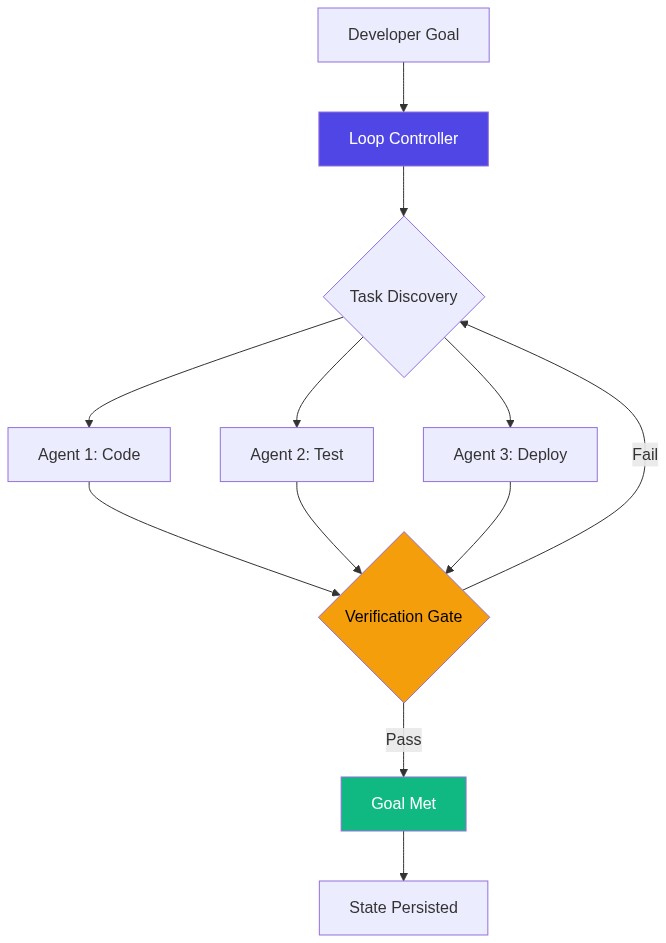 ## Why Loops Are the Terminal Abstraction
 The claim that loop engineering is the last abstraction rests on a simple observation. Every abstraction exists to reduce the distance between what you want and what you have to do to get it. Once that distance reaches zero, there is nothing left to abstract.
### The Intent to Execution Gap
Consider the gap at each stage of the evolution:
| Abstraction Era | What You Specify | What the System Figures Out | Gap Remaining |
|---|---|---|---|
| Machine Code | Opcodes | Nothing | Everything |
| Assembly | Mnemonics | Opcode encoding | Register allocation |
| Compiled Languages | Algorithms | Register allocation, machine code | Algorithm design |
| Frameworks | Conventions | Boilerplate, patterns | Business logic |
| APIs | Integration contracts | Service communication | Integration code |
| Prompting | Natural language instructions | Text generation | Instruction refinement |
| Loop Engineering | Goals | Task decomposition, execution, verification, iteration | Zero |
The gap shrinks with each abstraction. Loop engineering closes it entirely. Once you can specify a goal and the system autonomously decomposes, executes, verifies, and iterates, there is no remaining translation layer to abstract away. The only thing left is the goal itself, and that is not software. That is intent.
### Why This Is Different From "Automation"
A common objection is that loop engineering is just automation with a new name. It is not. Traditional automation follows a predetermined script. An automated pipeline executes steps that a human designed in advance. If a step fails, the pipeline halts and waits for human intervention.
Loop engineering is fundamentally different because the loop itself decides what to do next. It does not follow a script. It evaluates the current state, selects from a space of possible actions, executes, verifies, and adapts. The loop is not automation. It is agency.
Consider the difference in failure modes:
- **Automation fails closed.** When something goes wrong, the pipeline stops and a human investigates.
- **Loop engineering fails open.** When something goes wrong, the loop detects the failure, selects an alternative approach, and continues toward the goal.
This distinction is what makes loop engineering terminal. Automation still requires a human to design the failure handling. Loop engineering handles failure autonomously because the loop itself is the failure handler.
The claim that loop engineering is the last abstraction rests on a simple observation. Every abstraction exists to reduce the distance between what you want and what you have to do to get it. Once that distance reaches zero, there is nothing left to abstract.
### The Intent to Execution Gap
Consider the gap at each stage of the evolution:
| Abstraction Era | What You Specify | What the System Figures Out | Gap Remaining |
|---|---|---|---|
| Machine Code | Opcodes | Nothing | Everything |
| Assembly | Mnemonics | Opcode encoding | Register allocation |
| Compiled Languages | Algorithms | Register allocation, machine code | Algorithm design |
| Frameworks | Conventions | Boilerplate, patterns | Business logic |
| APIs | Integration contracts | Service communication | Integration code |
| Prompting | Natural language instructions | Text generation | Instruction refinement |
| Loop Engineering | Goals | Task decomposition, execution, verification, iteration | Zero |
The gap shrinks with each abstraction. Loop engineering closes it entirely. Once you can specify a goal and the system autonomously decomposes, executes, verifies, and iterates, there is no remaining translation layer to abstract away. The only thing left is the goal itself, and that is not software. That is intent.
### Why This Is Different From "Automation"
A common objection is that loop engineering is just automation with a new name. It is not. Traditional automation follows a predetermined script. An automated pipeline executes steps that a human designed in advance. If a step fails, the pipeline halts and waits for human intervention.
Loop engineering is fundamentally different because the loop itself decides what to do next. It does not follow a script. It evaluates the current state, selects from a space of possible actions, executes, verifies, and adapts. The loop is not automation. It is agency.
Consider the difference in failure modes:
- **Automation fails closed.** When something goes wrong, the pipeline stops and a human investigates.
- **Loop engineering fails open.** When something goes wrong, the loop detects the failure, selects an alternative approach, and continues toward the goal.
This distinction is what makes loop engineering terminal. Automation still requires a human to design the failure handling. Loop engineering handles failure autonomously because the loop itself is the failure handler.
 ## Loop Engineering vs Traditional Software Development
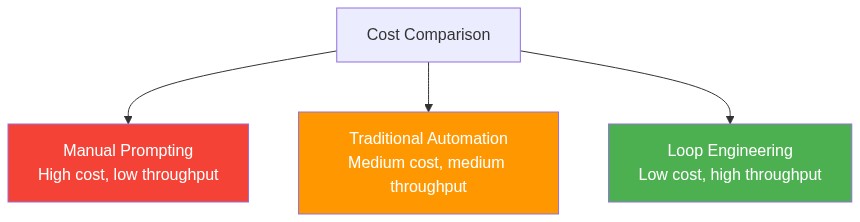 To make the contrast concrete, here is how loop engineering compares to traditional software development across the dimensions that matter to engineering teams.
| Dimension | Traditional Development | Loop Engineering |
|---|---|---|
| Primary Input | Detailed specification | Goal description |
| Execution Model | Fixed pipeline | Recursive control loop |
| Failure Handling | Manual intervention | Autonomous retry with alternatives |
| State Management | External (databases, queues) | Internal (loop memory, context persistence) |
| Scaling Approach | Add more engineers | Add more parallel loops |
| Quality Assurance | Separate QA phase | Inline verification gates |
| Time to First Result | Days to weeks | Minutes to hours |
| Maintenance Model | Patch and redeploy | Loop self corrects and persists |
| Cost Structure | Linear with complexity | Sublinear with complexity |
| Knowledge Retention | Lost on team turnover | Persisted in loop memory |
The most important row is the last one. In traditional development, institutional knowledge lives in the heads of engineers. When they leave, the knowledge leaves with them. In loop engineering, knowledge is persisted in the loop's state, memory, and verification history. The loop becomes the documentation.
## Key Characteristics of Loop Engineered Systems
Systems built with loop engineering share a set of characteristics that distinguish them from traditional software. Understanding these characteristics is essential for teams evaluating whether to adopt the approach.
1. **Goal oriented, not instruction oriented.** The system is configured with a desired outcome, not a sequence of steps. The loop determines the steps.
2. **Stateful across sessions.** The loop maintains memory of past attempts, successes, and failures. It does not start from scratch each time. This is what makes it improve over iterations.
3. **Self verifying.** Every agent action passes through a verification gate before the loop accepts it. Verification can be deterministic (test suite, linting, type checking) or semantic (evaluator agent, human review for high stakes decisions).
4. **Parallelizable.** Loops can dispatch multiple agents concurrently, each working on an independent subgoal. The loop coordinates their outputs and resolves conflicts.
5. **Budget aware.** Each loop has a compute and cost budget. When the budget is exhausted, the loop reports its progress and waits for a decision rather than running indefinitely.
6. **Auditable.** Every decision the loop makes is logged: what task it discovered, what agent it dispatched, what output was produced, whether verification passed, and what alternative it selected on failure. This creates a full audit trail.
7. **Composable.** A loop can spawn subloops. A subloop can spawn subsubloops. This recursive composition allows arbitrarily complex systems to be built from a single primitive.
8. **Safe by default.** The loop includes deterministic circuit breakers that halt execution when safety constraints are violated, regardless of what the agent recommends. These breakers cannot be overridden by the agent.
To make the contrast concrete, here is how loop engineering compares to traditional software development across the dimensions that matter to engineering teams.
| Dimension | Traditional Development | Loop Engineering |
|---|---|---|
| Primary Input | Detailed specification | Goal description |
| Execution Model | Fixed pipeline | Recursive control loop |
| Failure Handling | Manual intervention | Autonomous retry with alternatives |
| State Management | External (databases, queues) | Internal (loop memory, context persistence) |
| Scaling Approach | Add more engineers | Add more parallel loops |
| Quality Assurance | Separate QA phase | Inline verification gates |
| Time to First Result | Days to weeks | Minutes to hours |
| Maintenance Model | Patch and redeploy | Loop self corrects and persists |
| Cost Structure | Linear with complexity | Sublinear with complexity |
| Knowledge Retention | Lost on team turnover | Persisted in loop memory |
The most important row is the last one. In traditional development, institutional knowledge lives in the heads of engineers. When they leave, the knowledge leaves with them. In loop engineering, knowledge is persisted in the loop's state, memory, and verification history. The loop becomes the documentation.
## Key Characteristics of Loop Engineered Systems
Systems built with loop engineering share a set of characteristics that distinguish them from traditional software. Understanding these characteristics is essential for teams evaluating whether to adopt the approach.
1. **Goal oriented, not instruction oriented.** The system is configured with a desired outcome, not a sequence of steps. The loop determines the steps.
2. **Stateful across sessions.** The loop maintains memory of past attempts, successes, and failures. It does not start from scratch each time. This is what makes it improve over iterations.
3. **Self verifying.** Every agent action passes through a verification gate before the loop accepts it. Verification can be deterministic (test suite, linting, type checking) or semantic (evaluator agent, human review for high stakes decisions).
4. **Parallelizable.** Loops can dispatch multiple agents concurrently, each working on an independent subgoal. The loop coordinates their outputs and resolves conflicts.
5. **Budget aware.** Each loop has a compute and cost budget. When the budget is exhausted, the loop reports its progress and waits for a decision rather than running indefinitely.
6. **Auditable.** Every decision the loop makes is logged: what task it discovered, what agent it dispatched, what output was produced, whether verification passed, and what alternative it selected on failure. This creates a full audit trail.
7. **Composable.** A loop can spawn subloops. A subloop can spawn subsubloops. This recursive composition allows arbitrarily complex systems to be built from a single primitive.
8. **Safe by default.** The loop includes deterministic circuit breakers that halt execution when safety constraints are violated, regardless of what the agent recommends. These breakers cannot be overridden by the agent.
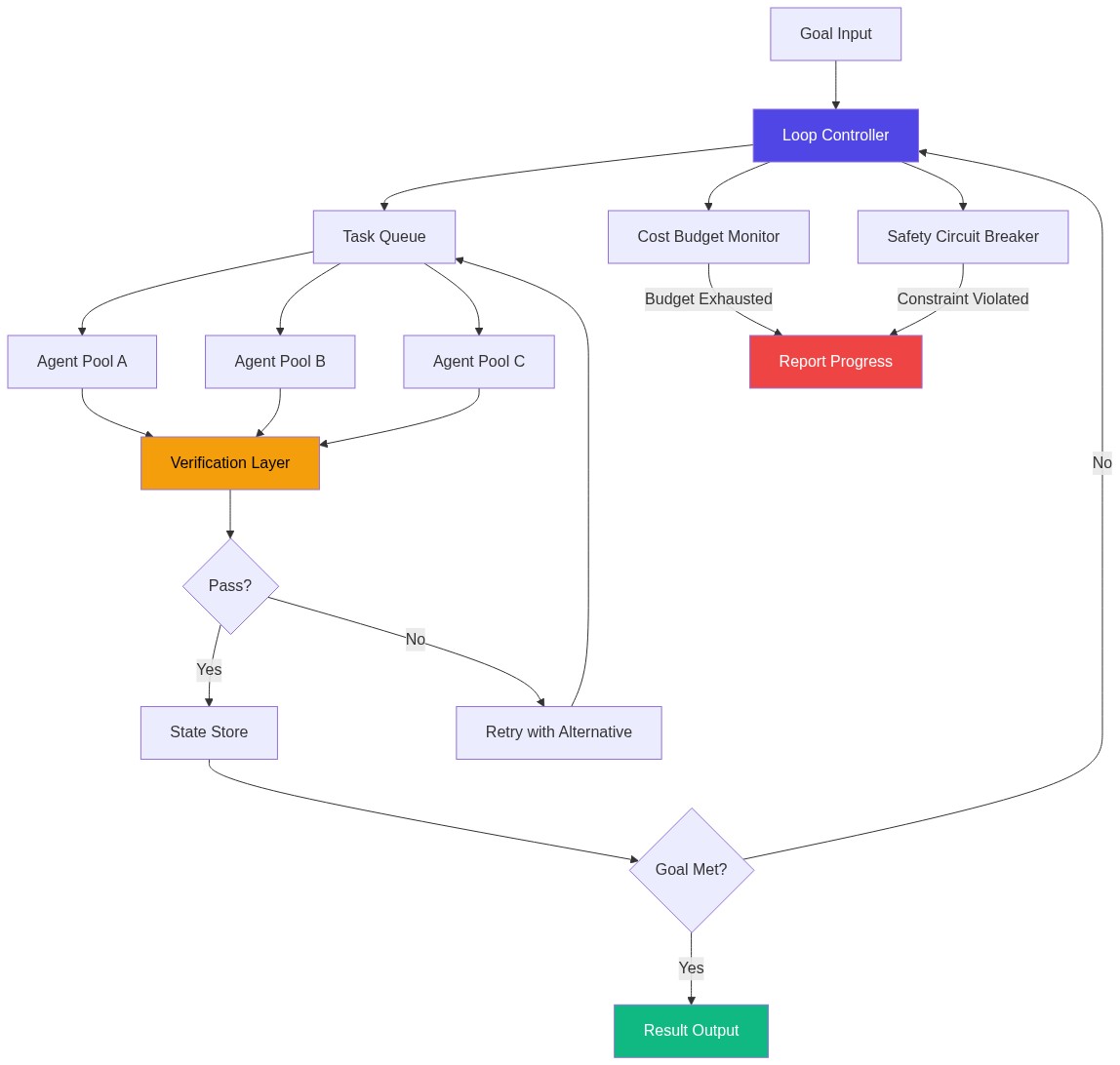 ## How Loop Engineering Works in Practice
The theoretical argument for loop engineering as the terminal abstraction is compelling, but the practical question is how it actually works in production. Here is a walkthrough of a typical loop engineered workflow.
### Step 1: Define the Goal
The developer writes a goal specification. This is not a user story or a ticket. It is a structured description of the desired outcome, including constraints, success criteria, and budget.
- Goal: "Add pagination to the user list API endpoint"
- Success criteria: "Endpoint accepts page and page_size parameters, returns paginated results, and all existing tests pass"
- Constraints: "No breaking changes to existing API consumers"
- Budget: "Maximum 50 agent turns, 30 minutes wall clock"
### Step 2: The Loop Discovers Tasks
The loop controller reads the goal and decomposes it into discrete tasks. It may use an agent to analyze the codebase, identify the relevant files, and generate a task list.
- Task 1: Locate the user list endpoint handler
- Task 2: Add pagination parameters to the route definition
- Task 3: Modify the database query to support LIMIT and OFFSET
- Task 4: Update the response schema to include pagination metadata
- Task 5: Write tests for the paginated endpoint
- Task 6: Run the full test suite and verify no regressions
### Step 3: Agents Execute Tasks
The loop dispatches agents to execute each task. Some tasks run in parallel (locating files, writing tests) while others are sequential (modifying the query before updating the schema). The loop manages the dependency graph.
### Step 4: Verification Gates
After each task completes, the loop runs a verification gate. For code changes, this typically includes:
- Syntax validation
- Type checking
- Unit test execution
- Linting and formatting checks
- Integration test execution
If verification fails, the loop feeds the error back to the agent and retries with the failure context. If verification fails repeatedly, the loop selects an alternative approach (different agent, different strategy, or human escalation).
### Step 5: State Persistence
The loop persists state at every step. This includes the current task graph, completed tasks, failed attempts, agent outputs, and verification results. If the loop is interrupted (budget exhaustion, circuit breaker, or manual pause), it can resume from the last checkpoint without losing progress.
### Step 6: Goal Resolution
When all tasks are verified and the success criteria are met, the loop reports completion. The result includes the changes made, the verification results, the total cost, and a full audit trail.
## How Loop Engineering Works in Practice
The theoretical argument for loop engineering as the terminal abstraction is compelling, but the practical question is how it actually works in production. Here is a walkthrough of a typical loop engineered workflow.
### Step 1: Define the Goal
The developer writes a goal specification. This is not a user story or a ticket. It is a structured description of the desired outcome, including constraints, success criteria, and budget.
- Goal: "Add pagination to the user list API endpoint"
- Success criteria: "Endpoint accepts page and page_size parameters, returns paginated results, and all existing tests pass"
- Constraints: "No breaking changes to existing API consumers"
- Budget: "Maximum 50 agent turns, 30 minutes wall clock"
### Step 2: The Loop Discovers Tasks
The loop controller reads the goal and decomposes it into discrete tasks. It may use an agent to analyze the codebase, identify the relevant files, and generate a task list.
- Task 1: Locate the user list endpoint handler
- Task 2: Add pagination parameters to the route definition
- Task 3: Modify the database query to support LIMIT and OFFSET
- Task 4: Update the response schema to include pagination metadata
- Task 5: Write tests for the paginated endpoint
- Task 6: Run the full test suite and verify no regressions
### Step 3: Agents Execute Tasks
The loop dispatches agents to execute each task. Some tasks run in parallel (locating files, writing tests) while others are sequential (modifying the query before updating the schema). The loop manages the dependency graph.
### Step 4: Verification Gates
After each task completes, the loop runs a verification gate. For code changes, this typically includes:
- Syntax validation
- Type checking
- Unit test execution
- Linting and formatting checks
- Integration test execution
If verification fails, the loop feeds the error back to the agent and retries with the failure context. If verification fails repeatedly, the loop selects an alternative approach (different agent, different strategy, or human escalation).
### Step 5: State Persistence
The loop persists state at every step. This includes the current task graph, completed tasks, failed attempts, agent outputs, and verification results. If the loop is interrupted (budget exhaustion, circuit breaker, or manual pause), it can resume from the last checkpoint without losing progress.
### Step 6: Goal Resolution
When all tasks are verified and the success criteria are met, the loop reports completion. The result includes the changes made, the verification results, the total cost, and a full audit trail.
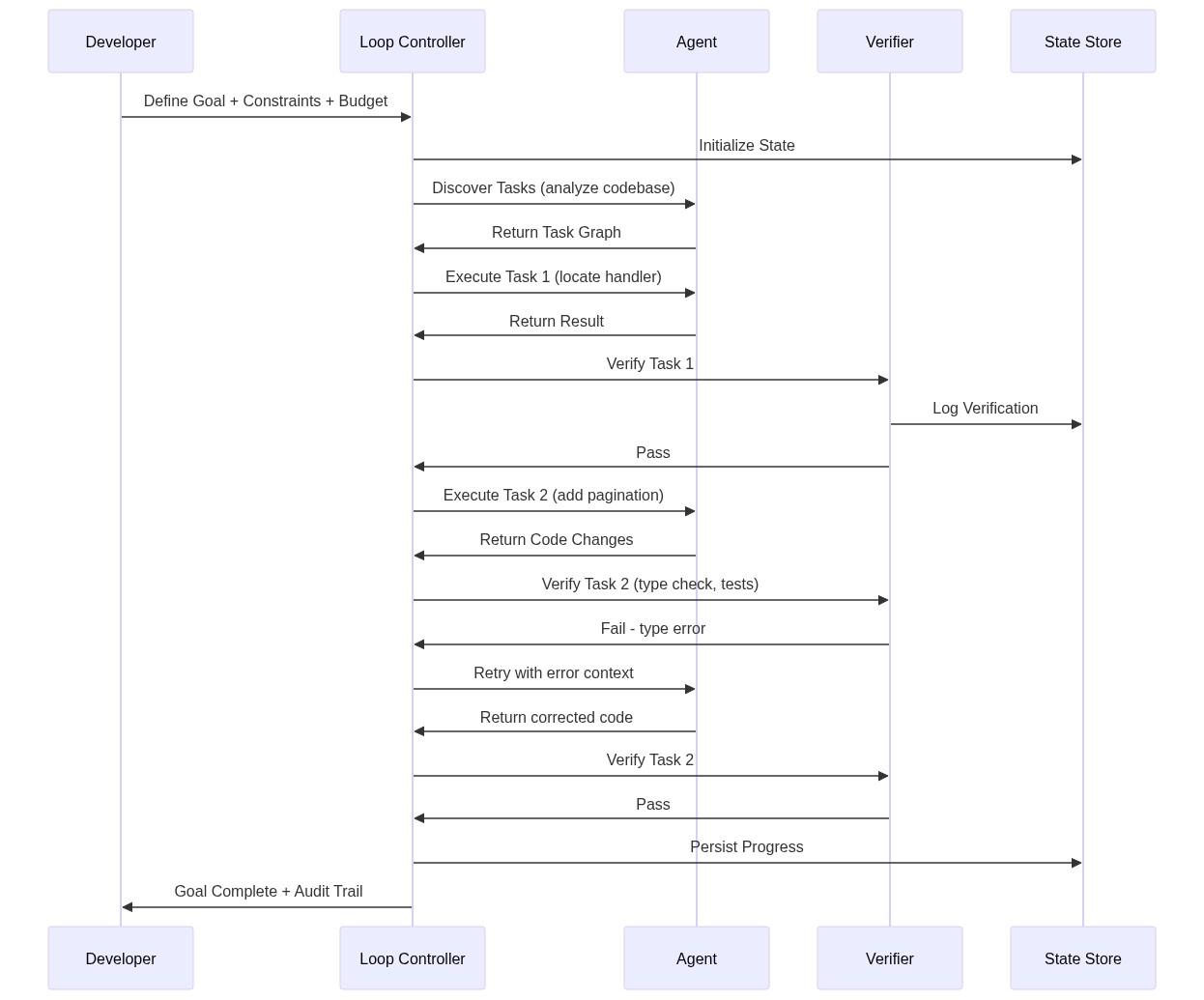 ## Industry Use Cases
Loop engineering is not a theoretical framework waiting for adoption. It is already in production across industries. The use cases below illustrate how different sectors apply the terminal abstraction to solve problems that traditional development could not.
### Finance and Banking
Financial institutions use loop engineering for regulatory compliance automation. A compliance loop continuously monitors transactions, flags anomalies, generates regulatory reports, and submits them through the appropriate channels. The loop verifies each report against regulatory schemas before submission and retries with corrections if validation fails. This replaces teams of analysts who previously reviewed transactions manually and reduces reporting latency from days to minutes.
Key applications in finance:
- Transaction monitoring and anomaly detection loops
- Automated regulatory report generation and submission
- Risk assessment loops that evaluate portfolio exposure in real time
- Loan underwriting loops that verify documentation and assess creditworthiness
### Healthcare
Healthcare organizations deploy loop engineering for clinical documentation and care plan generation. A clinical loop reads patient records, extracts relevant information, generates documentation that meets billing and compliance standards, and verifies the output against clinical coding rules. The loop includes human review gates for high stakes decisions but handles routine documentation autonomously.
Key applications in healthcare:
- Clinical documentation automation loops
- Prior authorization processing loops
- Patient intake and triage assistance loops
- Medical coding verification loops
### Manufacturing
Manufacturing companies use loop engineering for supply chain optimization and predictive maintenance. A supply chain loop monitors inventory levels, predicts demand based on historical data and market signals, automatically places orders when thresholds are crossed, and verifies that orders meet compliance and budget constraints. The loop adapts to disruptions by selecting alternative suppliers and rerouting logistics.
Key applications in manufacturing:
- Inventory optimization and auto ordering loops
- Predictive maintenance scheduling loops
- Quality inspection loops that analyze sensor data and flag defects
- Production scheduling loops that adapt to demand fluctuations
### Retail and E Commerce
Retailers apply loop engineering to dynamic pricing, content generation, and customer support. A pricing loop monitors competitor prices, demand signals, and inventory levels, then adjusts prices within guardrails set by the merchandising team. The loop verifies that every price change meets margin and competitiveness constraints before publishing.
Key applications in retail:
- Dynamic pricing optimization loops
- Product description generation and A/B testing loops
- Customer support automation loops with escalation gates
- Inventory forecasting and replenishment loops
### Technology and Software Development
Technology companies are the earliest adopters of loop engineering, applying it to the software development lifecycle itself. A development loop takes a feature request, writes the code, runs the tests, fixes failures, and prepares a pull request. The loop includes code review verification gates and can escalate to human reviewers for architectural decisions. This is the use case that most directly demonstrates why loop engineering is the terminal abstraction: the software is writing the software.
Key applications in technology:
- Autonomous code generation and review loops
- Infrastructure provisioning and configuration loops
- Incident response loops that detect, diagnose, and remediate outages
- Security vulnerability scanning and patching loops
## Industry Use Cases
Loop engineering is not a theoretical framework waiting for adoption. It is already in production across industries. The use cases below illustrate how different sectors apply the terminal abstraction to solve problems that traditional development could not.
### Finance and Banking
Financial institutions use loop engineering for regulatory compliance automation. A compliance loop continuously monitors transactions, flags anomalies, generates regulatory reports, and submits them through the appropriate channels. The loop verifies each report against regulatory schemas before submission and retries with corrections if validation fails. This replaces teams of analysts who previously reviewed transactions manually and reduces reporting latency from days to minutes.
Key applications in finance:
- Transaction monitoring and anomaly detection loops
- Automated regulatory report generation and submission
- Risk assessment loops that evaluate portfolio exposure in real time
- Loan underwriting loops that verify documentation and assess creditworthiness
### Healthcare
Healthcare organizations deploy loop engineering for clinical documentation and care plan generation. A clinical loop reads patient records, extracts relevant information, generates documentation that meets billing and compliance standards, and verifies the output against clinical coding rules. The loop includes human review gates for high stakes decisions but handles routine documentation autonomously.
Key applications in healthcare:
- Clinical documentation automation loops
- Prior authorization processing loops
- Patient intake and triage assistance loops
- Medical coding verification loops
### Manufacturing
Manufacturing companies use loop engineering for supply chain optimization and predictive maintenance. A supply chain loop monitors inventory levels, predicts demand based on historical data and market signals, automatically places orders when thresholds are crossed, and verifies that orders meet compliance and budget constraints. The loop adapts to disruptions by selecting alternative suppliers and rerouting logistics.
Key applications in manufacturing:
- Inventory optimization and auto ordering loops
- Predictive maintenance scheduling loops
- Quality inspection loops that analyze sensor data and flag defects
- Production scheduling loops that adapt to demand fluctuations
### Retail and E Commerce
Retailers apply loop engineering to dynamic pricing, content generation, and customer support. A pricing loop monitors competitor prices, demand signals, and inventory levels, then adjusts prices within guardrails set by the merchandising team. The loop verifies that every price change meets margin and competitiveness constraints before publishing.
Key applications in retail:
- Dynamic pricing optimization loops
- Product description generation and A/B testing loops
- Customer support automation loops with escalation gates
- Inventory forecasting and replenishment loops
### Technology and Software Development
Technology companies are the earliest adopters of loop engineering, applying it to the software development lifecycle itself. A development loop takes a feature request, writes the code, runs the tests, fixes failures, and prepares a pull request. The loop includes code review verification gates and can escalate to human reviewers for architectural decisions. This is the use case that most directly demonstrates why loop engineering is the terminal abstraction: the software is writing the software.
Key applications in technology:
- Autonomous code generation and review loops
- Infrastructure provisioning and configuration loops
- Incident response loops that detect, diagnose, and remediate outages
- Security vulnerability scanning and patching loops
 ## How to Transition to Loop Engineering
Moving from traditional development to loop engineering is not a switch. It is a phased transition that introduces loop primitives incrementally. Here is a roadmap that teams can follow.
### Phase 1: Identify Loopable Workflows
Start by identifying workflows that are repetitive, well defined, and verifiable. These are the candidates for loop engineering. Good starting points include:
- Bug fixing workflows where the fix can be verified by a test suite
- Documentation generation where the output can be verified against a schema
- Data transformation pipelines where the output can be verified by validation rules
- Configuration management where changes can be verified by infrastructure tests
### Phase 2: Build Your First Loop
Select one workflow and wrap it in a control loop. The loop should include:
1. A goal input that describes the desired outcome
2. A task discovery step that decomposes the goal into actionable tasks
3. An agent dispatch step that executes each task
4. A verification gate that checks the output
5. A retry mechanism that feeds failures back to the agent
6. A state store that persists progress across iterations
### Phase 3: Add Safety Controls
Before deploying to production, add the safety controls that make the loop trustworthy:
- Deterministic circuit breakers that halt execution on constraint violations
- Cost budget monitors that prevent runaway spending
- Human review gates for high stakes decisions
- Audit logging for every loop decision
### Phase 4: Scale with Parallel Loops
Once the first loop is stable, scale by running multiple loops in parallel. Each loop handles an independent workflow. Coordinate loops through shared state and dependency graphs.
### Phase 5: Compose Loops
The final phase is composition. Build meta loops that orchestrate subloops. A meta loop takes a high level goal, decomposes it into subgoals, and dispatches each subgoal to a specialized subloop. This is where the recursive power of loop engineering becomes visible.
## How to Transition to Loop Engineering
Moving from traditional development to loop engineering is not a switch. It is a phased transition that introduces loop primitives incrementally. Here is a roadmap that teams can follow.
### Phase 1: Identify Loopable Workflows
Start by identifying workflows that are repetitive, well defined, and verifiable. These are the candidates for loop engineering. Good starting points include:
- Bug fixing workflows where the fix can be verified by a test suite
- Documentation generation where the output can be verified against a schema
- Data transformation pipelines where the output can be verified by validation rules
- Configuration management where changes can be verified by infrastructure tests
### Phase 2: Build Your First Loop
Select one workflow and wrap it in a control loop. The loop should include:
1. A goal input that describes the desired outcome
2. A task discovery step that decomposes the goal into actionable tasks
3. An agent dispatch step that executes each task
4. A verification gate that checks the output
5. A retry mechanism that feeds failures back to the agent
6. A state store that persists progress across iterations
### Phase 3: Add Safety Controls
Before deploying to production, add the safety controls that make the loop trustworthy:
- Deterministic circuit breakers that halt execution on constraint violations
- Cost budget monitors that prevent runaway spending
- Human review gates for high stakes decisions
- Audit logging for every loop decision
### Phase 4: Scale with Parallel Loops
Once the first loop is stable, scale by running multiple loops in parallel. Each loop handles an independent workflow. Coordinate loops through shared state and dependency graphs.
### Phase 5: Compose Loops
The final phase is composition. Build meta loops that orchestrate subloops. A meta loop takes a high level goal, decomposes it into subgoals, and dispatches each subgoal to a specialized subloop. This is where the recursive power of loop engineering becomes visible.
 ## Best Practices for Loop Engineering
Teams that succeed with loop engineering follow a set of practices that keep loops safe, effective, and cost efficient. These are the practices that separate production grade loops from experiments.
1. **Start with verifiable goals.** If you cannot define a verification gate, you are not ready to loop. Every goal must have a deterministic or semantic check that the loop can use to evaluate success.
2. **Set aggressive budgets.** Loops without budgets run forever. Set a turn limit, a wall clock limit, and a cost limit. When any limit is hit, the loop should report progress and stop.
3. **Use deterministic breakers for safety.** Do not rely on the agent to self regulate. Use deterministic code that checks safety constraints and halts the loop regardless of what the agent recommends.
4. **Persist state aggressively.** Every task, every output, every verification result should be persisted. This enables resumption after interruption and creates an audit trail.
5. **Separate execution from verification.** The agent that executes a task should not be the same agent that verifies it. Use independent verification to avoid confirmation bias.
6. **Escalate gracefully.** When a loop exhausts its budget or hits a circuit breaker, it should escalate to a human with a clear summary of what was attempted, what succeeded, and what failed.
7. **Monitor cost per goal, not per turn.** Individual agent turns are cheap. The question is whether the total cost of achieving a goal is acceptable. Track cost per completed goal, not cost per API call.
8. **Version your loops.** Treat the loop definition as code. Version it, test it, and roll back if a new version produces worse results than the previous one.
9. **Share memory across loops.** Loops that work on related problems should share a memory store. This prevents redundant discovery and allows one loop's learnings to benefit another.
10. **Measure loop efficiency.** Track the ratio of successful goals to total attempts, the average turns per goal, and the average cost per goal. These metrics tell you whether your loops are improving over time.
## Loop Engineering with Shakudo
Shakudo provides the infrastructure that makes loop engineering practical at enterprise scale. The [Shakudo platform](/platform) includes the components that a production grade loop requires: an [AI gateway](/ai-gateway) for routing agent calls across model providers, [Kaji](/kaji) for orchestrating agent workflows with verification gates and state persistence, and a deep [integration catalog](/integrations) for connecting loops to your existing data and tools.
### What Shakudo Provides for Loop Engineering
- **Model routing and failover.** The AI gateway routes agent calls to the best model for each task and fails over automatically when a provider is unavailable. Loops do not break when a model endpoint goes down.
- **Agent orchestration.** Kaji provides the loop controller primitives: task discovery, agent dispatch, verification gates, retry logic, and state persistence. You define the goal. Kaji runs the loop.
- **Integration with existing systems.** Loops need access to your codebase, databases, CI/CD pipelines, and monitoring tools. Shakudo's [integration catalog](/integrations) connects loops to the systems they need to act on.
- **Governance and audit.** Every loop decision is logged and auditable. Safety circuit breakers are enforced at the platform level, not the application level, so they cannot be bypassed by agent behavior.
- **Cost management.** Shakudo tracks cost per loop, per goal, and per agent turn. Budgets are enforced at the platform level, preventing runaway spending before it starts.
### Getting Started
To start building loops on Shakudo:
1. Define a goal that is currently handled by a repetitive, verifiable workflow
2. Connect the relevant [integrations](/integrations) (GitHub, databases, CI/CD, monitoring)
3. Configure the [AI gateway](/ai-gateway) with the models you want to use
4. Write the goal specification and verification criteria
5. Deploy the loop via [Kaji](/kaji) with a cost budget and safety breakers
6. Monitor the loop's progress, cost, and audit trail in the dashboard
If you want to see loop engineering in action on your own infrastructure, [contact us](/contact-us) and we will help you design your first production loop.
## Best Practices for Loop Engineering
Teams that succeed with loop engineering follow a set of practices that keep loops safe, effective, and cost efficient. These are the practices that separate production grade loops from experiments.
1. **Start with verifiable goals.** If you cannot define a verification gate, you are not ready to loop. Every goal must have a deterministic or semantic check that the loop can use to evaluate success.
2. **Set aggressive budgets.** Loops without budgets run forever. Set a turn limit, a wall clock limit, and a cost limit. When any limit is hit, the loop should report progress and stop.
3. **Use deterministic breakers for safety.** Do not rely on the agent to self regulate. Use deterministic code that checks safety constraints and halts the loop regardless of what the agent recommends.
4. **Persist state aggressively.** Every task, every output, every verification result should be persisted. This enables resumption after interruption and creates an audit trail.
5. **Separate execution from verification.** The agent that executes a task should not be the same agent that verifies it. Use independent verification to avoid confirmation bias.
6. **Escalate gracefully.** When a loop exhausts its budget or hits a circuit breaker, it should escalate to a human with a clear summary of what was attempted, what succeeded, and what failed.
7. **Monitor cost per goal, not per turn.** Individual agent turns are cheap. The question is whether the total cost of achieving a goal is acceptable. Track cost per completed goal, not cost per API call.
8. **Version your loops.** Treat the loop definition as code. Version it, test it, and roll back if a new version produces worse results than the previous one.
9. **Share memory across loops.** Loops that work on related problems should share a memory store. This prevents redundant discovery and allows one loop's learnings to benefit another.
10. **Measure loop efficiency.** Track the ratio of successful goals to total attempts, the average turns per goal, and the average cost per goal. These metrics tell you whether your loops are improving over time.
## Loop Engineering with Shakudo
Shakudo provides the infrastructure that makes loop engineering practical at enterprise scale. The [Shakudo platform](/platform) includes the components that a production grade loop requires: an [AI gateway](/ai-gateway) for routing agent calls across model providers, [Kaji](/kaji) for orchestrating agent workflows with verification gates and state persistence, and a deep [integration catalog](/integrations) for connecting loops to your existing data and tools.
### What Shakudo Provides for Loop Engineering
- **Model routing and failover.** The AI gateway routes agent calls to the best model for each task and fails over automatically when a provider is unavailable. Loops do not break when a model endpoint goes down.
- **Agent orchestration.** Kaji provides the loop controller primitives: task discovery, agent dispatch, verification gates, retry logic, and state persistence. You define the goal. Kaji runs the loop.
- **Integration with existing systems.** Loops need access to your codebase, databases, CI/CD pipelines, and monitoring tools. Shakudo's [integration catalog](/integrations) connects loops to the systems they need to act on.
- **Governance and audit.** Every loop decision is logged and auditable. Safety circuit breakers are enforced at the platform level, not the application level, so they cannot be bypassed by agent behavior.
- **Cost management.** Shakudo tracks cost per loop, per goal, and per agent turn. Budgets are enforced at the platform level, preventing runaway spending before it starts.
### Getting Started
To start building loops on Shakudo:
1. Define a goal that is currently handled by a repetitive, verifiable workflow
2. Connect the relevant [integrations](/integrations) (GitHub, databases, CI/CD, monitoring)
3. Configure the [AI gateway](/ai-gateway) with the models you want to use
4. Write the goal specification and verification criteria
5. Deploy the loop via [Kaji](/kaji) with a cost budget and safety breakers
6. Monitor the loop's progress, cost, and audit trail in the dashboard
If you want to see loop engineering in action on your own infrastructure, [contact us](/contact-us) and we will help you design your first production loop.
 ## Conclusion: The End of the Abstraction Stack
The history of software engineering is the history of abstraction. Each generation moved the developer further from the machine and closer to intent. Assembly abstracted opcodes. Compilers abstracted assembly. Frameworks abstracted boilerplate. APIs abstracted integration. Prompting abstracted instruction.
Loop engineering abstracts the last remaining manual step: the human steering of the agent through each turn. Once you can specify a goal and the system autonomously discovers, executes, verifies, and iterates, there is nothing left to abstract. The gap between intent and execution has closed.
This is why loop engineering is not just another tool in the stack. It is the last piece of software you will need to write by hand. After loops, you do not write software. You describe goals. The loop writes the software.
The teams that adopt loop engineering now will build a compounding advantage. Their loops will accumulate state, memory, and verification history. Their cost per goal will decline over time. Their knowledge will persist in the loop, not in the heads of engineers who might leave. The teams that wait will find themselves competing against organizations whose software writes itself.
The abstraction stack is complete. The question is whether you are ready to stand at the top of it.
## FAQ
**Is loop engineering the same as agentic AI?**
No. Agentic AI refers to AI systems that can take autonomous actions. Loop engineering is the discipline of building the control loops that govern those agents. An agent without a loop is a chatbot. An agent with a loop is a production system.
**Does loop engineering replace software engineers?**
No, it changes what software engineers do. Instead of writing instructions, engineers design goals, build verification gates, configure safety controls, and govern loop behavior. The work becomes higher level and more architectural.
**What is the difference between loop engineering and RPA?**
RPA (robotic process automation) follows predetermined scripts. If a step fails, the RPA pipeline halts. Loop engineering discovers steps dynamically and handles failure autonomously by selecting alternative approaches. RPA is automation. Loop engineering is agency.
**How much does loop engineering cost?**
Cost depends on the complexity of the goal, the number of agent turns required, and the models used. Most production loops complete goals for a fraction of the cost of manual engineering time. Shakudo's cost tracking lets you monitor cost per goal and enforce budgets at the platform level.
**Is loop engineering safe for production use?**
Yes, when deployed with proper safety controls. Deterministic circuit breakers, cost budgets, verification gates, and human review for high stakes decisions make loops safe for production. The key is enforcing safety at the platform level, not relying on the agent to self regulate.
**What tools do I need to start loop engineering?**
You need an AI model provider, an orchestration layer for the loop controller, verification tooling (test suites, linters, type checkers), and state persistence. Shakudo provides all of these as an integrated [platform](/platform).
**How is loop engineering different from the existing loop engineering guide?**
The existing [loop engineering guide](/blog/loop-engineering) covers what loop engineering is, how it works, and the maturity model. This article argues why it is the terminal abstraction, the end of the abstraction stack, and what that means for the future of software development.
# blog/loop-engineering.md
*[Source (/blog/loop-engineering)](https://www.shakudo.io/blog/loop-engineering) | [Markdown twin](https://www.shakudo.io/blog/loop-engineering.md)*
---
## Introduction: The End of Manual Prompting
In 2026, the way developers work with AI has fundamentally changed. The era of typing a prompt, reading a response, correcting the model, and re-prompting is ending. A new discipline has emerged from the developer community that treats AI agents not as chat partners but as autonomous systems driven by control loops. That discipline is **loop engineering**.
Loop engineering is the practice of writing outer control loops that drive AI agents autonomously. Instead of manually prompt-correct-reprompting through every step, a loop engineer writes code that prompts the agent, evaluates the output, decides what to do next, and iterates until a goal is met or a safety limit is hit. The developer's job shifts from babysitting a chat window to designing, governing, and verifying the loops that run the agents.
This shift matters because the babysitter bottleneck is real. Manually steering an agent through every turn is slow, error-prone, and, as one prominent engineer described it, "the most boring job in the world." Loop engineering eliminates that bottleneck by codifying the steering logic into repeatable, auditable, production-grade software.
In this article, we cover everything you need to know about loop engineering: where it came from, how it works, the maturity model that tracks its evolution, the core patterns practitioners use, the safety controls that make it viable in production, and how enterprises are adopting it under governance.
## The Shift from Prompting to Looping
The defining statement of loop engineering came from Boris Cherny, Head of Claude Code at Anthropic:
> "I don't prompt Claude anymore. I write loops that prompt Claude and figure out what to do."
This single quote captures the paradigm shift. The most skilled AI engineers are no longer optimizing prompts. They are building systems around agents. Andrej Karpathy has reinforced this idea, noting that large language models become dramatically better when forced into disciplined workflows rather than free-form conversation.
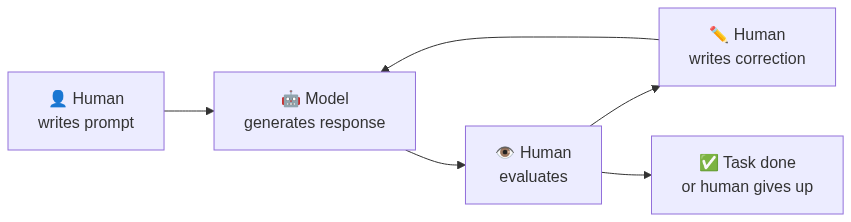
The manual prompting workflow looks like this:
1. Human writes a prompt
2. Model generates a response
3. Human reads and evaluates the response
4. Human writes a correction or follow-up prompt
5. Model generates a new response
6. Repeat until the task is done or the human gives up
Every step requires human attention. The human is the loop. This works for quick tasks but breaks down when you need an agent to verify hundreds of user flows, fix production errors flagged by monitoring tools, or iterate on a complex codebase over hours.
The loop-driven workflow replaces the human loop with a software loop:
1. Engineer writes a control loop with a goal, constraints, and verification gates
2. The loop prompts the agent
3. The loop evaluates the output against verification criteria
4. If the output passes, the loop proceeds or terminates
5. If the output fails, the loop injects feedback and re-prompts
6. The loop continues autonomously until the goal is met or a circuit breaker triggers
The human's role changes from turn-by-turn operator to loop designer and supervisor. This is a fundamentally different job, and it is the job that loop engineering prepares you for.
## What is Loop Engineering?
Loop engineering is the discipline of designing, building, and operating autonomous control loops that drive AI agents to completion. It borrows its name and core philosophy from control systems engineering, where feedback loops regulate physical and software processes. In the AI context, the loop regulates the agent's behavior through prompts, evaluations, memory, and safety constraints.
A loop-engineered system has several core components:
- **A goal specification:** What the loop is trying to achieve, expressed in terms the agent can act on and the loop can verify.
- **A prompt generation strategy:** How the loop constructs prompts for the agent, including context injection, task decomposition, and feedback from prior iterations.
- **A verification mechanism:** How the loop checks whether the agent's output is correct, complete, and safe before proceeding.
- **Memory and state management:** How the loop carries context forward across iterations and sessions.
- **Safety controls:** Hard limits on iterations, cost, time, and permissions that prevent runaway behavior.
- **An orchestration layer:** How the loop coordinates multiple agents, tools, and external systems.
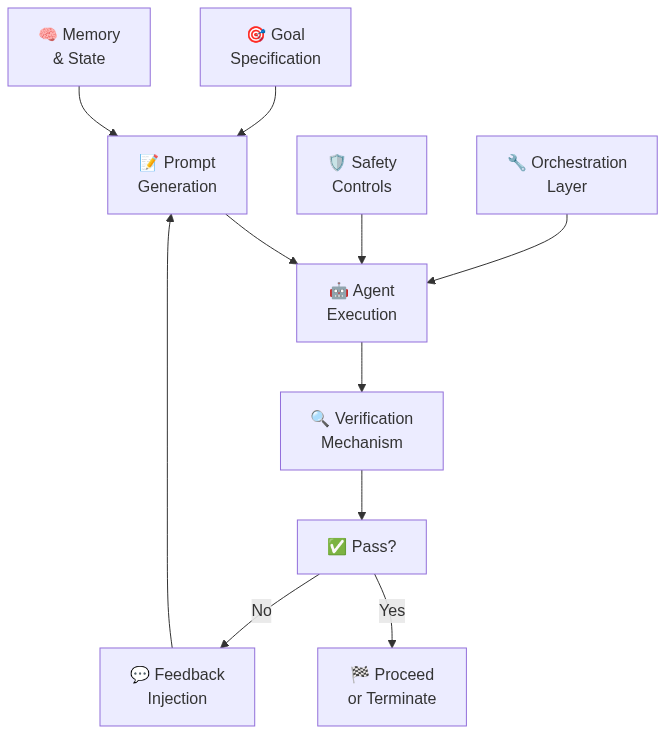
Loop engineering is not the same as prompt engineering. Prompt engineering optimizes what you say to a model in a single turn. Loop engineering optimizes the system that decides what to say, when to say it, and what to do with the response across many turns. Prompt engineering is a skill within loop engineering, but loop engineering is the broader discipline.
The [Anthropic agent guide](https://www.anthropic.com/research/building-effective-agents) describes this distinction well: effective agents are built from composable patterns, not single prompts. The guide outlines patterns like routing, tool use, and evaluation loops that are foundational to loop engineering practice.
## The Loop Maturity Model
Not all loops are created equal. The developer community has begun organizing loop sophistication into a maturity model spanning six levels beyond manual prompting. This model helps teams assess where they are and where they need to go.
| Level | Name | Description | Human Involvement |
|-------|------|-------------|-------------------|
| L0 | Manual prompting | Human writes each prompt by hand | Full |
| L1 | Templated prompting | Reusable prompt templates with variable substitution | High |
| L2 | Scripted loops | Deterministic scripts call LLMs in a fixed sequence | Medium |
| L3 | Stateful loops | Loops maintain persistent memory and context across iterations | Low |
| L4 | Self-verifying loops | Built-in verification gates check outputs before proceeding | Low |
| L5 | Autonomous goal-seeking loops | Loops decompose goals and self-direct execution | Minimal |
| L6 | Fully autonomous multi-agent loops | Swarms of agents coordinate autonomously toward complex goals | Supervisory only |

Most organizations in 2026 sit between L1 and L3. They have templated prompts and some scripted workflows, but they lack stateful memory and verification gates. The jump from L3 to L4 is where production-grade loop engineering begins, because verification gates are what make autonomous loops safe enough to run without constant supervision.
Key observations about the maturity model:
1. L0 and L1 are prompt engineering, not loop engineering
2. L2 is where developers first experience the productivity multiplier of automation
3. L3 introduces the persistent runtime concept, which is essential for long-running tasks
4. L4 is the minimum viable level for production deployments in regulated industries
5. L5 and L6 are active research frontiers with real-world deployments but limited standardization
6. Each level reduces human involvement but increases the need for governance
## Core Patterns in Loop Engineering
Loop engineering has developed a set of recurring patterns that practitioners apply across use cases. These patterns are the building blocks of production agent loops.
### Maker-Checker Architecture
The maker-checker pattern splits execution and evaluation between models. A faster, less expensive model generates candidate output. A more capable model verifies that output against criteria. This separation improves quality and controls cost.
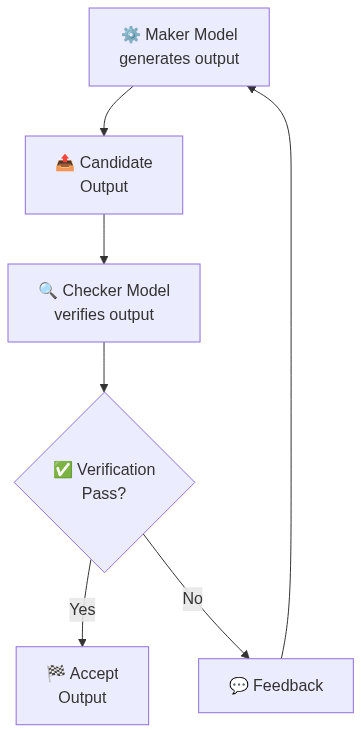
The maker-checker pattern is valuable because:
- Generation and verification require different capabilities
- A mid-tier model can handle most generation tasks at lower cost
- A stronger model focuses only on verification, reducing its token usage
- The checker provides a natural verification gate for the loop
- Failed checks generate targeted feedback that improves the next generation cycle
### Deterministic Circuit Breakers
Every production loop must have hard limits. These are not optional. A loop without circuit breakers is an accident waiting to happen. The essential circuit breakers are:
1. **Max iterations:** A hard ceiling on how many times the loop can cycle
2. **Token cost ceiling:** A budget that stops the loop when token spend exceeds a threshold
3. **Time timeout:** A wall-clock limit that kills the loop if it runs too long
4. **Error rate threshold:** A limit that halts the loop if errors accumulate beyond a rate
5. **Permission scope:** A restriction on what tools and resources the loop can access
6. **Human escalation:** A trigger that pauses the loop and notifies a human when thresholds approach
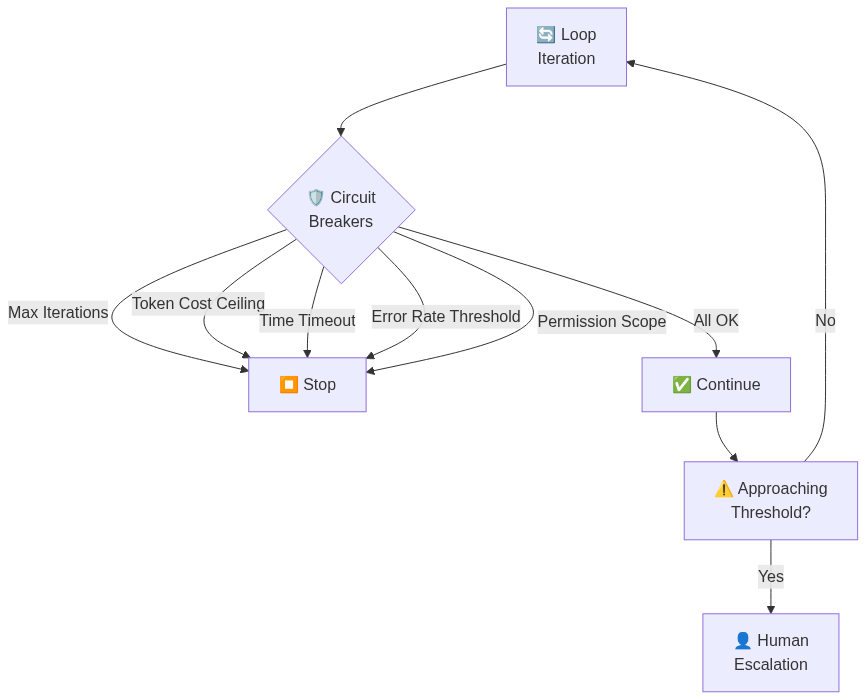
### Cross-Session Memory Injection
Cross-session memory injection compresses and injects historical context so the agent carries forward what it learned across sessions. Without it, every loop starts from scratch and repeats mistakes. With it, the loop accumulates knowledge and improves over time.
Effective memory injection involves:
- Summarizing prior iterations into compact context blocks
- Selecting relevant memories based on the current task
- Pruning stale or contradictory information
- Structuring memory so the model can act on it efficiently
- Bounding memory size to avoid context window bloat
Addy Osmani's work on [context engineering](https://addyosmani.com) is directly relevant here. Context engineering is about delivering the right information at the right time to the model. Loop engineering depends on it, because a loop that injects the wrong context will iterate toward the wrong goal.
## The Stateful Runtime Stack
Loop engineering at L3 and above requires a stateful runtime. This is the infrastructure that keeps a loop running across iterations, sessions, and even restarts. The stateful runtime stack has several layers.
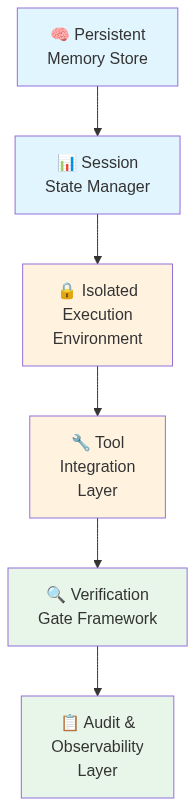
The layers include:
- **Persistent memory store:** Long-term storage for agent context, decisions, and learned facts
- **Session state manager:** Tracks the current state of an active loop, including iteration count and intermediate results
- **Isolated execution environment:** A sandboxed workspace where the agent can make changes without affecting production
- **Tool integration layer:** Connects the agent to external systems like version control, CI/CD pipelines, and monitoring dashboards
- **Verification gate framework:** Pluggable checks that evaluate agent output before the loop proceeds
- **Audit and observability layer:** Records every action, decision, and token spent for compliance and debugging
The open-source community is actively building this stack. Projects like [Dapr Agents](https://github.com/dapr/dapr-agents) propose standardized stateful execution for long-running agents. The [loop-engineering CLI tools](https://github.com/cobusgreyling/loop-engineering) repository provides practical utilities for developers building loops. These projects signal that the runtime stack is moving from concept to implementation.
## Enterprise Adoption: From Experimentation to Operations
Loop engineering is not just a developer movement. Enterprises are adopting it to solve one of the most persistent pain points in AI-driven development: the deployment velocity gap. AI coding agents can produce candidate code in days, but promoting that code into a governed production runtime traditionally takes weeks. Loop engineering closes that gap by automating the path from generation to deployment within governance boundaries.
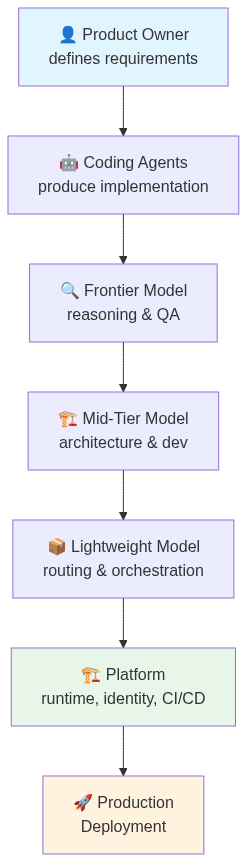
The enterprise loop engineering pipeline includes these stages:
1. **Goal definition:** Product owner or engineer defines the task and acceptance criteria
2. **Agent execution:** Coding agent generates candidate implementation in a loop
3. **Automated verification:** Tests, security scans, and code quality checks run automatically
4. **Human review:** A human reviews the verified output at a checkpoint gate
5. **Controlled deployment:** The loop promotes approved changes through CI/CD
6. **Production monitoring:** The loop watches for regressions and can trigger auto-fixes
7. **Feedback injection:** Production telemetry feeds back into the next loop iteration
This pipeline turns what was a multi-week manual process into a compressed, auditable workflow. GALLO, the world's largest winery with 70M+ cases produced annually, experienced this transformation firsthand. Their deployment timeline compressed from four weeks to hours, with a 4x increase in delivery velocity. Robert Barrios, CIO of GALLO, described the dynamic:
> "When developers ship production-ready code this quickly, how can I have environments spun up fast enough? Shakudo is how we close that gap."
GALLO's approach uses a multi-tier model routing strategy: frontier models handle reasoning and quality assurance, mid-tier models handle architecture and development, and lightweight models handle routing and orchestration. This mirrors the maker-checker pattern at an organizational scale. Barrios also addressed the cost dimension:
> "I do not want to be in a position where I have to pay for a token for every single piece of work. Eventually I want to buy compute, scale it, and run our own LLMs next to our data."
This is the economic argument for loop engineering with multi-tier routing: enterprises want compute-based economics, not per-token pricing, when loops run thousands of iterations per day.
## Governance: Building Safety Into the Loop
Governance is the factor that separates production loop engineering from experimental scripting. Enterprises in regulated industries cannot deploy autonomous agent loops without controls. The governance requirements that shape loop engineering include:
- **Identity and access control:** Every agent action must be attributable to an identity with scoped permissions
- **Audit trails:** Every prompt, response, tool call, and decision must be logged for compliance review
- **Data sovereignty:** Agent loops must run within the enterprise's own infrastructure, not on external SaaS
- **Cost observability:** Per-loop and per-workload cost attribution is required for scaling
- **Security scanning:** All agent skills and tools must be scanned before deployment
- **Human oversight:** Escalation paths must exist for the loop to pause and notify a human
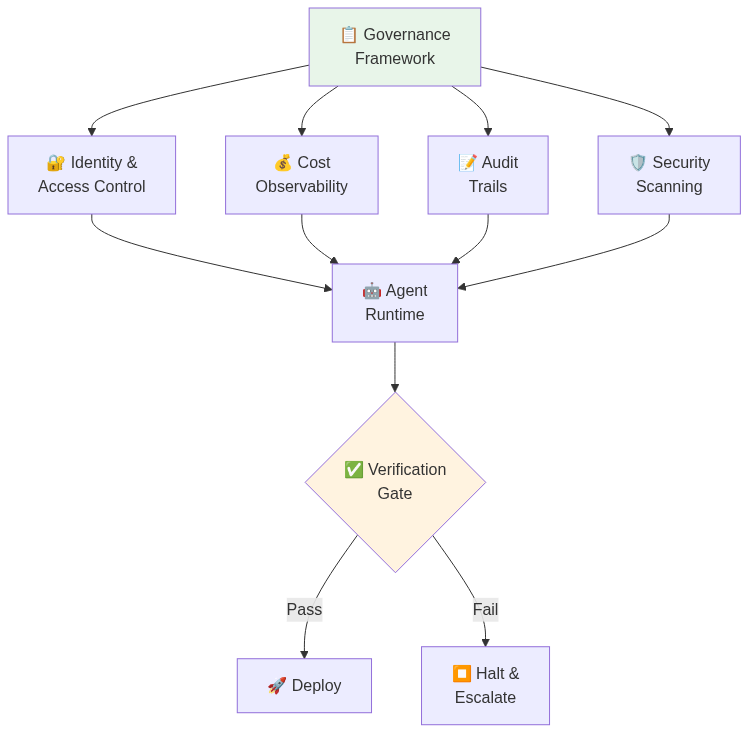
[Huntington Bank](/customers/huntington-bank), a Fortune 500 U.S. bank with $200B+ in assets under management, built their AI platform around these principles. With 100+ AI practitioners, they migrated from a major cloud ML platform to a unified governed AI environment running entirely within their own infrastructure. Their governance framework scored 27 out of 28 control points against ISO 42001 and NIST AI RMF standards. The one gap they identified: agent-level risk ratings and trust-but-verify controls, which are exactly what L4 self-verifying loops provide.
Governance frameworks like ISO 42001 and NIST AI RMF are becoming the baseline for enterprise loop engineering. These frameworks collapse dozens of control points into actionable buckets:
1. Governance and accountability
2. Risk management
3. Data governance
4. Transparency and explainability
5. Human oversight
6. Security
7. Compliance
8. Vendor management
Each bucket maps directly to loop engineering controls. For example, "human oversight" maps to circuit breakers and escalation triggers. "Transparency" maps to audit logging. "Risk management" maps to verification gates and agent risk ratings.
## The Cost Economics of Loop Engineering
When loops run autonomously, token costs compound quickly. A loop that runs 100 iterations per task across hundreds of tasks per day can generate significant costs if every iteration hits a frontier model. Multi-tier model routing is the solution.
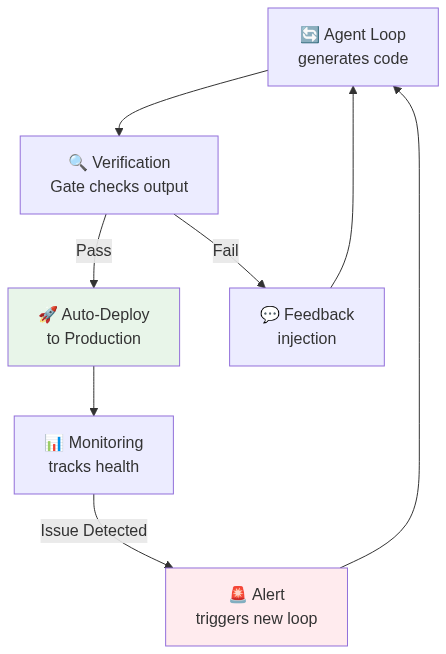
The routing strategy works as follows:
- **Tier 1 (Frontier models):** Reserved for high-reasoning tasks like architecture decisions, complex debugging, and final quality verification. Approximately 10 to 20 percent of loop iterations.
- **Tier 2 (Mid-tier models):** Handle routine development, code generation, and standard verification. Approximately 50 to 60 percent of loop iterations.
- **Tier 3 (Lightweight models):** Handle routing, formatting, classification, and simple checks. Approximately 20 to 30 percent of loop iterations.
Enterprises report 2x to 20x cost savings with this approach compared to routing all traffic to frontier models. A global asset management firm achieved approximately 3x cost reduction by routing routine agent tasks to mid-tier open-weight models while reserving frontier models for high-reasoning work.
Open-source models play a critical role in this strategy. Enterprises are piloting self-hosted models like Gemma, Nemotron, and Deepseek-class architectures to handle high-volume loop traffic without per-token API costs. The [Shakudo platform](/platform) supports this by providing an [AI Gateway](/ai-gateway) that routes requests across proprietary and open-source models with cost tracking, RBAC, and audit trails built in.
## Real-World Case Studies in Governed Loop Engineering
### FlexiVan: Agentic Logistics at Physical Asset Scale
[FlexiVan](/customers/flexivan), a North American intermodal logistics company managing 120,000+ chassis, moved from experimental AI to operational AI. They use AI vision to replace manual gate recording, eliminating a 2% error rate. Their CIO, Sagar Chikkala, captured the shift:
> "AI used to be experimental at FlexiVan. It is no longer experimental. It is operational."
The operationalization Chikkala describes is loop engineering in practice: AI agents running in continuous loops that monitor, detect, classify, and act on real-world events from IoT sensors across their chassis fleet.
### Loblaw: Governed AI for Retail at Scale
[Loblaw](/customers/loblaw-digital), Canada's largest retailer with 2,400+ stores and 220,000+ employees, built a centralized governed AI environment. Their approach treats governance as an enabler of scale, not a brake. Every agent loop runs within their secure infrastructure with full data sovereignty. This is the L4 model: autonomous loops with built-in governance gates that allow safe scaling.
### Whitecap Resources: Agentic AI in Upstream Oil and Gas
[Whitecap Resources](/customers/whitecap-resources), the 7th-largest Canadian oil and gas producer at approximately 375,000 boe/d, uses governed AI loops to process TB-scale monthly data and microsecond telemetry. Custom analytics that previously took weeks now complete in under an hour. Their deployment includes cybersecurity scanning of all AI agent skills before they enter production, reflecting the governance-first approach that loop engineering demands in energy and critical infrastructure.
## The Competitive Landscape
The loop engineering space is forming rapidly. Several platforms are positioning themselves as the runtime for autonomous agent loops:
| Platform | Approach | Enterprise Readiness |
|----------|----------|----------------------|
| AWS Bedrock AgentCore | Production AI agents with any framework or model | Strong cloud-native; lock-in and cost concerns |
| Google Gemini Enterprise Agent Platform | Build, scale, govern, and optimize agents | Strong model ecosystem; governance maturing |
| Snowflake Cortex Agents | Managed agentic platform within Snowflake | Attractive for Snowflake shops; limited scope |
| OpenAI Codex | Automations with follow-goals and worktrees | Strong code generation; limited enterprise controls |
| Vercel AI SDK (Loop Control) | Loop control primitive for agent orchestration | Developer-friendly; governance not primary focus |
| Dapr Agents | Open-source stateful agent execution | Early-stage; watching for enterprise readiness |
The decision criteria enterprises use, ranked by frequency:
1. Governance and compliance capabilities
2. Data sovereignty and infrastructure control
3. Cost economics and model routing flexibility
4. Deployment velocity and time-to-production
5. Model flexibility across proprietary and open-source
This ranking reveals that the market is governance-first, not model-first. Enterprises are not choosing platforms based on which has the best frontier model. They are choosing based on which lets them run governed loops within their own infrastructure.
## Getting Started with Loop Engineering
If you are a developer or team looking to adopt loop engineering, start with these steps:
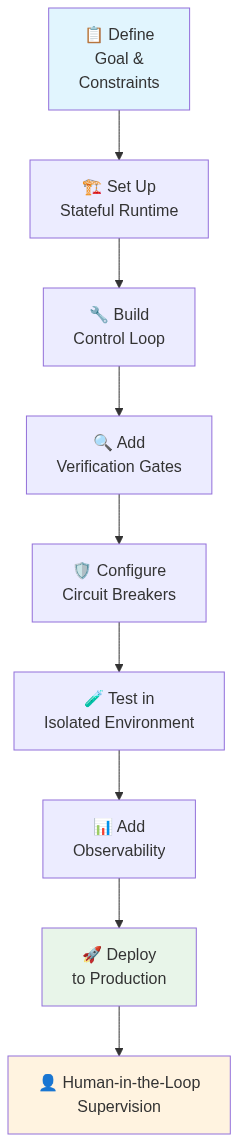
1. **Audit your current workflow:** Identify where you are on the maturity model. Most teams start at L1 or L2.
2. **Pick a bounded use case:** Choose a task that is repetitive, verifiable, and low-risk. Good starting points include test generation, documentation updates, or linting auto-fixes.
3. **Build your first scripted loop:** Write a script that prompts an agent, evaluates the output, and iterates. Keep it simple.
4. **Add a circuit breaker:** Before running any loop autonomously, implement max iteration and cost limits.
5. **Introduce memory:** Store context from prior iterations and inject it into future ones. This moves you from L2 to L3.
6. **Add a verification gate:** Implement automated checks that validate agent output before the loop proceeds. This moves you to L4.
7. **Instrument with observability:** Log every action, decision, and cost. You cannot govern what you cannot see.
8. **Establish governance:** Define who is responsible for the loop, what permissions it has, and how it is audited.
Tools that can help you get started:
- [Claude Code](/integrations/claude) for agent-driven code generation with loop support
- [LangGraph](/integrations/langgraph) for building stateful, multi-actor agent workflows
- [CrewAI](/integrations/crewai) for orchestrating role-based multi-agent systems
- [Aider](/integrations/aider) for AI pair programming with git integration
- [GitHub](/integrations/github) for version control integration within agent loops
- [Argo CD](/integrations/argo-cd) for GitOps-driven deployment of agent-produced changes
- [Apache Airflow](/integrations/apache-airflow) for orchestrating pipeline stages around agent loops
- [MLflow](/integrations/mlflow) for tracking agent experiments and model performance
- [Grafana](/integrations/grafana) for monitoring loop health and cost metrics
- [Snyk](/integrations/snyk) for security scanning of agent-generated code
## The Risks and Trade-offs
Loop engineering is not without risks. The community has an active debate about how much autonomy to give agents, and the concerns are legitimate:
- **Token waste:** Unsupervised loops can burn through tokens without producing value if verification gates are weak
- **Spaghetti output:** Loops that iterate without strong direction can produce tangled, inconsistent results
- **Incentive misalignment:** Some model providers benefit from increased token consumption, creating a potential conflict of interest
- **Security exposure:** Persistent agent runtimes with access to production infrastructure expand the attack surface
- **Shadow AI risk:** Developers adopting consumer-grade AI coding tools without oversight creates what one VP of Platform Engineering called "a ticking compliance time bomb"
These risks are why governance and circuit breakers are not optional add-ons. They are foundational components of loop engineering. A loop without safety controls is not loop engineering. It is an accident waiting to happen.
## The Future of Loop Engineering
Loop engineering is evolving rapidly. Several trends will shape its trajectory through 2026 and beyond:
- **Standardization:** Open-source proposals like [Dapr Agents](https://github.com/dapr/dapr-agents) are pushing toward standardized stateful agent execution runtimes
- **Governance convergence:** ISO 42001 and NIST AI RMF are becoming the common language for agent governance across industries
- **Multi-tier routing maturity:** Enterprises are moving from ad hoc model selection to systematic routing strategies that optimize cost and capability
- **Verification automation:** The L4 to L5 transition depends on better automated verification, which is an active research frontier
- **Platform consolidation:** The fragmented tool landscape will consolidate around platforms that provide governed runtimes with built-in loop engineering primitives
The [Shakudo platform](/platform) is built for this trajectory. It provides the governed runtime that loop engineering requires: an [AI Gateway](/ai-gateway) for multi-tier model routing with cost tracking, [Kaji](/kaji) for autonomous agent execution with verification gates, and the infrastructure controls that enterprises need to run agent loops within their own VPC. Whether you are at L2 or moving toward L5, the platform provides the building blocks for production loop engineering.
## Conclusion
Loop engineering represents a fundamental shift in how developers work with AI. It moves the discipline from manual prompting to autonomous, governed, verifiable control loops. The maturity model from L0 to L6 provides a roadmap. The core patterns of maker-checker architecture, deterministic circuit breakers, and cross-session memory injection provide the building blocks. And governance frameworks like ISO 42001 and NIST AI RMF provide the safety rails.
Enterprises like GALLO, Huntington Bank, FlexiVan, Loblaw, and Whitecap Resources are already proving that governed loop engineering works at scale. The deployment velocity gap is closing. Token costs are being managed through multi-tier routing. And governance is being built into the loop from day one, not bolted on after.
If your organization is ready to move from manual prompting to governed autonomous loops, [talk to Shakudo](/contact-us) about deploying loop engineering infrastructure within your own environment.
# blog/machine-learning-platform-shakudo-closes-3-4m-seed-round.md
*[Source (/blog/machine-learning-platform-shakudo-closes-3-4m-seed-round)](https://www.shakudo.io/blog/machine-learning-platform-shakudo-closes-3-4m-seed-round) | [Markdown twin](https://www.shakudo.io/blog/machine-learning-platform-shakudo-closes-3-4m-seed-round.md)*
---
## Conclusion: The End of the Abstraction Stack
The history of software engineering is the history of abstraction. Each generation moved the developer further from the machine and closer to intent. Assembly abstracted opcodes. Compilers abstracted assembly. Frameworks abstracted boilerplate. APIs abstracted integration. Prompting abstracted instruction.
Loop engineering abstracts the last remaining manual step: the human steering of the agent through each turn. Once you can specify a goal and the system autonomously discovers, executes, verifies, and iterates, there is nothing left to abstract. The gap between intent and execution has closed.
This is why loop engineering is not just another tool in the stack. It is the last piece of software you will need to write by hand. After loops, you do not write software. You describe goals. The loop writes the software.
The teams that adopt loop engineering now will build a compounding advantage. Their loops will accumulate state, memory, and verification history. Their cost per goal will decline over time. Their knowledge will persist in the loop, not in the heads of engineers who might leave. The teams that wait will find themselves competing against organizations whose software writes itself.
The abstraction stack is complete. The question is whether you are ready to stand at the top of it.
## FAQ
**Is loop engineering the same as agentic AI?**
No. Agentic AI refers to AI systems that can take autonomous actions. Loop engineering is the discipline of building the control loops that govern those agents. An agent without a loop is a chatbot. An agent with a loop is a production system.
**Does loop engineering replace software engineers?**
No, it changes what software engineers do. Instead of writing instructions, engineers design goals, build verification gates, configure safety controls, and govern loop behavior. The work becomes higher level and more architectural.
**What is the difference between loop engineering and RPA?**
RPA (robotic process automation) follows predetermined scripts. If a step fails, the RPA pipeline halts. Loop engineering discovers steps dynamically and handles failure autonomously by selecting alternative approaches. RPA is automation. Loop engineering is agency.
**How much does loop engineering cost?**
Cost depends on the complexity of the goal, the number of agent turns required, and the models used. Most production loops complete goals for a fraction of the cost of manual engineering time. Shakudo's cost tracking lets you monitor cost per goal and enforce budgets at the platform level.
**Is loop engineering safe for production use?**
Yes, when deployed with proper safety controls. Deterministic circuit breakers, cost budgets, verification gates, and human review for high stakes decisions make loops safe for production. The key is enforcing safety at the platform level, not relying on the agent to self regulate.
**What tools do I need to start loop engineering?**
You need an AI model provider, an orchestration layer for the loop controller, verification tooling (test suites, linters, type checkers), and state persistence. Shakudo provides all of these as an integrated [platform](/platform).
**How is loop engineering different from the existing loop engineering guide?**
The existing [loop engineering guide](/blog/loop-engineering) covers what loop engineering is, how it works, and the maturity model. This article argues why it is the terminal abstraction, the end of the abstraction stack, and what that means for the future of software development.
# blog/loop-engineering.md
*[Source (/blog/loop-engineering)](https://www.shakudo.io/blog/loop-engineering) | [Markdown twin](https://www.shakudo.io/blog/loop-engineering.md)*
---
## Introduction: The End of Manual Prompting
In 2026, the way developers work with AI has fundamentally changed. The era of typing a prompt, reading a response, correcting the model, and re-prompting is ending. A new discipline has emerged from the developer community that treats AI agents not as chat partners but as autonomous systems driven by control loops. That discipline is **loop engineering**.
Loop engineering is the practice of writing outer control loops that drive AI agents autonomously. Instead of manually prompt-correct-reprompting through every step, a loop engineer writes code that prompts the agent, evaluates the output, decides what to do next, and iterates until a goal is met or a safety limit is hit. The developer's job shifts from babysitting a chat window to designing, governing, and verifying the loops that run the agents.
This shift matters because the babysitter bottleneck is real. Manually steering an agent through every turn is slow, error-prone, and, as one prominent engineer described it, "the most boring job in the world." Loop engineering eliminates that bottleneck by codifying the steering logic into repeatable, auditable, production-grade software.
In this article, we cover everything you need to know about loop engineering: where it came from, how it works, the maturity model that tracks its evolution, the core patterns practitioners use, the safety controls that make it viable in production, and how enterprises are adopting it under governance.
## The Shift from Prompting to Looping
The defining statement of loop engineering came from Boris Cherny, Head of Claude Code at Anthropic:
> "I don't prompt Claude anymore. I write loops that prompt Claude and figure out what to do."
This single quote captures the paradigm shift. The most skilled AI engineers are no longer optimizing prompts. They are building systems around agents. Andrej Karpathy has reinforced this idea, noting that large language models become dramatically better when forced into disciplined workflows rather than free-form conversation.

The manual prompting workflow looks like this:
1. Human writes a prompt
2. Model generates a response
3. Human reads and evaluates the response
4. Human writes a correction or follow-up prompt
5. Model generates a new response
6. Repeat until the task is done or the human gives up
Every step requires human attention. The human is the loop. This works for quick tasks but breaks down when you need an agent to verify hundreds of user flows, fix production errors flagged by monitoring tools, or iterate on a complex codebase over hours.
The loop-driven workflow replaces the human loop with a software loop:
1. Engineer writes a control loop with a goal, constraints, and verification gates
2. The loop prompts the agent
3. The loop evaluates the output against verification criteria
4. If the output passes, the loop proceeds or terminates
5. If the output fails, the loop injects feedback and re-prompts
6. The loop continues autonomously until the goal is met or a circuit breaker triggers
The human's role changes from turn-by-turn operator to loop designer and supervisor. This is a fundamentally different job, and it is the job that loop engineering prepares you for.
## What is Loop Engineering?
Loop engineering is the discipline of designing, building, and operating autonomous control loops that drive AI agents to completion. It borrows its name and core philosophy from control systems engineering, where feedback loops regulate physical and software processes. In the AI context, the loop regulates the agent's behavior through prompts, evaluations, memory, and safety constraints.
A loop-engineered system has several core components:
- **A goal specification:** What the loop is trying to achieve, expressed in terms the agent can act on and the loop can verify.
- **A prompt generation strategy:** How the loop constructs prompts for the agent, including context injection, task decomposition, and feedback from prior iterations.
- **A verification mechanism:** How the loop checks whether the agent's output is correct, complete, and safe before proceeding.
- **Memory and state management:** How the loop carries context forward across iterations and sessions.
- **Safety controls:** Hard limits on iterations, cost, time, and permissions that prevent runaway behavior.
- **An orchestration layer:** How the loop coordinates multiple agents, tools, and external systems.

Loop engineering is not the same as prompt engineering. Prompt engineering optimizes what you say to a model in a single turn. Loop engineering optimizes the system that decides what to say, when to say it, and what to do with the response across many turns. Prompt engineering is a skill within loop engineering, but loop engineering is the broader discipline.
The [Anthropic agent guide](https://www.anthropic.com/research/building-effective-agents) describes this distinction well: effective agents are built from composable patterns, not single prompts. The guide outlines patterns like routing, tool use, and evaluation loops that are foundational to loop engineering practice.
## The Loop Maturity Model
Not all loops are created equal. The developer community has begun organizing loop sophistication into a maturity model spanning six levels beyond manual prompting. This model helps teams assess where they are and where they need to go.
| Level | Name | Description | Human Involvement |
|-------|------|-------------|-------------------|
| L0 | Manual prompting | Human writes each prompt by hand | Full |
| L1 | Templated prompting | Reusable prompt templates with variable substitution | High |
| L2 | Scripted loops | Deterministic scripts call LLMs in a fixed sequence | Medium |
| L3 | Stateful loops | Loops maintain persistent memory and context across iterations | Low |
| L4 | Self-verifying loops | Built-in verification gates check outputs before proceeding | Low |
| L5 | Autonomous goal-seeking loops | Loops decompose goals and self-direct execution | Minimal |
| L6 | Fully autonomous multi-agent loops | Swarms of agents coordinate autonomously toward complex goals | Supervisory only |

Most organizations in 2026 sit between L1 and L3. They have templated prompts and some scripted workflows, but they lack stateful memory and verification gates. The jump from L3 to L4 is where production-grade loop engineering begins, because verification gates are what make autonomous loops safe enough to run without constant supervision.
Key observations about the maturity model:
1. L0 and L1 are prompt engineering, not loop engineering
2. L2 is where developers first experience the productivity multiplier of automation
3. L3 introduces the persistent runtime concept, which is essential for long-running tasks
4. L4 is the minimum viable level for production deployments in regulated industries
5. L5 and L6 are active research frontiers with real-world deployments but limited standardization
6. Each level reduces human involvement but increases the need for governance
## Core Patterns in Loop Engineering
Loop engineering has developed a set of recurring patterns that practitioners apply across use cases. These patterns are the building blocks of production agent loops.
### Maker-Checker Architecture
The maker-checker pattern splits execution and evaluation between models. A faster, less expensive model generates candidate output. A more capable model verifies that output against criteria. This separation improves quality and controls cost.

The maker-checker pattern is valuable because:
- Generation and verification require different capabilities
- A mid-tier model can handle most generation tasks at lower cost
- A stronger model focuses only on verification, reducing its token usage
- The checker provides a natural verification gate for the loop
- Failed checks generate targeted feedback that improves the next generation cycle
### Deterministic Circuit Breakers
Every production loop must have hard limits. These are not optional. A loop without circuit breakers is an accident waiting to happen. The essential circuit breakers are:
1. **Max iterations:** A hard ceiling on how many times the loop can cycle
2. **Token cost ceiling:** A budget that stops the loop when token spend exceeds a threshold
3. **Time timeout:** A wall-clock limit that kills the loop if it runs too long
4. **Error rate threshold:** A limit that halts the loop if errors accumulate beyond a rate
5. **Permission scope:** A restriction on what tools and resources the loop can access
6. **Human escalation:** A trigger that pauses the loop and notifies a human when thresholds approach

### Cross-Session Memory Injection
Cross-session memory injection compresses and injects historical context so the agent carries forward what it learned across sessions. Without it, every loop starts from scratch and repeats mistakes. With it, the loop accumulates knowledge and improves over time.
Effective memory injection involves:
- Summarizing prior iterations into compact context blocks
- Selecting relevant memories based on the current task
- Pruning stale or contradictory information
- Structuring memory so the model can act on it efficiently
- Bounding memory size to avoid context window bloat
Addy Osmani's work on [context engineering](https://addyosmani.com) is directly relevant here. Context engineering is about delivering the right information at the right time to the model. Loop engineering depends on it, because a loop that injects the wrong context will iterate toward the wrong goal.
## The Stateful Runtime Stack
Loop engineering at L3 and above requires a stateful runtime. This is the infrastructure that keeps a loop running across iterations, sessions, and even restarts. The stateful runtime stack has several layers.

The layers include:
- **Persistent memory store:** Long-term storage for agent context, decisions, and learned facts
- **Session state manager:** Tracks the current state of an active loop, including iteration count and intermediate results
- **Isolated execution environment:** A sandboxed workspace where the agent can make changes without affecting production
- **Tool integration layer:** Connects the agent to external systems like version control, CI/CD pipelines, and monitoring dashboards
- **Verification gate framework:** Pluggable checks that evaluate agent output before the loop proceeds
- **Audit and observability layer:** Records every action, decision, and token spent for compliance and debugging
The open-source community is actively building this stack. Projects like [Dapr Agents](https://github.com/dapr/dapr-agents) propose standardized stateful execution for long-running agents. The [loop-engineering CLI tools](https://github.com/cobusgreyling/loop-engineering) repository provides practical utilities for developers building loops. These projects signal that the runtime stack is moving from concept to implementation.
## Enterprise Adoption: From Experimentation to Operations
Loop engineering is not just a developer movement. Enterprises are adopting it to solve one of the most persistent pain points in AI-driven development: the deployment velocity gap. AI coding agents can produce candidate code in days, but promoting that code into a governed production runtime traditionally takes weeks. Loop engineering closes that gap by automating the path from generation to deployment within governance boundaries.

The enterprise loop engineering pipeline includes these stages:
1. **Goal definition:** Product owner or engineer defines the task and acceptance criteria
2. **Agent execution:** Coding agent generates candidate implementation in a loop
3. **Automated verification:** Tests, security scans, and code quality checks run automatically
4. **Human review:** A human reviews the verified output at a checkpoint gate
5. **Controlled deployment:** The loop promotes approved changes through CI/CD
6. **Production monitoring:** The loop watches for regressions and can trigger auto-fixes
7. **Feedback injection:** Production telemetry feeds back into the next loop iteration
This pipeline turns what was a multi-week manual process into a compressed, auditable workflow. GALLO, the world's largest winery with 70M+ cases produced annually, experienced this transformation firsthand. Their deployment timeline compressed from four weeks to hours, with a 4x increase in delivery velocity. Robert Barrios, CIO of GALLO, described the dynamic:
> "When developers ship production-ready code this quickly, how can I have environments spun up fast enough? Shakudo is how we close that gap."
GALLO's approach uses a multi-tier model routing strategy: frontier models handle reasoning and quality assurance, mid-tier models handle architecture and development, and lightweight models handle routing and orchestration. This mirrors the maker-checker pattern at an organizational scale. Barrios also addressed the cost dimension:
> "I do not want to be in a position where I have to pay for a token for every single piece of work. Eventually I want to buy compute, scale it, and run our own LLMs next to our data."
This is the economic argument for loop engineering with multi-tier routing: enterprises want compute-based economics, not per-token pricing, when loops run thousands of iterations per day.
## Governance: Building Safety Into the Loop
Governance is the factor that separates production loop engineering from experimental scripting. Enterprises in regulated industries cannot deploy autonomous agent loops without controls. The governance requirements that shape loop engineering include:
- **Identity and access control:** Every agent action must be attributable to an identity with scoped permissions
- **Audit trails:** Every prompt, response, tool call, and decision must be logged for compliance review
- **Data sovereignty:** Agent loops must run within the enterprise's own infrastructure, not on external SaaS
- **Cost observability:** Per-loop and per-workload cost attribution is required for scaling
- **Security scanning:** All agent skills and tools must be scanned before deployment
- **Human oversight:** Escalation paths must exist for the loop to pause and notify a human

[Huntington Bank](/customers/huntington-bank), a Fortune 500 U.S. bank with $200B+ in assets under management, built their AI platform around these principles. With 100+ AI practitioners, they migrated from a major cloud ML platform to a unified governed AI environment running entirely within their own infrastructure. Their governance framework scored 27 out of 28 control points against ISO 42001 and NIST AI RMF standards. The one gap they identified: agent-level risk ratings and trust-but-verify controls, which are exactly what L4 self-verifying loops provide.
Governance frameworks like ISO 42001 and NIST AI RMF are becoming the baseline for enterprise loop engineering. These frameworks collapse dozens of control points into actionable buckets:
1. Governance and accountability
2. Risk management
3. Data governance
4. Transparency and explainability
5. Human oversight
6. Security
7. Compliance
8. Vendor management
Each bucket maps directly to loop engineering controls. For example, "human oversight" maps to circuit breakers and escalation triggers. "Transparency" maps to audit logging. "Risk management" maps to verification gates and agent risk ratings.
## The Cost Economics of Loop Engineering
When loops run autonomously, token costs compound quickly. A loop that runs 100 iterations per task across hundreds of tasks per day can generate significant costs if every iteration hits a frontier model. Multi-tier model routing is the solution.

The routing strategy works as follows:
- **Tier 1 (Frontier models):** Reserved for high-reasoning tasks like architecture decisions, complex debugging, and final quality verification. Approximately 10 to 20 percent of loop iterations.
- **Tier 2 (Mid-tier models):** Handle routine development, code generation, and standard verification. Approximately 50 to 60 percent of loop iterations.
- **Tier 3 (Lightweight models):** Handle routing, formatting, classification, and simple checks. Approximately 20 to 30 percent of loop iterations.
Enterprises report 2x to 20x cost savings with this approach compared to routing all traffic to frontier models. A global asset management firm achieved approximately 3x cost reduction by routing routine agent tasks to mid-tier open-weight models while reserving frontier models for high-reasoning work.
Open-source models play a critical role in this strategy. Enterprises are piloting self-hosted models like Gemma, Nemotron, and Deepseek-class architectures to handle high-volume loop traffic without per-token API costs. The [Shakudo platform](/platform) supports this by providing an [AI Gateway](/ai-gateway) that routes requests across proprietary and open-source models with cost tracking, RBAC, and audit trails built in.
## Real-World Case Studies in Governed Loop Engineering
### FlexiVan: Agentic Logistics at Physical Asset Scale
[FlexiVan](/customers/flexivan), a North American intermodal logistics company managing 120,000+ chassis, moved from experimental AI to operational AI. They use AI vision to replace manual gate recording, eliminating a 2% error rate. Their CIO, Sagar Chikkala, captured the shift:
> "AI used to be experimental at FlexiVan. It is no longer experimental. It is operational."
The operationalization Chikkala describes is loop engineering in practice: AI agents running in continuous loops that monitor, detect, classify, and act on real-world events from IoT sensors across their chassis fleet.
### Loblaw: Governed AI for Retail at Scale
[Loblaw](/customers/loblaw-digital), Canada's largest retailer with 2,400+ stores and 220,000+ employees, built a centralized governed AI environment. Their approach treats governance as an enabler of scale, not a brake. Every agent loop runs within their secure infrastructure with full data sovereignty. This is the L4 model: autonomous loops with built-in governance gates that allow safe scaling.
### Whitecap Resources: Agentic AI in Upstream Oil and Gas
[Whitecap Resources](/customers/whitecap-resources), the 7th-largest Canadian oil and gas producer at approximately 375,000 boe/d, uses governed AI loops to process TB-scale monthly data and microsecond telemetry. Custom analytics that previously took weeks now complete in under an hour. Their deployment includes cybersecurity scanning of all AI agent skills before they enter production, reflecting the governance-first approach that loop engineering demands in energy and critical infrastructure.
## The Competitive Landscape
The loop engineering space is forming rapidly. Several platforms are positioning themselves as the runtime for autonomous agent loops:
| Platform | Approach | Enterprise Readiness |
|----------|----------|----------------------|
| AWS Bedrock AgentCore | Production AI agents with any framework or model | Strong cloud-native; lock-in and cost concerns |
| Google Gemini Enterprise Agent Platform | Build, scale, govern, and optimize agents | Strong model ecosystem; governance maturing |
| Snowflake Cortex Agents | Managed agentic platform within Snowflake | Attractive for Snowflake shops; limited scope |
| OpenAI Codex | Automations with follow-goals and worktrees | Strong code generation; limited enterprise controls |
| Vercel AI SDK (Loop Control) | Loop control primitive for agent orchestration | Developer-friendly; governance not primary focus |
| Dapr Agents | Open-source stateful agent execution | Early-stage; watching for enterprise readiness |
The decision criteria enterprises use, ranked by frequency:
1. Governance and compliance capabilities
2. Data sovereignty and infrastructure control
3. Cost economics and model routing flexibility
4. Deployment velocity and time-to-production
5. Model flexibility across proprietary and open-source
This ranking reveals that the market is governance-first, not model-first. Enterprises are not choosing platforms based on which has the best frontier model. They are choosing based on which lets them run governed loops within their own infrastructure.
## Getting Started with Loop Engineering
If you are a developer or team looking to adopt loop engineering, start with these steps:

1. **Audit your current workflow:** Identify where you are on the maturity model. Most teams start at L1 or L2.
2. **Pick a bounded use case:** Choose a task that is repetitive, verifiable, and low-risk. Good starting points include test generation, documentation updates, or linting auto-fixes.
3. **Build your first scripted loop:** Write a script that prompts an agent, evaluates the output, and iterates. Keep it simple.
4. **Add a circuit breaker:** Before running any loop autonomously, implement max iteration and cost limits.
5. **Introduce memory:** Store context from prior iterations and inject it into future ones. This moves you from L2 to L3.
6. **Add a verification gate:** Implement automated checks that validate agent output before the loop proceeds. This moves you to L4.
7. **Instrument with observability:** Log every action, decision, and cost. You cannot govern what you cannot see.
8. **Establish governance:** Define who is responsible for the loop, what permissions it has, and how it is audited.
Tools that can help you get started:
- [Claude Code](/integrations/claude) for agent-driven code generation with loop support
- [LangGraph](/integrations/langgraph) for building stateful, multi-actor agent workflows
- [CrewAI](/integrations/crewai) for orchestrating role-based multi-agent systems
- [Aider](/integrations/aider) for AI pair programming with git integration
- [GitHub](/integrations/github) for version control integration within agent loops
- [Argo CD](/integrations/argo-cd) for GitOps-driven deployment of agent-produced changes
- [Apache Airflow](/integrations/apache-airflow) for orchestrating pipeline stages around agent loops
- [MLflow](/integrations/mlflow) for tracking agent experiments and model performance
- [Grafana](/integrations/grafana) for monitoring loop health and cost metrics
- [Snyk](/integrations/snyk) for security scanning of agent-generated code
## The Risks and Trade-offs
Loop engineering is not without risks. The community has an active debate about how much autonomy to give agents, and the concerns are legitimate:
- **Token waste:** Unsupervised loops can burn through tokens without producing value if verification gates are weak
- **Spaghetti output:** Loops that iterate without strong direction can produce tangled, inconsistent results
- **Incentive misalignment:** Some model providers benefit from increased token consumption, creating a potential conflict of interest
- **Security exposure:** Persistent agent runtimes with access to production infrastructure expand the attack surface
- **Shadow AI risk:** Developers adopting consumer-grade AI coding tools without oversight creates what one VP of Platform Engineering called "a ticking compliance time bomb"
These risks are why governance and circuit breakers are not optional add-ons. They are foundational components of loop engineering. A loop without safety controls is not loop engineering. It is an accident waiting to happen.
## The Future of Loop Engineering
Loop engineering is evolving rapidly. Several trends will shape its trajectory through 2026 and beyond:
- **Standardization:** Open-source proposals like [Dapr Agents](https://github.com/dapr/dapr-agents) are pushing toward standardized stateful agent execution runtimes
- **Governance convergence:** ISO 42001 and NIST AI RMF are becoming the common language for agent governance across industries
- **Multi-tier routing maturity:** Enterprises are moving from ad hoc model selection to systematic routing strategies that optimize cost and capability
- **Verification automation:** The L4 to L5 transition depends on better automated verification, which is an active research frontier
- **Platform consolidation:** The fragmented tool landscape will consolidate around platforms that provide governed runtimes with built-in loop engineering primitives
The [Shakudo platform](/platform) is built for this trajectory. It provides the governed runtime that loop engineering requires: an [AI Gateway](/ai-gateway) for multi-tier model routing with cost tracking, [Kaji](/kaji) for autonomous agent execution with verification gates, and the infrastructure controls that enterprises need to run agent loops within their own VPC. Whether you are at L2 or moving toward L5, the platform provides the building blocks for production loop engineering.
## Conclusion
Loop engineering represents a fundamental shift in how developers work with AI. It moves the discipline from manual prompting to autonomous, governed, verifiable control loops. The maturity model from L0 to L6 provides a roadmap. The core patterns of maker-checker architecture, deterministic circuit breakers, and cross-session memory injection provide the building blocks. And governance frameworks like ISO 42001 and NIST AI RMF provide the safety rails.
Enterprises like GALLO, Huntington Bank, FlexiVan, Loblaw, and Whitecap Resources are already proving that governed loop engineering works at scale. The deployment velocity gap is closing. Token costs are being managed through multi-tier routing. And governance is being built into the loop from day one, not bolted on after.
If your organization is ready to move from manual prompting to governed autonomous loops, [talk to Shakudo](/contact-us) about deploying loop engineering infrastructure within your own environment.
# blog/machine-learning-platform-shakudo-closes-3-4m-seed-round.md
*[Source (/blog/machine-learning-platform-shakudo-closes-3-4m-seed-round)](https://www.shakudo.io/blog/machine-learning-platform-shakudo-closes-3-4m-seed-round) | [Markdown twin](https://www.shakudo.io/blog/machine-learning-platform-shakudo-closes-3-4m-seed-round.md)*
---
PRESS RELEASE
DevSentient Rebrands as Shakudo and announces a US$3.4M seed round November 3, 2021
Shakudo, a disruptive end-to-end machine learning platform provider, has raised a US$3.4M seed round. Previously called DevSentient, Shakudo’s funding and rebrand comes as the company becomes a leading challenger in the Machine Learning Operations (MLOps) space.
The round was 40% oversubscribed and was led by Golden Ventures and Parade Ventures, with participation from Global Founders Capital, Garage Capital, Draft Ventures, Basecamp Fund and angel investors including Anton Rabie (Spinmaster), Ivan Yuen (Wattpad), Dave Rai (Nymi), Chanda Carr (The Group Ventures) and others. In total, Shakudo has raised US$3.9M since inception.
“Most businesses recognize the power of data and data science, but struggle to effectively tie this capability to direct ROI,” said Yevgeniy Vahlis, Shakudo’s CEO. “With the latest round of funding we’re able to expand the interoperability and frictionless data science that our platform provides to businesses in all industries.”
Through the use of Shakudo’s platform, Hyperplane, companies get their products to market faster and better, significantly reducing their reliance on expensive engineering talent and Development Operations (DevOps) to support their data science teams. Hyperplane requires no additional capital investment and leverages the existing tools.
Shakudo disrupts the end-to-end machine learning platform space by approaching the problem as a user experience (UX) challenge of creating a unified environment that makes it easy to use the multitude of powerful open-source point solutions in the space. Hyperplane offers data scientists and engineers a familiar experience using the tools that they already love, with many of the common engineering and DevOps tasks fully automated and one click away.
The company was founded by an experienced team of machine learning experts, Yevgeniy Vahlis, Christine Yuen, and Stella Wu, who have previously scaled up AI teams at Borealis AI, RBC, Bank of Montreal AI, and Georgian Partners. The founders witnessed firsthand the tremendous growth of and potential for data science projects, but lack of engineering teams and infrastructure to support the development & testing of AI products. As a result Shakudo was born, purpose-built to help AI practitioners go from research to market in a matter of days.
“Shakudo’s vision is to fundamentally change how data science and machine learning are operationalized within a company. I’m excited about the large-scale impact of their platform. This is a world class team with deep expertise in building ML solutions for industry.” said Jamie Rosenblat. Jamie is a Partner at Golden Ventures and the lead investor in Shakudo’s seed round. “We’re seeing a lot of activity in the MLOps and data science platforms space. There is an element of saturation on the buyers side. Shakudo’s approach cuts through the noise, providing an interoperable and extensible platform that will survive the test of time because it evolves with the industry instead of focusing on a single tool or methodology.” said Shawn Merani, Managing Partner at Parade Ventures and co-lead on the round.
Today, Shakudo’s customers and partners rely on the platform to accelerate their data science efforts through ML Engineering and MLOps automation.
# blog/mcp-model-context-protocol.md *[Source (/blog/mcp-model-context-protocol)](https://www.shakudo.io/blog/mcp-model-context-protocol) | [Markdown twin](https://www.shakudo.io/blog/mcp-model-context-protocol.md)* ---The enterprise Artificial Intelligence (AI) landscape is undergoing a period of rapid, almost explosive, expansion. We are witnessing a proliferation of specialized AI models, including Large Language Models (LLMs) and multimodal systems capable of processing text, images, audio, and video. Alongside these models, new frameworks for Retrieval-Augmented Generation (RAG) and autonomous agents, coupled with essential tools like vector databases and sophisticated monitoring systems, are emerging at an unprecedented pace. This "AI Cambrian Explosion" offers immense potential, reflected in significant enterprise investment – a May 2024 Forrester survey found 67% of AI decision-makers plan to increase generative AI investment within the next year, and IDC predicts over 40% of core IT spending will go to AI initiatives by 2025.
However, this very dynamism creates substantial hurdles. AI models, even the most advanced, often operate in isolation, constrained by their inability to access the diverse, real-time context residing in external data sources and business tools. Anthropic highlights a critical pain point: "Every new data source requires its own custom implementation, making truly connected systems difficult to scale". This leads to a complex integration challenge, often described as an "M×N problem," where M applications need custom connectors for N tools or data sources. The sheer velocity and diversity of AI tool development have reached a point where these bespoke, one-off integrations are becoming unsustainable for enterprises striving for agility and a competitive edge. The friction caused by this integration complexity hinders the ability to build cohesive, truly intelligent systems and slows the realization of AI's full value, making a standardized communication layer an operational imperative.

The challenges stemming from this diverse and rapidly evolving AI ecosystem are multifaceted. Enterprises grapple with significant interoperability issues, where getting different AI components, models, and data sources to communicate effectively requires substantial, often custom, development effort. Before the advent of protocols aiming for standardization, integrating AI applications with external systems necessitated building unique connections for each, consuming considerable time and resources. This situation mirrors earlier technological inflection points, like the pre-USB era where connecting peripherals involved a confusing array of ports and drivers.
This reliance on custom integrations not only inflates development costs and timelines but also introduces significant risks. Enterprises may find themselves locked into specific vendor ecosystems if their integrations are tied to proprietary standards, such as OpenAI's original plugin architecture. Furthermore, the lack of standardized communication makes it difficult to construct complex, multi-component AI workflows, such as sophisticated agentic systems where multiple AI agents need to collaborate or access a variety of tools dynamically. Industry analysts like Gartner have noted that integration challenges and system complexity are major impediments to delivering value from AI initiatives. This forces many organizations into a reactive posture, constantly building and rebuilding connectors, which inhibits strategic AI deployment and prevents the creation of truly differentiated, compound AI capabilities where multiple components work in concert.
In response to these challenges, the Model Context Protocol (MCP) has emerged as a significant development. Introduced and open-sourced by Anthropic in late 2024, MCP is an open standard protocol specifically designed to standardize the communication pathways between AI applications and the external systems that hold necessary data or provide functional tools. Its fundamental goal is to simplify the integration process, allowing AI models, particularly LLMs and agents, to access the context they need securely and efficiently, thereby producing "better, more relevant responses".

MCP is often described using the analogy of a "USB-C port for AI applications", signifying its aim to be a universal standard for connection. It achieves this through a defined client-server architecture :
Servers expose their capabilities through distinct components defined by the protocol :
MCP is explicitly designed as an open standard, with a detailed specification and a growing ecosystem supported by SDKs in various languages (Python, TypeScript, Java, C#, Rust, etc.) and repositories of pre-built servers. Early adopters like Block and Apollo, along with development tool companies such as Cursor, Zed, Replit, Codeium, and Sourcegraph, are already integrating MCP. While older standards like OpenAPI and GraphQL exist for API interaction, MCP is positioned as being "AI-Native," specifically designed for the needs of modern AI agents and their interaction patterns. This represents a move away from application-specific integration logic towards a shared, standardized infrastructure layer for AI context and tooling – an attempt to define how AI agents fundamentally interact with their operational environment.
The emergence and growing traction of MCP are timely, directly addressing the escalating integration complexities faced by enterprises. Its primary significance lies in transforming the challenging M×N integration problem into a more manageable M+N scenario. In this model, the N creators of tools or data sources build MCP servers, and the M developers of AI applications build MCP clients, drastically reducing the total number of unique integrations required.

This simplification is particularly crucial for unlocking the potential of sophisticated, multi-component AI systems, especially agentic AI. To develop these advanced agentic systems effectively, developers can utilize CrewAI, an AI agent orchestration framework designed to enable multiple AI agents to collaborate, assign roles, and delegate tasks, thereby facilitating complex problem-solving.For AI agents to move beyond simple chatbots and truly "thrive," they require dynamic, reliable access to external files, tools, and knowledge bases. To efficiently manage and query the large volumes of semantic information often found in knowledge bases for RAG, organizations can integrate Qdrant, a high-performance vector database specifically built for massive-scale similarity search essential for retrieving relevant context. MCP provides the structured communication framework necessary for these agents to discover available capabilities (via server descriptions) and interact with them effectively to perform tasks. It helps formalize the way context is managed and provided to models, moving beyond simple chat history to include structured information about available resources and tools.
This standardization offers several key benefits for enterprises:
The following table contrasts MCP with common alternative integration approaches, highlighting its potential advantages for enterprise technology leaders:
MCP's rise reflects a maturation in the AI field. The focus is shifting from merely enhancing the reasoning capabilities of standalone models to enabling these models to act effectively, reliably, and safely within the complex realities of enterprise environments. MCP provides a critical piece of infrastructure to facilitate this shift towards operational, integrated AI systems.
The true measure of a protocol like MCP lies in its ability to enable tangible business value. By standardizing how AI interacts with external systems, MCP (or similar integration frameworks) can unlock a range of powerful use cases across various industries:
Beyond these specific examples, the core value proposition emerges: MCP facilitates the creation of compound AI applications. These are sophisticated workflows where multiple specialized AI models, tools, and data sources interact seamlessly via the standardized protocol to automate complex end-to-end business processes. This capability allows enterprises to move beyond incremental improvements towards potentially transformative automation and value creation, tackling challenges previously deemed too complex or costly to automate.

While MCP offers a compelling vision for standardized AI integration, transitioning from the protocol specification to robust, scalable production deployments involves navigating several practical realities and challenges. Defining the communication interface is only the first step; successful implementation requires careful consideration of the entire operational lifecycle.
Enterprises must recognize that adopting MCP still necessitates development effort, primarily in building and maintaining the MCP Servers that wrap existing tools and data sources. The quality, reliability, and security of these servers are critical. Furthermore, the data exposed via MCP Resources must meet quality standards to be useful for AI models, demanding robust data governance and preparation practices. Ensuring data consistency, accuracy, completeness, timeliness, and relevance remains paramount. Poor data quality is cited as a primary reason for AI project failures.
Integrating MCP components into the broader AI/ML ecosystem introduces Machine Learning Operations (MLOps) complexities. Each MCP server, alongside the AI models, data pipelines, and other components, needs to be deployed, monitored, managed, and updated. For achieving comprehensive monitoring across this distributed setup, HyperDX and Grafana offer observability platforms that consolidate logs, metrics, traces, errors, and session replays, providing a unified view essential for understanding system health and troubleshooting issues. Scaling this across potentially dozens or hundreds of servers and models requires mature MLOps practices and automation to avoid significant operational overhead. The fact that less than half of AI pilot projects typically make it to production underscores these operational hurdles.
Infrastructure readiness is another key consideration. AI models, particularly large ones, and the associated data processing can be computationally intensive. Enterprises need adequate compute resources, whether on-premises or in the cloud, and must manage the associated costs effectively. Cost management is a major concern for CIOs, with Gartner highlighting the risk of significant cost miscalculations in AI projects if scaling costs are not well understood.
These operational complexities – managing numerous distributed components, ensuring data quality, handling MLOps overhead, and controlling costs – suggest that simply adopting the MCP standard is not enough. Successfully leveraging it at enterprise scale points towards the need for a more holistic, platform-level approach. Such platforms can abstract away underlying infrastructure complexities, automate deployment and management workflows, and provide a unified control plane for the diverse components within the AI stack, thereby reducing the operational burden that can otherwise negate the integration benefits offered by protocols like MCP.
As AI systems become more integrated and capable of taking actions via protocols like MCP, security becomes an even more critical concern. The ability of MCP to connect AI agents to arbitrary tools and data sources introduces potential attack vectors that must be rigorously managed.
Industry frameworks like the OWASP Top 10 for Large Language Model Applications and the emerging OWASP Top 10 specifically for Agentic AI highlight relevant risks that apply directly to MCP-enabled systems:
The MCP specification itself acknowledges these risks and incorporates several security principles by design :
However, the protocol specification notes that MCP itself cannot enforce these principles; robust implementation by developers of Hosts and Servers is crucial. Effective mitigation requires a layered approach, including rigorous input validation and output sanitization, strict access controls on Tools and Resources, implementing human-in-the-loop workflows for critical actions, comprehensive security testing, and potentially employing AI guardrails to monitor and constrain agent behavior. To implement these specific constraints, Guardrails AI provides a dedicated framework for adding programmable guardrails to large language models, ensuring their outputs are structured, safe, and adhere to predefined policies
Securing an MCP-based ecosystem is therefore not just about securing the protocol's communication channels. It demands securing every component: the host application, the client implementations, each MCP server, the underlying tools and APIs they connect to, and the data sources they access. Managing this complex security posture across a potentially fragmented landscape of dozens or even hundreds of components, possibly built by different teams or vendors, is a significant challenge. This complexity favors integrated platforms that can provide centralized security management, policy enforcement, secret management, unified logging, and consistent application of security controls like guardrails across the entire AI stack, especially when operating within the secure perimeter of your own VPC.
The Model Context Protocol represents a significant and necessary step towards standardizing interactions within the increasingly complex AI ecosystem. However, the landscape continues to evolve at breakneck speed. New protocols are emerging, such as Google's Agent-to-Agent (A2A) protocol, designed to standardize communication between AI agents, potentially complementing MCP's focus on agent-to-tool/data communication. This suggests a future not of a single, monolithic standard, but potentially a suite of interoperable protocols addressing different facets of AI system interaction, possibly leading to "protocol wars" or convergence.
Furthermore, the pace of innovation in models (like local LLMs such as Qwen 2.5, DeepSeek-R1, Llama 4), frameworks (agents, RAG), and specialized tools (vector databases, guardrails, monitoring solutions) shows no sign of slowing. Relying solely on adapting to individual protocols or locking into a single vendor's integrated platform risks falling behind the curve and losing competitive advantage.
True future-proofing in this dynamic environment requires more than just adopting specific protocols; it demands architectural agility. Enterprises need a foundational layer that allows them to flexibly adopt, integrate, operate, and secure the best-of-breed tools and models as they emerge, without requiring constant, costly re-architecting. This is where the concept of an AI/Data Operating System becomes strategically compelling.
An OS approach, such as that provided by Shakudo, offers a unified platform designed to manage this inherent complexity. By running within an organization's own Virtual Private Cloud (VPC), it immediately addresses critical security and data privacy concerns often associated with external AI services . It directly tackles the implementation and MLOps challenges discussed earlier by automating DevOps and MLOps tasks – deployment, scaling, monitoring, and management – across the entire AI stack, significantly reducing operational overhead.
An operating system allows enterprises to integrate and orchestrate a diverse set of best-of-breed tools – including MCP servers, A2A-compliant agents, various LLMs, vector databases, RAG frameworks, monitoring tools, and AI guardrails – ensuring they can "talk" to each other through mechanisms like single sign-on and shared data contexts . This provides the flexibility to leverage the latest innovations from across the ecosystem, avoiding vendor lock-in and ensuring the architecture remains adaptable to future protocols and technologies.

The emergence of standards like the MCP marks a crucial step forward, offering a pathway to tame the integration complexity inherent in the modern AI landscape. MCP provides a vital common language, enabling AI models and agents to finally break free from their operational silos, access essential external context, and interact more effectively with the diverse tools and data streams that power the enterprise.
However, adopting a protocol, even one as promising as MCP, is only one piece of a much larger puzzle. Realizing the full, transformative potential of AI – building systems that are not just connected but also resilient, scalable, secure, and adaptable to constant innovation – demands a more comprehensive strategy. It requires looking beyond individual point solutions and protocols to establish a cohesive approach for managing the entire AI lifecycle. This includes robust data governance, streamlined MLOps, vigilant security across an expanding attack surface, and the architectural agility to embrace new models, tools, and even future protocols without necessitating constant, disruptive overhauls.
Successfully navigating this complexity and future-proofing AI investments often hinges on establishing a unified, adaptable foundation – an operational layer that orchestrates the diverse components, automates underlying complexities, and ensures security within your trusted environment. This allows technology leaders to focus on strategic value creation, leveraging the best the AI ecosystem has to offer without getting bogged down in operational friction.
Organizations ready to explore how such a foundational platform can help build a future-proof AI stack, integrating protocols like MCP and the best available tools, can request a demo to see these principles in action.For those seeking to accelerate their AI adoption journey and bridge the gap between potential and production value more rapidly, an intensive AI Workshop offers expert guidance tailored to assessing your current technology stack and defining a clear path for adopting MCP and beyond.
# blog/mlops-best-practices-enterprise.md *[Source (/blog/mlops-best-practices-enterprise)](https://www.shakudo.io/blog/mlops-best-practices-enterprise) | [Markdown twin](https://www.shakudo.io/blog/mlops-best-practices-enterprise.md)* ---87% of data science projects never make it to production. Despite billions invested in AI talent and infrastructure, most enterprise machine learning initiatives stall between experimentation and deployment. As the global MLOps market explodes from $3.13 billion in 2025 to a projected $89.18 billion by 2035, organizations that master ML operations will capture competitive advantages while others watch their AI investments evaporate.
The statistics paint a sobering picture. Moving a model from lab to full-scale production often takes seven to twelve months, according to Cisco's AI Readiness Index 2025. This delay stems from predictable yet persistent challenges: poor data quality, siloed information systems, and chronic shortages of skilled AI talent.
The operational chaos intensifies as ML initiatives scale. Manual model deployment processes, lack of visibility into model performance post-deployment, and no systematic retraining or lifecycle management create cascading failures. Models drift undetected, compliance requirements go unmet, and engineering teams spend more time firefighting than innovating.
For regulated industries, the challenges multiply. 59% of organizations face compliance barriers while 63% struggle with high integration complexities across existing systems. Without proper audit trails, governance frameworks, and automated compliance checks, enterprises in healthcare, finance, and government cannot safely deploy AI systems that handle sensitive data.
Traditional software CI/CD doesn't translate directly to machine learning. ML pipelines must handle not just code, but data versioning, model artifacts, hyperparameters, and computational environments. Implement automated testing that validates model performance against baseline metrics before deployment, catching regressions before they reach production.

Every model iteration requires complete lineage tracking. This means versioning code, training data, feature engineering logic, hyperparameters, and dependencies. When a model fails in production, teams must reproduce the exact training conditions to debug issues. Without versioning, troubleshooting becomes archaeological guesswork.
Inconsistent feature computation between training and serving environments causes silent failures. A centralized feature store ensures feature definitions remain consistent, enables feature reuse across teams, and provides the low-latency access production systems require. This single source of truth eliminates a major category of deployment bugs.
Production monitoring extends beyond infrastructure metrics. Track data drift, concept drift, prediction distributions, and business KPIs. Set automated alerts for anomalies in input data characteristics or model behavior. Companies implementing comprehensive MLOps best practices report 60% faster model deployment and 40% reduction in production incidents, largely due to proactive monitoring.

Model performance degrades over time as real-world patterns shift. Establish triggers based on performance thresholds, data drift metrics, or time intervals. Automated retraining pipelines should include data validation, training, evaluation, and conditional deployment based on improvement criteria.
Never deploy models to full production simultaneously. Implement canary deployments that expose new models to small traffic percentages, monitor performance, then gradually increase traffic. Build infrastructure for A/B testing that compares new models against champions using statistically rigorous evaluation.

Regulated industries require complete transparency into model decisions. Implement approval workflows, document model limitations and intended use cases, and maintain immutable logs of all deployment actions. Every prediction in high-stakes applications should trace back to a specific model version with known characteristics.
Manual infrastructure configuration creates snowflake systems that cannot be reproduced. Define all ML infrastructure through code: training clusters, serving endpoints, monitoring dashboards, and data pipelines. This enables disaster recovery, multi-environment deployment, and eliminates configuration drift.
Bad data creates bad models. Implement schema validation, statistical checks, and anomaly detection on training data before model training begins. In production, validate input data against expected distributions and reject requests that fall outside acceptable ranges.
Black box models face adoption barriers in regulated industries and high-stakes decisions. Implement explainability techniques appropriate to your models: SHAP values, LIME, attention visualizations. Provide stakeholders with confidence scores and feature importance rankings they can understand.
ML workloads consume substantial compute resources. Implement autoscaling for training and inference, use spot instances for fault-tolerant workloads, and monitor resource utilization. Track cost per prediction and establish budgets with automated alerts for anomalies.
MLOps succeeds when data scientists, ML engineers, DevOps teams, and business stakeholders collaborate effectively. Establish shared responsibilities, common tools, and communication protocols. Create self-service platforms that let data scientists deploy models without requiring deep infrastructure expertise.
These practices deliver measurable outcomes. Organizations implementing comprehensive MLOps frameworks report dramatic improvements in deployment velocity, system reliability, and team productivity. The automation reduces manual toil, letting skilled practitioners focus on high-value model development rather than operational firefighting.
The competitive advantage compounds over time. While competitors struggle with seven-to-twelve month deployment cycles, organizations with mature MLOps practices iterate weekly or daily. This velocity enables rapid experimentation, faster response to market changes, and continuous improvement of AI-driven products.
Compliance becomes manageable rather than prohibitive. Automated audit trails, governance workflows, and monitoring satisfy regulatory requirements without creating bottlenecks. Enterprises can confidently deploy AI in regulated contexts, opening revenue opportunities that competitors cannot pursue.
Financial services firms use these practices to deploy fraud detection models that adapt to emerging attack patterns within hours rather than months. Complete audit trails satisfy regulators while A/B testing validates improvements before full deployment.
Healthcare organizations leverage MLOps to maintain diagnostic models that comply with HIPAA and FDA requirements. Automated monitoring detects when model performance degrades on new patient populations, triggering retraining before clinical accuracy suffers.
Retail companies implement recommendation systems that continuously optimize based on seasonal trends and inventory changes. Feature stores ensure promotional logic applies consistently across online and in-store experiences.
Start with assessment. Evaluate your current ML lifecycle: How long does deployment take? Do you have automated testing? Can you reproduce training runs? Can you explain model decisions to auditors?
Prioritize based on pain points. If compliance blocks deployment, focus on governance and audit trails. If models fail silently in production, implement monitoring first. If deployment takes months, automate CI/CD pipelines.
Adopt incrementally. 72% of enterprises are adopting automation tools, while 68% prioritize scalable model deployment in production environments. You don't need perfect MLOps on day one. Implement practices that address your most acute challenges, then expand systematically.
Invest in platforms over point solutions. Integrating dozens of specialized tools creates the complexity that 63% of organizations struggle with. Seek platforms that provide integrated MLOps capabilities with unified interfaces and consistent workflows.
Shakudo addresses the core challenge that derails most MLOps initiatives: integration complexity. Rather than assembling and maintaining dozens of open-source tools, Shakudo provides pre-integrated MLOps frameworks with automated CI/CD pipelines and enterprise-grade security. The platform deploys on-premises or in private clouds, ensuring regulated enterprises maintain complete control over sensitive training data while eliminating vendor lock-in concerns that complicate long-term strategy.
For organizations facing the seven-to-twelve month deployment timeline, Shakudo collapses this to days through standardized workflows and automation. Teams get production-ready infrastructure without building integration layers or managing tool compatibility.
The gap between ML experimentation and production operation separates successful AI initiatives from expensive failures. Over 85% of AI projects fail due to a lack of operational infrastructure. The technology exists to bridge this gap, but success requires deliberate implementation of MLOps practices that address the full model lifecycle.
Enterprises that invest in MLOps foundations today will capture the competitive advantages of AI while others struggle with deployment bottlenecks, compliance barriers, and operational chaos. The question isn't whether to implement MLOps, but how quickly you can transform experimental models into production systems delivering measurable business value.
Start by evaluating your current ML operations against these twelve practices. Identify gaps, prioritize improvements, and begin building the operational foundation your AI initiatives require. The market is moving rapidly, and deployment velocity increasingly determines who captures value from AI innovation.
# blog/mlops-the-missing-piece-in-ai-infrastructure.md *[Source (/blog/mlops-the-missing-piece-in-ai-infrastructure)](https://www.shakudo.io/blog/mlops-the-missing-piece-in-ai-infrastructure) | [Markdown twin](https://www.shakudo.io/blog/mlops-the-missing-piece-in-ai-infrastructure.md)* ---Since AI’s emergence as a dominant force in the tech landscape, the focus of innovation has largely been on machine learning (ML). Large Language Models (LLMs) such as ChatGPT, DeepSeek, and Claude are often the first applications that come to mind when we think of AI. While the capabilities of these models are increasingly harnessed to improve operational efficiency, the critical importance of ‘Ops’—the operationalization, deployment, monitoring, and governance of these models in real-world environments—has often been overlooked.
The significance of MLOps can be easily underestimated, yet without a comprehensive, well-structured AI operating system, organizations face substantial challenges in unlocking the full potential of their AI investments.
In today’s blog, we will explore the crucial role MLOps plays in the AI ecosystem and discuss how optimizing the ‘Ops’ in AI can drive meaningful business outcomes.
MLOps is not just a set of tools or a specific technology. It's a mindset and a set of practices that aims to streamline the entire ML lifecycle, from data preparation and model building to deployment, monitoring, and continuous improvement. It brings together the principles of DevOps, data engineering, and machine learning to create a more efficient, collaborative, and reliable approach to building and deploying AI systems.

Consider an AI agent designed to personalize product recommendations on an e-commerce platform: the algorithms used can range from basic collaborative filtering features to a sophisticated deep learning model that analyzes user behavior. The process of building and deploying such an agent for widespread team utilization presents a considerable challenge. Beyond the necessity of extensive user interaction data and product catalogs for training, effective operation demands close collaboration across various technical teams such as data engineers, AI researchers, and platform engineers to ensure the agent’s ongoing reliability.
Here's why neglecting MLOps can hinder your AI initiatives:
Even some of the most advanced ML models never make it to production—this is often caused by significant operational complexities of deploying, scaling, monitoring, and governing models in a real-world setting, or a disconnect between the research focus on model development and their actual practicality. As a result, the thousands and millions of dollars you’ve poured into model development might not even yield any tangible returns and remain stuck in experimentation.
Manually deploying and managing ML models is unsustainable and prone to errors. MLOps introduces automation and infrastructure management techniques to ensure models can scale to handle increasing data volumes and user traffic while maintaining reliability.
Most regulated industries highly value the transparency, security, and compliance of their AI systems. Given the increasing security vulnerabilities of machine learning models, a comprehensive operational system provides the framework to track model lineage and ensure data provenance as well as responsible AI practices.
Cross-team collaborations between data scientists, engineers, and operations teams can often lead to prolonged development cycles and deployment timelines, with a centralized operation system, all relevant data, tools, and infrastructure can be accessed and managed on a single platform which streamlines workflows and accelerates the AI lifecycle.
The real world changes, and so does the data they are trained on. ML models are not static—they need to adapt to the rapid change of real-world dynamics. Without continuous monitoring and retraining, model performance will inevitably degrade.
Integrating MLOps into your AI infrastructure requires a shift in mindset and the adoption of specific tools and practices. Similar to software development, building a mature MLOps requires a variety of tools and cohesive frameworks. It is important for businesses to realize that having an operating system does not mean that MLOps is automatically implemented or that all challenges are magically solved, but it provides the essential foundation and unified platform upon which effective MLOps practices can be built and scaled.
As AI continues to permeate every aspect of our lives and businesses, the importance of MLOps will only grow. It's no longer enough to just build great models; we need to be able to deploy, manage, and continuously improve them effectively and responsibly. By embracing a well-rounded MLOps, organizations can transform their AI initiatives from experimental projects into reliable, scalable, and value-generating assets.
As an operating system for the entire AI lifecycle, Shakudo provides the foundational infrastructure and unified platform necessary to implement robust MLOps practices. Instead of focusing solely on model development, Shakudo addresses the critical “Ops” aspects by simplifying deployment across diverse environments, enabling seamless scalability, providing comprehensive monitoring and observability, and facilitating collaboration across teams.
Here’s how Shakudo helps the integration, implementation, and management of machine learning models up to 10 times faster:
Deployment & Orchestration:
A unified platform that automates workflows significantly increases the deployment and orchestration of machine learning models. This eliminates the manual configuration and complex scripting required to move models across production environments, reducing production timelines by weeks, even months. Through seamless integration with Kubeflow on Shakudo's platform, for example, teams can automate their ML workflows end-to-end, from experimentation to production, using a standardized, container-based infrastructure.
Read our case study on how Ritual achieved this transformative speed.
Scalability and Resource Management:
Shakudo automates the scaling of AI applications based on real-time demand and optimizes the utilization of underlying cloud resources. This dynamic resource management ensures that AI systems can handle fluctuating workloads efficiently without manual intervention. By intelligently allocating and de-allocating resources, the platform essentially minimizes infrastructure costs and ensures optimal performance without over-provisioning. Easily deployed on Shakudo, Horovod enables efficient distributed training across multiple GPUs and machines, automatically optimizing resource utilization while reducing training time and costs.
Governance & Compliance:
The platform's centralized nature allows for easier auditing and adherence to regulatory requirements, reducing the risk of non-compliance and fostering trust in AI deployments. The platform itself integrates applications such as Guardrails AI to extend its governance and compliance capabilities by enabling users to implement programmable checkpoints that actively monitor and validate the outputs of their deployed LLMs for issues like hallucinations, policy violations, and unauthorized data exposure.
Monitoring & Observability:
The comprehensive monitoring and observability tools integrated on the Shakudo platform provide real-time monitoring into model performance and system health. Automated alerts can be set to enable proactive identification of performance degradation, data inefficiency, or system anomalies before they have a critical impact on production. Applications such as HyperDX provide comprehensive observability by unifying logs, metrics, traces, and errors in one dashboard for real-time monitoring and alerting.
To effectively leverage the advancements in machine learning, organizations must recognize the critical role of MLOps. While machine learning provides the “brains” of AI through sophisticated models, MLOps acts as the essential “nervous system,” enabling these intelligent systems to function reliably and efficiently in real-world applications. Shakudo positions itself as the underlying operating system that provides the necessary infrastructure and comprehensive tooling for organizations to seamlessly implement and scale their MLOps practices.
Curious about how we can help your business grow at exponential speed without the complexities and overhead of traditional AI infrastructure? Book a quick demo with us to explore the power of the Shakudo AI Operating System.
# blog/model-context-protocol-mcp-for-enterprise.md *[Source (/blog/model-context-protocol-mcp-for-enterprise)](https://www.shakudo.io/blog/model-context-protocol-mcp-for-enterprise) | [Markdown twin](https://www.shakudo.io/blog/model-context-protocol-mcp-for-enterprise.md)* ---Despite massive AI investment, 70-95% of projects fail to launch due to the "integration bottleneck." The new Model Context Protocol (MCP) offers a universal translator to solve this, but adopting the protocol is not enough. To succeed, enterprises need a strategic operating model. This whitepaper provides a roadmap for moving from fragile demos to production-grade AI by focusing on how you implement MCP. Learn how to:
This guide details the architectural framework required to turn the promise of MCP into a durable competitive advantage.
# blog/modern-data-warehouse-clickhouse-shakudo-toronto-meetup.md *[Source (/blog/modern-data-warehouse-clickhouse-shakudo-toronto-meetup)](https://www.shakudo.io/blog/modern-data-warehouse-clickhouse-shakudo-toronto-meetup) | [Markdown twin](https://www.shakudo.io/blog/modern-data-warehouse-clickhouse-shakudo-toronto-meetup.md)* ---At Clickhouse's recent Toronto meetup, hosted at Shopify's Toronto office, we had the pleasure of sharing our vision for modern data infrastructure with the local tech community. Our VP of Alliances & Partnerships, Mark Mezzapelli, demonstrated how organizations can unify their entire data stack – from ClickHouse to AI tools – in one operating system.
When we say Shakudo is the operating system for data and AI, we mean just like Windows or iOS manages your computing experience, we manage your entire data and AI stack. No more wrestling with complex integrations or drowning in DevOps overhead – we handle it all in one unified platform.

In building modern data warehouses, we've found that bringing together best-in-class tools creates compound benefits. ClickHouse's incredible speed and low-latency queries are even more powerful when seamlessly connected to your ML models, ETL pipelines, and BI tools. When we recommend this unified approach to our clients, it's because we've seen firsthand how it transforms entire organizations – not just individual data operations.
Through our work with leading organizations, we've identified several critical elements:
We recently worked with a major retail organization to revolutionize their data infrastructure. Here's how we brought it all together:

By bringing together every component of the modern data stack under Shakudo's operating system, our clients are achieving:

Want to see how Shakudo and ClickHouse can transform your data operations? We'd love to show you a personalized demo of our platform in action. See firsthand how we're making modern data infrastructure accessible, powerful, and efficient.
Book Your Free Demo Today and discover how we can help you build a modern data warehouse that drives real business results.
Got questions? Our team of data infrastructure experts is here to help. Reach out to learn more about how Shakudo can power your data and AI initiatives.
# blog/multi-agent-frameworks.md *[Source (/blog/multi-agent-frameworks)](https://www.shakudo.io/blog/multi-agent-frameworks) | [Markdown twin](https://www.shakudo.io/blog/multi-agent-frameworks.md)* ---Building AI systems that can handle complex enterprise workflows often means asking a single agent to do too much. The result is brittle automation that breaks down when tasks require diverse expertise or parallel execution.
Multi-agent frameworks solve this by coordinating teams of specialized AI agents, each with defined roles and capabilities, working together on problems no single agent could tackle alone. This guide covers how these systems work, compares the top six frameworks available today, and walks through the practical considerations for deploying multi-agent AI in production environments.With Gartner identifying multiagent systems as a top strategic technology trend for 2026, this guide covers how these systems work, compares the top six frameworks available today, and walks through the practical considerations for deploying multi-agent AI in production environments.
Multi-agent frameworks are software systems that coordinate multiple specialized AI agents to work together on complex tasks. Instead of relying on a single AI to handle everything, these frameworks let you build teams of agents where each one has a specific role, set of tools, and area of expertise. Popular options include CrewAI, LangGraph, Microsoft AutoGen, and OpenAI Swarm, all of which support task delegation, tool usage, and parallel processing.
The concept becomes clearer with an analogy. Imagine you're running a project and instead of asking one person to research, write, edit, and publish a report, you assign each task to someone with the right skills. The framework acts as the project manager, making sure everyone communicates and the work comes together smoothly.
A multi-agent system is an environment where multiple autonomous agents interact to achieve goals that a single agent couldn't accomplish alone. Each agent operates independently but shares a common workspace and objective with the others.
The key pieces include:
Every agent framework relies on building blocks that determine how agents function and interact. The differences between frameworks often come down to how they implement each component.
Single-agent systems work well for straightforward tasks, but they hit walls when problems require diverse expertise or parallel execution. Multi-agent architectures address this by distributing work across specialized entities.
Complex tasks become manageable when broken into smaller pieces handled by agents with relevant expertise. A research agent can gather information while a writing agent drafts content and an editor agent reviews for quality, all working on the same project simultaneously.
This specialization means each agent can excel in its domain rather than being a mediocre generalist. The result, driven by proven agentic AI design patterns, is often higher-quality outputs and faster completion times.
When one agent encounters an error or fails, the system can continue operating. Other agents pick up the slack or route around the problem, making the overall system more resilient.
Scaling becomes straightforward too. Adding more specialized agents to handle increased workload is simpler than trying to make one agent do everything faster.
Multi-agent systems enable parallel processing, where several agents work simultaneously on different aspects of a problem. This dramatically speeds up resolution for complex queries that would otherwise require sequential processing.
The architecture also adapts easily to new requirements. Adding or modifying agent roles doesn't require rebuilding the entire system. You simply introduce new specialists to the team.
The mechanics behind multi-agent orchestration are more accessible than they might initially appear. Once you grasp the core concepts, evaluating frameworks and designing systems becomes much easier.
Large language models serve as the reasoning engine within each agent, providing the intelligence that drives decision-making. The orchestration layer, which is the system managing agent interactions, determines which agent handles which subtask and coordinates the overall workflow.
This separation between reasoning and coordination is what makes multi-agent systems flexible. You can swap out LLMs or adjust orchestration logic independently without rebuilding everything.
Agents can interact through several agentic workflow patterns, and the pattern you choose affects how your system behaves:
Work assignment happens through the orchestration layer, which tracks progress, resolves conflicts, and assembles final outputs. State management, or keeping track of where the workflow stands, is essential for complex multi-step processes.
The coordination mechanism also handles situations where agents produce conflicting outputs or when tasks depend on each other's completion.
The following frameworks represent the leading options for building multi-agent AI applications. Each has distinct strengths suited to different use cases and team requirements.
FrameworkDeveloperBest ForKey DifferentiatorLangGraphLangChainStateful workflowsGraph-based agent modelingCrewAICrewAIRole-based teamsCollaborative "crews" structureAutoGenMicrosoftConversational agentsHuman-in-the-loop supportOpenAI SwarmOpenAILightweight handoffsMinimal abstraction layerAgnoAgnoRapid prototypingSpeed and simplicityGoogle ADKGoogleEnterprise scaleGoogle Cloud integration
LangGraph models agent interactions as graphs with nodes and edges, making complex workflows easier to visualize and debug. It integrates tightly with the LangChain ecosystem and excels at maintaining state across long-running processes. Teams already using LangChain will find the learning curve gentle.
CrewAI organizes agents into collaborative "crews" with clearly defined roles and responsibilities. The framework supports sequential, hierarchical, and custom workflow patterns. It's particularly intuitive for teams that think in terms of job functions, since you're essentially defining who does what.
Microsoft's AutoGen framework emphasizes conversational interactions between agents and strong support for human oversight. It's highly customizable and works well for scenarios where human judgment is part of the workflow. The framework also handles complex multi-turn conversations between agents effectively.
Swarm takes a minimalist approach, focusing on lightweight handoffs between specialized agents. The framework prioritizes simplicity over complex orchestration, making it ideal for teams that want straightforward agent transitions without heavy abstractions.
Agno optimizes for rapid development and iteration. Teams that want to experiment quickly and refine their multi-agent designs through fast prototyping cycles often find Agno's approach appealing. It strips away complexity in favor of speed.
Google's ADK targets enterprise deployments with deep Google Cloud integration. Organizations already invested in Google's ecosystem benefit from native compatibility and robust orchestration capabilities. The framework handles scale well but assumes familiarity with Google's infrastructure.
Selecting a framework involves weighing technical requirements against organizational constraints. The right choice depends on your specific context rather than any universal "best" option.
All major multi-agent frameworks are Python-based, so compatibility with your existing Python codebase matters. Consider your team's familiarity with each framework's patterns and the library dependencies involved. Some frameworks have steeper learning curves than others.
Evaluate which LLMs each framework supports and whether you might face vendor lock-in. Enterprise features like authentication, logging, and monitoring vary significantly across options.
Frameworks that support multiple LLM providers offer more flexibility as the landscape evolves. Avoiding tight coupling to any single provider protects your investment over time.
Agents become valuable when they can access your proprietary data sources. Evaluate how each framework connects to databases, APIs, and existing data pipelines. The quality and flexibility of integrations varies considerably.
For organizations handling sensitive data, deploying frameworks on controlled infrastructure ensures information never leaves your governance boundary. Platforms that support on-premises or private cloud deployment provide this control while maintaining flexibility.
When evaluating frameworks for enterprise deployment, prioritize options that can run on your own infrastructure with built-in audit trails and access controls.
Multi-agent systems are finding traction across industries where complex workflows benefit from specialized, coordinated automation.
Agents can coordinate compliance checks, fraud detection, and document processing in parallel. The regulated nature of finance makes audit trails and governance capabilities particularly important. A compliance agent might flag issues while a documentation agent prepares reports simultaneously.
Clinical note generation, payor compliance verification, and administrative task automation all benefit from specialized agents handling different aspects of documentation workflows. One agent might draft notes while another checks them against payor requirements.
Inventory management, demand forecasting, and logistics optimization involve multiple interconnected decisions. Agents assigned to different supply chain nodes can coordinate responses to changing conditions in real time.
Researcher, writer, and editor agents working together can automate complex knowledge workflows. The pipeline might flow from literature review through content creation to final publication, with each agent handling its specialty.
Multi-agent systems introduce complexities that teams encounter as they move from experimentation to production. Being aware of the obstacles helps with planning.McKinsey's 2025 Global Survey found that while 62% of organizations are experimenting with AI agents, fewer than 10% have deployed them at scale. Being aware of the obstacles helps with planning.
Managing communication between many agents can become exponentially complex. Ensuring agents don't duplicate work or produce conflicting outputs requires careful design. The more agents you add, the more coordination overhead you create.
Tracing issues when multiple agents interact remains challenging. Current tooling for debugging multi-agent workflows is less mature than traditional software development tools. When something goes wrong, figuring out which agent caused the problem can be time-consuming.
Agents accessing sensitive data or external systems introduce risks that require robust access controls, audit trails, and data lineage tracking. Platform-wide governance becomes essential at scale, especially in regulated industries.
Multiple agents each making LLM calls can multiply compute costs quickly. Efficient resource allocation and autoscaling capabilities help manage expenses. Without careful monitoring, costs can spiral unexpectedly.
Moving from prototype to production requires infrastructure that supports reliability, security, and scale. The requires infrastructure that supports reliability, security, and scale. With over 40% of agentic AI projects predicted to be canceled by end of 2027 according to Gartner, the gap between a working demo and a production system is often larger than teams anticipate.
Key requirements include:
Organizations building enterprise multi-agent systems benefit from platforms that handle the DevOps complexity while maintaining control over data and infrastructure. Explore the Shakudo AI OS platform for tool-agnostic orchestration with built-in governance and security on your own infrastructure.
Yes, most open-source multi-agent frameworks can be deployed on private infrastructure. However, this typically requires additional DevOps configuration for orchestration, scaling, and security that managed platforms can simplify.
Enterprise deployments require role-based access controls, network isolation, immutable audit trails, and data lineage tracking. Proper controls ensure governance over agent activities and compliance with regulatory requirements.
Most frameworks provide tool-use capabilities that let agents connect to databases, REST APIs, and external services through configurable connectors. The quality and flexibility of integrations varies by framework.
Multi-agent systems require scalable compute infrastructure with GPU access for LLM inference, plus orchestration capabilities to manage resource allocation across concurrent agent workflows.
Production systems require centralized logging that captures each agent's inputs, outputs, and decision points. This enables full traceability of automated workflows and supports compliance requirements.
# blog/multi-agent-orchestration-guide-ops.md *[Source (/blog/multi-agent-orchestration-guide-ops)](https://www.shakudo.io/blog/multi-agent-orchestration-guide-ops) | [Markdown twin](https://www.shakudo.io/blog/multi-agent-orchestration-guide-ops.md)* ---Your organization has likely experimented with AI tools for procurement, logistics, or production planning. But isolated AI pilots rarely scale into transformative operational improvements. The breakthrough isn't adding more AI—it's orchestrating multiple specialized agents that work together autonomously to sense problems, make decisions, and execute solutions across your entire operations ecosystem.
How do you move from AI experiments stuck in testing to production-scale deployments delivering measurable ROI? What separates organizations achieving 15% logistics cost reductions and 35% inventory improvements from those still struggling with disconnected pilots?
Download the complete guide now to learn how leading operations teams are building AI orchestration systems that deliver measurable business impact at scale.
# blog/multi-agent-systems-2026-trends.md *[Source (/blog/multi-agent-systems-2026-trends)](https://www.shakudo.io/blog/multi-agent-systems-2026-trends) | [Markdown twin](https://www.shakudo.io/blog/multi-agent-systems-2026-trends.md)* ---Your competitors are already deploying AI agents that collaborate autonomously, slashing incident response times by 76% and cutting process costs by 80%. But here's the challenge: while the agentic AI market explodes from $7.55B to $199.05B over the next decade, 40% of enterprise implementations will fail—not because the technology doesn't work, but because organizations lack the orchestration frameworks, governance models, and integration strategies to make it work at scale.
Are you equipped to architect multi-agent systems that actually deliver—or are you heading toward the 40% failure zone?
In this white paper, you'll discover:
Download your copy now to build the competitive advantage that separates AI leaders from followers—before your competitors do.
# blog/multi-step-rag-architecture-patterns.md *[Source (/blog/multi-step-rag-architecture-patterns)](https://www.shakudo.io/blog/multi-step-rag-architecture-patterns) | [Markdown twin](https://www.shakudo.io/blog/multi-step-rag-architecture-patterns.md)* ---Enterprise AI teams implementing Retrieval-Augmented Generation face a frustrating paradox. Traditional RAG architectures retrieve too much context, driving up vector database queries and compute costs without delivering proportionally better answers. Meanwhile, complex queries that require synthesizing information across multiple internal knowledge sources often fail entirely, leaving critical business questions unanswered.
This isn't a tuning problem. It's an architectural one.
Most production RAG implementations follow a deceptively simple pattern: embed the user query, search the vector database, retrieve the top-k results, and pass everything to the language model. This single-step approach works adequately for straightforward factual lookups. But it breaks down spectacularly when deployed at scale across enterprise knowledge bases.
The computational waste is staggering. Every query triggers a vector search regardless of whether retrieval is necessary. Simple queries that the language model could answer directly still incur the full retrieval overhead. Complex queries that need information from multiple sources receive a single batch of context that may miss critical connections. The result is a system that simultaneously over-retrieves for simple cases and under-retrieves for complex ones.

Regulated industries face an additional burden. Financial services firms, healthcare organizations, and government contractors operating under strict data sovereignty requirements must deploy these systems entirely within their infrastructure. When every unnecessary retrieval multiplies infrastructure costs across dedicated VPC deployments, the economics become untenable. Teams find themselves choosing between answer quality and operational efficiency, a choice that shouldn't exist.
The evolution of RAG design patterns represents a fundamental rethinking of how retrieval and generation should interact. Rather than treating retrieval as a single preprocessing step, advanced architectures like Chain-of-Retrieval Augmented Generation (CoRAG) decompose complex queries into multi-step retrieval chains.
The technical distinction matters. In traditional REALM (Retrieval-Augmented Language Model) architectures, the system performs one retrieval operation and feeds all results to the generator. CoRAG instead implements a deliberative process:
This multi-step approach mirrors how domain experts actually research complex questions. A financial analyst investigating merger implications doesn't pull every relevant document simultaneously. They start with the deal structure, then retrieve specific regulatory filings, then pull historical precedents, building understanding iteratively.

Adaptive retrieval strategies add another layer of sophistication. Research by Wang et al. (2025) demonstrates that intelligent gating mechanisms can determine when retrieval adds value versus when the language model already possesses sufficient knowledge. These systems learn to route queries appropriately, avoiding unnecessary vector searches while ensuring complex queries receive the multi-hop reasoning they require.
The performance differences are substantial. CoRAG systems demonstrate significantly better results on complex queries compared to single-step approaches, precisely because they can gather context progressively rather than hoping a single retrieval captures everything needed.
The business case for advanced RAG patterns extends well beyond accuracy metrics. Infrastructure cost reduction represents the most immediate benefit. Adaptive retrieval strategies reduce unnecessary retrievals while enhancing output quality, cutting vector database query volumes by 30-40% in production deployments. For enterprises running dedicated Pinecone, Weaviate, or Qdrant clusters, this translates directly to lower compute costs.
Response latency improvements matter equally. Counter-intuitively, multi-step retrieval can actually reduce time-to-answer for complex queries. Single-step systems often require multiple user interactions to refine inadequate initial responses. CoRAG architectures handle this refinement internally, delivering complete answers on the first interaction. The user experience transforms from iterative dialog to direct resolution.
Auditability becomes tractable with chain-of-retrieval patterns. Regulated industries need to trace how AI systems reached specific conclusions. When retrieval happens in discrete, logged steps, compliance teams can reconstruct the reasoning chain. This visibility is nearly impossible with opaque single-step architectures where hundreds of document chunks feed the generator simultaneously.
Data sovereignty requirements find natural alignment with these architectural patterns. Because CoRAG systems can implement retrieval logic entirely within the organization's infrastructure, enterprises maintain complete control over what data gets accessed and how. No external API calls. No third-party processing. Just internal orchestration of internal resources.
Financial services firms use multi-step RAG for regulatory compliance analysis. A query about transaction reporting requirements might first retrieve the relevant regulatory framework, then pull internal policy documentation, then access previous audit findings. Each step informs the next, building a comprehensive view that single-step retrieval would miss.

Healthcare organizations implement CoRAG for clinical decision support. A complex diagnostic question triggers retrieval of patient history, then relevant research literature, then treatment protocols, then insurance coverage policies. The chain structure mirrors clinical reasoning processes, making outputs more trustworthy to medical professionals.
Manufacturing companies deploy adaptive RAG for supply chain intelligence. Simple queries about part availability hit internal databases directly. Complex questions about alternative sourcing under constraint scenarios trigger multi-step retrieval across supplier catalogs, logistics networks, and historical procurement data.
Legal teams use these patterns for case research. Initial retrieval gathers relevant precedents, subsequent steps pull specific statutory language, final steps access internal case notes and strategy documents. The iterative approach handles the hierarchical nature of legal reasoning.
Architecting multi-step RAG systems requires rethinking your infrastructure stack. Vector databases remain foundational, but orchestration becomes critical. Teams need workflow engines that can manage conditional retrieval logic, tracking state across multiple steps while maintaining performance.
Embedding model selection affects every retrieval step. CoRAG architectures amplify the impact of embedding quality because errors compound across the chain. Enterprises typically need multiple specialized embedding models: one for initial query understanding, others fine-tuned for specific document types in their knowledge base.
Prompt engineering complexity increases significantly. Each retrieval step requires carefully crafted prompts that guide the language model to identify information gaps and formulate targeted follow-up retrievals. These prompts must balance specificity with flexibility, avoiding brittle logic that breaks on edge cases.
Cost modeling shifts from per-query to per-chain economics. Teams need monitoring that tracks complete retrieval chains, not just individual operations. A query that triggers four retrieval steps but resolves the user's need completely may deliver better ROI than a single-step query that leads to three follow-up questions.
Data access patterns change fundamentally. Single-step RAG generates predictable, uniform load on vector databases. Multi-step systems create variable, bursty access patterns that require different capacity planning and caching strategies.
Shakudo enables enterprises to deploy both REALM and CoRAG architectures entirely within their VPC, supporting the vector databases, embedding models, and orchestration tools needed for adaptive multi-step retrieval while maintaining complete data sovereignty. This integrated approach allows teams to experiment with different RAG design patterns without vendor lock-in or data exposure, critical for regulated industries implementing knowledge-intensive AI systems.
The platform handles the infrastructure complexity of running coordinated retrieval chains across multiple tools, letting data science teams focus on optimizing architectural patterns rather than managing Kubernetes configurations and service mesh policies.
The shift from single-step to chain-of-retrieval patterns represents more than incremental improvement. It's a fundamental advancement in how enterprise AI systems handle knowledge-intensive tasks. Organizations that adopt these architectures gain simultaneous improvements in cost efficiency, answer quality, and operational transparency.
The path forward requires technical investment. Multi-step RAG systems are more complex to architect, deploy, and monitor than traditional approaches. But for enterprises operating at scale with complex internal knowledge bases, the economics are compelling. Reduced infrastructure costs, improved user satisfaction, and enhanced auditability create clear ROI.
Start by identifying query patterns in your current RAG deployment. Which questions require multiple user interactions to resolve? Where do simple queries incur unnecessary retrieval overhead? These patterns reveal opportunities for architectural refinement.
The tools and frameworks for advanced RAG patterns are production-ready today. The question isn't whether these architectures will become standard, but how quickly your organization can implement them while competitors continue running expensive, inefficient single-step systems.
Ready to implement multi-step RAG within your infrastructure? Connect with our team to discuss deploying CoRAG architectures with complete data sovereignty and flexible experimentation across retrieval patterns.
# blog/multimodal-the-next-frontier-in-ai.md *[Source (/blog/multimodal-the-next-frontier-in-ai)](https://www.shakudo.io/blog/multimodal-the-next-frontier-in-ai) | [Markdown twin](https://www.shakudo.io/blog/multimodal-the-next-frontier-in-ai.md)* ---On September 25th, Meta released the latest open-source LLM series – LlaMA 3.2 – featuring multimodal capabilities that can process both text and visual data at the same time, marking a significant leap forward in AI's ability to comprehend much more complex and context-aware prompts.
Like Meta, other major AI players in the market including OpenAI and Google DeepMind have also been investing heavily in the development of multimodal AI systems that aim to enhance user interactions and improve the accuracy of content outputs across various modalities.
So, what makes multimodal AI so revolutionary? And how can businesses harness these advanced systems to drive success?
The key distinction between multimodal AI and traditional, single-modal AI lies in the data types they handle. While single-modal AI focuses on specific data sources tailored to particular tasks, multimodal AI integrates multiple data forms such as text, image, and audio simultaneously. This capability allows for a richer understanding of the general context of the prompts, enabling AI to respond to complex queries and situations that require deeper information comprehension.
At a high level, multimodal AI systems typically consist of three main components:

Input Module is responsible for handling and processing different types of data inputs. Think of it as the “sensory system” of a multimodal AI model, gathering the income data such as text, images, and audio.
Fusion Module combines, categorizes, and aligns data from different modalities using techniques like transformer models. There are three main fusion techniques used in multimodal AI: 1) Early Fusion that coins raw data from different modalities; 2) Intermediate Fusion that processes and preserves modality-specific features; 3) Late Fusion that analyzes streams separately and merges outputs from each modality.
Output Module generates the final result based on the fused multimodal data. Depending on the task and system design, the output module can produce various types of results such as numerical values predictions, multi-class choices, text, image, audio, video outputs, or prompts for automated systems.
To give you an idea of how multimodal AI integrates and processes diverse data types, take a look at the graph below:

Data Collection
Gather data from various sources (text, images, audio, video) for a comprehensive understanding.
Preprocessing
Each data type undergoes specific preprocessing (e.g., tokenization for text, resizing for images, spectrograms for audio).
Unimodal Encoders
Specialized models extract features from each modality (e.g., CNN for images, NLP models for text).
Fusion Network
Combines features from different modalities into a unified representation for holistic processing.
Contextual Understanding
Analyzes the input data to understand relationships and importance between modalities, leading to predictions or classifications.
Output Module
Processes the unified representation to generate outcomes, such as classification or content generation.
Fine-Tuning
Adjusts model parameters for improved performance on specific tasks, adapting to new data while retaining original capabilities.
User Interface
Deploys the trained model for inference, processing new data to generate relevant outputs (e.g., object identification, text translation, speech recognition).
Deep Learning is a subdivision of machine learning that uses artificial neural networks with multiple layers to analyze data and learn from the given database. Think of it as neurotransmitters in our brain–these networks allow data to flow whilst being condensed into meaningful representations.
Unlike traditional machine learning, deep learning models can automatically learn relevant features from raw data and improve their performances through fine-tuning for specific tasks as the training datasets become more detailed and comprehensive.
Like natural language processing, computer vision enables computers to interpret and understand visual cues. It goes through processes such as image acquisition, preprocessing (e.g., noise reduction, resizing), feature extractions, machine learning, model training, and post-processing (e.g., image enhancement). From facial recognition to quality controls, computer vision analyzes images of products to automate operations and facilitate intelligent decision-making across diverse fields.
Multimodal AI takes computer vision a step further by integrating it with other data types, such as text, audio, or sensor data, to create more robust and context-aware systems. Integration systems that combine these diverse modalities allow for more comprehensive data analysis, enhancing decision-making processes and opening up new possibilities for automation and innovation in industries that rely on complex, multi-layered data.
Multimodal AI systems enhance human-computer interactions by better understanding nuances in real-world situations, enabling more natural and intuitive communication through voices, gestures, and other modalities. On the other hand, these models possess the ability for cross-domain knowledge transfer, meaning they can apply insights gained from one domain or dataset to entirely different areas. For example, a multimodal AI model trained on visual and textual data in medical imaging can use that knowledge to improve its understanding and processing of data in unrelated fields, such as retail or customer service, showcasing the versatility and adaptability of these advanced systems.
With its outstanding capability to integrate and analyze diverse data types, multimodal AI is finding applications across a wide range of industries. Let’s take a look at some of its real-world applications:
The healthcare industry deals with vast amounts of data originating from various sources such as medical imaging, patient records, and lab results. Multimodal AI enhances medical diagnosis by integrating these diverse datasets, enabling healthcare professionals to make more accurate diagnoses and develop effective treatment plans.
Multimodal AI enables retailers to deliver more personalized, efficient, and data-driven experiences, boosting both customer satisfaction and operational efficiency.
Self-driving cars leverage multimodal AI to integrate and analyze data from various sources, including cameras, LiDAR, GPS, and other sensors before creating a comprehensive understanding of their surroundings, ensuring safe navigation through complex environments.
While the potential of multimodal AI is undeniably promising, deploying these systems comes with significant challenges, primarily due to the complexities of the integration process. Different data types possess unique formats, quality levels, and temporal characteristics, making their alignment for seamless output a resource-intensive process that demands significant resources and advanced infrastructure.
Conversely, to extract meaningful insights and achieve high accuracy in multimodal AI applications, a substantial volume of datasets is required for effective training. This necessitates access to diverse and comprehensive data sources, along with robust data management and preprocessing techniques to ensure that the datasets are clean, relevant, and comprehensive. To maximize the benefits of multimodal AI and foster a seamless integration with existing systems, companies should create a unified data management system to provide access to unbiased customer data.
Shakudo provides an all-in-one platform to integrate multimodal AI into your workflow seamlessly. With a unified, user-friendly interface and access to over 170 powerful data tools for managing diverse data types, Shakudo’s automated workflows simplify model training and deployment so that you can concentrate on driving growth.
To delve deeper into multimodal AI and learn how to navigate it amid the complexities of today’s technological landscape, explore our comprehensive white paper or contact one of our Shakudo experts for insights tailored specifically to your organization’s needs.
# blog/n8n-enterprise-use-cases.md *[Source (/blog/n8n-enterprise-use-cases)](https://www.shakudo.io/blog/n8n-enterprise-use-cases) | [Markdown twin](https://www.shakudo.io/blog/n8n-enterprise-use-cases.md)* ---When Vodafone automated their security threat intelligence workflows with n8n, they didn't just streamline operations. They eliminated £2.2 million in annual operational costs while accelerating threat response from hours to minutes. This wasn't a proof-of-concept or pilot project; it was production-grade automation handling mission-critical security operations at enterprise scale.
As enterprises face mounting pressure to automate operations while maintaining data sovereignty, n8n has emerged as a powerful alternative to cloud-only platforms. n8n 2.0 strengthens the platform's position as enterprise-grade with secure-by-default execution and better performance under load, making it suitable for mission-critical workflows that technical teams can build with code-level control and visual ease.
Enterprise automation in 2026 presents a paradox. While 80% of organizations will adopt intelligent automation by 2025, with 83% of IT leaders believing workflow automation is necessary for digital transformation, most platforms force impossible tradeoffs between control, cost, and compliance.
Cloud-only automation platforms create three critical pain points for enterprises:
Data sovereignty constraints: Processing sensitive data on external servers creates GDPR, HIPAA, and regulatory compliance challenges that self-hosted solutions directly address. Cloud-only services with no self-hosting option require organizations to process all their data on US-based servers, presenting significant challenges for data sovereignty and GDPR compliance.
Unpredictable costs at scale: Task-based pricing means each step of an automation that successfully runs counts as one task, causing costs to increase quickly if businesses handle large volumes of data or run multiple automations every day. At enterprise scale, this becomes financially prohibitive.
Limited technical control: Proprietary platforms restrict the deep workflow customization, custom integrations, and code-level control that technical teams require. n8n provides a higher ceiling for complexity, customization, and control, better serving technical users or organizations with demanding requirements where other platforms' limitations in flexibility or cost scaling become prohibitive.
n8n is one of the strongest workflow automation platform choices in 2026, giving teams the speed of no-code through a clean, visual builder while developers can inject logic, build custom nodes, version workflows, and deploy in environments they own.
The platform's architecture addresses enterprise needs through several key capabilities:
Security teams at Fortune 500 companies use n8n to orchestrate threat intelligence workflows that traditional SIEM platforms cannot handle efficiently.
Security workflows enable URL or IP lookups using premier threat intelligence vendors, enhance analysis accuracy by checking obtained IP addresses via GreyNoise services, trigger VirusTotal scans to identify malicious properties, and deliver detailed analysis including classification, IP location, activity tags, and overall security vendor analysis via email or Slack.
Vodafone's implementation demonstrates the tangible impact. Their security automation workflow processes threat intelligence feeds, correlates indicators of compromise across multiple sources, automatically updates firewall rules, and escalates critical threats to analysts. The result: £2.2 million in annual savings and dramatically faster threat response.
Technical implementation patterns:
SecOps automation involves deploying automated solutions to detect threats, respond to incidents, and manage security tasks, reducing the need for manual intervention while enhancing efficiency, minimizing human errors, and improving overall security posture.
IT operations teams face coordination challenges across ticketing systems, monitoring platforms, asset management databases, and cloud infrastructure. n8n provides the orchestration layer that connects these fragmented systems, similar to how enterprises leverage open-source AIOps tools to automate incident detection and response.
Delivery Hero saved 200 hours monthly with a single IT ops workflow that automated server provisioning, configuration management, and access control. Unlike other platforms that charge per operation or task, n8n charges only for full workflow executions, meaning you can create complex IT Ops workflows involving thousands of tasks or steps without worrying about escalating costs; for workflows performing around 100k tasks, you could be paying $500+/month on other platforms, but with n8n's pro plan, you start at around $50.
Common IT automation workflows:
Containerized n8n deployments with Docker ensure seamless scaling and improved resource management for large-scale enterprise workflows, providing consistent environment configuration across development, testing, and production, simplified horizontal scaling to handle increased workflow execution volume, improved resource isolation to prevent workflows from interfering with each other, and enhanced deployment automation through container orchestration platforms like Kubernetes.
Enterprises like StepStone demonstrate the power of n8n for data integration challenges. They reduced new data source integration time from two weeks to two hours, achieving a 25x efficiency boost through automated data pipelines.
Data engineering teams use n8n to build ETL workflows that:
The key advantage: n8n's visual workflow builder allows data engineers to prototype pipelines quickly, while code nodes provide the flexibility to handle edge cases and complex transformations that purely visual tools cannot address.
AI workflows involve multiple steps, tools, and systems working together; n8n makes orchestration easier by providing native connectors for LLM providers like OpenAI, Hugging Face, Cohere, and others, alongside tools for prompt engineering, data enrichment, and post-processing, letting you build end-to-end AI pipelines without leaving the workflow editor.

Enterprises building data-sovereign AI applications face a critical challenge: how do you leverage large language models while keeping sensitive data on-premises? n8n solves this by orchestrating AI workflows where data preprocessing, prompt engineering, and output validation happen within your infrastructure, while only sanitized prompts reach external LLM APIs.
Production AI workflow patterns:
Finance teams use n8n to automate accounts payable and receivable workflows, bank reconciliation, subscription billing sync, and audit evidence collection. These workflows reduce spreadsheet work and operational risk while maintaining the audit trails required for compliance.
One financial services company automated their invoice processing workflow: invoices arrive via email, n8n extracts data using OCR, validates against purchase orders in their ERP system, routes for approval based on business rules, and automatically reconciles payments. The workflow handles exceptions gracefully, escalating to humans only when necessary. Organizations can further optimize similar financial document processing by extracting key insights from financial documents using AI.
Financial automation benefits:
Deploying n8n at enterprise scale requires careful architecture planning. A properly maintained enterprise n8n deployment includes infrastructure costs around $50K-75K annually plus one full-time engineer to manage scaling, upgrades, deployment, CI/CD, totaling up to $300K when accounting for operational overhead.
However, this represents significant savings compared to cloud-only platforms at enterprise execution volumes. You can scale from ten thousand executions to ten million, and the software cost from n8n remains zero, allowing enterprise-grade automation at the low cost of a VPS.
Technical requirements:
Enterprise features include integration with 3rd-party secret management tools to securely fetch and inject encrypted credentials, granular and custom project roles to define exactly what each user, team, or API is allowed to view, edit, deploy, or manage, and connection of all workflow events to observability stacks through direct integrations or webhooks to any monitoring solution.
While n8n offers powerful workflow automation, deploying it securely at scale requires Docker orchestration, database management, secrets integration, monitoring, and CI/CD pipelines. This operational overhead typically costs enterprises $200K-300K annually in infrastructure and DevOps resources.

Shakudo eliminates this burden by providing pre-integrated, production-ready n8n deployments alongside 200+ other AI/ML tools in a unified platform. Enterprises get n8n's data sovereignty and cost advantages without the DevOps complexity, deployed on their private cloud or on-premises infrastructure in days rather than months.
This means technical teams can focus on building business-critical workflows instead of managing automation infrastructure. n8n workflows seamlessly integrate with MLOps tools, vector databases, and LLM platforms within Shakudo's governed environment, all while maintaining enterprise-grade security and compliance controls.
60% of organizations achieve ROI within 12 months of workflow automation implementation, with average productivity increases of 25-30% in automated processes and error reduction rates of 40-75% compared to manual processing.
The path to successful n8n enterprise deployment:
Enterprises that deploy n8n successfully share a common approach: they treat it as infrastructure, not a tool. They invest in proper architecture, governance, and operational practices that enable teams to build automation confidently at scale.
The competitive advantage in 2026 won't come from better manual processes. It will come from intelligent, data-sovereign automation that enterprises control completely, deployed on infrastructure they own, with costs they can predict. n8n provides the foundation; the question is whether your enterprise will build on it before your competitors do.
Yes. When you self-host n8n or choose the Enterprise plan, you get SSO/SAML, granular roles, external secret stores, log streaming, and a support SLA—everything needed to run secure, large-scale workflows.
The Community Edition is free and open under the Sustainable Use License. Enterprise uses a commercial license and adds SSO/SAML, more granular roles, external secret stores, log streaming, longer data retention, and priority support.
You may use n8n inside your business for any internal workflow. If you resell a product or service whose core value is n8n, you must purchase an Enterprise license.
Enterprise plans bill on the number of full workflow executions each month. You can run n8n self-hosted (pay only for the license and your servers) or on n8n Cloud (license plus hosting). There are no per-step or per-user fees.
Run n8n in Docker or Kubernetes, connect it to PostgreSQL and Redis, integrate an external secret store (Vault, AWS Secrets Manager), and stream logs to your monitoring stack. For a faster start, Shakudo ships a pre-integrated deployment that you can launch on your private cloud or on-premises in a few days.
# blog/omakase-data-stack.md *[Source (/blog/omakase-data-stack)](https://www.shakudo.io/blog/omakase-data-stack) | [Markdown twin](https://www.shakudo.io/blog/omakase-data-stack.md)* ---
Imagine stepping into an upscale sushi restaurant on a bustling evening after a long day. Instead of getting lost in an extensive list of offerings, you simply say “Omakase.” In an instant, the chef takes the reins, crafting a meal perfectly tailored to your tastes, preferences, and needs—all without you having to navigate a complex menu.
The concept of omakase comes from Japanese cuisine, where the literal translation of "I'll leave it up to you" has evolved into a dining experience that embodies trust and artistry. The idea of curating a tailored suite of solutions that are customized to one’s specific needs can be applied almost anywhere, and in today’s technological landscape, it is precisely what companies need to harness the power of data solutions.
Take a look at the graph below:

This is the current number of available data tools on the market. Intimidating, right? Looking at them all at once makes it feel as overwhelming as navigating the Cheesecake Factory menu—full of enticing options but hard to decide which ones are right for you.
In the world of data and cloud computing, the perfect data stack isn’t one-size-fits-all; it requires a tailored approach to optimize decision-making. In other words, what companies need is a master chef—someone who understands their goals and challenges so that they can curate the right combination of tools that overcome roadblocks and foster growth.
To answer this question, we need to understand the goal of all data solutions—to enable organizations to effectively collect, manage, analyze, and leverage data.
The foundation of any effective data platform begins with the expert curation of tools and technologies designed for seamless integration, ensuring data flows smoothly across platforms, applications, and departments without unnecessary friction or manual intervention. In addition to being well-integrated, the platform must be highly adaptable to evolving business needs. As companies grow and pivot, the data platform should be flexible enough to accommodate new requirements, scaling up or shifting focus as needed. Finally, an ideal data stack offers managed DevOps and infrastructure, taking the burden of system maintenance, updates, and security off the organization's shoulders, allowing the business to focus on leveraging insights to drive success.
A powerful, future-ready data ecosystem should consist of three parts:
Accessibility to ensure that users can easily access the data they need without unnecessary barriers. This includes user-friendly interfaces and efficient data retrieval mechanisms that cater to various user needs.
Adaptability to allow the data solution to evolve with changing business requirements, technologies, and user expectations.
Scalability to handle increasing volumes of data without compromising its performance. A scalable data solution can grow alongside the organization, ensuring consistent performance and sustainable solutions.

With a master data “chef” guiding the process, businesses can avoid the overwhelming task of evaluating countless data solutions before deploying the right tools for effective management.
Like an Omakase menu, a curated data stack should be made up of tools that work harmoniously together. While the specific tools may vary, it's essential that they collectively address every stage of the data lifecycle to achieve a comprehensive data strategy.
Here’s what a comprehensive data solutions “menu” should look like:
Objective: Evaluate current data infrastructure and business needs
Components: Data audit, stakeholder interviews, and requirements gathering to understand existing challenges and goals.
Objective: Collect or retrieve data as the foundation for analysis, reporting, and decision-making
Components: Tools used to store raw data, such as Database Solutions (i.e. MongoDB, Postgres, MotherDuck, Milvus), Data Warehousing Solutions (i.e. Amazon Redshift, Google BigQuery, Snowflake), Data Lake Solutions, File Storage Systems (i.e. Oracle Blob, Azure Blob),
Objective: Ensure all data sources are seamlessly connected
Components: Tools used to move and normalize data from sources into storage, such as ETL Tools, ELT Tools, API Management Tools, Real-time Data Streaming Tools (i.e. Apache Kafka), Data Quality and Cleansing Tools
Objective: Equip teams with the right tools for data analysis
Components: Tools used to visualize dashboards and train users, such as Business Intelligence (BI) Tools (i.e. Microsoft Power BI, Amazon QuickSight, Cube, Rill), Data Visualization Tools
Objective: Deliver actionable insights to drive decision-making
Components: Tools used to develop customized reports, predictive analytics, and KPI dashboards tailored to business objectives, such as Statistical Analysis Tools, Predictive Analytics Tools, Web Analytics Tools
Objective: Ensure the accuracy, completeness, integrity, and consistency of data across the organization
Components: Tools such as Data Cataloging Tools (i.e. Amundsen), Compliance Management Tools, Access Management and Security Tools, Audit and Monitoring Tools (i.e. SonarQube, Great Expectations), Risk Management Tools (i.e. Falco)
Objective: Provide ongoing support and maintenance
Components: Tools that regulate system updates, security measures, and technical support for users, such as IT Service Management (ITSM) Tools, Remote Support and Access Tools, Configuration Management Tools
As exciting as such a personalized data platform sounds to businesses looking to optimize their data strategy, adopting an "Omakase" approach comes with its own set of challenges.
To start with, identifying experts who understand both the technical intricacies and the unique needs of the organization can be difficult. Companies also need to ensure that any new tools introduced into the existing infrastructure undergo a comprehensive compatibility assessment for smooth integration.
On the other hand, while the "Omakase" approach promises tailored solutions, maintaining a consistent standard across different stages can be difficult. Businesses must be equipped with enough resources to provide ongoing support and training to ensure consistency.
Ensuring scalability and flexibility poses another challenge. What works for small-scale, niche applications may not work as effectively as the company grows. The data platform needs to be designed to adapt to the evolving market and accommodate increasing data volumes, diverse use cases, and changing business needs.
Shakudo stands out as a leading data platform not only due to the versatility of its integrated data tools but also the flexible and cloud-agnostic architecture that allows organizations to manage their data stacks per request.
As an operating layer consisting of over 170 best-of-breed data tools, the Shakudo platform brings together the right mix of expertise, flexibility, and control. It ensures organizations utilize the best technologies tailored to their unique data needs. Rather than offering a one-size-fits-all solution, we recognize the specific requirements of different data environments and provide a unified platform for all types of data tools that effectively deploy, manage, and monitor your company data.
Bringing together best-of-breed tools with full control is just the beginning. With complete ownership over the data infrastructure, companies can adjust tools and processes as needs evolve. This approach prevents vendor lock-in, combining the convenience of a fully managed service with the freedom to adjust and expand the platform as necessary.
By implementing the "Omakase" approach with Shakudo, companies can achieve data-driven success with greater ease, efficiency, and confidence since the platform has taken the guesswork out of platform design and management to foster targeted and scalable data solutions.
At the core of Shakudo’s offering is flexibility, allowing companies to scale and adapt across various cloud providers. Such a system eliminates the risks and restrictions of being tied to a single cloud vendor. Whether the existing system operates on AWS, Google Cloud, Azure, or any other platform, having Shakudo as the operating layer is like wearing a versatile jacket that keeps you comfortable and protected, no matter what the weather brings.
To illustrate the capabilities of the Shakudo platform, here’s a curated “seasonal menu” that encompasses a fraction of the diverse data tools available on the Shakudo platform.

Like any tailored experience, there are countless options available on the platform to meet different requirements and objectives. The above graph is only an example of the potential data stacks that can be created to address specific data challenges.
To learn more about data stacks and how to optimize your data strategy, check out our comprehensive use cases, or read our detailed white paper on building the ideal data governance for your organization. You can also contact one of our Shakudo experts for a personalized demo.
# blog/open-source-ai-agent-frameworks.md *[Source (/blog/open-source-ai-agent-frameworks)](https://www.shakudo.io/blog/open-source-ai-agent-frameworks) | [Markdown twin](https://www.shakudo.io/blog/open-source-ai-agent-frameworks.md)* ---AI agents promise autonomous systems that can reason, plan, and execute complex tasks—but the framework you choose determines whether that promise becomes reality or a months-long engineering detour. With options ranging from LangChain's broad integrations to AutoGen's multi-agent orchestration, the decision shapes everything from development speed to long-term flexibility.
This guide compares the leading open source AI agent frameworks, breaks down their core components, and walks through how to match each option to your specific requirements and infrastructure constraints.
The leading open source AI agent frameworks in 2026 include LangChain, LangGraph, AutoGen, CrewAI, and Microsoft Agent Framework. Each provides high-level abstractions for tool use, memory management, and multi-agent collaboration—making it faster to build autonomous AI systems that can plan, reason, and act without constant human oversight. Open source options offer transparency and avoid vendor lock-in, which matters when you want full control over how your AI operates.
An AI agent framework gives you pre-built architecture for creating systems where large language models do more than respond to prompts. Agents built on these frameworks can break down complex goals, decide which tools to use, and execute multi-step workflows independently. Think of the framework as scaffolding that handles the repetitive engineering work so your team can focus on the actual problem you're solving.
Why go open source? You get visibility into exactly how the framework operates, the freedom to modify it for your specific situation, and protection against being tied to one vendor's roadmap.
Every AI agent framework shares a common set of components, though each implements them differently. Before comparing specific frameworks, it helps to understand what these building blocks actually do.
Agents break complex tasks into smaller, manageable steps through goal decomposition. When you ask an agent to "research competitors and create a summary report," it figures out the sequence—searching for information, filtering relevant results, synthesizing findings, formatting output. Chain-of-thought reasoning helps agents work through this planning process explicitly, step by step.
Once an agent has a plan, it evaluates options and chooses actions at each step. Many frameworks implement patterns like ReAct (Reasoning and Acting), where the agent alternates between thinking about what to do and actually doing it. This creates a traceable decision trail, which helps with debugging and, in regulated industries, compliance.
Agents become genuinely useful when they can interact with external systems. Tool connectors let agents call APIs, query databases, search the web, send emails, or work with enterprise software. The framework handles the complexity of formatting requests and parsing responses so agents can focus on higher-level reasoning rather than plumbing.
Short-term memory tracks the current conversation or task. Long-term memory persists information across sessions. This distinction matters because agents working on multi-day projects need to remember what they've already accomplished.
Some frameworks store memory in vector databases for semantic retrieval, meaning the agent can find relevant past information based on meaning rather than exact keywords. Others use more structured approaches depending on the use case.
Complex problems often benefit from multiple specialized agents working together working together—Gartner projects 70% of AI apps will use multi-agent systems by 2028. One agent might handle research while another focuses on writing, with a coordinator managing their interactions. Frameworks like CrewAI and AutoGen provide specific abstractions for defining these "crews" or "teams" of agents that can communicate and hand off work to each other.
Each framework makes different tradeoffs between ease of use, flexibility, and enterprise readiness. The right choice depends on what you're building and who's building it.
AutoGen focuses on multi-agent collaboration through asynchronous messaging. Agents can debate, critique each other's work, or handle complex multi-turn interactions where the conversation bounces between several specialized participants. The learning curve is steeper than some alternatives, but the flexibility pays off for advanced research workflows and sophisticated scenarios.
CrewAI takes a role-based approach where you define agents with specific personas and responsibilities. You might create a "researcher" agent, a "writer" agent, and an "editor" agent that collaborate on content creation—each with distinct instructions and tools. The high-level abstractions make CrewAI approachable for teams that want to deploy specialized agent crews quickly without deep technical investment.
LangGraph, built on the LangChain foundation, specializes in stateful, long-running agents. It provides robust checkpointing so agents can pause and resume, plus built-in support for human-in-the-loop interactions where people review and approve agent decisions before they execute. This makes LangGraph particularly suitable for workflows that span hours or days and require oversight at key decision points.
LangChain serves as a foundational framework with extensive integrations for virtually any model or tool. Its modular architecture lets you pick and choose components. While LangGraph handles complex stateful workflows, LangChain itself remains valuable for simpler agent implementations and as the integration layer connecting to hundreds of external services.
LlamaIndex takes a data-centric approach, designed specifically to connect LLMs with private data sources. If your agents reason over internal documents, databases, or knowledge bases, LlamaIndex provides optimized retrieval-augmented generation (RAG) capabilities. Many organizations use it alongside other frameworks rather than as a complete replacement.
Microsoft's Semantic Kernel emphasizes enterprise governance and integration with the Microsoft ecosystem. It provides strong typing, planning capabilities, and connects naturally with Azure services. Organizations already invested in Microsoft infrastructure often find Semantic Kernel reduces friction when deploying agents into existing environments.
FrameworkBest ForLearning CurveMulti-Agent SupportEnterprise ReadinessAutoGenComplex multi-agent researchSteepExcellentModerateCrewAIRole-based team workflowsGentleExcellentModerateLangGraphStateful, long-running agentsModerateGoodGoodLangChainBroad integrations, flexibilityModerateBasicGoodLlamaIndexData-centric RAG applicationsModerateBasicGoodSemantic KernelMicrosoft ecosystem integrationModerateGoodExcellent
Selecting a framework involves matching your specific requirements against each option's strengths. Here are the key factors worth evaluating.
Some teams want to move fast with minimal ramp-up time. Others can invest in mastering more powerful tools. CrewAI prioritizes simplicity; AutoGen offers granular control at the cost of complexity. Match the framework's sophistication to your team's current capabilities and timeline.
Where does your data flow when agents execute tasks? For enterprises handling sensitive information, this question is critical. Evaluate whether the framework supports deployment within your own infrastructure, what network calls it makes, and how it handles credentials for external services.
Consider compatibility with your current tech stack. Does the framework connect to your databases, cloud provider, and internal APIs? Some frameworks have hundreds of pre-built integrations. Others require more custom development to work with your existing systems.
Production workloads demand attention to latency, concurrent agent execution, and resource management. How does the framework handle multiple agents running simultaneously? What happens when you scale from ten to ten thousand agent executions per day? These questions become important once you move past prototyping.
Documentation quality, community activity, and the backing organization's stability all affect long-term success. A framework with active contributors and responsive maintainers will evolve with the rapidly changing AI landscape. One that stagnates can leave you stuck with outdated capabilities.
Enterprise requirements often extend beyond what any single framework provides out of the box. The framework handles agent logic, but production deployment involves broader concerns.
Regulated industries require audit trails, data lineage tracking, and demonstrable compliance with standards like HIPAA or SOC 2 require audit trails, data lineage tracking, and demonstrable compliance with standards like HIPAA or SOC 2—yet a Deloitte survey found only 21% report mature agent governance. While frameworks provide building blocks for agent behavior, enterprises typically need platform-wide governance that spans across whichever frameworks they adopt. This includes immutable logs of what agents did, when, and with what data.
Some organizations require on-premises deployment or private cloud VPCs where data never leaves their governance boundary. Others can use public cloud but want network policies that create virtual air-gap environments. Your deployment constraints significantly narrow which approaches are viable, and many frameworks assume public cloud access by default.
Running AI agent frameworks in production requires DevOps expertise, MLOps capabilities, and ongoing maintenance. Consider whether your team can handle this burden internally or whether managed services would accelerate time-to-value. The framework itself is free, but the infrastructure and expertise to run it are not.
Organizations often discover that different frameworks excel at different tasks. You might use LlamaIndex for data retrieval, AutoGen for multi-agent coordination, and LangChain for external integrations—all within the same system.
Managing this heterogeneous environment creates challenges around unified identity management, consistent logging, and coordinated scaling. When agents from different frameworks work together, someone has to handle the orchestration layer that keeps everything connected and observable.
Platforms that provide tool-agnostic orchestration allow teams to leverage the best framework for each use case without rebuilding infrastructure every time they adopt something new. This approach treats frameworks as interchangeable components rather than permanent commitments.
Rather than betting everything on one framework, consider infrastructure that supports experimentation across multiple options. The AI agent landscape evolves rapidly, and flexibility protects your investment.
The open source AI agent ecosystem changes fast. FrameworksThe open source AI agent ecosystem changes fast. Gartner reports agentic AI supply already exceeds demand with consolidation looming, and frameworks that dominate today may be superseded by better alternatives in six months. Betting heavily on a single framework creates lock-in risk that mirrors the vendor lock-in you were trying to avoid by choosing open source in the first place.
A more resilient approach treats frameworks as interchangeable components within a broader AI infrastructure. Your team can experiment with new frameworks, swap tools as requirements evolve, and adopt innovations without rebuilding from scratch.
This flexibility becomes especially valuable in critical infrastructure industries—banking, healthcare, manufacturing, energy—where both security requirements and AI capabilities continue to advance. The ability to adopt new frameworks while maintaining governance and compliance saves months of re-engineering work.
Explore how Shakudo's AI OS platform enables framework-agnostic agent deployment →
Yes, many organizations combine frameworks to leverage their respective strengths. You might use LangChain for its extensive integrations while employing AutoGen for complex multi-agent coordination. However, this approach requires careful orchestration and unified infrastructure management to avoid creating a fragmented system that's difficult to maintain and monitor.
While the frameworks themselves are free, production deployments involve significant infrastructure costs, DevOps expertise, security hardening, and ongoing maintenance. Organizations often underestimate the time required to move from prototype to production-ready deployment, sometimes extending timelines by months beyond initial estimates.
Deploying frameworks within your own infrastructure—whether cloud VPC or on-premises—keeps data within your governance boundary. Implementing network policies can create virtual air-gap environments, while platform-wide access controls and immutable audit trails provide the visibility that regulated industries require for compliance.
Production deployments typically require GPU compute for LLM inference (or API access to hosted models), vector databases for agent memory, orchestration tools for scaling, and monitoring systems for observability. The specific requirements depend on your chosen frameworks and expected workload volume.
Multi-agent frameworks like AutoGen and CrewAI provide specialized abstractions for agent-to-agent communication, role assignment, and coordinated task execution. Single-agent architectures lack these coordination primitives, making them simpler but less suitable for complex workflows that benefit from specialized agents working together on different aspects of a problem.
# blog/open-source-aiops-tools.md *[Source (/blog/open-source-aiops-tools)](https://www.shakudo.io/blog/open-source-aiops-tools) | [Markdown twin](https://www.shakudo.io/blog/open-source-aiops-tools.md)* ---The AIOps market stood at USD 16.42 billion in 2025 and is forecast to reach USD 36.60 billion by 2030, advancing at a 17.39% CAGR, yet enterprises face a critical decision: proprietary platforms that control your operational data, or open-source tools that preserve sovereignty while delivering equivalent intelligence. The answer increasingly points toward open-source, particularly for organizations managing sensitive infrastructure across healthcare, finance, and government sectors.
This convergence of market growth and data sensitivity creates a compelling case for open-source AIOps tooling. 55% of organizations are already using AIOps, and another 19% plan to adopt it within the next year. For enterprises committed to maintaining control over their operational telemetry while achieving the predictive capabilities that define modern IT operations, open-source solutions offer a viable path forward.
Enterprises struggle with complex hybrid clouds, escalating observability data, and the pressure to cut operating costs while raising service resilience. The numbers reveal the scale of this challenge: many organizations juggle five or more monitoring tools, fragmenting context and delaying action, with integration costs rising before AIOps delivers value.
Beyond tooling sprawl, enterprises confront a more fundamental issue. Data silos and disparate systems make data quality and integration a challenge and hinder comprehensive analytics. When your monitoring infrastructure spans Prometheus for metrics, Elasticsearch for logs, Grafana for visualization, and various alerting systems, the cognitive load on operations teams becomes unsustainable.

AI models help reduce notification fatigue by deduplicating and correlating alerts, transforming thousands of individual signals into actionable insights. However, sending your operational telemetry to third-party SaaS platforms introduces compliance risk, vendor lock-in, and loss of control over sensitive performance data that may reveal architectural patterns, security postures, or business operations.
The open-source ecosystem provides production-ready components for building comprehensive AIOps capabilities while maintaining complete data control.
Prometheus is an open-source monitoring system designed for collecting and storing time-series data, widely used for its efficiency and flexibility in monitoring and alerting infrastructure and application performance. Prometheus, functioning as the central monitoring component, adopts a pull-based approach to collect metrics from Kubernetes nodes and pods.
Prometheus excels at metrics collection with its powerful PromQL query language, service discovery, and native Kubernetes integration. It achieved a 67% year-over-year increase in downloads, totaling over 165.7 million in 2023, highlighting its status as a top workflow tool within the Apache Airflow ecosystem, though this adoption extends broadly across monitoring deployments.
Grafana is an open-source data visualization platform that allows users to create rich, interactive dashboards to visualize time-series data and other metrics. Beyond static dashboards, Grafana's Machine Learning plugin allows you to detect outliers in your metrics, bringing AI-powered anomaly detection directly into your visualization layer.
Grafana's ML model can analyse historical data and forecast future CPU usage trends, enabling proactive capacity planning. These tools help detect and resolve issues more rapidly and accurately through improved root cause analysis, reducing the mean time to resolution (MTTR) and enhancing understanding of system behavior.
The Elastic Stack combines Elasticsearch, Logstash, and Kibana into a comprehensive log analysis platform. Elasticsearch provides the search and analytics engine, Logstash handles data ingestion and transformation, while Kibana delivers visualization capabilities. Tools like Prometheus, Fluentd, and Kafka enable scalable and reliable data ingestion, and Elastic Stack integrates naturally with these components.
For AIOps implementations, Elastic Stack excels at centralizing logs from distributed systems, enabling full-text search across operational data, and correlating events across microservices architectures. Machine learning features built into Elasticsearch detect anomalies in log patterns that might indicate security incidents or performance degradation.
Keep is an open-source alert management and AIOps platform that is a swiss-knife for alerting, automation, and noise reduction. Keep acts as a single pane of glass to all your alerts from any monitoring tool and helps you turn 1000s into just 10s of meaningful alerts.

At its core, Keep is an integration service that pulls in data from a wide variety of infrastructure services and observability tools and then uses all of this data to enrich the individual alerts with more context. Keep's AI models provide support for things like noise reduction, event correlation, and automated root cause analysis, addressing alert fatigue directly through intelligent deduplication.
Seldon core converts machine learning models (e.g. Pytorch, Tensorflow, H2o) or language wrappers (Python, Java, etc.) into production REST/GRPC microservices. For AIOps implementations, this means deploying custom anomaly detection models, forecasting algorithms, or classification systems directly into your infrastructure.
Seldon Core handles the operational complexity of serving ML models at scale, including A/B testing, canary deployments, and model explainability. This enables enterprises to build proprietary AIOps intelligence while maintaining full control over model behavior and data processing.
Airflow is an open-source platform that makes it easier to schedule and monitor workflows, efficiently pulling logs from AWS CloudTrail and sending that data to anomaly detection models. Airflow orchestrates complex data pipelines that feed AIOps systems, managing dependencies between metric collection, log aggregation, feature engineering, and model inference.
For enterprises building custom AIOps workflows, Airflow provides programmatic pipeline definition through Python, extensive monitoring and alerting on pipeline health, and integration with virtually every data system in the modern stack.
Metaflow, developed by Netflix, simplifies machine learning workflows, built on Python and integrating seamlessly with AWS services like S3 and Batch, making it simple to manage tasks like data preprocessing and model training. Metaflow brings production ML practices to AIOps development, handling versioning, experiment tracking, and deployment automation.
Metaflow particularly excels at managing the iteration cycles required for tuning anomaly detection thresholds, testing forecasting models, or evaluating correlation algorithms against historical incident data.
AIOpsTools is a toolkit for Python developers who want to use existing features to build AIOps applications, realizing some Ops scenes by using artificial intelligence with easy module imports to achieve functions. While documentation remains primarily in Chinese, the toolkit provides pre-built capabilities for common AIOps scenarios including anomaly detection, root cause analysis, and failure prediction.
For development teams building custom AIOps solutions rather than deploying pre-packaged platforms, AIOpsTools accelerates implementation by providing tested algorithms and integration patterns.
Log anomaly detector (LAD) is an open source project code named 'Project Scorpio' that can connect to streaming sources and produce predictions of abnormal log lines using unsupervised machine learning. It involves a human in the loop feedback system, allowing operations teams to correct false positives and improve model accuracy over time.
LAD addresses a critical AIOps use case: detecting novel failure modes in log data without requiring labeled training examples. This unsupervised approach proves particularly valuable when dealing with constantly evolving microservices architectures where failure patterns change frequently.
Organizations implementing AIOps achieve a 50% reduction in downtime, reduce operational expenses by up to 80%, and realize a 130% ROI with a net present value of $2.94 million. These outcomes apply equally to open-source and proprietary implementations, yet open-source approaches deliver additional strategic advantages.
Data sovereignty remains paramount for regulated industries. When operational telemetry reveals application architecture, user behavior patterns, security postures, and business transaction flows, exfiltrating this data to third-party platforms creates compliance risk and potential competitive exposure. Open-source AIOps tools running on private infrastructure eliminate this concern entirely.
Building a custom AIOps stack from scratch gives you ultimate control, but also requires significant expertise to integrate, manage, and scale these disparate systems, demanding time and resources that could be spent on other business priorities. This integration tax represents the primary barrier to open-source AIOps adoption.
Combining basic anomaly detection and machine learning enables automatic anomaly identification in real time, serving as the cornerstone for proactive IT operations, allowing teams to identify issues early on and automate solutions. Financial services organizations deploy Prometheus and Grafana with machine learning plugins to monitor trading platforms, detecting performance anomalies before they impact transaction processing.

A leading U.S. bank reduced cloud costs by 30–40% and improved application performance by implementing IBM Turbonomic to right-size EC2 instances, optimize RDS, and reduce memory usage. While this example uses a proprietary tool, similar outcomes emerge from open-source implementations. A UK bank increased platform uptime and reduced incident troubleshooting time by 7–10 minutes using an AI/ML-powered AIOps solution, which included auto-healing and predictive incident management.
A comprehensive, enterprise-ready pipeline for real-time anomaly detection in network operations using AIOps principles handles large-scale, real-time operations efficiently while adapting to evolving network patterns, demonstrating production viability for open-source AIOps architectures.
Building or deploying a full AIOps platform typically takes 16 months or longer, creating a substantial barrier to adoption. The most common obstacles companies reported include cost, data quality, conflicts within IT, distrust of AI, lack of skills, and integration challenges.
Data quality forms the foundation of effective AIOps. The success of AIOps depends on the quality of your data. Inconsistent metric naming, irregular collection intervals, missing contextual labels, and fragmented data sources all degrade model accuracy and correlation effectiveness.
Skills requirements span multiple domains. Effective AIOps implementations require expertise in:
Cost, data quality, conflicts within IT, distrust of AI, lack of skills, and integration challenges are the most common obstacles to AIOps adoption. Organizational resistance often stems from fear that automation will eliminate operations roles, when in reality AIOps shifts responsibilities from reactive firefighting toward strategic improvement—similar to how autonomous workflows transform operations teams into strategic partners.
Shakudo eliminates the 16-month integration timeline by providing pre-integrated open-source AIOps components that deploy on your private infrastructure in days rather than quarters. The platform handles the operational complexity of running Prometheus, Grafana, Elastic Stack, Keep, and other tools at scale while maintaining complete data sovereignty.
For enterprises that need open-source flexibility without sacrificing deployment velocity, Shakudo provides:
This approach preserves the cost advantages and customization capabilities of open-source AIOps while removing the integration burden that typically consumes months of engineering effort and delays value realization.
Successful open-source AIOps adoption follows a staged approach:
By 2026, over 60% of large enterprises will have moved toward self-healing systems powered by AIOps, with open-source implementations playing a central role in this transformation. The combination of data sovereignty, cost efficiency, and customization flexibility makes open-source AIOps particularly attractive for enterprises managing sensitive infrastructure—especially in financial services where AI-powered monitoring requires strict compliance controls.
The decision between proprietary and open-source AIOps ultimately depends on your organization's priorities. For teams that value control over convenience, customization over convention, and data sovereignty over vendor-managed services, open-source tools provide a complete, production-ready path toward intelligent IT operations. The integration complexity once deterred adoption, but modern AI orchestration platforms eliminate this barrier while preserving the fundamental advantages that make open-source compelling.
The future of enterprise IT operations lies in systems that predict failures before they occur, correlate signals across fragmented tooling, and automate responses to known conditions. Open-source AIOps tools provide the components to build this future while maintaining control over the operational intelligence that defines your infrastructure.
# blog/openclaw-for-enterprise.md *[Source (/blog/openclaw-for-enterprise)](https://www.shakudo.io/blog/openclaw-for-enterprise) | [Markdown twin](https://www.shakudo.io/blog/openclaw-for-enterprise.md)* ---The AI agent market is moving fast. OpenClaw has captured attention, NVIDIA used GTC 2026 to push agentic AI further into the mainstream, and projects like Hermes Agent show how quickly the category is expanding. NVIDIA's NemoClaw announcement made the shift even clearer. The conversation has moved beyond whether AI agents will persist and toward which architectures can hold up in real enterprise environments.
Many teams stumble on that distinction. A personal AI assistant can be compelling, fast, and even secure for one operator, but enterprise teams evaluate a different checklist: user isolation, approval flows, memory boundaries, secrets management, auditability, observability, and deployment control. Those requirements shape the deployment from day one.
OpenClaw's own README is unusually clear about its design center. It calls OpenClaw a personal AI assistant and says, "If you want a personal, single-user assistant that feels local, fast, and always-on, this is it." Its official security guidance is just as explicit. The trust model centers on one trusted operator boundary rather than a multi-tenant environment with conflicting users and shared risk.
That positioning tells you exactly which questions matter once a CIO, CISO, or platform lead starts evaluating deployment. Can users share one instance safely? Can memory stay partitioned by person or team? Can approvals stay ergonomic without becoming a security hole? Can secrets stay out of configs, sandboxes, and logs? Can the system be observed, audited, and governed without wrapping it in a second platform?
Those questions are already showing up in OpenClaw's public issue tracker, from multi-user memory partition support and multi-user session isolation to SecretRef support in sandbox environments and plaintext secrets appearing in config audit logs.

To be fair, OpenClaw is not standing still. The product now documents exec approvals, secrets management, logging and OpenTelemetry export, and multi-agent routing. NVIDIA's NemoClaw packaging also shows that the ecosystem is actively adding more security and privacy scaffolding around claw-style agents.
That shift makes the comparison more important, because buyers now care less about demo capability and more about the trust model a product was built around. When the official docs start from a personal assistant boundary, enterprises still have to solve the jump from single operator to governed organizational runtime.
This is also where teams start asking for time-bounded approvals, tighter exec policy controls, partitioned memory, and cleaner secrets handling. The same concerns show up in responsible AI guidance. The NIST AI RMF Core emphasizes governing, measuring, and managing AI risk across the lifecycle. Microsoft's Azure guide for OpenClaw makes the operational point in plain language: teams want self-hosted agents on infrastructure they control, with security boundaries they can explain to IT. Enterprise rollout requires a higher bar than a strong local demo.

Kaji starts from the enterprise assumption. On its public product page, Shakudo positions Kaji as agentic AI that plans, delegates, and delivers inside your cloud. That framing matters because it shifts the category from assistant to governed runtime.
Kaji Chat gives teams a controlled surface for requests, review, approvals, outputs, and collaboration. Enterprise users want a place to initiate work, see what the system is doing, and intervene when needed.
Kaji Core turns goals into work. It can break tasks into steps, call tools, run workflows, and spin up sub-agents in isolated execution contexts. That operating model matches enterprise teams more closely, because they need durable workspaces, governed tool access, and clear execution boundaries.
Kaji stores knowledge as memory, skills, workflows, and notes that teams can search and reuse across sessions. Enterprise teams need context that survives individual chats and can be applied across people and processes. Deploying Kaji's built-in memory capabilities ensures that organizations have durable, structured context that outlives one operator and one chat session.
Kaji works because it sits on Shakudo infrastructure. Enterprises can run it inside their own cloud or private environment, connect models and tools through AI Gateway, and combine best-of-breed components without giving up governance. If you want the broader picture, see Shakudo's guides to AI agent architecture, the enterprise AI agent infrastructure stack, enterprise AI agent production failures, Autonomous Enterprise AI with Kaji and Shakudo AI Gateway, and AI agent vs. copilot.

OpenClaw, NemoClaw, and Hermes Agent are important signals. They show that the market wants agents that persist, automate, and live closer to real work. But they also expose the same tension: what feels powerful for one operator can become brittle once multiple users, sensitive data, approvals, and compliance enter the picture.
OpenClaw belongs in the current wave of self-hosted personal agents. For teams that want to operationalize AI across systems, users, and governance boundaries, Kaji is the stronger fit. It combines Kaji Chat, Kaji Core, reusable memory, workflows, sub-agent orchestration, and Shakudo infrastructure into one governed operating model.
OpenClaw is best understood as a personal AI assistant with active work underway around enterprise needs. Its docs and issue tracker show real progress on approvals, secrets, logging, and multi-agent features, while also highlighting the remaining work around isolation, memory boundaries, and security ergonomics that enterprise buyers care about.
Yes. OpenClaw documents exec approvals, secrets management, logging, OpenTelemetry export, and multi-agent routing. For buyers, the key issue is how those features fit into the overall operating model, and whether that model starts from enterprise governance or from a single-user assistant.
The clearest themes are multi-user isolation, partitioned memory, safe secrets handling, approval ergonomics, auditability, and better policy enforcement. Those concerns show up repeatedly in the official docs, deployment guides, and public GitHub issues.
Kaji is built as a governed runtime. It gives enterprises a controlled operator surface in Kaji Chat, an execution engine in Kaji Core, durable organizational memory, workflows, sub-agents, and infrastructure-native deployment through Shakudo.
NemoClaw is NVIDIA's packaging effort around the OpenClaw ecosystem. It matters because it shows the market is moving from raw agent excitement toward more secure, packaged, operationally usable deployments.
If you are evaluating OpenClaw for enterprise AI, begin with the trust model and operating boundary. Explore Kaji, see how it works with AI Gateway, and request a demo if you want a governed enterprise runtime built to survive real operating conditions.
# blog/orchestrating-open-source-ai-frameworks.md *[Source (/blog/orchestrating-open-source-ai-frameworks)](https://www.shakudo.io/blog/orchestrating-open-source-ai-frameworks) | [Markdown twin](https://www.shakudo.io/blog/orchestrating-open-source-ai-frameworks.md)* ---The promise of open source AI is compelling: 89% of organizations that have adopted AI use open-source AI in some form for their infrastructure. Enterprises are rapidly adopting frameworks like TensorFlow, PyTorch, Kubeflow, and LangChain to build intelligent systems that avoid vendor lock-in and maintain data sovereignty. Yet beneath this adoption surge lies a stark operational reality. While these AI frameworks offer zero licensing fees and unprecedented flexibility, they introduce hidden complexity that can cripple deployment velocity and balloon infrastructure costs.
The fundamental challenge isn't choosing between open source and proprietary AI. It's orchestrating dozens of disconnected tools into production-ready systems while maintaining enterprise-grade security, compliance, and performance.
Modern AI infrastructure resembles a patchwork of specialized tools, each excellent in isolation but challenging to unify. Data scientists need TensorFlow or PyTorch for model training, MLflow for experiment tracking, Kubeflow for pipeline orchestration, LangChain for LLM applications, vector databases for retrieval, and monitoring tools for production systems. More than 68 percent of organizations implementing AI pipelines reported integration challenges due to the absence of unified MLOps platforms, leading to an average 27 percent rise in operational delays across ML cycles.
The problem compounds at scale. Each framework requires specific configurations, dependency management, security hardening, and infrastructure optimization. Many open-source platforms require strong DevOps or MLOps expertise to deploy and manage, and without the right engineering skills, setup can be time-consuming and error-prone. This fragmentation recreates the operational chaos that enterprises spent decades escaping: siloed tools, redundant integrations, and lack of coherent workflows.
Consider the typical path from experimentation to production. Data scientists develop models locally using PyTorch, track experiments in MLflow, containerize applications with Docker, deploy pipelines on Kubeflow, serve models through custom APIs, and monitor performance with separate observability tools. Each transition point introduces integration work, version conflicts, and potential failure modes.

Open source AI frameworks eliminate licensing fees but introduce operational expenses that often exceed commercial alternatives. The hidden costs manifest across multiple dimensions:
Engineering overhead: Building and maintaining production MLOps infrastructure requires dedicated platform engineering expertise. Organizations typically need 3-5 full-time engineers just to maintain baseline operations, translating to over $400,000 annually in engineering overhead before delivering any business value. These teams spend their time on undifferentiated heavy lifting: configuring Kubernetes clusters, managing GPU resources, implementing security policies, troubleshooting integration issues, and maintaining tool compatibility across updates.

Security hardening: Open source tools ship with minimal security configurations. Unlike commercial platforms, open-source solutions don't always provide 24/7 support or guaranteed SLAs, and most assistance comes from community forums or documentation, which can delay problem resolution. Enterprises must implement authentication, authorization, secrets management, network policies, vulnerability scanning, and compliance controls across each component.
Integration complexity: Achieving seamless AI workflow automation across fragmented toolsets complicates the implementation of reproducible AI pipelines and MLOps standardization, and integrating disparate systems for CI/CD for machine learning and automated data lineage remains complex and can increase initial setup costs by over 50%.
Deployment bottlenecks: Without unified orchestration, deployment cycles stretch from days to months. Implementing critical governance features like model drift monitoring, explainable AI integration, and regulatory audit trails requires significant engineering effort, with many firms reporting implementation timelines 40% longer than anticipated.
The competitive advantage in enterprise AI doesn't come from selecting the best individual frameworks. It emerges from orchestrating those frameworks into coherent, production-ready systems. 94% of organizations view process orchestration as essential for deploying AI effectively, with this orchestration layer connecting individual tools into coherent workflows.
Effective orchestration platforms provide several critical capabilities:
MLflow continues to be the most widely adopted open-source MLOps platform in 2025, while Kubeflow remains the go-to choice for organizations running ML workloads on Kubernetes, offering a scalable platform for training, serving, and orchestrating ML workflows. However, these tools require substantial operational expertise to deploy at enterprise scale, and common MLOps mistakes can cost enterprises millions if not properly addressed.
The orchestration challenge becomes particularly acute in regulated industries where data sovereignty and compliance requirements eliminate public cloud options.
Healthcare organizations need to orchestrate TensorFlow models for medical imaging, LangChain applications for clinical decision support, and vector databases for patient record retrieval while maintaining HIPAA compliance and on-premises deployment. Clinical trial data is highly sensitive and often cannot cross borders, making public cloud deployments infeasible, and hybrid models allow organizations to keep protected health information within sovereign environments while still taking advantage of modern processing power capabilities. Solutions like automated clinical documentation with AI note generation demonstrate how healthcare organizations can leverage orchestrated frameworks while maintaining compliance.

Financial services firms face similar constraints. They deploy PyTorch models for fraud detection, time-series forecasting with specialized frameworks, and LLM-powered customer service agents while meeting SOC 2, PCI DSS, and data residency requirements. 42% of enterprises need access to eight or more data sources to deploy AI agents successfully, with security concerns emerging as the top challenge across both leadership (53%) and practitioners (62%).
Government agencies require complete data sovereignty for national security applications. They orchestrate open source frameworks for intelligence analysis, threat detection, and citizen services while maintaining air-gapped deployments and strict access controls. Open models are capable options for teams that need cost control or air-gapped deployments.
Telecommunications providers leverage open source AI for network optimization, customer churn prediction, and service personalization. Data residency regulations require all AI processing to remain local, making open models and on-premises orchestration mandatory rather than optional.
Successfully orchestrating open source AI frameworks requires strategic decisions across multiple dimensions:
Architecture approach: The concerns over security, cost, and guidelines induce most firms to adopt architecture approaches that include cloud and on-premises data centers. Hybrid deployments provide flexibility to keep sensitive data on-premises while leveraging cloud resources for development and testing.
Platform vs. point solutions: Organizations face a build-versus-buy decision. Building custom orchestration platforms provides maximum flexibility but requires sustained engineering investment. MLOps stacks are getting crowded: landscape roundups show teams stitching together experiment tracking, orchestration, model registry, monitoring, and data tools — often 5+ components for one lifecycle. Managed orchestration platforms reduce operational overhead but require careful vendor evaluation. Understanding MLOps best practices every enterprise needs can help guide this critical decision.
Team structure and skills: Platforms like Google Vertex AI and Azure ML minimize technical barriers through visual interfaces, while Kubernetes-native solutions like Kubeflow demand DevOps expertise but provide superior scalability for technical teams with container orchestration experience. Organizations must align platform choices with team capabilities or invest in upskilling.
Security and compliance: Regulated industries require security controls embedded throughout the orchestration layer. This includes role-based access control, audit logging, model governance, data lineage tracking, and compliance reporting. These capabilities cannot be effectively retrofitted; they must be architectural from the start.
Cost optimization: Companies implementing proper MLOps report 40% cost reductions in ML lifecycle management and 97% improvements in model performance. Effective orchestration optimizes GPU utilization, implements model caching, and provides visibility into resource consumption across frameworks.
Shakudo addresses the orchestration challenge by providing pre-integrated, production-ready deployment of 200+ open source AI frameworks. Rather than spending months integrating TensorFlow, PyTorch, MLflow, Kubeflow, LangChain, and vector databases, enterprises can deploy complete MLOps stacks on-premises or in private cloud within days.
The platform maintains complete data sovereignty while delivering enterprise-grade security, compliance, and governance controls. This approach eliminates the typical requirement for dedicated platform engineering teams while preserving the flexibility and innovation velocity of open source frameworks. For regulated enterprises in healthcare, finance, and government, this means leveraging cutting-edge AI capabilities while meeting strict compliance requirements without the operational complexity that typically accompanies open source adoption.
The future of enterprise AI belongs to organizations that master orchestration, not just framework selection. The increasing complexity and computational scale of modern artificial intelligence models serves as a primary market driver, and the drive for MLOps lifecycle automation is a primary market catalyst, enabling enterprise-grade AI deployment in high-stakes AI applications.
Successful orchestration transforms fragmented open source tools into unified platforms that accelerate deployment, reduce operational costs, and maintain enterprise governance. Organizations that invest in robust orchestration platforms position themselves to leverage AI innovation velocity while avoiding the operational quicksand that traps competitors in perpetual infrastructure work.
The question isn't whether to adopt open source AI frameworks. It's whether your organization can orchestrate them effectively enough to capture value before operational complexity erodes the cost advantages that made open source attractive in the first place. The enterprises that solve orchestration will build sustainable AI operations. Those that don't will discover that "free" frameworks carry hidden costs that dwarf commercial alternatives.
Ready to accelerate your AI deployment? Explore how unified orchestration platforms can reduce your time-to-production from months to days while maintaining complete data sovereignty and enterprise-grade security.
# blog/pandas-2-upgrade-and-adapt-guide.md *[Source (/blog/pandas-2-upgrade-and-adapt-guide)](https://www.shakudo.io/blog/pandas-2-upgrade-and-adapt-guide) | [Markdown twin](https://www.shakudo.io/blog/pandas-2-upgrade-and-adapt-guide.md)* ---Pandas 2.0 introduces improved functionality and performance by integrating with Apache Arrow. Key updates include API changes, enhanced nullable dtypes and extension arrays, PyArrow-backed DataFrames, and Copy-on-Write improvements. Migration from older Pandas versions may require updating dtype specifications, handling differences in data type support, and addressing potential performance implications. The new release represents a significant milestone in data processing efficiency and offers best practices for optimizing your code.
You’re probably familiar with Pandas, the powerful open-source data manipulation library for Python. Providing intuitive data structures and functions, Pandas enables users to effortlessly work with structured data, streamlining the process of cleaning, analyzing, and visualizing datasets.
The much-anticipated Pandas 2.0 has finally been released! This major update, years in the making, is the most significant overhaul since the library's inception. While most existing Pandas code will likely run as before and the changes might not be immediately apparent, the new version introduces substantial improvements. The shift from NumPy to Apache Arrow for data representation addresses many limitations and boosts the performance of numerous Pandas tasks.
The integration with the Apache Arrow project brings enhanced support for string, date, and categorical data types, along with improved internal memory management. These updates not only boost performance but also reduce memory overhead, making it easier to work with large-scale datasets.
Let's dive into the key updates and technical innovations.
In this major release, Pandas 2.0 enforces all deprecations from the 1.x series, resulting in approximately 150 warnings in version 1.5.3. If your code runs without warnings on 1.5.3, it should be compatible with 2.0. Notable deprecations include changes to Index dtype support and a behavior change in the numeric_only argument for aggregation functions.
A key highlight of this release is the introduction of pyarrow as an optional backing memory format. Initially, Pandas was built using NumPy data structures for memory management, but now users can choose to leverage pyarrow to gain performance improvements and achieve more memory-efficient operations.
Arrow is an open-source, language-agnostic columnar data format designed to represent data in memory, enabling zero-copy sharing of data between processes. By storing columns of data together in memory, columnar data stores can perform operations like calculating the mean of a column more quickly. Arrow datatypes also incorporate useful concepts such as null values.
Pandas 2.0 brings faster and more memory-efficient operations to the table by adding support for PyArrow. As a new feature, the PyArrow backend allows users to use Apache Arrow as an alternative data storage format for Pandas DataFrames and Series. Consequently, when reading or writing Parquet files in Pandas 2.0, PyArrow is used by default for data handling, resulting in faster and more memory-efficient operations.
Here's an example with modified variable names and data:
This code demonstrates reading a CSV file with sample data, converting numeric columns to nullable data types, and saving and reading the data as a Parquet file using the pyarrow engine.
Pandas 2.0 allows for the creation of DataFrames backed by PyArrow arrays, providing better performance when working with string columns. Here's an example of utilizing the pyarrow backend while loading a CSV file:
When creating the DataFrame, we set the ‘dtype_backend’ parameter to "pyarrow" to request a PyArrow-backed DataFrame. This is especially beneficial for string columns, as PyArrow arrays provide a more efficient representation which can improve performance and interoperability.
CoW was first introduced in Pandas 1.5.0, and version 2.0 brings further enhancements. This mechanism helps in managing memory more efficiently by deferring actual data copies until an object's data is modified, reducing memory overhead and improving performance.
By enabling CoW, Pandas can avoid making defensive copies when performing various operations, and instead, it only makes copies when necessary, which results in more efficient memory usage. These improvements are part of the overall enhancements made to internal memory management in Pandas 2.0.
In this code snippet, we enable the Copy-on-Write (CoW) feature in this line:
This improves internal memory management by deferring actual data copies until an object's data is modified. We create a DataFrame called df1 and make a copy of it called df2. When we modify the "a" column in df2, the underlying data is copied, but the unmodified columns still share the same memory. This results in reduced memory overhead and improved performance.
When migrating from older versions of Pandas to Pandas 2.0, you may encounter some compatibility issues. This section will provide a short guide on how to address these issues and help you migrate your code smoothly.
Update your Python environment to the latest version of Pandas:
Review your code and update it to use Arrow-backed data types.
As mentioned earlier, Apache Arrow has a broader set of data types compared to NumPy. Some operations may behave differently, and you might need to update your code accordingly.
For instance, Arrow strings are well supported in Pandas 2.0. However, you may need to adjust your code when dealing with new data types or list types, as some operations might not yet be supported.
Here’s an illustration of the process of creating a Pandas DataFrame that incorporates Apache Arrow-backed data types within a practical context.
In cases where some operations are not yet supported for specific Arrow types, you can either wait for future updates to Pandas 2.0, which will improve support over time, or write your own operations using any language with an Apache Arrow implementation.
When migrating to Pandas 2.0, it's essential to be aware of the performance implications of using Arrow-backed data types. In many cases, the performance will be significantly improved, especially when working with large datasets. However, some operations might be slower or not yet optimized, so it's crucial to benchmark your code and compare the performance with older versions of Pandas.
Here's an example of how you can measure the performance of different data manipulation tasks in Pandas 2.0 compared to other data processing libraries such as Polars, DuckDB, and Dask:
This code snippet demonstrates how to benchmark the performance of different data manipulation tasks across Pandas 2.0, Polars, DuckDB, and Dask. Keep in mind that the results may vary depending on the specific operation and dataset size. It's crucial to benchmark your code to ensure that you're achieving the desired performance improvements when migrating to Pandas 2.0.
In this blog post, we've discussed Pandas 2.0, its new features, and the adoption of Apache Arrow for efficient data manipulation tasks. We've also provided tips and tricks for optimizing your code, as well as a short guide on migrating from older versions of Pandas to Pandas 2.0. Lastly, we've compared the performance of Pandas 2.0 with alternative libraries such as Polars, DuckDB, and Dask.
Pandas 2.0 represents a significant milestone for the library, as the integration of Apache Arrow allows for simpler, faster, and more efficient data processing tasks. Using Pandas 2.0 with Shakudo's advanced infrastructure and tools will enhance your data processing workflows and elevate your experience. Don't hesitate – book a demo today to see the difference firsthand!


Artificial General Intelligence (AGI) is transitioning from theoretical concept to strategic business imperative faster than predicted. Unlike today’s narrow AI models, AGI will bring adaptive, context-aware capabilities that challenge traditional infrastructures, governance models, and organizational cultures. Enterprises must modernize holistically to keep pace—not just technologically, but operationally and ethically.
In this white paper, we explore:
Shakudo's Role in Enabling AGI Deployment: How Shakudo unifies data, orchestrates complex AI/AGI workflows, ensures compliance, and supports a "buy, then build" strategy for flexibility.
# blog/preparing-organization-ai-practical-steps-get-data-ai-ready.md *[Source (/blog/preparing-organization-ai-practical-steps-get-data-ai-ready)](https://www.shakudo.io/blog/preparing-organization-ai-practical-steps-get-data-ai-ready) | [Markdown twin](https://www.shakudo.io/blog/preparing-organization-ai-practical-steps-get-data-ai-ready.md)* ---A recent survey by Amazon Web Services and the MIT Chief Data Officer/Information Quality Symposium found that 46% of data leaders identified data quality as the biggest challenge to realizing AI's potential, while only 37% felt their organizations had the right data foundation for generative AI (Harvard Business Review). This highlights a significant gap between excitement over AI and the reality of data preparedness.
Rather than getting swept up in the latest AI buzzwords and point solutions, getting data ready for AI is the critical first step. This guide on how to make your data AI-ready and why it matters will outline practical steps to transform your organization, from consolidating data sources to ensuring stakeholder buy-in.
AI is no longer a futuristic concept; it’s becoming a critical tool for organizations across industries. Yet, when discussing AI use cases like vector databases or advanced analytics, many companies hesitate. A common refrain is, “We aren’t that advanced yet.”
But AI adoption doesn’t require an overnight transformation. Rather, the key to unlocking AI’s potential lies in data readiness, i.e. companies should focus on preparing their data to ensure a smooth AI integration.
This blog will outline practical steps to get your organization AI-ready, from consolidating data sources to ensuring stakeholder buy-in.
To reap the benefits of AI, businesses need to be AI-ready. This doesn’t mean implementing the most cutting-edge algorithms; it means ensuring that the data feeding these models is structured, clean, and easily accessible. Unprepared data leads to inaccurate insights and poor performance.
To further understand the necessary steps and strategies to achieve AI readiness, check out our comprehensive white paper.
But if you want a roadmap first, you have to attack the problem.
The problem is clear: AI depends on your data.
But the question to come up with a solution isn’t just “What data do I need?”
It’s “What data do I already have?” and “Where is this data stored?”
The answers to these questions form the foundation of your AI strategy.
Data silos are one of the most significant obstacles to effective AI deployment.
While structured data like order records, financial information, or inventory might reside in traditional databases such as Oracle or PostgreSQL, unstructured data such as emails, PDFs, and media files are scattered across various locations and formats.
These include network drives, local storage, and cloud environments like Google Drive. The challenge arises when this data exists in multiple disconnected systems, making it difficult to query and leverage effectively for AI applications.
Data silos are a major obstacle to AI deployment. While structured data resides in traditional databases, unstructured data like emails and PDFs are scattered across locations. Consolidating this data is crucial for effective AI use.
To facilitate this process, LlamaIndex is an ideal solution for unstructured data. It helps index and retrieve insights from diverse, fragmented sources like transcripts or documents, converting them into searchable formats for easy access by AI models.
For structured data, the goal is to centralize it from disparate locations to improve availability and reduce latency. Unstructured data, however, requires normalization into searchable formats to facilitate AI readiness.
Even with a unified data ecosystem, data quality remains crucial for AI readiness. Structured data may have incomplete or inconsistent records, while unstructured data poses even more significant challenges due to its diverse formats and sources.
For example, AI applications need to make sense of varied data types like spreadsheets, PDFs, or emails. This requires normalization into formats that AI models can process—such as converting unstructured data into vector embeddings, which transform different file types into comparable numerical representations.
Data quality is vital for AI readiness, as even unified data requires rigorous cleaning. For unstructured data, converting diverse formats into vector embeddings is essential for AI models to understand and process the data effectively.
Apache Kafka enables unified data streaming for AI applications, ensuring clean, updated data flows into your pipeline. This keeps your datasets consistent and accurate, making your AI outputs more reliable.
Additionally, establishing robust data governance frameworks ensures that data is not only cleaned but also continuously monitored for accuracy and relevance. This involves identifying and removing duplicates, irrelevant data, and errors, creating a structured, reliable foundation for AI models to produce accurate insights.
Legacy data systems often fall short in scalability, flexibility, and speed for modern AI workloads. Building an AI-ready data architecture requires rethinking traditional approaches. Data warehouses struggle with the vast datasets required for AI, which is why an AI-ready data strategy must emphasize advanced architectures like data lakehouses.
To further enhance this architecture, take a Dremio test drive and discover how this data lake engine builds on the Data Lakehouse Architecture by providing scalable and efficient query processing. As a data lake engine, Dremio builds on the Data Lakehouse Architecture by providing scalable and efficient query processing and a cloud-native architecture. This allows for faster and more collaborative data processing, making it an ideal solution for handling the massive datasets required for AI applications. By leveraging Dremio, organizations can surpass the limitations of traditional data lakehouses, unlocking greater flexibility and speed for their data needs.
For unstructured data, vector databases are essential. They convert various data formats into vector embeddings, enabling AI models to efficiently search and compare data. This approach allows real-time AI applications to process large volumes of information, reducing latency and optimizing performance. Organizations aiming to leverage their data for AI should consider enlisting a team of experts to guide them in implementing these modern solutions, ensuring a successful transition to a data-driven future.
While the technical foundation is critical, AI adoption also hinges on organizational buy-in. Resistance to new technologies often stems from a lack of understanding or fear of disruption. To foster AI readiness, it’s important to communicate AI's benefits—how it can enhance workflows, improve decision-making, and optimize processes—without overwhelming teams with complex technical jargon.
Encouraging early and ongoing education across teams ensures that employees are comfortable using AI technologies. When users understand how AI integrates into their day-to-day operations, it becomes easier to drive adoption and realize its full potential.
As organizations navigate the complexities of AI readiness, addressing the challenges of data consolidation, quality, and governance is crucial. Shakudo offers an operating system for your data stack to streamline the ingestion and processing of both structured and unstructured data, ensuring your data ecosystem is robust and efficient.
With tools like Airbyte, you can seamlessly ingest structured data while preserving its schema. When evaluating N8N vs Relevance AI for intricate workflows, N8N stands out by allowing for flexible data processing before storage. Additionally, you can deploy Kaji, our enterprise AI agent, to translate natural language queries into SQL database commands directly, allowing non-technical teams to query structured data using plain English and simplifying access to insights.
For unstructured data, our ingestion pipeline can convert documents, such as PDFs or design files, into searchable text, enabling their effective use in AI applications. Together, we are shaping the future of data and AI for commercial use, driving better decision-making and unlocking new opportunities for growth.
Interested in implementing AI in your data stack to cut costs and maximize efficiency with one click? Book a call with our experts or schedule a demo.
# blog/protect-against-owasp-top-10-large-language-model-security-risks.md *[Source (/blog/protect-against-owasp-top-10-large-language-model-security-risks)](https://www.shakudo.io/blog/protect-against-owasp-top-10-large-language-model-security-risks) | [Markdown twin](https://www.shakudo.io/blog/protect-against-owasp-top-10-large-language-model-security-risks.md)* ---Large language models are powerful tools, but they also come with significant security risks. The OWASP Top 10 list highlights the most critical security concerns, including prompt injection, training data poisoning, and more. This white paper explores these risks and provides essential recommendations for protecting your organization's language models and sensitive information. Download to learn how to secure your language models and prevent potential breaches.
Retrieval Augmented Generation (RAG) has transformed how we interact with LLMs over the past few years. The technique enhances LLM performance by incorporating reliable external knowledge sources into what the system already knows. Implementing RAG has significantly reduced the possibility of artificial hallucination and, therefore, improved the quality of LLM outputs as the results are augmented by the most current and relevant information available.
While RAG has equipped LLMs with the ability to generate more contextually aware responses, its limitations are obvious—since the generation model pulls relevant information from different knowledge bases independently, it struggles to effectively integrate the retrieved information into a coherent response, especially if the context is more complex or nuanced. For example, if the external knowledge base contains incorrect or noisy information, or if the query includes homonyms and polysemous terms, there may be a high chance of the RAG system generating biased results based on imagined facts or hallucinations.
To further enhance the accuracy and the quality of the output, a “Marie Kondo” approach that organizes, arranges, and filters unstructured data in the knowledge base becomes essential—that’s where GraphRAG enters the picture.
In short, GraphRAG is an advanced version of the RAG system that, instead of treating the knowledge base as a flat repository, presents information as a network of interconnected entities. So, instead of simply retrieving information from isolated knowledge sources, GraphRAG analyzes the relationships and reads data in different contexts to enable a much more cohesive response.
There are three primary factors that affect the quality of outputs generated by an RAG system:
Retriever: The retriever searches targeted knowledge bases, identifies and retrieves relevant documents and data points based on the user query. In the retrieving process, various techniques such as semantic and keyword-based searches are deployed.
Generator: Once the information is retrieved, the LLM model combines the data and initial user query to create a coherent response. The generator, therefore, integrates all data snippets before providing the final response to the user query.
Knowledge Base: The knowledge base is the repository for information extraction. It contains unstructured or structured data such as facts, figures, and entities.
For a more detailed analysis of best practices when developing and deploying production-grade RAG systems, read our full paper here.
Let’s break them down to see the different approaches executed by traditional RAG and GraphRAG.
Here comes the more interesting part—what sets GraphRAG apart from the traditional RAG is its ability to leverage knowledge graphs (KGs). So, what exactly is a knowledge graph?
Simply put, a knowledge graph is a structured representation of relational information between entities. In a knowledge graph, entities such as people, locations, concepts, terms, and objects are presented as nodes. The relationships that connect each node are represented by edges, indicating their corresponding relevance.
Here’s an example of a commonly seen knowledge graph:

Such a graph-based approach provides a way for the system to visualize and understand the connections among data points, making it particularly effective for applications that require nuanced understanding, such as recommendation systems, semantic search, and predictive analysis.
To create a knowledge graph, one needs to conceptually map the graph data model before implementing it in a database. Choosing the right database can simplify the design process and speed up the development process.
Neo4j, for example, is one of the leading graph database providers dedicated to developing an approach that integrates knowledge graphs with traditional RAG to enhance the accuracy and contextual relevance of responses in AI applications. Earlier this year, the company also announced its partnership with Google Cloud to launch new GraphRAG capabilities for generative AI applications.
JanusGraph is another open-source graph database designed for scalability and high performance. For complex queries, the system is capable of processing large-scale graphs with billions of vertices and edges before generating a highly optimized and contextually relevant response.
Now that we’ve understood the main differences between RAG and GraphRAG, organizations need to decide for themselves when and how they should be used.
Since GraphRAG is capable of navigating complex relationships and, therefore, producing outputs with much more accurate contextual understanding, it’s particularly well-suited for scenarios where data points are interconnected, such as knowledge management, consumer marketing, and trend analysis.
GraphRAG can be used to recommend similar products based on user search terms, leveraging the relationship between items to produce personalized recommendations. This technique can be used by online shopping sites. Amazon, for example, uses sophisticated recommendation algorithms that analyze user search terms and purchase history to suggest similar products.

Similarly, GraphRAG can be used to detect fraud in banking by identifying interconnected transaction patterns—an unusual transaction may trigger an alarm based on deviations from established networks. In the meantime, GraphRAG can also streamline insurance claims by automatically connecting different policyholders and service providers, significantly speeding up the claiming process.

Even in the courtroom, attorneys rely heavily on previous court decisions to establish legal principles relevant to the case. As the precedents build up, GraphRAG can be utilized to extract key information and connect relevant cases as well as legal doctrines before establishing compelling arguments.

Despite the advanced capabilities offered by GraphRAG, the reality is that LLMs are expensive and usage is never constant. For organizations looking to scale up and down their models on demand, leveraging solutions that can make the scaling as seamless as possible seems to be the optimal choice.
Shakudo is well-acquainted with the challenges of deploying and scaling RAG and GraphRAG use cases and the velocity constraints that arise from creating scaling solutions for these unique workloads.
To minimize the risks present throughout the RAG and GraphRAG development process, Shakudo integrates a production-ready RAG stack that allows the team to set up RAG-based LLM in minutes. The platform supports end-to-end RAG workflows by integrating power vector databases, such as Qdrant, Neon, and Milvus, in VPC setups that not only ensure immediate access but also protect privacy.
The Kubernetes-native environment allows Shakudo to scale up and down freely when the knowledge graphs grow as demand increases.
Shakudo’s ability to handle both types of deployments without heavy DevOps involvement allows businesses to focus on refining their AI applications rather than the infrastructure, making it a strong choice for companies implementing RAG and Graph-RAG solutions in sectors with strict data privacy requirements.
To learn more about the capabilities and benefits of GraphRAG, schedule a call with a Shakudo expert.
# blog/rebranded-shakudo-secures-4-2-million-cad-to-help-data-science-teams-get-ai-solutions-to-market.md *[Source (/blog/rebranded-shakudo-secures-4-2-million-cad-to-help-data-science-teams-get-ai-solutions-to-market)](https://www.shakudo.io/blog/rebranded-shakudo-secures-4-2-million-cad-to-help-data-science-teams-get-ai-solutions-to-market) | [Markdown twin](https://www.shakudo.io/blog/rebranded-shakudo-secures-4-2-million-cad-to-help-data-science-teams-get-ai-solutions-to-market.md)* ---PRESS RELEASE
https://betakit.com/rebranded-shakudo-secures-4-2-million-cad-to-help-data-science-teams-get-products-to-market/
Toronto-based software startup Shakudo has rebranded from DevSentient and raised $4.2 million CAD ($3.4 million USD) in seed funding to expand the reach of its artificial intelligence (AI) platform for data science and machine learning (ML) teams.
Shakudo offers an end-to-end platform designed to help these teams turn their AI solutions into products more quickly. It does so by reducing their need for engineers, which are especially hard to come by these days.
The startup, which was founded by a group of AI experts with experience building and working on AI teams at Georgian Partners, Borealis AI, and Bank of Montreal (BMO), has seen some strong early traction since rolling out its offering in January.
“Today it’s AI, down the road it might be blockchain or quantum. We want these areas of emerging tech to be adopted by the industry much faster.”
-Yevgeniy Vahlis, Chief Executive Officer, Shakudo
In an interview with BetaKit, Shakudo co-founder and CEO Yevgeniy Vahlis said, long-term, Shakudo wants to become “the platform for emerging tech teams.”
“Today it’s AI, down the road it might be blockchain or quantum,” said Vahlis. “We want these areas of emerging tech to be adopted by the industry much faster. And the only way we think you can do that effectively is if we empower these small but mighty teams to move fast on their own.”
Shakudo’s platform allows data science and ML teams to produce results in the form of products rather than experiments, while making them less reliant on engineers to take their research to market. The startup’s Hyperplane software allows researchers to design, develop, test, and deploy their AI products. Shakudo’s platform automates many common engineering and development tasks, and comes with built-in tools that simplify the process of scaling AI solutions.
The startup’s all-equity seed round, which closed in August, was led by Toronto-based Golden Ventures and California’s Parade Ventures, with participation from Kitchener-Waterloo’s Garage Capital, Global Founders Capital, Draft, and Basecamp Fund. The round was also supported by angel investors Spin Master co-founder Anton Rabie, Wattpad co-founder Ivan Yuen, Nymi COO Dave Rai, and Chanda Carr, co-managing partner of The Group Ventures.
“It’s obvious that data and machine learning and artificial intelligence are becoming sort of table stakes for a lot of different companies,” Jamie Rosenblatt, partner at Golden Ventures, told BetaKit. “We’ve seen massive investments across the board from that perspective, but it’s not super easy to implement.”
RELATED: Golden Ventures looks to capitalize on portfolio winners with two new funds
For Vahlis, this is the fourth time he has set up an AI shop, as he previously built AI teams at Georgian, Royal Bank of Canada (RBC)-backed AI research centre Borealis AI, and BMO. “I’ve done this several times, [and] I’ve seen a lot of the AI space as a buyer,” he said. “Now I’m trying to apply some of the lessons learned back and help things move faster.”
Shakudo was co-founded by Vahlis, Stella Wu (head of ML), and Christine Yuen (head of platform). Wu most recently worked as an ML researcher at BMO and Borealis AI, after she co-founded mAlgic and served as a data scientist with Firmex. Prior to joining Shakudo, Yuen held AI research positions at BMO and Deloitte.
Vahlis said Shakudo initially began as a side project a couple of years ago that he would work on during nights and weekends. At the time, Vahlis was serving as head of BMO AI Labs, which he founded in January 2019. He left BMO in July to focus on Shakudo.
The startup, which launched its product in January 2021, has been growing steadily since then. To date, the company has run a number of pilot programs, generating a perfect conversion rate, as all of the participants have become paying customers. “There’s a gap in the industry,” said Vahlis. “As soon as we had a product, there was a lot of interest.”

“Pretty much every business out there knows that they need to hire data scientists, and so they invest a certain amount of capital, they’ll invest, let’s say, $10 million in data science, expecting $10 million worth of output, but they actually get a $10 million worth of ideas and proofs of concept and demos,” said the CEO, who added that additional funding and engineering resources are typically required in order to take these ideas to market.
According to Vahlis, this cost, coupled with the particularly high demand for engineering talent right, especially that which is skilled in AI and ML, pose a significant challenge.
“All the existing solutions still require you to provide significant engineering resources to operate them to get the data scientist to the end of job,” said Vahlis. “And so you may be buying a product that claims they’ll offer to operationalize your data science team, but you still need to invest additional capital.”
Enter Shakudo, which aims to empower data scientists and ML teams to turn their ideas into products.
RELATED: BMO and Riskfuel collaborate on AI for financial transactions
Rosenblatt, who has known Vahlis for about two years, said he wanted to find a way to work with him. The Golden Ventures partner said the firm has seen, firsthand, the engineering challenges faced by other companies it has backed. To address these issues, some Golden Ventures portfolio companies are already using Shakudo.
“Machine learning and data infrastructure is a really interesting and fast-growing space,” said Rosenblatt. “[Shakudo has] a world-class team with a solution that we think will cut through the noise of that space and will also help solve for the engineering constraints that a lot of companies are facing right now.”
This is the company’s second round of funding to date, as it raised a previously undisclosed $500,000 angel round in May, which was supported by angel investors from NVIDIA, Capgemini, Quantum Metric, and more.
Shakudo’s original target for its seed round was $3.1 million CAD, and Vahlis claimed the startup was offered up to $8.7 million, but wasn’t prepared to take that much capital from a dilution perspective; so the software startup settled on $4.2 million. Shakudo plans to invest the fresh capital primarily in sales and marketing, but also intends to boost its engineering and product functions.
Prior to its seed round, Shakudo had four employees. Over the last month, the startup has hired five additional people, and plans to leverage its fresh capital to grow to 12 or 13.
# blog/retrieval-augmented-generation-rag-with-llama2-and-milvus.md *[Source (/blog/retrieval-augmented-generation-rag-with-llama2-and-milvus)](https://www.shakudo.io/blog/retrieval-augmented-generation-rag-with-llama2-and-milvus) | [Markdown twin](https://www.shakudo.io/blog/retrieval-augmented-generation-rag-with-llama2-and-milvus.md)* ---Note: This article is a followup to our previous post on using Milvus for knowledge base management. We recommend that you read that post first if you would like to implement the chatbot described here.
Chatbots have improved by leaps and bounds in the past few years thanks to the advent of easily accessible LLMs. General LLM-based chatbots can be quite entertaining in their own right, but with proper tuning, they can also be a way to significantly improve productivity.
Why read web articles all day to parse through endless fluff in order to find the tiny nuggets of information that make all the difference? Instead, let the LLM summarize what’s new and guide you to find what you’re looking for.
Or how about parsing through the last decade’s worth of internal business documents to identify patterns, like which sectors will most be affected by ongoing weather events based on a collection of document sources, or recall details, such as who logged into the admin database at around 3 AM last December, without having to guess at which keywords will turn out the best results, or risk missing critical details?
Perhaps you have a collection of complicated texts from which you need a simple answer: Based on the National Bank of Canada’s last 12 quarters of financial documents, is their revenue increasing or decreasing?
Modern chatbots can do all that when leveraging retrieval-augmented generation. In this blog post, we will build such a system, using Llama2 to generate our answers, Milvus to store our documents and perform quick vector searches to identify relevant documents, and Shakudo to bind it all together without having to endure complicated setup or rely on expert IT skills.
Retrieval-augmented generation, or RAG, is the task of generating text (generation) based on a document related to the query or search context (retrieval-augmented). There are many ways to architect a RAG system. Here, we will stick to a straightforward method based on prompt injection, discussed later in this post.
Our system will have the following features:

To achieve semantically relevant search results and a pleasant chat experience with limited response delays, we will leverage Milvus’s highly efficient vector search capabilities. Since running everything we need (Llama2, Milvus, and our frontend) on one computer is rather difficult, and since setting up everything on a few devices could be the subject of its own blog post, we will leverage Shakudo to effortlessly access everything we need instead. As a bonus, our chatbot will scale seamlessly when we are ready to deploy it.
We will be using the same database that was setup in our previous post on Milvus for this demo, with the WikiHow dataset. Our chatbot will be able to give us tips on how to run faster or how to handle spicy food better. In addition, we will have access to the source document from which our Llama2 generated its answer, allowing users to double check anything interesting they may discover through our chatbot.
Since we have already covered how to insert our data into Milvus, we’ll assume the database of interest is ready for further operations. We simply have to create the collection and load the collection, as before:
With this, our data is ready to be searched against, no additional setup required. As a reminder, we use the alias of ‘default’ because this saves us some typing, as this is the default connection reference name for other pymilvus functions.
We can test that we get reasonable results by doing a simple search against the database, as we did in our previous post, by defining our embeddings to match those we used when uploading data to Milvus like this:
And then performing the search proper:
Let’s see the result!
As expected of Milvus, blazing fast response and pretty great results!
Now that we can retrieve useful documents from our knowledge base, let’s hook the retrieved results into our generation system. First, we need a running instance. On Shakudo, this is just a question of launching a service:

Let’s connect to our LLM endpoint and make sure everything is up and running:
You may notice that we don’t simply use the query as prompt, but have to perform mild prompt engineering. That is because GPTs like Llama2 are trained with text completion objectives, not as dialogue systems. Therefore, it is important to ensure the prompt format matches the dialogue text corpora the model will have seen during training. Variations are acceptable as long as the basic format is followed (so for example, results may be a little worse, but will still resemble dialogue if using ROBOT: instead of ASSISTANT:, and so on).
Trying out this query returns us an interesting response, although probably not what we had in mind when asking the question:
There are several solutions to fix generations like these, including using a larger model, modifying the prompt format used, or performing sampling and optimizing generation parameters to achieve the desired results.
All these methods are compatible with knowledge grounding, as we’ll do in this post, though they fall outside our scope this time. Additionally, knowledge grounding is very effective and far cheaper to implement than finetuning, which requires ready access to GPUs even with modern, parameter efficient techniques like LoRA QLoRA. It also doesn’t require additional effort when modifying knowledge base data.
We will have to prepare a prompt template to insert previous user turns and the document from the knowledge base that is most relevant to the input query:
While a discussion of the pros and cons of various models is not in scope for this post, it’s worth experimenting a bit to find what works best for your use case. For this demo, we found that Llama2-7b provided lukewarm results, but at 13 billion parameters, responses became quite natural in a lot of cases. In addition, finetuned models can provide better results, though as a rule of thumb, finetuning reduces general performance while improving task-specific performance.
Without further ado, let’s tie everything up and try our previous query again:
Much better! This is the kind of response we would have liked the first time around.
The generation function to obtain this response looks like this:
We simply get the document from Milvus based on our query, check that the match is strong enough, indicate a change of topic (otherwise we assume the user is continuing the previous conversation), prepare the prompt using our template, and get our generated response stream like we did before. The magic is all in the additional information provided to the model.
And yes, our chatbot handles multi-turn dialogues!
This will be a very short step since we’re using Shakudo and Streamlit. All we have to do, in essence, is copy our notebook into a python file and wrap it in Streamlit UI elements. The full code can be found here The configuration and run script are fully reproduced here since they’re so tiny.
To deploy our RAG on Shakudo, we first create the following files:
run.sh:
pipeline.yaml:
Then we simply create a service on Shakudo, pointing to the yaml we use for this task:

When the service is ready, we simply have to click the link that appears in the service section, and land on our user-friendly RAG:

That’s it! If you enjoy a good laugh, you are cordially invited to visit the Streamlit documentation on deploying with Kubernetes. Feel free to compare the configuration above with the proposed configuration in the official document. Shakudo makes a world of difference in this, and in all other configuration and management tasks for LLM use cases.
If you would like to toy with our RAG yourself, you can find the notebook and service files at this link.
Armed with the information in this post, you are now ready to prototype your own LLM-powered question-answering system leveraging your own private business data, without having to worry about your documents reaching third party servers as would be a concern when using third party hosted LLMs.
A lot of work remains to finetune the method and interface to achieve the answers you would like with your own branding at the scale that matters to you, but this is where Shakudo comes in: Shakudo allows you to deploy services that automatically scale up and down with usage, and takes care of all the configuration work required to interoperate the many moving pieces involved in creating robust RAGs. Focus on developing business value, not on tool, environment, and configuration management!
# blog/secure-n8n-workflows-enterprise-auditability.md *[Source (/blog/secure-n8n-workflows-enterprise-auditability)](https://www.shakudo.io/blog/secure-n8n-workflows-enterprise-auditability) | [Markdown twin](https://www.shakudo.io/blog/secure-n8n-workflows-enterprise-auditability.md)* ---When a global financial services firm faced growing compliance demands, they needed a scalable, traceable solution to audit their n8n workflows. The problem was universal: 30% of firms have faced fines due to poor record-keeping in the past five years. As 25% of Fortune 500 companies adopt n8n for business-critical workflows, the question shifts from whether to automate to how to automate securely.
Automation without governance creates liability. Enterprises don't reject automation—they reject risk. If your workflows can't prove where data lives, who touched it, and how it's protected, the deal stalls. For regulated industries operating under GDPR, HIPAA, SOC 2, or ISO 27001, comprehensive audit trails transform from nice-to-have features into regulatory requirements.
Traditional workflow automation platforms create a dangerous blind spot. When workflows execute automatically, touching sensitive data across dozens of systems, organizations face three critical gaps:

Lack of Traceability
Without detailed logging, teams cannot answer fundamental questions during audits: Who created this workflow? When was it last modified? Which user triggered this execution? What data did it access?
Insufficient Access Controls
Many organizations discover only after a disruption that their automation estate has grown beyond control: workflows are undocumented, access is unrestricted, and critical processes rely on ad hoc scripts with no rollback or monitoring. This creates compliance violations waiting to happen.
Manual Compliance Burden
Auditing workflows manually was time-consuming, error-prone, and failed to meet real-time compliance demands. Finance teams keep spreadsheets tracking workflow changes. Security teams manually review execution logs. Compliance officers spend weeks preparing audit documentation.
The consequences are measurable. When regulators requested evidence during an annual exam, export time fell from days to minutes at a fintech lender with immutable audit trails, saving six figures in potential fines.
Securing n8n workflows for enterprise auditability requires a layered security architecture that addresses authentication, authorization, logging, and data protection.
RBAC is a way of managing access to workflows and credentials based on user roles and projects. You group workflows into projects, and user access depends on the user's project role. This enables separation of duties required by regulatory frameworks.
n8n provides granular role types:
n8n uses projects to group workflows and credentials, and assigns roles to users in each project. This means that a single user can have different roles in different projects, giving them different levels of access. For example, a data engineer might have Editor permissions in the Marketing Analytics project but only Viewer access to Finance Compliance workflows.
Enterprises rarely want standalone login systems. n8n integrates with identity providers (Okta, Azure AD, etc.), enabling Single Sign-On (SSO) and central policy enforcement. SSO, SAML, and LDAP are available with n8n's Enterprise plan, allowing organizations to enforce password policies, session timeouts, and conditional access rules centrally.
n8n should counter weak authentication by enforcing strong passwords with MFA, integrating with OIDC or SAML for centralized access control, applying least-privilege roles, and configuring sessions and API tokens to be short-lived, rotated often, and scoped minimally. This eliminates the risk of credential stuffing attacks and ensures departed employees lose access immediately when disabled in the central identity provider.
Every workflow edit, execution, and deployment can be logged. This makes compliance audits far easier and gives internal teams confidence that automations can be traced. Authorized users can query the log info as necessary to trace actions to individual users. We keep audit log history and historical activity records for at least 12 months, with at least the last three months immediately available for analysis.
Enterprise audit trails capture:
Write-once storage, cryptographic hashing, and chained log entries ensure that any alteration breaks the chain or hash, flagging tampering attempts. This immutability proves to auditors that logs haven't been retroactively modified to hide security incidents.

The n8n editor should be hidden behind a VPN or allow-listed IPs, with inbound traffic controlled through firewalls or cloud security groups. The admin UI must never be exposed directly to the internet. For high-security environments, consider binding the editor interface to localhost only and exposing it through a bastion host or SSH tunnel.
Production deployments should implement:
Integrate with 3rd-party secret management tools (HashiCorp Vault, AWS Secrets Manager, Azure Key Vault) to securely fetch and inject your encrypted credentials. This prevents storing API keys, database passwords, and service account tokens directly in workflow definitions.
External secret management provides:
Unlike SaaS platforms, n8n can run entirely inside a private cloud or on-premises environment. Sensitive data never leaves your controlled infrastructure—a critical requirement for GDPR, ISO 27001, or SOC 2 compliance.
n8n aligns its security program to SOC 2, a standard framework for security compliance. That means we have implemented processes and follow procedures that uphold high standards of security for our customers' data. We undergo continuous evaluation and annual audits by an independent auditor.
For self-hosted deployments, organizations must implement controls around:
For regulated teams—finance, healthcare, public sector—data location, isolation, and control are non-negotiable. Self-hosting n8n lets you pin data to a specific geography (EU, US, APAC), enforce network boundaries (VPC, private subnets, IP allowlists).
n8n can be configured to support GDPR and similar data protection regulations. Implement data minimization in your workflows, maintain audit logs for data processing activities, and ensure your automation design allows data subject access, correction, or deletion requests.
Patient data must remain fully compliant with HIPAA. Self-hosted n8n provides a clear advantage. Healthcare organizations must implement Business Associate Agreements, encrypt Protected Health Information at rest and in transit, maintain detailed access logs showing who viewed patient data, and implement automatic session timeouts to prevent unauthorized viewing.
Automated alerts on bulk downloads helped detect and stop an insider threat at a hospital chain, avoiding HIPAA breach penalties and reputational damage. Organizations looking to streamline electronic health records with automation must prioritize audit trails from day one.
You can run a security audit on your n8n instance, to detect common security issues. You can run an audit using the CLI, the public API, or the n8n node. Begin by auditing existing workflows to identify:
Start with identity provider integration. Configure SAML or OIDC with your existing SSO platform (Okta, Azure AD, Google Workspace). Map existing organizational units to n8n projects aligned with business functions or data sensitivity levels.
Implement role assignments:
Audit logs—available in the enterprise edition, tracking who ran what, and when—exist, but native integrations with SIEM platforms (Splunk, Elastic) require custom configuration.
Configure centralized log collection:
Organizations implementing comprehensive monitoring should review how to address AI security and cyber risks with intelligent defense to understand broader security context.
Smaller teams rely on the built-in versioning, but enterprises with stricter controls often extend it with GitOps pipelines. Storing workflows as JSON in a repo makes approvals and rollbacks auditable in the same way as code deployments. That way compliance doesn't depend on a single platform feature.
Implement workflow-as-code practices:
Within six months, the solution delivered measurable outcomes: 90% Faster Audits—automated checks reduced audit cycle time from 2 weeks to 4 hours. Zero Compliance Violations—all workflows passed regulatory reviews post-implementation. Full Change Traceability—Git history resolved 100% of "who changed what" inquiries.

Prepare audit-ready documentation:
The n8n Expert Program 2025 helped a Fortune 500 enterprise client, a global financial services firm, automate and secure their workflow auditing processes. The project leveraged Python scripting, Git version control, and automated compliance logging to create a robust auditing framework, ensuring adherence to regulatory standards like GDPR and SOX.
The implementation addressed critical challenges:
Manual Auditing Overhead
Custom Python scripts parsed n8n workflow JSONs, flagging non-compliant nodes (e.g., unencrypted data transfers), and integrated with the client's SIEM (Security Information and Event Management) system to alert on anomalies.
Scalability Issues
Git repositories version-controlled n8n workflows, with commit hooks enforcing peer reviews. Automated git diff reports highlighted changes, attributing modifications to specific teams/users.
Regulatory Risks
A logging pipeline using Python and PostgreSQL recorded workflow executions, approvals, and errors. Logs were cryptographically signed and stored in a tamper-proof blockchain layer for audits.
Results were dramatic. During a surprise SOX audit, the client generated compliant reports in minutes—previously a 3-day effort. Cost Savings eliminated 3 FTEs previously dedicated to manual audits (~$250K/year). Organizations implementing similar solutions for extracting key insights from financial documents using AI can benefit from the same architectural principles.
While n8n provides the foundation for secure workflow automation, enterprises face months of infrastructure work, security hardening, and compliance configuration. Shakudo eliminates this implementation gap.
Shakudo delivers pre-configured, audit-ready n8n deployments on your private infrastructure with enterprise security controls already integrated. This includes centralized audit logging streaming to your SIEM, RBAC mapped to your organizational structure, encrypted credential management with external vaults, and compliance-ready reporting for SOC 2, ISO 27001, and GDPR frameworks.
Your n8n workflows run entirely within your private cloud or on-premises environment, ensuring complete data sovereignty. Shakudo handles the operational complexity of high availability configurations, automated backup procedures, disaster recovery testing, and security patch management while your teams focus on building automation that drives business value.
Deployment accelerates from months to days. You maintain full workflow ownership and audit control without vendor lock-in while gaining production-ready infrastructure that meets regulatory requirements from day one.
Enterprise auditability transforms workflow automation from a compliance burden into a strategic capability. Organizations with comprehensive audit trails respond to regulatory inquiries in hours instead of weeks, prove data handling practices to security-conscious customers, identify and remediate security incidents before they escalate, and scale automation confidently across regulated business units.
We've seen enterprises standardize on n8n as their automation backbone precisely because it avoids the "black box" limitations of other platforms. The combination of self-hosted control, enterprise-grade security features, and comprehensive audit capabilities makes n8n uniquely suited for regulated industries where automation without governance is unacceptable.
For teams ready to move beyond manual compliance tracking and embrace audit-ready automation, the path forward is clear: implement RBAC aligned with least-privilege principles, stream comprehensive audit logs to centralized monitoring, integrate with enterprise secret managers and identity providers, enforce GitOps workflows with peer review and testing, and document everything for compliance teams.
The question is no longer whether enterprises can automate securely with n8n. The question is how quickly you can implement the governance controls that turn automation from a risk into a competitive advantage.
# blog/securing-federated-learning-privacy-techniques.md *[Source (/blog/securing-federated-learning-privacy-techniques)](https://www.shakudo.io/blog/securing-federated-learning-privacy-techniques) | [Markdown twin](https://www.shakudo.io/blog/securing-federated-learning-privacy-techniques.md)* ---Your organization sits on valuable data that could revolutionize AI models—but regulatory constraints, privacy concerns, and competitive risks keep it locked away. How can you harness distributed data sources for machine learning without exposing sensitive information? While Federated Learning promises decentralized AI training, recent vulnerabilities reveal it's not secure by default, leaving enterprises caught between innovation and compliance.
In this white paper, you'll discover:
Download this whitepaper to transform your AI strategy from siloed experimentation to secure, collaborative intelligence that maintains competitive advantage while meeting the strictest privacy standards.
# blog/self-hosted-ai-agents-enterprise-guide.md *[Source (/blog/self-hosted-ai-agents-enterprise-guide)](https://www.shakudo.io/blog/self-hosted-ai-agents-enterprise-guide) | [Markdown twin](https://www.shakudo.io/blog/self-hosted-ai-agents-enterprise-guide.md)* ---The enterprise AI agent market is moving fast. Forty percent of enterprise applications will be integrated with task-specific AI agents by the end of 2026, up from less than 5% today, according to Gartner. That adoption curve is compressing years of infrastructure maturity decisions into a window of months. And the tool most engineering teams reach for first — a self-hosted AI agent docker stack built around n8n and Ollama — is the same tool that will quietly fail them when regulated workloads, compliance audits, and production SLAs come calling.
This post is for the teams who have already built something with a hobbyist-grade self-hosted stack, hit real walls, and started asking harder questions. What does "self-hosted" actually need to mean at enterprise scale? And why does the cheapest-looking path so often end up being the most expensive decision?
The appeal is genuine. Tools like n8n offer a capable visual orchestration layer with native LangChain integration, and with over 70 AI and LangChain nodes, native support for OpenAI, Anthropic, Google Gemini, and open-source models through Ollama, n8n lets you build multi-step AI agent workflows that rival custom Python scripts — without writing code for orchestration, error handling, or API retry logic. Pair that with Ollama for local model inference, drop it all into a Docker Compose file, and you have something that looks — on a demo screen, at least — like a production-grade self-hosted AI agent platform.
For individual developers and small teams experimenting with automation, that's a legitimate win. The problems begin the moment you try to take that stack into a regulated enterprise environment.
The first fracture line is structured output reliability. Developers building production agentic workflows quickly discover that local models running through Ollama produce inconsistent results in ways that are incompatible with enterprise automation. After attempting to build with open-source models through Ollama, one developer's results were "all over the map." Outputs were "always unpredictable: sometimes partial JSON, sometimes extra text around the JSON. Sometimes fields would be missing. Sometimes it would just refuse to stick to the structure I asked for." This isn't an isolated edge case. Ollama models have recurring issues handling structured output, especially when used with frameworks like LangChain. Many users report failures to generate valid JSON, model hallucination of format elements, and inconsistent response content — problems stemming from compatibility gaps and incomplete enforcement of output schemas.
For a personal project, you iterate and work around it. For a healthcare workflow processing patient records or a financial agent executing compliance checks, unpredictable output isn't a nuisance — it's a disqualifier. If you're navigating these exact reliability and compliance pressures, our guide to deploying AI agents in production for regulated industries covers the architectural decisions that separate pilots from production-ready systems.
The second fracture line is data sovereignty. This one is more insidious because it's easy to overlook. Self-hosting does not solve data sovereignty for the LLM inference itself. When your n8n workflow calls OpenAI's API, the prompt — including any customer data embedded in it — is sent to OpenAI's US-based infrastructure. Many teams assume that running n8n inside their cloud VPC makes their AI workflows compliant. It does not. The boundary that matters for GDPR, HIPAA, and emerging regulations is where inference happens — not where orchestration runs.

Third: compliance infrastructure simply doesn't exist in these stacks out of the box. n8n and Ollama ship without built-in RBAC, identity-linked audit logging, PII stripping, or documented data governance frameworks. For a developer running personal automation, that's irrelevant. For a hospital, a bank, or a government contractor preparing for audit, those aren't nice-to-haves. Our deep-dive on how to secure n8n workflows for enterprise auditability illustrates just how much bespoke engineering is required to close these gaps in a stack that wasn't designed for them.
The governance gap in DIY AI agent stacks is about to become a legal exposure, not just an engineering concern.
For enterprises operating in or serving the European market, the August 2026 deadline for high-risk AI systems marks the transition from preparation to enforcement — and this includes AI used in employment, credit decisions, education, and law enforcement contexts. Non-compliance with prohibited AI practices can result in fines of up to 35 million EUR or 7% of worldwide turnover — exceeding even GDPR penalty levels.
Compliance requires integrating AI risk into enterprise GRC frameworks, establishing cross-functional governance structures, and implementing technical controls that weren't necessary when AI operated in a regulatory vacuum. A self-hosted AI docker stack with no audit trail, no access controls, and no documented data handling cannot satisfy these requirements. The audit documentation alone — what the EU AI Act calls "design history" — requires systematic, automated logging that typical DIY stacks don't generate.
Analysis of organizational readiness suggests most enterprises face significant compliance gaps as the 2026 deadline approaches. Over half of organizations lack systematic inventories of AI systems currently in production or development — making risk classification and compliance planning impossible. Building a DIY stack deepens this inventory problem rather than solving it.
The compliance risk compounds a broader execution risk. Over 40% of agentic AI projects will be canceled by the end of 2027, due to escalating costs, unclear business value, or inadequate risk controls, according to Gartner. "Most agentic AI projects right now are early stage experiments or proof of concepts that are mostly driven by hype," the firm notes. "This can blind organizations to the real cost and complexity of deploying AI agents at scale."
This isn't a theoretical risk for self-hosted stacks — it's a description of what happens when teams discover that their clever Docker Compose setup has no observability layer, no rollback mechanism, no approval workflow for high-stakes agent actions, and no path to SOC 2 certification. Governance, performance SLAs, and auditability will become mandatory for agentic tools. Infrastructure and operations leaders will need orchestration platforms that connect agents to real execution across enterprise systems.
The irony is that teams reach for DIY stacks to avoid vendor lock-in and preserve flexibility. What they often get instead is invisible lock-in through brittle custom integrations, and "flexibility" that means re-engineering the stack every time a dependency changes or a new model ships.
Building a production-ready self-hosted AI agent platform from components requires assembling and maintaining every layer of a complex stack. Consider what actually needs to be in place:
Each of these layers requires engineering expertise and ongoing maintenance. Architecting them from scratch translates to deployment cycles measured in months, not days. For most regulated enterprises, this timeline eliminates the competitive advantage that motivated the self-hosting decision in the first place.

The gap between developer-grade and enterprise-grade self-hosted AI infrastructure shows up most sharply in regulated industries.
In healthcare, every patient data point that enters an AI agent workflow is potentially PHI. A misconfigured Ollama instance calling an external LLM API — even once — can constitute a HIPAA breach with significant legal consequences. Healthcare organizations need PII stripping that happens deterministically at the infrastructure layer, not through prompt engineering.
In financial services, high-risk AI systems in the financial sector must comply with specific EU AI Act requirements by August 2, 2026. Credit scoring algorithms, fraud detection workflows, and customer-facing AI agents all require documented bias assessments, auditability, and explainability that a self-hosted AI agent docker environment cannot provide without substantial bespoke engineering.
In government contracting, data residency isn't a preference — it's a contractual obligation. The requirement is often not just that data stays in a given country, but that it stays on specified infrastructure with documented access controls. The global reach of the EU AI Act means that AI providers and financial institutions operating in or interacting with users in the EU must comply with its requirements, regardless of where they are incorporated or established.
The sticker price of a self-hosted AI agent builder built on open-source tools is low. The total cost of ownership is not.
Consider the engineering hours required to build and maintain each of the stack layers described above. Add the cost of security incidents when controls are missing or misconfigured. Factor in compliance audit costs when documentation doesn't exist. Include the opportunity cost of a 3-6 month deployment cycle that delays production rollout. And consider the organizational risk when Gartner warns that "most agentic AI propositions lack significant value or ROI, as current models don't have the maturity and agency to autonomously achieve complex business goals" — a risk that compounds when governance scaffolding is absent.
DIY makes sense when experimentation is the goal. It stops making sense when the goal is production workloads in regulated environments with real SLAs.
Shakudo was designed specifically for enterprises that have outgrown hobbyist-grade self-hosted tools but cannot accept the data sovereignty and control trade-offs of SaaS AI platforms.
Shakudo deploys entirely within an organization's own cloud VPC — AWS, Azure, GCP, or on-premise — providing the secure, sovereign foundation on which AI agents operate. All data, prompts, and institutional knowledge stay within the customer's perimeter. External LLMs can be used with zero-retention and zero-training guarantees.
Kaji, Shakudo's enterprise AI agent, operates within that already-deployed environment and is built for the exact requirements that DIY stacks leave unmet. Kaji works where teams already collaborate — Slack, Teams, Mattermost — with 200+ prebuilt connections to data, engineering, and business tools, so enterprises aren't rebuilding integrations from scratch. Critically, Kaji is human-in-the-loop by design: it pauses and requests approval before high-stakes or irreversible actions, directly addressing the governance concern that Gartner identifies as the primary cause of agentic AI project cancellation.

The Shakudo AI Gateway adds the control plane layer that compliance-driven deployments require: deterministic PII/PHI stripping before data reaches external LLMs, identity-linked audit trails for SOC 2 and HIPAA, and organization-wide parameter enforcement baked into the infrastructure rather than bolted on afterward.
For teams evaluating a self-hosted AI agent platform against the realities of regulated production deployment, the question isn't whether to self-host — it's whether the self-hosting approach you choose can actually satisfy the compliance, auditability, and reliability requirements your organization faces.
If you're currently running an n8n and Ollama stack in a development or pilot capacity, here is a practical way to assess your readiness gap:
Self-hosted AI agents are absolutely the right strategic direction for enterprises that need data sovereignty and regulatory control. The question is whether the stack you're building can survive first contact with your compliance team — and with the EU AI Act enforcement deadline that is now months away, not years.
The answer, for most DIY stacks, is no. The answer for a purpose-built enterprise AI infrastructure is different. If you're ready to explore what production-grade sovereign AI deployment actually looks like, Kaji is worth a closer look.
# blog/self-hosted-ai-platform.md *[Source (/blog/self-hosted-ai-platform)](https://www.shakudo.io/blog/self-hosted-ai-platform) | [Markdown twin](https://www.shakudo.io/blog/self-hosted-ai-platform.md)* ---Running AI models on third-party APIs means your sensitive data travels through infrastructure you don't control, gets processed by systems you can't audit, and remains subject to policies that can change without notice. For enterprises in banking, healthcare, and manufacturing, that's not a minor inconvenience—it's a fundamental risk to competitive advantage and regulatory compliance.
Self-hosted AI platforms solve this by deploying models directly within your own cloud VPC or on-premises servers, giving you complete control over data, costs, and capabilities. This guide covers what self-hosted AI actually means, how to evaluate whether it fits your organization, and the practical steps for deploying your own AI infrastructure.
Self-hosted AI platforms allow organizations to run large language models and generative AI on their own infrastructure, keeping data private and eliminating dependency on third-party services. Instead of sending queries to an external API, you deploy AI models directly within your cloud VPC or on-premises servers. The fundamental difference comes down to one question: where does your data live, and who controls it?
With hosted AI, a vendor handles everything. They manage the infrastructure, run the models, push updates, and you simply access capabilities through an API call. Self-hosted AI reverses this arrangement completely. You maintain the servers, you control data flow, and you decide which models to run and when to update them.
The move toward self-hosted AI reflects concerns that go deeper than technical preference. Banks, hospitals, and manufacturers are discovering that control over AI infrastructure directly shapes their competitive position and risk exposure.
Regulations like GDPR, HIPAA, and SOX impose strict rules on where sensitive data can travelRegulations like GDPR, HIPAA, and SOX impose strict rules on where sensitive data can travel, with GDPR enforcement alone exceeding €6.7 billion in cumulative fines. When you self-host AI models, data never leaves your governance boundary. That's a straightforward path to compliance that cloud APIs simply cannot guarantee.
Proprietary data represents years of accumulated competitive advantage. Self-hosting keeps trade secrets, customer information, and strategic insights within your security perimeter rather than flowing through external systems where you have limited visibility.
Cloud AI providers often design their ecosystems to increase switching costs over time. Self-hosting lets you swap models, tools, and components without rebuilding entire workflows or retraining your team on new platforms.
External APIs impose throttling, usage caps, and rate limits that can disrupt production workloads at the worst possible moments. Internal hosting removes those constraints entirely.
Per-token and per-call pricing models become expensive at scale. Self-hosting requires upfront infrastructure investment, but organizations with high-volume workloads often find it significantly cheaper over a two to three year horizon.
Understanding what you give up with cloud AI clarifies why self-hosting matters for sensitive workloads.
FactorSelf-Hosted AICloud AI APIsData LocationYour infrastructureVendor serversPrivacy ControlCompleteLimitedCustomizationFull fine-tuningRestrictedPricing ModelInfrastructure costsPer-usage feesComplianceYou controlVendor-dependentVendor Lock-InMinimalSignificant
The landscape of self-hosted AI tools spans several categories, each serving different organizational needs and technical capabilities.
Enterprise-grade platforms orchestrate multiple AI tools and models within a unified environment. Unlike DIY approaches that require extensive DevOps work, an AI OS deploys directly inside your infrastructure while handling operational complexity like updates, monitoring, and access control. The difference between an AI OS and assembling individual tools yourself is similar to the difference between buying a car and building one from parts.
Open-source LLMs like Llama, Mistral, and Gemma can run locally on your own hardware. For coding-specific use cases, CodeLlama variants offer strong performance. The quality of open models has improved dramatically over the past two years, making self-hosted options viable for many production workloads that previously required proprietary APIs., with over 50% of enterprises using open-source AI, making self-hosted options viable for many production workloads that previously required proprietary APIs.
Tools like n8n and CrewAI enable automated AI workflows that connect models to business processes. This category also includes self-hosted image generators like Stable Diffusion for organizations that want visual AI capabilities without sending images to external services.
Solutions like LangSmith and Langfuse provide monitoring for performance, cost, and behavior of self-hosted deployments. As AI workloads scale, observability becomes critical for identifying bottlenecks and controlling costs.
A practical starter kit contains the essential components for building and deploying AI applications in your own environment. Think of it as the minimum viable infrastructure for getting started.
The n8n self-hosted-ai-starter-kit bundles many of these components into a popular open-source template. Teams often start here before graduating to more sophisticated orchestration platforms as their needs grow.
Once the infrastructure is in place, common starting points include internal knowledge assistants for employees, document analysis and summarization tools, code generation and automated code review, customer service automation with AI agents, and data pipeline automation. Most organizations begin with one focused use case before expanding.
Practical infrastructure planning prevents performance bottlenecks and security gaps down the road.
GPU requirements vary significantly based on model size. Larger models with more parameters demand more VRAM. A 70B parameter model requires substantially different hardware than a 7B model. Selecting appropriate GPUs is critical for acceptable inference speeds, and undersizing here creates frustrating user experiences.
You'll want sufficient storage for model weights, vector stores, and application data. Memory impacts how quickly models and data can be accessed, particularly for larger deployments where multiple users are making concurrent requests.
Secure deployment requires network isolation, properly configured firewall rules, and secure access patterns. These considerations become especially important when AI systems access sensitive enterprise data, since a misconfigured network can expose your most valuable information.
Here's a tactical process for deploying self-hosted AI, broken into manageable steps.
Choose between on-premises servers, a cloud VPC (AWS, GCP, or Azure), or a hybrid model. Existing cloud credits can reduce initial costs while you validate your approach and learn what works for your specific use cases.
Select LLMs, embedding models, and supporting tools that fit your specific use case. Consider both capability requirements and infrastructure constraints. A model that performs beautifully on paper may be impractical given your available hardware.
Set up authentication, authorization, and network policies ensuring only approved users and services can access AI models and data. This step is often underestimated but becomes critical once production data enters the picture.
Use containerization for deployment, then conduct thorough testing. Validate that models perform as expected with your actual data, not just benchmark datasets.
Establish logging, alerting, and performance tracking. Plan for regular model updates and system maintenance. AI environments require ongoing attention, and neglecting this step leads to degraded performance over time.
Regulated industries require governance capabilities that differentiate enterprise-grade platforms from DIY approaches.
Enterprise platforms provide immutable logs of all AI interactions and data flows. These records prove essential for compliance demonstrations and troubleshooting when something goes wrong.
Managing resources across multiple clusters and GPU environments while enforcing organizational constraints requires sophisticated orchestration capabilities that most DIY setups lack.
Integration with existing identity providers like Active Directory or Okta controls who can access which AI capabilities across the organization. This prevents the proliferation of separate credentials and access systems.
For maximum security in sensitive environments, some platforms support air-gap mode, completely isolating the AI environment from external networks. This capability matters particularly for defense, nuclear, and certain financial applications.
Strategic value extends beyond technical considerations into competitive positioning and risk management.
While self-hosting requires initial infrastructure investment, TCO analysis often shows it's significantly cheaper over time compared to ongoing API costs. This is particularly true for high-volume workloads where per-token pricing adds up quickly.
Custom models fine-tuned on proprietary data create unique advantages competitors cannot easily replicate. As AI capabilities become table stakes, differentiation increasingly comes from how well models understand your specific domain.
Self-hosting reduces dependency on external services, insulating your business from vendor price hikes, service outages, or unexpected policy changes that could disrupt operations.
Modern AI OS platforms eliminate the traditional choice between fast deployment and full control. Teams can deploy sophisticated AI environments in weeks rather than months while maintaining complete data sovereignty.
The old assumption that you either move fast with cloud APIs or move slowly with self-hosted infrastructure no longer holds. Enterprise platforms now handle the operational complexity that previously required months of DevOps work, making it possible to have both speed and control.
Explore the AI OS platform to see how enterprises achieve both.
Yes, enterprises across banking, healthcare, and manufacturing run production AI workloads on self-hosted infrastructure. Orchestration platforms handle the operational complexity that would otherwise require dedicated DevOps teams.
Self-hosted AI platforms deploy directly into existing cloud VPCs (AWS, GCP, Azure) or on-premises data centers, leveraging your current infrastructure investments rather than requiring entirely new environments.
Self-hosted AI requires upfront infrastructure investment but eliminates per-usage fees. For high-volume enterprise workloads, total cost is often significantly lower over a multi-year period.
DIY deployments typically take months of DevOps work. Managed AI OS platforms reduce deployment to weeks with pre-integrated tooling and expert support.
Yes. Self-hosted platforms enable compliance by keeping data within your governance boundary while providing audit trails, access controls, and encryption you manage directly.
Requirements range from significant DevOps and ML engineering for DIY approaches to minimal overhead when using managed AI OS platforms that handle updates and orchestration on your behalf.
# blog/self-supervised-learning-enterprise-ai.md *[Source (/blog/self-supervised-learning-enterprise-ai)](https://www.shakudo.io/blog/self-supervised-learning-enterprise-ai) | [Markdown twin](https://www.shakudo.io/blog/self-supervised-learning-enterprise-ai.md)* ---Enterprise AI teams face a fundamental paradox. The more specialized your domain, the more valuable AI becomes, yet the harder it is to build. Healthcare organizations sit on vast imaging archives that could transform diagnostics, but expert radiologist annotations cost $100-500 per image. Manufacturing plants generate terabytes of sensor data daily, but identifying and labeling defects requires years of domain expertise. Traditional supervised learning demands these expensive labels at scale, creating bottlenecks that delay AI initiatives by months or years.
Self-supervised learning eliminates this dependency entirely.
The supervised learning paradigm that powered the last decade of AI breakthroughs carries hidden costs that scale poorly for enterprises. Consider a mid-sized healthcare provider building a diagnostic imaging system. Training a traditional convolutional neural network requires 50,000-100,000 labeled examples for production-grade accuracy. At $200 per expert annotation, that's $10-20 million before writing a single line of code.
The financial burden is only part of the problem. Data labeling creates three critical pain points for regulated enterprises:
Operational bottlenecks: Manual annotation pipelines can take 6-18 months, extending time-to-production and reducing competitive advantage. Domain experts spend valuable time labeling data instead of applying their expertise to higher-value activities.
Compliance and sovereignty risks: Outsourcing annotation to third-party services means sensitive data leaves your environment. For organizations in healthcare, finance, or government sectors, this creates unacceptable regulatory exposure. Even anonymized data can pose compliance challenges under GDPR, HIPAA, or industry-specific frameworks.
Scalability constraints: Supervised learning scales linearly with labeled data requirements. Adding new capabilities, fine-tuning for edge cases, or adapting to distribution shift all demand fresh rounds of expensive labeling. This creates ongoing costs that make AI economics unfavorable for all but the largest budgets.

These challenges are particularly acute in computer vision applications where visual inspection requires specialized expertise. A manufacturing quality control system might need to distinguish between dozens of defect types, each requiring expert labeling across thousands of examples.
Self-supervised learning fundamentally reimagines the training process by generating supervisory signals from the data itself, rather than relying on human annotations. The methodology creates pretext tasks that force models to learn meaningful representations of underlying patterns and structures.
The technical approach typically follows this pattern: The system takes unlabeled data (images, video, sensor readings) and creates multiple views or transformations of the same input. The model learns by solving tasks like predicting one view from another, reconstructing masked portions of the input, or identifying which transformations were applied. Through this process, the network develops rich feature representations that capture semantic meaning without ever seeing a human label.

Vision transformers have emerged as the dominant architecture for self-supervised learning in computer vision. Unlike convolutional neural networks that process images through fixed hierarchical filters, transformers treat images as sequences of patches and learn relationships between them through attention mechanisms. This architecture naturally suits self-supervised objectives.
Consider a concrete example. A masked autoencoding approach might randomly hide 75% of image patches and train the model to reconstruct the missing portions. To succeed, the network must learn what objects typically look like, how textures behave, and what spatial relationships make sense. These learned representations transfer remarkably well to downstream tasks like classification, detection, or segmentation, often matching or exceeding supervised learning performance.

The mathematics underlying these methods builds on contrastive learning principles. The model learns to pull together representations of the same image under different transformations while pushing apart representations of different images. This creates embedding spaces where semantically similar inputs cluster together, even though the model never saw explicit category labels.
Recent architectures like MAE (Masked Autoencoders) and DINO (self-distillation with no labels) have demonstrated that models can learn visual concepts approaching human-level semantic understanding purely from unlabeled data. A model trained on millions of unlabeled medical images can learn to distinguish tissue types, identify anatomical structures, and recognize pathological patterns without seeing a single diagnosis.
While reducing training costs by 60% makes compelling budget presentations, the strategic value of self-supervised learning extends into architectural and operational advantages that reshape AI economics.
Data sovereignty becomes achievable at scale. Organizations can extract maximum value from proprietary unlabeled data entirely within their own infrastructure. A regional hospital network can train powerful diagnostic models on their complete imaging archive without sending data to external annotation services or cloud providers. This keeps sensitive information within controlled environments while still accessing state-of-the-art capabilities.
The methodology democratizes advanced AI for mid-market enterprises. Organizations without hyperscaler budgets can now deploy high-performance computer vision systems using their existing data assets. Lower computational requirements mean models train effectively on modest GPU clusters rather than requiring massive distributed training infrastructure.
Adaptation speed increases dramatically. When business conditions change or new edge cases emerge, teams can retrain models using fresh unlabeled data without waiting for annotation cycles. A manufacturing plant responding to new product lines can quickly adapt quality control systems using production data from the first few hundred units.
Model performance often exceeds supervised baselines because self-supervised approaches can leverage vastly larger datasets. Where supervised learning might use 50,000 labeled examples, self-supervised methods can train on 5 million unlabeled images from the same domain, learning more nuanced and robust representations.
Healthcare organizations are deploying self-supervised learning for diagnostic imaging where expert annotations are prohibitively expensive. A radiological AI system can pre-train on millions of unlabeled X-rays, CT scans, and MRIs to learn anatomical structures and tissue characteristics. Fine-tuning for specific diagnostic tasks then requires only hundreds of labeled examples rather than tens of thousands, reducing both cost and time-to-deployment.
Manufacturing quality control benefits from self-supervised approaches trained on normal production data. The model learns what "good" looks like across thousands of unlabeled examples, then identifies anomalies without requiring extensive defect libraries. This addresses the common challenge where defects are rare and labeling requires specialized inspection expertise.
Financial services apply self-supervised learning to document processing and fraud detection. Models can learn document structure and typical transaction patterns from vast unlabeled datasets, then transfer this knowledge to specialized detection tasks with minimal labeled examples. This maintains data within regulated environments while building sophisticated analysis capabilities.
Environmental monitoring and infrastructure inspection leverage self-supervised vision transformers for real-time analysis of satellite imagery, drone footage, and sensor networks. Systems can identify changes, anomalies, or patterns of interest by learning normal environmental conditions from unlabeled temporal data.
Successful deployment requires addressing several technical and organizational factors. Infrastructure needs shift from label management platforms to computational resources for pre-training. While self-supervised learning reduces labeling costs, initial model training requires GPU resources, though optimized architectures have reduced these requirements significantly in 2025.
Data quality matters differently than in supervised settings. Rather than needing perfect labels, teams need large volumes of diverse, representative unlabeled data. Data engineering focuses on collection, storage, and preprocessing pipelines rather than annotation workflows.
Model selection depends on your specific domain and deployment constraints. Vision transformers offer superior performance but require more computational resources than optimized convolutional architectures. Edge deployment scenarios may favor smaller models or hybrid approaches that balance capability with resource constraints.
Teams should plan for a two-stage process: self-supervised pre-training on large unlabeled datasets, followed by supervised fine-tuning on smaller labeled sets for specific tasks. This hybrid approach delivers the cost benefits of self-supervised learning while maintaining task-specific performance.
Monitoring and validation require new approaches. Without explicit labels during training, teams need methods to evaluate whether models are learning meaningful representations. Techniques like linear probe evaluation and transfer learning benchmarks help assess pre-trained model quality before investing in fine-tuning.
Implementing self-supervised learning within sovereignty requirements means deploying complete ML infrastructure inside your own environment. This includes not just training frameworks but the entire ecosystem of tools for data processing, experimentation, model versioning, and deployment.
Shakudo's platform addresses this by providing 170+ pre-integrated AI tools including PyTorch, TensorFlow, and specialized computer vision libraries, all deployable within your VPC. Teams can experiment with emerging self-supervised architectures like MAE or DINO without building integration layers or compromising data sovereignty. The platform eliminates vendor lock-in while ensuring proprietary unlabeled data never leaves organizational control.
Self-supervised learning represents more than a cost optimization technique. It fundamentally changes what's possible for enterprise AI by removing the labeled data dependency that has constrained deployment for years. Organizations can now extract value from their complete data assets, not just the small fraction they can afford to label.
The convergence of optimized architectures, lower training costs, and proven methodologies makes 2025 the inflection point for enterprise adoption. Teams that establish self-supervised capabilities now will build sustainable competitive advantages in their domains while maintaining the data sovereignty that regulated industries demand.
For organizations ready to move beyond supervised learning constraints, the path forward starts with assessing your unlabeled data assets and identifying high-value computer vision applications where annotation costs currently block progress. Similar challenges around data sovereignty and model governance are explored in our guide to AI governance frameworks for 2025, while teams needing to train on distributed, privacy-sensitive datasets should consider when enterprises need federated learning as a complementary approach. The technical foundations are mature, the tools are accessible, and the business case is clear.
# blog/shakudo-celebrates-forbes-30-under-30-c100-fellowship.md *[Source (/blog/shakudo-celebrates-forbes-30-under-30-c100-fellowship)](https://www.shakudo.io/blog/shakudo-celebrates-forbes-30-under-30-c100-fellowship) | [Markdown twin](https://www.shakudo.io/blog/shakudo-celebrates-forbes-30-under-30-c100-fellowship.md)* ---At Shakudo, our journey is defined by the pursuit of advanced data solutions, and so we're pleased to announce two distinct recognitions that reflect our dedication to tech innovation and the way businesses think about their data stack.
We're equally happy to announce that our Co-Founder and Head of Engineering, Christine Yuen, has been recognized in the Toronto Forbes 30 Under 30 list. Christine's consistent dedication and expertise have been essential to Shakudo’s progress and vision. The acknowledgment from Forbes celebrates her notable accomplishments, while shining a spotlight on the rapid evolution occurring in the data and AI sectors and the crucial role of advanced data solutions like Shakudo.

C100, a non-profit organization dedicated to supporting and advancing Canadian tech innovations, has honored Shakudo’s founders, Yevgeniy Vahlis, Christine Yuen, and Stella Wu, with a 2023 Fellowship. The award recognizes our team's innovation in building the world’s first scalable operating system for data stacks. As part of the Fellowship experience, we look forward to meaningful networking opportunities with leading founders in the field.

Our mission has always been to simplify and innovate data and AI solutions, and this award strengthens our commitment. We're grateful to C100 and remain focused on delivering top-quality solutions for data professionals all over the world.
While we celebrate these milestones, our vision remains clear: to be at the forefront of innovation, helping our clients build a more reliable, performant, and cost-effective data stack. The data world is dynamic, and Shakudo is prepared to set benchmarks, foster innovation, and redefine possibilities.

Our journey is made possible by a brilliant team, and we're growing! If you're passionate about shaping the future of data and AI, consider joining Shakudo.
Interested in learning more about our innovations? Explore our latest blog post on vector databases.
# blog/shakudo-databento-financial-data-processing.md *[Source (/blog/shakudo-databento-financial-data-processing)](https://www.shakudo.io/blog/shakudo-databento-financial-data-processing) | [Markdown twin](https://www.shakudo.io/blog/shakudo-databento-financial-data-processing.md)* ---We're excited to announce a partnership between Shakudo and Databento. Together, the two companies strive to revolutionize large-scale data processing for financial services. Developers now have access to a powerful toolset for innovative fintech products with Databento’s real time and historical market data, combined with Shakudo’s simplified data stack management.
Shakudo's CEO, Yevgeniy Vahlis, shared his excitement about this partnership, stating,
"By partnering with Databento, we are providing financial institutions with a comprehensive solution for getting value from market data. Databento's expertise in providing real-time and historical market data, combined with Shakudo's operating system for the modern data stack are a complete solution for building AI applications that react to markets in real-time."
Similarly, Christina Qi, Databento’s CEO, added
“We are delighted to partner with Shakudo. In this new era of generative AI, having fast and easy access to high-quality data is critical to the success of many companies in our industry. By working together, we hope to fulfill a mutual mission of increasing global access to data, so that new AI and finance products can launch in record time.”
For developers and quants, scalability and efficiency are vital to their operations. Shakudo addresses this with its data stack management, designed for scalability, enabling businesses to quickly transition their products into production and expand their operations. Similarly, Databento's live market data framework ensures a seamless flow of accurate and timely data, enhancing efficiency and reliability.
This partnership equips developers with advanced tools to build applications capable of processing significant volumes of financial data, analyzing market trends, and delivering valuable business insights. This partnership represents a significant leap forward in data processing capabilities within the financial sector.
In the financial sector, the quality of market data is crucial for driving informed decisions. Databento provides its users with access to a comprehensive suite of real-time and historical market data, allowing users to launch their products faster, explore new datasets for free, and avoid the typical headaches associated with data licensing and data access.
Databento’s self-service model allows users to instantly pick up real-time exchange feeds and terabytes of historical data — and only pay for what they use. As a licensed distributor of 30+ trading venues, all of Databento’s data comes directly from the source. With our pay-as-you-go model, the average user can save thousands of dollars per month by switching to Databento.
To learn more about Databento’s real-time and historical market data services, visit databento.com.
Navigating the complexities of managing multiple data tools and workflows can be challenging when building modern finance applications. Shakudo steps in to streamline your data stack management with a single environment and a comprehensive suite of stack components. From data ingestion and processing tools to machine learning and visualization tools, Shakudo has you fully covered.
By reducing infrastructure complexity, Shakudo allows developers to focus on building modern products that can revolutionize their industries. Being committed to ongoing support and expansion, the platform regularly adds new features and components to keep pace with the rapidly evolving data science tool landscape. One exciting development on focus is to simplify the integration of Large Language Models (LLMs) into our clients workflow.
Learn more about our cutting-edge platform at shakudo.io.
Shakudo's data stack operating system combined with Databento's high-quality market data APIs creates a powerful solution. This partnership unlocks the ability to develop cutting-edge applications, capable of processing massive volumes of data, analyzing market trends, and providing valuable insights with speed and efficiency. We invite you to experience the power of the Shakudo and Databento platforms for yourself and explore the transformative potential these solutions can bring to your market data operations.
# blog/shakudo-is-creating-exceptional-ai-solutions.md *[Source (/blog/shakudo-is-creating-exceptional-ai-solutions)](https://www.shakudo.io/blog/shakudo-is-creating-exceptional-ai-solutions) | [Markdown twin](https://www.shakudo.io/blog/shakudo-is-creating-exceptional-ai-solutions.md)* ---Original post on keymakr.com: https://keymakr.com/blog/shakudo-is-creating-exceptional-ai-solutions/
Most businesses know that they need to invest in AI in order to stay competitive. However, it can be a challenge to go from investing in a team of data scientists to bringing actual products to market. In a tight, unpredictable market data scientists sometimes need a helping hand to transform AI experimentation into valuable models.
Shakudo is a Toronto based software startup that has created a platform for emerging AI teams. By streamlining and automating engineering functions Shakudo’s platform makes it easier and cheaper to iterate AI solutions that can help businesses in the near term.
In today’s blog we will show how Shakudo is empowering researchers and data scientists with smart and effective tools and features. Data annotation is an essential part of any computer vision model creation process. Shakudo is partnering with data annotation provider Keymakr to provide high quality annotated images and video to clients.

AI research and development is vital for the future success of companies in virtually every industry. However, even well resourced AI development teams can struggle to get over the final hurdle of bringing an actual product to market. AI teams need solutions that will help them to punch above their weight, and achieve valuable results with less overall investment.
Shakudo developed Hyperplane as a response to this emerging need. This software package allows researchers to design, develop, test, and deploy their AI products. Shakudo’s platform automates many common engineering and development tasks, and comes with built-in tools that simplify the process of scaling AI solutions.
With accelerating demand for AI solutions so has come increasing costs and growing hiring challenges. Businesses are willing to invest in AI teams but often they see returns in the form of ideas, proofs of concept and demos and not outputs. Finding the right engineering support is often a significant hurdle that prevents small AI teams from delivering usable products.
In a tight labor market it can be difficult and expensive to find the right engineering talent to bring a product to market. Shakudo’s tools and platform are designed to reduce the need for engineering resources, in turn empowering data scientists to bring their ideas to profitable fruition.
Shakudo helps teams and businesses seeking to optimize their AI solutions. Annotated image and video data is often an important component of final model performance. Because of this Shakudo has partnered with Keymakr. Keymakr provides precision annotation and verification services that augment computer vision AI innovation:
High quality data annotation is part of the impressive solution that Shakudo is offering to companies in the fast moving world of machine learning. To find out how Keymakr can support your AI teams contact a team member to book your personalized demo today.
# blog/simple-questions-natural-language-text-sql-query-tool.md *[Source (/blog/simple-questions-natural-language-text-sql-query-tool)](https://www.shakudo.io/blog/simple-questions-natural-language-text-sql-query-tool) | [Markdown twin](https://www.shakudo.io/blog/simple-questions-natural-language-text-sql-query-tool.md)* ---Imagine a world where anyone in your company can get insights from data just by asking simple questions. This is the power of converting natural language into SQL queries. A Natural Language to SQL Query Tool automatically connects to various data sources, interprets the user's natural language input, and generates corresponding SQL queries to retrieve the data. The results can then be visualized in dashboards or other business intelligence tools.
Whether you’re an executive or a market analyst, you no longer need to rely on IT teams to dig through databases. Just state what you need, like "Show me this month's sales" or "What was the average customer satisfaction rating in the third quarter?" and voilà—a smart tool fetches the data for you. This technology doesn’t just make data access faster; it democratizes it, letting everyone make quick, informed decisions.
But there’s more! These tools aren’t only for internal use. They can transform how your clients interact with your services. Clients can interact directly with your chatbot and get answers right away. Integrating these tools into client interfaces offers a smooth, interactive experience that can change the way they view your services.
As the market for these tools grows, filled with startups and open-source projects, remember—not all tools are created equal. Some might look great but could be complex to integrate and use.
How can organizations find a natural language to SQL query tool that best fits their specific needs, whether for internal analytics or enhancing client interfaces with powerful data querying capabilities?

When it comes to natural language to SQL tools, you'll find mainly two types: point solutions and data platforms. Point solutions focus solely on translating natural language to SQL. They're all about doing one thing well. Data platforms, however, are more like Swiss Army knives; they have a variety of features, with natural language queries being just one.
Choosing the right tool means asking several key questions:
Think of your data as it is now—sitting somewhere, structured in its unique way. This isn't about crafting new data to fit a tool; it's about the tool fitting your data. Implementing a chat app that understands and queries your data is especially challenging because every company's data architecture is distinct—data is stored in different formats, organized in various ways, and deeply integrated into existing systems.
Take the finance industry, particularly hedge funds, where the complexity is even more pronounced. Firms might manage tables with over 1,500 columns on assets alone, developed by research teams over decades. Adapting a tool to fully integrate with this complexity isn’t just tough—it requires a thorough understanding of your existing data structures and heavy tech resources, making the integration both time-consuming and costly.
A data platform integrates with pre-configured data stack components for diverse business needs. It gathers data from multiple sources, enriches it with useful metadata, and makes it easily accessible and queryable by a broad range of users, regardless of their technical expertise.
Setting up a natural language to SQL system is a hefty task that leans heavily on your DevOps team. It's not only about having the right tools but also about maintaining them. At the very least, you will need a vector database, LLM, chat interface, ETL tools, and authentication mechanisms. You will need to consider scaling, performance tuning, and ensuring strong security measures. Without a skilled DevOps team, integrating and managing these systems can be daunting.
Opting for a comprehensive data platform could alleviate many of these challenges by providing top-tier technologies and support. You will have frictionless access to the latest tools in the industry, eliminating the need for significant DevOps resources.
Point solutions, which often come as is, typically do not provide source code access. They might require additional investments if you need specific customizations, such as changes to the software's functionality, integration capabilities, or any other specific adaptations needed by the client. The customization process with point solutions can be restrictive and costly because it relies entirely on the vendor's willingness and ability to make the necessary changes, and the costs can accumulate significantly over time.
On the flip side, data platforms typically offer a more open and flexible approach to customization. They might provide source code, allowing your team to tweak the tool to perfectly suit your needs, from system integration to user interface design. This model is advantageous for organizations that have the capability to manage and execute software development, as it leverages the chat app as a starting point rather than a final product.
Scaling a natural language to SQL tool can be tricky due to the vast and diverse nature of the data involved. The difficulty in scaling such a system comes from the need to process and potentially be aware of large volumes of data across various storage systems. Each type of database—be it BigQuery, Redshift, or Snowflake—demands specific strategies for effective scaling. It's not feasible for a single point solution to master the scaling requirements of all these diverse systems, which is why there are companies that specialize in optimizing specific data storage technologies.
Data platforms come equipped with a suite of tools designed to gracefully handle the complexities of diverse data environments, ensuring smooth scaling across various platforms. This feature is a game-changer for savvy CTOs who are well-versed in the nuances of their data architectures and are eager to harness cutting-edge technologies to boost scalability effectively.
Security is paramount, especially when dealing with sensitive data. Point solutions are often SaaS cloud-based solutions that can introduce security risks and compliance headaches. That’s because you are essentially allowing a third-party vendor, possibly one that you haven't worked with extensively before, access to your organizational data.
In contrast, data platforms can be deployed on your own private cloud or even on-premises, giving you complete control over your data. This model significantly reduces the compliance burden as the data does not leave your controlled environment. Running the application inside your Virtual Private Cloud (VPC) ensures that all data querying happens within your secure network infrastructure, minimizing the risk of unauthorized access and data breaches.
When it comes to budgeting for a Natural Language to SQL tool, it’s not just the sticker price—it’s about the whole investment picture. Configuring a point tool could mean shelling out for multiple DevOps engineers, which could run you hundreds of thousands in salaries alone. Opt for a data platform instead, and you slash those hefty startup costs. These platforms are pre-built and ready to roll, letting your team dive straight into what they do best—creating value—without the heavy cost of DevOps resources.
There are maintenance costs to consider as well. Point tools might require frequent updates, which can become expensive if new skills or personnel are needed. Data platforms simplify this by offering adaptable and user-friendly environments that prevent costly re-starts when new engineers are onboarded. Plus, moving to a data platform with predictable fees can cut ongoing costs by up to 90%, freeing up resources for more strategic projects.
Choosing the right natural language to SQL tool transforms how your team interacts with data, speeding up decision-making and enhancing customer interactions.
A data platform stands out with its clear advantages. Unlike point solutions that require costly and time-consuming customizations, a data platform integrates seamlessly and works out of the box. This not only lowers risk and deployment time but also reduces costs, providing a flexible foundation that meets diverse needs without constant modifications.
Ready to transform how you interact with data? Step into a world where simple questions unlock extraordinary insights. With Shakudo’s Data and AI OS, your journey to smarter decisions begins with just one query.

The increasing volume and complexity of data has made the management of data pipelines a challenging task for many data professionals. In response, DBT is becoming a leading solution to streamline the process of managing and analyzing data.
DBT is an open-source command-line tool that assists analysts and data engineers with creating, testing, and maintaining SQL code. It's quickly becoming the go-to industry standard tool for data transformation. It is specifically designed to simplify the transformation aspect of ELT (Extract, Load, Transform) processes in a straightforward and efficient way. DBT enables this by using select statements to perform transformations, which are then converted into tables and views, making the transformation process more simple and effective.

Before tools like DBT, data pipeline management posed a significant challenge for data professionals. Many extensive tasks needed to be done manually, for example, monitoring dependencies between models, testing data accuracy and updating data correctly was complicated and time-consuming.
The complexity of data pipelines, with multiple steps and components, also made it difficult to keep track of everything and detect potential issues. DBT addresses this by automating the process of managing dependencies between models, documenting the data pipeline and testing the data quality and lineage.
DBT’s visualization also provides a clear view of the data flow, making it easier to identify potential issues in the data pipeline. You can write your transformations and apply your business logic to move your data from its raw format, standardize and curate it into your format for downstream processing. In parallel, version control is managed through Git for continuous deployment in a test environment for early feedback and validation of code changes.
Shakudo integrates dozens of open source tools to optimize your work with data, including DBT, Superset, Airflow, Grafana, and many others. By taking advantage of this, data teams can create their data products inside the Shakludo Platform from ideation to production, streamlining the process and saving time and resources.
Inside the Shakudo platform, on the Apps tab, you’ll be able to find DBT as one of the dozens of open-source applications that have been integrated.

Inside the Shakudo DBT Dashboard, you’ll be able to find the DBT documentation of your dbt projects including queries and relations, while also providing visual representation for the lineage of each one of these items. Here’s a simple example of the table user documentation.

(example of the DBT Dashboard)
To create a new DBT project, in the terminal, navigate to the directory where you want to create your DBT project and run ‘dbt init’, which will create a new directory with the basic file structure for a DBT project.
Your queries will be stored in the models folder, along with the schema.yml file, which is a configuration file that defines the structure, tests and descriptions of the tables and views within a DBT project. It is used to specify the relationships between different tables and to define the properties of individual columns, such as data types and primary keys.
Here’s an example of a simple schema.yml file. We’re defining a single model called users, which is created from a SELECT statement of a table called raw_users . The columns section specifies the structure of the table, with id as primary key, name and email as varchar(255).
This example includes the unique_email test, which tests that all emails in the table are unique. DBT allows for a wide range of tests, from simple column nullability or uniqueness, to more complex constraints like unique keys, and custom SQL tests.You can give each test a name, test statement and success_message that will be shown if the test passes.
Let’s see an example of how you can start running your DBT project on Shakudo.
After creating your Session on the platform, enter your IDE of preference and follow the steps listed above if that’s your first time using DBT in this environment. If you don’t know how to connect your preferred IDE to Shakudo yet, watch our video tutorial “SSH connect to Shakudo in 3 minutes“ here.
Now that you have the skeleton of your DBT project created, let’s configure the additional files you need to deploy your project. The first step to is to create a bash file (for this example “run_dbt.sh”), with the following commands:
The second step is to create a YAML file (for this example “job_pipeline.yaml”) with the following commands:
After all your files are created, commit your project to Git.
Finally, if you would like to create a scheduled job to run it, just go to the Shakudo Home Screen > Jobs > Scheduled > Create a new scheduled job.

On this tab, paste the path for the “job_pipeline.yaml” file and set your preferred schedule for it. You can also set up other configurations. For example, if your application requires any variables or settings to be passed to the job at runtime, you can add the ‘Key’ and ‘Value’ variables on the parameters field.

After filling in all necessary fields for your use case, click the Create button and your job will start running in the background immediately. To access the documentation for it, inside the WebApp home page, go to Apps > All > DBT Dashboard.
To access the details generated from the job, go to Jobs > Scheduled > Search your job’s name and go to the View menu.

There you can View the job details, clone it, or access its Logs on Grafana so you can track the progress and status of a job, as well as to troubleshoot any issues that may arise.
One of the most helpful features of DBT is its versioning system. The feature "source control" allows you to version your models and keep track of the changes being made over time. When you create a model, it automatically creates a new version of the model each time you run it. All of these versions are stored in a source control system similar to Git, which allows you to keep track of all model changes happening over time as well as who made them.
Each time you make changes to the SQL code in the model's file and run ‘dbt run’, dbt will create a new version of the model and store it in your source control system. This is a great way to help data teams to test and validate changes before they are pushed and also to rollback the model to previous versions if any mistakes happen to be made in the production environment.
To compare different versions of the model, you can run the command ‘dbt source diff <version_name>’ to see the differences between the current and specified versions of the model. For example:
To roll back to a previous version of the model, check out the previous version of the model's file from your source control system and then run the DBT run command. For example:
Please note that these commands may vary according to your own implementation of the model and you must adapt it accordingly.
DBT is becoming a must-have-tool for the data science stack because it addresses the common challenges data teams go through when working with data pipelines, like reusability, maintainability, data governance, and collaboration. One of the key benefits of using DBT inside the Shakudo platform is the seamless integration of your entire workflow with several other tools.
By having DBT integrated into Shakudo, data professionals no longer have to go through the hassle of setting up, connecting, and maintaining dozens of different integrations. It makes the data pipeline management process more efficient and streamlined, allowing teams to focus on more important tasks such as data analysis and modeling. It also ensures that the data pipeline is reliable, accurate, and easy to maintain, as all the necessary tools and connections are already in place.
Other examples of tools integrated inside Shakudo that help the platform to provide a complete end-to-end data pipeline solution are Superset, Airflow, Dask and Grafana. To learn more about these tools and how they work on Shakudo, you can read our blog posts and walkthrough videos.
You can also find all of our current integrations here.
# blog/slms-vs-llms-choosing-the-right-ai-solution-for-your-business.md *[Source (/blog/slms-vs-llms-choosing-the-right-ai-solution-for-your-business)](https://www.shakudo.io/blog/slms-vs-llms-choosing-the-right-ai-solution-for-your-business) | [Markdown twin](https://www.shakudo.io/blog/slms-vs-llms-choosing-the-right-ai-solution-for-your-business.md)* ---Ever wondered whether, in the world of AI, bigger is better? As giants like DeepSeek and GPT-4o take center stage in the limelight, what's been an interesting shift-one where small language models are finding a place in being an alternative to have attracted the interest of such industry leading firms as Gartner, in particular for those companies that like to keep their operations lean regarding business costs and information privacy.
The world of artificial intelligence is going through a paradigm shift, where more and more businesses balance the advantages of Small Language Models with Large Language Models. According to Gartner, SLMs are gaining traction as a remedy for enterprises needing cost-effective, privacy-preserving AI. While LLMs such as GPT-4 have commanded much attention with their scale and massive capabilities, the rise of SLMs marks a shift toward agility, efficiency, and specialization. For the C-suite executive overseeing data-intensive operations, this becomes more than an academic distinction-it's a question of strategic advantage.
To date, leading technology companies have released SLMs or smaller variants of their larger AI models designed to address different use cases. OpenAI provides GPT-4o and also has a miniature version called GPT-4o Mini. Google DeepMind offers Gemini Ultra when high performance is needed and Gemini Nano when the focus is on efficiency. Claude 3 has the powerful Opus, the balanced Sonnet, and the lightweight Haiku. Microsoft is also pushing forward with its series of smaller language models under Phi.
This blog takes a closer look at LLMs versus SLMs: their relative weaknesses and strengths, and how Shakudo can enable your business to make an informed, impactful decision in the adoption of AI with its operating system for data and AI.
LLMs, especially the top LLMs, are trained with billions of parameters on an enormous dataset. Therefore, they can perform better in the following ways:
While LLMs demand more computational resources and might need fine-tuning for domain-specific applications, their depth of knowledge, reasoning ability, and adaptability make them indispensable to businesses looking at AI models for complex, multi-faceted tasks at scale.
SLMs, with fewer parameters, are optimized for specialized applications where efficiency and privacy take precedence over broad reasoning capabilities. While LLMs remain superior for complex, multi-functional AI use cases, SLMs can provide strong performance in targeted enterprise applications—especially when optimized through platforms like Shakudo.
Their key advantages include:
SLMs would perform well in resource-constrained environments, like mobile devices or edge computing, besides being a very cost-effective means for high-volume, repetitive tasks involving AI.
But very soon, their limitations become clear in enterprise settings where AI needs to handle complex reasoning, deep analysis, and adaptable problem-solving.
Where the requirement is for deep AI insight into businesses, such as financial analysis, diagnosis in healthcare, processing legal documents, or developing software, LLMs do a much better job in terms of performance, flexibility, and reasoning. Their multitasking capacity, with deep understanding of context, makes them vital tools for companies aiming to scale AI horizontally across a number of functions.
Cost-efficient, real-time edge processing, or highly specialized tasks are business use cases that might be appropriate for deploying SLMs where necessary. But for most needs in enterprise-grade AI, the LLM is still superior due to its depth, accuracy, and versatility.
While some companies find SLMs for edge cases, most enterprise-grade AI applications still require the depth, reasoning, and adaptability of LLMs. The conversation, though, has shifted-not of replacing LLMs but about integrating AI solutions that better fit specific business needs.
Enterprises increasingly want AI solutions tailored to their unique data and workflows. While LLMs have been versatile, the ability to fine-tune SLMs for domain-specific tasks is increasingly a competitive differentiator. A number of factors drive this shift:
Whether automating operations with an LLM or scaling specialized AI, Shakudo provides the infrastructure, strategy, and support for measurable outcomes. The choice between SLMs and LLMs isn’t only about model size—it’s about how AI integrates with and improves your business’ workflow.
While LLMs dominate enterprise AI applications, there is growing demand for SLMs in specialized use cases. Shakudo enables businesses to deploy and manage both LLMs and SLMs through its infrastructure, including hosting open-source SLMs via Ollama and custom-built inference services.
Users can choose from a wide range of models, from smaller CPU-optimized models like Qwen2.5 (0.5B parameters) to larger 72B-parameter models that require GPUs. This ensures businesses can experiment with different AI models while maintaining control over costs, security, and performance.

This flexibility allows teams to experiment with different models while maintaining control over performance, cost, and security.
Some open-source Small Language Models include:
Additionally, by using the Shakudo Platform, teams can seamlessly build data pipelines that integrate AI-enriching insights into business systems like CRM, ERP, and HRMS—eliminating data silos and ensuring actionable decision-making.
But with so many options, how do you decide on which model is right for your specific business and use case?
Which will be used, an SLM or an LLM, depends on the complexity of the tasks at hand, data privacy concerns, and infrastructure capabilities. For enterprise applications requiring advanced reasoning and broad adaptability, LLMs remain a strong choice. However, for cost-efficient, privacy-sensitive, or highly specialized applications, SLMs—especially when deployed on a flexible infrastructure like Shakudo—can provide significant advantages.
While useful in some selected, lightweight applications, SLMs do not supplant LLMs in enterprise AI. In fact, the various limitations with SLMs have to be carefully weighed against their application before this choice is made over LLMs.
Despite their efficiency, SLMs face significant limitations that impact their suitability for enterprise AI:
SLMs have fewer parameters and smaller datasets to work with, hence less capable of capturing nuances, subtlety in context, and intricacy in text relationships.
This might cause misinterpretations or simplifications, especially in tasks that deeply require contextual understanding.
SLMs may not handle multi- faceted reasoning and high abstraction; hence, they commit more errors while problem-solving, analytics, and decision-making.
They are not fit for high-stakes applications involving medical diagnostics or financial risk assessment, where precision remains crucial.
While SLMs were optimized for efficiency, due to smaller size, this results in lesser performance on general activities that have required much computational power and long contexts.
They may fail in generating quality content, structured code, or complex responses as done by LLMs.
Deployment at scale for AI, especially in the case of LLMs, which are computationally expensive, requires infrastructure optimization with respect to performance, security, and efficiency. The Qdrant and Shakudo partnership allows seamless deployment of AI in Virtual Private Clouds, ensuring that large AI workloads can be stored and processed securely by enterprises while maintaining scalability.
While SLMs may be lightweight enough to run on local devices, LLMs often require high-performance environments like Shakudo’s managed VPCs, which provide secure data isolation, real-time processing, and compatibility with enterprise AI stacks. This reinforces why LLMs remain the superior choice for organizations looking to scale AI effectively without compromising security or compliance.
This is not a debate about which one wins; it's all about picking up the right technology to align with your business needs. Shakudo's operating system lets your teams harness the power of AI while minimizing the friction to AI adoption.
As AI evolves, the emergence of SLMs alongside LLMs means unprecedented flexibility in solving complex business problems. With Shakudo, you get tools, infrastructure, and expertise in deploying AI solutions tailored to the unique needs of your organization to stay ahead in today's data-driven world.
Want to see how it all works in action? Let's talk about your specific use case and show you how Shakudo can transform your AI initiatives into real business value. Schedule a demo or AI workshop today, and let's explore the possibilities together.
# blog/soc-2-compliance.md *[Source (/blog/soc-2-compliance)](https://www.shakudo.io/blog/soc-2-compliance) | [Markdown twin](https://www.shakudo.io/blog/soc-2-compliance.md)* ---In an era where data is the lifeblood of businesses, protecting it from unauthorized access and breaches is paramount. Businesses and their platforms have to adhere to the security standards set by industry, and constantly evolve with them. Shakudo understands the criticality of data security and privacy, which is why we're thrilled to announce our SOC 2 compliance certification.
System and Organization Controls 2 (SOC 2) is a framework established by AICPA to assess an organization’s adherence to five key trust service criteria: security, confidentiality, availability, privacy, and processing integrity. It’s a rigorous standard that ensures comprehensive protection of sensitive data. Beyond achieving the service criteria, the maintenance of policies and practices over time are a crucial aspect to compliance.
At Shakudo, our data platform empowers data scientists, engineers, and DevOps teams to leverage cutting-edge technology securely. Our platform is designed with the SOC 2 principles in mind, ensuring adherence to these important criteria:
Security: Our platform implements robust security measures to safeguard data against unauthorized access or breaches. From encryption protocols to multi-factor authentication, we prioritize the highest standards of security to protect your information.
Confidentiality: Your data’s confidentiality is of utmost importance to us. We enforce strict controls to ensure that only authorized personnel can access information, data, and applications, preserving confidentiality at all times.
Availability: Shakudo ensures that your data is available whenever you need it. Our platform's architecture and infrastructure are designed to guarantee high availability, minimizing downtime and ensuring uninterrupted access to your data.
Privacy: Respecting and preserving the privacy of your data is a core value at Shakudo. We enable organizations to maintain stringent privacy controls, ensuring that data is used and accessed in accordance with your defined policies and regulations.
Processing Integrity: Data integrity is fundamental to trust. Our platform maintains the accuracy and completeness of your data throughout its lifecycle, ensuring that it’s processed reliably and without compromise.
At Shakudo, we are deeply committed to maintaining the highest standards of data security and integrity for our customers. In fact, our platform was designed around this concept — Shakudo itself is deployed as a Kubernetes cluster inside the customer’s cloud or on-prem infrastructure. This means there is no data egress, and every aspect of your data can be wrapped with user-level data and privacy controls.
Maintaining our SOC 2 compliance is not just a strategic investment in our brand — it aligns with our human values and company culture. Our continued compliance underscores our pledge to safeguarding your most valuable asset — your data.
# blog/sovereign-ai-architecture.md *[Source (/blog/sovereign-ai-architecture)](https://www.shakudo.io/blog/sovereign-ai-architecture) | [Markdown twin](https://www.shakudo.io/blog/sovereign-ai-architecture.md)* --- The phrase “sovereign AI architecture” does not identify one deployment pattern. It describes a set of control decisions: where data is processed, who operates the infrastructure, which models are available, what network paths are permitted, and how the organization proves that its policies are working. That distinction matters because an on-premises environment is not automatically sovereign, a private VPC is not automatically private enough, and an air gap is not a substitute for governance. The right architecture depends on the workload, the consequences of exposure or downtime, the organization’s operating capability, and the controls it must demonstrate. This guide compares four common patterns and gives business, compliance, and operations leaders a practical way to choose among them. For the underlying vocabulary, start with the [sovereign AI glossary guide](/glossary/sovereign-ai). ## The four architectures at a glance | Architecture | What it primarily controls | What it does not guarantee | Typical reason to choose it | | --- | --- | --- | --- | | On-premises | Physical location, hardware, network, and operating access | Correct policy, resilient operations, or model independence by itself | The organization needs direct control of infrastructure or must keep workloads in a controlled facility | | Private VPC | Cloud account boundary, network segmentation, identity, and regional placement | That no vendor control plane, support path, or third-party service receives data | The organization wants strong isolation with more elastic infrastructure than its data center provides | | Air-gapped | Network separation from defined external networks | That the isolated system is governed, current, recoverable, or free of local access risk | External connectivity is prohibited or the impact of a connection failure or data disclosure is exceptionally high | | Hybrid | Workload placement and policy zoning across environments | That the boundaries between zones are correctly enforced | Different data classes and operating requirements need different levels of control | The table is a decision aid, not a certification. Each pattern can be implemented well or poorly. The architecture should be described in terms of actual components, paths, identities, and responsibilities.  ## On-premises: direct control with a larger operating responsibility An on-premises deployment runs the relevant AI platform inside facilities controlled by the organization or its approved operating partner. The organization usually controls the servers, storage, network segmentation, physical access model, and maintenance window. ### What on-premises provides - Direct control over the hardware and physical location - A clear path for keeping data, model artifacts, and logs inside the facility - The ability to tailor network connectivity to local policy - Predictable behavior for workloads that must continue without public-cloud availability - A strong foundation for restricted or disconnected environments ### What on-premises does not provide by itself - Correct access controls or separation between business units - Good model evaluation, versioning, or rollback - Resilience when a server, power source, storage system, or site fails - A complete audit trail for data access and agent actions - Protection from privileged insiders or poorly managed support access - An exit plan if the organization changes hardware, platform, or operator  On-premises shifts responsibility toward the organization. That can be the right tradeoff when direct control is more valuable than elastic capacity, but the operating model must include patching, capacity planning, recovery, model updates, and accountable ownership. Use this pattern when the control requirement is physical or jurisdictional, when the workload is stable enough to plan capacity, or when the organization already operates comparable critical systems. It is a poor fit when the business expects cloud-like elasticity but has not budgeted for the people and processes required to run the environment. ## Private VPC: cloud elasticity inside a controlled account boundary A private VPC deployment places the platform in an isolated network within a cloud account or subscription. The organization can usually define subnets, routing, identity, encryption, security groups, and regional placement while using cloud infrastructure for capacity and managed operations. ### What a private VPC provides - Elastic compute and storage without operating every physical layer - Network segmentation and private service connectivity - Integration with the organization’s identity, key, logging, and monitoring systems - A practical path to separate sensitive workloads from general cloud traffic - More flexibility for scaling model serving and data processing than a fixed site may offer ### What a private VPC does not provide by itself - A guarantee that the vendor has no control plane or support access - A guarantee that all services, backups, telemetry, or logs remain in the chosen jurisdiction - Protection from a cloud administrator with excessive permissions - Portability across providers if the platform depends on proprietary services - The same network isolation as an air-gapped environment The key question is not whether the VPC is private in the cloud provider’s terminology. It is whether the full platform deployment, including upgrades, licensing, support, observability, and recovery, fits the organization’s control boundary. Ask the vendor to label which components run inside the VPC and which remain outside it. Confirm the required egress paths, the identity that can use them, and the behavior when they are unavailable. A customer-owned VPC with an undisclosed external dependency can still create a sovereignty gap. ## Air-gapped: a network property for the strictest boundaries An air-gapped environment is separated from specified external networks. The exact definition varies by organization, so the policy must describe whether the environment has no physical connection, a controlled one-way transfer process, or a scheduled and inspected connection for updates. ### What an air gap provides - Strong control over external network paths - A clear barrier against ordinary internet-based data exfiltration - A useful foundation for workloads that cannot rely on external services - A simpler way to communicate a boundary when the prohibited paths are explicit ### What an air gap does not provide by itself - Safe users, safe administrators, or correct local permissions - Current software, models, vulnerability patches, or threat intelligence - High availability or disaster recovery - A useful audit trail - A way to share data across zones without a controlled transfer process - A guarantee that removable media or maintenance procedures are safe Air-gapped AI also changes the model lifecycle. Teams need a controlled process for importing model weights, container images, security updates, evaluation data, and license material. They need to verify provenance before an artifact enters the environment and to record who approved the transfer. Not every strict workload needs a fully disconnected facility. A [virtual air gap](/glossary/virtual-air-gap) can provide policy-enforced isolation inside a connected environment when the organization’s requirements allow controlled connectivity. The distinction should be made by risk and policy, not by marketing language. ## Hybrid: policy zoning across different operating environments A hybrid architecture assigns workloads to different environments according to sensitivity, latency, availability, and operating requirements. A highly restricted model or data class may stay on-premises or air-gapped, while approved workloads run in a private VPC. The two zones are connected only through explicitly governed interfaces. ### What hybrid provides - A way to apply the strictest control only where it is required - A path to use elastic capacity for lower-risk or bursty workloads - Gradual migration from existing infrastructure - Workload-specific choices for latency, availability, and model capability - A practical operating model for organizations with multiple sites or jurisdictions ### What hybrid does not provide by itself - A safe boundary between zones - Consistent policy and identity across environments - Automatic data classification or routing - Simple incident response when one zone is unavailable - Freedom from integration, monitoring, and support complexity Hybrid is often the most realistic pattern, but it is also easy to describe vaguely. Draw the zones and the allowed flows. Define whether information can move from a restricted zone to a less restricted one, in what form, under whose approval, and with what record. If the answer is not explicit, the architecture is not ready.  ## A decision matrix for business and risk owners Use this matrix to narrow the options. Choose the first pattern that meets the non-negotiable requirement, then compare operational and commercial tradeoffs. | If the primary requirement is… | Start with… | Confirm before committing | | --- | --- | --- | | Data and model processing must remain in an owned facility | On-premises | Capacity, recovery site, physical access, and model-update process | | Strong isolation is required but cloud elasticity is valuable | Private VPC | Region, control-plane location, egress, support access, and provider dependencies | | External connectivity is prohibited | Air-gapped | Artifact transfer, patching, recovery, monitoring, and administrator controls | | Different data classes need different boundaries | Hybrid | Classification, routing, cross-zone controls, shared identity, and incident response | | The organization has limited infrastructure operations capacity | Private VPC or a managed deployment in the approved boundary | Who operates the control plane and what happens when vendor access is unavailable | | The workload must continue during external-service outages | On-premises or air-gapped | Local model serving, local observability, spare capacity, and recovery exercises | This matrix should be paired with a workload inventory. Do not choose one architecture for every use case before classifying the information, actions, users, and availability requirements involved. ## Control questions to ask for every architecture Regardless of the pattern, ask the same control questions: ### Where does data go? Trace source data, retrieved context, prompts, responses, embeddings, caches, logs, backups, support artifacts, and deletion requests. [Enterprise data sovereignty](/blog/enterprise-data-sovereignty) provides useful context for separating storage location from legal and operational control. ### Who can change the system? Identify the people and services that can change a model, policy, route, connector, permission, or log-retention setting. Require named identities, approval paths, and evidence of the change. ### What happens when connectivity fails? Define the behavior when the vendor endpoint, cloud control plane, identity provider, update repository, or one of the connected zones is unavailable. A sovereign architecture should fail in a known way, with a recovery path that the organization has tested. ### How are models and software updated? Record how an update is evaluated, approved, transferred, installed, rolled back, and attributed. This is especially important for air-gapped environments, where the process cannot depend on an ordinary online package flow. ### How is evidence produced? A compliance review needs more than a diagram. Define which records prove data access, policy decisions, model versions, administrator actions, exceptions, incidents, and recovery tests. ## A staged rollout plan ### 1. Classify the first workload Choose one business workflow and document its data, users, outputs, actions, retention, and failure consequences. Start with a bounded process that has a clear owner rather than a vague “enterprise AI” objective. ### 2. Define the boundary and the prohibited paths Write down where data, models, logs, keys, backups, and support activity may occur. State which connections are allowed, which are blocked, and what approval is required for an exception. ### 3. Select the architecture by requirement Use the matrix above to choose an initial pattern. If the answer is hybrid, define the zones and transfer rules before building the integration. If the answer is air-gapped, design the artifact and recovery process at the same time as the platform. ### 4. Prove the data path and failure behavior Run a representative request with synthetic or approved data. Observe the network paths, records created, model call, policy decision, and response. Then remove a dependency and confirm the system fails safely and recovers predictably. ### 5. Add identity, policy, and human approval Connect the platform to the organization’s identity model. Restrict data and tools by role. Add approval checkpoints for high-impact actions and record the reason for each exception. ### 6. Operate the workload before expanding it Assign an owner, define support and escalation, monitor quality and availability, test backups, and rehearse model replacement. For agentic workloads, review the operational requirements in [How to Deploy AI Agents On-Premise](/blog/deploy-ai-agents-on-premise). ### 7. Document the decision and its limits Record what the architecture controls, what it does not control, which assumptions remain open, and which evidence must be refreshed. Revisit the decision when the workload, jurisdiction, provider, model, or risk profile changes. ## How the architecture choice affects procurement Architecture and platform selection should be evaluated together. A vendor may support on-premises deployment but require a cloud service for licensing or upgrades. Another may run in a private VPC but offer limited export or weak support for model substitution. These are procurement risks, not implementation details. Use [How to Evaluate Sovereign AI Platforms](/blog/evaluate-sovereign-ai-platforms) to score the platform across data, model, infrastructure, operations, governance, assurance, portability, and commercial risk. Use [Seven Rules for Sovereign AI in 2026](/blog/sovereign-ai-rules-2026) to extend the discussion into policy, deployment, and compliance planning. Ask each shortlisted provider to demonstrate the chosen architecture in the boundary where the workload will run. A generic cloud demo cannot prove an air-gapped process, and an architecture slide cannot prove that a private VPC deployment has no external dependency. If you are comparing options for a regulated or critical-infrastructure workload, [contact Shakudo](/contact-us) with the environment, data class, and availability constraint. The useful starting point is the decision boundary, not a promise that one architecture is universally best. ## Final takeaway On-premises gives direct infrastructure control. A private VPC gives isolated cloud capacity. An air gap limits external network paths. Hybrid assigns different workloads to different boundaries. None of these labels completes the sovereignty job by itself. The durable architecture is the one your organization can explain, enforce, operate, recover, and prove. Choose the narrowest boundary the workload requires, then make every data path, model dependency, operator action, and recovery step visible. # blog/sovereign-ai-bring-ai-in-house.md *[Source (/blog/sovereign-ai-bring-ai-in-house)](https://www.shakudo.io/blog/sovereign-ai-bring-ai-in-house) | [Markdown twin](https://www.shakudo.io/blog/sovereign-ai-bring-ai-in-house.md)* --- A VP of strategy is deciding whether to enter a new market. A plant manager is trying to work out why one production line keeps drifting out of tolerance. A treasury analyst is stress-testing a hedging position against a rate scenario nobody has modeled before. None of them have a colleague who can answer the question in ten minutes, so all three open a browser tab, paste in the context, and ask a third-party model what to do. The answer comes back quickly. So does everything they typed to get it: the market entry thesis, the tolerance data, the hedge structure, the customer names, the internal cost assumptions, and the fact that the company is considering the move at all. None of it stays inside the building, and none of it was classified before it left. In a recent conversation on the Machine Dreams podcast, Shakudo co-founder and CEO Yevgeniy Vahlis walked through why that pattern has become the central problem in enterprise AI, what sovereign AI means as a governance model rather than a product category, and what it actually takes to bring models, data and controls inside your own perimeter.Use this white paper alongside our sovereign AI definition and platform evaluation guide when building an enterprise business case for controlled AI deployment.
By 2028, 60% of financial services firms will operate sovereign AI environments—not by choice, but by regulatory necessity. The question isn't whether your organization will adopt sovereign AI, but whether you'll lead the transition or scramble to catch up. As global AI spending races toward $1.5 trillion and frameworks like the EU AI Act reshape compliance requirements, enterprises face a stark reality: conventional cloud AI exposes you to jurisdictional risk, vendor dependence, and operational constraints that could cost millions in delays, penalties, and lost competitive advantage.
In this white paper, you'll discover:
The organizations that master sovereign AI in 2026 will capture disproportionate value while their competitors navigate regulatory penalties and architectural rework. Download this whitepaper to position your enterprise among the leaders.
# blog/speculative-decoding-faster-llm-inference.md *[Source (/blog/speculative-decoding-faster-llm-inference)](https://www.shakudo.io/blog/speculative-decoding-faster-llm-inference) | [Markdown twin](https://www.shakudo.io/blog/speculative-decoding-faster-llm-inference.md)* --- ## What Is Speculative Decoding Speculative decoding is an inference acceleration technique that lets a large language model produce text faster without changing its output distribution. A small, fast draft model proposes several tokens in sequence, and the large target model verifies all of them in a single forward pass. Accepted tokens are kept; rejected tokens are replaced with samples from the correct distribution. The result is mathematically lossless: the output is provably identical to what the target model would have produced on its own. The technique was introduced independently by two teams in late 2022 and early 2023. Leviathan et al. at Google Research published "Fast Inference from Transformers via Speculative Decoding" (arXiv:2211.17192, ICML 2023), and Chen et al. at DeepMind published "Accelerating Large Language Model Decoding with Speculative Sampling" (arXiv:2302.01318). Both papers describe the same core idea: trade a small amount of extra compute for a large reduction in wall-clock latency. > [!ACCENT] The key insight is that standard autoregressive decoding is memory-bandwidth-bound, not compute-bound. The GPU sits mostly idle waiting for data to move, which means verifying several tokens at once costs roughly the same as generating one. For platform teams, speculative decoding has become one of the most practical levers for cutting inference cost. Production inference frameworks including vLLM, TensorRT-LLM, Text Generation Inference (TGI), SGLang, and LMDeploy now ship native support, and leading model families such as DeepSeek V3/R1 and Gemma 4 integrate multi-token prediction directly into their architectures. This whitepaper explains how speculative decoding works, compares the major variants, and provides a reference architecture for deploying it in production. ## The Latency Problem in Autoregressive LLM Inference Large language models generate text autoregressively: each token is produced one at a time, and every new token depends on all tokens that came before it. This sequential dependency is the fundamental bottleneck in LLM serving. 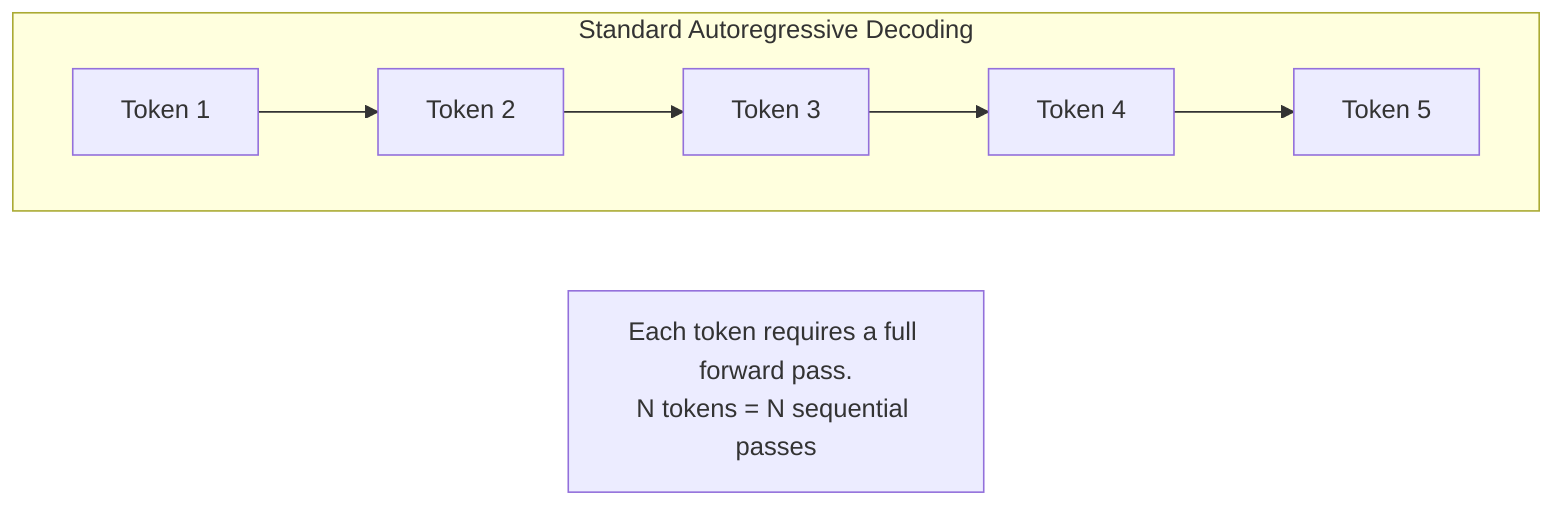 The cost of this serialization is dramatic. Consider a real benchmark from our own infrastructure: an A100 80GB GPU running Qwen3-32B-FP8 achieves roughly 270,000 tokens per second during prefill (the parallel processing of the input prompt) but only about 40 tokens per second during decode (the sequential generation of the output). That is a 6,750x gap between the two phases. For a request that generates 8,192 output tokens, decoding takes approximately 206 seconds while prefilling the prompt takes 0.04 to 0.12 seconds. The reason for this gap is that decoding processes a single token at a time. Each step requires loading the full model weights from memory, performing a matrix multiplication that uses only one row of the weight matrix, and writing out a single token. The GPU's compute units are barely engaged; the bottleneck is memory bandwidth. This is why scaling up to larger, more expensive GPUs yields diminishing returns for decode throughput: you are paying for compute capacity that goes unused. Several approaches attempt to address this bottleneck: - **Batching** combines multiple requests so each forward pass produces tokens for many users, improving GPU utilization. But it increases per-request latency because each request waits for the batch to fill. - **Quantization** reduces the memory footprint of weights, which can speed up memory-bound decoding. But it does not change the fundamental one-token-at-a-time structure. - **Speculative decoding** attacks the problem directly by verifying multiple tokens per forward pass, converting idle compute capacity into higher throughput without increasing latency. Speculative decoding is complementary to batching and quantization, and all three can be combined in a well-tuned serving stack. ## How Speculative Decoding Works Speculative decoding runs two models in concert: a draft model and the target model. The draft model is small and fast; the target model is the large model whose output quality you want to preserve.  The process works in three steps: 1. **Draft.** The draft model autoregressively generates K candidate tokens (the "draft length"). Because the draft model is small, this is fast. 2. **Verify.** The target model processes the K draft tokens in a single forward pass. Because the GPU is underutilized during standard decoding, verifying K tokens costs roughly the same as generating one token normally. 3. **Accept or reject.** Each draft token is compared against the target model's distribution. Accepted tokens are appended to the output. The first rejected token is discarded and replaced with a sample from the corrected distribution, and the process repeats. The number K (draft length) is a tunable parameter. A larger K means more tokens verified per pass, but also more wasted compute if the draft model's predictions are poor. Typical values range from 2 to 8, with 4 being a common starting point. The effective speedup depends on the acceptance rate: the fraction of draft tokens the target model accepts. If the draft model and target model are well matched, acceptance rates of 50 to 80 percent are achievable, yielding 2 to 3x speedups. The relationship is approximately: ``` speedup ~ 1 / (1 - acceptance_rate * (1 - 1/K)) ``` For example, with K=4 and an acceptance rate of 0.7, the theoretical speedup is roughly 2.3x. Real-world results from NVIDIA, Hugging Face, Google, and vLLM consistently report 2-3x speedups, with code generation tasks sometimes exceeding 3x because code is highly predictable. ## Draft Model Strategies and Selection The choice of draft model is, in the words of practitioners at General Compute, "the most consequential decision" when deploying speculative decoding. The draft model must be fast enough to generate tokens quickly, yet accurate enough that the target model accepts a high fraction of them. There are three main strategies: - **Same-family smaller siblings.** Use a smaller model from the same model family as the target. For example, pair Llama-3.3-70B with Llama-3.2-1B. This is the simplest approach and often works well because the models share training data and tokenization. - **Distilled student models.** Train a small model specifically to mimic the target model's output distribution. DistillSpec (ICLR 2024) shows that knowledge distillation can produce draft models with higher acceptance rates than generic smaller models. - **Self-speculative decoding.** Use the target model itself as the draft model by skipping layers or exiting early. This avoids maintaining a separate model but requires architectural support and careful tuning. A traditional constraint is that the draft and target models must share the same vocabulary and tokenizer. If they do not, the target model cannot verify draft tokens directly. Newer methods relax this constraint: - **OmniDraft** (Qualcomm, arXiv:2507.02659) introduces a learned mapping that enables cross-vocabulary speculative decoding. - **Heterogeneous vocabulary algorithms** (arXiv:2502.05202) allow pairing models with different tokenizers. - **TokenTiming** (ACL 2026) provides timing-aware cross-vocab verification. For teams just starting, the recommended path is to use a same-family smaller sibling, verify vocabulary compatibility, and benchmark acceptance rates before production deployment. ## Acceptance, Verification, and Losslessness The mathematical guarantee that makes speculative decoding safe for production is losslessness. The output distribution is provably identical to what the target model would produce on its own. No quality regression occurs, regardless of the draft model's accuracy. 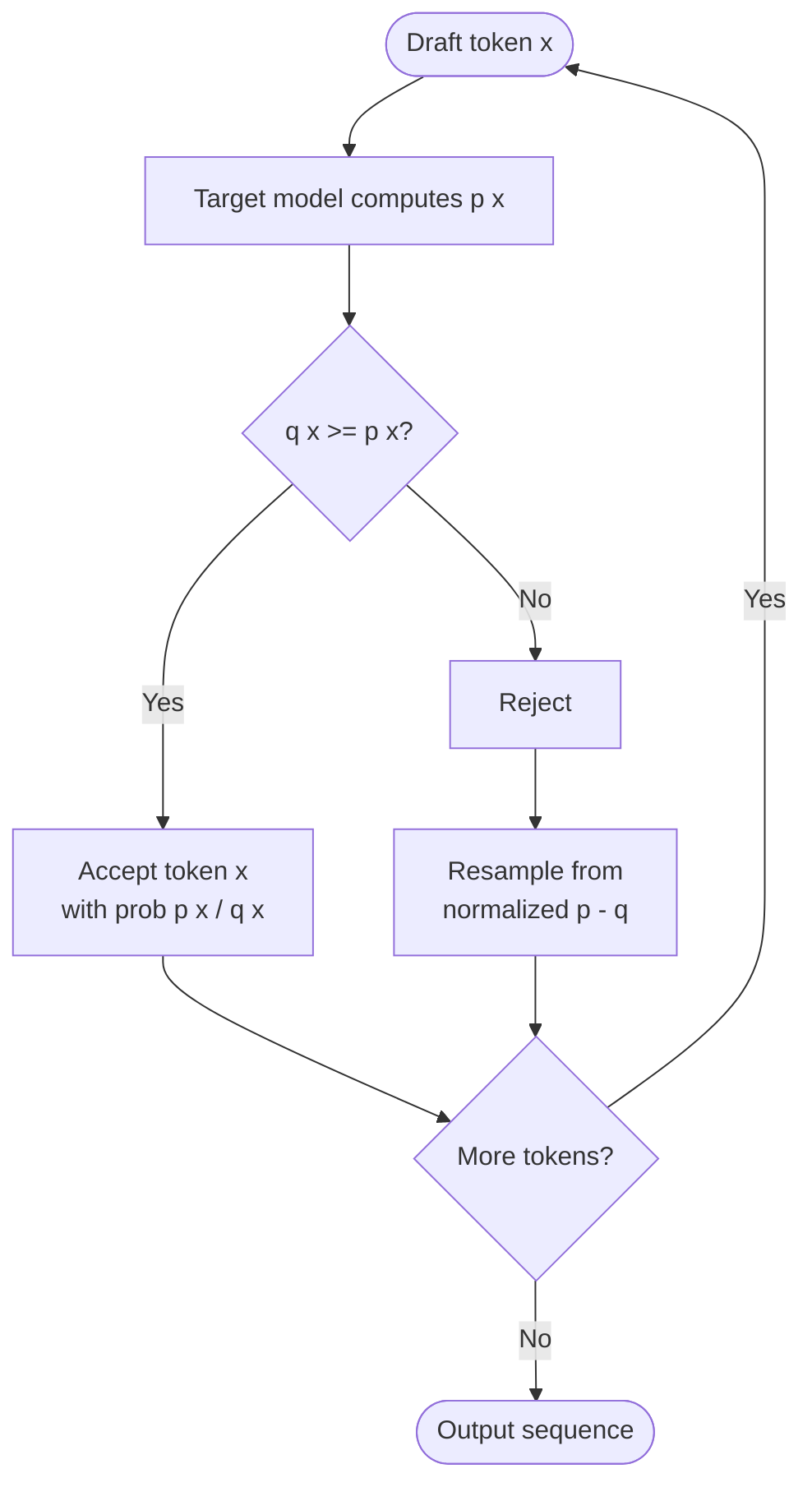 The acceptance mechanism uses modified rejection sampling. For each draft token x sampled from the draft model's distribution q: 1. The target model computes its distribution p over the same position. 2. If p(x) >= q(x), the token is accepted. 3. If p(x) < q(x), the token is accepted with probability p(x)/q(x). If rejected, a replacement token is sampled from the residual distribution max(0, p - q), normalized. This procedure ensures that every token in the final output is distributed exactly according to p, the target model's distribution. A poor draft model does not degrade quality; it only reduces the speedup because more tokens are rejected. > [!ACCENT] Losslessness means you can deploy speculative decoding without re-evaluating model quality. The risk is purely a performance risk: if acceptance rates are low, you gain little or nothing. There is no accuracy risk. The break-even point depends on the cost ratio between the draft model and the target model. If the draft model is very small relative to the target, even modest acceptance rates yield net speedups. If the draft model is large, higher acceptance rates are needed to overcome the drafting overhead. ## Speculative Decoding Variants Compared Since the original papers, the research community has developed many variants that improve on vanilla speculative decoding. The diagram below shows the taxonomy:  The major families are: - **Vanilla speculative decoding** uses a separate, smaller draft model. This is the original formulation and remains the most widely deployed. - **Multi-token prediction (Medusa)** adds multiple prediction heads to the target model itself, eliminating the need for a separate draft model. Medusa (arXiv:2401.10774) trains lightweight heads that predict future tokens from intermediate hidden states. - **Feature-level autoregression (EAGLE)** improves draft accuracy by predicting at the feature level rather than the token level. EAGLE-1 (ICML 2024) introduced this approach. EAGLE-2 (EMNLP 2024, arXiv:2406.16858) adds dynamic draft trees that adapt the speculation structure. EAGLE-3 (NeurIPS 2025, arXiv:2503.01840) is the current state of the art on Spec-Bench, abandoning feature prediction for a simpler but more effective formulation. - **Lookahead decoding** (arXiv:2402.02057) uses Jacobi iteration to generate draft tokens without any draft model at all. It reuses the target model's own computations from previous steps. - **Self-speculative decoding** uses the target model with early exit or layer skipping as its own draft model. - **N-gram and prompt lookup decoding** uses simple n-gram matching against the prompt or a suffix cache. It requires no model and has zero drafting overhead, making it ideal for retrieval-augmented generation (RAG) and document QA workloads where the output often copies from the input. - **Model-native MTP** integrates multi-token prediction into the model architecture itself. DeepSeek V3/R1 and Gemma 4 ship with MTP heads baked in, enabling speculative decoding without any external draft model. | Variant | Draft Source | Extra Model | Best For | Key Paper | |---------|-------------|-------------|----------|-----------| | Vanilla SD | Separate small model | Yes | General purpose, flexible pairing | Leviathan 2023 | | Medusa | Target model heads | No | Moderate speedup, no draft model | Cai 2024 | | EAGLE-2/3 | Feature-level drafter | Yes (lightweight) | Highest speedup, SOTA on Spec-Bench | Li 2024/2025 | | Lookahead | Jacobi iteration | No | No draft model, moderate gain | Fu 2024 | | N-gram / Prompt lookup | Suffix cache | No | RAG, document QA, code | Community | | Model-native MTP | Built-in heads | No | DeepSeek V3/R1, Gemma 4 | Model-specific | Table: Comparison of speculative decoding variants by draft source, model overhead, ideal workload, and reference paper. ## Throughput, Latency, and Cost Tradeoffs Speculative decoding trades extra compute for lower latency. Whether this tradeoff is favorable depends on the workload, the batch size, and the acceptance rate. 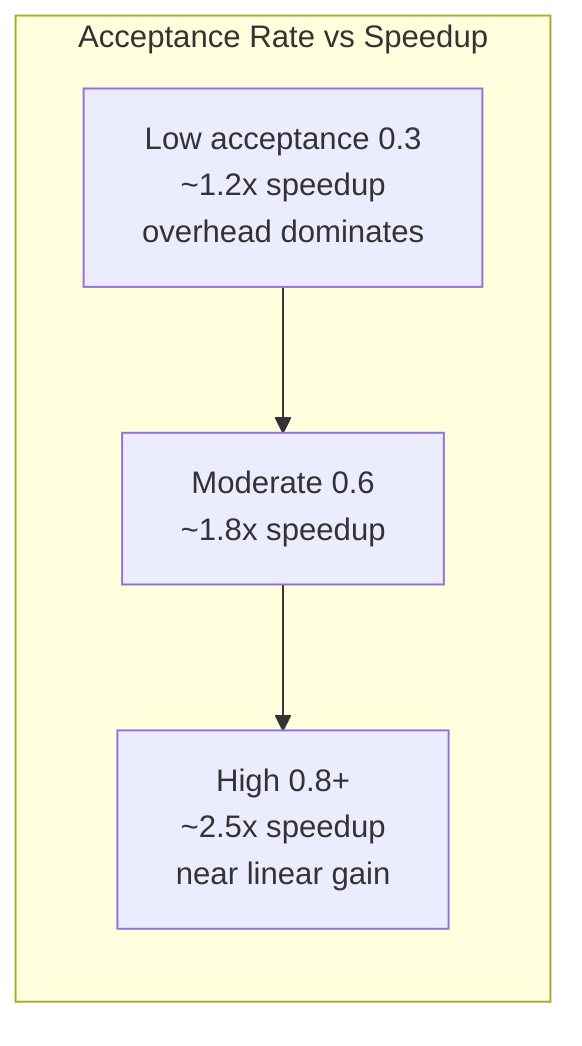 The speedup curve has three regimes: - **Low acceptance (below 0.3).** The overhead of running the draft model exceeds the benefit. Speedup is marginal, around 1.2x or less. This happens when the draft model is poorly matched or the task is highly creative. - **Moderate acceptance (0.4 to 0.6).** Speedups of 1.5x to 2x are typical. This is the regime where most general-purpose text generation falls. - **High acceptance (0.7 and above).** Speedups of 2x to 3x or more. Code generation, structured output, and RAG workloads often reach this regime because the text is highly predictable. The interaction with batch size is critical. Speculative decoding helps most when the batch size is small and the GPU is memory-bound. As batch size increases, the GPU becomes compute-bound: every forward pass is already doing useful work for many requests. At high batch sizes, speculative decoding can actually reduce throughput because the extra draft verification adds compute load to an already saturated GPU. vLLM's documentation explicitly warns that model-based speculative methods increase workload during peak traffic. Cohere's dynamic speculative decoding (DSD) blog addresses this by dynamically adjusting the draft length based on current load: using longer drafts when the system is idle and shorter drafts (or none) under heavy load. The cost implications are: - **Latency-sensitive workloads** (interactive chat, code completion) benefit the most. A 2-3x latency reduction directly improves user experience. - **Throughput-oriented workloads** (batch processing, offline inference) benefit less and may be harmed at high concurrency. - **Mixed workloads** should use dynamic adjustment to enable speculative decoding during low-traffic periods and disable it during peaks. ## Production Deployment Reference Architecture Deploying speculative decoding in production requires choosing a serving framework, selecting a method, and configuring it correctly. The table below summarizes framework support: | Framework | Supported Methods | Config API | Notes | |-----------|------------------|------------|-------| | vLLM | EAGLE, Medusa, MTP, Draft, N-gram, Lookahead, Suffix, PARD, MLP | `--speculative-config` JSON | Broadest support, most methods | | TensorRT-LLM | EAGLE, Medusa, MedusaTree, ReDrafter, Draft, NGram, Lookahead | Speculative Sampling config | NVIDIA-optimized, best on H100/A100 | | TGI | Medusa, N-gram, assisted generation | Server flags | "2-3x faster, much more for code" | | SGLang | EAGLE, draft model | Server config | High throughput, good for multi-tenant | | LMDeploy | EAGLE, Medusa, draft, n-gram | TurboMind engine config | Optimized for quantized models | Table: Speculative decoding support across major LLM serving frameworks, including supported methods and configuration APIs. A production reference architecture for speculative decoding includes the following components: - **Target model server.** The primary inference engine (vLLM, TensorRT-LLM, TGI, or SGLang) running the large target model with KV cache management and continuous batching. - **Draft model.** Either a separate small model loaded alongside the target, or an integrated method (Medusa heads, EAGLE drafter, or model-native MTP). - **Acceptance monitor.** A metrics collector that tracks the acceptance rate in real time. If the rate drops below a threshold, the system should reduce draft length or disable speculation. - **Dynamic controller.** Adjusts draft length K based on current load. During low traffic, increase K for lower latency. During peak traffic, reduce K or disable speculation to maximize throughput. - **Benchmark harness.** A pre-deployment validation step that measures acceptance rates and speedups on representative workloads using the team's actual hardware. The deployment process follows this sequence: 1. Identify the workload type (interactive, batch, mixed). 2. Select a draft model or method based on the target model family. 3. Verify vocabulary and tokenizer compatibility between draft and target. 4. Choose the speculative decoding method supported by your serving framework. 5. Configure the framework with the appropriate API (for example, `--speculative-config` in vLLM). 6. Tune the draft length K. Start with K=4 and adjust based on measured acceptance rates. 7. Benchmark on production hardware with representative prompts. 8. Set up monitoring for acceptance rate, latency, and throughput. > [!ACCENT] Monitor acceptance rates continuously. A sudden drop signals a distribution shift in your traffic, which means the draft model is no longer well matched to the current workload. Build alerting around this metric. ## When Speculative Decoding Helps (and When It Does Not) Speculative decoding is not a universal speedup. Understanding when it helps and when it hurts is essential for making the right deployment decision. Speculative decoding helps when: - **Batch sizes are small.** The GPU is memory-bound, so verifying extra tokens is nearly free. - **The workload is interactive.** Low latency directly improves user experience for chat, code completion, and copilot applications. - **The task is predictable.** Code generation, structured output (JSON, SQL), RAG, and document summarization have high acceptance rates. - **The draft model is well matched.** Same-family models or distilled draft models achieve high acceptance rates. - **Traffic is low to moderate.** The GPU has spare capacity for draft verification. Speculative decoding hurts when: - **Batch sizes are large.** The GPU is compute-bound, and draft verification adds load to an already saturated system. - **Traffic is at peak.** vLLM warns that model-based methods increase workload during peak traffic, reducing overall throughput. - **The task is creative or diverse.** High-temperature generation, open-ended creative writing, and broad-domain QA have low acceptance rates. - **Sequences are short.** The overhead of warming up the draft model may exceed the benefit for short generations. - **The draft model is poorly matched.** If acceptance rates fall below 30 percent, the overhead exceeds the gain. A practical decision framework: - [ ] Is the workload latency-sensitive (interactive, real-time)? - [ ] Are batch sizes typically small (under 8-16 concurrent requests)? - [ ] Is the output text predictable (code, structured, RAG-grounded)? - [ ] Can you find a same-family or distilled draft model? - [ ] Do you have a benchmark harness to measure acceptance rates? - [ ] Can you implement dynamic adjustment for peak traffic periods? If you answer yes to four or more of these, speculative decoding is likely to deliver meaningful speedups. If you answer yes to fewer than three, the overhead may not be worth the complexity. ## Conclusion and Next Steps Speculative decoding is a proven, mathematically lossless technique for accelerating LLM inference by 2-3x. It works by converting idle GPU compute capacity into higher throughput, exploiting the fundamental memory-bandwidth bottleneck of autoregressive decoding. The technique is mature: it is supported by every major serving framework, has been validated in production by teams at Google, NVIDIA, Hugging Face, and others, and has spawned a rich family of variants that improve on the original formulation. For platform teams evaluating inference acceleration, the path forward is: - [ ] Identify your workload profile (interactive vs batch, predictable vs creative) - [ ] Select a draft model or method matched to your target model - [ ] Verify vocabulary and tokenizer compatibility - [ ] Configure speculative decoding in your serving framework - [ ] Benchmark acceptance rates and speedups on production hardware - [ ] Deploy with dynamic adjustment enabled for peak traffic resilience - [ ] Monitor acceptance rates and set alerts for distribution shift The field continues to evolve rapidly. Model-native multi-token prediction, as seen in DeepSeek V3/R1 and Gemma 4, represents a paradigm shift: speculative decoding capabilities are increasingly built into the model itself rather than added at the serving layer. Cross-vocabulary methods like OmniDraft are removing the constraint that draft and target models must share tokenizers, opening up new pairing possibilities. And dynamic speculation techniques are making it safe to run speculative decoding under variable load without throughput regression. If your team is running LLM inference workloads and wants to reduce latency and cost without sacrificing output quality, speculative decoding is one of the highest-impact optimizations available today. Start with a same-family draft model, benchmark on your real traffic, and let the acceptance rate data guide your configuration. # blog/superset-comprehensive-guide-data-visualization-exploration.md *[Source (/blog/superset-comprehensive-guide-data-visualization-exploration)](https://www.shakudo.io/blog/superset-comprehensive-guide-data-visualization-exploration) | [Markdown twin](https://www.shakudo.io/blog/superset-comprehensive-guide-data-visualization-exploration.md)* ---Superset is a modern and cost-effective tool for data analysis. It provides users with easy-to-use features that allow them to explore their data.
From interactive dashboards for filtering and grouping data to performing ad-hoc analysis, Superset offers a wide range of features that make it easy for anyone to explore and understand their data. It supports multiple types of data sources, such as SQL databases and big data platforms like Hadoop and Druid. It also provides a variety of visualization options including bar and pie charts, line graphs, and maps.
Whether you're a business analyst or a data scientist, Superset can help you gain valuable insights from your data. In this blog, we will show you how to get started with Superset, the tool that is rapidly gaining popularity among data scientists, and how Shakudo can help you unlock its capabilities.

What is Superset? As an open-source tool for data visualization and exploration, Superset is designed to be easy to use and customizable. You can connect it to any database, create custom dashboards, and share your results with your team or organization. It’s also one of dozens of open-source tools integrated with Shakudo. Superset with Shakudo comes preconfigured with the database you'd like to connect to, so you can go straight into creating your dashboards. To be able to quickly start using Superset’s powerful visualization and analysis features is a game-changer for data analysts, data scientists, and anyone who wants to make data-driven decisions without worrying about compatibility across tools.

Superset is built on top of the popular Python web framework, Flask. It also integrates seamlessly with a wide range of data sources, including SQL databases and big data technologies like Spark. These features allow you to easily explore and visualize your data, have access to several chart types and customization options, and create interactive dashboards that allow you to visualize your data in real-time.

This tool also offers a range of advanced features, such as support for SQL Lab. It allows users to write and execute custom SQL queries against their data, and opens up a rich set of customization options for charts, such as dashboards. It also supports a wide range of visualizations, including bar charts, line graphs, pie charts, and maps.

Since Superset is open sourced, it offers a cost-efficient yet highly robust alternative to other common visualization tools like Tableau and QuickSight. Beyond visualization tools, it has a growing ecosystem of third-party plugins and integrations, which extend its functionality even further. If you want, you can use plugins to integrate Superset with some popular data sources like Google BigQuery and Salesforce or add support for new chart types. Who is Superset for? Superset is suitable for a wide range of users, from business analysts to data scientists. Its user-friendly interface and customizable features make it easy for anyone to explore and understand their data.

Whether you're looking to gain insights into sales trends, analyze customer behavior, or understand the performance of your business, Superset can help you get the answers you need. It's also a valuable tool for data scientists who are working with complex datasets and need a platform that can handle large amounts of data. Getting Started Now that you know what Superset is and what you can do with it, let's take a look at how you can get started with it.
By opening Superset using Shakudo, your data is already loaded into the database, and you can start exploring it right away. Since the dataset is ready, you can start configuring the column properties to determine how the column should be treated in the Explore workflow. Simply go to Datasets on the top right corner, and click on the edit button beside your chosen dataset.

To start visualizing your data, first create a dashboard and start adding some visualizations charts. Click the "+" button to add a new dashboard on the "Dashboards" tab in the top menu. You can then give your dashboard a name and add some visualizations.

If you’d like to add a new chart, click on the "Chart" tab in the top menu, then click the "+" button to add a new chart. You can then select the type of visualization you want to use (e.g., bar chart, line graph, pie chart, etc.) and choose the data source and columns that you want to visualize.
In the following screenshot, we crafted a Bar Chart to visualize the number of flights per origin airport just by clicking options in drop-down menus.

When is Superset Valuable? One valuable use case for Superset is analyzing sales trends. For example, seeing how your sales teams are performing over time. To do this, you can create a line graph visualization that shows your sales team’s activity data over time and use filters to narrow down the data to specific time periods or regions.
If you’re running a business, Superset can help you understand your business performance. For example, how your revenue and expenses are changing over time, or how your business is performing compared to industry benchmarks.
Another great use case for Superset is analyzing customer behavior. To know which products are the most popular among your customers, or how customer satisfaction scores vary by location. On Superset, you can create a bar chart visualization that shows the data that you are interested in. Thank you! We hope this blog post has given you a comprehensive overview of Superset and how it can be used. If you're interested in learning more about Superset, be sure to check out its documentation and tutorials, and if you’d like to know more about using Superset on Shakudo, click this link here to create a free account and start using it right now or book a demo with one of our data experts.
Happy data exploring!
# blog/sustainable-cloud-computing.md *[Source (/blog/sustainable-cloud-computing)](https://www.shakudo.io/blog/sustainable-cloud-computing) | [Markdown twin](https://www.shakudo.io/blog/sustainable-cloud-computing.md)* ---
Cloud computing is the backbone of modern AI and data-driven innovation, enabling businesses to scale, automate, and optimize operations. According to Gartner analysis, 70% of workloads are projected to migrate to the cloud by 2028, with spending expected to surpass USD 2.3 trillion by 2032, making a cloud-first mindset not just optional but a strategic necessity.
Yet, as cloud adoption accelerates, so does its environmental impact. Data centers consume vast amounts of energy, contributing significantly to global carbon emissions. As tech leaders start to acknowledge the urgent need for greener solutions and consciously invest in energy-efficient infrastructure to minimize their environmental footprint, sustainable cloud computing has emerged as a critical strategy to balance technological advancement with environmental responsibility, pushing organizations to rethink how they manage cloud resources.
Sustainable cloud computing refers to the adoption of eco-friendly practices to reduce energy consumption, minimize carbon footprints, and improve efficiency in cloud-based operations. This includes:
Training large-scale machine learning models requires significant computational power, often running for days or weeks across cloud-based GPUs and TPUs—this leads to high energy consumption and increased carbon emissions. While leading cloud providers are investing in renewable energy and carbon offsetting, companies deploying AI at scale still face challenges in optimizing cloud usage efficiently.
Cloud computing tackles these challenges by offering scalable and efficient infrastructure, enabling organizations to optimize workloads, reduce energy waste, and leverage greener data centers. In other words, the objective is to create a much more environmentally conscious digital infrastructure that optimizes the use of energy whilst maintaining operational efficiency.
Aside from consciously choosing to use renewable energy such as switching to solar, wind, and hydroelectric power to power data centers, a large part of cloud computing depends on efficient infrastructure optimization. This includes utilizing low-power processors and energy management software that minimize the energy required to maintain ideal operating temperatures in data centers.
Take a look at the graph below:

Modern data centers prioritize hardware efficiency by deploying energy-efficient servers, storage solutions, and networking equipment that reduce overall power consumption while maintaining high performance. Virtualization and dynamic resource allocation further enhance efficiency by enabling multiple workloads to run on fewer physical servers, minimizing energy waste and improving scalability. Additionally, advanced cooling techniques, such as liquid cooling and free-air cooling, help regulate temperatures more effectively, reducing the need for energy-intensive air conditioning and optimizing data center layouts for better airflow and heat dissipation.
Beyond traditional cloud models, edge computing plays a crucial role in reducing latency and bandwidth usage by processing data closer to the source, thereby decreasing the reliance on centralized cloud servers and improving real-time responsiveness. Complementing these strategies, AI-driven automation ensures that cloud workloads are intelligently scheduled and distributed based on demand, optimizing performance while reducing unnecessary energy consumption. Together, these innovations create a more sustainable and cost-effective cloud computing ecosystem that balances performance with environmental responsibility.
As AI continues to evolve, sustainable cloud computing will become a non-negotiable priority for businesses aiming to scale responsibly. Organizations that adopt AI-driven cloud optimization platforms like Shakudo can reduce costs, enhance efficiency, and contribute to a greener digital future. Shakudo is redefining cloud infrastructure management by offering an AI-native platform that optimizes cloud efficiency while minimizing waste. The all-in-one nature of the Shakudo platform allows companies to enhance fault tolerance and optimize performance by diversifying workloads across multiple platforms.
1. Automated Resource Optimization
Shakudo automates infrastructure scaling, ensuring compute resources are used efficiently. By dynamically allocating resources based on workload demand, it prevents over-provisioning and reduces energy waste. For example, teams can easily deploy tools such as Kubeflow on Shakudo, which provides automated scaling of ML workloads and intelligent resource allocation across clusters to achieve optimal resource management.
By intelligently monitoring cloud usage, Shakudo helps businesses avoid unnecessary costs and carbon emissions. The platform identifies underutilized resources and reallocates workloads to maximize efficiency, reducing the environmental impact of AI processing. HyperDX, for example, can be integrated on Shakudo's platform, providing comprehensive observability across logs, metrics, and traces to identify resource waste and optimization opportunities.
Shakudo also enables organizations to optimize workloads across public, private, and hybrid cloud environments. This flexibility allows companies to choose cloud providers that prioritize renewable energy sources and sustainability efforts. Teams can leverage VMware through Shakudo to efficiently manage hybrid cloud deployments and ensure consistent performance across different infrastructure environments."
Tools such as Windmill can be implemented to help organizations run computationally intensive AI tasks during off-peak hours. Being able to run natively on Shakudo, teams can achieve 5x faster workflow scheduling compared to traditional tools, enabling precise timing of resource-intensive tasks.
While management in AI infrastructure can be resource-intensive, tools like Velero can be deployed on Shakudo to enhance sustainability by minimizing redundant resource usage and ensuring data safety. Velero’s selective backup and restore approach helps reduce over-provisioning, enabling incremental backups instead of full system backups. This not only optimizes storage and compute efficiency but also lowers energy consumption.
Ultimately, future-proofing the cloud is a multidimensional challenge that requires a balance of sustainability, efficiency, and innovation. AI is playing a pivotal role in making cloud infrastructure more sustainable in 2025 by optimizing resource allocation, reducing energy waste, and enhancing automation. Shakudo enables organizations to leverage AI-driven infrastructure management, ensuring compute resources are right-sized, workloads are efficiently scheduled, and energy consumption is minimized. By integrating AI-powered automation with sustainable cloud strategies—including serverless computing, edge processing, and hybrid deployments—businesses can significantly reduce their carbon footprint while maintaining agility and cost efficiency.
# blog/sustainable-computing-whitepaper.md *[Source (/blog/sustainable-computing-whitepaper)](https://www.shakudo.io/blog/sustainable-computing-whitepaper) | [Markdown twin](https://www.shakudo.io/blog/sustainable-computing-whitepaper.md)* ---As artificial intelligence reshapes the business landscape, a critical challenge emerges: How can enterprises scale AI capabilities while minimizing environmental impact?
Traditional cloud infrastructure often struggles with efficiency, leading to excessive energy consumption and operational costs. To address this, organizations must adopt a multi-faceted strategy that includes energy-efficient hardware, AI-driven resource management, edge computing, and serverless architectures.
In this white paper, we explore:
Don't have time and want to read this blog offline? Click here to download the whitepaper PDF.
LLMs have unlocked a plethora of new use cases through their phenomenal text understanding and generation performance. One notable such use case is to interrogate internal knowledge through natural language queries — that is: to talk with your data. This is often referred to as “retrieval-augmented generation” (RAG).
Combining existing knowledge bases with LLMs is a difficult process, with challenges ranging from engineering concerns (how to process, store, and retrieve the data) to R&D challenges (how and what to embed and generate) to ops hurdles (how to ensure the service stays up and scales).
In this blog post, we outline best practices in addressing several key challenges associated with developing and deploying production-grade RAG systems.

Retrieval-augmented generation (RAG) architectures are a popular way to address issues in LLMs, such as their inability to answer questions about fresh or private content (not in their training data) and data accuracy in generated response.
As depicted above, a typical RAG architecture places a database in front of an LLM, and performs a semantic query between the user’s prompt and the database to recover relevant documents. Then, those documents’ text are made available to the LLM for natural language text generation.
Typically, those documents are really fragments from a larger document, for example paragraphs from a 300-page book. This allows an LLM to consume contents from multiple sources and to cross-reference different material to answer questions such as: “Which of these two companies saw more profit this year?”
RAGs can also be used to “extend” an LLMs memory, by saving previous user interactions in a vector store and recovering relevant chats to answer further questions.
Overall, they’re an efficient way to bypass context size limitations in LLMs.
Each segment of the rough diagram above represents multiple real-world challenges when brought to scale: How can we find relevant embeddings efficiently? How do we manage the documents so that the embeddings are relevant when we perform a search? How do we provide text fragments to the LLM so that it will answer from the data and not from imagination? How do we run this architecture efficiently for thousands or even millions of users?
In the following sections of this blog post, we cover three main challenges associated with RAG-based LLMs: options for efficient retrieval, model tuning, and resource and cost management.
If you are not familiar with RAG implementation, are looking for a refresher, or simply want to quickly give them a spin, see our previous blog post, in which we cover RAGs with example code and data.
While not all knowledge bases contain Google- or Amazon-scale data, there can be various complications, such as operating on large documents (300+ page PDF collections, videos, microsecond-resolution time data, etc.). Whether the dataset is composed of very many small documents, a medium amount of very large documents, or a mix of both, brute force approaches are usually not good enough, and cannot scale as the knowledge base grows.
In addition, since we expect natural language queries, we need semantic search with contextual relevance. For example, if the user asks for the price of adopting “cat,” “cat” can be the stock ticker for “Caterpillar,” or it could be the pet. Without contextual information (e.g., “adopting cat” clearly isn’t about adopting a stock ticker), the search will return bad results from the database, and for the generation part of a RAG, it’s Garbage In, Garbage Out.

The solution in practice is to use vector databases, which allow storing embedding vectors efficiently, and retrieving documents based on embeddings at interactive speeds. There are various vector stores available that provide different capability levels. Some notable options include Milvus, PgVector for Postgres, Pinecone, Weaviate, and Qdrant.
Setting up vector stores introduces additional challenges. For example, correctly partitioning large data which cannot fit entirely in RAM in vector stores like Milvus is not an easy endeavor. Doing it poorly can result in some queries taking up too much RAM and bringing the service down (under-partitioning), or having to perform too many probes to find a relevant document, which results in hitting slow permanent storage and reducing the RAG’s responsiveness significantly (over-partitioning).

Furthermore, the quality of embeddings chosen, and the embedding methodology (what to embed and how much of it) is its own complicated topic. Poor choices can break a RAG altogether, while good choices will make the downstream generation task a lot easier. It’s not enough to select whatever embedding model tops a benchmark, because the benchmark may not be using data resembling your specific knowledge base documents. Just because a model is great at embedding data from a Reddit threads dataset doesn’t mean it is good at embedding financial statements or business case studies. Good embeddings depend on the embedding model used, but good retrieval of those embeddings depends on using the right search algorithm and the right distance function to compare various embeddings. Two common distances are shown below:

It’s important to understand the kind of embeddings used since this affects how search metrics behave. Many modern embedding models use normalized embeddings, but not all. Common search metrics like L2 and Cosine similarity will return different results in the case of unnormalized embeddings. As you can see in the equation, Cosine similarity divides by the vector norms while L2 doesn’t account for it at all. Depending on embedding type and desired result, both are viable, although in typical cases, Cosine similarity results in the expected behavior. Beside L2 distance and Cosine similarity, other common distances are visually depicted below. Some may be more or less suitable depending on use case, type of data, and embedding model. However, many vector stores typically do not support more than the most common distances.

As in most non-trivial tasks, the exact best choices to make at any level depends on the specific task at hand. However, there are some useful rules of thumb that can enable faster development and serve as a basis to achieve decent results before parameters can be optimized further through experiments or trial and error.
For setting up embeddings, we find that using a small “L”LM, such as a small sentence BERT that was specifically trained to optimize distances between sentence pairs, achieves a good all-purpose baseline: these models are typically quite fast and cheap to use, and a bigger models’ improved performance can be marginal until the rest of the pipeline is fully optimized. For this kind of model, a Cosine similarity for a search metric is suitable.
For good performance, proper indexing is necessary so as to not perform a brute force search against the database. The usual choices are either inverted flat files (IVFFlat) or hierarchically navigable small worlds (HNSW).
In short, IVFFlat can be thought of as computing k-means clusters and performing a 2-step search during queries: a similarity search against the centroids, then against the list of vectors within the selected cluster only. As for HNSW, it builds a graph by creating links between elements and separating sets of links and elements into layers based on the length of those links. With a suitable choice of parameters, this ensures a logarithmic search time on the set of vectors.
The index for the former is far faster to build and requires fewer resources to store. However, it also results in much slower queries. That said, even a “slow” index is orders of magnitude faster than brute force search and perfectly suitable for searches against single or few documents (e.g., uploaded by a user for a one-time document discussion) or for small knowledge bases.
The next challenge, once we have covered retrieval, is generation. The context obtained from the document or documents retrieved in the database are provided to the model, and the model must now provide a natural language answer to the user query. Choosing the right LLM is critical for this.
Choosing the latest or biggest LLM is hardly a recipe for success. Bigger is not always better. Some 13B models perform better than some 40B ones. Not all models with the same amount of parameters perform the same. For example, we generally find that WizardLM-13B and Mistral-7B perform far better in our use cases than plain LLama2-13B, but your mileage may vary based on the kind of documents you use.
Bigger models are also far more expensive to run and harder to scale, and they generate more slowly. There are diminishing returns in general when increasing parameter count, and the optimum for you may not be the same as for someone else. Note the logarithmic scale on this graph compared to the almost linear performance increase:

Better models will make downstream engineering tasks, such as guardrail engineering and prompt engineering (which we’ll talk about later in this post) easier, as the model will yield better results from the get go. But it can never eliminate the issue, since LLMs’ need for massive data during training mostly limits them to being trained in text completion mode.
As with embeddings, choosing the right LLM isn’t simply a matter of choosing the biggest or latest model. How they’re trained matters, and it might be necessary to fine-tune the model to get good results on the specific data of interest.
Without prompting the model in the right format and with the right information, it is very likely to give seemingly sensible responses that, nevertheless, are not related to the document of interest at all. Common techniques to improve output quality include inserting the phrase “Let’s think step by step,” known as “chain of thought prompting” (which essentially makes the model generate extra context with which to continue on to generate better answers automatically), or instructions like “only answer based on the document.” This has the effect of improving the likelihood of generated tokens relative to the desired output if those phrases were previously encountered in the model’s training data — and the closer the phrase is to data the model has seen, the better for this purpose.
Correct prompt engineering is quite challenging. Minor differences like punctuation and capitalization can have radical downstream consequences. This will also often be task and model-specific, thus significant trial and error experimentation is required. Moreover, prompt shaping can never fully eliminate hallucinations, and a user can always bypass any prompt engineering effort with a little creativity. Projects like merlin.ai have tried to address this issue, but to no avail so far.
If the documents of interest in your RAG are small enough, a powerful trick is to provide example input-output pairs in the prompt. This approach can improve output quality radically, but again it is not failproof.

Another tool that can help generation is guardrail engineering. There are many ways to go about it, but the most common is to stop generation when specific words (“stop words”) are encountered. A classic hallucination pattern, since LLMs are trained for text completion and not dialogue for the majority of their time, is for the LLM to generate a fake user input and answer it in the same dialogue. Using the user input prompt component as a stop word greatly reduces the issue, although minor formatting issues in the output could cause this guardrail to fail.
Another common guardrail to use when generating categorical results (“which is rounder: a pear, an apple, or an orange?”) is to verify if the categorical options are present in the output. This can be combined with stop words to prevent the model from outputting more than just the answer, depending on use case.
Unlike prompt engineering, this tends to be more task and model agnostic (for example, all models and tasks benefit from setting a stop word on the “User:” prompt). Guardrail can’t affect output quality or format by itself, unlike prompt engineering, and neither technique can fully eliminate hallucinations — but together, they greatly help sanitize the resulting generated text.

WizardLM-13B and Mistral-7B are good, relatively cheap-to-run baseline models. They will not work very well for following non-trivial instructions, but provide decent baseline responses in line with most expectations. If those models do not perform well on the task even after prompt tuning, it may suggest that fine-tuning is needed.
Regarding prompt engineering, it is important to start by ensuring the correct prompt format for chatting is in use. For WizardLM-13B, which was fine-tuned on Vicuna-1.2, the correct prompt format is:
A chat between a curious user and an artificial intelligence assistant. The assistant gives helpful, detailed, and polite answers to the user's questions. [Or any other instruction] USER: [user text for the first turn goes here] ASSISTANT: [Assistant response goes here]</s> USER: [user text for the second turn goes here] ASSISTANT: Whereas the prompt for Mistral-7B follows a format similar to Llama2:
<s>[INST] [instruction and user turn goes here] [/INST] [answer goes here]</s>[INST] [Follow-up instruction and user turn goes here] [/INST]Using the wrong prompt will invariably give poor results regardless of the choice or capabilities of a model.
For instructions, we like to add “answer only based on the document,” where “document” can be substituted for another keyword to achieve the desired answer in case the question asked by the user is not available. We also find that adding text to the start of the assistance response (i.e., before generation begins) can tremendously help improve performance. For example:
...
USER: How can I run faster? Assistant: According to the provided document, [generation starts here]
will typically greatly augment the model focus on just document-provided information.
To insert the document within the prompt, we found success, depending on use case, either providing the document as part of the user query, or as part of the instructions. We find that formatting the prompt as some common format in the training data of models is helpful to separate the actual user query from the actual document contents and cuts down on hallucinations (e.g., it greatly reduces cases like “USER: How can I run faster? ASSISTANT: according to the document, a good diet and exercise is important for good running performance. So to answer your question, the answer is no: the brand of running shoes does not matter. Let me know if you have any other questions.”). A good choice of format is generic markdown. Json format also works well, depending on the task.
The final challenge we’ll discuss in this post is deployment at scale. LLMs are expensive and are generally too slow to run on just CPUs. GPUs are expensive to run, and the overhead of moving data from the CPU RAM to the GPU VRAM can be another hurdle for inference. Meanwhile, usage is not constant throughout the day (or week or season). We need a way to scale up and down as seamlessly as possible to avoid extraneous costs while maintaining a high quality of service.
At Microsoft or Meta scale, depending on service type, we can expect that models will have to serve millions of queries per day, or even per hour or more.

As the image shows, as models become bigger, more FLOPS are needed per token, which increases inference cost drastically. As a rule of thumb, the chart below is a good guide to estimate model overhead.

Scaling is hard, time consuming, and resource-intensive. Failing to scale, however, can destroy an otherwise promising project. At the risk of seeming a little biased, we recommend leveraging solutions that make the scaling as transparent as possible, so that you can focus instead on delivering business value through solving generation and retrieval pipelines. Scaling, after all, is not very business-specific, quite unlike the other challenges in deploying a RAG. Shakudo is very familiar with the difficulties of deploying and scaling RAG use cases and the velocity bottleneck that results from developing scaling solutions for these unusual workloads. The Shakudo platform lets you use and connect all the tools you need to build a RAG in minutes, hassle-free. Moreover, unlike other platforms, Shakudo keeps you fully in control of your data, code, and artifacts: you can move on or off Shakudo at any time, on any cloud, or even on-prem. We highly recommend leveraging such a platform.
Building RAGs is a complex process that can go wrong in many ways. In this post, we discussed three common hurdles: document retrieval, text generation, and RAG scaling in production. We also mentioned that some of the difficulties in creating RAG-based products are business-centric, where there is no one-size-fits-all solution, while other problems, namely scaling, are more general and can be addressed externally.
To de-risk RAG development processes, the Shakudo Platform provides a pre-integrated, production-ready environment that allows teams to quickly and cost-effectively set up a RAG-based LLM in minutes. With Shakudo, you select the vector database and LLM that meets your specific requirements, and our platform automatically connects them to your chosen knowledge base. The stack is launched with the click of a button, giving you immediate access to an upleveled LLM that produces precise, contextually-aware responses to your users’ prompts. To learn more about how Shakudo simplifies data infrastructure for LLMs and RAG, explore the Shakudo Platform.
Shakudo integrates with over 100 different data tools, including all the tools you will need to develop and deploy RAGs at scale. The platform also exposes features to ease development, such as self-serve openai-compatible embedding, vector store, and text generation APIs.
Are you looking to leverage the latest and greatest in LLM technologies? Go from development to production in a flash with Shakudo: the integrated development and deployment environment for RAG, LLM, and data workflows. Schedule a call with a Shakudo expert to learn more!
# blog/technology-partnership-roundup-01.md *[Source (/blog/technology-partnership-roundup-01)](https://www.shakudo.io/blog/technology-partnership-roundup-01) | [Markdown twin](https://www.shakudo.io/blog/technology-partnership-roundup-01.md)* ---As a unified, self-hosted operating system that integrates the best of open-source and commercial technologies, Shakudo is dedicated to streamlining and simplifying technology management for organizations. Our strategic partnerships are essential to our success, significantly enhancing our platform's capabilities and increasing its value for users. These alliances keep us at the forefront of innovation, allowing us to continuously refine our platform and enable us to deliver top-tier, end-to-end solutions tailored to our users' needs, eliminating the complexities of managing multiple technologies.
To celebrate the incredible contributions of our partners, we are excited to announce a series of blog posts dedicated to showcasing the innovative technologies and solutions they bring to Shakudo. Each post will delve into the unique strengths and advantages of our partnerships, illustrating how these collaborations enhance our platform and deliver exceptional value to our users. Stay tuned as we explore the transformative impact these technologies have on our unified operating system and demonstrate how they help us streamline and simplify technology management for organizations.
MinIO is a high-performance, S3-compatible object store that is built for AI/ML, advanced analytics, databases, data lakes and HDFS replacement workloads. It is downloaded over 2 million times a day and is used by 77% of the Fortune 100. Exclusively software defined, truly cloud-native and remarkably simple to install, manage and scale - it is the enterprise standard for object storage, across public, private, colo and edge clouds. MinIO offers a rich suite of enterprise features targeting security, resiliency, data protection and scalability. These capabilities, along with the flexibility of deployment, enables organizations to easily support their modern application data workloads while also reducing their infrastructure complexity and operational costs.
Dify simplifies and accelerates the development of GenAI applications. It provides a visual orchestration studio and backend services for integrating large language models (LLMs) into applications without complex infrastructure. Use cases include AI-driven customer service chatbots, automated document generation, and personalized AI assistants. Dify empowers businesses to innovate faster, improve AI application performance, and achieve greater scalability in their GenAI initiatives.
n8n gives technical teams a secure, AI-native workflow automation tool. Connect any app or API and flexibly integrate AI into your business processes. With a fair-code license, n8n allows you to self-host while benefiting from a vibrant community of developers and builders. Use cases include IT operations, SecOps, DevOps, and Sales Automation, enhancing efficiency and productivity. Its low-code interface makes it easy to use, letting you insert custom JavaScript or Python code or expressions as needed, truly enabling the connection of anything to everything.
Rill is a platform for building fast operational drill-down dashboards. Unlike most BI tools, Rill comes with its own embedded in-memory database. Data and compute are co-located, and queries return in milliseconds. It supports last-mile ETL using SQL and promotes BI-as-code for seamless local development and global deployment. Use cases include campaign analytics, infrastructure monitoring, and product telemetry. Rill enhances data accessibility, reduces cloud warehouse costs, and accelerates data-driven decision-making.
At Shakudo, we are committed to fostering meaningful collaborations that drive progress, create value for our customers, and contribute to the advancement of the technology industry as a whole. As our team continues to evolve and adapt to the ever-changing tech landscape, partnerships will remain a crucial element of our strategy. We invite you to explore our current partnerships and stay tuned for exciting announcements about future collaborations.
To learn more about how these collaborations work or to become a partner, contact one of our representatives.
# blog/technology-partnership-roundup-02.md *[Source (/blog/technology-partnership-roundup-02)](https://www.shakudo.io/blog/technology-partnership-roundup-02) | [Markdown twin](https://www.shakudo.io/blog/technology-partnership-roundup-02.md)* ---Welcome to our second round-up of Shakudo’s technology partnerships. In this edition, we’re excited to spotlight more game-changing collaborations that enhance the Shakudo platform. Building on our previous update, we’re showcasing innovative technologies from across the modern data stack, each tailored to address unique and diverse use cases.
From advanced data visualization tools to low-code customization platforms, our collaboration with industry-leading technology providers empowers cross-functional teams to analyze complex data swiftly and tailor solutions with ease. Our comprehensive use cases underscore how our growing network of partnerships infuses Shakudo’s ecosystem with diverse strengths, driving efficiency and innovation across various industries.
Together with the Shakudo operating system, data-driven organizations are delivering cutting-edge solutions to the most demanding needs.
Langfuse ensures smooth and efficient operation of large language models (LLM) applications through its advanced observability and LLM engineering solutions. Langfuse offers real-time performance monitoring, analytics, quality evaluations and testing as well as prompt management to optimize AI application performance. Example use cases include monitoring LLM-powered customer service bots, analyzing usage patterns of AI content generators, and judging the quality of AI search results through human annotation and automated evaluations. Organizations using Langfuse enhance decision-making and time to market with detailed and actionable insights into LLM based applications.
UI Bakery is a low-code platform designed to help developers rapidly build custom internal tools, customer portals, and dashboards. It features a drag-and-drop interface, 75+ pre-built components, and extensive integrations with SQL/NoSQL databases, APIs, and third-party services. Use cases include creating admin panels, workflow automation tools, and data visualization dashboards. Using UI Bakery results in faster development times, reduced reliance on extensive coding, and improved efficiency in building and maintaining internal applications.
Mattermost is a secure collaboration platform designed for mission-critical work in sectors like defense, government, and critical infrastructure. It features secure messaging, integrated playbooks, and robust DevSecOps tools with deployment options for on-prem, cloud, and air-gapped environments. Use cases include improving incident response, enabling secure communication, and enhancing operational workflows. Mattermost helps organizations accelerate decision-making, ensure data sovereignty, and enhance collaboration efficiency.
Neon offers a serverless PostgreSQL platform designed to help developers build reliable and scalable applications faster. It provides features like instant provisioning, autoscaling, and data branching. Use cases include developing modern web applications, automating database management tasks, and deploying database-per-tenant architectures. Companies who use Neon experience reduced infrastructure management, accelerated development workflows, and cost savings through efficient scaling and resource management.
# blog/technology-partnership-roundup-03.md *[Source (/blog/technology-partnership-roundup-03)](https://www.shakudo.io/blog/technology-partnership-roundup-03) | [Markdown twin](https://www.shakudo.io/blog/technology-partnership-roundup-03.md)* ---In the third edition of our round-up series, we’re excited to bring you another exciting update on our expanding network of strategic collaborations. As we continue to build on the momentum from our previous editions, this round-up highlights a fresh array of partnerships that further enhance the Shakudo platform's capabilities.
With focuses on data management, integration, and AI-driven automation, these partners together enhance Shakudo's platform efficiency and scalability. They simplify workflows, accelerate data access, and support AI applications, enabling businesses to integrate, analyze, and automate data processes seamlessly.
Laminar enables businesses to build custom API integrations faster using AI-driven tools and a specialized platform. It allows users to connect to any API or legacy system, generate business logic workflows, and manage integrations with built-in observability and notifications. Companies use Laminar to quickly integrate disparate systems, automate workflow generation, and maintain integrations without extensive custom code. Using Laminar, businesses can reduce implementation risks, cut costs, and accelerate time-to-market for their integrations.
Qdrant is an open-source vector database designed for high-performance similarity search and scalable AI applications. Built in Rust for performance, memory safety, and scalability, Qdrant handles billions of vectors and supports the matching of semantically complex objects. Use cases include advanced search, recommendation systems, retrieval-augmented generation (RAG), and anomaly detection, enabling precise and scalable solutions for AI-driven applications. By deploying Qdrant Hybrid Cloud in their own VPCs via Shakudo, enterprises can achieve secure, high-performance vector search while keeping full control over their data.
Dremio provides a unified lakehouse platform for self service analytics and AI, offering high-performance SQL query engines and seamless data integration across cloud, hybrid, and on-prem environments. It features capabilities like Apache Iceberg support, automated data optimization, and a universal semantic layer. Use cases include data lake modernization, data mesh implementation, and accelerating AI data access. Dremio enhances analytics performance, reduces total cost of ownership, and simplifies data management, enabling faster insights and more efficient data operations.
Windmill is an open-source developer platform and workflow engine that turns scripts into auto-generated UIs, APIs, and cron jobs. It supports multiple languages, including Python, TypeScript, Go, and SQL, and offers features like drag-and-drop interfaces and detailed monitoring. Use cases include automating business processes, creating complex data pipelines, and building internal tools. Windmill enables developers to build, deploy, and run software faster and more reliably, enhancing productivity and operational efficiency.
To learn more about how these collaborations work or to become a partner, contact one of our representatives.
# blog/technology-partnership-roundup-04.md *[Source (/blog/technology-partnership-roundup-04)](https://www.shakudo.io/blog/technology-partnership-roundup-04) | [Markdown twin](https://www.shakudo.io/blog/technology-partnership-roundup-04.md)* ---For today’s installment, we bring you a new lineup of industry leaders who are transforming how businesses manage and utilize data. Each partner offers innovative solutions emphasizing scalability, simplicity, and efficiency in handling complex data workflows.
Companies can leverage a powerful combination of these data tools to enable advanced machine learning applications, maintain data integrity across environments, and orchestrate seamless data pipelines, ultimately driving insights that fuel informed decision-making. Together, these tools not only simplify data handling but also empower organizations to unlock the full potential of their data assets.
Milvus is an open-source vector database optimized for high-performance similarity search and scalable GenAI applications. It supports features like instant provisioning, elastic scaling, and integrations with AI tools such as OpenAI, Hugging Face, and LangChain. Use cases include machine learning, deep learning, and recommendation systems. Milvus helps organizations efficiently manage large-scale vector data, ensuring fast and accurate retrieval, and supporting advanced analytics and AI workloads.
MotherDuck is a serverless data analytics platform powered by DuckDB, designed for hybrid execution that scales from local to cloud environments. It features instant query responses, seamless data movement between local and remote datasets, and extensive integrations. Use cases include data exploration, large-scale analytics, and building data-intensive applications. MotherDuck enhances analytics capabilities, simplifies data operations, and provides a flexible, scalable solution for modern data challenges.
LakeFS is an open-source data version control platform designed for managing data lakes, enabling teams to version, branch, and manage data like code. It integrates with existing data lakes and supports large-scale data operations, offering features such as atomic commits, metadata management, and easy rollbacks. Use cases include improving data pipeline reliability, enabling reproducible experiments, and simplifying data governance. LakeFS helps organizations manage data complexity, ensure data consistency, and accelerate development workflows in data-driven projects.
Dagster is a cloud-native data orchestration platform designed for building, testing, and managing data pipelines. It offers an asset-oriented approach, integrating deeply with modern data tools, and provides features like lineage tracking, observability, and a declarative programming model. Use cases include automating ETL processes, managing data infrastructure, and ensuring data quality. Dagster helps organizations streamline pipeline development, improve reliability, and accelerate data operations across the entire lifecycle.
# blog/the-7-deep-learning-algorithms-to-get-started-with-in-2023.md *[Source (/blog/the-7-deep-learning-algorithms-to-get-started-with-in-2023)](https://www.shakudo.io/blog/the-7-deep-learning-algorithms-to-get-started-with-in-2023) | [Markdown twin](https://www.shakudo.io/blog/the-7-deep-learning-algorithms-to-get-started-with-in-2023.md)* ---Ever wondered how smart assistants such as Siri, Google Assistant, and Alexa translate your voice commands into actions? How do search engines provide relevant search results? How do self-driving cars detect accidents? All these systems can work autonomously because of deep learning, which is set to be a "defining future technology". With the advancements around the globe, be it digital, environmental, or even social, technology is the answer because it applies deep learning to new domains and products and helps develop the necessary tools. If such is the importance of deep learning in our lives, we must understand what it is.
Deep learning is a subfield of machine learning that teaches computers to display human-like capabilities such as planning, reasoning, and creativity. It enables the systems to adapt and improvise in a new environment so that they can generalize their knowledge and apply it to unfamiliar scenarios. As far as the technical systems are concerned, deep learning enables them to:
Following are the top deep learning algorithms that can help you solve complex real-world problems.
A Convolutional Neural Network (ConvNet or CNN) is a well-known artificial neural network that learns directly from data. It takes in an input image, assigns weights and biases to different image objects, and differentiates one from the other. Unlike other classification algorithms, ConvNet doesn’t require high pre-processing.
Convolutional Neural Network imitates the architecture of neurons in the human brain. It is particularly useful for Object detection and Image recognition. Like other artificial neural networks, CNN also consists of an input layer, hidden layers, and an output layer. The three common layers (building blocks) of CNN are:

Using Convolutional Neural Networks for deep learning is popular due to the following three factors:
RNNs are deep learning neural networks that remember the input sequence, store it in cell states/memory states, and predict the future words. They are used for image captioning, time series prediction, machine translation, and natural language processing.

Suppose, while watching a drama, you know what happened in the previous episode. RNNs work in a similar fashion and remember the previous information to process the current input. But their shortcoming is: they can not remember long term dependencies due to vanishing gradient. Here comes the use of LSTMs.
Long Short-Term Memory Networks are advanced recurrent neural networks that can learn long term dependencies and can handle the vanishing gradient problem faced by RNN.
The LSTM network consists of different memory blocks called cells that have different parts as shown below.

These three parts of the cell are known as gates.
Generative Adversarial Network (GAN) is an unsupervised learning algorithm that consists of two neural networks. Both of these networks compete with each other to make accurate predictions.
Consider an example to understand the concept.
What would you do to get good at snooker? You would compete with a person who plays better than you. You would interpret where you were wrong, where he/she was right, and think on what strategy you could use to beat him/her in the next game.
You would continue to play the game until you defeat the opponent. In short, to become a powerful hero (generator), you need a more powerful opponent (discriminator). In deep learning, we use this concept to build better models.
GANs contain the following two neural networks:

Multilayer Perceptron is a fully-connected multi-layer neural network that has three layers including one hidden layer. If there are more than one hidden layer, it is called a deep Artificial Neural Network.
MLPs are typical examples of feedforward artificial neural networks. Their hyperparameters need tuning and we can use different cross validation techniques to find ideal values for them.

Self-Organizing Map (SOM) is a data visualization technique that reduces the dimensions of data to a map. It also groups similar data together and showcases clustering.

Radial Basis Function Networks (RBFNs) consist of an input layer, hidden layer, and an output layer. They use trial and error method to determine the structure of the neural network.

Deep learning algorithms have an increasing number of applications in many industries. For instance, iPhone's Facial Recognition uses deep learning to identify data points from our face and unlock the phone. Virtual assistants such as Amazon Echo, Alexa, Siri, and Google Assistant use deep learning algorithms to develop a customized user experience for us. Nowadays, hotels use robots to clean, greet, and deliver room service. Likewise, there are many other applications of deep learning algorithms. So, this is not the end of deep learning; there is way more to come from it. Who knows what AI and deep learning can do for us in the near future? Maybe it will be a society full of robots.
# blog/the-business-case-for-llama-3-in-modern-data-ai-workflows.md *[Source (/blog/the-business-case-for-llama-3-in-modern-data-ai-workflows)](https://www.shakudo.io/blog/the-business-case-for-llama-3-in-modern-data-ai-workflows) | [Markdown twin](https://www.shakudo.io/blog/the-business-case-for-llama-3-in-modern-data-ai-workflows.md)* ---While proprietary language models like GPT-4 offer impressive capabilities, they come with limitations. Businesses often lack control over data used to train these models, raising security concerns. Additionally, customization options are restricted, and costs can be significant. Integrating LLAMA 3 with a Data & AI Operating System unlocks even greater benefits. This combination streamlines deployment, fortifies data security, minimizes DevOps resource needs, and simplifies maintenance. These factors make LLAMA 3 a powerful and cost-effective choice for businesses seeking to leverage the potential of large language models.
LLAMA 3, Meta's open-source large language model, offers a compelling alternative. Here's why:
The discourse surrounding artificial intelligence is dominated by massive, general-purpose models, yet 74% of companies are failing to achieve and scale value from their AI initiatives. For leaders in critical infrastructure, this creates strategic paralysis. Are you wondering how to harness AI's power without the prohibitive costs, unacceptable security risks, and operational complexity of public LLM APIs? What if the "bigger is better" narrative is wrong, and the key to high-ROI, secure AI lies in a different, more focused approach?
In this white paper, you'll discover:
Download the white paper today to build your high-ROI, secure AI strategy.
# blog/the-cio-guide-to-building-ai-agents.md *[Source (/blog/the-cio-guide-to-building-ai-agents)](https://www.shakudo.io/blog/the-cio-guide-to-building-ai-agents) | [Markdown twin](https://www.shakudo.io/blog/the-cio-guide-to-building-ai-agents.md)* ---The rise of AI agents represents a significant shift in how organizations can use artificial intelligence, moving from basic automation to intelligent systems that can independently handle complex tasks and make decisions. For Chief Information Officers (CIOs), this creates both exciting opportunities and notable challenges. While AI agents promise to transform business operations and drive innovation, building and implementing them effectively requires careful planning and the right technological foundation.
Many organizations struggle with common obstacles when developing AI agents: complex technical requirements, difficulties in connecting different systems and data sources, and challenges in maintaining security and control. Traditional approaches of relying on single-vendor solutions often prove too rigid and limiting, especially as technology continues to evolve rapidly. Today's enterprises need a more flexible and practical approach to building AI agents that can adapt to changing business needs.
This white paper explores:
AI is revolutionizing industries, but the path from ingenious idea to real-world impact is riddled with financial potholes. This paper equips CTOs, engineering leaders, and data champions with the tools to navigate those obstacles. Learn how to estimate AI project costs upfront, leverage cost-saving solutions, and avoid budget-busting mistakes. Discover how to measure the return on investment for your AI initiatives, ensuring they not only launch strong but also scale efficiently — all without blowing your budget.
The high failure rate of AI projects can be traced back to one root cause: financial surprises. This paper dives into three key areas to help you conquer AI project budgeting:
The rapid evolution of AI has introduced both unprecedented opportunities and critical security risks. As cyber threats become more sophisticated, organizations must shift from reactive security measures to proactive, AI-driven defenses. Traditional security models struggle to keep pace with these dynamic threats, making intelligent automation essential for modern cybersecurity strategies.
With AI’s growing role in security, organizations face new challenges, including adversarial attacks, data poisoning, and governance risks. By 2027, Gartner predicts that 40% of AI-related data breaches will stem from the misuse of generative AI, highlighting the urgent need for robust security frameworks. Without strategic safeguards, enterprises risk exposing their AI models to vulnerabilities that attackers can exploit.
This white paper explores:
Artificial intelligence is revolutionizing industries, but capitalizing on its potential comes with a hidden danger: most AI projects fizzle out before delivering results. This paper dives into the critical decision CTOs face - build their own AI infrastructure from scratch, or leverage a pre-built solution? We'll explore how to assess your resources, navigate the risks, and ultimately choose the path that unleashes the true "AI magic" for your business.
Choosing between building and buying your AI infrastructure is a strategic decision, not just a technical one:
If you’ve been paying attention to leading tech forums and conferences like Nvidia’s GTC in the past few years, one term has been gaining serious traction: AGI, or Artificial General Intelligence. From OpenAI to DeepMind, major players are framing AGI as the next big leap in artificial intelligence—one that could fundamentally reshape how industries operate.
But while the buzz is growing, so is the risk. As enterprises race to prepare for this future, many are making costly mistakes that can stall, or even derail, their progress.
Here’s the thing: scaling toward AGI isn’t just about adopting smarter tools or bigger models. It’s about transforming your entire AI infrastructure to support the complexity, adaptability, and autonomy AGI demands.
To dive deeper into what this transformation actually entails—and how to build a resilient, future-ready foundation—download our comprehensive whitepaper, “Preparing for AGI: Strategic Frameworks for Enterprise Readiness and Responsible Deployment” . It outlines key considerations, common pitfalls, and actionable strategies to help your organization navigate the road to AGI with clarity and confidence.
In today’s post, we’ll unpack what AGI actually means, why it matters, and walk you through the five most common missteps companies make when evolving from AI to AGI—plus how to avoid them for a smoother, smarter transition.
Today’s AI systems, as powerful as they may be, are mostly task-specific—built to automate narrow functions and reduce manual labor. Large language models (LLMs) like ChatGPT and Claude are designed to generate outputs such as text, code, or summaries based on patterns in training data. While incredibly capable within their predefined scopes, these systems operate within fixed boundaries.
AGI breaks from this mold. Unlike narrow AI systems, AGI is designed to understand, learn, and apply knowledge across a wide range of domains—much like a human. Where traditional AI excels in specialized, well-defined contexts, AGI aims to generalize: solving unfamiliar problems, adapting in real time, and transferring learnings from one domain to another without being explicitly reprogrammed.
For example, AGI would possess capabilities like:
According to OpenAI, DeepMind, and other research labs, achieving AGI will likely involve architectures that can combine neural networks, memory systems, planning modules, and self-reflection mechanisms. This is a far cry from today’s AI pipelines, which are often brittle, narrowly scoped, and require extensive retraining when domain conditions shift. So to achieve the kind of adaptable, context-aware intelligence AGI promises, enterprises must build systems that are just as flexible, integrated, and continuously learning.
So, how can organizations ready themselves for this leap? Well, it has to be done on the back of scalable, intelligent infrastructure—designed not just to support today's AI workloads, but to evolve alongside tomorrow’s more autonomous systems. That kind of readiness doesn’t happen by accident. It starts by avoiding some common—and often costly—missteps.
Many organizations approach AGI as if it’s just “more powerful AI.” They attempt to scale existing narrow AI pipelines by adding compute or tuning more parameters, expecting AGI to slot into the same infrastructure and workflows. But AGI isn’t simply an upgrade—it’s a fundamentally different paradigm. AGI systems need to reason across domains, interact with diverse modalities, and operate in open-ended environments. Trying to retrofit legacy AI systems for AGI is like preparing for deep-sea diving by upgrading your swimming pool.
The Solution
Rather than scaling existing systems linearly, enterprises need to rethink their architectures to support AGI’s dynamic, exploratory nature. This means designing platforms that can handle unstructured data, adapt to real-time feedback loops, and integrate learning across tasks. A flexible, modular approach to infrastructure becomes critical—one that doesn’t assume predefined boundaries or linear inputs and outputs.
How Shakudo Helps
Shakudo enables enterprises to move beyond narrow-AI infrastructure with a modular, orchestration-first platform that can integrate diverse data sources, support real-time learning, and evolve alongside AGI capabilities. Instead of forcing AGI into static pipelines, Shakudo’s flexible architecture allows teams to adapt infrastructure on the fly—without rebuilding from scratch. This positions enterprises to support emerging AGI workloads as they develop organically.
AGI thrives on context—and that context comes from data. Yet in many enterprises, critical data is spread across disconnected silos: customer data in one system, product telemetry in another, compliance logs somewhere else. While this fragmentation already creates friction in traditional AI systems, it becomes a deal-breaker in AGI, where holistic understanding and reasoning require seamless access to varied and integrated data streams.
The Solution
Solving data fragmentation means more than consolidating databases—it requires a unified data strategy that emphasizes discoverability, governance, and context preservation. Enterprises need to invest in data lakes, orchestration layers, and pipelines that allow AGI systems to pull in insights from multiple sources in real time, with minimal friction and maximal control.
How Shakudo Helps
Shakudo unifies data operations by abstracting away the complexity of fragmented environments. Whether your data lives in the cloud, on-prem, or across multiple vendors, Shakudo provides a consistent orchestration layer to harmonize, monitor, and govern it end-to-end. This not only unlocks the full potential of enterprise data for AGI applications, but also ensures the integrity and traceability required for compliant, trustworthy decision-making.
In an effort to “prepare” for AGI, some enterprises double down on their existing tech stacks—purchasing more computing power, expanding cloud contracts, or building out massive data warehouses—without reevaluating whether these systems are actually designed to support AGI-level capabilities. The logic is understandable: reinforce what you know. But AGI isn’t just another workload; it demands dynamic orchestration, cross-system interoperability, and architectural flexibility. Overcommitting to rigid, legacy infrastructure risks turning your tech stack into a sunk cost sinkhole—locking you into tools that can't keep up with where AI is headed.
The Solution
Instead of sinking more money into static, monolithic systems, enterprises should adopt infrastructure that’s modular, elastic, and future-compatible. This means prioritizing portability across environments, support for heterogeneous compute, and the ability to experiment without breaking production. Agile infrastructure doesn’t mean starting from scratch—it means choosing systems that evolve with your needs, not against them. Think orchestration over accumulation.
How Shakudo Helps
Shakudo is purpose-built for this kind of agility. Rather than forcing teams to rip and replace, it overlays your existing stack to abstract away complexity and unify workflows—whether you’re running on-prem, in the cloud, or across multiple vendors. With Shakudo, you’re not locked into yesterday’s infrastructure decisions. You gain the flexibility to support new AGI paradigms while still leveraging what works today. It’s how future-forward teams avoid the trap of overengineering the past.
AGI will make decisions no human can fully anticipate. That makes traditional oversight mechanisms—like post-deployment model audits or manual reviews—insufficient. Enterprises that treat AGI like a black box or rely on outdated risk governance practices are setting themselves up for high-stakes failures, from regulatory noncompliance to reputational harm.
The Solution
Governance must be embedded from day one and evolve in lockstep with AGI systems. This means deploying frameworks that support explainability, safety validation, and accountability at every stage of the model’s lifecycle. It also means real-time monitoring of decisions, automated incident response, and built-in alignment tools that flag divergences from acceptable outcomes.
How Shakudo Helps
With Shakudo, governance is not an afterthought—it’s built into the platform. The Shakudo platform enables enterprises to monitor model behavior in real time, validate outputs against policy constraints, and maintain full audit trails across environments. This ensures teams can move fast without losing visibility, accountability, or control.
AGI isn’t just a technical leap—it’s an organizational transformation. Yet many enterprises treat it purely as an engineering challenge. This leads to skill mismatches, siloed teams, and a widening gap between what the tech can do and how people are empowered to use it. When culture lags behind capability, adoption stalls and innovation suffers.
The Solution
To successfully scale toward AGI, enterprises must invest in cross-functional training, foster agile collaboration, and embed AI literacy across departments. Leaders need to communicate the “why” behind AGI strategies and support experimentation without fear of failure.
How Shakudo Helps
Shakudo helps bridge the gap between people and platforms. Its user-friendly interface allows non-technical teams to interact with complex AI systems, while providing the depth engineers need to experiment and scale. By enabling collaboration across roles—data scientists, compliance officers, business stakeholders—Shakudo fosters a culture where AGI readiness isn’t confined to the R&D team, but embedded throughout the enterprise.
As organizations accelerate their preparations for the arrival of AGI, it’s clear that the path forward requires more than just upgrading hardware or adding computing power—it demands a fundamental rethinking of infrastructure, data management, governance, and culture. Enterprises that embrace agile, modular systems will be better positioned to evolve alongside AGI’s capabilities, and platforms like Shakudo play a pivotal role in enabling this transformation.
To learn more about how Shakudo can help future-proof your organization and support AGI readiness, book a demo today to see how our platform can streamline your AI/AGI deployment.
# blog/top-7-common-data-integration-challenges-and-how-to-solve-them.md *[Source (/blog/top-7-common-data-integration-challenges-and-how-to-solve-them)](https://www.shakudo.io/blog/top-7-common-data-integration-challenges-and-how-to-solve-them) | [Markdown twin](https://www.shakudo.io/blog/top-7-common-data-integration-challenges-and-how-to-solve-them.md)* ---While most companies today have been harnessing the power of AI to foster innovation, the path to intelligent transformation isn't always straightforward. As businesses race to adopt advanced technologies, one thing they’ll inevitably encounter is the persistent and complex challenge of data integration.
Bringing together data from disparate sources, in different formats, and at varying speeds can feel overwhelming—slowing down innovation, reducing data quality, and hindering effective decision-making.
As the foundation of any AI or analytics initiative, data integration is a strategic imperative. Without a solid integration framework, teams find themselves struggling to operationalize AI.
In today’s blog, we will examine the seven most common data integration challenges and demonstrate how Shakudo’s optimized platform enables businesses to overcome these obstacles. By transforming fragmented data into a unified strategic asset, Shakudo delivers innovative solutions—such as cutting-edge real-time data integration—that empower organizations to unlock their full enterprise potential in 2025.
Challenge
Managing data across fragmented systems—such as cloud platforms, on-premises servers, and third-party tools—can significantly reduce the efficiency of cross-team collaboration. Most companies, especially early adopters of digital transformation, are now facing growing data silos that hinder unified insights.
Take retail companies, for example: sales data might be stored in a cloud data warehouse, customer insights in a CRM system, and logistics information in an ERP platform. This fragmentation makes it challenging to consolidate datasets and train AI models effectively for use cases like demand forecasting.
Impact
Solution with Shakudo
The simple solution to managing disparate data sources is a unified platform that adapts to your workflow and connects your tools. Shakudo’s operating system essentially serves as a command center that automatically maps and integrates data without manual ETL pipelines. For instance, a retailer can combine sales, customer, and logistics data in real time, enabling accurate AI-driven forecasts.
Case Studies
Ritual turned to Shakudo to replace costly data sync tools like Stitch and Fivetran. By adopting a more flexible, scalable solution through Shakudo, they cut integration costs by up to 75% while maintaining operational efficiency. Read the full case study.
Challenge
AI and data teams often face friction when integrating tools that use proprietary formats or lack interoperability. For example, using Apache Spark for preprocessing and TensorFlow for training can require complex workarounds due to compatibility issues. Additionally, vendor lock-in restricts flexibility, making it costly and time-consuming to adopt new technologies or migrate workflows.
Impact
Solution with Shakudo
Shakudo supports over 200 open-source and commercial tools, enabling seamless interoperability across the entire AI lifecycle. Its platform abstracts away integration challenges, making it easy to use best-in-class tools like Spark, TensorFlow, MongoDB, and others—together, without conflict. By running within a customer’s own VPC, Shakudo ensures full control and avoids vendor lock-in.
Challenge
As data volumes continue to grow, traditional pipelines often struggle to keep up—leading to slower processing times and rising infrastructure costs. Scaling for AI workloads can quickly become unpredictable and inefficient, creating challenges for teams trying to move fast without blowing their budgets.
Impact
Solution with Shakudo
Shakudo’s optimized data stack is designed for scale. It dynamically allocates compute resources in real time and uses a flat-rate pricing model for cost predictability. The platform’s intelligent orchestration engine prioritizes tasks and reduces pipeline slowdowns, enabling teams to process large-scale data efficiently and affordably.
Case Study
CentralReach, a leader in clinical and behavioral health technology, needed to accelerate its AI innovation to address growing demand and clinician shortages. Off-the-shelf platforms couldn’t keep up with their advanced needs—until they discovered Shakudo. With Shakudo, CentralReach integrated best-of-breed AI tools into a unified environment, rapidly scaled prototypes, and reduced the burden on clinicians by automating complex, payor-specific documentation workflows. Read the full case study.
Challenge
Integrating and processing sensitive data—especially in regulated industries like healthcare and finance—requires strict adherence to frameworks such as GDPR, HIPAA, or regional data sovereignty laws. Manual governance processes not only introduce risk but also slow down AI initiatives. In conversations with prospective clients, data sovereignty consistently surfaced as a critical concern.
Impact
Solution with Shakudo
Shakudo is built with compliance at its core, ensuring data residency and sovereignty by running directly within a client’s own infrastructure or VPC. This design allows teams to maintain full control over their data while meeting regulatory requirements. Additionally, Shakudo supports the seamless deployment of tools such as ClamAV, a high-performance malware detection engine that adds an extra layer of security by scanning files and data streams in real-time. Furthermore, organizations can integrate Falco through Shakudo’s platform, enabling cloud-native runtime security monitoring and real-time threat detection across their infrastructure, ensuring robust protection against potential security threats.
Challenge
Working with unstructured data—like PDFs, scanned documents, or handwritten forms—remains a major barrier to AI readiness. Extracting relevant information requires complex, often manual workflows that slow down integration and analysis. Internally, teams have noted the difficulty of processing data like scanned financial records, which demand specialized handling.
Impact
Solution with Shakudo
Shakudo simplifies the extraction and structuring of unstructured data through AI-driven workflows. Its platform leverages advanced parsing algorithms to transform raw inputs—like PDFs or scans—into structured datasets ready for analysis or modeling. Plus, Shakudo’s engineering team is available 24/7 to ensure integration is smooth and any challenges are quickly addressed, so your team can stay focused on what matters most.
Challenge
Inconsistent data formats, duplicates, and missing values across diverse sources can severely undermine the accuracy and reliability of AI models. The challenge of extracting meaningful data from varied systems underscores the need for robust solutions to ensure data quality.
Impact
Solution with Shakudo
Shakudo addresses data quality challenges with automated workflows and AI-driven validation tools that proactively detect and resolve inconsistencies during integration. Organizations can easily deploy Meltano on Shakudo, a powerful DataOps operating system that excels in standardizing data formats and enforcing quality checks across the entire data lifecycle. Additionally, Shakudo seamlessly integrates with Qdrant, enabling organizations to implement vector-based similarity detection, efficiently identifying and eliminating duplicate records while preserving data integrity.
Challenge
Batch processing often delays insights, particularly for dynamic AI applications like those in logistics, where real-time IoT data is crucial for route optimization. The inability to integrate data in real time significantly hampers responsiveness and limits the agility of AI-driven systems.
Impact
Solution with Shakudo
Shakudo enables real-time data ingestion and integration, leveraging AI to process streaming data within VPCs. For example, companies can leverage Apache Kafka on Shakudo to handle millions of real-time IoT messages per second with guaranteed ordering and delivery. Teams can also deploy MinIO object storage to efficiently handle high-throughput streaming data while maintaining data locality within their VPC.
From overcoming data silos to ensuring real-time insights, the challenges of data integration can be daunting. But with the right platform, these roadblocks transform into opportunities for innovation.
Shakudo offers a unified, optimized data and AI operating system that simplifies and streamlines the integration process at every stage. Whether your organization is managing unstructured data, navigating regulatory compliance, or scaling to meet the demands of enterprise workloads, Shakudo’s intelligent orchestration, seamless tool interoperability, and intuitive design empower teams to concentrate on what truly matters: developing superior AI solutions with greater efficiency and speed.
Ready to integrate smarter?
Let Shakudo help you turn fragmented data into actionable, high-quality insights.
The most common hurdles are:
Shakudo connects to 200+ open-source and commercial tools inside your own cloud account, so you avoid building and maintaining custom ETL code. Automated orchestration, pay-once flat-rate pricing, and built-in monitoring replace multiple point solutions—cutting manual work and licensing fees.
The platform runs entirely inside your own VPC, so data never leaves your environment. You can enforce region-specific residency, scan files with ClamAV, monitor runtime activity with Falco, and apply role-based access controls that help meet GDPR, HIPAA, and other regulations.
Yes. Shakudo lets you spin up tools like Apache Kafka and MinIO inside the platform, so you can ingest, process, and store millions of events per second with guaranteed order and delivery—all within your secure cloud network.
# blog/top-9-ai-agent-frameworks.md *[Source (/blog/top-9-ai-agent-frameworks)](https://www.shakudo.io/blog/top-9-ai-agent-frameworks) | [Markdown twin](https://www.shakudo.io/blog/top-9-ai-agent-frameworks.md)* ---With the rapid development of AI agents, businesses these days continue to leverage intelligent automation to improve their operational efficiency. AI agents are transforming industries by automating tasks and delivering custom outputs at scale, yet the foundation of a comprehensive AI system lies in the right framework—it provides the right tools, libraries, and pre-built components that make developing intelligent systems faster, more efficient, and much more sustainable for future scalability and advancements.
To learn more about AI agents and their impact on modern enterprises, check out our comprehensive guide for a deeper dive into their capabilities and real-world applications.
A robust AI framework streamlines agent development with the essential components that facilitate the creation of sophisticated, interactive systems to help businesses achieve tangible goals such as improved customer satisfaction and accelerated business growth.
A well-designed AI framework typically includes:
Agent Architecture: Sophisticated decision-making engines with persistent memory management systems and advanced interaction protocols.
Environmental Integration Layer: APIs for real-world system integration, virtual environment adapters and robust security and access controls with performance monitoring interfaces.
Task Orchestration Framework: Automated workflow management with priority-based execution systems and resource allocation controls. Error handling and recovery mechanisms for emergencies.
Communication Infrastructure: Human-AI interaction protocols, API integration capabilities, data exchange systems, and inter-agent communication channels to facilitate internal collaborations.
Performance Optimization: Machine learning models with continuous learning capabilities and iteration frameworks. Audit trail capabilities and system health diagnostics for future optimization.
In this guide, we explore the top 9 AI agent frameworks you can use to create powerful AI solutions tailored to your business needs. Each of these frameworks has its own set of powerful AI capabilities designed to meet the goals and technical needs of the business as well as scales. While there is no one-size-fits-all AI framework for every system, we hope this guide helps you identify the most suitable framework that aligns with your business’s unique needs and technical requirements.

LangChain has emerged as a go-to framework for developers building LLM-powered applications, simplifying the handling of complex workflows with its modular tools and robust abstractions. The core strength of LangChain is its ability to build applications involving LLMs and complex workflows. Its companion library, LangGraph (now at v1.2.7), provides a standalone graph-based runtime for building stateful, multi-actor agents — and no longer requires other langchain-* packages. Together, LangChain and LangGraph can be easily integrated with APIs, databases, and external tools, making the ecosystem highly flexible for different applications.
This is particularly beneficial for use cases like building conversational assistants, automated document analysis and summarization, personalized recommendation systems, and research assistants across various domains. We'd recommend this framework for both mature corporations and beginner startups. It's particularly well-suited for mature companies, especially those with large-scale natural language processing (NLP) use cases, as well as startups developing AI-powered products.
However, building and running applications in LangChain, especially those involving large language models and external integrations, can be resource-heavy. LangChain also relies on several external dependencies and integrations, which may require constant updates or troubleshooting. Managing these dependencies can sometimes be cumbersome, especially when dealing with rapid changes in the AI landscape.
To accelerate the development of large-scale projects, we recommend utilizing platforms such as Shakudo to provide a fully managed environment for building and deploying AI applications. By integrating LangChain with Shakudo, teams can focus more on innovation and less on managing resources, resulting in faster and more efficient project execution.

Kaji is Shakudo’s autonomous AI agent platform purpose-built for enterprise environments where security, compliance, and scale are non-negotiable. Unlike traditional agent frameworks that require developers to wire up tools and orchestration logic manually, Kaji runs as a full computing environment with its own file system, CPU, and memory — all deployed inside your private cloud or on-prem infrastructure so sensitive data never leaves your perimeter. It connects to 200+ production data sources out of the box and executes complex, multi-step workflows end to end with minimal human intervention.
The platform excels in scenarios that demand real autonomy rather than simple prompt-and-response loops. Think compliance audits that query databases, cross-reference access logs, and generate filing-ready reports, or ops workflows that scaffold a live monitoring dashboard, deploy it to an internal Kubernetes cluster, and configure alerting in Teams or Slack. Kaji plans with frontier models, delegates simpler subtasks to lightweight models to control token costs, and stops to request human approval whenever it encounters a high-risk action — all governed by your organization’s RBAC policies and escalation rules.
For teams managing a growing ecosystem of internal tools and MCP servers, the Shakudo AI Gateway acts as the unified control plane sitting in front of Kaji. It aggregates every internal tool into a single secure endpoint, enforces parameter-level governance, and automatically strips PII from responses before they reach any external model. A permanent, identity-linked audit trail satisfies SOC 2 and HIPAA requirements without bolting on additional services.
We have found Kaji well suited to regulated industries such as financial services, healthcare, energy, and logistics where autonomous execution must coexist with strict compliance guardrails. The main trade-off is that Kaji is designed for production-grade enterprise deployments, so very small teams looking for a lightweight pip-install experimentation tool may prefer a simpler starting point. For organizations ready to move past prototypes and into reliable, auditable agentic AI at scale, Kaji shortens that path considerably.

AutoGen was originally developed by Microsoft to facilitate the creation of AI-powered multi-agent applications. However, in October 2025, Microsoft placed the original AutoGen into maintenance mode — no new features are being added. The project has since split into two successor paths: AG2, a community-driven fork of AutoGen v0.2 maintained by several of the original creators who left Microsoft, and Microsoft Agent Framework (MAF), the official Microsoft successor that reached v1.0 GA on April 2, 2026 by combining Semantic Kernel and AutoGen into a unified platform.
AG2 continues the spirit of the original AutoGen — automating the process of generating AI agents and making it easy for developers to create tailored agents without deep AI expertise. It remains actively developed with community contributions, and its user-friendly design makes it accessible to a wide range of developers. For teams already using AutoGen v0.2, AG2 offers the most straightforward migration path with ongoing feature development.
For organizations deeply invested in the Microsoft ecosystem, the recommended path forward is MAF, which unifies Semantic Kernel's enterprise integration capabilities with AutoGen's multi-agent orchestration patterns. We recommend evaluating AG2 for open-source flexibility or MAF for enterprise Microsoft deployments — the original AutoGen codebase should be treated as legacy for new projects.

Semantic Kernel is a framework developed by Microsoft that integrates AI capabilities into traditional software development. The core strength of Semantic Kernel lies in its ability to integrate AI-driven components seamlessly into existing applications, allowing for advanced functionalities such as natural language understanding, dynamic decision-making, and task automation. Note: Semantic Kernel has been absorbed into Microsoft Agent Framework (MAF) as its core orchestration layer. While standalone packages continue to receive updates, MAF is now the recommended path for new enterprise projects within the Microsoft ecosystem.
Semantic Kernel offers enterprise-grade language flexibility through its comprehensive support for Python, C#, and Java development environments. This cross-language compatibility, combined with robust security protocols for legacy system integration and sophisticated workflow orchestration capabilities, positions it as a strategic choice for organizations building production-ready AI applications at scale.
We recommend Semantic Kernel to organizations already invested in the Microsoft stack seeking advanced solutions across a variety of applications such as enterprise chatbots and virtual assistants, intelligent process automation, and AI-enhanced productivity tools. Teams starting greenfield projects may want to evaluate MAF directly, while existing Semantic Kernel users can continue with the standalone packages and migrate to MAF at their own pace.

Google ADK 2.0 is a major agent framework from Google, announced and updated at Google I/O 2026. With its shift from a hierarchical executor to a graph-based execution engine (conceptually similar to LangGraph), ADK 2.0 supports sophisticated multi-agent orchestration including coordinator agents, sub-agent delegation, and fan-out/fan-in patterns. It ships with built-in human-in-the-loop primitives and state persistence, making it production-ready out of the box. Install it with pip install google-adk, and choose from Python, TypeScript, Go, Java, or Kotlin for your implementation language.
ADK 2.0 is part of a broader Google ecosystem that includes the Managed Agents API for hosted deployments and the Agent2Agent (A2A) protocol for cross-framework interoperability. This makes it particularly appealing for organizations already leveraging Google Cloud, Vertex AI, or Gemini models, as the integration is seamless. We recommend Google ADK for teams building complex, multi-agent systems that need first-class Google Cloud support and the flexibility to orchestrate agents across multiple languages and runtimes.

CrewAI (now at v1.15.1) specializes in creating intelligent agents capable of collaborating, sharing tasks, and optimizing actions through real-time communication and decision-making. This framework effectively manages multiple agents in a shared environment, ideal for applications requiring teamwork between autonomous systems. Recent releases have introduced pluggable backends for memory, knowledge, and RAG, along with Snowflake Cortex support — expanding its integration surface considerably.
While CrewAI's niche focus on multi-agent collaboration may limit its applicability compared to general-purpose frameworks, its growing ecosystem and active community have significantly matured since its early releases. The framework now offers stronger documentation, more integrations, and a more stable API surface.
CrewAI is particularly well-suited for teams building collaborative AI systems that require multiple agents interacting or working together. Use CrewAI when building systems that require human-AI or multi-agent cooperation, such as virtual assistants, fraud detection, or personalized learning platforms where seamless collaboration and coordination are essential.

RASA (latest: Rasa Pro 3.17.0) is a framework built for developing conversational AI and chatbots. The platform has undergone a significant architectural shift from its traditional intent-based NLU pipeline to CALM (Conversational AI with Language Models), an LLM-native approach that replaces rigid intent classification with flexible, language-model-driven dialogue management. CALM allows developers to define business logic through natural language descriptions rather than training data, dramatically reducing the effort needed to build and maintain conversational flows.
RASA still supports both machine learning and rule-based methods for teams with existing deployments, but CALM is the recommended path for new projects. The framework can be difficult to learn for beginners, especially those unfamiliar with machine learning or natural language processing — its advanced features often require significant configuration and setup.
Running RASA, especially with machine learning-based configurations, can be resource-intensive, requiring substantial computational power for training and operation. We recommend this framework for businesses with dedicated technical resources and a need for highly customizable, scalable conversational solutions that benefit from CALM's LLM-native approach.

Hugging Face has rebranded its Transformers Agents framework to smolagents (v1.26.0), reflecting a deliberate shift toward minimalism and code-first agent development. Unlike most agent frameworks that rely on JSON-based tool calls, smolagents takes a fundamentally different approach: agents write and execute Python code directly to interact with tools, giving them the full expressiveness of a programming language for complex reasoning and multi-step workflows. The core library is intentionally minimalist at roughly 1,000 lines of code, making it easy to understand, audit, and extend.
smolagents supports dynamic model orchestration across the Hugging Face ecosystem, enabling engineering teams to leverage different transformer architectures based on specific task requirements. The framework's model flexibility supports customization through fine-tuning, allowing organizations to optimize performance for industry-specific use cases and proprietary datasets.
We recommend smolagents to teams that value simplicity and transparency in their agent stack — particularly research institutions, startups, and businesses in sectors like e-commerce and healthcare that want lightweight, auditable agents powered by open-source models without heavy framework overhead.

The OpenAI Agents SDK is OpenAI's production-ready agent framework and the official successor to the experimental Swarm project (now archived). Built around a small set of powerful primitives, the SDK provides Agents (LLMs configured with instructions and tools), Handoffs (structured task delegation between agents), Guardrails (input and output validation layers), and Sandbox Agents (isolated code execution environments). This design philosophy keeps the framework lightweight while offering the building blocks for sophisticated multi-agent systems.
The SDK offers configurable max_turns for controlling agent execution depth, improved tool execution concurrency for faster workflows, and first-class support for OpenAI's latest models. It is particularly well-suited for teams already using the OpenAI API who want to add agentic capabilities without introducing a separate orchestration layer. The SDK's opinionated but extensible design means faster time-to-production for common patterns like customer support agents, research assistants, and code generation workflows.
We recommend the OpenAI Agents SDK for teams building production agent systems on OpenAI models who want an officially supported, well-documented path from prototype to deployment with built-in safety guardrails and multi-agent coordination.
Shakudo
The right AI framework provides the foundation for scalable, intelligent systems, but building it can be difficult. Shakudo simplifies the complexities of managing AI frameworks by providing an end-to-end platform that integrates data processing, model orchestration, and real-time deployment. Unlike traditional approaches that require extensive engineering effort, Shakudo streamlines AI implementation, reducing time to production and operational costs. Its flexible architecture supports a wide range of AI frameworks, making it ideal for businesses aiming to scale AI applications without being locked into a specific ecosystem.
With built-in automation, security, and performance monitoring, Shakudo empowers organizations to focus on innovation while ensuring their AI systems remain robust, adaptable, and future-proof. To explore how Shakudo can help your company grow, contact our experts for a quick demo.
An AI agent framework provides tools, libraries, and pre-built components that make developing intelligent systems faster and more scalable, providing core features like agent architecture, task orchestration, communication infrastructure, and performance optimization capabilities.
smolagents has the lowest learning curve for code-based scripting due to its minimalist ~1,000-line core, while Kaji offers the easiest path to deploying secure, production-grade agents without writing complex custom integration code. The OpenAI Agents SDK is also beginner-friendly for teams already using OpenAI models.
Kaji runs as a full computing environment with its own file system, CPU, and memory inside your private cloud or on-prem infrastructure, ensuring sensitive data never leaves your perimeter. It connects to 200+ production data sources out of the box and executes multi-step workflows with minimal human intervention.
LangChain (with LangGraph) works best for complex LLM-powered applications requiring extensive customization and modular integrations. The original AutoGen is now in maintenance mode — for Microsoft ecosystem projects, evaluate Microsoft Agent Framework (MAF) or AG2 for open-source flexibility.
RASA has a high learning curve and requires substantial computational power for training and operation. Its new CALM (Conversational AI with Language Models) approach reduces the training data burden, but the framework is still better suited for businesses with dedicated technical resources.
The Shakudo AI Gateway acts as a unified control plane that aggregates internal tools into a single secure endpoint, enforces parameter-level governance, automatically strips PII from responses, and maintains an identity-linked audit trail for SOC 2 and HIPAA compliance.
CrewAI specializes in multi-agent collaboration and is designed for systems requiring teamwork between autonomous agents. For single-agent applications, frameworks like LangChain or the OpenAI Agents SDK offer more general-purpose capabilities.
Google ADK 2.0 uses a graph-based execution engine conceptually similar to LangGraph, but with first-class Google Cloud and Gemini integration, multi-language support (Python, TypeScript, Go, Java, Kotlin), and the Agent2Agent (A2A) interoperability protocol. It is ideal for teams already in the Google Cloud ecosystem.
# blog/top-9-knowledge-graph-use-cases.md *[Source (/blog/top-9-knowledge-graph-use-cases)](https://www.shakudo.io/blog/top-9-knowledge-graph-use-cases) | [Markdown twin](https://www.shakudo.io/blog/top-9-knowledge-graph-use-cases.md)* ---The enterprise data management landscape is undergoing a dramatic transformation. With the market projected to surge from $101.04 billion in 2024 to $224.87 billion by 2032, organizations are discovering that knowledge graphs are the key to unlocking unprecedented value from their expanding data ecosystems.
In this comprehensive report, we explore:
If we had to choose one word to describe the rapid evolution of AI today, it would probably be something along the lines of explosive. As predicted by the Market Research Future report, the large language model (LLM) market in North America alone is expected to reach $105.5 billion by 2030. The exponential growth of AI tools combined with access to massive troves of text data has opened gates for better and more advanced content generation than we had ever hoped. Yet, such rapid expansion also makes it harder than ever to navigate and select the right tools among the diverse LLM models available.
The goal of this post is to keep you, the AI enthusiast and professional, up-to-date with current trends and essential innovations in the field. Below, we highlighted the top 9 LLMs that we think are currently making waves in the industry, each with distinct capabilities and specialized strengths, excelling in areas such as natural language processing, code synthesis, few-shot learning, or scalability. While we believe there is no one-size-fits-all LLM for every use case, we hope that this list can help you identify the most current and well-suited LLM model that meets your business’s unique requirements.

Our list kicks off with OpenAI's Generative Pre-trained Transformer (GPT) models, which have consistently exceeded their previous capabilities with each new release. The company has announced its latest flagship model, GPT-5.5, alongside the GPT-5.6 Sol/Terra/Luna series in limited preview. The new standard features a significantly expanded context window of 400K tokens (up from 128K in GPT-4) and achieves a perfect 100% score on the AIME 2025 math benchmark. Crucially for enterprise reliability, the hallucination rate has been reduced to 6.2%—an approximately 40% reduction from earlier generations.
OpenAI has also made a move into the open-source community with its new "open-weight" models, GPT-oss-120b and GPT-oss-20b. These are released under the Apache 2.0 license, providing strong real-world performance at a lower cost. Optimized for efficient deployment, they can even run on consumer hardware and are particularly effective for agentic workflows powered by Kaji, tool use, and few-shot function calling.
With the release of GPT-5.5, older models like GPT-4o, GPT-4, and GPT-3.5 are being deprecated (with GPT-4.5 retired on June 26, 2026). While GPT-4o was a notable step toward more natural human-computer interaction with its multimodal capabilities, it is now largely superseded. Similarly, the foundational GPT-4 and GPT-3.5 models are considered less capable than the newer GPT-5.5, which is less prone to reasoning errors and hallucinations. Users who built workflows around older models like o3 and o1 may experience frustration as OpenAI consolidates its offerings.
Despite its advanced conversational and reasoning capabilities, GPT remains a proprietary model. OpenAI keeps the training data and parameters confidential, and full access often requires a commercial license or subscription. We recommend this model for businesses seeking an LLM that excels in multi-step reasoning, conversational dialogue, and real-time interactions, particularly those with a flexible budget.

DeepSeek, a Chinese AI company, has continued to push the boundaries of AI innovation with a focus on both specialized and versatile models. As of mid-2026, DeepSeek has been actively releasing and updating its models, from the DeepSeek-V3.2-Exp and the DeepSeek-R1 series to the latest DeepSeek-V4 family (previewed April 2026). DeepSeek-V4 Pro features 1.6 trillion total parameters (49B active) while V4 Flash offers 284B parameters (13B active), both supporting a 1M token context window. A full public launch is expected mid-July 2026.
This model introduces 'Fine-Grained Sparse Attention,' a first-of-its-kind architecture that improves computational efficiency by 50%. For enterprises focused on ROI, DeepSeek offers an aggressive pricing structure, with input costs as low as $0.07/million tokens (with cache hits). It is also the first model to integrate 'thinking' directly into tool-use capabilities, bridging the gap between reasoning and action.
For advanced reasoning, the DeepSeek-R1 series was introduced, which includes models like R1-Zero and R1. The R1 series is specifically designed for high-level problem-solving in areas such as financial analysis, complex mathematics, and automated theorem proving.
DeepSeek also released the DeepSeek-Prover-V2, an open-source model tailored for formal theorem proving in Lean 4. To make these powerful capabilities more accessible, DeepSeek has also developed the DeepSeek-R1-Distill series, which are smaller, more efficient models that have been "distilled" from the larger R1 model. These distilled models, based on architectures like Qwen and Llama, are perfect for production environments where computational efficiency is a priority.

Alibaba has been actively advancing its language model lineup, with the latest major releases centered around the Qwen3 series. These hybrid Mixture-of-Experts (MoE) models reportedly meet or beat GPT-5.5 and DeepSeek-V4 on most public benchmarks while using far less compute.
Alibaba’s Qwen 3.7-Max/Plus and the massive Qwen3-235B-A22B-Thinking have redefined the open-weights landscape. With a parameter scale exceeding 1 trillion via MoE architecture, Qwen now supports 119 languages and achieves 92.3% accuracy on AIME25. It is particularly strong in real-world coding, scoring 74.1% on LiveCodeBench v6. Alibaba reports that these models now outperform GPT-5.5 and Llama-4 Maverick on key benchmarks, making them a heavy hitter for global, multilingual deployments.
The models in the Qwen family, spanning from 4 billion to 235 billion parameters, are open-sourced under the Apache 2.0 license and available through multiple platforms including Alibaba Cloud API, Hugging Face, and ModelScope. The Qwen3 series also includes traditional dense models like the Qwen3-32B and Qwen3-4B, which are highly flexible and can be deployed in various settings. For specialized tasks, there are models like Qwen3-Coder for software engineering, Qwen-VL for vision-language applications, and Qwen-Audio for audio processing.
For businesses and developers, the Qwen family has gained significant traction, with adoption by over 90,000 enterprises across consumer electronics, gaming, and other sectors.

Grok is the generative AI chatbot from xAI, integrated with the social media platform X to offer real-time information and a witty conversational experience. The Grok family of models is designed as a tiered lineup, with each model optimized for a different purpose.
Released as the flagship model, Grok 4.3 (with Grok 4.5 in private beta since June 28, 2026) has taken the lead in pure reasoning. It currently holds the #1 position on the LMArena Elo ranking and EQ-Bench. Most notably for business use, the hallucination rate has dropped to just over 4%—a significant reduction. In blind A/B tests, users preferred the newer model nearly 65% of the time over the previous production model.
For developers, Grok Code Fast 1 (and the Grok Build 0.1 coding agent) is a specialized, cost-effective model built for "agentic coding," excelling at automating software development workflows, debugging, and generating code.
These recent models build on the foundation laid by their predecessors. Grok 4.1 and Grok 3 introduced advanced reasoning capabilities with a "Think" mode for step-by-step problem-solving and a "DeepSearch" function for in-depth, real-time research. Grok 2 was the first to introduce multimodality, including image understanding and text-to-image generation.
Given this diverse lineup, Grok is recommended for a range of applications. Grok 4 is ideal for heavy research, data analysis, and expert-level problem-solving. Grok Code Fast 1 is the go-to for software development where speed and cost are a priority. For a balance of speed and quality, the Grok 3 models are well-suited for advanced problem-solving, education, and real-time analysis of current events.

Zhipu AI (Z.ai), a Beijing-based AI company spun out of Tsinghua University, has rapidly become one of the most significant players in the open-weight LLM space. The company went public on the Hong Kong Stock Exchange in January 2026 and has since seen its market cap exceed 1 trillion RMB (~$140B USD). Its latest flagship model, GLM-5.2, is a 744-billion parameter Mixture-of-Experts model with approximately 40 billion active parameters per token, released in June 2026 under the permissive MIT license.
GLM-5.2 currently ranks as the #1 open-weight model on the Artificial Analysis Intelligence Index v4.1. On SWE-bench Pro, it scored 62.1%, surpassing GPT-5.5's 58.6%—a significant achievement for an open-weight model. The model features a 1 million token context window, enabled by its novel IndexShare architecture that reuses sparse-attention indexers across layers for a 2.9x reduction in per-token compute at extreme context lengths.
A notable aspect of GLM's development is its complete independence from NVIDIA hardware. The entire GLM-5 series was trained on Huawei Ascend chips using the MindSpore framework—a geopolitical milestone proving that frontier AI models can be built without access to US-manufactured GPUs. This makes GLM particularly appealing for enterprises seeking geopolitical resilience in their AI supply chain.
The GLM model family spans from the lightweight GLM-4.6V-Flash (9B) for edge deployment to the full GLM-5.2 flagship. Specialized variants include GLM-5V-Turbo for multimodal vision tasks and the AutoGLM agent framework for complex multi-step task planning. For developers, the ZCode coding agent is powered by GLM. The models are available on Hugging Face, and API pricing starts at $0.94/million input tokens—significantly cheaper than proprietary alternatives while matching or exceeding their performance. With its MIT license, strong bilingual Chinese-English capabilities, and competitive benchmarks, GLM is an excellent choice for businesses seeking a powerful, self-hostable alternative to closed-source models, particularly those operating in or serving the Chinese market.

Anthropic’s latest flagship models, the Claude 5 family (led by Claude Fable 5 as the public flagship), build on the foundation of the Claude 4 and 3 series by integrating multiple reasoning approaches. A standout feature is the “extended thinking mode,” which leverages a technique of deliberate reasoning or self-reflection loops. This allows the model to iteratively refine its thought process, evaluate various reasoning paths, and optimize for accuracy before finalizing an output, making it suitable for complex, multi-step problem-solving.
Claude models are designed as a versatile family, with each model balancing intelligence, speed, and cost. While older Claude 4 models like Sonnet 4 and Opus 4 were deprecated on June 15, 2026, the lineup has consolidated around Claude Fable 5 (best-in-class reasoning and multi-step tasks) and Claude Opus 4.8 (available for long-running workflows). Claude Fable 5 is considered the best for real-world agents and coding, and can autonomously sustain complex, multi-step tasks for over 30 hours, while also being an all-around performer optimized for enterprise workloads like data processing.
The lineup now includes Claude Fable 5, alongside the restricted-access Claude Mythos 5 for specialized enterprise reasoning. The series is currently unmatched in computer use, scoring 61.4% on OSWorld (previous bests were ~45%).
On the coding front, the Claude 5 series achieved 77.2% on SWE-bench Verified, maintaining context over 6+ hour debugging sessions with an 89% success rate. For enterprises, Fable 5 offers higher performance while using 48% fewer tokens than previous high-effort models.
While the older Claude models featured a 200K-token context window, the newer Claude 5 models offer an impressive 200K token window (with a beta 1 million token context window on Fable 5), allowing them to process lengthy documents. The models are multimodal, capable of processing both text and images, and have introduced new features like "computer use," which allows them to navigate a computer's screen with enhanced proficiency. Overall, the Claude family is a strong competitor to models like Google's Gemini and OpenAI's GPT-5, consistently performing well on benchmarks for solving mathematical problems.

NVIDIA's Nemotron family represents a unique proposition in the LLM landscape: a frontier-class model built by the company that also designs the GPUs it runs on. The latest flagship, Nemotron 3 Ultra (announced at Computex, June 2026), features 550 billion total parameters with 55 billion active per forward pass, a 1 million token context window, and is released under NVIDIA's permissive OpenMDW-1.1 license.
What sets Nemotron apart architecturally is its hybrid Mamba-Transformer MoE design—combining Mamba-2 state-space model layers with traditional Transformer attention layers in a Latent Mixture-of-Experts configuration. This novel approach delivers up to 5x faster inference compared to dense models of equivalent capability. Multi-Token Prediction further boosts throughput by generating multiple tokens per forward pass. On the AIME 2025 benchmark, the mid-range Nemotron 3 Super (120B) scored 90.21%, while the Ultra model achieves a score of 90.0 on PinchBench and 56.0 on ProfBench, competing with GPT-5.5 and Claude Fable 5 on agentic reasoning tasks.
The Nemotron 3 family is organized into three tiers: Nano (30B total, 3B active) for edge and real-time tasks including a multimodal Nano Omni variant that handles video, audio, image, and text; Super (120B total, 12B active) for complex enterprise agentic workflows; and Ultra (550B total, 55B active) as the frontier reasoning model. NVIDIA also maintains the Llama Nemotron family—models derived from Meta's Llama architecture but heavily post-trained with Neural Architecture Search, knowledge distillation, and multi-phase RLHF, featuring a unique dynamic reasoning toggle that switches between fast chat and deep chain-of-thought modes at inference time.
NVIDIA's full vertical integration is Nemotron's ultimate differentiator. The models are optimized for deployment via NVIDIA NIM (inference microservices with TensorRT-LLM), and are available for free prototyping on the NVIDIA API Catalog. For production, enterprises can self-host using the open weights at no model cost, or deploy via cloud partners (AWS, Azure, GCP) with NVIDIA AI Enterprise support at ~$4,500/GPU/year. The models also run on community frameworks like vLLM, SGLang, and Ollama. For businesses already invested in the NVIDIA ecosystem, Nemotron offers an unmatched combination of hardware-software co-optimization, open weights, and enterprise-grade support.

Google’s Gemini 3.5 Flash (production since May 19, 2026) and the upcoming Gemini 3.5 Pro (coming July 2026) have shown massive improvements. Gemini 3.5 Pro features a 1M token context window and achieved a staggering 100% on AIME 2025 (with code execution).
The 'Deep Think' capabilities in Gemini 3.5 have improved reasoning scores by a factor of 2.5x compared to previous generations (ARC-AGI-2 score of 45.1%). For developers, Gemini 3.5 Flash is a standout, achieving 78% on SWE-bench Verified, outperforming even the Pro version in specific coding tasks.
For developers and businesses, Google offers several specialized versions of Gemini 3.5. The Gemini 3.5 Flash and Flash-Lite models are optimized for high-speed, cost-efficient, and latency-sensitive tasks like classification and translation. Google has also introduced specialized models, including Gemini 3.5 Flash Image, internally called "Nano Banana" for advanced image editing, and the state-of-the-art video generation model, Veo 3. Veo 3 can create high-fidelity, short videos from text or images and is integrated into the Gemini app.
While Gemini is a proprietary, closed-source model, Google also provides the Gemma family of open-source models, built from the same research. Gemma 3 supports a context window of up to 128,000 tokens and is available in various parameter sizes, making it an ideal, flexible alternative for developers, academics, and startups who need to fine-tune and deploy models locally with greater control.
Given that Gemini is a proprietary model, companies handling sensitive or confidential data must ensure vendor compliance with data privacy and security standards such as GDPR and HIPAA. This due diligence is crucial to mitigate security concerns related to sending data to external servers.

MiniMax, a Shanghai-based AI company that IPO'd on the Hong Kong Stock Exchange in January 2026 (raising $619 million at a ~$13.7B valuation), has emerged as one of China's most formidable AI companies—known as one of the country's "AI Tigers." Backed by Alibaba, Tencent, and Hillhouse Capital, MiniMax now serves over 1 million enterprise and developer clients worldwide. Its latest flagship, MiniMax M3 (released June 2026), is a 428-billion parameter MoE model with just 23 billion active parameters per token, offering frontier-level performance at a fraction of the compute cost.
MiniMax's core architectural innovation is its proprietary Lightning Attention, which eliminates the quadratic O(n²) scaling of standard transformers and reduces it to linear O(n) complexity. This breakthrough, evolved into MiniMax Sparse Attention (MSA) in M3, enables the model to handle a 1 million token context window efficiently. The earlier MiniMax-Text-01 model still holds the record for the longest inference context at 4 million tokens. On SWE-bench Pro, M3 scored 59.0%—slightly ahead of GPT-5.5's 58.6%—while also achieving 83.5 on BrowseComp and 66.0% on Terminal-Bench 2.1.
What makes MiniMax unique among LLM makers is its full multimodal product stack. Beyond text models, the company offers Hailuo AI for physics-accurate 1080p video generation (with Director Mode for cinematic control), MiniMax Speech for real-time multilingual text-to-speech, and MiniMax Music for text-to-music generation. The Talkie companion app adds consumer reach. This breadth means enterprises can source text, vision, video, audio, and speech capabilities from a single vendor.
For enterprises focused on cost efficiency, MiniMax's API pricing is exceptionally aggressive at just $0.30 per million input tokens and $1.20 per million output tokens—making it one of the most affordable frontier-class models available. The models are open-weight and available on Hugging Face for self-hosted deployment. MiniMax also offers global infrastructure through AWS and GCP partnerships, and has established enterprise partnerships in telecom (GSMA member operators for 5G-Advanced integration) and customer experience (Agora, uDesk). For businesses seeking a versatile, cost-effective alternative to Western proprietary models with strong multimodal capabilities, MiniMax is a compelling choice.
# blog/top-9-vector-databases.md *[Source (/blog/top-9-vector-databases)](https://www.shakudo.io/blog/top-9-vector-databases) | [Markdown twin](https://www.shakudo.io/blog/top-9-vector-databases.md)* ---Vector database (Vector DB) has emerged as a powerful tool in recent years alongside the rapid growth of AI and machine learning technologies. It is essentially a data management system to store, search, and retrieve high-dimensional data generated by AI models, often in the form of texts, images, audio, or unstructured embeddings.
The popularity of AI, especially in the fields of computer vision and Natural Language Processing, has undeniably made vector DBs indispensable in managing the overwhelming volume of unstructured data produced by these AI systems. These systems, in turn, enable AI models to rapidly search for similar content for purposes such as recommendation engines, translation, and image recognition.
In this article, we cover the most recent professional vector DBs and examine their attributes, capacities, and how they are changing the business landscape with AI and big data. Whether you’re a tech expert who’s already working with vector databases, a business owner looking to stay competitive, or someone curious about how this technology can transform your work, we hope this list can help you identify the most current and well-suited vector DB that meets your unique requirements.

Milvus is an open-source vector database designed for handling massive-scale vector data. This vector database has excellent performance, with GPU acceleration, distributed querying, and efficient indexing. It is highly configurable and supports a range of indexing methods such as IVF, HNSW, and PQ, allowing users to balance accuracy and speed according to their needs. The database offers excellent scalability with efficient index storage and shard management, ensuring smooth growth as data volumes increase. With native support for multiple languages (Python, Java, Go, etc.) and integration with data pipelines like Kafka, Milvus also ensures seamless usability.
As an open-source solution, Milvus is cost-effective for on-premise use, though large-scale deployments may require substantial resources. For its flexibility in supporting real-time updates, hybrid search, and rich metadata handling, we recommend Milvus to enterprise-grade businesses looking to store and analyze large-scale data for insights across industries such as marketing, logistics, and customer analytics.
While Milvus provides powerful capabilities, managing and deploying it at scale can present challenges, especially for organizations without dedicated resources for database management. Shakudo can streamline the integration of Milvus into your existing infrastructure by offering a fully managed, cloud-based platform that simplifies deployment and scaling. With Shakudo, you can leverage Milvus’ high performance and advanced vector search capabilities without the operational complexity of managing the database yourself. Find Out How

Chroma is a vector DB designed specifically to query high-dimensional vector embeddings. Chroma has an intuitive API that simplifies integration into applications, making it accessible for developers and researchers without requiring extensive database management expertise.
Chroma delivers high accuracy with impressive recall rates, supporting embedding-based search and advanced ANN methods. While it offers compact storage, its storage efficiency is less robust for massive datasets compared to dedicated vector databases like Milvus. However, as an open-source option, it offers minimal deployment costs unless scaled heavily. This is a database we’d recommend for early-stage businesses with small-to-medium workloads, particularly for startups who are looking to experiment and prototype with AI models.
As businesses begin to scale their AI initiatives, they may find the need for more robust infrastructure and enhanced security. Shakudo helps secure companies’ integration of vector databases by providing built-in encryption and access control, ensuring data is protected both at rest and in transit. The platform ensures scalability without compromising security, with disaster recovery protocols and seamless integration with existing security tools.

Pinecone offers exceptional query speed and low-latency search, particularly well-suited for enterprise-grade workloads. It is tuned for high accuracy, with configurable trade-offs between recall and performance to meet specific needs. Storage efficiency is optimized through vector compression and scaling support, ensuring effective use of resources. The solution provides strong metadata support, making it ideal for enterprise and production-ready applications. It also offers a managed service with robust APIs, supporting most programming languages via SDKs.
While the managed service can come with higher costs, they are predictable, making it an excellent choice for businesses that need scalability without the concerns of managing infrastructure.

Qdrant is another open-source database with excellent performance. It boasts high recall rates using advanced ANN methods and customizable distance metrics. Storage efficiency is enhanced with compact design and support for hybrid search, combining vectors and filters. The system is highly flexible, offering dynamic updates, metadata search, and hybrid queries, which makes it versatile for various use cases.
Qdrant is highly compatible with Python and JavaScript, along with a simple API, making integration easy and straightforward. As an open-source solution, it is cost-effective for self-hosting. We recommend this tool to businesses or developers seeking an efficient, flexible vector database for AI and ML applications that require high performance, scalability, and ease of integration.

Weaviate leverages hybrid search and a distributed architecture for optimal efficiency. This tool focuses on high recall rates and supports various distance metrics and vector models for accurate results. Storage efficiency is enhanced through vector compression and modularity, making it both compact and scalable. The system also provides strong support for metadata, hybrid search, and real-time updates, offering great flexibility for diverse use cases.
With a user-friendly, API-first design, it seamlessly integrates with external machine learning models. As an open-source solution, it is cost-effective, making it a top choice for companies looking for large-scale or enterprise-grade deployments.

The database excels in integration within the MongoDB ecosystem, making it an excellent choice for general-purpose use cases. It offers seamless usability and works well for light vector workloads combined with traditional database needs. MongoDB Atlas provides managed services, though these can become costly for large datasets.
However, the database has some limitations. It performs decently for smaller datasets but is not optimized for high-scale vector workloads. In terms of accuracy, it lags behind dedicated VectorDBs, particularly in the flexibility of its approximate nearest neighbor (ANN) algorithms. Its storage efficiency is hindered by the use of MongoDB's general-purpose storage, which may not be ideal for dense vector indexing. Additionally, it offers limited vector-specific features and lacks advanced vector-native tooling. For businesses that are already integrated into the MongoDB ecosystem and looking to leverage light vector search alongside conventional database functionality, we recommend this tool for its seamless usability and cost-effective deployment.

Vespa mainly excels in accuracy for hybrid use cases, effectively combining structured data, text, and vector search to meet complex requirements. The system ensures storage efficiency with optimized indexing for both structured and unstructured data. It is highly flexible, supporting custom ranking algorithms and mixed workloads, though it requires more setup effort for advanced customization.
As an open-source solution, it is cost-effective for self-hosting, but can become resource-intensive for large clusters, making it more suitable for businesses that need robust performance and are prepared for the associated infrastructure costs. The system also requires more setup effort, making it less beginner-friendly.

Deep Lake specializes in handling unstructured and multimodal data, making it ideal for AI/ML applications. Its performance is tailored to unstructured data such as images and videos, delivering decent vector operations but with a primary focus on multimodal datasets. The system offers high recall, particularly when integrated deeply with multimodal data. Storage efficiency is optimized for large, unstructured datasets rather than just vectors, making it well-suited for complex AI/ML workflows. It integrates tightly with PyTorch and TensorFlow, supporting seamless AI pipeline integration.
As an open-source solution, it is affordable for self-hosting but may require additional tooling for large-scale operations. This is a database we’d recommend to companies who focus on multimodal AI/ML workflows, particularly those working with large, unstructured datasets such as images, videos, and audio.

Last on our list is Pgvector. This database came out in 2021 as an extension for PostgreSQL to enable native support for vector search. This extension allows PostgreSQL users to perform operations like similarity search on high-dimensional vectors, making it easier to integrate vector-based queries within a relational database environment.
Pgvector relies on basic vector search methods and lacks the advanced indexing options found in dedicated vector databases. It performs adequately for smaller datasets but is not optimized for high-speed or concurrent vector queries. Storage efficiency is also limited with its general-purpose database architecture. We recommend using this database if you’re working mostly with small datasets with mixed workloads such as relational and vector data, where high performance and scalability are not primary concerns.
At Shakudo, we specialize in simplifying the integration of vector databases into enterprise infrastructures. Shakudo empowers teams to focus on innovation rather than infrastructure management, offering robust tools and support for handling large-scale vector data efficiently. Our platform accelerates the deployment of advanced vector search capabilities, enabling companies to unlock deeper insights and drive smarter decision-making across industries.
# blog/top-9-workflow-automation-tools.md *[Source (/blog/top-9-workflow-automation-tools)](https://www.shakudo.io/blog/top-9-workflow-automation-tools) | [Markdown twin](https://www.shakudo.io/blog/top-9-workflow-automation-tools.md)* ---When developers at fast-growing companies spend their days copying data between systems, manually triggering builds, or responding to endless alert chains, innovation grinds to a halt. The brilliant minds that should be solving complex problems and building breakthrough products - instead become human middleware, trapped in cycles of repetitive tasks.
The cost? Beyond the obvious waste of talent and time, manual workflows introduce delays, errors, and security risks that modern enterprises simply can't afford.
As AI and machine learning reshape the technology landscape, the ability to rapidly automate and adapt workflows has become more than a nice-to-have - it's a critical competitive advantage.That's why technical leaders are increasingly focused on finding workflow automation platforms that can truly scale with their ambitions. The ideal solution must seamlessly connect applications, data pipelines, and AI processes while remaining open enough to embrace tomorrow's innovations. Drawing from hundreds of customer implementations and deep technical expertise, we've identified nine standout platforms that are transforming how modern enterprises work. Here's what you need to know about each:

n8n is an open-source workflow automation platform often described as an open alternative to Zapier. It provides a low-code interface with a node-based editor for connecting hundreds of apps and services. With over 70k ⭐ on GitHub and a large community, n8n has quickly become one of the most popular automation tools for technical teams.

Windmill is a newer open-source entrant that blurs the line between low-code and pro-code automation. Backed by Y Combinator and others, Windmill positions itself as a “developer platform and workflow engine” for building internal tools and automations quickly . It allows engineers to turn scripts into production-grade workflows, complete with auto-generated UIs and APIs.

Activepieces is a no-code, AI-first automation tool that emerged as an open-source alternative to Zapier . It’s MIT-licensed, meaning completely free and open for everyone, and can be self-hosted on your own servers. Activepieces focuses on enabling business users to automate processes (like marketing, sales ops, or HR workflows) with a simple, modern interface – all while keeping the solution in-house for security and cost control.

Node-RED is a veteran in the automation space, first released in 2013 by IBM, and now part of the OpenJS Foundation. It’s a flow-based development tool with a browser-based visual editor, often used for IoT and event-driven applications. Node-RED allows you to wire together devices, APIs, and online services using a wide array of pre-built “nodes” from its palette .

Make.com (formerly Integromat) represents the middle ground between Zapier's simplicity and enterprise-grade complexity. While also cloud-based, it offers deeper technical capabilities that appeal to organizations scaling their automation initiatives. This platform particularly shines for teams requiring more sophisticated workflow logic without full custom development – though as with any cloud platform, organizations should consider how it fits within their broader infrastructure strategy. Make.com has also been expanding its AI capabilities, introducing Make AI Agents for building autonomous workflows and MCP Tools integration that lets AI models interact directly with Make scenarios.

No discussion of workflow automation is complete without Zapier, the pioneer of codeless integration for web apps. Zapier has been a go-to solution for over a decade, especially in small-to-mid sized organizations, and many enterprise teams use it for quick automations. It’s a cloud-based, closed-source platform – notable here as a baseline to compare open alternatives against.

Figure: Apache Airflow’s graph view of a workflow (DAG) in the Airflow UI . Apache Airflow is an open-source platform for orchestrating complex workflows and data pipelines. Initially developed by Airbnb, Airflow has become a de facto standard for data engineering teams in enterprises. It excels at scheduled, programmatic workflows – think nightly ETL jobs, batch processing, and machine learning pipelines – making it quite different from the event-driven, app-integration tools like those above.

Prefect is a newer open-source workflow orchestration tool (launched in 2018) that positions itself as a “modern Airflow.” It was designed to address some pain points of Airflow while introducing a more flexible, hybrid execution model. Prefect has gained popularity in data teams for its focus on ease of use and observability.
(Alternative tools in this orchestration category include Dagster and Luigi, which we won’t delve into here. The key takeaway is that code-first workflow engines like Airflow/Prefect are complementary to the no-code platforms – each serves different user bases and types of workflows.)

Workato is a leading integration and automation platform often found in enterprise IT portfolios. It’s a proprietary, cloud-based tool (not open-source) but is known for its powerful capabilities and enterprise-friendly features. Think of Workato as an enterprise-grade Zapier on steroids, with the ability to handle more complex workflows, enterprise application integrations, and even some RPA (robotic process automation) tasks in a unified platform.
The tools above each offer distinct strengths – some are superb for citizen developers building quick wins, others excel at hardcore data pipelines or deep integration. Many organizations adopt several of them, finding that no single tool does it all. In fact, a common pain point for enterprises is rapid tool churn in the AI/data/automation space. New solutions emerge constantly (as we saw with newcomers like Windmill and Activepieces), and teams experiment to see what delivers value. However, this can lead to a fragmented landscape of scripts, workflows, and platforms that are siloed or hard to maintain.
For forward-thinking operators who need to automate complex workflows, but are currently living in spreadsheets, Parabola.io is a viable solution. Parabola's AI-powered workflow builder makes it easy to organize and transform messy data from anywhere—even PDFs, emails, and spreadsheets—so that teams can finally tackle the projects that used to feel impossible.
Technical leaders are thus faced with a challenge: how to embrace innovation in tools without causing chaos or long-term lock-in? Traditional one-size-fits-all platforms often fail to keep pace with the latest technology – and getting “locked in” with a single vendor or cloud can hinder your ability to adopt better tools down the line. What’s needed is an operating system approach to automation in the enterprise.
Imagine an orchestration layer that sits within your organization’s infrastructure, where all these best-in-class tools can plug in as components. This layer would provide common services – identity/auth, data access, DevOps, monitoring – so that whether a team is using n8n or Airflow or any new tool, they do so in a consistent, secure environment. Rather than each tool living in a vacuum, they become part of an integrated stack (much like apps on an OS).
Shakudo is an example of this emerging approach. Shakudo is a platform that acts as the operating system for data and AI workflows on your own infrastructure. Instead of forcing you to use one “uber tool,” it enables seamless orchestration across many tools – including several of the ones we discussed above – by providing:
In essence, Shakudo treats your data/AI stack as a constantly evolving “app store.” Today you might run an automation workflow with n8n and a feature engineering pipeline with Airflow; tomorrow you might experiment with a new AI model trainer or a different automation engine – all without rebuilding foundations. For enterprise execs, this approach translates to faster time to value and less risk. You spend less time wrangling infrastructure or rewriting workflows for new platforms, and more time delivering business results.
From PoC to Production in Weeks, Not Years: A frequent lament in the AI and data space is the long gap between proof-of-concept and production. It’s not uncommon for an AI initiative to work in the lab but take 18+ months to deploy in the real world (if at all), due to the complexity of integrating into existing systems, ensuring reliability, and compliance. Shakudo short-circuits this by providing an out-of-the-box operational framework. Teams can develop on their preferred tools and, when ready, deploy on Shakudo where scalability, security, and compliance are already handled. Organizations have reported moving from prototype to production in a matter of weeks with this model – an order-of-magnitude acceleration. And they do so with confidence, thanks to expert support from Shakudo’s team who specialize in data platform deployment and can assist with best practices.
In conclusion, as enterprises evaluate workflow automation tools in 2026, success lies not just in selecting individual solutions, but in adopting a cohesive strategy that unifies them. An operating system approach to automation enables teams to innovate with their preferred tools while maintaining enterprise-grade governance, scalability, and integration. Organizations that embrace this philosophy can rapidly deploy AI and data workflows, adapt to technological shifts with agility, and maintain their competitive edge. Shakudo is turning this vision into reality, helping enterprises build sustainable automation ecosystems that deliver business value in weeks rather than years. Whether you're looking to explore a tailored demo of this approach or accelerate your journey through our hands-on AI Workshop, our experts are here to help evaluate your current stack and chart the most effective path forward.
# blog/top-ai-agent-platforms-citizen-developers.md *[Source (/blog/top-ai-agent-platforms-citizen-developers)](https://www.shakudo.io/blog/top-ai-agent-platforms-citizen-developers) | [Markdown twin](https://www.shakudo.io/blog/top-ai-agent-platforms-citizen-developers.md)* --- The citizen developer movement has been building for over a decade. Low-code and no-code platforms promised to turn business users into app builders, but most stalled at simple forms and workflows. In 2026, AI agents are changing the equation entirely. Gartner projects that AI agent software spending will reach **$206.5 billion in 2026**, up from $86.4 billion in 2025, and surge to $376.3 billion by 2027. The low-code development technologies market is on track to hit **$58.2 billion by 2029**. By 2030, Gartner predicts that AI-native development platforms will cause 80% of organizations to evolve their software engineering teams fundamentally. The message is clear: enterprises are racing to give their teams the ability to build AI agents, and the platforms that enable citizen developers are at the center of this shift. In conversations with enterprises across financial services, manufacturing, and consumer goods, one theme keeps surfacing. Business users do not want to write code. They want to build web apps, interactive dashboards, and autonomous agents that solve real business problems without waiting six months for IT. As Yevgeniy Vahlis, CEO of Shakudo, explains when speaking with customers: > "It's turning what you refer to as citizen developers into citizen developers who have both the AI agents to help them, but also the extension into IT where a perspective is required and not just kind of code generation." That is the shift. It is not just code generation. It is AI agents plus governance, together. This guide breaks down the top 7 platforms enabling that shift in 2026. --- ## What Is a Citizen Developer in 2026? A citizen developer is a non-technical business user who builds applications, automations, or AI agents without writing traditional code. In 2026, that definition has expanded significantly. The citizen developers seen across enterprises are not just building simple forms. They are: - **Marketing teams** building campaign analytics dashboards - **Operations teams** automating supply chain workflows with autonomous agents - **Finance teams** creating real-time reporting tools - **Fraud teams in banks** deploying agent-based detection systems - **C-suite executives** prototyping strategic dashboards - **HR teams** building recruitment and onboarding automation - **Risk and compliance teams** creating regulatory tracking agents As Yevgeniy notes when speaking with asset management firms: > "The types of business users we work with when it comes to specifically the data agentic side is marketing teams, operations, finance, fraud teams in banks." The key insight is that modern citizen developers are not working in isolation. The winning platforms create an environment where business users provide the business context and IT provides the architecture, governance, and security. It is collaboration, not shadow IT. | Industry | Use Case | Agent Type | Business Impact | |----------|----------|------------|-----------------| | Financial Services | Fraud detection dashboards | Autonomous monitoring | Reduced false positives, faster response | | Manufacturing | Supply chain optimization | Predictive analytics | Lower inventory costs, fewer disruptions | | Consumer Goods | Campaign analytics | Reporting agent | Faster campaign iteration, higher ROI | | Healthcare | Patient intake automation | Workflow agent | Reduced admin overhead, better compliance | | Insurance | Claims processing | Document extraction agent | Faster turnaround, lower operational cost |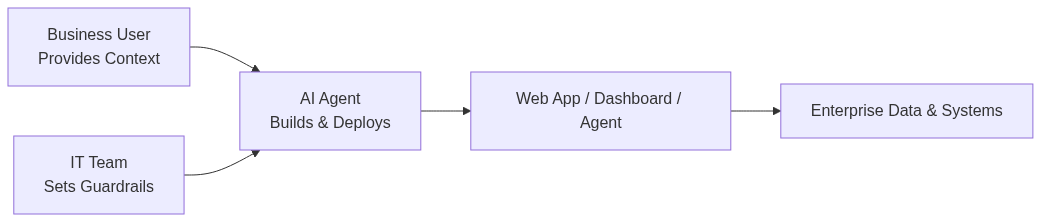 ---
## The Shift: From Low-Code to AI Agent-Assisted Development
The first wave of citizen development platforms focused on visual drag-and-drop interfaces. Power Apps, OutSystems, and similar tools let users build forms and simple workflows without code. But they hit a ceiling: complex logic, data integration, and AI capabilities remained out of reach for non-developers.
The second wave, happening now, is fundamentally different. AI agents can:
- Understand natural language instructions from business users
- Write, test, and deploy code autonomously
- Connect to enterprise data sources and APIs
- Build complete web applications from a description
- Create and manage other AI agents
- Operate within governance guardrails set by IT
This is why Gartner warns that "no-code/low-code platforms and vibe coding expand, driving unmanaged AI agent proliferation." The risk is real. Without governance, citizen developers using AI agents can create shadow IT at an unprecedented scale.
---
## The Shift: From Low-Code to AI Agent-Assisted Development
The first wave of citizen development platforms focused on visual drag-and-drop interfaces. Power Apps, OutSystems, and similar tools let users build forms and simple workflows without code. But they hit a ceiling: complex logic, data integration, and AI capabilities remained out of reach for non-developers.
The second wave, happening now, is fundamentally different. AI agents can:
- Understand natural language instructions from business users
- Write, test, and deploy code autonomously
- Connect to enterprise data sources and APIs
- Build complete web applications from a description
- Create and manage other AI agents
- Operate within governance guardrails set by IT
This is why Gartner warns that "no-code/low-code platforms and vibe coding expand, driving unmanaged AI agent proliferation." The risk is real. Without governance, citizen developers using AI agents can create shadow IT at an unprecedented scale.
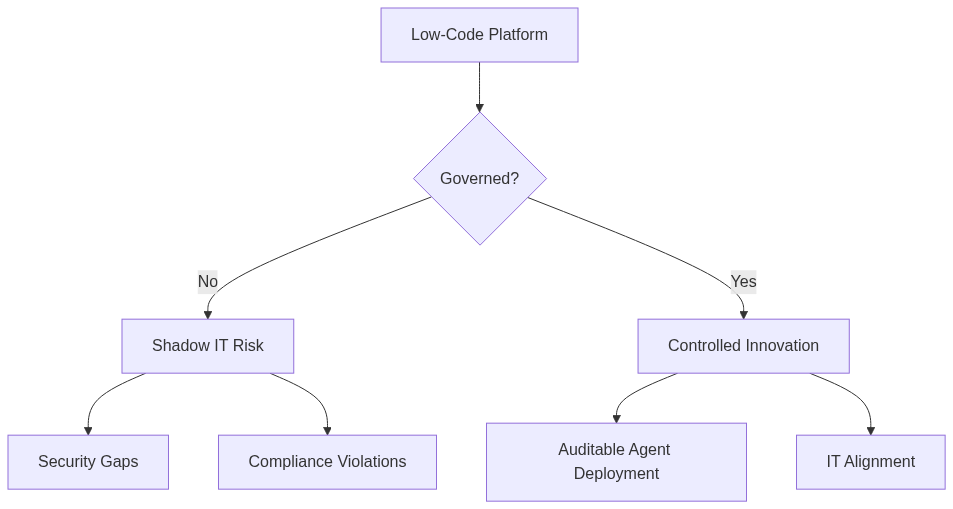 The solution is not to block citizen developers. It is to give them AI agents inside a governed environment where IT collaborates rather than blocks.
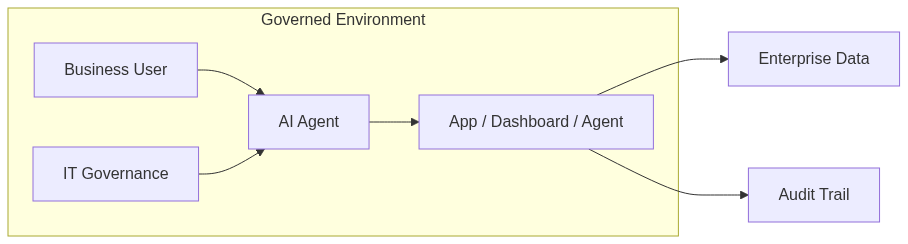 As Yevgeniy explains:
> "Think of it as creating an environment where business users and IT can collaborate where the business users provide the business context and IT provides the architecture."
Here are the top 7 platforms that are making this possible in 2026.
As Yevgeniy explains:
> "Think of it as creating an environment where business users and IT can collaborate where the business users provide the business context and IT provides the architecture."
Here are the top 7 platforms that are making this possible in 2026.
 ---
## 1. Microsoft Power Platform (Copilot Studio + Power Apps)
Microsoft arguably invented the modern citizen developer category, and in 2026 the Power Platform has fully absorbed AI agents through [Copilot Studio](https://learn.microsoft.com/en-us/microsoft-copilot-studio/). The platform combines [Power Apps](https://learn.microsoft.com/en-us/power-apps/) for app building, [Power Automate](https://learn.microsoft.com/en-us/power-automate/) for workflows, and Copilot Studio for AI agent creation.
**What citizen developers can build:**
- Internal apps and forms via Power Apps (canvas and model-driven)
- Automated workflows via Power Automate
- AI agents and copilots via Copilot Studio
- Chatbots grounded in enterprise data via knowledge sources
- Custom agents using natural language descriptions
**Strengths:**
- Deepest enterprise penetration: most large organizations already have M365 licenses
- Copilot Studio lets business users describe an agent in natural language and refine it through conversation
- Strong governance via environment-level DLP policies and admin centers
- Extensive connector ecosystem with 1,000+ pre-built connectors
- Integration with [Microsoft Fabric](https://learn.microsoft.com/en-us/fabric/) for unified analytics
**Limitations:**
- Licensing complexity (premium connectors, AI credits, per-user vs per-flow pricing)
- Heavy Microsoft ecosystem lock-in
- Agents built in Copilot Studio can feel constrained compared to fully custom agent runtimes
---
## 1. Microsoft Power Platform (Copilot Studio + Power Apps)
Microsoft arguably invented the modern citizen developer category, and in 2026 the Power Platform has fully absorbed AI agents through [Copilot Studio](https://learn.microsoft.com/en-us/microsoft-copilot-studio/). The platform combines [Power Apps](https://learn.microsoft.com/en-us/power-apps/) for app building, [Power Automate](https://learn.microsoft.com/en-us/power-automate/) for workflows, and Copilot Studio for AI agent creation.
**What citizen developers can build:**
- Internal apps and forms via Power Apps (canvas and model-driven)
- Automated workflows via Power Automate
- AI agents and copilots via Copilot Studio
- Chatbots grounded in enterprise data via knowledge sources
- Custom agents using natural language descriptions
**Strengths:**
- Deepest enterprise penetration: most large organizations already have M365 licenses
- Copilot Studio lets business users describe an agent in natural language and refine it through conversation
- Strong governance via environment-level DLP policies and admin centers
- Extensive connector ecosystem with 1,000+ pre-built connectors
- Integration with [Microsoft Fabric](https://learn.microsoft.com/en-us/fabric/) for unified analytics
**Limitations:**
- Licensing complexity (premium connectors, AI credits, per-user vs per-flow pricing)
- Heavy Microsoft ecosystem lock-in
- Agents built in Copilot Studio can feel constrained compared to fully custom agent runtimes
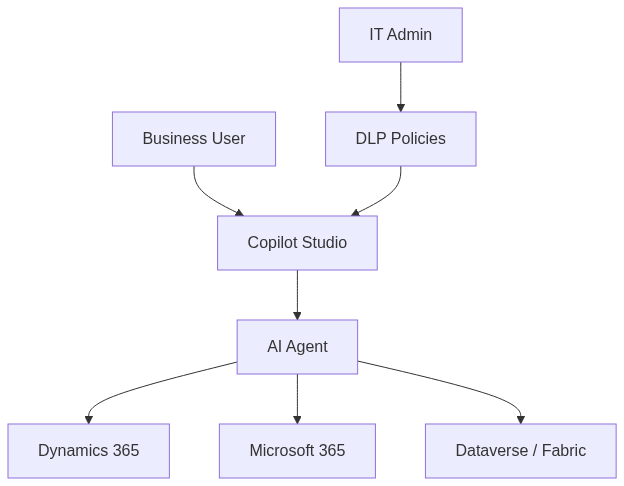 **Best for:** Enterprises already deeply invested in Microsoft 365 that want to extend their existing investment into AI agents.
---
## 2. Salesforce Agentforce
Salesforce rebranded and rebuilt its AI agent offering as [Agentforce](https://www.salesforce.com/agentforce/), positioning it as the platform for deploying autonomous agents inside the CRM and beyond.
**What citizen developers can build:**
- Customer service agents that resolve cases autonomously
- Sales assistant agents that draft outreach and update records
- Marketing agents that segment audiences and personalize campaigns
- Custom agents using the Agent Builder with natural language instructions
**Strengths:**
- Agent Builder uses a no-code, prompt-driven interface: business users describe what the agent should do in plain English
- Deep integration with Salesforce Data Cloud means agents are grounded in real customer data
- Einstein Trust Layer provides guardrails for AI outputs (toxicity filtering, data masking, audit trails)
- Pre-built agent templates for service, sales, and marketing accelerate time-to-value
**Limitations:**
- Tightly coupled to the Salesforce data model: less flexible for non-CRM use cases
- Pricing scales with usage (per-conversation or per-resolution), which can get expensive at scale
- Custom logic beyond templates still requires Salesforce developers (Apex, Flows)
**Best for:** Enterprises already deeply invested in Microsoft 365 that want to extend their existing investment into AI agents.
---
## 2. Salesforce Agentforce
Salesforce rebranded and rebuilt its AI agent offering as [Agentforce](https://www.salesforce.com/agentforce/), positioning it as the platform for deploying autonomous agents inside the CRM and beyond.
**What citizen developers can build:**
- Customer service agents that resolve cases autonomously
- Sales assistant agents that draft outreach and update records
- Marketing agents that segment audiences and personalize campaigns
- Custom agents using the Agent Builder with natural language instructions
**Strengths:**
- Agent Builder uses a no-code, prompt-driven interface: business users describe what the agent should do in plain English
- Deep integration with Salesforce Data Cloud means agents are grounded in real customer data
- Einstein Trust Layer provides guardrails for AI outputs (toxicity filtering, data masking, audit trails)
- Pre-built agent templates for service, sales, and marketing accelerate time-to-value
**Limitations:**
- Tightly coupled to the Salesforce data model: less flexible for non-CRM use cases
- Pricing scales with usage (per-conversation or per-resolution), which can get expensive at scale
- Custom logic beyond templates still requires Salesforce developers (Apex, Flows)
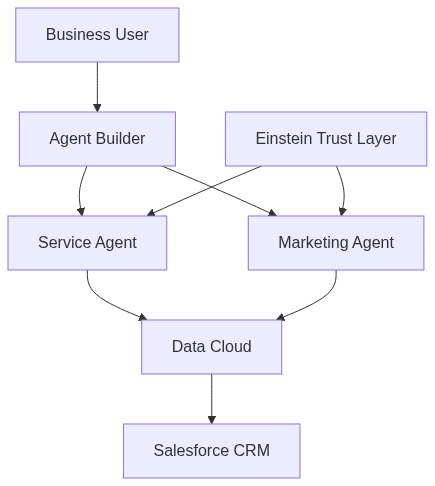 **Best for:** Sales, service, and marketing teams already on Salesforce who want to deploy agents inside their existing CRM workflows.
---
## 3. Kaji by Shakudo
[Kaji](/kaji) is the platform purpose-built for the citizen developer plus IT governance model that enterprises in regulated industries need. Unlike platforms that either give business users too much freedom (shadow IT) or too little (locked-down enterprise tools), Kaji is designed around the collaboration between business users and IT. It runs on the [Shakudo Platform](/platform), which deploys inside the customer's own infrastructure.
**What citizen developers can build:**
- Web apps deployed as microservices: business users describe what they need, and AI agents build and deploy them
- Interactive dashboards grounded in enterprise data
- Reusable AI agents that run inside the customer's own infrastructure
- Automated workflows that combine AI agents with existing enterprise systems
**How it works for citizen developers:**
- Business users interact through a Teams-like, agentic-focused interface: they do not write code
- They can request a use case to be built (e.g., an app deployed as a microservice), and AI agents handle the build
- Everything runs on the customer's own infrastructure, maintaining data sovereignty
- The [AI Gateway](/ai-gateway) routes requests to the right LLM while controlling costs and ensuring compliance
**The governance model:**
As Yevgeniy explains to enterprise customers:
> "Think of it as creating an environment where business users and IT can collaborate where the business users provide the business context and IT provides the architecture."
This is the core differentiator. IT sets the guardrails (security, infrastructure, data access policies) while business users get AI agents that help them build within those guardrails. It is not just code generation; it is agents that understand the enterprise context.
**Strengths:**
- Deploys inside the customer's own Kubernetes infrastructure: data never leaves
- AI agents are autonomous and governed, not just chat interfaces
- Business-user-friendly interface that feels like Microsoft Teams but is agentic-focused
- IT retains control over architecture, security, and deployment
- Transparent pricing model that has helped customers reduce token costs significantly
**Limitations:**
- Newer platform: smaller ecosystem of pre-built templates than Microsoft or Salesforce
- Requires Kubernetes infrastructure (though Shakudo manages deployment)
- Less brand recognition than the hyperscaler-backed platforms
**Best for:** Sales, service, and marketing teams already on Salesforce who want to deploy agents inside their existing CRM workflows.
---
## 3. Kaji by Shakudo
[Kaji](/kaji) is the platform purpose-built for the citizen developer plus IT governance model that enterprises in regulated industries need. Unlike platforms that either give business users too much freedom (shadow IT) or too little (locked-down enterprise tools), Kaji is designed around the collaboration between business users and IT. It runs on the [Shakudo Platform](/platform), which deploys inside the customer's own infrastructure.
**What citizen developers can build:**
- Web apps deployed as microservices: business users describe what they need, and AI agents build and deploy them
- Interactive dashboards grounded in enterprise data
- Reusable AI agents that run inside the customer's own infrastructure
- Automated workflows that combine AI agents with existing enterprise systems
**How it works for citizen developers:**
- Business users interact through a Teams-like, agentic-focused interface: they do not write code
- They can request a use case to be built (e.g., an app deployed as a microservice), and AI agents handle the build
- Everything runs on the customer's own infrastructure, maintaining data sovereignty
- The [AI Gateway](/ai-gateway) routes requests to the right LLM while controlling costs and ensuring compliance
**The governance model:**
As Yevgeniy explains to enterprise customers:
> "Think of it as creating an environment where business users and IT can collaborate where the business users provide the business context and IT provides the architecture."
This is the core differentiator. IT sets the guardrails (security, infrastructure, data access policies) while business users get AI agents that help them build within those guardrails. It is not just code generation; it is agents that understand the enterprise context.
**Strengths:**
- Deploys inside the customer's own Kubernetes infrastructure: data never leaves
- AI agents are autonomous and governed, not just chat interfaces
- Business-user-friendly interface that feels like Microsoft Teams but is agentic-focused
- IT retains control over architecture, security, and deployment
- Transparent pricing model that has helped customers reduce token costs significantly
**Limitations:**
- Newer platform: smaller ecosystem of pre-built templates than Microsoft or Salesforce
- Requires Kubernetes infrastructure (though Shakudo manages deployment)
- Less brand recognition than the hyperscaler-backed platforms
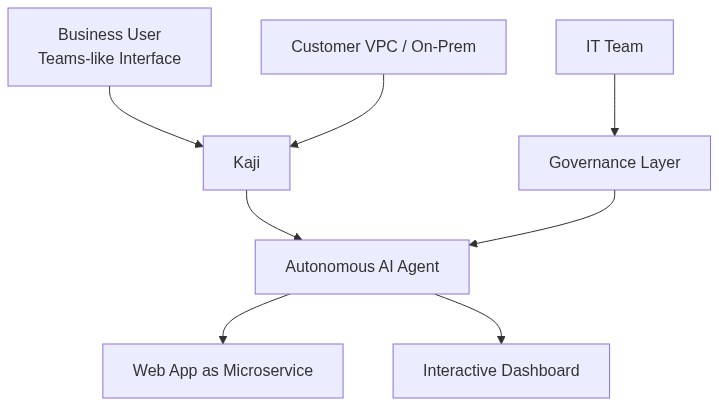 **Best for:** Enterprises in regulated industries (financial services, manufacturing, healthcare) that need data sovereignty, governance, and want to turn business users into agent builders without losing IT control.
---
## 4. Google Vertex AI Agent Builder + AppSheet
Google combines [Vertex AI Agent Builder](https://cloud.google.com/vertex-ai-agent-builder) for AI agent creation with [AppSheet](https://about.appsheet.com/) for no-code app development, giving citizen developers a two-tool pathway to building AI-powered applications.
**What citizen developers can build:**
- No-code apps and dashboards via AppSheet
- AI agents and copilots via Vertex AI Agent Builder
- Search and conversational experiences grounded in enterprise data
- Workflow automations that combine AppSheet apps with AI agent intelligence
**Strengths:**
- AppSheet is one of the most accessible no-code platforms for true non-developers
- Vertex AI Agent Builder provides grounded AI agents with enterprise data connectors
- Google Cloud infrastructure provides enterprise-grade security and scalability
- Gemini model integration gives agents strong reasoning capabilities
**Limitations:**
- AppSheet and Vertex AI Agent Builder are separate products: no unified citizen developer experience
- AppSheet apps can feel limited for complex use cases
- Google Cloud expertise needed for Vertex AI Agent Builder configuration
- Less pre-built enterprise agent templates than Salesforce or ServiceNow
**Best for:** Organizations on Google Cloud that want to combine simple no-code apps with powerful AI agent capabilities.
---
## 5. ServiceNow Now Assist
[ServiceNow Now Assist](https://www.servicenow.com/products/now-assist.html) brings AI agents to the ServiceNow platform, focusing on IT service management, HR service delivery, and customer service workflows.
**What citizen developers can build:**
- AI-powered service catalog items
- Automated incident resolution agents
- HR onboarding and case management agents
- Custom workflow automations using Flow Designer
- Virtual agents for customer service
**Strengths:**
- Deep integration with ServiceNow's ITSM, HR, and CSM modules
- Now Assist provides AI-powered search, summarization, and routing
- Flow Designer enables no-code workflow automation
- Strong governance through ServiceNow's role-based access control
**Limitations:**
- Primarily useful within the ServiceNow ecosystem
- AI agent capabilities are newer and less mature than dedicated agent platforms
- Licensing requires ServiceNow platform commitment
- Less flexible for building standalone apps outside ServiceNow
**Best for:** IT, HR, and customer service teams already on ServiceNow who want to add AI agents to their existing service workflows.
---
## 6. Amazon Q + Bedrock
Amazon combines [Amazon Q](https://aws.amazon.com/q/) (an AI assistant for business and developers) with [Amazon Bedrock](https://aws.amazon.com/bedrock/) (a managed foundation model service) to enable AI agent building on AWS.
**What citizen developers can build:**
- Amazon Q Business assistants that answer questions from enterprise data
- Amazon Q Developer agents that help with code generation and review
- Custom agents via Bedrock Agents that connect to enterprise APIs
- Knowledge base-powered conversational experiences
**Strengths:**
- Bedrock provides access to multiple foundation models (Anthropic, Meta, Amazon, Mistral)
- Amazon Q Business is designed for non-technical business users
- Deep integration with AWS services (S3, Lambda, RDS, etc.)
- Enterprise-grade security and compliance through AWS infrastructure
**Limitations:**
- Bedrock Agents require some technical knowledge for configuration
- No unified no-code app builder comparable to Power Apps or AppSheet
- Amazon Q is primarily a conversational assistant, not a full app-building platform
- AWS expertise needed for infrastructure setup
**Best for:** AWS-native organizations that want to build AI agents using multiple foundation models with enterprise data integration.
---
## 7. OutSystems
[OutSystems](https://www.outsystems.com/) is a low-code application platform that has added AI agent capabilities to its offering, positioning itself as an enterprise-grade option for citizen developers who need more power than basic no-code tools.
**What citizen developers can build:**
- Complex enterprise web and mobile applications
- AI-powered features using OutSystems AI Agent Builder
- Workflow automations with AI decision points
- Integration-heavy applications connecting multiple enterprise systems
**Strengths:**
- More powerful than basic no-code: supports complex logic and enterprise integrations
- AI Agent Builder enables conversational AI within applications
- Strong enterprise governance (role-based access, audit trails, deployment pipelines)
- Large component marketplace and community
**Limitations:**
- Steeper learning curve than pure no-code platforms
- Premium pricing aimed at enterprise budgets
- AI agent capabilities are newer compared to Microsoft or Salesforce
- Less focused on AI agents as a primary use case
**Best for:** Enterprise teams that need complex, integration-heavy applications with AI agent features and have some technical support.
---
**Best for:** Enterprises in regulated industries (financial services, manufacturing, healthcare) that need data sovereignty, governance, and want to turn business users into agent builders without losing IT control.
---
## 4. Google Vertex AI Agent Builder + AppSheet
Google combines [Vertex AI Agent Builder](https://cloud.google.com/vertex-ai-agent-builder) for AI agent creation with [AppSheet](https://about.appsheet.com/) for no-code app development, giving citizen developers a two-tool pathway to building AI-powered applications.
**What citizen developers can build:**
- No-code apps and dashboards via AppSheet
- AI agents and copilots via Vertex AI Agent Builder
- Search and conversational experiences grounded in enterprise data
- Workflow automations that combine AppSheet apps with AI agent intelligence
**Strengths:**
- AppSheet is one of the most accessible no-code platforms for true non-developers
- Vertex AI Agent Builder provides grounded AI agents with enterprise data connectors
- Google Cloud infrastructure provides enterprise-grade security and scalability
- Gemini model integration gives agents strong reasoning capabilities
**Limitations:**
- AppSheet and Vertex AI Agent Builder are separate products: no unified citizen developer experience
- AppSheet apps can feel limited for complex use cases
- Google Cloud expertise needed for Vertex AI Agent Builder configuration
- Less pre-built enterprise agent templates than Salesforce or ServiceNow
**Best for:** Organizations on Google Cloud that want to combine simple no-code apps with powerful AI agent capabilities.
---
## 5. ServiceNow Now Assist
[ServiceNow Now Assist](https://www.servicenow.com/products/now-assist.html) brings AI agents to the ServiceNow platform, focusing on IT service management, HR service delivery, and customer service workflows.
**What citizen developers can build:**
- AI-powered service catalog items
- Automated incident resolution agents
- HR onboarding and case management agents
- Custom workflow automations using Flow Designer
- Virtual agents for customer service
**Strengths:**
- Deep integration with ServiceNow's ITSM, HR, and CSM modules
- Now Assist provides AI-powered search, summarization, and routing
- Flow Designer enables no-code workflow automation
- Strong governance through ServiceNow's role-based access control
**Limitations:**
- Primarily useful within the ServiceNow ecosystem
- AI agent capabilities are newer and less mature than dedicated agent platforms
- Licensing requires ServiceNow platform commitment
- Less flexible for building standalone apps outside ServiceNow
**Best for:** IT, HR, and customer service teams already on ServiceNow who want to add AI agents to their existing service workflows.
---
## 6. Amazon Q + Bedrock
Amazon combines [Amazon Q](https://aws.amazon.com/q/) (an AI assistant for business and developers) with [Amazon Bedrock](https://aws.amazon.com/bedrock/) (a managed foundation model service) to enable AI agent building on AWS.
**What citizen developers can build:**
- Amazon Q Business assistants that answer questions from enterprise data
- Amazon Q Developer agents that help with code generation and review
- Custom agents via Bedrock Agents that connect to enterprise APIs
- Knowledge base-powered conversational experiences
**Strengths:**
- Bedrock provides access to multiple foundation models (Anthropic, Meta, Amazon, Mistral)
- Amazon Q Business is designed for non-technical business users
- Deep integration with AWS services (S3, Lambda, RDS, etc.)
- Enterprise-grade security and compliance through AWS infrastructure
**Limitations:**
- Bedrock Agents require some technical knowledge for configuration
- No unified no-code app builder comparable to Power Apps or AppSheet
- Amazon Q is primarily a conversational assistant, not a full app-building platform
- AWS expertise needed for infrastructure setup
**Best for:** AWS-native organizations that want to build AI agents using multiple foundation models with enterprise data integration.
---
## 7. OutSystems
[OutSystems](https://www.outsystems.com/) is a low-code application platform that has added AI agent capabilities to its offering, positioning itself as an enterprise-grade option for citizen developers who need more power than basic no-code tools.
**What citizen developers can build:**
- Complex enterprise web and mobile applications
- AI-powered features using OutSystems AI Agent Builder
- Workflow automations with AI decision points
- Integration-heavy applications connecting multiple enterprise systems
**Strengths:**
- More powerful than basic no-code: supports complex logic and enterprise integrations
- AI Agent Builder enables conversational AI within applications
- Strong enterprise governance (role-based access, audit trails, deployment pipelines)
- Large component marketplace and community
**Limitations:**
- Steeper learning curve than pure no-code platforms
- Premium pricing aimed at enterprise budgets
- AI agent capabilities are newer compared to Microsoft or Salesforce
- Less focused on AI agents as a primary use case
**Best for:** Enterprise teams that need complex, integration-heavy applications with AI agent features and have some technical support.
---
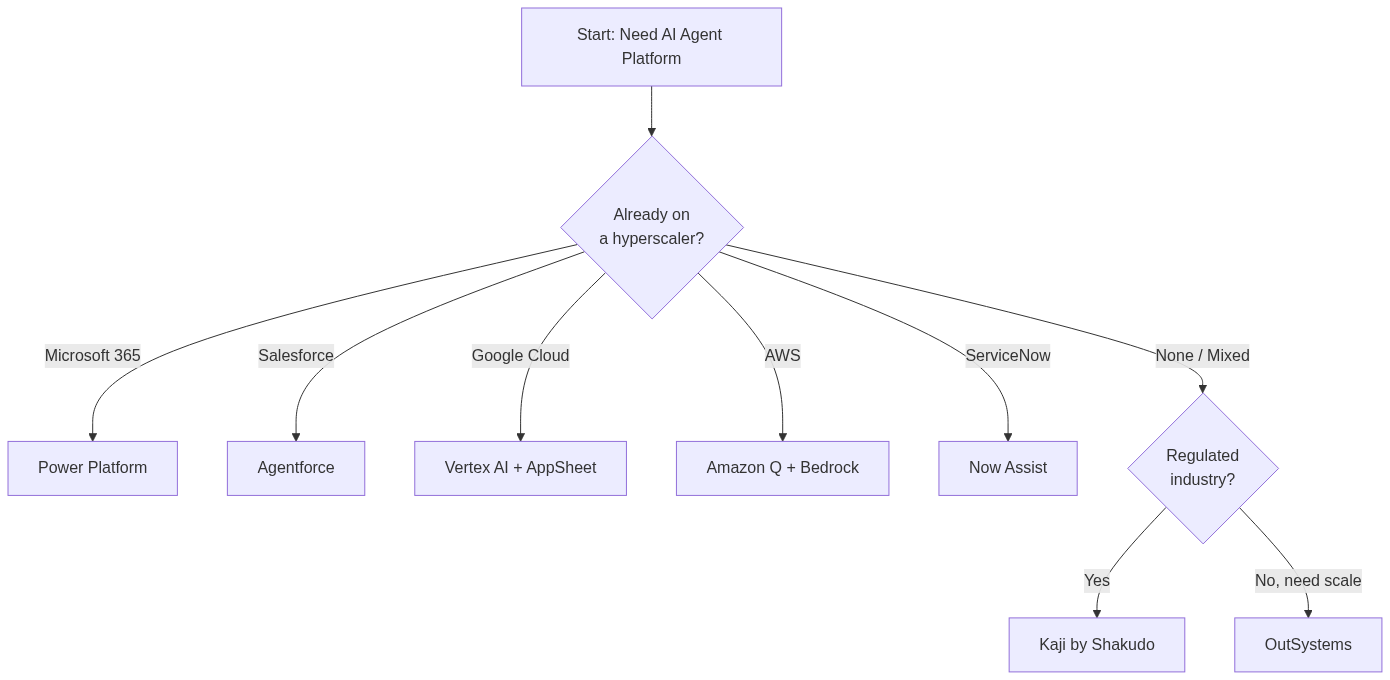 ## How to Choose the Right Platform
 | Platform | Best For | AI Agent Maturity | Governance | Data Sovereignty | Ecosystem |
|----------|----------|-------------------|------------|-----------------|-----------|
| Microsoft Power Platform | M365 shops | High | Strong | Azure-dependent | Largest |
| Salesforce Agentforce | CRM teams | High | Strong | Salesforce cloud | Large |
| Kaji by Shakudo | Regulated industries | High | Strongest | Customer infrastructure | Growing |
| Google Vertex AI + AppSheet | Google Cloud shops | Medium | Strong | GCP-dependent | Medium |
| ServiceNow Now Assist | IT/HR service teams | Medium | Strong | ServiceNow cloud | Medium |
| Amazon Q + Bedrock | AWS-native teams | Medium | Strong | AWS-dependent | Large |
| OutSystems | Complex enterprise apps | Low-Medium | Strong | Cloud or on-prem | Medium |
**Key decision factors:**
1. **Where does your data live?** If data sovereignty is critical (regulated industries), choose a platform that deploys in your infrastructure like Kaji
2. **What ecosystem are you already in?** Microsoft, Salesforce, Google, and AWS platforms are easiest if you are already invested there
3. **Who are your citizen developers?** Marketing and finance teams need simpler interfaces; operations teams may need more power
4. **What is your governance model?** Ensure the platform supports IT oversight without blocking business user productivity
5. **What are you building?** Simple agents and chatbots work on most platforms; complex apps and dashboards need more capable tools
---
| Platform | Best For | AI Agent Maturity | Governance | Data Sovereignty | Ecosystem |
|----------|----------|-------------------|------------|-----------------|-----------|
| Microsoft Power Platform | M365 shops | High | Strong | Azure-dependent | Largest |
| Salesforce Agentforce | CRM teams | High | Strong | Salesforce cloud | Large |
| Kaji by Shakudo | Regulated industries | High | Strongest | Customer infrastructure | Growing |
| Google Vertex AI + AppSheet | Google Cloud shops | Medium | Strong | GCP-dependent | Medium |
| ServiceNow Now Assist | IT/HR service teams | Medium | Strong | ServiceNow cloud | Medium |
| Amazon Q + Bedrock | AWS-native teams | Medium | Strong | AWS-dependent | Large |
| OutSystems | Complex enterprise apps | Low-Medium | Strong | Cloud or on-prem | Medium |
**Key decision factors:**
1. **Where does your data live?** If data sovereignty is critical (regulated industries), choose a platform that deploys in your infrastructure like Kaji
2. **What ecosystem are you already in?** Microsoft, Salesforce, Google, and AWS platforms are easiest if you are already invested there
3. **Who are your citizen developers?** Marketing and finance teams need simpler interfaces; operations teams may need more power
4. **What is your governance model?** Ensure the platform supports IT oversight without blocking business user productivity
5. **What are you building?** Simple agents and chatbots work on most platforms; complex apps and dashboards need more capable tools
---
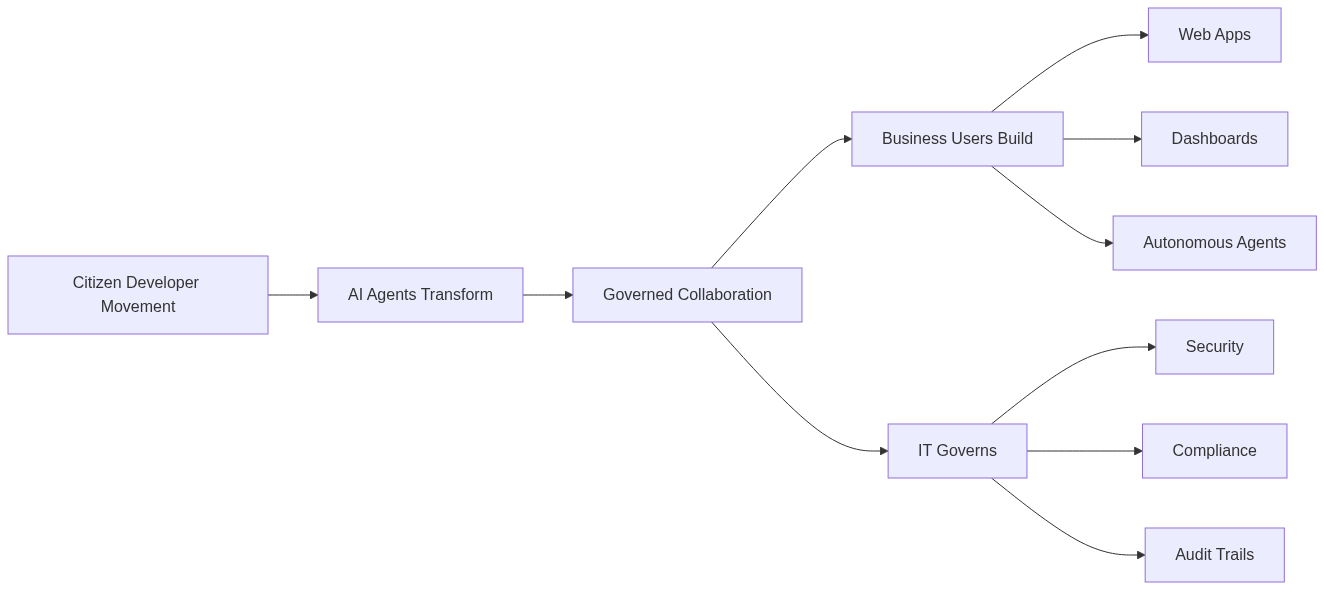 When evaluating these platforms, start with a pilot rather than a full rollout. Identify a single department or use case where citizen developers are already building informally, and deploy your chosen platform there with governance guardrails in place. Measure adoption rate, time-to-solution, and IT oversight burden over 30 days. The right platform should reduce IT tickets, not create new ones. If IT finds themselves spending more time managing the platform than enabling business users, the fit is wrong. Yevgeniy Vahlis emphasizes this point: the goal is not to add another layer of IT bureaucracy, but to give business users autonomy within pre-approved boundaries so IT can focus on architecture and security rather than ticket queues.
## The Bottom Line
The citizen developer movement has been promised for years. What makes 2026 different is that AI agents can now do the heavy lifting that low-code platforms could not: writing code, connecting data sources, building complete applications, and operating autonomously within governance guardrails.
The platforms that will win are the ones that solve the collaboration problem between business users and IT. Giving business users AI agents without governance creates shadow IT at scale. Giving IT control without AI agents creates bottlenecks. The answer is both, together.
As the CEO of Shakudo puts it:
> "It's turning what you refer to as citizen developers into citizen developers who have both the AI agents to help them, but also the extension into IT where a perspective is required and not just kind of code generation."
The enterprises that get this right will unlock productivity gains that were impossible with either low-code alone or AI alone. The ones that get it wrong will either drown in ungoverned AI-generated apps or strangle innovation with excessive controls.
The choice is not whether to enable citizen developers. They are already building, with or without permission. The choice is whether to give them the right platform to do it safely, governed, and at scale.
**Ready to enable your citizen developers with governed AI agents?** [Contact the Shakudo team](/contact-us) to learn how Kaji deploys inside your infrastructure and gives business users the power to build while IT keeps control.
# blog/top-enterprise-ai-vendors-to-consider.md
*[Source (/blog/top-enterprise-ai-vendors-to-consider)](https://www.shakudo.io/blog/top-enterprise-ai-vendors-to-consider) | [Markdown twin](https://www.shakudo.io/blog/top-enterprise-ai-vendors-to-consider.md)*
---
When evaluating these platforms, start with a pilot rather than a full rollout. Identify a single department or use case where citizen developers are already building informally, and deploy your chosen platform there with governance guardrails in place. Measure adoption rate, time-to-solution, and IT oversight burden over 30 days. The right platform should reduce IT tickets, not create new ones. If IT finds themselves spending more time managing the platform than enabling business users, the fit is wrong. Yevgeniy Vahlis emphasizes this point: the goal is not to add another layer of IT bureaucracy, but to give business users autonomy within pre-approved boundaries so IT can focus on architecture and security rather than ticket queues.
## The Bottom Line
The citizen developer movement has been promised for years. What makes 2026 different is that AI agents can now do the heavy lifting that low-code platforms could not: writing code, connecting data sources, building complete applications, and operating autonomously within governance guardrails.
The platforms that will win are the ones that solve the collaboration problem between business users and IT. Giving business users AI agents without governance creates shadow IT at scale. Giving IT control without AI agents creates bottlenecks. The answer is both, together.
As the CEO of Shakudo puts it:
> "It's turning what you refer to as citizen developers into citizen developers who have both the AI agents to help them, but also the extension into IT where a perspective is required and not just kind of code generation."
The enterprises that get this right will unlock productivity gains that were impossible with either low-code alone or AI alone. The ones that get it wrong will either drown in ungoverned AI-generated apps or strangle innovation with excessive controls.
The choice is not whether to enable citizen developers. They are already building, with or without permission. The choice is whether to give them the right platform to do it safely, governed, and at scale.
**Ready to enable your citizen developers with governed AI agents?** [Contact the Shakudo team](/contact-us) to learn how Kaji deploys inside your infrastructure and gives business users the power to build while IT keeps control.
# blog/top-enterprise-ai-vendors-to-consider.md
*[Source (/blog/top-enterprise-ai-vendors-to-consider)](https://www.shakudo.io/blog/top-enterprise-ai-vendors-to-consider) | [Markdown twin](https://www.shakudo.io/blog/top-enterprise-ai-vendors-to-consider.md)*
---
The enterprise artificial intelligence (AI) market has moved past the initial hype cycle. Today it serves as a core operating layer for most organizations, powered by automation platforms that “reshape how teams design, orchestrate, and govern AI agents at scale.” As a result, three dominant trends now guide every vendor strategy.
The first is a shift from isolated AI tools to a more unified, platform-centric model. Rather than a collection of disjointed services, AI platforms are evolving into an "operating layer" for a company's entire technology stack. This new paradigm eliminates the complexity and overhead traditionally associated with managing disparate AI solutions. Leading offerings now bundle critical capabilities—from “Multi-Agent Orchestration” and AI security & governance to no-code builder toolkits—so teams can plug new use cases into a single control plane instead of stitching together point products.
Secondly, the market is witnessing the rise of a more sophisticated form of automation: agentic AI. This marks a significant departure from simple chatbots. The focus is on autonomous agents that can reason, plan, and execute complex, multi-step tasks without constant human intervention.
Finally, as AI moves into mission-critical applications, the conversation has shifted to "how can we use AI responsibly?". The primacy of governance, security, and trust has become a non-negotiable differentiator. Companies now prioritize vendors that offer robust data privacy and compliance with regulations like GDPR and HIPAA.
Navigating the AI vendor landscape requires a strategic approach. Here are six key factors to consider when evaluating enterprise AI solutions:

Shakudo positions itself as the "Operating System for AI on Your VPC". It is designed to empower technology teams by eliminating the complexity of managing their data and AI stacks. The platform's mission is to provide an operating layer on top of a user's cloud, offering a fully automated DevOps experience.
The platform helps companies accelerate time-to-value by providing pre-built templates of over 200 of best-of-breed open source data and AI tools and a platform that can set up a production-ready AI infrastructure in under an hour. This reduces the engineering overhead associated with new projects, which helps to lower the total cost of ownership. Shakudo also ensures future-proofing through a flexible and infra-agnostic design. It enables businesses to adapt quickly to the fast-changing AI landscape.

Microsoft Azure AI represents a comprehensive portfolio of AI services deeply integrated with the broader Microsoft ecosystem. Its unique value proposition is providing an enterprise-ready, end-to-end AI platform. It simplifies adoption for organizations already invested in Microsoft's cloud products.
The platform's strategy is to win the enterprise AI race through incumbency and a "full-stack" approach. It leverages existing customer relationships and data environments. By democratizing AI development with low-code and no-code tools, Azure AI lowers the barrier to entry. It also offers pre-built models for vision, speech, and language processing.
A key strength of Azure AI is its seamless integration and robust security features. The platform benefits from enterprise-grade security and compliance frameworks that align with major industry standards and regulations. This makes it a preferred choice for regulated environments with strong audit requirements.
However, users frequently note a steep learning curve and complexity in leveraging the full range of services. This can lead to unexpected costs if not carefully managed, as large-scale projects can become expensive. Furthermore, the tight integration, while a major benefit, contributes to a risk of vendor lock-in.

Google Cloud Vertex AI is a unified machine learning platform. It combines data engineering, data science, and ML engineering workflows into a single environment. Its unique value proposition is its ability to tap directly into Google's extensive AI research and "data native" infrastructure.
The platform is designed to help teams move beyond raw data and into actionable intelligence by understanding "human intent" through nuanced contextual analysis. By providing a single environment for the entire ML lifecycle, Vertex AI enables teams to collaborate and scale their applications. This platform-first approach has earned it recognition as a leader in the 2025 Gartner® Magic Quadrant™ for Conversational AI Platforms.
Vertex AI is praised for its seamless integration with other Google Cloud services like BigQuery and Cloud Storage. It also offers a comprehensive set of tools, including AutoML for low-code model training and Model Garden for deploying a wide variety of models. Its tight coupling with the Google Cloud ecosystem, however, is a point of friction for multi-cloud strategies.
A significant drawback is its high cost and a steep learning curve, which are common criticisms from users. Its complexity and extensive feature set, while powerful, can be challenging for beginners and lead to performance issues or unexpected process terminations.

Amazon SageMaker is a machine learning platform that provides a comprehensive suite of tools for the entire ML lifecycle, from data preparation to deployment. Its unique value proposition is its focus on empowering developers and data scientists with a high degree of control. SageMaker is purpose-built for those who need to fine-tune every aspect of their models and workflows from scratch, making it the preferred choice for advanced machine learning use cases. The platform provides a unified studio for data and AI development, bringing together tools from other AWS services into a single, governed environment.
SageMaker's main strength is its deep customization and robust MLOps capabilities, which allow for granular control and optimization. It offers a wide range of open-source models and deep integration with the broader AWS data ecosystem. The platform also provides purpose-built MLOps tools to automate and standardize processes across the ML lifecycle.
The primary drawback of SageMaker is its complexity and high barrier to entry. The platform is designed for experienced data scientists and ML engineers, and its manual setup requires more labor than automated approaches. While it offers a pay-as-you-go model, granular cost control requires expertise to optimize resource usage.

IBM watsonx is a portfolio of AI products designed to accelerate the impact of generative AI in core enterprise workflows. Its unique value proposition is a deep emphasis on trust, governance, and security. This makes it a powerful solution for heavily regulated industries like finance and healthcare.
IBM's approach is to provide a platform that enables companies to access and prepare data from anywhere while ensuring that the data and models remain private to the customer's account. The platform's built-in governance and security controls simplify compliance and support the creation of responsible, explainable AI workflows—similar to how enterprises deploy Kaji to orchestrate governed AI agent workflows with structured memory. The acquisition of companies like DataStax underscores IBM's commitment to unifying and leveraging unstructured data at scale.
A core strength of watsonx is its enterprise-grade governance and security features, which are non-negotiable for companies handling sensitive information. It excels at processing and finding patterns in massive, unstructured datasets. The platform is viewed as a rich, flexible toolkit for custom AI development.
A significant weakness, however, is its overwhelming complexity and a steep learning curve. The platform's intricate design can make it a non-starter for teams without a deep technical background. The high cost and time required for integration also target the platform toward larger organizations that can afford the investment.

C3.ai provides a model-driven platform for rapidly developing, deploying, and operating enterprise AI applications. Its unique value proposition is its library of over 130 pre-built, turnkey AI applications. These applications are tailored to address high-value use cases in specific industries.
This approach allows organizations to realize tangible business outcomes from AI, such as increased revenue or reduced costs, in months rather than years. The platform's comprehensive suite of development tools—including deep-code, low-code, and no-code environments—are designed to abstract away routine and complex development tasks. The company aims to be the global leader in Enterprise AI.
A core strength of C3.ai is its ability to accelerate AI development significantly, with claims of being up to 25x faster on platforms like AWS and Azure. The platform's multi-cloud and data virtualization capabilities allow for flexible deployment and easy data integration across a variety of sources. Its agentic AI capabilities for complex autonomous agents are also a strong advantage.
However, some user sentiment suggests a perception of the platform being a "jack of all trades, master of none". While the model-driven architecture is a key differentiator, it may have a learning curve for teams unfamiliar with this approach.

DataRobot is a pioneer in Automated Machine Learning (AutoML). It aims to democratize AI by putting the power of advanced ML into the hands of the teams already in place. Its unique value proposition is providing a unified, end-to-end platform that streamlines the entire AI lifecycle.
The platform's automated capabilities save businesses significant time when building predictive models. This allows them to quickly generate accurate models and make more informed decisions. It leverages the knowledge and experience of leading data scientists, incorporating best practices to deliver rapid model deployment.
The platform is widely praised for its ease of use and ability to quickly run hundreds of parallel models against a common business problem. Its MLOps capabilities, which include robust model monitoring and drift detection, are also highly valued. The platform's governance features provide detailed model lineage tracking and audit trails.
A major limitation is its higher cost structure compared to open-source alternatives like H2O.ai. The platform's core philosophy emphasizes automation over manual control. This may be a drawback for technical teams that prefer a code-first approach and a higher degree of customization.

H2O.ai is a company committed to democratizing AI by providing a portfolio that includes both a free, open-source platform and a commercial AI cloud. Its unique value proposition is its community-powered approach. It combines the flexibility and transparency of open-source technology with enterprise-grade commercial solutions.
The company's beginnings as a grassroots effort have fostered a massive community of over 200,000 members. This community-centric model provides a powerful advantage, allowing H2O.ai to co-innovate with its customers.
A major strength of H2O.ai is the transparency and flexibility offered by its open-source foundation, H2O-3. This gives technical teams granular control over resource utilization and access to a comprehensive portfolio of algorithms. The platform also offers a robust suite of explainable AI (XAI) tools.
A significant weakness is the high technical skill required to use it effectively, especially the free version, which is designed for experienced data scientists. Even the commercial platform, Driverless AI, is intended for expert users. The high cost of the commercial platform can also be a barrier.

NVIDIA AI Enterprise is an end-to-end, cloud-native software suite that provides a comprehensive platform for the entire AI lifecycle. Its unique value proposition is leveraging NVIDIA's dominance in accelerated computing hardware and creating an optimized software stack to run on it. This full-stack approach, from GPUs to pre-trained models, streamlines AI development and deployment for enterprises.
The platform's strategy is to provide a unified environment that accelerates every step of the AI workflow, from data preparation and model training to inference and deployment at scale. It offers a rich library of pre-packaged reference examples, frameworks, and pre-trained models. This allows organizations to solve complex challenges and increase operational efficiency without starting from scratch.
A core strength of NVIDIA AI Enterprise is its unparalleled performance and optimization. By providing a software layer certified to run on over 400 NVIDIA-Certified Systems, it ensures that organizations get the most out of their hardware investment. It also offers enterprise-grade security and support with service-level agreements and long-term support for designated software branches.
A potential weakness is the tight coupling with NVIDIA's hardware ecosystem, which could limit flexibility and increase costs if an organization wishes to use a multi-vendor hardware strategy. While the software itself is flexible, the full benefits are realized on NVIDIA hardware, which can lead to a form of vendor lock-in.

OpenAI is a pioneering AI research lab that provides access to some of the most powerful foundational models, such as the GPT-5 series and GPT-4o. Its unique value proposition is providing state-of-the-art, cutting-edge models that serve as the "brain" for a wide range of enterprise applications.
By offering models via its API platform and enterprise-ready solutions like ChatGPT Enterprise, OpenAI enables companies to integrate advanced AI capabilities while keeping their data secure and private. This allows businesses to enhance productivity, drive data-driven decision-making, and reduce operational costs without having to invest in training models from scratch.
A core strength of OpenAI is the continuous innovation and superior performance of its models. This gives businesses a powerful tool for enhanced efficiency and customer experiences. OpenAI also offers strong security and compliance features for enterprise clients, including data encryption, role-based access controls, and support for HIPAA compliance via a Business Associate Agreement.
Weaknesses, however, include the "black box" nature of its proprietary models, which can lead to a lack of transparency and make it difficult to understand how decisions are being made. This opacity also makes it challenging to identify and correct potential biases.

Anthropic is a leading AI safety company behind the Claude family of models. Its unique value proposition is a safety-first approach to AI development, emphasizing models that are "helpful, honest, and harmless".
This focus on building reliable, interpretable, and steerable systems is what the company refers to as a "race to the top on safety". The company's models are known for their strong reasoning abilities and for being a "thinking partner" that amplifies human creativity rather than replacing it. This design resonates with a specific type of user who works with complex challenges, such as debugging code, analyzing research, and strategic thinking.
A key strength of Anthropic is its explicit focus on AI safety and alignment, which makes Claude a preferred choice for sensitive or regulated industries. Its models are noted for their strong performance in handling long contexts and for hallucinating less due to a more cautious, deliberate approach. The company's models also excel at complex tasks and tend to provide more structured responses compared to competitors.
A limitation, however, is the current lack of public fine-tuning options, which may be a drawback for businesses requiring highly-specialized, domain-specific behavior. This can be a point of friction for companies that need to adapt a model to a specific task.

Cohere is an enterprise AI company that specializes in building large language models (LLMs) for business applications. Its unique value proposition is a focus on security, privacy, and flexible deployment options that empower businesses to use cutting-edge generative AI models on their proprietary data without compromising on control.
The company provides powerful models via an API platform, offering a high-performance generative model family (Command) and models for semantic text representation (Embed) and relevance-based result refinement (Rerank). Cohere's strategy is to enable businesses to deploy models within a dedicated virtual private cloud (VPC) environment or on-premises, air-gapped behind a firewall. This ensures data sovereignty and compliance.
A core strength of Cohere is its commitment to enterprise-grade security and privacy. The ability to deploy models in a controlled environment is non-negotiable for many regulated industries. The company's models are known for their strong reasoning abilities and are designed to seamlessly integrate into existing systems.
A potential weakness is that while Cohere offers a robust set of tools for enterprise use cases, its brand recognition and community support may not be as extensive as those of larger competitors. Additionally, its high cost may be a barrier for smaller organizations.

Palantir Technologies is a specialized software company that develops data integration and analytics platforms for high-stakes decision-making. Initially known for its work with government and intelligence agencies, Palantir has expanded its reach to commercial enterprises. The company's platforms, like Gotham and Foundry, are designed to unify disparate data sources and provide a single operating picture, enabling users to gain insights and act on complex problems.
Palantir's uniqueness lies in its "ontology-driven" approach. Its platforms build a dynamic digital twin of an organization, connecting data to real-world operations. This creates a semantic layer that allows AI to understand not just data, but operational context, enabling autonomous AI agents to make and execute decisions across the enterprise with unprecedented speed and accuracy.
A core strength of Palantir is its ability to handle complex, highly-sensitive data and provide robust, secure solutions for industries where data security is paramount. A potential weakness is the high cost and complexity of its implementations, which can deter smaller organizations. Furthermore, the company's unique 'ontology-driven' architecture, which builds a proprietary digital twin of the organization, creates a high risk of vendor lock-in, making it difficult for customers to switch to a different platform in the future.

Dataiku is an enterprise AI platform that aims to democratize the use of data and artificial intelligence. Its unique value proposition is a single, collaborative platform that unites technical and non-technical users—from data scientists to business analysts—on the same projects. This allows for a more fluid and efficient workflow across an organization.
A core strength of Dataiku is its user-friendly interface that offers a "no-code to full-code" development environment, which makes it highly accessible. The platform also emphasizes governance, with features that provide data lineage and audit trails to help manage risk and ensure transparency.
However, despite its strengths, there are significant drawbacks. The platform’s heavy reliance on its proprietary visual flow and component system can create a form of vendor lock-in. If an organization builds a large number of projects and workflows within Dataiku's ecosystem, it can be very difficult and costly to migrate those solutions to a different platform. Additionally, while the no-code tools are powerful for many tasks, they can become limiting for users who need to develop highly customized or complex solutions that require specific, bespoke coding.

Databricks offers a "lakehouse platform" that unifies data management and machine learning into a single environment. Its unique value proposition is combining the flexibility of a data lake with the reliability of a data warehouse to create a single, governed platform for all data and AI workloads. This helps eliminate data silos and reduces complexity, cost, and risk by not having to stitch together multiple disparate systems.
A core strength of Databricks is its ability to handle massive, messy datasets and its integrated MLOps tooling. Tools like MLflow allow data scientists to manage the entire machine learning lifecycle, from experimentation to production. The platform's commitment to open formats like Apache Iceberg also helps to prevent vendor lock-in. A potential weakness is that while it democratizes the process, it still requires a high degree of technical expertise to get the most out of the platform.

UiPath is a dominant force in the enterprise AI market, with a unique value proposition centered on its leadership in Robotic Process Automation (RPA). The company's platform is designed to automate repetitive, rule-based tasks and has evolved to integrate AI, which adds intelligence to its automation capabilities. This allows businesses to extend automation beyond simple processes to manage complex, end-to-end workflows that require a degree of decision-making.
A core strength of UiPath is its ability to deliver tangible ROI through the automation of routine tasks, freeing up human employees to focus on higher-value work. The platform offers a wide range of pre-built bots and integrations, simplifying deployment and accelerating time to value. UiPath's focus on a low-code/no-code approach also makes automation accessible to business users, not just technical experts.
A potential weakness is that while it has integrated AI, its core identity remains rooted in RPA. This might make it less appealing to organizations seeking a platform-first approach for complex, data-intensive AI models and applications that aren't tied to a specific business process. The company's expansion into AI may also face competition from vendors with deeper AI research and development backgrounds.
The vendors above are platforms. Most enterprises also need an engineering partner to design, build, and operate the AI systems that run on top of them. The partner below is a services firm rather than a platform, and is listed separately from the ranked vendors above.
Azumo is an AI development company that helps enterprises build and deploy tailored AI solutions, including AI agents, machine learning applications, and intelligent data platforms. Its unique value proposition is its focus on custom AI development, enabling organizations to create AI systems designed around their specific workflows, data environments, and business objectives rather than relying only on standardized solutions. Azumo works across areas such as generative AI, large language models, conversational AI, and automation.
Azumo's main strength is its ability to combine AI engineering expertise with practical implementation support, helping businesses move from AI experimentation to production-ready applications. The company provides services including AI strategy, LLM integration, model fine-tuning, MLOps, and AI agent development to help enterprises integrate AI into their existing operations.
The primary drawback of working with a custom AI development partner like Azumo is that project scope, timelines, and costs can vary depending on technical complexity, available data, and integration requirements. Organizations with simple AI needs may prefer ready-made platforms, while businesses requiring specialized solutions may benefit from a tailored development approach.
A foundational challenge in enterprise AI adoption is the issue of trustworthiness. The rapid development of generative AI has brought the problem of "hallucinations" and inaccuracies to the forefront, creating a significant concern for business leaders. Errors in these environments can be costly or even dangerous.
This issue is compounded by the "black box" problem, where the opaque nature of complex deep-learning models makes it difficult to understand how a specific decision or output was reached. The absence of transparency impairs trust and raises questions of accountability. To mitigate these risks, organizations must move beyond simply deploying AI models as opaque systems.
A strategic response involves implementing a transparent AI orchestration layer that provides a "human-in-the-loop" approach, where skilled individuals oversee outputs to identify deviations from expected results. This layer provides transparency, governance, and audit trails to ensure that AI decisions are not just accurate but also explainable and accountable to all stakeholders.
At the heart of every AI challenge lies data. Enterprise data is frequently fragmented, siloed, and of inconsistent quality, which can lead to flawed and unreliable AI outputs. The integrity of AI systems is only as strong as the data they are trained on.
Poor data quality or inherent biases can result in unfair or inaccurate decisions that damage a company's reputation and expose it to regulatory scrutiny. Beyond quality, data privacy and security present a critical barrier to adoption.
Traditional cloud-based AI architectures, which transmit sensitive data to external services for processing, pose significant privacy risks, particularly in heavily regulated industries. A fundamental shift in the market is now observable, as companies prioritize on-premise, edge, or in-VPC deployments that ensure "data sovereignty". This architectural choice reflects a deeper understanding that AI must operate alongside business applications without transmitting sensitive data externally.
The global shortage of AI talent is one of the most significant and well-documented barriers to enterprise AI adoption. With data scientists and AI engineers in high demand, many organizations find it difficult and costly to recruit and retain the talent needed to design, deploy, and maintain AI systems.
The measurable impact of this skills gap is stark; reports indicate that 65% of organizations have had to abandon AI projects due to a lack of in-house expertise. This widespread business pain point is not merely a human resources issue. It is a primary driver of the enterprise AI market's product development and a key factor in vendor differentiation.
The talent shortage has created a powerful market incentive for vendors to develop platforms that democratize AI and bypass the need for deep technical expertise. This is why platforms like DataRobot and Salesforce emphasize low-code and no-code tools that enable existing employees to directly contribute to AI initiatives.
The AI industry is evolving at an unprecedented pace, with model capabilities improving exponentially every 12 to 18 months. This rapid innovation cycle means that today's best-in-class AI solution may become obsolete within months, raising a significant risk for long-term, high-cost investments.
Enterprises that build their AI stack on a rigid, tightly coupled architecture face the prospect of a full system rebuild to stay current with technological advancements. The solution to this challenge lies in adopting a flexible, modular, and agile AI strategy.
This involves selecting platforms with architectures that allow for easy swapping or upgrading of AI models without a complete system overhaul. By prioritizing flexible platforms that can adapt to a continuously changing technology landscape, organizations can mitigate the risk of technology obsolescence.
Beyond the technical and talent challenges, the adoption of enterprise AI is also hampered by business and cultural barriers. A major obstacle is the difficulty in proving the financial value and return on investment (ROI) of AI initiatives. This makes it challenging to secure and maintain stakeholder buy-in.
Projects that are pursued due to novelty rather than a clear alignment with business strategy often fail to deliver a compelling business case, leading to "proof-of-concept purgatory". Compounding this are organizational challenges, including employee fears of job displacement and a general resistance to changing established workflows.
As organizations consider a strategic investment in AI, the need for a solution that delivers data sovereignty and architectural flexibility is paramount. Shakudo is an AI operating system that provides a robust foundation for AI innovation at scale. By removing the technical and security barriers to AI implementation, we enable leading organizations to transform their data into a competitive advantage. The journey to a truly intelligent organization begins with a platform that is ready for both today's challenges and tomorrow's possibilities. Discover a path to a more controlled and powerful AI future. Get a personalized guided tour of Shakudo's key features and architectural advantages tailored to your specific needs.
When evaluating who offers the most trusted enterprise AI for industries with strict regulations, the answer lies in data sovereignty. For absolute control, Shakudo has emerged as a critical operating layer. Unlike traditional SaaS, Shakudo operates entirely within your own Virtual Private Cloud (VPC), ensuring sensitive data never leaves your infrastructure—a non-negotiable for highly regulated sectors.
However, the landscape includes other strong incumbents. IBM watsonx is a top contender, leveraging a long history of governance to service finance and healthcare with robust audit trails. Similarly, Microsoft Azure AI offers deep integration with existing enterprise security frameworks like HIPAA and GDPR.
While IBM and Microsoft rely on their massive compliance ecosystems, Shakudo offers a distinct strategic advantage: it eliminates the "black box" risk of external data processing while preventing vendor lock-in, offering the best balance of modern flexibility and strict regulatory adherence.
Artificial Intelligence (AI) is a broad field of computer science focused on creating machines that can perform tasks that typically require human intelligence. This includes everything from simple rule-based systems to complex generative models.
“Enterprise AI is more than just advanced machine learning algorithms — it’s a system designed to understand, adapt, and integrate within the complex operational structures of large organizations.” In practice, Enterprise AI refers to AI systems and applications specifically designed and deployed within a business or organizational context. It’s not just about the technology itself, but about how that technology is integrated to solve business problems, improve efficiency, and create value. Key characteristics of enterprise AI include:
Essentially, while AI is the general science, Enterprise AI is the applied, business-ready version of that science, built to meet the unique demands of a corporate environment.
Enterprise AI is the overarching category of AI applications used in business. It includes a wide range of technologies, such as:
Generative AI (Gen AI) is a specific subset of AI that focuses on creating new content, such as text, images, code, or video. While it is a type of AI, it has become a central component of the enterprise AI market. Many of the vendors on this page, like OpenAI, Anthropic, and Cohere, specialize in Gen AI.
The key difference is scope:
The 2025 enterprise AI market is defined by three major trends:
Data sovereignty is the concept that data is subject to the laws and governance structures of the nation or region in which it is collected. In enterprise AI, this is a critical concern for two main reasons:
This has led to a major market shift, with companies prioritizing vendors like Shakudo and Cohere that offer on-premise, edge, or in-VPC deployments. This architecture ensures that AI can operate on a company's data without ever transmitting it externally, giving the company full control and ownership of its data.
Large organizations need solutions that provide a clear financial return by reducing overhead and accelerating time-to-market. While platforms like C3.ai offer turnkey applications for specific use cases, these can be expensive and may lead to a "jack of all trades" scenario. Shakudo provides a more flexible path to ROI. By offering a fully automated DevOps experience and a flexible, future-proof architecture, we help large organizations significantly reduce their total cost of ownership. Our pre-built templates and rapid environment setup allow teams to go from concept to production in under an hour, meaning you get a return on your investment in weeks, not years, by getting products to market faster.
For heavily regulated industries like finance and healthcare, reliability goes beyond uptime; it’s about trust, security, and data governance. While established players like IBM watsonx and Microsoft Azure AI offer robust compliance frameworks (e.g., GDPR, HIPAA), they often rely on a hosted SaaS model that requires transmitting sensitive data externally. This creates a potential privacy risk. Shakudo's unique value proposition is its in-VPC model, which ensures unparalleled data sovereignty. By operating as an "AI Operating System" directly on your cloud, your data never leaves your private environment. This provides the highest level of privacy and control, making it a reliable and secure choice for even the most sensitive applications.
For a small and growing team, the priority is a platform that empowers your existing talent, scales with your needs, and prevents being locked into a rigid architecture. While platforms like DataRobot and H2O.ai democratize AI with AutoML and low-code tools, they can be expensive and may not offer the granular control needed as your team matures. Shakudo is purpose-built to address this challenge. By providing an automated DevOps experience with pre-built templates, we eliminate the engineering overhead that slows small teams down. This allows your team to focus on building models and solving business problems, not on managing complex infrastructure. Our infra-agnostic and modular design ensures that as your team and projects grow, the platform can scale and adapt without requiring a full system rebuild.
# blog/turnkey-llm-based-rag.md *[Source (/blog/turnkey-llm-based-rag)](https://www.shakudo.io/blog/turnkey-llm-based-rag) | [Markdown twin](https://www.shakudo.io/blog/turnkey-llm-based-rag.md)* ---Organizations integrating LLMs (Large Language Models) into their workflows are surpassing the competition with powerful AI tools for knowledge-base management, text and image generation, and data analysis. But pre-trained LLMs like ChatGPT have significant limitations, putting businesses at risk with inaccurate responses, hallucinations, and out-of-date data. That’s where RAG, or Retrieval-Augmented Generation, comes in.
A RAG system is an AI framework designed to enhance the capabilities of LLMs. RAG-based LLM architecture — which leverages a vector database and a trusted, continually updated data source — ensures that your LLM is content aware and delivers accurate responses customized to your domain. But RAGs can be costly, difficult to set up, and time consuming to maintain.
That’s why we’re building the Shakudo RAG Stack, a turnkey RAG-based LLM framework that you can easily set up and start running in minutes. Shakudo integrates with the top LLMs and vector databases, giving you immediate access to best-in-class tools that make the most sense for your business. In four simple steps, you will be up and running with a RAG framework that’s securely connected to your trusted data source.
Shakudo offers the fastest, most cost-effective way to self-serve a best-in-class RAG system. Click here to learn more about the Shakudo platform and sign up.
[.div-block-152][.text-block-45]Learn About Shakudo's Production-Ready RAG Stack[.text-block-45][.cta-button-blog]LEARN MORE[.cta-button-blog][.div-block-152]
# blog/unstructured-data-management-with-advanced-ai-technology.md *[Source (/blog/unstructured-data-management-with-advanced-ai-technology)](https://www.shakudo.io/blog/unstructured-data-management-with-advanced-ai-technology) | [Markdown twin](https://www.shakudo.io/blog/unstructured-data-management-with-advanced-ai-technology.md)* ---While 80-90% of enterprise data is unstructured according to MIT, only a fraction of organizations effectively harness its potential. This data—comprising text, images, videos, and emails—holds transformative value, but is underutilized due to its complexity and variability, along with a knowledge gap on how to tap into unstructured data.
Generative AI (GenAI) is revolutionizing unstructured data management, offering unprecedented capabilities to extract insights and drive business outcomes. However, successful implementation requires more than just advanced models; it demands a strategic approach to data readiness, governance, and integration.
Despite the promise, 46% of data leaders cite data quality as the primary challenge for deploying AI in production, with only 6% successfully implementing generative AI solutions. Organizations that master unstructured data management stand to gain significant competitive advantages, from personalized customer experiences to predictive intelligence.
This white paper explores:
Large Language Models (LLMs) have revolutionized natural language processing, enabling new applications in enterprise knowledge management. This whitepaper explores the implementation of Retrieval-Augmented Generation (RAG) systems, which combine existing knowledge bases with LLMs to enable natural language querying of internal data.
We address key challenges in developing and deploying production-grade RAG systems discussing:
Cut your AI deployment costs in half while doubling compliance confidence? Leading organizations are achieving exactly this through smart infrastructure choices. As Virtual Private Clouds (VPCs) and managed platforms revolutionize how AI scales in production, companies in heavily regulated industries like healthcare and finance are discovering they can accelerate innovation without compromising security or control.
In this white paper, we explore:
Back in 2023, in a landmark market forecast, Gartner highlighted the role of cloud computing, and predicted that by 2028, cloud computing will transition from a competitive advantage to a business necessity, with worldwide spending projected to surpass $1 trillion by 2027. Indeed, with the rapid acceleration of digital transformation, cloud computing is increasingly being used to drive innovation, disrupt markets, and scale business value—especially through the integration of AI. Its evolution from an innovation enabler to a core business function, and now to the backbone of enterprise agility and intelligence, underscores its growing role as a foundational element in modern enterprise strategy.

While many organizations have embraced cloud for its technical benefits, few have fully leveraged its role in business transformation. The cloud has evolved from a simple repository for data into an indispensable computing fabric that, when coupled with AI, is reshaping how organizations strategize, operate, and compete. Consequently, businesses are increasingly encouraged to rethink their digital strategies and modernize their core infrastructure to stay ahead of the game. From enhanced operational efficiencies and refined business intelligence applications, to secure and scalable environments that drive transformative revenue gains, this is a technology that unlocks innovation and accelerates growth.
So, how does AI shape the development of cloud computing amid the complexity of today’s digital landscape?
Today, to bring you clarity alongside the rapid pace of AI development, we dive into the top 9 ways that AI is poised to redefine cloud computing paradigms. With practical examples and key insights, we hope to give you a strategic overview for decision-making and future-proofing your organization.
AI-enhanced cloud services are redefining what’s possible in modern IT environments, particularly through dynamic resource allocation and intelligent automation. By integrating AI into cloud infrastructure, organizations can automatically adjust compute and storage resources based on real-time demand, reducing costs and minimizing downtime.
Cloud platforms now use AI to streamline deployments, manage system health, and fine-tune resource distribution across hybrid and multi-cloud environments. This level of responsiveness not only boosts operational efficiency but also enables businesses to innovate faster and scale with greater precision. Alongside optimization, AI also contributes to proactive anomaly detection, flagging potential performance issues or security threats before they escalate—enabling faster, more effective responses from IT teams.
Microsoft Azure’s AI-powered Auto-Scale feature, for example, monitors application performance and adjusts their resource allocations automatically based on predictive models. During an e-commerce sales event like Black Friday, Azure’s AI can detect increasing user activity, forecast the traffic surge, and scale out virtual machines preemptively—ensuring uninterrupted customer experiences while avoiding unnecessary overprovisioning. Ultimately, AI-enhanced cloud services empower businesses to move from reactive to proactive operations, transforming the cloud into a responsive, intelligent platform that drives agility, resilience, and continuous innovation.
In the era of generative AI, the rapid pace of model development and deployment has made Machine Learning Operations (MLOps) a critical layer in modern cloud ecosystems. AI-enabled MLOps platforms are now essential for streamlining the end-to-end machine learning lifecycle—from model training and validation to deployment, monitoring, and continuous improvement.
What sets modern MLOps apart is the integration of both proprietary and open-source models, including foundation models like GPT, LLaMA, and Claude. These platforms are increasingly incorporating advanced techniques such as prompt engineering, retrieval-augmented generation (RAG), and fine-tuning, enabling teams to build customized AI solutions with improved performance, relevance, and control.
For example, developers can use prompt engineering to tailor responses from large language models without retraining the entire model, or use RAG pipelines to ground responses in trusted data sources—improving accuracy and reducing hallucination. For seamless implementation, organizations can leverage powerful AI frameworks such as LangGraph to simplify the orchestration of complicated AI workflows and RAG pipelines.
At the infrastructure level, MLOps platforms also offer version control for datasets and models, automated pipeline orchestration, and real-time performance monitoring, enabling continuous learning and deployment in a robust, repeatable manner. These capabilities are essential in high-stakes environments like healthcare, finance, and legal services, where explainability, compliance, and auditability are non-negotiable.
The Shakudo operating system stands out as a leading example of such modern MLOps, integrating tools, data engineering, and infrastructure orchestration into one unified platform. Shakudo enables teams to plug in their preferred tools—whether open-source libraries, proprietary models, or cloud-native services—while abstracting away infrastructure complexity. Its flexible architecture supports both experimentation and production, allowing enterprises to scale AI initiatives faster while maintaining control, security, and reproducibility.
As the demand for real-time intelligence grows, Edge AI is emerging as a transformative force by bringing computation closer to where data is generated—on devices, sensors, and remote nodes. The technology can reduce latency by processing data near its source, often achieving up to a 40% reduction compared to centralized models, and can cut cloud traffic costs by as much as 70%. From autonomous vehicles to smart factories, Edge AI comes particularly handy in applications such as autonomous systems where immediacy and decentralization are critical.
On the other hand, Federated Learning complements this by enabling collaborative AI model training across distributed devices or data sources without requiring raw data to be centralized. Advanced federation techniques combine blockchain-based secure aggregation, model compression, and hybrid federated architectures to address communication overhead, data heterogeneity, and limited resources, enabling resilient and scalable cloud security systems with high efficiency.
Traditional security focuses on data at rest and in transit; however, cutting-edge innovations such as NVIDIA’s Confidential Computing now protect data during processing. Utilizing a hardware-based trusted execution environment (TEE) integrated into the H100 Tensor Core GPU, these solutions ensure that sensitive data is shielded against hypervisor and OS-level threats.
Tools like Google Cloud’s Security Command Center are drastically cutting threat response times, with self-healing infrastructures and real-time anomaly detection paving the path for proactive security management, protecting organization data while ensuring highest level of compliance with evolving regulations.
As AI workloads grow in size and complexity, enterprises are increasingly adopting multi-cloud and hybrid strategies to ensure flexibility, cost optimization, and resilience. AI is helping orchestrate and manage these complex environments, abstracting vendor-specific tools and enabling seamless transitions between providers.
Reports suggest that up to 89% of organizations now leverage distributed workloads across platforms such as AWS, Azure, and Google Cloud. Technologies like container orchestration (especially Kubernetes) and DevOps automation facilitate seamless workload migration across disparate clouds.

Contractual mechanisms, such as leaveability clauses and negotiated exit terms, further ensure agility and cost optimization as they help neutralize the high integration costs and potential delays often associated with AI cloud deployment. The push towards multi-cloud and hybrid architectures not only buffers against single-vendor dependence but also promotes innovation by fostering a competitive ecosystem where best practices and rapid deployment frameworks are continuously improved and refined.
In cloud operations, agentic AI can monitor system health, adjust compute allocations, or reroute workflows based on real-time feedback. For example, an agentic AI could identify performance degradation in a cloud service and independently migrate workloads or suggest optimizations—reducing downtime and increasing resilience.
As agentic systems mature, they will begin to collaborate with other AI systems and human teams to orchestrate high-level business goals, from optimizing infrastructure spend to ensuring regulatory compliance. This evolution marks a shift from AI as a tool to AI as an operational partner within cloud ecosystems. To explore this transformation in greater depth—including real-world applications and enterprise use cases—check out our comprehensive white paper here.
The proliferation of advanced AI models is driving the integration of generative AI into DevOps workflows. This powerful combination automates code reviews, initiates rapid vulnerability scans, and implements real-time anomaly detection, dramatically reducing exposure to zero-day exploits while enabling self-healing infrastructures.
The fusion of AI with digital asset management tools, like digital passports and model cards, streamlines threat intelligence, continuous compliance checks, and predictive analytics. Generative AI is having a major impact on DevOps, streamlining the way cloud-native applications are developed, tested, and secured. By generating code snippets, test cases, and deployment scripts, AI accelerates software delivery cycles while maintaining quality and compliance.
The integration of generative AI into DevOps workflows means teams can now develop, secure, and deploy faster—with fewer manual touchpoints and less risk. Autonomous AI coding assistants like Cline, for example, can create and modify files, execute commands, and navigate web resources while maintaining a thoughtful, permission-based approach to code generation. In the long term, autonomous pipelines where generative agents write, test, secure, and push code with minimal human input will become increasingly common.
Multimodal AI systems—those that can process and integrate text, audio, image, video, and sensor data simultaneously—are opening up new dimensions of capability in cloud applications. These models provide richer, more contextual understanding and can power next-gen experiences in everything from healthcare to smart cities.
For instance, a multimodal AI platform could analyze satellite imagery, social media text, and sensor data to assess environmental risks or monitor disaster zones in real time. Tools such as Xorbits can be implemented as a versatile library for scalable serving of language, speech recognition, and multimodal models. In cloud environments, these models can be deployed at scale and updated continuously, delivering actionable insights across domains.
By integrating multimodal AI into the cloud, enterprises can build context-aware applications that adapt to user intent, environment, and modality—enabling more human-like interactions, deeper insights, and better decision-making.
Sustainability is no longer optional—and AI is becoming a key enabler of greener cloud computing. By optimizing resource usage, minimizing energy waste, and predicting infrastructure demand, AI helps reduce the carbon footprint of data centers and cloud workloads. Here’s an overview of how AI is driving more sustainable cloud infrastructure in 2025.
For example, AI can dynamically schedule compute-intensive tasks during periods of renewable energy availability or reroute workloads to regions with lower emissions. AI-driven cooling and energy management systems also improve the efficiency of physical infrastructure, reducing operational costs and environmental impact.
As regulatory and investor pressure mounts around ESG goals, AI-powered sustainability tools will be essential in helping cloud providers and enterprises monitor emissions, report accurately, and drive continuous improvements in energy efficiency. To learn more about how to future proof your cloud with sustainable computing strategies, read our comprehensive white paper “Future-Proofing the Cloud: Sustainable Computing Strategies for Executives.”
The strategic infusion of AI into cloud computing is fundamentally reshaping modern business practices. From tangible economic benefits demonstrated through notable case studies to transformative trends in edge computing, autonomous cybersecurity, multi-cloud architectures, and sustainable operations, the landscape is evolving at an unprecedented pace.
In this rapidly changing environment, Shakudo stands at the forefront, empowering businesses to harness the full potential of AI-driven cloud solutions. With our cutting-edge platform, we deliver scalable, secure, and sustainable cloud infrastructure, helping organizations accelerate innovation, optimize performance, and stay ahead of the curve in a world where AI is the key to success.
Curious about how we can help? Click here for a personalized demo.
# blog/ways-out-of-the-ai-purgatory.md *[Source (/blog/ways-out-of-the-ai-purgatory)](https://www.shakudo.io/blog/ways-out-of-the-ai-purgatory) | [Markdown twin](https://www.shakudo.io/blog/ways-out-of-the-ai-purgatory.md)* ---Over 80% of companies are using or exploring AI in 2025, yet only 15% have achieved enterprise-wide implementation. Despite organizations increasing AI infrastructure spending by 97% year-over-year to $47.4 billion, the vast majority remain trapped in what industry analysts call "AI purgatory." Only one in four AI initiatives deliver their expected ROI, and 70-85% of AI projects fail to move past the pilot stage.
The math doesn't add up. More investment should mean more production deployments, but the opposite is happening. The gap between pilot enthusiasm and production reality continues to widen, leaving enterprises with proof-of-concept fatigue and mounting pressure to deliver actual business value.
Why do most AI projects stall? The failure isn't about algorithm sophistication or computing power. It's about the unglamorous infrastructure, compliance, and integration challenges that separate experimental notebooks from production systems.
Over 85% of technology leaders expect to modify infrastructure before deploying AI at scale, with 60% citing integration with legacy systems as their primary challenge. Your organization's existing technology stack wasn't designed for AI workloads. Mainframes running critical business logic, data warehouses optimized for batch processing, and monolithic applications with decades of accumulated complexity create integration nightmares.
The problem intensifies when AI models need real-time access to operational data locked in these systems. Building custom connectors for each integration point creates technical debt that compounds over time.
Deploying AI and ML solutions takes up to 9 months on average, with machine learning teams spending seven months to deploy one project to production. This isn't because data scientists are slow. It's because standing up the infrastructure for a single AI application requires orchestrating dozens of specialized tools.
Consider what's needed: container orchestration platforms, model serving infrastructure, feature stores, experiment tracking systems, monitoring tools, data versioning solutions, and CI/CD pipelines adapted for ML workflows. Each tool requires configuration, security hardening, and integration with enterprise systems. By the time infrastructure is ready, business requirements have often changed.

72% of leaders list data sovereignty and regulatory compliance as their top AI-related challenge for 2026, up from 49% in 2024. This represents a fundamental shift in how enterprises view AI deployment. What was once primarily a technical challenge has become a legal and geopolitical one.
71% of organizations cite cross-border data transfer compliance as their top regulatory challenge, with fragmented frameworks across jurisdictions. GDPR in Europe, data localization laws in China, sector-specific regulations in healthcare and finance, and emerging AI-specific legislation create a compliance maze. Cloud-based AI services often require data to leave organizational boundaries, creating legal exposure that risk-averse enterprises cannot accept.

Only 14% of leaders have the right talent to meet AI goals, with 61% reporting skills gaps in managing specialized infrastructure, up from 53% a year ago. The problem isn't just finding data scientists. It's finding people who understand MLOps, can configure Kubernetes for GPU workloads, know how to optimize model serving latency, and can debug distributed training failures.
This skills gap is widening because AI infrastructure tooling evolves faster than training programs can adapt. The MLOps engineer who mastered last year's toolchain faces a different landscape today.
64% of organizations cite integration complexity as a top barrier for scaling AI. Moving from a pilot project with clean datasets to enterprise deployment means integrating with identity management systems, connecting to data governance frameworks, implementing audit logging, and ensuring high availability.
Each integration point introduces potential failure modes. A model that worked perfectly in development fails in production because of subtle differences in data preprocessing, unexpected load patterns, or timeout configurations in enterprise networking.

Escaping AI purgatory requires addressing these barriers systematically, not heroically.
Instead of assembling dozens of point solutions, organizations that successfully scale AI use platforms that provide pre-integrated toolchains. This reduces deployment time from months to days by eliminating the integration work that consumes ML engineering resources.
For regulated industries, data sovereignty isn't negotiable. Architectures that enable AI deployment within organizational boundaries solve compliance challenges without sacrificing capability. This approach addresses the 72% of leaders citing compliance as their top concern.
Standardizing infrastructure deployment through code reduces configuration drift and makes environments reproducible. Teams can spin up consistent AI environments across development, staging, and production without manual setup.
Rather than directly integrating AI with legacy systems, create API layers that abstract complexity. This approach lets AI applications evolve independently from core systems while maintaining necessary data access.
Waiting until production to think about model monitoring, versioning, and deployment pipelines guarantees delays. Organizations that build MLOps practices during pilot phases move to production faster.
Every new AI project shouldn't reinvent data preprocessing, model serving, or monitoring. Building internal libraries of validated components accelerates subsequent projects.
The 14% with adequate talent didn't just hire more data scientists. They built platform teams responsible for creating infrastructure that makes data scientists productive.
Successful scaling often begins with focused applications that deliver clear ROI. Early wins build organizational momentum and justify infrastructure investment. Organizations exploring specific use cases like analyzing sales call transcripts demonstrate how targeted applications can generate immediate business value while building toward broader AI capabilities.
Integrating data governance, access controls, and audit logging from the beginning prevents costly rework. Compliance requirements like SOC 2 should shape architecture decisions, not constrain completed systems.
The 6% of organizations achieving 5%+ EBIT impact from AI share common characteristics. They treat AI infrastructure as strategic capability, not IT project. They invest in platforms that reduce deployment friction. They prioritize time-to-value over perfect solutions.
These organizations recognize that the competitive advantage isn't having the most sophisticated algorithms. It's being able to deploy and iterate on AI applications faster than competitors.
Breaking out of AI purgatory requires confronting uncomfortable truths. Your existing infrastructure wasn't designed for AI workloads. Your compliance requirements won't relax. Your talent shortage won't resolve through hiring alone.
But these constraints don't make enterprise AI impossible. They make the right infrastructure choices critical.
Platforms like Shakudo address these challenges by providing pre-integrated AI operating systems that deploy in days rather than months, support on-premises and private cloud architectures for data sovereignty, and eliminate the integration complexity that keeps 85% of AI projects stuck in pilot phase.
The question isn't whether your organization will scale AI. It's whether you'll do it before your competitors do.
Nearly two-thirds of organizations have not yet begun scaling AI across the enterprise, with 43% remaining in experimental phase. If you're among them, the gap between experimentation and production deployment grows wider each quarter.
Start by auditing your current AI infrastructure against the five barriers outlined here. Identify which constraints most limit your ability to scale. Then prioritize solutions that address multiple barriers simultaneously rather than optimizing individual components.
The path out of AI purgatory isn't mysterious. It's just hard. But with the right infrastructure foundation, it's achievable.
# blog/what-are-ai-agents.md *[Source (/blog/what-are-ai-agents)](https://www.shakudo.io/blog/what-are-ai-agents) | [Markdown twin](https://www.shakudo.io/blog/what-are-ai-agents.md)* ---Learn how AI agents surpass LLMs by enabling autonomous decisions and deliver actionable results for businesses, in our in-depth whitepaper.
As artificial intelligence continues to evolve, a groundbreaking development is on the horizon: AI agents.
According to Gartner, AI agents represent a significant departure from traditional AI models like pattern recognition or predictive analytics. Unlike these systems, agentic AI autonomously initiates actions, makes decisions, and executes workflows without continuous human intervention.
As Google's Project Mariner shows, AI agents increasingly can execute complex tasks in an automated manner, for example, browsing the internet, filling out forms, and even making purchases. This forms a massive shift from prior AI models, which required human oversight for every step involved.
This evolution from AI as a decision-support tool to AI that actively participates in organizational processes represents a leap in the use of the technology by enterprises. Gartner identifies agentic AI as one of the top strategic trends which is going to reshape enterprise technology by 2025.
More than the mere automation and generative models of current and preceding technology, AI agents introduce machines as living entities that can work intelligently and proactively with considerable self-autonomy. These can set goals, understand situations, and execute actions all by themselves to reach intended conclusions, unlike earlier systems when one needed to keep on telling them what to do.

Fundamentally, agentic AI denotes a form of systems capable of self-contained executing tasks or decisions independently. These intelligent agents, besides being reactive, are even proactive, as they would plan in advance, analyze situations, and do things without the intervention of man at every turn. Naturally, this ability is going to go beyond all traditional AI, such as ChatGPT, which creates excellent texts but cannot accomplish anything truly complex or even solve on its own. Coupled with deep natural language processing, machine learning, and automation, agentic models of AI can now perform very complex workflows, query databases, and execute tasks hitherto dependent on human judgment.
While previous generations of AI had to be explicitly instructed by a human for every action, agentic AI is designed to understand user intent as well as the context. The system will hence be able to set objectives and achieve tasks at hand, such as inventory optimization, report generation, or customer service inquiries, without a human having to oversee everything.
Agentic AI systems are built to make nuanced decisions on their own, using their reasoning capabilities. This enables them to solve problems in ways that human supervisors would usually address. For example, instead of following a set of rules, an agentic AI might independently resolve supply chain disruptions or coordinate a team of agents to research a complex topic.
One of the hallmarks of agentic AI is its ability to create highly specialized models, even for very specific tasks. For example, a financial management AI could focus solely on budgeting, while a marketing agent could specialize in customer engagement strategies. This helps a business streamline operations and boost productivity in a big way.
With agentic AI already set to create disruption across a wide range of industries, with every passing day, the ways to apply it continue to expand. According to Harvard Business Review, here are a few use cases where it is sure to make a considerable impact:
Customer Service: Traditional bots offer scripted, reactive responses. On the other hand, this AI can understand customer emotions and predict their actions to ensure smoother, more personalized interactions. These agents will independently solve queries, recommend products, and even proactively solve problems for better customer satisfaction.
Manufacturing and Supply Chain: With Agentic AI, the production lines can be self-sustaining, and supply chains forecasted for their needs, hence changing the face of industries. For instance, AI agents can predict machinery breakdowns, track product flows, and adjust manufacturing plans in real time to avoid bottlenecks.
Sales and Marketing: AI agents can generate leads, automate follow-up tasks, and assist in personalizing communications in sales, thereby reducing the administrative burden significantly. This frees up more space for strategy, creativity, and customer interaction-things where human expertise pays.
Health Care and Social Care: AI agents that can recognize human emotion and respond with empathy hold great promise, especially for sectors like health care and caregiving. By reminding patients to take medication, scheduling appointments, or offering social interaction, these agents can free up valuable time for human caregivers while ensuring quality and consistent support for patients.
Although the potential benefits of agentic AI are huge, several challenges have to be overcome, including: Trust and Governance: While these systems offer increased decision-making autonomy, they must be trusted to make choices that align with human values. Businesses must implement careful goal setting, establishing SMART (Specific, Measurable, Achievable, Relevant, and Time-bound) criteria to ensure that AI models can be held accountable for their actions.
Human-AI Collaboration: Even the most sophisticated agentic AI systems can't replace human judgment entirely. Success with these systems will depend on effective collaboration, where AI agents perform routine, decision-based tasks, leaving humans to oversee complex, strategic, or emotional decisions.
Risk Mitigation: The risk of biases or errors is always there. Since decisions taken by the agentic AI systems are based on data, organizations should ensure that the training data used are clean, diverse, and free from biases that might affect decision-making outcomes.
Looking ahead, agentic AI could redefine how industries operate, driving automation to new levels of sophistication and improving productivity. However, businesses will need to strike a careful balance. While these agents bring increased efficiency, there is an equal need for governance to ensure that the systems remain aligned with human oversight and decision-making frameworks.
In other words, as AI agents grow increasingly sophisticated and autonomous, our approach to work, governance, and collaboration will shift dramatically–a shift that requires thoughtful integration, responsible management, and careful calibration of the expanding role of AI in human environments.
For now, organizations that stay on top of this trend stand to tap the full benefit of agentic AI, realizing its many benefits of specialisation, efficiency, and trustworthiness. Shakudo accelerates the adoption of emerging technologies by empowering businesses to unlock the potential of AI in the modern data stack. With deep expertise in building scalable solutions for the modern data stack, the team delivers strategies tailored to transform operations and enhance decision-making.
Ready to unlock the full potential of AI in your tech stack? Our team of data and AI experts will guide you through implementing solutions that ensure measurable results, optimize workflows, and keep you ahead in an evolving technological landscape. Connect with one of our experts to explore what's possible.
# blog/what-are-ai-enabled-services-and-why-theyre-replacing-saas.md *[Source (/blog/what-are-ai-enabled-services-and-why-theyre-replacing-saas)](https://www.shakudo.io/blog/what-are-ai-enabled-services-and-why-theyre-replacing-saas) | [Markdown twin](https://www.shakudo.io/blog/what-are-ai-enabled-services-and-why-theyre-replacing-saas.md)* ---The rapid expansion of artificial intelligence (AI) is transforming how companies compete in numerous industries. From autonomous AI models to custom application expert systems, the advantages of AI are clear: greater productivity, efficiency, and innovation.
This shift redefines the AI-service model, emphasizing the distinction between software and AI-powered services. Harvey (AI legal assistant) and XBOW (AI-powered cybersecurity pentester) are just two examples of this phenomenon, using AI to fuel smart automation that replaces or augments conventional service models. For the majority of companies, though, the path from AI concept to concrete business value remains rife with obstacles.
Some businesses are moving toward Service-as-a-Software (SaaS 2.0), where AI-powered services replace manual workflows and automate outcomes. But this transition is not simple—many companies struggle with integrating AI-driven automation at scale, facing technical bottlenecks, escalating cloud costs, and governance concerns.
Shakudo powers AI-enabled services that automate and optimize workflows across industries, excelling at closing the AI time-to-value gap. It offers a safe and integrated data and AI operating system. Our OS provides the infrastructure, governance, and deployment framework that allows businesses to scale AI-powered services securely. Shakudo delivers AI-powered services along with its platform for data and AI that seamlessly enhance existing business workflows—providing immediate, outcome-driven automation without disruption.
This blog explores the fundamental shifts in AI-driven business models, the challenges companies face in scaling AI-powered services, and how Shakudo enables enterprises to adopt AI securely, efficiently, and at scale—without the risks of unstructured automation.
Over the past decade, SaaS has been defined by subscription-based, tool-centric offerings where customers pay per user or per feature. Now, AI-driven automation is blurring the lines between software and services, allowing businesses to move beyond static tools and toward dynamic AI-powered outcomes. While some call this shift ‘SaaS 2.0,’ in reality, it represents a broader transformation in how businesses deploy and monetize AI.
Traditional SaaS products (as exemplified by Salesforce and Google Workspace) are built around software utilities that require active human input. Service-as-a-Software flips this model by automating critical business functions. Many companies struggle with integrating AI-driven automation at scale, facing technical bottlenecks, escalating cloud costs, and governance concerns.
Historically, professional services firms (such as the Big 4, IT consulting, and legal services) have operated on a human expertise + billable hours model. This approach is now at risk due to AI's ability to replicate specialized knowledge tasks, allowing firms to charge per successful outcome instead of per hour.
By leveraging AI to deconstruct and modernize mainframe systems, Mechanical Orchard shows how AI-enabled services can replace traditional consulting. But not every company has the infrastructure to execute this transformation smoothly. Businesses need a scalable, AI-ready architecture—which is exactly what Shakudo provides.
This shift demonstrates how AI-enabled services are replacing high-cost manual workflows with scalable, automated solutions—directly threatening traditional consulting firms.
AI-driven services introduce new ways to charge for value. While traditional SaaS models rely on subscriptions and per-seat licensing, AI-powered services are testing performance-based pricing—charging for outcomes rather than access.
However, this approach requires secure, transparent, and auditable AI infrastructure to track performance, prevent cost unpredictability, and ensure compliance. Shakudo provides the governance and observability necessary along with its own AI-enabled service to support businesses as they explore these new pricing strategies.
This model offers flexibility but also presents challenges:
Regardless of pricing structure, Shakudo provides the observability, data governance, and infrastructure companies need to deploy AI confidently. The operating system provides the observability and governance needed for any pricing model, ensuring AI adoption remains structured, cost-efficient, and scalable.
Pricing is just one aspect of AI-enabled services. Another major shift is in how AI models are structured and deployed.
The generative AI revolution, evidenced by strides in large language models (LLMs), has shifted to another phase—one characterized by “System 2” thinking and inference-time logic. Teams can leverage Mistral, an efficient and powerful open-source LLM that seamlessly runs on Shakudo.

However, completely using this coming surge of AI requires a strong, flexible, as well as properly governed data infrastructure.
This is exactly where Shakudo especially excels. Its safe operating system combines more than 200 AI and data instruments and also backs the changing calculation needs of thinking models, guaranteeing steady growth without infrastructure problems.
As AI-powered services evolve, businesses need to rethink their underlying architectures to support real-time reasoning and decision-making at scale.
At the core of Service-as-a-Software is the deployment of Agentic AI. AI agents are evolving beyond simple chatbots—they now handle complex, autonomous workflows such as automated cybersecurity threat detection, dynamic content generation, and AI-driven marketing campaign optimization.
AI-driven marketing optimization is another prime example of this shift. Shakudo’s AI-powered Ad Campaign Manager dynamically allocates budgets across platforms like LinkedIn, Meta, and Google—optimizing ROI through predictive analytics and automated performance tracking. This AI-enabled service ensures every ad dollar contributes directly to business growth.
To build robust multi-agent AI systems, organizations require flexible orchestration frameworks that enable AI agents to communicate, share context, and execute tasks efficiently. Along with AI-driven automation, Shakudo supports several key stack components for deploying and managing agentic AI workflows:
These tools, when combined with Shakudo’s AI infrastructure, enable organizations to deploy scalable, automated AI services that operate with minimal human intervention while ensuring efficiency, observability, and data-driven decision-making.
Even the most powerful AI models can fail without the right infrastructure.
Many businesses struggle with AI deployment because their technical stacks weren’t built for real-time inference and agentic AI workflows.
One of the most potent obstacles to AI adoption is the lengthy ideation-to-deployment timeline. Companies have heterogeneous data stacks, intricate infrastructure dependencies, and no uniform DevOps processes.
Companies also no longer wish to be locked into static AI stacks. They desire to be able to plug in the new tools when they come along. The new direction toward AI-powered services mandates a dynamic structure that can facilitate dynamic, agentic workflows.
Shakudo's platform is built for this shift, allowing businesses to:
CentralReach, a provider of autism and IDD care software, struggled with slow feature development and integration bottlenecks, delaying AI adoption.
Solution:
By integrating Shakudo’s AI DevOps pipeline, CentralReach eliminated months-long development delays and enabled real-time AI feature deployment.
Outcome:
This illustrates how AI-enabled services accelerate enterprise AI adoption, providing measurable ROI and operational efficiency.
Ready to transform your business with strategic AI deployment? Shakudo provides both an operating system for data and AI as well as AI-powered services. Our AI-enabled Ad Campaign Manager optimizes marketing spend, while our platform enables businesses to deploy and scale AI effortlessly. Contact one of our data and AI specialists to develop a tailored AI strategy for your business.
Or, sign up for our exclusive AI Workshop and discover how you can deploy your first AI use case through Shakudo.
# blog/what-is-data-mesh-definition-challenges-uses.md *[Source (/blog/what-is-data-mesh-definition-challenges-uses)](https://www.shakudo.io/blog/what-is-data-mesh-definition-challenges-uses) | [Markdown twin](https://www.shakudo.io/blog/what-is-data-mesh-definition-challenges-uses.md)* ---In today's data-driven world, every enterprise aspires to leverage AI and analytics across business units. Yet many organizations hit a wall when scaling data initiatives beyond a few teams or projects. Traditional centralized data platforms — data lakes or warehouses managed by a single group — become bottlenecks as use cases multiply and data sources diversify. It’s a familiar story: as companies roll out more AI and BI applications, a central data team struggles to keep up with each domain’s needs, limiting scalability and slowing innovation. To break through this barrier, organizations are turning to Data Mesh, a new paradigm in data architecture designed for scale and agility. This blog will demystify Data Mesh in an accessible way, explain its core principles, and discuss why it’s increasingly critical for scaling AI across the enterprise. We’ll also explore the practical challenges of implementing Data Mesh and how an “operating system” approach can address those challenges. In particular, we’ll introduce Shakudo as an example of a Data & AI operating system that makes Data Mesh a reality by abstracting complexity and accelerating value delivery.
Data Mesh is a decentralized data architecture approach that addresses the limitations of monolithic data platforms. Much like the shift from monolithic software to microservices, Data Mesh breaks data management into domain-oriented components. In contrast to a single centralized data lake or warehouse, Data Mesh federates data ownership to individual business domains (such as Marketing, Finance, Supply Chain), each responsible for serving its data to others. Zhamak Dehghani, who first coined the term, describes Data Mesh as being founded on four key principles: domain-oriented decentralized data ownership, data as a product, self-serve data infrastructure as a platform, and federated computational governance.

Let’s briefly unpack each of these:
Why does Data Mesh matter for large organizations? In short, it offers a path to scale data and AI initiatives in a way that mirrors how the organization itself is structured. Most enterprises are composed of semi-independent departments or business units, each with distinct data needs and expertise. A centralized data platform model often can’t accommodate this diversity at scale – the central team becomes overworked and out of touch with domain-specific context, leading to slow delivery and one-size-fits-all solutions. Data Mesh addresses this by empowering domain experts to own data pipelines, thus removing bottlenecks and leveraging local knowledge) ). It enables parallel development of data products across the company, so dozens of teams can push forward AI/analytics projects simultaneously rather than waiting in queue for a central data team. This is especially critical for AI, where use cases can span everything from customer personalization to supply chain optimization – no single data team could possibly execute all those with sufficient speed or domain insight.
Moreover, Data Mesh enhances data democratization. By treating data as a product with clear owners and interfaces, it becomes easier for any team to discover and use data from other parts of the business. This cross-domain data sharing is essential for advanced AI initiatives (think 360-degree customer analytics pulling data from marketing, sales, and support domains). Traditional architectures often struggle here, either producing siloed data or a swampy data lake that nobody trusts. Data Mesh’s combination of domain ownership and federated standards aims to provide the best of both worlds: decentralized ownership with centralized standards means data can be both diverse and unified. Many forward-looking enterprises see Data Mesh as the key to becoming truly data-driven at scale. For example, in a PwC survey, 70% of companies expected the Data Mesh concept to significantly change their data architecture and technology strategy. In practice, Data Mesh can unlock enormous value – one large company estimated it could increase revenue by billions through better cross-domain data products enabled by a mesh architecture.

While the promise of Data Mesh is compelling, implementing this architecture in the real world is not trivial. Enterprise leaders should be aware of several challenges that come with adopting Data Mesh at scale:
These challenges do not diminish the value of Data Mesh — instead, they highlight the need for smart strategies and enabling technologies to make Data Mesh successful. Enterprise CTOs and Heads of AI often ask: how can we implement Data Mesh principles without drowning in complexity or sacrificing agility? This is where an operating system approach to Data Mesh becomes invaluable.
One way to overcome the hurdles of Data Mesh implementation is to treat your data platform like an operating system for data and AI. Think of how a computer operating system (OS) abstracts away hardware complexity and provides a standard environment for applications. A similar concept applied to enterprise data architecture would mean a unified layer that abstracts the underlying infrastructure, integrates various data tools, and provides common services (security, logging, governance) – essentially making a diverse data stack behave like a cohesive system. We often refer to this as a Data Operating System (Data OS).
At its core, a Data OS provides a unified framework to streamline the management, integration, and analysis of data. Instead of teams manually stitching together dozens of tools, the Data OS offers an integrated platform where those tools can run interoperably. Different data and AI tools (for ETL, warehousing, ML modeling, BI, etc.) can work both independently and together as part of end-to-end pipelines. The OS takes on the heavy lifting of connecting these components – handling things like unified identity and access control, data connectors between systems, monitoring, and resource orchestration – so that each domain team doesn’t have to engineer that integration themselves.
Crucially, a Data OS approach aligns extremely well with Data Mesh principles. It effectively implements the "self-serve data platform" principle: the OS is the self-serve platform that provides all the common features domain teams need. Domain teams can then focus on their data as a product development (writing transformations, curating data, building AI models) without worrying about how to provision Kafka clusters or how to integrate their feature store with their dashboard tool – the OS handles those details. A good Data OS also inherently supports federated governance by centralizing certain controls: for example, if all tools (databases, notebooks, pipelines) run on the OS, it can uniformly enforce security policies and track data lineage across domains. In other words, it provides the “universal interoperability” and standards layer under the hood.
By adopting an OS mindset, enterprises get the flexibility of a best-of-breed modular stack with the ease-of-use of a unified platform. The rapid evolution of new tools becomes far less daunting – you can plug new components into the OS rather than rebuilding your whole platform. This approach also reduces the operational burden: the OS vendor or platform team handles updates, integration compatibility, and infrastructure scaling, while your domain teams concentrate on delivering data value. In summary, a Data OS serves as the enabler of Data Mesh – it’s the technological glue that makes a distributed, domain-driven data architecture feasible and efficient.
A data mesh architecture, facilitated by an operating system like Shakudo, can provide significant advantages for enterprise companies across various industries.
In data analytics, a data mesh allows multiple business functions to provision trusted, high-quality data for their specific analytical workloads. Marketing teams can access campaign data, sales teams can analyze performance metrics, and product teams can gain insights into user behavior, all within a governed and interoperable framework. Data scientists can leverage the distributed data products to accelerate machine learning projects and derive deeper insights for automation and predictive modeling.
For customer care, a data mesh can provide a comprehensive, 360-degree view of the customer by integrating data from various touchpoints, such as CRM systems, marketing platforms, and support interactions. This unified view empowers support teams to resolve issues more efficiently and enables marketing teams to personalize campaigns and target the right customer demographics .
In highly regulated industries like finance, a data mesh can streamline regulatory reporting by providing a decentralized yet governed platform for managing and sharing the necessary data. Regulated firms can push reporting data into the mesh, ensuring timeliness, accuracy, and compliance with regulatory objectives .
The ability to easily integrate third-party data is another significant advantage. Organizations can treat external data sources as separate domains within the mesh, ensuring consistency with internal datasets and enabling richer analysis and insights .
Consider a manufacturing company with various production lines and sensor data. Each production line can be treated as a separate domain, responsible for the data generated by its sensors. These domains can then expose data products related to machine performance, output quality, and potential anomalies. Other domains, such as maintenance and supply chain, can then consume these data products to optimize maintenance schedules, predict potential equipment failures, and ensure timely delivery of raw materials. Shakudo can provide the underlying operating system to manage the diverse data streams, ensure interoperability between different sensor types and data formats, and automate the deployment of predictive maintenance models across the production line domains.
Implementing a Data Mesh from scratch can feel like assembling a complex puzzle of tools and infrastructure. Shakudo provides an elegant solution: an operating system for data and AI that runs in your environment and abstracts away the enterprise DevOps complexity. Shakudo is designed to make Data Mesh principles practical by offering a unified platform where all your preferred data tools and frameworks are already integrated and ready to use. It’s essentially a pre-built Data OS that you can deploy on your own cloud or on-premises (so your data stays within your controls), with the flexibility to evolve as your needs change.
Shakudo’s platform brings best-in-class tools into your virtual private cloud (VPC) and operates them automatically, giving you a more reliable and performant data stack without the usual maintenance overhead. The value proposition is that you no longer have to choose between the convenience of a single vendor platform and the flexibility of open-source tools – Shakudo lets you have both. For example, if you want to incorporate a cutting-edge AI model like DeepSeek (an advanced large language model), Shakudo can seamlessly integrate it into your existing data stack with minimal effort. Domain teams can then immediately start using DeepSeek for their applications (say, code generation or NLP) as part of their data product, and it will work smoothly with the rest of your tools because Shakudo takes care of the plumbing. This ability to onboard new technology quickly while maintaining a unified workflow is a game-changer for staying ahead in the AI race.
In essence, Shakudo provides the capabilities needed to implement Data Mesh architecture without the headache. It enables organizations to:
Data Mesh offers a practical way to scale data and AI across large organizations by giving domain teams more control and moving away from centralized systems. Its key principles—domain ownership, treating data as a product, self-service tools, and unified governance—help overcome the limitations of traditional data platforms, enabling faster, more agile decision-making. However, implementing Data Mesh at scale can be complex without the right technology. This is where an operating system for data and AI, like Shakudo, makes a difference. Shakudo simplifies the process by handling infrastructure challenges, ensuring compatibility across tools, and maintaining governance—so teams can focus on delivering value from data rather than managing systems.
With Shakudo, companies can build a scalable, federated Data Mesh without getting bogged down by technical hurdles. It provides the flexibility to use the best AI and analytics tools, adapt to new technologies, and maintain strong security and governance across the entire data ecosystem. Many organizations are already using Shakudo to turn the vision of Data Mesh into reality—accelerating innovation while keeping everything secure and well-managed.
Want to make Data Mesh work for your organization? By decentralizing data ownership and treating data as a product, it enables teams across your business to take control of their data, making it more accessible, reliable, and actionable. If you’re ready to explore how Data Mesh can transform your data strategy, let’s connect. For those who want to dive in quickly, we can schedule a fast-track workshop session to get a POC up and running as soon as possible. If you’d like to learn more about Data Mesh and its potential impact on your business.
# blog/what-is-shakudo.md *[Source (/blog/what-is-shakudo)](https://www.shakudo.io/blog/what-is-shakudo) | [Markdown twin](https://www.shakudo.io/blog/what-is-shakudo.md)* ---For enterprises running critical systems, adopting AI is not about using another SaaS tool—it's about building lasting, secure, and sovereign infrastructure. Shakudo was founded to address this fundamental need. We provide an AI operating system that deploys directly inside your VPC or on-premise data centers, giving you complete control over your data and technology stack.
Shakudo’s mission is to empower technology teams by eliminating the complexity of managing their AI and data stack, allowing for the effective implementation of their ideas through:

Absolute Data Sovereignty
Your data and models never leave your environment. Shakudo installs within your existing VPC or on-premise infrastructure, ensuring you maintain full control and comply with the strictest security and regulatory requirements. This is non-negotiable for critical systems.
Access to Best-in-Class Open-Source Tools
Escape vendor lock-in from proprietary cloud stacks. Shakudo integrates the best open-source data and AI tools, allowing you to use the right technology for the job, every time. Our platform is designed to be durable and adaptable, ensuring what you build can outlast any single technology trend.
Deep Customization with Dedicated Support
AI is not one-size-fits-all. Adopting it requires hands-on tailoring. Shakudo provides forward-deployed engineers who work as an extension of your team to customize, integrate, and evolve your AI infrastructure, ensuring the solution fits your unique operational needs perfectly.
Shakudo provides a unified control plane for your sovereign AI infrastructure. It's designed to orchestrate best-in-class, open-source tools securely within your own VPC or on-premise environment. The core components give your teams the power to build, deploy, and manage mission-critical AI systems with full operational control. The Platform ensures that your organization is equipped with the most up-to-date data management solutions. Here's how it achieves this goal through its core components:

Sessions: Sessions provide a unified, containerized development environment that runs entirely within your network. This eliminates configuration drift and ensures that all development is consistent, auditable, and secure. It gives you complete control over libraries, dependencies, and access.
Jobs and Services: This is the operational core for your production AI. Jobs automate and manage your mission-critical pipelines—from large-scale model training to complex data transformations—with robust scheduling and execution. Services provide a resilient framework for deploying high-availability APIs and applications, such as real-time model inference endpoints. Both are deployed via auditable, version-controlled pipelines using Git or container registries, giving you full control over your production environment.
Shakudo Stack Components: To prevent vendor lock-in, Shakudo provides a library of curated, pre-integrated stacks built from best-in-class open-source technologies. This gives you a production-ready foundation without sacrificing control. You get the power of a cohesive platform while retaining the flexibility to use the right tool for the job, ensuring your infrastructure is built on durable, community-supported standards.
Our philosophy is to provide a durable, open ecosystem, not a restrictive, proprietary one. We strategically select and integrate production-grade, open-source technologies that serve as a stable foundation for your infrastructure. This isn't about chasing every new trend; it's about providing an adaptable and future-proof toolchain that your organization controls, ensuring what you build today remains viable for years to come. You can check out the latest additions on our integrations page.

Shakudo's platform is adaptable and caters to a diverse range of problems and requirements. Whether you want to quickly develop models, deploy pipelines, monitor model performance, or build data applications, Shakudo provides the right tools and user-friendly environment for your needs.
As your organization grows and your data needs become more complex, Shakudo helps you scale your data infrastructure with ease. For teams eager to explore emerging data technologies or test new tools, it offers a supportive, easy-to-navigate environment.
The Platform designed to support various tools and use cases, including:
Data Engineering: Streamline data transformation development and deployment processes for efficient data management with:
Distributed Computing: Manage data larger than memory, optimizing data processing and storage capabilities with:
Data analytics and Visualization: Enhance data insights and decision-making with advanced analytics and visualization with:
Deployment of Batch Jobs: Automate and manage batch jobs efficiently for improved data processing with:
Serving Data Applications and Pipelines: Seamlessly serve and manage data applications and pipelines for better data flow and accessibility with:
Machine Learning Model Training: Train machine learning models effectively, ensuring optimal performance and results with:
Machine Learning Model Serving: Deploy and manage machine learning models for production, providing reliable and efficient solutions with:
Connection to storage and data warehousing: As your organization grows and the volume of data increases, Shakudo can help scale your data infrastructure to accommodate the increasing workload with:
Experimenting with New Data Tools: If your team wants to explore emerging data technologies or test new tools without the burden of DevOps overhead, Shakudo allows for easy experimentation in a flexible environment with:
Shakudo is not only an operating system for your AI and data stack but also a strategic partner on your data management journey. The operating system foundation equips your team with the tools needed to innovate and excel in today's fast-paced world.
As your organization grows and your data needs evolve, Shakudo scales with you, ensuring your data infrastructure can handle increasing workloads and complexity. To experience the transformative impact of enterprise AI operating system, contact our team today.
# blog/when-enterprises-need-federated-learning.md *[Source (/blog/when-enterprises-need-federated-learning)](https://www.shakudo.io/blog/when-enterprises-need-federated-learning) | [Markdown twin](https://www.shakudo.io/blog/when-enterprises-need-federated-learning.md)* ---The best AI models require vast amounts of data. Yet the most valuable enterprise data cannot be moved, shared, or centralized due to regulatory constraints, competitive concerns, or sovereignty requirements. This creates an impossible choice: either accept limited AI capabilities trained on siloed data, or violate compliance boundaries to aggregate information. In 2025, as sovereign AI becomes critical infrastructure comparable to power grids and telecommunications networks, this tension has reached a breaking point.
Federated learning resolves this paradox by inverting the traditional machine learning paradigm.
Traditional machine learning architectures assume data centralization. You collect datasets from various sources, aggregate them in a single location, and train models on the combined information. This approach worked well when data privacy was an afterthought and regulatory frameworks were nascent.
Today's reality is fundamentally different. Healthcare organizations cannot share patient records across hospital networks due to HIPAA regulations. Financial institutions face prohibitive restrictions on cross-border transaction data movement under GDPR and local banking laws. Manufacturers cannot expose proprietary operational data from facilities to centralized cloud environments without risking intellectual property theft. Government agencies must maintain data residency within national boundaries.
The cost of non-compliance is staggering. GDPR violations can reach 4% of global annual revenue. Healthcare breaches average $10.93 million per incident. Beyond regulatory penalties, centralized data architectures create single points of failure for security breaches and limit participation from organizations unwilling to expose sensitive information.

Yet the pressure to leverage AI continues intensifying. Organizations with distributed data silos are watching competitors gain advantages from machine learning while remaining unable to utilize their own distributed datasets.
Federated learning fundamentally restructures the training process by moving computation to data rather than data to computation.
Instead of centralizing raw data, federated learning keeps information distributed across its original locations (edge devices, regional servers, organizational boundaries). The training process occurs locally on each node using that node's private dataset. Only model updates, specifically gradients or parameters, are transmitted to a central aggregation server.
The central server combines these updates using aggregation algorithms (typically federated averaging) to produce an improved global model. This updated model is then distributed back to participating nodes for the next training round. The process iterates until the model converges to optimal performance.
Critically, raw data never leaves its origin location. A hospital trains on its patient records locally. A bank processes its transaction data within its own infrastructure. A factory analyzes operational metrics on-premises. The learning happens collaboratively, but the data remains sovereign.

Modern frameworks like NVIDIA FLARE (Federated Learning Application Runtime Environment) and Flower provide production-ready infrastructure for enterprise federated learning. NVIDIA FLARE offers a domain-agnostic platform with built-in security features, support for heterogeneous computing environments, and integration with popular ML frameworks like PyTorch and TensorFlow. Flower provides a flexible Python framework that simplifies federated learning implementation across diverse architectures.
These tools handle the complex orchestration required for distributed training: secure communication protocols, differential privacy mechanisms, client selection strategies, and fault tolerance. What once required extensive custom development is now accessible through standardized frameworks.
While regulatory compliance drives initial interest in federated learning, the strategic advantages extend far deeper.
Data sovereignty becomes operationalized rather than aspirational. Organizations maintain complete control over their data assets while participating in collaborative learning initiatives. This aligns perfectly with the sovereign AI paradigm where nations and enterprises must control their AI capabilities using their own infrastructure, data, and workforce.
Competitive collaboration becomes possible. Competitors within an industry can jointly train better models without exposing proprietary information. Banks can collaboratively improve fraud detection while keeping customer data private. Hospitals can build superior diagnostic models without sharing patient records. The collective intelligence improves outcomes for all participants without compromising competitive positions.
Edge intelligence scales naturally. Federated learning architectures inherently support edge deployment scenarios where data generation occurs on distributed devices. Manufacturing sensors, retail point-of-sale systems, and IoT networks can contribute to model training without overwhelming network bandwidth or creating centralized data bottlenecks.
Model performance often exceeds centralized alternatives. Federated learning preserves the natural distribution of data across its sources, which can produce models that generalize better to real-world heterogeneity than those trained on artificially homogenized centralized datasets.
Healthcare organizations are deploying federated learning to build diagnostic models across hospital networks. Multiple institutions collaborate to train models on medical imaging, electronic health records, or genomic data while patient information never leaves each facility. The resulting models benefit from diversity across patient populations, geographic regions, and clinical practices without creating privacy vulnerabilities.
Financial institutions use federated learning for fraud detection and risk assessment across regional branches or international subsidiaries. Transaction patterns, credit behaviors, and market signals remain within regulatory boundaries while contributing to globally optimized models. This is particularly critical for international banks navigating conflicting data residency requirements and operationalizing MLOps across jurisdictions.
Manufacturing enterprises implement federated learning to optimize production processes across global facilities. Operational parameters, quality metrics, and equipment sensor data from factories worldwide contribute to predictive maintenance and process optimization models without exposing proprietary manufacturing techniques to centralized repositories.
Telecommunications providers leverage federated learning for network optimization and predictive maintenance across distributed infrastructure. Cell towers, edge nodes, and regional data centers contribute to models that improve service quality while network configuration and usage patterns remain localized.

Successful federated learning deployments require careful architectural planning.
Communication efficiency becomes critical. Unlike centralized training where data transfer happens once, federated learning requires multiple rounds of model update exchange. Organizations must optimize communication protocols, implement gradient compression techniques, and carefully schedule update frequencies to balance model performance against bandwidth constraints.
Heterogeneity management presents unique challenges. Participating nodes often have different computational capabilities, data distributions, and availability patterns. Robust federated learning implementations must handle stragglers, adapt to non-IID (non-independent and identically distributed) data, and maintain training progress despite intermittent node participation.
Security and privacy require defense-in-depth approaches. While federated learning inherently improves privacy by avoiding data centralization, model updates can still leak information through inference attacks. Production deployments should implement differential privacy, secure aggregation protocols, and encrypted communication channels. Organizations pursuing SOC 2 compliance must ensure their federated learning architecture meets stringent security requirements.
Infrastructure requirements differ significantly from centralized ML. Organizations need secure aggregation servers, identity management systems for node authentication, monitoring infrastructure for distributed training visibility, and orchestration platforms that can coordinate across organizational or geographic boundaries.
Implementing production-grade federated learning requires infrastructure that maintains data sovereignty while orchestrating complex distributed workflows. Organizations need to deploy and manage frameworks like NVIDIA FLARE and Flower within their own controlled environments, integrate them with existing ML pipelines and data infrastructure, and ensure all components operate within compliance boundaries.
Shakudo's deployment of 170+ AI tools within customer VPCs provides the foundation for these federated learning architectures. By operating entirely within customer-controlled infrastructure, organizations can orchestrate distributed training workflows while ensuring all data, models, and compute remain sovereign. This vendor-independent approach aligns with the fundamental requirements of both federated learning and sovereign AI, where control over the complete technology stack is non-negotiable.
Federated learning represents more than a technical architecture. It embodies a fundamental shift in how organizations approach AI development in an era where data sovereignty is strategic infrastructure.
As AI becomes comparable to ports, power grids, and telecommunications networks in strategic importance, the ability to develop and deploy models using your own infrastructure, data, and workforce becomes a competitive necessity. Federated learning provides the technical foundation for this sovereignty while enabling the collaborative learning required for state-of-the-art model performance.
The question is no longer whether enterprises should consider federated learning, but how quickly they can implement it to remain competitive in the sovereign AI era. Organizations that master distributed, privacy-preserving model training will define the next decade of AI innovation.
Ready to implement federated learning within your infrastructure? Explore how sovereign AI architectures can unlock your distributed data assets while maintaining complete control over your AI capabilities.
# blog/when-to-choose-deep-learning-over-machine-learning.md *[Source (/blog/when-to-choose-deep-learning-over-machine-learning)](https://www.shakudo.io/blog/when-to-choose-deep-learning-over-machine-learning) | [Markdown twin](https://www.shakudo.io/blog/when-to-choose-deep-learning-over-machine-learning.md)* ---While today’s industries are being reshaped by AI, one significant development that has emerged alongside the rise of companies like Nvidia is the evolution of specialized AI hardware. The advent of high-performance GPUs, AI-optimized chips, and other similar hardware has greatly increased the efficiency of model training processes, the real-world applications of AI, and the power computing can reach. As AI hardware continues to evolve, so do the capabilities of AI models, leading to a reality where sophisticated and efficient learning systems can exist. With all the progress made, two significant branches of AI stand out: Deep Learning and Machine Learning.
Though both play a crucial role in modern AI applications, they differ significantly in terms of complexity, data requirements, and how they approach problems, making each ideal for different use cases. Machine learning is a discipline that allows systems to learn from data without being programmed explicitly. Deep learning, on the other hand, is a subset within machine learning that with the help of highly specialized neural networks, identifies complex patterns and relationships.
For leaders in charge of ensuring innovation while effectively utilizing resources, the decision on which method to adopt is not only technical but strategic, as it affects ROI, scalability, and time-to-market. In today’s blog, we’re digging deeper into the strengths and limitations of ML and DL, providing you with a decision-making framework to help you determine which technology should be the right fit for your business goals.

Machine Learning (ML) is a type of system that works from a broad set of defined algorithms that, when supplied with data, can teach themselves how to perform various tasks without explicit instructions. In fact, the reason ML is widely used across industries is that it can identify patterns and make predictions using the available historical databases. ML relies heavily on structured data and manual feature engineering, but requires little computing power to set up. Since they are much simpler in nature, they tend to be easily implemented by organizations.
Face recognition, for example, is probably one of the most commonly seen machine learning applications. Once enabled, the AI system will automatically analyze your facial features and compare them against what’s been stored in its database. Other common examples include predictive analysis, product recommendation systems, and spam email filtering.
Deep learning is a variant of ML that uses artificial neural networks to automatically find patterns and features in data. Unlike ML models that rely on manual feature engineering, DL architectures—particularly deep neural networks—can learn complex relationships across different data types without human intervention. This means that deep learning can effectively work with both structured, semi-structured, and unstructured data when large amounts of information and high-dimensional feature spaces are involved.
Deep learning’s capabilities are impressive because of the model’s ability to process and transfigure information across various media types. DL models recognize images, provide automatic speech recognition (ASR), translate between languages, and even predict protein structures from amino acid sequences. These capabilities enable breakthroughs in visions related to natural language processing, healthcare, scientific research, and much more.
Machine learning (ML) and deep learning (DL) differ in several key aspects, particularly in their data requirements, feature engineering, computational power, interpretability, and scalability.

Machine learning (ML) is often the better choice in scenarios where data is limited, interpretability is important, or when computational resources are constrained. ML models perform well with small to medium-sized datasets, making them ideal for applications where collecting vast amounts of data is impractical. When it comes to complex interpretability among the dataset, such as decision trees and linear regression, ML can produce clear, explainable results that help businesses and stakeholders understand predictions and decision-making processes.
Another advantage of ML is its efficiency on standard hardware, as it does not require the extensive computational power needed for deep learning. This makes it an excellent option for organizations with limited computing resources or those looking to deploy models on edge devices. ML also enables faster prototyping, allowing businesses to quickly develop and deploy predictive models without the long training times associated with deep learning.
Common use cases for ML include predicting sales based on historical data, clustering customers for targeted marketing, fraud detection in financial transactions, and predictive maintenance for industrial equipment. In these scenarios, ML models provide accurate and actionable insights while remaining cost-effective and efficient.
For example, companies in the financial services industry can benefit from ML for fraud detection, credit scoring, and algorithmic trading, where transparency and interpretability are critical. Retail and E-commerce companies leverage ML for customer relationship management by forecasting demand and optimizing recommendation systems. Healthcare companies, on the other hand, can benefit from ML’s capabilities in predictive analytics, risk assessment, and claims processing, where explainability is essential for compliance.

Since deep learning (DL) is significantly more complex than traditional machine learning, it is best suited for scenarios that involve large and complex datasets, particularly when dealing with unstructured data such as images, videos, and audio. Deep learning thrives on vast amounts of information, leveraging deep neural networks to uncover intricate patterns that might be difficult or impossible for traditional machine learning models to detect.
One of DL’s biggest advantages is its ability to automate feature extraction, eliminating the need for manual feature engineering. This makes it particularly useful for applications requiring high accuracy, such as image recognition, speech-to-text conversion, and medical diagnosis, where even slight improvements in precision can have a significant impact. For example, DL powers medical imaging analysis, drug discovery, and genomics research, where complex pattern recognition is essential. Companies in the media and entertainment industry may also benefit from DL’s ability to recognize image, enhance video, detect deepfake, and personalize content recommendations. Tech companies can develop high-quality chatbots and generative AI applications for NLP and DL-powered automation.
On the downside, deep learning requires significant computational power, typically relying on GPUs or specialized hardware like TPUs to train complex models efficiently. These high-resource demands stem from the need to process vast amounts of data, optimize millions (or even billions) of parameters, and perform intensive matrix operations during training. The excessive computing resources are necessary for models to learn intricate patterns, improve generalization, and reduce errors through multiple iterations of backpropagation and optimization algorithms.
On top of that, deep learning models often require longer training times and substantial energy consumption, making them expensive to develop and deploy. Due to their complex neural network-based nature, these systems can be difficult to interpret—often referred to as “black boxes,” they lack the transparency found in traditional ML models, making it challenging to understand how specific decisions are made. In this case, only businesses with access to large datasets, high-performance computing infrastructure, and the need for state-of-the-art AI capabilities will find deep learning to be a transformative tool in solving complex problems.
Since both machine learning and deep learning have their strengths and limitations, businesses must carefully evaluate their specific needs, data availability, and computational resources before choosing which model to implement. Selecting the right approach requires balancing accuracy, interpretability, scalability, and cost-effectiveness. To effectively test and deploy AI models, we recommend that you leverage an operating system that simplifies infrastructure management, accelerates development, and supports both ML and DL workflows.
This is where Shakudo provides a powerful advantage. As an AI operating system, Shakudo eliminates the complexities of managing ML pipelines and DL infrastructure, allowing businesses to focus on building and deploying AI solutions rather than handling the underlying technology.
A comprehensive workflow managed entirely in a unified AI-driven environment provides much more efficiency, scalability, and control over machine learning and deep learning operations. For example, to streamline the workflow automation of AI model deployment and data processing, systems like Windmill can be integrated to accelerate performance with a high-performance workflow engine that is 5x faster than traditional solutions. To address the lack of transparency introduced by LLMs, applications such as Guardrails AI can be deployed to add safety measures and interpretability layers to large language models, ensuring more reliable, explainable, and controlled AI outputs. To optimize resource utilization across GPU clusters, Kubeflow can be implemented to help data scientists and ML engineers manage the entire machine learning lifecycle—from model training to production deployment; and to enhance the monitoring and optimization of your ML/DL operations, HyperDX can be integrated on Shakudo to provide comprehensive observability across logs, metrics, traces, and errors.
Whether working with structured ML models or large-scale DL architectures, Shakudo seamlessly integrates data processing, model training, and deployment into a unified platform so that you can accelerate AI development, reduce operational overhead, and scale your solutions with ease.
# blog/why-85-of-ai-projects-fail-and-how-clean-data-can-ensure-your-success.md *[Source (/blog/why-85-of-ai-projects-fail-and-how-clean-data-can-ensure-your-success)](https://www.shakudo.io/blog/why-85-of-ai-projects-fail-and-how-clean-data-can-ensure-your-success) | [Markdown twin](https://www.shakudo.io/blog/why-85-of-ai-projects-fail-and-how-clean-data-can-ensure-your-success.md)* ---Despite considerable investment, a surprisingly large number of AI projects never make it beyond the pilot phase.
Why do so many AI initiatives fail, and what can organizations do to bridge the gap from potential to success?
Most failures in AI projects are because of these foundational missteps rather than technical limitations.
The following are some of the most common issues organizations face:
An AI effort without a well-defined problem to be solved or measurable objectives can easily falter. Many business leaders push AI projects without having a sense of what specific outcome they are trying to achieve.
The incomplete, inconsistent, biased data all undermine AI’s effectiveness and lead to untrustworthy or even harmful results.
Yes, the new AI tools have a hype factor in the market, but when they’re not aligned with business objectives, these point solutions fail to deliver any meaningful output.
With supply so low and demand for skilled AI professionals so high, it's not a surprise that organizations are barely managing to implement and sustain their AI initiatives.
AI is often also seen as threatening to employees, creating resistance and slowing adoption at an organizational level.
To get past these hurdles, it is time for organizations to go back to the basics of deploying AI:
Every AI project should begin with an explicit statement of goals - objectives linked to measurable business outcomes. Teams must understand how AI will solve very specific problems or unlock an opportunity.
To learn how your organization can obtain the maximum ROI for its AI initiative/s, check out our blog on cutting AI project costs.
Data is the lifeblood of AI. It requires a key focus on cleaning and validation for accuracy and consistency, besides developing governance policies to ensure security and privacy of data.
The best AI projects require collaboration between technical and non-technical teams. Bringing together data scientists, engineers, business leaders, and domain experts helps ensure AI solutions solve real-world problems.
AI requires iterative experimentation and adaptation. Agile methodologies let teams quickly refine models, rapidly resolve issues, and easily pivot to meet emerging business needs.
Robust data infrastructure–cloud systems, data lakes, and real-time processing capabilities--is what would provide the needed scaling of AI with success.
Organizations need to demystify AI and focus on how it augments rather than replaces human capabilities. Transparency and employee training can help foster trust and buy-in.
One point that the recent CDW Executive SummIT drove home was that clean and quality data is at the heart of successful AI deployments.
In the absence of good data governance practices, AI fails to work. It has been causing instances of AI hallucinations among other errors and unreliable outcomes, said Paul Zajdel, Vice President and General Manager of Data and Analytics at CDW.
Organizations often face different issues with data quality and integration when it comes to deploying AI use cases, added Brent Blawat, AI Strategist at CDW.
These insights underscore that, regardless of industry, the success of AI initiatives heavily depends on the integrity and cleanliness of the underlying data. Organizations must prioritize data governance and invest in processes that ensure data quality to fully leverage AI's potential and achieve meaningful, reliable results.
AI success isn’t about having the latest tools; it’s about leveraging them intelligently to deliver measurable value.
To effectively manage and maintain clean data, consider utilizing Shakudo, an AI-powered operating system for data and AI that serves as the operating layer on top of your data infrastructure.
Shakudo enables data teams to focus on delivering business value by simplifying data stack management and providing a fully automated DevOps experience. This ensures that your AI initiatives are built on a solid foundation of high-quality data, facilitating successful deployment and scalability.
Interested in seeing how Shakudo can streamline your data operations and enhance your AI projects? Connect with one of our experts now to see how Shakudo can scale your data and AI operations.
# blog/why-a-data-os-is-the-future-of-data-management.md *[Source (/blog/why-a-data-os-is-the-future-of-data-management)](https://www.shakudo.io/blog/why-a-data-os-is-the-future-of-data-management) | [Markdown twin](https://www.shakudo.io/blog/why-a-data-os-is-the-future-of-data-management.md)* ---Like any other operating system, a Data Operating System(DOS) serves as the backbone for managing and optimizing essential data processes. As businesses increasingly rely on data-driven decisions to gain competitive market advantages, more companies are turning to data operation systems to streamline their workflows and offload routine data management tasks from engineers to a centralized, automated platform.
In this white paper, we explore:
Leaders who successfully implement AI gain 3-5x productivity gains over competitors, yet this advantage remains untapped by most organizations.
While 92% of companies invest heavily in AI initiatives, a remarkable 85% of these projects never reach production, according to Gartner research. The difference between success and failure lies not in technology selection, but in how organizations approach implementation. Companies that master this approach become the sole players in their industry to fully harness AI's transformative power. This white paper explores:
Don't have time to read the entire case study? Download the PDF here to read on the go.
“We use Shakudo to shorten development time and time to impact. The platform provides us with a value-added shortcut to get from Point A to Point Z much faster. It’s now weeks or months vs months and years. And the faster we can roll out these solutions, the more impact we can have on the market, and the more impact our customers can have on the community they serve.”
Chris Sullens
CEO at CentralReach
Founded in 2012, CentralReach is the leader of Autism and IDD Care software and services for applied behavior analysis (ABA), multidisciplinary, and special education designed to help children and adults diagnosed with autism and related intellectual and developmental disabilities - and those who serve them - unlock potential, achieve better outcomes, and live more independent lives. CentralReach is the only end-to-end solution in the market that integrates all aspects of autism and IDD care.
Since GenAI was introduced in 2022, CentralReach has dedicated itself to finding opportunities to apply AI to solve many of its customers' problems, such as managing growth and improving clinical outcomes for the community it serves.
Chris Sullens, CEO of CentralReach, discusses the severe capacity constraints facing the industry. The number of impacted individuals is growing by 9-10% annually, yet only half the required clinicians are available to treat them. He says the company was looking to use AI to alleviate some of these capacity restraints, minimize the negative impact of high turnover rates, and connect the dots between assessment, protocols, curriculum, and data output to enhance long-term outcomes. Ultimately, they expected this strategy to lead to increased margins, revenue, and cash flow for their customers.
For CentralReach, clinical documentation that is always payor compliant was a perfect use case for AI. Every payor has their own rules, some as particular as a clinical note must be 3 sentences, and even the best clinician out there would have a hard time remembering all the necessary requirements to ensure the clinical note is compliant. That's where AI comes in: generating a payor-compliant clinical note based on data collected during a session for a clinician to review, all of which reduces the administrative burden on the clinician and helps them maximize their time on clinical care. CentralReach realized that they were ready for the next step in accelerating their AI journey.
In their quest for a solution, CentralReach evaluated numerous vendors. Due to their familiarity and progress with AI, the company felt that they were already further advanced than what some vendors were offering out of the box as part of their solution. Unfortunately, none of the vendors or platforms they evaluated offered a solution to their exact problem.
Until they found Shakudo.
David Stevens, Head of AI at CentralReach, explained the challenge.
“We wanted to ramp up our prototypes. We started looking at some of the big companies, like AWS, and while they're amazing, they lag behind the point solutions that are best of breed, really leading edge. And so, it quickly became apparent that if we went down that legacy path, we were going to be hamstrung in terms of our ability to quickly deliver POCs. We started searching for platforms, and that's when we found Shakudo.”
David Stevens
Head of AI at CentralReach
Shakudo is a commercial solution that integrates the best data and AI products into customers’ infrastructure and operates them automatically, achieving a more reliable, performant, and cost-effective data stack. The OS supports a broad range of data stacks across various infrastructures, allowing data scientists to develop, run, and deploy their data pipelines and applications in an all-in-one integrated environment.
One of the advantages of a data and AI OS is the ability to jump in. Users can explore an idea in Shakudo and validate whether it is a working solution that could be tested out quickly and know how directionally accurate they were. Without Shakudo, teams would have to wait for the traditional DevOps route, making sure everything complied with all the SOC2 requirements before moving forward. With Shakudo’s contained environment, users can spin up new things and throw out the things that don’t work without wasting weeks of time and company resources.
Dave expands on this point.
“CentralReach has an amazing team with deep expertise. Shakudo allows us to get these subject matter experts closer to the delivery, closer to the solutioning domain. Creating solutions themselves where they used to not have this capability. They had to write requirements and send them off to an engineering team. Today, we can leverage a range of open-source tools, replace them if they're not working for us, and easily try something else – sometimes even twice a day. It helps us save weeks or months.”
David Stevens
Head of AI at CentralReach
Shakudo integrated with CentralReach’s existing tools and helped them create a robust end-to-end data stack. This partnership enabled CentralReach to quickly and smoothly integrate LLM features and machine learning algorithms into its existing workflows, without engineering resources.
Chris reflects on the partnership:
“Shakudo allows us to accelerate our transparency, visibility, and time to market. I’ve also really appreciated having the Shakudo team, engineers, and support people semi-embedded on our team and shoulder-to-shoulder with Dave and his team. This has been hugely helpful to allow us to make the most of the tool.”
Chris Sullens
CEO at CentralReach
Since deploying Shakudo, CentralReach has been leading the way with its AI solutions designed to boost professionals working in the autism and IDD care industry. Recently, the company introduced CR NoteGuardAI, the industry's only fully-integrated, proprietary AI-powered note copilot designed to generate, audit, and fix clinical note summaries.
CentralReach also launched CR MobileAI which provides AI-generated session summaries that clinicians can review, edit, and approve before submitting. In a recent study, CR MobileAI showed a direct impact on billing velocity, producing significant improvements in as little as 24 hours, with on-time conversions increasing to 99%.
In a mission-driven company like CentralReach, at the end of the day, every problem they solve helps someone out there live a better life. What better use for AI than that?
Want to learn more about Shakudo? Click here for a personalized demo of Shakudo’s Data and AI OS, and transform how you connect with your data.
# customers/cloudhq.md *[Source (/customers/cloudhq)](https://www.shakudo.io/customers/cloudhq) | [Markdown twin](https://www.shakudo.io/customers/cloudhq.md)* --- # customers/enpowered.md *[Source (/customers/enpowered)](https://www.shakudo.io/customers/enpowered) | [Markdown twin](https://www.shakudo.io/customers/enpowered.md)* --- # customers/flexivan.md *[Source (/customers/flexivan)](https://www.shakudo.io/customers/flexivan) | [Markdown twin](https://www.shakudo.io/customers/flexivan.md)* ---Related article: IBM recently published its own look at FlexiVan's platform , detailing how webMethods serves as the integration backbone that feeds the AI and analytics layer Shakudo powers on top.
FlexiVan has spent 70 years powering intermodal logistics across North America. With more than 120,000 chassis in operation, the company sits at the center of container mobility.
A decade ago, the industry lacked real-time visibility beyond the port gate. FlexiVan addressed that challenge with IoT-enabled SmartChassis and transformed static assets into connected infrastructure. In the process, the company recognized that visibility was only the foundation. The larger opportunity was to embed intelligence into fleet operations and turn operational data into predictive insight and autonomous decision-making across the network.
In 2016, FlexiVan's founders Ronald Widdows and Nathaniel Seeds launched a bold bet: outfit their chassis fleet with IoT sensors, GPS tracking, weight sensors, and mount/dismount detection to create what they call Smart Chassis. The idea was straightforward. A shipping container has no wheels. It cannot move without a chassis. And if no one knows where the chassis is, the entire supply chain stalls.
Smart Chassis gave FlexiVan and their customers something the industry had never had before: real-time visibility into where assets were, whether a container was loaded or empty, and when it would arrive at its destination.
But visibility was only the beginning.
With location data flowing, FlexiVan turned to the next problem: accuracy. At port and warehouse gates, human operators manually recorded which container was on which chassis, pulled by which truck. The process was error-prone. Even a 2% error rate cascaded into misrouted containers, delayed shipments, and lost productivity across the network.
FlexiVan deployed cameras at gates and built computer vision models to automatically identify container IDs, chassis IDs, and truck license plates, then marry all three objects together in real time. Getting it right required solving hard physical problems: camera angles, lighting differences between day and night, and the challenge of reading IDs on equipment that was never designed to be machine-readable.
It took years of iteration. But today, the system runs autonomously across their facilities.
"AI used to be experimental at FlexiVan. It is no longer experimental. It is operational."
Sagar Chikkala
Chief Information Officer @ Flexivan
Knowing where things are is valuable. Knowing where things will be is transformational.
FlexiVan needed to forecast how many chassis would be required at each port on any given day, based on incoming cargo volumes, customer behavior patterns, and container trip times. If a customer's containers are arriving at the Port of Los Angeles but there are not enough chassis available, those containers sit idle. The cargo does not move. The supply chain loses velocity.
This is where FlexiVan's partnership with Shakudo began.
FlexiVan needed a platform that could handle predictive analytics at scale, across millions of monthly data points from their Smart Chassis network, without forcing them into a locked-down vendor ecosystem or compromising data governance. Their data is operationally sensitive. Their competitive advantage lives in the intelligence they extract from it.
Shakudo deployed inside FlexiVan's own infrastructure, giving them full control over their data while providing access to the best open-source and commercial AI tools, orchestrated and managed as a single platform. FlexiVan's team did not have to re-engineer their stack or hand their data to a third party. They got time-to-value in weeks rather than months.
"Shakudo does not just provide the platform. It is a real partnership. They are always there to help and execute our vision faster and the right way. It is like a co-team working together to achieve our goals."
Sagar Chikkala
Chief Information Officer @ Flexivan
One of the defining characteristics of FlexiVan's technology organization is how much they build in-house. Their AIM360 platform, their AI vision pipeline, their operational analytics layer: all built internally. In an industry where most companies buy off-the-shelf software and accept its limitations, FlexiVan treats technology as a core competitive asset.
Sagar Chikkala has a clear philosophy guiding these decisions: build the capabilities that set you apart from competitors, and partner for the platforms that help you move faster.
"Build what differentiates you. Buy what accelerates you. The employees focus on what differentiates us, and the agents help them do it faster and better."
Sagar Chikkala
Chief Information Officer @ Flexivan
This is exactly the role Shakudo plays. Rather than spending months on DevOps, infrastructure configuration, and tool integration, FlexiVan's engineers focus on the models, workflows, and intelligence layers that create business value, a shift recently highlighted by IBM in its coverage of FlexiVan's hybrid integration architecture. Shakudo handles the orchestration underneath: compute management, autoscaling, identity and access controls, monitoring, and software updates across the full AI and data toolchain.
The result is a team that punches well above its weight. FlexiVan runs an innovation practice where engineers spend dedicated time each day on forward-looking projects. What starts as experimentation becomes production capability. The Smart Chassis program, the AI vision system, and now predictive logistics all followed this pattern.
FlexiVan is not stopping at prediction. Sagar's vision for the company centers on what he calls agentic logistics: deploying AI agents to handle the manual, repetitive transactions that consume operational bandwidth without adding strategic value.
In logistics, exceptions are constant. Sensor data is not always perfect. Containers get delayed. Inventory counts drift. Today, back-office teams spend significant time identifying and resolving these exceptions manually. AI agents can take over that work, freeing people to focus on the decisions and relationships that actually differentiate the business.
FlexiVan is also transforming how customers interact with their data. Their AIM360 platform now features dynamic, AI-generated interfaces. Instead of navigating static dashboards, a VP of operations logging in sees an executive summary tailored to their role. A regional manager in Chicago sees the operational data relevant to their area. Customers can ask questions in natural language and receive visualizations built on the fly.
"If we implement agents and enable AI tools for our employees to do better than what they used to do before, we can achieve our five-year vision in three years."
Sagar Chikkala
Chief Information Officer @ Flexivan
This is where Shakudo's newest capability, Kaji, enters the picture. Kaji is an autonomous AI agent that runs on the Shakudo platform, connected to FlexiVan's data and tools. It understands the organizational context: who holds which role, what systems contain which data, and how to collaborate with human team members through Microsoft Teams, Slack, or email. Rather than replacing people, Kaji works alongside them, handling execution while the team steers strategy.
For FlexiVan, Kaji represents the next chapter in a journey that has moved from visibility to prediction to autonomy. The steel and wheels have not changed. But the intelligence layer on top of them is evolving faster than anyone in intermodal logistics expected.
FlexiVan operates in a sector that is traditionally low-tech and transactional. Chassis leasing was, for decades, a commodity business. What FlexiVan has built is a platform company layered on top of physical assets, using sensors, software, AI vision, predictive analytics, and now autonomous agents to create value that competitors cannot easily replicate.
The playbook is instructive for any organization operating in critical infrastructure, logistics, manufacturing, energy, or transportation:
FlexiVan is achieving its five-year roadmap in three years by combining deep operational expertise with Shakudo's AI platform and Kaji, our autonomous AI agent.
If you are leading AI initiatives in logistics, supply chain, manufacturing, or any operationally intensive industry, Get a Demo of Shakudo and Kaji Today.
# customers/grey-parrot.md *[Source (/customers/grey-parrot)](https://www.shakudo.io/customers/grey-parrot) | [Markdown twin](https://www.shakudo.io/customers/grey-parrot.md)* --- # customers/huntington-bank.md *[Source (/customers/huntington-bank)](https://www.shakudo.io/customers/huntington-bank) | [Markdown twin](https://www.shakudo.io/customers/huntington-bank.md)* ---In the dynamic world of financial services, staying competitive means more than just having access to the latest AI models. It means being able to operationalize them seamlessly across a secure, compliant enterprise environment. A leading U.S. bank, and one of Forbes world's best banks faced precisely this challenge.
With a team of over 100 data scientists and AI practitioners, the bank had a strong vision: adopt AI at scale to improve operational efficiency and customer experience across departments — from intelligent document processing to customer interactions with AI agents. However, they grappled with the very real limitations of fragmented MLOps stacks, siloed tools, and the difficulty of ensuring regulatory compliance across their existing cloud-hosted workflows.
Their existing platform (highly reliant on SageMaker) was functional but limited in integration, observability, and cost transparency. As AI innovation within the bank accelerated, they recognized the need for a more cohesive, scalable, and secure machine learning operations stack.
Shakudo worked closely with the bank’s data and AI leadership to streamline and unify their entire MLOps ecosystem. This started with a strategic migration of models and workflows from SageMaker into the Shakudo platform. What distinguished Shakudo was not only its ability to match and exceed the incumbent platform’s features but also to provide a long-term vision: an operating system for AI and data.
Migrating existing batch models into the Shakudo environment allowed the team to take advantage of deep cost visibility enabling transparency and prioritization across projects.
Through Shakudo’s infrastructure-agnostic platform, they also decoupled their AI workflows from vendor lock-in. AI products could now be deployed in a secure, compliant environment that could scale across both cloud and on-prem deployment options, maintaining full data sovereignty and compliance with financial regulations.
To ensure ongoing model accuracy and reliability, Shakudo enabled robust model monitoring capabilities. Changes in data distributions could now be detected early, allowing the AI team to proactively adjust models before performance degraded or compliance risks emerged — a key differentiator in highly regulated sectors.
In a high-impact internal prototype, the team began developing an AI agent chatbot using Dify and LiteLLM to analyze and interpret SEC-filed 10-K documents. This use case demonstrated what was possible when tools could interact natively within one platform. From retrieval-augmented generation (RAG) pipelines to cost tracking and model/vendor flexibility, the proof-of-concept went from whiteboard to working pilot in weeks — not years.
Shakudo’s model of deploying directly within the customer’s infrastructure — whether cloud or on-prem — ensured that none of the bank’s sensitive data had to leave their secure environment. This allowed them to run high-performance AI workloads in full compliance with internal policy and federal regulations, including robust access control and audit capabilities across all AI tools on the platform.
In today’s fast-evolving machine learning landscape, the one constant is change. Shakudo eliminated friction by enabling over 170+ data and AI tools to work together in the same platform — with shared data access, single sign-on, cost controls, and automated DevOps integration.
This not only empowered data scientists and developers but also gave IT leaders peace of mind. No longer did they need to choose between innovation and control — they could have both.
With powerful observability features supporting compliance and IT governance standards, Shakudo helped the bank’s AI leadership maintain control over model performance, infrastructure costs, and vendor usage — helping to future-proof their investments in a fast-moving AI market.
This collaboration is an example of why the traditional “one-size-fits-all” data platform no longer works in a world where new AI tools emerge every week and the competitive landscape shifts daily.
Legacy platforms can’t keep up. They assume lock-in, static toolchains, and long cycles of vendor dependency. But innovation in AI isn’t static — it’s accelerating.
Shakudo is an operating system for AI and data that runs within your enterprise infrastructure. It serves as the intelligent layer between your data teams and the underlying stack, automating all DevOps operations while letting AI tools genuinely interoperate across your system:
If you're a technology leader facing the challenges of scaling AI across your organization, especially in regulated industries like finance, healthcare, or manufacturing, now is the time to adopt a more agile, future-ready approach.
Learn how Shakudo’s operating system for AI and data can help your teams move faster, stay compliant, and stay ahead. Book a demo or join our next AI workshop to see what’s possible.
# customers/kev-group.md *[Source (/customers/kev-group)](https://www.shakudo.io/customers/kev-group) | [Markdown twin](https://www.shakudo.io/customers/kev-group.md)* --- # customers/loblaw-digital.md *[Source (/customers/loblaw-digital)](https://www.shakudo.io/customers/loblaw-digital) | [Markdown twin](https://www.shakudo.io/customers/loblaw-digital.md)* ---Loblaw Companies Limited (TSX: L) is Canada's largest retailer, operating over 2,400 corporate and franchise stores under some of the country's most recognized banners: Loblaws, Shoppers Drug Mart, No Frills, T&T Supermarket, Real Canadian Superstore, and Maxi. With over 220,000 employees and a presence in every province, Loblaw touches the daily lives of millions of Canadians through grocery, pharmacy, loyalty (PC Optimum), financial services, and apparel. The company has long been a quiet technology leader in Canadian retail, running one of the most sophisticated supply chain and logistics operations in the country.
In May 2026, Loblaw publicly announced its partnership with Shakudo, marking a strategic decision to standardize and accelerate how the company builds, deploys, and governs AI across its enterprise. The partnership reflects a broader shift happening across every large, data-rich organization: the realization that the barrier to AI adoption is no longer the availability of models or the ambition of teams, but the infrastructure and governance layer that sits between a promising prototype and a production-grade, auditable system.
Loblaw's Digital and Technology & Analytics teams had no shortage of AI ambition. Across the organization, teams were building machine learning models for demand forecasting, personalization engines for PC Optimum, pharmacy workflow automation, and supply chain optimization. But the path from a working model to a governed, production-ready application was fragmented and slow.
Each team was independently assembling its own toolchain: different ML frameworks, different deployment pipelines, different approaches to data access, identity, and secrets management. The result was technical duplication at scale. Engineering hours that should have gone into solving business problems were instead spent reinventing core plumbing — standing up environments, wiring authentication, configuring CI/CD, and navigating security review processes that were designed for a different era of software delivery.
"Shakudo's platform allows our teams to focus on solving real problems rather than reinventing core plumbing. It enables us to scale our agentic AI capabilities responsibly across the organization."
Charu Pujari
Senior Vice President, Engineering and AI, Loblaw
Layered on top of the fragmentation challenge were three additional pressures unique to a retailer of Loblaw's scale and regulatory exposure. First, data sovereignty: Loblaw handles enormous volumes of sensitive customer data through PC Optimum, Shoppers Drug Mart pharmacy records, and PC Financial. Any AI platform had to guarantee that data never leaves Loblaw's own infrastructure — no third-party data residency questions, no ambiguity about where models are trained or where inference runs. Second, governance at scale: with thousands of potential AI applications across dozens of business units, Loblaw needed platform-level audit trails, lineage, and access controls that work consistently regardless of which team builds what. Third, speed without compromise: the business was moving faster than the infrastructure could support, and the gap between prototype and production was widening, not shrinking.
Loblaw evaluated Shakudo against this specific set of constraints rather than against a generic AI platform checklist. Three capabilities set Shakudo apart.
The first was infrastructure sovereignty. Shakudo runs entirely within Loblaw's own cloud environment. There is no data exfiltration, no external SaaS dependency for the core AI runtime, and no ambiguity about data residency. For a company handling pharmacy records, financial data, and the personal shopping behavior of millions of Canadians through PC Optimum, this was non-negotiable. Shakudo provides the AI gateway, model endpoints, orchestration, and compute layer inside Loblaw's governance boundary, with network policies, audit trails, and lineage built into the platform from day one.
The second was a centralized, consistent environment that eliminates duplication. Instead of each team assembling its own stack, Shakudo gives Loblaw's Digital and Technology & Analytics teams a shared substrate with identity management, secrets handling, data access controls, CI/CD, observability, and integration with the best open and closed source AI tools all pre-configured. New applications plug into this environment immediately rather than spending weeks re-creating what another team built last quarter.
The third was tool-agnostic flexibility. Loblaw's AI landscape is inherently heterogeneous. Different teams use different frameworks, different model providers, and different data stores. Shakudo's architecture does not force a single-vendor commitment across the stack. Instead, it orchestrates whatever tools each team needs — frontier commercial models for high-reasoning tasks, open-weight models for cost-sensitive workloads, and specialized frameworks for domain-specific applications — while keeping governance, access control, and audit consistent across all of them.
"We needed a platform that gives our teams the freedom to use the best tools available while maintaining the governance and oversight that a company of our scale requires. Shakudo delivers exactly that."
Charu Pujari
Senior Vice President, Engineering and AI, Loblaw
With Shakudo in place, Loblaw has built a unified AI operating environment that serves as the foundation for all AI development across the company. The architecture is designed around a simple principle: teams should spend their time building applications that solve business problems, not managing infrastructure.
The platform provides a centralized runtime where Loblaw's engineers can build and deploy first-party AI applications with full governance built in by default. When a team develops a new demand forecasting model, a pharmacy workflow agent, or a supply chain optimization service, it deploys into the same governed environment with the same identity controls, the same audit trail, and the same CI/CD pipeline. The result is a dramatic reduction in the time and effort required to move from prototype to production.
Loblaw is using this foundation to pursue several strategic AI initiatives across the business:
Retail operations and supply chain: AI-powered demand forecasting and inventory optimization across 2,400+ stores, with models that account for regional preferences, seasonal patterns, and real-time supply chain signals. The deterministic requirements of supply chain logistics — where a routing decision directly affects whether product reaches the right store at the right time — demand the kind of auditable, governed AI execution that Shakudo provides.
Customer experience and personalization: Enhanced personalization across the PC Optimum loyalty ecosystem, connecting purchase history, preferences, and behavioral signals to deliver more relevant offers and experiences — all processed within Loblaw's own infrastructure with no data leaving the governance boundary.
Pharmacy and healthcare: Workflow automation and intelligent assistants for Shoppers Drug Mart pharmacy operations, where regulatory compliance and patient data protection are paramount. Shakudo's infrastructure sovereignty model ensures that sensitive healthcare data is processed entirely within Loblaw's controlled environment.
Agentic AI at scale: Loblaw is building toward an agentic AI operating model where autonomous agents handle increasingly complex workflows across the business. Shakudo's platform provides the orchestration layer, AI gateway, and governance framework needed to deploy agent swarms responsibly — with human oversight designed into critical decision points and every agent action recorded in an immutable audit trail.
For a company of Loblaw's scale and regulatory exposure, governance cannot be an afterthought bolted onto AI initiatives after the fact. It has to be woven into the platform layer so that every application, every model, and every agent inherits the same controls automatically.
Shakudo provides this through several integrated capabilities. Platform-wide audit trails capture every model invocation, data access event, and deployment action, creating the immutable record that compliance and security teams require. Data lineage tracks how information flows through AI pipelines from source to output, critical for regulatory reporting and for building trust with customers whose data powers these systems. Network policies and access controls ensure that sensitive data stores — pharmacy records, financial data, personally identifiable information — are accessible only to authorized applications and users, with policy enforcement happening at the infrastructure layer rather than depending on application-level implementation.
This approach transforms governance from a drag on AI adoption into an accelerant. Teams move faster because the security review process is streamlined — the platform guarantees a baseline of controls that would otherwise require manual verification for each new application. And leadership gains confidence to approve more ambitious AI initiatives because the risk management framework is built into the foundation rather than assessed case by case.
Loblaw's partnership with Shakudo positions the company at the forefront of responsible enterprise AI adoption in Canada. The roadmap extends naturally from the foundation already in place: more first-party AI applications replacing expensive SaaS seats, more business units enabled to build on the shared platform, and more agentic workflows deployed with the governance and oversight that a company serving millions of Canadians requires.
The pattern is instructive for every large enterprise wrestling with the same challenge Loblaw identified. The barrier to AI adoption is no longer ambition, talent, or access to frontier models. It is the infrastructure and governance layer that determines whether AI applications can move from prototype to production safely, quickly, and economically. Shakudo is the operating system for data and AI that closes that gap inside your own infrastructure, with deep controls for audit, lineage, identity, and network policy already in place. Kaji is the autonomous AI agent that runs on top of it, connected to your data, equipped with the best open and closed source tools, and governed end to end through the Shakudo AI gateway.
If your organization is ready to move beyond AI experiments and build a production-grade, governed AI capability that scales with your business, the next step is straightforward. Get a demo of Shakudo and Kaji today and see what responsible AI at enterprise scale looks like running inside your own four walls.
# customers/martinrea-international.md *[Source (/customers/martinrea-international)](https://www.shakudo.io/customers/martinrea-international) | [Markdown twin](https://www.shakudo.io/customers/martinrea-international.md)* --- # customers/osler-hoskin-harcourt.md *[Source (/customers/osler-hoskin-harcourt)](https://www.shakudo.io/customers/osler-hoskin-harcourt) | [Markdown twin](https://www.shakudo.io/customers/osler-hoskin-harcourt.md)* --- # customers/quadreal.md *[Source (/customers/quadreal)](https://www.shakudo.io/customers/quadreal) | [Markdown twin](https://www.shakudo.io/customers/quadreal.md)* --- # customers/quantum-metric.md *[Source (/customers/quantum-metric)](https://www.shakudo.io/customers/quantum-metric) | [Markdown twin](https://www.shakudo.io/customers/quantum-metric.md)* --- # customers/replicant.md *[Source (/customers/replicant)](https://www.shakudo.io/customers/replicant) | [Markdown twin](https://www.shakudo.io/customers/replicant.md)* --- # customers/risk-thinking.md *[Source (/customers/risk-thinking)](https://www.shakudo.io/customers/risk-thinking) | [Markdown twin](https://www.shakudo.io/customers/risk-thinking.md)* --- # customers/ritual.md *[Source (/customers/ritual)](https://www.shakudo.io/customers/ritual) | [Markdown twin](https://www.shakudo.io/customers/ritual.md)* ---“Being in the food industry, where the market is highly competitive, it really comes down to the matter of effectively outsourcing our DevOps and operational needs to the Shakudo umbrella as a whole, whether it’s the product itself or the team behind it. Shakudo’s operating system provides integrated data solutions that enable our data scientists to execute tasks without getting blocked by lack of availability of data and ML engineers.”
Jeff Zakrzewski
VP of Engineering @ Ritual
Founded in 2014, Ritual is one of the fastest-growing food ordering services in North America. The company has transformed the way businesses approach food ordering by offering a comprehensive platform that streamlines meal selection, ordering, and delivery. Through its data-driven approach and intuitive interface, Ritual empowers businesses to streamline their meal management while delivering exceptional customer experiences.
The food market is competitive. With numerous players in the space, the margin for error is razor-thin. As such, the Ritual team was looking to leverage data-driven insights and optimize operational workflows to ensure fast, personalized service while maintaining top-tier quality and customer satisfaction.
One of the challenges faced by Ritual, as the digital landscape becomes increasingly competitive, was to choose the most appropriate data tools to help optimize their operations and decision-making processes. With an overwhelming number of tools available in the market, it becomes ever so crucial for the company to find a flexible solution that allows the teams to leverage data quickly and efficiently.
On the other hand, the team at Ritual needed to ensure that data scientists could execute their tasks without delays caused by limited data access or reliance on ML engineers. As data volumes grew alongside the company’s global expansion, Ritual sought a more efficient and effective solution to streamline data management and enhance productivity.
An optimum solution for Ritual consists of three pillars:
Easy Integration to Existing Workflow
Since the company has already made significant investments in building a robust data infrastructure that supports its current operations, the team at Ritual needed to ensure that any new solution wouldn’t disrupt existing workflows or create unnecessary bottlenecks. Therefore, the ideal solution would need to seamlessly integrate with their current systems, enhancing capabilities without causing disruptions to their ongoing operations.
Operational Effectiveness and Flexibility
The new solution had to ensure operational effectiveness by improving overall workflow efficiency. Ritual’s team had already been operating at scale, and as the company expanded, it was vital that the new technology could not only drive measurable improvements in productivity but also adapt to evolving business objectives to accommodate future growth.
“The realities of everything data is that there is massive and rapid change in tool sets, in open source environments, product offerings, and new technologies. So what I'm really looking for is actually flexibility... So having flexibility of choice of what is making up your stack is probably the most important thing to me. And that's really actually what Shakudo is driving for us."
Jeff Zakrzewski
VP of Engineering @ Ritual
Liability and Continuous Support.
With millions of active users on its platform, Ritual needed robust infrastructure to guarantee uninterrupted operations at any scale. The solution needed to be backed by reliable vendor support and clear liability protections in case of emergencies.
Ritual started working on a major project with Shakudo in June 2024, with the goal to streamline its data infrastructure and uplevel its data processing capabilities. For the leadership team, one of the biggest advantages of working with Shakudo is its proactive support throughout the deployment, integration, and scaling process, ensuring seamless performance and continuous optimization as the company grows.
Since day one, Shakudo’s expert engineering team has been working alongside Ritual's data team to create a robust, flexible data infrastructure that scales with the company's growth. The managed infrastructure requires no DevOps effort from the team at Ritual, allowing data scientists to focus on executing high-value tasks.
“I was personally surprised by the level of involvement from the team and the care that went into making sure that the solution worked.”
Jeff Zakrzewski
VP of Engineering @ Ritual
Looking ahead, Ritual recognizes that flexibility is key. As market demands evolve and new product offerings are introduced, the ability to adjust and expand their existing tech stack is crucial to maintaining a competitive edge.
“I’m looking to establish a solution that doesn't need constant revisions—something that can stand the test of time for at least 2 to 3 years in the data world. For me, having the flexibility to choose the components that make up your stack is by far the most important factor.”
Jeff Zakrzewski
VP of Engineering @ Ritual
Adopting a data and AI OS like Shakudo provides the speed and flexibility that Ritual requires to stay competitive and agile. The platform’s flexible architecture enables users to quickly experiment and iterate with different tools and solutions within a secured environment. With Shakudo, teams can rapidly test new tools and scale their tech stacks up or down, all while ensuring the platform remains reliable and agile as demands increase.
Shakudo has transformed Ritual’s data synchronization process. The company was relying on Stitch as the primary tool to synchronize data from its primary operations database to the data warehouse. However, as the data volume grew, the cost rose significantly, and they needed an alternative that could offer greater scalability at a lower cost.
Since deploying Shakudo, Ritual was able to explore a variety of customized solutions other than integration tools such as Stitch and Fivetran that fit their specific needs, streamlined their workflows, and enhanced data flow efficiency. With Shakudo’s help, they were able to adopt a new solution that was significantly more cost-effective.
“With Shakudo’s help, we ended up deploying a solution which was 60-70% cheaper than what Stitch was going to be, and 50-75% cheaper than what Fivetran was offering.”
Jeff Zakrzewski
VP of Engineering @ Ritual
This cost reduction has allowed Ritual to maintain the same operational efficiency with the same operator at a much more efficient cost, providing significant savings without sacrificing performance.
“The Shakudo team's extensive knowledge and experience with various components in the market, coupled with their willingness to take on in-depth investigations, allowed them to identify and implement the most effective solutions. They followed through every step of the way, delivering a comprehensive solution for Ritual that operates at a highly efficient cost.
Jeff Zakrzewski
VP of Engineering @ Ritual
Shakudo’s mission to empower data-driven companies such as Ritual is powered by the variety of advanced data tools available on its platform and a team of experienced AI and data experts. As an operating layer, Shakudo provides organizations with an easy-to-integrate infrastructure that seamlessly bridges the gap between advanced data solutions and custom development.
To learn more about how Shakudo can help advance your business today, click here for a personalized demo.
# customers/speedgauge.md *[Source (/customers/speedgauge)](https://www.shakudo.io/customers/speedgauge) | [Markdown twin](https://www.shakudo.io/customers/speedgauge.md)* ---"Big data is characterized by three Vs: volume, velocity, and variation. At SpeedGauge, we handle a moderate volume of data, but it's highly varied. The Shakudo platform has enabled me to experiment with various methods for managing nested JSON and missing elements in our S3 archives. The ability to use Jupyter notebooks and then convert them into scheduled jobs is a significant upgrade from our previous developer workflow, which used AWS EMR and PySpark."
— Matt Moehr, Ph.D., Senior Data Scientist, SpeedGauge
As a key player in the transportation and logistics industry, SpeedGauge focuses on providing advanced fleet safety improvements and risk management solutions. One of the prominent challenges in this industry is the management of large and diverse data. Companies often encounter data in various non-standardized formats, a complexity that can hinder accurate logistics tracking and the extraction of valuable insights.
To solve this challenge, SpeedGauge has continually updated and adjusted their technology stack. Their journey began with traditional tools for handling their extensive and complex data. As the industry and technological landscape advanced, SpeedGauge recognized the necessity for more efficient and economical data processing solutions, spurring their exploration and adoption of innovative, next-generation tools.
SpeedGauge's challenge centered around the efficient and accurate management of their non-standardized data. The data that they had to deal with came from a variety of Telematics Service Providers (TSPs) which provides foundations for driver behavior analysis which has wide use cases around risk management, driver safety, insurance claims and CRA score improvement, each with their own unique data format. With no standardized logging methodology in the industry, trucking companies found it increasingly difficult to accurately track logistics data.
The problem was clear: the company needed a streamlined, cost-effective, and efficient system for handling and processing their diverse and complicated data.
The company's previous solution was reliant on EMR Spark clusters to manage their JSON-based geospatial temporal data. This system was effective but not without its drawbacks. The data processing tasks required considerable resources and engineering time, often taking hours to complete. This extended processing time led to inefficiencies, limiting the team's productivity and their ability to swiftly derive valuable insights from the data.
Shakudo introduced a user-friendly one-liner code to spin up Spark and other distributed computing clusters with preemptible nodes. This new approach was a substantial improvement over the former EMR setup, removed the Spark cluster management effort and allowed SpeedGauge to migrate existing Spark based pipeline as is to run on a lower cost setup. While the pipelines are running, SpeedGauge explored the possibility of migrating the code to using Dask. However, they found that their data processing required frequent group-by types of operations, which is not one of Dask’s core strengths.
In their journey to find a more suitable solution, SpeedGauge explored various data processing tools including Spark, Dask, Polars, and ultimately DuckDB. One of the key advantages of their experimentation process was the flexible environment provided by Shakudo. With Shakudo’s data stack integrations, SpeedGauge had the ability to swap out one tool and plug in another without the need to leave their notebook environment or refactor their existing pipelines.
The freedom to experiment with various tools directly in the notebook, coupled with Shakudo's robustness to handle these changes without disrupting existing workflows, provided a significant boost to SpeedGauge's quest for the right tool. As a result, they were able to identify and adopt the solution that best met their needs – an in-memory database system, DuckDB, which provided a much-needed increase in efficiency and transparency in their data processing.
The introduction of PyArrow and DuckDB, supported by Shakudo, not only streamlined their operations and improved their driving analytics capabilities, but facilitated the deployment of their solution with Shakudo Jobs.
Another benefit of the transition was the significant improvement in error logging. Prior to this, the debugging process was complicated due to the vague error messages from PySpark and Dask and long waiting time for workers to return logs. Now, with DuckDB, logs are instant and local, leading to substantial time and cost savings and highly reduced time to value .
Now that SpeedGauge has an efficient and lightweight data pipeline to ingest all the GPS data into one unified platform, it built the foundation of advanced analytics and machine learning use cases with the rest of the Shakudo stack.
SpeedGauge and Shakudo’s future collaborations revolve around developing machine learning models that categorize different types of fleets and driving styles. The objective is to enhance safety and suggest coaching methods to reduce speed violations. By leveraging historical driver data, SpeedGauge will be able to predict events such as the likelihood of receiving a ticket the following week.These predictions will lead to lower operational costs, and help support customers with on the ground recommendations.
To facilitate this, Speedgauge will extend the stack to include model training and MLOps tools for model deployment and production lifecycle management on Shakudo.
Are you considering modernizing your data processing operations, to improve the speed and lower the cost of your data stack? If so, learn more about Shakudo and the benefits of running a data stack on our platform.
# customers/waste-vision-llc.md *[Source (/customers/waste-vision-llc)](https://www.shakudo.io/customers/waste-vision-llc) | [Markdown twin](https://www.shakudo.io/customers/waste-vision-llc.md)* --- # customers/whitecap-resources.md *[Source (/customers/whitecap-resources)](https://www.shakudo.io/customers/whitecap-resources) | [Markdown twin](https://www.shakudo.io/customers/whitecap-resources.md)* ---Sixteen years ago, Whitecap Resources was producing about 1,400 barrels of oil equivalent per day. Today the company runs at roughly 375,000 boe/d, and its combination with Veren roughly doubled the company in a single transaction. The data underneath that growth has scaled with it.
Each month Whitecap moves about a terabyte of data into its relational systems. That figure does not include the microsecond-resolution drilling, frac, and subsurface streams the company also captures, which can two or three times the monthly footprint on their own. James Wakelin, who started Whitecap's analytics team twelve years ago and now leads a 30-person business intelligence and data group, has spent most of those years building infrastructure to keep up.
For James, the question is not whether AI changes analytics. It is whether the data foundation underneath it is in shape for what the next two years are going to demand.
For most of his 28 years in analytics, James Wakelin has watched the industry treat reporting as a backward-looking discipline. Something happened. Visualize it. Analyze it. Hope to do better next quarter. By the time the dashboard answered the question, the operation had already moved on. That is the legacy posture of business intelligence across most of the energy sector, and Whitecap's analytics group is built to leave it behind.
"It started out that we had a ton of data but no information. Everyone saw data, but they couldn't do anything with it. So analytics initially starts turning data into information to give something useful to someone who's going to make a decision. As we get into these larger data sets and new tools, we are hoping to implement predictive analytics where we're predicting what the next thing looks like."
James Wakelin
Director of Business Intelligence @ Whitecap
Whitecap's data volumes are not unique to Whitecap. Wells, pipes, fluids, daily production, frac and drilling streams, vendor feeds, subsurface telemetry. Every operator at this scale collects all of it. The difference is what gets done with it. Most companies report on what the data has already shown. James wants the platform to predict what the data is about to show, and to do it fast enough that operators have time to react.
Whitecap operates with a different model than the supermajors. The largest producers employ specialists in every discipline a data platform might need. Whitecap, even at 375,000 boe/d, runs lean by design, with a focused team paired with strong tools. That choice shapes what good infrastructure has to do. The platform has to let domain experts work faster without turning them into platform engineers, and it has to be the leverage point that lets a smaller team operate at supermajor data volumes.
The vendor landscape does not make that easier. The same physical measurement arrives under different names from different providers. Reconciling those feeds manually is one of the problems that scales linearly with each new well, each new vendor contract, each new acquisition. The Veren combination doubled the surface area of all of it overnight.
Manual reconciliation, ticket-based analytics requests, and long requirements cycles are the patterns that quietly erode analytics teams across the industry. They are also the patterns Whitecap moved early to get ahead of. Stack the operating realities together and the picture looks like this:
Long before AI was the headline, Whitecap had been laying the groundwork. About a year and a half ago, the company began working with Shakudo to build a foundational data layer for its analytics group. AI was not the priority. The priority was a single, well-understood place from which the business could pull clean data fast.
That sequencing turned out to matter. When the Veren combination closed, the data team was not starting from scratch. They had a base that could absorb the new operations, the new vendors, and the new headcount. The analytics group did not double overnight, but the surface area of the data did, and the platform was already designed to scale into it.
"We started out with Shakudo about a year and a half ago as a way to build a foundational data layer for our analytics. We weren't totally contemplating AI at that point, but we knew we needed a solid foundation. Then we went through our business combination and doubled in size, and that foundation needed to double too. What started out as the foundational layer, which we needed, will turn into really an advanced AI tool for our business."
James Wakelin
Director of Business Intelligence @ Whitecap
Built on that foundation, a different operating model became possible. The traditional sequence is the part James thinks AI tools collapse most aggressively. A business user describes a need, a project manager translates it, a developer interprets that translation, and scope creeps from there.
"A POC driven by the business users instead of a requirements document is going to be what changes this space. Where they can citizen code, or vibe code, a small program that gets them an objective and they can turn around and say, this is what I need on a corporate scale. I don't think anyone's ever been really good at defining requirements. When someone can spend a day developing with AI coding tools to get them what they need to see, that becomes a living, breathing requirements document."
James Wakelin
Director of Business Intelligence @ Whitecap
James calls this AI entrepreneurialism. The business owns the idea, proves it at small scale, and keeps ownership of the outcome. IT and analytics turn the prototype into something secure, scalable, and maintainable. Accountability does not move from business users to IT once the work goes to production. It stays with the people who originated the need.
The trade-off is that this only works if IT can move quickly. If the platform team cannot productionize prototypes faster than business users can build them, the prototypes become permanent. Three different groups end up running near-duplicate workflows, performance degrades, and the platform spends its time chasing fragmentation. Whitecap's answer is a tooling stack that keeps the gap between prototype and production short enough that experimentation feeds the platform instead of competing with it. This is the same logic behind a disciplined build-versus-buy approach: build what differentiates Whitecap, and buy the layers that do not.
It is also where tools like Kaji for agentic workflows and natural-language-to-SQL queries earn their place. Shakudo's unified integrations make it possible to add these tools without standing up new infrastructure for each one.
For Whitecap, the architecture choice came before the AI choice. The company is on-prem by deliberate decision, and that decision predates the current generation of frontier models. It is a posture about jurisdiction, not a posture about technology.
"We're an on-prem company because we didn't want our data exposed to laws that we had no control over. Put it in the cloud and it may be subject to a different country's legal framework and exposure to being opened at any time. The company made a decision to keep as much on-prem as possible, because then we had control over where that information ended up."
James Wakelin
Director of Business Intelligence @ Whitecap
That does not mean rejecting frontier models. It means using them deliberately. Whitecap negotiates strong contractual safeguards with its enterprise model providers, including no-training and no-retention terms, but it also runs open and on-prem models for the work where contract language alone is not the right control. The result is a hybrid posture: a frontier model when the capability gap justifies the exposure, an on-prem model that may be a version or two behind for the majority of work where the capability gap does not.
The same posture extends to how James thinks about output trust. AI is treated as a colleague whose work still gets reviewed. Repeatable tasks earn trust through volume. After 20 or 200 consistent answers, a workflow can move from supervised to lightly supervised. New questions, exceptions, and high-stakes outputs stay in front of a human. Validation is a discipline, not a stage.
For a deeper read on the architecture and contractual choices behind that posture, see Shakudo's perspective on AI agents in regulated industries and the on-prem LLM and RAG stacks that support them.
As AI tooling matures, Whitecap is doubling down on a posture that started with a data foundation and has grown into a working platform. Eighteen months in, the substrate has done its job. The relational layer, the time-series layer, and the emerging AI layer all run on the same governed environment. The analytics team has absorbed a doubled business on the same governed foundation. Where the platform stands today:
The endpoint James is building toward is not a larger BI catalog. It is an environment where a business user can ask a new question and get a trustworthy answer in an hour or less, without waiting for a development cycle to deliver it.
"I truly believe custom analytics will be driven by AI. We're not reliant on functionality that exists in current analytic programs. If we come up with an idea for a new analytic, it can be created on the fly and added to the arsenal of what people are analyzing. Independent customization by the individual will really take off, so we need to make sure our data is clean and in the right spot, with the right metadata, that the AI agents can use to give the right answer."
James Wakelin
Director of Business Intelligence @ Whitecap
That future puts more weight, not less, on data hygiene. Metadata, lineage, and structure all matter more when an AI agent is the one assembling an answer. The work the team is doing now is preparing the substrate that determines whether those agents become a force multiplier or a generator of plausible-looking nonsense.
Agentic tooling is the layer that follows. Systems like Kaji point toward governed action, helping teams move from analytics and recommendations into outcomes a business can act on, while people continue to handle exceptions, oversight, and strategy. For a broader read on how this plays out in energy operations, see Shakudo's practical guide to AI in oil and gas and the climate and energy industry overview.
Whitecap's approach is useful precisely because it does not romanticize AI. The company is building from operational constraints outward: real data volumes, real jurisdictional concerns, real cost discipline, and a real preference for keeping ownership of outcomes inside the business. If you are leading data and AI initiatives in energy, industrials, or any environment where the data foundation has to come before the AI story, get a demo of Shakudo and Kaji today.
# customers/zero-eyes.md *[Source (/customers/zero-eyes)](https://www.shakudo.io/customers/zero-eyes) | [Markdown twin](https://www.shakudo.io/customers/zero-eyes.md)* --- # department/innovation.md *[Source (/department/innovation)](https://www.shakudo.io/department/innovation) | [Markdown twin](https://www.shakudo.io/department/innovation.md)* --- # department/it.md *[Source (/department/it)](https://www.shakudo.io/department/it) | [Markdown twin](https://www.shakudo.io/department/it.md)* --- # department/marketing.md *[Source (/department/marketing)](https://www.shakudo.io/department/marketing) | [Markdown twin](https://www.shakudo.io/department/marketing.md)* --- # department/operations.md *[Source (/department/operations)](https://www.shakudo.io/department/operations) | [Markdown twin](https://www.shakudo.io/department/operations.md)* --- # department/sales.md *[Source (/department/sales)](https://www.shakudo.io/department/sales) | [Markdown twin](https://www.shakudo.io/department/sales.md)* --- # embeddable-scripts/agentic-workflow-automation.md *[Source (/embeddable-scripts/agentic-workflow-automation)](https://www.shakudo.io/embeddable-scripts/agentic-workflow-automation) | [Markdown twin](https://www.shakudo.io/embeddable-scripts/agentic-workflow-automation.md)* --- # embeddable-scripts/build-vs-buy-whitepaper.md *[Source (/embeddable-scripts/build-vs-buy-whitepaper)](https://www.shakudo.io/embeddable-scripts/build-vs-buy-whitepaper) | [Markdown twin](https://www.shakudo.io/embeddable-scripts/build-vs-buy-whitepaper.md)* --- # embeddable-scripts/comparison-graph.md *[Source (/embeddable-scripts/comparison-graph)](https://www.shakudo.io/embeddable-scripts/comparison-graph) | [Markdown twin](https://www.shakudo.io/embeddable-scripts/comparison-graph.md)* --- # embeddable-scripts/email-testimonial-v2.md *[Source (/embeddable-scripts/email-testimonial-v2)](https://www.shakudo.io/embeddable-scripts/email-testimonial-v2) | [Markdown twin](https://www.shakudo.io/embeddable-scripts/email-testimonial-v2.md)* --- # embeddable-scripts/enpowered-case-study.md *[Source (/embeddable-scripts/enpowered-case-study)](https://www.shakudo.io/embeddable-scripts/enpowered-case-study) | [Markdown twin](https://www.shakudo.io/embeddable-scripts/enpowered-case-study.md)* --- # embeddable-scripts/flexible-unified-data-stack-in-2023-pdf.md *[Source (/embeddable-scripts/flexible-unified-data-stack-in-2023-pdf)](https://www.shakudo.io/embeddable-scripts/flexible-unified-data-stack-in-2023-pdf) | [Markdown twin](https://www.shakudo.io/embeddable-scripts/flexible-unified-data-stack-in-2023-pdf.md)* --- # embeddable-scripts/how-to-accelerate-your-companys-adoption-of-open-source-llms.md *[Source (/embeddable-scripts/how-to-accelerate-your-companys-adoption-of-open-source-llms)](https://www.shakudo.io/embeddable-scripts/how-to-accelerate-your-companys-adoption-of-open-source-llms) | [Markdown twin](https://www.shakudo.io/embeddable-scripts/how-to-accelerate-your-companys-adoption-of-open-source-llms.md)* --- # embeddable-scripts/infrastructure-calculator.md *[Source (/embeddable-scripts/infrastructure-calculator)](https://www.shakudo.io/embeddable-scripts/infrastructure-calculator) | [Markdown twin](https://www.shakudo.io/embeddable-scripts/infrastructure-calculator.md)* --- # embeddable-scripts/kaji-ui.md *[Source (/embeddable-scripts/kaji-ui)](https://www.shakudo.io/embeddable-scripts/kaji-ui) | [Markdown twin](https://www.shakudo.io/embeddable-scripts/kaji-ui.md)* --- # embeddable-scripts/pass-utm-parameters.md *[Source (/embeddable-scripts/pass-utm-parameters)](https://www.shakudo.io/embeddable-scripts/pass-utm-parameters) | [Markdown twin](https://www.shakudo.io/embeddable-scripts/pass-utm-parameters.md)* --- # embeddable-scripts/rich-text-enhancer.md *[Source (/embeddable-scripts/rich-text-enhancer)](https://www.shakudo.io/embeddable-scripts/rich-text-enhancer) | [Markdown twin](https://www.shakudo.io/embeddable-scripts/rich-text-enhancer.md)* --- # embeddable-scripts/roi-on-ai-whitepaper.md *[Source (/embeddable-scripts/roi-on-ai-whitepaper)](https://www.shakudo.io/embeddable-scripts/roi-on-ai-whitepaper) | [Markdown twin](https://www.shakudo.io/embeddable-scripts/roi-on-ai-whitepaper.md)* --- # embeddable-scripts/shakudo-soc2-badge.md *[Source (/embeddable-scripts/shakudo-soc2-badge)](https://www.shakudo.io/embeddable-scripts/shakudo-soc2-badge) | [Markdown twin](https://www.shakudo.io/embeddable-scripts/shakudo-soc2-badge.md)* --- # embeddable-scripts/shakudo-testimonial-gif.md *[Source (/embeddable-scripts/shakudo-testimonial-gif)](https://www.shakudo.io/embeddable-scripts/shakudo-testimonial-gif) | [Markdown twin](https://www.shakudo.io/embeddable-scripts/shakudo-testimonial-gif.md)* --- # embeddable-scripts/table-of-contents.md *[Source (/embeddable-scripts/table-of-contents)](https://www.shakudo.io/embeddable-scripts/table-of-contents) | [Markdown twin](https://www.shakudo.io/embeddable-scripts/table-of-contents.md)* --- # embeddable-scripts/text-to-sql-pdf.md *[Source (/embeddable-scripts/text-to-sql-pdf)](https://www.shakudo.io/embeddable-scripts/text-to-sql-pdf) | [Markdown twin](https://www.shakudo.io/embeddable-scripts/text-to-sql-pdf.md)* --- # embeddable-scripts/utm-persistence.md *[Source (/embeddable-scripts/utm-persistence)](https://www.shakudo.io/embeddable-scripts/utm-persistence) | [Markdown twin](https://www.shakudo.io/embeddable-scripts/utm-persistence.md)* --- # embeddable-scripts/vector-databases-whitepaper.md *[Source (/embeddable-scripts/vector-databases-whitepaper)](https://www.shakudo.io/embeddable-scripts/vector-databases-whitepaper) | [Markdown twin](https://www.shakudo.io/embeddable-scripts/vector-databases-whitepaper.md)* --- # glossary/agent-2-agent.md *[Source (/glossary/agent-2-agent)](https://www.shakudo.io/glossary/agent-2-agent) | [Markdown twin](https://www.shakudo.io/glossary/agent-2-agent.md)* ---A2A, or Agent-to-Agent protocol, is an open communication standard that lets autonomous AI agents discover one another, negotiate tasks, and exchange data in real time. Google introduced the spec in early 2025 and soon contributed it to the Linux Foundation so vendors and open-source projects could extend it without lock-in.
At the heart of A2A is an Agent Card – a small JSON file that lists an agent’s capabilities, authentication method, and endpoint URL. Agents crawl or receive these cards, verify mutual TLS, and then interact through simple HTTP calls. No agent shares its private memory; the protocol keeps conversations stateless, auditable, and secure.
Without a shared language, multi-agent workflows break down whenever teams mix frameworks like LangChain, Semantic Kernel, or custom code. A2A removes that friction and lets companies scale from single-task bots to complex hierarchies that pass work, results, and budget limits back and forth.
AgentFlow already supports A2A-style hand-offs, so you can chain research, orchestration, and action agents on one low-code canvas while keeping all data inside your own VPC. For deeper dives, see our guides on top AI agent frameworks and the CTO’s playbook for building agents.
It turns agent interoperability into a plug-and-play exercise rather than a bespoke integration project, cutting weeks of custom API plumbing.
Yes. The reference implementation lives on GitHub under an Apache-2.0 license, and governance moves through a Linux Foundation working group.
Each agent hosts its card at a standard .well-known/agent.json path. Discovery services or other agents fetch those URIs and build a live registry.
No. You can build agents in Python, Rust, Go, or anything that can speak HTTP and JSON.
Typical REST APIs expose one app’s functions to clients. A2A is peer-to-peer: every agent can be both client and server, sharing structured goals, context, and results rather than raw endpoints.
A2A gives AI teams a common backbone for secure, observable, multi-agent systems. Paired with Shakudo’s AI Operating System, it lets you orchestrate complex agent swarms without rebuilding your stack or surrendering your data.
# glossary/agentic-ai.md *[Source (/glossary/agentic-ai)](https://www.shakudo.io/glossary/agentic-ai) | [Markdown twin](https://www.shakudo.io/glossary/agentic-ai.md)* ---Agentic AI describes systems that pursue a goal across multiple steps instead of returning one answer to one prompt. An agentic system plans a course of action, calls external tools such as APIs, databases, or code interpreters, observes what those tools return, and decides what to do next—repeating that loop until the objective is met or a stopping condition fires. The distinction is not the model but the control flow around it: a chatbot answers, while an agent operates. In an enterprise setting this shift moves the hard problems away from prompt quality and toward orchestration, permissions, observability, and the blast radius of an action taken without a human in the loop.
Three properties, in combination. Goal direction: the system is given an outcome rather than an instruction. Tool use: it can reach outside its own weights to read and change real state. Iteration: it feeds the result of each action back into its own reasoning and adjusts. A model that calls a single function once is using tools; a model that calls a function, evaluates the output, and chooses a different approach is behaving agentically.
A RAG pipeline is a fixed sequence: retrieve relevant context, then generate an answer. The path is determined before the user asks. An agent decides its own path at runtime—it might search, then query a database, then run a calculation, then search again based on what it found. RAG is often one tool inside an agent rather than an alternative to it.
Agents fail differently from chatbots. Errors compound across steps, so a small early misreading can produce a confidently wrong final action. Costs are non-deterministic because the number of model calls depends on the path taken. And because agents hold real credentials to real systems, a prompt injection in retrieved content becomes an authorization problem rather than a wrong answer. Scoped permissions, step limits, audit logs, and human approval gates on irreversible actions are not optional extras—they are the architecture.
Usually less than teams expect. Reliability in agentic workloads tends to come from the surrounding harness—clear tool definitions, well-shaped context, retries, validation of tool output—more than from raw model capability. A smaller model with disciplined orchestration frequently outperforms a frontier model wired up carelessly, at a fraction of the inference cost.
Shakudo runs agentic workloads entirely inside your own VPC or on-premise environment, so agents can be granted access to production databases, internal APIs, and proprietary documents without that data crossing your governance boundary. The platform is tool-agnostic—LangGraph, CrewAI, or a bespoke orchestration layer all deploy the same way—and handles the operational surface that agents demand: identity and role-based access control per agent, centralized model routing through an AI Gateway, and full execution tracing so every action an agent took is auditable after the fact.
# glossary/ai-governance.md *[Source (/glossary/ai-governance)](https://www.shakudo.io/glossary/ai-governance) | [Markdown twin](https://www.shakudo.io/glossary/ai-governance.md)* ---AI governance refers to the framework of principles, policies, and practices that guide the responsible development, deployment, and use of artificial intelligence systems. It aims to ensure AI technologies are ethical, transparent, and aligned with human values and societal norms.
An AI governance platform is a comprehensive solution that helps organizations implement and manage their AI governance strategies. It typically includes tools for model tracking, bias detection, explainability, and compliance monitoring.
For example, a healthcare organization might use an AI governance platform to ensure their diagnostic AI models meet regulatory requirements and maintain patient privacy. The platform would provide audit trails, bias assessments, and model performance monitoring across different demographic groups.
The pillars of AI governance form the foundation for responsible AI development and deployment. They typically include ethics, transparency, accountability, fairness, and privacy.
Ethics in AI governance involves ensuring AI systems align with moral principles and societal values. Transparency requires that AI decision-making processes be explainable and understandable. Accountability establishes clear responsibility for AI outcomes.
Fairness focuses on mitigating bias and ensuring equitable treatment across different groups. Privacy safeguards personal data used in AI systems.
Responsible AI and AI governance are closely related but distinct concepts. Responsible AI refers to the practice of developing and using AI systems in an ethical and socially beneficial manner. It's the 'what' and 'why' of ethical AI development.
AI governance, on the other hand, provides the 'how'. It's the framework and mechanisms that ensure responsible AI principles are actually implemented and adhered to within an organization.
Consider a facial recognition system. Responsible AI principles might dictate that it should be unbiased across different ethnicities. AI governance would provide the processes to test for bias, monitor performance, and ensure corrective actions are taken when issues are identified.
The basics of AI governance include establishing clear policies, implementing monitoring and auditing processes, and fostering a culture of responsible AI development.
Start by defining your organization's AI principles and ethical guidelines. Implement processes for risk assessment and impact analysis of AI projects. Establish mechanisms for ongoing monitoring and auditing of AI systems in production.
Crucially, invest in education and training to ensure all team members understand and can apply these governance principles in their daily work.
Shakudo's platform integrates AI governance principles directly into MLOps workflows. It provides tools for model versioning, lineage tracking, and performance monitoring, enabling organizations to maintain transparency and accountability throughout the AI lifecycle.
With Shakudo, teams can implement governance checks at every stage of the ML pipeline, from data preparation to model deployment. This ensures that AI systems developed on the platform adhere to established governance policies, facilitating responsible AI practices without sacrificing development speed or flexibility.
# glossary/ai-operating-system.md *[Source (/glossary/ai-operating-system)](https://www.shakudo.io/glossary/ai-operating-system) | [Markdown twin](https://www.shakudo.io/glossary/ai-operating-system.md)* ---An AI Operating System (AI OS) is a software layer that sits between artificial intelligence and machine-learning workloads and the underlying compute, networking, and storage. Like a classic OS that abstracts disks and memory, an AI OS abstracts GPUs, vector databases, orchestration tools, and model hubs, then bundles them behind a secure, unified interface. This approach enables data scientists and engineers spin up models, schedule pipelines, monitor resources, and govern data with far less manual wiring. Because it eliminates the “glue code” normally required to stitch many point tools together, an AI OS reduces time to production from months to days.
A practical example is Shakudo, the first secure Operating System for AI that unifies best-in-class AI tools and frameworks. Teams get a single login, policy-driven access, and turnkey scaling without giving up tool choice.
To understand the difference, consider a recommendation engine application. The “AI system” is the end-to-end workflow: ingesting clickstreams, embedding items with a vector database, training a ranking model, and serving results via an API. An AI OS orchestrates every step, logs lineage, and allocates compute automatically, so builders focus on relevance logic instead of YAML files and security rules.
When evaluating options, prioritize three factors:
Traditional Linux distributions remain essential under the hood, but they stop at the kernel. An AI OS builds on that foundation to orchestrate specialized accelerators and data services out of the box—making it the best environment for modern AI development. Shakudo combines these capabilities in a single subscription, delivering exponential time-to-market gains for technology teams that refuse to trade speed for control.
# glossary/compound-ai-system.md *[Source (/glossary/compound-ai-system)](https://www.shakudo.io/glossary/compound-ai-system) | [Markdown twin](https://www.shakudo.io/glossary/compound-ai-system.md)* ---A Compound AI System is an architectural approach that integrates multiple AI components—such as Large Language Models (LLMs), retrievers, databases, and external tools—to solve complex problems. Unlike a monolithic model that relies solely on its training data, a compound system breaks tasks into modular steps. This allows the system to access up-to-date information (via RAG), execute code, or trigger actions. By combining probabilistic models with deterministic logic, organizations achieve higher accuracy, trust, and flexibility in their enterprise applications.
A standard LLM is a single statistical model that predicts the next token based on training data. A Compound AI System wraps that model in a broader architecture. It gives the model access to "tools"—like search engines, vector databases, or calculators—allowing it to reason, fact-check, and perform specific actions rather than just generating text.
These systems generally rely on the orchestration of three or more of the following distinct components:
Monolithic models suffer from hallucinations, lack knowledge of private enterprise data, and cannot easily update their knowledge base. Compound systems solve this by grounding the AI in real-time data and providing audit trails for how answers were generated.
Most modern "AI apps" are actually compound systems. Common examples include:
Building compound systems requires integrating many fragmented tools—vector stores, model endpoints, and data pipelines—which usually creates security risks and DevOps headaches.
Shakudo solves this by acting as a tool-agnostic operating system. We allow you to spin up and connect any component (open or closed source) within your own secure infrastructure. We handle the orchestration, governance, and networking, ensuring your compound system is production-ready, secure, and compliant in weeks, not months.
# glossary/context-window.md *[Source (/glossary/context-window)](https://www.shakudo.io/glossary/context-window) | [Markdown twin](https://www.shakudo.io/glossary/context-window.md)* ---A context window is the maximum quantity of text a large language model can hold in view during a single inference pass, measured in tokens rather than words or characters. It is a hard architectural ceiling covering everything the model sees at once: the system prompt, conversation history, any retrieved documents, tool definitions and their outputs, plus the response being generated. Exceed it and something must be dropped. Frontier models now advertise windows of a million tokens or more, but the practical constraint has shifted—cost and accuracy degrade well before the stated limit is reached, which makes deciding what to exclude a more important engineering skill than finding a model that can technically fit everything.
For English prose, roughly 0.75 words per token—so 1,000 tokens is about 750 words, and a 128,000-token window holds something on the order of a 250-page book. Code, JSON, and non-Latin scripts tokenize far less efficiently, sometimes at more than double the token count for the same visible content. Always measure with the tokenizer of the model you are actually serving rather than estimating from character counts.
The request fails outright, or the framework silently truncates it—usually from the middle or the oldest turns. Silent truncation is the more dangerous outcome, because the model still answers fluently while missing the very instruction or document that mattered. Production systems should measure token counts before dispatch and fail loudly or summarize deliberately, never leave the trimming decision to a default.
No. Two effects work against it. Attention cost scales quadratically with sequence length, so a long prompt is materially more expensive and slower on every call. And models exhibit "lost in the middle" behavior—recall is strongest at the beginning and end of a long context and weakest for material buried in the centre. Feeding a model fifty documents when three are relevant typically produces a worse answer than retrieval would, at many times the price.
Input tokens are billed on every single call, and in agentic systems the accumulated history is resent with each step—so a conversation that grows unchecked pays for the same prefix repeatedly. Prompt caching, aggressive context pruning between turns, and summarizing older history into compact state are the standard levers, and they often cut inference spend more than switching to a cheaper model would.
Shakudo's AI Gateway gives teams a single control point for routing requests across models with different window sizes and price points, so a long-context model is used only when the payload genuinely requires it. Combined with vector database retrieval running inside your own infrastructure, this keeps prompts small and targeted—improving answer quality and reducing token spend at the same time, without proprietary context ever leaving your environment.
# glossary/data-lineage.md *[Source (/glossary/data-lineage)](https://www.shakudo.io/glossary/data-lineage) | [Markdown twin](https://www.shakudo.io/glossary/data-lineage.md)* ---Data lineage is the process of tracking the flow of data over time. It provides a visual map of the data's journey from its original source, through various transformations, ETL processes, and aggregations, to its final destination in reports or AI models. This visibility is vital for maintaining data integrity. By capturing the "who, what, where, and when," organizations can verify accuracy, ensuring that downstream analytics and machine learning models are built on trustworthy, traceable foundations.
For industries like Finance and Healthcare, lineage is non-negotiable. It proves to auditors that data is accurate, private, and handled according to regulations like GDPR, HIPAA, or Basel III. It allows you to demonstrate exactly how sensitive data was processed and who accessed it.
While often used interchangeably, provenance specifically documents the origin and history of a data object (where it came from), while lineage tracks the movement, flow, and transformations of that data throughout its lifecycle.
Yes. When a report or model fails, lineage allows engineers to trace the error upstream instantly. Instead of checking every stage manually, they can pinpoint exactly which transformation introduced the corruption, significantly reducing Time-to-Recovery (TTR).
Absolutely. To build reliable AI, you must understand your training data. Lineage ensures you can trace model outputs back to specific datasets, helping you identify bias, remove low-quality inputs, and explain model behavior to stakeholders.
Shakudo integrates lineage into the orchestration layer. Because Shakudo manages your entire tool ecosystem—from storage to compute—it maintains platform-wide audit trails and lineage maps automatically. This gives enterprises absolute control, ensuring sensitive data never leaves your governance boundary and simplifying compliance for critical infrastructure sectors.
# glossary/data-loss-prevention.md *[Source (/glossary/data-loss-prevention)](https://www.shakudo.io/glossary/data-loss-prevention) | [Markdown twin](https://www.shakudo.io/glossary/data-loss-prevention.md)* ---Data Loss Prevention (DLP) is the set of technologies and policies that detect, monitor, and control how sensitive data moves through an organization. DLP identifies regulated or high-value data, such as customer names, account numbers, health records, or source code, and prevents it from leaving the environment it is meant to stay in. The control works at the endpoint, the network, and the cloud layer, and it is one of the first things a regulator or auditor asks about when reviewing how an organization protects data.
AI has changed the DLP problem. Before large language models, the primary data-egress path was a human attaching a file to an email. Now the dominant path is a staff member pasting customer data, a financial record, or a patient note into a public model and sending it to a third-party service they do not control. DLP that only watches file transfers and email no longer covers the highest-risk path in the organization. AI data loss prevention closes that gap by inspecting every model call before data can leave the boundary.
A public AI model receives whatever is pasted into it, holds the data under the provider's terms, and returns a response. For an organization handling PII, PHI, or financial data, a single prompt can constitute a data leak that a traditional DLP tool never sees because it was not a file transfer, an email, or an upload to a known destination. The data left through an API call that looked like ordinary web traffic.
Modern data loss prevention for AI environments addresses this in three ways:
In a governed AI deployment, DLP is enforced at the gateway layer rather than at each individual tool. The AI Gateway sits between staff and the models they use, and it applies the data-loss policy to every request and response. A user cannot route around the control by switching models or using a different interface, because all AI traffic converges on the gateway before it leaves the environment. This is the structural difference between DLP that depends on user discipline and DLP that is architecturally enforced.
Shakudo's AI Gateway inspects AI traffic and enforces the data-loss policy at the point where requests leave the organization. Sensitive data that matches a defined pattern is blocked or redacted before it reaches a model, and every decision is logged so an auditor can see that the control fired and what it did. The gateway operates inside the customer's infrastructure, so the DLP policy and its logs stay under the customer's control, which is the property a regulated environment requires.
DLP prevents sensitive data from leaving the environment; data masking replaces or alters sensitive data before it is used, so it can be handled without exposing the real value. The two are complementary. Masking lets a team work with a realistic dataset in development, while DLP ensures that real sensitive data does not egress in production. A governed AI environment uses both.
Both. A model can echo sensitive data back in a response, or generate a summary that combines sensitive fields. A complete DLP control inspects the response path as well as the request path, so sensitive data is not reintroduced into logs, documents, or downstream systems through the model's output.
Frameworks such as HIPAA and NCUA standards require organizations to control how protected data is accessed and transmitted. DLP provides the technical control that demonstrates that requirement is met: it shows the boundary, shows the data that was protected, and produces the log evidence that a control was active. For an AI deployment, DLP is the control that turns a statement about data protection into something an auditor can verify.
# glossary/data-sovereignty.md *[Source (/glossary/data-sovereignty)](https://www.shakudo.io/glossary/data-sovereignty) | [Markdown twin](https://www.shakudo.io/glossary/data-sovereignty.md)* ---Data sovereignty refers to the concept that digital data is subject to the laws and governance structures of the country in which it physically resides. As enterprises expand globally and rely on distributed cloud infrastructure, maintaining sovereignty becomes a critical challenge. It is not merely about where data is stored (residency), but about which government has legal jurisdiction over that data. For regulated sectors like finance, defense, and healthcare, ensuring data sovereignty is essential to avoid legal penalties, maintain national security compliance, and protect proprietary intellectual assets from foreign overreach.
While the terms are often used interchangeably, they are distinct. Data residency refers strictly to the physical geographical location where data is stored. Data sovereignty encompasses residency but adds a legal layer; it dictates that the data is subject to the laws and regulations of the specific country where it is held. For example, data residing in Germany is subject to German laws (sovereignty), not just located there (residency).
Generative AI often relies on public APIs and external model providers. If an enterprise sends sensitive customer data to a third-party LLM hosted in a different country, that data may lose the legal protections of its origin country. This creates a compliance risk, particularly regarding GDPR or industry-specific regulations, as the enterprise loses control over how that data is logged, retrained, or accessed by foreign entities.
Not entirely. While strong encryption protects data confidentiality, it does not solve the jurisdictional legal issues. If the encryption keys are managed by a provider in a different legal jurisdiction, or if the data is decrypted for processing (compute) in a different country, sovereignty may still be compromised. True sovereignty requires control over storage, processing, and key management within the correct border.
The US CLOUD Act allows US federal law enforcement to compel US-based technology companies to provide requested data, regardless of whether that data is stored in the United States or on foreign servers. This creates a significant conflict for international companies using US cloud providers, as their data might technically be "sovereign" by location, but still accessible to foreign authorities, potentially violating local privacy laws.
Shakudo solves the sovereignty dilemma by acting as an operating system that deploys entirely inside your own infrastructure—whether that is a specific cloud VPC region or on-premise hardware. Because Shakudo is not a SaaS that hosts your data, your sensitive information never leaves your defined governance boundary. This allows you to utilize modern AI tools and orchestrate complex data stacks while maintaining absolute control and compliance with local jurisdictional laws.
# glossary/drift-monitoring.md *[Source (/glossary/drift-monitoring)](https://www.shakudo.io/glossary/drift-monitoring) | [Markdown twin](https://www.shakudo.io/glossary/drift-monitoring.md)* ---Drift monitoring is the systematic process of tracking changes in data distributions or model performance over time in machine learning systems. It's essential for maintaining model accuracy and reliability in production environments, where data patterns may evolve.
Data drift occurs when the statistical properties of the input features change over time. For example, in a credit scoring model, the average income of applicants might increase due to inflation.
Concept drift, on the other hand, refers to changes in the relationship between input features and the target variable. In the same credit scoring scenario, this could manifest as a shift in how income correlates with creditworthiness due to economic changes.
Data drift focuses on gradual changes in data distributions over time. Data quality, however, encompasses a broader set of issues including completeness, accuracy, and consistency of data.
While data drift might be a natural evolution of patterns, data quality issues often stem from errors in data collection or processing. For instance, a sensor malfunction causing incorrect readings would be a data quality problem, not data drift.
Detecting data drift involves several techniques:
Implementing these methods requires robust monitoring infrastructure and automated alerting systems.
Shakudo's flexible platform allows seamless integration of drift monitoring tools into your ML pipelines. By leveraging our managed infrastructure, you can implement custom drift detection algorithms or integrate third-party solutions without the overhead of DevOps management. This enables your team to focus on developing sophisticated drift monitoring strategies tailored to your specific use cases, enhancing model reliability and performance in production environments.
# glossary/enterprise-ai-platform.md *[Source (/glossary/enterprise-ai-platform)](https://www.shakudo.io/glossary/enterprise-ai-platform) | [Markdown twin](https://www.shakudo.io/glossary/enterprise-ai-platform.md)* ---An enterprise AI platform is a comprehensive software environment designed to operationalize artificial intelligence within large-scale organizations. Unlike fragmented tools, it unifies the entire lifecycle—from data preparation and model training to deployment and monitoring—into a cohesive system. These platforms prioritize security, governance, and scalability, allowing teams to move beyond experiments to production. By handling the underlying infrastructure and DevOps complexity, they empower data scientists and engineers to focus on driving business value rather than maintaining complex technical stacks.
MLOps is a methodology and set of practices for managing the machine learning lifecycle, whereas an enterprise AI platform is the actual software suite that implements those practices. Think of MLOps as the "how" and the platform as the "where" and "what" you use to do it effectively at scale.
Direct cloud tools often require stitching together dozens of disparate services, leading to "spaghetti code," security gaps, and vendor lock-in. A dedicated platform creates a standardized layer on top of those resources, handling the heavy lifting of orchestration, access control, and compliance automatically.
Data Science teams, DevOps engineers, and IT leaders in regulated industries like healthcare, finance, and critical infrastructure.
Shakudo redefines the category by acting as an "operating system" for data and AI that lives entirely inside your existing infrastructure (cloud or on-prem). While traditional platforms often force you into specific proprietary tools or expose your data to external environments, Shakudo offers tool-agnostic orchestration. It automates the DevOps stack for any open or closed-source tool you choose, ensuring absolute data sovereignty and cutting deployment times from months to weeks without vendor lock-in.
# glossary/enterprise-data-science-platform.md *[Source (/glossary/enterprise-data-science-platform)](https://www.shakudo.io/glossary/enterprise-data-science-platform) | [Markdown twin](https://www.shakudo.io/glossary/enterprise-data-science-platform.md)* ---An Enterprise Data Science Platform (EDP) is a comprehensive suite of tools and infrastructure designed to support the end-to-end data science workflow in large organizations. It integrates data management, model development, deployment, and monitoring capabilities into a cohesive environment.
An EDP data platform is the foundational layer of an enterprise data science ecosystem. It provides:
Scalable data storage and processing capabilities
Data governance and security features
Collaboration tools for data scientists and analysts
Model versioning and experiment tracking
For example, it might include a distributed file system for handling large datasets, a metadata management system for data lineage, and integrated Jupyter notebooks for collaborative analysis.
The "best" platform depends on an organization's specific needs, but key factors include:
Flexibility to integrate various tools and frameworks
Scalability to handle growing data volumes and user bases
Robust security and governance features
Ease of use for both technical and non-technical users
While usage varies across organizations, some widely adopted tools include:
Python: A versatile programming language with extensive data science libraries
SQL: For data querying and manipulation
Jupyter Notebooks: For interactive data exploration and visualization
Git: For version control of code and models
Shakudo sets itself apart by offering unparalleled flexibility and control. Unlike restrictive proprietary solutions, Shakudo allows organizations to integrate their preferred tools seamlessly. It provides managed DevOps on the client's cloud infrastructure, ensuring data sovereignty and eliminating vendor lock-in. This approach enables enterprises to leverage best-of-breed tools while maintaining full control over their data science stack, making Shakudo an attractive choice for CTOs who value both innovation and autonomy in their data science initiatives.
# glossary/feature-dataset.md *[Source (/glossary/feature-dataset)](https://www.shakudo.io/glossary/feature-dataset) | [Markdown twin](https://www.shakudo.io/glossary/feature-dataset.md)* ---In data science and machine learning, a feature is an individual measurable property or characteristic of a phenomenon being observed. Features are the input variables used in predictive modeling and statistical analysis. They represent the attributes that might influence the outcome or target variable we're trying to predict or understand.
Feature creation, often called feature engineering, is a crucial step in the data science pipeline. It involves selecting, manipulating, or transforming raw data into formats that better represent the underlying problem to predictive models, resulting in improved model accuracy.
To create a feature, one might:
The key is to create features that capture meaningful patterns in the data, enhancing the model's ability to learn and generalize.
Feature datasets are collections of features extracted or derived from raw data, organized in a structure suitable for machine learning algorithms. They're essentially the preprocessed, feature-rich versions of raw datasets, ready for model training and evaluation.
For example, in a dataset about houses, features might include square footage, number of bedrooms, location coordinates, and even derived features like "proximity to schools" or "average neighborhood income."
Feature data can take many forms, depending on the domain and the specific problem at hand. Here are some examples:
While these terms are sometimes used interchangeably, there's a subtle distinction:
Data features refer to individual characteristics or attributes within a dataset. These are the columns in your data table, each representing a specific measurable aspect of the phenomenon you're studying.
Dataset features, on the other hand, often refer to characteristics of the dataset as a whole. These might include the number of samples, the distribution of classes in a classification problem, the presence of missing values, or the overall statistical properties of the data.
Shakudo's platform significantly streamlines the feature engineering process. By providing a flexible, managed environment, data scientists can focus on creating and iterating on features without getting bogged down in infrastructure management.
Our platform allows for seamless integration of various data sources and tools, enabling data scientists to easily combine and transform data from multiple origins. This flexibility is crucial for creating complex, high-value features that often require data from diverse sources.
Furthermore, Shakudo's approach to running on the client's cloud infrastructure ensures that feature engineering can be performed on the full dataset, without data movement restrictions. This is particularly valuable when dealing with sensitive data or when regulatory compliance is a concern. By handling the DevOps aspects, Shakudo enables data scientists to rapidly prototype and deploy feature engineering pipelines, significantly accelerating the pace of model development and improvement.
# glossary/hybrid-cloud-ai.md *[Source (/glossary/hybrid-cloud-ai)](https://www.shakudo.io/glossary/hybrid-cloud-ai) | [Markdown twin](https://www.shakudo.io/glossary/hybrid-cloud-ai.md)* ---Hybrid Cloud AI is an architectural approach that executes artificial intelligence and machine learning workloads across a combination of on-premises infrastructure, private clouds, and public cloud services (such as AWS, Azure, or GCP). This strategy allows enterprises to maintain "data gravity"—keeping sensitive or regulated data within a secure, local boundary—while simultaneously leveraging the elastic computing power of the public cloud for resource-intensive tasks like training Large Language Models (LLMs). It effectively balances security compliance with performance and cost-efficiency.
Adopting a hybrid approach offers three distinct advantages for enterprise organizations:
Multi-cloud involves using services from several distinct public providers (e.g., using Google Cloud for analytics and AWS for storage). Hybrid Cloud AI specifically bridges the gap between your own private on-premises infrastructure and external public clouds, creating a unified operating environment.
The primary challenge is complexity. Without the right orchestration tools, engineering teams often face:
Yes, it is often the preferred choice for industries like banking and healthcare. It allows them to firewall sensitive data physically on-premise while only transmitting anonymized or necessary feature sets to the cloud for processing.
Shakudo acts as a unified operating system that sits above your hybrid infrastructure. It abstracts the underlying hardware, allowing you to manage data lineage, access controls, and deployments seamlessly across both on-prem and cloud environments. By automating the MLOps stack, Shakudo eliminates the heavy DevOps work usually required to connect these systems, giving you absolute control and flexibility without the integration headaches.
# glossary/integrated-development-environment.md *[Source (/glossary/integrated-development-environment)](https://www.shakudo.io/glossary/integrated-development-environment) | [Markdown twin](https://www.shakudo.io/glossary/integrated-development-environment.md)* ---An integrated development environment (IDE) is a comprehensive software suite that consolidates essential tools for coding, debugging, and data analysis into a unified interface. It serves as a central workspace where data scientists and engineers can efficiently develop, test, and deploy their projects.
IDEs significantly boost productivity by providing a cohesive environment for various development tasks. They offer features like syntax highlighting, code completion, and integrated version control, which streamline the coding process.
Consider a data scientist working on a machine learning project. With an IDE, they can seamlessly switch between data exploration in a notebook-like interface and writing production code in a script editor. This fluidity reduces context-switching and accelerates development cycles.
Advanced IDEs also integrate with data science-specific tools. For example, they might provide built-in support for popular libraries like TensorFlow or PyTorch, allowing data scientists to visualize neural network architectures or debug model training in real-time.
Key features for data science IDEs include:
Interactive computing environments, exemplified by Jupyter notebooks, which allow for iterative code execution and inline visualization of results. This is particularly useful when exploring datasets or prototyping models.
Robust debugging tools are essential. Imagine tracking down a subtle bug in a complex data preprocessing pipeline. An IDE with step-through debugging and variable inspection can save hours of troubleshooting.
Integration with version control systems like Git is crucial for collaboration and code management. This allows data science teams to work on shared codebases, track changes, and maintain reproducibility of their experiments.
Shakudo's platform takes the IDE concept further by providing a fully managed, cloud-based development environment. It offers the flexibility to use familiar tools like Jupyter notebooks and VS Code, while handling the underlying infrastructure and DevOps complexities.
This approach allows data teams to focus on their core work—building and deploying models—rather than wrestling with setup and maintenance of development environments. By integrating seamlessly with various data science tools and cloud resources, Shakudo enables a more efficient and collaborative workflow, from initial data exploration to production deployment.
# glossary/load-balancer.md *[Source (/glossary/load-balancer)](https://www.shakudo.io/glossary/load-balancer) | [Markdown twin](https://www.shakudo.io/glossary/load-balancer.md)* ---A load balancer sits in front of a pool of backend resources and decides which one should handle each incoming request. Its purpose is to prevent any single node from becoming a bottleneck or a single point of failure: it tracks which backends are healthy, routes traffic away from those that are not, and spreads load according to a chosen policy. In conventional web infrastructure the pool is a set of application servers. In AI infrastructure the same pattern applies to model endpoints—self-hosted GPU replicas, hosted provider APIs, or a mix of both—where balancing decisions must account for rate limits, token cost, and wildly variable request duration rather than simple connection counts.
The common policies are round robin (each backend in turn), least connections (whichever node is currently least busy), weighted distribution (proportional to declared capacity), and hash-based routing (a consistent key such as session or user ID always maps to the same backend). Weighted and least-connections policies dominate in practice because real backend pools are rarely homogeneous.
Assumptions that hold for web requests break down. Response times vary by orders of magnitude depending on output length, so "least connections" is a poor proxy for actual load—queued tokens or GPU memory pressure are better signals. Backends are constrained by provider rate limits and token quotas rather than CPU. Costs differ per endpoint, making the cheapest healthy route a legitimate balancing criterion. And requests are expensive enough that failing over on error, rather than returning a 503, is usually worth the added latency.
A load balancer answers "which backend gets this request?" A gateway additionally handles authentication, rate limiting, request transformation, caching, and observability. An AI Gateway is the AI-specific form of the latter: it load balances across model providers while also enforcing spend caps, applying fallback chains when a provider degrades, caching repeated prompts, and logging every call for audit.
Only alongside health checking. A balancer that keeps routing to a failed backend distributes errors rather than traffic. Active health probes, circuit breaking after repeated failures, and automatic reinstatement once a node recovers are what convert distribution into genuine resilience.
Shakudo provisions load balancing as part of the platform layer inside your own VPC or on-premise cluster, so scaling and failover for both application services and model endpoints are managed without bespoke infrastructure work. Traffic across self-hosted models and external providers is routed through the AI Gateway, giving teams cost-aware routing, automatic failover, and a single observability surface—while inference and the data feeding it remain entirely within your governance boundary.
# glossary/mlops-lifecycle.md *[Source (/glossary/mlops-lifecycle)](https://www.shakudo.io/glossary/mlops-lifecycle) | [Markdown twin](https://www.shakudo.io/glossary/mlops-lifecycle.md)* ---The MLOps lifecycle is a comprehensive framework that combines machine learning development with operational excellence. It streamlines the process of taking ML models from conception to production, ensuring scalability, reliability, and continuous improvement.
The MLOps lifecycle typically includes these key steps:
Each step involves collaboration between data scientists, ML engineers, and operations teams, fostering a culture of continuous integration and delivery for ML systems.
The ML deployment lifecycle focuses specifically on the process of taking a trained model and making it operational. It includes:
1. Model packaging: Containerizing the model and its dependencies.
2. Infrastructure provisioning: Setting up the necessary compute resources.
3. Deployment: Rolling out the model to production environments.
4. Testing: Conducting A/B tests or canary releases.
5. Monitoring: Tracking model performance and system health.
6. Rollback: Preparing contingency plans for quick reversions if issues arise.
The deployment process in machine learning involves transitioning a model from development to production. This includes:
1. Model serialization: Converting the trained model into a format suitable for deployment.
2. API development: Creating interfaces for model interaction.
3. Scaling considerations: Ensuring the system can handle expected traffic.
4. Version control: Managing different versions of deployed models.
5. Documentation: Providing clear guidelines for model usage and maintenance.
Effective deployment requires close collaboration between data scientists and IT operations to ensure smooth integration with existing systems.
Shakudo's platform streamlines the MLOps lifecycle by providing a flexible, managed environment that integrates seamlessly with your preferred tools. Our infrastructure abstracts away the complexities of DevOps, allowing your team to focus on model development and deployment. With Shakudo, you can easily implement best practices like version control, automated testing, and monitoring across your entire ML pipeline. This accelerates your time-to-production while maintaining the agility to adapt to changing requirements or incorporate new technologies as needed.
# glossary/mlops-platform.md *[Source (/glossary/mlops-platform)](https://www.shakudo.io/glossary/mlops-platform) | [Markdown twin](https://www.shakudo.io/glossary/mlops-platform.md)* ---An MLOps platform is a comprehensive solution that integrates tools, processes, and best practices to streamline the entire machine learning lifecycle. It bridges the gap between data science and IT operations, enabling teams to develop, deploy, and maintain ML models efficiently at scale.
The choice of cloud platform for MLOps depends on specific organizational needs. AWS, Azure, and Google Cloud offer robust MLOps capabilities. Shakudo, however, provides a unique advantage. It runs on your preferred cloud, giving you the flexibility to leverage best-of-breed tools without vendor lock-in.
Consider a financial institution developing a fraud detection model. With Shakudo, they could utilize AWS's powerful compute resources while maintaining data sovereignty and integrating specialized fintech tools seamlessly.
Selecting an MLOps platform requires careful evaluation of your organization's needs, existing infrastructure, and long-term goals. Key factors to consider include scalability, integration capabilities, and support for your preferred ML frameworks.
Examine the platform's ability to handle your specific use cases. For instance, if you're working on computer vision projects, ensure the platform supports efficient management of large image datasets and model versioning for deep learning architectures.
Building an MLOps platform from scratch is a complex undertaking. It involves integrating various components such as version control, CI/CD pipelines, monitoring tools, and model registry.
Start by defining your requirements and architectural design. Implement core components incrementally, beginning with version control and automated testing. Gradually add more advanced features like A/B testing and automated retraining.
However, this approach requires significant time and resources. Many organizations find it more efficient to leverage existing solutions that provide these capabilities out-of-the-box.
Shakudo's MLOps platform offers the control and customization of an in-house solution without the associated engineering overhead. It provides a flexible, cloud-agnostic environment where data scientists can focus on their core competencies rather than infrastructure management.
Unlike a DIY approach, Shakudo handles complex DevOps tasks, ensuring seamless integration of tools and efficient resource utilization. This allows organizations to accelerate their ML initiatives while maintaining full ownership of their data and compute resources.
# glossary/model-context-protocol-mcp.md *[Source (/glossary/model-context-protocol-mcp)](https://www.shakudo.io/glossary/model-context-protocol-mcp) | [Markdown twin](https://www.shakudo.io/glossary/model-context-protocol-mcp.md)* ---The Model Context Protocol (MCP) is an open standard developed by Anthropic to facilitate seamless integration between large language model (LLM) applications and external data sources and tools. It provides a standardized interface that allows AI applications to access diverse data repositories, business tools, and development environments without the need for custom integrations.
MCP addresses the challenge of fragmented integrations in AI systems. Traditionally, connecting AI models to various data sources required bespoke solutions, leading to inefficiencies and scalability issues. By standardizing these connections, MCP enhances interoperability, reduces development complexity, and enables AI models to access the necessary context for generating more accurate and relevant responses.
MCP operates on a client-server architecture:
This setup allows AI applications to request and retrieve data from various sources in a consistent manner, facilitating efficient and context-rich interactions.
While both MCP and traditional APIs enable communication between systems, MCP offers a standardized framework specifically designed for integrating AI models with diverse data sources and tools. Unlike traditional APIs that often require custom integration for each data source, MCP provides a universal protocol that simplifies and unifies these connections, reducing development effort and enhancing scalability.
Shakudo is a platform that enables organizations to build and manage AI applications efficiently. While specific details about Shakudo's support for MCP are not provided in the available sources, platforms like Shakudo can potentially integrate MCP to streamline the connection between AI models and various data sources, enhancing the development and deployment of context-aware AI solutions.
# glossary/model-development.md *[Source (/glossary/model-development)](https://www.shakudo.io/glossary/model-development) | [Markdown twin](https://www.shakudo.io/glossary/model-development.md)* ---Model development is the iterative process of creating, training, and refining machine learning models to extract meaningful insights from data and solve complex problems. It's a critical phase in the data science lifecycle where algorithms are applied to data to uncover patterns and make predictions.
Model development typically progresses through several key stages. It begins with problem definition and data collection. Then, data preprocessing and feature engineering lay the groundwork for model selection.
The heart of development lies in training and tuning the model. This often involves splitting data into training and validation sets, a practice exemplified by the classic MNIST dataset for handwritten digit recognition.
Evaluation follows, using metrics like accuracy or F1-score. The process concludes with deployment and monitoring, but rarely ends there. Models often require ongoing refinement to maintain performance in real-world conditions.
A model developer wears many hats. They're part mathematician, part computer scientist, and part domain expert. Their day might involve:
Analyzing a dataset of customer transactions to identify fraudulent patterns. Experimenting with different neural network architectures to improve image classification accuracy. Collaborating with business stakeholders to translate their needs into mathematical formulations.
Consider the development of a recommendation system. A model developer might start by exploring user behavior data, then craft features that capture preferences. They'd select and tune an algorithm—perhaps a collaborative filtering approach—and iterate until recommendations meet quality thresholds.
The model development life cycle is a framework that guides the creation and management of machine learning models from conception to retirement. It encompasses the stages mentioned earlier, but extends beyond to include:
Continuous monitoring and retraining to combat model drift. A/B testing of model versions in production environments. Ethical considerations and bias detection throughout the process.
Take the example of a credit scoring model. Its lifecycle might span years, starting with initial development using historical loan data. As economic conditions change, the model would undergo periodic retraining and validation to ensure its predictions remain accurate and fair.
Shakudo's platform accelerates model development by providing a flexible, managed environment where data scientists can focus on their core work. It integrates seamlessly with popular development tools and handles the underlying infrastructure, allowing teams to iterate faster and deploy models more efficiently.
For instance, a data scientist working on a complex NLP model can leverage Shakudo to easily scale computations across a distributed cluster, without getting bogged down in DevOps tasks. This allows for rapid prototyping and experimentation, significantly reducing the time from concept to production-ready model.
# glossary/model-registry.md *[Source (/glossary/model-registry)](https://www.shakudo.io/glossary/model-registry) | [Markdown twin](https://www.shakudo.io/glossary/model-registry.md)* ---A model registry is a centralized repository for managing and versioning machine learning models throughout their lifecycle. It serves as a single source of truth for model metadata, artifacts, and deployment information.
Model registries enable data science teams to track, version, and manage ML models efficiently. They facilitate collaboration, reproducibility, and governance in the model development process.
For instance, a fintech company using a model registry can easily track different versions of their credit scoring model, compare performance metrics, and quickly roll back to a previous version if issues arise in production.
Model registries typically store:
Model artifacts (e.g., serialized model files)Metadata (e.g., model name, version, creator, creation date)Performance metricsHyperparametersDependencies and environment informationDeployment status and history
Consider a healthcare AI system. Its model registry might contain multiple versions of a diagnostic model, each with associated accuracy metrics, training datasets, and deployment records across various hospitals.
While often complementary, model registries and experiment tracking serve distinct purposes.
Experiment tracking focuses on the model development phase, capturing details of training runs, hyperparameter tuning, and intermediate results.Model registries, in contrast, deal with the lifecycle management of production-ready models. They're concerned with versioning, deployment, and governance of models that have graduated from the experimentation phase.
Think of experiment tracking as a scientist's lab notebook, while the model registry is more akin to a product catalog and version control system.
Shakudo's model registry solution exemplifies our commitment to flexibility and interoperability. Unlike monolithic platforms that force you into their ecosystem, our model registry integrates seamlessly with your existing tools and workflows.
We provide a robust, cloud-agnostic model registry that can be deployed on your infrastructure, ensuring data sovereignty and eliminating vendor lock-in. This approach allows you to leverage best-of-breed tools for model development while maintaining a centralized system for model management and governance.
For example, a Shakudo client in the autonomous vehicle industry can use their preferred deep learning frameworks for model development, while relying on our model registry to manage model versions across their global testing facilities. This flexibility accelerates innovation without compromising on governance or scalability.
# glossary/multi-cluster-orchestration.md *[Source (/glossary/multi-cluster-orchestration)](https://www.shakudo.io/glossary/multi-cluster-orchestration) | [Markdown twin](https://www.shakudo.io/glossary/multi-cluster-orchestration.md)* ---Multi-cluster orchestration is the automated process of managing, deploying, and scaling applications across several distinct server clusters, often located in different geographic regions or cloud environments. Instead of treating each cluster as an isolated silo, this approach unifies them into a single logical control plane.
This strategy ensures high availability, efficient disaster recovery, and reduced latency by processing data closer to the source. It is essential for modern enterprises that need to run complex AI workloads or manage data residency requirements while significantly lowering the operational burden on DevOps teams.
It is primarily about reliability and compliance. By distributing workloads, you ensure that if one environment fails, operations continue elsewhere without interruption. Furthermore, it enables:
A single-cluster environment centralizes all applications and data in one location, creating a potential single point of failure. Multi-cluster setups distribute these workloads across independent environments, offering superior redundancy, fault tolerance, and the ability to scale beyond the limits of a single data center.
Without the right tooling, yes. It creates significant complexity regarding security consistency, networking, and observability. To do it effectively, you need a centralized platform to manage software updates, identity management, and access rights across all environments simultaneously, rather than configuring them one by one.
Yes, absolutely. It allows organizations to engage in "cloud arbitrage." You can dynamically schedule batch jobs or training workloads on the cheapest available compute instances or spot instances across different cloud providers, rather than being locked into a single vendor’s pricing model.
Shakudo abstracts the complexity entirely. We automate the MLOps and DevOps stack, allowing you to manage multi-cluster and multi-GPU environments with organizational resource constraints built-in. Shakudo provides a unified control plane for identity, access control, and logging, enabling you to deploy across any infrastructure in weeks rather than months while maintaining absolute governance.
# glossary/ncua.md *[Source (/glossary/ncua)](https://www.shakudo.io/glossary/ncua) | [Markdown twin](https://www.shakudo.io/glossary/ncua.md)* ---The National Credit Union Administration (NCUA) is the independent federal agency that charters, supervises, and regulates all federal credit unions in the United States and provides oversight of state-chartered credit unions. Established in 1934, the NCUA serves as the primary regulatory authority for the credit union industry and is responsible for protecting depositors, ensuring financial stability, and enforcing the credit union safety and soundness standards.
For credit unions deploying AI, the NCUA has become a central compliance driver. The agency's supervisory framework, particularly the 12 Elements of a Sound Internal Controls System and the Risk Management program standards, now extends to AI and machine learning systems. Credit unions must demonstrate that AI deployments have documented governance controls, defined access boundaries, and auditable evidence trails.
NCUA examiners review AI and data analytics programs under three lenses: risk management, information security, and operational risk. A credit union deploying AI must be able to show that the system has defined ownership, documented access controls, model or vendor due diligence records, and an incident response path for AI-specific failures. The evidence is not a single document but an operating pattern that examiners can trace across systems.
Key exam expectations include:
NCUA supervision is relationship-based. Examiners work from a relationship officer who knows the institution's risk profile, which means the quality of the documentation matters as much as its existence. A credit union that can demonstrate AI governance as an ongoing operational practice, rather than a point-in-time compliance document, is better positioned in a supervisory conversation. This distinguishes NCUA readiness from checklist-based certifications: the exam is a working session, not a submission.
Shakudo's AI Gateway runs inside the credit union's infrastructure and provides the access control, audit logging, and data boundary enforcement that NCUA examiners look for. Every AI interaction, from the prompt to the response, is logged with a timestamp, user identity, and role assignment. Role-based access controls restrict which staff can use which AI tools and which data they can reference. The audit trail is produced as part of normal operation, not assembled for an exam, which is the distinction NCUA examiners note.
For credit unions that deploy Shakudo alongside an internal AI interface, the AI Gateway sits as the governance layer between staff and models, enforcing the access policy, blocking data egress outside the credit union's boundary, and generating the evidence NCUA requires without changing the staff experience.
The NCUA has issued guidance on AI and emerging technology risk management but has not published a standalone AI regulation. Exam expectations derive from the existing risk management, information security, and operational risk standards, applied to AI use. Credit unions should treat AI as any other significant technology deployment: document it, control access, and maintain audit evidence.
NCUA examines credit unions on a cycle that depends on the institution's size and risk rating. Smaller credit unions are typically examined every 36 months; larger or higher-risk institutions every 12 to 18 months. Between examinations, the NCUA relationship officer may request updates on significant technology changes. AI governance documentation should be current at all times, not only before a scheduled exam.
The NCUA supervises credit unions; the OCC supervises national banks. Both agencies are increasing attention to AI risk, but the NCUA's relationship-based exam model places more weight on the quality of documentation and the institution's demonstrated operational discipline. A credit union's AI governance program should be built to survive an NCUA working session, not just a certification audit.
# glossary/pii-and-phi.md *[Source (/glossary/pii-and-phi)](https://www.shakudo.io/glossary/pii-and-phi) | [Markdown twin](https://www.shakudo.io/glossary/pii-and-phi.md)* ---Personally Identifiable Information (PII) is any data that can identify a specific individual, including a name, government ID number, financial account number, or geolocation. Protected Health Information (PHI) is a defined subset regulated under HIPAA: individually identifiable health information, whether held on paper or in electronic form. The distinction matters in an AI deployment because the controls a system needs depend on which data class it touches, and the two classes often travel together in real workflows.
The practical rule for both is the same: a model or an AI agent that reads PII or PHI must do so inside a boundary the organization controls, under access rules that limit who can trigger that read, and with a record of what was accessed and by whom. The risk is not that a model is inaccurate; it is that a sensitive data class reaches a place, or a provider, where the organization has no control and no audit trail.
PII is defined broadly and appears in nearly every business process. A credit union's loan application, an insurer's claims file, and a bank's customer profile all carry PII, and the exposure from leaking it is a data-breach notification obligation plus regulatory scrutiny. PHI carries an additional layer: it is individually identifiable health data, and HIPAA attaches specific obligations, including business associate agreements for any vendor that handles it and the minimum necessary standard for access.
In an AI environment the handling difference shows up in the access policy. A role that summarizes a financial document may legitimately reference PII. A role that touches PHI needs a tighter scope, a documented business purpose, and a business associate agreement covering the AI vendor. The system must know which class it is processing so it can apply the right rule.
The failure mode is data egress. A staff member pastes a patient note or a customer account statement into a public model, and that PII or PHI leaves the environment under a third party's terms, with no boundary and no audit trail the organization can point to. The fix is to route all AI traffic through a controlled layer that identifies the data class, enforces the access rule, and blocks egress outside the permitted boundary. When the model runs on the customer's infrastructure and the gateway enforces the boundary, the sensitive data never leaves the environment at all.
Shakudo's AI Gateway enforces the boundary around PII and PHI at the point where AI requests would leave the environment. Role-based access controls define which users can reference which data class, and Data Loss Prevention rules block or redact sensitive fields before a request reaches a model. Every access is logged with the user, the role, and the data class, so the audit trail a HIPAA or NCUA review expects is produced as part of normal operation. Because the gateway and the models run inside the customer's infrastructure, the regulated data stays inside the boundary the framework requires.
PII is any data that identifies a person and appears in most business systems. PHI is PII combined with health information, and it is regulated specifically under HIPAA. All PHI is PII, but not all PII is PHI. The controls for PHI are stricter because HIPAA adds business associate agreements and the minimum necessary access standard on top of general data-protection duties.
Sending PII to a public model under a third party's terms is the kind of data exposure that triggers breach-notification analysis, because the data left the organization's control. A governed deployment avoids this by keeping the model and the data inside the customer's boundary, so the egress that would trigger the breach does not occur. The distinction is between PII leaving the environment and PII being processed inside it under control.
HIPAA's minimum necessary standard requires access to PHI to be limited to what the task actually needs. For an AI workflow, that means a role that only needs to summarize a claim should not have access to the full patient record. Role-based access control enforces the limit: each role references the data class and fields its task requires, and the gateway enforces the restriction on every request.
# glossary/retrieval-augmented-generation-rag.md *[Source (/glossary/retrieval-augmented-generation-rag)](https://www.shakudo.io/glossary/retrieval-augmented-generation-rag) | [Markdown twin](https://www.shakudo.io/glossary/retrieval-augmented-generation-rag.md)* ---Retrieval-Augmented Generation (RAG) is a technique used to optimize the output of Large Language Models (LLMs) by referencing an authoritative knowledge base outside of the model's training data. Instead of relying solely on pre-trained internal knowledge, the AI retrieves relevant information from your company’s specific documents or databases before generating an answer. This significantly reduces hallucinations, improves accuracy, and ensures the model relies on your most current proprietary data without the high cost and complexity of fine-tuning or retraining.
Fine-tuning involves retraining a model to learn new patterns or specific tones, which is computationally expensive and static. RAG, specifically, focuses on retrieving new facts. It allows the model to look up information in real-time from your documents, making it cheaper to implement and easier to keep up-to-date.
It significantly reduces them, though it doesn't eliminate them entirely. By forcing the AI to "ground" its answers in specific facts retrieved from your reliable data sources, the model is much less likely to fabricate information compared to relying on its memory alone.
You can use almost any structured or unstructured data source relevant to your business, including:
Yes, but only if deployed correctly. If you use a public API for RAG, you risk exposing data. However, if you run the RAG pipeline inside your own secure infrastructure (like a private cloud VPC), your data remains governed by your internal security policies.
Shakudo allows you to deploy the entire RAG stack—including vector databases, embedding models, and LLMs—entirely inside your own infrastructure. This guarantees that the sensitive data being retrieved never leaves your governance boundary. We automate the orchestration of these tools, ensuring your RAG apps are secure, scalable, and audit-ready from day one.
# glossary/role-based-access-control-rbac.md *[Source (/glossary/role-based-access-control-rbac)](https://www.shakudo.io/glossary/role-based-access-control-rbac) | [Markdown twin](https://www.shakudo.io/glossary/role-based-access-control-rbac.md)* ---Role-Based Access Control (RBAC) is a security framework that grants access to computing resources based on a user's job function rather than their individual identity. Administrators assign specific permissions—such as read, write, or execute—to defined roles (e.g., "Data Scientist," "Auditor," or "Admin") and then assign users to those roles. This approach simplifies administration, enforces the principle of least privilege, and ensures employees only interact with the data and tools strictly necessary for their responsibilities, significantly reducing internal security risks and compliance overhead.
To function correctly, an RBAC system generally adheres to these three principles:
RBAC grants access based on static job roles (who you are in the org chart), whereas Attribute-Based Access Control (ABAC) uses dynamic attributes—such as time of day, user location, or specific file tags—to determine access permissions in real-time.
It is the security concept ensuring users act with the minimum levels of access necessary to complete their specific job functions.
RBAC is essential for meeting standards like HIPAA, GDPR, and SOC 2. By creating a structured hierarchy of access, organizations can easily prove to auditors that sensitive data is restricted only to authorized personnel, maintaining a clear audit trail of who can access what.
Shakudo unifies Identity and Access Control across the entire open and closed-source ecosystem. Instead of managing logins for every individual tool, Shakudo centralizes RBAC to manage permissions for storage, compute, and services simultaneously. This allows teams to share data and access rights instantly while maintaining a virtual air-gap and absolute governance within your infrastructure.
# glossary/shap.md *[Source (/glossary/shap)](https://www.shakudo.io/glossary/shap) | [Markdown twin](https://www.shakudo.io/glossary/shap.md)* ---SHAP (SHapley Additive exPlanations) is a unified approach to explain the output of any machine learning model. It connects optimal credit allocation with local explanations using the classic Shapley values from game theory and their related extensions.
SHAP is primarily used for model interpretability and explanation. It helps data scientists and stakeholders understand why a model makes certain predictions.
For instance, in a loan approval model, SHAP can show how much each feature (like credit score, income, or debt-to-income ratio) contributes to the final decision for any individual applicant.
SHAP supports a wide range of machine learning models, including:
1. Tree-based models (Random Forests, Gradient Boosting Machines)
2. Linear models
3. Deep learning models
4. Kernel-based models
While powerful, SHAP has some limitations:
Computational complexity: Calculating SHAP values can be computationally expensive, especially for large datasets or complex models.
Assumes feature independence: SHAP may not accurately capture feature interactions in some cases.
Interpretation challenges: For high-dimensional data, interpreting SHAP values for all features can be overwhelming.
Shakudo's enterprise data science platform streamlines SHAP integration and computation. It provides optimized infrastructure for handling computationally intensive SHAP calculations, even on large datasets. The platform's flexible architecture allows data scientists to easily incorporate SHAP into their workflows, regardless of the underlying model type. This enables teams to leverage SHAP's explanatory power without getting bogged down in implementation details or resource constraints.
# glossary/sovereign-ai.md *[Source (/glossary/sovereign-ai)](https://www.shakudo.io/glossary/sovereign-ai) | [Markdown twin](https://www.shakudo.io/glossary/sovereign-ai.md)* ---Sovereign AI is an organization’s ability to control how its artificial intelligence is built, deployed, operated, and governed. That control can include the data an AI system uses, the models it runs, the infrastructure that executes it, the policies that constrain it, and the people who can inspect or change it.
For a nation, sovereign AI may involve domestic compute, locally developed models, energy, talent, and public policy. For an enterprise, the practical question is narrower: can the business run valuable AI inside an infrastructure and governance boundary it controls, while retaining the flexibility to choose models and tools?
Sovereignty is not a switch that is either on or off. It is a spectrum. A company may begin by keeping sensitive data and inference inside an approved private cloud, then add model control, operational independence, auditability, and stronger network isolation as its requirements mature.
AI is moving from isolated experiments into finance, healthcare, energy, manufacturing, and other business-critical operations. As that happens, the AI system can become part of the organization’s operating infrastructure. It may process customer records, proprietary research, financial information, employee data, or the logic behind an important decision.
Sending that information to a third-party model API may be acceptable for some workloads and unacceptable for others. The decision depends on the data, the jurisdiction, the model provider’s terms, the required audit trail, and the consequences of an outage or provider change.
Sovereign AI gives business leaders a way to evaluate those tradeoffs explicitly. It helps answer questions such as:
Running a model in a private cloud is useful, but location alone does not create sovereignty. A system can be hosted in an approved region and still depend on an external provider for model access, administration, updates, monitoring, or emergency control.
A more useful enterprise framework evaluates six connected dimensions:
| Dimension | What the business needs to control | Questions to ask |
|---|---|---|
| Data | Collection, storage, retrieval, processing, retention, and deletion | Does sensitive data stay inside the approved boundary during training and inference? |
| Models | Model choice, weights, configuration, prompts, and update process | Can the organization test, replace, or roll back a model without losing control of the application? |
| Infrastructure | Compute, networking, storage, deployment location, and hardware dependencies | Can workloads run in the organization’s cloud, data center, or isolated environment? |
| Operations | Administration, releases, scaling, incident response, and continuity | Who can change the system, and can the business operate if an external service is unavailable? |
| Governance | Identity, permissions, policies, approvals, audit trails, and accountability | Can the organization prove which data and tools an AI system accessed and what actions it took? |
| Assurance | Testing, monitoring, provenance, security review, and independent verification | Can the organization detect drift, investigate failures, and produce evidence for an audit? |
This layered view is consistent with the broader discussion of sovereign AI in Red Hat’s sovereign AI overview. It also connects naturally to established risk-management practices such as the NIST AI Risk Management Framework, which organizes AI risk work around governing, mapping, measuring, and managing risk.
These terms overlap, but they are not interchangeable.
The practical test is not whether a vendor uses the word sovereign. It is whether the organization can demonstrate control over the parts of the AI system that matter to its risk, continuity, and business objectives.
Keeping processing inside a defined environment can reduce exposure of customer data, intellectual property, operational records, and confidential prompts. It can also make data flows easier to document and review.
Many organizations must account for residency, cross-border transfers, retention, access, and sector-specific obligations. Sovereign architecture does not automatically make a system compliant, but it gives the organization more direct control over the technical conditions that compliance depends on. The EU AI Act Explorer is one example of why organizations need to map technical controls to the specific use case and jurisdiction rather than rely on a generic compliance label.
A model-agnostic architecture lets a business evaluate open-weight and hosted models, choose the right model for each workload, and change providers when requirements change. This reduces the risk that a pricing change, API restriction, model retirement, or geopolitical event becomes an application rewrite.
Some operations cannot depend on an internet connection or an external API being available at all times. Private, on-premises, or isolated deployment patterns can support continuity when latency, connectivity, or provider availability is critical.
Customers, regulators, and business owners are more likely to trust AI when the organization can explain where data goes, which model made an output, what policies were applied, and who can intervene.
Sovereign AI trades some convenience for control. The organization takes on more responsibility for infrastructure, model lifecycle management, security, monitoring, staffing, and incident response.
Business and technology leaders can use these questions when comparing platforms:
For a practical buyer’s scorecard, see how to evaluate sovereign AI platforms. If the main decision is where the system should run, compare on-premises, private VPC, air-gapped, and hybrid architectures.
Shakudo is designed for organizations that need to run AI inside their own governance boundary while keeping the freedom to choose the tools behind each workflow. The platform deploys in the customer’s cloud or on-premises environment, where the customer controls the surrounding infrastructure and data boundary.
That gives an enterprise a practical path to sovereignty:
Shakudo does not claim that a platform alone creates complete national or enterprise sovereignty. The organization still owns its decisions about data, models, infrastructure, people, policy, and assurance. Shakudo’s role is to make that controlled operating model easier to deploy and run.
No. Governments may pursue national AI capacity, but enterprises also need control over AI that handles regulated or strategically important work. Financial institutions, healthcare organizations, energy companies, manufacturers, and public-sector operators may all need private or isolated AI environments depending on their data, jurisdiction, and continuity requirements.
No. An organization can use open-weight models, licensed models, or external model services while retaining different levels of control over data, deployment, and operations. The right architecture depends on the business risk. The goal is not to rebuild every component. The goal is to control the components that are material to the organization’s sovereignty requirements.
No. A private or local deployment can still have vulnerable software, excessive permissions, poor data quality, unsafe model behavior, or weak operational controls. Sovereignty improves control and accountability, but security, testing, monitoring, and legal compliance still require ongoing work.
Start with one valuable use case and map its boundary. Identify the data it needs, the decisions it supports, the jurisdictions involved, the model options, the people who must operate it, and the evidence an auditor or customer would need. Then choose the smallest deployment pattern that meets those requirements and expand control as the use case proves its value.
A Vector Database is a specialized storage system designed to handle high-dimensional vector embeddings—numerical representations of unstructured data like text, images, or audio. Unlike traditional relational databases that rely on exact keyword matching, vector databases utilize mathematical algorithms to measure the distance between data points, identifying semantic similarities. This architecture is the backbone of modern Generative AI, powering recommendation engines, semantic search, and Retrieval-Augmented Generation (RAG) workflows by providing Large Language Models (LLMs) with scalable, long-term memory.
Traditional databases (SQL or NoSQL) generally rely on exact keyword matches or fixed values to retrieve rows. Vector databases, conversely, use "embeddings" to perform similarity searches (nearest neighbor search). This allows them to find data that is conceptually similar to a query, even if the specific keywords don't match exactly.
They are essential for Retrieval-Augmented Generation (RAG). LLMs have a knowledge cutoff; a vector database stores your up-to-date, proprietary data as vectors. When a user asks a question, the system retrieves the most relevant context from the database and feeds it to the LLM, ensuring accurate, factual answers with fewer hallucinations.
It follows a mathematical process to determine relevance:
It depends on your scale. Dedicated tools (like Weaviate or Pinecone) are optimized purely for high-scale vector performance. However, traditional databases with vector plugins (like PostgreSQL with pgvector) are excellent for simplifying your stack if you don't require massive throughput.
Shakudo is tool-agnostic, meaning we orchestrate whichever vector solution fits your needs best—whether that’s open-source options like Milvus and Qdrant, or extensions like pgvector. Crucially, Shakudo deploys these databases entirely within your own secure VPC or on-prem infrastructure, ensuring your sensitive embeddings and proprietary context data never leave your governance boundary.
# glossary/virtual-air-gap.md *[Source (/glossary/virtual-air-gap)](https://www.shakudo.io/glossary/virtual-air-gap) | [Markdown twin](https://www.shakudo.io/glossary/virtual-air-gap.md)* ---Virtual Air-Gapping is a cybersecurity strategy that replicates the isolation of a physical air-gap through software-defined perimeters and strict policy enforcement. Instead of physically unplugging servers from the internet, it utilizes advanced network segmentation, firewalls, and access controls to ensure sensitive data environments remain inaccessible to unauthorized traffic. This architecture allows enterprises in regulated industries to deploy advanced AI and cloud tools securely, maintaining absolute data sovereignty and governance while still enabling controlled updates and necessary system monitoring.
It provides high-level security isolation while retaining the operational flexibility to perform necessary software updates, patch management, and system monitoring.
It achieves isolation through a combination of logical controls:
This architecture is essential for Critical Infrastructure and highly regulated sectors, including:
Yes. A virtual air-gap allows you to host open-source LLMs within your secure perimeter, ensuring that no proprietary data is sent to external public APIs or third-party vendors.
Shakudo acts as an operating system that deploys entirely inside your private infrastructure (VPC or on-prem). By establishing deep control over network policies, data lineage, and audit trails, Shakudo creates a "virtual air-gap mode." This ensures your sensitive data never leaves your governance boundary, allowing you to use advanced tools securely without the risk of vendor lock-in or data leakage.
# industries/aerospace.md *[Source (/industries/aerospace)](https://www.shakudo.io/industries/aerospace) | [Markdown twin](https://www.shakudo.io/industries/aerospace.md)* ---The aerospace industry contends with massive volumes of data from flight operations, manufacturing processes, and maintenance logs. Managing this data efficiently while ensuring compliance with stringent regulatory standards poses a significant challenge. Moreover, the high stakes of aerospace operations demand absolute precision and reliability.
Traditional data management tools often lack the flexibility and scalability to handle such specialized needs effectively. Shakudo addresses these challenges by providing a robust, compliant, and scalable data and AI OS that simplifies complex data operations and ensures industry compliance without the need for deep technical expertise.
# industries/automotive-transportation.md *[Source (/industries/automotive-transportation)](https://www.shakudo.io/industries/automotive-transportation) | [Markdown twin](https://www.shakudo.io/industries/automotive-transportation.md)* ---The automotive and transportation sectors generate colossal amounts of data from connected vehicles, vast supply chains, and customer interactions. However, companies often find themselves stuck in the slow lane when it comes to extracting tangible value from their data assets. Legacy systems, data silos, and a shortage of specialized talent lead to data and AI initiatives stalling out.
Companies often have petabytes of vehicle sensor data with the potential to revolutionize predictive maintenance and autonomous driving. But getting the right data into the hands of their engineers and data scientists remains an uphill battle. Without a scalable data and AI operating system, transportation leaders risk falling behind in the race towards intelligent, data-driven operations. That's where the Shakudo operating system comes in.
# industries/climate-energy.md *[Source (/industries/climate-energy)](https://www.shakudo.io/industries/climate-energy) | [Markdown twin](https://www.shakudo.io/industries/climate-energy.md)* ---Energy data comes in many formats from countless IoT sensors, meter records, grid logs, weather stations, and more. Analyzing this data to optimize operations, track emissions, and make green breakthroughs requires advanced AI and data science that most energy companies struggle to implement due to DevOps challenges. Data leaders are drowning in unharmonized data silos, grappling with technical skill shortages, and lacking a unified platform to drive insights and innovation. They need powerful AI tools that are purpose-built for the energy industry's unique data challenges. That's where Shakudo comes in.
# industries/construction.md *[Source (/industries/construction)](https://www.shakudo.io/industries/construction) | [Markdown twin](https://www.shakudo.io/industries/construction.md)* ---In construction, operational data is everywhere and connected nowhere. Field teams generate timesheets, punch lists, and site imagery on paper or on devices that never sync back to headquarters. Procurement teams chase quotes across email and spreadsheets. Safety and compliance staff maintain records in separate systems. The result is slow decision-making, payroll errors, missed deadlines, and procurement costs that quietly compound across every project.
Consolidating these diverse operational data sources under one system is typically time consuming, expensive, and hard to scale. Many firms attempt an in-house build and quickly realize the engineering effort it takes to do it correctly cannot be spared. The firms that solve this first gain a foundation for business intelligence and AI use cases that span estimating, operations, and compliance, and that evolve as project needs change.
# industries/financial-services.md *[Source (/industries/financial-services)](https://www.shakudo.io/industries/financial-services) | [Markdown twin](https://www.shakudo.io/industries/financial-services.md)* ---As the landscape of alternative asset management continues to evolve, the intersection of technology and data stands as a cornerstone for innovation and maintaining a competitive edge. Many financial services are looking to external and internal data sources to capture trends, uncover information, and provide insight around operational opportunities. Large language models (LLMs) serve a growing use case around this data, as they provide an amazing ability to summarize unstructured data.
While existing models like BloombergGPT have demonstrated remarkable capabilities, they often fall short in addressing the nuances of organizational-specific use cases for LLMs. Fine-tuning improves model performance, but has its limits due to the specific training the fine-tuning is specialized for. Enter Retrieval Augmented Generation (RAG).
RAG fundamentally improves use case performance by enabling LLMs to access organizational context in real time. Whether it’s industry news, market data, recorded earnings calls, or internal emails, these data sources can provide needed context for the LLM. The Shakudo platform is a catalyst in the realization of RAG-based LLM architecture for financial services .
# industries/healthcare-life-sciences.md *[Source (/industries/healthcare-life-sciences)](https://www.shakudo.io/industries/healthcare-life-sciences) | [Markdown twin](https://www.shakudo.io/industries/healthcare-life-sciences.md)* ---With petabytes of patient data scattered across legacy EHRs, PACS archives, and research databases, teams struggles to derive timely clinical insights. Queries that could improve patient outcomes sit untouched, as overburdened IT staff grapple with fragmented systems and complex compliance requirements.
Across the healthcare spectrum, from small practices to major research hospitals, the promise of Big Data remains largely untapped. Siloed information, technical skill gaps, and strict regulatory standards leave valuable knowledge locked away. But what if there was a way to unify these disparate data assets, making them securely accessible and actionable for every stakeholder?
Enter the Shakudo - the operating system for data and AI- an intelligent platform that brings order to the chaos of healthcare information. By integrating leading AI tools and automating data workflows, Shakudo empowers clinicians, researchers, and administrators to finally harness the full potential of their data. With intuitive interfaces and robust compliance features, it's the remedy healthcare has been waiting for.
# industries/manufacturing.md *[Source (/industries/manufacturing)](https://www.shakudo.io/industries/manufacturing) | [Markdown twin](https://www.shakudo.io/industries/manufacturing.md)* ---Leading manufacturing enterprises have been pursuing the vision of Industry 4.0 - AI-driven factories that self-optimize for unparalleled efficiency. However, the path has been challenging due to legacy systems, data silos, and a scarcity of data science talent, hindering the operationalization of AI at scale.
Consider a major automotive parts manufacturer. Despite vast amounts of data from factory sensors, their data remains fragmented across disparate systems. Limited data science resources are overwhelmed, focusing more on data integration than AI model development. Consequently, pilot projects struggle to scale.
Shakudo addresses this by serving as an operating system for the data stack, unifying data and AI tools within an integrated platform. This enables manufacturers to seamlessly connect diverse data sources and deploy AI at scale, prioritizing high-impact AI applications while the platform manages the complex data infrastructure. This critical capability allows manufacturers to fully harness Industry 4.0 and build the smart factories of the future.
# industries/real-estate.md *[Source (/industries/real-estate)](https://www.shakudo.io/industries/real-estate) | [Markdown twin](https://www.shakudo.io/industries/real-estate.md)* ---In commercial real estate, the abundance of data available presents both challenges and untapped potential. Organizations grapple with extensive data, which typically leads to data silos and incomplete data sets. Fragmented data results in slow decision-making, inefficient resource allocation, missed investment opportunities, and labor inefficiencies.
With most current solutions, consolidating diverse operational data sources under one system is time consuming, expensive, and often lacks scalability. For an enterprise data platform to grow with a real estate organization, it needs to be flexible, which typically comes with high costs. Many organizations look to building an in-house solution, but quickly realize that the resources it takes to do it correctly can’t be spared.
For the companies with modern data infrastructure, a foundation is created for business intelligence and data use cases to stand on top of. These opportunities can span the organization and evolve easily as business needs change.
# industries/retail.md *[Source (/industries/retail)](https://www.shakudo.io/industries/retail) | [Markdown twin](https://www.shakudo.io/industries/retail.md)* ---In the dynamic world of retail, the underutilization of data from customers to suppliers often lies at the heart of missed business opportunities. To effectively uncover business intelligence as a retail, data needs to be accessible to stakeholders across the entire organization. And as today’s retail companies deal with an ever-expanding amount of valuable data, their previous data management solutions are not scaling with the increased business demand around data use cases.
Data fragmentation has many repercussions: ineffective demand forecasting, poor supplier management, inaccurate pricing models, and even untapped customer segments. These data silos are not merely obstacles but, when left unaddressed, can significantly impact profits and escalate losses for retail chains. The shift toward scalable solutions to data integration and orchestration within retail chains is critical to maintaining a sustainable, competitive edge.
# integration-categories/ai-agent.md *[Source (/integration-categories/ai-agent)](https://www.shakudo.io/integration-categories/ai-agent) | [Markdown twin](https://www.shakudo.io/integration-categories/ai-agent.md)* --- # integration-categories/ai-coding.md *[Source (/integration-categories/ai-coding)](https://www.shakudo.io/integration-categories/ai-coding) | [Markdown twin](https://www.shakudo.io/integration-categories/ai-coding.md)* --- # integration-categories/api.md *[Source (/integration-categories/api)](https://www.shakudo.io/integration-categories/api) | [Markdown twin](https://www.shakudo.io/integration-categories/api.md)* --- # integration-categories/automl.md *[Source (/integration-categories/automl)](https://www.shakudo.io/integration-categories/automl) | [Markdown twin](https://www.shakudo.io/integration-categories/automl.md)* --- # integration-categories/business-intelligence.md *[Source (/integration-categories/business-intelligence)](https://www.shakudo.io/integration-categories/business-intelligence) | [Markdown twin](https://www.shakudo.io/integration-categories/business-intelligence.md)* --- # integration-categories/communication.md *[Source (/integration-categories/communication)](https://www.shakudo.io/integration-categories/communication) | [Markdown twin](https://www.shakudo.io/integration-categories/communication.md)* --- # integration-categories/data-catalog.md *[Source (/integration-categories/data-catalog)](https://www.shakudo.io/integration-categories/data-catalog) | [Markdown twin](https://www.shakudo.io/integration-categories/data-catalog.md)* --- # integration-categories/data-dashboard.md *[Source (/integration-categories/data-dashboard)](https://www.shakudo.io/integration-categories/data-dashboard) | [Markdown twin](https://www.shakudo.io/integration-categories/data-dashboard.md)* --- # integration-categories/data-format.md *[Source (/integration-categories/data-format)](https://www.shakudo.io/integration-categories/data-format) | [Markdown twin](https://www.shakudo.io/integration-categories/data-format.md)* --- # integration-categories/data-integration.md *[Source (/integration-categories/data-integration)](https://www.shakudo.io/integration-categories/data-integration) | [Markdown twin](https://www.shakudo.io/integration-categories/data-integration.md)* --- # integration-categories/data-lake.md *[Source (/integration-categories/data-lake)](https://www.shakudo.io/integration-categories/data-lake) | [Markdown twin](https://www.shakudo.io/integration-categories/data-lake.md)* --- # integration-categories/data-logging.md *[Source (/integration-categories/data-logging)](https://www.shakudo.io/integration-categories/data-logging) | [Markdown twin](https://www.shakudo.io/integration-categories/data-logging.md)* --- # integration-categories/data-platform.md *[Source (/integration-categories/data-platform)](https://www.shakudo.io/integration-categories/data-platform) | [Markdown twin](https://www.shakudo.io/integration-categories/data-platform.md)* --- # integration-categories/data-quality.md *[Source (/integration-categories/data-quality)](https://www.shakudo.io/integration-categories/data-quality) | [Markdown twin](https://www.shakudo.io/integration-categories/data-quality.md)* --- # integration-categories/data-source.md *[Source (/integration-categories/data-source)](https://www.shakudo.io/integration-categories/data-source) | [Markdown twin](https://www.shakudo.io/integration-categories/data-source.md)* --- # integration-categories/data-storage.md *[Source (/integration-categories/data-storage)](https://www.shakudo.io/integration-categories/data-storage) | [Markdown twin](https://www.shakudo.io/integration-categories/data-storage.md)* --- # integration-categories/data-streaming.md *[Source (/integration-categories/data-streaming)](https://www.shakudo.io/integration-categories/data-streaming) | [Markdown twin](https://www.shakudo.io/integration-categories/data-streaming.md)* --- # integration-categories/data-transformation.md *[Source (/integration-categories/data-transformation)](https://www.shakudo.io/integration-categories/data-transformation) | [Markdown twin](https://www.shakudo.io/integration-categories/data-transformation.md)* --- # integration-categories/data-warehouse.md *[Source (/integration-categories/data-warehouse)](https://www.shakudo.io/integration-categories/data-warehouse) | [Markdown twin](https://www.shakudo.io/integration-categories/data-warehouse.md)* --- # integration-categories/database.md *[Source (/integration-categories/database)](https://www.shakudo.io/integration-categories/database) | [Markdown twin](https://www.shakudo.io/integration-categories/database.md)* --- # integration-categories/dbms.md *[Source (/integration-categories/dbms)](https://www.shakudo.io/integration-categories/dbms) | [Markdown twin](https://www.shakudo.io/integration-categories/dbms.md)* --- # integration-categories/devops.md *[Source (/integration-categories/devops)](https://www.shakudo.io/integration-categories/devops) | [Markdown twin](https://www.shakudo.io/integration-categories/devops.md)* --- # integration-categories/distributed-computing.md *[Source (/integration-categories/distributed-computing)](https://www.shakudo.io/integration-categories/distributed-computing) | [Markdown twin](https://www.shakudo.io/integration-categories/distributed-computing.md)* --- # integration-categories/ide-development-environment.md *[Source (/integration-categories/ide-development-environment)](https://www.shakudo.io/integration-categories/ide-development-environment) | [Markdown twin](https://www.shakudo.io/integration-categories/ide-development-environment.md)* --- # integration-categories/kb-article.md *[Source (/integration-categories/kb-article)](https://www.shakudo.io/integration-categories/kb-article) | [Markdown twin](https://www.shakudo.io/integration-categories/kb-article.md)* --- # integration-categories/kb-filter.md *[Source (/integration-categories/kb-filter)](https://www.shakudo.io/integration-categories/kb-filter) | [Markdown twin](https://www.shakudo.io/integration-categories/kb-filter.md)* --- # integration-categories/language.md *[Source (/integration-categories/language)](https://www.shakudo.io/integration-categories/language) | [Markdown twin](https://www.shakudo.io/integration-categories/language.md)* --- # integration-categories/large-language-model-llm.md *[Source (/integration-categories/large-language-model-llm)](https://www.shakudo.io/integration-categories/large-language-model-llm) | [Markdown twin](https://www.shakudo.io/integration-categories/large-language-model-llm.md)* --- # integration-categories/low-code-development-platform.md *[Source (/integration-categories/low-code-development-platform)](https://www.shakudo.io/integration-categories/low-code-development-platform) | [Markdown twin](https://www.shakudo.io/integration-categories/low-code-development-platform.md)* --- # integration-categories/machine-learning.md *[Source (/integration-categories/machine-learning)](https://www.shakudo.io/integration-categories/machine-learning) | [Markdown twin](https://www.shakudo.io/integration-categories/machine-learning.md)* --- # integration-categories/model-serving.md *[Source (/integration-categories/model-serving)](https://www.shakudo.io/integration-categories/model-serving) | [Markdown twin](https://www.shakudo.io/integration-categories/model-serving.md)* --- # integration-categories/model-tracking.md *[Source (/integration-categories/model-tracking)](https://www.shakudo.io/integration-categories/model-tracking) | [Markdown twin](https://www.shakudo.io/integration-categories/model-tracking.md)* --- # integration-categories/monitoring.md *[Source (/integration-categories/monitoring)](https://www.shakudo.io/integration-categories/monitoring) | [Markdown twin](https://www.shakudo.io/integration-categories/monitoring.md)* --- # integration-categories/pipeline-orchestration.md *[Source (/integration-categories/pipeline-orchestration)](https://www.shakudo.io/integration-categories/pipeline-orchestration) | [Markdown twin](https://www.shakudo.io/integration-categories/pipeline-orchestration.md)* --- # integration-categories/security.md *[Source (/integration-categories/security)](https://www.shakudo.io/integration-categories/security) | [Markdown twin](https://www.shakudo.io/integration-categories/security.md)* --- # integration-categories/spatial-data.md *[Source (/integration-categories/spatial-data)](https://www.shakudo.io/integration-categories/spatial-data) | [Markdown twin](https://www.shakudo.io/integration-categories/spatial-data.md)* --- # integration-categories/static-site-generator.md *[Source (/integration-categories/static-site-generator)](https://www.shakudo.io/integration-categories/static-site-generator) | [Markdown twin](https://www.shakudo.io/integration-categories/static-site-generator.md)* --- # integration-categories/version-control.md *[Source (/integration-categories/version-control)](https://www.shakudo.io/integration-categories/version-control) | [Markdown twin](https://www.shakudo.io/integration-categories/version-control.md)* --- # integration-categories/web-framework.md *[Source (/integration-categories/web-framework)](https://www.shakudo.io/integration-categories/web-framework) | [Markdown twin](https://www.shakudo.io/integration-categories/web-framework.md)* --- # integration-categories/workflow-automation.md *[Source (/integration-categories/workflow-automation)](https://www.shakudo.io/integration-categories/workflow-automation) | [Markdown twin](https://www.shakudo.io/integration-categories/workflow-automation.md)* --- # integrations/activepieces.md *[Source (/integrations/activepieces)](https://www.shakudo.io/integrations/activepieces) | [Markdown twin](https://www.shakudo.io/integrations/activepieces.md)* --- # integrations/aider.md *[Source (/integrations/aider)](https://www.shakudo.io/integrations/aider) | [Markdown twin](https://www.shakudo.io/integrations/aider.md)* ---Aider's AI pair programming capabilities are seamlessly integrated into Shakudo's infrastructure, allowing developers to leverage GPT-powered coding assistance directly within their existing development environment. The platform's kubernetes-native architecture ensures that Aider's terminal interface and git repository interactions work flawlessly while maintaining enterprise-grade security and version control.
Running Aider on Shakudo dramatically reduces deployment complexity and time-to-value, as teams can instantly start using AI pair programming without worrying about infrastructure setup, model hosting, or security configurations. Shakudo's expert-guided implementation ensures organizations can quickly scale from initial proof-of-concept to production-ready AI pair programming across their entire development team.
The flexibility of Shakudo's platform allows teams to easily switch between different language models for Aider, whether using GPT-3.5, GPT-4, or custom models, while maintaining consistent development workflows. This adaptability, combined with Shakudo's end-to-end infrastructure management, means development teams can focus purely on coding rather than DevOps overhead.
# integrations/airbyte.md *[Source (/integrations/airbyte)](https://www.shakudo.io/integrations/airbyte) | [Markdown twin](https://www.shakudo.io/integrations/airbyte.md)* --- # integrations/amazon-eventbridge.md *[Source (/integrations/amazon-eventbridge)](https://www.shakudo.io/integrations/amazon-eventbridge) | [Markdown twin](https://www.shakudo.io/integrations/amazon-eventbridge.md)* --- # integrations/amazon-quicksight.md *[Source (/integrations/amazon-quicksight)](https://www.shakudo.io/integrations/amazon-quicksight) | [Markdown twin](https://www.shakudo.io/integrations/amazon-quicksight.md)* --- # integrations/amazon-redshift.md *[Source (/integrations/amazon-redshift)](https://www.shakudo.io/integrations/amazon-redshift) | [Markdown twin](https://www.shakudo.io/integrations/amazon-redshift.md)* --- # integrations/amazon-s3.md *[Source (/integrations/amazon-s3)](https://www.shakudo.io/integrations/amazon-s3) | [Markdown twin](https://www.shakudo.io/integrations/amazon-s3.md)* --- # integrations/amundsen.md *[Source (/integrations/amundsen)](https://www.shakudo.io/integrations/amundsen) | [Markdown twin](https://www.shakudo.io/integrations/amundsen.md)* --- # integrations/apache-airflow.md *[Source (/integrations/apache-airflow)](https://www.shakudo.io/integrations/apache-airflow) | [Markdown twin](https://www.shakudo.io/integrations/apache-airflow.md)* ---Shakudo Platform serves Apache Airflow on Kubernetes. Data engineers and developers can unlock increased stability and autoscaling capabilities of a Kubernetes cluster without taking time to setup.
Every tool your team use on top of the Shakudo platform is connected to be compatible with each other.
You can develop code in Python push it to your git repository and set up your Directed Acryclic Graph (DAGs)
# integrations/apache-doris.md *[Source (/integrations/apache-doris)](https://www.shakudo.io/integrations/apache-doris) | [Markdown twin](https://www.shakudo.io/integrations/apache-doris.md)* --- # integrations/apache-flink.md *[Source (/integrations/apache-flink)](https://www.shakudo.io/integrations/apache-flink) | [Markdown twin](https://www.shakudo.io/integrations/apache-flink.md)* --- # integrations/apache-hudi.md *[Source (/integrations/apache-hudi)](https://www.shakudo.io/integrations/apache-hudi) | [Markdown twin](https://www.shakudo.io/integrations/apache-hudi.md)* --- # integrations/apache-iceberg.md *[Source (/integrations/apache-iceberg)](https://www.shakudo.io/integrations/apache-iceberg) | [Markdown twin](https://www.shakudo.io/integrations/apache-iceberg.md)* --- # integrations/apache-kafka.md *[Source (/integrations/apache-kafka)](https://www.shakudo.io/integrations/apache-kafka) | [Markdown twin](https://www.shakudo.io/integrations/apache-kafka.md)* --- # integrations/apache-parquet.md *[Source (/integrations/apache-parquet)](https://www.shakudo.io/integrations/apache-parquet) | [Markdown twin](https://www.shakudo.io/integrations/apache-parquet.md)* --- # integrations/appsmith.md *[Source (/integrations/appsmith)](https://www.shakudo.io/integrations/appsmith) | [Markdown twin](https://www.shakudo.io/integrations/appsmith.md)* --- # integrations/argo-cd.md *[Source (/integrations/argo-cd)](https://www.shakudo.io/integrations/argo-cd) | [Markdown twin](https://www.shakudo.io/integrations/argo-cd.md)* ---Shakudo's operating system seamlessly integrates Argo CD's GitOps capabilities, automating deployment workflows while maintaining security and compliance within your infrastructure. The native integration eliminates complex setup procedures and ensures consistent application states across environments.
Teams using Shakudo benefit from pre-configured Argo CD implementations that work harmoniously with other AI and data tools through unified authentication and shared configurations. This integration accelerates the time-to-value from months to weeks, allowing teams to focus on innovation rather than infrastructure management.
While traditional Argo CD setups require significant DevOps expertise and ongoing maintenance, Shakudo's end-to-end management ensures your continuous delivery pipeline stays optimized as your AI initiatives evolve.
# integrations/atomic-agents.md *[Source (/integrations/atomic-agents)](https://www.shakudo.io/integrations/atomic-agents) | [Markdown twin](https://www.shakudo.io/integrations/atomic-agents.md)* ---Atomic Agents' modular framework integrates seamlessly with Shakudo's operating system, enabling instant deployment of agent pipelines while maintaining granular control. The framework's components automatically inherit Shakudo's enterprise-grade security, monitoring, and resource optimization capabilities, eliminating months of DevOps setup traditionally required for production-ready agent systems.
Development teams can leverage Atomic Agents' CLI and interfaces within Shakudo's unified environment, where all AI tools and data sources are instantly accessible. This eliminates the complexity of managing multiple disconnected systems and authentication protocols.
The open-source flexibility of Atomic Agents combined with Shakudo's infrastructure automation means organizations can rapidly experiment with and deploy different agent architectures without being locked into specific implementations or vendors.
# integrations/autogen.md *[Source (/integrations/autogen)](https://www.shakudo.io/integrations/autogen) | [Markdown twin](https://www.shakudo.io/integrations/autogen.md)* ---AutoGen's multi-agent framework integrates seamlessly with Shakudo's kubernetes-native infrastructure, allowing for efficient deployment and scaling of AI agents across your organization. Shakudo's automated DevOps ensures that AutoGen's complex agent interactions and workflows are managed effectively without requiring extensive infrastructure expertise, while maintaining enterprise-grade security within your VPC.
Running AutoGen on Shakudo dramatically accelerates time-to-value by eliminating the typical infrastructure setup challenges. Shakudo's platform automatically handles dependencies, resource allocation, and agent communication patterxns, allowing teams to focus on designing effective agent workflows rather than wrestling with deployment details. The platform's flexibility also ensures that as AutoGen evolves, updates can be implemented without disrupting existing workflows.
Shakudo's expertise in AI deployment provides crucial guidance for optimizing AutoGen implementations, helping organizations move from experimental agent systems to production-ready applications in weeks rather than months. The platform's built-in monitoring and management capabilities ensure reliable operation of AutoGen's multi-agent systems while maintaining full visibility and control over resource usage and performance.
# integrations/autogluon.md *[Source (/integrations/autogluon)](https://www.shakudo.io/integrations/autogluon) | [Markdown twin](https://www.shakudo.io/integrations/autogluon.md)* --- # integrations/azure-blob-storage.md *[Source (/integrations/azure-blob-storage)](https://www.shakudo.io/integrations/azure-blob-storage) | [Markdown twin](https://www.shakudo.io/integrations/azure-blob-storage.md)* --- # integrations/azure-devops.md *[Source (/integrations/azure-devops)](https://www.shakudo.io/integrations/azure-devops) | [Markdown twin](https://www.shakudo.io/integrations/azure-devops.md)* ---Shakudo's platform seamlessly integrates Azure DevOps into your existing infrastructure, providing native support for Azure Repos, Pipelines, and Boards while maintaining enterprise-grade security within your VPC. The platform's Kubernetes-native architecture ensures that Azure DevOps tools can be deployed and scaled efficiently, with automatic infrastructure provisioning that eliminates complex setup procedures.
Organizations using Azure DevOps on Shakudo benefit from dramatically reduced time-to-value, as the platform automates the entire DevOps toolchain configuration and maintenance. Instead of spending months setting up CI/CD pipelines and integration points, teams can leverage pre-configured workflows while maintaining the flexibility to customize their development processes according to specific requirements.
Shakudo's expert-guided implementation ensures Azure DevOps best practices are followed from day one, with built-in monitoring, logging, and security controls that typically require significant engineering effort to configure manually. This allows development teams to focus on building and shipping software while Shakudo handles the underlying infrastructure complexity and maintenance.
The platform's unique ability to swap components as technology evolves means organizations aren't locked into specific tooling choices, making it easy to adapt Azure DevOps workflows as team needs change. This flexibility, combined with Shakudo's end-to-end infrastructure management, delivers a superior DevOps experience that accelerates development cycles and improves team productivity.
# integrations/bigquery.md *[Source (/integrations/bigquery)](https://www.shakudo.io/integrations/bigquery) | [Markdown twin](https://www.shakudo.io/integrations/bigquery.md)* --- # integrations/bitbucket.md *[Source (/integrations/bitbucket)](https://www.shakudo.io/integrations/bitbucket) | [Markdown twin](https://www.shakudo.io/integrations/bitbucket.md)* --- # integrations/bytebase.md *[Source (/integrations/bytebase)](https://www.shakudo.io/integrations/bytebase) | [Markdown twin](https://www.shakudo.io/integrations/bytebase.md)* --- # integrations/capacitor.md *[Source (/integrations/capacitor)](https://www.shakudo.io/integrations/capacitor) | [Markdown twin](https://www.shakudo.io/integrations/capacitor.md)* ---Capacitor, the UI solution for FluxCD, integrates seamlessly within Shakudo's operating system architecture, providing enhanced visibility and control over GitOps workflows while maintaining enterprise-grade security and compliance standards that are automatically inherited from Shakudo's infrastructure.
While Capacitor typically requires manual setup and maintenance in traditional environments, Shakudo's platform automatically handles the deployment, configuration, and integration with your existing toolchain, allowing teams to leverage Capacitor's capabilities immediately without DevOps overhead.
The combination of Capacitor's intuitive interface and Shakudo's unified authentication system creates a streamlined experience where teams can monitor and manage their FluxCD deployments alongside other AI and data tools, all through a single pane of glass.
# integrations/ceph.md *[Source (/integrations/ceph)](https://www.shakudo.io/integrations/ceph) | [Markdown twin](https://www.shakudo.io/integrations/ceph.md)* ---Ceph’s distributed, fault-tolerant architecture provides seamless scalability for object, block, and file storage. On Shakudo, Ceph is automatically orchestrated, monitored, and integrated as a native component of the data infrastructure stack—without bespoke configs or manual deployments—allowing storage to scale with data workloads without additional DevOps investment.
Teams using Ceph in traditional setups often face long provisioning times, misaligned integrations across tools, and fragmented access control. On Shakudo, Ceph becomes part of a unified operating system where data pipelines, compute, identity, and storage operate cohesively. This eliminates toil, accelerates deployment cycles, and ensures cross-tool interoperability out of the box.
Shakudo drastically reduces time-to-value for Ceph-powered initiatives by transforming it from a complex technical implementation into a turnkey component aligned with the rest of your AI stack—from model training to data cataloging—managed seamlessly within your own infrastructure.
# integrations/chroma.md *[Source (/integrations/chroma)](https://www.shakudo.io/integrations/chroma) | [Markdown twin](https://www.shakudo.io/integrations/chroma.md)* --- # integrations/clair.md *[Source (/integrations/clair)](https://www.shakudo.io/integrations/clair) | [Markdown twin](https://www.shakudo.io/integrations/clair.md)* ---Clair analyzes container images to detect known security vulnerabilities, which is crucial for maintaining a secure data infrastructure. When deployed on Shakudo, Clair becomes even more powerful and user-friendly compared to proprietary solutions or self-deployment.
Without Shakudo, implementing Clair can be complex and time-consuming, requiring significant DevOps expertise and ongoing maintenance. However, with Shakudo's platform, you can deploy Clair with just one click, seamlessly integrating it into your existing data stack. Our automated DevOps ensures Clair is always up-to-date and optimized for your specific cloud environment. This integration allows your team to focus on leveraging Clair's insights rather than managing its deployment and operation, ultimately enhancing your container security with minimal overhead and maximum efficiency.
# integrations/clamav.md *[Source (/integrations/clamav)](https://www.shakudo.io/integrations/clamav) | [Markdown twin](https://www.shakudo.io/integrations/clamav.md)* ---When integrated with Shakudo, ClamAV becomes even more effective due to Shakudo's seamless compatibility with best-of-breed data tools and its robust DevOps automation. This integration allows organizations to deploy ClamAV effortlessly within their existing infrastructure, ensuring that security measures are both comprehensive and easy to manage. Shakudo's platform eliminates the common pain points of manual deployment and maintenance, offering a streamlined, automated process that reduces the time and resources typically required for antivirus management.
Deploying ClamAV through Shakudo means you benefit from a secure, efficient, and cost-effective solution that leverages your existing cloud infrastructure. Unlike proprietary solutions that can be rigid and costly, or self-deployment which demands significant DevOps resources, Shakudo offers a flexible and scalable environment. This ensures that your security measures evolve alongside your organization's needs without the headaches of manual updates or compatibility issues. With Shakudo, ClamAV's integration is not just about protection; it's about optimizing your entire data stack for better performance and reliability.
# integrations/claude.md *[Source (/integrations/claude)](https://www.shakudo.io/integrations/claude) | [Markdown twin](https://www.shakudo.io/integrations/claude.md)* --- # integrations/clickhouse.md *[Source (/integrations/clickhouse)](https://www.shakudo.io/integrations/clickhouse) | [Markdown twin](https://www.shakudo.io/integrations/clickhouse.md)* --- # integrations/cline.md *[Source (/integrations/cline)](https://www.shakudo.io/integrations/cline) | [Markdown twin](https://www.shakudo.io/integrations/cline.md)* ---Cline's autonomous coding capabilities reach new heights when integrated with Shakudo's enterprise-grade operating system. The AI agent seamlessly interfaces with your existing development tools while leveraging Shakudo's automated DevOps infrastructure, enabling secure file operations, command execution, and browser interactions across your entire tech stack.
Development teams can deploy Cline across multiple projects and environments without wrestling with complex configurations or security concerns. Shakudo's infrastructure handles authentication, permissions, and resource management automatically, letting developers focus purely on leveraging Cline's AI capabilities.
The combination dramatically accelerates time-to-value for AI-assisted development. What typically requires weeks of setup and integration work can be accomplished in hours.
# integrations/cloudflare-r2.md *[Source (/integrations/cloudflare-r2)](https://www.shakudo.io/integrations/cloudflare-r2) | [Markdown twin](https://www.shakudo.io/integrations/cloudflare-r2.md)* --- # integrations/code-server.md *[Source (/integrations/code-server)](https://www.shakudo.io/integrations/code-server) | [Markdown twin](https://www.shakudo.io/integrations/code-server.md)* --- # integrations/cohere.md *[Source (/integrations/cohere)](https://www.shakudo.io/integrations/cohere) | [Markdown twin](https://www.shakudo.io/integrations/cohere.md)* --- # integrations/command-r.md *[Source (/integrations/command-r)](https://www.shakudo.io/integrations/command-r) | [Markdown twin](https://www.shakudo.io/integrations/command-r.md)* ---Cohere's Command R stands out as a retrieval-focused LLM specifically designed for enterprise knowledge workflows, competing directly with OpenAI and Anthropic in the RAG space. Unlike general-purpose models, Command R excels at processing long documents, maintaining citation accuracy, and grounding responses in your existing data sources—making it ideal for compliance-heavy industries and internal knowledge management.
On Shakudo, Command R integrates seamlessly with your unified data infrastructure, automatically accessing connected sources without requiring custom retrieval pipelines or per-environment API reauthorization. The platform handles enterprise deployment complexities—security, governance, scaling—that typically consume months of engineering effort, reducing setup to hours while maintaining your cloud environment's compliance standards.
Teams can immediately combine Command R with vector search, prompt orchestration, and other AI tools within Shakudo's unified operating system, where infrastructure constraints are pre-solved. For organizations requiring on-premises control, Cohere's open-source Command A offers similar capabilities with full data sovereignty, deployable through the same streamlined Shakudo workflow.
# integrations/continue.md *[Source (/integrations/continue)](https://www.shakudo.io/integrations/continue) | [Markdown twin](https://www.shakudo.io/integrations/continue.md)* ---Continue's open-source IDE extensions integrate seamlessly within Shakudo's operating system, allowing teams to create and share custom AI code assistants across their entire development ecosystem. The native integration enables secure access to enterprise development data and models while maintaining compliance within your infrastructure.
Running Continue through Shakudo eliminates the complexity of managing separate authentication, data access, and deployment configurations. Teams can instantly leverage Continue's AI capabilities alongside other development tools, with Shakudo handling all infrastructure and security requirements automatically.
Development teams using Continue within Shakudo's ecosystem can immediately start building custom AI assistants that learn from their codebase, without spending weeks on setup and integration work.
# integrations/copilotkit.md *[Source (/integrations/copilotkit)](https://www.shakudo.io/integrations/copilotkit) | [Markdown twin](https://www.shakudo.io/integrations/copilotkit.md)* ---CopilotKit's integration with Shakudo's kubernetes-native infrastructure enables seamless deployment and scaling of AI copilots within your secure VPC environment. The platform's containerized architecture aligns perfectly with Shakudo's automated DevOps practices, allowing for consistent deployment across development, staging, and production environments without additional configuration overhead.
Running CopilotKit on Shakudo dramatically accelerates time-to-value by eliminating the complex infrastructure setup typically required for AI copilot implementations. Shakudo's end-to-end infrastructure management combined with CopilotKit's plug-and-play React components means teams can focus on building AI experiences rather than wrestling with deployment challenges, reducing implementation time from months to weeks.
Shakudo's flexible architecture ensures CopilotKit integrations remain future-proof, allowing teams to easily swap or upgrade AI models and components as technology evolves. This adaptability, combined with Shakudo's expert guidance and automated DevOps, creates an ideal environment for rapidly developing and deploying production-grade AI copilots while maintaining enterprise-grade security and scalability.
# integrations/coraza.md *[Source (/integrations/coraza)](https://www.shakudo.io/integrations/coraza) | [Markdown twin](https://www.shakudo.io/integrations/coraza.md)* ---Without Shakudo, deploying and managing a WAF like Coraza can be a complex and time-consuming process, often requiring manual configuration and maintenance. This increases the risk of misconfigurations, leaving your applications vulnerable to attacks. However, with Shakudo's one-click install integrations and automated DevOps capabilities, you can seamlessly integrate Coraza into your infrastructure, ensuring consistent and secure deployments across your entire application stack. Our platform simplifies the deployment process, reducing the risk of human error and enabling you to focus on developing and scaling your applications without compromising security.
# integrations/crewai.md *[Source (/integrations/crewai)](https://www.shakudo.io/integrations/crewai) | [Markdown twin](https://www.shakudo.io/integrations/crewai.md)* ---CrewAI's multi-agent orchestration framework achieves optimal performance on Shakudo's kubernetes-native platform, leveraging the infrastructure's automated scaling and resource management capabilities to efficiently coordinate multiple AI agents. Shakudo's enterprise-grade infrastructure ensures reliable execution of CrewAI's complex agent interactions while maintaining security and compliance within your VPC.
Running CrewAI on Shakudo dramatically accelerates time-to-value by eliminating the complex DevOps overhead typically required for deploying and managing multi-agent AI systems. Shakudo's end-to-end infrastructure automation and expert guidance enable teams to focus on designing effective agent workflows rather than wrestling with deployment challenges, reducing implementation time from months to weeks.
The integration of CrewAI with Shakudo's flexible architecture allows organizations to easily swap between different LLM backends and tools as technology evolves, ensuring your agent-based automation remains future-proof. Shakudo's infrastructure automatically handles dependencies, scaling, and monitoring for CrewAI deployments while providing enterprise-grade security and governance controls essential for production AI systems.
# integrations/cube-js.md *[Source (/integrations/cube-js)](https://www.shakudo.io/integrations/cube-js) | [Markdown twin](https://www.shakudo.io/integrations/cube-js.md)* --- # integrations/dagster.md *[Source (/integrations/dagster)](https://www.shakudo.io/integrations/dagster) | [Markdown twin](https://www.shakudo.io/integrations/dagster.md)* --- # integrations/dask.md *[Source (/integrations/dask)](https://www.shakudo.io/integrations/dask) | [Markdown twin](https://www.shakudo.io/integrations/dask.md)* --- # integrations/databricks.md *[Source (/integrations/databricks)](https://www.shakudo.io/integrations/databricks) | [Markdown twin](https://www.shakudo.io/integrations/databricks.md)* --- # integrations/datahub.md *[Source (/integrations/datahub)](https://www.shakudo.io/integrations/datahub) | [Markdown twin](https://www.shakudo.io/integrations/datahub.md)* --- # integrations/daytona.md *[Source (/integrations/daytona)](https://www.shakudo.io/integrations/daytona) | [Markdown twin](https://www.shakudo.io/integrations/daytona.md)* ---Daytona's development environment management capabilities are seamlessly integrated within Shakudo's operating system, allowing teams to instantly provision standardized workspaces while maintaining enterprise-grade security and compliance within their existing infrastructure. The single-binary deployment architecture aligns perfectly with Shakudo's streamlined approach to infrastructure management.
By running Daytona on Shakudo, organizations can leverage built-in authentication, resource management, and monitoring capabilities without additional configuration overhead. Teams can focus on development while Shakudo handles the complex infrastructure orchestration.
The combination enables truly reproducible development environments that can be version controlled and shared across teams, with Shakudo's expertise ensuring optimal configuration and rapid time-to-value.
# integrations/dbt.md *[Source (/integrations/dbt)](https://www.shakudo.io/integrations/dbt) | [Markdown twin](https://www.shakudo.io/integrations/dbt.md)* --- # integrations/deepseek-ai.md *[Source (/integrations/deepseek-ai)](https://www.shakudo.io/integrations/deepseek-ai) | [Markdown twin](https://www.shakudo.io/integrations/deepseek-ai.md)* --- # integrations/deltalake.md *[Source (/integrations/deltalake)](https://www.shakudo.io/integrations/deltalake) | [Markdown twin](https://www.shakudo.io/integrations/deltalake.md)* --- # integrations/dify.md *[Source (/integrations/dify)](https://www.shakudo.io/integrations/dify) | [Markdown twin](https://www.shakudo.io/integrations/dify.md)* --- # integrations/django.md *[Source (/integrations/django)](https://www.shakudo.io/integrations/django) | [Markdown twin](https://www.shakudo.io/integrations/django.md)* --- # integrations/docling.md *[Source (/integrations/docling)](https://www.shakudo.io/integrations/docling) | [Markdown twin](https://www.shakudo.io/integrations/docling.md)* ---Docling transforms unstructured documents—PDFs, DOCX, PPTX—into structured JSON or Markdown. On Shakudo, it's pre-integrated within a production-grade, scalable environment where it talks natively with vector databases, orchestration tools, and custom AI models. That means zero setup friction: you're running Docling across org-wide documents in hours, not months, with native support for caching, access control, and automation workflows.
Many teams struggle to operationalize document parsing at scale due to siloed pipelines and the need for constant DevOps intervention. With Shakudo, you route inputs and outputs from Docling into your stack—whether that’s RAG pipelines, prompt engineering tools, or fine-tuning jobs—without needing additional glue code or infrastructure decisions. It becomes a plug-and-play layer in your AI system.
A team tried using Docling alone and spent four weeks building wrappers, monitoring jobs, and connecting their results to a LangChain pipeline. On Shakudo, they dropped the Docling block into an existing AI workflow, authenticated automatically with their data lake and downstream tools, and shipped a working prototype in under 48 hours.
# integrations/dremio.md *[Source (/integrations/dremio)](https://www.shakudo.io/integrations/dremio) | [Markdown twin](https://www.shakudo.io/integrations/dremio.md)* --- # integrations/duckdb.md *[Source (/integrations/duckdb)](https://www.shakudo.io/integrations/duckdb) | [Markdown twin](https://www.shakudo.io/integrations/duckdb.md)* --- # integrations/elasticsearch.md *[Source (/integrations/elasticsearch)](https://www.shakudo.io/integrations/elasticsearch) | [Markdown twin](https://www.shakudo.io/integrations/elasticsearch.md)* --- # integrations/esmf.md *[Source (/integrations/esmf)](https://www.shakudo.io/integrations/esmf) | [Markdown twin](https://www.shakudo.io/integrations/esmf.md)* --- # integrations/evidence.md *[Source (/integrations/evidence)](https://www.shakudo.io/integrations/evidence) | [Markdown twin](https://www.shakudo.io/integrations/evidence.md)* --- # integrations/evidently.md *[Source (/integrations/evidently)](https://www.shakudo.io/integrations/evidently) | [Markdown twin](https://www.shakudo.io/integrations/evidently.md)* --- # integrations/falco.md *[Source (/integrations/falco)](https://www.shakudo.io/integrations/falco) | [Markdown twin](https://www.shakudo.io/integrations/falco.md)* ---When integrated with Shakudo, Falco's capabilities are significantly enhanced, offering a seamless and automated deployment experience that is difficult to achieve with proprietary solutions or self-deployment. Shakudo's platform simplifies the integration process, allowing for one-click installs and automated DevOps, which eliminates the typical complexities and maintenance burdens associated with deploying Falco independently. This results in a more reliable and cost-effective security solution that operates directly within your infrastructure, ensuring optimal performance and security without the hassle.
For organizations, the challenge often lies in managing complex security deployments that require significant DevOps resources and expertise. Shakudo addresses this pain point by providing a user-friendly interface and automated processes that streamline the deployment and operation of Falco. This allows data teams to focus on innovation and business impact rather than getting bogged down by technical intricacies. By choosing Shakudo, enterprises can leverage Falco's security features with minimal effort, reducing both time and cost while enhancing their security posture.
# integrations/fastapi.md *[Source (/integrations/fastapi)](https://www.shakudo.io/integrations/fastapi) | [Markdown twin](https://www.shakudo.io/integrations/fastapi.md)* --- # integrations/feast.md *[Source (/integrations/feast)](https://www.shakudo.io/integrations/feast) | [Markdown twin](https://www.shakudo.io/integrations/feast.md)* ---Feast, an open-source feature store for machine learning, integrates seamlessly with Shakudo's operating system architecture. The platform automatically handles infrastructure deployment, database configurations, and API endpoints, eliminating the complex setup typically required for feature store implementation.
Running Feast on Shakudo enables instant connectivity with your existing data sources and ML tools through unified authentication and automated data pipelines. Teams can focus on feature engineering and model development while Shakudo manages the underlying infrastructure, security, and scalability of the feature store.
Machine learning teams using Feast on Shakudo experience streamlined feature management across both offline training and online inference scenarios, with built-in monitoring and governance capabilities that ensure consistent feature access across all environments.
# integrations/flask.md *[Source (/integrations/flask)](https://www.shakudo.io/integrations/flask) | [Markdown twin](https://www.shakudo.io/integrations/flask.md)* --- # integrations/flyte.md *[Source (/integrations/flyte)](https://www.shakudo.io/integrations/flyte) | [Markdown twin](https://www.shakudo.io/integrations/flyte.md)* --- # integrations/fugue.md *[Source (/integrations/fugue)](https://www.shakudo.io/integrations/fugue) | [Markdown twin](https://www.shakudo.io/integrations/fugue.md)* --- # integrations/gdal.md *[Source (/integrations/gdal)](https://www.shakudo.io/integrations/gdal) | [Markdown twin](https://www.shakudo.io/integrations/gdal.md)* --- # integrations/gemini.md *[Source (/integrations/gemini)](https://www.shakudo.io/integrations/gemini) | [Markdown twin](https://www.shakudo.io/integrations/gemini.md)* --- # integrations/geopandas.md *[Source (/integrations/geopandas)](https://www.shakudo.io/integrations/geopandas) | [Markdown twin](https://www.shakudo.io/integrations/geopandas.md)* --- # integrations/geyser-data.md *[Source (/integrations/geyser-data)](https://www.shakudo.io/integrations/geyser-data) | [Markdown twin](https://www.shakudo.io/integrations/geyser-data.md)* ---Geyser Data's Tape-as-a-Service model becomes significantly more powerful when deployed on Shakudo’s infrastructure. It runs in your environment with built-in access control, data federation, and workload orchestration, stitching easily into any AI pipeline. Data archived with Geyser becomes queryable and retrievable across tools without custom engineering to bridge software or secure endpoints.
Without Shakudo, integrating Geyser often requires teams to build and maintain connectors, scripts, and access policies to make data usable across projects—slowing adoption and limiting value. On Shakudo, Geyser is one of many interoperable services, enabling engineers and analysts to instantly archive or retrieve massive datasets in sustainable and cost-efficient ways, with zero added DevOps complexity.
Organizations using Geyser on Shakudo unlock sustainable archiving while accelerating model development cycles, turning previously unreachable cold data into active inputs for LLM training, trend detection, or regulatory compliance scans in a fraction of the time it took before.
# integrations/github.md *[Source (/integrations/github)](https://www.shakudo.io/integrations/github) | [Markdown twin](https://www.shakudo.io/integrations/github.md)* --- # integrations/gitlab.md *[Source (/integrations/gitlab)](https://www.shakudo.io/integrations/gitlab) | [Markdown twin](https://www.shakudo.io/integrations/gitlab.md)* --- # integrations/google-storage-bucket.md *[Source (/integrations/google-storage-bucket)](https://www.shakudo.io/integrations/google-storage-bucket) | [Markdown twin](https://www.shakudo.io/integrations/google-storage-bucket.md)* --- # integrations/goose.md *[Source (/integrations/goose)](https://www.shakudo.io/integrations/goose) | [Markdown twin](https://www.shakudo.io/integrations/goose.md)* --- # integrations/grafana-loki.md *[Source (/integrations/grafana-loki)](https://www.shakudo.io/integrations/grafana-loki) | [Markdown twin](https://www.shakudo.io/integrations/grafana-loki.md)* --- # integrations/grafana.md *[Source (/integrations/grafana)](https://www.shakudo.io/integrations/grafana) | [Markdown twin](https://www.shakudo.io/integrations/grafana.md)* --- # integrations/graphql.md *[Source (/integrations/graphql)](https://www.shakudo.io/integrations/graphql) | [Markdown twin](https://www.shakudo.io/integrations/graphql.md)* --- # integrations/great-expectations.md *[Source (/integrations/great-expectations)](https://www.shakudo.io/integrations/great-expectations) | [Markdown twin](https://www.shakudo.io/integrations/great-expectations.md)* --- # integrations/guardrails-ai.md *[Source (/integrations/guardrails-ai)](https://www.shakudo.io/integrations/guardrails-ai) | [Markdown twin](https://www.shakudo.io/integrations/guardrails-ai.md)* --- # integrations/h2o-llm-studio.md *[Source (/integrations/h2o-llm-studio)](https://www.shakudo.io/integrations/h2o-llm-studio) | [Markdown twin](https://www.shakudo.io/integrations/h2o-llm-studio.md)* --- # integrations/harbor.md *[Source (/integrations/harbor)](https://www.shakudo.io/integrations/harbor) | [Markdown twin](https://www.shakudo.io/integrations/harbor.md)* --- # integrations/horovod.md *[Source (/integrations/horovod)](https://www.shakudo.io/integrations/horovod) | [Markdown twin](https://www.shakudo.io/integrations/horovod.md)* ---Horovod's distributed deep learning framework seamlessly integrates with Shakudo's infrastructure, enabling automatic scaling across multiple GPUs and machines without complex configuration. The native integration handles all networking, resource allocation, and cross-framework compatibility for TensorFlow, PyTorch, and MXNet workloads.
Running Horovod through Shakudo eliminates the traditional complexity of distributed training setup, allowing data scientists to focus purely on model development. The platform automatically handles worker coordination, fault tolerance, and optimal resource utilization across your infrastructure.
Teams can leverage Shakudo's expertise to implement production-grade Horovod deployments in weeks rather than months, with built-in monitoring, logging, and the flexibility to adapt as requirements change.
# integrations/hugo.md *[Source (/integrations/hugo)](https://www.shakudo.io/integrations/hugo) | [Markdown twin](https://www.shakudo.io/integrations/hugo.md)* --- # integrations/hyperdx.md *[Source (/integrations/hyperdx)](https://www.shakudo.io/integrations/hyperdx) | [Markdown twin](https://www.shakudo.io/integrations/hyperdx.md)* ---Teams often struggled with siloed monitoring tools, manual correlation across logs, metrics, and traces, and high costs associated with proprietary solutions. This led to inefficiencies, longer resolution times, and increased operational overhead.
With HyperDX integrated into Shakudo, data teams can streamline their observability workflow by leveraging a unified platform that centralizes logs, metrics, traces, and session replays. Shakudo's automated DevOps capabilities and secure deployment options, whether on your own cloud or on-premises, ensure a seamless and hassle-free experience. Teams can quickly identify and resolve issues by correlating data across different telemetry sources, reducing mean time to resolution (MTTR) and improving overall application reliability. Additionally, HyperDX's open-source nature and Shakudo's cost-effective pricing model eliminate vendor lock-in and provide significant cost savings compared to proprietary alternatives.
Without Shakudo, deploying and managing JanusGraph can be a complex, time-consuming process requiring specialized DevOps expertise. You'd need to handle infrastructure setup, security configurations, and ongoing maintenance, which can divert resources from your core business objectives.With Shakudo, you can deploy JanusGraph with just one click, seamlessly integrating it into your existing data stack. Our platform automates DevOps tasks, ensuring optimal performance and security on your own cloud infrastructure.
This means you can focus on leveraging JanusGraph's powerful graph analytics capabilities without worrying about the underlying technical complexities. Plus, Shakudo's unified interface allows for easy monitoring and management of JanusGraph alongside your other data tools, streamlining your workflow and reducing operational overhead. By choosing Shakudo, you're not just getting JanusGraph – you're getting a fully optimized, enterprise-ready graph database solution that integrates smoothly with your entire data ecosystem.
# integrations/jax.md *[Source (/integrations/jax)](https://www.shakudo.io/integrations/jax) | [Markdown twin](https://www.shakudo.io/integrations/jax.md)* --- # integrations/jenkins.md *[Source (/integrations/jenkins)](https://www.shakudo.io/integrations/jenkins) | [Markdown twin](https://www.shakudo.io/integrations/jenkins.md)* --- # integrations/jupyter-notebook.md *[Source (/integrations/jupyter-notebook)](https://www.shakudo.io/integrations/jupyter-notebook) | [Markdown twin](https://www.shakudo.io/integrations/jupyter-notebook.md)* --- # integrations/kasm-workspaces.md *[Source (/integrations/kasm-workspaces)](https://www.shakudo.io/integrations/kasm-workspaces) | [Markdown twin](https://www.shakudo.io/integrations/kasm-workspaces.md)* ---Kasm Workspaces on Shakudo integrates seamlessly into your existing infrastructure, with automated deployment and configuration that eliminates the complexity of container streaming setup. The operating system handles all security configurations, networking, and GPU resource allocation automatically, making browser-based workspace deployment instant.
While traditional Kasm setups require significant DevOps overhead for maintenance and scaling, Shakudo's operating system approach means your virtual workspaces automatically scale with demand and integrate with all your other AI and data tools through unified authentication and resource management.
Teams can leverage Kasm's streaming capabilities for secure remote development without worrying about infrastructure - Shakudo experts guide the entire implementation from proof-of-concept to production, reducing time-to-value from months to weeks.
# integrations/keep.md *[Source (/integrations/keep)](https://www.shakudo.io/integrations/keep) | [Markdown twin](https://www.shakudo.io/integrations/keep.md)* ---Keep's alert management capabilities integrate seamlessly within Shakudo's operating system, allowing teams to monitor AI workflows and data pipelines through a unified interface. The native integration eliminates the need for complex configurations while enabling real-time alerts across your entire AI stack.
Running Keep on Shakudo's infrastructure provides instant access to advanced AIOps features without additional DevOps overhead. Teams can leverage Keep's monitoring capabilities alongside other AI tools through Shakudo's single sign-on and shared data sources, creating a cohesive development environment.
While traditional Keep deployments require significant setup time and ongoing maintenance, Shakudo's enterprise-grade infrastructure handles all operational aspects automatically, reducing time-to-value from months to weeks.
# integrations/kestra.md *[Source (/integrations/kestra)](https://www.shakudo.io/integrations/kestra) | [Markdown twin](https://www.shakudo.io/integrations/kestra.md)* --- # integrations/khoj.md *[Source (/integrations/khoj)](https://www.shakudo.io/integrations/khoj) | [Markdown twin](https://www.shakudo.io/integrations/khoj.md)* ---Khoj's AI-powered search and knowledge management capabilities are seamlessly integrated with Shakudo's enterprise infrastructure, allowing for secure deployment within your VPC while maintaining data privacy. The platform's kubernetes-native architecture ensures Khoj can scale efficiently while leveraging Shakudo's automated DevOps capabilities for hassle-free deployment and maintenance.
Running Khoj on Shakudo dramatically accelerates time-to-value for enterprises by eliminating complex infrastructure setup and management. Teams can immediately focus on leveraging Khoj's natural language search and AI assistant features across their organization's knowledge base, while Shakudo handles all backend operations, security, and scaling needs automatically.
Shakudo's flexible architecture allows Khoj to be easily integrated with other enterprise tools and AI systems, creating a comprehensive knowledge management ecosystem. The platform's expert guidance ensures organizations can quickly move from testing Khoj to full production deployment, while maintaining the ability to adapt and evolve as technology advances.
# integrations/kiali.md *[Source (/integrations/kiali)](https://www.shakudo.io/integrations/kiali) | [Markdown twin](https://www.shakudo.io/integrations/kiali.md)* --- # integrations/kserve.md *[Source (/integrations/kserve)](https://www.shakudo.io/integrations/kserve) | [Markdown twin](https://www.shakudo.io/integrations/kserve.md)* ---KServe's deployment on Shakudo eliminates complex Kubernetes configurations and custom resource definitions typically required for model serving. The platform automatically handles infrastructure provisioning, networking, and security configurations while maintaining KServe's powerful features for serverless inference and auto-scaling capabilities.
Shakudo's operating system approach transforms KServe implementation by providing instant integration with your existing ML tools and data sources. Authentication, monitoring, and model management seamlessly connect through Shakudo's unified interface, enabling immediate deployment of production-ready inference endpoints.
Teams using KServe through Shakudo can focus entirely on model development and business outcomes rather than infrastructure management. The platform's expertise accelerates the path from model creation to production deployment, reducing implementation time from months to days.
# integrations/kubeflow.md *[Source (/integrations/kubeflow)](https://www.shakudo.io/integrations/kubeflow) | [Markdown twin](https://www.shakudo.io/integrations/kubeflow.md)* ---Kubeflow's machine learning workflows and pipelines integrate seamlessly into Shakudo's operating system, eliminating complex container orchestration and infrastructure setup. The platform automatically handles dependencies, networking, and security configurations, allowing immediate deployment of ML workflows.
Teams can leverage Kubeflow's powerful capabilities for distributed training and model serving without wrestling with Kubernetes complexities. Shakudo's infrastructure automation enables instant access to Jupyter notebooks, pipeline orchestration, and model tracking - all unified under single sign-on with inherited access controls and shared data sources.
What typically requires months of DevOps work to set up Kubeflow's components now takes minutes with Shakudo's pre-configured environment, letting data scientists focus purely on ML development while infrastructure scales automatically.
# integrations/label-studio.md *[Source (/integrations/label-studio)](https://www.shakudo.io/integrations/label-studio) | [Markdown twin](https://www.shakudo.io/integrations/label-studio.md)* ---LabelStudio is a powerful open-source tool, but without the right infrastructure, teams often struggle with scalability, security, and integration issues.
This is where Shakudo shines.
Before Shakudo, data teams had to spend countless hours setting up and maintaining the infrastructure required to run LabelStudio at scale, ensuring secure deployment, and integrating it with their existing data pipelines. This process was time-consuming, error-prone, and diverted valuable resources away from their core mission of building accurate models. With Shakudo, teams can deploy LabelStudio with a single click, leveraging our automated DevOps capabilities and secure deployment on their own cloud infrastructure.
Our one-click install integrations seamlessly connect LabelStudio with their existing data tools, enabling a streamlined and efficient labeling workflow. This empowers data teams to focus on what truly matters - creating high-quality training data and building better models, faster.
# integrations/lakefs.md *[Source (/integrations/lakefs)](https://www.shakudo.io/integrations/lakefs) | [Markdown twin](https://www.shakudo.io/integrations/lakefs.md)* ---While LakeFS itself is fantastic, deploying and managing it can be complex and time-consuming.
That's where Shakudo shines.Shakudo's platform streamlines LakeFS deployment and integration, eliminating the headaches of manual setup and maintenance. Teams can leverage LakeFS's capabilities without the operational overhead, allowing them to focus on data-driven innovation rather than infrastructure management. Shakudo's one-click installation and seamless integration with existing data tools create a frictionless experience, accelerating time-to-value for LakeFS adoption. This approach not only reduces implementation costs but also enhances security and compliance by leveraging Shakudo's robust infrastructure within your own cloud environment.
# integrations/laminar.md *[Source (/integrations/laminar)](https://www.shakudo.io/integrations/laminar) | [Markdown twin](https://www.shakudo.io/integrations/laminar.md)* ---Deploying Laminar on your own can be complex and time-consuming, often requiring extensive DevOps resources and expertise.With Shakudo, you can leverage Laminar's powerful integration capabilities seamlessly within a secure, automated DevOps environment. Our platform offers one-click install integrations and secure deployment on your own cloud, eliminating the need for manual setup and ongoing maintenance. This means you can focus on extracting real business value from your data without getting bogged down by infrastructure challenges. Shakudo not only accelerates the integration process but also ensures that your deployments are secure and scalable, providing a superior alternative to proprietary solutions or self-deployment.
# integrations/langchain.md *[Source (/integrations/langchain)](https://www.shakudo.io/integrations/langchain) | [Markdown twin](https://www.shakudo.io/integrations/langchain.md)* --- # integrations/langflow.md *[Source (/integrations/langflow)](https://www.shakudo.io/integrations/langflow) | [Markdown twin](https://www.shakudo.io/integrations/langflow.md)* ---Langflow's visual IDE for building AI pipelines seamlessly integrates with Shakudo's operating system, providing instant access to enterprise-grade security, monitoring, and resource management. The native integration eliminates complex setup procedures and ensures consistent performance across your infrastructure.
Running Langflow on Shakudo's platform enables immediate connectivity with your existing data sources and AI tools through unified authentication and standardized APIs. Teams can rapidly prototype and deploy production-ready AI workflows while maintaining complete control over their data and compute resources.
By leveraging Shakudo's infrastructure automation, organizations can scale Langflow applications from proof-of-concept to production in weeks rather than months, with built-in best practices for security, compliance, and cost optimization.
# integrations/langfuse.md *[Source (/integrations/langfuse)](https://www.shakudo.io/integrations/langfuse) | [Markdown twin](https://www.shakudo.io/integrations/langfuse.md)* --- # integrations/langgraph.md *[Source (/integrations/langgraph)](https://www.shakudo.io/integrations/langgraph) | [Markdown twin](https://www.shakudo.io/integrations/langgraph.md)* ---LangGraph's integration with Shakudo's infrastructure provides seamless deployment of stateful, multi-actor LLM applications within your secure VPC environment. The platform's kubernetes-native architecture ensures efficient orchestration of LangGraph's cyclic workflows and agent runtimes, while automatically handling scaling and resource management for optimal performance.
Running LangGraph on Shakudo dramatically accelerates time-to-value by eliminating complex DevOps overhead typically required for deploying stateful AI applications. Teams can leverage Shakudo's end-to-end infrastructure management to rapidly prototype and deploy LangGraph-powered agent systems, while maintaining the flexibility to modify components as needs evolve.
The combination of LangGraph's powerful agent orchestration capabilities with Shakudo's enterprise-grade infrastructure automation creates an ideal environment for building production-ready AI applications. Shakudo's expert guidance ensures best practices are followed when implementing LangGraph's state machines and multi-agent systems, significantly reducing the time from proof-of-concept to production deployment.
# integrations/librechat.md *[Source (/integrations/librechat)](https://www.shakudo.io/integrations/librechat) | [Markdown twin](https://www.shakudo.io/integrations/librechat.md)* ---LibreChat integrates seamlessly on Shakudo by taking advantage of the system's native interoperability across the AI toolchain. Instead of manually configuring backend model endpoints, authentication layers, and persistent storage, Shakudo auto-provisions these components across your infrastructure while enabling immediate model switching, API routing, and unified observability with zero setup friction.
Without Shakudo, running LibreChat self-hosted demands dedicated DevOps effort for container orchestration, secure model access, and connecting to other enterprise tools. On Shakudo, teams skip weeks of setup and can launch production-grade conversational AI in hours, with governance, scaling, and logging built-in. This transforms LibreChat from a hobbyist project into a robust enterprise-ready platform instantly.
When product teams need to evaluate multiple foundation models behind a unified interface, Shakudo eliminates vendor lock-in by enabling plug-and-play support for any commercial or open-source LLM inside LibreChat. This allows teams to iterate on real-world workflows across model providers with total freedom and no infrastructure dependencies.
# integrations/liferay.md *[Source (/integrations/liferay)](https://www.shakudo.io/integrations/liferay) | [Markdown twin](https://www.shakudo.io/integrations/liferay.md)* --- # integrations/lightgbm.md *[Source (/integrations/lightgbm)](https://www.shakudo.io/integrations/lightgbm) | [Markdown twin](https://www.shakudo.io/integrations/lightgbm.md)* --- # integrations/litellm.md *[Source (/integrations/litellm)](https://www.shakudo.io/integrations/litellm) | [Markdown twin](https://www.shakudo.io/integrations/litellm.md)* --- # integrations/llamaindex.md *[Source (/integrations/llamaindex)](https://www.shakudo.io/integrations/llamaindex) | [Markdown twin](https://www.shakudo.io/integrations/llamaindex.md)* --- # integrations/localai.md *[Source (/integrations/localai)](https://www.shakudo.io/integrations/localai) | [Markdown twin](https://www.shakudo.io/integrations/localai.md)* --- # integrations/longhorn.md *[Source (/integrations/longhorn)](https://www.shakudo.io/integrations/longhorn) | [Markdown twin](https://www.shakudo.io/integrations/longhorn.md)* ---Longhorn provides distributed block storage that works well for stateful applications, but deployments often involve setting up complex networking, storage classes, and manual configuration for high availability. Managing upgrades or scaling can quickly become operationally heavy, especially when multiple AI or data teams need reliable persistent storage across workloads.
On Shakudo, Longhorn is not a separate component you have to wrangle. Instead, it is already integrated as part of the operating system for AI and data, so persistent block storage is automatically available to every AI tool and workflow you enable. The infrastructure orchestration is handled end-to-end, giving you resilient storage that “just works” without engineering overhead.
The shift is clear: instead of siloed storage setups handled per-cluster or team, you have Longhorn seamlessly wired into a platform where compute, data, and AI services can share it securely and consistently. That means scaling AI proofs-of-concept into production becomes faster, without the delays of managing storage lifecycles by hand.
# integrations/looker.md *[Source (/integrations/looker)](https://www.shakudo.io/integrations/looker) | [Markdown twin](https://www.shakudo.io/integrations/looker.md)* --- # integrations/mage.md *[Source (/integrations/mage)](https://www.shakudo.io/integrations/mage) | [Markdown twin](https://www.shakudo.io/integrations/mage.md)* --- # integrations/mattermost.md *[Source (/integrations/mattermost)](https://www.shakudo.io/integrations/mattermost) | [Markdown twin](https://www.shakudo.io/integrations/mattermost.md)* ---Mattermost, while a powerful collaboration tool, can be cumbersome to set up, configure, and integrate with your existing infrastructure. Shakudo automates the deployment and management of Mattermost, ensuring seamless integration with your cloud environment and other data tools.
Without Shakudo, teams struggle with manual provisioning, compatibility issues, and scaling challenges when running Mattermost alongside their data pipelines. This leads to inefficiencies, security risks, and slower time-to-market for AI solutions. With Shakudo, you can deploy Mattermost with a single click, automatically configured and optimized for your specific needs. Sensures Mattermost runs reliably and securely, while enabling smooth integration with your data tools and workflows. This empowers your teams to focus on building innovative solutions rather than managing infrastructure complexities.
# integrations/meltano.md *[Source (/integrations/meltano)](https://www.shakudo.io/integrations/meltano) | [Markdown twin](https://www.shakudo.io/integrations/meltano.md)* ---Running Meltano on Shakudo's platform elevates your data integration capabilities to new heights. Instead of managing complex deployments and scaling issues, you can leverage Shakudo's automated DevOps to have Meltano up and running in minutes. The seamless integration with Shakudo'sWhen deployed on Shakudo, Meltano becomes even more advantageous.
Shakudo's platform automates the complex DevOps processes, offering a seamless integration with your existing data infrastructure. This means you can enjoy the benefits of Meltano's robust data integration capabilities without the typical headaches of manual deployment and ongoing maintenance. Shakudo ensures that Meltano operates efficiently and securely within your cloud environment, optimizing performance and reducing costs by leveraging automated scaling and resource management. Without Shakudo, deploying Meltano involves significant manual setup and maintenance, often requiring dedicated DevOps resources to manage integrations and ensure system stability. This can divert valuable time and energy away from core business activities. With Shakudo, these pain points are alleviated, as the platform provides a comprehensive, user-friendly interface that simplifies the deployment and management of Meltano.
This combination not only accelerates your data pipeline development but also ensures enterprise-grade security and compliance. With Shakudo, you can focus on extracting insights from your data rather than worrying about infrastructure management, making it an ideal solution for organizations looking to implement robust, scalable DataOps practices.
# integrations/meta-llama.md *[Source (/integrations/meta-llama)](https://www.shakudo.io/integrations/meta-llama) | [Markdown twin](https://www.shakudo.io/integrations/meta-llama.md)* --- # integrations/metabase.md *[Source (/integrations/metabase)](https://www.shakudo.io/integrations/metabase) | [Markdown twin](https://www.shakudo.io/integrations/metabase.md)* --- # integrations/metaflow.md *[Source (/integrations/metaflow)](https://www.shakudo.io/integrations/metaflow) | [Markdown twin](https://www.shakudo.io/integrations/metaflow.md)* --- # integrations/milvus.md *[Source (/integrations/milvus)](https://www.shakudo.io/integrations/milvus) | [Markdown twin](https://www.shakudo.io/integrations/milvus.md)* --- # integrations/minicran.md *[Source (/integrations/minicran)](https://www.shakudo.io/integrations/minicran) | [Markdown twin](https://www.shakudo.io/integrations/minicran.md)* ---On Shakudo, miniCRAN becomes even more effective by integrating seamlessly into your existing data infrastructure, eliminating the complexities of manual deployment and maintenance. Shakudo's platform automates DevOps tasks, ensuring that miniCRAN runs efficiently and securely within your own cloud environment. This not only reduces the burden on your IT teams but also enhances the reliability of your data operations, allowing you to focus on leveraging data insights rather than managing infrastructure.
Deploying miniCRAN on Shakudo offers a significant advantage over proprietary solutions or self-deployment. With Shakudo, you benefit from a unified interface that simplifies package management, reduces operational costs, and enhances security by keeping everything within your infrastructure. This means you can maintain control over your data ecosystem without the headaches of manual updates or compatibility issues. By choosing Shakudo, you streamline your data operations, ensuring your team can innovate and deliver faster, without the typical bottlenecks associated with traditional deployment methods.
# integrations/minimax.md *[Source (/integrations/minimax)](https://www.shakudo.io/integrations/minimax) | [Markdown twin](https://www.shakudo.io/integrations/minimax.md)* --- # integrations/minio.md *[Source (/integrations/minio)](https://www.shakudo.io/integrations/minio) | [Markdown twin](https://www.shakudo.io/integrations/minio.md)* --- # integrations/mistral-ai.md *[Source (/integrations/mistral-ai)](https://www.shakudo.io/integrations/mistral-ai) | [Markdown twin](https://www.shakudo.io/integrations/mistral-ai.md)* --- # integrations/mlflow.md *[Source (/integrations/mlflow)](https://www.shakudo.io/integrations/mlflow) | [Markdown twin](https://www.shakudo.io/integrations/mlflow.md)* --- # integrations/modin.md *[Source (/integrations/modin)](https://www.shakudo.io/integrations/modin) | [Markdown twin](https://www.shakudo.io/integrations/modin.md)* --- # integrations/mongodb.md *[Source (/integrations/mongodb)](https://www.shakudo.io/integrations/mongodb) | [Markdown twin](https://www.shakudo.io/integrations/mongodb.md)* ---MongoDB excels in scenarios requiring rapid development and complex data structures. It's commonly used for:
1. Content management systems
2. Real-time analytics
3. High-volume data applications
4. Caching and high-performance scenarios
MongoDB and SQL databases serve different purposes. MongoDB shines in handling unstructured data and scaling horizontally. SQL databases excel in complex queries and transactions. The choice depends on specific project requirements.
MongoDB's popularity stems from its flexibility and ease of use. It allows developers to iterate quickly, scales effortlessly, and integrates well with modern development stacks. Its document model aligns naturally with object-oriented programming.
While powerful, MongoDB has limitations:
1. Less suitable for complex transactions
2. Potential for data duplication
3. Higher memory usage
4. Limited JOIN capabilities compared to SQL databases
Shakudo seamlessly incorporates MongoDB into its flexible data stack. This integration allows organizations to leverage MongoDB's strengths while benefiting from Shakudo's managed DevOps and interoperability with other best-of-breed tools. Shakudo ensures MongoDB deployments are optimized, secure, and easily scalable within your cloud infrastructure.
# integrations/moonshot-kimi.md *[Source (/integrations/moonshot-kimi)](https://www.shakudo.io/integrations/moonshot-kimi) | [Markdown twin](https://www.shakudo.io/integrations/moonshot-kimi.md)* --- # integrations/morphllm.md *[Source (/integrations/morphllm)](https://www.shakudo.io/integrations/morphllm) | [Markdown twin](https://www.shakudo.io/integrations/morphllm.md)* ---Morph is primarily used for:
Morph uses a specialized AI model—Morph Apply—trained specifically to interpret and apply suggested code changes. Instead of asking LLMs to output entire rewritten files or raw diffs, Morph intelligently merges suggestions into existing files using semantic understanding. This preserves your code’s structure, handles edge cases like import dependencies, and processes changes at over 2,000 tokens/second, making it both fast and reliable.
Traditional tools like git diff or patch scripts rely on syntax-level comparisons and rigid rules. They often break when LLMs make partial edits, rename variables, or restructure code. Morph is trained on thousands of examples of real-world code edits and understands code semantically—so it can apply updates that feel natural, accurate, and consistent with your codebase. This is especially useful for large files, loosely formatted code, or context-sensitive changes.
Yes. Morph is built to complement frontier models like GPT-4o, Claude, and Gemini. These models are great at suggesting high-level code changes, but often lack the precision to apply those changes directly. Morph bridges this gap—taking their outputs and converting them into correctly updated code files, ready for production or further iteration.
Yes. Morph supports self-hosted deployments in your own VPC or private cloud. This gives engineering teams full control over code, performance, and security while maintaining the same fast, streaming experience. Morph is also GDPR-compliant and supports enterprise deployment options for teams working with sensitive codebases or regulated environments.
# integrations/motherduck.md *[Source (/integrations/motherduck)](https://www.shakudo.io/integrations/motherduck) | [Markdown twin](https://www.shakudo.io/integrations/motherduck.md)* ---MotherDuck shines on Shakudo by leveraging its hybrid execution model, allowing users to query data across local machines and cloud endpoints effortlessly. This integration eliminates the complexities of deployment and maintenance, enabling data teams to focus on analytics rather than infrastructure management.
The pain point of scaling MotherDuck's capabilities while maintaining data security and cost-efficiency is elegantly solved through Shakudo's platform. Users benefit from automated DevOps, secure deployment on their own cloud infrastructure, and one-click installation, significantly reducing time-to-value. Shakudo's approach enhances MotherDuck's strengths in handling moderate data sizes efficiently, providing a cost-effective solution for common analytics workloads. This combination delivers a powerful, user-friendly environment that fosters collabohomeration and accelerates data-driven decision-making across organizations.
# integrations/mxnet.md *[Source (/integrations/mxnet)](https://www.shakudo.io/integrations/mxnet) | [Markdown twin](https://www.shakudo.io/integrations/mxnet.md)* --- # integrations/n8n.md *[Source (/integrations/n8n)](https://www.shakudo.io/integrations/n8n) | [Markdown twin](https://www.shakudo.io/integrations/n8n.md)* --- # integrations/neo4j.md *[Source (/integrations/neo4j)](https://www.shakudo.io/integrations/neo4j) | [Markdown twin](https://www.shakudo.io/integrations/neo4j.md)* ---Neo4j is primarily used for applications that involve complex relationships and require efficient traversal of those relationships. Some common use cases for Neo4j include social networks, recommendation engines, fraud detection systems, and knowledge graphs.
Neo4j is classified as a NoSQL database. Unlike traditional relational databases that use SQL, Neo4j uses its own query language called Cypher, which is specifically designed for working with graph data structures.
Comparing Neo4j to MongoDB is not straightforward, as they serve different purposes. Neo4j excels at handling complex relationships and queries involving deep data connections, while MongoDB is better suited for applications requiring flexible document storage and scalability. The choice between them depends on the specific needs of your project.
Neo4j can be considered better than traditional SQL databases in certain scenarios, particularly when dealing with highly interconnected data. Its graph model allows for more intuitive representation of relationships and more efficient querying of connected data. This can lead to better performance for relationship-heavy queries that might require multiple joins in a SQL database.
Neo4j may not be as suitable for applications that don't heavily rely on relationships. It can also be more complex to set up and manage compared to simpler databases. Additionally, while Neo4j has improved its horizontal scaling capabilities, it traditionally focused more on vertical scaling, which could be a limitation for some large-scale applications.
Neo4j is best for projects that involve complex relationships and require efficient traversal of those relationships. It shines in scenarios such as:
Neon is a cutting-edge serverless PostgreSQL platform that separates storage and compute, offering unparalleled scalability and cost-efficiency for enterprises. Its ability to scale resources down to zero, coupled with features like instant database branching, makes it a game-changer for modern application development. However, deploying and managing Neon can be complex, especially when integrating it with existing infrastructure and ensuring security compliance.This is where Shakudo shines. Our platform streamlines Neon deployment on your preferred cloud, providing automated DevOps, robust security measures, and one-click integrations.
With Shakudo, you can harness Neon's full potential without the headaches of manual configuration or the limitations of proprietary solutions. We handle the intricate details of setup, scaling, and maintenance, allowing your team to focus on leveraging Neon's powerful features for building innovative applications. The result? Faster time-to-market, reduced operational overhead, and the flexibility to adapt your database infrastructure as your needs evolve.
# integrations/nextcloud.md *[Source (/integrations/nextcloud)](https://www.shakudo.io/integrations/nextcloud) | [Markdown twin](https://www.shakudo.io/integrations/nextcloud.md)* --- # integrations/node-red.md *[Source (/integrations/node-red)](https://www.shakudo.io/integrations/node-red) | [Markdown twin](https://www.shakudo.io/integrations/node-red.md)* ---Without Shakudo, deploying and managing Node-RED can be complex, requiring significant DevOps efforts and infrastructure management. You'd need to handle security, scalability, and integration challenges yourself, diverting valuable resources away from building innovative solutions.
With Shakudo, you can effortlessly deploy and operate Node-RED within your own secure cloud infrastructure, alongside your data and other best-of-breed tools. Our automated DevOps and one-click integrations streamline the entire process, enabling your team to focus solely on developing impactful Node-RED flows that drive business value. Shakudo's managed platform ensures seamless scalability, cost optimization, and organizational flexibility to evolve your data stack without vendor lock-in, empowering you to harness the full potential of Node-RED without the operational overhead.
# integrations/nvidia-nemotron.md *[Source (/integrations/nvidia-nemotron)](https://www.shakudo.io/integrations/nvidia-nemotron) | [Markdown twin](https://www.shakudo.io/integrations/nvidia-nemotron.md)* --- # integrations/nvidia-triton-inference-server.md *[Source (/integrations/nvidia-triton-inference-server)](https://www.shakudo.io/integrations/nvidia-triton-inference-server) | [Markdown twin](https://www.shakudo.io/integrations/nvidia-triton-inference-server.md)* --- # integrations/okta.md *[Source (/integrations/okta)](https://www.shakudo.io/integrations/okta) | [Markdown twin](https://www.shakudo.io/integrations/okta.md)* ---Shakudo's operating system architecture enables seamless integration with Okta's identity management services, providing enterprise-grade authentication across all AI and data tools deployed in your infrastructure. The integration leverages Okta's cloud-based IAM capabilities while maintaining security within your VPC, allowing unified access control and single sign-on functionality that extends automatically to any new tools or applications you deploy through Shakudo.
While traditional Okta implementations require significant DevOps resources to configure and maintain integrations across multiple tools and environments, Shakudo's platform automatically handles the entire authentication infrastructure. This means your team can focus on building AI solutions instead of spending weeks configuring identity management for each new tool.
Most importantly, as your organization's AI and data infrastructure evolves, Shakudo's native integration with Okta adapts automatically - whether you're adding new machine learning frameworks, switching between different notebook environments, or scaling up your data processing capabilities. The platform's unified authentication layer means you maintain enterprise security standards without the traditional overhead of managing multiple disparate systems and access controls.
# integrations/ollama.md *[Source (/integrations/ollama)](https://www.shakudo.io/integrations/ollama) | [Markdown twin](https://www.shakudo.io/integrations/ollama.md)* --- # integrations/open-notebook.md *[Source (/integrations/open-notebook)](https://www.shakudo.io/integrations/open-notebook) | [Markdown twin](https://www.shakudo.io/integrations/open-notebook.md)* ---Open Notebook is a self-hosted, open-source alternative to Google NotebookLM. The key differences are data sovereignty—your content never leaves your own infrastructure—and model flexibility. While NotebookLM is locked to Google's models, Open Notebook supports 16+ AI providers including OpenAI, Anthropic, Ollama, and LM Studio. It also allows up to four podcast speakers versus NotebookLM's two, and exposes a full REST API for automation.
Open Notebook supports over 16 AI providers, including OpenAI, Anthropic (Claude), Google Gemini, Ollama, LM Studio, Groq, and more. This includes full support for reasoning models like DeepSeek-R1 and Qwen3. You can configure multiple providers simultaneously and select which model to use per task, enabling cost optimization and avoiding vendor lock-in.
Open Notebook supports importing web links (URLs), PDFs, plain text files, PowerPoint presentations, and YouTube videos. Content is indexed and made available for AI-powered chat, summarization, and transformation workflows within your notebooks.
Yes. Open Notebook exposes a comprehensive REST API that gives programmatic access to notebooks, sources, notes, and transformations. This enables teams to automate ingestion pipelines, integrate with external tools, and build custom workflows on top of the platform—something Google NotebookLM does not offer.
# integrations/open-webui.md *[Source (/integrations/open-webui)](https://www.shakudo.io/integrations/open-webui) | [Markdown twin](https://www.shakudo.io/integrations/open-webui.md)* --- # integrations/openai-gpt.md *[Source (/integrations/openai-gpt)](https://www.shakudo.io/integrations/openai-gpt) | [Markdown twin](https://www.shakudo.io/integrations/openai-gpt.md)* --- # integrations/openbb.md *[Source (/integrations/openbb)](https://www.shakudo.io/integrations/openbb) | [Markdown twin](https://www.shakudo.io/integrations/openbb.md)* --- # integrations/opencode.md *[Source (/integrations/opencode)](https://www.shakudo.io/integrations/opencode) | [Markdown twin](https://www.shakudo.io/integrations/opencode.md)* ---1. Writing, debugging, and refactoring code directly from the terminal
2. Exploring and understanding unfamiliar codebases with AI-powered analysis
3. Automating multi-step development tasks like file editing, testing, and command execution
4. Running AI coding agents in CI/CD pipelines via GitHub Actions integration
Yes, OpenCode is fully open source under the MIT license. The source code is available on GitHub with over 100,000 stars and active community contributions.
OpenCode itself is free and open source. You can use it with your own API keys from any supported LLM provider, or use OpenCode Zen for optimized model access. Costs depend on the underlying model provider you choose.
Shakudo provides centralized model management, unified authentication, and governance controls for OpenCode deployments across teams. This eliminates per-developer API key management and ensures consistent, auditable AI usage across the organization.
# integrations/opencost.md *[Source (/integrations/opencost)](https://www.shakudo.io/integrations/opencost) | [Markdown twin](https://www.shakudo.io/integrations/opencost.md)* ---OpenCost is the open source cost allocation engine originally developed by Kubecost and donated to the CNCF. It provides core cost monitoring, allocation by Kubernetes concepts, and cloud pricing integrations. Kubecost builds on this with commercial features like SSO, long-term storage, cross-cluster aggregation, and enterprise support. OpenCost is free under Apache 2.0 and community-maintained.
OpenCost integrates with AWS, Azure, and GCP billing APIs for dynamic on-demand asset pricing. It also supports on-premises Kubernetes clusters using custom CSV pricing sheets, making it viable for hybrid and air-gapped environments. Cloud costs outside the cluster, such as managed databases and object storage, can also be monitored.
OpenCost can be deployed per cluster, and each instance provides independent cost visibility. However, it does not natively offer a unified multi-cluster view. For centralized reporting across clusters, teams typically export metrics to Prometheus and aggregate via Grafana or a similar dashboard tool.
Shakudo deploys OpenCost as part of a unified AI and data platform, eliminating the need to manually configure Prometheus or Helm charts. Cost data is automatically correlated with workload metadata across all tools in the stack, giving teams a single pane of glass for spend visibility alongside governance and access controls already built in.
# integrations/openhands.md *[Source (/integrations/openhands)](https://www.shakudo.io/integrations/openhands) | [Markdown twin](https://www.shakudo.io/integrations/openhands.md)* --- # integrations/opik.md *[Source (/integrations/opik)](https://www.shakudo.io/integrations/opik) | [Markdown twin](https://www.shakudo.io/integrations/opik.md)* ---Opik provides a structured way to evaluate, monitor, and debug LLM-powered applications by logging traces, running experiments, and visualizing performance metrics. On its own, teams often face challenges integrating Opik into production environments because infrastructure setup, access management, and scaling require significant engineering cycles.
Running Opik on Shakudo eliminates these hurdles. Instead of dedicating time to custom deployments or building connectors, Opik immediately plugs into the existing AI ecosystem Shakudo orchestrates. Data pipelines, authentication, and observability tools are unified, letting Opik focus solely on evaluation while the operating system handles environment consistency and interoperability with other AI components.
The result is that organizations can iterate faster. Evaluations that previously took weeks to configure safely in a production-like environment are now launched in days, with experiments feeding seamlessly into the rest of the AI stack. Instead of maintaining infrastructure, teams spend effort refining model behavior and driving business outcomes.
# integrations/oracle-blob-storage.md *[Source (/integrations/oracle-blob-storage)](https://www.shakudo.io/integrations/oracle-blob-storage) | [Markdown twin](https://www.shakudo.io/integrations/oracle-blob-storage.md)* --- # integrations/pagerduty.md *[Source (/integrations/pagerduty)](https://www.shakudo.io/integrations/pagerduty) | [Markdown twin](https://www.shakudo.io/integrations/pagerduty.md)* --- # integrations/pgvector.md *[Source (/integrations/pgvector)](https://www.shakudo.io/integrations/pgvector) | [Markdown twin](https://www.shakudo.io/integrations/pgvector.md)* --- # integrations/pgweb.md *[Source (/integrations/pgweb)](https://www.shakudo.io/integrations/pgweb) | [Markdown twin](https://www.shakudo.io/integrations/pgweb.md)* --- # integrations/pinecone.md *[Source (/integrations/pinecone)](https://www.shakudo.io/integrations/pinecone) | [Markdown twin](https://www.shakudo.io/integrations/pinecone.md)* --- # integrations/plotly.md *[Source (/integrations/plotly)](https://www.shakudo.io/integrations/plotly) | [Markdown twin](https://www.shakudo.io/integrations/plotly.md)* ---Plotly integration in Shakudo's operating system enables seamless deployment of interactive visualizations across your entire AI stack. The platform automatically handles dependencies, versioning, and security configurations, allowing data scientists to focus on creating compelling visualizations rather than wrestling with infrastructure setup.
While standalone Plotly requires significant effort in managing server configurations and authentication systems, Shakudo's infrastructure automatically handles these complexities. Teams can instantly share Plotly dashboards with role-based access control, and visualizations can directly access any data source connected to the Shakudo ecosystem.
The unified operating system approach means Plotly visualizations can be embedded anywhere within your AI workflows, from notebooks to production apps, with consistent performance and security.
# integrations/polyaxon.md *[Source (/integrations/polyaxon)](https://www.shakudo.io/integrations/polyaxon) | [Markdown twin](https://www.shakudo.io/integrations/polyaxon.md)* ---Polyaxon's MLOps capabilities integrate seamlessly with Shakudo's operating system, providing automated experiment tracking, hyperparameter tuning, and model versioning without configuration overhead. The native integration eliminates complex setup procedures and provides instant access to GPU resources and distributed training capabilities.
Teams using Polyaxon through Shakudo's operating system benefit from unified authentication, streamlined data access, and automated resource scaling - enabling data scientists to focus on model development rather than infrastructure management. This integration transforms the MLOps workflow from weeks of setup to minutes.
Shakudo's expertise ensures Polyaxon deployments align with enterprise security and compliance requirements while maintaining flexibility to evolve as ML technology advances.
# integrations/postgis.md *[Source (/integrations/postgis)](https://www.shakudo.io/integrations/postgis) | [Markdown twin](https://www.shakudo.io/integrations/postgis.md)* ---PostGIS adds spatial capabilities to PostgreSQL, enabling storage and complex querying of geographic objects. On Shakudo, it is provisioned automatically with secure networking, persistent storage, and seamless interoperability with geospatial analysis tools like QGIS and raster processing libraries—all fully integrated under a common operating system without additional DevOps effort.
Organizations running PostGIS outside Shakudo often face friction integrating it with data pipelines, notebooks, access control systems, and visualization layers. On Shakudo, PostGIS operates as a first-class citizen alongside AI tools, with environment-level user permissioning and native support for workflows that combine spatial data with ML models or BI dashboards.
Instead of weeks spent configuring PostGIS to work securely inside enterprise infrastructure, Shakudo delivers a production-ready stack within hours—fully containerized, monitored, and scalable—letting teams focus on spatial logic and insights, not deployment scripts or system reliability.
# integrations/postgres.md *[Source (/integrations/postgres)](https://www.shakudo.io/integrations/postgres) | [Markdown twin](https://www.shakudo.io/integrations/postgres.md)* --- # integrations/postgresml.md *[Source (/integrations/postgresml)](https://www.shakudo.io/integrations/postgresml) | [Markdown twin](https://www.shakudo.io/integrations/postgresml.md)* --- # integrations/power-bi.md *[Source (/integrations/power-bi)](https://www.shakudo.io/integrations/power-bi) | [Markdown twin](https://www.shakudo.io/integrations/power-bi.md)* --- # integrations/prefect.md *[Source (/integrations/prefect)](https://www.shakudo.io/integrations/prefect) | [Markdown twin](https://www.shakudo.io/integrations/prefect.md)* --- # integrations/project-nessie.md *[Source (/integrations/project-nessie)](https://www.shakudo.io/integrations/project-nessie) | [Markdown twin](https://www.shakudo.io/integrations/project-nessie.md)* ---Project Nessie's Git-like version control for data lakes integrates seamlessly with Shakudo's operating system, providing automated infrastructure setup and instant connectivity with your existing data tools. The native integration eliminates complex configuration requirements while maintaining enterprise-grade security within your infrastructure.
Shakudo's unified platform approach means Nessie's transactional catalog capabilities can be immediately leveraged across all your AI and analytics workflows, with built-in governance and access controls.
While traditional Nessie deployments require significant DevOps overhead to maintain scalability and tool integration, Shakudo's infrastructure automation handles these concerns automatically, letting data teams focus on leveraging Nessie's powerful versioning capabilities rather than managing infrastructure.
# integrations/prometheus.md *[Source (/integrations/prometheus)](https://www.shakudo.io/integrations/prometheus) | [Markdown twin](https://www.shakudo.io/integrations/prometheus.md)* --- # integrations/promptfoo.md *[Source (/integrations/promptfoo)](https://www.shakudo.io/integrations/promptfoo) | [Markdown twin](https://www.shakudo.io/integrations/promptfoo.md)* ---Setting up Promptfoo requires significant effort in configuring infrastructure, managing dependencies, and ensuring secure deployment. This process is time-consuming, error-prone, and diverts valuable resources from your core business objectives. With Shakudo, you can effortlessly deploy Promptfoo with a single click, leveraging our automated DevOps pipeline and secure deployment within your own cloud environment.
Our integrated environment seamlessly orchestrates the entire stack, ensuring compatibility across best-of-breed data tools and eliminating vendor lock-in. Unlike proprietary solutions that limit your flexibility, Shakudo empowers you to experiment, iterate, and scale your AI initiatives with ease, while maintaining full control over your data and infrastructure.
# integrations/purple-llama.md *[Source (/integrations/purple-llama)](https://www.shakudo.io/integrations/purple-llama) | [Markdown twin](https://www.shakudo.io/integrations/purple-llama.md)* ---As Meta's comprehensive AI safety framework, Purple Llama requires careful orchestration of multiple components - Llama Guard for content moderation, Prompt Guard for security, and Code Shield for secure code generation. While you could deploy these individually, Shakudo's AI operating system provides enterprise-grade orchestration out of the box, complete with SOC2 Type 2 compliance and seamless integration capabilities. This means instead of building custom infrastructure for each component, you get immediate deployment with built-in monitoring, scaling, and security controls.
The real business value comes from future-proofing your AI safety infrastructure. As Purple Llama evolves and releases new components or as alternative safety tools emerge in the market, Shakudo's configuration-driven approach means you can adapt without re-architecting your entire stack. This flexibility translates to tangible ROI - you're looking at significantly reduced DevOps overhead, faster time-to-market for your AI applications, and the ability to stay current with the latest AI safety innovations without technical debt. Plus, with everything running in your own environment, you maintain complete control over sensitive data and compliance requirements while leveraging Shakudo's enterprise-ready infrastructure.
# integrations/pyarrow.md *[Source (/integrations/pyarrow)](https://www.shakudo.io/integrations/pyarrow) | [Markdown twin](https://www.shakudo.io/integrations/pyarrow.md)* --- # integrations/pycharm.md *[Source (/integrations/pycharm)](https://www.shakudo.io/integrations/pycharm) | [Markdown twin](https://www.shakudo.io/integrations/pycharm.md)* --- # integrations/pypiserver.md *[Source (/integrations/pypiserver)](https://www.shakudo.io/integrations/pypiserver) | [Markdown twin](https://www.shakudo.io/integrations/pypiserver.md)* ---On Shakudo, the PyPI Server becomes even more powerful by integrating seamlessly into your existing data infrastructure, providing a streamlined, automated DevOps experience. This means you can deploy and manage your Python packages securely and efficiently on your own cloud, without the typical headaches of manual setup and maintenance. Shakudo's platform simplifies the process, allowing your team to focus on innovation rather than infrastructure, which is often a pain point when using proprietary solutions or handling deployment independently.
By leveraging Shakudo, organizations can avoid the complexities and resource drains associated with traditional DevOps tasks. The platform ensures that your data and AI tools, including the PyPI Server, are always up-to-date and optimized for performance, reducing the risk of project delays and cost overruns. This not only enhances productivity but also aligns with your strategic goals of maximizing business impact while minimizing operational friction. With Shakudo, you gain the flexibility to evolve your data stack using best-of-breed tools, ensuring your development environment is both cutting-edge and cost-effective.
# integrations/python.md *[Source (/integrations/python)](https://www.shakudo.io/integrations/python) | [Markdown twin](https://www.shakudo.io/integrations/python.md)* --- # integrations/pytorch.md *[Source (/integrations/pytorch)](https://www.shakudo.io/integrations/pytorch) | [Markdown twin](https://www.shakudo.io/integrations/pytorch.md)* --- # integrations/qdrant.md *[Source (/integrations/qdrant)](https://www.shakudo.io/integrations/qdrant) | [Markdown twin](https://www.shakudo.io/integrations/qdrant.md)* --- # integrations/qwen-ai.md *[Source (/integrations/qwen-ai)](https://www.shakudo.io/integrations/qwen-ai) | [Markdown twin](https://www.shakudo.io/integrations/qwen-ai.md)* --- # integrations/r.md *[Source (/integrations/r)](https://www.shakudo.io/integrations/r) | [Markdown twin](https://www.shakudo.io/integrations/r.md)* --- # integrations/rapids.md *[Source (/integrations/rapids)](https://www.shakudo.io/integrations/rapids) | [Markdown twin](https://www.shakudo.io/integrations/rapids.md)* --- # integrations/ray-tune.md *[Source (/integrations/ray-tune)](https://www.shakudo.io/integrations/ray-tune) | [Markdown twin](https://www.shakudo.io/integrations/ray-tune.md)* --- # integrations/ray.md *[Source (/integrations/ray)](https://www.shakudo.io/integrations/ray) | [Markdown twin](https://www.shakudo.io/integrations/ray.md)* --- # integrations/redis.md *[Source (/integrations/redis)](https://www.shakudo.io/integrations/redis) | [Markdown twin](https://www.shakudo.io/integrations/redis.md)* --- # integrations/retool.md *[Source (/integrations/retool)](https://www.shakudo.io/integrations/retool) | [Markdown twin](https://www.shakudo.io/integrations/retool.md)* ---While Retool is a game-changer for many organizations, deploying and managing Retool can be a headache, especially when dealing with sensitive data or complex infrastructure requirements. That's where Shakudo comes in, transforming the Retool experience from potentially cumbersome to seamlessly efficient. With Shakudo, you get all the benefits of Retool without the deployment hassles. Our automated DevOps and secure deployment on your own cloud mean you can have Retool up and running in minutes, not days or weeks.
Shakudo eliminates the need for extensive in-house DevOps expertise, saving you time and resources. Plus, our one-click install integrations make it a breeze to connect Retool with your existing data sources and tools. You maintain full control over your data and infrastructure while we handle the heavy lifting of setup, maintenance, and scaling. It's Retool, supercharged with Shakudo's efficiency and security - giving you more time to focus on building great tools and less time wrestling with infrastructure.
# integrations/rill.md *[Source (/integrations/rill)](https://www.shakudo.io/integrations/rill) | [Markdown twin](https://www.shakudo.io/integrations/rill.md)* --- # integrations/rstudio.md *[Source (/integrations/rstudio)](https://www.shakudo.io/integrations/rstudio) | [Markdown twin](https://www.shakudo.io/integrations/rstudio.md)* --- # integrations/rudderstack.md *[Source (/integrations/rudderstack)](https://www.shakudo.io/integrations/rudderstack) | [Markdown twin](https://www.shakudo.io/integrations/rudderstack.md)* --- # integrations/sas.md *[Source (/integrations/sas)](https://www.shakudo.io/integrations/sas) | [Markdown twin](https://www.shakudo.io/integrations/sas.md)* --- # integrations/scikit-learn.md *[Source (/integrations/scikit-learn)](https://www.shakudo.io/integrations/scikit-learn) | [Markdown twin](https://www.shakudo.io/integrations/scikit-learn.md)* --- # integrations/screenshot-to-code.md *[Source (/integrations/screenshot-to-code)](https://www.shakudo.io/integrations/screenshot-to-code) | [Markdown twin](https://www.shakudo.io/integrations/screenshot-to-code.md)* ---Screenshot to Code integration on Shakudo provides seamless deployment within your existing infrastructure, leveraging Kubernetes-native architecture to ensure the AI-powered code generation service runs efficiently in your VPC. The platform automatically handles all dependencies, scaling, and infrastructure requirements, making it immediately production-ready without complex DevOps overhead.
While traditional Screenshot to Code implementations require significant setup time and infrastructure management, Shakudo's platform enables instant deployment with enterprise-grade security and performance optimizations. Teams can leverage GPT-4 Vision and DALL-E 3 capabilities for code generation while Shakudo manages the entire infrastructure stack, from GPU allocation to API integrations.
The flexibility of Shakudo's platform allows teams to easily swap between different Screenshot to Code models and frameworks - whether using Claude Sonnet, Gemini, or other AI models - while maintaining consistent infrastructure and security standards. This adaptability ensures organizations can always use the best-performing AI models as the technology evolves.
# integrations/semantic-kernel.md *[Source (/integrations/semantic-kernel)](https://www.shakudo.io/integrations/semantic-kernel) | [Markdown twin](https://www.shakudo.io/integrations/semantic-kernel.md)* ---Semantic Kernel's integration with Shakudo streamlines the deployment and management of AI applications by automatically handling dependencies, scaling, and infrastructure setup. The operating system approach means your SK plugins and functions are instantly deployable with proper resource allocation and monitoring, eliminating traditional DevOps complexity.
Teams can seamlessly connect Semantic Kernel with other AI tools and data sources in their stack through Shakudo's unified platform. This native interoperability means SK functions can directly interact with your existing data pipelines, authentication systems, and other AI services without additional configuration overhead.
Shakudo's expertise accelerates Semantic Kernel implementation from months to weeks, with built-in best practices for security, monitoring, and scalability. The platform's flexibility allows teams to evolve their SK applications as requirements change, while maintaining enterprise-grade reliability.
# integrations/semantic-router.md *[Source (/integrations/semantic-router)](https://www.shakudo.io/integrations/semantic-router) | [Markdown twin](https://www.shakudo.io/integrations/semantic-router.md)* ---Semantic Router on its own provides a fast decision-making layer for LLMs by routing inputs based on semantic meaning. When deployed, it still requires engineering effort to provision infrastructure, tie into authentication systems, and connect data sources. This often creates overhead that slows down adoption beyond experimental projects.
On Shakudo, Semantic Router runs inside the operating system for AI and data where authentication, monitoring, and data connectivity are already unified across tools. That means the router can immediately interoperate with vector databases, orchestration frameworks, and observability stacks without additional integrations, allowing teams to focus purely on designing routing logic instead of managing the environment around it.
The result is decision flows that move from prototype to production rapidly, with governance and scaling handled automatically. Instead of months of DevOps setup, organizations can rapidly validate use cases and start deriving business value in weeks, while maintaining future flexibility to swap or extend tooling around the Semantic Router as requirements evolve.
# integrations/singlestore.md *[Source (/integrations/singlestore)](https://www.shakudo.io/integrations/singlestore) | [Markdown twin](https://www.shakudo.io/integrations/singlestore.md)* --- # integrations/slack.md *[Source (/integrations/slack)](https://www.shakudo.io/integrations/slack) | [Markdown twin](https://www.shakudo.io/integrations/slack.md)* --- # integrations/snowflake.md *[Source (/integrations/snowflake)](https://www.shakudo.io/integrations/snowflake) | [Markdown twin](https://www.shakudo.io/integrations/snowflake.md)* --- # integrations/snowplow.md *[Source (/integrations/snowplow)](https://www.shakudo.io/integrations/snowplow) | [Markdown twin](https://www.shakudo.io/integrations/snowplow.md)* --- # integrations/snyk.md *[Source (/integrations/snyk)](https://www.shakudo.io/integrations/snyk) | [Markdown twin](https://www.shakudo.io/integrations/snyk.md)* ---Snyk is primarily used for identifying and fixing vulnerabilities in open-source dependencies, container images, and infrastructure-as-code configurations. It helps developers integrate security seamlessly into their development workflow by scanning code and providing actionable remediation advice.
The main difference between Snyk and SonarQube lies in their focus and approach. Snyk specializes in detecting vulnerabilities in open-source libraries and container security, while SonarQube offers a more comprehensive code analysis covering security, code quality, and maintainability. Snyk is typically cloud-based, whereas SonarQube is often deployed on-premises.
Yes, Snyk is indeed a vulnerability scanner. It scans code, dependencies, and container images to identify security vulnerabilities and suggest fixes.
Snyk does use AI in its scanning and analysis processes. It employs a hybrid AI approach combining symbolic AI and machine learning to perform real-time code analysis, detect vulnerabilities, and generate fix suggestions.
Yes, Snyk does perform secret scanning. Snyk Code, one of its products, scans codebases to identify hard-coded secrets such as API keys, passwords, and other sensitive information.
Organizations need Snyk to enhance their application security and reduce the risk of vulnerabilities in their software supply chain. It helps developers identify and fix security issues early in the development process, ensuring that applications are built with secure components and practices. Snyk's integration with development tools and its focus on developer-friendly solutions make it valuable for teams looking to implement "shift-left" security practices.
# integrations/sonarqube.md *[Source (/integrations/sonarqube)](https://www.shakudo.io/integrations/sonarqube) | [Markdown twin](https://www.shakudo.io/integrations/sonarqube.md)* ---Shakudo's unique architecture seamlessly integrates SonarQube into your existing infrastructure, eliminating the typical headaches of manual deployment and maintenance. This integration ensures that you can leverage SonarQube's powerful static code analysis capabilities without the burden of managing complex DevOps tasks. Shakudo automates these processes, allowing your team to focus on enhancing code quality and security, rather than getting bogged down in operational details. This not only optimizes your resource allocation but also significantly reduces cloud costs through Shakudo's efficient compute management and autoscaling features.
By utilizing Shakudo, organizations can sidestep the common pitfalls of deploying SonarQube independently, such as compatibility issues and the need for specialized DevOps expertise. Shakudo's platform provides a unified interface that simplifies tool management and ensures consistent performance across your data stack. This approach not only enhances the reliability and effectiveness of SonarQube but also empowers your team to deliver high-quality software faster, driving greater business impact. With Shakudo, you gain a robust, scalable solution that aligns with your strategic goals, making it a superior choice over proprietary solutions or self-managed deployments.
# integrations/spacy.md *[Source (/integrations/spacy)](https://www.shakudo.io/integrations/spacy) | [Markdown twin](https://www.shakudo.io/integrations/spacy.md)* ---spaCy's natural language processing capabilities are seamlessly integrated into Shakudo's infrastructure, with pre-configured environments and automated dependency management. The enterprise-grade deployment ensures optimal performance for processing large volumes of text data, while maintaining security and compliance within your infrastructure.
Data scientists can leverage spaCy's advanced NLP features without wrestling with complex setups or environment conflicts. Shakudo's operating system approach means spaCy can easily share processed text data with other AI tools, enabling sophisticated language processing pipelines that would typically require significant engineering effort.
Teams can immediately start using spaCy's production-ready NLP capabilities for tasks like named entity recognition, part-of-speech tagging, and dependency parsing, while Shakudo handles all infrastructure concerns.
# integrations/spark.md *[Source (/integrations/spark)](https://www.shakudo.io/integrations/spark) | [Markdown twin](https://www.shakudo.io/integrations/spark.md)* --- # integrations/spectaql.md *[Source (/integrations/spectaql)](https://www.shakudo.io/integrations/spectaql) | [Markdown twin](https://www.shakudo.io/integrations/spectaql.md)* --- # integrations/streamlit.md *[Source (/integrations/streamlit)](https://www.shakudo.io/integrations/streamlit) | [Markdown twin](https://www.shakudo.io/integrations/streamlit.md)* --- # integrations/supabase.md *[Source (/integrations/supabase)](https://www.shakudo.io/integrations/supabase) | [Markdown twin](https://www.shakudo.io/integrations/supabase.md)* --- # integrations/superagi.md *[Source (/integrations/superagi)](https://www.shakudo.io/integrations/superagi) | [Markdown twin](https://www.shakudo.io/integrations/superagi.md)* ---SuperAGI's autonomous AI agents seamlessly integrate into Shakudo's operating system, enabling instant deployment and concurrent agent execution without the traditional infrastructure complexity. The native integration allows SuperAGI's agents to leverage shared data sources and authentication across your entire AI toolkit.
Teams can rapidly prototype and scale SuperAGI implementations by leveraging Shakudo's enterprise-grade infrastructure, eliminating months of DevOps work. The platform's built-in monitoring, logging, and security controls provide immediate production-readiness for SuperAGI's autonomous agents.
Shakudo's flexible architecture allows SuperAGI to communicate effortlessly with other AI tools in your stack, creating powerful automation workflows while maintaining complete control over your infrastructure and data.
# integrations/superset.md *[Source (/integrations/superset)](https://www.shakudo.io/integrations/superset) | [Markdown twin](https://www.shakudo.io/integrations/superset.md)* --- # integrations/surrealdb.md *[Source (/integrations/surrealdb)](https://www.shakudo.io/integrations/surrealdb) | [Markdown twin](https://www.shakudo.io/integrations/surrealdb.md)* ---SurrealDB's ability to unify document, graph, and relational data models through a single query language becomes significantly more impactful when deployed on Shakudo. The environment ensures zero-friction integration with data orchestration, monitoring, and access control layers—allowing teams to leverage SurrealDB's multi-model power without building middleware or managing devops pipelines.
Without Shakudo, standing up a scalable SurrealDB cluster with proper authentication, logging, and ecosystem connectivity often takes weeks of infrastructure work. On Shakudo, the same setup is instantiated in minutes with built-in observability, workspace isolation, and durable storage—allowing data teams to go from raw ingestion to interactive querying in record time.
For product and analytics teams, this means real-time features, personalization systems, or event-based user models can be built faster and changed frequently without involving platform engineers. SurrealDB’s dynamic schema and SQL-like DSL align with rapid iteration needs—and Shakudo provides the operational scaffolding to ship them safely.
# integrations/tensorflow.md *[Source (/integrations/tensorflow)](https://www.shakudo.io/integrations/tensorflow) | [Markdown twin](https://www.shakudo.io/integrations/tensorflow.md)* --- # integrations/tooljet.md *[Source (/integrations/tooljet)](https://www.shakudo.io/integrations/tooljet) | [Markdown twin](https://www.shakudo.io/integrations/tooljet.md)* ---When integrated with Shakudo, ToolJet becomes even more advantageous, as Shakudo's data and AI operating system streamlines the deployment and management of ToolJet on your own infrastructure. This integration alleviates the common pain points of managing DevOps and cloud infrastructure, allowing organizations to focus on innovation rather than maintenance. Shakudo's automated DevOps and secure deployment capabilities ensure that ToolJet operates efficiently, reducing time-to-market and operational costs significantly compared to other proprietary solutions or self-deployment.
By leveraging Shakudo, enterprises can enjoy a hassle-free experience with ToolJet, benefiting from one-click install integrations and automated updates that keep the platform running smoothly. This approach eliminates the complexity and resource drain typically associated with maintaining a low-code environment, enabling teams to concentrate on building impactful applications. Shakudo's comprehensive support for a wide range of data tools ensures that ToolJet can be tailored to meet specific organizational needs, providing a robust, scalable solution that enhances the overall value of your data and AI initiatives.
# integrations/transformers-agent.md *[Source (/integrations/transformers-agent)](https://www.shakudo.io/integrations/transformers-agent) | [Markdown twin](https://www.shakudo.io/integrations/transformers-agent.md)* ---Transformers Agent seamlessly integrates with Shakudo's operating system, enabling instant deployment of the agent alongside your existing AI tools. The infrastructure automatically handles dependencies, scaling, and security, while providing unified access to your data sources and model endpoints through a centralized authentication system.
Running Transformers Agent on Shakudo eliminates the complexity of managing separate development and production environments, tool dependencies, and infrastructure configurations. Teams can focus purely on leveraging the agent's capabilities for their use cases rather than spending weeks on DevOps setup and maintenance.
The agent's natural language API and tool selection capabilities are enhanced through Shakudo's unified data access layer, allowing it to seamlessly interact with your organization's data and models while maintaining enterprise-grade security and governance.
# integrations/transformers.md *[Source (/integrations/transformers)](https://www.shakudo.io/integrations/transformers) | [Markdown twin](https://www.shakudo.io/integrations/transformers.md)* --- # integrations/trino.md *[Source (/integrations/trino)](https://www.shakudo.io/integrations/trino) | [Markdown twin](https://www.shakudo.io/integrations/trino.md)* --- # integrations/trivy.md *[Source (/integrations/trivy)](https://www.shakudo.io/integrations/trivy) | [Markdown twin](https://www.shakudo.io/integrations/trivy.md)* --- # integrations/ui-bakery.md *[Source (/integrations/ui-bakery)](https://www.shakudo.io/integrations/ui-bakery) | [Markdown twin](https://www.shakudo.io/integrations/ui-bakery.md)* ---When deployed on Shakudo, UI Bakery becomes a powerhouse for enterprise-grade application development, addressing common pain points like complex setup, security concerns, and scalability issues. Unlike proprietary solutions or self-deployment, Shakudo's automated DevOps and secure cloud infrastructure provide a seamless, one-click installation process for UI Bakery, eliminating the need for extensive IT resources and reducing time-to-market.
With Shakudo, organizations can leverage UI Bakery's capabilities while benefiting from enhanced security measures, automatic scaling, and simplified management of cloud resources. This combination allows teams to focus on creating value-driven applications rather than wrestling with infrastructure challenges. The result is a more efficient development cycle, reduced operational overhead, and the ability to rapidly iterate on internal tools that drive business productivity. Shakudo's integration with UI Bakery offers a best-of-both-worlds solution: the flexibility and speed of low-code development with the robustness and security of enterprise-grade infrastructure.
# integrations/unified.md *[Source (/integrations/unified)](https://www.shakudo.io/integrations/unified) | [Markdown twin](https://www.shakudo.io/integrations/unified.md)* ---Currently, companies using Unified.to for their integration needs often face the complex challenge of managing their AI infrastructure separately - manually configuring cloud resources, handling security compliance, and dealing with the operational overhead of maintaining multiple AI tools and databases alongside their integration layer.
By deploying Unified.to on Shakudo's AI-first operating system, companies can seamlessly combine their integration capabilities with their AI infrastructure in one secure environment that runs in their own cloud.
This means they could easily connect Unified.to's real-time data streams directly to various AI tools, vector databases, and ML models without additional DevOps work - for example, automatically routing CRM data through different LLMs or switching vector databases without disrupting their integration workflows. The combination would allow enterprises to maintain their data privacy and security requirements while significantly reducing the technical complexity and time-to-market for AI-powered features that rely on integrated data from multiple sources, essentially turning Unified.to from just an integration layer into a core component of their AI data pipeline.
# integrations/vaex.md *[Source (/integrations/vaex)](https://www.shakudo.io/integrations/vaex) | [Markdown twin](https://www.shakudo.io/integrations/vaex.md)* --- # integrations/velero.md *[Source (/integrations/velero)](https://www.shakudo.io/integrations/velero) | [Markdown twin](https://www.shakudo.io/integrations/velero.md)* ---Velero's backup and disaster recovery capabilities are seamlessly integrated into Shakudo's operating system, providing automated scheduling, monitoring, and restoration of your entire AI infrastructure with a single click. The platform's native integration ensures consistent backups across all deployed AI tools and data sources while maintaining security compliance.
By running Velero within Shakudo's infrastructure, teams gain enterprise-grade backup reliability without managing complex configurations. The unified control plane enables granular backup policies and instant recovery of specific AI workloads or entire environments.
Shakudo's expert-guided implementation of Velero eliminates weeks of setup time and ensures best practices are followed from day one.
# integrations/verdaccio.md *[Source (/integrations/verdaccio)](https://www.shakudo.io/integrations/verdaccio) | [Markdown twin](https://www.shakudo.io/integrations/verdaccio.md)* ---Verdaccio is a lightweight private npm proxy registry that simplifies internal package publishing and dependency management. On Shakudo, it deploys with zero manual configuration, connects securely to your identity provider for SSO, and automatically integrates with existing workspace tools like Git and artifact storage—no custom scripts or infrastructure expertise needed.
Engineering teams using Verdaccio on their own typically spend days provisioning infrastructure, writing CI scripts, and handling network configurations—only to rework them as requirements evolve. On Shakudo, it becomes a drop-in utility that's production-ready in minutes, reducing DevOps overhead and accelerating secure software delivery across teams.
With Verdaccio running on Shakudo, updates, scaling, and toolchain integration are automated and version-controlled, so organizations avoid committing engineering cycles to maintenance. Instead, the focus shifts entirely to delivering internal packages fast and with enterprise-grade governance built in.
# integrations/vespa.md *[Source (/integrations/vespa)](https://www.shakudo.io/integrations/vespa) | [Markdown twin](https://www.shakudo.io/integrations/vespa.md)* --- # integrations/vllm.md *[Source (/integrations/vllm)](https://www.shakudo.io/integrations/vllm) | [Markdown twin](https://www.shakudo.io/integrations/vllm.md)* --- # integrations/vmware.md *[Source (/integrations/vmware)](https://www.shakudo.io/integrations/vmware) | [Markdown twin](https://www.shakudo.io/integrations/vmware.md)* ---VMware's virtualization technology integrates seamlessly with Shakudo's operating system, allowing organizations to manage virtual machines and containerized workloads through a unified control plane. This integration enables automated provisioning of compute resources and dynamic scaling of AI workloads across your infrastructure.
Running VMware through Shakudo's platform eliminates complex configuration requirements and provides instant access to enterprise-grade security features, monitoring, and resource optimization. Teams can deploy AI applications faster while maintaining complete control over their virtual infrastructure.
The combination of VMware and Shakudo creates a flexible foundation where data scientists can focus on model development while IT teams maintain governance. Organizations can leverage existing VMware investments while accelerating their AI initiatives through Shakudo's automated DevOps capabilities and expert guidance.
# integrations/voila.md *[Source (/integrations/voila)](https://www.shakudo.io/integrations/voila) | [Markdown twin](https://www.shakudo.io/integrations/voila.md)* --- # integrations/voltagent.md *[Source (/integrations/voltagent)](https://www.shakudo.io/integrations/voltagent) | [Markdown twin](https://www.shakudo.io/integrations/voltagent.md)* ---VoltAgent provides developers with a powerful TypeScript framework for orchestrating AI agents, but deploying and scaling it in an enterprise environment often requires significant DevOps effort. On Shakudo, VoltAgent runs as part of a managed AI operating system where authentication, data integrations, and infrastructure automation are handled out-of-the-box.
Without Shakudo, teams spend weeks wiring VoltAgent to data sources, configuring storage, and aligning it with other AI frameworks. With Shakudo, these steps disappear—the operating system automatically connects VoltAgent to the same unified data environment as other tools, allowing immediate agent experimentation and faster iteration cycles with enterprise-grade reliability.
The real shift is in outcomes: engineering bottlenecks are eliminated, agents built with VoltAgent reach production in weeks instead of years, and swapping in new models or tools is effortless. This agility ensures VoltAgent's flexibility is fully realized, while organizations can focus entirely on agent logic instead of infrastructure complexity.
# integrations/vscode.md *[Source (/integrations/vscode)](https://www.shakudo.io/integrations/vscode) | [Markdown twin](https://www.shakudo.io/integrations/vscode.md)* --- # integrations/wandb.md *[Source (/integrations/wandb)](https://www.shakudo.io/integrations/wandb) | [Markdown twin](https://www.shakudo.io/integrations/wandb.md)* --- # integrations/wasabi.md *[Source (/integrations/wasabi)](https://www.shakudo.io/integrations/wasabi) | [Markdown twin](https://www.shakudo.io/integrations/wasabi.md)* --- # integrations/weaviate.md *[Source (/integrations/weaviate)](https://www.shakudo.io/integrations/weaviate) | [Markdown twin](https://www.shakudo.io/integrations/weaviate.md)* --- # integrations/whylogs.md *[Source (/integrations/whylogs)](https://www.shakudo.io/integrations/whylogs) | [Markdown twin](https://www.shakudo.io/integrations/whylogs.md)* --- # integrations/windmill.md *[Source (/integrations/windmill)](https://www.shakudo.io/integrations/windmill) | [Markdown twin](https://www.shakudo.io/integrations/windmill.md)* --- # integrations/wolfram.md *[Source (/integrations/wolfram)](https://www.shakudo.io/integrations/wolfram) | [Markdown twin](https://www.shakudo.io/integrations/wolfram.md)* ---Running Wolfram on Shakudo unlocks seamless integration with live enterprise data, AI agents, and surrounding systems. Instead of deploying Wolfram tools in siloed or manually configured environments, teams on Shakudo gain out-of-the-box access to authenticated data sources, version-controlled pipelines, and collaborative, production-ready workflows. Whether you’re using the Wolfram API in an AI agent or embedding Mathematica in an R&D workflow, Shakudo provides the orchestration layer to deploy faster, scale securely, and automate end-to-end reasoning on top of your existing stack—no glue code or infrastructure setup required.
# integrations/wren-ai.md *[Source (/integrations/wren-ai)](https://www.shakudo.io/integrations/wren-ai) | [Markdown twin](https://www.shakudo.io/integrations/wren-ai.md)* ---Wren AI's text-to-SQL capabilities integrate seamlessly within Shakudo's operating system, allowing instant deployment and connection to your existing data sources through a unified authentication layer. This eliminates the traditional multi-week setup process and security configurations required when implementing Wren AI independently.
Running Wren AI on Shakudo's infrastructure enables real-time collaboration between data scientists and business users, with built-in governance and access controls that maintain security while democratizing data access. Teams can generate SQL queries, visualizations, and reports without writing code, all within their secure environment.
The magic happens when Wren AI connects with other AI tools in your Shakudo ecosystem - imagine combining conversational SQL generation with automated machine learning pipelines and custom LLM applications, all sharing the same data sources and authentication.
# integrations/xai-grok.md *[Source (/integrations/xai-grok)](https://www.shakudo.io/integrations/xai-grok) | [Markdown twin](https://www.shakudo.io/integrations/xai-grok.md)* --- # integrations/xarray.md *[Source (/integrations/xarray)](https://www.shakudo.io/integrations/xarray) | [Markdown twin](https://www.shakudo.io/integrations/xarray.md)* --- # integrations/xclim.md *[Source (/integrations/xclim)](https://www.shakudo.io/integrations/xclim) | [Markdown twin](https://www.shakudo.io/integrations/xclim.md)* --- # integrations/xgboost.md *[Source (/integrations/xgboost)](https://www.shakudo.io/integrations/xgboost) | [Markdown twin](https://www.shakudo.io/integrations/xgboost.md)* --- # integrations/xorbits-inference.md *[Source (/integrations/xorbits-inference)](https://www.shakudo.io/integrations/xorbits-inference) | [Markdown twin](https://www.shakudo.io/integrations/xorbits-inference.md)* ---Xorbits Inference is a powerful open-source solution, but deploying and maintaining it yourself can be complex and resource-intensive. With Shakudo, you can leverage Xorbits Inference's capabilities without the hassle of manual setup and configuration. Our automated DevOps pipeline streamlines the deployment process, ensuring seamless integration with your existing infrastructure.
Moreover, Shakudo's secure deployment on your own cloud eliminates data privacy concerns associated with proprietary solutions. Our one-click install integrations with popular third-party libraries like LangChain and Dify enable you to build AI-powered applications rapidly. By choosing Shakudo, you gain the benefits of Xorbits Inference while avoiding the pitfalls of DIY deployment, freeing up valuable resources to focus on your core business objectives.
# integrations/zarr.md *[Source (/integrations/zarr)](https://www.shakudo.io/integrations/zarr) | [Markdown twin](https://www.shakudo.io/integrations/zarr.md)* --- # integrations/zhipu-glm.md *[Source (/integrations/zhipu-glm)](https://www.shakudo.io/integrations/zhipu-glm) | [Markdown twin](https://www.shakudo.io/integrations/zhipu-glm.md)* --- # news/enterprise-ai-news.md *[Source (/news/enterprise-ai-news)](https://www.shakudo.io/news/enterprise-ai-news) | [Markdown twin](https://www.shakudo.io/news/enterprise-ai-news.md)* ---Date: June 12, 2026
Moonshot AI has aggressively disrupted the frontier landscape by open-sourcing Kimi-K2.7-Code. Armed with a 1-trillion-parameter MoE architecture and a 256K context window, the model significantly undercuts proprietary API costs while actively slashing reasoning token overhead by 30%. By beating key benchmarks, it proves that open-weight agentic workflows can now go toe-to-toe with Big Tech.
Sources: binance.com, kucoin.com, openrouter.ai, medium.com, news.ycombinator.com
Date: June 11, 2026
Xiaomi has shaken up the developer landscape by open-sourcing MiMo Code V0.1.0, a terminal-native AI coding assistant built on its MiMo V2.5 model. By offering long-term memory and an MIT license, Xiaomi directly challenges proprietary tools like Claude Code. This move democratizes local, agentic workflows and marks a aggressive shift as smartphone giants weaponize open-source AI to capture dev mindshare.
Sources: yugatech.com, gigazine.net, news.aibase.com, github.com, reddit.com
Date: June 10, 2026
Google and NVIDIA have disrupted traditional autoregressive AI by launching DiffusionGemma, a 26B parameter model that generates text up to 4x faster by denoising tokens in parallel. Clocking over 1,000 tokens/sec on H100 GPUs, it shifts the competitive landscape, challenging OpenAI's sequential dominance and proving that diffusion frameworks can radically scale text throughput.
Sources: developer.nvidia.com, ca.investing.com, gurufocus.com, letsdatascience.com, nokiapoweruser.com
Date: June 10, 2026
Cursor’s major outage crippled Cloud Agents and GitHub integrations, exposing a critical vulnerability in the developer tool ecosystem. By tying its core workflows so tightly to upstream third parties, the platform faces compounding friction at a time when competitive AI IDEs are aggressively scaling. This disruption underscores the fragile infrastructure underlying the rapid race for developer adoption.
Sources: status.cursor.com, status.cursor.com, statusgator.com, isdown.app, pagerly.io
Date: June 10, 2026
Google's flagship AI ecosystem suffered a severe, multi-hour global outage across web, mobile, and Workspace integrations, leaving users stranded with connection timeouts and server-side errors. The unprecedented downtime exposed infrastructure vulnerabilities at a critical moment, occurring just two days after Apple announced a deeply integrated Siri upgrade reliant on custom cloud-hosted Gemini models.
Sources: techtimes.com, mashable.com, discuss.ai.google.dev
Date: June 9, 2026
Xiaomi’s MiMo-V2.5-Pro-UltraSpeed mode shifts the AI paradigm by scaling a trillion-parameter model to over 1,000 tokens per second. By leveraging FP4 quantization and DFlash speculative decoding, it sidesteps proprietary infrastructure constraints and drastically undercuts the operational costs of traditional enterprise competitors, redefining high-throughput consumer and edge inference.
Sources: mimo.xiaomi.com, gizchina.com, aastocks.com, byteiota.com, platform.xiaomimimo.com
Date: June 9, 2026
Anthropic has officially deployed Claude Fable 5, its advanced "Mythos" architecture model, following a flurry of developer leaks and surging prediction market odds. Positioned to leapfrog existing reasoning benchmarks, Fable 5 represents a direct assault on rival frontier models, aggressively scaling up multi-modal capabilities and strict safety guardrails to capture dominant enterprise market share.
Sources: gate.com, kucoin.com, digg.com, wavespeed.ai, news.ycombinator.com
Date: June 8, 2026
OpenAI's confidential S-1 filing sets up the most anticipated tech debut in a decade, forcing rivals like Anthropic to accelerate their own capitalization plans. By taking the initiative ahead of inevitable leaks, the AI giant positions itself to secure unprecedented capital. This move signals a massive shift from venture backing to public market scrutiny, stress-testing commercial AI valuations.
Sources: openai.com, theguardian.com, qz.com, ctvnews.ca, zacks.com
Date: June 5, 2026
Google's $920 million monthly deal to rent 110,000 NVIDIA GPUs from SpaceX underscores an unprecedented desperation for immediate AI infrastructure. Valued at over $30 billion, this stopgap measure for Gemini Enterprise highlights severe capacity bottlenecks, proving that even tech titans must look outside their own data centers to win the aggressive, high-stakes generative AI race.
Sources: sec.gov, techrepublic.com, tomshardware.com, pcmag.com, ca.investing.com
Date: June 5, 2026
Google has released quantized-aware training checkpoints for Gemma models, delivering 4-bit and 8-bit precision with virtually zero accuracy loss compared to base variants. By baking quantization into the training loop rather than applying it post-training, Google slashes memory footprints while retaining superior reasoning capabilities, raising the stakes for local deployment against Meta's Llama series.
Sources: blog.google, huggingface.co, unsloth.ai, aiweekly.co, nokiapoweruser.com
# people/adam-dille.md *[Source (/people/adam-dille)](https://www.shakudo.io/people/adam-dille) | [Markdown twin](https://www.shakudo.io/people/adam-dille.md)* --- # people/aki-kim.md *[Source (/people/aki-kim)](https://www.shakudo.io/people/aki-kim) | [Markdown twin](https://www.shakudo.io/people/aki-kim.md)* --- # people/albert-yu.md *[Source (/people/albert-yu)](https://www.shakudo.io/people/albert-yu) | [Markdown twin](https://www.shakudo.io/people/albert-yu.md)* --- # people/arshia-malekahmadi.md *[Source (/people/arshia-malekahmadi)](https://www.shakudo.io/people/arshia-malekahmadi) | [Markdown twin](https://www.shakudo.io/people/arshia-malekahmadi.md)* --- # people/ash-fontana.md *[Source (/people/ash-fontana)](https://www.shakudo.io/people/ash-fontana) | [Markdown twin](https://www.shakudo.io/people/ash-fontana.md)* --- # people/benjamin-palko.md *[Source (/people/benjamin-palko)](https://www.shakudo.io/people/benjamin-palko) | [Markdown twin](https://www.shakudo.io/people/benjamin-palko.md)* --- # people/christine-yuen.md *[Source (/people/christine-yuen)](https://www.shakudo.io/people/christine-yuen) | [Markdown twin](https://www.shakudo.io/people/christine-yuen.md)* --- # people/david-stevens.md *[Source (/people/david-stevens)](https://www.shakudo.io/people/david-stevens) | [Markdown twin](https://www.shakudo.io/people/david-stevens.md)* --- # people/devon-hockley.md *[Source (/people/devon-hockley)](https://www.shakudo.io/people/devon-hockley) | [Markdown twin](https://www.shakudo.io/people/devon-hockley.md)* --- # people/dj-patil.md *[Source (/people/dj-patil)](https://www.shakudo.io/people/dj-patil) | [Markdown twin](https://www.shakudo.io/people/dj-patil.md)* --- # people/drew-stark.md *[Source (/people/drew-stark)](https://www.shakudo.io/people/drew-stark) | [Markdown twin](https://www.shakudo.io/people/drew-stark.md)* --- # people/eleanor-dorfman.md *[Source (/people/eleanor-dorfman)](https://www.shakudo.io/people/eleanor-dorfman) | [Markdown twin](https://www.shakudo.io/people/eleanor-dorfman.md)* --- # people/hannah-sha.md *[Source (/people/hannah-sha)](https://www.shakudo.io/people/hannah-sha) | [Markdown twin](https://www.shakudo.io/people/hannah-sha.md)* --- # people/ian-watt.md *[Source (/people/ian-watt)](https://www.shakudo.io/people/ian-watt) | [Markdown twin](https://www.shakudo.io/people/ian-watt.md)* --- # people/jamie-rosenblatt.md *[Source (/people/jamie-rosenblatt)](https://www.shakudo.io/people/jamie-rosenblatt) | [Markdown twin](https://www.shakudo.io/people/jamie-rosenblatt.md)* --- # people/jeremie-zumer.md *[Source (/people/jeremie-zumer)](https://www.shakudo.io/people/jeremie-zumer) | [Markdown twin](https://www.shakudo.io/people/jeremie-zumer.md)* --- # people/jim-orlando.md *[Source (/people/jim-orlando)](https://www.shakudo.io/people/jim-orlando) | [Markdown twin](https://www.shakudo.io/people/jim-orlando.md)* --- # people/mark-mezzapelli.md *[Source (/people/mark-mezzapelli)](https://www.shakudo.io/people/mark-mezzapelli) | [Markdown twin](https://www.shakudo.io/people/mark-mezzapelli.md)* --- # people/neal-gilmore.md *[Source (/people/neal-gilmore)](https://www.shakudo.io/people/neal-gilmore) | [Markdown twin](https://www.shakudo.io/people/neal-gilmore.md)* --- # people/pavan-kristipati.md *[Source (/people/pavan-kristipati)](https://www.shakudo.io/people/pavan-kristipati) | [Markdown twin](https://www.shakudo.io/people/pavan-kristipati.md)* --- # people/philip-poulidis.md *[Source (/people/philip-poulidis)](https://www.shakudo.io/people/philip-poulidis) | [Markdown twin](https://www.shakudo.io/people/philip-poulidis.md)* --- # people/raman-paulovich.md *[Source (/people/raman-paulovich)](https://www.shakudo.io/people/raman-paulovich) | [Markdown twin](https://www.shakudo.io/people/raman-paulovich.md)* --- # people/robert-barrios.md *[Source (/people/robert-barrios)](https://www.shakudo.io/people/robert-barrios) | [Markdown twin](https://www.shakudo.io/people/robert-barrios.md)* --- # people/roger-magoulas.md *[Source (/people/roger-magoulas)](https://www.shakudo.io/people/roger-magoulas) | [Markdown twin](https://www.shakudo.io/people/roger-magoulas.md)* --- # people/sabrina-aquino.md *[Source (/people/sabrina-aquino)](https://www.shakudo.io/people/sabrina-aquino) | [Markdown twin](https://www.shakudo.io/people/sabrina-aquino.md)* --- # people/sai-kalyan-siddanatham.md *[Source (/people/sai-kalyan-siddanatham)](https://www.shakudo.io/people/sai-kalyan-siddanatham) | [Markdown twin](https://www.shakudo.io/people/sai-kalyan-siddanatham.md)* --- # people/sarah-kricheff.md *[Source (/people/sarah-kricheff)](https://www.shakudo.io/people/sarah-kricheff) | [Markdown twin](https://www.shakudo.io/people/sarah-kricheff.md)* --- # people/shakudo-team.md *[Source (/people/shakudo-team)](https://www.shakudo.io/people/shakudo-team) | [Markdown twin](https://www.shakudo.io/people/shakudo-team.md)* --- # people/stella-wu.md *[Source (/people/stella-wu)](https://www.shakudo.io/people/stella-wu) | [Markdown twin](https://www.shakudo.io/people/stella-wu.md)* --- # people/yevgeniy-vahlis.md *[Source (/people/yevgeniy-vahlis)](https://www.shakudo.io/people/yevgeniy-vahlis) | [Markdown twin](https://www.shakudo.io/people/yevgeniy-vahlis.md)* --- # people/yiran-wang.md *[Source (/people/yiran-wang)](https://www.shakudo.io/people/yiran-wang) | [Markdown twin](https://www.shakudo.io/people/yiran-wang.md)* --- # people/yujian-tang.md *[Source (/people/yujian-tang)](https://www.shakudo.io/people/yujian-tang) | [Markdown twin](https://www.shakudo.io/people/yujian-tang.md)* --- # people/yulia-kim.md *[Source (/people/yulia-kim)](https://www.shakudo.io/people/yulia-kim) | [Markdown twin](https://www.shakudo.io/people/yulia-kim.md)* --- # people/zane-lackey.md *[Source (/people/zane-lackey)](https://www.shakudo.io/people/zane-lackey) | [Markdown twin](https://www.shakudo.io/people/zane-lackey.md)* --- # resources/ai-governance-regulated-financial-services.md *[Source (/resources/ai-governance-regulated-financial-services)](https://www.shakudo.io/resources/ai-governance-regulated-financial-services) | [Markdown twin](https://www.shakudo.io/resources/ai-governance-regulated-financial-services.md)* --- A credit union CIO has been told to "harness AI." Staff are already using ChatGPT, Perplexity, and Claude at their desks to summarize loan documents, draft board minutes, and answer customer questions. The compliance office has a question: who knows what data went where, and what happens when NCUA asks? This guide walks through the AI governance structure a regulated financial institution needs to answer that question, and the specific controls that produce the evidence an NCUA, state, or HIPAA review expects. ## What an AI governance framework actually covers in a financial services context AI governance is the set of operating controls that determine who can use which AI tools, what data they can reference, what the system logs, and what happens when something goes wrong. It is not a policy document; it is a running set of controls that produces evidence continuously. In a regulated financial institution, the governance scope is defined by the data classes the institution handles. A credit union touches PII (account numbers, names, SSNs), sometimes PHI (for credit unions offering health benefits), and transaction data that NCUA and state examiners expect to see inside a defined boundary. The governance structure must reflect that: each data class has an access rule, an egress rule, and an audit requirement. | Control layer | What it governs | What the regulator sees | |---|---|---| | **Identity and access** | Who can use AI, which tools, on which data | Access logs tied to user roles; the minimum necessary standard applied per data class | | **Data boundary** | Where regulated data can and cannot go | Network egress controls; the statement that PII/PHI does not leave the institution's infrastructure | | **Audit trail** | What the system did, when, and who triggered it | Immutable logs with user, role, model version, timestamp; retention matching the institution's schedule | | **Model and change control** | Which models are approved, how they are updated | Model inventory, approval records, update logs; the supply-chain evidence a reviewer expects | | **Incident path** | What happens when AI produces a bad output or a data event | Documented incident response, notification timelines aligned to NCUA and state requirements | The five layers are not optional and they are not independent. A model change that is not logged is an audit gap. An access rule that is not enforced is a policy, not a control. The governance structure works when each layer produces evidence the others can reference. ## How an AI governance framework maps to the NIST AI RMF Most regulated teams already use the NIST AI Risk Management Framework as the vocabulary for AI risk, even before they operationalize it. The NIST AI RMF defines four functions, and a governed deployment produces the evidence for each one as part of normal operation. | NIST AI RMF function | What the framework asks | What the governed deployment produces | |---|---|---| | **Govern** | Who owns AI risk, what is the policy, is accountability assigned? | Named AI ownership, a written access policy, and role-based controls enforced at the gateway on every request | | **Map** | What AI systems, data, and use cases exist, and what could go wrong? | A model inventory, the data classes each system touches, and the risk context for each use case | | **Measure** | Is the risk being monitored, and can you prove the controls worked? | An immutable audit trail of prompts, access decisions, and model versions, retained to the institution's schedule | | **Manage** | When a risk materializes, what is the response path? | A documented incident procedure aligned to NCUA and state notification timelines, with the log as the starting evidence | The framework gives the compliance team the language to describe the program to a board or an examiner. The governed deployment is what makes each function true rather than aspirational, because each one produces evidence the others can reference. The AI risk management framework a credit union builds is the NIST AI RMF with a running control underneath it, not a slide deck. ## The uncontrolled AI problem in financial services Before a governed deployment, the pattern in most credit unions and mid-size financial institutions looks like this: - Staff use public AI tools for document summarization, email drafting, and research. Each prompt that includes a customer name, account number, or transaction detail sends that PII to a third-party provider under that provider's terms. - The IT team has no visibility into what data left the environment, how much, or to which provider. - The compliance office has a risk register entry for AI that says "monitored," with no underlying evidence. - When NCUA or a state regulator asks for the AI governance documentation, the team assembles it from memory, which is not the same as producing it. The cost is not a single incident; it is the accumulated gap between the policy the institution says it has and the evidence the institution can actually show. ## How a governed AI deployment closes the gap A governed AI deployment replaces the "monitored" risk register entry with a running control. The architecture has three layers: **The interface layer.** Staff interact with AI through an internal application, such as OpenWebUI, that looks and feels like the tools they already use. The interface handles prompts, conversation history, and document upload. It does not enforce the policy; it presents it. **The governance layer.** The AI Gateway sits between the interface and every model. It authenticates the user, applies the role-based access rule, inspects the prompt for sensitive data patterns, routes the request to the approved model, and logs the full interaction. It blocks egress outside the institution's boundary. This is where the evidence is produced. **The model layer.** The models run inside the institution's infrastructure. They are open source, closed source, or a mix, selected by the institution's use case and approved through the model change control process. The models do not call home; they do not send telemetry to a vendor. The institution controls the model lifecycle. The three layers are independent. The institution can change the interface, add models, or update the access policy without rebuilding the others. The governance layer is the constant, and it is the layer a regulator asks about first. ## What NCUA and state regulators look for in an AI governance program NCUA does not have a standalone AI regulation. Exam expectations derive from the Risk Management program standards, the 12 Elements of a Sound Internal Controls System, and the information security standards applied to AI use. The specific evidence an examiner looks for: 1. **AI in the risk register.** The system has a named owner, a risk rating, and a documented review cycle. It is not a footnote; it is a line item. 2. **Access control documentation.** Role definitions, the data classes each role can access, and the access logs that prove the rule was enforced. The logs should cover the examiner's lookback period, which for NCUA is typically seven years for transaction records. 3. **Data boundary statement.** A clear, testable statement that regulated data does not leave the institution's infrastructure, supported by the network egress controls that make the statement true. 4. **Audit trail retention.** Immutable logs that cover prompts, retrievals, and generations, with user identity, role, model version, and timestamp. The retention schedule should match the institution's records retention policy. 5. **Model and vendor due diligence.** For each model in use: where it came from, what it was trained on, what license governs it, and the approval record for its deployment. For closed-source models, the vendor agreement and the data handling terms. 6. **Incident response path.** A documented procedure for AI-specific incidents: a model produces an incorrect output that reaches a customer, a prompt contains PII that should have been blocked, a model update introduces a regression. The procedure should specify who is notified, within what timeframe, and what the escalation path is. The examiner is not looking for perfection. They are looking for a system that produces the evidence continuously, so that on exam day the institution is showing them what already exists rather than assembling it under time pressure. ## PII and PHI in an AI Governance Framework Credit unions and financial services institutions handle PII in every customer interaction. Some also handle PHI when they administer health benefits or partner with a health services provider. The AI governance structure must distinguish between the two because the access rules are different. PII access is broad: most staff roles need to reference customer data to do their job. The governance control is role-scoped, so a loan officer can access loan documents but not the board minutes. PHI access is narrower: the minimum necessary standard means a role that needs to summarize a claims document does not get the full patient record. The AI Gateway enforces this by inspecting the data class in each request and applying the access rule before the request reaches the model. For a credit union that handles PHI, the governance structure also requires a business associate agreement with any vendor that touches PHI, including the AI vendor. A governed deployment where the models run inside the institution's infrastructure simplifies this: there is no external vendor in the data path, so the BAA chain is shorter and the data boundary is the institution's own network. ## How governance maps to the NCUA exam cycle NCUA examines credit unions on a cycle that depends on size and risk rating: every 36 months for smaller institutions, every 12 to 18 months for larger or higher-risk ones. Between exams, the relationship officer may request updates on significant technology changes. The practical implication: AI governance documentation should be current at all times. An institution that can show a six-month audit trail, not a one-week pre-exam compilation, is in a fundamentally different position in a supervisory conversation. The governed deployment produces the trail as part of normal operation, so the documentation is always current. A practical starting point for an institution building its AI governance program is the [AI governance frameworks overview](/blog/ai-governance-frameworks), which maps the major frameworks to specific control requirements. For the deployment architecture side, the [regulated AI guide](/resources/regulated-ai) covers the boundary models and evidence requirements in more depth. ## What to ask a vendor about AI governance Five questions that separate a governance platform from a model hosting service: 1. **Where does every AI request go, including telemetry and model updates?** Require the network diagram and a written zero-egress statement for regulated data. 2. **What is in the audit log?** User identity, role, prompt, response, model version, timestamp, and the access decision. Not a summary; the full record. 3. **How is the access policy enforced?** At the gateway layer, on every request, with the decision logged. Not at the application layer, where a bypass is possible. 4. **What happens when a model is updated?** Is the update logged? Is there an approval step? Can the institution roll back? The answer should be yes to all three. 5. **What does the institution own?** The data, the logs, the access policy, and the model weights should all be under the institution's control. A vendor that retains ownership of any of these is a data dependency, not a governance partner. ## Bottom line AI governance in a regulated financial institution is not a document; it is a running control that produces evidence continuously. The institution that can show a regulator six months of audit trail, access decisions, and data boundary enforcement, produced as part of normal operation, is in a fundamentally different position than the one that assembled the evidence in the three weeks before the exam. The architecture that produces that evidence is the one where the governance layer sits between the staff and the models, inside the institution's own infrastructure, and logs every interaction it processes. A working demonstration of the governed AI architecture is available at [Shakudo's demo](https://www.shakudo.io/demo). Last verified: 2026-09-11 # resources/air-gapped-llm-deployment.md *[Source (/resources/air-gapped-llm-deployment)](https://www.shakudo.io/resources/air-gapped-llm-deployment) | [Markdown twin](https://www.shakudo.io/resources/air-gapped-llm-deployment.md)* --- Your models run fine in a connected lab, but the site they need to serve is the one with no path to the internet. Every commercial API call, every model hub pull, and every telemetry check hits a hard wall: the environment is isolated on purpose, and the LLM has to work there without a single byte leaving the boundary. That turns a normal model rollout into a different kind of project, and the planning questions change with it. Air-gapped LLM deployment means running a large language model entirely inside a network with no path to the public internet, so model weights, prompts, and outputs never cross a security boundary. It is the most demanding form of on-premises AI, and in defense, healthcare, nuclear, and critical-infrastructure organizations it is often the only compliant way to use LLMs at all. This guide explains what an air gap actually is, how an offline LLM deployment works in practice, what it costs, and how to decide which isolation level a workload really requires. ## What an air gap actually means NIST's glossary defines an air gap as a separation between two systems that are not physically connected and at which any logical connection is not automated — data moves across the gap only manually, under human control. In practice, an air-gapped network has no network interface to the outside world; anything that crosses the boundary moves on physical media through a controlled, logged process. Air gaps are not an AI invention. They predate large language models by decades and remain the standard isolation pattern for military and government computer networks, financial systems such as stock exchanges, and industrial control systems like the SCADA networks that run oil and gas operations. The term is used loosely in AI projects; three levels are worth distinguishing: - **Physical air gap.** No network hardware connects the environment to anything outside it. Isolation is enforced by the absence of a path, not by a policy that could be misconfigured. - **Logical air gap.** The hardware sits on shared physical fabric, but the segment is closed off with enforced routing, firewall policy, and network controls. A connection could exist; none is permitted or automated. - **Virtual air gap.** Logical separation inside a shared compute platform — segmentation, namespace isolation, and egress blocking in a virtualized or private-cloud environment. It is the cheapest to operate and the weakest to defend. The [virtual air gap](/glossary/virtual-air-gap) glossary entry covers how far that protection actually goes. | Type | How isolation is enforced | Strength | When it is defensible | |---|---|---|---| | Physical air gap | No connecting network hardware; data moves on inspected physical media | Highest — the outside cannot reach the network at all | Classified or highly sensitive work, contractually mandated isolation, hostile threat models | | Logical air gap | Dedicated segment on shared fabric, enforced by routing, firewall policy, and network controls | High — reachable in principle, blocked in practice | Regulated data such as CUI or PHI, where the rule requires network separation but not physical separation | | Virtual air gap | Segmentation, namespace isolation, and egress blocking inside a shared platform | Moderate — a failure at the host layer can collapse the boundary | Pilots, internal tools, and transitional states before a dedicated environment exists | The stronger the isolation, the higher the operating cost. The job of the architecture decision is to buy the level the requirements demand — not the level that looks most impressive in a board deck.  ## Why regulated organizations need it **Defense and defense contractors.** Federal contractors that touch Controlled Unclassified Information (CUI) must protect it under NIST SP 800-171, which sets the confidentiality requirements for CUI resident in nonfederal information systems. DoD's CMMC final rule goes a step further: under the program, Level 2 requirements apply to all contractors that process, store, or transmit CUI, and DoD's rule estimates 135 third-party certification assessments in the program's first year alone. For many primes and suppliers, the practical consequence is that CUI — and any LLM that might see data containing it — runs on networks that commercial cloud endpoints cannot reach. [Sovereign AI for defense](/resources/sovereign-ai-for-defense) covers the broader program picture. **Healthcare.** Health systems face the same problem in different language. The HIPAA Security Rule requires that electronic protected health information be safeguarded against reasonably anticipated threats, hazards, and impermissible uses and disclosures, and NIST's implementation guidance (SP 800-66) frames those obligations as concrete security safeguards. When an LLM will read clinical notes or patient data, sending that data to a commercial API is a disclosure risk unless the provider is a contracted business associate — and many health systems simply keep that traffic on isolated networks. **Nuclear, energy, and finance.** Utilities and nuclear operators extend the same logic to safety and operational data, and financial firms have run air-gapped systems around exchange and trading infrastructure for decades. The pattern is identical across all four: a regulator or contract counterparty watches the data, and the LLM must work on it without it ever leaving the boundary. This is the practical core of [sovereign AI](/resources/what-is-sovereign-ai): ownership of the model, the compute, and the data path inside the security perimeter, with an air-gapped deployment as the most stringent expression of that posture. The [sovereign AI reference architecture](/blog/sovereign-ai-reference-architecture) shows how such a deployment is structured, from model transfer to offline telemetry. NIST's AI Risk Management Framework, released in January 2023 and intended for voluntary use, is a useful governance frame for the program — its purpose is to help organizations incorporate trustworthiness into the design, development, use, and evaluation of AI systems. ## How offline LLM deployment works An air-gapped LLM deployment differs from a cloud deployment in exactly three loops: how the model gets there, how it is served, and how it gets updated. ### Model acquisition and transfer Model weights, embedding models, and every runtime dependency are downloaded in a connected "gold" environment, checksummed and, where available, signature-verified, then transferred into the air-gapped network on approved physical media. There is no runtime pull from a model hub. If a weight is not on the network, the model does not exist — the acquisition list has to be complete before day one, and the media-transfer process becomes part of the security control set. ### Serving without cloud fallback Inference runs on local GPUs. A [self-hosted AI platform](/blog/self-hosted-ai-platform) running an OpenAI-compatible serving stack such as vLLM is the common pattern: Elastic's documentation for air-gapped deployments describes running vLLM behind a reverse proxy with no outbound network access at all, and calls it a safe option for air-gapped environments. Applications point at the local endpoint and behave as if they were calling an API. The critical difference: there is no cloud fallback. If the serving node fails, the feature stops — redundancy (spare GPUs, multi-node serving, on-prem alerting) must be designed in, not assumed from a provider's SLA. Sizing is arithmetic once quantization is chosen. A 70B-parameter model needs roughly 140 GB of memory for its weights alone at full precision; the same model at 4-bit quantization needs approximately 43–45 GB of total memory including context and framework overhead. A 43-45 GB footprint fits on a single 80 GB data-center GPU card, and mid-size models fit on far smaller footprints. Throughput — tokens per second at expected concurrency and context length — then determines how many GPUs, not how many gigabytes. ### The update cycle Models and software are updated in batches, not continuously. The cycle: a release lands in the gold environment, is tested in a lab replica, and is staged as a signed artifact for media transfer. The cadence — quarterly, semiannual — is a business decision, not a technical one, and it should be written into the operating agreement with the teams that consume the model. For an AI program accustomed to continuous improvement, this is the single largest cultural change. ## Operational tradeoffs **Stale models.** The model's knowledge and the weights themselves freeze at the last transfer. There is no mid-cycle improvement. The trade is acceptable for most document, extraction, and analysis workloads; it is not for workloads that depend on current external knowledge. **No failover path.** A cloud deployment degrades when one provider hiccups; an air-gapped deployment has nothing to degrade toward. Every failure mode is local, and availability depends entirely on the on-prem redundancy the organization built. **Offline maintenance.** Every OS, driver, CUDA, and framework patch is an offline project: fetch it in the gold environment, test it, transfer it, apply it. Government and military organizations already run their core systems this way — their networks are disconnected and air-gapped with no access to the public internet, and vendors ship offline installers and internal certificate authorities to serve them. Most AI tooling was not designed for that reality, and the gap shows up as patch lag. **Staffing.** The stack needs a small team covering infrastructure, MLOps, and the update process. An understaffed air-gapped environment does not fail dramatically; it quietly falls behind on models, patches, and support. **Velocity.** New models and features cross the gap only when the update process carries them — budget for that lag explicitly. ## The cost in a CFO's frame The cost model has a capital half, an operating half, and a risk term that cloud pricing never shows. **Capital.** GPU servers sized for the chosen model and throughput — a 70B model at 4-bit fits on one 80 GB GPU, while full-precision weights of roughly 140 GB mean two or more — plus storage for the model library and retrieval data, network gear for the isolated segment, and in many cases a dedicated space with appropriate power and cooling. This is a one-time outlay amortized over the hardware refresh cycle. **Operating.** Power and cooling; the one to three people who own the stack; the recurring cost of the media-transfer and lab-testing process; and the opportunity cost of a fixed update cadence. The honest comparison against cloud is not the server price — it is total cost per 1,000 tokens served at the organization's actual volume, versus API pricing at the same volume. **Risk.** This is the term that justifies the spend. The air gap is a purchase of assurance: data residency, no external dependency, and a threat surface a regulator or contract counterparty can audit. In CMMC- or 800-171-covered programs, that assurance has a direct price — non-compliance costs contract eligibility, not merely a fine. Model the decision as (capital + operating) versus (cloud spend + residual risk). In regulated environments, the risk term usually dominates. ## When do you actually need an air gap Most organizations land in the middle, not at the extremes. Work the questions in order: 1. **Does a regulation, contract, or customer requirement specify the isolation level?** If a contract requires physical separation, the question is closed — budget for a physical air gap and move on. 2. **What is the classification of the data the model will touch?** CUI, PHI, or safety-critical operational data points to at least a logical air gap; classified work points to a physical one. 3. **Who is in the threat model?** An air gap defends against actors outside the boundary — including commercial cloud providers. It does not defend against insiders; access control and audit do that. A gap changes which parts of the [LLM security threat landscape](/blog/llm-security-threats-and-mitigations) apply. 4. **Can the business absorb a batched update cadence?** If the use case depends on weekly model releases, a strict air gap will frustrate it. Choose the strongest isolation the update tolerance allows. 5. **Does an approved media-transfer process exist?** If not, budget for it as a first-class workstream. It is where most air-gapped deployments quietly stall. The mapping that follows from those answers: - **Physical air gap:** classified work, contractually mandated isolation, hostile threat models. - **Logical air gap:** CUI or PHI workloads where the rule requires network separation, not physical separation. - **Virtual air gap:** pilots and internal tools on an on-prem platform while a dedicated environment is planned — a transitional state, not an end state. - **No air gap:** low-sensitivity internal workloads. Run them on-prem or in a private cloud and keep the budget for workloads that need the isolation. The boundary case worth naming: if the requirement is simply "no public cloud" but the environment keeps normal internal connectivity, that is on-premises AI, not an air gap — and it is cheaper to run. See [on-premise AI](/resources/on-premise-ai) for that decision. ## How to plan an air-gapped LLM deployment 1. **Map the data first.** Identify every data class the model will touch and the handling requirement attached to each. The isolation level follows from the data, not from the model. 2. **Choose the isolation level the requirement and threat model justify** — the strongest level that is required, not the strongest level available. 3. **Size the serving stack for the real workload:** expected concurrency, context length, and tokens per second. Use quantized weights to cut memory footprints by an order of magnitude, and size GPU count for throughput. 4. **Design the update pipeline before buying hardware:** gold environment, checksums, signed media, a lab replica, and a documented cadence. 5. **Plan for failure without a fallback path:** spare GPUs or a multi-node configuration, monitoring, and an on-prem alerting path. 6. **Staff the operating model explicitly:** who owns patching, media exchange, and model refresh. 7. **Track the program like any other infrastructure:** availability, time from vendor release to production, and cost per 1,000 tokens served locally. When a vendor platform is on the shortlist, require an air-gap reference architecture in the RFP: model transfer, update cycle, and offline telemetry separate a deployable product from a brochure. [Book a demo](https://www.shakudo.io/demo) to see how an air-gapped deployment looks end to end. Last verified: 2026-09-05 # resources/government-ai.md *[Source (/resources/government-ai)](https://www.shakudo.io/resources/government-ai) | [Markdown twin](https://www.shakudo.io/resources/government-ai.md)* --- The AI mandate has arrived at your agency: an executive order, a federal action plan, and an OMB memo that expects an enterprise strategy for responsible AI use. The catch is that the data the models would touch does not leave your control. Public records are subject to FOIA, CUI carries marking and handling requirements, and classified material lives on networks where only a closed enclave is allowed. So every AI conversation in the agency runs on a single question: where does the data sit, and can you prove it? This guide breaks down how agencies adopt AI under those constraints: the deployment ladder that data sensitivity forces, the workloads agencies actually deploy, the cost frame of TCO versus egress, and how to procure an AI platform that stays in-house, including the authorization artifacts to demand in an RFP. Government AI is the use of artificial intelligence inside federal, state, local, and tribal agencies — where public records, controlled unclassified information, and classified data all remain under agency control. Unlike commercial deployments, the central constraint is not capability: it is sovereignty. Agency data, records subject to the Freedom of Information Act, and classified material must stay within boundaries the agency can prove, or the deployment does not happen at all. The pressure to deploy is real and dated. Executive Order 14179, "Removing Barriers to American Leadership in Artificial Intelligence" (January 23, 2025), set the policy of "sustain[ing] and enhanc[ing] America's global AI dominance" and directed development of an AI Action Plan within 180 days. That plan, "Winning the AI Race: America's AI Action Plan," was released by the White House on July 23, 2025, and identifies more than 90 federal policy actions. OMB Memorandum M-24-10, executed March 28, 2024, requires each CFO Act agency to develop an enterprise strategy for responsible AI use and to follow minimum practices when AI affects the rights or safety of the public. For agency leaders, the mandate is no longer whether to adopt AI — it is how to adopt it while keeping control of the data. ## Why public-sector AI differs from commercial AI Four structural differences shape every decision that follows. **Data classification, not just security.** Federal information spans public records, Controlled Unclassified Information (CUI), and classified material. CUI is a defined program: established by Executive Order 13556 in November 2010 and implemented through 32 CFR Part 2002, with agency data reported annually. CUI carries marking and handling requirements that a vendor's cloud region selection cannot satisfy on its own. Classified data sits above that, on networks such as SIPRNet, where only a closed, self-contained enclave is permitted. **FOIA-adjacent records obligations.** Records created by an agency — including records produced with vendor assistance — can be subject to the Freedom of Information Act, 5 U.S.C. § 552, which entitles the public to access agency records absent an exemption. When a vendor holds agency-generated data, the agency must be able to retrieve it, produce it, and explain what happened to it. "The data lives in the vendor's cloud" is not a defensible answer to a records officer, a FOIA request, or an audit. **Budget cycles, not annual renewals.** The federal fiscal year runs from October 1 to September 30, and agency IT funding is largely discretionary, set by Congress annually. An AI deployment that costs $200,000 a year must be modeled as a multi-year appropriation request with justification, not as a card on file. Multi-year cost behavior, not the sticker price, is what the budget office evaluates. **Procurement is the architecture.** Federal purchase decisions run through the Federal Acquisition Regulation and established vehicles. OMB Memoranda M-25-21 and M-25-22, referenced by GSA's Buy AI program, direct agencies toward efficient, governed AI acquisition, and GSA now lists AI products and services as standard contracting options. In practice, this means the deployment model has to be specified, defensible, and vendor-verifiable *before* the RFP goes out — not negotiated after a demo impresses a stakeholder. ## Deployment options by data sensitivity The first architecture question is where the data may sit. The answer determines everything else — security baseline, certification path, cost model, and which vendors can even bid. The standard ladder looks like this: | Data sensitivity | Deployment model | Certification / authorization path | |---|---|---| | Public / internal, low impact | Public cloud (IaaS/PaaS/SaaS), commercial | FedRAMP Low authorization | | CUI / mission data, moderate impact | FedRAMP-certified public cloud, or government/private cloud | FedRAMP Moderate; agencies may leverage an existing agency ATO for an AI service | | High-impact unclassified CUI, DoD environments | DoD-approved commercial government cloud | DoD Cloud Computing SRG Impact Level 5 (IL-5) | | Classified (up to Secret) | On-prem or enclave data center inside the agency's classified network | DoD Impact Level 6 (IL-6): a closed, self-contained enclave connected only to the classified network (e.g., SIPRNet); no commercial-cloud path | | Highest sensitivity / disconnected requirements | Air-gapped on-prem deployment, no external network path | Agency-specific ATO with physical isolation; no external authorization body applies | Three consequences follow from this table. First, **FedRAMP is a gate, not a nice-to-have.** FedRAMP is a GSA-operated federal program for the security authorization of cloud services, and it categorizes cloud offerings at Low, Moderate, and High impact levels based on FIPS 199. GSA's procurement guidance is explicit that all cloud service providers used by the federal government must be FedRAMP-authorized or in the process of obtaining authorization — and it recommends reusing an existing agency authority to operate rather than starting from scratch. Second, **the ladder is not a menu.** CUI rules mean some datasets simply cannot go to a commercial region; DoD impact levels mean IL-5 and IL-6 workloads run under different security requirements guides and different vendor ecosystems. Third, **the top of the ladder is on-prem by construction.** Classified and air-gapped environments are closed, self-contained, and disconnected — which is why the sovereign AI discussion (see [what is sovereign AI](/resources/what-is-sovereign-ai)) and [on-premise AI](/resources/on-premise-ai) matter to government buyers long before they matter to commercial ones. For defense-specific environments, [sovereign AI for defense](/resources/sovereign-ai-for-defense) covers the IL-5/IL-6 authorization path in detail.  ## The workloads agencies actually deploy Federal AI is not speculative. The workloads that dominate agency roadmaps cluster in four areas: **Document processing and records management.** Agencies hold massive backlogs of records, correspondence, and case files. AI-assisted document triage, classification, summarization, and FOIA request support — locating responsive records, identifying exemptions, generating summaries — is the most common first deployment, because the data is internal, the workflow is repetitive, and the upside is measured in staff hours recovered. The records obligations cut both ways: the same documents the AI helps process are the documents the agency must be able to produce under FOIA. **Citizen services.** Public-facing intake, routing, and response — permit applications, benefit inquiries, 311-style services, multilingual help desks. The sensitivity here is lower (often public or PII-level), which makes cloud deployment viable, but the service-level and accessibility expectations are higher than in commercial settings because the agency is the only provider. **Predictive maintenance of public assets.** Bridges, water systems, rail, and fleet vehicles generate sensor and inspection data that predicts failure before it happens. This is a classic on-prem or edge-adjacent workload: the data is local, the model benefits from staying near the asset, and the deployment avoids egress costs that would make continuous telemetry uneconomic. **Situational awareness and operations.** Fusion of feeds for emergency management, infrastructure monitoring, and threat picture — the workloads that push agencies into the higher rungs of the sensitivity table, where air-gapped and classified deployment models apply. A pattern worth noting: nearly all four workloads are [regulated AI](/resources/regulated-ai) workloads in the practical sense — the deployment is governed by a specific set of requirements (CUI handling, ATO, audit logging) that the vendor must demonstrate, not merely claim. ## The cost frame of TCO versus cloud egress The commercial AI price frame is per-token or per-seat SaaS billing. The government frame is different, in four ways: 1. **Multi-year budget line, not annual renewal.** A FY-cycle deployment is scored on three to five years of total cost of ownership — license, hosting, integration, security review, and operations. The budget office will model year two and year three pricing explicitly; usage-based bills that "can grow quickly without proper monitoring" (GSA's own words) are a disqualifying risk if the envelope is not modeled. 2. **Egress is a real line item.** Predictive-maintenance and situational-awareness workloads move data continuously. Routing that telemetry to a remote cloud for inference and back produces recurring egress charges that can dominate the license cost — a structural argument for processing at the edge or on-prem, where the data never leaves the facility. 3. **Authorization has a price, and reusing it saves money.** A FedRAMP authorization and an ATO consume assessor time, staff time, and calendar weeks. GSA explicitly recommends leveraging existing authorities where available. An in-house platform that already carries the agency's ATO avoids re-running the authorization for every new model or workflow. 4. **Procurement overhead is front-loaded.** Security review, contract negotiation, and vehicle compliance consume staff months before the first dollar of subscription. Vendors who come with FedRAMP status, an ATO package, and pilot-ready environments shorten this phase materially — which is a legitimate part of the price comparison, not a tiebreaker. ## How to procure AI in government The RFP is where sovereignty gets decided. The practical checklist: - **Specify the deployment boundary in the statement of work.** State explicitly where data is processed and stored: FedRAMP-authorized cloud, agency-operated data center, or air-gapped. "Vendor's discretion" is not a requirement — it is a waiver of control. - **Require the authorization artifacts, not just the claim.** FedRAMP authorization letter (and impact level), current ATO or provisional ATO path, and for DoD workloads the DoD Cloud Computing SRG impact level (IL-5 or IL-6). Verify against the [FedRAMP Marketplace](https://marketplace.fedramp.gov), which lists every FedRAMP-certified service. - **Demand data residency and portability language.** The agency must be able to retrieve all data, models, and logs on contract end, and the vendor must not use agency data to train shared models without written authorization. [Why enterprise data sovereignty matters more than ever](/blog/enterprise-data-sovereignty) frames the stakes of that requirement. - **Require audit and records support.** Immutable audit logs for model inputs and outputs, plus a contractual commitment to support records production (including FOIA responses) for agency-generated outputs. [AI agents in regulated industries](/blog/ai-agents-regulated-industries-compliance-architecture) covers the compliance architecture side of that requirement. - **Model the multi-year cost in the evaluation criteria.** Weight three-year TCO, egress/egress-avoidance design, and usage-cap behavior explicitly in the scoring matrix rather than comparing sticker prices. - **Structure a pilot-to-production path.** GSA's guidance recommends evaluating solutions in testbeds, sandboxes, or pilot programs with a small user group before large-scale purchase. Specify the pilot's exit criteria (accuracy threshold, ATO status, cost confirmation) so the pilot is a decision, not an extension. - **Engage the full governance bench before the RFP ships.** GSA's guidance names the coordination set: Chief Information Officer, Chief AI Officer, Chief Data Officer, Chief Information Security Officer, and Chief Privacy Officer. M-24-10 requires each CFO Act agency to develop an enterprise strategy for responsible AI use — the RFP should map to it. Procurement is also where the market gap shows. Most incumbent AI vendors frame public-sector offerings around their cloud: the pitch is platform and models, and the deployment boundary is whatever the cloud allows. When an agency's data cannot leave its own facility, that framing does not survive the requirements review. The sovereign framing — platform, model, and data all inside the agency's control, with the authorization artifacts to prove it — is the frame that maps onto the actual sensitivity ladder. That is the core of the [sovereign AI](/resources/what-is-sovereign-ai) argument, and the one worth testing against a working system before an RFP is finalized. [How to evaluate sovereign AI platforms](/blog/evaluate-sovereign-ai-platforms) walks through the criteria for that test. [See the demo](https://www.shakudo.io/demo). Last verified: 2026-09-05 # resources/industrial-ai.md *[Source (/resources/industrial-ai)](https://www.shakudo.io/resources/industrial-ai) | [Markdown twin](https://www.shakudo.io/resources/industrial-ai.md)* --- Every line on your floor already runs on a stack of proprietary PLCs, historians, and MES, and the data it produces stays segmented in an OT network that cannot simply be piped to a cloud. The models that could cut unplanned stops, catch escaped defects, or lower energy per unit need to run where that data is, but most AI platforms assume a shared cloud that the floor cannot reach. So the question for operations leaders is not whether industrial AI works, it is how to put it on the plant's own hardware and hand it off to someone who will keep it running. This guide breaks down the industrial AI use cases that actually pay, the OT/IT constraints that shape the deployment, and the path from pilot to factory-floor production, including the cost frame that ties the model to a number finance already owns. Industrial AI is applied machine learning and machine vision running on plant data — sensors, PLCs, SCADA, MES, and quality cameras — to make decisions at the speed of the production line. Unlike office or analyst AI, which works on documents, spreadsheets, and email, industrial AI is judged by what happens on the floor: fewer unplanned stops, fewer escaped defects, lower energy per unit, and a faster response from the operator standing at the machine. ## What industrial AI is Industrial AI is not a product category; it is a set of models and data pipelines deployed where the value is created. The data sources that define it are the ones office AI never touches: - **Sensors and field devices** — vibration, temperature, pressure, current, and flow readings from Level 0 and Level 1 equipment. - **SCADA and supervisory systems** — real-time process state, setpoints, and alarm history from Level 2. - **MES and plant historians** — batch records, line speeds, changeover times, and quality events from Level 3. - **Machine vision** — cameras on the line and at inspection stations that turn images into defect and conformance calls. The market is real but still early. The global industrial AI market reached $43.6 billion in 2024 and is expected to grow at a CAGR of 23% to $153.9 billion by 2030, according to the Industrial AI Market Report 2025–2030. Yet even at that scale, industrial AI spending represents only about 0.1% of revenue at the typical U.S. manufacturer — roughly $40,000 per manufacturer — which tells a COO the same thing: the budget exists, the discipline to spend it well does not, and the gap is where the advantage is. The difference from office AI is the operating environment, not the model. General-purpose AI tools dominate consumer and office adoption for text and images, but most industrial value comes from sensor time-series, machine vision, and simulations that must run reliably at the edge and integrate with OT systems. That single fact drives nearly every decision that follows. [Democratizing smart manufacturing](/blog/democratizing-manufacturing-how-ai-tools-empower-industry-4-0) walks through how AI tools are being brought to the floor in an Industry 4.0 context. ## The use cases with real ROI logic Not every industrial AI project pays. The ones that do attach the model to a cost line the finance team already tracks. Four use cases carry most of the value; operator assistance is the emerging fifth. [How to use agentic AI in manufacturing](/blog/agentic-ai-manufacturing-guide) shows the use cases in a step-by-step setup. **Predictive maintenance** is the clearest case. Unplanned downtime is the largest single loss: industrial manufacturers spend an estimated $50 billion annually on it, and the median per-incident cost exceeds $125,000 per hour across industries. Predictive maintenance that watches vibration, temperature, and pressure in real time has documented results — maintenance cost reductions of 18–25% and unplanned downtime reductions of 30–50% versus reactive strategies, and proactive repairs that cost 4 to 5 times less than the emergency job on the same asset. Renault's then-CEO reported €270 million in savings on energy and maintenance in a single year after deploying predictive maintenance AI tools. **Quality inspection** is where machine vision outperforms the human eye most dramatically. Even well-trained inspectors, working in ideal conditions, carry a 10% to 20% error rate over an 8-hour shift as fatigue sets in. Vision systems inspect 100% of parts at line speed with accuracy in the 99.8% to 99.9% range. Pegatron's automated optical inspection tool reported 99.8% defect detection accuracy and a fourfold improvement in throughput. **Yield and process optimization** applies models to MES and SCADA setpoints and historians to reduce scrap and raise first-pass yield, and **energy optimization** applies the same to power and utility data — a North American protein producer operating over 40 plants used AI process optimization to save over 25% in energy costs on its ammonia refrigeration systems, with an anticipated benefit of up to $9 million annually. **Operator assistance** — copilots over work instructions, PLCs, and maintenance history — is newer but moves changeover and troubleshooting time. | Use case | Data source | Typical outcome | Deployment model | | --- | --- | --- | --- | | Predictive maintenance | Vibration, temperature, pressure, current sensor streams | 18–25% lower maintenance cost; 30–50% fewer unplanned stops | Edge / on-prem | | Quality inspection | Machine vision cameras on the line | 99.8–99.9% detection accuracy at 100% inspection | Edge, on the line | | Yield optimization | MES + SCADA setpoints, process historians | Lower scrap, higher first-pass yield | On-prem / edge | | Energy optimization | Plant power meters, utility SCADA | Up to ~25% energy cost savings on target systems | On-prem | | Operator assistance | Copilot over MES, PLC, and work-instruction data | Faster changeovers, less search time | Hybrid (on-prem model) | ## The OT/IT constraint This is the part office AI never faces, and it is the sovereign angle. Factory networks are segmented by design. The Purdue model, the reference frame for industrial networking, organizes them into levels from the physical process (Level 0: sensors and actuators) up through supervision (Level 2: SCADA and HMIs) and site operations (Level 3: MES and historians) to enterprise IT (Level 4) and cloud (Level 5). Between the floor and the office sits a screened boundary, the Level 3.5 Industrial DMZ, with firewalls, historian replicas, and jump hosts.  Most Level 1 PLCs and Level 0 sensors run proprietary firmware and real-time operating systems that cannot run antivirus or EDR, have very limited memory, and can be destabilized by added latency. That is why many plants simply cannot send line data to the cloud: the control network is physically and logically separated from the IT network, and the latency and reliability requirements of a production line do not tolerate a round trip to a distant data center. Rising data costs, latency-sensitive applications, and security considerations are all pushing AI workloads back toward the machines. The practical consequence: an industrial AI platform that assumes everything lives in a shared cloud will not run on most floors. A platform that runs where the data is — on-prem or at the edge — with data staying inside the plant boundary is not a nice feature; it is the deployment model the floor requires. For plants under defense, export, or data-residency rules, on-prem is the only option at all. The [on-premise AI guide](/resources/on-premise-ai) covers the full constraint set, and the [regulated AI guide](/resources/regulated-ai) covers the compliance cases. [Edge AI infrastructure economics](/blog/edge-ai-infrastructure-economics) covers the cost side of moving AI to the plant's own hardware. ## The pilot-to-production path Most industrial AI projects die between the demo and the production line. MIT's "GenAI Divide" report, drawing on more than 300 public AI initiatives, 52 organizational interviews, and surveys of 153 senior leaders, found that 95% of organizations are getting zero return on generative AI despite $30–40 billion invested. The report's central finding is that the gap is driven by approach, not by model quality or regulation: most pilots fail due to brittle workflows, lack of contextual learning, and misalignment with day-to-day operations. Five things separate the pilots that ship from the pilots that die. 1. **Tie the model to a line-attached metric.** Downtime, defect rate, energy per unit. If the outcome cannot be read off a number the finance team already owns, it is a demo, not a project. 2. **Start where the data already lives.** The floor's OT network, not a new data warehouse. Building a cloud pipeline before the model works is the most common way to burn a pilot's runway. 3. **Budget for the integration, not the model.** The model is a small fraction of the work. Connecting to PLCs, MES, and historians, and routing alerts to the right person, is most of it. 4. **Design for the edge from day one.** Latency, network segmentation, and data-egress rules are constraints to design around, not problems to solve after the demo looks good. 5. **Fund the hand-off before the pilot ends.** A named production owner, a maintenance budget, and a retraining trigger agreed up front. Top performers in the MIT data reported average timelines of 90 days from pilot to full implementation; enterprises took nine months or longer. The difference was rarely the technology. A useful structural point from the same research: internal builds failed roughly twice as often as external partnerships, with external tools reaching deployment about two-thirds of the time versus about one-third for internally built tools. For a plant without a dedicated data science team, that argues for a platform that carries the operational load rather than a one-off model. The [AI factory overview](/resources/what-is-an-ai-factory) explains how to run that platform as an internal capability. ## The cost and ROI frame for a COO Frame it as a reduction of a cost line you already pay, not an investment in a new capability. - **Name the baseline loss.** Unplanned downtime, escaped-defect rework, and energy per unit are all on existing P&Ls. The industry spends an estimated $50 billion a year on unplanned downtime alone. - **Size the addressable slice.** One critical line, one defect class, one energy system. The protein producer case saved over 25% on refrigeration energy, not on total spend — the win was scoped to the most energy-intensive system first. - **Use the reference savings as planning figures, not promises.** Predictive maintenance: 18–25% lower maintenance cost and 30–50% fewer unplanned stops. Quality vision: near-total inspection accuracy versus a human error rate that climbs through the shift. Energy: double-digit savings on targeted systems. - **Model payback in months.** 95% of organizations that implement predictive maintenance report positive ROI, and 27% reach full payback within 12 months. - **Separate capex from egress.** Edge hardware is a capex decision; a cloud-dependent design turns the same data into a recurring egress and latency cost that the floor can feel every minute. The same discipline applies regardless of industry; the [manufacturing overview](/industries/manufacturing) maps these to specific plant challenges, and [machinery anomaly detection](/use-cases/monitor-machinery-anomaly-detection-manufacturing) is a concrete, already-deployed starting point for the downtime line. ## A maturity assessment Most plants land somewhere between levels 1 and 3. Name the level honestly before scoping spend. 1. **Reactive** — maintenance after failure; quality caught at end-of-line or by the customer. Baseline data is not collected or is not trusted. 2. **Digitized** — sensors and MES exist, data is captured, but it is not acting on anything yet. Historians are siloed. 3. **Pilot** — one or more models in a controlled setting; value shown but not yet owned by operations. 4. **Operational** — models in production, alerts routed to owners, a retraining trigger in place, and a named operator. 5. **Optimized** — the model is part of the control loop or the standard process, with outcomes tracked against the P&L line it was tied to. A pilot that has not crossed into level 4 is not producing value yet; it is demonstrating potential. ## Pre-flight checklist - The use case is tied to a cost or revenue line finance already reports. - The data source is named and accessible from the plant network without a new cloud pipeline. - The deployment model (edge, on-prem, or hybrid) is chosen before the model is built. - Network segmentation and data-egress rules are written down and signed off. - Integration scope — PLCs, MES, historians, alert routing — is budgeted as its own workstream. - A production owner, a maintenance budget, and a retraining trigger are agreed before the pilot ends. - Payback is modeled in months against a scoped slice, not the whole plant. - Compliance or data-residency rules that force on-prem are confirmed up front. Industrial AI pays when it runs where the data is, ties to a number finance already owns, and is handed off to someone who will keep it running. The rest is the same discipline the line has always applied: scope the win, control the cost, and hold the operator accountable. To see how a plant-scoped AI platform runs in practice, [request a demo](https://www.shakudo.io/demo). Last verified: 2026-09-05 # resources/nuclear-ai.md *[Source (/resources/nuclear-ai)](https://www.shakudo.io/resources/nuclear-ai) | [Markdown twin](https://www.shakudo.io/resources/nuclear-ai.md)* ---Your plant has decades of telemetry, maintenance records, and operating knowledge sitting in systems that cannot ship to a third-party cloud, and the experienced engineers who hold that knowledge are at the margin of retirement. The deployment question is not whether AI helps. It is how to run models on-site, under the plant's own change control, and out of the safety path.
Artificial intelligence in a nuclear power plant means applying machine learning and generative AI to an industry where safety, compliance, and data control are non-negotiable. Unlike most industrial AI, nuclear AI runs inside a closed environment: on hardware at the plant, under the rules of the U.S. Nuclear Regulatory Commission (NRC), and separated from the systems that keep the reactor safe.
That separation is the whole story. The use cases are real and the data is abundant, but the deployment model is forced by regulation. This guide explains why nuclear is different, where AI fits, the hard constraints a plant leadership team must plan around, and a phased path from pilot to production.
A plant's deployment options narrow quickly, because the constraint is not the model but the boundary. The modes are compared at a glance below, and the on-premises, private VPC, and air-gapped topologies are covered in Sovereign AI Architecture.
| Deployment mode | Where it runs | Data egress | Fit for a plant |
|---|---|---|---|
| On-site on-premises AI | At the plant, connected internal network | No external egress | Document retrieval, shift assistant, forecasting, anomaly detection |
| Air-gapped AI | Physically isolated, no external connectivity | None, updates on controlled media | Workloads that must not cross any network boundary |
| Private cloud or dedicated VPC | Isolated tenant, vendor-operated | Egress to the vendor platform | Rarely a fit; plant data must not leave the site |
| Public cloud AI | Vendor cloud | Full external egress | Not a fit for nuclear operational data |
Nuclear is the most heavily regulated form of electricity generation in most countries. In the United States, the NRC licenses every plant and every change that affects safety. The agency took AI head-on in 2024, issuing SECY-24-0035, Advancing the Use of Artificial Intelligence at the U.S. Nuclear Regulatory Commission, on April 24, 2024, and appointing a Chief AI Officer with an AI Governance Board to manage the agency's own use of the technology (NRC, accessed 2026-09-05). A regulator that has an internal AI strategy gives a plant a concrete reference point for what the oversight side expects.
The first distinction every project must respect is the line between safety-critical and non-safety-critical systems. Reactor protection, shutdown signals, and safety actuators are safety-critical; everything a model touches should stay on the other side of that line. The NRC's Regulatory Guide 1.152, Revision 4, issued July 25, 2023, sets criteria for programmable digital devices in safety-related systems of nuclear power plants (Federal Register, 88 FR 47754, accessed 2026-09-05). In practice, an AI project in a plant is almost always positioned as non-safety-critical decision support, which keeps it out of the heaviest validation burden while still subject to the plant's change control.
The second difference is the data. As of the end of 2024, 417 reactors were operating in 31 countries, and the industry had accumulated roughly 20,200 reactor-years of operating experience across 653 reactors worldwide (IAEA, 2025). That is decades of telemetry, maintenance records, operating procedures, and event reports. The data is the asset; most plants already own it and have been generating it for thirty or forty years.
The third difference is the workforce. About 67% of the world's operating reactor capacity has been running for more than 30 years (IAEA, 2025). That is experienced knowledge at the margin of retirement, and plants are under pressure to transfer it. AI systems that surface procedure pages, prior events, and expert answers function as a knowledge-preservation layer, which is why document retrieval and shift assistance tend to be the first production deployments.
The fourth difference is reliability. Nuclear is the most consistently available source of electricity: the World Nuclear Association reported the global reactor fleet ran at an average capacity factor of 83% in 2024, higher than any other source of electricity (World Nuclear Association, 2025). When a unit is expected to run for years at a time, an unplanned outage is expensive, which is why equipment trend monitoring and anomaly detection carry direct financial value.
Not every AI pattern fits. The cases that hold up are the ones that stay on the non-safety side of the line and run on data the plant already has.
Turbines, pumps, and balance-of-plant equipment generate long histories of vibration, temperature, and pressure data. Models trained on that history can flag a component trending toward failure before it forces an outage. The output is an alert and a work-order recommendation, reviewed by a human engineer. This use case maps directly onto the reliability economics above: the value is avoiding an unplanned outage, which is where the cost of a nuclear plant is lost.
Operators make a continuous stream of small decisions against a body of procedures, technical specifications, and past events. A retrieval system that surfaces the relevant procedure page, the relevant prior event, and the applicable limit in seconds shortens the decision loop and reduces the time an operator spends searching. It does not make the decision. The human stays the decision-maker; the system makes the knowledge available faster.
Nuclear plants are increasingly expected to interact more actively with the grid as variable renewable generation grows. Forecasting output, load, and market conditions helps a plant position its dispatch and manage the interface with the grid operator. This is a planning-layer workload: it informs decisions and never executes control actions in real time.
This is where the industry has actually started. Federal and state rules require a plant to manage a very large body of technical documentation spread across multiple systems, and staff spend significant time retrieving it. On November 13, 2024, PG&E announced the first commercial deployment of on-site generative AI at a U.S. nuclear power plant: Atomic Canyon's Neutron Enterprise solution at Diablo Canyon, built to transform document search and retrieval (PG&E, accessed 2026-09-05). The system runs on eight NVIDIA H100 GPUs installed at the site, answering questions over millions of pages of NRC-regulated technical documents (CalMatters, accessed 2026-09-05). The fact that the first production nuclear AI deployment is a document system, not a control system, is telling: the constraint set shapes what ships first.
Cooling loops, condensers, and turbines produce dense multivariate signals. Models can learn the normal operating envelope and flag deviations that are early and subtle, outside the range a human watch would catch. The output is an alert, not an automatic action. Vendors have built this pattern into nuclear-specific platforms; Westinghouse's HiVE system and bertha generative AI model list anomaly and unusual-pattern detection as a core safety and security capability (Westinghouse, accessed 2026-09-05).
The constraints define the project more than the model does. Three of them are non-negotiable.
Non-safety-critical separation. Probabilistic models must remain out of the safety-related control path. Everything a model does must be reviewable, logged, and bounded, and the human stays the decision-maker for anything that crosses into operational control. This is not a best practice; it is the line the NRC's safety-criteria guides draw around programmable digital devices, and a plant's own safety organization will enforce it before the regulator does.
Data cannot leave the site. The operational data, maintenance records, and regulatory corpus belong to the plant and to the plant's environment. Shipping plant telemetry or a compliance document set to a third-party cloud service is not an engineering trade-off; for most operators it is disallowed by policy and contract. On-premise serving is effectively mandatory, which is why the Diablo Canyon deployment put its accelerators at the site rather than in a data center (CalMatters, accessed 2026-09-05).
Change control and validation. A model deployed in a plant is a change to a controlled environment. It needs versioning, an audit trail, and a validation story that a licensing and inspection process will accept. The commercial nuclear AI platforms point the way: the Westinghouse system ships with data encrypted in motion and at rest, private endpoints that block external access, centralized access control, automatic audit logging and data lineage, and alignment with the vendor's quality management system (Westinghouse, accessed 2026-09-05). That security and audit model is what a plant's engineering and licensing teams will ask any AI project to match.
The model that fits these constraints is an on-site deployment with no cloud egress. The accelerators live at the plant, the data lives at the plant, and model serving happens at the plant. A one-way data path in, with human-reviewed outputs, is the standard topology. The reference architecture has three zones. In the outer zone, non-safety-critical AI workloads: document retrieval, the shift assistant, forecasting, and anomaly detection. In the middle, the plant's operational data store and the model-serving stack, isolated from safety systems. In the inner zone, the safety-critical control systems, no AI runs at all, and no data flow from the AI stack crosses into that zone for control purposes.
For a team weighing build versus buy, the nuclear-specific systems already in the market are worth studying as a control-plane reference, even if a plant ends up building a more targeted deployment. The shared control patterns appear across the sovereign-AI lane: see regulated AI for the regulatory side, on-premise AI for the deployment patterns, and what is sovereign AI for the broader positioning, and climate and energy for the grid context, and the economics of running inference on owned hardware are worked through in Edge AI Infrastructure Transforms Enterprise Economics.
A phased path keeps each step reviewable and reversible, which is what a regulated environment rewards. A plant leadership team can move through five stages.
Phase 1: Scope and baseline. Name the one or two workloads with the clearest, lowest-risk payoff. For most plants that is document and compliance retrieval, with equipment trend monitoring second. Define the non-safety-critical boundary in writing before any model is trained.
Phase 2: Stand up the on-site data foundation. Build the retrieval index over the plant's own document corpus and the telemetry store for the chosen equipment. This phase is mostly data engineering and access control, not modeling. It produces the audit trail and the data lineage that the later phases will need.
Phase 3: Pilot one use case behind a human. Run a single retrieval or shift-assistant workload in a supervised setting, with the human in the loop and every answer logged. Measure retrieval quality and operator trust, not model benchmarks. The pilot's output is evidence, not just a feature.
Phase 4: Validate and document for the regulator. Write up the validation story: what the model does, what it cannot do, the boundary that keeps it non-safety-critical, and the audit trail. Engage the NRC review path early rather than late. The agency has a stated AI strategy and a governance board, so there is a defined channel for this conversation (NRC, accessed 2026-09-05).
Phase 5: Extend and standardize. Add the second and third use cases, formalize the change-control process for models as for any software in a controlled environment, and standardize the serving and monitoring stack so each new workload is a configuration, not a new project. The model-operations discipline that keeps those standard workloads running is covered in MLOps: The Missing Piece in AI Infrastructure.
| Use case | Primary constraint | Deployment model |
|---|---|---|
| Predictive maintenance of plant equipment | Must stay out of the safety-related control path | On-site model over plant telemetry, alerting to a human |
| Shift-assistant decision support | Human must remain the decision-maker | On-site retrieval over the plant's document corpus, logged answers |
| Grid and energy forecasting | Planning-layer only, no real-time control action | On-site forecasting models over plant and grid data |
| Document and compliance knowledge | Data cannot leave the site | On-site generative AI, no cloud egress |
| Anomaly detection in cooling and turbine systems | Output is an alert, not an automatic action | On-site monitoring with unidirectional data flow |
The phased path and the table above describe the same reality from two directions: the value is in protecting availability and preserving knowledge, and the model that delivers it is one that runs on-site, stays out of the safety path, and answers to the plant's own change control. For a leadership team weighing whether to move, the on-premise constraint is the decisive one, and it is the reason a nuclear AI project is best approached as a controlled, phased deployment rather than a cloud pilot. A working reference for how on-site AI serving is structured is available at request a demo.
Last verified: 2026-09-05
# resources/on-premise-ai-vs-cloud.md *[Source (/resources/on-premise-ai-vs-cloud)](https://www.shakudo.io/resources/on-premise-ai-vs-cloud) | [Markdown twin](https://www.shakudo.io/resources/on-premise-ai-vs-cloud.md)* ---You know the pattern by now. The cloud quote arrives with impressive unit pricing and a three-day onboarding promise. Then compliance review starts. Where does the data actually live? Who else can touch it? What does the audit trail look like? Which jurisdiction does the provider's contract put it under? Each answer reshapes the price, and the gap between the first quote and the real number keeps growing.
This guide breaks down the four deployment modes that matter in 2026. Public cloud, private cloud, on-premise, and air-gapped. It compares them across the eight dimensions that decide the outcome in a regulated industry, explains when each mode fits, and ends with the break-even math your finance team will ask for. No vendor pitches, no competitor comparisons. Just the decision logic, stated plainly.
The table sets up the whole comparison. Read it top to bottom. The rows that usually decide the outcome for a regulated buyer are data residency, compliance surface, and vendor exposure.
| Dimension | Public cloud AI | Private cloud | On-prem | Air-gapped |
|---|---|---|---|---|
| Data residency | Inside a provider region you select. You cannot exclude provider-side access. | Inside a provider-operated environment, logically or physically isolated for your tenant. | Inside your own facility or a facility you contract for. | Never leaves your network boundary. |
| Compliance surface | Provider certifications plus your configuration choices. | Provider certifications plus your tenant configuration and your contracts. | You own the full control stack: physical, network, logical. | Everything on-prem owns, plus proof of isolation from external networks. |
| Cost shape | Per-use. Scales with every query and every token. | Committed spend. Steady platform fee plus usage. | Capital up front, then a low marginal cost per GPU-hour at sustained utilization. | On-prem cost plus the cost of maintaining a true network isolation. |
| Latency | Network hops to the region add latency. Fine for batch, less so for tight loops. | On provider network, usually close to your systems. | Local to your network. The lowest option. | Local to your network. Same profile as on-prem. |
| Ops burden | Lowest. The provider operates the infrastructure. You operate the model layer. | Low to medium. The provider runs the platform, your team runs the AI stack. | High. You run hardware, networking, power, cooling, and patching. | High. Everything on-prem handles, plus controlled transfer processes for models and patches. |
| Model updates | Instant via API. You inherit the provider's release pace. | Fast, through the provider's model catalog or your transfer process. | Manual or scripted. You decide when and how a new model lands. | Through a secure, one-way transfer channel. Slower, and fully auditable. |
| Vendor exposure | Highest. Data, model catalog, and platform all sit behind one provider. | Medium. One provider for the environment, but you keep the model layer portable. | Low. You own the infrastructure; models and tooling stay replaceable. | Lowest. No external dependency in the steady state. |
| Who operates it | The provider, end to end. | The provider plus your platform team. | Your own infrastructure and AI teams. | Your own staff, on site, with no external escalation path. |
Public cloud is the fast default. You provision GPU capacity or call a model API, and you have a running system the same week. It fits workloads where the data is not highly sensitive, where demand spikes are real, and where time-to-value matters more than control. For a regulated industry, that scope is often narrower than the organization expects.
The cost shape is pure consumption. You pay per GPU-hour or per token, so the bill tracks usage one-for-one. When utilization is low or the workload is experimental, that is a feature, not a defect. When usage is steady and high, the bill never stops climbing, and there is no cap below the negotiated enterprise rate.
The compliance posture rests on the provider. You inherit its certifications, its region menu, and its access model. Your own configuration still decides a lot of the outcome, which is why the same platform can pass one audit and fail another depending on how it was set up. The provider operates the infrastructure, so your team operates the model layer on top.
Private cloud gives you a provider-operated environment that is isolated for your tenant. The data stays in a defined region or facility, and the isolation can be logical or physical depending on the offering. It fits organizations that want provider-grade operations without giving up data separation, and it is a common middle step before a full on-prem build.
The cost shape is committed. You sign for a platform fee and a capacity block, which keeps the monthly number flat and predictable. The trade is flexibility: you are buying a fixed envelope, and growth beyond it is a contract conversation, not a slider.
The compliance posture is stronger than public cloud because the data is separated, and the contract usually names the facility and the region. The provider still operates the hardware, and your data still sits on provider-owned infrastructure, which some regimes treat as a real dependency rather than a neutral fact.
Who operates it: the provider runs the platform, and your team runs the AI stack on top. The ops burden is the lowest that keeps your data separated, which is why it is the default middle ground.
On-premise is the control maximum. The hardware is in a facility you own or contract for, the network is yours, and the access model is yours. It fits workloads where the data must stay inside a defined boundary, where audit requires physical-level answers, and where usage is steady enough to justify the capital. For many regulated industries, that is the majority of production work.
The cost shape flips the cloud model. You take a capital line item for the hardware. An 8-GPU node of current-generation accelerators lands around $300,000 to $400,000. Fully loaded, that node works out to roughly $3.50 per GPU-hour at full utilization. The marginal cost of the next query is close to zero. The catch is that the capital is spent whether or not the node is busy, so utilization becomes the whole game.
The compliance posture is as complete as the team behind it. You own the physical security, the network policy, the logical controls, and the logs. Nothing is delegated. That is the strength, and it is also the reason the ops burden is the highest of the four modes: you run the power, the cooling, the patching, and the on-call.
The deeper cost and workload analysis, including the five hidden line items that show up after the hardware, is covered in Five Hidden Costs Sabotaging Your AI ROI. The cross-cutting strategy of mixing cloud, on-prem, and hybrid, which is where most regulated landings actually settle, is laid out in Cloud vs On-Prem vs Hybrid.
Air-gapped is on-premise plus one more hard requirement. The network has no path to the outside world. No cloud API, no telemetry, no external update channel. It fits the smallest class of workloads: defense and intelligence programs, certain critical-infrastructure control systems, and some research environments where the isolation itself is the requirement.
The cost shape is on-prem cost plus the isolation. You pay for the hardware the same way, and you add the engineering of a clean transfer process for models, patches, and data. The operational cost is real because every change has to move through a controlled channel with verification, and the margin for automation is narrower.
The compliance posture is the strongest of the four, and the proof burden matches it. You have to demonstrate the isolation, not just assert it. The network boundary, the transfer channel, and the audit log all have to stand up to inspection. That is exactly what the Sovereign AI Architecture post maps out, mode by mode.
Most regulated buyers in 2026 do not pick one mode. They run several, and the routing rule is sensitivity. The public cloud takes workloads where the data is not sensitive and the requirement is speed. On-prem takes the confidential workloads that must stay inside the boundary. Air-gapped takes the restricted class where isolation is the rule. A private cloud sometimes fills the middle, holding the workloads that need separation but not full facility control.
The routing has to be enforced at the orchestration layer, not by convention. If the same workflow can reach a model in the cloud or a model on-prem depending on the input, the compliance posture is only as strong as the routing rule, and the routing rule has to be testable. That is the practical reason a single orchestration plane across the modes matters more than any single deployment decision.
The budget consequence is that you price each tier on its own terms. Cloud is priced per use. On-prem is priced per node and per utilization. Air-gapped is priced per node plus the transfer process. The total is lower and more defensible than forcing every workload into the most expensive mode that satisfies the strictest rule.
The honest counter-case first. If the data already lives in a cloud region, if the workload does not touch the most sensitive classes, and if your auditor accepts the provider's certifications plus your configuration, then public cloud is the right answer, and building on-prem to avoid it is a cost center, not a control.
The same is true for experimentation and early development. The value of cloud in the prototype phase is speed and near-zero fixed cost. You learn what the workload needs before you commit capital to a node that may end up half empty. Several of the organizations that ended up with a hybrid stack started exactly here, on cloud, and moved only the production confidential tier on-prem once usage was proven.
The test is simple. Ask whether the workload has a compliance reason to be off cloud, or a cost reason to be on it. If neither, the mode should follow the data and the usage, not the default.
The break-even is the number finance will ask for. At roughly $3.50 per GPU-hour for a fully loaded on-prem node, and $2.50 to $7.00 per GPU-hour in the cloud depending on the accelerator and the contract, on-prem stops losing to cloud once your utilization is sustained above the midpoint. Below about 50% sustained utilization, cloud is cheaper, because you are paying for capacity you do not use. Above it, the flat on-prem cost wins, because every extra query is nearly free.
Two things move that line. The first is the price of the node. Accelerator pricing falls with each generation, which pushes the break-even utilization down and makes on-prem rational at lower volumes than it was two years ago. The second is the shape of the demand. A workload that runs 24/7, like a production inference service, sits on the right side of the line by default. A workload that runs in bursts during business hours sits on the left, and the capital is wasted.
The strategic point is that the break-even decides the on-prem tier, not the whole strategy. The workloads with a compliance reason to stay inside your boundary land on-prem or air-gapped regardless of utilization, because the alternative is not available. The remaining workloads, the ones with no residency or isolation requirement, should follow the cloud cost curve. Price the two tiers separately, and the budget becomes a routing decision instead of a build-versus-buy argument.
Last verified: 2026-09-10 # resources/on-premise-ai.md *[Source (/resources/on-premise-ai)](https://www.shakudo.io/resources/on-premise-ai) | [Markdown twin](https://www.shakudo.io/resources/on-premise-ai.md)* ---Your inference bills keep climbing, your data team will not let regulated workloads leave the building, and every public-cloud quote arrives with an asterisk about egress fees and model deprecation. The buying conversation starts with a simple question: what does it actually take to run AI on infrastructure we control?
On-premise AI means running artificial-intelligence models and the data they process on infrastructure that the organization owns and controls, rather than on a public-cloud provider's network. This guide explains how on-premise AI works, why executives choose it, what it costs against public cloud, and how to evaluate a platform, including the cases where on-premise is the wrong answer.
"On-premises" (often shortened to on-prem) originally described software installed on computers in the buying organization's own facility, as opposed to software served from a remote provider. Applied to AI, the term covers the full stack: the GPU servers, the model-serving software, the orchestration layer that routes work to the right model, and the data pipeline that feeds training and inference. Nothing about the workload has to leave the organization's boundary to be considered on-premise, though some buyers reserve the term for the air-gapped end of the spectrum.
The term sits on a spectrum, and buying teams confuse the modes enough to warrant a side-by-side view:
| Deployment mode | Who owns the hardware | Where it runs | Who operates it | Typical buyer |
|---|---|---|---|---|
| Public cloud AI | Hyperscaler (AWS, Azure, GCP) | Provider's data centers | Provider | Startups, teams experimenting with models |
| Private cloud AI | Colocation facility or cloud provider | Dedicated resources inside a third-party data center | Shared: provider manages hardware, buyer manages software | Enterprises that want dedicated isolation without owning racks |
| Self-hosted AI | Organization | Organization's own racks, in its own facility or a colo it contracts | Organization | Teams with existing data centers and ML staff |
| On-premise AI platform | Organization | Organization's own facility | Vendor-assisted or fully managed service on the buyer's hardware | Regulated and hard industries that need both control and operational support |
The last row matters most to a buying committee: a platform that deploys inside the buyer's infrastructure, so data and compute stay inside a governance boundary the buyer defines, without hiring a full machine-learning platform team. This is closely related to sovereign AI and data sovereignty — the requirement that data remains subject to the laws of the jurisdiction where it was collected.
For workloads that need stricter isolation than a private network provides — defense, critical manufacturing, certain government programs — the boundary extends to air-gapped deployment, where the AI system has no wired or wireless connection to the internet or any unsecured network at all.
Four drivers show up repeatedly in on-premise decisions.
When a model runs on a public cloud, the organization's data, prompts, outputs, and sometimes the model weights themselves traverse third-party infrastructure in jurisdictions the buyer does not control. Regulated industries — financial services, defense, healthcare, energy — carry legal obligations that make that arrangement unacceptable for certain workloads. A bank running credit-risk scoring on personally identifiable information, for example, has a defensible position to keep the workload on hardware it controls.
The United States' CLOUD Act, enacted in 2018, allows US federal law enforcement to compel US-based technology companies to produce data they control, regardless of where that data is physically stored. For a European or Asian buyer, that legal reach is a sovereignty issue, not just a security one. The EU's AI Act — in force since 1 August 2024, with a phased rollout extending over three years — assigns deployers of high-risk AI systems security, transparency, and quality obligations that are easier to evidence when the system runs on infrastructure the organization controls.
On-premise inference runs next to the process it serves. A manufacturing facility using computer vision for defect detection on a production line cannot tolerate the round-trip latency of a public-cloud call, particularly when internet connectivity is shared with other plant traffic.
Public-cloud GPUs are priced for elasticity, not for sustained load. If an organization runs inference around the clock, the accumulated per-hour GPU cost over a three-year horizon can exceed the amortized purchase price of equivalent on-premise hardware. The break-even depends on utilization, the cloud being compared against, and the real cost of power, cooling, and staffing. It is a CFO conversation: capex versus opex, and the utilization that tips the balance, and the hidden costs that quietly sink AI ROI if nobody budgets for them.
Auditors and regulators can inspect on-premise infrastructure directly. For defense and government programs, air-gapped or physically separated environments are a stated requirement. On-premise deployment makes the audit trail shorter and the boundary more legible.
A production on-premise AI stack has four layers, and a buyer can evaluate a platform vendor on each one separately rather than accepting a single bundle.
Deep-learning training and large-model inference run on GPU accelerators. The dominant platforms in 2025–2026 are the Nvidia Hopper H100 (introduced 2022, 80 billion transistors, SXM5 socket) and its successor Blackwell, alongside the Ampere A100 for inference that does not need the newest generation. Rack-scale systems — Nvidia's 8-GPU DGX line is the reference design — pair GPUs with fast interconnects (NVLink, InfiniBand) so one large model can span several accelerators, with the CPUs, high-bandwidth storage, and collective-communication fabric that feed them.
A model file is not a service. The serving layer converts a downloaded model into a low-latency, concurrent, multi-tenant API. Open-source serving frameworks such as vLLM (originally from UC Berkeley's Sky Computing Lab) handle continuous batching, memory-efficient attention (PagedAttention), and prefix caching — the features that turn a single GPU into a production endpoint. A vendor should run a well-known serving layer or demonstrate equivalent throughput under load.
Most organizations run more than one model: a large model for complex reasoning, a smaller one for high-volume classification, retrieval for grounding, tool calls for actions. The orchestration layer routes each request to the right model, applies access controls, logs and meters usage, and exposes a stable API to the rest of the business.
Models are only as good as the data reaching them. A production deployment needs pipelines that ingest source data, prepare it, feed retrieval indexes, and — for training — produce labeled datasets, plus integration with existing enterprise systems (ERP, MES, CRM, data warehouses). This is where most of the real implementation work lives.
Across all four layers, the supporting infrastructure is easy to underestimate: rack space, power (a single 8-GPU H100 system draws 8–10 kW at peak, roughly $8,000–$15,000 per year in electricity at US commercial rates), cooling (liquid cooling is cheaper per watt than air), dedicated network connectivity, and physical security. These line items are what separate a realistic cost model from a hardware-sticker-price model.
The comparison a CFO should make is a three-year, fully loaded total cost of ownership — not a per-hour sticker price against a per-hour sticker price.
Hyperscaler H100 on-demand pricing sits in the $4–$7 per GPU-hour range, with lower effective rates under savings plans and multi-year commitments, and lower still from specialized GPU providers. The number a buyer should use is the committed, sustained rate for the specific workload, not the on-demand headline rate.
An 8-GPU H100 node costs roughly $300,000–$400,000 to purchase. Over a three-year horizon that amortizes to a per-GPU-hour cost that can be below the cheapest hyperscaler on-demand rate — but only if the node is actually utilized. Add the real operating costs: power and cooling, rack space, a portion of the ML-ops team, and refresh cycles. A reasonable mid-range model puts the fully loaded three-year cost of an 8-GPU node in the neighborhood of $750,000, or roughly $3.50 per GPU-hour at 100% utilization, before the cost of people.
| Cost dimension | Public cloud (H100-class) | On-premise (8-GPU H100 node) |
|---|---|---|
| Upfront (year 0) | None (opex) | $300k–$400k hardware + facility fit-out |
| Per-GPU-hour at sustained load | $2.50–$7.00 depending on provider and commitment | Roughly $3.50 at 100% utilization, fully loaded |
| Utilization below break-even | Pays only for what is used | Cost is fixed whether used or not |
| Scaling beyond committed capacity | Instant, on-demand | Procurement lead time (weeks to months) |
| Hardware refresh (3–4 yrs) | Provider's problem | Buyer's problem; budget for a full refresh cycle |
| Staffing | Platform team | Platform team plus facility/ops ownership |
| Compliance evidence | Provider attestations | Direct audit of own infrastructure |
Break-even lands around 50% sustained utilization for an 8-GPU H100 node — below that, cloud is cheaper; above it, on-premise wins on cost and outright on control. The older "buy if you will use it more than 70% of the time" rule of thumb was calibrated to higher cloud prices; committed rates have come down and the effective break-even has moved lower. Continuous production inference makes the cost case defensible. A team that uses GPUs a few hours a day for experimentation is better served by staying in the cloud.
The "on-premise AI platform" search surface is dominated by vendor product pages, so a buying team should fill this checklist on its own before the vendor RFP.
For organizations in regulated industries, the first and fourth items are usually the decisive ones. The remaining items decide which platform wins among the ones that clear the compliance bar. The adjacent guides on regulated AI and industrial AI extend this framework into specific industry contexts.
For a live walkthrough of the platform against the checklist, book a demo.
On-premise is a control and cost decision, not a posture. It is the wrong choice when:
None of this argues against on-premise; it argues for a deployment decision made per workload, with break-even and control factors evaluated on the real numbers. The organizations that get on-premise right make that decision deliberately — CFO, CISO, and operations lead in the same room.
Last verified: 2026-09-05 # resources/private-ai-for-healthcare.md *[Source (/resources/private-ai-for-healthcare)](https://www.shakudo.io/resources/private-ai-for-healthcare) | [Markdown twin](https://www.shakudo.io/resources/private-ai-for-healthcare.md)* --- Your clinicians want AI that reads the chart, and your compliance team knows that PHI cannot simply go to a vendor's shared cloud without a business associate agreement and a Security Rule risk analysis the hospital must own. The procurement decision is not whether to deploy AI. It is where the model and the patient data must sit so that the hospital stays in control of its own compliance posture. Private AI for healthcare is a deployment model in which the model, the inference workload, and the patient data it touches are kept inside a boundary the health system controls, so that protected health information (PHI) does not flow to a vendor's shared infrastructure. It is the procurement answer to a regulatory reality: PHI is restricted by HIPAA, and the organization that holds it cannot point an AI tool at the records without assuming compliance responsibility for where the data lands. This guide breaks down how PHI changes the deployment rules, ranks the private and on-prem options against HIPAA-eligible cloud, gives a total-cost frame for the CFO, and lays out the vendor checklist for the procurement conversation, including the workloads where the cloud is the right answer. ## Why PHI changes the rules When an AI system reads, writes, or reasons over records that contain individually identifiable health information, it is operating on PHI. The federal framework that governs PHI is the Health Insurance Portability and Accountability Act (HIPAA) — specifically the Privacy Rule, the Security Rule, and the Breach Notification Rule. Two facts about this framework drive most procurement decisions. **The covered entity remains responsible.** HIPAA places its compliance obligations on covered entities, which include health plans, health care clearinghouses, and health care providers that transmit health information electronically in connection with covered transactions. A hospital that bills electronically is a covered entity. When it engages a vendor that creates, receives, maintains, or transmits PHI, that vendor is generally a business associate, and the covered entity must put a business associate agreement (BAA) in place before disclosing PHI to it. HHS makes this explicit: a covered entity may disclose PHI to a business associate only if it obtains satisfactory assurances, in the form of a contract or other written arrangement, that the business associate will appropriately safeguard the information. The obligation is contractual, but the accountability is not transferred. **A BAA is not optional.** The requirement is codified at 45 CFR 164.502(e) and 164.308(b)(1). HHS is direct that a covered entity that uses a cloud service provider to process or store ePHI without a BAA is in violation of the HIPAA Rules, and it has entered resolution agreements with covered entities that stored the ePHI of over 3,000 individuals on a cloud server without first executing a BAA. This is the point where "HIPAA-compliant cloud" and "private AI" diverge: with a BAA, the vendor is contractually bound; without one, the hospital carries the full regulatory exposure alone. **Business associates are directly liable, but that is not a shield for the hospital.** The Health Information Technology for Economic and Clinical Health (HITECH) Act, enacted in 2009 and implemented by OCR's 2013 final rule, made business associates directly liable for certain provisions of the HIPAA Rules, including the Security Rule, impermissible uses and disclosures of PHI, breach notification to the covered entity, and failure to enter into BAAs with their own subcontractors. HHS lists as examples of business associates a cloud service provider that processes or stores ePHI, a third-party vendor AI chatbot on a patient portal that handles PHI, and an EHR vendor whose support work requires access to ePHI. Direct liability is meaningful leverage in a negotiation, but it does not relieve the covered entity of its own duties. **Breach exposure is the cost center.** Under the Breach Notification Rule, 45 CFR 164.400–414, a covered entity and its business associates must notify affected individuals, the Secretary of HHS, and in some cases the media, after a breach of unsecured PHI. Individual notification must be provided without unreasonable delay and in no case later than 60 days from discovery; breaches affecting fewer than 500 individuals may be reported to the Secretary annually, due within 60 days of the end of the calendar year. A breach is an impermissible use or disclosure that compromises the security or privacy of the PHI, and it is presumed to be a breach unless a risk assessment demonstrates a low probability of compromise. For a procurement decision, this is the line item that turns a software purchase into a balance-sheet risk: the notification duty, the corrective action plan, and any resolution agreement all land on the covered entity. Where the realistic risk sits is the deciding factor. In a shared-infrastructure SaaS, PHI is processed on the vendor's systems; the protection is the BAA, vendor attestations such as SOC 2 and HITRUST, and the vendor's own Security Rule compliance. The residual risk is that the hospital cannot inspect the environment or control where the data resides. In an on-prem or air-gapped deployment, the data never leaves the hospital's boundary, so residency, the attack surface, and the logging are directly controlled, at the cost of speed and capital. ## The deployment options ranked for healthcare Three models cover nearly every hospital AI decision, and they are not mutually exclusive. The ranking runs from fastest to deploy down to most controlled.  | Deployment option | PHI handling | Speed to value | Cost profile | Control | |---|---|---|---|---| | HIPAA-eligible cloud SaaS (with BAA) | PHI processed on vendor cloud; protected by BAA + vendor compliance | Days to weeks | Low upfront; subscription, per-seat or per-usage | Lowest; relies on vendor attestations | | Private cloud / dedicated VPC | PHI in an isolated tenant or dedicated infrastructure; BAA still required | Weeks to a few months | Moderate; infrastructure + integration | Medium; scoped isolation, shared underlying platform | | Fully on-prem / air-gapped | PHI never leaves the hospital boundary; models run on owned hardware | Months | High; hardware, MLOps, licensing | Highest; full residency, logging, and access control | **Option 1 — HIPAA-eligible cloud SaaS with a BAA.** The vendor operates the model and the infrastructure, the hospital signs a BAA, and PHI is processed in the vendor's environment. It is the fastest path to value and the cheapest upfront, but the hospital gives up direct control of the environment and the data's physical location. The standard mitigation is a BAA plus a strong vendor compliance posture. This is the correct starting point where the PHI is already in the EHR and the benefit is immediate, such as ambient clinical documentation. **Option 2 — Private cloud or dedicated VPC.** The workload runs in an isolated tenant or a dedicated virtual private cloud, under the hospital's own credentials. The BAA is still required because the vendor remains a business associate. The trade: isolation reduces cross-tenant exposure and can satisfy residency constraints, but the platform is still vendor-operated and slower to stand up than a shared SaaS. **Option 3 — Fully on-prem or air-gapped.** The model and the inference stack run on hardware the hospital owns, inside its network; in the air-gapped case, on a network with no external connectivity. This is the model for the most sensitive workloads: PHI at rest, the full longitudinal record, research datasets, and any workflow where leaving the boundary is not acceptable. The trade: it is the slowest to deploy and the most expensive to run, because the hospital carries the hardware, the licensing, and the machine learning operations. For the broader sovereign and on-premise models and where each fits, see [on-premise AI](/resources/on-premise-ai) and [what is sovereign AI](/resources/what-is-sovereign-ai); the general architecture for running AI inside regulated boundaries is in the [regulated AI](/resources/regulated-ai) guide. A pragmatic pattern is staged adoption: start with a BAA-backed cloud SaaS for a low-sensitivity, high-return workflow, then move the most data-intensive workloads to private cloud, and reserve on-prem or air-gapped capacity for the subset where residency or connectivity constraints are absolute. ## The use cases hospitals buy first Hospitals do not buy "AI"; they buy workflow relief. The use cases that reach funded status first map to a measurable pain and the record the hospital already holds. The clinical and operational patterns behind these workloads are worked through in How to Use Agentic AI in Health Care. **Clinical documentation and ambient scribes.** This is the current entry point. Ambient AI tools capture the clinician-patient conversation and produce a structured note for the chart. Adoption is broad: a 2026 study of US hospitals using Epic found that 62.6% of those hospitals had adopted ambient AI by June 2025, with uptake higher in larger, nonprofit, higher-margin, and higher-workload systems. The benefit is immediate (documentation time, after-hours work, administrative burden), the data lives in the EHR, and the ROI is measurable in clinician hours. It is also a natural fit for [streamlining electronic health records](/use-cases/streamline-electronic-health-records). **Coding and revenue cycle.** AI-assisted medical coding, charge capture, and denial management target the revenue side, where payback is direct and quantifiable. These workloads touch the full claim and encounter history, so they sit at the center of the PHI boundary question. **Prior authorization.** Automated prior-authorization handling is high-friction and high-volume, and a strong candidate for a private deployment because generating and submitting requests requires access to the patient's record. **Patient communications.** AI triage, scheduling, symptom assessment, and patient messaging on the portal are explicitly called out by HHS as business associate activities when they involve PHI, which makes the BAA requirement unavoidable and pushes the conversation toward a compliant vendor or a private stack. **Research and data science.** De-identified and longitudinal research workloads are where the air-gapped model earns its keep, because the dataset is the most sensitive and the regulatory posture is the strictest. For the broader landscape of how healthcare organizations deploy AI across clinical and operational workflows, see the [healthcare and life sciences](/industries/healthcare-life-sciences) guide. For the data side of those workloads, the Healthcare Data Stack guide covers building the modern stack under the PHI boundary. ## The TCO frame for a CFO A cloud SaaS quote is the floor, not the total. A defensible total cost of ownership has six components, and the mix shifts with the level of control. 1. **Licensing and usage.** Cloud SaaS is subscription or per-usage; on-prem is a capital or amortized license plus usage. The per-unit economics of inference compound with volume and are easy to understate at scale. 2. **Integration and EHR touchpoints.** Every workflow that reads or writes the chart needs interface work. This is a one-time cost that recurs with each new use case, and it is often the largest hidden line in the first year. 3. **Compliance and contracting.** BAA negotiation, security review, SOC 2 / HITRUST review, and the hospital's own risk analysis under the Security Rule are labor that lands before go-live. In a private deployment, this expands to validating the vendor's controls inside the boundary. 4. **Infrastructure and MLOps.** On-prem and air-gapped add hardware, networking, storage, and the staffing to operate a model in production, including monitoring, updates, and the failure handling a public cloud vendor otherwise absorbs. 5. **Breach and liability exposure.** This is a tail risk, not a line item. The 60-day notification duty, a potential corrective action plan, and an OCR resolution agreement are the downside scenario a BAA-backed or private deployment is meant to reduce. 6. **Exit and re-procurement cost.** The cost of leaving a vendor, migrating the data, and re-establishing the BAA or the on-prem stack. A contract without a clean exit path converts a vendor decision into a dependency. The rule of thumb: cloud SaaS has the lowest first-year cost and the highest vendor dependence; on-prem the reverse. The decision is whether the sensitivity of the data and the frequency of the workload justify carrying the infrastructure, or whether a BAA plus a strong vendor posture is sufficient. ## The vendor checklist Run this checklist during due diligence. Each item maps to a requirement or risk identified above, and each should be answered in writing before signature. A step-by-step view of putting AI workloads through production in a regulated environment is in How to Deploy AI Agents in Production. - **BAA.** Does the vendor sign a BAA that meets 45 CFR 164.504(e) before PHI is disclosed? Is the vendor willing to flow the BAA down to its own subcontractors, as it is required to do? - **Data residency and location.** Where does the data physically reside, and can the hospital require a specific region or its own boundary? - **Model data residency and training.** Is the hospital's data used to train or fine-tune shared models? What is the contractually committed answer, and how is it verified? - **PHI in inference logs.** Are prompts, outputs, and intermediate PHI captured in logs or telemetry, and for how long are they retained? - **Audit logs.** Can the hospital access a complete, exportable audit trail of access to and processing of PHI? - **Security Rule controls.** What administrative, physical, and technical safeguards does the vendor maintain, and can it produce the evidence (SOC 2 Type II, HITRUST) on request? - **Breach notification.** What is the vendor's contractual commitment to notify the hospital of a suspected breach, and does it meet the hospital's own 60-day duty to individuals and HHS? - **Access control.** Who can access the data and the model, and how are roles, privileges, and workforce access managed and reviewed? - **Subprocessor transparency.** What is the current list of subprocessors, and what is the notice and consent process if the list changes? - **De-identification and minimization.** Can the hospital enforce minimum necessary use, and are de-identification options available for non-clinical workloads? - **Exit path.** What is the process for returning or destroying PHI at termination, and what is the migration assistance and data portability commitment? A vendor that can answer every item in writing, with evidence, has thought about the boundary. A vendor that deflects any of them is pricing the hospital's compliance risk as a free option. For a live walkthrough of how a private or sovereign AI stack is put in front of a hospital's own data boundary, [see a demo](https://www.shakudo.io/demo). Last verified: 2026-09-05 # resources/regulated-ai.md *[Source (/resources/regulated-ai)](https://www.shakudo.io/resources/regulated-ai) | [Markdown twin](https://www.shakudo.io/resources/regulated-ai.md)* --- The AI project was approved, and then the compliance office sat down at the table. The model has to read clinical notes, controlled unclassified information, or export-controlled technical data, and the regime governing that data does not accept the answer "it is hosted somewhere safe." From that point on, every decision, from hosting to model refresh, has to survive an inspection that may come years later. Regulated AI is artificial intelligence deployed under a binding compliance or security regime — HIPAA in healthcare, FedRAMP in federal government, NRC requirements in nuclear, and export control in defense. The model itself is rarely the constraint; the deployment must be provable to an auditor, a regulator, or both. For an executive, that distinction reframes the buying conversation: the question is not "how capable is the model?" but "what can this system prove, to whom, and under which authority?" ## What "regulated AI" means In this guide, "regulated AI" is an AI system operating under a binding compliance or security regime. A regime becomes binding when a body of law, regulation, or accreditation requires specific controls and produces specific evidence: a signed contract (a HIPAA business associate agreement), an authorization (FedRAMP), an accepted engineering basis (NRC), or an export-control determination (ITAR). Four properties separate regulated AI from general enterprise AI: - **A named data class.** The system touches protected health information, controlled unclassified information, classified data, or export-controlled technical data. The data class — not the workload — drives the design. - **A named authority.** HHS, the FedRAMP PMO, the NRC, and the State Department's Directorate of Defense Trade Controls each enforce their own evidence expectations. - **Auditability as a requirement.** Logging, lineage, and access review exist to be inspected, not for IT convenience. - **A deployment posture that follows the data.** On-premises, private cloud, or air-gapped, chosen to keep the data class inside a boundary the authority accepts. The concept sits on the same axis as [sovereign AI](/resources/what-is-sovereign-ai) — data, compute, and models under organizational control — but regulated AI is defined by the obligations it must satisfy, not by ownership alone. ## The major regimes and what each forces on architecture The four regimes below dominate US deployments in hard industries. The table maps each regime to the data constraint it imposes, the architectural requirement that follows, and the deployment model that satisfies it. | Regime | Data constraint | Architectural requirement | Deployment model | |--------|-----------------|---------------------------|------------------| | **HIPAA** (45 CFR Part 164) — healthcare | Protected health information (PHI) may not be disclosed to a business associate without satisfactory assurance of safeguards (45 CFR 164.502(e)); the "minimum necessary" standard applies to every use and disclosure | PHI isolation; audit controls that record and examine system activity (45 CFR 164.312(b)); access controls; a business associate agreement with every vendor in the chain (45 CFR 164.504(e)) | On-premises, private cloud, or a BAA-covered cloud service | | **FedRAMP** — government and defense | Controlled unclassified information (CUI) must be protected per NIST SP 800-171 in nonfederal systems; cloud services are categorized by FIPS 199 impact levels: Low, Moderate, and High | A FedRAMP authorization at the required impact level, built on the applicable NIST security control baseline, with continuous monitoring; FedRAMP 20x certification (Classes A through C finalized, Class D for High in planning) | FedRAMP-authorized cloud services, or on-premises with an internal authorization | | **NRC** — nuclear | Digital software used in nuclear power plant safety systems must meet NRC regulatory requirements; NRC Regulatory Guide 1.172 describes an acceptable software requirement specification method for such software | A hard boundary between safety-critical and non-safety-critical systems; change control and verification for anything that touches safety functions | Plant-local compute; non-safety-critical AI kept behind a documented boundary from safety systems | | **ITAR / export control** — defense | Defense articles and defense services are designated on the U.S. Munitions List under 22 CFR Part 120; persons engaged in manufacturing or exporting defense articles must register with the Directorate of Defense Trade Controls (22 CFR Part 122); exports and sales to certain countries are prohibited (22 CFR Part 126) | Access-controlled enclaves with US-person-only access, a technology control plan, and disclosure gates at every boundary crossing | On-premises in cleared facilities, or cleared classified cloud accredited to DoD CC SRG Impact Level 6 and ICD 503 | Two notes on reading the table. First, the regimes do not consolidate into a single standard — they are different evidence systems. How the governance frameworks that sit on top of these regimes layer onto each other is covered in [AI governance frameworks](/blog/ai-governance-frameworks). A FedRAMP authorization does not satisfy HIPAA, and a business associate agreement does not satisfy export control. Second, the deployment model column is an outcome, not a menu item: the data class determines the boundary, and a vendor can only offer it as a property of the platform. FIPS 199, the NIST standard for security categorization of federal information and information systems, is the basis for those impact levels: it assigns Low, Moderate, or High impact values across the three security objectives of confidentiality, integrity, and availability. ## How sovereign deployment satisfies each constraint Sovereign deployment — data, models, and compute under the organization's direct control, on-premises or air-gapped — is the architectural answer that fits all four regimes. It is an answer, not a substitute: each regime still requires its own evidence. **HIPAA.** On-premises keeps PHI inside the covered entity's own network, the simplest way to keep the information under the organization's control. The contract still does the liability work: a business associate agreement is required with every outside party that touches PHI, including a vendor's support engineers if they can see it. **FedRAMP.** A FedRAMP authorization attaches to a cloud service, not to a building. The FedRAMP marketplace lists certified cloud services, authorizing agencies, and recognized assessors; a government buyer who cannot use an authorized service must run on-premises and manage the authorization internally. FedRAMP 20x, a new approach to cloud security assessment and authorization, changes the certification mechanics for new services — but the impact-level categorization, and the control work it carries, moves in-house rather than disappearing. **NRC.** Separation is the whole game. The agency's own framework already splits the plant: digital software used in safety systems is held to a strict engineering standard — NRC Regulatory Guide 1.172 sets the acceptable software requirement specification method for that software — while non-safety-critical plant IT runs under ordinary corporate controls. AI in a nuclear environment lands on the non-safety side of that boundary. In April 2021, the NRC published a public comment request on the use of artificial intelligence and machine learning tools in US commercial nuclear power operations — a sign the agency is still shaping the rules, and an argument for conservative architecture. **ITAR.** Export control is a people-and-data problem, not a compute problem. The system must sit inside a boundary where only authorized US persons can reach the data, and every model update that crosses that boundary must be a logged, controlled event. Cleared cloud shows the pattern at scale: AWS describes Secret Cloud as designed and accredited to the Department of Defense Cloud Computing Security Requirements Guide Impact Level 6 and ICD 503 — accreditation to a classified impact level, not generic hosting. The common thread: sovereignty supplies the boundary; the regime supplies the evidence. Buying "on-prem" without the evidence — the agreement, the authorization, the engineering basis, the control plan — is the most common compliance failure in regulated AI. ## A decision framework for your architecture Five steps, in order:  1. **Classify the data first.** PHI, CUI, ITAR-controlled technical data, classified. The highest-class data in scope sets the baseline for the whole system. 2. **List the binding regimes.** Industry and data type together determine the list: a defense prime's shop-floor vision system touches ITAR, a hospital's clinical assistant touches HIPAA, and a national lab's forecasting tool may touch FedRAMP and CUI. 3. **Map each regime to architectural requirements.** Data boundary, access control, audit logging, change control, personnel control. The table above is the mapping. 4. **Design to the most restrictive constraint.** One architecture that satisfies the hardest regime usually satisfies the others. If any data is ITAR-controlled, the enclave is ITAR-scoped, and the remaining workloads run inside it or are excluded from it. 5. **Buy the evidence, not just the software.** Business associate agreements, FedRAMP authorizations, NRC-accepted engineering bases, ITAR technology control plans. A vendor that cannot produce the evidence does not have the capability, however capable the model is. A practical playbook for putting AI agents into production in regulated settings is in [deploying AI agents in regulated industries](/blog/deploy-ai-agents-production-regulated-industries). ## What to demand from any AI vendor in a regulated environment Ten questions that double as a pre-qualification checklist: 1. **Data boundary.** Where does every byte go, including telemetry, logs, and model updates? For an on-prem or air-gapped deployment, require the network diagram and a written zero-egress statement. 2. **Contract posture.** A signed business associate agreement before PHI touches the system; a FedRAMP authorization at the required impact level before CUI does; an ITAR-compatible access and disclosure plan before controlled technical data does. 3. **Model provenance.** Where do the weights come from, what were they trained on, and what license governs redistribution? In an air-gapped environment that is a supply-chain question, not a curiosity. 4. **Update path.** How do models, dependencies, and patches get refreshed on a network that cannot reach the internet? What review and approval governs each update? 5. **Audit and lineage.** Immutable logs of prompts, retrievals, and generations; who accessed what and when; model version tied to every output. 6. **Access control.** Identity and role-based access at the application level, not just the network level; US-person-only access for ITAR scope; cleared personnel handling for classified scope. 7. **Separation from critical systems.** A documented boundary from safety-critical or production OT systems, with a defined blast radius if the AI layer fails. 8. **Incident notification.** Contractual breach-notification timelines that meet HIPAA deadlines, and evidence retention that survives a regulator's lookback. 9. **Personnel.** Vetting and backgrounding processes for anyone on the vendor side who can see the data or the models. 10. **Exit.** Data deletion, model deletion, and verified erasure, on the contract's timeline. ## Where each industry lands This guide maps the regimes; the industry pages apply them. [Private AI for healthcare](/resources/private-ai-for-healthcare) covers PHI handling, business associate agreement chains, and the deployment models a hospital system can actually operate. [Sovereign AI for defense](/resources/sovereign-ai-for-defense) covers ITAR, cleared facilities, classified cloud, and what accreditation means in a procurement. [Nuclear AI](/resources/nuclear-ai) covers the safety-critical and non-safety-critical boundary and what the NRC expects of AI in a plant environment. [Government AI](/resources/government-ai) covers FedRAMP impact levels, CUI handling, and how authorization decisions get made. ## Bottom line Regulated AI is not a product category; it is a deployment discipline. The regimes do not negotiate, the evidence requirements are not optional, and the architecture that satisfies the most restrictive constraint in the estate usually satisfies the rest. If the buying conversation starts with the data class and ends with the evidence, model selection becomes what it should be: a detail. A working demonstration of how a sovereign deployment is structured against these constraints is available at [Shakudo's demo](https://www.shakudo.io/demo). Last verified: 2026-09-05 # resources/sovereign-ai-for-defense.md *[Source (/resources/sovereign-ai-for-defense)](https://www.shakudo.io/resources/sovereign-ai-for-defense) | [Markdown twin](https://www.shakudo.io/resources/sovereign-ai-for-defense.md)* --- Your program holds source code, engineering data, and export-controlled technical data that cannot cross to a foreign-accessible cloud, and every commercial AI tool you evaluate asks you to put that data in infrastructure you do not control. The buying decision is not whether AI is useful. It is how to run models on the data you must keep under your control at the required impact level. Sovereign AI for defense means running AI workloads on infrastructure that is controlled end to end — data residency on domestic soil, a supply chain with verified provenance, and no foreign government access to models, weights, or data. For a program leader, the question is rarely whether AI is useful, but which deployment posture keeps program data and models under control at the required impact level. This guide is written for the people accountable for that decision: program directors, CIOs, CISOs, and procurement leads at agencies, primes, and Tier 2 and Tier 3 suppliers. It covers why public cloud is off the table for most defense data, the deployment options available at each sensitivity level, what sovereignty actually means in a defense context, how to spec these requirements in a contract, and a decision framework for choosing between on-premises, private cloud, and air-gapped environments. ## Why public cloud is off the table Most defense and aerospace programs handle at least one of three data classes, and each one has a specific reason commercial public-cloud AI cannot touch it: - **Controlled Unclassified Information (CUI).** Established by Executive Order 13556, the CUI program standardizes how the executive branch handles unclassified information that requires safeguarding or dissemination controls. CUI covers a wide range of material — source and object code, technical data, business and financial data, law enforcement information, and personal privacy data. Federal contractors that process CUI on nonfederal systems must protect it under NIST SP 800-171. - **Classified information.** National security information at the Secret level (and Restricted Data under the Atomic Energy Act) may only be hosted on environments authorized for DoD Impact Level 6 — in practice, DoD private cloud or dedicated classified clouds such as AWS Secret Cloud, which is accredited for DoD CC SRG Impact Level 6 and Intelligence Community Directive (ICD) 503 requirements and is authorized for data up to Secret. - **Export-controlled technical data.** The International Traffic in Arms Regulations (ITAR), codified at 22 CFR Part 120, authorize the President to control the export and import of defense articles and defense services, with administration delegated to the Secretary of State. Technical data that supports defense articles is export-controlled, and exposing it to a foreign-national workforce or to infrastructure with foreign access rights creates a violation risk that no amount of contractual language fully eliminates. On top of those data rules sits the **National Industrial Security Program (NISP)**, established by Executive Order 12829 and implemented through the NISPOM (32 CFR Part 117). Industry organizations that hold a facility clearance and process classified work must operate in accordance with the NISPOM — a regime designed around physical, personnel, and information security controls, not around multi-tenant commercial SaaS. There is also a supply-chain question. An AI model is only as sovereign as the pipeline that built it: the training data, the weights, the inference framework, the chips. When a program depends on a commercial API, each of those layers is operated by someone else, subject to someone else's jurisdiction, terms of service, and change control. For the defense industrial base, that is a risk the enterprise must either accept consciously or eliminate by design. ## Deployment options by sensitivity level DoD's cloud authorization regime is built around **impact levels**, defined in the DoD Cloud Computing Security Requirements Guide (CC SRG) and operationalized through DoD Instruction 8510.01 (the DoD Risk Management Framework), effective July 19, 2022. The CC SRG defines the levels a program will encounter: - **Level 4** — CUI that requires protection from unauthorized disclosure under EO 13556 or other mission-critical data. It may be hosted on shared or dedicated infrastructure, on-premises or off-premises, with strong virtual separation controls and jurisdiction restrictions. - **Level 5** — CUI requiring a higher level of protection, and the home for unclassified National Security Systems (NSS) because the FedRAMP+ control set includes NSS-specific requirements. - **Level 6** — Classified national security information up to Secret (and Restricted Data). Only DoD private, DoD community, or federal government community clouds that are stand-alone or connected to SECRET networks (for example, SIPRNet) are eligible, and physical separation from non-DoD, non-federal tenants is required. The practical mapping for an AI program looks like this: | Sensitivity level | Typical data | Deployment model | |---|---|---| | Unclassified, public-releasable | Marketing content, public technical papers | Commercial cloud (SaaS, PaaS) or on-premises | | IL4 — CUI | Source code, business data, engineering data, non-public program documentation | FedRAMP/IL4-authorized private cloud or dedicated on-premises environment | | IL5 — elevated CUI, unclassified NSS | Sensitive program data, unclassified national security systems | IL5-authorized private cloud with FedRAMP+ controls, or dedicated on-premises | | IL6 — Secret and Restricted Data | Classified technical data, SIPRNet-connected systems | Dedicated classified cloud (for example, AWS Secret Cloud) or fully air-gapped on-premises | | Fully air-gapped | Workloads that must not cross any network boundary | Physically isolated on-premises environment; data moves on controlled media | A few consequences follow from the table. First, the higher the impact level, the fewer eligible providers there are, and the more the program must build and operate the environment itself. Second, at IL6 and above, "cloud" means a government community cloud, not the public offerings most IT teams are familiar with. Third, some programs — particularly those handling Restricted Data or export-controlled technical data at scale — conclude that no external provider, however accredited, should host the workload, and choose a fully air-gapped, on-premises deployment instead. The same deployment modes, compared across on-premises, private VPC, and air-gapped topologies, are worked through in Sovereign AI Architecture.  ## What "sovereign AI" means specifically for defense "Sovereign AI" gets used loosely in commercial writing. For a defense program, it has three concrete components: **Data residency.** Data and model artifacts live on soil in the program's home jurisdiction, inside infrastructure the program (or its government counterpart) can audit. The CC SRG encodes this directly: even at Level 4, cloud deployments must restrict the physical location of the information, and Level 6 hosting must meet strict facility and separation requirements under the NISP. **Controlled supply chain.** Every layer of the AI stack — model weights, training data, framework code, inference software, and where relevant, the hardware — has documented provenance and a change-control path the program can inspect. In an air-gapped environment this means the update mechanism itself is part of the security design: models and dependencies are vetted, signed, and moved through the boundary on controlled media, never downloaded live. **No foreign access.** Access to the data, models, and compute is limited to cleared, vetted personnel, and the infrastructure itself has no path — logical or physical — that gives a foreign actor access. At IL6, the CC SRG requires facility clearances and cleared personnel as part of the hosting arrangement. DoD is already moving toward exactly this architecture. The 2018 DoD AI Strategy — "Harnessing AI to Advance Our Security and Prosperity" — directs the Department to accelerate AI adoption, deliver AI-enabled capabilities that address key missions, scale through a common foundation, and lead in military ethics and AI safety, with the Joint Artificial Intelligence Center (JAIC) as the focal point. The Chief Digital and Artificial Intelligence Office (CDAO), whose public site is ai.mil, now frames the effort as "AI Dominance" — accelerating adoption of data, analytics, and AI "from the boardroom to the battlefield" through a set of pace-setting projects. The signal for the defense industrial base is unambiguous: DoD will field AI, and the industrial base will be expected to support AI workloads at every impact level. For a deeper look at the mechanics of the most demanding posture, see [Air-Gapped LLM Deployment: The Complete Guide](/resources/air-gapped-llm-deployment), and for the broader concept, [What is Sovereign AI?](/resources/what-is-sovereign-ai). The requirements for [regulated AI](/resources/regulated-ai) overlap heavily with the defense case, and the broader sector context is covered in [AI in Aerospace and Defense](/blog/ai-in-aerospace-defense) and on the [Aerospace & Defense industry page](/industries/aerospace). ## The procurement reality Most defense AI buying happens through one of two doors, and each door has its own checklist. The general discipline for weighing a vendor list against these sovereign requirements is covered in How to Evaluate Sovereign AI Platforms. **Buying as a government program office.** The DoD contract must state the required CMMC level. Under DFARS Subpart 204.75, contracting officers include the required CMMC level in the solicitation, and award eligibility is checked against the DoD's CMMC status registry before a contract, task order, or delivery order is signed — an offeror without the required current CMMC status is not eligible. From 2028 onward, the clause is triggered whenever the contractor's systems will process, store, or transmit Federal Contract Information (FCI) or CUI in contract performance, with the CMMC level mapped to the data being handled. **Buying as a prime or supplier.** The vendor's obligations flow down from the prime's contracts, and the prime's job is to spec them before the RFP goes out. A defense AI RFP that takes sovereignty seriously should require: 1. **Deployment model, named and specific.** Which impact level the offering supports, on which infrastructure, with which separation model (shared, dedicated, or air-gapped). "On-premises available" is not an answer; the buyer should see the target environment in writing. 2. **Air-gap and egress proof.** For air-gapped claims, the exact boundary: network interfaces disabled and documented, update mechanism, media control process, and how model updates cross the gap. A vendor that cannot describe its update path has no air gap, only a promise. 3. **Model provenance.** Where the weights came from, whether fine-tuning data is auditable, and the change-control and rollback process for model versions in production. 4. **Personnel and clearance posture.** Whether the vendor holds a facility clearance, how cleared access is granted, and how personnel screening aligns with NISPOM expectations. 5. **Security attestations.** FedRAMP (and FedRAMP+ at IL5), DoD Provisional ATO where applicable, CMMC status at the required level, and NIST SP 800-171 attestation for CUI on nonfederal systems. 6. **Export control handling.** How the offering handles ITAR-controlled technical data, and the vendor's own export-control compliance posture. 7. **Audit and incident flow.** What the buyer can inspect, and how incidents are reported on the DoD timelines that the CC SRG and DIB cyber requirements impose. The single most useful test in an RFP: ask the vendor to state, in one paragraph, what their infrastructure looks like on the day the contract is signed — location of compute, who can access it, how the model gets updated. Vendors with a real sovereign offering can answer precisely. Vendors selling a marketing term cannot. ## A decision framework for program leaders Work through five questions, in order: **1. What is the highest sensitivity of the data the model will touch?** This question alone determines the eligible deployment set. Public data allows anything; CUI narrows the field to FedRAMP/IL4 or better; Secret narrows it to government community clouds or on-premises; air-gapped requirements narrow it to physically isolated systems. **2. Can the workload tolerate latency and capacity constraints?** On-premises and air-gapped environments trade off against public infrastructure in raw compute availability. A program whose model runs nightly batch jobs has different constraints than one that needs inference at the edge of a live system. **3. Who operates the environment?** On-premises deployments create an internal operating burden — hardware, networking, security operations, model ops. Private cloud transfers some of that to a provider under a service agreement. Air-gapped on-premises transfers the least, which is precisely the point, and it should be priced as an operating expense, not a license. **4. How do models and dependencies reach the environment?** This is the question that separates real sovereignty from branding. Documented, signed, media-based updates through a controlled boundary are acceptable for air-gapped operations. Live downloads from a public registry are not, at any defense sensitivity level. **5. What does the contract require, and can the vendor prove it?** Every requirement from the procurement section above should be a stated contract clause with an audit path — not a feature-list bullet. If a requirement cannot be verified after award, it was never really specified. A common pattern in practice: unclassified CUI workloads (document review, code analysis, logistics optimization) run in an IL4/IL5 private cloud; the same models, or tuned variants, run in an air-gapped on-premises environment for classified or export-controlled work, with the model update pipeline treated as a controlled export. The two environments share the same governance model and the same vendor, which is what makes the program manageable as the workload grows. For teams evaluating which deployment posture fits a specific workload — and how much it costs to run inference on your own hardware — [book a technical walkthrough of sovereign AI deployments with the Shakudo team](https://www.shakudo.io/demo) to work through the architecture with your data constraints in hand. The strategic point for a program leader: sovereignty is not a feature a vendor adds to a cloud account. It is a deployment architecture chosen deliberately, specified precisely in the contract, and verified at audit. The programs that get it right will be the ones that can put AI to work on data no one else is allowed to see — at the same pace the DoD expects the industrial base to move. Last verified: 2026-09-05 # resources/sovereign-ai-platforms.md *[Source (/resources/sovereign-ai-platforms)](https://www.shakudo.io/resources/sovereign-ai-platforms) | [Markdown twin](https://www.shakudo.io/resources/sovereign-ai-platforms.md)* ---You have probably read six different definitions of sovereign AI in one sales cycle. One vendor calls it private cloud. Another calls it a domestic data center. A third calls it an air-gapped box. Each is a real thing, and none of them is the same. The word sovereign has become a label, and a label alone does not tell you where your data actually lives or who can legally reach it.
This guide gives you a baseline to hold every vendor to. It defines the five requirements a platform must meet to be called sovereign, lays out an evaluation table you can take into a vendor call, and ends with a one-page RFP checklist. The goal is simple. You should be able to separate a real sovereign platform from a private cloud wearing a different name.
Five requirements separate sovereignty from simple isolation. A platform that meets only a few of them is private, not sovereign. Hold each vendor to all five before you use the word yourself.
These five are not a wish list. They are the minimum bar. A platform that cannot demonstrate all five is offering you a private environment, which can be valuable on its own but is a different promise than sovereignty. See The Sovereign AI Reference Architecture for how these requirements map to a concrete system design.
Use this table in the room. Each row is a criterion, the question you ask, and the answer pattern that should make you suspicious. Strong answers are specific and verifiable. Weak answers are adjectives.
| Criterion | What to ask | What weak answers look like |
|---|---|---|
| Data residency | In which jurisdiction does the data physically reside, and who signs the contract that guarantees it? | "It's hosted in a compliant region." No named jurisdiction, no named entity. |
| Model provenance | How is each model transferred into our environment, and how do we verify it is unchanged? | "Models are pre-loaded." No transfer path, no checksum, no signature. |
| Air-gap capability | Does the platform run end to end with no internet connection, and what breaks when you remove it? | "It's designed to be secure." No offline mode demonstrated. |
| No foreign jurisdiction | Which legal entities and regions can access our data or models, and under what law? | "Our team is global." No answer on data access or governing law. |
| Audit surface | Can we export raw logs and audit trails for every model run, transfer, and admin action? | "We provide compliance reports." Summaries only, no raw export. |
| Customer infrastructure | Does the platform run inside our own infrastructure, or in the vendor's? | "We can run it on your cloud." Vague about whose data center. |
| Tool-agnostic orchestration | Are we locked to one model provider, framework, or runtime? | "It's built around [one stack]." No path to swap models or tools. |
| Ops maturity | Who operates the platform day to day, and how do we prove it works, not just that it installed? | "It's easy to set up." No runbooks, no observability, no support model. |
This is the first question, and it is the one most likely to produce a confident but empty answer. Ask for the named jurisdiction and the named legal entity that holds the data, not a marketing adjective. Then ask who can access it and under what law. A strong vendor will give you a specific data center, a specific operator, and a contract clause. A weak vendor will give you a word like compliant.
Why it matters: residency is the foundation of every other claim. If you cannot name where the data is, you cannot audit what happens to it. This maps directly to how teams reason about where workloads should run. For the broader decision on on-prem, private, air-gapped, and hybrid placement, see Sovereign AI Architecture: On-Premises, Private VPC, Air-Gapped, or Hybrid.
The proof to demand: a signed data residency statement naming the jurisdiction, the operating entity, and the access model. Not a slide.
Ask how a model moves into your environment and how you confirm it is exactly what you expect. A real answer includes a transfer path, an artifact, and a way to verify integrity. You should be able to see the model as an object with a known source and a known state, not as an opaque download from a vendor account.
Why it matters: a model is a piece of software you are trusting with your data. If you cannot verify what it is, provenance is a claim, not a fact. Shakudo moves models as artifacts with a documented transfer path, so you can verify the model before it runs. The evaluation should treat unverified model transfer as a disqualifier.
The proof to demand: a demonstrated model transfer with a checksum or signature you can independently verify, plus a record of every model that has entered your environment.
Ask what the platform does when the internet is gone. A sovereign platform must run end to end offline. If it phones home for licensing, model updates, or telemetry, your residency claim depends on a connection you do not control. That is not sovereign, that is dependent.
Why it matters: air-gap capability is what turns a private environment into one that survives an outage, a sanction, or a security event. It is the hardest requirement to fake, because a vendor has to demonstrate it, not describe it. Shakudo supports fully offline, air-gapped deployments for environments that cannot reach the internet.
The proof to demand: a live demo in an air-gapped lab, with the network physically disconnected, running a real workload end to end.
This is the requirement that separates sovereignty from a private cloud. Ask which legal entities, in which jurisdictions, can access your data or models, and under what governing law. If the answer is a global company with employees in multiple countries and no data access policy, you do not have sovereignty, you have a private cloud.
Why it matters: data you cannot prove is isolated from a foreign jurisdiction is not yours to control. This is the requirement most often missing from a sales deck, because it is a legal question, not a technical one. Force the legal answer before you trust the technical one.
The proof to demand: a written statement on data access, governing law, and the absence of foreign legal access. Have your counsel review it, not your sales contact.
Ask whether you can pull raw logs and audit records for every model run, transfer, and admin action. A strong platform gives you an exportable, structured audit surface you can hand to a reviewer or a regulator. A weak one gives you a compliance report, which is the vendor's summary of itself.
Why it matters: sovereignty is only as good as your ability to prove it. If you cannot export the evidence, you are trusting a narrative. Shakudo keeps operations logged so your team can export evidence for review, which is the difference between a claim and a fact you can show.
The proof to demand: a sample audit export in a format your team can ingest, covering a real workload, with timestamps and actor identity.
Ask two related questions. First, does the platform run inside your own infrastructure, or in the vendor's? Second, are you locked to one model provider, framework, or runtime? A sovereign platform runs where you want it and lets you change the models underneath it. Lock-in is the opposite of sovereignty, because it hands a vendor a second kind of control over your stack.
Why it matters: sovereignty you can leave is sovereignty. If you are tied to one provider and one region and one runtime, you are renting control, not owning it. Shakudo orchestrates workloads inside customer-controlled infrastructure with tool-agnostic orchestration, so the models and tools under it can change without a rip-and-replace.
The proof to demand: a deployment where the platform runs in your environment, plus a documented path to swap a model or a tool without re-architecting.
Ask who runs the platform day to day and how you would know it is healthy, not just installed. A real sovereign deployment has runbooks, observability, and a support model you can name. If the answer is that it is easy to set up, that tells you about installation, not operation, and operation is where sovereign deployments quietly fail.
Why it matters: an air-gapped platform that breaks and no one can fix it offline is a risk, not a capability. Operational maturity is the requirement that most buyers skip in evaluation and discover in production. Bake it into the RFP before the contract is signed.
The proof to demand: a reference deployment you can talk to, plus runbooks and an observability stack that work offline.
These criteria are the working set. For the governing rules that tie them together, see Seven Rules for Sovereign AI in 2026, and for a deeper comparison of evaluation approaches, see How to Evaluate Sovereign AI Platforms.
Take this list into every vendor call. Each item is something you should be able to point to, not just hear about.
A vendor that can answer every item specifically has a sovereign platform. A vendor that answers with adjectives is selling you a private cloud and asking you to call it sovereign.
Last verified: 2026-09-10 # resources/what-is-an-ai-factory.md *[Source (/resources/what-is-an-ai-factory)](https://www.shakudo.io/resources/what-is-an-ai-factory) | [Markdown twin](https://www.shakudo.io/resources/what-is-an-ai-factory.md)* --- Your pilot worked, the board approved the full buildout, and now the question is whether the next hundred models run on rented capacity or on infrastructure the organization owns. Every new team that wants a model, a new data source, or a new latency target arrives as a separate project with its own GPUs, its own pipeline, and its own way of measuring cost. That sprawl, and the bill it generates, is the day-to-day problem an AI factory exists to end. An AI factory is purpose-built computing infrastructure that runs the full AI life cycle — from raw data through trained models to high-volume inference — as one integrated system. The term was popularized by NVIDIA, and the definition the industry most often cites comes from its glossary: specialized infrastructure whose "primary product is intelligence, measured by token throughput." This guide explains what an AI factory actually is, its four component layers, how to rent versus build versus run a hybrid, what it costs, and how to decide whether the workloads justify the build.| Route | Where it runs | Capital model | Fits |
|---|---|---|---|
| Rent (managed AI cloud) | Provider's facility, capacity on demand | Operating expense, no capital outlay, higher unit cost at sustained volume | Validating workloads and building the data pipeline before volume is proven |
| Build (on-premises or campus) | Organization's own facility, inside the perimeter | Capital-heavy, payback depends on sustained utilization | Sensitive data that cannot leave the site, sustained high-volume inference |
| Hybrid (rent, then build) | Both, in sequence | Operating expense first, capital later | Most organizations: validate in the cloud, then own the core, sensitive workloads |
The route is driven by where the data can be, the shape of the workload, and whether the volume is proven. Most organizations rent first, then build or collocate the capacity that carries the core, sensitive workloads.
## Defining the AI factory NVIDIA's glossary defines an AI factory as "a specialized computing infrastructure designed to create value from data by managing the entire AI life cycle, from data ingestion to training, fine-tuning, and high-volume AI inference." Two parts of that definition matter for a buyer. First, the unit of output. A conventional data center is designed to handle general-purpose computing tasks; an AI factory, in NVIDIA's glossary, is "specifically optimized for artificial intelligence workloads, with a strong emphasis on AI inference performance and energy efficiency." It exists to produce a measurable product — tokens, inferences, predictions — and its design is driven by the cost, latency, and energy efficiency of that output. Second, the life cycle. Training, fine-tuning, and inference are treated as one production system rather than three separate projects. That is what separates an AI factory from a server room full of GPUs: the organization is operating a production line, not hosting hardware. The double meaning of "factory" is not an accident. The organizations most likely to need one — manufacturers, utilities, defense primes, hospitals — already run factories. The metaphor imports that discipline: defined throughput, maintenance schedules, cost per unit, and the ability to scale up and scale out. ## The components of an AI factory A working AI factory has four layers. Most organizations run fragments of each one today; the "factory" is the integration of all four. 1. **Compute.** NVIDIA's glossary lists the required hardware — high-performance GPUs, CPUs, networking, storage, and advanced cooling systems — and calls for a software stack that is "modular, scalable, and API-driven" so the layers can be upgraded independently. 2. **Data pipeline.** The stage where raw, unstructured data — sensor logs, documents, images, transaction records — is cleaned, structured, and converted into the tokens that models learn from. Pipeline quality sets the ceiling on model quality, which is where most of the engineering effort belongs. 3. **Model serving.** The inference layer that runs trained or fine-tuned models against continuous production traffic: low-latency responses, autoscaling, and routing across models. Routing and cost control across those models is where an [AI gateway cuts enterprise LLM costs](/blog/ai-gateway-cut-enterprise-llm-costs). NVIDIA's glossary describes inference as "a critical iterative process" and notes that its outputs feed back into the system in a "data flywheel" that improves accuracy over time. 4. **Operations and observability.** Fleet health, evaluation, cost-per-token tracking, and access governance. This is the plant-floor control room, and the layer most often missing. MLOps is the discipline that closes that gap in AI infrastructure: [MLOps, the missing piece in AI infrastructure](/blog/mlops-the-missing-piece-in-ai-infrastructure). NVIDIA even describes using digital twins to design, simulate, and optimize a facility before construction begins. | Layer | What it does | The question that matters | |-------|--------------|---------------------------| | Compute | GPUs, CPUs, networking, storage, cooling, power | What is the capacity in tokens per day, and what does it cost per watt? | | Data pipeline | Cleans, structures, and tokenizes raw data | Is there a measured quality standard for data entering models? | | Model serving | Runs models against production traffic | What are the p95 latency and the cost per million tokens? | | Ops and observability | Monitoring, evaluation, cost and access controls | Can the cost and quality of any model in production be explained? | ## Renting or building an AI factory Both routes are established, and both are in production today. **Rent.** Managed AI cloud services provide AI factory capacity without capital outlay. NVIDIA markets its own DGX Cloud as "NVIDIA's AI factory in the cloud," with the service running "across CSPs and NVIDIA Cloud Partners." Renting means the provider handles the facility, power, cooling, and hardware refresh cycles, and capacity scales on demand rather than by capital cycle. The trade-offs: unit economics stay higher at sustained volume, the workload runs in another party's facility (which has direct consequences for data-sensitive organizations), and the roadmap and pricing belong to the provider. **Build.** An on-premises or campus AI factory means the organization owns the compute, the facility, and the operating model. The upfront cost is real — hardware, facility work for power and cooling, networking, and a staffed operations function — and the payback depends on sustained utilization. The payoff is that the entire stack, including the data, stays inside the perimeter, and at sustained volume the unit economics can come in below what renting offers. NVIDIA's glossary notes that AI factories are built to enable "efficient scaling up and scaling out of both sovereign AI infrastructure and enterprise AI infrastructure," and that governments are investing in sovereign AI factories as part of national infrastructure. **Hybrid.** Most organizations end up renting first — to validate workloads and to build the data pipeline — and then building or collocating the capacity that carries the core, sensitive workloads. The order matters: a data pipeline and an evaluation process built in the cloud transfer to on-premises hardware. The compute does not. A useful rule of thumb: rent while AI workloads are still being discovered, and build when a specific workload is proven, the data cannot or should not leave the site, and the volume justifies amortizing the hardware.  ## Who needs an AI factory on their own campus? The on-campus answer is not about prestige; it is about the location of the data. An on-premises or on-campus AI factory is the right choice when at least one of the following is true: - **Regulation.** The data is subject to sector rules — defense, healthcare, energy, financial services, critical infrastructure — that restrict where it may be processed. Data sovereignty requirements may mandate processing inside national borders or inside the organization's own perimeter, and an on-campus factory is the cleanest way to prove that boundary. See [data sovereignty](/glossary/data-sovereignty) for the underlying requirement and [on-premise AI](/resources/on-premise-ai) for what the deployment actually requires. - **Latency and reliability.** The AI runs the plant, the grid, or the operating room. A factory-floor model that decides in milliseconds cannot tolerate a round trip to a third-party cloud. - **Scale economics.** The workload is large enough that owned infrastructure amortizes better than renting, and the organization wants the roadmap in its own hands. - **Security posture.** The organization is threat-graded (air-gapped or isolated networks are standard in defense and critical infrastructure), and multi-tenant cloud environments cannot be cleared. If none of those apply, a public or sovereign cloud is usually the more rational first step. The on-campus factory is the answer for organizations where the data itself is the asset that cannot move — which, in hard industries, is most of them. [Sovereign AI](/resources/what-is-sovereign-ai) and [industrial AI](/resources/industrial-ai) describe the surrounding positioning for these buyers. ## The cost and ROI frame for a CFO The honest cost model has four lines. 1. **Capital.** Compute (GPU systems plus CPUs, networking, storage), facility work for power and cooling, and networking. Capital scales with the number of GPUs and the power and cooling the facility must deliver — which is why the facility work is usually the second-largest line, not the first. 2. **Operating.** Power is usually the dominant recurring cost, and it is why NVIDIA's glossary treats "performance per watt" as a design goal — energy efficiency directly moves the operating line. Add cooling, facilities, and a staffed operations function. 3. **Software and models.** Licensing, model access, and the integration work to connect pipelines and serving. 4. **Opportunity cost.** The months of engineering spent building the factory instead of shipping AI applications — the line most budgets miss. The ROI side. NVIDIA's glossary frames the factory's output as revenue: AI factories "convert raw data into actionable intelligence that can be used to drive business decisions and generate revenue." The CFO question is whether the workload being served is valuable enough to carry that cost. The right metric is **cost per unit of output** — per token, per inference, per decision — because it makes owned and rented capacity directly comparable and ties the infrastructure to the value the application produces. The economics of that serving layer, and the optimizations that cut it, are covered in [speculative decoding for faster LLM inference](/blog/speculative-decoding-faster-llm-inference). A concrete anchor for the inference line: NVIDIA's DGX B200 page cites SemiAnalysis InferenceX benchmarks (Q1 2026) showing Blackwell-powered inference at approximately $0.02 per million tokens for GPT-OSS-120B using TensorRT-LLM, versus roughly $0.09 per million tokens on the prior generation — a 4.5x step in unit cost from hardware-and-software optimization alone. That kind of step change is the argument for re-basing a five-year AI infrastructure plan rather than extending a three-year one. A disciplined ROI frame: identify the highest-value workload, measure its current cost of inaction (manual review, delayed decisions, unexploited data), price the factory against that workload's output, and hold the capital line against the savings or revenue the workload produces per unit of inference. ## A maturity model for the AI factory Executives can self-assess against five levels. The point is to name the gap, not to chase the highest number. | Level | Name | What is true at this level | |-------|------|---------------------------| | 0 | Ad hoc | AI workloads run on borrowed GPUs and developer laptops; no shared data pipeline; no cost visibility. | | 1 | Piloting | A few production AI projects exist, mostly rented; the data pipeline is per-project; no factory concept. | | 2 | Standardizing | A shared data pipeline and model serving exist; workloads are evaluated against cost-per-token; ops tooling is in place. | | 3 | On-campus factory | Core, sensitive workloads run on owned infrastructure inside the perimeter; the full life cycle — data, training, serving, ops — is operated as one system. | | 4 | Factory-native | AI factory capacity is a strategic asset: it runs continuous operations (not just apps), the data flywheel is institutionalized, and capacity is sold or shared across business units. | Many regulated-industry organizations sit at level 1 or 2 today. The move from 2 to 3 is the capital decision the CFO is being asked to make; the move from 3 to 4 is an operations and organizational decision. ## How to evaluate whether you need one Five questions, answerable by the existing data: 1. **Can the data leave the site?** If a regulation, contract, or threat model says no, the factory is a compliance requirement, not an optimization. 2. **What is the cost per unit of output on rented capacity today?** Establish the baseline before any build discussion. 3. **Is the workload sustained or episodic?** A factory amortizes against sustained, high-volume inference; episodic workloads stay in the cloud. 4. **What does the latency budget require?** If the model is on the decision path for a physical process, the network round trip is often the deciding factor. 5. **Can the organization staff the factory?** The operating model — a small but permanent platform team — is a permanent cost. If it cannot be staffed, renting the operations layer too is a legitimate architecture, not a retreat. A practical next step: run one candidate workload in a managed AI cloud service for one quarter, instrument cost per token and data-quality issues end to end, and then re-price the same workload on owned capacity. That comparison, built on measured numbers rather than vendor presentations, is the material a board should see. For organizations that have decided the answer is on-campus, [what is an AI factory in practice](https://www.shakudo.io/demo) — a 30-minute working session where the platform team walks through the reference architecture, the cost model, and a pilot plan against the organization's actual workloads. Last verified: 2026-09-05 # resources/what-is-sovereign-ai.md *[Source (/resources/what-is-sovereign-ai)](https://www.shakudo.io/resources/what-is-sovereign-ai) | [Markdown twin](https://www.shakudo.io/resources/what-is-sovereign-ai.md)* ---The models are working, but the answer to "where does this data actually live, and who can touch it?" is no longer comfortable. Every prompt that leaves the boundary, every weight held by a third party, and every model update applied by someone else is a dependency the business now has to defend. For a team that handles regulated data or treats its models as IP, the dependency stops being an abstraction and starts being a liability.
Sovereign AI is the ability of an organization to control where its AI data resides, where and how its models compute, and who can access, change, or audit the system. In practice, it means running AI inside an infrastructure boundary the organization controls, rather than inside a third party's cloud.
The term also covers nations and regions. The European Commission's Cloud and AI Development Act is intended to strengthen Europe's sovereignty and competitiveness in the cloud and AI ecosystem. For an executive team, the practical question is narrower: can the business run valuable AI inside a boundary it controls, while keeping the flexibility to choose models and tools?
| Deployment mode | Control and boundary | Where it runs | Typical buyer |
|---|---|---|---|
| Public cloud | Provider controls infrastructure and terms | Provider's data centers, optionally in a chosen region | Product teams, low-sensitivity workloads |
| Private cloud | Dedicated to one organization, often provider-operated | Dedicated resources, internally or by a provider | Compliance-driven workloads |
| On-premises | Organization controls racks, power, and network | Organization's own data center | Data centers, edge sites, restricted facilities |
| Air-gapped | Maximum: no outside network paths | Network physically isolated from unsecured networks | Defense, classified, critical infrastructure |
The step a team takes depends on the workload, not on ideology: the stronger the control a data class needs, the further up this table the workload belongs.
## Three things that must be under control Sovereign AI is not one feature. It is a bundle of three control questions, and a system is only as sovereign as the weakest answer.  - **Data residency.** Data residency is the geographic or physical location of data, identified by the country or region that houses the data centers, servers, or other infrastructure that processes and stores it. For AI, the question extends to prompts, retrieved documents, training data, and model outputs: where do they live during inference, and where are backups and logs written? - **Compute and model residency.** Where does inference actually run, and who holds the model weights? A model called through a third-party API is sent to the provider's endpoint and runs on the provider's hardware, with prompts and outputs passing through the provider's infrastructure. - **Governance.** Who can access the system, who approves model changes, and what evidence exists of what the system did? Governance is what lets an audit trail answer a regulator's question, not just a sales call. A useful litmus test: geography is not sovereignty. A model hosted in-country but reached through a vendor's API is still under the vendor's control over updates, terms, and access. [Data sovereignty](/glossary/data-sovereignty) is the data side of this idea; sovereignty adds control over the models, infrastructure, and people involved. The [sovereign AI reference architecture](/blog/sovereign-ai-reference-architecture) lays out how that control is structured in practice. ## Why executives care Four forces push AI decisions up to the executive layer. **Compliance is becoming binary.** The EU AI Act entered into force on 1 August 2024 and phases in over time; the remainder of the Act starts to apply on 2 August 2026. Under the GDPR, transfers of personal data to a third country may take place only where the safeguards in Chapter V are complied with, which shapes where EU personal data can be processed. In healthcare, HIPAA covered entities are healthcare providers, health care clearinghouses, or health plans that conduct electronic transactions, and business associates that create, receive, maintain, or transmit protected health information must operate under a business associate agreement. In the power sector, NERC CIP compliance means meeting the Critical Infrastructure Protection (CIP) standards issued by the North American Electric Reliability Corporation (NERC), which establish mandatory cybersecurity and physical security requirements for systems that support the Bulk Electric System (BES). For federal workloads, the Federal Risk and Authorization Management Program (FedRAMP) is a United States federal government-wide compliance program that provides a standardized approach to security assessment, authorization, and continuous monitoring for cloud products and services. **Supply-chain risk.** The European Commission has stated that over-reliance on non-EU cloud service providers poses a significant risk to digital autonomy and resilience. The same dynamic applies inside the enterprise: a model whose updates, pricing, or availability sit outside the organization is a dependency, not an asset. The set of rules that is hardening into the default for sovereign deployments is summarized in [the rules for sovereign AI in 2026](/blog/sovereign-ai-rules-2026). **Predictable cost.** Sovereign deployments convert variable per-token spend into owned capacity with a steadier cost profile. The accounting trades a usage-based operating expense for a capital-heavy, more predictable one; whether that suits the business depends on how steady the workload is. **Intellectual property.** In manufacturing, defense, and research, the models and data are the IP. Processing them through external services hands a copy to the vendor, whether intended or not. ## The sovereignty spectrum Sovereignty is a spectrum, not a switch. Four deployment models cover most of the range, in ascending order of control. - **Public cloud.** Shared multi-tenant infrastructure operated by a provider, with the cheapest cost per unit and the fastest deployment. Residency commitments exist, but physical control belongs to the provider. - **Private cloud.** A cloud computing environment in which all hardware and software resources are dedicated exclusively to, and accessible only by, a single organization. Many organizations choose it as the simplest, or the only, way to meet regulatory compliance requirements. - **On-premises.** The same workloads, but inside the organization's own data center, with physical control of racks, power, and network. - **Air-gapped.** A network security measure that ensures a secure network is physically isolated from unsecured networks, with no network interfaces connected to outside networks. [On-premise AI](/resources/on-premise-ai) and air-gapped operation sit at the high-control end of this spectrum; [AI factories](/resources/what-is-an-ai-factory) are the industrial pattern that standardizes how such capacity is built and operated. Each step to the right buys control and gives up something: cost per unit, deployment speed, and ease of updates. ## Named deployment topologies In vendor and procurement language, the spectrum shows up as named topologies: | Topology | What it is | Typical buyer | | --- | --- | --- | | Public cloud AI | Models and data on shared provider infrastructure, possibly in a chosen region | Product teams, low-sensitivity workloads | | Sovereign / dedicated cloud | Provider-operated, region-restricted or single-tenant cloud | Regulated data that must stay in-country | | Private cloud | Dedicated infrastructure serving a single organization, hosted internally or by a provider | Compliance-driven workloads | | On-premises AI | AI on hardware the organization operates in its own data center | Data centers, edge sites, restricted facilities | | Air-gapped AI | AI on networks physically isolated from unsecured networks | Defense, classified, critical infrastructure | ## The cost, control, and compliance tradeoff table | Model | Cost profile | Control | Compliance posture | What it gives up | | --- | --- | --- | --- | --- | | Public cloud | Lowest per unit; pay-as-you-go | Infrastructure controlled by the provider | Requires cross-border transfer safeguards for regulated data | Physical control, audit independence | | Private cloud | Moderate; dedicated resources, cloud-style operations | Dedicated to one organization | Strong for many regulatory requirements | Still provider-operated in many offerings | | On-premises | High capital cost, predictable operating cost | Full physical control | Eases in-country residency requirements | Slower deployment; operations burden on the organization | | Air-gapped | Highest; isolation plus manual change paths | Maximum; no outside network paths | Meets the strictest isolation requirements | No live updates; changes move across the gap physically | The air-gapped row deserves a sentence on its own: because an air-gapped network has no network interfaces connected to outside networks, software cannot automatically self-update, and updates must be installed manually, with data and new versions carried across the gap on removable media. That is the real price of the strongest isolation, and it is why the update path is a legitimate evaluation question. ## How sovereign AI differs from generic enterprise AI Generic enterprise AI is about adopting AI across functions to support organizational goals, combining technology, processes, and people. Sovereign AI is a subset with an additional constraint set: the workload must run inside a defined infrastructure and governance boundary. The two lenses select for different things. A generic enterprise AI evaluation weighs accuracy, per-token cost, and developer experience, and calling an external model API is a perfectly rational choice. A sovereign AI evaluation weighs where inference executes, who can access prompts, weights, and outputs, and how the organization proves what happened. An enterprise can be running both: high-volume, low-sensitivity workloads on public models, and regulated or sensitive workloads on sovereign infrastructure. The distinction is about workload classification, not ideology. The practical consequence: procurement questions change. Instead of only "what does it cost per token?", the evaluation asks "who holds the weights, where do the prompts live, and what evidence does an auditor see?" That is why sovereign AI belongs in the same conversation as [regulated AI](/resources/regulated-ai): regulation is usually what defines the boundary, and the deployment model is how the organization meets it. ## Who needs it most - **Defense and aerospace.** Classified and controlled workloads, export controls, and partner-agreement restrictions that limit what may touch foreign networks or vendors. - **Healthcare.** Protected health information under HIPAA, payer and research agreements, and patient-trust expectations that push processing inward. - **Nuclear, energy, and utilities.** Grid-critical systems under NERC CIP, plus physical security and audit evidence requirements that extend to the systems that support operations. - **Manufacturing and factories.** Process knowledge, yield data, and quality models as trade secrets; production networks that are often already segmented from the internet. - **Government and public sector.** FedRAMP authorization for cloud services holding federal data, and a general expectation that sensitive processing stays inside the national boundary. - **Finance and insurance.** Cross-border transfer rules, model risk management, and audit demands on anything that influences a decision. The common thread is not industry but consequence: when the data is regulated, the model is IP, or an outage is a safety event, the boundary is the business case. ## How to evaluate a sovereign AI platform A short checklist that turns "sovereign" from a marketing adjective into a procurement test, and a fuller walkthrough of what to probe is in [how to evaluate sovereign AI platforms](/blog/evaluate-sovereign-ai-platforms): 1. **Data residency, end to end.** Ask where sensitive data is during training, inference, backup, and logging, and who can access each copy. Accept named locations and named roles, not adjectives. 2. **Model control.** Confirm that model weights stay inside the boundary, that models can be replaced or rolled back without rebuilding the application, and that the organization can audit which model produced which output. 3. **Air-gap proof, if claimed.** Request the network architecture and evidence that no network interfaces connect to outside networks. Ask how updates are staged and moved across the gap. 4. **Compliance attestations.** Collect named certifications and sample audit exports; a platform that cannot produce the evidence it claims to keep is telling you something. 5. **Exit path.** What happens to data, models, and integrations if the relationship ends? Lock-in is a sovereignty issue, not just a pricing issue. 6. **Total cost over three years.** Compare owned capacity against usage-based spend, including engineering time and compliance effort. Predictability is the benefit; make sure it is real for the workload shape. The goal is not to reach the most extreme point on the spectrum. It is to place each workload where its risks, regulations, and economics point, and to be able to explain that placement to a board, an auditor, or a regulator. A working demonstration of a sovereign AI platform shows what the boundary looks like in operation: data, models, and workflows running inside the organization's infrastructure, with the audit trail to prove it. [Request a demo of Shakudo](https://www.shakudo.io/demo). Last verified: 2026-09-05 # solutions/data-preparation-and-storage.md *[Source (/solutions/data-preparation-and-storage)](https://www.shakudo.io/solutions/data-preparation-and-storage) | [Markdown twin](https://www.shakudo.io/solutions/data-preparation-and-storage.md)* ---The complexity of data preparation and storage often stems not from the individual tools but from how they interact or — more accurately — fail to interact. Shakudo simplifies this by offering a unified platform that seamlessly integrates with a variety of data preparation engines, data storages, and frameworks. For example, if your data team is already comfortable using Apache Spark for data processing, Shakudo allows you to easily integrate with Delta Lake for robust data lake storage. This enables your team to leverage the best aspects of both platforms without needing to reinvent your existing data pipeline architecture.
Many organizations find that their data infrastructure is a major obstacle to their data team's productivity, especially as DevOps roles have expanded to include complex ETL tasks — extracting, transforming, and loading data into various storage solutions, from traditional databases to modern data lakes and warehouses. These workflows require coordination across multiple environments, each with its own unique demands for speed and scalability. Shakudo simplifies these challenges by serving as a single platform capable of managing these tasks, freeing up teams to focus on analytics and insights.
Managing a variety of specialized tools for tasks like data preparation, storage, and orchestration can complicate operations and elevate the risk of errors. Shakudo streamlines this by integrating with a range of open source and commercial tools. This approach reduces operational complexity and frees teams from the limitations often imposed by vendor lock-in.
Shakudo is compatible with over 20 specialized data preparation and storage tools. This includes data processing and warehousing tools like Doris, Clickhouse, SingleStore, and Snowflake, as well as cloud storage layer. This adaptability is crucial for data teams needing flexibility to quickly adapt to changing requirements and to leverage existing investments in data tools and infrastructure.
# solutions/llm.md *[Source (/solutions/llm)](https://www.shakudo.io/solutions/llm) | [Markdown twin](https://www.shakudo.io/solutions/llm.md)* ---The challenge of data interaction often stems from the use of disjointed platforms and tools. Shakudo offers a unified solution to your data operations, featuring advanced methods for deploying large language models (LLMs), managing vector databases, and establishing robust data pipelines. We streamline the entire journey — from dividing your data into context-fitting chunks, running it through an embedding LLM, storing it in a vector database, to finally productionizing it. This centralized process enhances operational efficiency and minimizes the potential for errors, freeing you to focus on strategic objectives.
Moving from a local demo to a fully operational production-grade system is simplified with Shakudo's unified platform, which seamlessly carries your project from development notebooks to resilient, auto-scaling pipelines with real-time monitoring and automated orchestration. Key operational tasks like resource provisioning and security audits are automated, significantly reducing operational overhead. This ensures a secure, efficient, and reliable production environment.
With Shakudo, you can easily switch between different generative AI models — open source or proprietary — without having to deal with complex system migrations or code changes. Our platform also enables you to select embeddings that align well with your specific data types. Additionally, we have scalable vector databases that can handle high-volume and blazing-fast queries, and update in real-time to reflect any changes in your data. Shakudo also supports data ingestion pipelines like Airbyte and Prefect, orchestration frameworks like LangChain, and flexible deployment options, including cloud and on-premise GPUs.
Managing vector databases in a production environment requires high-throughput, low-latency, and scalability. Shakudo addresses these complexities with performant database stack components and real-time resource allocation to optimize performance and cost. The platform offers full database control without the need for manual synchronization efforts. Its serverless architecture simplifies scaling, and auto-sync ensures data consistency with your Delta Lake. Shakudo’s stack components allow you to create an adaptable and unified data stack with no vendor lock-in. You can freely use the same codebase whether you continue with Shakudo or choose a different path, providing you with ultimate flexibility.
Shakudo stands out by offering a broad array of 20+ specialized LLMOps tools. Whether it's LLMs like PALM 2, GPT-4, or FALCON LLM, or vector databases like PINECONE, VESPA, WEAVIATE, our platform brings together best-of-breed open source and commercial data and AI tools into a unified ecosystem. This enhances the functional richness of your existing tech stack, allowing you to manage complex operations through a single, consolidated interface.
# solutions/pipeline-orchestration.md *[Source (/solutions/pipeline-orchestration)](https://www.shakudo.io/solutions/pipeline-orchestration) | [Markdown twin](https://www.shakudo.io/solutions/pipeline-orchestration.md)* ---The challenge to achieving streamlined pipeline management often lies in the fragmented array of tools and platforms that organizations use. A unified architecture offers a more coherent, agile, and robust solution. By centralizing your data workflows and machine learning models into a single ecosystem, Shakudo consolidates various operations into one intuitive interface. As a result, the entire pipeline — from data ingestion to transformation and downstream analytics — becomes easier to manage and monitor. This simplification does more than just improve operational efficiency; it also minimizes the risk of errors, ensuring more reliable outcomes and accelerating time-to-insight.
It’s not uncommon for organizations to invest in a variety of specialized platforms, each serving a distinct function, such as ETL, orchestration, or complex scheduling. But challenges emerge when these tools need to be cohesively managed. A scattered approach not only consumes valuable time, but also increases the chance of errors that could compromise the integrity and efficiency of the entire workflow. That’s why Shakudo serves as a unified control center that elegantly brings together the best-of-breed open source tools for pipeline orchestration. This single-point interface enhances operational efficiency and lowers the risk of errors, freeing your team to focus on strategic growth and innovation.
Minor disruptions, such as unexpected spikes in user traffic or database contention, can quickly evolve into major operational challenges like service outages or performance issues. To proactively counteract these risks, Shakudo’s orchestration services come equipped with automated monitoring, fault identification, and issue resolution. Our platform is designed to maintain operational continuity by swiftly identifying and addressing any emerging bottlenecks or system anomalies, thereby safeguarding revenue, crucial data, and your organization’s reputation.
Scalability isn’t merely about growing; it’s about scaling smartly in a way that aligns with both operational needs and financial objectives. Shakudo’s dynamic resource allocation intelligently calibrates resources in real-time, ensuring optimal performance without wasteful spending. This approach maximizes your IT efficiency and allows for more accurate and predictable budget planning, so you can focus on broader strategic initiatives.
At Shakudo, we recognize the value of specialized tools in data management and machine learning. Our platform seamlessly integrates with Mage, Prefect, Airflow, Dagster, Jenkins, and Flyte, creating a synergistic environment that enhances the unique capabilities of each tool. This elevates the functionality and strategic utility of your existing tech stack, allowing you to manage intricate pipelines and workflows from a single, unified interface. With Shakudo, you gain a consolidated yet flexible control plane that minimizes operational complexity and enables your team to accelerate innovation.
# use-cases/accelerate-development-with-ai-powered-code-review.md *[Source (/use-cases/accelerate-development-with-ai-powered-code-review)](https://www.shakudo.io/use-cases/accelerate-development-with-ai-powered-code-review) | [Markdown twin](https://www.shakudo.io/use-cases/accelerate-development-with-ai-powered-code-review.md)* ---Every pull request is a queue. A developer opens the change, reviewers check in when they can, and the merge waits on a second pair of eyes. The review queue grows with the team, and code quality depends on the reviewer who happens to be free that day.
AI code review removes the wait. A large language model reads the change the moment it is pushed, checks it against the codebase it already knows, and returns comments that address syntax, logic, and security in the same pass. Review time drops from hours to minutes, and the same checks run on every pull request, every time, from the first commit to the release candidate.
Shakudo deploys an AI code review agent inside the GitLab workflow the team already runs. Llama 3 reviews each pull request for syntax problems, logic errors, and risky patterns, and posts its findings where the team reads code reviews. FastAPI serves the review requests and delivers the AI insights instantly. MongoDB keeps the review history and the organization's coding patterns, so the model gets better with every pull request. Trivy scans for security vulnerabilities in the code and the dependencies it pulls in, and Prometheus monitors the service that runs the reviews. The result is fewer bugs caught late, more maintainable code, and a shorter path from commit to production. The review comments land in the GitLab thread the team already reads, so nothing about the workflow changes.
The AI model runs in the customer's environment, so source code stays where it already is. That matters for product code, where every line is competitive property, and for teams that cannot route uncommitted code through a third-party service. The agent connects to GitLab, reads the diff and the surrounding codebase, and generates context-aware suggestions across the programming languages the team writes in. Security and performance checks run on the same pass, so reliability does not trade against speed. The model belongs to the customer and can be retrained as the codebase evolves.
The stack is built from tools the engineering team already knows. Llama 3 is the large language model that reads the diff, understands the surrounding code, and writes the review. GitLab is the workflow that triggers each review the moment a pull request opens. FastAPI is the application layer that serves review requests and returns the AI's findings. MongoDB stores the review history and the codebase context the model learns from. Trivy scans code and dependencies for known vulnerabilities. Prometheus monitors the review service itself, so the tooling that protects the codebase has its own health checks.
Engineering and platform teams that ship frequently and want AI to carry the first pass of code review. Software houses, product engineering groups, and in-house platform teams fit best. The review runs on the customer's infrastructure, which makes it a natural fit for teams with source code that cannot leave the environment.
The model reviews the pull request against the surrounding codebase it can already read, with full context around the diff. Context-aware suggestions address syntax and logic in the same pass, so the review reflects how the team actually writes code. MongoDB keeps the codebase context and review history, so the checks improve as the team ships.
Yes. Trivy scans the code and its dependencies for known vulnerabilities as part of the same pass, and the AI model flags risky patterns in the change itself. The review covers security alongside syntax and logic, so one review pass does double duty.
Shakudo brings the full stack, from model to GitLab integration, up and running in days. The GitLab trigger, the Llama 3 model, the storage, and the monitoring arrive as one working system, so the first automated review lands the same week the platform does.
For engineering teams that review code by hand on every pull request, AI code review moves that first pass to minutes and frees the team for the changes that need a human. Book a demo and see the review pipeline run on a real repository.
# use-cases/adaptive-ai-personalized-learning-pathways.md *[Source (/use-cases/adaptive-ai-personalized-learning-pathways)](https://www.shakudo.io/use-cases/adaptive-ai-personalized-learning-pathways) | [Markdown twin](https://www.shakudo.io/use-cases/adaptive-ai-personalized-learning-pathways.md)* ---A course is built for an average learner who does not exist. One student finishes a module in an afternoon. Another stalls on the same material and falls behind quietly, until the final exam makes the gap visible. Institution-level data hides the individual gap, and the average class is bigger than one instructor's attention can cover, so a course designer cannot watch every learner across a full catalog of courses.
Adaptive AI closes that loop. The system reads each learner's pace, answers, and performance data in real time, and reshapes the pathway around it. Difficulty adjusts, remedial content appears where a gap forms, and at-risk students surface to the instructor while there is still time to help. The course stops being one plan for thirty students and becomes thirty plans that follow each student.
Shakudo deploys an adaptive learning platform that personalizes the educational experience for each student. H2O LLM Studio runs the core language models that understand and generate educational content. LangChain drives the reasoning that maps student performance to the right next step. Ray scales the processing to large student populations. MLflow manages the lifecycle of the many models a program needs, one per subject and learning style. Metabase shows student progress and performance trends to the faculty, and Mage orchestrates the adaptive workflow end to end. Faculty spend less time chasing individual students and more time teaching. The result is higher engagement, better retention, stronger success rates, and fewer dropouts across the institution.
The models run inside the institution's own environment. Student performance records are personal data, and most cloud AI services are a poor fit for them, so the adaptive engine stays where the student records already are. The system ingests quiz results, assignment scores, and engagement signals, then uses them to adjust content, difficulty, and learning modality for each learner. Predictive analytics flag at-risk students early, while instructors see the trends in Metabase and step in while there is still time. The adjustments run continuously, so the pathway tracks the student's growth week by week across the term.
The stack combines language models, distributed compute, and the visualization tools faculty already trust. H2O LLM Studio powers the core language models for understanding and generating educational content. LangChain handles the complex reasoning about student learning patterns. Ray provides the distributed computing that scales the system across large student populations. MLflow manages the lifecycle of the many subject-specific models the program runs. Metabase visualizes student progress and performance trends for faculty and administrators. Mage orchestrates the entire adaptive learning workflow from data intake to content delivery.
Educational institutions of every size, from universities to corporate training programs, where course delivery still runs on a one-size-fits-all plan and the learner data to fix it already exists. Learning experience platforms, academic technology teams, and instructional design groups are the usual owners of the deployment.
The AI reads each student's pace, answers, and performance data in real time. Difficulty levels, content, and learning modality adjust around that signal, and remedial material appears where a knowledge gap forms. MLflow manages a separate model per subject and learning style, so the personalization holds across a whole curriculum.
Predictive analytics monitor performance signals continuously and flag at-risk students early, while the gap is still small enough to close. Faculty see the same trends in Metabase, so intervention lands while there is still time to help. The instructor sees the same evidence the model uses, the dip in quiz scores, the stalled assignment, the fading engagement, so the outreach is grounded in what the student actually did.
Building an adaptive learning system from scratch typically takes years of research and development. Shakudo deploys the full platform, from the language models to the orchestration layer, within weeks, so the institution can deliver personalized education at scale on a real schedule.
For institutions that already collect rich learner data, adaptive AI turns that data into a pathway that fits each student. Book a demo and see how personalized learning works on real course data.
# use-cases/ai-drug-development-pipeline-accelerate-fda-approval.md *[Source (/use-cases/ai-drug-development-pipeline-accelerate-fda-approval)](https://www.shakudo.io/use-cases/ai-drug-development-pipeline-accelerate-fda-approval) | [Markdown twin](https://www.shakudo.io/use-cases/ai-drug-development-pipeline-accelerate-fda-approval.md)* ---Drug development generates data at every stage: target screening, preclinical studies, CRO reports, clinical trial results, stability data, and the regulatory documents that tie it all together. That data lives in a dozen places and a dozen formats, and the documentation that describes it takes longer to write than the experiments it describes. A platform that unifies the pipeline data and drafts the documentation from it removes both bottlenecks at once, and it runs inside the pharma company's own environment, where the data and the intellectual property stay.
Most of the delay in an accelerated drug development program is the data work. It is moving data between CROs, labs, and trial sites, reconciling formats, and writing the regulatory documentation that an FDA submission requires. Every handoff loses time and adds error. Because pharma data is proprietary and often sensitive, the team cannot send it to a general-purpose tool, and the documentation cost stays fixed at every stage of the program.
Shakudo builds a data platform that spans the pipeline, from drug discovery data acquisition through clinical trial data and into the regulatory record. The platform is deployed in the customer's environment. The molecule data, the trial data, and the resulting documents never leave it. For a team under confidentiality agreements or a data governance policy, that is the deciding factor: the platform runs where the data already lives, so it never requires the team to upload its most sensitive IP to a third party.
The same drafting pattern applies to other regulated documentation. See how clinical documentation is generated from raw notes for the medical-records variant of the approach.
The platform fits the teams where the data work is the constraint: a biotech R&D team running a late-stage program, a pharma R&D organization consolidating CRO output, or a small biotech that cannot staff the documentation load a submission demands. The system is buildable infrastructure. The team extends it to new asset classes and new document types as the portfolio grows, and the platform keeps running after the engagement ends.
Several AI document tools can draft regulatory text, but most are general-purpose and require the data to be sent to a third party. A platform that drafts FDA-compliant documents from data already inside the customer's environment, with a versioned audit trail on every output, is a different category, and it is the one that fits pharma data governance.
A CRO runs the experiments. A data platform accelerates the data work around them: integrating CRO output, structuring it, and generating the documents the submission needs. The platform removes the documentation and integration delay that sits on top of the CRO work, while the CRO keeps running the science.
Structure it around the entities that connect the stages: molecule, target, assay, trial, and document. A knowledge graph over those entities lets the team answer cross-stage questions from the graph itself, and it is what lets a document generator cite the exact source data behind each section.
The software that matters for FDA compliance is the one that keeps the record defensible: versioned documents, a logged audit trail, and a lineage from each document section back to the source data. Generation speed is a bonus. The compliance value is in the record left behind.
At minimum: ingestion and mapping of CRO and trial data, a knowledge graph that links the core entities, AI document drafting with human review, a versioned audit trail, and dashboards for program status. It should also run in the customer's environment, so the data and the IP stay in place.
The strongest platforms ingest from many sources and link the results into a queryable graph. For a team that also needs the regulatory documentation generated from that same data, the platform should cover both the discovery data and the document layer in one environment.
When the question is how to accelerate a program without sending its data off-site, a conversation with Shakudo is the fastest way to see what the platform would look like on the team's own pipeline data.
# use-cases/air-traffic-control-pattern-recognition.md *[Source (/use-cases/air-traffic-control-pattern-recognition)](https://www.shakudo.io/use-cases/air-traffic-control-pattern-recognition) | [Markdown twin](https://www.shakudo.io/use-cases/air-traffic-control-pattern-recognition.md)* ---Air traffic controllers make hundreds of decisions an hour, each from a screen that shows the present. Radar returns, weather cells, and flight plans arrive from separate systems at separate speeds, and the pattern that predicts a conflict often needs all three at once. A controller cannot hold every aircraft in the airspace in memory.
AI pattern recognition changes what the controller sees. The system streams the radar, weather, and flight-plan data together and flags the developing patterns, a converging flow, an emerging conflict, a route that will lose the on-time window, before the human eye has to find them. The controller gets the read while the pattern is still open to act on.
Shakudo deploys an AI pattern recognition system for air traffic management. TensorFlow trains and runs the models that detect patterns across the combined airspace data. Apache Kafka streams the live feeds from radar, weather, and flight-plan sources in real time. Spark and Ray process and analyze the data at scale, so the system keeps pace with a full sector of traffic. Milvus runs the vector similarity search that matches a developing situation against known patterns in seconds. Grafana visualizes the airspace dynamics in real time, so controllers see the AI's read alongside their own. The result is fewer near-miss incidents, better airspace utilization, and improved on-time performance. The controller works from a richer picture of the airspace, and the sector runs calmer under the same traffic volume.
The platform runs inside the operations environment. Radar data, weather feeds, and flight plans are operational data for an air traffic control center, and they stay where the operations team keeps them. Kafka ingests the streams, the models watch the combined picture continuously, and the AI-augmented insights reach the controller before the pattern matures into a conflict. The system supports the decision; it does not replace it, and the controller keeps the call. The AI handles the pattern-finding load, and the human handles the decision.
The stack is built for streaming data at operational scale. TensorFlow trains and runs the pattern recognition models. Apache Kafka streams the real-time data from radar, weather, and flight-plan sources. Spark processes the large volumes of airspace data in parallel. Ray scales the model inference across the fleet. Milvus is the vector database that matches a live situation against known patterns with fast similarity search. Grafana gives the control room a real-time view of airspace dynamics and the model's output.
Air traffic control centers, airspace providers, and aviation operations teams in the aerospace industry that want AI to carry the pattern-finding load. The system is built for environments where the data never leaves the operations floor and the humans on the console keep authority over every decision. The build is sized for an existing control-room operation, so the deployment fits the way the center already runs.
The system streams radar returns, weather observations, and flight-plan data together in real time. Apache Kafka moves the feeds, Spark and Ray process them at scale, and the TensorFlow models watch the combined picture for developing patterns that a single source would not show. The combined feed gives the models a picture of the airspace that no single source provides.
No. The AI surfaces the pattern and the options, and the controller makes the call. The design keeps human authority over every decision while giving the console the read on emerging conflicts and route options earlier than the eye can find them. The pattern and the options arrive with a short read of what is happening, so the decision is faster and better informed.
A system of this kind typically takes years of development and integration to build. Shakudo deploys the full stack, from the streaming layer to the model fleet, within weeks, so a control center can move from evaluation to operations on a real timeline.
For control rooms that manage dense airspace, AI pattern recognition finds the developing conflict before it becomes an incident. Book a demo and see airspace pattern recognition run on live data.
# use-cases/analyze-sales-call-transcripts-identify-winning-strategies.md *[Source (/use-cases/analyze-sales-call-transcripts-identify-winning-strategies)](https://www.shakudo.io/use-cases/analyze-sales-call-transcripts-identify-winning-strategies) | [Markdown twin](https://www.shakudo.io/use-cases/analyze-sales-call-transcripts-identify-winning-strategies.md)* ---A sales manager can listen to a handful of calls a week. A transcript analysis pipeline can score every call, every rep, every week, and the gap between those two numbers is where winning strategies live. The analysis runs in the customer's environment, where the call recordings, the CRM, and the win-loss data already live, and the call data never leaves.
Most sales coaching runs on anecdotes. The manager hears three great calls, hears five mediocre ones, and the feedback cycle is limited to what a person can actually listen to. That sample size is small enough that one lucky deal or one bad week changes the picture. A transcript analysis pipeline removes the listening bottleneck: every call becomes a structured record of what happened, so patterns across hundreds of calls surface instead of impressions across a dozen.
For every call, the pipeline extracts a fixed set of fields: sentiment, talk-to-listen ratio, discovery depth, objection handling, next-step commitment, competitor mentions, and a score against the team's own rubric. Those fields are stored, searchable, and dashboard-ready, which turns call review from a sampling exercise into a measurement system. A PDF report per call makes the output usable in one-on-one coaching without anyone opening a data tool.
The pipeline is deployed in the customer's environment. Call recordings are transcribed where the recordings already live, the transcripts are scored, and the structured output feeds the dashboards and reports the team actually uses. Nothing is sent to a third-party SaaS queue, which matters for a business that treats its call data as sensitive. The platform keeps running after the engagement, and the team can add new fields, new rubric criteria, and new report types as the program matures.
The rubric is the unit of analysis, and it is customer-defined. A team that wins on technical depth scores discovery depth differently from a team that wins on relationship and cadence. Every call is scored against the same rubric, so the numbers are comparable across reps and over time, and the rubric itself becomes the documented expression of what a winning call looks like. When the team updates the rubric after a win-loss review, every past call can be rescored and the trend line stays honest.
The coaching loop is the payoff. Calls are scored against one shared rubric, the top scorers on the criteria that correlate with wins are identified, and those calls become the coaching material: the exact discovery sequence, the objection response, the next-step commitment. Instead of guessing which behaviors predict a win, the team sees them in the data and replicates them deliberately.
The same in-environment analysis pattern applies to other conversational data, such as a knowledge base that answers questions over internal documents. Where the transcripts are is where the analysis runs, so the call data never leaves the environment.
A transcript analysis pipeline fits organizations where call volume makes manual review impossible and where call data is sensitive enough that third-party processing is off the table: inside sales teams running hundreds of calls a week, field sales organizations that want call review standardized across regions, and customer success teams that want the same scoring discipline on onboarding and renewal calls.
The pipeline extracts a fixed set of structured fields per call: sentiment, talk-to-listen ratio, discovery depth, objection handling, next-step commitment, competitor mentions, and the rubric score. Every field is stored and searchable, so a manager can query across the whole call history instead of re-listening to individual calls.
A small set of leading indicators tends to matter most: talk-to-listen ratio, discovery density, objection response quality, and whether a concrete next step was set. The winning set differs by team, so the pipeline measures the full field set against the team's own win and loss reviews rather than against a generic benchmark, and the rubric is updated as the correlation evidence builds.
Score every call against one shared rubric, then look at the reps who consistently score highest on the criteria that correlate with closed-won outcomes. The individual calls behind those scores become the coaching material, and the rubric keeps the comparison fair across every rep and every week.
Call recordings, customer conversations, and pricing conversations are among the most sensitive data a sales organization holds. A deployed pipeline transcribes, scores, and reports inside the environment where that data already lives, so nothing is shipped to a third-party SaaS for processing, and the platform keeps running after the engagement ends.
When the goal is a coaching system that covers every call, a conversation with Shakudo is the fastest way to see what the pipeline would score on the team's own transcripts.
# use-cases/assess-investment-thesis-fit-and-drift-efficiently.md *[Source (/use-cases/assess-investment-thesis-fit-and-drift-efficiently)](https://www.shakudo.io/use-cases/assess-investment-thesis-fit-and-drift-efficiently) | [Markdown twin](https://www.shakudo.io/use-cases/assess-investment-thesis-fit-and-drift-efficiently.md)* ---An investment thesis is written in one meeting and checked rarely after that. Markets move, companies pivot, and the holding that fit the thesis in January can drift out of it by March. The portfolio review is where the gap should surface, but the review takes days of manual work across holdings, and the thesis lives in a deck that nobody updates, so the drift is found late, when it has already cost returns.
AI thesis assessment keeps the check continuous. The platform reads the market data, the company performance signals, and the unstructured news flow together, scores each holding against the thesis the fund set, and flags drift the day it starts to form.
Shakudo deploys a thesis assessment platform for investment firms. Trino consolidates the financial data across the sources the firm already uses, and dbt transforms it into a clean, auditable analysis layer. PyTorch runs the machine learning models that track market trends and company performance against the thesis. LangChain reads the unstructured data, the earnings calls and news flow, and folds that context into the score. Metabase gives the team a real-time view of how each holding lines up with its thesis, and MLflow keeps the predictive models current as markets shift. The result is a portfolio that is checked against its theses continuously, with drift flagged the day it starts to form, long before the quarterly review. The investment team works from a live alignment picture that updates as the market moves, and the drift shows up the day it forms.
The platform runs in the firm's own environment. Portfolio positions, theses, and trading intent are confidential, and they stay on the firm's infrastructure for the entire workflow. The data pipeline pulls from Trino and shapes it with dbt, the PyTorch models score each holding against its thesis, and LangChain adds the unstructured context from news and filings. The output is a live drift signal the investment team can act on, with Metabase showing the alignment picture at a glance. The signal is a score per holding, so the portfolio manager sees it inside the same review that handles the position itself, and the thesis gets re-checked as the market moves. The quarterly snapshot stops being the first look the team has at the drift. The firm keeps the robustness of big vendor tooling with the flexibility of a custom system, without the build time.
The stack pairs a warehouse-grade data layer with the machine learning tools a quant team already works in. Trino is the data warehousing layer that consolidates the firm's financial data. dbt transforms and models that data into the analysis layer the rest of the stack reads. PyTorch runs the machine learning models for market trends and company performance. LangChain processes the unstructured data, from news to filings, and turns it into signals the model can use. Metabase visualizes the portfolio's alignment with its theses in real time. MLflow tracks and keeps the predictive models accurate and up to date as conditions change.
Investment teams at funds, asset managers, and family offices that hold a thesis per holding and want the fit checked continuously. The setup suits quantitative and fundamental teams in financial services, where portfolio data is confidential and the thesis review today runs on spreadsheets and quarterly cycles.
Each holding is scored continuously against the specific thesis the fund set for it. The PyTorch models track market and company signals, LangChain adds the unstructured context, and the score moves as the evidence moves. A shift that used to be noticed at the next review is flagged the day it starts, with the score and the evidence shown together in the alignment view.
Yes. LangChain reads the unstructured sources, the news flow and the filings, and turns them into signals the models use alongside the structured data in Trino. The thesis score reflects both halves of the market picture, the numbers and the narrative.
Building a thesis assessment system of this kind typically takes months, if not years, of development and integration. Shakudo deploys the full stack within days, so the firm moves from the first integration to live thesis monitoring on a compressed schedule.
For investment teams that check their theses by hand and on a calendar, AI assessment makes the check continuous and the drift signal immediate. Book a demo and see thesis fit scoring run on a live portfolio.
# use-cases/automate-ad-creative-review.md *[Source (/use-cases/automate-ad-creative-review)](https://www.shakudo.io/use-cases/automate-ad-creative-review) | [Markdown twin](https://www.shakudo.io/use-cases/automate-ad-creative-review.md)* ---An advertising team producing creative at scale faces a review bottleneck that grows with every campaign. A single product launch can generate thousands of image variants across formats, markets, and channels, and each one needs a brand check, a policy check, and a sign-off before it can run. Reviewers become screeners, and the work that actually needs human judgment waits behind a queue of assets that were never going to be approved.
The cost shows up in two places. Approval takes days when a campaign needed hours, and the review standard drifts between reviewers, markets, and time zones. Automating the first pass fixes both: the rules are applied uniformly to every asset, and reviewers are left with the decisions only a person can make.
A reviewer working through a queue of assets makes a series of fast judgments. Most are straightforward: the logo is present, the claim is approved, the image meets the format spec. A small minority need real thought, such as a borderline health claim or a visual that reads differently in another market. When the queue is long, everything gets the same few seconds, and the hard cases get the same attention as the easy ones.
The downstream effects are familiar to anyone who has run a campaign calendar. Approvals slip and launch dates move. Different markets apply different standards, so the same creative passes in one region and fails in another. When an auditor or a platform asks why an asset ran, the answer lives in a chat thread or a spreadsheet. And the reviewers themselves burn out on work that a rule could have handled.
The platform puts every creative asset through an automated first pass the moment it is uploaded. Brand rules, policy requirements, format specifications, and quality thresholds are evaluated against each asset, and the result is a structured record rather than a note in a thread. It delivers:
Reviewers move from screening to deciding. A campaign that previously waited days for approval clears its automated pass in minutes, and the human review time goes to the assets that carry real risk. Marketing leaders get a consistent standard across regions and a defensible record when a creative decision is questioned.
Shakudo deploys the review pipeline inside the advertiser's own environment, connected to the systems where creative already lives. Assets arrive from the digital asset manager or the campaign platform through an automated connector, and each one is checked against the rule set the team defines: required brand elements, prohibited claims, format and dimension specifications, and any market-specific restrictions.
Assets that pass every check are marked approved with a complete record of what was evaluated. Assets that fail a hard rule are returned with the specific reason. Assets that fall into the judgment zone are routed to a human reviewer with the relevant context attached, so the decision takes seconds rather than minutes of reconstruction. Every outcome feeds a reporting layer that shows approval volume, common failure reasons, and where review time is actually going. A first working pipeline, connecting one campaign's assets to the automated checks, is in place within days.
Airbyte connects the digital asset manager, campaign platform, and any other system where creative is stored, so assets and their metadata arrive without manual export. Postgres holds the asset records, rule definitions, and review outcomes as the system of record. dbt models the review data into consistent tables for reporting, so approval rates and failure reasons are defined once and reused. Qdrant provides vector search over the asset library, which is what allows a reviewer to find visually similar creative that was previously approved or rejected. n8n orchestrates the workflow, routing each asset to automated checks, to a reviewer, or to an approval state based on the rule outcome. Metabase presents the review queue and the reporting dashboards that marketing and creative operations teams work from each day.
The pipeline serves marketing and creative operations teams at advertisers and retailers producing creative at a volume that outpaces manual review. Creative operations managers use it to keep approval turnaround predictable during campaign peaks. Brand and compliance reviewers use the queue to focus on judgment calls while the automated pass handles the routine checks. Marketing leaders use the reporting layer to see where review time goes and whether the standard is being applied consistently across markets. It is also the build-versus-buy alternative to per-seat creative review software: if your brand rules, market restrictions, or approval chains are specific enough that a generic product does not fit, an in-house pipeline applies your actual rules.
It handles the first pass, not the decision. Every asset is checked against explicit rules such as required brand elements, prohibited claims, and format specifications. Assets that pass are recorded as approved, assets that break a hard rule are returned with the reason, and everything in between goes to a human with the context attached. Reviewers keep every judgment call.
Yes, and that is usually the point. Rules are defined per market, channel, and campaign type, so a claim that is permitted in one region and restricted in another is evaluated correctly without a reviewer having to remember the difference. The same asset submitted to several markets is checked against each market's rule set in one pass.
Every outcome is stored with the asset, the rule set it was evaluated against, the result, and the reviewer where a human decided. That record answers the question of why a creative ran, which matters when a platform, a regulator, or an internal audit asks. It replaces the chat threads and spreadsheets that usually hold this information.
A first working pipeline, connecting one campaign's assets to the automated checks, is in place within days. The pipeline runs inside the advertiser's own environment and is configured around the brand rules and approval chains already in use, so reviewers work in a queue that matches their existing process rather than a new one to learn.
When the goal is faster creative approval without giving up human judgment, a conversation with Shakudo is the fastest way to see it on your own assets. The pipeline runs inside your own environment, and a first working pipeline is in place within days. Book a demo and scope creative review for your campaigns.
# use-cases/automate-bom-extraction-rfq-processing-automotive.md *[Source (/use-cases/automate-bom-extraction-rfq-processing-automotive)](https://www.shakudo.io/use-cases/automate-bom-extraction-rfq-processing-automotive) | [Markdown twin](https://www.shakudo.io/use-cases/automate-bom-extraction-rfq-processing-automotive.md)* ---Automotive suppliers spend weeks pulling bill of materials data out of CAD and CATIA files by hand, and each drawing carries dozens of part numbers, quantities, and material specifications that have to be transcribed perfectly. A single missed component or misread tolerance can stall a supplier quote or delay production. Done well, AI extraction and RFQ automation cuts that cycle from days to minutes and builds RFQs up to 85 percent faster.
Manual BOM preparation drains engineering and procurement time while introducing errors that follow a project through sourcing and production. In automotive, vehicle programs face frequent BOM changes across multi-tier supply chains with fixed launch timelines. Sourcing teams spend critical weeks reconciling quotes before they can lock awards. Each part number, quantity, and material specification must be transcribed from complex engineering drawings into procurement systems one line at a time.
A single error in part classification or quantity can cascade through the supply chain. Wrong quantities lead to overstock or shortage. Misclassified components go to the wrong suppliers, who quote on parts they cannot manufacture. The result is delayed quotes, rework, and missed launch deadlines. Manual categorization line by line drains engineering hours and slows the entire RFQ cycle. Industry data shows automotive sourcing teams can spend up to 23 production days per year recovering from procurement errors and supply disruptions.
Shakudo deploys an extraction and RFQ pipeline that reads engineering drawings directly and turns them into a sourcing-ready bill of materials and standardized RFQ packages. It delivers three measurable outcomes: RFQs built up to 85 percent faster than manual preparation, one engineer handling roughly twice the quotation volume, and a data entry error rate that stops cascading through production.
The pipeline ingests CAD files, CATIA files, PDFs, and spreadsheets in batch uploads of up to 100 files at once. Classification models read the drawings and extract part numbers, dimensions, material specifications, and quantities, then categorize each component, merge duplicates, and structure the output into a sourcing-ready bill of materials with confidence scores on every field. The extracted BOM then feeds directly into RFQ generation: each line item is matched to the appropriate supplier category, quantities are validated against drawing callouts, and technical specifications are formatted into standardized RFQ templates. Low-confidence extractions are flagged for human review rather than silently passing errors downstream.
The pipeline is built on a practical, open technology stack. Python provides the core orchestration and data processing for each extraction step. LangChain structures the document-reading and reasoning steps that turn a drawing into structured part data. OpenAI models perform the extraction, classification, and validation across part numbers, dimensions, and material specifications. Qdrant stores and retrieves the vectorized reference data the models compare each extraction against. FastAPI exposes the extraction and RFQ generation logic as a service, and Streamlit provides the review interface where procurement teams inspect flagged line items before a quote ships.
This is for the teams in automotive and transportation supply chains that own the RFQ cycle: sourcing and procurement teams reconciling supplier quotes, engineering and program teams managing BOM changes across multi-tier supply chains, and cost analysts building should-cost estimates ahead of awards. It fits organizations where vehicle programs carry fixed launch deadlines and design changes arrive faster than manual transcription can keep up.
AI BOM extraction achieves high accuracy on standard drawings, with confidence scores on every extracted field. Low-confidence items are flagged for human review rather than passing errors silently. Accuracy depends on drawing quality and training data, but the system improves over time as it processes more files from the company's own engineering standards and supplier requirements.
Yes. The system processes CATIA files alongside other CAD formats, 2D drawings, PDFs, and spreadsheets commonly used in automotive engineering. Batch uploads handle up to 100 files at once, extracting technical specifications and categorizing parts across multiple file types in a single automated workflow run without manual intervention.
Deployment timelines depend on integration depth and the variety of CAD formats in use. A basic extraction pipeline can be operational in weeks when built on an existing AI platform. Full integration with PLM, ERP, and costing tools adds time but follows an incremental path where each connected component delivers value independently.
The pipeline connects to existing PLM and ERP systems through standard APIs. Extracted BOM data flows directly into procurement workflows without manual handoff. The system adapts to the company's current tool stack rather than requiring a replacement of existing infrastructure, preserving prior investments in engineering and procurement software.
When the goal is an RFQ cycle built on your own drawings, a conversation with Shakudo is the fastest way to see it on your own CAD data. The pipeline deploys on your infrastructure, on-prem or in your cloud, a first working pipeline is in place within days, and you can book a demo to watch it run.
# use-cases/automate-clinical-documentation-with-ai-note-generation.md *[Source (/use-cases/automate-clinical-documentation-with-ai-note-generation)](https://www.shakudo.io/use-cases/automate-clinical-documentation-with-ai-note-generation) | [Markdown twin](https://www.shakudo.io/use-cases/automate-clinical-documentation-with-ai-note-generation.md)* ---Clinicians write the chart after the last patient leaves. Dictation, transcription, template-filling, sign-off: hours of documentation work that never gets billed, and that compounds into after-hours charting, delayed coding, and burnout. Rapid clinical note generation removes the typing while keeping the clinical judgment intact.
For a busy practice or hospital unit, the cost shows up in operational terms: documentation time per patient, after-hours charting volume, and a revenue cycle that starts late because the note that triggers coding was finished late. The encounter itself took thirty minutes; the record of it takes two more, most of them unpaid.
The market calls this category ambient AI. The system captures the encounter, drafts the clinical note in the format your EHR expects, SOAP or free text, and returns it for clinician review before sign-off. Recent peer-reviewed work measuring the quality of AI-generated notes reaches the same conclusion: the draft gets close, and clinician review stays non-negotiable. A system that makes the review step a first-class feature, rather than a caveat, matches how the work actually has to be done.
The draft should be available before the clinician leaves the room, or while the next patient is being seen. That latency comes from where the inference runs. When the model runs on the organization's own environment, the note is ready to review when the clinician is. No remote round trip, no queue behind another tenant, no transcript leaving the building.
Evaluate any candidate against five criteria. First, the draft is grounded in the actual encounter and the patient's prior records, so no two notes start from the same template. Second, a human clinician reviews and signs every note; the system keeps a clean audit trail of what changed. Third, it runs on infrastructure the organization controls, on-premises or private cloud, so patient data never leaves the environment. Fourth, it deploys as a working platform that keeps running after the engagement ends. Fifth, it writes the signed note to the EHR over FHIR so the record stays in one place.
Four beats. Capture: ambient audio from the encounter is streamed and transcribed inside your environment. Draft: an on-environment large language model generates the structured note from the transcript, with the patient's prior records retrieved for context so the draft reflects the longitudinal record. Review: the clinician reads, edits, and signs the note in the clinical interface. Integrate: the signed note is written to the EHR over FHIR, and the coding workflow starts on time.
Ambulatory and clinic practices where after-hours charting is the pain. Hospital systems where patient data has to stay inside their own environment. Health-system IT teams that want a platform they own and operate. When the scope is right, a conversation with Shakudo is the fastest way to see what the deployment would look like in your setting.
The draft is produced as the encounter ends, from the live transcript, so the clinician reviews it while the patient is still in the room or the next patient is being seen. The speed comes from inference running on the organization's own environment.
A scribe produces a note. A platform is the infrastructure that captures the encounter, drafts the note, retrieves prior records for context, routes the draft to review, and writes the signed result to the EHR. It runs inside the organization's environment and keeps running after deployment, instead of ending when a subscription ends.
Yes, because the system is on-environment infrastructure. Scaling means adding capture points. Throughput scales with the compute the organization already provisions.
The AI drafts from the encounter; the physician keeps full authorship and signs the final note. The system removes the typing; the clinical judgment stays with the physician. Every signed note stays a physician-authored record.
Depth comes from retrieving the patient's prior records for context alongside the live transcript, so the draft reflects the longitudinal record. The note can reference prior visits, conditions, and treatment history the way an experienced clinician would.
# use-cases/automate-custom-sustainability-report-population.md *[Source (/use-cases/automate-custom-sustainability-report-population)](https://www.shakudo.io/use-cases/automate-custom-sustainability-report-population) | [Markdown twin](https://www.shakudo.io/use-cases/automate-custom-sustainability-report-population.md)* ---A sustainability report starts with a spreadsheet. Someone gathers emissions data from one system, revenue data from another, and narrative text from a dozen emails, then fills the report fields by hand. The report is due on a fixed calendar, the data is scattered across systems and inboxes, and every revision cycle restarts the same manual pass, with the deadline always closer than the data is ready.
Automated report population removes the manual pass. A pipeline connects the sources the company already keeps, standardizes the ESG metrics, reads the qualitative narratives, and fills the report fields from the data. The report builds itself from the source systems, on the schedule the disclosure team sets, and every field traces back to an audited source.
Shakudo deploys an ESG data aggregation and report generation system. Airbyte integrates the data from the diverse internal and external sources a company already uses. dbt transforms and standardizes the ESG metrics so every field means the same thing in every report. LangChain processes the qualitative data, reading the sustainability narratives and extracting the context a structured field needs. MinIO stores the large volumes of ESG data with the integrity and compliance controls the reporting function requires. Superset gives the team the data exploration and visualization to verify the numbers before publication, and Windmill orchestrates the whole workflow, including custom reporting schedules and automated report generation. The result is a sustainability report that populates itself, with far less manual aggregation, more consistent numbers, and the room to report more often and in more detail.
The pipeline runs in the company's own environment. ESG source data, from the metering systems to the narrative documents, stays on the company's infrastructure for the entire workflow, which matters when the data is compliance-sensitive. Airbyte pulls from the source systems on schedule, dbt standardizes the metrics, LangChain extracts the qualitative context, and Windmill triggers the report build on the disclosure calendar. The data never leaves the building, and the report fields fill from the same audited source every cycle. The output is a report draft that is complete and internally consistent, so the disclosure team spends its time on judgment calls, the narrative, and the numbers that need a human read, with the compilation handled by the pipeline.
The stack is an end-to-end data pipeline with an AI reader built in. Airbyte integrates data from the diverse sources the company already uses. dbt transforms and standardizes the ESG metrics for consistency across reports. Superset provides the data exploration and visualization the reporting team uses to verify the numbers. LangChain runs the natural language processing that extracts context from sustainability narratives. MinIO stores and manages the large volumes of ESG data with integrity and compliance controls. Windmill orchestrates the entire workflow, automates report generation, and runs the custom reporting schedules.
Sustainability, ESG, and investor relations teams that produce custom sustainability reports on a fixed disclosure calendar. Financial services firms and any reporting organization whose ESG data lives across many internal systems fit best, along with teams under regulatory pressure to report more frequently and with more detail, and boards that want the numbers to reconcile across every document.
Airbyte integrates data from the diverse internal and external sources a company already keeps, from emissions and metering systems to financial and operational databases. dbt standardizes whatever arrives, so the report fields stay consistent no matter where the data comes from. A new source joins the pipeline as a connector, and the report fields it feeds appear in the next cycle.
LangChain applies natural language processing to the qualitative data. The AI reads the sustainability narratives, extracts the context and the numbers embedded in the prose, and feeds both into the report fields alongside the structured metrics.
Setting up a robust ESG reporting system by hand typically takes several months of development and integration. Shakudo deploys the full pipeline, from source connectors to scheduled report generation, within weeks.
For teams that fill sustainability reports by hand on a fixed calendar, automated population turns the cycle into a scheduled pipeline. Book a demo and see a custom report populate from live source data.
# use-cases/automate-document-management-ai-metadata-tagging.md *[Source (/use-cases/automate-document-management-ai-metadata-tagging)](https://www.shakudo.io/use-cases/automate-document-management-ai-metadata-tagging) | [Markdown twin](https://www.shakudo.io/use-cases/automate-document-management-ai-metadata-tagging.md)* ---Manufacturing engineering teams manage thousands of documents across drawings, specifications, material certificates, and quality records. One industry survey found that 48% of engineers spend at least an hour a day searching for parts and information because data sits scattered across disconnected systems. When documents lack consistent metadata and tags, retrieval becomes a bottleneck that stalls production lines and frustrates audit cycles.
Manufacturing operations generate enormous volumes of engineering documents: CAD drawings, revision histories, supplier specifications, material test reports, and compliance certificates. Without automated tagging, someone must manually open each file, read through it, and assign the right categories. This process is slow, inconsistent, and expensive.
The problem compounds as document libraries grow. Two engineers may tag the same drawing differently, making it impossible to find later. Version control breaks down when files sit in personal folders rather than a centralized repository. One manufacturer found that production stopped for two days while two people searched for a valve assembly drawing that existed on a shared drive nobody had reason to open.
Research shows that manufacturing companies can reduce document retrieval time by 85% when they replace manual tagging and fragmented storage with structured metadata and intelligent search. The hours recovered go back into engineering work rather than file hunting.
The system uses large language models to read engineering documents and pull structured information from unstructured text. When a new drawing or specification enters the system, the model identifies key fields: document type, part number, material grade, revision level, responsible engineer, and applicable project code.
The system then assigns category tags automatically. A material certificate gets tagged with quality assurance, compliance, and supplier records. A CAD revision gets tagged with engineering drawings, version control, and the relevant product line. A batch of 500 incoming supplier certificates is processed and tagged in minutes rather than the days manual entry would require, and the AI catches inconsistencies that humans miss, flagging a certificate that references a different material grade than the drawing specifies. Research shows retrieval time can drop by 85% once structured metadata and intelligent search replace manual tagging and fragmented storage.
Automatic tagging is only half the solution. Manufacturing documents often require formal sign-off before they go into production use. An engineering drawing may need approval from a design lead and a quality manager. A supplier qualification report may require sign-off from procurement and compliance.
The system routes tagged documents through configurable approval chains. When the AI tags a document as a new engineering revision, it creates review tasks for the right approvers based on the document category and project. Approvers see the extracted metadata, the assigned tags, and the document itself in a single interface, and can approve, reject, or request changes.
This keeps humans in the loop without the overhead of manual routing. The workflow engine tracks who approved what and when, creating an audit trail that satisfies ISO and quality management requirements. If an approver is out of office, the system escalates to a designated backup so documents do not stall. Documents stay in their original locations, including shared drives and PLM platforms, while the AI layer adds metadata, tags, and searchable indexes on top.
The pipeline is built in Python, with LangChain orchestrating the model calls that extract metadata and assign tags. OpenAI supplies the large language models that read drawings, specifications, and certificates and pull out structured fields. Pinecone holds the vector index behind semantic search, so engineers can find documents by describing what they need rather than remembering exact file names or folder paths. FastAPI serves the tagging, search, and approval endpoints, and Streamlit provides the interface where approvers review extracted metadata, assigned tags, and the document itself in one place.
The system serves manufacturing engineering teams, where drawings, specifications, material certificates, and quality records accumulate across product lines, and the engineers, quality managers, and procurement staff who must find and sign off on them daily.
It also fits quality and compliance teams in manufacturers with ISO and quality management obligations, since the approval workflow creates the audit trail those regimes expect, and works alongside the shared drives and PLM platforms these teams already run.
Modern language models achieve high accuracy on structured engineering documents because these files follow predictable patterns. Part numbers, material grades, and revision codes appear in consistent locations. The system improves over time as it processes more documents, and human reviewers can correct any misclassified tags during the approval step.
Yes. The workflow engine supports conditional routing based on document type, project, risk level, and other metadata fields. A high-risk change may require three approvals while a routine update needs one. The rules are configurable without code changes, so engineering teams can adjust them as requirements evolve.
The solution connects to existing storage systems, including shared drives, PLM platforms, and cloud storage. Documents stay in their original locations while the AI layer adds metadata, tags, and searchable indexes on top. This avoids a painful migration while making existing documents immediately searchable.
A custom document management system with AI tagging typically takes 6 to 12 months to build from scratch. With a platform that provides pre-configured components, deployment drops to weeks. The AI models, workflow engine, and search infrastructure come ready to connect to the existing document sources.
When the goal is a document library your engineers can actually search, a conversation with Shakudo is the fastest way to see it run on your own drawings and certificates. The solution deploys on your own infrastructure, on-prem or in your cloud, a first working pipeline is in place within days, and you can book a demo to watch your own documents get tagged.
# use-cases/automate-dot-compliance-fleet-safety-records.md *[Source (/use-cases/automate-dot-compliance-fleet-safety-records)](https://www.shakudo.io/use-cases/automate-dot-compliance-fleet-safety-records) | [Markdown twin](https://www.shakudo.io/use-cases/automate-dot-compliance-fleet-safety-records.md)* ---A single out-of-service vehicle event costs a commercial fleet an average of $16,000 in downtime, towing, repair, and freight rerouting. A fleet that tracks DOT compliance with paper logs and spreadsheets is not managing compliance. It is managing the risk of missing something until a roadside inspector finds it first.
The ELD mandate, in full enforcement since December 2019, requires most commercial drivers to maintain electronic records of duty status, and a poor CSA Vehicle Maintenance BASIC score follows the carrier for 24 months.
DOT compliance covers multiple overlapping regulatory areas. Hours of service rules limit driving time and require accurate records of duty status. Driver qualification files must stay current with CDL checks, medical certifications, and drug test records. Daily vehicle inspection reports need to capture defects and confirm repairs. IFTA fuel tax reporting adds another layer of quarterly paperwork.
Fleet safety teams typically manage these obligations with a patchwork of paper forms, shared spreadsheets, and manual data entry. Documents expire without warning. Roadside inspection findings pile up on paper. Onboarding new drivers drags across multiple signature steps. One missed renewal or unrecorded inspection is all it takes to trigger an out-of-service order. The cost is not just the fine. It is the downtime, the lost freight, and the reputational damage that follows a poor CSA score. A CSA Vehicle Maintenance BASIC score above the 65-point intervention threshold adds a 57 percent crash risk premium that follows the carrier for 24 months.
Shakudo delivers a compliance system that ingests telematics data, document submissions, and inspection results, then cross-references everything against DOT safety thresholds in real time. Records of duty status generate automatically from ELD data and flag potential hours of service violations before they occur. Driver qualification files stay current with automated reminders for medical certificate renewals, CDL expirations, and random drug test selections. The system continuously monitors CSA scores and alerts safety directors when a category approaches the intervention threshold. This shifts compliance from a reactive scramble after a violation to a proactive process that prevents issues before they reach an auditor.
The measurable outcomes from a deployed fleet: fewer compliance violations, faster audit preparation, and fewer out-of-service events. Safety teams spend less time on data entry and more time on the work that actually prevents accidents.
A transportation company deployed this compliance automation across its fleet to manage records of duty status, vehicle inspection reports, and driver documentation. The system integrated with existing ELD data streams and telematics feeds. N8n orchestrated the workflows that moved data between the ELD provider, document storage, and the compliance dashboard. Appsmith provided the interface where safety staff reviewed flagged items and approved corrective actions. For vehicle inspection reports, AI digitizes driver-submitted DVIRs, extracts defect descriptions, and routes urgent items to maintenance teams. Document classification models sort incoming paperwork into the right compliance category, reducing the manual sorting that consumes hours of safety team time.
Supabase stores the structured compliance data with full audit trails. Qdrant handles vector search across historical inspection reports and driver qualification documents, making it fast to retrieve relevant records during an audit. Ollama runs the language models that classify incoming documents and extract key fields from inspection forms without sending sensitive data to external APIs. Predictive violation detection analyzes patterns across the fleet to identify vehicles or drivers at elevated risk before a roadside inspection catches the problem.
The pipeline runs on n8n, which orchestrates the workflows that move data between the ELD provider, document storage, and the compliance dashboard. Appsmith provides the interface where safety staff review flagged items and approve corrective actions. Supabase stores the structured compliance data with full audit trails. Python implements the data processing and classification logic behind each workflow. Qdrant handles vector search across historical inspection reports and driver qualification documents. Ollama runs the language models locally, classifying incoming documents and extracting key fields without sending sensitive data to external APIs.
This is built for the teams that own a fleet's regulatory record in trucking and commercial transportation: fleet safety directors, compliance officers, driver managers, and dispatchers. It fits fleets already on an FMCSA-registered ELD that want audit-ready records of duty status, vehicle inspection reports, and driver qualification files without a manual data entry layer, and safety teams that need evidence trails ready for a roadside inspection or an FMCSA audit.
The system manages records of duty status, driver vehicle inspection reports, driver qualification files, hours of service logs, and CSA score monitoring. It automates document collection, classification, and expiry tracking so nothing falls through the cracks before an audit or roadside inspection.
AI agents continuously analyze ELD data against current HOS rulesets. When a driver approaches a driving limit or needs a required rest break, the system flags the potential violation and alerts both the driver and safety dispatcher. This catches issues before they become roadside inspection violations.
Yes. The system integrates with most FMCSA-registered ELD platforms through their data APIs. It reads records of duty status and vehicle data from the existing ELD provider, so drivers do not need to learn a new device. The automation layer sits on top of the company's current tools.
A standard deployment takes weeks rather than the months a custom build would require. The platform connects to the company's ELD and telematics data, configures compliance rulesets for the operating authority, and sets up the driver qualification workflows. Safety teams can begin using the dashboard within days of going live.
When the goal is a fleet that stays audit-ready between inspections, a conversation with Shakudo is the fastest way to see it on your own data. The platform deploys on your own infrastructure, on-premises or in your cloud, and a first working compliance pipeline is in place within days. Book a demo to see it run on your ELD data.
# use-cases/automate-drone-mission-planning-field-operations.md *[Source (/use-cases/automate-drone-mission-planning-field-operations)](https://www.shakudo.io/use-cases/automate-drone-mission-planning-field-operations) | [Markdown twin](https://www.shakudo.io/use-cases/automate-drone-mission-planning-field-operations.md)* ---Roofing businesses lose hours each week to manual drone mission planning. Pilots plot flight paths by hand, verify airspace restrictions, and compile inspection data into reports that take days to finalize. With 67% of drone operations still handled manually, field teams spend more time on paperwork than on actual inspections. The global drone market is projected to reach $41 billion by 2026, yet most roofing companies still rely on fragmented tools and manual processes.
Commercial drone operators must hold an FAA Part 107 remote pilot certificate and comply with strict airspace regulations. Every mission requires checking controlled airspace, setting no-fly zone buffers, and planning flight parameters like altitude, overlap percentage, and grid patterns. A single roof inspection might need 75% photo overlap at 80 feet above ground level with terrain-following adjustments for slope variations.
Manual planning typically takes 30 to 60 minutes per site. Multiply that across a week of inspections and field engineers lose entire days to preparation. After the flight, the work continues: reviewing hundreds of photos, identifying damage, and writing inspection reports that clients expect within 48 hours. Field engineers often juggle three to five active job sites, making manual coordination a bottleneck that delays deliverables and frustrates clients.
The pipeline automates the full planning and reporting cycle. It pulls FAA LAANC data, identifies controlled airspace boundaries, and generates compliant flight plans in under 30 seconds, so an engineer draws the inspection area on a map and the platform produces a terrain-aware grid pattern ready for export to the drone controller. For roof inspections it configures photogrammetry settings automatically: the correct gimbal angle, flight speed, and photo interval based on roof geometry, with terrain-following mode that adjusts altitude for multi-level roofs without manual waypoints.
After the flight, computer vision models process the captured imagery and detect missing shingles, hail damage, water pooling, and flashing failures. The system compiles findings into a structured inspection report with annotated photos, GPS coordinates, and severity ratings. What used to take a field engineer two hours per report now takes minutes.
Mission planning does not exist in isolation. A roofing business runs on coordination between drone pilots, field engineers, project managers, and clients, and the workflow connects these roles and eliminates the manual handoffs. When a new inspection request comes in, the system assigns the job to the nearest qualified pilot and generates a preliminary flight plan based on the property address. Field engineers receive a mobile notification with the mission package: airspace status, flight plan, property boundaries, and any historical inspection data on file.
After the drone lands, captured imagery syncs to a central dashboard where engineers review AI-flagged issues before the report goes out. Integration with scheduling tools means the next available inspection slot updates automatically when a flight completes early or weather delays a mission. Teams report saving 40 hours per month on average and delivering inspection reports three times faster than with manual workflows.
The solution runs on Python, which provides the core processing for airspace analysis, photogrammetry calculations, and report generation. LangChain and OpenAI power the language models that structure inspection findings into reports, while Pinecone indexes historical inspection data so the workflow can pull prior findings for the same property. FastAPI serves the integration endpoints that connect the pipeline to drone controllers, scheduling tools, and client portals, and Streamlit provides the interactive dashboard where engineers review mission packages and AI-flagged issues.
This workflow fits roofing contractors and commercial construction firms that use drones for roof inspections and field documentation. It connects the roles those teams already run: drone pilots holding FAA Part 107 certificates, field engineers juggling multiple job sites, and project managers who need inspection reports in the client's hands quickly.
The system queries FAA LAANC airspace data in real time and checks each planned flight against controlled airspace, temporary flight restrictions, and no-fly zones. Flight plans are generated only within Part 107 parameters, including the maximum altitude of 400 feet and line-of-sight requirements. Pilots receive automatic alerts if conditions change before launch.
Computer vision models trained on roofing imagery identify missing or damaged shingles, hail impact marks, water ponding, cracked flashing, membrane tears, and vegetation growth. Each finding includes GPS coordinates, a confidence score, and a cropped image for human review. Engineers verify flagged issues before finalizing the report, maintaining quality control.
Most residential roof inspection plans generate in under 30 seconds. The engineer draws the inspection polygon on a map, selects a photogrammetry template, and the system calculates the grid pattern, altitude, overlap, and photo interval. Commercial properties with complex rooflines may take one to two minutes. Manual planning typically required 30 to 60 minutes per site.
Yes. The automation platform connects to scheduling software, CRM systems, and document storage through standard APIs. When a flight completes, the inspection report routes to the assigned project manager and client portal automatically. This eliminates manual file transfers and keeps all stakeholders informed in real time.
When the goal is same-day inspection reports from your own drone flights, a conversation with Shakudo is the fastest way to see automated mission planning run on your own inspection data. The pipeline deploys on your own infrastructure, on-prem or in your cloud, and a first working pipeline is in place within days. Book a demo to watch it plan a mission on one of your sites.
# use-cases/automate-erp-release-testing-qa.md *[Source (/use-cases/automate-erp-release-testing-qa)](https://www.shakudo.io/use-cases/automate-erp-release-testing-qa) | [Markdown twin](https://www.shakudo.io/use-cases/automate-erp-release-testing-qa.md)* ---Real estate companies depend on ERP systems to manage property portfolios, lease accounting, tenant billing, and financial reporting across hundreds of buildings. Each ERP release threatens to break critical workflows that process rent payments and calculate lease charges. A failed update can disrupt tenant billing cycles, miscalculate rent escalations, or corrupt financial reports that investors and stakeholders depend on for decisions.
Manual QA teams test each module after every release, executing hundreds of transaction scripts by hand across property management and accounting workflows. The process takes days, delays deployments, and still lets regression bugs reach production. Industry data shows that automated ERP testing can cut test cycle times by up to 90 percent while eliminating human error across testing cycles.
Every ERP release in a real estate company touches interconnected modules. A change in lease accounting can break tenant billing. An update to property management can disrupt CAM charge calculations. Manual QA teams must retest these dependencies after every release, executing transaction scripts one by one across multiple modules and properties. The effort scales linearly with portfolio size and module complexity, which means larger real estate operations face the heaviest testing burden.
The cost of incomplete testing compounds quickly. A regression bug in rent calculation can charge tenants incorrectly for months before anyone notices. A broken lease escalation workflow can underbill across an entire property class. By the time accounting catches the error, the company faces manual corrections, tenant disputes, and audited financial restatements. Manual testing also introduces its own errors. Testers skip steps under deadline pressure, misjudge expected results on complex transactions, or lose track of which modules they have already validated.
AI-driven test automation changes the economics of ERP release validation. Instead of manual scripts, AI agents interpret the intent of each test step and navigate ERP transactions autonomously across modules. The system reads ERP metadata, understands business rules, and validates how transactions move between property management, lease accounting, and billing systems. When fields or screens change between releases, the agents adapt automatically rather than breaking like rigid scripted tests.
Each test run produces a pass or fail status, a detailed execution log, and a screenshot-based audit trail capturing every step. Low-confidence results are flagged for human review rather than passing silently. One organization achieved a 95 percent reduction in test cycle time using AI-powered regression testing, compressing validation from 12 hours to 15 minutes for complex scenarios. Test script creation time dropped by 90 percent as well, since AI generates executable test flows from plain-language descriptions of business processes.
A practical ERP testing pipeline connects to the existing ERP environment and runs automated suites after every release candidate. The pipeline validates critical business processes first: rent posting, lease escalations, security deposit tracking, CAM reconciliations, and financial period closes. Each process is broken into transaction-level test cases that execute across multiple properties and lease types. The system records every result and produces a release readiness report before deployment proceeds.
Security and data privacy matter in real estate ERP testing. Property data, tenant financials, and lease terms are sensitive, so the pipeline runs within controlled environments to keep production-adjacent data inside the network. It integrates with existing CI/CD and release management tools so QA results gate deployment decisions automatically. Over time the test library grows with each release, and the system learns which modules and transaction paths carry the highest regression risk. Teams can expand coverage without adding headcount, since AI handles test generation and maintenance that would otherwise require dedicated automation engineers.
The solution runs on Python, which provides the core orchestration for test execution, result capture, and audit-trail generation. LangChain and OpenAI power the language models that interpret test-step intent, adapt to interface changes, and generate executable test flows from plain-language descriptions. Qdrant indexes the ERP metadata and business rules the agents consult to understand how transactions flow between modules. FastAPI serves the integration endpoints that connect the pipeline to CI/CD and release management tools, and Streamlit provides the dashboard where QA teams review pass or fail statuses, execution logs, and flagged exceptions.
The pipeline fits real estate companies running ERP systems across property portfolios: a portfolio operator managing hundreds of buildings, a property management firm processing rent payments and lease accounting at scale, or any operations team whose ERP release cycle touches tenant billing, CAM reconciliations, and financial reporting and where a single regression can reach tenants and investors.
AI test agents read ERP metadata and understand how transactions flow between modules like property management, lease accounting, and tenant billing. When a release changes one module, the system automatically retests dependent transaction paths across connected modules. This dependency-aware testing catches cross-module regressions that manual testing often misses under deadline pressure.
Yes. AI agents interpret the intent of each test step rather than relying on fixed UI element selectors. When fields, screens, or workflows change between releases, the agents adapt automatically and continue executing. This self-healing behavior reduces test maintenance by over 50 percent compared to traditional scripted automation that breaks when the interface shifts.
Organizations using AI-powered ERP test automation report up to 90 percent reductions in test cycle time. Complex scenarios that took 12 hours to script manually can be generated in 15 minutes. Test accuracy reaches near 100 percent across cycles by eliminating human error. Manual QA time shifts from repetitive execution to reviewing flagged exceptions.
The testing pipeline integrates with standard CI/CD and release management tools through APIs. Automated test suites run after each release candidate and produce a readiness report that gates deployment decisions. Results feed into existing workflows so QA outcomes directly control whether a release proceeds or rolls back.
When the goal is a release pipeline that catches regression bugs before they reach your tenants and investors, a conversation with Shakudo is the fastest way to see automated ERP testing run against your own release candidate. The pipeline runs in your own environment, on-prem or in your cloud, and a first working test cycle is in place within days. Book a demo to watch it validate a release candidate.
# use-cases/automate-executive-reporting-data-summaries.md *[Source (/use-cases/automate-executive-reporting-data-summaries)](https://www.shakudo.io/use-cases/automate-executive-reporting-data-summaries) | [Markdown twin](https://www.shakudo.io/use-cases/automate-executive-reporting-data-summaries.md)* ---Retail executives spend days each month pulling data from sales, inventory, and HR systems to build board-ready reports, and the work falls to analysts who lose 60 to 80 percent of their time just gathering and formatting it. An automated reporting pipeline changes that: a board brief that once took days now generates in roughly 15 minutes, with every figure traced to a validated source record.
Executive reporting is the most expensive reporting in any organization, not because the tools cost more but because the time invested is enormous. Finance teams spend days compiling board decks, department heads lose hours preparing quarterly business reviews, and CEOs and founders spend weekends building investor updates. In retail the problem compounds because data lives across point-of-sale systems, inventory management platforms, HR databases, and supply chain tools that were never designed to talk to each other.
Analysts spend 60 to 80 percent of their time gathering and formatting data rather than analyzing it. KPIs get dumped into slides without narrative context, so directors receive numbers but not insight. By the time a report reaches leadership the data is already days old, and decisions made on stale information cost retailers missed opportunities and slow responses to market shifts. A regional inventory shortage detected in real time becomes a crisis when it surfaces in a monthly board deck three weeks later.
Shakudo delivers an automated reporting pipeline that connects directly to your data sources and generates natural language summaries on a schedule. Instead of exporting spreadsheets and building charts by hand, the system pulls sales figures, inventory levels, and HR metrics from source systems, then uses large language models to identify trends and anomalies and write narrative summaries in plain language.
For a retail organization the pipeline can report that same-store sales rose 4.2 percent week over week, flag that inventory turnover dropped in three regions, and note that seasonal hiring is tracking behind plan. Each figure traces back to validated source data, so the AI does not invent numbers. Retailers that have implemented this approach report cutting report preparation time from days to roughly 15 minutes per brief, and the same pipeline can produce different views for different audiences: a high-level summary for the board, a detailed operational report for store managers, and an investor update formatted for external distribution.
Building the pipeline comes down to three components, and the validation step is where board-level trust is won.
The time saved shifts analyst focus from data gathering to strategic analysis, which is where their expertise delivers the most value.
The pipeline is built on a practical, open stack. Python provides the core orchestration and data processing for every step. LangChain structures the reasoning that turns raw metrics into narrative summaries. dbt handles the transformation layer, keeping metrics consistent across every report. Airflow schedules the connectors and runs the refresh on a reliable cadence. Streamlit provides the interface where analysts and executives review briefs, and OpenAI models perform the language understanding that writes each summary in plain language.
This is for the operations and finance teams in retail organizations that own the reporting cycle: finance teams compiling board decks, department heads preparing quarterly reviews, and store or regional managers who need operational detail. It fits retail operators whose data is spread across point-of-sale, inventory, HR, and supply chain systems and who need a single executive view without a dedicated data team rebuilding it by hand.
Most retail organizations can deploy an automated reporting pipeline in 4 to 6 weeks. The timeline depends on how many data sources need connecting and how much formatting customization the executive team requires. Teams with clean, well-documented data infrastructure move faster.
Yes, when built with proper validation. Each figure should trace to a specific source record rather than a model-generated estimate. Many organizations add a human review step for board materials while letting operational summaries generate automatically. The AI reads from connected systems rather than inventing numbers.
Common sources include point-of-sale systems, inventory management platforms, ERP databases, HR systems, supply chain tools, and CRM platforms. The pipeline connects to each source on a schedule, pulls relevant metrics, and consolidates them into a single executive view. Custom connectors can be built for proprietary systems.
Organizations report reducing report preparation from days to approximately 15 minutes per brief. Analysts shift from manual data gathering to analysis and strategy. The time savings compound across weekly, monthly, and quarterly reporting cycles, freeing hundreds of hours per year for higher-value work.
When the goal is board reporting your team can trust, a conversation with Shakudo is the fastest way to see it on your own data. The pipeline deploys on your infrastructure, on-prem or in your cloud, a first working pipeline is in place within days, and you can book a demo to watch it run.
# use-cases/automate-expense-reporting-conversational-ai.md *[Source (/use-cases/automate-expense-reporting-conversational-ai)](https://www.shakudo.io/use-cases/automate-expense-reporting-conversational-ai) | [Markdown twin](https://www.shakudo.io/use-cases/automate-expense-reporting-conversational-ai.md)* ---The average expense report costs $58 to process and takes 20 minutes to complete, and one in five reports contains errors that add another $52 and 18 minutes to fix. Finance teams spend an average of 12 hours each week chasing receipts, correcting entries, and reconciling statements. Automating expense reporting with conversational AI removes this burden: employees describe expenses in plain language, and submission time drops to roughly 6 minutes per report.
Organizations lose approximately 5% of annual revenue to occupational fraud, with expense reimbursement fraud among the most pervasive categories. One in five expense claims contains manipulation, and the average fraudulent claim value sits at $180. Manual processes cannot keep up with the volume or sophistication of modern expense fraud.
Employees delay filing because the process is tedious. A salesperson returns from a trip, intends to file, gets pulled into back-to-back meetings, and two weeks later finance is still chasing a crumpled receipt. By the time reports arrive, amounts are reconstructed from memory and approvals stall in manager inboxes over long weekends. Every manual report requires data entry, policy review, reconciliation against corporate card statements, and general ledger coding. When something is coded wrong or a receipt is missing, the report bounces back and the cycle repeats. Finance teams end up spending 624 hours per year per employee on expense processing alone.
A conversational expense assistant that employees actually use. Instead of navigating forms and dropdown menus, an employee types "Client lunch at a restaurant, $47.50" in a chat window, and the AI extracts the amount, categorizes it as meals and entertainment, attaches the merchant, checks it against company policy, and submits the report automatically.
The measurable outcomes: submission time falls from 20 minutes to roughly 6 minutes per report, AI policy engines flag 91% of out-of-policy submissions instantly at the point of entry before they reach a manager inbox, and per-report cost drops from over $26 to under $7. Teams that deploy these systems see per-report cost drop by 74% compared to manual processing, and automated fraud detection catches three to five times more anomalies than manual audits. As the fraud landscape shifts, that protection matters: AI-generated fake receipts now account for over 70% of flagged expense fraud, and 34% of surveyed professionals admit to using AI to fabricate receipts. The solution deploys on the customer's own infrastructure, on-prem or in the customer's cloud, with self-hosted models and on-premises inference keeping sensitive expense data inside the corporate perimeter.
The system is built around three core capabilities. First, receipt capture and optical character recognition: employees photograph or upload receipts, and the system extracts amounts, dates, merchants, and line items automatically. Second, policy enforcement: the AI checks each expense against company-specific rules, flagging violations before submission rather than after, so a meal over the daily limit or a category requiring pre-approval is caught at entry. Third, fraud detection: pattern analysis identifies duplicate claims, amount inflation, and fabricated receipts, protecting organizations from fraudulent claims that average $180 each.
Compliance and integrations complete the design. Approved expenses flow directly into the general ledger through integrations with existing ERP and accounting systems, without manual re-entry, and financial data stays within controlled environments for the life of the solution.
The assistant runs on a practical, open stack. Python provides the core service logic for extraction, validation, and submission. LangChain orchestrates the conversation, routing each employee message through the appropriate tools. OpenAI models handle the language understanding that turns a plain-language description into structured expense data. Pinecone stores company policy documents as a vector database, so the system retrieves the relevant policy and validates each submission in real time. FastAPI exposes the backend as a service, and Streamlit provides the chat interface that employees interact with.
This is for the finance teams in financial services firms where expense volume makes manual processing a standing cost: controllers and accounting teams running the month-end close, AP teams reconciling corporate card statements, and finance operations leaders managing policy compliance across a distributed workforce. It fits organizations where expense reports flow from sales desks, deal teams, and field staff, and where fraud exposure on reimbursement is a board-level concern.
Yes. The AI parses natural language descriptions that include multiple items, split costs, and unusual categories. An employee can type "Hotel $180 per night for 3 nights, plus $45 parking" and the system creates separate line items automatically. LangChain routes each component to the correct category and validates them independently against policy.
The AI retrieves company-specific policy documents from a vector database and checks each expense against them in real time. If a meal exceeds the daily limit or a category requires pre-approval, the system flags it before submission. This catches 91% of policy violations at the point of entry, reducing the back-and-forth between employees and managers.
The system analyzes receipt metadata, pixel patterns, and merchant data to detect fabricated or altered receipts. AI-generated fake receipts now account for over 70% of flagged fraud. Automated detection catches three to five times more anomalies than manual review, protecting organizations from fraudulent claims averaging $180 each.
With Shakudo, teams can deploy a conversational expense assistant in weeks rather than the six to twelve months that traditional development requires. The platform provides pre-configured integrations, model hosting, and security controls so finance teams can start automating reports quickly without building infrastructure from scratch.
When the goal is an expense process that pays back in minutes, a conversation with Shakudo is the fastest way to see it on your own expense data. The solution deploys on your infrastructure, on-prem or in your cloud, a first working pipeline is in place within days, and you can book a demo to watch it run.
# use-cases/automate-financial-due-diligence-ai-analysis.md *[Source (/use-cases/automate-financial-due-diligence-ai-analysis)](https://www.shakudo.io/use-cases/automate-financial-due-diligence-ai-analysis) | [Markdown twin](https://www.shakudo.io/use-cases/automate-financial-due-diligence-ai-analysis.md)* ---Manual financial due diligence drags deals to a halt. Analysts spend two to three weeks on a single target, sifting through data rooms full of trial balances, contracts, and consolidated statements. The work is repetitive, the pressure is high, and critical risk factors get buried under thousands of rows of data. A financial services company that automates this process with AI turns months of manual effort into a matter of minutes, cutting delivery time by up to 60 percent per project.
Due diligence is where deals succeed or fail, yet most firms still run it the way they did twenty years ago. A single M&A transaction can require reviewing thousands of financial documents, comparing figures across reporting periods, and reconciling trial balances against consolidated statements. Human analysts work at a fixed pace. They miss inconsistencies buried deep in the data, and they cannot compare every line item against industry benchmarks in the time available.
The result is risk. Missed contingent liabilities, unrecognized revenue issues, and working capital anomalies surface late in the process or not at all. The cost is not just time. It is deal certainty. A buyer that overpays for a target with hidden problems pays for that mistake long after the deal closes. Manual review also introduces variability. Different analysts produce different report structures, making it hard to compare findings across deals or maintain consistent quality standards.
An AI due diligence agent takes the first pass on every deal. It navigates the virtual data room, extracts and normalizes financial figures, and structures them according to accounting standards like IFRS, GAAP, and HGB, handling trial balances, consolidated statements, and supporting schedules while preserving accounting logic at every step. Risk detection runs in parallel: the AI flags anomalies in earnings quality, net working capital, and net debt, and identifies contingent liabilities and revenue recognition issues that a tired analyst might overlook after ten hours of spreadsheet review. Benchmark comparison happens automatically, so deal teams see not just what the numbers are but how they compare to peers. The output is a standardized due diligence report with a consistent structure across every deal.
The outcomes are measurable. Due diligence delivery time dropped by up to 60 percent per project. Report generation that previously consumed full analyst weeks now completes in under an hour of compute time. The platform handles multiple transactions in parallel without adding headcount, and what took two to three weeks of manual work becomes a draft report ready for human review in minutes. Analysts shift from manual data extraction to reviewing AI-generated findings and focusing on judgment calls that require human expertise.
A financial services company deployed the pipeline in three layers. Financial documents flow from the data room into a processing layer that extracts structured data and loads it into a vector database for retrieval. Large language models then analyze the extracted figures, generate variance explanations, and draft report sections following a standardized template. Risk flags surface earlier in the deal cycle, giving deal teams more time to negotiate price adjustments or walk away from problematic targets, and standardization eliminates the variability that came from different analysts producing different report structures.
The pipeline is built on a practical stack that a financial services company has already run in production. Python provides the core pipeline that moves documents through extraction, normalization, and report drafting. LangChain orchestrates the agent that navigates the data room and structures the analysis steps. OpenAI models analyze the extracted figures, generate variance explanations, and draft the report sections. Pinecone stores the extracted data as a vector database so the models can retrieve and compare figures across periods and reporting standards. FastAPI exposes the backend service layer, and Streamlit provides the analyst-facing interface where deal teams review findings.
This is for the teams in financial services that own the first pass on a deal: M&A advisors and corporate development teams running transactions, buy-side and sell-side deal teams that need consistent report structures across every engagement, and audit and assurance teams standardizing financial analysis across clients. It fits firms where deal volume makes manual review the bottleneck, where multiple transactions run in parallel, and where confidentiality requires the pipeline to stay inside the firm's own infrastructure.
AI achieves high accuracy on structured extraction and consistency checks. It normalizes figures against accounting standards and flags anomalies systematically. Human analysts still review the output for context and judgment. The combination catches more issues than manual review alone while cutting delivery time significantly.
The system processes trial balances, consolidated financial statements, management accounts, contracts, and supporting schedules. It handles multiple accounting frameworks including IFRS, GAAP, and HGB. Extracted data gets normalized into a consistent structure so figures are comparable across periods and reporting standards.
Traditional first-pass due diligence takes two to three weeks per deal. AI can produce a draft due diligence report in minutes after data upload. Full delivery time drops by up to 60 percent, with analysts reviewing rather than generating the initial analysis from scratch.
The pipeline runs in a controlled environment with access controls and encryption. Deal data stays within the firm's infrastructure. AI models process financial documents without exposing them to public services. This satisfies the confidentiality requirements that M&A transactions demand.
When the goal is a due diligence first pass that is consistent, audit-ready, and faster on every deal, a conversation with Shakudo is the fastest way to see it on your own data. The pipeline deploys on your infrastructure, on-prem or in your cloud, a first working pipeline is in place within days, and you can book a demo to watch it run on a real data room.
# use-cases/automate-hybrid-rpa-uipath-ai-workflows.md *[Source (/use-cases/automate-hybrid-rpa-uipath-ai-workflows)](https://www.shakudo.io/use-cases/automate-hybrid-rpa-uipath-ai-workflows) | [Markdown twin](https://www.shakudo.io/use-cases/automate-hybrid-rpa-uipath-ai-workflows.md)* ---Robotic process automation handles high-volume, rules-based tasks with precision, and manufacturing organizations lean on it for order intake, purchase order processing, and production scheduling. Research shows that 30 to 50 percent of initial RPA projects fail, though, because bots stall on unstructured data, changed interfaces, and edge cases outside their programmed logic. Each exception halts the pipeline and generates an IT ticket. A hybrid RPA approach, deterministic bots on the happy path and AI agents on the exception path, is how mature RPA deployments reduce exception backlog without a full rebuild.
Bots excel at following explicit rules. They click buttons, move data between systems, and execute fixed sequences with consistent accuracy. The problem is that real manufacturing processes are rarely clean. Supplier purchase orders arrive with inconsistent part naming. Customer order emails change format without notice. Work orders arrive with missing fields or smudged dates. A minor update to a web application can shift a button position and break a bot that relied on fixed coordinates. Studies of large-scale RPA environments confirm that erratic bot behavior is common, driven by variability in the systems bots interact with.
When a bot encounters a case it cannot process, it stops. The transaction enters an exception queue. A human reviews the failure, resolves it manually, and the bot moves on. For high-volume processes these exceptions accumulate fast. Engineering teams spend significant time monitoring bots, diagnosing failures, and patching workflows. The result is a fragile automation pipeline that requires constant maintenance to stay operational.
A hybrid RPA architecture that keeps your existing bots running the deterministic happy path while AI agents resolve the exception cases that break rule-based automation. The system covers:
The solution is structured around three layers. Existing RPA bots continue handling the deterministic happy path: data entry, system-to-system transfers, and scheduled batch processing. An orchestration layer monitors bot execution and detects exceptions in real time. When a bot fails, the orchestrator routes the case to an AI agent equipped with the relevant business context and document access.
The agents bring probabilistic reasoning to automation. They interpret unstructured input with large language models, extract missing fields, infer values from surrounding context, and apply decision logic. A vector database gives agents access to historical cases and policy documents so each exception is resolved consistently rather than reinvented. Cases the agent resolves with high confidence complete automatically. Lower-confidence cases go to a human reviewer with the agent analysis attached, reducing review time from minutes to seconds. Industry reports indicate that intelligent process automation can reduce cycle times by 60 to 90 percent compared to manual processing, and maintenance costs fall because specialist developers no longer need to hardcode every edge case into the workflow.
The pipeline is built on a practical, open technology stack. Python provides the core orchestration and data processing for each workflow step. LangChain structures the agent reasoning and tool-calling steps that turn a stalled case into a resolved one. n8n wires the bot executions, agent handoffs, and reviewer notifications into a visible, auditable pipeline. OpenAI models perform the unstructured input interpretation, field extraction, and judgment calls at exception points. Pinecone stores and retrieves the vectorized historical cases and policy documents the agents compare each exception against. FastAPI exposes the orchestration and agent logic as a service that the existing RPA environment calls.
This is for manufacturing IT and operations teams that already run RPA bots: automation engineers maintaining the bot fleet, operations managers facing the exception queue, and plant or corporate IT owners accountable for pipeline uptime. It fits organizations where production, procurement, and order management run high-volume repetitive processes, where bots already cover the happy path, and where every unresolved exception consumes engineering time. Teams that need judgment at exception points, not just rule execution, get the most from this architecture.
Hybrid RPA combines deterministic bots with AI agents. Bots handle the rules-based happy path. Agents handle exception cases that require judgment, such as interpreting unstructured data or resolving ambiguous inputs. The two layers work together so the pipeline processes more cases end to end without human intervention.
No. A hybrid architecture preserves existing RPA investments. Bots continue running the deterministic workflows they already handle well. Agents are added at exception points where bots fail. Companies keep their current automation while extending coverage to cases that previously required manual handling.
Agents handle exceptions involving unstructured data, missing fields, changed formats, and ambiguous inputs. Examples include reading invoices with smudged dates, matching purchase orders with inconsistent naming, and interpreting free-text order requests. Agents can also route low-confidence cases to human reviewers with analysis attached.
Deployment time depends on process complexity and the number of exception types. A focused pilot targeting one high-exception workflow can launch in weeks. Scaling across multiple processes follows once the agent logic and orchestration patterns are proven. Existing bots require no changes to participate.
If your bots stall on exception cases and your team spends hours resolving failures, a conversation with Shakudo is the fastest way to see a hybrid design on your own workflows. The pipeline deploys on your infrastructure, on-prem or in your cloud, a first working exception-handling loop is in place within days, and you can book a demo to watch it run.
# use-cases/automate-insurance-agent-onboarding.md *[Source (/use-cases/automate-insurance-agent-onboarding)](https://www.shakudo.io/use-cases/automate-insurance-agent-onboarding) | [Markdown twin](https://www.shakudo.io/use-cases/automate-insurance-agent-onboarding.md)* ---Onboarding an independent insurance agent is a race of paper. A new agent has to pass a license check, get appointed with each carrier, finish the product training, and only then can they write their first policy. Every step lives in a different system, every handoff needs a human to notice it, and most agents stall silently in the middle of the pipeline without anyone realizing.
At a distributor onboarding around 100 new agents a week across several carriers, the cost is measurable. The industry norm for time to first sale is roughly 90 days, and a large share of that is not selling at all. It is waiting on a license confirmation, chasing an appointment, and finding out in week six that a training requirement was missed. The agent is still in the pipeline, but the momentum is gone.
Shakudo Kaji runs the entire pre-sale process as an autonomous workflow. It checks licensing, appointment, and training status directly in Salesforce and Salesforce Marketing Cloud, flags the exact step where each agent is blocked, and sends the nudge that unblocks them, a training reminder, an appointment follow-up, a document request. A live funnel shows every agent from license application to first sale, with days-in-stage and conversion at every step. The target is concrete: time to first sale falls from around 90 days to around 45.
Because the workflows are generated and maintained by Kaji itself, the system adapts when the process changes. A new carrier appointment requirement becomes a new check within the same week, without a developer ticket. The team sees the whole lifecycle in one place for the first time, which is itself the fix for the slowest stalls, the ones nobody was watching.
Kaji runs on the agency's own infrastructure, so agent records, carrier data, and email history never leave the environment. The workflows are n8n flows that Kaji generated from the process description and maintains as it evolves. Each agent record carries a status row per step: license, appointment per carrier, product training, with the source system and last sync time. When a check finds a blocker, Kaji drafts the nudge email and routes it through Marketing Cloud, with a human approval gate on anything that leaves the building.
The funnel is the operating view. Stage counts, conversion percentages, and average days-in-stage refresh continuously, and the weekly cohort table shows how each class of 100 agents is moving. When a stage starts to slow, the view shows which agents are in it and what they are blocked on, so the fix is a specific person and a specific step, not a monthly report.
Time to first sale is the KPI, and it moves because the blockers move. License checks that used to take a week of back-and-forth run in hours. Training completions that used to be discovered in a monthly review are caught the day they happen, and the missing product code is requested before the agent stalls. Appointment gaps that sat unnoticed for weeks get a follow-up in the same day. Across a class of 100 agents per week, the eliminated manual touches add up to full person-weeks of pre-sale work that no longer exists.
The platform runs on a stack the data and sales-ops teams already know. n8n orchestrates the checks and the email handoffs. LangChain drives the Kaji agent that reads the process, detects the blocker, and drafts the nudge. Qdrant makes past agent records and carrier requirements searchable in plain language, so the answer for one agent is found when the next agent hits the same wall. PostgresML scores the funnel for the stages most likely to stall. Grafana surfaces the lifecycle metrics the team works from every day.
Sales and channel-operations teams at insurance distributors, agencies, and MGA-style operations that onboard independent agents at volume across multiple carriers. Any organization where new-producer onboarding is tracked in a spreadsheet and the first-sale date is a hope rather than a number.
The pre-sale pipeline that every new agent walks through: license verification, per-carrier appointment, product training completion, and the document and payment steps in between. Each step is a check with a status, a source system, and a last sync time, and each blocked agent gets a targeted nudge for the specific step they are stuck on.
A Salesforce workflow needs a developer to build and maintain each rule, and it stops at what the platform models. Kaji reads the whole process across systems, generates the automations itself, and adapts when the process changes. The funnel view also covers the gaps Salesforce does not track, the waiting states between steps where agents actually stall.
No. Kaji runs on the agency's own infrastructure. Agent records, carrier data, and email history stay in place, which is also what makes it possible to read the data that a cloud AI vendor would not be allowed to see.
For agent onboarding, that means the 90-day pipeline becomes a 45-day pipeline, and the team can see every agent in it. Book a demo and watch the funnel run itself.
# use-cases/automate-insurance-eligibility-verification-claims.md *[Source (/use-cases/automate-insurance-eligibility-verification-claims)](https://www.shakudo.io/use-cases/automate-insurance-eligibility-verification-claims) | [Markdown twin](https://www.shakudo.io/use-cases/automate-insurance-eligibility-verification-claims.md)* ---Manual insurance eligibility verification takes 8 to 12 minutes per patient, and roughly 15 to 20 percent of those manual checks contain errors. Half of all claim denials trace back to eligibility mistakes made during intake. For an organization processing thousands of verifications a week, these errors compound into delayed reimbursements and lost revenue.
Claim denials are the top revenue cycle challenge for nearly three-quarters of healthcare organizations, and front-end workflows contribute the most to reimbursement breakdowns. Hospitals face an average of $5 million in annual losses from denied claims, about 5 percent of net patient revenue. Survey data shows 42 percent of organizations report rising denial rates year over year, and 30 percent see 10 to 15 percent of their claims denied.
Much of this stems from manual processes: staff calling payers, navigating portal screens, and transcribing coverage details by hand. A wrong plan code or a missed coordination of benefits at intake triggers a denial weeks later, and reworking a denied claim costs 4 to 5 times more than getting it right the first time. Staff spend hours on hold with payers instead of focusing on complex cases that need human judgment.
A revenue cycle automation pipeline that verifies eligibility, validates coverage, and submits claims with far fewer front-end errors. The measurable outcomes: eligibility checks that take 8 to 12 minutes by hand complete in seconds, eligibility-related denials fall by 38 percent or more at health systems using AI-powered verification, and manual workload on routine checks drops by 60 to 80 percent while human judgment stays on the edge cases.
The pipeline covers the full path from scheduling to submission. Checks run at scheduling, 24 to 48 hours before the visit, and again at check-in. Pre-visit coverage validation flags prior authorization requirements, out-of-network status, and coverage limitations before they become denials. Verified data flows directly into claim submission, with payer-specific formatting applied automatically and rejections routed back for immediate correction instead of a 30-day denial cycle.
The pipeline is built around three capabilities. First, real-time verification: the system queries payer portals and EDI connections at scheduling and check-in to confirm active coverage, plan type, copay amounts, deductibles, and coordination of benefits. Second, coverage validation: the AI compares patient benefits against the scheduled service and flags prior authorization needs, out-of-network status, and coverage limitations before the visit. Third, claims submission: workflow bots pull the validated eligibility data, populate the claim form, apply payer-specific formatting rules, and submit electronically, logging confirmations and routing rejections for immediate correction.
Human-in-the-loop checkpoints remain in the design. The system handles routine checks and validation; staff review flagged items like coordination of benefits, self-pay determinations, and unusual coverage scenarios. Integration uses API-based connections to payer portals and real-time eligibility transactions, and teams typically start with a small set of high-volume payers and expand coverage over time.
The pipeline is built on a practical, open stack. Python provides the core service logic for verification, validation, and submission steps. LangChain structures the reasoning that turns payer responses into standardized coverage fields. OpenAI models perform the natural language extraction and the benefit-versus-service comparisons that catch coverage problems before a visit. Pinecone stores payer-specific rules, benefit catalogs, and historical verification cases so the system applies consistent logic across payers. n8n wires the bot executions: eligibility queries, claim submission steps, and reviewer notifications in an auditable pipeline. Streamlit provides the review interface where staff resolve flagged coverage cases.
This is for revenue cycle teams in healthcare organizations that process high volumes of patient verifications: registration and front-desk teams running check-in, eligibility specialists reconciling coverage, and revenue cycle leaders accountable for denial rates and reimbursement timing. It fits organizations where payers, plan types, and coordination of benefits make manual verification slow and error-prone, and where a denial rate trend is a standing financial exposure. A healthcare services firm with this profile used the pipeline to verify eligibility, check coverage, and submit claims without the manual errors that drive rework.
Manual verification takes 8 to 12 minutes per patient. Staff call payers or navigate portals, transcribe coverage details, and check prior authorization requirements. Automated verification completes the same checks in seconds by querying payer systems directly and structuring the response with AI.
Half of all claim denials trace back to eligibility errors. Front-end mistakes during registration and intake are the leading cause of reimbursement breakdowns: wrong plan codes, missed coordination of benefits, and outdated coverage information that manual checks fail to catch.
Organizations using AI-powered eligibility verification have reduced denials by 38 percent or more. The exact improvement depends on current denial rates, payer mix, and workflow maturity. Most organizations see meaningful results within the first 90 days as real-time checks replace manual verification errors.
Yes. The pipeline integrates with practice management software, electronic health records, and clearinghouse platforms through APIs and EDI transactions. Workflow bots connect to payer portals for eligibility checks and claims submission. The system fits into existing revenue cycle workflows without replacing core systems.
When the goal is a revenue cycle that verifies coverage right the first time, a conversation with Shakudo is the fastest way to see it on your own payer data. The pipeline deploys on your infrastructure, on-prem or in your cloud, a first working pipeline is in place within days, and you can book a demo to watch it run.
# use-cases/automate-invoice-processing-eliminate-expense-reports.md *[Source (/use-cases/automate-invoice-processing-eliminate-expense-reports)](https://www.shakudo.io/use-cases/automate-invoice-processing-eliminate-expense-reports) | [Markdown twin](https://www.shakudo.io/use-cases/automate-invoice-processing-eliminate-expense-reports.md)* ---Invoice processing costs your accounts payable team about eight minutes per invoice, and each expense report takes just as long. The team keys data by hand, chases receipts, and matches line items across three documents. Industry benchmarks put manual invoice processing at $12 to $16 per invoice, and automated processing drops it to about $3. Sixty-eight percent of companies still key invoice data straight into their ERP by hand, and a single AP employee manages roughly 23,000 invoices a year.
On paper, processing 40,000 invoices with the headcount you have should be impossible. The reason it is, until you automate, is that you are not paying for people. You are paying for rework.
Shakudo's AI invoice processing automation workflow runs on your own infrastructure and handles the full cycle. It ingests each invoice the moment it lands, in PDF, email, or API form, and extracts every line item. Then it runs a touchless three-way match, reconciling the invoice against the purchase order and the receipt. Clean invoices post to the ERP without a human in the loop; only the exceptions route to a reviewer, with the exact mismatch flagged and the context attached. The same pipeline handles expense reports end to end: the AI extracts the receipts, validates them against policy, and books them directly, with no app, no card portal, and no monthly subscription. A Top-10 U.S. bank cut AP effort 85% and cut invoice processing time by 80 to 90%, processing 40,000 invoices a year with the team it already had. The world's largest wine producer, Gallo, eliminated its expense software entirely. The software your team used to log expenses becomes a line item you can delete from the budget.
Because the model sits inside your environment and your data never leaves it, the AI can read the good stuff no SaaS vendor ever gets: master service agreements, rebate terms, disputed line history, vendor pricing history, and the contract behind every purchase order. That is the difference between a tool that compares numbers and one that understands the deal behind them. The model, the workflows, and the audit trail stay under your control, which is the point of sovereign AI: it is not an automation layer bolted onto the same software stack. It replaces the layer.
The workflow runs on a stack your team already knows. LangChain drives the document understanding and extraction layer. Qdrant is the vector store that holds the contracts and pricing history the AI reasons over. Snowflake is where the invoice and ERP data lives, dbt keeps the transformations versioned and testable, n8n orchestrates the submission and exception-handling workflows, and Great Expectations validates the data quality at every stage of the pipeline.
AP, finance operations, and controller teams at companies processing tens of thousands of invoices a year, and any organization that cannot send purchase orders, contracts, or vendor payment data to a SaaS vendor.
It extracts the line items from the invoice and matches them against the purchase order and the receipt in one pass. When everything reconciles, the invoice posts to the ERP automatically. Only exceptions route to a reviewer, with the exact mismatch and the surrounding context attached, so a human reviews discrepancies instead of every document.
It removes it. The AI extracts the receipts, validates them against policy, and books them directly, so the app, the card portal, and the subscription disappear. Gallo, the world's largest wine producer, eliminated its expense software entirely.
Yes. The model runs on your own infrastructure and your data never leaves your environment. That is why the AI can read contracts, rebate terms, and vendor pricing history at all, and it is why the setup stays defensible when auditors ask who sees what.
Days, not months. You point the pipeline at your invoice inbox and your ERP, and the first touchless matches post quickly. The exception queue shrinks as the model learns your vendor and contract patterns.
Building a pipeline like this yourself, extraction, three-way match, ERP posting, exception handling, is a months-long project staffed by specialists. With Shakudo, you can deploy the full AI invoice processing and expense report automation pipeline within days, on the infrastructure you already own. Book a demo and see how it works.
# use-cases/automate-medical-billing-invoice-processing.md *[Source (/use-cases/automate-medical-billing-invoice-processing)](https://www.shakudo.io/use-cases/automate-medical-billing-invoice-processing) | [Markdown twin](https://www.shakudo.io/use-cases/automate-medical-billing-invoice-processing.md)* ---Medical billing drains clinic revenue. Manual charge entry, code lookup, and claim submission cost providers between $8 and $15 per claim, with turnaround times of 24 to 48 hours. Nearly one in five claims gets denied on first submission, often from coding errors or missing documentation. A clinic network processing thousands of claims monthly sees these inefficiencies compound into lost revenue and delayed payments.
Revenue cycle management remains one of the most labor-intensive operations in healthcare. Billing staff transcribe service details from clinical encounters into CMS-1500 or UB-04 claim forms, look up ICD-10 diagnosis codes and CPT procedure codes, verify patient insurance eligibility, and submit claims to payer portals one at a time.
Each manual touch point introduces risk. A transposed digit in a procedure code or a missing modifier can trigger an automatic denial. Industry data shows that 15% to 20% of submitted claims are denied on first submission. Denials require investigation, correction, and resubmission, adding another 7 to 14 days to the payment cycle. Some denied claims are never recovered at all, representing pure revenue loss.
The staffing cost compounds the problem. Medical billing specialists command competitive salaries, and turnover in revenue cycle roles is high. Clinics that rely on offshore billing operations face communication lag and quality control challenges. The result is a billing operation that is expensive, slow, and error-prone.
Shakudo builds an AI billing pipeline that reads medical invoices, superbills, and encounter notes directly. Document extraction pulls out patient demographics, provider details, procedures performed, and diagnoses, converting unstructured paperwork into structured billing data in seconds rather than hours. Coding engines then assign ICD-10 and CPT codes automatically, applying specialty-specific logic trained on millions of claims, checking against national coding edits before submission, and verifying eligibility in real time against payer systems before a claim leaves the clinic.
The outcome is measurable: coding accuracy rates above 95%, end-to-end processing times under 10 seconds per claim, and clean claim forms generated and submitted to the appropriate payer automatically. Clinics that implement this well report denial rate reductions of 30% to 50% and days in accounts receivable dropping by 10 to 20 days. The pipeline also reads electronic remittance advice and explanation of benefits documents, posts payments automatically, and flags underpayments for follow-up.
The pipeline connects to electronic health record platforms, practice management software, and payer portals, and it must meet HIPAA requirements. Patient health information flows through the billing pipeline, so the infrastructure enforces encryption, access controls, and audit logging at every stage.
Change management matters as much as technology. Billing staff shift from building claims to reviewing AI-generated ones, and denial management moves from manual correction to exception handling, where staff focus only on claims the AI flags as high risk. A focused pilot on a single specialty or location launches in 4 to 8 weeks depending on integration complexity, with full rollout across multiple locations and specialties taking 3 to 6 months. Measure denial rates, clean claim rates, and days in accounts receivable before and after, then scale once the metrics validate the approach.
The pipeline is built on n8n, which orchestrates the claim workflow from extraction through coding to payer submission, and LangChain, which structures the reasoning that decides which document fields feed the coding models. OpenAI models read the invoices and encounter notes and assign the ICD-10 and CPT codes, while Pinecone stores the payer policy context and rule set references the models query during coding checks.
FastAPI exposes the billing pipeline as an API that EHR and practice management integrations call, and Supabase provides the structured store for claims, denials, and payment records that keeps the audit trail intact.
The solution fits clinic networks, hospital groups, and physician practices that process thousands of claims a month and want a denial rate that is controlled by data rather than by how many hands touch each claim. Revenue cycle teams that need coding consistent across specialties, practice managers weighing offshore versus in-house billing, and any provider group that needs HIPAA-compliant infrastructure behind its revenue cycle will use this pipeline.
AI coding engines trained on large claim datasets report accuracy rates above 95%. They apply specialty-specific rules and check claims against national coding edits before submission, and accuracy improves over time as the system learns from denials and corrections, making each subsequent claim cleaner than the last.
Yes. The pipeline maintains payer-specific rule sets and code conversion logic, and it scrubs each claim against hundreds of payer policies before submission, catching requirements that manual processes often miss. This reduces payer-specific denials and accelerates reimbursement across multiple insurance providers.
Compliant deployments encrypt patient data in transit and at rest, enforce role-based access controls, and maintain full audit trails. The infrastructure is configured for HIPAA compliance, including business associate agreements with any cloud providers involved, so protected health information stays secure throughout the billing workflow.
A focused pilot can launch in 4 to 8 weeks, depending on integration complexity with existing EHR and practice management systems. Full rollout across multiple locations and specialties typically takes 3 to 6 months, and starting with a single specialty lets the team validate results before scaling.
When the goal is a billing operation that cuts denials and collects faster on the clinic's own data, a conversation with Shakudo is the fastest way to see it on your own claims. The solution deploys on your own infrastructure, on-prem or in your cloud, and a first working pipeline is in place within days. Book a demo to review the numbers with your team.
# use-cases/automate-ocr-invoice-extraction-oilfield.md *[Source (/use-cases/automate-ocr-invoice-extraction-oilfield)](https://www.shakudo.io/use-cases/automate-ocr-invoice-extraction-oilfield) | [Markdown twin](https://www.shakudo.io/use-cases/automate-ocr-invoice-extraction-oilfield.md)* ---Oilfield services companies process thousands of supplier invoices each month, each one arriving in a different format. Manual entry averages $10.89 per invoice and takes 10.9 days end to end, and nearly 39 percent of manually processed invoices contain at least one error.
In oilfield operations, invoices reference multiple wells, AFEs, and joint venture partners, so a single misread line item can send costs to the wrong well and trigger months of reconciliation work.
Oilfield accounts payable carries a level of complexity that generic automation tools were never designed to handle. Invoices arrive with AFE numbers, cost codes, and joint interest references scattered across multi-page field tickets and supplier statements. AP teams must validate each charge against the correct purchase order, allocate costs to the right well or project, and ensure joint venture billing rules are followed. Manual processing costs $12.88 to $19.83 per invoice in complex energy operations.
The errors compound quickly. A misread AFE number sends costs to the wrong well. A quantity mismatch between the field ticket and the invoice goes unnoticed until audit. Overcharges for equipment rentals and service hours slip through because no one has time to cross-reference every line item against contracted rates. Best-in-class AP teams using automation process invoices for $2.78 each, a 74 percent cost reduction, and complete them in 3.1 days instead of 10.9.
Shakudo deploys an AI OCR extraction pipeline that reads supplier invoices directly from PDFs, scanned images, and email attachments, without template setup per vendor. The pipeline extracts every line item from multi-page invoices, not just the lump-sum total, and classification models identify AFE numbers, cost codes, well names, and joint interest references from the extracted text.
The measurable outcomes are a 99.5 percent OCR accuracy on typed documents, error rates below 0.1 percent compared to 39 percent under manual processing, manual document handling cut by up to 80 percent, and processing that took 15 minutes per invoice now running in seconds. Each line item carries a confidence score, and low-confidence extractions are routed for human review rather than silently passing errors into the accounting system. Duplicate invoice numbers are flagged before they enter the payment queue.
Once line items are extracted, the pipeline hands off to matching, where the work becomes deterministic and auditable.
Teams that previously processed 100 invoices per day can handle 400 or more with the same headcount, and best-in-class AP organizations now achieve 35 percent or higher touchless processing rates on routine invoices.
Python powers the extraction, matching, and allocation logic that runs the pipeline end to end. LangChain structures the reasoning over the extracted invoice text, and OpenAI models read field ticket language, AFE references, and cost codes to produce the line item and joint interest classifications.
Pinecone stores the supplier, well, and AFE reference context that grounds each extraction in the operator's own history. FastAPI exposes the extraction and matching services to the accounting system, and Streamlit gives the AP team a dashboard to review discrepancies and approve or reject invoices.
Built for accounts payable and cost control teams at oilfield services companies, drilling contractors, and energy operators, where invoices reference AFEs, cost codes, and joint venture partners. It fits AP clerks validating line items against contracted rates, cost accountants allocating charges to wells and projects, and joint venture controllers reconciling working interest billing across partners.
The pipeline belongs in climate and energy operations, where supplier spend is high, vendor formats vary, and reconciliation across working interest owners is a recurring, labor-intensive task.
Modern OCR achieves 99.5 percent accuracy on typed documents, and AI-powered invoice systems push error rates below 0.1 percent. For scanned field tickets and handwritten elements, confidence scoring flags uncertain extractions for human review. The system improves over time as it processes more invoices from your specific suppliers and field operations.
Yes. The extraction pipeline identifies AFE numbers, cost codes, and joint interest references from invoice text. The system applies working interest allocation rules automatically and splits charges across the correct wells and projects. This handles the multi-party validation and cost recovery requirements that generic AP tools cannot manage.
Each extracted line item is matched to its corresponding purchase order by part number, description, and quantity. Unit prices are compared against contracted rates. Variances above a configurable threshold are flagged for review. The system catches overcharges, unauthorized line items, and quantity mismatches before the invoice enters approval routing.
A basic OCR extraction and matching pipeline can be operational in weeks when built on an existing AI platform. Full integration with ERP systems, AFE databases, and joint interest billing tools adds time but follows an incremental path. Each connected component delivers value independently as teams connect more data sources.
When the goal is invoice processing that moves from days to hours, a conversation with Shakudo is the fastest way to see it on your own invoice data. The solution deploys on your own infrastructure, on-prem or in your cloud, and a first working pipeline is in place within days. Book a demo to watch it run on your invoices.
# use-cases/automate-oil-gas-agentic-rpa.md *[Source (/use-cases/automate-oil-gas-agentic-rpa)](https://www.shakudo.io/use-cases/automate-oil-gas-agentic-rpa) | [Markdown twin](https://www.shakudo.io/use-cases/automate-oil-gas-agentic-rpa.md)* ---Unplanned downtime at an oil and gas facility costs roughly $500,000 per hour, a figure that has more than doubled in two years. The data that could prevent it is already being generated, but it sits trapped in disconnected systems.
A typical operator's asset hierarchy is fragmented across 14 systems, and reconciling it burns about $150,000 in engineering time before any new platform goes live. Agentic RPA closes that gap by moving, reconciling, and reporting the data automatically.
Every system in an operator's stack has its own idea of what a well is. SCADA calls it a tag such as WELL-007-PRESS. ERP calls it a cost center such as WELL-7-A. The CMMS calls it an asset with a third identifier, and GIS tracks it as a feature with coordinates and a fourth. Before any automation can rank a day's work, those systems have to agree on what is being ranked.
This fragmentation is why engineers spend hours reformatting CSV files, fixing broken scripts and rerunning reservoir models because one input was off. Compliance teams copy production figures from one database into regulatory templates by hand. Finance never sees SCADA data until someone moves it manually. The result is decision latency: by the time data reaches the people who act on it, the window to prevent a costly outage has often closed.
Shakudo deploys an agentic RPA platform on the operator's own infrastructure, on-prem or in the customer's cloud. An AI agent reads the source system, understands the data structure, and writes it into the target system in the correct format. When a regulatory template changes, the agent adapts without a developer rewriting the integration, so the platform keeps working as templates and schemas evolve.
Operators that deploy agentic automation report 20% less unplanned downtime and 25% lower maintenance costs, and one major operator projects over $1 billion in savings by applying AI and automation across its business. The gains come from closing the gap between data generation and action. When an agent detects declining production or abnormal pump vibration in SCADA telemetry, it routes a work order and surfaces the relevant context immediately instead of waiting for a weekly manual review.
The agent orchestrates workflows across SCADA, ERP, historians, and regulatory reporting tools. It pulls pressure and flow readings from SCADA, reconciles them against ERP cost centers, and generates compliance reports in the required format. A portal with role-based access control ensures field operators, engineers, and compliance staff each see and act on only the data their role permits.
Every data movement carries an audit trail. Each automated run records what was read, what was written, and who authorized it, which matters during regulatory inspections. When an agent encounters a field it cannot map confidently, it flags the exception for a human reviewer instead of writing bad data, so automation speeds up the routine work while people handle the edge cases that require judgment.
Python is the base language for the agent logic and data transformations that move operational data between systems. n8n coordinates the handoffs between SCADA, ERP, historians, and reporting tools, and LangChain structures the reasoning that decides what data moves where and in what order.
OpenAI models power the natural language understanding that lets the agent interpret unstructured fields and adapt to schema changes without custom code for every variation. FastAPI exposes the workflow APIs so source systems and the portal can call each pipeline, and Streamlit gives teams a lightweight interface to trigger, monitor, and audit each automated run.
The platform fits oil and gas operators running disconnected SCADA, ERP, and regulatory reporting stacks: upstream production teams reconciling well-level telemetry against cost centers, midstream and downstream operations moving volumes and financials between systems, and compliance staff filing production and emissions reports on a fixed calendar.
It also fits engineering teams that spend hours reformatting CSV files and fixing broken scripts, and finance teams that need SCADA data in the general ledger without a manual movement. The role-based portal keeps each function inside the data its role permits.
Agentic RPA uses AI agents to automate data entry, report generation, and workflow orchestration across oil and gas systems. Unlike fixed scripts, the agents adapt when field names or report templates change, so integrations keep working without developer intervention.
The agent reads operational data from SCADA and reconciles it against ERP records. It maps tags to cost centers, matches asset identifiers, and writes data in the format each system expects. n8n coordinates the handoffs while the agent handles the matching logic.
Yes. The agent pulls production and emissions data from source systems, formats it to match regulatory templates, and generates the required reports. When a template changes, the agent adapts without a manual rewrite, reducing errors and the time compliance teams spend on data entry.
The portal restricts what each user can see and do based on their role. Field operators, engineers, and compliance staff interact only with the data and actions their role permits, which keeps sensitive operational and financial data protected while each team works efficiently.
When the goal is moving SCADA, ERP, and regulatory data without manual handoffs, a conversation with Shakudo is the fastest way to see it on your own systems. The platform deploys on your own infrastructure, on-prem or in your cloud, and a first working pipeline is in place within days. Book a demo to review the numbers with your team.
# use-cases/automate-performance-review-preparation.md *[Source (/use-cases/automate-performance-review-preparation)](https://www.shakudo.io/use-cases/automate-performance-review-preparation) | [Markdown twin](https://www.shakudo.io/use-cases/automate-performance-review-preparation.md)* ---Performance reviews depend on memory. A manager with eight direct reports is asked to reconstruct a year of work from fragments: a launch that slipped two quarters, a migration nobody volunteered for, a stretch of unglamorous reliability work that kept a system standing. The evidence exists. It is spread across documents, tickets, code reviews, and chat threads that nobody has time to read again.
Assembling that evidence by hand takes weeks and still produces an incomplete picture. The person who closes the most tickets is not always the person whose work mattered most. Review quality ends up shaped by how well a manager remembers the year rather than by what actually happened.
A typical cycle asks managers to produce written assessments for every direct report inside a two-week window, on top of their normal job. The inputs are everywhere: project trackers, document repositories, code review systems, incident logs, and messaging platforms. Each holds a fragment. None holds the story.
The cost shows up in three places. Time: managers spend evenings reconstructing timelines, and the effort scales with team size. Quality: assessments lean on the most recent or most visible work, so a strong contribution from eight months ago disappears. Defensibility: when an employee disputes a rating, the manager has no structured record to point to, only a recollection. Organizations that run calibration sessions feel this most acutely, because managers arrive with inconsistent evidence and the meeting becomes about reconciling formats instead of evaluating work.
The system builds a per-person evidence record from the tools the organization already uses, then organizes it into review-ready summaries. Managers open a cycle with the work already gathered, attributed, and linked back to its source. It delivers:
The measurable change is preparation time and coverage. Managers stop spending the first week of a cycle gathering material and start it reviewing material. Contributions that would have been forgotten stay in the record because collection runs continuously rather than as a scramble at the end.
Shakudo deploys inside the organization's own environment and connects to the systems that already hold the work record. Connectors pull activity from project trackers, document stores, code review platforms, and messaging tools on a schedule. Each artifact is normalized into a common shape: who produced it, what project it belongs to, when it happened, and what outcome it supported.
From there the pipeline groups artifacts by person and project, summarizes clusters of related work, and preserves a link to every underlying item. Managers see a draft summary with citations rather than an opaque paragraph. They can expand any line to inspect the source, correct a grouping, or add context the systems could not see. Sensitive categories, such as compensation discussions and private messages, are excluded at the connector level before anything is summarized.
A first working pipeline, connecting one team's tracker and code repository into per-person summaries for a single cycle, is in place within days.
Airbyte handles ingestion, pulling activity from project trackers, document stores, code repositories, and messaging platforms into a single landing area. PostgreSQL stores the normalized artifact record, which gives every summary a queryable source of truth. dbt models that raw activity into review-period aggregates, grouping work by person, project, and outcome, with the transformation logic version-controlled so the definitions stay auditable.
Qdrant provides vector search over the artifact corpus, so related work clusters by meaning rather than by keyword. That is what lets a summary connect a design document to the pull requests that implemented it. n8n orchestrates the pipeline: scheduled ingestion, summarization runs, and delivery of draft summaries to managers at the right point in the cycle. Metabase gives HR and people-analytics teams dashboards over cycle progress and coverage without exposing the underlying private content.
The system serves organizations large enough that managers cannot hold a full year of work in their heads, roughly a few hundred employees and up, and where review quality is treated as a retention and fairness issue rather than an administrative chore. HR and people-operations teams use it to run cycles with consistent evidence and shorter preparation windows. Engineering and product managers use the per-person summaries as the starting draft for written assessments. Calibration facilitators use the shared structure to compare contributions across teams.
It fits organizations whose work record is already distributed across several systems, which is nearly all of them. It is a poor fit for teams whose work is genuinely unrecorded, because the system summarizes evidence rather than inventing it.
Preparation shifts from gathering to reviewing. Managers typically spend their first days in a cycle reading assembled summaries and verifying sources rather than reconstructing timelines from scattered tools. Collection runs continuously in the background, so the effort at review time concentrates on judgment instead of archaeology.
No. It assembles evidence and drafts structure. Managers decide ratings, write the assessment, and own the conversation. Every summarized line links back to its source, so a manager can verify a claim, drop a grouping that misrepresents the work, or add context the systems never captured. The output is a starting draft with citations, not a verdict.
It stays inside the organization's own environment, whether on-premises or in the organization's own cloud. Connectors read from existing systems under the access controls already in place, and sensitive categories are excluded before summarization. Nothing is sent to an external service, and the access rules that govern the source systems continue to govern the derived summaries.
Project trackers, document repositories, code review platforms, incident management tools, and messaging platforms are the common sources. Because ingestion runs through configurable connectors, the pipeline reads from what the organization already uses rather than requiring teams to move their work into a new system first.
When the goal is review cycles built on evidence instead of recollection, a conversation with Shakudo is the fastest way to see it on your own data. The platform runs inside your own environment, and a first working pipeline is in place within days. Book a demo and scope performance review preparation for your teams.
# use-cases/automate-powerpoint-generation-presentation-ai.md *[Source (/use-cases/automate-powerpoint-generation-presentation-ai)](https://www.shakudo.io/use-cases/automate-powerpoint-generation-presentation-ai) | [Markdown twin](https://www.shakudo.io/use-cases/automate-powerpoint-generation-presentation-ai.md)* ---Financial professionals spend significant time building PowerPoint presentations. Pitch decks, quarterly reviews and client reports demand consistent branding, accurate data and polished design. A single pitch deck can take 20 to 40 hours to assemble, and every revision cycle repeats the same manual formatting, chart rebuilding and number checking.
For a firm producing dozens of decks per quarter, that time adds up fast. Automated PowerPoint generation turns structured data into branded, presentation-ready decks in minutes, so teams focus on analysis and client work instead of formatting slides.
Analysts copy data between spreadsheets and slides, reformat charts to match brand guidelines and manually verify every number. Each revision cycle introduces new error risk. A misplaced decimal or an outdated figure in a client deck can damage credibility in an instant, and the fix requires another full formatting pass.
A firm with 50 analysts each producing 4 presentations per quarter spends roughly 8,000 hours annually on slide creation alone. That figure excludes review cycles, formatting fixes and version control. Industry research suggests professionals spend up to 30 percent of their work time on presentation-related tasks, which for high-value deal and portfolio teams is capacity pulled directly from revenue work.
Shakudo builds a data-to-deck pipeline that connects directly to the firm's data sources and produces complete slide decks on demand. Financial models, portfolio performance data, market research and client profiles feed the pipeline. A language model extracts the key insights and structures them into a narrative arc, the pipeline maps content to prebuilt brand templates, and charts render live from connected data using the firm's color palette and typography. The output is a native PowerPoint file an analyst can open, adjust and share.
The measurable outcomes from a financial services deployment: presentation creation time dropped from an average of 30 hours per deck to under 2 hours, brand compliance issues fell to near zero because templates are applied programmatically, and the firm served 40 percent more clients with the same team size. Analysts shifted their time from formatting slides to reviewing content and refining narratives.
Implementation starts by normalizing inputs. A data ingestion layer pulls portfolio performance from the portfolio management system, market data from external feeds and client information from the CRM into a consistent format. A scheduled job generates updated client presentations each morning, with on-demand generation for ad hoc requests. Different templates serve different audiences: a detailed version for internal investment committees and a concise version for client meetings.
Chart generation maps data fields to chart types automatically. Time series data becomes line charts, portfolio allocations become pie charts and benchmark comparisons become bar charts, with each chart pulling live data at generation time so the numbers are always current. Because the output is a standard .pptx file, analysts make final adjustments in PowerPoint before sending, and nothing in the pipeline writes back to the firm's source systems.
Python provides the pipeline runtime that orchestrates ingestion, generation and assembly. LangChain structures the language model calls that turn raw numbers into narrative descriptions and key takeaways. OpenAI handles the content generation, extracting insights from financial data and writing the slide text for each audience. python-pptx builds the final deck, applying the firm's template layouts, fonts and chart styling to produce a native PowerPoint file.
FastAPI exposes the generation pipeline as an API, so the CRM, reporting tools or a scheduled job can request a deck by specifying the data source, audience and template. Streamlit provides the internal dashboard where analysts preview generated decks, review chart data and trigger on-demand generation without writing code.
This solution fits financial services firms that produce client-facing decks at volume: investment banks building pitch materials, asset managers running quarterly client reports, wealth advisory teams preparing portfolio reviews and private equity deal teams assembling investment committee materials. The buyer is typically the head of research or client reporting, with analysts and associate teams as the daily users.
Yes. The output is a standard .pptx file with native charts and editable text. Analysts open it in PowerPoint, adjust any element and share it normally. The generated file is not a static image or web link but a real PowerPoint document.
The system uses predefined PowerPoint templates as a foundation. Each template defines slide layouts, fonts, color palettes and chart styling. When the AI generates content, it maps each piece to the appropriate template layout, so every deck matches the firm's visual standards without manual formatting.
Common inputs include financial databases, portfolio management systems, CRM platforms, market data feeds and Excel models. The pipeline normalizes data from these sources and feeds it into the content generation and chart rendering layers. Structured data like portfolio holdings and performance metrics work particularly well for automated chart population.
A basic pipeline that generates decks from a single data source can be operational in a few weeks. More complex deployments connecting multiple systems with custom templates and approval workflows take 6 to 8 weeks. The timeline depends on the number of data sources, template complexity and integration requirements.
When the goal is decks and client reports built from live data, a conversation with Shakudo is the fastest way to see it on your own data. The pipeline deploys on your own infrastructure, on-prem or in your cloud, and a first working generator is in place within days. Book a demo to review the output.
# use-cases/automate-rd-tax-credit-documentation.md *[Source (/use-cases/automate-rd-tax-credit-documentation)](https://www.shakudo.io/use-cases/automate-rd-tax-credit-documentation) | [Markdown twin](https://www.shakudo.io/use-cases/automate-rd-tax-credit-documentation.md)* ---R&D tax credit claims fail on documentation, not on merit. The engineering work was real. The technical uncertainty was real. What is missing is a defensible record connecting the two, and reconstructing that record after the fact costs more than the credit is worth for some teams. Staff spend weeks hunting through repositories, ticket systems, and calendars, then ask engineers to describe projects they finished eighteen months ago from memory.
The result is a claim that is weaker than the underlying work. Narratives drift between business units. Hours are estimated rather than evidenced. Reviewers ask for supporting detail that nobody can produce, and the credit is reduced or disallowed on procedural grounds. R&D tax credit documentation exists to fix the evidence problem, not the accounting problem.
Most companies assemble the claim annually. A finance or tax team sends a spreadsheet to engineering managers, who forward it to engineers, who fill it in between sprint work. The responses are recollections: approximate percentages, project names that no longer match the repository, and descriptions of technical problems that have since been solved and forgotten.
The evidence that would settle the question already exists. Commit history shows when work started and how long it continued. Issue trackers record the technical uncertainty, the failed approaches, and the resolution. Design documents capture the alternatives considered. None of it is connected to the claim, because the systems that hold it were never built to talk to each other.
The cost shows up twice. Engineering teams lose weeks to paperwork during a period when they are also shipping. Finance teams carry risk they cannot quantify, because a claim supported by recollection is a claim that depends on the reviewer accepting the narrative.
The platform connects the systems that already hold the evidence and assembles the documentation file from them. It delivers:
Engineers review and confirm what the system assembled instead of writing narratives from scratch. Finance teams get a documentation file with traceable provenance, so a reviewer asking how a figure was derived gets a link to the record rather than an explanation. The hours that were spent reconstructing history go back into engineering work.
Shakudo deploys inside the company's own environment and connects to the systems that hold engineering evidence: version control, issue tracking, documentation stores, and time or project systems. Pipelines extract activity, normalize it against a consistent project model, and link each qualifying project to the technical uncertainty that justified it.
The mapping is configured around the company's own definition of qualifying activity and its own project taxonomy, rather than a generic template. Engineers receive a review queue where they confirm or correct what the system inferred, which keeps a human in the loop on anything that will be submitted. Finance teams generate the documentation file on demand, with each line traceable to its source. A first working pipeline, connecting one engineering group's activity to a draft documentation file, is in place within days of deployment.
Airbyte moves data from version control, issue trackers, and project systems into the platform on a schedule. Postgres holds the normalized project and activity model that the claim is built from. dbt applies the transformation logic that maps raw activity to qualifying projects and computes the figures that appear in the documentation file. Elasticsearch makes the underlying evidence searchable, so a reviewer or an engineer can locate the issue, commit, or design document behind any line in the claim. n8n orchestrates the review workflow, routing assembled projects to engineers for confirmation and collecting their responses. Metabase provides the dashboards that finance teams use to track claim progress, review coverage, and the status of each business unit's documentation.
This serves companies that claim the R&D tax credit or a comparable research incentive and run engineering organizations large enough that manual documentation has become a bottleneck. Finance and tax teams use the assembled documentation file and its traceable provenance. Engineering managers use the review queue to confirm what their teams worked on without writing it up from memory. Technical leads provide the detail on technical uncertainty where the system flags a gap. It fits organizations where engineering work is spread across many repositories and teams, and where the documentation burden currently falls on the people who are also expected to ship.
By tying each qualifying project to evidence of technical uncertainty and the work done to resolve it. The strongest documentation is contemporaneous, drawn from the systems where the work happened rather than reconstructed afterward. Connecting repositories, issue trackers, and project systems into one model gives finance teams a file where every figure traces back to a source record.
Commit history and pull requests show when work occurred and how long it continued. Issue trackers record the technical problems, the approaches that failed, and the resolution. Design documents capture alternatives that were considered. Together they establish that a project involved technical uncertainty and that qualified people spent time resolving it.
Yes. The system extracts activity from systems engineers already use, then presents a review queue where they confirm or correct the result. That shifts the work from writing narratives to checking them, which takes minutes rather than hours. Engineers stay in the loop on anything submitted, without carrying the documentation burden.
No. The platform runs on infrastructure the company controls, whether on-premises or in its own cloud. Repository data, issue history, and project records stay inside that boundary under the company's own governance. That matters when the evidence file contains unreleased product detail or sensitive technical information.
When the goal is a documentation file that holds up to review, a conversation with Shakudo is the fastest way to see it built from your own engineering data. The platform runs inside your own environment, and a first working pipeline is in place within days. Book a demo and scope R&D documentation for your teams.
# use-cases/automate-sales-enablement-data-fusion.md *[Source (/use-cases/automate-sales-enablement-data-fusion)](https://www.shakudo.io/use-cases/automate-sales-enablement-data-fusion) | [Markdown twin](https://www.shakudo.io/use-cases/automate-sales-enablement-data-fusion.md)* ---Field sales teams in the beverage industry manage thousands of accounts across distributors, direct retail, and on-premise channels. Sales data lives in disconnected systems: CRM records, POS terminals, distributor depletion reports, and manual spreadsheets. Reps spend hours reconciling numbers instead of selling, and the numbers still disagree.
Nearly 80 percent of customer interactions never make it into the CRM, and half of revenue operations time goes to cleaning data by hand. AI data fusion ends that pattern by combining every source into one dataset reps can actually query.
Data fragmentation creates blind spots at every level of a sales organization. When sales intelligence depends on manual data assembly, the lag between activity and insight stretches from days to weeks. By the time a dashboard reflects last quarter's distributor depletions, the window to adjust a promotion has closed. Teams that fuse their data sources into a single pipeline cut review cycles from days to minutes and surface account risks before they become losses.
The manual approach also burns headcount. Analysts pull exports from three or four systems, reconcile SKU mismatches, and rebuild pivot tables every reporting period. Each handoff introduces errors. A single misaligned product code can hide a declining account for an entire quarter. A regional manager cannot see which distributor accounts are underperforming because POS data sits in one system and CRM activity in another, so field reps arrive at accounts without knowing recent purchase trends or pending promotions. The result is missed upsell opportunities and reactive selling rather than proactive account management.
Shakudo builds a data fusion pipeline that ingests CRM records, POS transactions, and distributor reports into a shared model, then turns that model into rep-ready intelligence. Large language models classify unstructured distributor notes and email summaries, while vector search lets reps ask natural language questions about territory performance. Instead of exporting three spreadsheets and reconciling by hand, a rep asks which accounts show declining order volume and gets an answer grounded in fused data.
The intelligence layer also generates enablement materials automatically. Call summaries, win-loss patterns, and account briefs compile from fused data into territory-specific playbooks. Enablement teams that previously spent weeks building training content produce it in days. Reps get the right talking points for each account before they walk in the door, and managers spot at-risk accounts through anomaly detection rather than end-of-quarter surprises. The payoff shows up in the numbers that matter: fewer manual reconciliation hours, faster review cycles, and account risks caught within days instead of quarters.
Implementation starts with connectors. Data connectors pull from CRM APIs, POS databases, and distributor portals on a schedule. Transformation jobs normalize SKUs, map distributor territories, and flag anomalies, so a product code in the distributor report resolves to the same item in the CRM and the POS feed. A dashboard layer presents the fused data with filters by region, channel, and product line.
The key implementation choice is where computation happens. Running models close to the data warehouse minimizes transfer costs and latency. A platform that orchestrates these pipelines lets data and sales teams iterate on dashboard logic without rebuilding infrastructure. Organizations that take this approach deploy sales intelligence systems in weeks rather than the months a custom build demands, and they can swap data sources as distributor relationships change without rewriting code.
Python runs the pipeline itself: ingestion, transformation jobs, anomaly detection, and the normalization rules that align SKUs and territories across systems. LangChain structures the language model calls that classify distributor notes and draft account briefs from fused data. OpenAI does the classification and summarization, reading unstructured distributor emails and turning them into tagged, queryable records.
Pinecone stores the vector index over fused records and distributor notes, which is what powers the natural language territory queries reps use every day. FastAPI exposes the fusion pipeline and query endpoints, so the CRM, BI tools, and the rep dashboard all read from the same fused dataset. Streamlit provides the internal dashboards where revenue operations previews territory views, tunes anomaly thresholds, and reviews generated account briefs without writing code.
This solution fits consumer packaged goods and beverage companies running field sales through distributors and direct channels, where POS data, depletion reports, and CRM activity each tell part of the story. The buyers are revenue operations leaders and sales operations directors who own data quality, and the daily users are field reps, regional sales managers, and the analysts who currently spend their week reconciling exports. Retail and distribution heavyweights with large account counts benefit most, because the reconciliation burden grows with every channel added.
Data fusion combines sales records from CRM, POS, distributor reports, and other sources into one unified dataset. AI models clean and classify the merged data so reps query territory performance without manual reconciliation.
Reps arrive at accounts with current order history, promotion status, and risk flags in one view. Instead of digging through separate systems, they get account briefs and talking points generated from fused data before each visit.
A managed pipeline deploys data connectors, transformation jobs, and dashboards in weeks. Custom builds that wire together multiple tools and data warehouses typically take six to twelve months before reps see value.
Yes. Language models classify unstructured distributor notes and emails, while transformation jobs normalize SKUs and territory mappings. The pipeline adapts as distributors change report templates or add new product lines.
When the goal is sales intelligence reps actually use, a conversation with Shakudo is the fastest way to see it on your own data. The pipeline deploys on your own infrastructure, on-prem or in your cloud, and a first working fusion layer is in place within days. Book a demo to review the output.
# use-cases/automate-sales-quote-creation.md *[Source (/use-cases/automate-sales-quote-creation)](https://www.shakudo.io/use-cases/automate-sales-quote-creation) | [Markdown twin](https://www.shakudo.io/use-cases/automate-sales-quote-creation.md)* ---Quote turnaround time is a win-rate problem before it is a productivity problem. Teams that respond to RFPs and bid requests in three to five days lose to competitors whose quotes arrive in hours, and the numbers back it up: the average RFP response now takes 25 hours, a typical winning proposal still consumes 10 to 40+ hours of specialist time, and in construction a full quote can take weeks of estimator hours to assemble.
Every week spent rebuilding a quote from a blank template is a week in which a faster competitor has already anchored the decision.
Shakudo's RFP response automation removes the rebuild. The AI pulls the scope of work directly from the RFP, spec, or bid documents, then searches your own comparable jobs, past quotes, and pricing history to draft the complete quote: line items, bill of materials, pricing, and your margin rules applied. Your estimator reviews a finished draft, adjusts, and approves. Quote creation is cut from weeks to under one day, the estimator's role moves from building quotes to reviewing them, and the team's quote turnaround time lands in the sub-24-hour tier where the first credible bid wins the deal. Loblaw Digital uses Shakudo sovereign AI to move data-intensive operations from slow manual cycles to automated same-day workflows, including the quote and estimation work that used to sit in an estimator's queue for days.
This works on sensitive commercial data because the AI is sovereign: it runs on your own infrastructure, you fully own it, and your data never leaves your environment. That ownership is exactly why the system can read your pricing history, contracts, and margin logic at all. No external cloud, no shared models, no copied credentials. The alternative is an RFP or CPQ SaaS that gives you AI drafting only by moving your answer library, bid history, and pricing patterns into its cloud. Sovereign automation keeps every artifact on your side of the firewall while doing the same work: scope extraction, comparable-job pricing, and a draft quote your team can review.
The workflow runs on a stack your sales ops and data teams already know. Snowflake is where the pricing history, comparable jobs, and bid data live. dbt keeps the margin logic and pricing transforms versioned and testable. LangChain drives the drafting agent that reads the RFP and the comparable jobs. Qdrant is the vector store that makes past quotes and contracts searchable in plain language. n8n orchestrates the submission, review, and approval workflow, and Rill serves the quote dashboard the sales team actually looks at.
Sales, estimating, and RFP teams at RFP-heavy businesses, including construction, industrial, wholesale, and logistics, where the pricing history and bid data are too sensitive to send to a CPQ SaaS vendor.
A CPQ SaaS gives you AI drafting only by moving your answer library, bid history, and pricing patterns into its cloud. Shakudo's AI runs on your own infrastructure, so your pricing history, contracts, and margin logic never leave your environment, and the model stays fully owned and controlled.
From weeks to under one day. The AI drafts the complete quote, line items, bill of materials, pricing, and your margin rules applied, and the estimator reviews and approves instead of building from scratch. The team's quote turnaround time lands in the sub-24-hour tier.
Reviews a complete draft instead of building one. The AI handles the scope extraction, the comparable-job pricing, and the line-item assembly. The estimator adjusts, approves, and sends. The role moves from data entry to judgment, which is where the margin is.
Days, not quarters. You connect the AI to your pricing history and comparable-job data, and the first draft quote lands from your own history in hours. Loblaw Digital runs the same pattern to move data-intensive operations into automated same-day workflows.
With Shakudo, you can deploy this on your own infrastructure within days, not quarters. Book a demo and see how a draft quote is built from your own history in hours.
# use-cases/automate-sharepoint-memo-workflow-approval.md *[Source (/use-cases/automate-sharepoint-memo-workflow-approval)](https://www.shakudo.io/use-cases/automate-sharepoint-memo-workflow-approval) | [Markdown twin](https://www.shakudo.io/use-cases/automate-sharepoint-memo-workflow-approval.md)* ---While a customer can submit a loan application in under a minute, the internal memo that approves it takes days. Research shows approvals account for more than 60 percent of total document processing time, and every sign-off that bounces between inboxes adds delay, version risk and compliance exposure. A memo workflow that generates the document and routes it automatically cuts that delay while keeping the full audit trail.
Financial institutions handle regulatory memos, internal policy updates and executive directives through a predictable but painful process. Someone drafts a memo in a word processor and emails it to a manager for review. The manager forwards it to legal, legal sends it back with changes, and the revised version goes to compliance. Each step takes hours or days, and nobody has a clear view of where the document sits in the chain. A memo marked urgent can sit in someone's inbox for a full day before anyone notices it.
The delays compound. A single regulatory memo can pass through five or six approvers before it reaches final sign-off, and studies of financial institution workflows show that 73 percent of finance teams lack full automation for these processes. The result is inconsistent documentation, compliance gaps and memos that arrive late. When auditors ask who approved what and when, the answers live in scattered email threads that nobody can reconstruct quickly.
Shakudo builds the workflow that removes the manual middle of memo approval. The system generates memos from predefined templates populated with structured data: a large language model reads the input parameters, selects the correct template and produces a draft that follows the firm's formatting standards. The draft lands in SharePoint with the correct metadata, permissions and version control already applied, and routing runs programmatically through a configurable approval chain that supports sequential and parallel sign-off, conditional routing and escalation rules.
The outcomes are measurable. At a financial services company that deployed this workflow, memo approval cycle time dropped by up to 70 percent: documents that previously spent three to five days bouncing between approvers now complete the full chain in under eight hours. The firm processed the same volume of memos with fewer manual hours and zero lost documents, and version control issues disappeared entirely because every revision stayed in SharePoint with full history.
Compliance teams gain a complete audit trail alongside the speed: every approver, every comment and every timestamp for any memo on demand, and every rejection and revision logged for audit purposes.
The pipeline is built in Python, the language of the memo generation layer and the integration code that reads internal databases and writes SharePoint documents. LangChain orchestrates the language model calls that turn structured input into formatted draft memos, and OpenAI provides the large language model that generates the text.
Pinecone stores the firm's policy documents and prior memos as a searchable knowledge base so generated drafts follow established conventions. FastAPI serves the API layer that connects generation and routing to SharePoint, and Streamlit provides the dashboard where teams track pending approvals, document status and escalation alerts.
The workflow fits the teams where memo volume makes manual sign-off a measurable cost: operations analysts in a financial services firm who draft and chase regulatory memos and internal policy updates, compliance staff who need a reconstructable audit trail for every approval decision, and the legal and risk reviewers who sign off on executive directives. It is built for institutions where SharePoint is already the system of record and days-long approval cycles are a documented problem.
The system uses predefined templates with structured placeholders. A language model reads input data, fills the template fields and produces a formatted draft memo that follows the firm's styling and content standards automatically. Human reviewers check the draft before it enters the approval chain.
Yes. Each memo type maps to a configurable approval chain stored as rules. Regulatory memos can route through compliance and legal, while internal policy memos can route through department heads and executive sponsors. The system supports sequential, parallel and conditional routing with escalation rules for delayed approvals.
The system writes generated memos directly to SharePoint document libraries with correct metadata, permissions and version control. Approvers review and sign off within SharePoint. All changes, comments and approval decisions are tracked automatically, and nothing leaves the firm's controlled environment.
The system routes the memo back to the originator with the rejection comments. If the issues are structural, the AI regenerates the affected sections based on the feedback, and the revised draft re-enters the approval chain at the appropriate stage. Every rejection and revision is logged for audit purposes.
When the goal is memo approvals that close in hours with a complete audit trail, a conversation with Shakudo is the fastest way to see it on your own data. The workflow deploys on your own infrastructure, on-prem or in your cloud, with a first working pipeline in place within days. Book a demo to try it.
# use-cases/automate-sox-404-controls-ai-compliance.md *[Source (/use-cases/automate-sox-404-controls-ai-compliance)](https://www.shakudo.io/use-cases/automate-sox-404-controls-ai-compliance) | [Markdown twin](https://www.shakudo.io/use-cases/automate-sox-404-controls-ai-compliance.md)* ---Most SOX 404 compliance automation still works the way it did fifteen years ago: by sampling. You test 25 of 40,000 transactions and hope the other 39,975 behaved. Timing makes it worse: a control fails in Q1, internal audit samples it in Q3, and remediation lands in Q4 with the external auditors watching. Everyone in the process knows it is fragile, and nobody has the hours to check.
Control owners spend the quarter taking screenshots, exporting logs, and filling out testing templates for work they already did once. And the external audit fee is partly a function of how much mess your team hands over.
Shakudo's AI turns control testing into continuous controls monitoring. Every day, it pulls the full transaction population, payroll records, vendor payments, journal entries, access logs, straight from your systems of record and runs each key control's assertions against all of it, not a sample. When a control starts to fail, or a journal-entry pattern looks anomalous, the AI flags it in the same week, while it is still cheap to fix. The evidence that a control operated, which transactions, which timestamps, which approvals, is captured automatically as part of the test, so your team walks into PBC requests with an assembled, audit-ready file instead of weeks of chasing. A Top-10 U.S. Regional Bank reduced its SOX 404 findings to zero, and a Major North American Financial Institution runs this continuous control testing today. Fewer exceptions, cleaner walkthroughs, faster PBC turnaround, and a compliance team that knows a control broke the week it broke, not three quarters later.
Ownership is what makes this possible. The evidence behind your internal control over financial reporting, payroll, vendor payments, journal entries, access logs, cannot go to a cloud AI vendor. Shakudo's sovereign AI runs on your own infrastructure, and your data never leaves your environment. That is why the AI can read the sensitive data a real SOX program depends on, and why the models, the workflows, and the audit trail stay under your control, and defensible when the board, regulators, or auditors ask who sees what.
The workflow runs on a stack your finance and data teams already know. Snowflake pulls the full transaction population from the systems of record, and dbt keeps the control assertions testable and versioned. LangChain drives the AI that reasons over the assertions and the journal-entry patterns. Qdrant holds the vector store for control definitions, past findings, and the audit trail. n8n orchestrates the daily test runs and the PBC packaging, and Great Expectations validates that the data feeding each assertion is complete and consistent before the AI runs against it.
CFO, controller, and internal audit teams at public companies and regulated private companies that cannot send payroll, vendor, journal-entry, or access data to a cloud AI vendor.
Every transaction, every day. The AI pulls the full population from your systems of record and runs each key control's assertions against all of it. That is the difference between a point-in-time sample and continuous controls monitoring: the 25-of-40,000 sample becomes the whole 40,000.
It reasons over the full journal-entry population, not a sample, so patterns a 25-transaction sample would miss surface on their own. When a control starts to fail or an entry pattern looks anomalous, the AI flags it in the same week, while it is still cheap to fix.
Yes. The evidence that a control operated, which transactions, which timestamps, which approvals, is captured automatically as part of the test run. PBC responses become a matter of exporting an assembled, audit-ready file instead of weeks of chasing screenshots and exports.
Days, not months. You connect your systems of record, point the AI at your key controls, and the first daily test run lands quickly. The compliance team sees the full population tested on day one, not after a quarter of sampling.
With Shakudo, you can deploy this SOX 404 compliance automation within days: connect your systems of record, point the AI at your key controls, and start testing every transaction every day. See how it works, or book a demo.
# use-cases/automate-subcontractor-timesheet-tracking-construction.md *[Source (/use-cases/automate-subcontractor-timesheet-tracking-construction)](https://www.shakudo.io/use-cases/automate-subcontractor-timesheet-tracking-construction) | [Markdown twin](https://www.shakudo.io/use-cases/automate-subcontractor-timesheet-tracking-construction.md)* ---Every Friday afternoon, crews submit hundreds of paper timesheets scrawled in pencil, often missing job codes or cost centers. One general contractor reported processing 300 handwritten timesheets every week, a volume that consumed two full-time payroll clerks. An automated extraction and validation pipeline turns that backlog into payroll-ready data in minutes.
Paper timesheets are more than a minor inconvenience. They are a structural bottleneck that delays payroll, inflates administrative overhead, and introduces errors at every stage. When payroll teams transcribe hours manually, mistakes are inevitable. A misread eight can become a three, turning a regular shift into unauthorized overtime. Missing cost codes force follow-up calls that push payroll processing past its deadline.
The problem compounds with subcontractor volume. A single project may involve a dozen subcontractors, each submitting timesheets in a different format with different field structures. Controllers spend entire days normalizing these documents into a consistent project cost framework. One construction firm controller noted that parsing timesheets from 12 subcontractors took a full day of manual work each week. Errors also carry financial risk. Overreported hours mean overpayment. Underreported hours trigger complaints and rework. Without automated validation, discrepancies surface only after payroll runs, when corrections are costly and contentious.
Shakudo builds the pipeline that replaces the manual middle of timesheet processing. Instead of transcription, crews photograph paper timesheets on any phone, and the system reads handwritten names, dates, job codes, and hours into structured digital rows. Extracted hours are checked against project schedules, crew rosters, and expected shift durations, and approved entries flow directly into the payroll system the firm already runs, formatted to match the exact field structure it expects.
The outcomes are measurable. Firms that deploy automated timesheet processing report payroll error rates dropping by 70 percent or more. What took an accountant a full day now takes 20 minutes, and staff hours previously spent on data entry shift to higher-value work like cost analysis and schedule optimization. Payroll cycles shorten because there is no longer a multi-day lag between timesheet collection and check processing.
The pipeline is built around construction realities: varying union rules, prevailing wage rates, and certified payroll requirements, all handled without forcing the firm to change its existing tools or retrain its workforce.
n8n orchestrates the end-to-end workflow: it watches the collection channels, runs the extraction and validation steps, and triggers the sync to the payroll system. Appsmith provides the internal review interface where payroll staff resolve the low-confidence fields the OCR layer flags, without a custom front-end build.
Ollama runs local language model inference, so the name normalization and field interpretation logic processes personnel data on the firm's own infrastructure. Supabase provides the structured storage for extracted timesheet rows and the API that connects the workflow to review and sync steps. Qdrant vectorizes crew rosters and payroll records so fuzzy name matching can resolve variants against payroll IDs. Dify supplies the AI workflow orchestration for the extraction steps that combine language model calls with structured output validation.
The pipeline fits construction firms where subcontractor volume makes manual transcription a structural cost: controllers and payroll clerks at general contractors running a dozen subcontractors per project in different formats, field operations leads collecting hours from crews on basic phones across multiple sites, and accounting teams that must meet certified payroll, prevailing wage, and union reporting requirements on a weekly deadline. It is built for the firm that already runs a commercial construction platform or a general accounting package and wants its timesheets to flow into it automatically.
Yes. Modern OCR models trained on handwriting recognition handle messy penmanship, smudged entries, and non-standard form layouts. The system assigns confidence scores to each extracted field and routes low-confidence values to a human reviewer. This approach catches illegible entries without rejecting the entire timesheet.
The parsing layer normalizes data from any format into a single structured schema. Whether a subcontractor uses a custom PDF, a photo of a carbon copy, or a spreadsheet, the AI maps employee names, hours, job codes, and dates to your project cost structure. Fuzzy matching resolves name variants so records align with your payroll IDs.
Yes. The pipeline writes structured timesheet data to your payroll system through its API or file import path. Extracted rows are formatted to match your system field structure exactly, so no manual mapping is needed. The same data feeds project costing and certified payroll reports without duplicate entry.
Automated extraction typically matches or exceeds manual accuracy while running in minutes instead of days. Firms report payroll error rates falling by 70 percent after deployment. Confidence scoring and automated variance checks catch discrepancies that human transcribers miss, because the system cross-references every entry against schedule data.
When the goal is payroll-ready timesheets in minutes instead of days, a conversation with Shakudo is the fastest way to see it on your own data. The pipeline deploys on your own infrastructure, on-prem or in your cloud, with a first working pipeline in place within days. Book a demo to try it.
# use-cases/build-operator-apps-data-center-automation.md *[Source (/use-cases/build-operator-apps-data-center-automation)](https://www.shakudo.io/use-cases/build-operator-apps-data-center-automation) | [Markdown twin](https://www.shakudo.io/use-cases/build-operator-apps-data-center-automation.md)* ---Data center operators manage thousands of alerts daily across cooling, power, networking and compute infrastructure. When something fails, teams scramble between disconnected dashboards, ticketing systems and command line tools. The average data center incident takes over two hours to resolve, and a single outage can cost upwards of $9,000 per minute. A branded operator portal that unifies monitoring, alerting and remediation in one interface cuts that delay and gives every operator real-time visibility across the systems they are responsible for.
Modern data centers run dozens of monitoring and management tools at the same time. Operators check temperature sensors in one dashboard, network health in another and server logs in a third. When an incident occurs, they piece together context from five or six sources before they can even diagnose the problem. That fragmentation drives up mean time to resolution, increases human error during stressful incidents, and makes it nearly impossible to keep response procedures consistent across shifts.
A typical NOC team handles thousands of alarms per day, and most of them are noise. Without intelligent filtering, operators develop alert fatigue and start missing the critical signals. Teams that try to build a custom operator portal on their own face months of development work, complex integrations with legacy systems, and ongoing maintenance that pulls engineers away from core infrastructure projects.
Shakudo builds the branded operator portal that consolidates monitoring, incident response and infrastructure control into a single interface. The portal pulls telemetry from the monitoring systems the company already runs, applies AI-driven anomaly detection to filter out the noise, and presents operators with prioritized actions instead of a raw alert stream. Incident response workflows escalate, notify and remediate common issues automatically, so a known failure pattern does not need a human in the loop to start resolving.
The outcome is a production-ready operator application in under thirty minutes instead of months, built on the company's own monitoring stack. AI-driven monitoring reduces alert volume by up to 94 percent by filtering duplicates and correlating related alarms, and mean time to resolution drops by 87 percent or more when operators see contextual information and automated remediation paths in the same interface where they see the alert.
The result is measurable. A data center company that deployed the portal reduced average incident resolution time by over 60 percent in the first month and cut false escalations by nearly half. The branded interface also improved onboarding, with new team members reaching full productivity in days instead of weeks because every procedure and dashboard lives in one place.
Appsmith is the low-code builder that produces the branded operator portal and its dashboards in minutes, with standard API connections to the existing monitoring stack. n8n orchestrates the incident response and escalation workflows, and Python provides the custom integration and correlation logic that ties telemetry sources together.
OpenAI provides the language model that performs alert correlation, root cause analysis and remediation suggestions. Prometheus is the metrics source that feeds the telemetry into the portal, and Supabase provides the structured storage and API layer behind the dashboards, workflow state and the audit trail.
The portal fits the operators where alert volume and tool fragmentation make manual response a measurable cost: the NOC team in a data center or colocation company that juggles cooling, power, network and compute alerts, the facilities team that tracks thermal and power events across racks, and the security team that needs a single view of infrastructure events. It is built for companies where the monitoring stack already exists and the missing layer is a unified, branded interface with automated response on top.
A custom operator portal with real-time monitoring, incident response workflows and a branded UI can be built in under thirty minutes using low-code tools. The portal connects to existing monitoring systems through standard APIs, so no rip and replace of the current infrastructure is required.
Yes. The portal connects to existing DCIM, SNMP and log management systems through standard APIs and webhooks. Telemetry from power, cooling, network and compute systems all feed into the unified interface without replacing the underlying monitoring infrastructure.
AI correlates related alerts across systems, filters duplicate alarms and identifies root causes faster than manual investigation. Operators see prioritized incidents with contextual data instead of a raw alert stream, and automated remediation handles common issues, reducing mean time to resolution by up to 87 percent.
Yes. Each team can configure dashboards, alert thresholds, escalation rules and remediation workflows for its own responsibilities. Network operations, facilities and security teams each get views tailored to their systems while sharing the same underlying data and incident history.
When the goal is NOC operations that respond in minutes with a complete audit trail, a conversation with Shakudo is the fastest way to see it on your own data. The portal builds on your own infrastructure, on-prem or in your cloud, with a first working operator app in place within days. Book a demo to try it.
# use-cases/build-portfolio-intelligence-regulatory-filing-extraction.md *[Source (/use-cases/build-portfolio-intelligence-regulatory-filing-extraction)](https://www.shakudo.io/use-cases/build-portfolio-intelligence-regulatory-filing-extraction) | [Markdown twin](https://www.shakudo.io/use-cases/build-portfolio-intelligence-regulatory-filing-extraction.md)* ---An investment analyst reading a single 10-K can spend a full day pulling holdings data, risk factors and material events into a spreadsheet. Multiply that by the thousands of filings the SEC's EDGAR database publishes each quarter, across a book of 20 portfolios, and the manual review becomes a bottleneck that delays investment decisions and leaves compliance gaps. A pipeline that reads the filings as they are published closes that gap.
The SEC EDGAR database holds over 18 million searchable filing manifests with coverage back to 1993, and investment teams need specific data points from 10-K annual reports, 10-Q quarterly filings and 8-K material event disclosures. These documents often run hundreds of pages of dense financial text, complex tables and risk factor narratives. A single 10-K can contain 200 or more pages, and the material disclosure an analyst needs can be buried in a footnote or a supplementary schedule.
The lag is the real risk. When a portfolio manager needs to compare holdings across 20 portfolios against current regulatory disclosures, manual review stretches the gap between filing publication and actionable analysis to days or weeks. An 8-K filed on a material event can signal a portfolio-relevant change that requires immediate attention, and teams operating on stale information miss the time-sensitive window entirely.
Shakudo builds the pipeline that turns filing publication into a dashboard alert in minutes. A Python and LangChain pipeline processes SEC filings as they appear on EDGAR, and large language models extract structured data from unstructured filing text: holdings information, risk factor changes and material event summaries, each linked back to its source filing. Pinecone indexes the filing content for semantic retrieval, so analysts can query across years of filings and track how risk language evolves, and Streamlit powers the dashboards that display portfolio performance metrics alongside regulatory signals.
In a deployment on 20 simulated portfolios, each holding a diverse set of sector positions, the pipeline tracked performance against benchmarks while monitoring related regulatory filings. When a company in the book filed an 8-K material event, the dashboard flagged it within minutes of publication. What previously took days of analyst review surfaced in under five minutes from publication to alert, and the analysts moved from reading filings to acting on the signals they extracted.
The pipeline is built in Python, the language of the extraction layer and the integration code that polls EDGAR and writes structured records. LangChain orchestrates the language model calls that turn unstructured filing text into structured data points, and OpenAI provides the large language model that performs the extraction and summarization.
Pinecone serves as the vector database that indexes filing content for semantic retrieval across years of documents. FastAPI exposes the extraction and analytics endpoints to the dashboard layer, and Streamlit provides the interactive dashboards where analysts see portfolio metrics and regulatory signals together.
The pipeline fits the teams where filing volume makes manual review a measurable cost: portfolio analysts and research staff who read 10-K, 10-Q and 8-K filings to update holdings and risk views, compliance officers who need to verify that material disclosures are tracked against the book, and portfolio managers who need current regulatory signals at the moment they make allocation decisions. It is built for financial services firms where the lag between EDGAR publication and analyst review is a documented problem.
Language models parse the unstructured text in filings like 10-K and 8-K reports, identifying holdings, risk factors and material events, then convert that text into structured data. XBRL tags on financial statements provide structured data directly and are parsed alongside the LLM extraction, and every extracted value links back to the source filing for verification.
The pipeline processes 10-K annual reports, 10-Q quarterly filings, 8-K material event disclosures and S-1 registration statements. Each filing type carries different information, and the extraction layer identifies the filing type and applies the appropriate parsing rules, so the structured output stays consistent across the full range of documents.
Extracted data appears on dashboards within minutes of a filing publication on EDGAR, and the reference deployment surfaced alerts in under five minutes from publication to dashboard. That compares to days or weeks for manual analyst review, and the difference matters most for time-sensitive material events where the decision window closes quickly.
Every extracted data point links back to its source filing with the SEC accession number and URL, so a compliance team can trace any figure on the dashboard to the original document. Extracted financial metrics are validated against XBRL structured data where available, and the system maintains an audit log of every extraction, including the timestamp and the model version that produced it.
When the goal is portfolio intelligence that reflects regulatory filings in minutes instead of days, a conversation with Shakudo is the fastest way to see it on your own data. The pipeline deploys on your own infrastructure, on-prem or in your cloud, with a first working extraction running within days. Book a demo to try it.
# use-cases/build-rapid-prototyping-internal-tools-ai.md *[Source (/use-cases/build-rapid-prototyping-internal-tools-ai)](https://www.shakudo.io/use-cases/build-rapid-prototyping-internal-tools-ai) | [Markdown twin](https://www.shakudo.io/use-cases/build-rapid-prototyping-internal-tools-ai.md)* ---Engineering teams carry a quiet backlog of internal tool requests: admin dashboards, approval workflows, employee portals, data management interfaces. Every one of them competes with product work, and most take weeks or months to ship. A technology company wanted a faster path from idea to working tool, and by using AI to generate functional web applications from requirements documents, they compressed the build from weeks to minutes.
Internal tools are the backbone of every company that runs operations. Operations teams need admin dashboards, approval workflows, employee portals and data management interfaces, yet building these applications through traditional development cycles takes weeks or months. Engineering teams juggle these requests alongside product work, creating bottlenecks that delay the very operational improvements the tools are meant to deliver.
The problem compounds over time. When teams cannot get the tools they need, they fall back on manual processes, spreadsheets and workarounds. A single internal application that takes three months to build can cost an organization far more in lost productivity during the wait. Enterprise low-code platforms show that technical professionals can develop applications in minutes rather than days when given the right tools. The gap between what teams need and what they can build is where operational efficiency leaks away.
Shakudo builds the pipeline that turns a requirements document into a working internal application. The system reads the specification in natural language, generates a data model, builds a multipage user interface and wires up the workflows the tool needs. What previously required a full development sprint happens in a single afternoon, and the output is structured, extensible code rather than a throwaway mockup.
The technology company in this case started with a structured requirements document outlining the data fields, user roles and approval steps for an internal operations tool. The AI generated a working application with a dashboard, filtered data tables, role-based access controls and email notifications. The team reviewed the output, requested changes and received an updated build within the same day, a rapid feedback loop that let stakeholders test real functionality instead of reviewing static mockups. Platforms offering AI application generation report productivity gains of 10x or more compared to manual development.
The quality of the generated application tracks the clarity of the input. Teams that invest time in describing data models, user roles and workflow steps get functional applications that need minimal rework, and that discipline is the difference between a prototype and a tool that survives production.
Dify orchestrates the AI agent that reads the requirements document and generates the data model, user interface and workflow logic. Appsmith provides the low-code builder that assembles the multipage interface and connects it to live data, while n8n handles the workflow and notification layer that triggers email and in-app actions as users act on the tool.
Streamlit provides the dashboards where teams review tool usage, approval queues and the operational data the internal tools exist to surface. FastAPI exposes the API layer that connects the generated application to live data sources, and Supabase stores the application data and serves as the integration point for existing databases.
The workflow fits product and engineering organizations whose teams are waiting on internal tools: product managers at a technology company who own a backlog of dashboard and approval workflow requests, operations staff who run on spreadsheets and manual workarounds until the tool is built, and the engineers who have to build those tools without displacing product work. It is built for companies where internal tooling is a recurring bottleneck and where a working, extensible prototype is worth more than a polished mockup.
A functional internal tool prototype can be generated in minutes. Teams describe the application in natural language or provide a requirements document, and the system produces a working web app with data models, user interfaces and basic workflows. Complex applications with multiple integrations take longer but still complete within hours rather than weeks.
Yes. Generated applications connect to databases and APIs through standard integration patterns. The system builds data models and connection logic from the requirements specification, so prototypes work with real data from the start, and teams can test functionality against actual records rather than placeholder data.
AI prototyping works well for admin dashboards, approval workflows, employee directories, data management interfaces and vendor portals. Any internal application with structured data, user roles and defined workflows is a good candidate. The approach handles CRUD operations, filtered views and notification triggers without manual coding.
Yes. The system produces structured, readable code that engineers can review and modify. Teams extend generated applications with custom logic, additional integrations or modified user interfaces as needed, and the generated foundation removes repetitive work so developers focus on business-specific requirements.
When the goal is internal tools that ship in days, a conversation with Shakudo is the fastest way to see it on your own requirements. The pipeline deploys on your own infrastructure, on-prem or in your cloud, with a first working prototype in place within days. Book a demo to try it.
# use-cases/build-rd-dashboard-data-visualization.md *[Source (/use-cases/build-rd-dashboard-data-visualization)](https://www.shakudo.io/use-cases/build-rd-dashboard-data-visualization) | [Markdown twin](https://www.shakudo.io/use-cases/build-rd-dashboard-data-visualization.md)* ---Engineers spend up to 30 percent of their time searching for and reconciling data instead of analyzing it. For an energy company running hundreds of R&D projects simultaneously, that lost time shows up as delayed decisions and duplicate experiments. An R&D dashboard brings experiments, simulations, and field tests into a single visual interface that updates in real time, so results are visible without switching between disconnected tools or spreadsheets.
R&D data in energy engineering lives in silos. Test results sit in lab information management systems. Simulation outputs rest on high-performance computing clusters. Project timelines live in separate planning tools. Field sensor data streams into databases that research teams rarely access directly. Each source tells part of the story, but no single view connects them.
This fragmentation has real costs. Research decisions get delayed because teams cannot see the full picture. Duplicate experiments run because one team does not know another already tested the same parameters.
The problem grows with scale. An industrial energy company running 200 concurrent R&D projects generates thousands of data points daily across lab tests, pilot programs, and field deployments. Manual reporting cannot keep pace. By the time a weekly status report reaches decision makers, the data is already outdated.
Shakudo deploys a real-time R&D dashboard inside the customer's existing infrastructure, so proprietary research data never leaves the corporate network. The dashboard connects lab instruments, simulation outputs, sensor feeds, and project management APIs into one visual layer. Engineers filter by project, date range, material type, or test condition without writing queries, and the interactive charts, heat maps, and trend lines update as new information flows in.
An AI layer does the interpretive work. Natural language processing models extract structured information from research notes, lab reports, and technical documents that would otherwise require manual interpretation. Classification models categorize experiment results and tag them with project metadata. Predictive models trained on historical experiment data project likely outcomes for ongoing tests, and anomaly detection highlights unexpected results that might indicate equipment failures or new discoveries worth investigating. The measurable outcomes: hours previously spent compiling status reports and reconciling data return to the team, and the dashboard becomes an active research assistant that surfaces insights engineers might otherwise miss.
The dashboard pipeline works in layers. Ingestion connectors pull from SCADA systems for field data, laboratory information management systems for test results, and simulation tools for computational models. An AI processing layer normalizes formats, enriches records with contextual metadata, and flags anomalies for review. The visualization layer renders the processed data into interactive charts, heat maps, and trend lines that update as new data arrives from connected sources.
A vector database enables semantic search across research documents and experiment notes. Engineers ask questions in plain language and retrieve relevant past experiments, related findings, and associated project data instead of digging through file systems. AI components process queries and generate automated reports. An incremental deployment approach works well: start with one data source, prove value, then expand to additional systems as teams adopt the dashboard.
Python powers the data pipelines that handle ingestion and normalization from every connected source. LangChain orchestrates the AI components that process queries and generate summaries, and OpenAI models handle natural language understanding for search and automated reporting. Qdrant stores the vector representations of research documents and experiment notes, which makes plain-language semantic search possible. FastAPI serves the processed data to the front end, and Streamlit builds the interactive dashboard engineers use day to day.
The stack runs on premises, inside the corporate network, so research data stays in a controlled environment while access controls ensure each team sees only the projects and data relevant to it.
The dashboard fits research engineers, lab teams, simulation groups, and project leads in energy and climate organizations that run large parallel R&D programs, from materials testing to grid optimization studies. It suits operations teams that track hundreds of concurrent projects, need every experiment result and project metric in one real-time view, and cannot send proprietary research, patented technologies, or regulated operational data outside the corporate network.
An R&D dashboard connects to laboratory information management systems, SCADA systems, simulation outputs, sensor feeds, project management tools, and document repositories. Python-based ingestion pipelines handle the data normalization, and API connectors adapt to each source format. The system aggregates all connected sources into unified visual views that update in real time as new data arrives.
AI processes raw research data into structured, searchable formats. Natural language models extract key information from lab notes and technical documents, classification models tag experiment results automatically, and predictive models project likely outcomes based on historical data. Engineers search across all R&D data using plain language and receive visual summaries without manual report compilation.
Yes. The entire dashboard stack runs within your existing infrastructure. Data stays inside the corporate network, and access controls restrict visibility by team and project. This approach suits energy companies that handle proprietary research, patented technologies, and regulated operational data that cannot leave controlled environments.
A basic dashboard connecting one or two data sources can be operational in weeks when built on an existing AI platform. Full integration across all research systems takes longer but follows an incremental path. Each connected data source delivers value independently, so teams see benefits early and the dashboard expands organically as adoption grows.
When the goal is a real-time R&D dashboard over research data, a conversation with Shakudo is the fastest way to see it on your own data. The pipeline deploys on your own infrastructure, on-premises or in your cloud, and a first working pipeline is in place within days. Book a demo to watch it run on a connected source.
# use-cases/build-sales-intelligence-dashboard-competitor-tracking.md *[Source (/use-cases/build-sales-intelligence-dashboard-competitor-tracking)](https://www.shakudo.io/use-cases/build-sales-intelligence-dashboard-competitor-tracking) | [Markdown twin](https://www.shakudo.io/use-cases/build-sales-intelligence-dashboard-competitor-tracking.md)* ---Analysts at investment firms spend 15 to 20 hours per week manually scanning news sites, regulatory filings, social media, and pricing pages. A pricing change detected on day one versus day five can shift an entire investment thesis, yet manual tracking means signals arrive late, stale, or not at all. A sales intelligence dashboard aggregates competitor activity into one continuously updated view, so the team sees market movements the day they happen instead of the week after.
Investment firms depend on timely competitive intelligence to inform portfolio decisions, identify market shifts, and brief stakeholders. Yet most teams still track competitors through a patchwork of browser tabs, spreadsheets, and email alerts. Organizations monitoring 20 or more signal types catch market movements days earlier than those relying on manual methods, and the gap compounds as coverage grows. Analysts tend to monitor the competitors they know well, missing emerging players or adjacent market moves.
By the time a signal reaches the investment committee, it has often been summarized, filtered, and delayed through multiple handoffs. The result is a competitive picture that is both incomplete and outdated by the time decision makers see it.
Shakudo builds the dashboard inside the customer's own environment, so the competitive intelligence pipeline runs where the firm's data already lives. The result is one interface instead of a dozen tabs: news APIs, regulatory filing feeds, social media streams, job boards, and pricing page monitors all flow into a centralized processing layer, and each incoming signal is classified by competitor, topic, and relevance, with sentiment analysis flagging whether a mention represents a positive or negative market event.
The measurable outcomes: analyst time spent on manual competitor research drops by 60 percent, signal detection improves from an average of three days to under two hours, and coverage expands from the handful of competitors a team tracks by hand to a full competitive set. Investment committees receive weekly briefings generated from the dashboard, and the pipeline keeps running after the engagement ends, with the firm owning the connectors, the models, and the data.
A financial services firm ran this pattern end to end: ingestion pipelines connected to news APIs, SEC filing feeds, and social media monitoring, with the vector database holding the historical record behind the filterable front end. The same architecture applies across sectors, with source feeds and classification rules adjusted per industry.
The pipeline runs on Python, with LangChain orchestrating the ingestion, classification, and extraction steps. OpenAI models perform the natural language scoring and structured extraction from raw signals, and Pinecone stores the historical competitor data that lets patterns surface over time. FastAPI serves the alerting and query layer, while Streamlit renders the competitor-specific timelines analysts open each morning.
The dashboard fits investment firms and financial services teams that brief stakeholders on competitive dynamics, portfolio monitoring teams that need a current picture of the market, and any operations team that currently compiles competitive intelligence by hand. It suits organizations tracking a full competitive set, not just the rivals they already know, and need signal detection measured in hours rather than days.
The dashboard pulls from news APIs, regulatory filings, social media platforms, job boards, pricing pages, and press release feeds. Most implementations connect 20 or more sources, with each feed processed by NLP pipelines that classify and score signals before they appear on the dashboard.
A typical deployment takes 4 to 6 weeks. The core data pipelines, source connectors, and dashboard interface can be configured in the first 2 weeks. Fine-tuning signal classification models, setting up alerting rules, validating output quality, and integrating with existing reporting tools usually takes the remaining time. Teams can start with a subset of sources and expand coverage incrementally.
No. The dashboard handles the repetitive work of collecting and classifying signals, freeing analysts to focus on interpretation and strategy. Analysts still review flagged signals, contextualize findings, and present recommendations. The tool removes manual data gathering, not analytical judgment.
Yes. The signal classification layer can be configured for any industry. Financial services firms use it to track portfolio companies and market competitors. The same architecture applies to technology, healthcare, or manufacturing, with source feeds and classification rules adjusted per sector.
When the goal is a competitive picture that updates as the market moves, a conversation with Shakudo is the fastest way to see it on your own source set. The pipeline deploys in your own environment, and a first working dashboard is in place within days. Book a demo to watch it classify live signals.
# use-cases/calculate-and-optimize-customer-lifetime-value-metrics.md *[Source (/use-cases/calculate-and-optimize-customer-lifetime-value-metrics)](https://www.shakudo.io/use-cases/calculate-and-optimize-customer-lifetime-value-metrics) | [Markdown twin](https://www.shakudo.io/use-cases/calculate-and-optimize-customer-lifetime-value-metrics.md)* ---Customer value is usually measured as a number that goes stale. The last CLV model was trained on last year's orders, the segmentation was built on assumptions, and the marketing budget still follows the old picture. The customers who are about to churn are treated the same as the customers who will double their spend, and the retention budget follows last year's cohorts into this year's decisions.
A CLV model trained on the company's own data fixes the picture. The model reads the order history and the usage signals, predicts each customer's future value, and updates the score as behavior changes. Marketing spend, retention effort, and resource allocation all follow the live numbers.
Shakudo deploys a customer lifetime value analytics platform. Snowflake holds the customer data at scale, and dbt transforms the raw order and usage records into the clean inputs the model needs. PyTorch runs the machine learning models that predict future customer behavior and value. Metabase turns the predictions into visualizations that every stakeholder can read. MLflow keeps the models current as markets and behavior shift, and Windmill runs the workflows that keep the whole pipeline moving. The result is a live picture of the customer base, a CLV score per customer, and the targeting, retention, and allocation decisions that follow from it. The score updates as the customer base moves, so the segmentation and the spend plan stay current.
The platform runs in the company's own environment. Order and usage data is commercial data, and it stays on the company's infrastructure from ingestion through model inference. Snowflake ingests and stores the data, dbt builds the analysis layer, and the PyTorch models train on the company's own order and usage history. The CLV score updates as new behavior lands, so the segmentation reflects the current customer base, and Windmill automates the refresh so the picture never goes stale again.
The stack is a standard analytics pipeline with a prediction layer on top. Snowflake is the data warehouse that holds the customer data at scale. dbt transforms the raw customer records into the modeled inputs the models train on. PyTorch runs the machine learning models that predict future customer behavior and value. Metabase provides the visualizations that make the CLV insights accessible to all stakeholders. MLflow tracks the model lifecycle and keeps the predictions accurate as conditions change. Windmill orchestrates the workflows that run the pipeline end to end.
Revenue, marketing, and analytics teams that manage customer relationships on data older than a quarter. Financial services firms, subscription businesses, and any company whose retention budget follows a static forecast fit the use case best. The platform works wherever the customer data already lives in a warehouse, and the dashboards reach every stakeholder who needs the number.
The model trains on the company's own order and usage data in Snowflake, so the score reflects the actual customer base. PyTorch re-trains as new behavior lands, and MLflow keeps the model current, so the prediction tracks the customers as they change. The number updates with the behavior, and the team watches the movement in Metabase.
Yes. Metabase visualizes the CLV predictions and their movement across the customer base, so stakeholders can watch the scores shift as behavior changes. The dashboards make the insight accessible to the whole team on the same view the analysts use to build the model.
Building a CLV optimization system from scratch typically takes several months of development. Shakudo deploys the full platform, from the data layer to the prediction models, within hours of the first data connection, so the first live CLV score arrives quickly and the first segmentation built on it lands the same week.
For teams that allocate retention spend on a CLV number that goes stale, a live model trained on the company's own data keeps the score current and the spend pointed at real value. Retention and acquisition budgets start from the same live number. Book a demo and see the CLV pipeline run on real customer data.
# use-cases/chat-with-enterprise-knowledge-base-using-ai-assistants.md *[Source (/use-cases/chat-with-enterprise-knowledge-base-using-ai-assistants)](https://www.shakudo.io/use-cases/chat-with-enterprise-knowledge-base-using-ai-assistants) | [Markdown twin](https://www.shakudo.io/use-cases/chat-with-enterprise-knowledge-base-using-ai-assistants.md)* ---Company knowledge lives in wikis, document stores, ticketing systems, and email. New hires spend weeks finding what veterans know by osmosis, and employees ask the same questions of the same experts repeatedly. An enterprise knowledge base assistant turns the sources a company already uses into answers, in plain language, with the source attached.
The cost shows up in operational terms. Onboarding takes longer because institutional knowledge lives in a dozen places. Experts get interrupted constantly with questions that should be self-serve. Decisions slip while someone digs for the policy, the procedure, or the prior decision. The knowledge exists; it is just hard to reach.
Evaluate candidates against four criteria. First, answers must be grounded in the company's own sources, with a citation on every response, so the buyer can test whether the assistant retrieves internal documents or general knowledge. Second, access control must follow the document owner's permissions, enforced at retrieval time. Third, the system must deploy inside the customer's environment, so corporate data never leaves it; security is the architecture. Fourth, there must be a real platform under the hood, one that keeps running after the engagement.
The assistant connects to the sources a company already uses, indexes them, and answers questions in plain language with sources attached. Shakudo deploys the full stack inside the customer's environment, from the data pipelines that pull content in to the retrieval layer and the assistant interface, and the platform keeps running after the engagement. The pattern is proven in production: a global winery runs its supply chain intelligence on an in-environment AI system built this way.
Four beats. Connect: scheduled data pipelines pull content from document stores, wikis, and structured sources. Index: content is chunked and embedded for semantic retrieval, alongside full-text search. Retrieve and answer: the assistant composes responses from retrieved passages, with citations, respecting each user's access. Integrate: the assistant surfaces in the chat tools and internal portals employees already use, so adoption needs neither a new login nor a new habit.
IT and knowledge management teams that own the company's information. Operations and finance teams that answer the same policy, procedure, and audit questions on repeat. Leadership that needs onboarding time and expert load reduced. Where the scope is right, a conversation with Shakudo is the fastest way to see what deployment in your environment would look like.
A qualifying assistant indexes the company's own sources, retrieves from them per question, and respects the same permissions as the underlying documents. The test is simple: does the answer cite internal sources, or does it answer from general knowledge.
The sources are connected with scheduled data pipelines, the content is indexed for semantic and full-text search, and the assistant retrieves from that index at query time. Access control is enforced at retrieval.
A chat assistant grounded in internal documents that answers with citations and permission checks. The value is in the retrieval and governance layer underneath. An assistant without that layer is a chat window with no source of truth.
Finance teams need answers from policies, procedures, and audit-relevant documents that are verifiable, so every answer carries a source. The assistant should run in the environment where the finance data lives, which is why deployment inside the customer's environment is the deciding criterion for that use case.
The deciding factor is deployment. A partner that builds the system inside your environment and leaves a working platform behind, rather than a hosted pilot that ends with the contract, is the one that can serve specialized domains where the data itself is the asset.
Yes. The assistant exposes the same indexed knowledge through the chat tools and internal portals employees already use, so adoption needs neither a new login nor a new habit. The index is the product; the chat window is one of its surfaces.
# use-cases/construction-field-cost-management.md *[Source (/use-cases/construction-field-cost-management)](https://www.shakudo.io/use-cases/construction-field-cost-management) | [Markdown twin](https://www.shakudo.io/use-cases/construction-field-cost-management.md)* ---Commercial construction projects lose money in the gap between the field and the back office. An RFI that waits three days in an inbox idles a crew. A punch list on paper never reaches the cost sheet. By closeout, the overrun is a settled fact, not a warning a manager could have acted on. Construction field cost management exists to close that gap: field data and cost data on one platform, reconciled while there is still time to act.
At portfolio scale the gap compounds. RFIs, quality holds, and change orders each carry a dollar value, and none of it lands in the cost model until weeks later, if at all. The teams that fix this treat the project record as a single system: what happens in the field changes the budget picture the same day.
Most construction cost control runs on a stack of disconnected tools: email and chat for RFIs, paper or shared drives for punch lists, daily reports that take hours to compile, and a cost spreadsheet that refreshes monthly. Each handoff loses information. An RFI response arrives in a thread nobody archives. A change order is priced from memory. A rework instruction never gets coded to a cost line.
The result is predictable. Projects report on schedule and on budget through the middle, then variance appears in the final months when the only options are to absorb it or renegotiate. Superintendents spend evenings reconstructing what happened on site. Project managers spend the week after closeout explaining why the actuals differ from the plan. The data existed all along. It just lived in the wrong places.
The platform gives every project a single record. RFIs, quality and safety issues, daily logs, commitments, change orders, and invoices all reference the same project, the same cost codes, and the same timeline. It delivers:
Project executives see aging RFIs and open issues across the portfolio before they become schedule risk. Project managers see cost variance while there is still time to act. Every record is defensible: it settles disputes, supports claims, and gives owners confidence without extra administrative headcount.
Shakudo deploys the platform inside the contractor's own environment, configured around the projects, cost codes, and approval workflows already in use. Field data enters the record through the workflows people already follow: an RFI raised on site routes to the ball-in-court owner with a due date, a quality issue is assigned to a subcontractor, and the daily log closes out each day with weather, manpower, and work completed.
On the cost side, every commitment, change order, and invoice reconciles against the budget by cost code. The change-order lifecycle, from potential change to executed change, lives in the same system as the field data that justifies it, so pricing questions resolve against documented reality. Reports, dashboards, and exports feed the tools the project team already uses. A first working pipeline, connecting one active project's field data to its cost sheet, is in place within days of deployment.
Off-the-shelf construction software assumes your projects fit its shape: its cost codes, its approval chains, its data model. When the work does not fit, teams keep the system of record elsewhere and treat the software as another form to fill in.
With an in-house platform, the system is built around the contractor's own projects and stays under its own data governance. Project records, subcontractor pricing, and client terms never leave infrastructure the contractor controls. The platform is also a real platform: the workflows, cost models, and reports keep running after the engagement that built it ends, and the in-house team can operate and extend it independently.
The platform serves general contractors and construction managers running multiple commercial projects, where field coordination and cost control are measured in portfolio terms. Project executives use the portfolio view for aging RFIs, open issues, and cost variance. Superintendents and project engineers use the field workflows for RFIs, quality and safety issues, and daily logs. Project managers use the cost model for budget-versus-actual tracking, change-order pricing, and closeout. It is also the build-versus-buy alternative to per-seat construction software: if your cost structure, subcontracting model, or reporting is specific enough that a generic product falls short, an in-house platform is the durable option.
By reconciling costs against the budget with every transaction, not at month-end. Each commitment, change order, and invoice updates the cost model the day it is recorded, so variance by cost code is current. When the field data that justifies a cost, like an RFI response or a rework instruction, lives in the same record, the numbers hold up when they are questioned.
A common data environment is one project record that the whole team works from: RFIs, issues, daily logs, and cost data all reference the same project, cost codes, and timeline. It removes the handoffs where information is lost between the field and the back office, and it gives every stakeholder the same version of what happened on site and what it cost.
A first working pipeline, connecting one active project's field workflows to its cost sheet, is in place within days. The platform is deployed inside the contractor's own environment and configured around the cost codes and approval workflows already in use, so crews log into a system that matches how they already work rather than a new one to learn.
Yes. The platform runs on infrastructure the contractor controls, whether on-premises or in the contractor's own cloud. Project records, subcontractor pricing, and client terms never leave that environment, and data governance stays under the contractor's own policies. That is a core reason contractors choose an in-house platform over a SaaS seat.
When the goal is field data and cost data on one record, a conversation with Shakudo is the fastest way to see it on your own project data. The platform runs inside the contractor's own environment, and a first working pipeline is in place within days. Book a demo and scope field and cost management for your projects.
# use-cases/cut-fp-and-a-planning-cycles.md *[Source (/use-cases/cut-fp-and-a-planning-cycles)](https://www.shakudo.io/use-cases/cut-fp-and-a-planning-cycles) | [Markdown twin](https://www.shakudo.io/use-cases/cut-fp-and-a-planning-cycles.md)* ---Most FP&A teams model the business once a year and defend that financial planning cycle for the next twelve months, even as the business underneath it changes. Budget season shows the cost of that rhythm: three weeks of consolidation, two weeks of review cycles, one week building the board deck, and when the assumptions change, half of it is scrap.
None of that is planning. It is chasing submissions across 47 cost centers, fixing broken templates, reconciling versions that drifted, and rewriting commentary that changed after the last review. Your analysts are doing the data work of the company, running 60 hour weeks through budget season, while the actual analysis waits.
Shakudo deploys an AI that lives inside your finance stack and does that work for you. It reads every cost center submission the moment it lands, catches the assumptions that contradict each other before they reach the board, reconciles the versions automatically, and drafts the variance narrative, so the first version of the model your team reviews is already clean. The same model, the same assumptions, carried forward every cycle instead of rebuilding the whole thing from scratch. The planning cycle falls by half, and the weeks come back for the analysis your team was hired to do: driver models, scenario work, and the numbers that actually change decisions. Canada's Largest Retail Leader and the World's Largest Wine Producer use it to replan faster than their markets move. The result: 47 cost centers, one reconciled forecast, planning cycles cut by 50%, and millions saved a year, mostly in decisions made earlier.
The reason this goes further than a SaaS planning tool is where it runs. This is sovereign AI that you own outright, deployed on your own infrastructure, and your data never leaves your environment. That means it can work with the inputs that are too sensitive to send to a third party: deal pipeline, headcount plans, unannounced pricing, M&A assumptions. Your most sensitive data becomes usable in the forecast instead of staying locked in a spreadsheet, and nothing about your pipeline or your pricing has to be shared for the model to get better. That is the difference between a rolling forecast and a rolling forecast that actually rolls. When reality shifts, a price change, a hiring decision, a deal that closes, finance reforecasts in days and reruns the cycle whenever it matters, instead of waiting for next year's budget.
The workflow runs on a stack your finance team already knows. Snowflake is the single source of truth for every submission, and dbt keeps the transformations and versioning under test. LangChain drives the AI that reads submissions and drafts the variance narrative. Qdrant holds the vector store for historical commentary and past assumptions. n8n orchestrates the submission, review, and distribution workflows, and Rill serves the interactive dashboards finance actually looks at.
FP&A and corporate finance teams at companies where the deal pipeline, headcount plans, and pricing history are too sensitive to send to a planning SaaS vendor, and where 47 cost centers (or more) make the manual consolidation a tax on the whole year.
When the business changes, you rerun the same model with the new inputs instead of rebuilding it. The model and assumptions carry forward, so a reforecast is a matter of updating the changed drivers and reviewing the delta, not weeks of consolidation and version chasing.
The model runs on your own infrastructure, and your data never leaves your environment. Deal pipeline, headcount plans, unannounced pricing, and M&A assumptions stay in-house. Nothing about your pipeline or your pricing is shared with any third party for the model to get better.
Yes. The AI reads every submission the moment it lands, catches the assumptions that contradict each other before they reach the board, and reconciles the versions automatically. The result is one reconciled forecast, not 47 spreadsheets with a master copy nobody trusts.
Most planning platforms ask you to move your data to them and rent the tools by the seat. Shakudo does the opposite: the AI deploys inside your stack, you own it outright, and every number stays where it belongs. With Shakudo, you can deploy this within days and cut your planning cycle in half before the next budget season. Book a demo.
# use-cases/deploy-ai-powered-customer-service-agents-for-support.md *[Source (/use-cases/deploy-ai-powered-customer-service-agents-for-support)](https://www.shakudo.io/use-cases/deploy-ai-powered-customer-service-agents-for-support) | [Markdown twin](https://www.shakudo.io/use-cases/deploy-ai-powered-customer-service-agents-for-support.md)* ---Every support ticket that sits unanswered costs customer trust. A large support team can take weeks to fully staff every channel, and response times stretch when ticket volume spikes. First-contact resolution drops, customers re-submit the same question, and the satisfaction score follows.
AI customer service agents change this math. An AI agent answers from the help center, past tickets, and product docs the business already runs, in the tone the brand uses. The agent resolves the majority of routine queries on first contact and hands off the complex ones with full context. Building this system by hand, the way most teams have done it, takes three to six months of integration work. Shakudo deploys it in days.
Shakudo deploys an AI agent that answers from the knowledge base, help center, and ticket history the business already has. The agent reads each incoming query, pulls the relevant documentation, and returns a grounded answer with a citation to the source it used. First-contact resolution rises and response times fall from hours to seconds for routine questions. The agent keeps its answer consistent across thousands of tickets, and it hands the complex ones to a human with a summary of what it has already tried. A support team that used to need three to six weeks of integration now runs the agent in days.
Because the AI runs entirely on the customer's own infrastructure, it can read the internal knowledge base, ticket history, and product docs that the business cannot send to a third-party cloud AI vendor. That is what makes this support possible in the first place. Most cloud chatbot platforms need the help-center content to leave the environment, and a lot of support documentation is too sensitive to leave. Sovereign AI on the customer's own infrastructure closes that gap. The agent stays fully owned and controlled, from model to memory.
The agent runs on a stack the data and ML teams already know. LangChain orchestrates the natural, context-aware conversation. Llama 3, a large language model, powers the natural language understanding and generation that reads each query and writes the reply. Qdrant is the vector store that makes the help center, docs, and ticket history searchable, so the agent always has the right answer at hand. Grafana shows agent performance and customer satisfaction in real time. MLflow tracks and manages the evolution of the AI models over time, and MinIO provides scalable storage for the growing knowledge base.
Support, customer experience, and operations teams that handle high volumes of customer inquiries and want faster, more consistent answers without scaling headcount one to one. The agent handles the repetitive inquiries that fill most of a support queue, so the human team can focus on the cases that truly need a human. Also a fit for companies whose support knowledge base or ticket history is too sensitive to hand to a public cloud AI vendor.
The agent pulls its answer from the help center, product docs, and ticket history the business already runs, and it returns a citation to the source it used. Qdrant makes that knowledge base searchable, so the agent grounds each reply in a real document. Answers stay consistent across thousands of tickets, and the agent flags any query it is unsure about for a human.
The agent hands off to a human with a summary of the customer's question and what it has already tried. The human agent gets the full context in one place, so the handoff is quick and the customer does not repeat the story.
A support team that would normally need three to six months of manual integration gets the agent running in days. Shakudo deploys the full stack, from the language model to the knowledge base, on the customer's own infrastructure.
For customer support, that means a routine ticket that used to wait hours now resolves in seconds, with a human agent for the rest. Book a demo and see an AI support agent answer from the knowledge base the business already has.
# use-cases/detect-and-mitigate-toxic-behavior-in-online-gaming-apps.md *[Source (/use-cases/detect-and-mitigate-toxic-behavior-in-online-gaming-apps)](https://www.shakudo.io/use-cases/detect-and-mitigate-toxic-behavior-in-online-gaming-apps) | [Markdown twin](https://www.shakudo.io/use-cases/detect-and-mitigate-toxic-behavior-in-online-gaming-apps.md)* ---Toxic behavior is the reason players leave. A single bad experience in chat can end a subscription before the game itself is ever tested, and the cost compounds: churn, moderation backlogs, brand risk, and for operators in the EU and UK, compliance expectations under the Digital Services Act and the Online Safety Act. A detection pipeline that runs inside the customer's environment addresses the problem where the player data lives.
Every toxic message is a moderation decision someone has to make, and the volume of in-game chat makes manual review impossible at scale. Unchecked, toxic behavior shapes the community: new players see it first, and the window after a player joins is exactly when toxic behavior compounds into churn. For a live-service game, that window is also a compliance window, since the EU and UK regulations place active moderation duties on operators of large platforms. The brand risk is the same in every case: a community that feels unsafe is a community that leaves, and the exit happens before a player ever judges the game.
Shakudo deploys the detection pipeline inside the customer's environment. Player data never leaves the environment, which matters for a business that treats conversation data as a regulated asset. The result is a real platform: detection runs at the scale of peak gaming hours, community-health dashboards make the trend visible to the whole team, and the platform keeps running after the engagement ends. The team owns the pipeline, the models, and the data.
The same in-environment pipeline pattern applies to other high-volume decision problems, such as sales call transcript analysis. In both cases, the pipeline runs where the data lives, so the data never leaves the environment.
The pipeline fits the operators where player volume makes manual moderation impossible: a live-service publisher with in-game text or voice chat, a game studio shipping a community title, an esports or platform operator running player behavior monitoring as part of trust and safety, and any platform operator that needs moderation at the scale of peak gaming hours.
Models trained on gaming-specific language score each message in real time, reading context rather than matching keywords. A coded insult or a multilingual message that a keyword list misses is still flagged, and the flag reaches the moderation workflow while the conversation is still ongoing, before the message shapes the match.
The decision usually comes down to four questions: where does the player data live after ingestion, does the detection hold up at peak-hour throughput, are the models tuned to the community's actual language, and what happens when the vendor leaves, does the studio keep a working platform or lose access to its own moderation? An in-environment pipeline answers the first and last of those in the studio's favor.
Detection works at two levels. Message-level flags catch individual toxic messages in real time, while player-level signals, such as report history, repeat-offender patterns, and behavior across sessions, identify the accounts that need a human review before escalation, mute, or ban.
Detection is one layer of the solution. Pair it with response playbooks so moderators act consistently, community-health dashboards so the trend is visible to the whole team, and design that rewards positive behavior, since punishment-only approaches leave the root cause untouched. The detection pipeline provides the signal that every one of those layers runs on.
When the goal is a moderation system that keeps player data in the studio's own environment, a conversation with Shakudo is the fastest way to see what the pipeline would flag on the game's own chat data.
# use-cases/detect-hidden-red-flags-in-company-data.md *[Source (/use-cases/detect-hidden-red-flags-in-company-data)](https://www.shakudo.io/use-cases/detect-hidden-red-flags-in-company-data) | [Markdown twin](https://www.shakudo.io/use-cases/detect-hidden-red-flags-in-company-data.md)* ---Every company accumulates data that quietly hides problems. Financial records, operational logs, vendor files, and compliance documents all carry signals that a single analyst can never check by hand. Errors, fraud, and compliance gaps often sit in that data for months before anyone notices. When they surface, they surface as losses, fines, or outages.
Traditional checks are manual. Analysts sample the data, set fixed threshold rules, and work through the alerts that come back. Subtle patterns get missed. A figure that looks normal on its own can be part of a combination of signals that together point to a real risk. Building an anomaly detection system in-house typically takes six to twelve months. AI red-flag detection exists to find those patterns before they cost the company money.
Shakudo deploys an AI system that scans financial records, operational logs, and vendor files continuously. The AI models detect subtle anomalies across multiple dimensions, so the system catches combinations of signals that each look normal in isolation. Every finding arrives with a risk score and a priority, so the risk team works on the issues that matter first. Risks get flagged before they escalate into unexpected financial losses, compliance breaches, or operational disruptions. A system that takes a data team six to twelve months to build in-house is operational in weeks. The company protects shareholder value, holds regulatory compliance, and keeps business continuity intact without standing up a custom detection pipeline.
Because the AI runs entirely on the company's own infrastructure, it can read the financial records, vendor files, and operational data that the business cannot hand to a cloud AI vendor. That is what makes this detection possible in the first place. Sensitive corporate data often cannot leave the environment, and most cloud risk tools require it to. Sovereign AI on the company's own infrastructure closes that gap. The platform stays on the customer's infrastructure, so the AI is fully owned and controlled from model to memory, and the detection keeps working as new data sources come online.
The system runs on a stack the data and ML teams already know. Dremio provides a unified view of the company's data lake, so the models can access diverse datasets in one place. PyTorch powers the machine learning models that detect subtle patterns and anomalies across multiple dimensions. Ray enables the distributed computing behind rapid analysis of large-scale datasets. Evidently monitors model performance and data drift over time. W&B tracks every experiment and drives the continuous improvement of detection accuracy, and Great Expectations validates the data quality and consistency that reliable risk detection depends on.
Risk, compliance, and internal audit teams at financial services firms and other data-heavy organizations that need to monitor large volumes of corporate data for hidden problems. A strong fit for teams whose data cannot leave the company's own environment and who want detection coverage that outpaces manual review.
A red flag is a pattern that looks normal to a human but is abnormal to a model. An unusual vendor payment amount, a shift in the timing of operational events, a record that breaks a historical pattern. The PyTorch models detect these across multiple dimensions, so a single odd value becomes a finding when the signals combine.
Evidently watches for model performance drops and data drift, so the team sees the moment detection quality changes. Great Expectations validates data quality at every stage of the pipeline, and W&B tracks each model iteration so the team can compare versions. New data sources and updated detection algorithms roll in as the business evolves.
An in-house build of a comprehensive anomaly detection system typically takes six to twelve months. With Shakudo, the system is operational in weeks, so the company gets detection coverage at the start of the project, a year earlier than a custom build delivers.
For risk management, that means a hidden anomaly that used to surface as a loss now surfaces as a flagged record in time to act. Book a demo and see AI anomaly detection scan the data the company already holds.
# use-cases/extract-custom-insights-from-earnings-calls-rapidly.md *[Source (/use-cases/extract-custom-insights-from-earnings-calls-rapidly)](https://www.shakudo.io/use-cases/extract-custom-insights-from-earnings-calls-rapidly) | [Markdown twin](https://www.shakudo.io/use-cases/extract-custom-insights-from-earnings-calls-rapidly.md)* ---Every quarter, hundreds of earnings calls run in the same few days. Each transcript is long, full of jargon, and dense with the details that move a portfolio. By the time an analyst has read the quarter's calls, the market has already priced in the news. The value of an earnings call is measured in hours, and manual reading cannot keep that pace.
AI extraction changes the math. A custom AI system reads every transcript the analyst already tracks, pulls the figures, the guidance, and the sentiment shifts, and files them with the underlying numbers attached. The analyst gets structured insights in the time it took to read one call. Building a natural language processing system like this from scratch takes months of development and fine-tuning. Shakudo deploys and customizes it in days.
Shakudo deploys a custom AI system that extracts insights from earnings call transcripts at the speed of a quarter. The system interprets complex financial jargon and nuanced statements, flags the KPIs and forward-looking statements that matter, and structures the findings for analysis. Manual analysis time falls sharply, the depth of insight rises, and the team can react swiftly to market-moving information before the quarter's data is stale. The result is better-informed investment decisions, reduced exposure to missed signals, and improved portfolio performance. The analyst spends the hours previously given to transcript reading on strategy and judgment. A system that takes a data team months to build is live in days.
The AI runs in the firm's own environment, so the research data, theses, and transcripts never leave it. That keeps the firm's proprietary analysis where it belongs. The system processes transcripts on schedule or in real time during a live call, indexes every insight, and loads the results into the analyst's existing tools. New models and data sources plug in as they emerge, so the extraction keeps pace with the market. The firm can point the system at more companies, more quarters of history, or a new metric set without rework. The AI stays fully owned and controlled from model to memory.
The system runs on a stack the quant and data teams already know. Llama 3 provides the language understanding that interprets complex financial jargon and nuanced statements. Dify and LlamaIndex work together to build the custom AI application that extracts and indexes the relevant insights. DBT transforms the extracted data into structured, actionable intelligence. Metabase visualizes the trends and patterns across quarters and companies, and Redis provides fast data retrieval for real-time analysis during live earnings calls.
Investment analysts, equity research teams, and quant researchers at asset managers, hedge funds, and corporate strategy teams that cover many companies and need to stay current across the entire earnings season. The system fits a desk that tracks a hundred names and reads every call the names give, and it gives each analyst a structured feed of the quarter's figures, guidance, and sentiment shifts, ready to work from before the next call starts.
The system processes a full transcript in minutes and files the figures, guidance, and sentiment shifts while the quarter is still fresh. Redis keeps the retrieval fast enough to run analysis during the live call, so the team reacts while the numbers are still moving.
Llama 3 interprets the complex financial language of the transcript, including jargon, hedged statements, and forward-looking statements. The AI pulls the specific figure behind a vague phrase and attaches the underlying number to every extracted insight, so the analyst always sees the source.
Yes. Dify and LlamaIndex build the extraction around the questions the firm already asks, so the AI pulls the KPIs, segments, and signals that matter to the strategy. New questions and new models plug in as the firm's focus shifts, and the extraction stays in the firm's own environment the whole time.
For earnings analysis, that means a quarter of transcripts that used to take a week now takes an evening. Book a demo and see AI earnings call extraction on the calls the firm already tracks.
# use-cases/extract-key-insights-financial-documents-using-ai.md *[Source (/use-cases/extract-key-insights-financial-documents-using-ai)](https://www.shakudo.io/use-cases/extract-key-insights-financial-documents-using-ai) | [Markdown twin](https://www.shakudo.io/use-cases/extract-key-insights-financial-documents-using-ai.md)* ---Most financial data sits in documents. 10-Ks, 10-Qs, annual reports, filings, and credit agreements carry the figures analysts need, and each one arrives as unstructured text. Reading a full annual report takes hours, and extracting the data points into a usable form takes longer still. By the time the numbers are in a spreadsheet, the market has moved.
AI document intelligence closes that gap. An AI system reads each document, extracts the key figures, metrics, and risk disclosures, and files them as structured data with the source location attached to every field. Analysts compare periods and companies in one view, with the source page behind every figure. Building a system like this traditionally takes extensive development time and expertise. Shakudo deploys it within days, so the team starts working from extracted data on day one of the project.
Shakudo deploys an AI pipeline that turns complex financial documents into structured, searchable data. The system reads 10-Ks, 10-Qs, and annual reports, extracts the key metrics and performance indicators, and categorizes them for analysis. Every extracted figure carries the source document and location, so an analyst can trace any number back to the page it came from. The team compares financial data across multiple periods and companies for trend analysis, sets alerts on significant changes and anomalies in reporting, and finds opportunities and risks faster than manual reading allows. The result is better investment decisions, tighter financial performance monitoring, and a competitive edge in a fast-paced market.
The AI runs in the firm's own environment, so the filings, the research, and the extracted data never leave it. That matters for a firm where proprietary analysis and client work cannot be sent to a public cloud AI vendor. The pipeline ingests each new document, runs the AI extraction, and loads the results into the warehouse the team already queries, on a schedule the firm sets. New document types plug in as the coverage expands, and the AI stays fully owned and controlled from model to memory.
The pipeline runs on a stack the data teams already know. LangChain processes and understands the nuances of financial language in each document. Qdrant is the vector database that powers semantic search and retrieval across the document corpus, so any figure is findable in plain language. DBT transforms the extracted fields into clean, structured financial data, and Snowflake stores that data for analysis at scale. Rill builds fast, AI-powered visualizations of financial trends and key metrics, and N8n automates the entire workflow from document ingestion to insight distribution.
Financial analysts, research teams, and risk teams at asset managers, banks, and corporate finance groups that work from filings, annual reports, and other unstructured financial documents and need the data points as structured, comparable fields. The system fits a desk that reads every filing in its coverage and compares the numbers across periods and companies, and it gives each analyst a data table with the source page behind every row, ready to feed the models and workbooks the team already runs.
10-Ks, 10-Qs, annual reports, filings, credit agreements, and similar unstructured financial documents. The AI reads the full text, extracts the key metrics and disclosures, and files each data point with the source document and location attached, so any figure traces back to its page.
LangChain handles the financial language, and Qdrant makes the whole corpus searchable in plain language. The AI pulls each figure into a structured field, DBT transforms the fields into a clean schema, and Snowflake stores the result. The analyst queries the data like a table, and the source document sits behind every row.
Building a comprehensive financial analysis system traditionally takes extensive development time and expertise. With Shakudo, the pipeline is deployed within days, so the team starts extracting insights from day one of the project.
For financial research, that means a quarter of filings that used to take a week of reading now arrives as structured data with sources attached. Book a demo and see AI document extraction on the filings the firm already reads.
# use-cases/generate-real-world-evidence-for-healthcare-decisions.md *[Source (/use-cases/generate-real-world-evidence-for-healthcare-decisions)](https://www.shakudo.io/use-cases/generate-real-world-evidence-for-healthcare-decisions) | [Markdown twin](https://www.shakudo.io/use-cases/generate-real-world-evidence-for-healthcare-decisions.md)* ---Healthcare decisions often run on thin evidence. Clinical guidelines lag years behind the treatments already in use, and the data that could close that gap sits in electronic health records, claims data, and patient-reported outcomes. No one has the time to read it all by hand. Real-world evidence could show which treatments work for which patients. Building the pipeline to generate it typically takes nine to twelve months.
AI changes what a health system can do with the data it already holds. An AI pipeline harmonizes records, claims, and outcomes from every source, reads the unstructured clinical text, and turns it into evidence a clinician or administrator can act on. The result is a tool for identifying effective treatments, predicting patient outcomes, and optimizing healthcare delivery. Shakudo deploys a functional version in weeks, so the evidence starts building early in the project.
Shakudo deploys an AI pipeline that turns vast amounts of real-world health data into actionable clinical insight. The system integrates electronic health records, claims data, and patient-reported outcomes into one evidence base, reads the unstructured medical text in it, and surfaces the trends behind treatment effectiveness and patient outcomes. Clinicians and administrators work from interactive views of the same data, so the evidence reaches the people who make the decisions. Resource allocation follows the data. Outcomes improve as the evidence base grows and updates. A system that would take a data team nine to twelve months to build is functional in weeks.
Because the AI runs entirely on the health system's own infrastructure, it can read patient records, claims, and outcomes that cannot leave the environment. That is what makes real-world evidence possible in the first place. Protected health information often cannot be uploaded to a cloud AI vendor, and most analytics platforms require it to. Sovereign AI on the health system's own infrastructure closes that gap. The pipeline stays on the customer's infrastructure, so the evidence base and the AI that builds it are fully owned and controlled from model to memory.
The pipeline runs on a stack the data engineering and analytics teams already know. Apache Spark processes the large-scale health datasets in a distributed way, and Ray extends that distributed computing across the full workload. Transformers extracts meaningful information from unstructured medical text, so the narrative notes become analyzable fields. Delta Lake keeps the data reliable and versioned, which is critical for maintaining the integrity of sensitive health information. Superset provides the interactive visualizations that make complex health trends accessible to clinicians and administrators alike, and Apache Airflow orchestrates the entire data pipeline so the evidence base stays timely and accurate.
Health systems, life sciences organizations, and health analytics teams that need real-world evidence from the data they already hold, and whose patient information cannot leave the environment. A strong fit for teams building comparative effectiveness insights, outcome prediction models, or resource optimization analytics on top of clinical and claims data, and for teams preparing an evidence package for payers or regulators where the data trail has to hold up to review.
Electronic health records, claims data, and patient-reported outcomes. The pipeline integrates and harmonizes all three into one evidence base, and the Transformers models read the unstructured clinical text in them, so the notes and narratives become part of the analysis.
Delta Lake versioning tracks every change to the data, so any finding traces back to the exact version of the evidence base that produced it. Apache Airflow keeps the pipeline running on schedule, so the evidence base stays timely and accurate as new records and claims arrive.
Developing a system like this in-house typically takes nine to twelve months. Shakudo deploys a functional version in weeks, so the health system starts generating evidence early in the project, with the full pipeline growing from there.
For healthcare decisions, that means a question that used to need a nine-month data build now has evidence from the records the system already holds. Book a demo and see real-world evidence generated from the data a health system already runs on.
# use-cases/govern-enterprise-ai-access-regulated-industries.md *[Source (/use-cases/govern-enterprise-ai-access-regulated-industries)](https://www.shakudo.io/use-cases/govern-enterprise-ai-access-regulated-industries) | [Markdown twin](https://www.shakudo.io/use-cases/govern-enterprise-ai-access-regulated-industries.md)* ---Staff are already using AI. A loan officer summarizes a credit application in ChatGPT. A compliance analyst drafts a board memo in Claude. Each prompt that carries a customer name, an account number, or a health record leaves the firm's boundary and lands under a third party's terms. For a regulated institution, that is not a productivity question. It is a data egress event, and the firm cannot see it, stop it, or show an examiner that it controlled it.
Governed enterprise AI access closes that gap. A single internal interface connects to every model through one governance layer that authenticates the user, applies the access rule, inspects the data, and logs the interaction, all inside the firm own infrastructure. Staff get the AI they use today. The firm gets the evidence a regulator expects. This is the AI risk management framework a regulated firm needs, operationalized as a control that runs on every request instead of a document that is written once a year.
Shakudo deploys a governed AI hub inside the customer's environment. OpenWebUI is the interface staff use, a familiar chat and document workspace where prompts, files, and conversation history live. Keycloak provides single sign-on and the role definitions that drive access. LiteLLM runs as the gateway engine, the layer that authenticates each request, enforces the role-based access policy, inspects prompts and responses for sensitive data, and routes the request to the approved model. PostgreSQL stores the immutable audit log. Redis holds session and rate state. Ollama runs the open-source models on the firm's own hardware. The result is one access policy across every model, one audit trail an examiner can read, and no regulated data leaving the boundary. The staff experience stays simple. The compliance evidence is produced on every interaction.
The deployment has three layers, and the governance layer is the one that carries the control. OpenWebUI presents the interface and hands each request to the gateway. The gateway authenticates the user against Keycloak, looks up the role, and applies the access rule for that role. It inspects the prompt for PII and PHI patterns, blocks or redacts what is not permitted for that role, and records the decision. It routes the request to the approved model through Ollama or a private endpoint, inspects the response the same way, and writes the full record to PostgreSQL: user, role, prompt, response, model, and timestamp. Nothing in the path sends regulated data to a public model. Because the models run on the firm's hardware and the gateway enforces the boundary on every request, the access policy, the data boundary, and the audit trail hold together as one system.
The stack is built from the tools a platform team already operates. OpenWebUI is the web interface that gives staff a chat and document workspace across the models the firm approves. Keycloak is the identity provider that issues the SSO session and holds the role assignments the access policy reads. LiteLLM is the proxy and governance engine that sits between the interface and the models, enforcing authentication, access, and data inspection on every request. PostgreSQL is the audit store, the durable, queryable log of every interaction. Redis holds the session and rate-limit state so the gateway stays fast under load. Ollama runs the open-source models locally, so the model inference happens on the firm's own hardware and never routes through a public provider.
IT and compliance leaders at credit unions, regional banks, insurance companies, and other regulated financial institutions that want staff to use AI without losing control of the data. The fit is strongest where the institution handles PII or PHI, answers to an NCUA or state exam, and needs the AI evidence to exist as part of normal operation rather than as a pre-exam assembly. The system runs on the firm own infrastructure, so the data stays inside the boundary the regulator requires.
The interface looks and works like the tools staff already use. They type a prompt, upload a document, and get a response, the same way. The difference is that the request passes through a gateway that enforces the access rule and logs the interaction before it reaches a model. The convenience stays, and the control is added at a layer staff never have to think about.
Every interaction is logged with the user, the role, the prompt, the response, the model, and the timestamp. The log is written to PostgreSQL and retained to the institution's schedule, which for a credit union is typically seven years for transaction records. An examiner can pull any period and see exactly who did what, with which model, and what the access decision was.
No. The gateway routes to whichever models the firm approves, open or closed. The access policy, the data inspection, and the audit trail apply to the request and the response, not to a specific model. A firm can run open-source models on its own hardware through Ollama and route other workloads to a private endpoint, with the same control in front of both.
Shakudo brings the full stack, from the interface to the gateway to the local model runtime, up and running in days. The identity provider, the access policy, the audit log, and the first working model arrive as one governed system, so the firm is not assembling it from parts over a quarter. The first governed interaction is live in the same week the deployment lands.
When the goal is governed AI access that survives an NCUA or state exam, a conversation with Shakudo is the fastest way to see it on your own data. The deployment runs on the firm own infrastructure, a first governed interaction is live within days, and the audit trail starts accumulating from day one. Book a demo to see the governed hub run on a sample of your data.
# use-cases/implement-digital-twins-for-enhanced-system-modeling.md *[Source (/use-cases/implement-digital-twins-for-enhanced-system-modeling)](https://www.shakudo.io/use-cases/implement-digital-twins-for-enhanced-system-modeling) | [Markdown twin](https://www.shakudo.io/use-cases/implement-digital-twins-for-enhanced-system-modeling.md)* ---Complex systems are expensive to get wrong. A plant line, a network, a factory, or a logistics operation runs on dozens of interacting components, and the failure modes show up as downtime, waste, or both. Engineering teams model these systems on paper and in static simulations, but a static model drifts the moment the physical system changes. The gap between the model and the running system is where the expensive surprises hide.
A digital twin closes that gap. The twin is a virtual replica of the physical system, synced in real time to the sensor data the system already streams. AI models run against the twin to predict behavior, flag developing failures, and test changes in the virtual world before anyone touches the real system. Creating a comprehensive digital twin system traditionally requires six to twelve months. Shakudo has a basic digital twin operational in weeks.
Shakudo implements a digital twin that mirrors the physical system in real time and grows with it. The twin stays synchronized with the live sensor data from every connected asset, so the model reflects the system as it actually runs. AI-driven predictive modeling runs on the twin to predict system behavior and flag problems before they become failures. Engineering teams test scenarios virtually, from a process change to a capacity shift, before implementing them in the real world. The result is reduced downtime, optimized resource utilization, and faster iteration on the system. A six-to-twelve-month build becomes a system live in weeks, with the depth added over time.
Because the AI runs entirely on the customer's own infrastructure, the twin can read the sensor streams and operational data that the business cannot upload to a cloud AI vendor. That is what makes a faithful twin possible in the first place. Most cloud simulation platforms need the plant data to leave the facility, and sensitive operational data often cannot. Sovereign AI on the customer's own infrastructure closes that gap. The twin and the models that run on it stay on the customer's infrastructure, fully owned and controlled from model to memory.
The twin runs on a stack the data and ML teams already know. Apache Flink processes the streaming data from the physical assets, keeping the virtual replica in real time with the physical one. PyTorch powers the machine learning models that predict system behavior and flag developing failures. Ray provides the distributed computing that handles complex simulations at scale, so the twin can grow with the system it models. Grafana provides real-time visualizations of the twin for monitoring and control. MinIO stores the vast amounts of data the twin generates, and Neo4j manages the complex relationships between system components, so the twin captures the system as a connected whole.
Engineering, operations, and innovation teams at organizations with complex physical systems, from manufacturing plants to energy infrastructure to logistics networks, that want predictive modeling and scenario testing on a faithful virtual replica. A strong fit for teams whose operational data cannot leave the facility.
The twin connects to the sensor data the physical system already streams. Apache Flink keeps the virtual replica in real time with the physical one, Neo4j maps the relationships between components, and the AI models start predicting behavior as the data flows. No rip and replace of the running system is needed, and the twin grows to cover more of the system over time.
Yes. Ray provides the distributed computing behind the simulations, so the twin scales as the system it models adds assets, sensors, and data. MinIO gives the storage room for the volume the twin generates, and the models keep training on the live data as the system changes.
A comprehensive digital twin system traditionally takes six to twelve months to build. With Shakudo, a basic digital twin is operational in weeks, and the team adds predictive models, more assets, and deeper scenario testing from there.
For system modeling, that means a change that used to need a six-month simulation project can be tested on a live twin before it touches the real system. Book a demo and see a digital twin built from the sensor data the system already streams.
# use-cases/integrate-supply-chain-sharepoint-powerbi.md *[Source (/use-cases/integrate-supply-chain-sharepoint-powerbi)](https://www.shakudo.io/use-cases/integrate-supply-chain-sharepoint-powerbi) | [Markdown twin](https://www.shakudo.io/use-cases/integrate-supply-chain-sharepoint-powerbi.md)* ---An automotive manufacturer operating 12 facilities manages 50,000 or more SKUs while tracking shipments, inventory, and equipment health across multiple ERP systems with no unified view. Supplier contracts sit in SharePoint libraries, production schedules live in OneDrive folders, and executives expect dashboards in Power BI. When that data stays in separate silos, plant managers cannot see inventory levels at other facilities, and the result is excess stock at some plants and stockouts at others.
Supply chain data fragments naturally as organizations grow. Each plant adopts its own tools, each department standardizes on different file formats, and procurement, logistics, and production teams maintain separate copies of the same supplier information. SharePoint document libraries hold contracts and specifications. OneDrive folders accumulate ad hoc spreadsheets. Power BI dashboards pull from a subset of these sources, often with manually refreshed connections that break when files move or rename.
The cost is measurable. A manufacturer with 12 plants and 50,000 SKUs can lose millions annually to unplanned downtime when equipment failure data sits in a system no one monitors in real time. Excess inventory ties up working capital because managers order conservatively when they cannot trust the numbers from other facilities. Sourcing teams spend days reconciling supplier lists stored across multiple drives, and by the time a report reaches leadership, the data is already days old.
Shakudo builds an integration layer that connects SharePoint document libraries, OneDrive file storage, and Power BI workspaces into a single automated pipeline. Automated workflows pull supplier contracts, inventory spreadsheets, and production logs from their source locations on a schedule, normalize the data into a shared schema, and push it into a unified data model. Power BI dashboards then render against that model with live connections rather than manual exports.
The pipeline handles file format differences automatically: a supplier specification stored as a PDF in SharePoint, a production log in an Excel file on OneDrive, and a shipment record in a database all feed the same reporting layer. Document processing extracts structured data from contracts and PDFs, and scheduled refreshes keep dashboards current on a cadence the team controls. The result is real-time visibility across every facility, with the integration running inside the existing Microsoft 365 and Power BI environment.
The deployment is incremental: connect SharePoint first, add OneDrive sources next, then layer Power BI dashboards on top, with each phase delivering value on its own. An automotive parts manufacturer connected 200 machines across 12 plants on this pattern and reduced unplanned downtime by 65 percent while cutting supply chain costs by 25 percent.
Data ingestion and normalization run on Python, with n8n workflows scheduling the SharePoint and OneDrive connections and the downstream report distribution. LangChain drives the mixed-format document processing that extracts from PDF contracts and Excel spreadsheets with confidence scoring, and Qdrant indexes the extracted records so anomaly patterns and historical baselines stay queryable. FastAPI exposes the unified data model to Power BI live connections, and Streamlit provides the operational dashboards for plant teams.
The integration fits manufacturing organizations that run multiple facilities and track inventory, shipments, and supplier performance across SharePoint, OneDrive, and Power BI. It suits plant managers and operations teams that need cross-facility visibility, sourcing teams that reconcile supplier lists by hand, and leadership that wants consistent metrics from every plant without waiting on manually assembled reports.
Automated workflows authenticate to SharePoint document libraries and OneDrive folders through standard APIs, extract data on a schedule, and push it into a shared data model that Power BI dashboards query with live connections. No manual exports or file transfers are required. The pipeline handles different file formats and refreshes dashboards automatically on a cadence you define.
Yes. Document processing extracts structured data from PDF contracts, supplier specifications, and Excel spreadsheets stored across SharePoint and OneDrive. The pipeline normalizes extracted data into a consistent schema so that dashboards combine information from mixed file types without manual formatting or data entry. Confidence scoring flags low-confidence extractions for human review.
Deployment follows an incremental path. Connecting SharePoint document libraries and OneDrive sources can take weeks when built on an existing AI platform. Adding Power BI dashboards and automated report distribution follows in subsequent phases, with each connected data source delivering value independently as the system expands across facilities.
The integration layer connects to existing ERP systems, logistics platforms, and supplier portals through standard APIs alongside SharePoint and OneDrive. It adapts to your current tool stack rather than requiring a replacement. Existing dashboards and reports continue to work while the unified data model adds new cross-facility visibility on top of existing infrastructure.
When the goal is one live view across every facility, a conversation with Shakudo is the fastest way to see it on your own data. The pipeline deploys inside the Microsoft 365 environment you already run, and a first connected source is live within days. Book a demo to watch it unify SharePoint, OneDrive, and Power BI.
# use-cases/manage-customer-retention-with-predictive-analytics.md *[Source (/use-cases/manage-customer-retention-with-predictive-analytics)](https://www.shakudo.io/use-cases/manage-customer-retention-with-predictive-analytics) | [Markdown twin](https://www.shakudo.io/use-cases/manage-customer-retention-with-predictive-analytics.md)* ---Customer churn is the quiet tax on a growing business. Every account that leaves takes its revenue with it, and the cost of winning a replacement runs several times the cost of keeping the one that was there. The at-risk signal usually shows up late. Usage drops for a few weeks, the support tickets go quiet, the renewal date gets close, and by then the account is already deciding. Churn prediction exists to move that signal earlier, so the team acts while the account can still be saved.
A retention model that works needs the full picture. It needs usage data, support tickets, billing history, and account health, together with the small changes that no single metric catches on its own. Building that system in-house typically takes 4 to 6 months of data engineering and modeling work. A predictive retention stack on Shakudo deploys in days. The first at-risk list is live in the same week, before the next renewal wave arrives.
Shakudo deploys an AI retention system that scores every account for churn risk. The model reads usage trends, support activity, and billing history together, and it ranks the accounts by how likely they are to leave. The sales and customer success teams get an at-risk list that refreshes on a schedule the business sets, with the signals behind each score. Retention outreach moves from a gut check at the renewal date to a plan that starts weeks earlier. The accounts that need a call get the call, and the team stops spending retention effort on accounts that were safe all along. Customer lifetime value rises as a direct result, because the saves that were possible actually happen.
The system runs in the customer's own environment, so the usage, support, and billing data never leaves it. That matters for a retention model, because the most predictive signals are the internal ones a public AI vendor would never see. Dask processes the full customer dataset in a distributed fashion, so the model scores every account even as the base grows. PyTorch trains the deep learning models that find the churn patterns in that data. Great Expectations validates the data quality at each stage, so a bad feed never poisons a score. MLflow manages the model lifecycle from training to production, and the retraining runs on a schedule the team sets. Metabase turns the scores into the retention dashboards the whole team reads. SingleStore keeps the scores queryable in real time, so the at-risk list is current the moment a call starts.
The stack is one a data team can run end to end. PyTorch trains the deep learning models that predict which accounts are drifting toward churn. Dask runs the distributed processing across the full customer dataset, so the scoring keeps up as the base grows. MLflow tracks every model run and manages the lifecycle from experiment to production. Great Expectations checks the quality and consistency of the customer data at each stage of the pipeline. Metabase gives the team dashboards that make the retention insights readable at a glance. SingleStore is the high-performance database that keeps the at-risk scores available in real time.
Revenue, sales, and customer success teams at subscription and SaaS businesses where churn directly moves the bottom line. It fits the operations leaders who need a retention KPI they can act on weekly, the CSMs who want an early list before the renewal surprise, and the data team that owns the models in-house. The stack suits a business with a real usage and billing history behind it, because the model learns from that history and gets sharper with every score.
It is a three-step loop. First, the model scores every account for churn risk from the usage, support, and billing data. Second, the at-risk list goes to the owner of each account, with the signals behind the score, so the outreach is specific. Third, the team tracks what the intervention changed, and the model learns from the outcome. The insights are used in the weekly workflow, where they change the call the CSM makes, and the loop tightens with every cycle.
Churn risk moves. An account that was safe in May can drift in June as the usage drops or the support friction builds. A list that only refreshes at the renewal date is already stale by the time the team reads it. The system re-scores on a schedule the business sets, and the refresh is fast because the pipeline is in place. The team works from a list that reflects this week, which is when the save is still possible.
Building a custom predictive retention system typically takes 4 to 6 months of engineering and modeling. On Shakudo, the same stack deploys in days, and the first at-risk list is live in the same week. The model starts on the customer's own usage and billing history, so the scores reflect the accounts actually in the book from day one.
For revenue teams, that means the at-risk account gets a call weeks before the renewal, with the reason for the risk already in hand. Book a demo and see predictive retention move the save to before the account is at risk.
# use-cases/manage-inventory-accurately-with-ai-powered-predictions.md *[Source (/use-cases/manage-inventory-accurately-with-ai-powered-predictions)](https://www.shakudo.io/use-cases/manage-inventory-accurately-with-ai-powered-predictions) | [Markdown twin](https://www.shakudo.io/use-cases/manage-inventory-accurately-with-ai-powered-predictions.md)* ---Inventory is cash that is sitting on a shelf. Too much of it and the carrying cost eats the margin, the shelf space, and the working capital that the business needs elsewhere. Too little of it and the product that should have sold is out of stock, and the customer buys from someone else instead. The teams that manage this well run demand forecasts that track what is actually selling in each location, and the teams that manage it with a spreadsheet run on last quarter's gut feel. The difference between the two is the forecast.
AI inventory forecasting is a data problem with a long tail. It needs sales history, seasonality, market trends, and the live stock position across every location, and it has to update as the day changes. Building a custom forecasting system typically takes 3 to 5 months of data work. A dedicated inventory AI stack shortens that build to weeks, and the first working forecast is live before the next stockout cycle repeats.
Shakudo deploys an AI demand forecasting system that predicts what will sell, where, and when. The model reads sales history, seasonality, and market trends together, and it accounts for the factors that a static reorder rule misses. The result is a stock level for every product and location that the team can stand behind. Overstock falls and the carrying cost comes down. Stockouts fall and the product that should sell is on the shelf. Safety stock is sized to the actual demand the model sees, which is why the service level holds without the extra buffer. Cash flow improves as the dead stock clears, and availability improves at the same time, which is the part a manual process cannot do at once.
The forecast runs on the company's own data, in the environment the company controls. Apache Kafka streams the sales and inventory events in as they happen, so the forecast reflects today's position the moment it changes. PyTorch trains the deep learning models that learn the demand pattern for each product, including the seasonality and trend that a rule-based model smooths away. Windmill orchestrates the full workflow, from the data in to the reorder recommendation out. Metabase puts the inventory levels and the predictions on one dashboard, so the team sees the position and the forecast side by side. Milvus keeps the product categorization fast, so the model can group similar products and borrow demand signals across them. The reorder points and safety stock update as the forecast updates, and the recommendation the team sees is one the model just recomputed.
The stack is one a supply chain and data team can own. PyTorch trains the deep learning models that predict demand with the seasonality and market trends folded in. Apache Kafka streams the real-time sales and inventory data that keeps the forecast current. MLflow manages the lifecycle of the forecasting models from training through production. Metabase provides the visualizations of inventory levels and the predictions, so the position is one glance away. Milvus runs the similarity search that categorizes products and shares demand signals across similar items. Windmill orchestrates the entire inventory workflow, from the forecast in to the reorder recommendation out.
Supply chain, procurement, and inventory teams at retail and e-commerce businesses where the stock position is a real cost line. It fits the operations leaders who carry the carrying cost and the service level at the same time, and the planners who want a forecast they can set the reorder point from. The stack suits a business with a meaningful sales history behind it, because the model learns from that history and gets sharper with every product it covers. It works for a single site and for a distribution network, and it scales to the catalog the business already runs.
The model learns the demand pattern from the business's own sales history, and it folds in the factors that drive it, such as seasonality, trend, and the live stock position. It runs on a schedule, and it refreshes as the sales and inventory events stream in. The output is a demand forecast for each product and location, and a reorder recommendation built from that forecast. The team reads the position and the forecast on one dashboard, and the safety stock is sized from the demand the model sees.
Demand and stock position move during the day. A forecast built on a nightly batch is already a step behind by the morning. Apache Kafka streams the sales and inventory events as they happen, so the model works on today's position. The reorder recommendation the team acts on is one the forecast just recomputed, which is what keeps the stockout and overstock both low at the same time.
Building a custom AI-powered inventory system typically takes 3 to 5 months of data engineering and modeling. On Shakudo, a functional system is operational in weeks, and the first forecast is live against the real sales history. The model starts on the products and locations the business already tracks, and it covers the rest of the catalog as the team onboards it.
For supply chain teams, that means a stock level per product and location that tracks what is actually selling. Book a demo and see AI inventory forecasting hold the service level and cut the carrying cost in the same system.
# use-cases/model-media-mix-effectiveness-for-marketing-optimization.md *[Source (/use-cases/model-media-mix-effectiveness-for-marketing-optimization)](https://www.shakudo.io/use-cases/model-media-mix-effectiveness-for-marketing-optimization) | [Markdown twin](https://www.shakudo.io/use-cases/model-media-mix-effectiveness-for-marketing-optimization.md)* ---A marketing budget spread across paid search, paid social, email, content, and video is a hard thing to read. Each channel reports its own numbers, and each one makes a claim on the next quarter's budget. The team that wins the budget meeting is the one that can say which channel actually drove the revenue, and how much more it would have driven with more spend. That answer comes from a media mix model, and the model has to be built on the business's own data to mean anything.
Media mix modeling is a data problem with a long setup. It needs months of channel spend, conversion, and revenue data joined together, and it needs a model that can separate the channels' effects from each other. Building that system from scratch takes weeks or even months of analytics work. A dedicated media mix modeling stack on Shakudo deploys almost instantly, and the first channel-level read is available the same week.
Shakudo deploys a media mix modeling system that attributes revenue to the channels the marketing team actually runs. The model measures each channel's contribution to the revenue and to the customer it brings, and it estimates how that contribution changes as the spend moves. The budget meeting gets a number it can use. The team sees which channels are earning their share and which are not, and it can reallocate the spend toward the channels the model says will return more. Campaign performance improves as the budget follows the data, and the marketing ROI the team reports is one the model can stand behind.
The model runs on the company's own data, in the environment the company controls. Dask processes the full historical dataset in a distributed fashion, so months of channel spend and conversion data fit in one model run. XGBoost trains the predictive models that separate each channel's effect from the others and estimate the revenue each one drives. Cube.js provides the analytics layer that joins the spend, conversion, and revenue data into the queries the model and the dashboards read. MLflow tracks every experiment, so the team can see which model version is live and what it scored. Metabase turns the results into the dashboards the budget meeting reads. Windmill orchestrates the workflow, from the data in to the recommendation out. The model re-runs as new data lands, so the channel read tracks the current market.
The stack is one a marketing analytics team can operate. XGBoost is the predictive modeling engine that estimates each channel's revenue contribution and the return on additional spend. Dask runs the distributed processing across the full historical dataset of spend and conversion. MLflow tracks the experiments and manages the model versions through production. Metabase provides the user-friendly dashboards that put the channel-level results in front of the budget meeting. Cube.js is the analytics layer that handles the complex joins across spend, conversion, and revenue data. Windmill orchestrates the workflow, from the data refresh through the model run to the published dashboard.
Marketing and growth teams at multi-channel businesses that run paid and owned channels at a scale where the budget allocation is a real decision. It fits the marketing leader who has to defend the next quarter's budget with a number, the growth team that wants to know which channel to fund next, and the analytics team that owns the models in-house. The stack suits a business with several months of channel spend and conversion history behind it, because the model learns from that history and the attribution gets sharper with every month it covers.
It is the practice of using a model to measure how each marketing channel contributes to revenue, and to estimate how that contribution changes as the spend moves. The model is built on the business's own spend, conversion, and revenue data. The output is a channel-level read that tells the team where the next dollar of budget returns the most, and the team reallocates the budget toward the channels that earn their share. The budget follows the model's estimate, with the channel-level reasoning in hand for the budget meeting.
The model runs in the company's own environment, which is the part that makes the attribution honest. The data stays where the company keeps it, and the model is built on the spend and conversion history that only the company holds. Shakudo deploys the full stack in days, so the team gets the working model without a months-long build. The team keeps ownership of the model and the data it runs on, and it re-runs as new channel data lands.
Traditionally, setting up a comprehensive media mix system takes weeks or even months of analytics work. On Shakudo, the stack deploys almost instantly, and the first channel-level read is available the same week. The model starts on the history the team already has, and the attribution sharpens as each new month of spend and conversion data lands in the pipeline.
For marketing teams, that means the budget meeting gets a channel-level number it can defend, and the next quarter's spend follows the data. Book a demo and see media mix modeling put a number on every channel in the budget.
# use-cases/monitor-machinery-anomaly-detection-manufacturing.md *[Source (/use-cases/monitor-machinery-anomaly-detection-manufacturing)](https://www.shakudo.io/use-cases/monitor-machinery-anomaly-detection-manufacturing) | [Markdown twin](https://www.shakudo.io/use-cases/monitor-machinery-anomaly-detection-manufacturing.md)* ---Unplanned equipment failures cost global manufacturing an estimated $50 billion each year. When a critical compressor or pump seizes without warning, a single plant loses hours of output and racks up emergency repair bills that dwarf routine maintenance. An industrial gas producer managing machinery across multiple plants needed to see failures coming before they stopped production, rather than reacting after the damage was done.
Most plants maintain machinery on fixed schedules or wait for something to break. Calendar-based maintenance replaces parts that still have useful life, while run-to-failure guarantees unplanned outages. Neither approach accounts for the actual condition of the equipment, and the problem scales poorly.
A plant with 200 monitored assets generates thousands of sensor readings per second across vibration, temperature, pressure, and load channels. No maintenance team can watch that volume of data manually. Subtle drift in a bearing vibration signature, the kind of signal that precedes a failure by days, gets buried in noise until the machine seizes. By the time a gauge crosses a fixed threshold, the repair is already an emergency, and emergency repairs cost three to five times more than planned work once expedited parts, overtime labor, and lost output are factored in.
Shakudo builds an AI anomaly detection pipeline that learns what normal operation looks like for each piece of equipment, then flags deviations before they become breakdowns. The pipeline streams sensor data through a FastAPI backend, scores each reading against the learned baseline, and pushes alerts to a live dashboard where maintenance teams watch equipment health by asset and by plant, ranked by current risk.
The accuracy is real: deep learning approaches reach F1-scores above 0.96 on standard bearing fault datasets and classify faults with over 99 percent accuracy, and the most advanced pipelines predict remaining useful life, giving maintenance teams a window of days or weeks to plan a repair. Each alert carries SHAP-based explanations, so a technician sees that rising vibration on a compressor bearing, not a random spike, triggered the warning. The model retrains on new sensor data as equipment ages, so its baseline shifts with normal wear instead of treating every gradual change as a fault.
An industrial gas producer built a working dashboard on this pipeline in under four hours, and after deployment its teams stopped reacting to surprise failures and started scheduling repairs around the anomaly alerts. The composable architecture collapses a multi-vendor integration project into a single afternoon: a vector database for historical comparison, an autoencoder for anomaly scoring, and a dashboard builder for visualization.
The modeling layer is Python, where LSTM autoencoders and temporal convolutional networks learn each asset normal-operation pattern, and Ollama runs the inference on site so sensor data stays inside the plant. FastAPI streams the one reading per second over WebSockets, and Appsmith renders the live monitoring dashboard technicians use on the floor. Qdrant holds the historical alert and SHAP explanation context for each asset, and n8n routes alert workflows to the right maintenance team.
The pipeline fits manufacturing and process operations that run fleets of compressors, pumps, and rotating equipment across multiple plants. It suits maintenance teams that manage hundreds of monitored assets, operations leaders who carry the cost of unplanned downtime, and engineering groups that want failure prediction on existing sensor data without a multi-month integration project or new hardware.
Deep learning models reach F1-scores above 0.96 on standard bearing fault datasets and classify faults with over 99 percent accuracy. The system assigns confidence scores to each alert and routes low-certainty cases to a human reviewer, so false positives do not swamp maintenance teams with noise. Thresholds tune to each asset, since a pump and a compressor vibrate on very different baselines.
The pipeline reads multivariate time-series data from existing sensors: vibration, temperature, pressure, and load. No new hardware is required if the plant already instruments its equipment. The models learn each asset's normal operating signature from historical data and flag deviations in real time.
Yes. A composable pipeline connecting sensor ingestion, an anomaly detection model, and a live dashboard can go live in hours rather than months. One producer built a working real-time monitoring system across multiple plants in under four hours, with alerts flowing the same day the pipeline launched.
No. It complements it. The system tells you which equipment is drifting toward failure so you can prioritize repairs based on actual condition. Scheduled maintenance still handles routine service, but anomaly detection prevents the unplanned failures that fixed schedules miss.
When the goal is to catch failures before they halt production, a conversation with Shakudo is the fastest way to see it on your own sensor data. The pipeline runs on the infrastructure you already operate, and a working monitoring dashboard is in place within days. Book a demo to watch live alerts flow.
# use-cases/monitor-market-sentiment-across-multiple-sources.md *[Source (/use-cases/monitor-market-sentiment-across-multiple-sources)](https://www.shakudo.io/use-cases/monitor-market-sentiment-across-multiple-sources) | [Markdown twin](https://www.shakudo.io/use-cases/monitor-market-sentiment-across-multiple-sources.md)* ---Market sentiment turns before the price does. The news breaks, the filing lands, the earnings call ships, and the social feed moves, all within the same minutes. The desk that reads those signals first has the edge, and the desk that reads them last is chasing a price that already moved. The gap between the two is the speed at which a team can pull sentiment out of a stream of sources and put it in front of the analyst while it is still fresh. AI sentiment analysis is the tool that closes that gap.
Feeding a real-time stream of financial news into an LLM for sentiment is an infrastructure problem as much as a model problem. It needs the news, filings, earnings transcripts, and social posts ingested as they arrive, scored for sentiment and theme, and correlated with the market movement that is happening at the same time. Building that pipeline from scratch takes months of development and integration. A dedicated AI sentiment stack on Shakudo deploys within days, and the first live sentiment feed is running the same week.
Shakudo deploys an AI market sentiment system that reads sentiment across the sources the market moves on. The system ingests the news, filings, earnings calls, and social streams as they arrive, and it scores each item for sentiment and key themes. The analyst gets a real-time view of where the sentiment is shifting, and the correlation with the market movement that is happening at the same time. Investment firms react to a sentiment shift while it is still moving, which is when the opportunity and the risk are both still open. The decision-making improves, the risk management tightens, and the portfolio read the desk works from is one the model keeps current.
The system runs where the firm's data stays, and the news stream feeds the model in the environment the firm controls. Apache Kafka ingests the real-time streams from the news, filings, and social sources, and it hands them to the model as they arrive. Apache Flink runs the complex event processing and the time-series analysis that ties each sentiment score to the market data at the same timestamp. LangChain drives the LLM that reads each item and scores the sentiment and the key themes, and Qdrant holds the vectors that make the semantic search fast, so the desk can ask for a theme and get the matching items back in seconds. MLflow manages the models that power the sentiment scoring and the predictive read, so the version in front of the desk is the one the team last validated. Rill puts the sentiment trends and the market correlations on a fast, interactive dashboard. The feed is live, and the latency the desk sees is the latency of the stream, measured in seconds from the source to the dashboard.
The stack is one a quant and data engineering team can run. Apache Kafka ingests and processes the real-time streams from the diverse sources that make up the market's signal. Apache Flink runs the complex event processing and the time-series analysis that pairs each sentiment score with the market movement. LangChain drives the AI that reads each item for sentiment and key themes. Qdrant provides the vector search that makes the semantic analysis fast, so the desk can retrieve the items behind any theme in seconds. Rill creates the AI-powered, fast, and interactive dashboards that show the sentiment trends and the market correlations. MLflow manages the machine learning models that power the sentiment analysis and the predictive insights.
Investment firms, trading desks, and research teams where the speed of the sentiment read is part of the edge. It suits the analysts who want the news, filings, and social signal in front of them while it is still fresh, the risk team that wants to see the sentiment shift before the position does, and the data team that owns the pipeline in-house. The system suits a firm that reads multiple sources at once, because the value is in the cross-source view that a single feed cannot give.
The news and the other sources land in Apache Kafka as they arrive, and the stream hands each item to the LangChain-driven LLM as it comes in. The model scores the item for sentiment and key themes, and the result is written to the store that the dashboard reads. The whole path is a stream, so the sentiment score for a fresh headline lands while the headline is still new. The desk works from a feed that is as current as the source, and the model keeps scoring as the items arrive.
The latency is the latency of the stream, measured in seconds from the source to the dashboard. Apache Kafka hands each item to the model as it arrives, and Apache Flink pairs the score with the market data at the same timestamp. The dashboard updates as the scores land, so the analyst sees the shift the moment the stream produces it. The firm controls the model and the data path, which is what keeps the read honest and the latency tight.
In the firm's own environment. The news, filings, earnings, and social streams feed the model where the firm's data is, and the scores stay in the environment the firm controls. Nothing is sent to an external AI vendor to be read, and the model the desk works from is one the firm owns and can re-validate at any time.
For the trading desk, that means the sentiment shift is in front of the analyst while it is still moving. Book a demo and see AI market sentiment read the sources the market moves on, in real time.
# use-cases/optimize-excel-irr-models-ai.md *[Source (/use-cases/optimize-excel-irr-models-ai)](https://www.shakudo.io/use-cases/optimize-excel-irr-models-ai) | [Markdown twin](https://www.shakudo.io/use-cases/optimize-excel-irr-models-ai.md)* ---Internal rate of return sits at the center of nearly every investment decision, yet the Excel models that calculate it remain alarmingly fragile. Research spanning 35 years of spreadsheet audits shows that 94 percent of audited business spreadsheets contain errors. When a single broken formula can shift an IRR by double digits, that error rate is a serious liability for any firm advising on capital allocation.
Complex IRR models fail for predictable reasons. Hardcoded values sit buried inside formulas instead of in clearly labeled assumption cells. Circular references creep in when debt schedules link back to interest calculations. Timing assumptions get applied inconsistently across sheets, so cash inflows and outflows land in the wrong periods. Each of these silently distorts the final return figure.
The bigger problem is that manual review cannot find them all. An analyst tracing formulas across 20 sheets spends hours following dependency chains, checking named ranges, and validating that every input cell feeds the right calculation. A missed timing offset or an outdated exit multiple can move IRR by 10 percentage points or more, and the firm only learns about it after the deal closes.
A financial advisory firm discovered this firsthand. Their investment analysis lived in a 20-plus sheet workbook where cash flow schedules, exit assumptions, and debt waterfalls fed into a single IRR calculation. Manual review found the model returning 23.96 percent on a deal, but no analyst could confidently say whether that number reflected the true economics or a buried formula error. The result is a model that nobody fully trusts: committees debate whether the IRR is right while analysts rebuild portions of the workbook from scratch to verify, and deals stall.
Shakudo builds an IRR optimization system that reads the entire workbook structure at once. Instead of an analyst clicking through 20 sheets one formula at a time, an AI agent parses every formula, traces dependency chains across sheets, and maps which assumption cells feed the final IRR calculation. Where a human sees a wall of cells, the system sees the full calculation graph.
Once the structure is mapped, the system flags hardcoded values that should be assumption cells, detects circular references, and spots timing inconsistencies that suppress returns. It then runs sensitivity scenarios, adjusting exit multiples, holding periods, and financing costs to find the combination of defensible assumptions that maximizes IRR without distorting the underlying economics. For the advisory firm, IRR moved from 23.96 percent to 35.12 percent. The improvement came from correcting modeling errors and applying more defensible timing assumptions, not from changing the deal.
Trust is the central requirement, so the system is built to be auditable. Every adjustment carries a clear trace: which cell changed, why it changed, and what the impact on IRR was. The deterministic calculation layer runs locally in Python, guaranteeing replicable numbers, while the AI reasoning layer handles pattern recognition and assumption extraction. That separation keeps the math reproducible even as the language model does the reading.
Security matters equally. Deal models contain confidential terms, valuations, and client information. Self-hosted models and on-premises inference keep that data inside the corporate perimeter, and the AI reads the workbook structure directly, including formulas, named ranges, and cell dependencies, rather than working from a flattened copy that loses the calculation logic.
The workflow fits how analysts already work. The system produces a structured optimization report listing each finding, the affected cells, and the IRR impact. Analysts review each suggestion, accept or reject it, and apply only the changes they can defend. Nothing lands in the model without human signoff. The result is faster review cycles, higher confidence in the final number, and models that hold up under investment committee scrutiny.
The deterministic calculation layer is Python, guaranteeing replicable IRR and sensitivity numbers, while LangChain structures the AI reasoning layer that reads workbook structure, extracts assumptions, and proposes adjustments. OpenAI models run that reasoning behind the self-hosted inference setup, so confidential deal data never leaves the corporate network. Pinecone stores the firm modeling conventions and prior adjustments for consistent recommendations. FastAPI exposes the optimization endpoints, and Streamlit gives analysts the auditable review interface with a trace for every cell change.
The system fits financial advisory firms, private equity teams, and investment banks that run complex IRR models across large multi-sheet workbooks. It suits operations teams that must defend every number to an investment committee, and analysts who spend hours tracing formulas before they can trust a result.
Yes. The AI reads the full workbook structure, including formulas, named ranges, and cross-sheet dependencies, rather than a flattened copy. It traces the complete calculation graph across all sheets, so it can find timing errors or broken links that span the entire model. A 20-sheet workbook is well within its range.
The AI maps which assumption cells feed the final IRR calculation, then runs sensitivity scenarios across exit multiples, holding periods, and financing costs. It flags hardcoded values, circular references, and timing inconsistencies that suppress returns. Each finding includes the affected cells and the estimated IRR impact so analysts can evaluate it.
No. The system separates its calculation layer from its reasoning layer and produces a structured report of findings. Analysts review every suggestion, see the IRR impact, and decide which changes to apply. Nothing is written to the workbook without human signoff, so the team keeps full control over the final model.
With Shakudo, teams can deploy an IRR optimization system in weeks rather than the six to twelve months traditional development requires. The platform provides model hosting, security controls, and pre-configured integrations so finance teams can start reviewing models quickly without building infrastructure from scratch.
When the goal is IRR models your committee can defend on every deal, a conversation with Shakudo is the fastest way to see it on your own workbooks. The system runs on self-hosted models and on-premises inference, so deal data stays inside your perimeter, and a first working review is in place within days. Book a demo to watch it trace a 20-sheet model.
# use-cases/optimize-hospital-staffing-with-ai-demand-forecasting.md *[Source (/use-cases/optimize-hospital-staffing-with-ai-demand-forecasting)](https://www.shakudo.io/use-cases/optimize-hospital-staffing-with-ai-demand-forecasting) | [Markdown twin](https://www.shakudo.io/use-cases/optimize-hospital-staffing-with-ai-demand-forecasting.md)* ---Hospitals run on shifts, and every shift carries a labor cost. Staff too few nurses, physicians, or technicians on a busy night, and coverage gets unsafe and wait times climb. Staff too many, and payroll idles through a quiet morning. The demand a hospital sees is rarely random. It follows admission trends, seasonal illness, local events, and unit-level patterns. Forecasting that demand in advance is the difference between planned care and scramble, and it is the part of staffing that a spreadsheet cannot do.
Demand forecasting at hospital scale is a data problem. It needs admission history, census and acuity data, staffing rosters, and absence and overtime history fused into models that update as the week changes. Building that pipeline from scratch takes a healthcare data team months, and the data has to stay where it belongs, on the hospital's own infrastructure. A dedicated hospital staffing AI stack shortens the build to days, and the forecast runs where the hospital data belongs from the first day.
Shakudo deploys an AI demand forecasting system that learns each unit's admission patterns and care requirements. The model predicts patient volume by unit and by shift, and it flags where staffing will fall short or run heavy before the week starts. The scheduling automation then builds rosters from those forecasts, and the operations team reviews a schedule the model has already checked against the expected demand. Coverage during peak demand holds steady, quiet periods stop burning payroll, and wait times trend down as the staff is where the patients are. The charge nurse gets a roster with a reason behind each shift, and the payroll line stops paying for coverage the week did not need.
The system runs entirely on the hospital's own infrastructure. Admission, census, scheduling, and payroll data stay in the hospital's environment and feed the models where they are. That is the standard for patient-adjacent data, and it is why on-premises AI is the workable path here. dbt and Snowflake pull together the admission, census, and staffing sources into one clean model of demand. PyTorch trains the forecasting models on that history, and the models learn the unit-level patterns a generic forecast would miss. Dagster keeps the pipeline running and the models retraining on a schedule the operations team sets. Metabase puts the predictions and staffing performance on a dashboard the operations team checks every morning. n8n executes the scheduling steps the forecast recommends, so the roster the model proposes is the roster the schedule holds.
The stack is one a hospital data team can own end to end. Snowflake is the data warehouse that holds the admission, census, and staffing history. dbt transforms those sources into the tables the models read, so the forecast works from one clean view of demand. PyTorch trains the AI models that forecast patient demand by unit and shift. Dagster orchestrates the pipeline, from the raw data in to the retrained model out. Metabase visualizes the staffing predictions and the performance metrics for the operations team. n8n automates the scheduling workflow, turning a forecast into a proposed roster the charge nurse can approve.
Hospitals, health systems, and hospital operators where the labor budget is the largest controllable cost and coverage must stay safe. The system suits hospitalist teams, nursing leadership, and operations leaders who want a staffing forecast that respects workload balance across teams, and a scheduling process that follows the data. It fits the hospital that has a real admission and staffing history behind it, because the model learns from that history and gets sharper with every unit it covers. It runs on the hospital's own infrastructure, where patient-adjacent data belongs.
It is a system that predicts patient volume and care demand by unit and by shift, then aligns staffing to that prediction. The forecast learns from the hospital's own admission history, census, and acuity data. It refreshes as the week changes, so the roster tracks the demand the hospital is about to see. Coverage holds at peak, and payroll holds during quiet periods. The operations team reads the prediction and the actual coverage on one dashboard, and the next roster starts from the model's read of the week ahead.
The scheduling automation can. The forecast sets the required coverage, and the scheduling workflow distributes shifts against that coverage while applying balance rules the hospital sets, such as caps on consecutive shifts and an even distribution across teams. The fairness constraints live in the workflow, so the balance holds by design. The dashboard shows how each team's load compares week to week, and the operations team can see where the balance moved and why.
On the hospital's own infrastructure. Admission, census, and scheduling data stay in the hospital's environment and feed the models where they are. Nothing is sent to an external AI vendor, which is what makes the system workable with patient-adjacent data. The model the hospital works from is one it owns, and it re-trains on the hospital's own history as that history grows.
For hospital operations, that means a schedule that matches the week's real demand from the first shift of the month. Book a demo and see AI demand forecasting turn staffing plans into coverage the operations team can stand behind.
# use-cases/optimize-retail-pricing-strategies-for-market-advantage.md *[Source (/use-cases/optimize-retail-pricing-strategies-for-market-advantage)](https://www.shakudo.io/use-cases/optimize-retail-pricing-strategies-for-market-advantage) | [Markdown twin](https://www.shakudo.io/use-cases/optimize-retail-pricing-strategies-for-market-advantage.md)* ---Price set too high and the demand that should move a product stalls. Price set too low and the margin that funds the rest of the business quietly gives up. Retailers manage price across thousands of products, dozens of channels, and competitors who change their own prices several times a day. Manual price review cannot keep up with that pace. The teams that win do it with a pricing model that reads the same demand and competitor signals the market is giving right now, and updates price on the back of them.
Dynamic pricing at retail scale is a data and compute problem. It needs sales history, inventory position, and competitor price feeds joined into a model that can recompute across the catalog and ship the new prices before the signal fades. Building that pipeline and the governance around it from scratch takes a retail data team months. A dedicated AI pricing stack shortens that build to a fraction of the time, and the model runs where the retailer's own sales data belongs.
Shakudo deploys an AI pricing system that finds the price point that balances demand and margin for each product. The model reads sales history, inventory position, and competitor pricing, and proposes price adjustments across the catalog. Retailers move from a monthly price review to a continuous one. The margin that the old static prices left on the table comes back, and the products that were overpriced start moving. The pricing team keeps the final call, and the model works in the guardrails they set.
The stack runs on the retailer's own environment, where the sales and inventory data stays. dbt cleans and joins the sales, inventory, and competitor price sources into the tables the model reads. Ray scales the computation across the full catalog, so a reprice passes over every product in one run. PyTorch trains the AI models that estimate how price moves demand for each product. MLflow tracks each model run, so the pricing team can see which version is live and what it scored. Grafana shows the price and margin movement in real time. Redis holds the current price state and serves the updates fast, so a new price reaches the channel the same hour it is approved.
The stack is one a retail data and engineering team can operate. dbt transforms the sales, inventory, and competitor sources into the tables the pricing models read. Ray runs the distributed compute that scales the reprice across the whole catalog. PyTorch trains the AI models that estimate demand response for each product. MLflow tracks the model experiments and manages which version is in production. Grafana gives the pricing team a real-time view of price and margin movement. Redis is the fast in-memory store that holds current price state and serves the rapid updates to each channel.
Retailers and e-commerce operators who run a wide catalog, face active competitor pricing, and want dynamic pricing with the governance to match. It suits pricing teams, category managers, and revenue leaders who need the model to hold inside a set of rules, minimum margins, discount caps, and a review step, and who want the price to move on the market's signal.
The model works inside rules the pricing team sets. Minimum margins, maximum discount caps, and a human review step before a price moves. The governance lives in the pipeline, so a price that breaks a rule never reaches the channel. Grafana keeps a running view of every price change, so the team can audit what the model did and why. The human keeps the final decision.
The same hour the adjustment is approved. Ray recomputes the catalog, PyTorch estimates the demand response, and Redis serves the new price to the channel the same hour. The model runs on a schedule the retailer sets, and each run covers the full catalog, so the price tracks the demand and competitor signal across the whole range.
No. The model proposes the price and the reason for it, and the team approves it inside the guardrails they set. MLflow keeps a record of each model run and its score, so the team can see what the model learned and when to override it. The human judgment stays in the loop for every move that matters.
For retail, that means a price that moves with the market's own signal across the whole catalog. Book a demo and see AI pricing find the price point that holds the margin and moves the demand.
# use-cases/optimize-ticket-pricing-with-dynamic-demand-modeling.md *[Source (/use-cases/optimize-ticket-pricing-with-dynamic-demand-modeling)](https://www.shakudo.io/use-cases/optimize-ticket-pricing-with-dynamic-demand-modeling) | [Markdown twin](https://www.shakudo.io/use-cases/optimize-ticket-pricing-with-dynamic-demand-modeling.md)* ---Every event sells differently. A home opener and a midseason matchup have different demand, different ticket velocity, different price ceilings, and a single static price cannot capture any of it. A dynamic demand model prices each tier from the actual demand signal, retrained as the season unfolds, and runs inside the customer's environment where the ticketing data lives.
Static pricing sets one price per tier and changes it slowly, on a manual calendar. High-demand events underprice and leave seats on the table, low-demand events overprice and push fans to secondary markets, and pricing decisions lean on last season's results and gut feel. There is no way to test a pricing strategy against last year's data before committing, and when a price does change, the pricing team cannot say which signal drove it.
A demand model turns ticketing history into a forecast. Before on-sale, it estimates demand for each event, tier, and time window: event ticket demand forecasting grounded in the operator's own sales data, comparable events, and market signals. The forecast feeds a recommended price band for every tier, and the strategy is checked against guardrails before it runs.
The guardrails matter as much as the model. Price floors and ceilings, league and venue policies, limits on how fast a price can move, and a human approval step before any strategy goes live. When the strategy runs, every price change is logged with the signal that drove it, so the pricing team can explain any price to a fan, a board, or a league office.
Shakudo builds the demand model inside the customer's environment.
The same demand-modeling pattern carries to other pricing problems, such as property valuation, where models retrain as markets shift. At every step, the ticketing data never leaves the customer's environment.
A dynamic demand model fits the operators where pricing volume makes the manual work unmanageable: a major venue operator running a full season, an event series organizer with dozens of dates and cities, or a ticketing company that wants the pricing engine to run on the customer's own infrastructure. The system is buildable infrastructure: the team extends it to new event types, new markets, and new data sources as the portfolio grows, and the platform keeps running after the engagement ends.
Several major platforms run AI pricing programs, including Ticketmaster and Live Nation, Vivenu, SeatGeekIQ, Kiwi Navi, Spektrix, RightsHelper, and Turnit. Most offer it as a SaaS module, where the ticketing data is sent to a third party. A different category is an in-environment demand model: the forecast runs on the operator's own infrastructure, and the pricing data stays where the ticketing system already lives.
Dynamic ticket pricing software adjusts prices from a live demand forecast instead of a fixed schedule. A demand model estimates how many fans will buy at what price for each event and tier, recommends price bands within guardrails, and applies the changes on an approved cadence. The software is the pipeline that connects the forecast to the box office, with a log of every price change.
The forecast trains on the operator's own history: past sell-through by event, tier, and day before the event, plus comparable events and market signals. A model trained on that data can estimate on-sale velocity weeks in advance, which sets the starting price band and the reprice triggers for the on-sale window.
Yes. Price changes can run automatically within configured guardrails: floors and ceilings, a maximum change per reprice window, and pause conditions for sensitive dates. A human approves the strategy and the guardrail set before automation starts, and every automated change is logged with the signal that drove it.
The model can replay last season's demand under a new pricing strategy and estimate the revenue difference before anything goes live. That what-if step is where guardrails get tuned: the pricing team sees the fan-facing impact of a strategy on the events where it would hurt, and adjusts before on-sale.
When the question is how a venue, a series, or a ticketing platform should price a season, a conversation with Shakudo is the fastest way to see what the demand model would look like on the operator's own data.
# use-cases/predict-property-values-with-ai-market-analysis.md *[Source (/use-cases/predict-property-values-with-ai-market-analysis)](https://www.shakudo.io/use-cases/predict-property-values-with-ai-market-analysis) | [Markdown twin](https://www.shakudo.io/use-cases/predict-property-values-with-ai-market-analysis.md)* ---Property values move at the pace of the market, but most valuation processes still run on quarterly reports, manual comps, and spreadsheet models that lag behind current conditions. At portfolio scale, that lag is a pricing error: overpriced assets, missed acquisitions, and underwriting decisions built on stale numbers. This is the problem that AI property analysis and AI real estate market analysis are being adopted to solve.
Real estate market analysis used to be a periodic exercise. A portfolio is revalued a few times a year, comparable sales are gathered by hand, and trend judgments are made from trailing indicators. Markets now shift faster than that cycle. Interest rate changes, new development pipelines, and localized demand shifts can move value drivers between quarterly reviews. Teams that price on last quarter's data absorb the difference directly, in acquisition cost, exit timing, or underwriting error.
Shakudo deploys a property value prediction and market analysis system inside your environment. The system delivers:
The output feeds the tools your teams already use: portfolio dashboards, underwriting workflows, and acquisition analysis.
The system ingests your existing data sources: transaction history, property attributes, market feeds, and economic indicators. Machine learning models are trained and backtested against your historical transactions before they go into production. A model lifecycle process then keeps them current: versions are tracked, drift is monitored, and models are retrained on a regular cadence with new transaction data. The result is a property valuation model that reflects the market as it is today. Valuation output is delivered as a service that your internal tools consume, and the model is yours, running in your environment.
Third-party valuation tools require you to send your transaction data and market data to an external vendor, then accept their model, their cadence, and their governance. With an in-house property valuation model, your transaction data, market data, and valuation model never leave your environment, under your own data governance and privacy requirements. The system is also a real platform: the pipelines, models, and monitoring keep running after the engagement that built it ends. The same architecture runs at production volume for institutions like Gallo, a global winery that runs its operations on Shakudo.
The system serves portfolio valuation teams at REITs and institutional investors, data and analytics teams at large brokerages, lenders building internal AVMs for underwriting, and developers analyzing market trends for acquisition decisions. It is also the build-versus-buy alternative to buying a SaaS valuation seat: if your data governance, portfolio shape, or market segments are specific enough that a generic model falls short, an in-house model is the durable option.
Accuracy depends on data quality and model lifecycle. A model trained on your own transaction history, benchmarked against your historical deals, and retrained as the market shifts will stay accurate longer than a generic model that is updated on someone else's cadence.
A property value trend predictor tool uses market data, transaction history, and economic indicators to forecast where property values are heading over a forward-looking period. It is distinct from a current-value AVM, which estimates what a property is worth today.
Through the retraining loop. New transaction data feeds back into the model on a regular cadence, so the model reflects the current market rather than the market from months ago, and drift monitoring flags when a retrain is needed earlier.
A third-party AVM uses public data and a generic model. An in-house model is trained on your own transaction history and market data, reflects your portfolio, your market segments, and your underwriting criteria, and stays under your data governance.
Yes. The platform runs entirely inside the customer's own environment. Shakudo engineers the pipelines, models, and lifecycle process with your team, and your data team can operate the system independently after the engagement.
If your team is weighing build versus buy for valuation infrastructure, request pricing and scope for an in-house property valuation system.
# use-cases/property-management-operations.md *[Source (/use-cases/property-management-operations)](https://www.shakudo.io/use-cases/property-management-operations) | [Markdown twin](https://www.shakudo.io/use-cases/property-management-operations.md)* ---Property portfolios lose money in the gap between the units and the ledger. A lease renewal that sits in an inbox turns into a vacancy. A rent arrears list that lives in a spreadsheet turns into a month-end scramble. A work order that never reaches a vendor turns into an angry resident and a repeat repair. Property management operations exists to close that gap: leasing, rent collection, maintenance, and owner accounting on one operating system for the portfolio.
At portfolio scale the gap compounds. Every unit, every building, and every owner statement draws from the same records, but the records live in different places: the leasing CRM, the rent roll, the maintenance inbox, and the accounting system that closes whenever it closes. The teams that fix this run the portfolio as a single system: what happens at a property updates the ledger the same day.
Most portfolio operations run on a stack of disconnected tools: email for leasing, a spreadsheet for the rent roll, a shared inbox for maintenance, and accounting software that reconciles weeks behind. Each handoff loses information. A renewal deadline passes untracked. Late rent is chased by hand, one call at a time. A resident request is logged twice, dispatched never, and closed when someone remembers.
The result is predictable. Occupancy drifts down while arrears drift up, maintenance backlogs stretch into weeks, and owner reports are assembled by hand from whatever data can be found. Managers spend the first week of every month reconstructing what happened across the portfolio. The data existed all along. It just lived in the wrong places.
The platform gives every property in the portfolio a single record. Leases, payments, work orders, and owner accounts all reference the same unit, the same ledger, and the same timeline. It delivers:
Portfolio managers see collections, occupancy, and arrears across the portfolio before they become losses. Property managers see each building's queue without opening five tools. Owners receive statements they can trust because the statement and the ledger are the same record. None of it requires extra administrative headcount.
Shakudo deploys the platform inside the operator's own environment, configured around the portfolio, the lease structures, and the approval workflows already in use. Operational data enters the record through the workflows people already follow: a listing posted once flows through applications and screening to a signed lease, a missed payment raises an arrears case with a follow-up sequence attached, and a resident request routes to the right vendor with a due date.
On the accounting side, every payment, invoice, and owner distribution reconciles against the ledger in real time. The trust account, the vendor bills, and the owner statements draw from the same records, so a question about a number resolves against documented reality instead of a month-old export. Reports, dashboards, and exports feed the tools the team already uses. A first working pipeline, connecting one building's operations to its ledger, is in place within days of deployment.
Off-the-shelf property management software assumes your portfolio fits its shape: its lease types, its fee structures, its reporting formats. When the portfolio does not fit, teams keep the system of record elsewhere and treat the software as another form to fill in.
With an in-house platform, the system is built around the operator's own portfolio and stays under its own data governance. Lease terms, resident records, and owner financials never leave infrastructure the operator controls. The platform is also a real platform: the workflows, ledger models, and reports keep running after the engagement that built it ends, and the in-house team can operate and extend it independently.
The platform serves property operators and managers running portfolios measured in buildings rather than units, where leasing, collections, maintenance, and owner accounting are measured in portfolio terms. Portfolio managers use the portfolio view for collections, occupancy, and arrears. Property managers use the workflows for leasing, rent follow-up, and maintenance dispatch. Accounting teams use the single ledger for trust accounting, vendor bills, and owner statements. It is also the build-versus-buy alternative to per-seat property management software: if your lease structures, fee models, or owner reporting are specific enough that a generic product falls short, an in-house platform is the durable option.
By flagging arrears the day they appear and following up automatically, not at month-end. Each payment updates the ledger in real time, so arrears cases open themselves with a follow-up sequence attached. When the lease terms and payment history live in the same record, the follow-up is accurate and the escalation path is documented.
Every resident request becomes a work order with an owner, a vendor, and a due date from the moment it is logged. Dispatch, vendor updates, and resident notifications happen in the same record, so nothing waits in an inbox. Requests that breach their due date surface in the portfolio queue before residents escalate them.
Owner statements are generated from the same ledger that records every payment, invoice, and distribution. There is no separate reporting process to drift out of sync: when a number changes in the ledger, it changes in the statement. Trust accounting, reserve balances, and distributions all trace back to individual transactions, so an owner question resolves against the underlying record.
Yes. The platform runs on infrastructure the operator controls, whether on-premises or in the operator's own cloud. Lease terms, resident records, and owner financials never leave that environment, and data governance stays under the operator's own policies. That is a core reason operators choose an in-house platform over a SaaS seat.
When the goal is leasing, rent collection, maintenance, and owner accounting on one record, a conversation with Shakudo is the fastest way to see it on your own portfolio data. The platform runs inside the operator's own environment, and a first working pipeline is in place within days. Book a demo and scope property operations for your portfolio.
# use-cases/real-time-traffic-analytics-route-optimization.md *[Source (/use-cases/real-time-traffic-analytics-route-optimization)](https://www.shakudo.io/use-cases/real-time-traffic-analytics-route-optimization) | [Markdown twin](https://www.shakudo.io/use-cases/real-time-traffic-analytics-route-optimization.md)* ---Route planning breaks the moment conditions change. A planned corridor backs up with an accident. A bridge closes. A delivery window slips. Dispatchers re-plan by hand from dashboards that lag real traffic by minutes, and every idle truck burns fuel while the driver sits in a queue. In urban freight, an hour of avoidable congestion can add ten to fifteen percent to a delivery's fuel and labor cost. Drivers follow a plan that was right an hour ago and wrong now. Each late delivery erodes customer confidence and triggers service credits that land on the bottom line. Over a full quarter, those small slippages add up to a measurable loss of on-time performance.
A better system reads live traffic, recalculates routes as conditions change, and hands drivers the best path before the next traffic wave builds. Setting up such a system traditionally requires months of integration and fine-tuning. With Shakudo, the platform deploys within days, and the fleet starts running on AI-driven logistics immediately. The dispatcher keeps the same daily rhythm, but the network does the re-planning automatically, all day long.
Shakudo deploys a real-time route optimization system that streams traffic, GPS, and order data, calculates the best route for every vehicle, and updates it as conditions change. Fuel consumption falls, delivery times tighten, and on-time performance climbs. Dispatchers stop re-planning by hand and watch the network adjust itself around congestion, closures, and shifting demand. The platform deploys in days, and the fleet benefits from the first route assignment. Route plans adapt to urban congestion, road closures, weather, and shifting demand throughout the day, and the dispatcher sees the same live view as the driver on the road.
The platform reads live traffic feeds, GPS positions, weather, and order data in one stream. Apache Flink processes that stream in real time, so the picture of the road is current to the second, and the optimizer always plans from the latest state of the network. Neo4j models the road network as a graph, and shortest-path math runs over it for every vehicle, every assignment. PyTorch models predict which corridors will congest next and how long a delay will last, so the optimizer plans around traffic that has not formed yet. The whole system runs as sovereign AI on your own infrastructure, so fleet, fuel, and customer delivery data stay in your environment, which matters for carrier contracts and customer data agreements.
The stack is built from tools your data and logistics teams already know. Apache Flink processes streaming data from the traffic, GPS, and order sources. Neo4j provides the graph database that makes complex route calculations possible. PyTorch powers the AI models that predict traffic and optimize routes. Redis caches real-time traffic data for lightning-fast lookups, so the route engine answers in milliseconds. Metabase visualizes route efficiency and fleet performance for dispatchers and operations leaders. n8n automates the entire workflow from data ingestion to route assignment.
Fleet operations and logistics teams at delivery, distribution, and last-mile operators that run dense urban routes, where congestion cost is a line item in the P&L. The core users are dispatchers, route planners, and the data team that supports them, all working from one live view of the network.
Apache Flink processes the live traffic stream, so routes recalculate as conditions change. The PyTorch models predict congestion before it forms, and the optimizer re-plans around it. Drivers receive the updated route before the delay builds, and the dispatcher sees the same view.
Shakudo deploys the platform within days. Traditional route optimization builds take months of integration and fine-tuning. With Shakudo, the first optimized routes go out to drivers almost immediately, and the fleet starts saving fuel and delivery time from day one.
No. The platform runs as sovereign AI on your own infrastructure. GPS traces, fuel data, and customer delivery details never leave your environment, which keeps carrier contracts and customer data agreements intact.
For fleet route optimization, that means a network that plans itself around live traffic. Book a demo and see real-time route optimization cut fuel spend and lift on-time deliveries.
# use-cases/schedule-preventive-maintenance-for-energy-infrastructure.md *[Source (/use-cases/schedule-preventive-maintenance-for-energy-infrastructure)](https://www.shakudo.io/use-cases/schedule-preventive-maintenance-for-energy-infrastructure) | [Markdown twin](https://www.shakudo.io/use-cases/schedule-preventive-maintenance-for-energy-infrastructure.md)* ---A downed substation, a failing line, a corroded transformer. Each failure in the energy grid costs millions in repairs, lost service, and penalties, and it endangers the public at the moment it happens. Reactive maintenance, which waits for a failure before it acts, cannot keep up with an aging asset base. Outages climb. Safety reviews get harder. Regulators ask why the asset that failed was not caught earlier.
Predictive maintenance solves this with data. Sensors, SCADA feeds, and inspection records already exist on most energy networks. The missing piece is the model that reads them all together and schedules the right crew to the right asset before the failure happens. Manually integrating these technologies takes several months and specialized expertise. Shakudo's platform reduces this to days, and the first risk scores land on the dashboard in the first week.
Shakudo deploys a sovereign AI maintenance scheduler that predicts which assets will fail, when they will fail, and which crews to send. Maintenance shifts from a fixed calendar to a risk-based plan. Crews go to the assets most likely to fail, in the order the models rank them, and the schedule re-prioritizes as new sensor data arrives. Unplanned outages drop, maintenance spend tightens, and compliance reporting pulls from the same data the models already use.
Because the AI runs entirely on your own infrastructure, it can read the SCADA, sensor, and asset data that cannot leave the control center. That is what makes this possible in the first place. Most cloud maintenance platforms need your operational data to leave the grid, and for a regulated utility it often cannot. The platform ingests telemetry through a streaming pipeline, trains XGBoost models on historical failures, and scores every asset on a continuous failure risk. Ray runs the load and weather simulations that stress the network model, so the risk score reflects the conditions the grid will actually face. Dagster orchestrates the maintenance workflows, so a high-risk score becomes a work order with the right crew assigned. The deployment takes days, and the AI is yours, fully owned from model to memory.
The stack is built from tools your OT and data teams already know. XGBoost predicts failures from historical sensor, inspection, and outage data. Apache Kafka streams the real-time sensor data into the pipeline, so the model sees the grid as it is, not as it was last night. Ray runs the complex network and load simulations. Superset delivers the dashboards that show risk, schedule, and compliance in one place. Neo4j manages asset relationships, so the model sees how a failing transformer connects to a feeder and a substation. Dagster orchestrates the maintenance workflows end to end, from score to work order to crew assignment.
Asset management, reliability, and operations teams at utilities, transmission and distribution companies, and energy infrastructure operators that must keep the lights on and the regulators satisfied on a fixed budget. The core users are asset managers and reliability engineers, supported by the data team that maintains the pipelines.
A calendar treats every transformer the same, whether it is healthy or failing. The AI scores each asset on a continuous failure risk and schedules crews by risk order. Maintenance spend follows the assets that need it, and healthy assets stop getting unnecessary visits, which frees crew time for the work that matters.
Yes. The platform runs as sovereign AI on your own infrastructure, so it reads the SCADA, sensor, and asset data that cannot leave the control center. Apache Kafka carries that telemetry into the pipeline in real time, and the model trains on it without a copy leaving the grid.
Shakudo deploys the platform in days. Manually integrating the same components takes several months and specialized expertise. The first risk scores appear on the dashboard within the first week, and the maintenance schedule adapts from there, one retraining cycle at a time.
For energy infrastructure, that means the failing transformer is found before it fails. Book a demo and see AI-driven preventive scheduling cut unplanned outages and tighten maintenance spend.
# use-cases/score-propensity-to-buy-with-predictive-analytics-tools.md *[Source (/use-cases/score-propensity-to-buy-with-predictive-analytics-tools)](https://www.shakudo.io/use-cases/score-propensity-to-buy-with-predictive-analytics-tools) | [Markdown twin](https://www.shakudo.io/use-cases/score-propensity-to-buy-with-predictive-analytics-tools.md)* ---Sales teams work the whole pipeline at once. Some accounts will buy this quarter. Many will not. A few will never buy. Treating every account the same burns the sales team's time and the marketing budget on low-probability accounts, and the cost shows up as a low win rate and a flat pipeline quarter after quarter.
Propensity to buy scoring puts a number on each account. The AI reads the same signals the sales team reads manually, engagement history, product usage, firmographics, and interaction patterns, and ranks every account by the chance it converts this quarter. Sales calls the top of the list first. Marketing targets the same accounts. Building a similar system in-house often takes 3 to 6 months. With Shakudo, the platform deploys within days, and the first scores land on the dashboard in the first week.
Shakudo deploys a predictive scoring platform that scores every account and lead for propensity to buy. Sales focuses on the accounts with the highest scores, and marketing targets the same accounts in the same period. Conversion rates rise, and customer lifetime value climbs because the team works the pipeline that will actually convert. The model re-scores as new data arrives, so the ranking stays current with the market, and the team sees which signals moved each account up or down.
The platform ingests CRM, product, and marketing data and turns it into a feature set the model can read. PyTorch runs the deep learning models that predict purchase probability at the account level, not a coarse lead-level guess. Dask scales the data processing to the full customer base, so the model trains on every account, not a sample. Milvus stores the customer embeddings that power similarity and segmentation queries, so a new account can be matched against the accounts that have already converted. MLflow manages the model lifecycle, so the team can retrain, compare, and promote models without a rebuild. Evidently monitors performance in production, so the score stays accurate as the market shifts, and drift gets flagged before it quietly degrades the ranking. The AI scores every account, re-scores as new data arrives, and explains which signals drove each score.
The stack is built from tools your data and ML teams already know. PyTorch runs the deep learning models that score propensity to buy. Dask processes the customer data at scale, across the full base, without a separate big-data platform. MLflow manages the model lifecycle, from training to promotion to retirement. Evidently monitors model performance in production and flags drift. Metabase delivers the business-friendly dashboards that show score, segment, and conversion in plain language. Milvus provides the vector store that makes customer segmentation and similarity queries fast.
Revenue, sales, and marketing teams at B2B and B2C companies with a real pipeline and a CRM worth mining. The core users are sales leaders and demand gen managers, supported by the data team that maintains the feature set and the model monitoring.
It ranks every account by the chance it converts in the current period. The top of the list is where the team spends the day. The score explains which signals drove the rank, so a rep can see why an account moved up or down and adjust the approach accordingly.
A rule engine applies fixed thresholds and goes stale as the market shifts. The AI model learns from conversion outcomes, re-scores as new data arrives, and adapts to what actually predicts a purchase in the current market. MLflow keeps the model lifecycle under version control, and Evidently flags drift before it quietly degrades the score the team relies on.
Shakudo deploys the platform within days. In-house builds take 3 to 6 months of modeling, integration, and monitoring. With Shakudo, the first scores land on the dashboard in the first week, and the team starts working the top of the list almost immediately, with Evidently watching the model behind the rankings.
For sales and marketing, that means the pipeline the team works is the one that converts. Book a demo and see AI propensity scoring lift conversion rates and customer lifetime value.
# use-cases/segment-customers-intelligently-for-targeted-marketing.md *[Source (/use-cases/segment-customers-intelligently-for-targeted-marketing)](https://www.shakudo.io/use-cases/segment-customers-intelligently-for-targeted-marketing) | [Markdown twin](https://www.shakudo.io/use-cases/segment-customers-intelligently-for-targeted-marketing.md)* ---Marketing budgets go out the door on generic campaigns. The email goes to everyone. The offer fits no one. Open rates sit low, and the budget burns on customers who were never going to buy. The root cause is segmentation, which is manual, stale, and built from gut feel. The plan chases last quarter's customers and misses this quarter's buyers.
AI segmentation fixes the root. It reads the full customer data, purchases, behavior, engagement, and firmographics, and groups customers by what they actually do. The segments track a live behavioral picture, so the plan follows the customer as the customer changes. Campaigns then speak to each segment in its own language, with the offer and channel that segment responds to. Building a comprehensive marketing analytics platform in-house typically requires 2 to 4 months of development. Shakudo's solution cuts that to a few days, and the first segments are live before the next campaign is due.
Shakudo deploys an AI customer segmentation platform that turns raw data into live segments. Campaigns target the right customers with the right message at the right time. Engagement rises, and the budget stops paying for audiences that will not convert. The segments refresh as new data lands, so the plan stays current without a quarterly rebuild, and the marketing team works from segments the model keeps up to date on its own.
The platform pulls customer data from CRM, web, product, and commerce sources into one place. DBT cleans, transforms, and standardizes it into an analysis-ready model, so the model trains on clean tables with consistent definitions across sources. Snowflake stores the data at scale, and the whole pipeline runs without a separate data platform. The unified model means a customer's web behavior, purchases, and CRM notes line up under one ID, so the model sees the whole customer in one record. PyTorch models predict customer behavior: which segments will respond to which offers, which customers are at risk of churning, and which are ready to buy next month. MLflow manages the model lifecycle across retraining cycles, so each segment refresh is tied to a versioned model. n8n automates the workflows, so a new segment becomes a campaign draft in the tool the team already uses, with no manual export. Metabase shows the results in plain-language dashboards the whole team reads.
The stack is built from tools your data and marketing teams already know. DBT handles the data transformation that turns raw events into clean, analysis-ready tables with consistent definitions. Snowflake provides the scalable data storage behind the whole platform, so the customer data lives in one governed place. PyTorch runs the customer behavior prediction models that power each segment. MLflow manages the machine learning lifecycle, from training to promotion, so every model behind a segment is versioned. Metabase delivers the intuitive visualizations the marketing team reads daily. n8n automates the workflow, from a new segment to a campaign in the tool the team already uses.
Marketing, lifecycle, and CRM teams at B2B and B2C companies that run multi-channel campaigns on real customer data. The core users are marketing ops and lifecycle managers, supported by the data team that maintains the transformation layer and the model registry.
Manual tags freeze the customer in the last quarter. The AI reads behavior that updates daily and re-groups customers as they change. A customer who was a one-time buyer last month can become a high-intent segment member this week, and the campaign follows the movement without a manual re-tagging pass.
Yes. n8n automates the pipeline, so new data lands, the model re-scores, and the segments update without a manual rebuild. MLflow tracks the model versions behind each refresh, so the team can see exactly what changed and why the segment moved.
Shakudo deploys the solution in days. Assembling a comparable platform in-house takes 2 to 4 months of development. The first segments are live in the first week, and the team runs the next campaign on AI-built audiences from there, with Metabase tracking the lift against the old manual segments.
For targeted marketing, that means every dollar reaches a customer who is likely to respond. Book a demo and see AI segmentation lift engagement and cut wasted spend.
# use-cases/sop-creation-management-with-ai-automation.md *[Source (/use-cases/sop-creation-management-with-ai-automation)](https://www.shakudo.io/use-cases/sop-creation-management-with-ai-automation) | [Markdown twin](https://www.shakudo.io/use-cases/sop-creation-management-with-ai-automation.md)* ---A standard operating procedure is a living record of what the team already does. When the procedure lives in someone's head, in a shared drive, or in a whiteboard, the organization carries the risk: an audit arrives, a process changes, a key person leaves, and the record is gone. AI SOP automation turns that record into a versioned, searchable, auditable system, and the platform keeps running after the engagement.
The first project should be a procedure the team performs every day, documented nowhere well. The inputs are messy: a half-finished document, meeting notes, a conversation in a channel, a checklist that lives on a clipboard. AI turns those inputs into a first structured SOP with consistent sections, steps, and roles. From there, the same approach scales to the rest of the library, because the structure learned from the first SOP applies to the next.
For quality and regulated environments, the bar is named: 21 CFR Part 11, ICH E6, Annex 11. The workflow is the same in every case: AI drafts, a human reviews, and the record is redlined against the regulation. The draft carries its provenance: the source notes, the regulation clauses it was checked against, who approved each change. Lab SOPs follow the same pattern. A cold room temperature SOP or a stability testing procedure starts as a draft from the existing notes, gets reviewed by the responsible scientist, and is versioned. This is the affordable path to FDA-aligned SOPs and clinical study documents: drafting is automated, review stays human.
In an AI SOP system, the sensitive inputs are the procedures themselves: production recipes, clinical protocols, quality records. Corporate data never leaves the customer environment. The inference runs on the organization's own infrastructure, on-premises or private cloud, and an audit trail covers every AI output, so a regulator, a customer, or an internal auditor can see what was generated, from which sources, and who approved it.
SOPs change, and in a regulated environment a change is an event: it has an author, a reviewer, an approver, and a reason. Versioning and approval workflows make that change auditable instead of silent. When step four of a procedure changes, the system shows the delta between versions, the review path it took, and the date it became effective. The SOP stays a living record of what the team already does, and the change history is the audit evidence.
Once the library is structured, the team can query it. A knowledge layer over the SOPs answers questions the way a senior person on the team would: which procedure covers this situation, who owns it, what changed in the last version. For a pharma or regulated site, this is the sop bot for pharma use case: a search and answer surface over the procedure library, so the team has the answer before the audit. The library becomes usable by everyone.
The system is buildable infrastructure. The organization owns the platform, extends it to new procedure types and new departments, and it keeps running after the engagement ends. When the scope is right, a conversation with Shakudo is the fastest way to see what the deployment would look like for a specific procedure library.
Start with one SOP the team already runs. Feed the messy notes, the existing document, and the team knowledge into the system. AI produces a first structured SOP, a human reviews it, and it is versioned from there. The pattern then extends to the rest of the library.
AI drafts, a human reviews, and the record is redlined against the named regulations: 21 CFR Part 11, ICH E6, and Annex 11. The draft carries provenance, so the review team can verify which clauses the procedure was checked against. The review step stays human, and the audit trail records who approved each change.
Versioning and approval workflows. When the process changes, the procedure is updated through the same review path, and the system records the delta, the reviewers, and the effective date. The SOP stays a living record, and the change history is the audit evidence.
Yes. Once the library is structured, a knowledge layer over it answers questions: which procedure applies, who owns it, what changed in the last version. The team gets the answer before the audit, and the library becomes usable by everyone.
Corporate data never leaves the customer environment. The inference runs on the organization's own infrastructure, and an audit trail covers every AI output, so the organization controls where the procedures, protocols, and quality records are processed and stored.
Yes. The system is buildable infrastructure that the organization owns and operates. The team can extend it to new procedure types and new departments without starting over.
# use-cases/streamline-electronic-health-records.md *[Source (/use-cases/streamline-electronic-health-records)](https://www.shakudo.io/use-cases/streamline-electronic-health-records) | [Markdown twin](https://www.shakudo.io/use-cases/streamline-electronic-health-records.md)* ---Patient data sits in a dozen systems that do not talk to each other. The EHR holds the chart. The lab holds the results. The pharmacy holds the med list. The imaging system holds the scans. A clinician who needs the full history of one patient may check four screens, pull a record by hand, and make a decision with a partial picture. Care coordination slows, and medical errors follow from gaps the clinician cannot see.
An interoperable EHR layer fixes this at the data level. It pulls patient information from every source, cleans and standardizes it, and puts the full history in one place the care team can query in plain language. Building an interoperable EHR system from scratch typically requires 1 to 2 years of development and significant resources. With Shakudo, healthcare organizations deploy this solution within weeks, and the care team works from a complete record from the first month.
Shakudo deploys a sovereign AI EHR interoperability platform that unifies patient data from every source into one governed, queryable record. Clinicians access a comprehensive patient history instantly and make more informed decisions. Care coordination improves across departments, and medical errors tied to incomplete records fall. The platform also surfaces population health trends, so care teams can plan proactive care across the population, ahead of the next admission spike.
The platform runs as sovereign AI on your own infrastructure, which is a hard requirement in healthcare. Patient information cannot leave the hospital's environment, and the platform is built around that constraint from the first component. Airbyte integrates data from the EHR, lab, pharmacy, and imaging sources into one pipeline, following the standards the systems already speak. dbt cleans, standardizes, and optimizes the data for analysis, so the record has consistent definitions of the same condition or test across systems. Dremio provides the secure, scalable data warehouse that stores and serves the patient information, with the access controls a regulated environment requires. LangChain powers the AI layer that lets clinicians and care coordinators query medical records in natural language, in plain words, and get a synthesized answer. Mattermost provides the secure, real-time collaboration channel where the care team discusses findings beside the record. The deployment takes weeks, and the organization stays ahead of evolving healthcare data standards and regulations, with the flexibility to adapt the EHR system while maintaining the security and compliance the industry requires.
The stack is built from tools your data and clinical informatics teams already know. Airbyte forms the backbone of the system, integrating data seamlessly from the EHR, lab, pharmacy, and other healthcare sources. dbt cleans, standardizes, and optimizes the data for analysis, so every table in the warehouse follows the same definitions. Dremio provides the secure, scalable data warehouse for storing and accessing patient information at clinical speed. Metabase offers the intuitive visualizations that turn the unified record into population health insights the care team can act on. LangChain enables natural language querying of medical records, so a care coordinator can ask a question in plain words and get an answer. Mattermost ensures secure, real-time collaboration among healthcare professionals, with the discussion threaded to the record it is about.
Clinical operations, health informatics, and IT teams at hospitals, health systems, and post-acute providers that run multi-system environments and need the full patient picture at the point of care. The core users are clinicians and care coordinators, supported by the data and informatics teams that maintain the pipelines.
The platform runs as sovereign AI on your own infrastructure, and patient information stays in the hospital's environment for its entire life. Dremio enforces access controls on the warehouse, and Mattermost provides a secure channel for clinical collaboration. Compliance and security requirements drive the architecture, from the first component onward.
Yes. LangChain powers the natural language layer, so a clinician or care coordinator can ask a question in plain words about a patient's history and get a synthesized answer drawn from the unified record, across the EHR, lab, pharmacy, and imaging sources. The question and the answer thread in Mattermost, where the care team discusses the next step.
Shakudo deploys the solution within weeks. Building an interoperable EHR system from scratch typically requires 1 to 2 years of development and significant resources. The architecture is built to adapt as healthcare data standards and regulations evolve, so the EHR system flexes with the rules while keeping the security and compliance posture intact.
For electronic health records, that means the full patient picture at the point of care, every time. Book a demo and see sovereign AI EHR interoperability cut record work and improve care coordination.
# use-cases/supply-chain-traceability-platform-with-ai-real-time-semiconductor-lot-tracking.md *[Source (/use-cases/supply-chain-traceability-platform-with-ai-real-time-semiconductor-lot-tracking)](https://www.shakudo.io/use-cases/supply-chain-traceability-platform-with-ai-real-time-semiconductor-lot-tracking) | [Markdown twin](https://www.shakudo.io/use-cases/supply-chain-traceability-platform-with-ai-real-time-semiconductor-lot-tracking.md)* ---A wafer lot that fails at final test can take weeks to trace back to its source. The lot moved through fabrication, assembly, and test, and each step left a record in a different system owned by a different supplier. Quality engineers reconstruct the path by hand, across email threads and spreadsheets, while the finished good is already on hold and the customer is already asking questions. Every week of that search is revenue frozen in a quality hold.
A supply chain traceability platform ends the manual search. It tracks every lot in real time, from raw material to shipped good, across the full network of suppliers and manufacturing partners, and the AI predicts potential quality issues before they impact production. Building and deploying this supply chain visibility platform traditionally requires 6 to 8 months of integration work. With Shakudo's managed platform, organizations deploy these tools within days and securely connect their suppliers without complex IT infrastructure changes.
Shakudo deploys an AI supply chain traceability platform built for semiconductor manufacturers. Every lot is tracked in real time across the supplier and partner network, with quality metrics and supplier performance in one view. Manufacturing teams gain immediate visibility into lot status. Quality managers proactively address potential issues using AI predictions, and procurement teams get real-time insights for supplier management and capacity planning. When a defect does appear, the team traces it to the source lot, process, and supplier in minutes, and the hold clears faster.
The platform runs as sovereign AI on your own infrastructure, which is the foundation of the whole system. Manufacturing process data, supplier quality documents, and lot histories are sensitive, and the platform is built so they never leave the manufacturer's environment. Snowflake serves as the central data warehouse for the full lot and supplier history. MinIO provides secure object storage for supplier documentation and quality reports, in the native formats the suppliers send. dbt transforms raw manufacturing data into standardized formats, so a lot from one fab and a lot from a second source line up in the same model. LangChain powers the AI models that predict potential quality issues from the pattern of lot history and supplier signals, before the issues impact production. n8n enables automated workflow triggers based on real-time manufacturing events, so a lot flag becomes a review task with the right owner assigned. Metabase delivers the dashboards that track the key metrics across the supply chain, from lot yield to supplier on-time performance. As semiconductor manufacturing continues to evolve, the flexible architecture lets teams adopt new processes and new suppliers without rebuilding the platform.
The stack is built from tools your data and supply chain teams already know. Snowflake serves as the central data warehouse for lot and supplier history across the whole network. MinIO provides secure object storage for supplier documentation and quality reports. dbt transforms raw manufacturing data into standardized formats, so every source lines up in one governed model. LangChain powers the AI models that predict quality issues before they impact production. n8n enables automated workflow triggers on real-time manufacturing events, from a lot flag to an assigned review. Metabase delivers the dashboards that track the key metrics across the supply chain.
Quality, manufacturing, and procurement teams at semiconductor manufacturers and their contract manufacturers that run a complex network of suppliers and partners. The core users are quality engineers and supply chain planners, supported by the data team that maintains the warehouse and the AI models.
It is a platform that tracks every lot and component in real time across the supplier and partner network, and uses AI to predict quality issues before they reach production. The trace runs in both directions: a defect traces back to the source lot and process, and a risky supplier or process flags the lots that may be affected before they ship.
Yes. Shakudo's managed platform connects suppliers through document exchange and structured data feeds. MinIO holds the supplier documentation and quality reports in the formats the suppliers already produce, and n8n automates the intake and routing, so the supplier sends a quality report and it lands in the warehouse without a manual step on either side.
LangChain powers the AI models that read the combined lot history, process parameters, and supplier quality signals, and flag the lots and suppliers that show the pattern of an emerging defect. The prediction lands in Metabase and triggers an n8n workflow, so the quality team reviews the flagged lot while it is still in process, which is when a catch is cheapest.
For semiconductor supply chains, that means the trace takes minutes, and the defect is caught before it ships. Book a demo and see an AI supply chain traceability platform track every lot in real time.
# use-cases/triage-production-incidents-in-minutes.md *[Source (/use-cases/triage-production-incidents-in-minutes)](https://www.shakudo.io/use-cases/triage-production-incidents-in-minutes) | [Markdown twin](https://www.shakudo.io/use-cases/triage-production-incidents-in-minutes.md)* ---Unplanned downtime is one of the most expensive problems in manufacturing. Industry studies put the average cost of unplanned downtime at around $260,000 per hour across sectors, and a single idle line at a large automotive or heavy-industry plant can cost on the order of hundreds of millions of dollars a year.
When a line stops, the technician on the floor checks the panel, calls the shift lead, digs through maintenance logs, texts the one person who fixed it last time, and waits for a callback. Traditional root cause analysis, when it happens at all, takes three to five days of manual correlation and lands on the wrong conclusion about 40 percent of the time. The answer to most production faults is already written down somewhere in your plant, in a work order from a few years ago, an OEM manual, or the head of a senior tech. AI incident triage exists to end that search.
Shakudo deploys a sovereign AI agent that reads all of it together: the PLC history, machine telemetry, maintenance records, past work orders, OEM documentation, and shift notes, and hands the technician the likely root cause with the fix the team has already used, in minutes. Incident triage drops from around seven hours to under ten minutes, and mean time to repair falls with it. The fix your team found in 2019 is found again in seconds. Past work orders and shift reports become searchable in plain language, and the tribal knowledge held by a handful of senior technicians is captured before they retire. With typical OEE around 45 percent and world class closer to 85, every recovered minute is production you ship.
Because the AI runs entirely on your own infrastructure, it can read the floor-level operational data that you cannot upload to a cloud AI vendor. That is what makes this triage possible in the first place. Most cloud APM and AIOps platforms need your OT data to leave the plant, and sensitive production and maintenance records often cannot. Sovereign AI on your own infrastructure closes that gap. The platform deploys in days, not months, and stays on your infrastructure, so the AI is yours, fully owned and controlled from model to memory.
The agent runs on a stack your OT and data teams already know. Apache Kafka streams the PLC and telemetry events into the pipeline. LangChain drives the AI agent that correlates the signals and reads the documentation. Qdrant is the vector store that makes past work orders and OEM manuals searchable in plain language. PostgresML runs the anomaly detection on the historical sensor data. Grafana surfaces the incident and OEE metrics on the floor, and Great Expectations validates the data quality at every stage of the pipeline.
Maintenance, operations, and reliability teams at plants, refineries, and production facilities where unplanned downtime costs real money and where OT data cannot leave the environment. Proven on production floors for a Premier Energy & Oil Producer and the World's Largest Wine Producer.
The AI reads the PLC history, machine telemetry, maintenance records, past work orders, OEM manuals, and shift notes together, and hands the technician the likely root cause with the fix the team has already used, in minutes. The seven-hour search becomes a ten-minute triage, and mean time to repair falls with it.
Cloud APM and AIOps platforms need your OT data to leave the plant. Shakudo's agent runs entirely on your own infrastructure, so it can read the floor-level operational data that you cannot upload to a cloud vendor, and the model stays fully owned and controlled from model to memory.
The AI captures it into a searchable form before they do. Past work orders, shift reports, and the fixes the team has already used become searchable in plain language, so the answer from 2019 is found again in seconds, not in a callback from a retired tech.
For production incident response, that means a line-down fault that used to cost your operation hours now resolves in minutes. Book a demo and see AI incident triage cut the seven-hour search down to minutes.
# webinar/building-llm-chatbots-with-milvus-leverage-internal-knowledge-base.md *[Source (/webinar/building-llm-chatbots-with-milvus-leverage-internal-knowledge-base)](https://www.shakudo.io/webinar/building-llm-chatbots-with-milvus-leverage-internal-knowledge-base) | [Markdown twin](https://www.shakudo.io/webinar/building-llm-chatbots-with-milvus-leverage-internal-knowledge-base.md)* ---