
When Vodafone automated their security threat intelligence workflows with n8n, they didn't just streamline operations. They eliminated £2.2 million in annual operational costs while accelerating threat response from hours to minutes. This wasn't a proof-of-concept or pilot project; it was production-grade automation handling mission-critical security operations at enterprise scale.
As enterprises face mounting pressure to automate operations while maintaining data sovereignty, n8n has emerged as a powerful alternative to cloud-only platforms. n8n 2.0 strengthens the platform's position as enterprise-grade with secure-by-default execution and better performance under load, making it suitable for mission-critical workflows that technical teams can build with code-level control and visual ease.
Enterprise automation in 2026 presents a paradox. While 80% of organizations will adopt intelligent automation by 2025, with 83% of IT leaders believing workflow automation is necessary for digital transformation, most platforms force impossible tradeoffs between control, cost, and compliance.
Cloud-only automation platforms create three critical pain points for enterprises:
Data sovereignty constraints: Processing sensitive data on external servers creates GDPR, HIPAA, and regulatory compliance challenges that self-hosted solutions directly address. Cloud-only services with no self-hosting option require organizations to process all their data on US-based servers, presenting significant challenges for data sovereignty and GDPR compliance.
Unpredictable costs at scale: Task-based pricing means each step of an automation that successfully runs counts as one task, causing costs to increase quickly if businesses handle large volumes of data or run multiple automations every day. At enterprise scale, this becomes financially prohibitive.
Limited technical control: Proprietary platforms restrict the deep workflow customization, custom integrations, and code-level control that technical teams require. n8n provides a higher ceiling for complexity, customization, and control, better serving technical users or organizations with demanding requirements where other platforms' limitations in flexibility or cost scaling become prohibitive.
n8n is one of the strongest workflow automation platform choices in 2026, giving teams the speed of no-code through a clean, visual builder while developers can inject logic, build custom nodes, version workflows, and deploy in environments they own.
The platform's architecture addresses enterprise needs through several key capabilities:
Security teams at Fortune 500 companies use n8n to orchestrate threat intelligence workflows that traditional SIEM platforms cannot handle efficiently.
Security workflows enable URL or IP lookups using premier threat intelligence vendors, enhance analysis accuracy by checking obtained IP addresses via GreyNoise services, trigger VirusTotal scans to identify malicious properties, and deliver detailed analysis including classification, IP location, activity tags, and overall security vendor analysis via email or Slack.
Vodafone's implementation demonstrates the tangible impact. Their security automation workflow processes threat intelligence feeds, correlates indicators of compromise across multiple sources, automatically updates firewall rules, and escalates critical threats to analysts. The result: £2.2 million in annual savings and dramatically faster threat response.
Technical implementation patterns:
SecOps automation involves deploying automated solutions to detect threats, respond to incidents, and manage security tasks, reducing the need for manual intervention while enhancing efficiency, minimizing human errors, and improving overall security posture.
IT operations teams face coordination challenges across ticketing systems, monitoring platforms, asset management databases, and cloud infrastructure. n8n provides the orchestration layer that connects these fragmented systems, similar to how enterprises leverage open-source AIOps tools to automate incident detection and response.
Delivery Hero saved 200 hours monthly with a single IT ops workflow that automated server provisioning, configuration management, and access control. Unlike other platforms that charge per operation or task, n8n charges only for full workflow executions, meaning you can create complex IT Ops workflows involving thousands of tasks or steps without worrying about escalating costs; for workflows performing around 100k tasks, you could be paying $500+/month on other platforms, but with n8n's pro plan, you start at around $50.
Common IT automation workflows:
Containerized n8n deployments with Docker ensure seamless scaling and improved resource management for large-scale enterprise workflows, providing consistent environment configuration across development, testing, and production, simplified horizontal scaling to handle increased workflow execution volume, improved resource isolation to prevent workflows from interfering with each other, and enhanced deployment automation through container orchestration platforms like Kubernetes.
Enterprises like StepStone demonstrate the power of n8n for data integration challenges. They reduced new data source integration time from two weeks to two hours, achieving a 25x efficiency boost through automated data pipelines.
Data engineering teams use n8n to build ETL workflows that:
The key advantage: n8n's visual workflow builder allows data engineers to prototype pipelines quickly, while code nodes provide the flexibility to handle edge cases and complex transformations that purely visual tools cannot address.
AI workflows involve multiple steps, tools, and systems working together; n8n makes orchestration easier by providing native connectors for LLM providers like OpenAI, Hugging Face, Cohere, and others, alongside tools for prompt engineering, data enrichment, and post-processing, letting you build end-to-end AI pipelines without leaving the workflow editor.
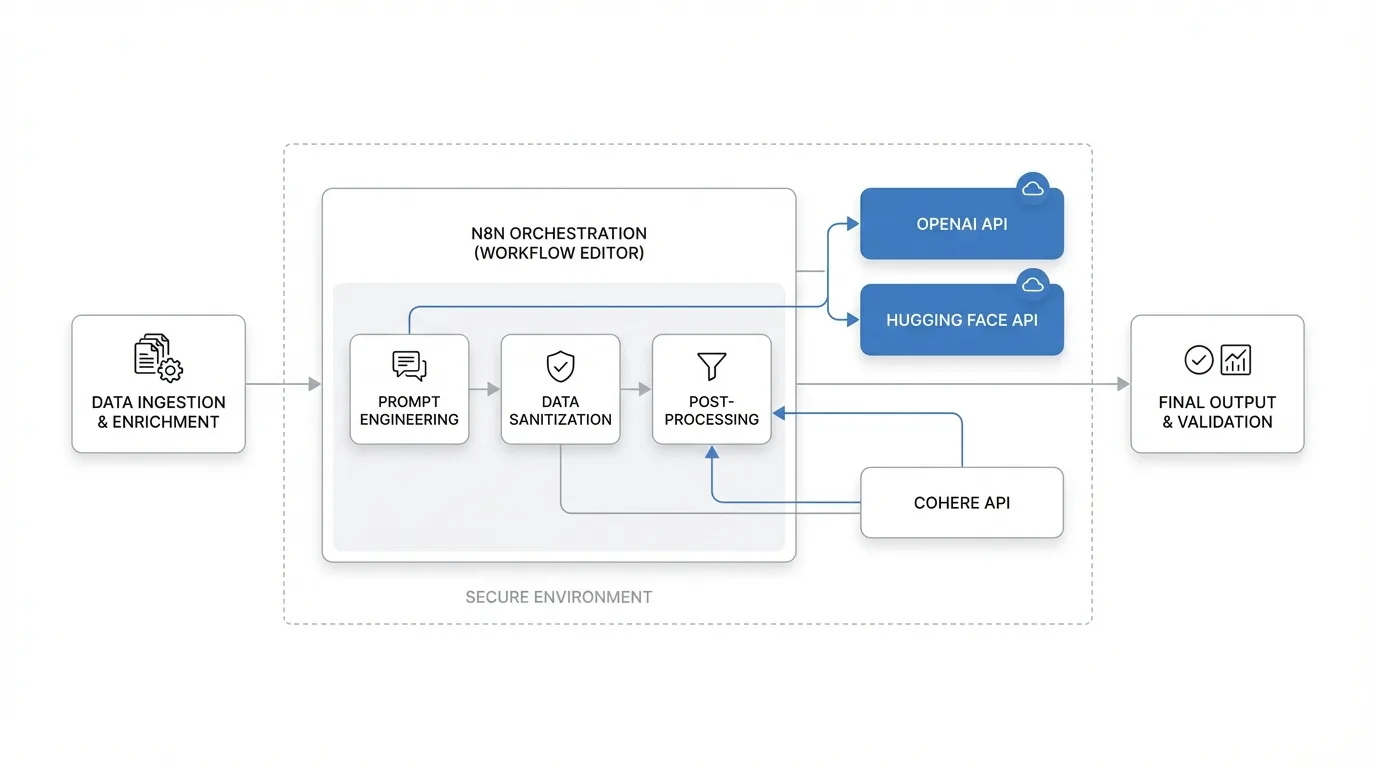
Enterprises building data-sovereign AI applications face a critical challenge: how do you leverage large language models while keeping sensitive data on-premises? n8n solves this by orchestrating AI workflows where data preprocessing, prompt engineering, and output validation happen within your infrastructure, while only sanitized prompts reach external LLM APIs.
Production AI workflow patterns:
Finance teams use n8n to automate accounts payable and receivable workflows, bank reconciliation, subscription billing sync, and audit evidence collection. These workflows reduce spreadsheet work and operational risk while maintaining the audit trails required for compliance.
One financial services company automated their invoice processing workflow: invoices arrive via email, n8n extracts data using OCR, validates against purchase orders in their ERP system, routes for approval based on business rules, and automatically reconciles payments. The workflow handles exceptions gracefully, escalating to humans only when necessary. Organizations can further optimize similar financial document processing by extracting key insights from financial documents using AI.
Financial automation benefits:
Deploying n8n at enterprise scale requires careful architecture planning. A properly maintained enterprise n8n deployment includes infrastructure costs around $50K-75K annually plus one full-time engineer to manage scaling, upgrades, deployment, CI/CD, totaling up to $300K when accounting for operational overhead.
However, this represents significant savings compared to cloud-only platforms at enterprise execution volumes. You can scale from ten thousand executions to ten million, and the software cost from n8n remains zero, allowing enterprise-grade automation at the low cost of a VPS.
Technical requirements:
Enterprise features include integration with 3rd-party secret management tools to securely fetch and inject encrypted credentials, granular and custom project roles to define exactly what each user, team, or API is allowed to view, edit, deploy, or manage, and connection of all workflow events to observability stacks through direct integrations or webhooks to any monitoring solution.
While n8n offers powerful workflow automation, deploying it securely at scale requires Docker orchestration, database management, secrets integration, monitoring, and CI/CD pipelines. This operational overhead typically costs enterprises $200K-300K annually in infrastructure and DevOps resources.
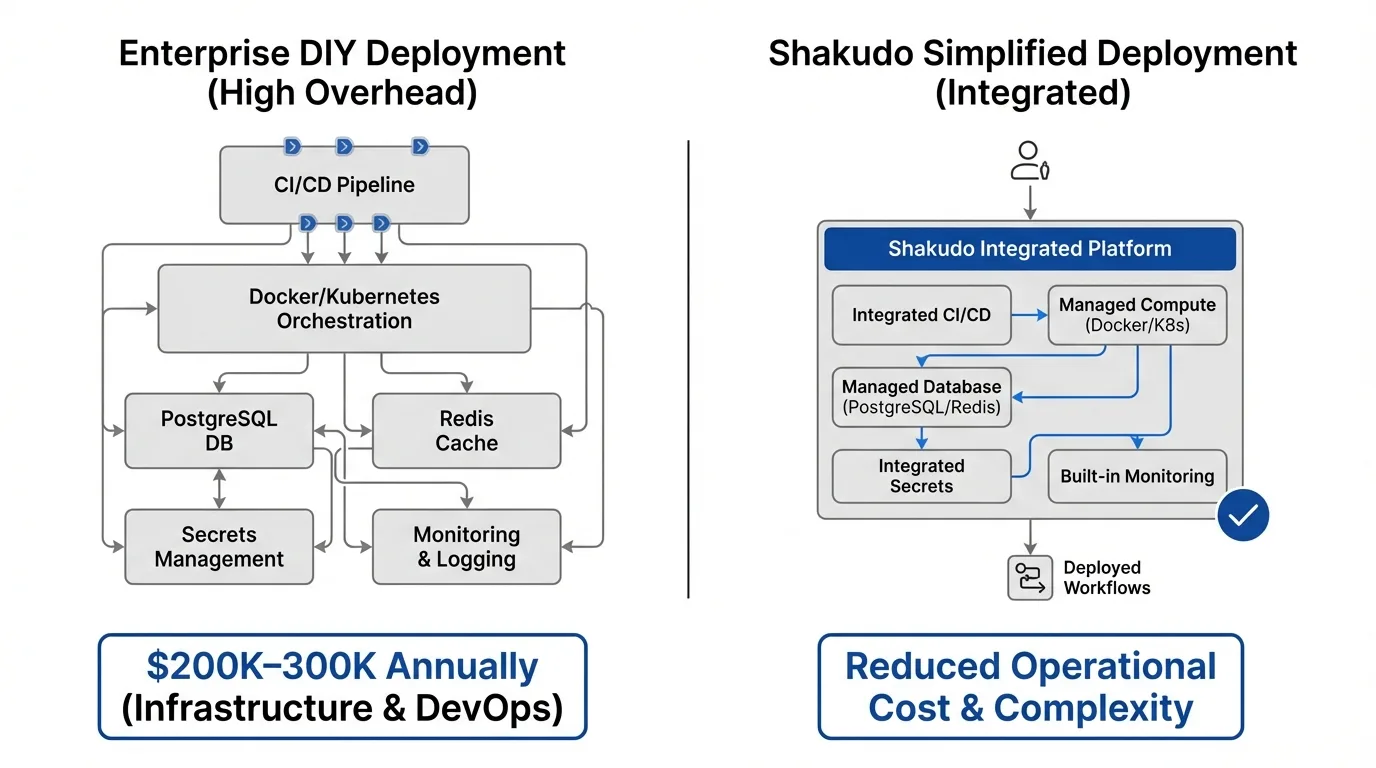
Shakudo eliminates this burden by providing pre-integrated, production-ready n8n deployments alongside 200+ other AI/ML tools in a unified platform. Enterprises get n8n's data sovereignty and cost advantages without the DevOps complexity, deployed on their private cloud or on-premises infrastructure in days rather than months.
This means technical teams can focus on building business-critical workflows instead of managing automation infrastructure. n8n workflows seamlessly integrate with MLOps tools, vector databases, and LLM platforms within Shakudo's governed environment, all while maintaining enterprise-grade security and compliance controls.
60% of organizations achieve ROI within 12 months of workflow automation implementation, with average productivity increases of 25-30% in automated processes and error reduction rates of 40-75% compared to manual processing.
The path to successful n8n enterprise deployment:
Enterprises that deploy n8n successfully share a common approach: they treat it as infrastructure, not a tool. They invest in proper architecture, governance, and operational practices that enable teams to build automation confidently at scale.
The competitive advantage in 2026 won't come from better manual processes. It will come from intelligent, data-sovereign automation that enterprises control completely, deployed on infrastructure they own, with costs they can predict. n8n provides the foundation; the question is whether your enterprise will build on it before your competitors do.

When Vodafone automated their security threat intelligence workflows with n8n, they didn't just streamline operations. They eliminated £2.2 million in annual operational costs while accelerating threat response from hours to minutes. This wasn't a proof-of-concept or pilot project; it was production-grade automation handling mission-critical security operations at enterprise scale.
As enterprises face mounting pressure to automate operations while maintaining data sovereignty, n8n has emerged as a powerful alternative to cloud-only platforms. n8n 2.0 strengthens the platform's position as enterprise-grade with secure-by-default execution and better performance under load, making it suitable for mission-critical workflows that technical teams can build with code-level control and visual ease.
Enterprise automation in 2026 presents a paradox. While 80% of organizations will adopt intelligent automation by 2025, with 83% of IT leaders believing workflow automation is necessary for digital transformation, most platforms force impossible tradeoffs between control, cost, and compliance.
Cloud-only automation platforms create three critical pain points for enterprises:
Data sovereignty constraints: Processing sensitive data on external servers creates GDPR, HIPAA, and regulatory compliance challenges that self-hosted solutions directly address. Cloud-only services with no self-hosting option require organizations to process all their data on US-based servers, presenting significant challenges for data sovereignty and GDPR compliance.
Unpredictable costs at scale: Task-based pricing means each step of an automation that successfully runs counts as one task, causing costs to increase quickly if businesses handle large volumes of data or run multiple automations every day. At enterprise scale, this becomes financially prohibitive.
Limited technical control: Proprietary platforms restrict the deep workflow customization, custom integrations, and code-level control that technical teams require. n8n provides a higher ceiling for complexity, customization, and control, better serving technical users or organizations with demanding requirements where other platforms' limitations in flexibility or cost scaling become prohibitive.
n8n is one of the strongest workflow automation platform choices in 2026, giving teams the speed of no-code through a clean, visual builder while developers can inject logic, build custom nodes, version workflows, and deploy in environments they own.
The platform's architecture addresses enterprise needs through several key capabilities:
Security teams at Fortune 500 companies use n8n to orchestrate threat intelligence workflows that traditional SIEM platforms cannot handle efficiently.
Security workflows enable URL or IP lookups using premier threat intelligence vendors, enhance analysis accuracy by checking obtained IP addresses via GreyNoise services, trigger VirusTotal scans to identify malicious properties, and deliver detailed analysis including classification, IP location, activity tags, and overall security vendor analysis via email or Slack.
Vodafone's implementation demonstrates the tangible impact. Their security automation workflow processes threat intelligence feeds, correlates indicators of compromise across multiple sources, automatically updates firewall rules, and escalates critical threats to analysts. The result: £2.2 million in annual savings and dramatically faster threat response.
Technical implementation patterns:
SecOps automation involves deploying automated solutions to detect threats, respond to incidents, and manage security tasks, reducing the need for manual intervention while enhancing efficiency, minimizing human errors, and improving overall security posture.
IT operations teams face coordination challenges across ticketing systems, monitoring platforms, asset management databases, and cloud infrastructure. n8n provides the orchestration layer that connects these fragmented systems, similar to how enterprises leverage open-source AIOps tools to automate incident detection and response.
Delivery Hero saved 200 hours monthly with a single IT ops workflow that automated server provisioning, configuration management, and access control. Unlike other platforms that charge per operation or task, n8n charges only for full workflow executions, meaning you can create complex IT Ops workflows involving thousands of tasks or steps without worrying about escalating costs; for workflows performing around 100k tasks, you could be paying $500+/month on other platforms, but with n8n's pro plan, you start at around $50.
Common IT automation workflows:
Containerized n8n deployments with Docker ensure seamless scaling and improved resource management for large-scale enterprise workflows, providing consistent environment configuration across development, testing, and production, simplified horizontal scaling to handle increased workflow execution volume, improved resource isolation to prevent workflows from interfering with each other, and enhanced deployment automation through container orchestration platforms like Kubernetes.
Enterprises like StepStone demonstrate the power of n8n for data integration challenges. They reduced new data source integration time from two weeks to two hours, achieving a 25x efficiency boost through automated data pipelines.
Data engineering teams use n8n to build ETL workflows that:
The key advantage: n8n's visual workflow builder allows data engineers to prototype pipelines quickly, while code nodes provide the flexibility to handle edge cases and complex transformations that purely visual tools cannot address.
AI workflows involve multiple steps, tools, and systems working together; n8n makes orchestration easier by providing native connectors for LLM providers like OpenAI, Hugging Face, Cohere, and others, alongside tools for prompt engineering, data enrichment, and post-processing, letting you build end-to-end AI pipelines without leaving the workflow editor.

Enterprises building data-sovereign AI applications face a critical challenge: how do you leverage large language models while keeping sensitive data on-premises? n8n solves this by orchestrating AI workflows where data preprocessing, prompt engineering, and output validation happen within your infrastructure, while only sanitized prompts reach external LLM APIs.
Production AI workflow patterns:
Finance teams use n8n to automate accounts payable and receivable workflows, bank reconciliation, subscription billing sync, and audit evidence collection. These workflows reduce spreadsheet work and operational risk while maintaining the audit trails required for compliance.
One financial services company automated their invoice processing workflow: invoices arrive via email, n8n extracts data using OCR, validates against purchase orders in their ERP system, routes for approval based on business rules, and automatically reconciles payments. The workflow handles exceptions gracefully, escalating to humans only when necessary. Organizations can further optimize similar financial document processing by extracting key insights from financial documents using AI.
Financial automation benefits:
Deploying n8n at enterprise scale requires careful architecture planning. A properly maintained enterprise n8n deployment includes infrastructure costs around $50K-75K annually plus one full-time engineer to manage scaling, upgrades, deployment, CI/CD, totaling up to $300K when accounting for operational overhead.
However, this represents significant savings compared to cloud-only platforms at enterprise execution volumes. You can scale from ten thousand executions to ten million, and the software cost from n8n remains zero, allowing enterprise-grade automation at the low cost of a VPS.
Technical requirements:
Enterprise features include integration with 3rd-party secret management tools to securely fetch and inject encrypted credentials, granular and custom project roles to define exactly what each user, team, or API is allowed to view, edit, deploy, or manage, and connection of all workflow events to observability stacks through direct integrations or webhooks to any monitoring solution.
While n8n offers powerful workflow automation, deploying it securely at scale requires Docker orchestration, database management, secrets integration, monitoring, and CI/CD pipelines. This operational overhead typically costs enterprises $200K-300K annually in infrastructure and DevOps resources.

Shakudo eliminates this burden by providing pre-integrated, production-ready n8n deployments alongside 200+ other AI/ML tools in a unified platform. Enterprises get n8n's data sovereignty and cost advantages without the DevOps complexity, deployed on their private cloud or on-premises infrastructure in days rather than months.
This means technical teams can focus on building business-critical workflows instead of managing automation infrastructure. n8n workflows seamlessly integrate with MLOps tools, vector databases, and LLM platforms within Shakudo's governed environment, all while maintaining enterprise-grade security and compliance controls.
60% of organizations achieve ROI within 12 months of workflow automation implementation, with average productivity increases of 25-30% in automated processes and error reduction rates of 40-75% compared to manual processing.
The path to successful n8n enterprise deployment:
Enterprises that deploy n8n successfully share a common approach: they treat it as infrastructure, not a tool. They invest in proper architecture, governance, and operational practices that enable teams to build automation confidently at scale.
The competitive advantage in 2026 won't come from better manual processes. It will come from intelligent, data-sovereign automation that enterprises control completely, deployed on infrastructure they own, with costs they can predict. n8n provides the foundation; the question is whether your enterprise will build on it before your competitors do.
When Vodafone automated their security threat intelligence workflows with n8n, they didn't just streamline operations. They eliminated £2.2 million in annual operational costs while accelerating threat response from hours to minutes. This wasn't a proof-of-concept or pilot project; it was production-grade automation handling mission-critical security operations at enterprise scale.
As enterprises face mounting pressure to automate operations while maintaining data sovereignty, n8n has emerged as a powerful alternative to cloud-only platforms. n8n 2.0 strengthens the platform's position as enterprise-grade with secure-by-default execution and better performance under load, making it suitable for mission-critical workflows that technical teams can build with code-level control and visual ease.
Enterprise automation in 2026 presents a paradox. While 80% of organizations will adopt intelligent automation by 2025, with 83% of IT leaders believing workflow automation is necessary for digital transformation, most platforms force impossible tradeoffs between control, cost, and compliance.
Cloud-only automation platforms create three critical pain points for enterprises:
Data sovereignty constraints: Processing sensitive data on external servers creates GDPR, HIPAA, and regulatory compliance challenges that self-hosted solutions directly address. Cloud-only services with no self-hosting option require organizations to process all their data on US-based servers, presenting significant challenges for data sovereignty and GDPR compliance.
Unpredictable costs at scale: Task-based pricing means each step of an automation that successfully runs counts as one task, causing costs to increase quickly if businesses handle large volumes of data or run multiple automations every day. At enterprise scale, this becomes financially prohibitive.
Limited technical control: Proprietary platforms restrict the deep workflow customization, custom integrations, and code-level control that technical teams require. n8n provides a higher ceiling for complexity, customization, and control, better serving technical users or organizations with demanding requirements where other platforms' limitations in flexibility or cost scaling become prohibitive.
n8n is one of the strongest workflow automation platform choices in 2026, giving teams the speed of no-code through a clean, visual builder while developers can inject logic, build custom nodes, version workflows, and deploy in environments they own.
The platform's architecture addresses enterprise needs through several key capabilities:
Security teams at Fortune 500 companies use n8n to orchestrate threat intelligence workflows that traditional SIEM platforms cannot handle efficiently.
Security workflows enable URL or IP lookups using premier threat intelligence vendors, enhance analysis accuracy by checking obtained IP addresses via GreyNoise services, trigger VirusTotal scans to identify malicious properties, and deliver detailed analysis including classification, IP location, activity tags, and overall security vendor analysis via email or Slack.
Vodafone's implementation demonstrates the tangible impact. Their security automation workflow processes threat intelligence feeds, correlates indicators of compromise across multiple sources, automatically updates firewall rules, and escalates critical threats to analysts. The result: £2.2 million in annual savings and dramatically faster threat response.
Technical implementation patterns:
SecOps automation involves deploying automated solutions to detect threats, respond to incidents, and manage security tasks, reducing the need for manual intervention while enhancing efficiency, minimizing human errors, and improving overall security posture.
IT operations teams face coordination challenges across ticketing systems, monitoring platforms, asset management databases, and cloud infrastructure. n8n provides the orchestration layer that connects these fragmented systems, similar to how enterprises leverage open-source AIOps tools to automate incident detection and response.
Delivery Hero saved 200 hours monthly with a single IT ops workflow that automated server provisioning, configuration management, and access control. Unlike other platforms that charge per operation or task, n8n charges only for full workflow executions, meaning you can create complex IT Ops workflows involving thousands of tasks or steps without worrying about escalating costs; for workflows performing around 100k tasks, you could be paying $500+/month on other platforms, but with n8n's pro plan, you start at around $50.
Common IT automation workflows:
Containerized n8n deployments with Docker ensure seamless scaling and improved resource management for large-scale enterprise workflows, providing consistent environment configuration across development, testing, and production, simplified horizontal scaling to handle increased workflow execution volume, improved resource isolation to prevent workflows from interfering with each other, and enhanced deployment automation through container orchestration platforms like Kubernetes.
Enterprises like StepStone demonstrate the power of n8n for data integration challenges. They reduced new data source integration time from two weeks to two hours, achieving a 25x efficiency boost through automated data pipelines.
Data engineering teams use n8n to build ETL workflows that:
The key advantage: n8n's visual workflow builder allows data engineers to prototype pipelines quickly, while code nodes provide the flexibility to handle edge cases and complex transformations that purely visual tools cannot address.
AI workflows involve multiple steps, tools, and systems working together; n8n makes orchestration easier by providing native connectors for LLM providers like OpenAI, Hugging Face, Cohere, and others, alongside tools for prompt engineering, data enrichment, and post-processing, letting you build end-to-end AI pipelines without leaving the workflow editor.

Enterprises building data-sovereign AI applications face a critical challenge: how do you leverage large language models while keeping sensitive data on-premises? n8n solves this by orchestrating AI workflows where data preprocessing, prompt engineering, and output validation happen within your infrastructure, while only sanitized prompts reach external LLM APIs.
Production AI workflow patterns:
Finance teams use n8n to automate accounts payable and receivable workflows, bank reconciliation, subscription billing sync, and audit evidence collection. These workflows reduce spreadsheet work and operational risk while maintaining the audit trails required for compliance.
One financial services company automated their invoice processing workflow: invoices arrive via email, n8n extracts data using OCR, validates against purchase orders in their ERP system, routes for approval based on business rules, and automatically reconciles payments. The workflow handles exceptions gracefully, escalating to humans only when necessary. Organizations can further optimize similar financial document processing by extracting key insights from financial documents using AI.
Financial automation benefits:
Deploying n8n at enterprise scale requires careful architecture planning. A properly maintained enterprise n8n deployment includes infrastructure costs around $50K-75K annually plus one full-time engineer to manage scaling, upgrades, deployment, CI/CD, totaling up to $300K when accounting for operational overhead.
However, this represents significant savings compared to cloud-only platforms at enterprise execution volumes. You can scale from ten thousand executions to ten million, and the software cost from n8n remains zero, allowing enterprise-grade automation at the low cost of a VPS.
Technical requirements:
Enterprise features include integration with 3rd-party secret management tools to securely fetch and inject encrypted credentials, granular and custom project roles to define exactly what each user, team, or API is allowed to view, edit, deploy, or manage, and connection of all workflow events to observability stacks through direct integrations or webhooks to any monitoring solution.
While n8n offers powerful workflow automation, deploying it securely at scale requires Docker orchestration, database management, secrets integration, monitoring, and CI/CD pipelines. This operational overhead typically costs enterprises $200K-300K annually in infrastructure and DevOps resources.

Shakudo eliminates this burden by providing pre-integrated, production-ready n8n deployments alongside 200+ other AI/ML tools in a unified platform. Enterprises get n8n's data sovereignty and cost advantages without the DevOps complexity, deployed on their private cloud or on-premises infrastructure in days rather than months.
This means technical teams can focus on building business-critical workflows instead of managing automation infrastructure. n8n workflows seamlessly integrate with MLOps tools, vector databases, and LLM platforms within Shakudo's governed environment, all while maintaining enterprise-grade security and compliance controls.
60% of organizations achieve ROI within 12 months of workflow automation implementation, with average productivity increases of 25-30% in automated processes and error reduction rates of 40-75% compared to manual processing.
The path to successful n8n enterprise deployment:
Enterprises that deploy n8n successfully share a common approach: they treat it as infrastructure, not a tool. They invest in proper architecture, governance, and operational practices that enable teams to build automation confidently at scale.
The competitive advantage in 2026 won't come from better manual processes. It will come from intelligent, data-sovereign automation that enterprises control completely, deployed on infrastructure they own, with costs they can predict. n8n provides the foundation; the question is whether your enterprise will build on it before your competitors do.