The Complete Buyer's Guide to On-Premise AI

Your inference bills keep climbing, your data team will not let regulated workloads leave the building, and every public-cloud quote arrives with an asterisk about egress fees and model deprecation. The buying conversation starts with a simple question: what does it actually take to run AI on infrastructure we control?
On-premise AI means running artificial-intelligence models and the data they process on infrastructure that the organization owns and controls, rather than on a public-cloud provider's network. This guide explains how on-premise AI works, why executives choose it, what it costs against public cloud, and how to evaluate a platform, including the cases where on-premise is the wrong answer.
What on-premise AI actually means
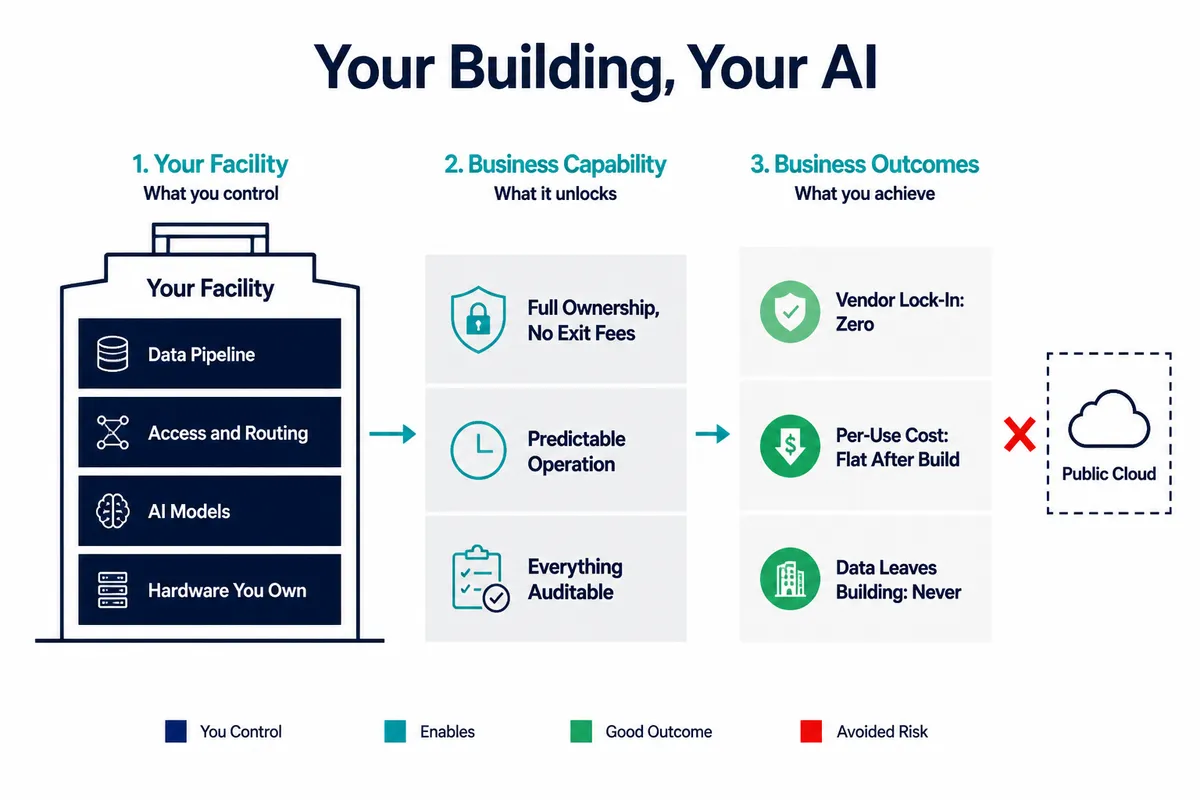
"On-premises" (often shortened to on-prem) originally described software installed on computers in the buying organization's own facility, as opposed to software served from a remote provider. Applied to AI, the term covers the full stack: the GPU servers, the model-serving software, the orchestration layer that routes work to the right model, and the data pipeline that feeds training and inference. Nothing about the workload has to leave the organization's boundary to be considered on-premise, though some buyers reserve the term for the air-gapped end of the spectrum.
The term sits on a spectrum, and buying teams confuse the modes enough to warrant a side-by-side view:
| Deployment mode | Who owns the hardware | Where it runs | Who operates it | Typical buyer |
|---|---|---|---|---|
| Public cloud AI | Hyperscaler (AWS, Azure, GCP) | Provider's data centers | Provider | Startups, teams experimenting with models |
| Private cloud AI | Colocation facility or cloud provider | Dedicated resources inside a third-party data center | Shared: provider manages hardware, buyer manages software | Enterprises that want dedicated isolation without owning racks |
| Self-hosted AI | Organization | Organization's own racks, in its own facility or a colo it contracts | Organization | Teams with existing data centers and ML staff |
| On-premise AI platform | Organization | Organization's own facility | Vendor-assisted or fully managed service on the buyer's hardware | Regulated and hard industries that need both control and operational support |
The last row matters most to a buying committee: a platform that deploys inside the buyer's infrastructure, so data and compute stay inside a governance boundary the buyer defines, without hiring a full machine-learning platform team. This is closely related to sovereign AI and data sovereignty — the requirement that data remains subject to the laws of the jurisdiction where it was collected.
For workloads that need stricter isolation than a private network provides — defense, critical manufacturing, certain government programs — the boundary extends to air-gapped deployment, where the AI system has no wired or wireless connection to the internet or any unsecured network at all.
Why executives move AI on-premise
Four drivers show up repeatedly in on-premise decisions.
Data control and regulatory exposure
When a model runs on a public cloud, the organization's data, prompts, outputs, and sometimes the model weights themselves traverse third-party infrastructure in jurisdictions the buyer does not control. Regulated industries — financial services, defense, healthcare, energy — carry legal obligations that make that arrangement unacceptable for certain workloads. A bank running credit-risk scoring on personally identifiable information, for example, has a defensible position to keep the workload on hardware it controls.
The United States' CLOUD Act, enacted in 2018, allows US federal law enforcement to compel US-based technology companies to produce data they control, regardless of where that data is physically stored. For a European or Asian buyer, that legal reach is a sovereignty issue, not just a security one. The EU's AI Act — in force since 1 August 2024, with a phased rollout extending over three years — assigns deployers of high-risk AI systems security, transparency, and quality obligations that are easier to evidence when the system runs on infrastructure the organization controls.
Latency and availability
On-premise inference runs next to the process it serves. A manufacturing facility using computer vision for defect detection on a production line cannot tolerate the round-trip latency of a public-cloud call, particularly when internet connectivity is shared with other plant traffic.
Cost at scale
Public-cloud GPUs are priced for elasticity, not for sustained load. If an organization runs inference around the clock, the accumulated per-hour GPU cost over a three-year horizon can exceed the amortized purchase price of equivalent on-premise hardware. The break-even depends on utilization, the cloud being compared against, and the real cost of power, cooling, and staffing. It is a CFO conversation: capex versus opex, and the utilization that tips the balance, and the hidden costs that quietly sink AI ROI if nobody budgets for them.
Compliance and audit trail
Auditors and regulators can inspect on-premise infrastructure directly. For defense and government programs, air-gapped or physically separated environments are a stated requirement. On-premise deployment makes the audit trail shorter and the boundary more legible.
The on-premise AI architecture
A production on-premise AI stack has four layers, and a buyer can evaluate a platform vendor on each one separately rather than accepting a single bundle.
1. GPU compute
Deep-learning training and large-model inference run on GPU accelerators. The dominant platforms in 2025–2026 are the Nvidia Hopper H100 (introduced 2022, 80 billion transistors, SXM5 socket) and its successor Blackwell, alongside the Ampere A100 for inference that does not need the newest generation. Rack-scale systems — Nvidia's 8-GPU DGX line is the reference design — pair GPUs with fast interconnects (NVLink, InfiniBand) so one large model can span several accelerators, with the CPUs, high-bandwidth storage, and collective-communication fabric that feed them.
2. Model serving
A model file is not a service. The serving layer converts a downloaded model into a low-latency, concurrent, multi-tenant API. Open-source serving frameworks such as vLLM (originally from UC Berkeley's Sky Computing Lab) handle continuous batching, memory-efficient attention (PagedAttention), and prefix caching — the features that turn a single GPU into a production endpoint. A vendor should run a well-known serving layer or demonstrate equivalent throughput under load.
3. Orchestration and gateway
Most organizations run more than one model: a large model for complex reasoning, a smaller one for high-volume classification, retrieval for grounding, tool calls for actions. The orchestration layer routes each request to the right model, applies access controls, logs and meters usage, and exposes a stable API to the rest of the business.
4. Data pipeline and integration
Models are only as good as the data reaching them. A production deployment needs pipelines that ingest source data, prepare it, feed retrieval indexes, and — for training — produce labeled datasets, plus integration with existing enterprise systems (ERP, MES, CRM, data warehouses). This is where most of the real implementation work lives.
Across all four layers, the supporting infrastructure is easy to underestimate: rack space, power (a single 8-GPU H100 system draws 8–10 kW at peak, roughly $8,000–$15,000 per year in electricity at US commercial rates), cooling (liquid cooling is cheaper per watt than air), dedicated network connectivity, and physical security. These line items are what separate a realistic cost model from a hardware-sticker-price model.
Total cost of on-premise versus public cloud
The comparison a CFO should make is a three-year, fully loaded total cost of ownership — not a per-hour sticker price against a per-hour sticker price.
What the public-cloud number actually is
Hyperscaler H100 on-demand pricing sits in the $4–$7 per GPU-hour range, with lower effective rates under savings plans and multi-year commitments, and lower still from specialized GPU providers. The number a buyer should use is the committed, sustained rate for the specific workload, not the on-demand headline rate.
What the on-premise number actually is
An 8-GPU H100 node costs roughly $300,000–$400,000 to purchase. Over a three-year horizon that amortizes to a per-GPU-hour cost that can be below the cheapest hyperscaler on-demand rate — but only if the node is actually utilized. Add the real operating costs: power and cooling, rack space, a portion of the ML-ops team, and refresh cycles. A reasonable mid-range model puts the fully loaded three-year cost of an 8-GPU node in the neighborhood of $750,000, or roughly $3.50 per GPU-hour at 100% utilization, before the cost of people.
| Cost dimension | Public cloud (H100-class) | On-premise (8-GPU H100 node) |
|---|---|---|
| Upfront (year 0) | None (opex) | $300k–$400k hardware + facility fit-out |
| Per-GPU-hour at sustained load | $2.50–$7.00 depending on provider and commitment | Roughly $3.50 at 100% utilization, fully loaded |
| Utilization below break-even | Pays only for what is used | Cost is fixed whether used or not |
| Scaling beyond committed capacity | Instant, on-demand | Procurement lead time (weeks to months) |
| Hardware refresh (3–4 yrs) | Provider's problem | Buyer's problem; budget for a full refresh cycle |
| Staffing | Platform team | Platform team plus facility/ops ownership |
| Compliance evidence | Provider attestations | Direct audit of own infrastructure |
The break-even framing
Break-even lands around 50% sustained utilization for an 8-GPU H100 node — below that, cloud is cheaper; above it, on-premise wins on cost and outright on control. The older "buy if you will use it more than 70% of the time" rule of thumb was calibrated to higher cloud prices; committed rates have come down and the effective break-even has moved lower. Continuous production inference makes the cost case defensible. A team that uses GPUs a few hours a day for experimentation is better served by staying in the cloud.
How to choose an on-premise AI platform
The "on-premise AI platform" search surface is dominated by vendor product pages, so a buying team should fill this checklist on its own before the vendor RFP.
1. Data control
- Does the platform run entirely on hardware the buyer owns, with no required external calls?
- Is an air-gapped deployment supported and documented, not just a promise in a sales call?
- Where do model weights live, and who can access them, including the vendor's own support staff?
2. Model flexibility
- Can the platform run open-weight models (Llama, Mistral, DeepSeek, and similar) without per-token metering to a vendor backend?
- Can the buyer bring their own fine-tuned model, and what is the deployment path?
3. Serving performance
- What is the serving layer, and what is the measured tokens-per-second under realistic concurrency for the target model?
- Is continuous batching and prefix caching available — the features that determine real throughput?
- Has the vendor demonstrated the platform on the buyer's own model and workload, not a demo model?
4. Orchestration and governance
- Is there a single API gateway that routes across multiple models with access controls, audit logs, and usage metering?
- Are the logs and telemetry retained on-premise, or do they ship to a vendor cloud?
5. Operational maturity
- What does the platform need from the buyer's team — ML engineers, SREs, facility staff — and what does the vendor provide as a managed service?
- What is the vendor's support model on the buyer's own hardware, and what are the response SLAs?
6. Cost structure
- Is licensing per-GPU, per-seat, per-token, or per-deployment — and how does it scale as the buyer adds models and workloads?
- Does the vendor's pricing assume a specific GPU generation, and how is the buyer protected against refresh cycles?
- Is there a realistic path to a pilot on existing hardware before the full capex decision?
For organizations in regulated industries, the first and fourth items are usually the decisive ones. The remaining items decide which platform wins among the ones that clear the compliance bar. The adjacent guides on regulated AI and industrial AI extend this framework into specific industry contexts.
For a live walkthrough of the platform against the checklist, book a demo.
When on-premise is the wrong answer
On-premise is a control and cost decision, not a posture. It is the wrong choice when:
- Utilization is low. If GPUs would run a few hours a day for experimentation, the fully loaded on-premise cost exceeds any cloud rate.
- Model access is the bottleneck, not data control. If the buyer needs frontier models that are not available as open weights, on-premise infrastructure adds little for that workload.
- There is no internal or vendor-operated platform team. An on-premise deployment without someone to own serving, monitoring, and refresh becomes a liability within a year; the cost model above assumes operating staff.
- Scaling is a core requirement. On-premise capacity has a procurement lead time measured in weeks to months. A workload that doubles in three months is a bad fit.
- The compliance requirement is narrower than the deployment. If only one data domain needs to stay in-bounds, a hybrid design — sensitive workloads on-premise or in a private VPC, everything else on public cloud — is cheaper and easier to operate than moving everything on-premise.
None of this argues against on-premise; it argues for a deployment decision made per workload, with break-even and control factors evaluated on the real numbers. The organizations that get on-premise right make that decision deliberately — CFO, CISO, and operations lead in the same room.
Last verified: 2026-09-05
Why Executives Buying AI Infrastructure Choose Shakudo to power their on-premise AI
-
Runs in the environment you already run
Shakudo orchestrates the AI stack inside your own infrastructure, so data residency, latency, and compliance controls stay under your team's control.
-
Tool-agnostic by design
GPU serving, model gateways, and orchestration are composed from best-of-breed components you select, not a single vendor's opinionated stack.
-
One platform from pilot to production
The same control plane that ran the evaluation runs the workload in production, so the buy decision does not reset your architecture.
-
Serving performance you can measure
Routing, caching, and speculative decoding are applied where they matter, so throughput and cost per inference are numbers you can audit.

Frequently asked questions
Is on-premise AI only for classified or regulated data?
No. Teams also choose on-premise for latency, cost at scale, and data gravity. The regulated case is the most obvious, but not the only one.
What does on-premise AI actually require on day one?
GPU servers, a model-serving layer, an orchestration and gateway layer, and a data pipeline. Sizing depends on the models and expected request volume.
Can we start on-premise and keep cloud options open?
Yes. Many deployments keep a hybrid path for overflow or experimental work while production inference stays inside the boundary.
How long does an on-premise AI deployment take?
Hardware lead time dominates. The software stack itself, serving, orchestration, and pipelines, typically stands up in weeks rather than months.