Industrial AI From Pilot to Factory-Floor Production
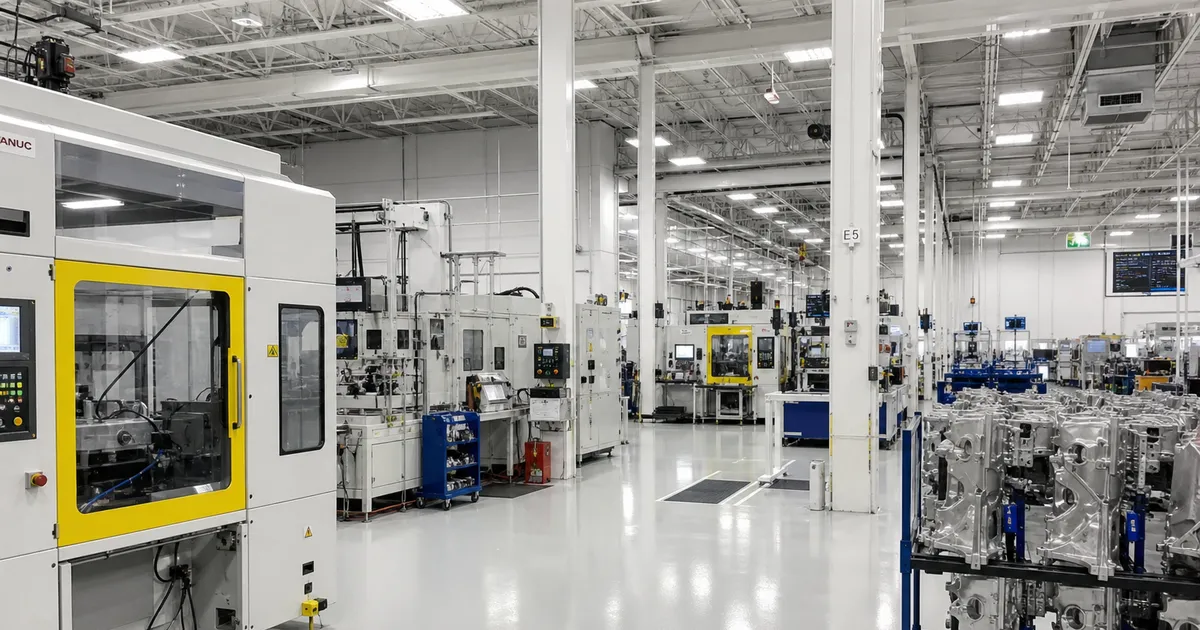
Every line on your floor already runs on a stack of proprietary PLCs, historians, and MES, and the data it produces stays segmented in an OT network that cannot simply be piped to a cloud. The models that could cut unplanned stops, catch escaped defects, or lower energy per unit need to run where that data is, but most AI platforms assume a shared cloud that the floor cannot reach. So the question for operations leaders is not whether industrial AI works, it is how to put it on the plant’s own hardware and hand it off to someone who will keep it running.
This guide breaks down the industrial AI use cases that actually pay, the OT/IT constraints that shape the deployment, and the path from pilot to factory-floor production, including the cost frame that ties the model to a number finance already owns.
Industrial AI is applied machine learning and machine vision running on plant data — sensors, PLCs, SCADA, MES, and quality cameras — to make decisions at the speed of the production line. Unlike office or analyst AI, which works on documents, spreadsheets, and email, industrial AI is judged by what happens on the floor: fewer unplanned stops, fewer escaped defects, lower energy per unit, and a faster response from the operator standing at the machine.
What industrial AI is
Industrial AI is not a product category; it is a set of models and data pipelines deployed where the value is created. The data sources that define it are the ones office AI never touches:
- Sensors and field devices — vibration, temperature, pressure, current, and flow readings from Level 0 and Level 1 equipment.
- SCADA and supervisory systems — real-time process state, setpoints, and alarm history from Level 2.
- MES and plant historians — batch records, line speeds, changeover times, and quality events from Level 3.
- Machine vision — cameras on the line and at inspection stations that turn images into defect and conformance calls.
The market is real but still early. The global industrial AI market reached $43.6 billion in 2024 and is expected to grow at a CAGR of 23% to $153.9 billion by 2030, according to the Industrial AI Market Report 2025–2030. Yet even at that scale, industrial AI spending represents only about 0.1% of revenue at the typical U.S. manufacturer — roughly $40,000 per manufacturer — which tells a COO the same thing: the budget exists, the discipline to spend it well does not, and the gap is where the advantage is.
The difference from office AI is the operating environment, not the model. General-purpose AI tools dominate consumer and office adoption for text and images, but most industrial value comes from sensor time-series, machine vision, and simulations that must run reliably at the edge and integrate with OT systems. That single fact drives nearly every decision that follows. Democratizing smart manufacturing walks through how AI tools are being brought to the floor in an Industry 4.0 context.
The use cases with real ROI logic
Not every industrial AI project pays. The ones that do attach the model to a cost line the finance team already tracks. Four use cases carry most of the value; operator assistance is the emerging fifth. How to use agentic AI in manufacturing shows the use cases in a step-by-step setup.
Predictive maintenance is the clearest case. Unplanned downtime is the largest single loss: industrial manufacturers spend an estimated $50 billion annually on it, and the median per-incident cost exceeds $125,000 per hour across industries. Predictive maintenance that watches vibration, temperature, and pressure in real time has documented results — maintenance cost reductions of 18–25% and unplanned downtime reductions of 30–50% versus reactive strategies, and proactive repairs that cost 4 to 5 times less than the emergency job on the same asset. Renault’s then-CEO reported €270 million in savings on energy and maintenance in a single year after deploying predictive maintenance AI tools.
Quality inspection is where machine vision outperforms the human eye most dramatically. Even well-trained inspectors, working in ideal conditions, carry a 10% to 20% error rate over an 8-hour shift as fatigue sets in. Vision systems inspect 100% of parts at line speed with accuracy in the 99.8% to 99.9% range. Pegatron’s automated optical inspection tool reported 99.8% defect detection accuracy and a fourfold improvement in throughput.
Yield and process optimization applies models to MES and SCADA setpoints and historians to reduce scrap and raise first-pass yield, and energy optimization applies the same to power and utility data — a North American protein producer operating over 40 plants used AI process optimization to save over 25% in energy costs on its ammonia refrigeration systems, with an anticipated benefit of up to $9 million annually. Operator assistance — copilots over work instructions, PLCs, and maintenance history — is newer but moves changeover and troubleshooting time.
| Use case | Data source | Typical outcome | Deployment model |
|---|---|---|---|
| Predictive maintenance | Vibration, temperature, pressure, current sensor streams | 18–25% lower maintenance cost; 30–50% fewer unplanned stops | Edge / on-prem |
| Quality inspection | Machine vision cameras on the line | 99.8–99.9% detection accuracy at 100% inspection | Edge, on the line |
| Yield optimization | MES + SCADA setpoints, process historians | Lower scrap, higher first-pass yield | On-prem / edge |
| Energy optimization | Plant power meters, utility SCADA | Up to ~25% energy cost savings on target systems | On-prem |
| Operator assistance | Copilot over MES, PLC, and work-instruction data | Faster changeovers, less search time | Hybrid (on-prem model) |
The OT/IT constraint
This is the part office AI never faces, and it is the sovereign angle. Factory networks are segmented by design. The Purdue model, the reference frame for industrial networking, organizes them into levels from the physical process (Level 0: sensors and actuators) up through supervision (Level 2: SCADA and HMIs) and site operations (Level 3: MES and historians) to enterprise IT (Level 4) and cloud (Level 5). Between the floor and the office sits a screened boundary, the Level 3.5 Industrial DMZ, with firewalls, historian replicas, and jump hosts.
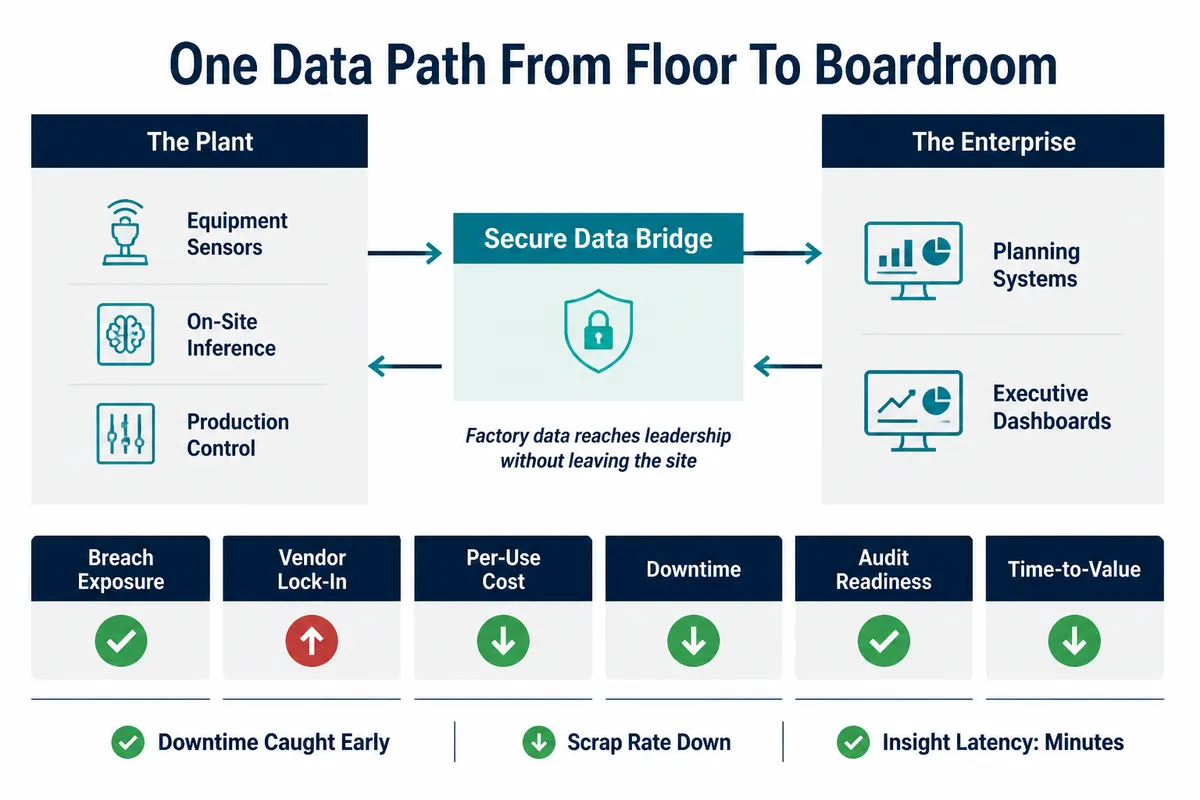
Most Level 1 PLCs and Level 0 sensors run proprietary firmware and real-time operating systems that cannot run antivirus or EDR, have very limited memory, and can be destabilized by added latency. That is why many plants simply cannot send line data to the cloud: the control network is physically and logically separated from the IT network, and the latency and reliability requirements of a production line do not tolerate a round trip to a distant data center. Rising data costs, latency-sensitive applications, and security considerations are all pushing AI workloads back toward the machines.
The practical consequence: an industrial AI platform that assumes everything lives in a shared cloud will not run on most floors. A platform that runs where the data is — on-prem or at the edge — with data staying inside the plant boundary is not a nice feature; it is the deployment model the floor requires. For plants under defense, export, or data-residency rules, on-prem is the only option at all. The on-premise AI guide covers the full constraint set, and the regulated AI guide covers the compliance cases. Edge AI infrastructure economics covers the cost side of moving AI to the plant’s own hardware.
The pilot-to-production path
Most industrial AI projects die between the demo and the production line. MIT’s “GenAI Divide” report, drawing on more than 300 public AI initiatives, 52 organizational interviews, and surveys of 153 senior leaders, found that 95% of organizations are getting zero return on generative AI despite $30–40 billion invested. The report’s central finding is that the gap is driven by approach, not by model quality or regulation: most pilots fail due to brittle workflows, lack of contextual learning, and misalignment with day-to-day operations.
Five things separate the pilots that ship from the pilots that die.
- Tie the model to a line-attached metric. Downtime, defect rate, energy per unit. If the outcome cannot be read off a number the finance team already owns, it is a demo, not a project.
- Start where the data already lives. The floor’s OT network, not a new data warehouse. Building a cloud pipeline before the model works is the most common way to burn a pilot’s runway.
- Budget for the integration, not the model. The model is a small fraction of the work. Connecting to PLCs, MES, and historians, and routing alerts to the right person, is most of it.
- Design for the edge from day one. Latency, network segmentation, and data-egress rules are constraints to design around, not problems to solve after the demo looks good.
- Fund the hand-off before the pilot ends. A named production owner, a maintenance budget, and a retraining trigger agreed up front. Top performers in the MIT data reported average timelines of 90 days from pilot to full implementation; enterprises took nine months or longer. The difference was rarely the technology.
A useful structural point from the same research: internal builds failed roughly twice as often as external partnerships, with external tools reaching deployment about two-thirds of the time versus about one-third for internally built tools. For a plant without a dedicated data science team, that argues for a platform that carries the operational load rather than a one-off model. The AI factory overview explains how to run that platform as an internal capability.
The cost and ROI frame for a COO
Frame it as a reduction of a cost line you already pay, not an investment in a new capability.
- Name the baseline loss. Unplanned downtime, escaped-defect rework, and energy per unit are all on existing P&Ls. The industry spends an estimated $50 billion a year on unplanned downtime alone.
- Size the addressable slice. One critical line, one defect class, one energy system. The protein producer case saved over 25% on refrigeration energy, not on total spend — the win was scoped to the most energy-intensive system first.
- Use the reference savings as planning figures, not promises. Predictive maintenance: 18–25% lower maintenance cost and 30–50% fewer unplanned stops. Quality vision: near-total inspection accuracy versus a human error rate that climbs through the shift. Energy: double-digit savings on targeted systems.
- Model payback in months. 95% of organizations that implement predictive maintenance report positive ROI, and 27% reach full payback within 12 months.
- Separate capex from egress. Edge hardware is a capex decision; a cloud-dependent design turns the same data into a recurring egress and latency cost that the floor can feel every minute.
The same discipline applies regardless of industry; the manufacturing overview maps these to specific plant challenges, and machinery anomaly detection is a concrete, already-deployed starting point for the downtime line.
A maturity assessment
Most plants land somewhere between levels 1 and 3. Name the level honestly before scoping spend.
- Reactive — maintenance after failure; quality caught at end-of-line or by the customer. Baseline data is not collected or is not trusted.
- Digitized — sensors and MES exist, data is captured, but it is not acting on anything yet. Historians are siloed.
- Pilot — one or more models in a controlled setting; value shown but not yet owned by operations.
- Operational — models in production, alerts routed to owners, a retraining trigger in place, and a named operator.
- Optimized — the model is part of the control loop or the standard process, with outcomes tracked against the P&L line it was tied to.
A pilot that has not crossed into level 4 is not producing value yet; it is demonstrating potential.
Pre-flight checklist
- The use case is tied to a cost or revenue line finance already reports.
- The data source is named and accessible from the plant network without a new cloud pipeline.
- The deployment model (edge, on-prem, or hybrid) is chosen before the model is built.
- Network segmentation and data-egress rules are written down and signed off.
- Integration scope — PLCs, MES, historians, alert routing — is budgeted as its own workstream.
- A production owner, a maintenance budget, and a retraining trigger are agreed before the pilot ends.
- Payback is modeled in months against a scoped slice, not the whole plant.
- Compliance or data-residency rules that force on-prem are confirmed up front.
Industrial AI pays when it runs where the data is, ties to a number finance already owns, and is handed off to someone who will keep it running. The rest is the same discipline the line has always applied: scope the win, control the cost, and hold the operator accountable.
To see how a plant-scoped AI platform runs in practice, request a demo.
Last verified: 2026-09-05
Why Factory and Manufacturing Operations Leaders Choose Shakudo to power their plant-floor AI
-
Runs on the plant's own edge infrastructure
Shakudo deploys the AI stack on the plant's own edge and on-prem systems, so production data never leaves the factory boundary.
-
Low-latency serving on site
Model serving runs where the line runs, so defect calls, maintenance alerts, and setpoint changes are returned in milliseconds instead of a round trip to a distant cloud.
-
Deterministic orchestration for operational workflows
Routing, access control, and logging apply to every model call, so the plant can audit and govern what its models do on the floor.
-
Vendor-agnostic models and tooling
Serving, orchestration, and pipelines are composed from components the plant selects, not a single vendor's opinionated stack, so the deployment survives a change of model or supplier.

Frequently asked questions
Can AI run at the edge on the plant floor?
Yes. The platform runs on the plant's own edge and on-prem infrastructure, so models, data, and inference stay inside the factory boundary instead of a cloud round trip.
What happens when the plant network is offline?
Edge serving keeps working. Because models and data sit on the plant's own hardware, inference does not depend on connectivity back to a remote cloud, and the line keeps getting its calls back.
How does it integrate with existing OT and IT systems?
The platform connects to the sources the plant already has, such as PLCs, SCADA, MES, historians, and quality cameras, and routes alerts to the right owner without a new cloud pipeline.
When should a plant pilot versus roll out?
A pilot works when the model is tied to a line metric, the data source is named, and a production owner plus a retraining trigger are agreed before the pilot ends. Roll out once the pilot has crossed into operational status and the hand-off is funded.