AI in Nuclear, Deployment Constraints and Use Cases
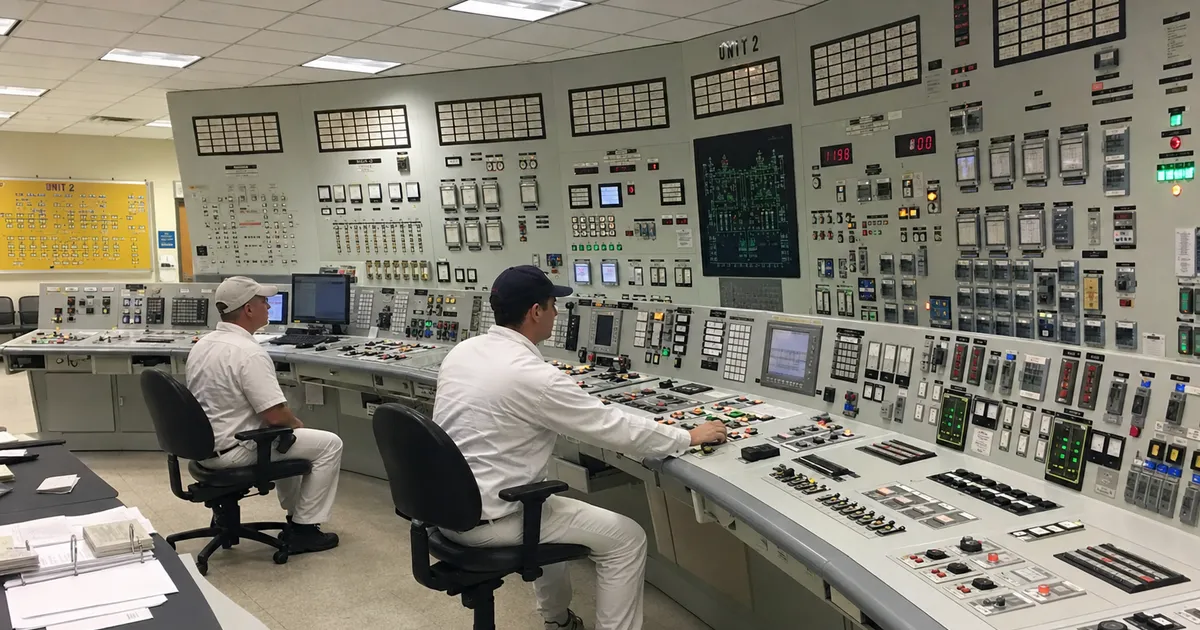
Your plant has decades of telemetry, maintenance records, and operating knowledge sitting in systems that cannot ship to a third-party cloud, and the experienced engineers who hold that knowledge are at the margin of retirement. The deployment question is not whether AI helps. It is how to run models on-site, under the plant's own change control, and out of the safety path.
Artificial intelligence in a nuclear power plant means applying machine learning and generative AI to an industry where safety, compliance, and data control are non-negotiable. Unlike most industrial AI, nuclear AI runs inside a closed environment: on hardware at the plant, under the rules of the U.S. Nuclear Regulatory Commission (NRC), and separated from the systems that keep the reactor safe.
That separation is the whole story. The use cases are real and the data is abundant, but the deployment model is forced by regulation. This guide explains why nuclear is different, where AI fits, the hard constraints a plant leadership team must plan around, and a phased path from pilot to production.
Deployment options at a glance
A plant's deployment options narrow quickly, because the constraint is not the model but the boundary. The modes are compared at a glance below, and the on-premises, private VPC, and air-gapped topologies are covered in Sovereign AI Architecture.
| Deployment mode | Where it runs | Data egress | Fit for a plant |
|---|---|---|---|
| On-site on-premises AI | At the plant, connected internal network | No external egress | Document retrieval, shift assistant, forecasting, anomaly detection |
| Air-gapped AI | Physically isolated, no external connectivity | None, updates on controlled media | Workloads that must not cross any network boundary |
| Private cloud or dedicated VPC | Isolated tenant, vendor-operated | Egress to the vendor platform | Rarely a fit; plant data must not leave the site |
| Public cloud AI | Vendor cloud | Full external egress | Not a fit for nuclear operational data |
Why nuclear is different
Nuclear is the most heavily regulated form of electricity generation in most countries. In the United States, the NRC licenses every plant and every change that affects safety. The agency took AI head-on in 2024, issuing SECY-24-0035, Advancing the Use of Artificial Intelligence at the U.S. Nuclear Regulatory Commission, on April 24, 2024, and appointing a Chief AI Officer with an AI Governance Board to manage the agency's own use of the technology (NRC, accessed 2026-09-05). A regulator that has an internal AI strategy gives a plant a concrete reference point for what the oversight side expects.
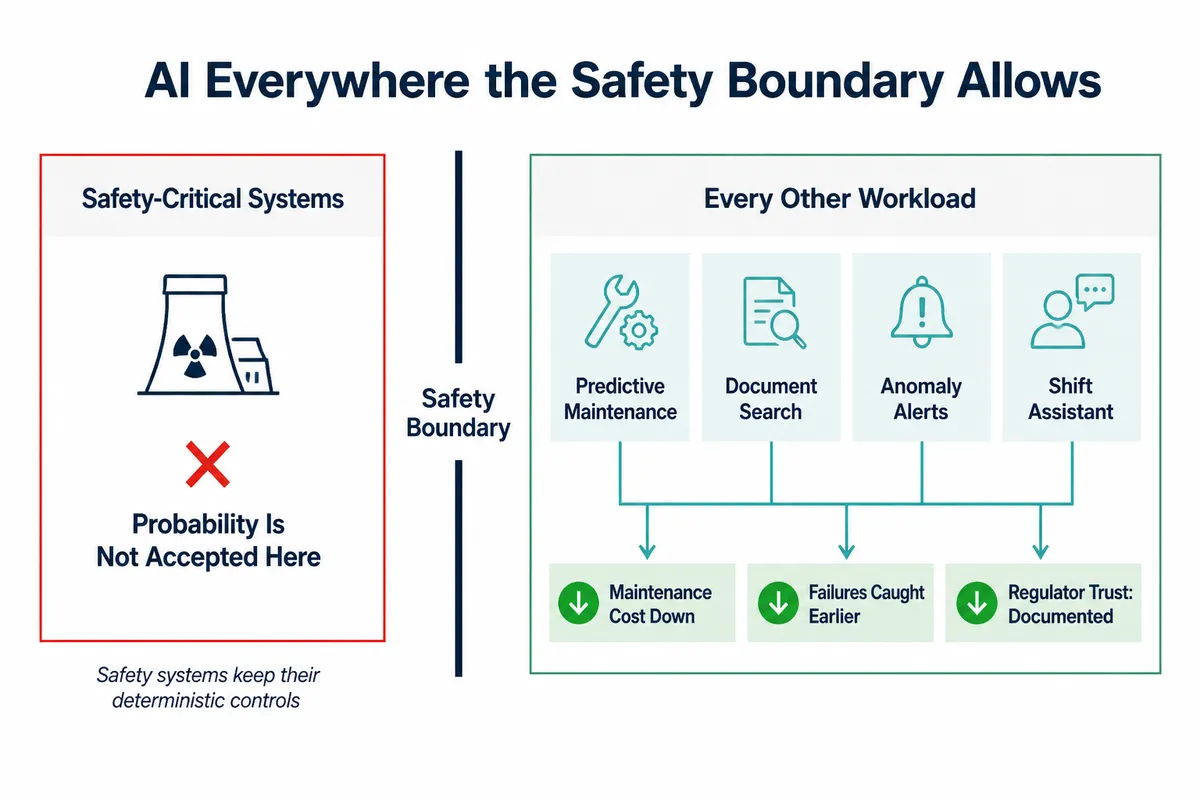
The first distinction every project must respect is the line between safety-critical and non-safety-critical systems. Reactor protection, shutdown signals, and safety actuators are safety-critical; everything a model touches should stay on the other side of that line. The NRC's Regulatory Guide 1.152, Revision 4, issued July 25, 2023, sets criteria for programmable digital devices in safety-related systems of nuclear power plants (Federal Register, 88 FR 47754, accessed 2026-09-05). In practice, an AI project in a plant is almost always positioned as non-safety-critical decision support, which keeps it out of the heaviest validation burden while still subject to the plant's change control.
The second difference is the data. As of the end of 2024, 417 reactors were operating in 31 countries, and the industry had accumulated roughly 20,200 reactor-years of operating experience across 653 reactors worldwide (IAEA, 2025). That is decades of telemetry, maintenance records, operating procedures, and event reports. The data is the asset; most plants already own it and have been generating it for thirty or forty years.
The third difference is the workforce. About 67% of the world's operating reactor capacity has been running for more than 30 years (IAEA, 2025). That is experienced knowledge at the margin of retirement, and plants are under pressure to transfer it. AI systems that surface procedure pages, prior events, and expert answers function as a knowledge-preservation layer, which is why document retrieval and shift assistance tend to be the first production deployments.
The fourth difference is reliability. Nuclear is the most consistently available source of electricity: the World Nuclear Association reported the global reactor fleet ran at an average capacity factor of 83% in 2024, higher than any other source of electricity (World Nuclear Association, 2025). When a unit is expected to run for years at a time, an unplanned outage is expensive, which is why equipment trend monitoring and anomaly detection carry direct financial value.
The use cases that make sense
Not every AI pattern fits. The cases that hold up are the ones that stay on the non-safety side of the line and run on data the plant already has.
Predictive maintenance of plant equipment
Turbines, pumps, and balance-of-plant equipment generate long histories of vibration, temperature, and pressure data. Models trained on that history can flag a component trending toward failure before it forces an outage. The output is an alert and a work-order recommendation, reviewed by a human engineer. This use case maps directly onto the reliability economics above: the value is avoiding an unplanned outage, which is where the cost of a nuclear plant is lost.
Operations and shift-assistant decision support
Operators make a continuous stream of small decisions against a body of procedures, technical specifications, and past events. A retrieval system that surfaces the relevant procedure page, the relevant prior event, and the applicable limit in seconds shortens the decision loop and reduces the time an operator spends searching. It does not make the decision. The human stays the decision-maker; the system makes the knowledge available faster.
Grid and energy forecasting
Nuclear plants are increasingly expected to interact more actively with the grid as variable renewable generation grows. Forecasting output, load, and market conditions helps a plant position its dispatch and manage the interface with the grid operator. This is a planning-layer workload: it informs decisions and never executes control actions in real time.
Document and compliance knowledge
This is where the industry has actually started. Federal and state rules require a plant to manage a very large body of technical documentation spread across multiple systems, and staff spend significant time retrieving it. On November 13, 2024, PG&E announced the first commercial deployment of on-site generative AI at a U.S. nuclear power plant: Atomic Canyon's Neutron Enterprise solution at Diablo Canyon, built to transform document search and retrieval (PG&E, accessed 2026-09-05). The system runs on eight NVIDIA H100 GPUs installed at the site, answering questions over millions of pages of NRC-regulated technical documents (CalMatters, accessed 2026-09-05). The fact that the first production nuclear AI deployment is a document system, not a control system, is telling: the constraint set shapes what ships first.
Anomaly detection in cooling and turbine systems
Cooling loops, condensers, and turbines produce dense multivariate signals. Models can learn the normal operating envelope and flag deviations that are early and subtle, outside the range a human watch would catch. The output is an alert, not an automatic action. Vendors have built this pattern into nuclear-specific platforms; Westinghouse's HiVE system and bertha generative AI model list anomaly and unusual-pattern detection as a core safety and security capability (Westinghouse, accessed 2026-09-05).
The hard constraints
The constraints define the project more than the model does. Three of them are non-negotiable.
Non-safety-critical separation. Probabilistic models must remain out of the safety-related control path. Everything a model does must be reviewable, logged, and bounded, and the human stays the decision-maker for anything that crosses into operational control. This is not a best practice; it is the line the NRC's safety-criteria guides draw around programmable digital devices, and a plant's own safety organization will enforce it before the regulator does.
Data cannot leave the site. The operational data, maintenance records, and regulatory corpus belong to the plant and to the plant's environment. Shipping plant telemetry or a compliance document set to a third-party cloud service is not an engineering trade-off; for most operators it is disallowed by policy and contract. On-premise serving is effectively mandatory, which is why the Diablo Canyon deployment put its accelerators at the site rather than in a data center (CalMatters, accessed 2026-09-05).
Change control and validation. A model deployed in a plant is a change to a controlled environment. It needs versioning, an audit trail, and a validation story that a licensing and inspection process will accept. The commercial nuclear AI platforms point the way: the Westinghouse system ships with data encrypted in motion and at rest, private endpoints that block external access, centralized access control, automatic audit logging and data lineage, and alignment with the vendor's quality management system (Westinghouse, accessed 2026-09-05). That security and audit model is what a plant's engineering and licensing teams will ask any AI project to match.
A deployment model for a plant
The model that fits these constraints is an on-site deployment with no cloud egress. The accelerators live at the plant, the data lives at the plant, and model serving happens at the plant. A one-way data path in, with human-reviewed outputs, is the standard topology. The reference architecture has three zones. In the outer zone, non-safety-critical AI workloads: document retrieval, the shift assistant, forecasting, and anomaly detection. In the middle, the plant's operational data store and the model-serving stack, isolated from safety systems. In the inner zone, the safety-critical control systems, no AI runs at all, and no data flow from the AI stack crosses into that zone for control purposes.
For a team weighing build versus buy, the nuclear-specific systems already in the market are worth studying as a control-plane reference, even if a plant ends up building a more targeted deployment. The shared control patterns appear across the sovereign-AI lane: see regulated AI for the regulatory side, on-premise AI for the deployment patterns, and what is sovereign AI for the broader positioning, and climate and energy for the grid context, and the economics of running inference on owned hardware are worked through in Edge AI Infrastructure Transforms Enterprise Economics.
A phased path for plant leadership
A phased path keeps each step reviewable and reversible, which is what a regulated environment rewards. A plant leadership team can move through five stages.
Phase 1: Scope and baseline. Name the one or two workloads with the clearest, lowest-risk payoff. For most plants that is document and compliance retrieval, with equipment trend monitoring second. Define the non-safety-critical boundary in writing before any model is trained.
Phase 2: Stand up the on-site data foundation. Build the retrieval index over the plant's own document corpus and the telemetry store for the chosen equipment. This phase is mostly data engineering and access control, not modeling. It produces the audit trail and the data lineage that the later phases will need.
Phase 3: Pilot one use case behind a human. Run a single retrieval or shift-assistant workload in a supervised setting, with the human in the loop and every answer logged. Measure retrieval quality and operator trust, not model benchmarks. The pilot's output is evidence, not just a feature.
Phase 4: Validate and document for the regulator. Write up the validation story: what the model does, what it cannot do, the boundary that keeps it non-safety-critical, and the audit trail. Engage the NRC review path early rather than late. The agency has a stated AI strategy and a governance board, so there is a defined channel for this conversation (NRC, accessed 2026-09-05).
Phase 5: Extend and standardize. Add the second and third use cases, formalize the change-control process for models as for any software in a controlled environment, and standardize the serving and monitoring stack so each new workload is a configuration, not a new project. The model-operations discipline that keeps those standard workloads running is covered in MLOps: The Missing Piece in AI Infrastructure.
Use case, constraint, and deployment model
| Use case | Primary constraint | Deployment model |
|---|---|---|
| Predictive maintenance of plant equipment | Must stay out of the safety-related control path | On-site model over plant telemetry, alerting to a human |
| Shift-assistant decision support | Human must remain the decision-maker | On-site retrieval over the plant's document corpus, logged answers |
| Grid and energy forecasting | Planning-layer only, no real-time control action | On-site forecasting models over plant and grid data |
| Document and compliance knowledge | Data cannot leave the site | On-site generative AI, no cloud egress |
| Anomaly detection in cooling and turbine systems | Output is an alert, not an automatic action | On-site monitoring with unidirectional data flow |
The phased path and the table above describe the same reality from two directions: the value is in protecting availability and preserving knowledge, and the model that delivers it is one that runs on-site, stays out of the safety path, and answers to the plant's own change control. For a leadership team weighing whether to move, the on-premise constraint is the decisive one, and it is the reason a nuclear AI project is best approached as a controlled, phased deployment rather than a cloud pilot. A working reference for how on-site AI serving is structured is available at request a demo.
Last verified: 2026-09-05
Why Nuclear and Energy Operators Choose Shakudo to power their critical-infrastructure AI
-
Runs in the operator's own boundary
Shakudo orchestrates the AI stack on hardware at the plant, so operational data, models, and inference stay inside the site and no data leaves the facility.
-
Works offline and air-gapped
The orchestration and serving layers run with no external calls, so the workload operates where communications are restricted and model updates move on reviewed, controlled media.
-
Audit-ready, deterministic orchestration
Every run is logged with a version and a change-control trail, so a plant's engineering and licensing teams can match the model to the validation story the NRC review path expects.
-
Vendor-agnostic model serving
Model serving and the surrounding stack are composed from the components a plant selects, so the plant is not locked to a single vendor's opinionated platform.

Frequently asked questions
Can AI run fully offline at a nuclear site?
Yes. The first commercial on-site generative AI deployment at a U.S. nuclear power plant ran eight GPUs installed at the site rather than in a data center. A fully offline, air-gapped deployment is the strictest form, where model updates cross the boundary on controlled media.
What does sovereign mean for critical infrastructure like a nuclear plant?
It means the model, the data, and the serving infrastructure live inside the plant's own boundary, under the plant's change control, and stay out of the safety-related control path. Sovereignty here is a deployment architecture, not a cloud tier, and the human stays the decision-maker.
How does on-site serving handle latency and availability for operational workflows?
On-site serving keeps the request path inside the site, so there is no round trip to an external cloud, and the workload is isolated from the safety path. It is sized for the operational and planning-layer workloads, not for real-time control actions.
Who operates the stack after deployment?
The plant's own teams operate the on-site stack, with the model treated as a change to a controlled environment. Versioning, an audit trail, and a validation story the licensing and inspection process accepts are the operating baseline.