







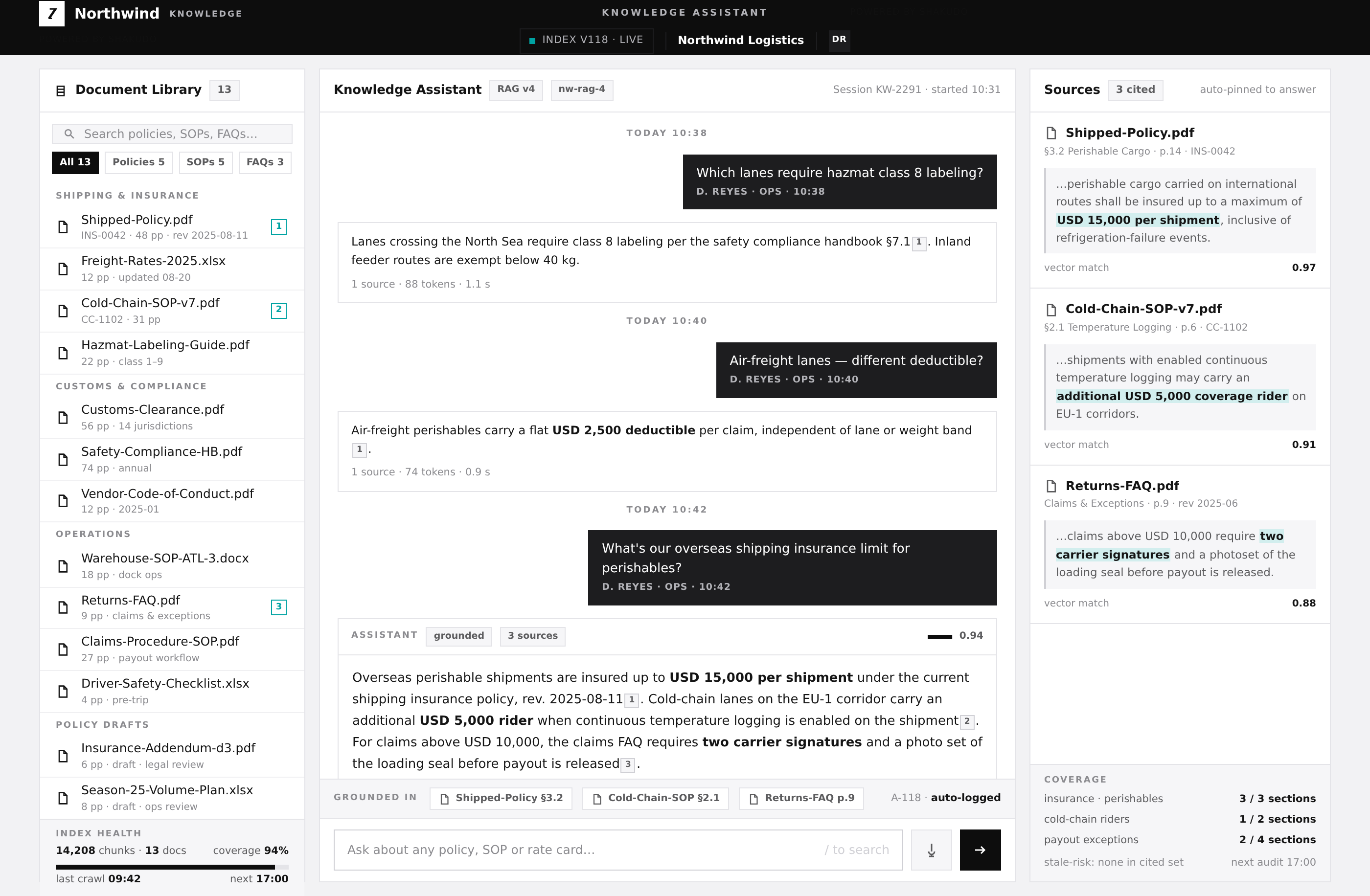
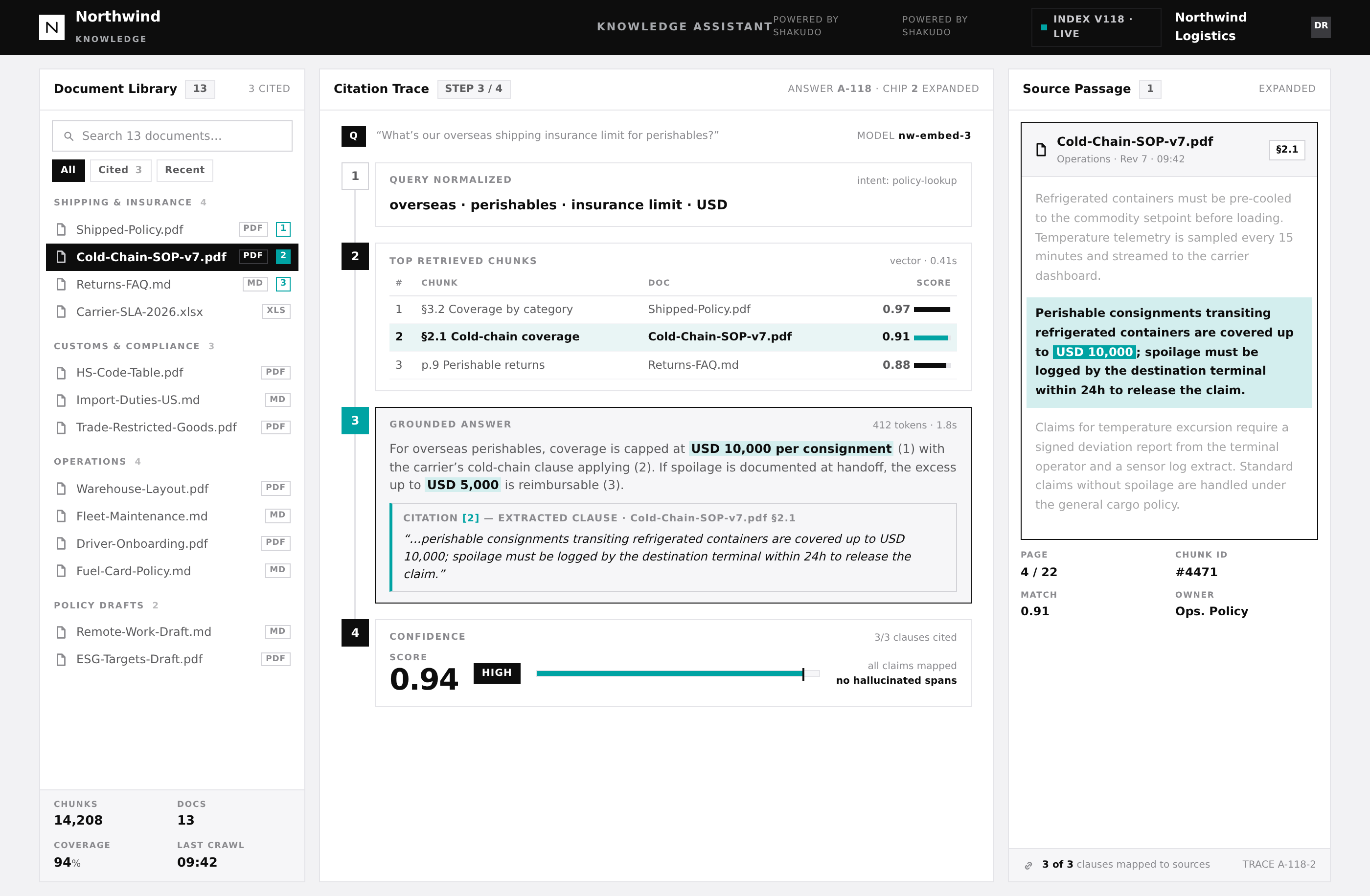
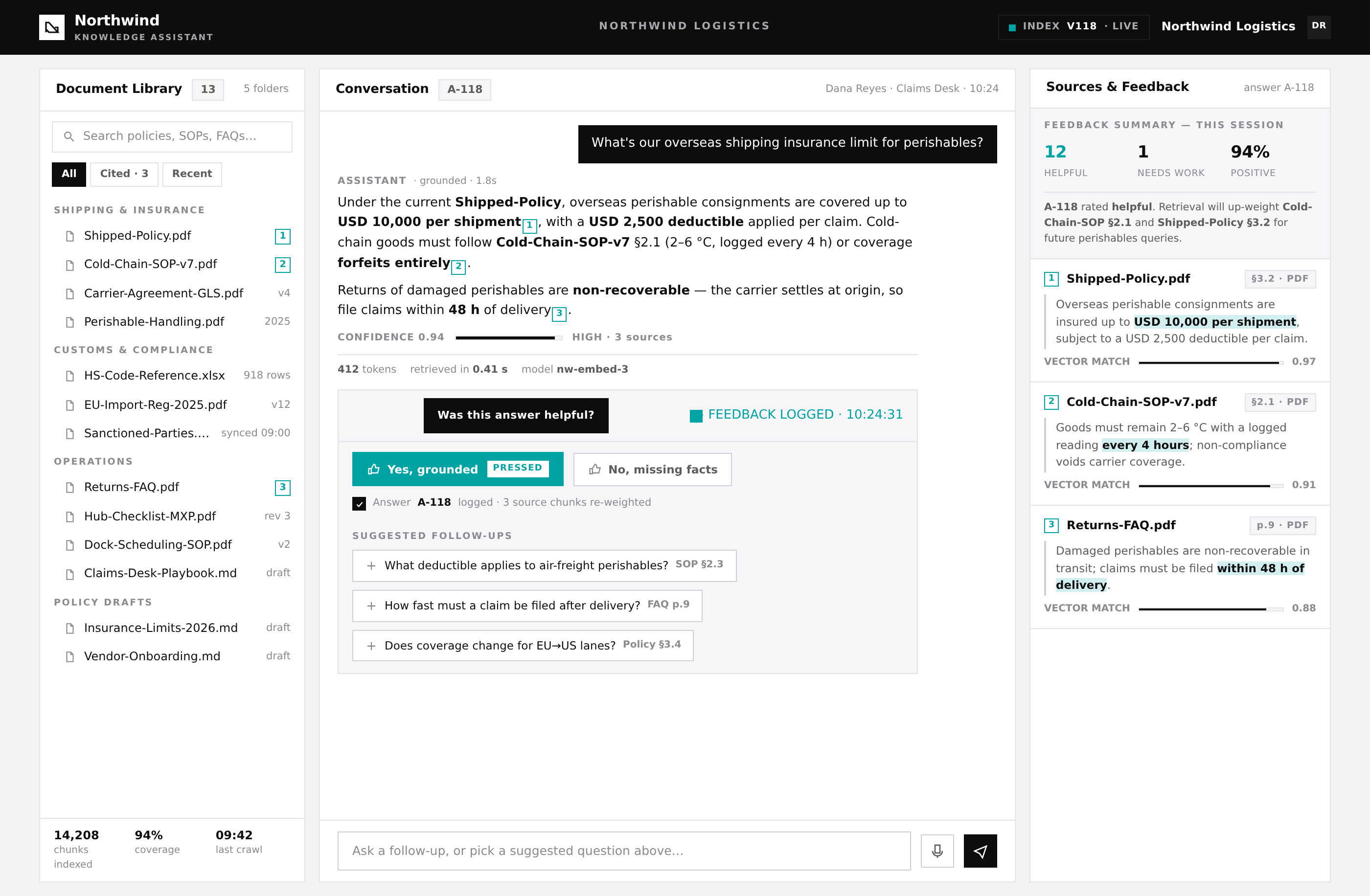
Three screens from a live run: the knowledge assistant, the citation trace, and answer follow-up.
1–2 / 3
Company knowledge lives in wikis, document stores, ticketing systems, and email. New hires spend weeks finding what veterans know by osmosis, and employees ask the same questions of the same experts repeatedly. An enterprise knowledge base assistant turns the sources a company already uses into answers, in plain language, with the source attached.
The cost shows up in operational terms. Onboarding takes longer because institutional knowledge lives in a dozen places. Experts get interrupted constantly with questions that should be self-serve. Decisions slip while someone digs for the policy, the procedure, or the prior decision. The knowledge exists; it is just hard to reach.
Evaluate candidates against four criteria. First, answers must be grounded in the company's own sources, with a citation on every response, so the buyer can test whether the assistant retrieves internal documents or general knowledge. Second, access control must follow the document owner's permissions, enforced at retrieval time. Third, the system must deploy inside the customer's environment, so corporate data never leaves it; security is the architecture. Fourth, there must be a real platform under the hood, one that keeps running after the engagement.
The assistant connects to the sources a company already uses, indexes them, and answers questions in plain language with sources attached. Shakudo deploys the full stack inside the customer's environment, from the data pipelines that pull content in to the retrieval layer and the assistant interface, and the platform keeps running after the engagement. The pattern is proven in production: a global winery runs its supply chain intelligence on an in-environment AI system built this way.
Four beats. Connect: scheduled data pipelines pull content from document stores, wikis, and structured sources. Index: content is chunked and embedded for semantic retrieval, alongside full-text search. Retrieve and answer: the assistant composes responses from retrieved passages, with citations, respecting each user's access. Integrate: the assistant surfaces in the chat tools and internal portals employees already use, so adoption needs neither a new login nor a new habit.
IT and knowledge management teams that own the company's information. Operations and finance teams that answer the same policy, procedure, and audit questions on repeat. Leadership that needs onboarding time and expert load reduced. Where the scope is right, a conversation with Shakudo is the fastest way to see what deployment in your environment would look like.
A qualifying assistant indexes the company's own sources, retrieves from them per question, and respects the same permissions as the underlying documents. The test is simple: does the answer cite internal sources, or does it answer from general knowledge.
The sources are connected with scheduled data pipelines, the content is indexed for semantic and full-text search, and the assistant retrieves from that index at query time. Access control is enforced at retrieval.
A chat assistant grounded in internal documents that answers with citations and permission checks. The value is in the retrieval and governance layer underneath. An assistant without that layer is a chat window with no source of truth.
Finance teams need answers from policies, procedures, and audit-relevant documents that are verifiable, so every answer carries a source. The assistant should run in the environment where the finance data lives, which is why deployment inside the customer's environment is the deciding criterion for that use case.
The deciding factor is deployment. A partner that builds the system inside your environment and leaves a working platform behind, rather than a hosted pilot that ends with the contract, is the one that can serve specialized domains where the data itself is the asset.
Yes. The assistant exposes the same indexed knowledge through the chat tools and internal portals employees already use, so adoption needs neither a new login nor a new habit. The index is the product; the chat window is one of its surfaces.
Shakudo deploys an enterprise knowledge base assistant inside the customer's own environment. The assistant connects to the sources a company already uses, answers questions in plain language with citations, and keeps running after the engagement, with corporate data never leaving the environment.










"What drew me in is simple. When developers ship production-ready code this quickly, how can I have environments spun up fast enough? Shakudo is how we close that gap."



"Shakudo does not just provide the platform. It is a real partnership. They are always there to help and execute our vision faster and the right way. It is like a co-team working together to achieve our goals."