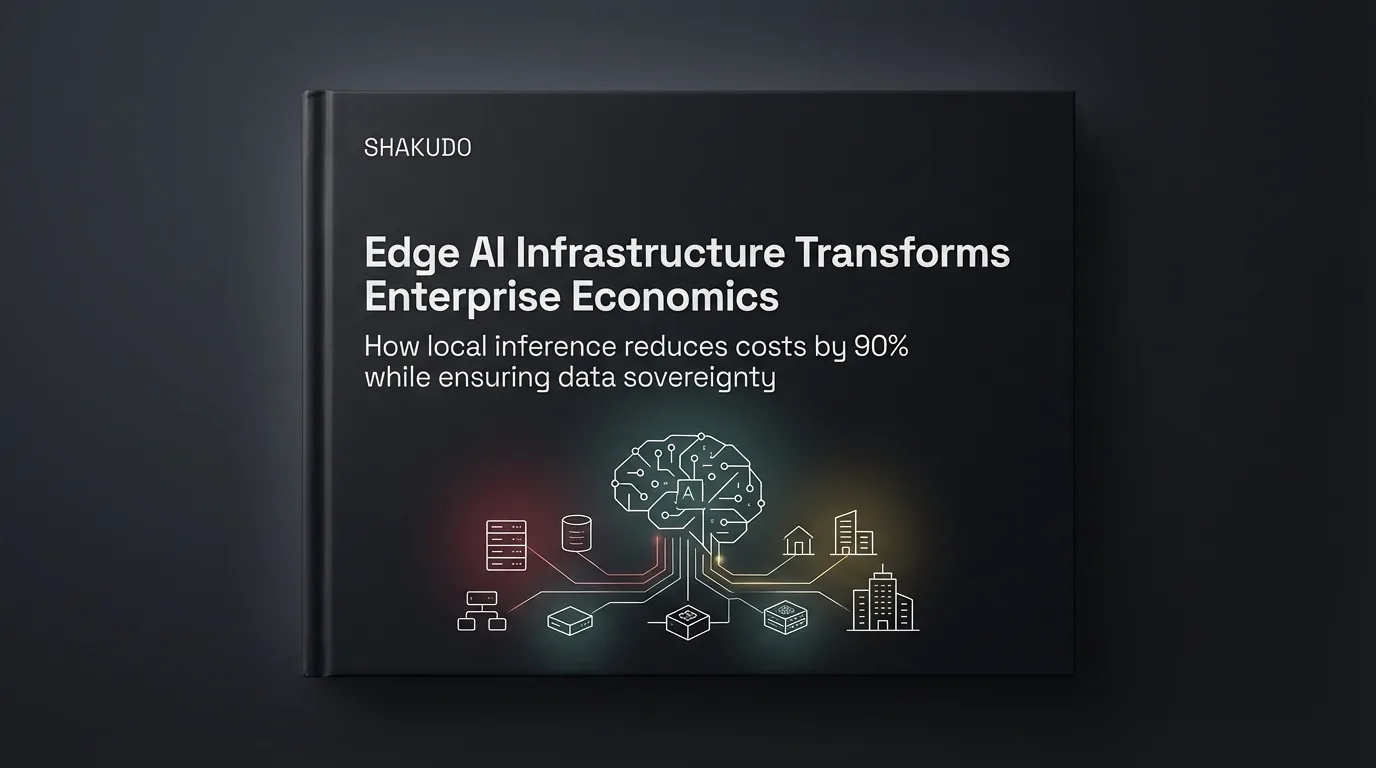
What if your AI infrastructure costs could drop 90% while simultaneously improving performance tenfold? As enterprises scale AI from pilot projects to production workloads processing millions of daily inferences, a critical gap emerges: cloud-based architectures that worked for experimentation become cost-prohibitive and performance-limited at scale. The path forward isn't incremental optimization—it's an architectural transformation that establishes competitive moats your rivals cannot easily replicate.
In this white paper, you'll discover:
- The unit economics transformation: Detailed cost modeling comparing cloud inference APIs versus edge infrastructure, including break-even analysis and ROI timelines for organizations at different scales
- Physics-based competitive advantages: How sub-10 millisecond edge latency enables entire categories of real-time applications—manufacturing automation, autonomous systems, instant customer experiences—that 200ms cloud round-trips physically cannot serve
- The regulatory arbitrage opportunity: Why complete data sovereignty through edge processing simplifies GDPR, HIPAA, and sector-specific compliance while competitors struggle with cloud data governance
- Implementation roadmap: Practical framework for migrating inference workloads to edge infrastructure, including model optimization techniques, hardware selection criteria, and hybrid architecture patterns
Download this white paper to understand how forward-thinking enterprises are restructuring their AI economics and establishing performance advantages that become increasingly difficult to replicate as workloads scale and regulations tighten.