






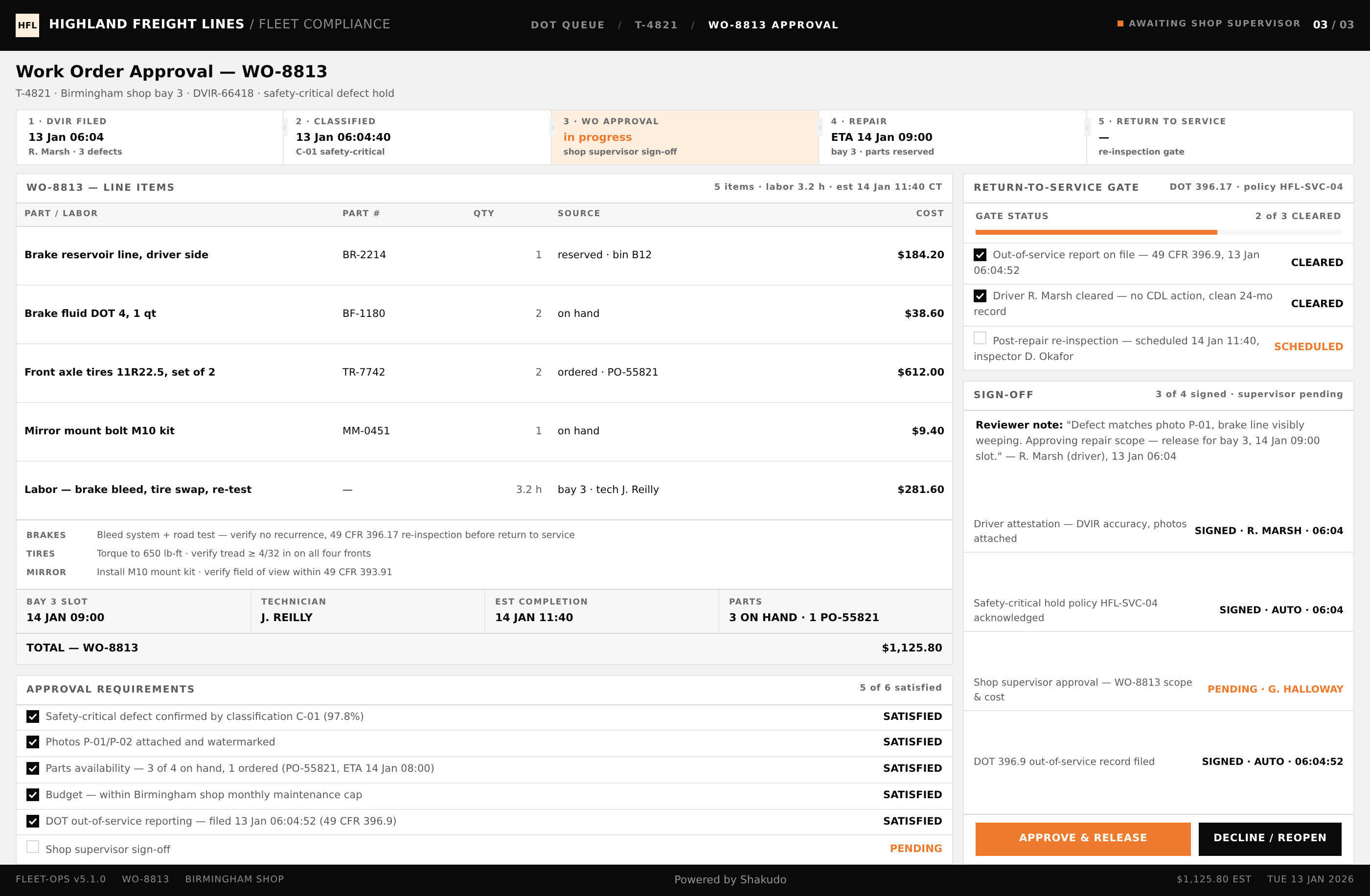
Three screens from a live run: the driver roster, the compliance check, and the record export.
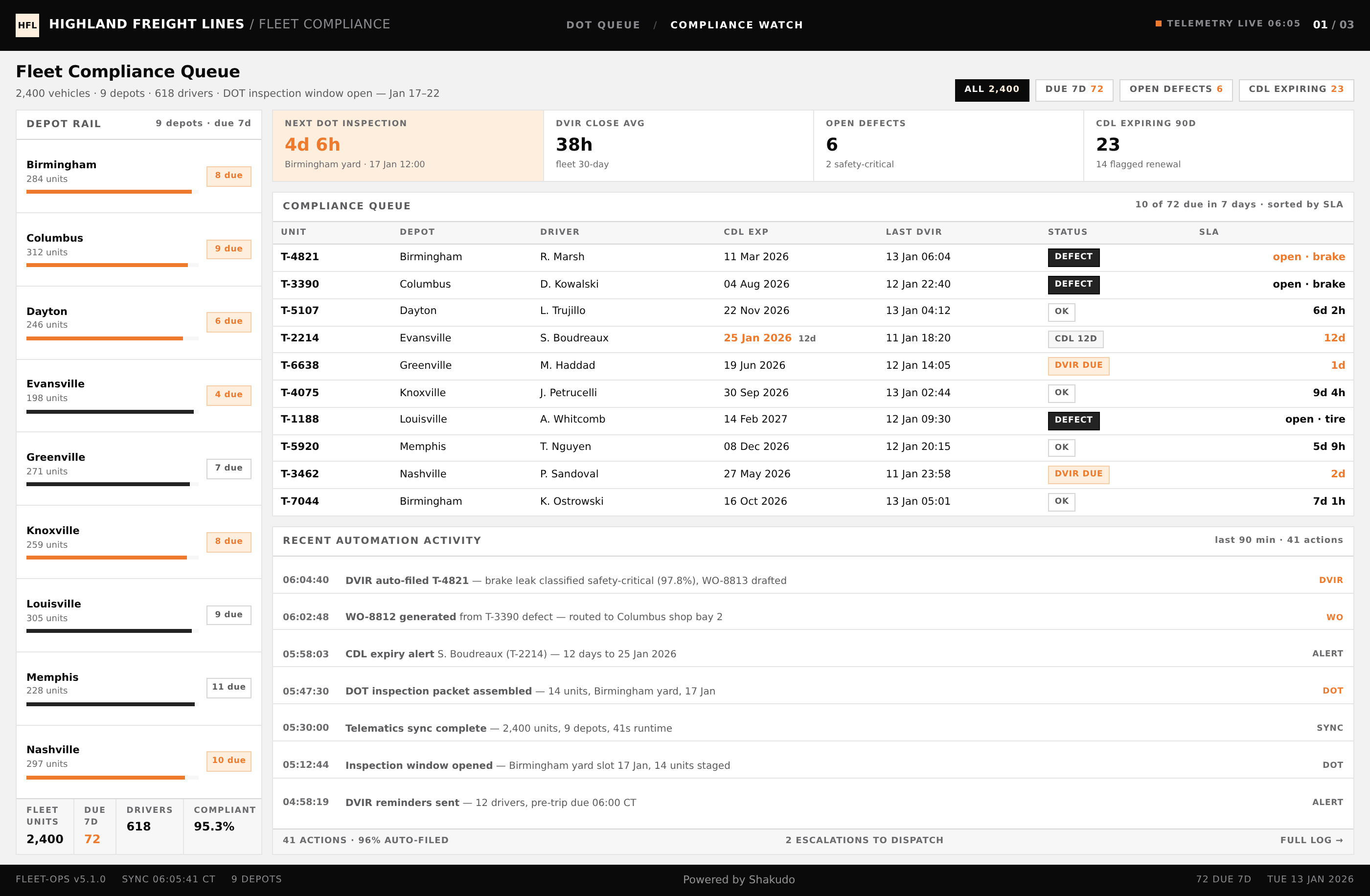
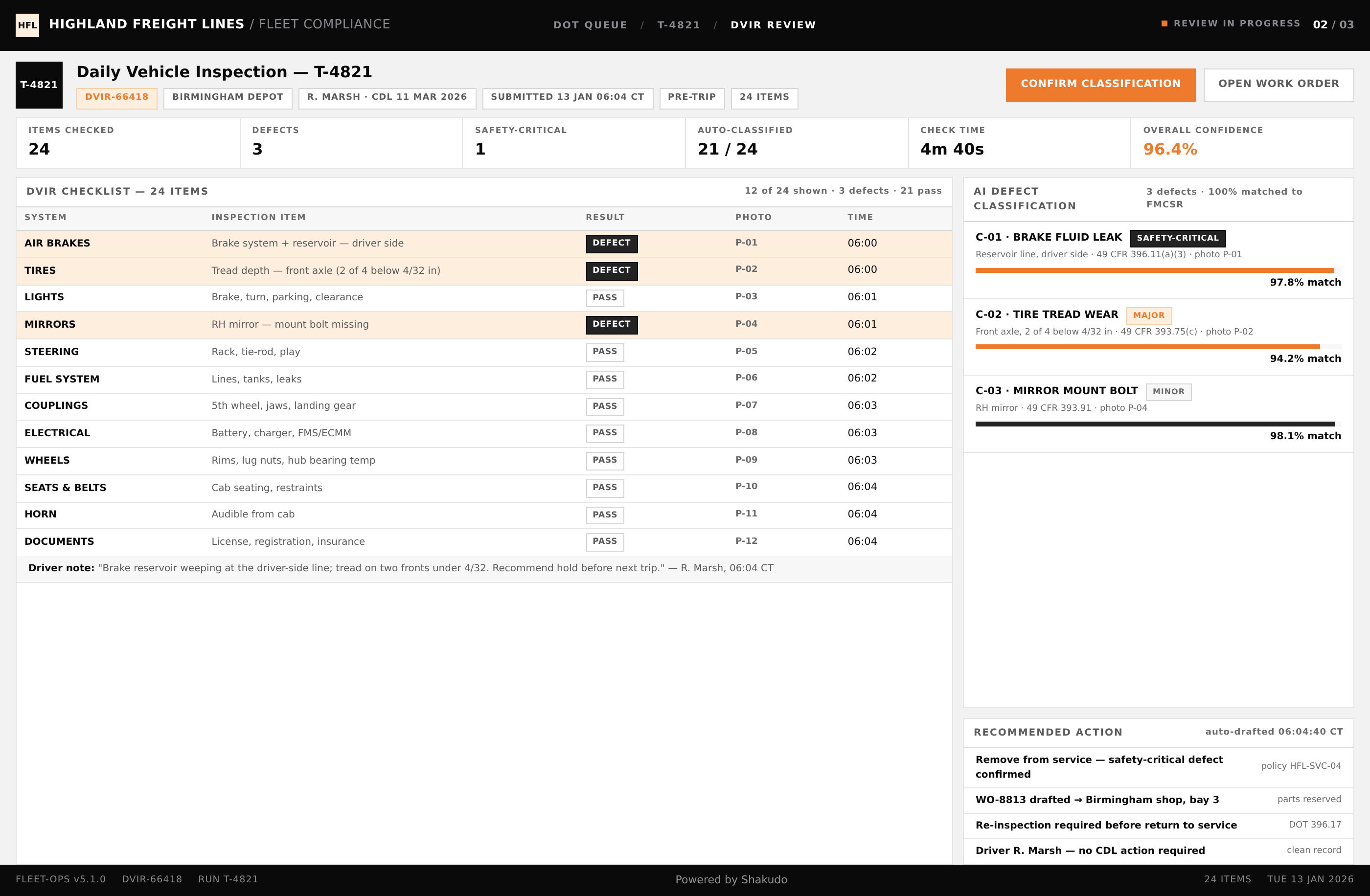
1–2 / 3
A single out-of-service vehicle event costs a commercial fleet an average of $16,000 in downtime, towing, repair, and freight rerouting. A fleet that tracks DOT compliance with paper logs and spreadsheets is not managing compliance. It is managing the risk of missing something until a roadside inspector finds it first.
The ELD mandate, in full enforcement since December 2019, requires most commercial drivers to maintain electronic records of duty status, and a poor CSA Vehicle Maintenance BASIC score follows the carrier for 24 months.
DOT compliance covers multiple overlapping regulatory areas. Hours of service rules limit driving time and require accurate records of duty status. Driver qualification files must stay current with CDL checks, medical certifications, and drug test records. Daily vehicle inspection reports need to capture defects and confirm repairs. IFTA fuel tax reporting adds another layer of quarterly paperwork.
Fleet safety teams typically manage these obligations with a patchwork of paper forms, shared spreadsheets, and manual data entry. Documents expire without warning. Roadside inspection findings pile up on paper. Onboarding new drivers drags across multiple signature steps. One missed renewal or unrecorded inspection is all it takes to trigger an out-of-service order. The cost is not just the fine. It is the downtime, the lost freight, and the reputational damage that follows a poor CSA score. A CSA Vehicle Maintenance BASIC score above the 65-point intervention threshold adds a 57 percent crash risk premium that follows the carrier for 24 months.
Shakudo delivers a compliance system that ingests telematics data, document submissions, and inspection results, then cross-references everything against DOT safety thresholds in real time. Records of duty status generate automatically from ELD data and flag potential hours of service violations before they occur. Driver qualification files stay current with automated reminders for medical certificate renewals, CDL expirations, and random drug test selections. The system continuously monitors CSA scores and alerts safety directors when a category approaches the intervention threshold. This shifts compliance from a reactive scramble after a violation to a proactive process that prevents issues before they reach an auditor.
The measurable outcomes from a deployed fleet: fewer compliance violations, faster audit preparation, and fewer out-of-service events. Safety teams spend less time on data entry and more time on the work that actually prevents accidents.
A transportation company deployed this compliance automation across its fleet to manage records of duty status, vehicle inspection reports, and driver documentation. The system integrated with existing ELD data streams and telematics feeds. N8n orchestrated the workflows that moved data between the ELD provider, document storage, and the compliance dashboard. Appsmith provided the interface where safety staff reviewed flagged items and approved corrective actions. For vehicle inspection reports, AI digitizes driver-submitted DVIRs, extracts defect descriptions, and routes urgent items to maintenance teams. Document classification models sort incoming paperwork into the right compliance category, reducing the manual sorting that consumes hours of safety team time.
Supabase stores the structured compliance data with full audit trails. Qdrant handles vector search across historical inspection reports and driver qualification documents, making it fast to retrieve relevant records during an audit. Ollama runs the language models that classify incoming documents and extract key fields from inspection forms without sending sensitive data to external APIs. Predictive violation detection analyzes patterns across the fleet to identify vehicles or drivers at elevated risk before a roadside inspection catches the problem.
This is built for the teams that own a fleet's regulatory record in trucking and commercial transportation: fleet safety directors, compliance officers, driver managers, and dispatchers. It fits fleets already on an FMCSA-registered ELD that want audit-ready records of duty status, vehicle inspection reports, and driver qualification files without a manual data entry layer, and safety teams that need evidence trails ready for a roadside inspection or an FMCSA audit.
The system manages records of duty status, driver vehicle inspection reports, driver qualification files, hours of service logs, and CSA score monitoring. It automates document collection, classification, and expiry tracking so nothing falls through the cracks before an audit or roadside inspection.
AI agents continuously analyze ELD data against current HOS rulesets. When a driver approaches a driving limit or needs a required rest break, the system flags the potential violation and alerts both the driver and safety dispatcher. This catches issues before they become roadside inspection violations.
Yes. The system integrates with most FMCSA-registered ELD platforms through their data APIs. It reads records of duty status and vehicle data from the existing ELD provider, so drivers do not need to learn a new device. The automation layer sits on top of the company's current tools.
A standard deployment takes weeks rather than the months a custom build would require. The platform connects to the company's ELD and telematics data, configures compliance rulesets for the operating authority, and sets up the driver qualification workflows. Safety teams can begin using the dashboard within days of going live.
When the goal is a fleet that stays audit-ready between inspections, a conversation with Shakudo is the fastest way to see it on your own data. The platform deploys on your own infrastructure, on-premises or in your cloud, and a first working compliance pipeline is in place within days. Book a demo to see it run on your ELD data.
DOT compliance demands constant attention to records of duty status, vehicle inspection reports, and driver qualification files. Manual tracking with paper logs and spreadsheets creates gaps that lead to violations and out-of-service orders. AI automation handles document collection, hours of service monitoring, and audit preparation so fleets stay road-ready.










"What drew me in is simple. When developers ship production-ready code this quickly, how can I have environments spun up fast enough? Shakudo is how we close that gap."


"Shakudo does not just provide the platform. It is a real partnership. They are always there to help and execute our vision faster and the right way. It is like a co-team working together to achieve our goals."