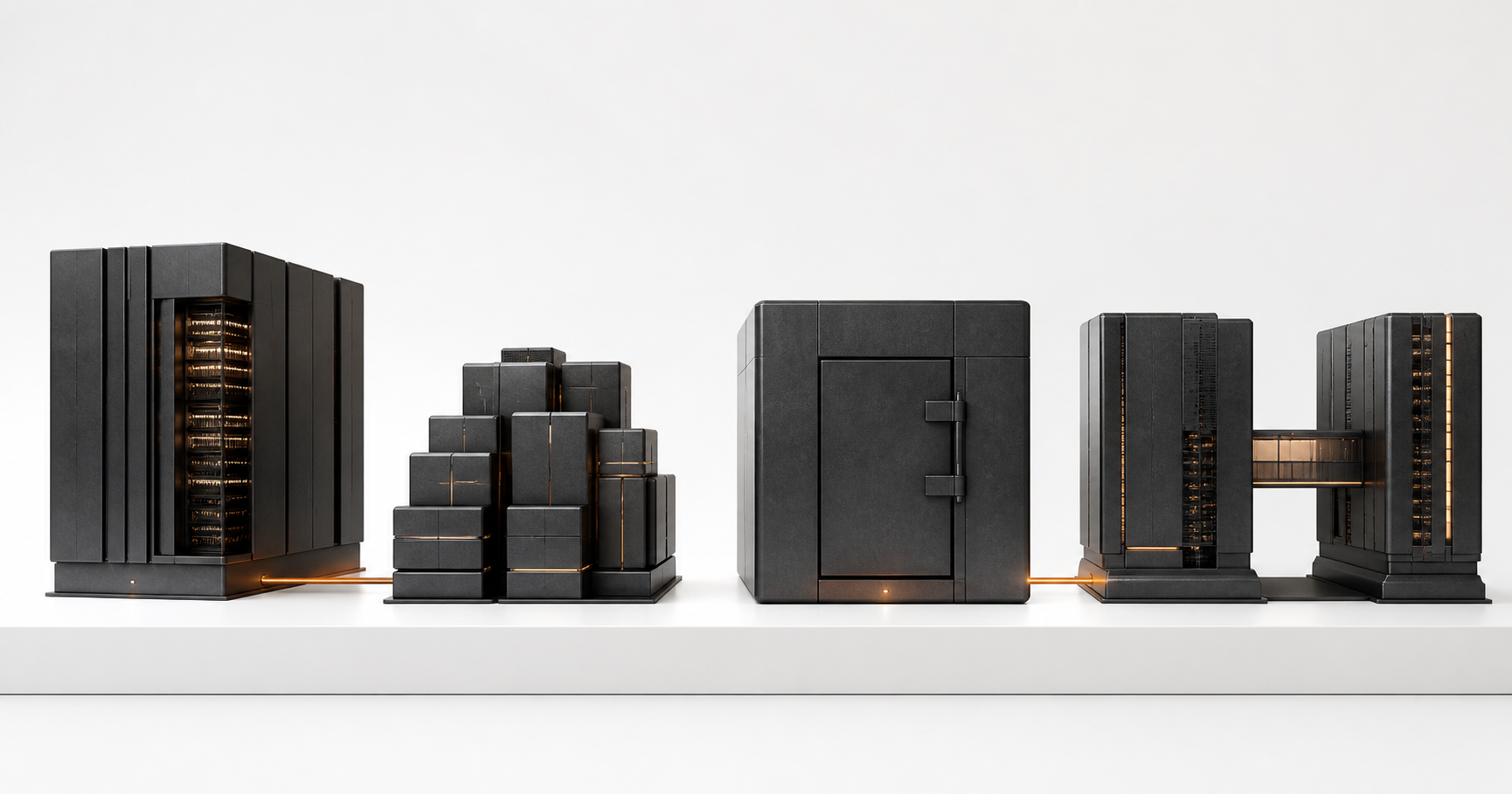

The phrase “sovereign AI architecture” does not identify one deployment pattern. It describes a set of control decisions: where data is processed, who operates the infrastructure, which models are available, what network paths are permitted, and how the organization proves that its policies are working.
That distinction matters because an on-premises environment is not automatically sovereign, a private VPC is not automatically private enough, and an air gap is not a substitute for governance. The right architecture depends on the workload, the consequences of exposure or downtime, the organization’s operating capability, and the controls it must demonstrate.
This guide compares four common patterns and gives business, compliance, and operations leaders a practical way to choose among them. For the underlying vocabulary, start with the sovereign AI glossary guide.
| Architecture | What it primarily controls | What it does not guarantee | Typical reason to choose it |
|---|---|---|---|
| On-premises | Physical location, hardware, network, and operating access | Correct policy, resilient operations, or model independence by itself | The organization needs direct control of infrastructure or must keep workloads in a controlled facility |
| Private VPC | Cloud account boundary, network segmentation, identity, and regional placement | That no vendor control plane, support path, or third-party service receives data | The organization wants strong isolation with more elastic infrastructure than its data center provides |
| Air-gapped | Network separation from defined external networks | That the isolated system is governed, current, recoverable, or free of local access risk | External connectivity is prohibited or the impact of a connection failure or data disclosure is exceptionally high |
| Hybrid | Workload placement and policy zoning across environments | That the boundaries between zones are correctly enforced | Different data classes and operating requirements need different levels of control |
The table is a decision aid, not a certification. Each pattern can be implemented well or poorly. The architecture should be described in terms of actual components, paths, identities, and responsibilities.

An on-premises deployment runs the relevant AI platform inside facilities controlled by the organization or its approved operating partner. The organization usually controls the servers, storage, network segmentation, physical access model, and maintenance window.

On-premises shifts responsibility toward the organization. That can be the right tradeoff when direct control is more valuable than elastic capacity, but the operating model must include patching, capacity planning, recovery, model updates, and accountable ownership.
Use this pattern when the control requirement is physical or jurisdictional, when the workload is stable enough to plan capacity, or when the organization already operates comparable critical systems. It is a poor fit when the business expects cloud-like elasticity but has not budgeted for the people and processes required to run the environment.
A private VPC deployment places the platform in an isolated network within a cloud account or subscription. The organization can usually define subnets, routing, identity, encryption, security groups, and regional placement while using cloud infrastructure for capacity and managed operations.
The key question is not whether the VPC is private in the cloud provider’s terminology. It is whether the full platform deployment, including upgrades, licensing, support, observability, and recovery, fits the organization’s control boundary.
Ask the vendor to label which components run inside the VPC and which remain outside it. Confirm the required egress paths, the identity that can use them, and the behavior when they are unavailable. A customer-owned VPC with an undisclosed external dependency can still create a sovereignty gap.
An air-gapped environment is separated from specified external networks. The exact definition varies by organization, so the policy must describe whether the environment has no physical connection, a controlled one-way transfer process, or a scheduled and inspected connection for updates.
Air-gapped AI also changes the model lifecycle. Teams need a controlled process for importing model weights, container images, security updates, evaluation data, and license material. They need to verify provenance before an artifact enters the environment and to record who approved the transfer.
Not every strict workload needs a fully disconnected facility. A virtual air gap can provide policy-enforced isolation inside a connected environment when the organization’s requirements allow controlled connectivity. The distinction should be made by risk and policy, not by marketing language.
A hybrid architecture assigns workloads to different environments according to sensitivity, latency, availability, and operating requirements. A highly restricted model or data class may stay on-premises or air-gapped, while approved workloads run in a private VPC. The two zones are connected only through explicitly governed interfaces.
Hybrid is often the most realistic pattern, but it is also easy to describe vaguely. Draw the zones and the allowed flows. Define whether information can move from a restricted zone to a less restricted one, in what form, under whose approval, and with what record. If the answer is not explicit, the architecture is not ready.

Use this matrix to narrow the options. Choose the first pattern that meets the non-negotiable requirement, then compare operational and commercial tradeoffs.
| If the primary requirement is… | Start with… | Confirm before committing |
|---|---|---|
| Data and model processing must remain in an owned facility | On-premises | Capacity, recovery site, physical access, and model-update process |
| Strong isolation is required but cloud elasticity is valuable | Private VPC | Region, control-plane location, egress, support access, and provider dependencies |
| External connectivity is prohibited | Air-gapped | Artifact transfer, patching, recovery, monitoring, and administrator controls |
| Different data classes need different boundaries | Hybrid | Classification, routing, cross-zone controls, shared identity, and incident response |
| The organization has limited infrastructure operations capacity | Private VPC or a managed deployment in the approved boundary | Who operates the control plane and what happens when vendor access is unavailable |
| The workload must continue during external-service outages | On-premises or air-gapped | Local model serving, local observability, spare capacity, and recovery exercises |
This matrix should be paired with a workload inventory. Do not choose one architecture for every use case before classifying the information, actions, users, and availability requirements involved.
Regardless of the pattern, ask the same control questions:
Trace source data, retrieved context, prompts, responses, embeddings, caches, logs, backups, support artifacts, and deletion requests. Enterprise data sovereignty provides useful context for separating storage location from legal and operational control.
Identify the people and services that can change a model, policy, route, connector, permission, or log-retention setting. Require named identities, approval paths, and evidence of the change.
Define the behavior when the vendor endpoint, cloud control plane, identity provider, update repository, or one of the connected zones is unavailable. A sovereign architecture should fail in a known way, with a recovery path that the organization has tested.
Record how an update is evaluated, approved, transferred, installed, rolled back, and attributed. This is especially important for air-gapped environments, where the process cannot depend on an ordinary online package flow.
A compliance review needs more than a diagram. Define which records prove data access, policy decisions, model versions, administrator actions, exceptions, incidents, and recovery tests.
Choose one business workflow and document its data, users, outputs, actions, retention, and failure consequences. Start with a bounded process that has a clear owner rather than a vague “enterprise AI” objective.
Write down where data, models, logs, keys, backups, and support activity may occur. State which connections are allowed, which are blocked, and what approval is required for an exception.
Use the matrix above to choose an initial pattern. If the answer is hybrid, define the zones and transfer rules before building the integration. If the answer is air-gapped, design the artifact and recovery process at the same time as the platform.
Run a representative request with synthetic or approved data. Observe the network paths, records created, model call, policy decision, and response. Then remove a dependency and confirm the system fails safely and recovers predictably.
Connect the platform to the organization’s identity model. Restrict data and tools by role. Add approval checkpoints for high-impact actions and record the reason for each exception.
Assign an owner, define support and escalation, monitor quality and availability, test backups, and rehearse model replacement. For agentic workloads, review the operational requirements in How to Deploy AI Agents On-Premise.
Record what the architecture controls, what it does not control, which assumptions remain open, and which evidence must be refreshed. Revisit the decision when the workload, jurisdiction, provider, model, or risk profile changes.
Architecture and platform selection should be evaluated together. A vendor may support on-premises deployment but require a cloud service for licensing or upgrades. Another may run in a private VPC but offer limited export or weak support for model substitution. These are procurement risks, not implementation details.
Use How to Evaluate Sovereign AI Platforms to score the platform across data, model, infrastructure, operations, governance, assurance, portability, and commercial risk. Use Seven Rules for Sovereign AI in 2026 to extend the discussion into policy, deployment, and compliance planning.
Ask each shortlisted provider to demonstrate the chosen architecture in the boundary where the workload will run. A generic cloud demo cannot prove an air-gapped process, and an architecture slide cannot prove that a private VPC deployment has no external dependency.
If you are comparing options for a regulated or critical-infrastructure workload, contact Shakudo with the environment, data class, and availability constraint. The useful starting point is the decision boundary, not a promise that one architecture is universally best.
On-premises gives direct infrastructure control. A private VPC gives isolated cloud capacity. An air gap limits external network paths. Hybrid assigns different workloads to different boundaries. None of these labels completes the sovereignty job by itself.
The durable architecture is the one your organization can explain, enforce, operate, recover, and prove. Choose the narrowest boundary the workload requires, then make every data path, model dependency, operator action, and recovery step visible.