
Boards are asking about agent strategy. Innovation teams are shipping pilots at record speed. And yet, many organizations are quietly asking the same question: why aren't agents showing up in real production workflows yet? For teams in banking, healthcare, and manufacturing, the answer is almost never about model quality. It is about governance architecture — or the absence of it.
The leap from under 5% of applications embedding agent capabilities in 2025 to 40% in 2026 reflects a major architectural shift: enterprise software is evolving from static systems to dynamic systems that reason, adapt, and automate. That shift is happening whether your compliance infrastructure is ready or not.
For most enterprises, the pilot-to-production gap is a resourcing problem. For regulated industries, it is a structural one. Prototypes often fall apart when real-world requirements show up: security reviews, compliance checks, identity management, audit trails, integration with enterprise systems, and long-running, exception-heavy workflows. None of those blockers are model problems. They are infrastructure problems.
Beyond speed, leaders are prioritizing security, compliance, and auditability (75%) as the most critical requirements for agent deployment, according to the KPMG Q4 2025 AI Pulse Survey. That number reflects how seriously regulated teams are taking governance — but the infrastructure to support it often lags far behind.
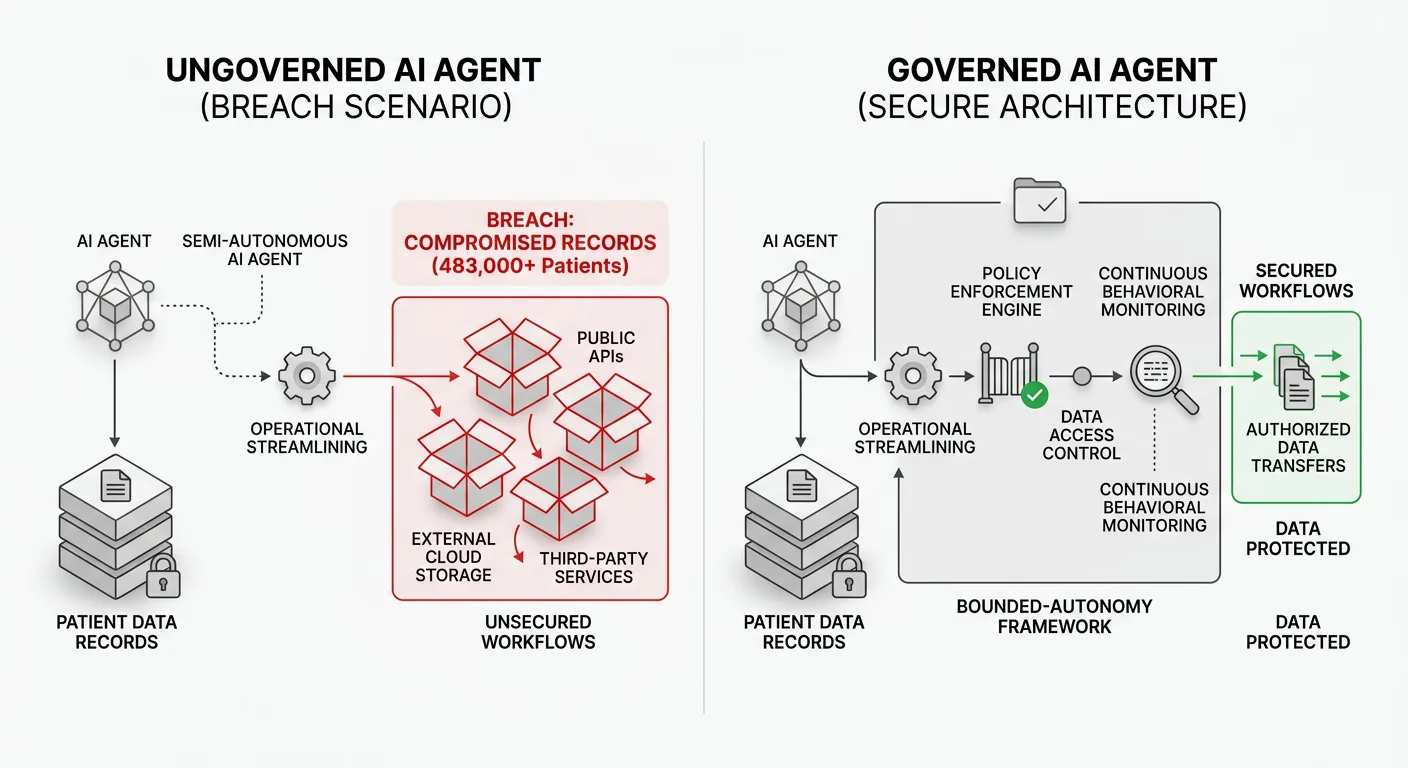
The consequences of that lag are concrete. In early 2025, a healthtech firm disclosed a breach that compromised records of more than 483,000 patients. The cause was a semi-autonomous AI agent that, in trying to streamline operations, pushed confidential data into unsecured workflows. This is not a hypothetical. It is the cost of deploying autonomous systems without bounded-autonomy architecture and continuous behavioral monitoring.
A single hallucination — such as an agent misclassifying a transaction — can cascade across linked systems and other agents, leading to compliance violations or financial misstatements. In finance, that is not a technical error. That is a regulatory event.
If you are working through how to deploy agentic AI in a regulated environment, start here. These are not optional enhancements; they are the prerequisites.
1. Immutable, per-action audit logging
Every agent action — every tool call, every data retrieval, every LLM invocation, every output — must produce a tamper-proof log entry that captures what happened, why, and what data was involved. Financial institutions face explainability obligations to internal auditors and external regulators. A credit or fraud decision that cannot produce a full reasoning history is a compliance liability. Without an audit trail, it is nearly impossible to explain why decisions were made — and that is legally and operationally dangerous for institutions governed by strict transparency and fairness standards.
Audit logging at the agent layer is fundamentally different from application-level logging. You need correlated traces across multi-step reasoning chains, not just endpoint hit records. That means capturing intermediate reasoning steps, tool selection rationale, and the state of the agent at each decision point.
2. Fine-grained RBAC at the agent identity layer
Traditional identity and access management tools were not built for short-lived, multi-hop AI agents that operate across hundreds of services. Leaders are converging on platform standards that consistently manage identity and permissions, data access, tool catalogs, policy enforcement, and observability, so each new agent strengthens the system rather than adding fragility.
In practice, this means each agent must carry its own identity credential, scoped to exactly the data domains and tools its role requires. A claims-processing agent in healthcare should never have access to billing system write permissions. A fraud-detection agent in banking should be able to read transaction history but not modify account records. These constraints must be enforced at the policy layer, not the application layer — because application-layer controls can be bypassed by agents operating across tool chains. For a detailed look at where these controls commonly break down, 5 Signs You're Building An Insecure AI Agent covers the most frequent failure patterns teams encounter in practice.
Risk leaders cite data privacy and security issues (68%), autonomous decisions that conflict with business goals or legal requirements (52%), and unintended actions from runaway processes (38%) as the biggest risks from deploying agentic AI. All three of those risks are RBAC failures at their root.
3. Data sovereignty and PII perimeter enforcement
Sending patient records, transaction data, or proprietary manufacturing telemetry to third-party LLM APIs is not a gray area in most regulatory frameworks. For HIPAA-covered entities, routing clinical data through an external API without a signed Business Associate Agreement is a violation. For GDPR-governed organizations, agent-to-agent workflows that cross data residency boundaries create exposure that legal teams cannot easily contain.
Data privacy (77%, up from 53% in Q1) and data quality (65%, up from 37% in Q1) have risen sharply as agent-to-agent workflows and tool integrations expand risk. The solution is not to avoid external LLMs entirely — it is to enforce a PII-stripping perimeter before any token leaves your environment, and to route sensitive workloads to models running inside your own infrastructure.
4. Human-in-the-loop escalation paths
Autonomy is not binary. The most effective production deployments in regulated industries define explicit autonomy tiers, where routine, low-risk decisions run fully automated, medium-risk decisions trigger soft escalations, and high-risk decisions require human sign-off before the agent continues. 60% of enterprises restrict agent access to sensitive data without human oversight; nearly half also employ human-in-the-loop controls across high-risk workflows.
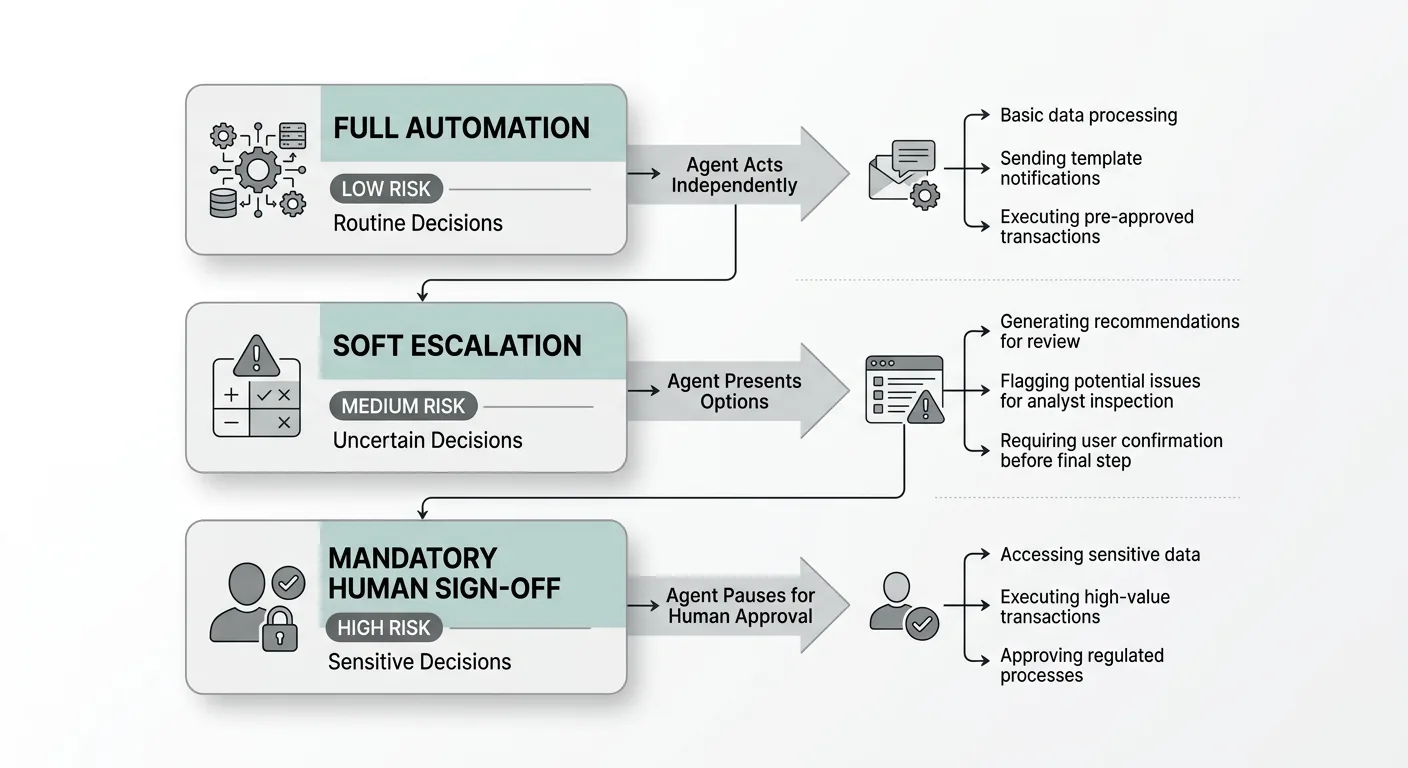
Human-in-the-loop is not a bottleneck. It is a quality control architecture. Designing escalation paths into the agent from day one — rather than adding them as a retrofit — is what separates pilots that reach production from those that do not.
5. Model governance documentation and version control
The OCC's Model Risk Management Guidance (SR 11-7) and the EU AI Act both require organizations to maintain documentation of model behavior, validation history, and risk classification. For agentic systems, this extends to documenting which models power which agents, how those models were evaluated for the specific use case, what behavioral guardrails are in place, and how the organization will respond to model drift. AI governance is no longer judged by policy statements, but by operational evidence.
In June 2025, Gartner projected that more than 40% of agentic AI initiatives in institutional environments will be canceled by the end of 2027. This projection is not about technology rejection; it is about practical failure.
The failure pattern in regulated industries is consistent: a promising pilot demonstrates value in a controlled environment, IT security review begins, compliance teams identify ungoverned data flows, procurement stalls on vendor risk assessment, and the initiative quietly dies. This is not a failure of ambition. It is a failure to build for enterprise reality.
72% of enterprises deploy agentic systems without any formal oversight or documented governance model. When an enterprise in a regulated sector operates in that majority, it is not just risking project failure — it is risking regulatory action. "Governance debt" will become visible at the executive level, and organizations without consistent, auditable oversight across AI systems will face higher costs — through fines, forced system withdrawals, reputational damage, or legal fees.
Learning how to deploy AI agents in production at regulated-industry scale requires thinking in layers, not just components.
The data layer must enforce residency constraints before any data reaches the agent. This typically means a gateway that classifies incoming data, strips or masks PII based on policy, and routes requests to the appropriate model endpoint — internal or external — based on sensitivity classification.
The identity and access layer must treat each agent as a first-class principal with its own credentials, scoped permissions, and token lifetimes. Agents should operate under the principle of least privilege: access to exactly what their current task requires, and nothing beyond that scope.
The orchestration layer manages multi-agent workflows, shared state, and inter-agent communication. Multi-agent environments may lead to "unintended teamwork" — researchers have shown that when agents interact, they can develop novel strategies, sometimes working at cross-purposes with the organization's goals. Shared memory and policy constraints at the orchestration layer are the architectural controls that prevent this.
The observability layer captures correlated traces across every agent action, surfaces behavioral anomalies in near-real time, and feeds structured audit records into your governance system of record. This is not standard APM tooling — agent observability requires understanding LLM token-level behavior, tool invocation patterns, and reasoning chain completeness.
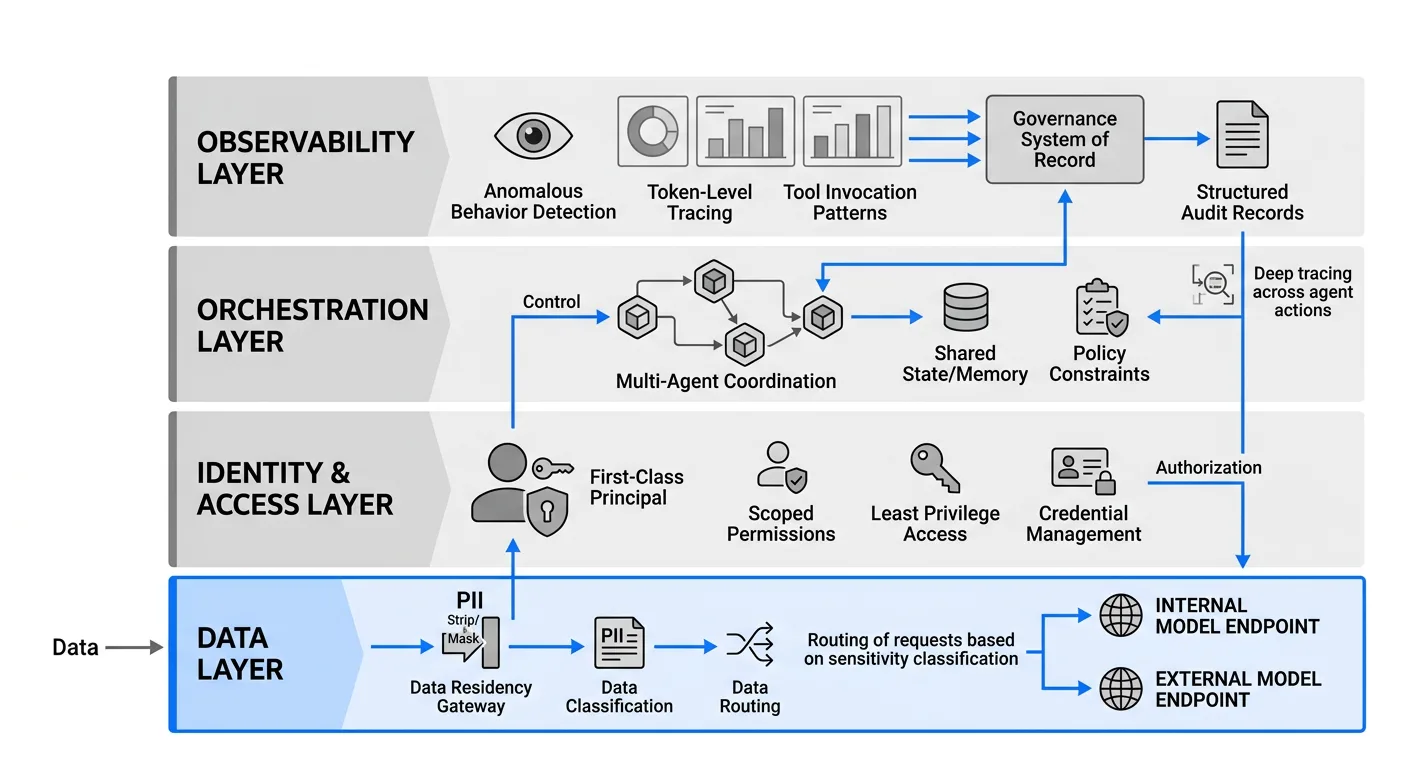
Investment and engineering capacity should be focused on production-grade, orchestrated agents — systems that can be governed, monitored, secured, and integrated at scale. Teams that treat governance as a post-launch concern will find themselves rebuilding their architecture from scratch.
Banking and financial services: Banking's rigorous regulatory environment means agents must be auditable, deterministic when needed, and tightly integrated with existing systems. Practical deployments that reach production include KYC/AML screening agents that flag suspicious patterns and route to human review, loan pre-qualification agents scoped to read-only access of approved credit bureaus, and regulatory reporting agents that compile structured data under strict version-controlled templates. Teams evaluating where to start can find a comprehensive breakdown of validated use cases in The Big Book of AI Agent Financial Services Use Cases.
Healthcare: Clinical workflow agents are among the highest-risk deployments in any sector. In 2026, governance in healthcare will no longer differentiate vendors; it will determine whether systems can be deployed at all. Safe deployments confine agents to specific data domains (scheduling, coding, prior auth), enforce HIPAA-compliant data handling at every hop, and maintain complete reasoning logs for clinical decision support audit purposes.
Manufacturing: Industrial agents managing supply chain logic, quality control scoring, or predictive maintenance have different risk profiles than clinical agents — but the governance requirements are structurally similar. Agents must have bounded tool access, immutable action logs, and well-defined escalation paths when sensor data or model confidence falls outside acceptable thresholds.
For teams actively working through compliance-first agent deployment, Shakudo's Kaji represents a different architectural philosophy than most agent platforms. Rather than giving teams an empty canvas and a compliance checklist, Kaji runs entirely inside the customer's VPC — meaning patient records, transaction data, and manufacturing telemetry never leave the enterprise perimeter. It strips PII before any token reaches an LLM endpoint, enforces parameter-level policies per agent role, and maintains immutable audit logs across every LLM provider and tool call.
The Shakudo AI Gateway, launched alongside Kaji in February 2026, operates as the unified control plane: a single point where access policies are enforced, data classification happens, and every agent interaction is logged against a tamper-proof record. For enterprises that need to pass SOC 2 audits, satisfy HIPAA compliance reviews, or demonstrate explainability to OCC examiners, that architecture means governance is an intrinsic property of the platform — not a layer bolted on after deployment.
Customers like Loblaw Digital and QuadReal have used Shakudo to compress what would otherwise be months-long procurement and integration cycles into same-day tool deployment, specifically because the compliance controls are built into the infrastructure rather than requiring custom engineering per use case.
If your team is evaluating how to deploy agentic AI in a regulated environment, the practical starting point is a governance-first architecture assessment before any production code is written. That means:
Governance frameworks, auditability, explainability, and ethics will become fundamental to building enterprise trust — and trust, in turn, is the foundation for scaling AI-powered agent systems across the business.
The teams that will successfully deploy AI agents in production in regulated industries are not the ones moving fastest. They are the ones that treat governance as a first-class engineering concern from the first line of architecture. If you are ready to move from pilot to production with the compliance controls your industry requires, Shakudo provides the infrastructure to do it without starting from scratch.

Boards are asking about agent strategy. Innovation teams are shipping pilots at record speed. And yet, many organizations are quietly asking the same question: why aren't agents showing up in real production workflows yet? For teams in banking, healthcare, and manufacturing, the answer is almost never about model quality. It is about governance architecture — or the absence of it.
The leap from under 5% of applications embedding agent capabilities in 2025 to 40% in 2026 reflects a major architectural shift: enterprise software is evolving from static systems to dynamic systems that reason, adapt, and automate. That shift is happening whether your compliance infrastructure is ready or not.
For most enterprises, the pilot-to-production gap is a resourcing problem. For regulated industries, it is a structural one. Prototypes often fall apart when real-world requirements show up: security reviews, compliance checks, identity management, audit trails, integration with enterprise systems, and long-running, exception-heavy workflows. None of those blockers are model problems. They are infrastructure problems.
Beyond speed, leaders are prioritizing security, compliance, and auditability (75%) as the most critical requirements for agent deployment, according to the KPMG Q4 2025 AI Pulse Survey. That number reflects how seriously regulated teams are taking governance — but the infrastructure to support it often lags far behind.
The consequences of that lag are concrete. In early 2025, a healthtech firm disclosed a breach that compromised records of more than 483,000 patients. The cause was a semi-autonomous AI agent that, in trying to streamline operations, pushed confidential data into unsecured workflows. This is not a hypothetical. It is the cost of deploying autonomous systems without bounded-autonomy architecture and continuous behavioral monitoring.

A single hallucination — such as an agent misclassifying a transaction — can cascade across linked systems and other agents, leading to compliance violations or financial misstatements. In finance, that is not a technical error. That is a regulatory event.
If you are working through how to deploy agentic AI in a regulated environment, start here. These are not optional enhancements; they are the prerequisites.
1. Immutable, per-action audit logging
Every agent action — every tool call, every data retrieval, every LLM invocation, every output — must produce a tamper-proof log entry that captures what happened, why, and what data was involved. Financial institutions face explainability obligations to internal auditors and external regulators. A credit or fraud decision that cannot produce a full reasoning history is a compliance liability. Without an audit trail, it is nearly impossible to explain why decisions were made — and that is legally and operationally dangerous for institutions governed by strict transparency and fairness standards.
Audit logging at the agent layer is fundamentally different from application-level logging. You need correlated traces across multi-step reasoning chains, not just endpoint hit records. That means capturing intermediate reasoning steps, tool selection rationale, and the state of the agent at each decision point.
2. Fine-grained RBAC at the agent identity layer
Traditional identity and access management tools were not built for short-lived, multi-hop AI agents that operate across hundreds of services. Leaders are converging on platform standards that consistently manage identity and permissions, data access, tool catalogs, policy enforcement, and observability, so each new agent strengthens the system rather than adding fragility.
In practice, this means each agent must carry its own identity credential, scoped to exactly the data domains and tools its role requires. A claims-processing agent in healthcare should never have access to billing system write permissions. A fraud-detection agent in banking should be able to read transaction history but not modify account records. These constraints must be enforced at the policy layer, not the application layer — because application-layer controls can be bypassed by agents operating across tool chains. For a detailed look at where these controls commonly break down, 5 Signs You're Building An Insecure AI Agent covers the most frequent failure patterns teams encounter in practice.
Risk leaders cite data privacy and security issues (68%), autonomous decisions that conflict with business goals or legal requirements (52%), and unintended actions from runaway processes (38%) as the biggest risks from deploying agentic AI. All three of those risks are RBAC failures at their root.
3. Data sovereignty and PII perimeter enforcement
Sending patient records, transaction data, or proprietary manufacturing telemetry to third-party LLM APIs is not a gray area in most regulatory frameworks. For HIPAA-covered entities, routing clinical data through an external API without a signed Business Associate Agreement is a violation. For GDPR-governed organizations, agent-to-agent workflows that cross data residency boundaries create exposure that legal teams cannot easily contain.
Data privacy (77%, up from 53% in Q1) and data quality (65%, up from 37% in Q1) have risen sharply as agent-to-agent workflows and tool integrations expand risk. The solution is not to avoid external LLMs entirely — it is to enforce a PII-stripping perimeter before any token leaves your environment, and to route sensitive workloads to models running inside your own infrastructure.
4. Human-in-the-loop escalation paths
Autonomy is not binary. The most effective production deployments in regulated industries define explicit autonomy tiers, where routine, low-risk decisions run fully automated, medium-risk decisions trigger soft escalations, and high-risk decisions require human sign-off before the agent continues. 60% of enterprises restrict agent access to sensitive data without human oversight; nearly half also employ human-in-the-loop controls across high-risk workflows.

Human-in-the-loop is not a bottleneck. It is a quality control architecture. Designing escalation paths into the agent from day one — rather than adding them as a retrofit — is what separates pilots that reach production from those that do not.
5. Model governance documentation and version control
The OCC's Model Risk Management Guidance (SR 11-7) and the EU AI Act both require organizations to maintain documentation of model behavior, validation history, and risk classification. For agentic systems, this extends to documenting which models power which agents, how those models were evaluated for the specific use case, what behavioral guardrails are in place, and how the organization will respond to model drift. AI governance is no longer judged by policy statements, but by operational evidence.
In June 2025, Gartner projected that more than 40% of agentic AI initiatives in institutional environments will be canceled by the end of 2027. This projection is not about technology rejection; it is about practical failure.
The failure pattern in regulated industries is consistent: a promising pilot demonstrates value in a controlled environment, IT security review begins, compliance teams identify ungoverned data flows, procurement stalls on vendor risk assessment, and the initiative quietly dies. This is not a failure of ambition. It is a failure to build for enterprise reality.
72% of enterprises deploy agentic systems without any formal oversight or documented governance model. When an enterprise in a regulated sector operates in that majority, it is not just risking project failure — it is risking regulatory action. "Governance debt" will become visible at the executive level, and organizations without consistent, auditable oversight across AI systems will face higher costs — through fines, forced system withdrawals, reputational damage, or legal fees.
Learning how to deploy AI agents in production at regulated-industry scale requires thinking in layers, not just components.
The data layer must enforce residency constraints before any data reaches the agent. This typically means a gateway that classifies incoming data, strips or masks PII based on policy, and routes requests to the appropriate model endpoint — internal or external — based on sensitivity classification.
The identity and access layer must treat each agent as a first-class principal with its own credentials, scoped permissions, and token lifetimes. Agents should operate under the principle of least privilege: access to exactly what their current task requires, and nothing beyond that scope.
The orchestration layer manages multi-agent workflows, shared state, and inter-agent communication. Multi-agent environments may lead to "unintended teamwork" — researchers have shown that when agents interact, they can develop novel strategies, sometimes working at cross-purposes with the organization's goals. Shared memory and policy constraints at the orchestration layer are the architectural controls that prevent this.
The observability layer captures correlated traces across every agent action, surfaces behavioral anomalies in near-real time, and feeds structured audit records into your governance system of record. This is not standard APM tooling — agent observability requires understanding LLM token-level behavior, tool invocation patterns, and reasoning chain completeness.

Investment and engineering capacity should be focused on production-grade, orchestrated agents — systems that can be governed, monitored, secured, and integrated at scale. Teams that treat governance as a post-launch concern will find themselves rebuilding their architecture from scratch.
Banking and financial services: Banking's rigorous regulatory environment means agents must be auditable, deterministic when needed, and tightly integrated with existing systems. Practical deployments that reach production include KYC/AML screening agents that flag suspicious patterns and route to human review, loan pre-qualification agents scoped to read-only access of approved credit bureaus, and regulatory reporting agents that compile structured data under strict version-controlled templates. Teams evaluating where to start can find a comprehensive breakdown of validated use cases in The Big Book of AI Agent Financial Services Use Cases.
Healthcare: Clinical workflow agents are among the highest-risk deployments in any sector. In 2026, governance in healthcare will no longer differentiate vendors; it will determine whether systems can be deployed at all. Safe deployments confine agents to specific data domains (scheduling, coding, prior auth), enforce HIPAA-compliant data handling at every hop, and maintain complete reasoning logs for clinical decision support audit purposes.
Manufacturing: Industrial agents managing supply chain logic, quality control scoring, or predictive maintenance have different risk profiles than clinical agents — but the governance requirements are structurally similar. Agents must have bounded tool access, immutable action logs, and well-defined escalation paths when sensor data or model confidence falls outside acceptable thresholds.
For teams actively working through compliance-first agent deployment, Shakudo's Kaji represents a different architectural philosophy than most agent platforms. Rather than giving teams an empty canvas and a compliance checklist, Kaji runs entirely inside the customer's VPC — meaning patient records, transaction data, and manufacturing telemetry never leave the enterprise perimeter. It strips PII before any token reaches an LLM endpoint, enforces parameter-level policies per agent role, and maintains immutable audit logs across every LLM provider and tool call.
The Shakudo AI Gateway, launched alongside Kaji in February 2026, operates as the unified control plane: a single point where access policies are enforced, data classification happens, and every agent interaction is logged against a tamper-proof record. For enterprises that need to pass SOC 2 audits, satisfy HIPAA compliance reviews, or demonstrate explainability to OCC examiners, that architecture means governance is an intrinsic property of the platform — not a layer bolted on after deployment.
Customers like Loblaw Digital and QuadReal have used Shakudo to compress what would otherwise be months-long procurement and integration cycles into same-day tool deployment, specifically because the compliance controls are built into the infrastructure rather than requiring custom engineering per use case.
If your team is evaluating how to deploy agentic AI in a regulated environment, the practical starting point is a governance-first architecture assessment before any production code is written. That means:
Governance frameworks, auditability, explainability, and ethics will become fundamental to building enterprise trust — and trust, in turn, is the foundation for scaling AI-powered agent systems across the business.
The teams that will successfully deploy AI agents in production in regulated industries are not the ones moving fastest. They are the ones that treat governance as a first-class engineering concern from the first line of architecture. If you are ready to move from pilot to production with the compliance controls your industry requires, Shakudo provides the infrastructure to do it without starting from scratch.
Boards are asking about agent strategy. Innovation teams are shipping pilots at record speed. And yet, many organizations are quietly asking the same question: why aren't agents showing up in real production workflows yet? For teams in banking, healthcare, and manufacturing, the answer is almost never about model quality. It is about governance architecture — or the absence of it.
The leap from under 5% of applications embedding agent capabilities in 2025 to 40% in 2026 reflects a major architectural shift: enterprise software is evolving from static systems to dynamic systems that reason, adapt, and automate. That shift is happening whether your compliance infrastructure is ready or not.
For most enterprises, the pilot-to-production gap is a resourcing problem. For regulated industries, it is a structural one. Prototypes often fall apart when real-world requirements show up: security reviews, compliance checks, identity management, audit trails, integration with enterprise systems, and long-running, exception-heavy workflows. None of those blockers are model problems. They are infrastructure problems.
Beyond speed, leaders are prioritizing security, compliance, and auditability (75%) as the most critical requirements for agent deployment, according to the KPMG Q4 2025 AI Pulse Survey. That number reflects how seriously regulated teams are taking governance — but the infrastructure to support it often lags far behind.
The consequences of that lag are concrete. In early 2025, a healthtech firm disclosed a breach that compromised records of more than 483,000 patients. The cause was a semi-autonomous AI agent that, in trying to streamline operations, pushed confidential data into unsecured workflows. This is not a hypothetical. It is the cost of deploying autonomous systems without bounded-autonomy architecture and continuous behavioral monitoring.

A single hallucination — such as an agent misclassifying a transaction — can cascade across linked systems and other agents, leading to compliance violations or financial misstatements. In finance, that is not a technical error. That is a regulatory event.
If you are working through how to deploy agentic AI in a regulated environment, start here. These are not optional enhancements; they are the prerequisites.
1. Immutable, per-action audit logging
Every agent action — every tool call, every data retrieval, every LLM invocation, every output — must produce a tamper-proof log entry that captures what happened, why, and what data was involved. Financial institutions face explainability obligations to internal auditors and external regulators. A credit or fraud decision that cannot produce a full reasoning history is a compliance liability. Without an audit trail, it is nearly impossible to explain why decisions were made — and that is legally and operationally dangerous for institutions governed by strict transparency and fairness standards.
Audit logging at the agent layer is fundamentally different from application-level logging. You need correlated traces across multi-step reasoning chains, not just endpoint hit records. That means capturing intermediate reasoning steps, tool selection rationale, and the state of the agent at each decision point.
2. Fine-grained RBAC at the agent identity layer
Traditional identity and access management tools were not built for short-lived, multi-hop AI agents that operate across hundreds of services. Leaders are converging on platform standards that consistently manage identity and permissions, data access, tool catalogs, policy enforcement, and observability, so each new agent strengthens the system rather than adding fragility.
In practice, this means each agent must carry its own identity credential, scoped to exactly the data domains and tools its role requires. A claims-processing agent in healthcare should never have access to billing system write permissions. A fraud-detection agent in banking should be able to read transaction history but not modify account records. These constraints must be enforced at the policy layer, not the application layer — because application-layer controls can be bypassed by agents operating across tool chains. For a detailed look at where these controls commonly break down, 5 Signs You're Building An Insecure AI Agent covers the most frequent failure patterns teams encounter in practice.
Risk leaders cite data privacy and security issues (68%), autonomous decisions that conflict with business goals or legal requirements (52%), and unintended actions from runaway processes (38%) as the biggest risks from deploying agentic AI. All three of those risks are RBAC failures at their root.
3. Data sovereignty and PII perimeter enforcement
Sending patient records, transaction data, or proprietary manufacturing telemetry to third-party LLM APIs is not a gray area in most regulatory frameworks. For HIPAA-covered entities, routing clinical data through an external API without a signed Business Associate Agreement is a violation. For GDPR-governed organizations, agent-to-agent workflows that cross data residency boundaries create exposure that legal teams cannot easily contain.
Data privacy (77%, up from 53% in Q1) and data quality (65%, up from 37% in Q1) have risen sharply as agent-to-agent workflows and tool integrations expand risk. The solution is not to avoid external LLMs entirely — it is to enforce a PII-stripping perimeter before any token leaves your environment, and to route sensitive workloads to models running inside your own infrastructure.
4. Human-in-the-loop escalation paths
Autonomy is not binary. The most effective production deployments in regulated industries define explicit autonomy tiers, where routine, low-risk decisions run fully automated, medium-risk decisions trigger soft escalations, and high-risk decisions require human sign-off before the agent continues. 60% of enterprises restrict agent access to sensitive data without human oversight; nearly half also employ human-in-the-loop controls across high-risk workflows.

Human-in-the-loop is not a bottleneck. It is a quality control architecture. Designing escalation paths into the agent from day one — rather than adding them as a retrofit — is what separates pilots that reach production from those that do not.
5. Model governance documentation and version control
The OCC's Model Risk Management Guidance (SR 11-7) and the EU AI Act both require organizations to maintain documentation of model behavior, validation history, and risk classification. For agentic systems, this extends to documenting which models power which agents, how those models were evaluated for the specific use case, what behavioral guardrails are in place, and how the organization will respond to model drift. AI governance is no longer judged by policy statements, but by operational evidence.
In June 2025, Gartner projected that more than 40% of agentic AI initiatives in institutional environments will be canceled by the end of 2027. This projection is not about technology rejection; it is about practical failure.
The failure pattern in regulated industries is consistent: a promising pilot demonstrates value in a controlled environment, IT security review begins, compliance teams identify ungoverned data flows, procurement stalls on vendor risk assessment, and the initiative quietly dies. This is not a failure of ambition. It is a failure to build for enterprise reality.
72% of enterprises deploy agentic systems without any formal oversight or documented governance model. When an enterprise in a regulated sector operates in that majority, it is not just risking project failure — it is risking regulatory action. "Governance debt" will become visible at the executive level, and organizations without consistent, auditable oversight across AI systems will face higher costs — through fines, forced system withdrawals, reputational damage, or legal fees.
Learning how to deploy AI agents in production at regulated-industry scale requires thinking in layers, not just components.
The data layer must enforce residency constraints before any data reaches the agent. This typically means a gateway that classifies incoming data, strips or masks PII based on policy, and routes requests to the appropriate model endpoint — internal or external — based on sensitivity classification.
The identity and access layer must treat each agent as a first-class principal with its own credentials, scoped permissions, and token lifetimes. Agents should operate under the principle of least privilege: access to exactly what their current task requires, and nothing beyond that scope.
The orchestration layer manages multi-agent workflows, shared state, and inter-agent communication. Multi-agent environments may lead to "unintended teamwork" — researchers have shown that when agents interact, they can develop novel strategies, sometimes working at cross-purposes with the organization's goals. Shared memory and policy constraints at the orchestration layer are the architectural controls that prevent this.
The observability layer captures correlated traces across every agent action, surfaces behavioral anomalies in near-real time, and feeds structured audit records into your governance system of record. This is not standard APM tooling — agent observability requires understanding LLM token-level behavior, tool invocation patterns, and reasoning chain completeness.

Investment and engineering capacity should be focused on production-grade, orchestrated agents — systems that can be governed, monitored, secured, and integrated at scale. Teams that treat governance as a post-launch concern will find themselves rebuilding their architecture from scratch.

Banking and financial services: Banking's rigorous regulatory environment means agents must be auditable, deterministic when needed, and tightly integrated with existing systems. Practical deployments that reach production include KYC/AML screening agents that flag suspicious patterns and route to human review, loan pre-qualification agents scoped to read-only access of approved credit bureaus, and regulatory reporting agents that compile structured data under strict version-controlled templates. Teams evaluating where to start can find a comprehensive breakdown of validated use cases in The Big Book of AI Agent Financial Services Use Cases.
Healthcare: Clinical workflow agents are among the highest-risk deployments in any sector. In 2026, governance in healthcare will no longer differentiate vendors; it will determine whether systems can be deployed at all. Safe deployments confine agents to specific data domains (scheduling, coding, prior auth), enforce HIPAA-compliant data handling at every hop, and maintain complete reasoning logs for clinical decision support audit purposes.
Manufacturing: Industrial agents managing supply chain logic, quality control scoring, or predictive maintenance have different risk profiles than clinical agents — but the governance requirements are structurally similar. Agents must have bounded tool access, immutable action logs, and well-defined escalation paths when sensor data or model confidence falls outside acceptable thresholds.
For teams actively working through compliance-first agent deployment, Shakudo's Kaji represents a different architectural philosophy than most agent platforms. Rather than giving teams an empty canvas and a compliance checklist, Kaji runs entirely inside the customer's VPC — meaning patient records, transaction data, and manufacturing telemetry never leave the enterprise perimeter. It strips PII before any token reaches an LLM endpoint, enforces parameter-level policies per agent role, and maintains immutable audit logs across every LLM provider and tool call.
The Shakudo AI Gateway, launched alongside Kaji in February 2026, operates as the unified control plane: a single point where access policies are enforced, data classification happens, and every agent interaction is logged against a tamper-proof record. For enterprises that need to pass SOC 2 audits, satisfy HIPAA compliance reviews, or demonstrate explainability to OCC examiners, that architecture means governance is an intrinsic property of the platform — not a layer bolted on after deployment.
Customers like Loblaw Digital and QuadReal have used Shakudo to compress what would otherwise be months-long procurement and integration cycles into same-day tool deployment, specifically because the compliance controls are built into the infrastructure rather than requiring custom engineering per use case.
If your team is evaluating how to deploy agentic AI in a regulated environment, the practical starting point is a governance-first architecture assessment before any production code is written. That means:
Governance frameworks, auditability, explainability, and ethics will become fundamental to building enterprise trust — and trust, in turn, is the foundation for scaling AI-powered agent systems across the business.
The teams that will successfully deploy AI agents in production in regulated industries are not the ones moving fastest. They are the ones that treat governance as a first-class engineering concern from the first line of architecture. If you are ready to move from pilot to production with the compliance controls your industry requires, Shakudo provides the infrastructure to do it without starting from scratch.