← Back to Blog

AI Agents in Regulated Industries

By:
No items found.
Updated on:
March 2, 2026

The enterprise AI agent rollout is no longer theoretical. Across healthcare systems, financial institutions, and government agencies, teams are deploying autonomous AI agents to automate complex workflows—and the productivity gains are real. What is also real: the majority of those deployments are architecturally incompatible with the regulatory frameworks those organizations are legally required to follow.

According to a PwC survey of 1,000 U.S. business leaders, 79% of organizations have adopted AI agents to some extent. Yet Deloitte's 2026 State of AI report finds that only 1 in 5 companies has a mature governance model for autonomous AI agents. That gap is not an academic concern. It is an active compliance liability, and in 2026, regulators are running out of patience.

The Core Architectural Problem

Most commercial AI agent platforms are designed cloud-first. Prompts, payloads, and retrieved context travel to third-party API endpoints to be processed by external large language models. For enterprises in unregulated industries, that works fine. For a hospital processing protected health information (PHI), a financial institution handling KYC records, or a government agency managing citizen data, it is frequently illegal.
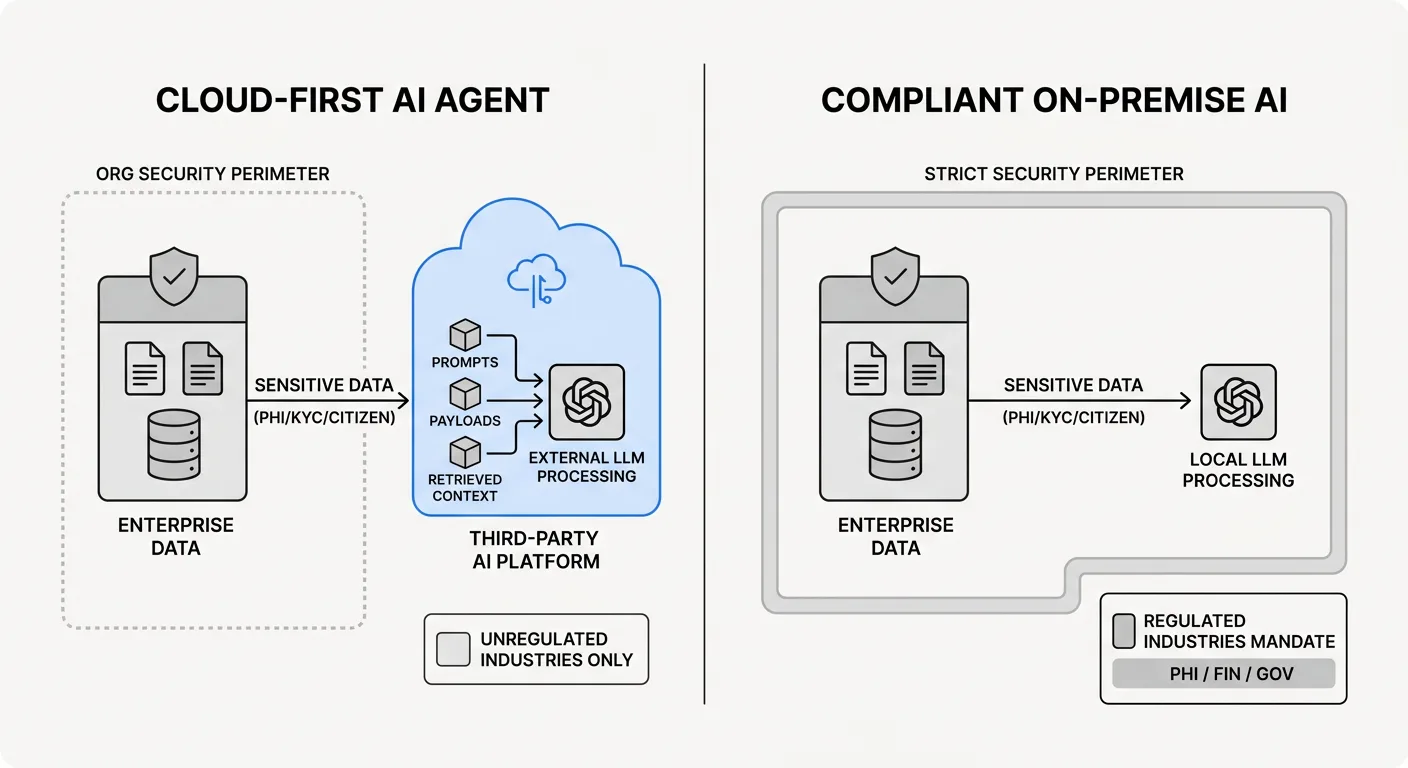
A split-diagram showing data flow in a cloud-first AI architecture versus a compliant on-premise architecture, highlighting where sensitive data (PHI, KYC, citizen data) leaks outside the organization's security perimeter in the cloud model.

HIPAA prohibits routing PHI through unapproved third-party processors without a valid Business Associate Agreement and strict data handling controls. GDPR restricts transferring personal data outside approved jurisdictions. CMMC and FedRAMP impose even tighter controls on data residency for federal contractors. Employees across all three sectors are already feeding sensitive data into unsanctioned tools: one recent survey found that 33% of workers admit to sharing enterprise research or datasets with unapproved AI applications, 27% reveal employee data, and 23% input company financial information into tools their IT teams have never reviewed.

The problem is not that AI agents are inherently unsafe. The problem is that the dominant deployment model creates a structural mismatch with how regulated data must legally be handled. Compliance becomes an afterthought requiring expensive rework rather than a property of the architecture itself. For teams evaluating ai agent compliance seriously, this distinction is everything—and it's why 7 reasons ChatGPT and Copilot put the enterprise at risk is a conversation more regulated-industry leaders are having before they approve any AI deployment.

The Shadow AI Crisis Is Already Here

Waiting for official AI deployment programs to catch up has not slowed employee adoption. It has pushed that adoption underground.

Nearly half of workers admit to adopting AI tools without employer approval, many using free versions and sharing sensitive enterprise data without understanding the implications. AI models that process and store corporate data may violate GDPR, HIPAA, and SOC 2, particularly when data handling policies are unclear or unenforced. Shadow AI can result in unintentional compliance breaches as companies struggle to track where data is being processed, stored, or used in AI workflows.

In regulated sectors, this dynamic also accelerates a second problem: orphaned agents. When individual teams deploy AI agent workflows without going through IT or security review, those agents can persist in production long after the original project ends, quietly accessing sensitive data stores with no audit trail, no monitoring, and no formal decommission process. A single agent accessing patient records or trading data through an unapproved API can constitute a reportable breach under HIPAA or SEC guidelines. The compliance exposure accumulates faster than most organizations realize.

The Regulatory Timeline Is Not Slowing Down

For enterprises hoping to buy more time, 2026 offers no relief.

The EU AI Act is fully applicable as of 2 August 2026, with prohibited AI practices already enforceable since February 2025 and governance rules for general-purpose AI models in effect since August 2025. Penalties for non-compliant high-risk AI systems reach up to €35 million or 7% of global annual turnover, whichever is higher—exceeding even GDPR penalty levels. The Act's extraterritorial reach mirrors the GDPR: any organization whose AI systems are used within the EU or produce outputs affecting EU residents must comply, regardless of where the organization is incorporated.
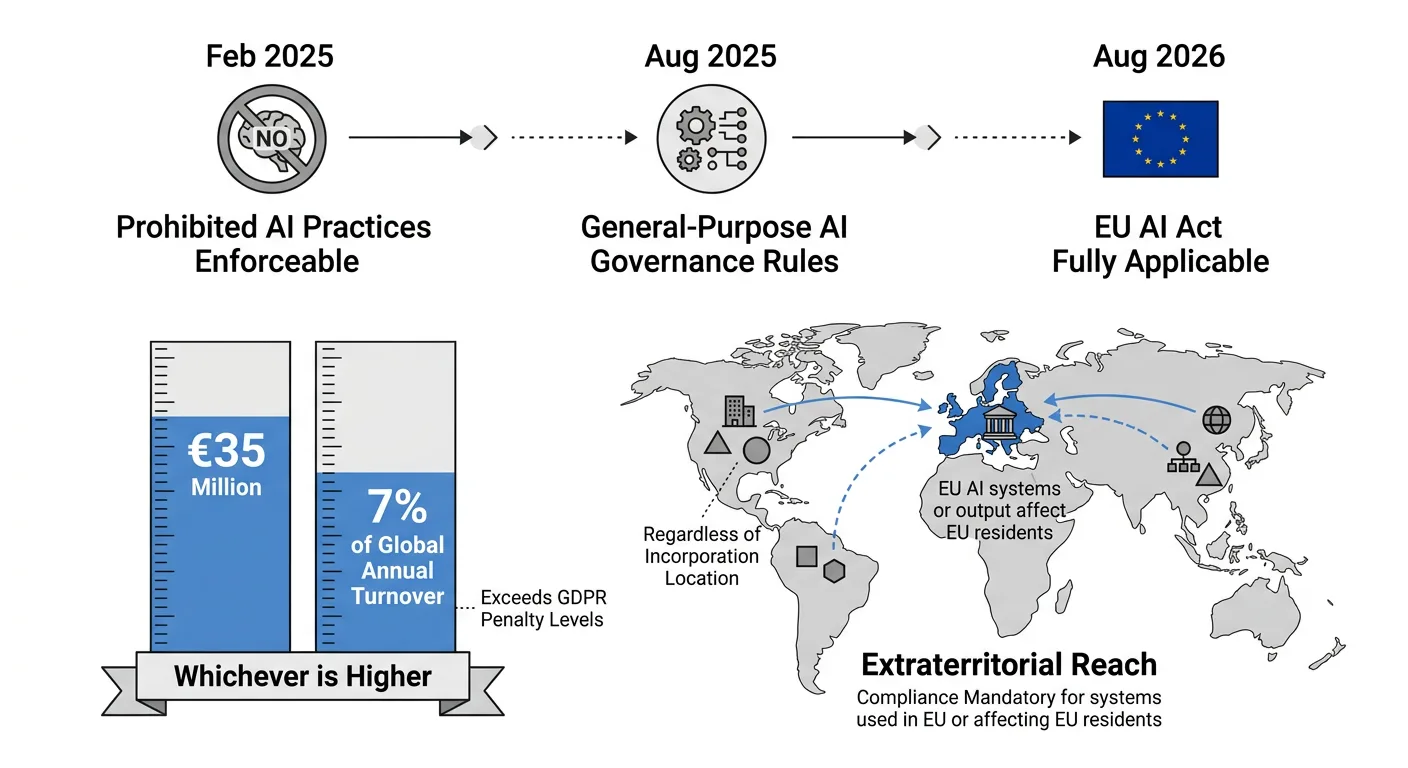
A regulatory timeline graphic showing key EU AI Act enforcement milestones from February 2025 through August 2026, with penalty thresholds displayed alongside a world map illustrating the law's extraterritorial reach.

On the healthcare side, HHS/OCR published a Notice of Proposed Rulemaking in January 2025 proposing the first significant revision to the HIPAA Security Rule in over a decade. The most consequential proposed change eliminates the distinction between "required" and "addressable" implementation specifications, making uniform security controls mandatory across the board. The 2025 Security Rule updates also made network segmentation mandatory and added 72-hour breach notification requirements, vulnerability scanning every six months, and annual penetration testing.

Add 18 active U.S. state privacy laws, updated Basel III guidance for financial institutions, SEC AI-related disclosure requirements, and international regimes including South Korea's AI Basic Act, and the compliance surface area for a mid-sized enterprise spans dozens of overlapping mandates simultaneously. Fragmented toolchains where different teams deploy different AI services in different regions make this problem exponentially harder to manage at audit time.

What a Compliant AI Agent Architecture Actually Looks Like

Building for ai agent compliance in regulated environments requires treating data sovereignty as a first-class architectural constraint, not a feature added later. Here is what that means in practice.


The data plane, where sensitive data lives and where agent queries execute, must stay inside your organization's VPC or on-premise infrastructure. External LLMs can be used for genuinely non-sensitive tasks, but PHI, financial records, and classified data should never leave your environment. Open-source models running on self-hosted inference (
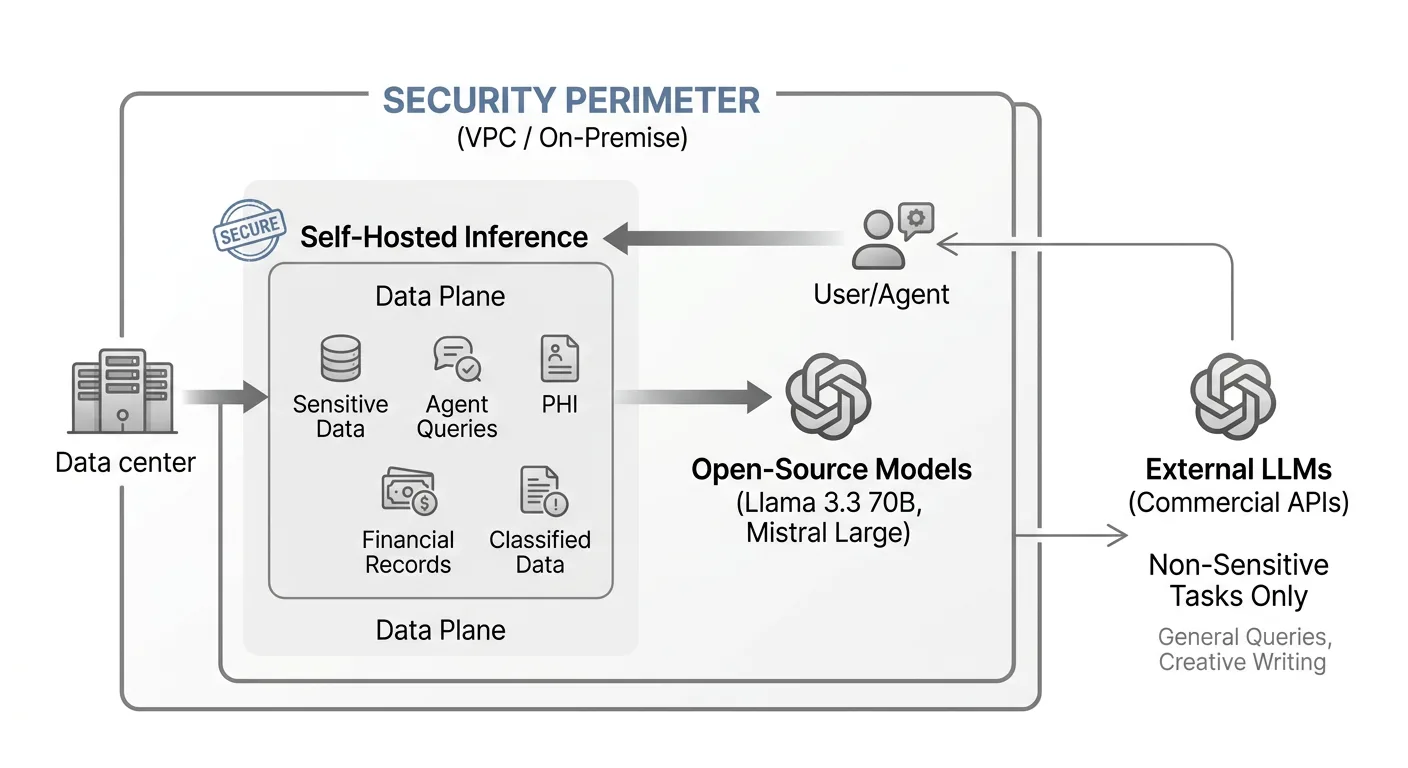
A network architecture diagram illustrating a secure VPC or on-premise perimeter with self-hosted LLM inference inside, clearly showing which data types stay within the boundary and where external APIs are only permitted for non-sensitive tasks.


The agent orchestration layer, where task planning, tool routing, and multi-step reasoning happen, should be architecturally distinct from the data retrieval layer. This separation lets you apply different security policies to different stages of an agent workflow and makes audit logging tractable. Every tool call, data access event, and agent decision should write to an immutable log tied to a specific user identity.


The HIPAA Minimum Necessary Standard requires that an AI agent be granted access only to the specific data fields required for its function, not to a patient's entire record. This principle of least-privilege access per agent function should be enforced programmatically through attribute-based access control, not through policy documents. Each agent in a multi-agent workflow should carry its own access scope, scoped to its specific task.


Before any prompt or retrieved context reaches an external model (if external models are used at all), a deterministic scrubbing layer should strip regulated identifiers. A properly designed agentic compliance framework integrates attribute-based access control for granular PHI governance alongside a hybrid sanitization pipeline combining rule-based and model-based detection to minimize leakage, coupled with immutable audit trails for compliance verification.


Autonomous execution is appropriate for low-risk, reversible tasks. For anything that modifies clinical records, initiates financial transactions, generates regulatory filings, or triggers irreversible downstream actions, the agent should pause and surface an approval request to a human before proceeding. This is not a UX preference. For regulated AI systems under the EU AI Act's human oversight requirements, it is an architectural obligation.


Financial services firms typically face 7-year audit log requirements. Healthcare organizations face 6-year retention under HIPAA. Government agencies may face even longer obligations depending on the classification of the data involved. The audit trail architecture must accommodate the most demanding regulatory obligation across your entire portfolio, with logs that are tamper-proof, identity-linked, and exportable for regulatory review on demand.

Industry-Specific Considerations

The core architecture above applies across regulated sectors, but the specific threat models and compliance obligations differ in ways that matter for implementation.

Healthcare. The primary risk is PHI leakage through agentic workflows that span clinical and administrative systems. Agentic AI systems are transforming workflows like medical report generation and clinical summarization by autonomously analyzing sensitive data with minimal human oversight, but that same autonomy demands strict HIPAA controls at every data access point. An ai agent for regulatory compliance in a hospital context must treat every data retrieval event as a potential PHI exposure and apply scrubbing and access controls accordingly. The 2025 HIPAA Security Rule updates add specific technical requirements around network segmentation and audit logging that directly constrain how agent infrastructure can be architected. For a closer look at how these patterns play out in practice, our guide to using agentic AI in healthcare covers the workflow and compliance considerations in detail.

Financial Services. Compliance risk in financial institutions spans transaction data, KYC records, model governance documentation, and now EU AI Act obligations for high-risk AI systems in the financial sector, which take effect August 2026. Unapproved AI models generating financial reports or credit recommendations create liability that extends beyond data privacy into model accountability and explainability requirements. An ai agent in a regulated industry context here must produce auditable reasoning chains, not just outputs.

Government. For federal contractors and agencies, FedRAMP authorization and CMMC compliance constrain not just data residency but the entire supply chain of AI tooling. Air-gapped deployments are frequently mandatory, ruling out cloud APIs entirely. The question of whether AI can be deployed on-premise is not a question in the government context. It is the only viable option, and the architecture must be validated against the specific control baseline of the applicable authorization program before a single agent goes into production.

Can AI Actually Run On-Premise?

This is the most common question from IT and compliance leaders evaluating ai agents for enterprise automation in regulated environments, and the answer in 2026 is unambiguously yes—with the right platform.

The practical barriers that existed two years ago have largely dissolved. Open-source model quality has reached commercial parity for most enterprise tasks. Agent frameworks like LangChain and CrewAI run fully on self-hosted infrastructure. Vector databases, embedding models, and retrieval-augmented generation pipelines all have mature self-hosted options with active support ecosystems. The cost comparison favors on-premise at scale: self-hosted inference for high-volume enterprise workflows costs a fraction of equivalent cloud API spend.

The remaining barrier is not technology. It is the engineering effort required to assemble, harden, certify, and maintain the full stack in a way that satisfies auditors. Historically that required 2 to 4 dedicated ML infrastructure and DevOps engineers at significant personnel cost before a single agent could be deployed. That is the problem a purpose-built sovereign AI platform solves. Our guide to deploying AI agents on-premise walks through exactly what that assembly process looks like and where teams most commonly get stuck.

How Shakudo Enables This

This is precisely the architectural challenge Shakudo is built to address. Shakudo's AI operating system deploys entirely within an organization's own cloud VPC (AWS, Azure, or GCP) or on-premise infrastructure, providing the secure, sovereign foundation on which AI tools and agents run. Sensitive data, whether PHI, financial records, or government data, never travels to a third-party API. External LLMs can be used where appropriate, with zero-retention and zero-training guarantees enforced at the infrastructure level.

Kaji, Shakudo's enterprise AI agent, operates within that already-secured environment. Rather than requiring a new interface for teams to learn, Kaji works where teams already collaborate: Slack, Teams, or Mattermost. It connects to 200+ prebuilt integrations across data, engineering, and business tools and is designed with human-in-the-loop approval gates for high-stakes or irreversible actions. That is an architectural property of how Kaji is built, not a configuration option.

The Shakudo AI Gateway sits between enterprise users and AI models, enforcing organization-wide governance at the infrastructure level. It strips PII and PHI from payloads before they reach any external model, filters sensitive fields from agent responses before they leave the VPC, and maintains a permanent identity-linked audit trail built for SOC 2 and HIPAA compliance. It also aggregates internal MCP tools into a single endpoint, making it possible to govern every agent interaction through one control plane rather than managing security policy across dozens of fragmented integrations.

For compliance officers and CIOs navigating the EU AI Act, updated HIPAA Security Rule requirements, and 18 simultaneous U.S. state privacy laws, Shakudo transforms compliance from a deployment blocker into a durable architectural property. The typical months-long build collapses into days through pre-integrated AI and ML tooling that arrives audit-ready.

The Architecture Decision You Cannot Defer

Analysis of organizational readiness shows most enterprises face significant compliance gaps as the 2026 enforcement deadlines arrive. Over half of organizations lack systematic inventories of AI systems currently in production or development, and without knowing what AI exists within the enterprise, risk classification and compliance planning is impossible.

For engineering leaders, data teams, and C-suite executives in healthcare, financial services, and government, the path forward requires treating the AI deployment architecture itself as a compliance artifact. That means data sovereignty built in from day one, audit infrastructure sized to your most demanding regulatory obligation, agent governance that enforces least-privilege access programmatically, and human oversight checkpoints that satisfy both the EU AI Act and your internal risk management requirements.

The enterprises that move fastest over the next 18 months will not necessarily be the ones with the largest AI budgets. They will be the ones that built compliance into the foundation early enough that regulation became a competitive accelerant rather than a production brake.

If your organization is evaluating how to deploy AI agents in a regulated environment without assembling the compliance stack from scratch, Shakudo is worth a close look.

See 175+ of the Best Data & AI Tools in One Place.

Get Started
trusted by leaders
Whitepaper

The enterprise AI agent rollout is no longer theoretical. Across healthcare systems, financial institutions, and government agencies, teams are deploying autonomous AI agents to automate complex workflows—and the productivity gains are real. What is also real: the majority of those deployments are architecturally incompatible with the regulatory frameworks those organizations are legally required to follow.

According to a PwC survey of 1,000 U.S. business leaders, 79% of organizations have adopted AI agents to some extent. Yet Deloitte's 2026 State of AI report finds that only 1 in 5 companies has a mature governance model for autonomous AI agents. That gap is not an academic concern. It is an active compliance liability, and in 2026, regulators are running out of patience.

The Core Architectural Problem

Most commercial AI agent platforms are designed cloud-first. Prompts, payloads, and retrieved context travel to third-party API endpoints to be processed by external large language models. For enterprises in unregulated industries, that works fine. For a hospital processing protected health information (PHI), a financial institution handling KYC records, or a government agency managing citizen data, it is frequently illegal.

A split-diagram showing data flow in a cloud-first AI architecture versus a compliant on-premise architecture, highlighting where sensitive data (PHI, KYC, citizen data) leaks outside the organization's security perimeter in the cloud model.

HIPAA prohibits routing PHI through unapproved third-party processors without a valid Business Associate Agreement and strict data handling controls. GDPR restricts transferring personal data outside approved jurisdictions. CMMC and FedRAMP impose even tighter controls on data residency for federal contractors. Employees across all three sectors are already feeding sensitive data into unsanctioned tools: one recent survey found that 33% of workers admit to sharing enterprise research or datasets with unapproved AI applications, 27% reveal employee data, and 23% input company financial information into tools their IT teams have never reviewed.

The problem is not that AI agents are inherently unsafe. The problem is that the dominant deployment model creates a structural mismatch with how regulated data must legally be handled. Compliance becomes an afterthought requiring expensive rework rather than a property of the architecture itself. For teams evaluating ai agent compliance seriously, this distinction is everything—and it's why 7 reasons ChatGPT and Copilot put the enterprise at risk is a conversation more regulated-industry leaders are having before they approve any AI deployment.

The Shadow AI Crisis Is Already Here

Waiting for official AI deployment programs to catch up has not slowed employee adoption. It has pushed that adoption underground.

Nearly half of workers admit to adopting AI tools without employer approval, many using free versions and sharing sensitive enterprise data without understanding the implications. AI models that process and store corporate data may violate GDPR, HIPAA, and SOC 2, particularly when data handling policies are unclear or unenforced. Shadow AI can result in unintentional compliance breaches as companies struggle to track where data is being processed, stored, or used in AI workflows.

In regulated sectors, this dynamic also accelerates a second problem: orphaned agents. When individual teams deploy AI agent workflows without going through IT or security review, those agents can persist in production long after the original project ends, quietly accessing sensitive data stores with no audit trail, no monitoring, and no formal decommission process. A single agent accessing patient records or trading data through an unapproved API can constitute a reportable breach under HIPAA or SEC guidelines. The compliance exposure accumulates faster than most organizations realize.

The Regulatory Timeline Is Not Slowing Down

For enterprises hoping to buy more time, 2026 offers no relief.

The EU AI Act is fully applicable as of 2 August 2026, with prohibited AI practices already enforceable since February 2025 and governance rules for general-purpose AI models in effect since August 2025. Penalties for non-compliant high-risk AI systems reach up to €35 million or 7% of global annual turnover, whichever is higher—exceeding even GDPR penalty levels. The Act's extraterritorial reach mirrors the GDPR: any organization whose AI systems are used within the EU or produce outputs affecting EU residents must comply, regardless of where the organization is incorporated.

A regulatory timeline graphic showing key EU AI Act enforcement milestones from February 2025 through August 2026, with penalty thresholds displayed alongside a world map illustrating the law's extraterritorial reach.

On the healthcare side, HHS/OCR published a Notice of Proposed Rulemaking in January 2025 proposing the first significant revision to the HIPAA Security Rule in over a decade. The most consequential proposed change eliminates the distinction between "required" and "addressable" implementation specifications, making uniform security controls mandatory across the board. The 2025 Security Rule updates also made network segmentation mandatory and added 72-hour breach notification requirements, vulnerability scanning every six months, and annual penetration testing.

Add 18 active U.S. state privacy laws, updated Basel III guidance for financial institutions, SEC AI-related disclosure requirements, and international regimes including South Korea's AI Basic Act, and the compliance surface area for a mid-sized enterprise spans dozens of overlapping mandates simultaneously. Fragmented toolchains where different teams deploy different AI services in different regions make this problem exponentially harder to manage at audit time.

What a Compliant AI Agent Architecture Actually Looks Like

Building for ai agent compliance in regulated environments requires treating data sovereignty as a first-class architectural constraint, not a feature added later. Here is what that means in practice.


The data plane, where sensitive data lives and where agent queries execute, must stay inside your organization's VPC or on-premise infrastructure. External LLMs can be used for genuinely non-sensitive tasks, but PHI, financial records, and classified data should never leave your environment. Open-source models running on self-hosted inference (

A network architecture diagram illustrating a secure VPC or on-premise perimeter with self-hosted LLM inference inside, clearly showing which data types stay within the boundary and where external APIs are only permitted for non-sensitive tasks.


The agent orchestration layer, where task planning, tool routing, and multi-step reasoning happen, should be architecturally distinct from the data retrieval layer. This separation lets you apply different security policies to different stages of an agent workflow and makes audit logging tractable. Every tool call, data access event, and agent decision should write to an immutable log tied to a specific user identity.


The HIPAA Minimum Necessary Standard requires that an AI agent be granted access only to the specific data fields required for its function, not to a patient's entire record. This principle of least-privilege access per agent function should be enforced programmatically through attribute-based access control, not through policy documents. Each agent in a multi-agent workflow should carry its own access scope, scoped to its specific task.


Before any prompt or retrieved context reaches an external model (if external models are used at all), a deterministic scrubbing layer should strip regulated identifiers. A properly designed agentic compliance framework integrates attribute-based access control for granular PHI governance alongside a hybrid sanitization pipeline combining rule-based and model-based detection to minimize leakage, coupled with immutable audit trails for compliance verification.


Autonomous execution is appropriate for low-risk, reversible tasks. For anything that modifies clinical records, initiates financial transactions, generates regulatory filings, or triggers irreversible downstream actions, the agent should pause and surface an approval request to a human before proceeding. This is not a UX preference. For regulated AI systems under the EU AI Act's human oversight requirements, it is an architectural obligation.


Financial services firms typically face 7-year audit log requirements. Healthcare organizations face 6-year retention under HIPAA. Government agencies may face even longer obligations depending on the classification of the data involved. The audit trail architecture must accommodate the most demanding regulatory obligation across your entire portfolio, with logs that are tamper-proof, identity-linked, and exportable for regulatory review on demand.

Industry-Specific Considerations

The core architecture above applies across regulated sectors, but the specific threat models and compliance obligations differ in ways that matter for implementation.

Healthcare. The primary risk is PHI leakage through agentic workflows that span clinical and administrative systems. Agentic AI systems are transforming workflows like medical report generation and clinical summarization by autonomously analyzing sensitive data with minimal human oversight, but that same autonomy demands strict HIPAA controls at every data access point. An ai agent for regulatory compliance in a hospital context must treat every data retrieval event as a potential PHI exposure and apply scrubbing and access controls accordingly. The 2025 HIPAA Security Rule updates add specific technical requirements around network segmentation and audit logging that directly constrain how agent infrastructure can be architected. For a closer look at how these patterns play out in practice, our guide to using agentic AI in healthcare covers the workflow and compliance considerations in detail.

Financial Services. Compliance risk in financial institutions spans transaction data, KYC records, model governance documentation, and now EU AI Act obligations for high-risk AI systems in the financial sector, which take effect August 2026. Unapproved AI models generating financial reports or credit recommendations create liability that extends beyond data privacy into model accountability and explainability requirements. An ai agent in a regulated industry context here must produce auditable reasoning chains, not just outputs.

Government. For federal contractors and agencies, FedRAMP authorization and CMMC compliance constrain not just data residency but the entire supply chain of AI tooling. Air-gapped deployments are frequently mandatory, ruling out cloud APIs entirely. The question of whether AI can be deployed on-premise is not a question in the government context. It is the only viable option, and the architecture must be validated against the specific control baseline of the applicable authorization program before a single agent goes into production.

Can AI Actually Run On-Premise?

This is the most common question from IT and compliance leaders evaluating ai agents for enterprise automation in regulated environments, and the answer in 2026 is unambiguously yes—with the right platform.

The practical barriers that existed two years ago have largely dissolved. Open-source model quality has reached commercial parity for most enterprise tasks. Agent frameworks like LangChain and CrewAI run fully on self-hosted infrastructure. Vector databases, embedding models, and retrieval-augmented generation pipelines all have mature self-hosted options with active support ecosystems. The cost comparison favors on-premise at scale: self-hosted inference for high-volume enterprise workflows costs a fraction of equivalent cloud API spend.

The remaining barrier is not technology. It is the engineering effort required to assemble, harden, certify, and maintain the full stack in a way that satisfies auditors. Historically that required 2 to 4 dedicated ML infrastructure and DevOps engineers at significant personnel cost before a single agent could be deployed. That is the problem a purpose-built sovereign AI platform solves. Our guide to deploying AI agents on-premise walks through exactly what that assembly process looks like and where teams most commonly get stuck.

How Shakudo Enables This

This is precisely the architectural challenge Shakudo is built to address. Shakudo's AI operating system deploys entirely within an organization's own cloud VPC (AWS, Azure, or GCP) or on-premise infrastructure, providing the secure, sovereign foundation on which AI tools and agents run. Sensitive data, whether PHI, financial records, or government data, never travels to a third-party API. External LLMs can be used where appropriate, with zero-retention and zero-training guarantees enforced at the infrastructure level.

Kaji, Shakudo's enterprise AI agent, operates within that already-secured environment. Rather than requiring a new interface for teams to learn, Kaji works where teams already collaborate: Slack, Teams, or Mattermost. It connects to 200+ prebuilt integrations across data, engineering, and business tools and is designed with human-in-the-loop approval gates for high-stakes or irreversible actions. That is an architectural property of how Kaji is built, not a configuration option.

The Shakudo AI Gateway sits between enterprise users and AI models, enforcing organization-wide governance at the infrastructure level. It strips PII and PHI from payloads before they reach any external model, filters sensitive fields from agent responses before they leave the VPC, and maintains a permanent identity-linked audit trail built for SOC 2 and HIPAA compliance. It also aggregates internal MCP tools into a single endpoint, making it possible to govern every agent interaction through one control plane rather than managing security policy across dozens of fragmented integrations.

For compliance officers and CIOs navigating the EU AI Act, updated HIPAA Security Rule requirements, and 18 simultaneous U.S. state privacy laws, Shakudo transforms compliance from a deployment blocker into a durable architectural property. The typical months-long build collapses into days through pre-integrated AI and ML tooling that arrives audit-ready.

The Architecture Decision You Cannot Defer

Analysis of organizational readiness shows most enterprises face significant compliance gaps as the 2026 enforcement deadlines arrive. Over half of organizations lack systematic inventories of AI systems currently in production or development, and without knowing what AI exists within the enterprise, risk classification and compliance planning is impossible.

For engineering leaders, data teams, and C-suite executives in healthcare, financial services, and government, the path forward requires treating the AI deployment architecture itself as a compliance artifact. That means data sovereignty built in from day one, audit infrastructure sized to your most demanding regulatory obligation, agent governance that enforces least-privilege access programmatically, and human oversight checkpoints that satisfy both the EU AI Act and your internal risk management requirements.

The enterprises that move fastest over the next 18 months will not necessarily be the ones with the largest AI budgets. They will be the ones that built compliance into the foundation early enough that regulation became a competitive accelerant rather than a production brake.

If your organization is evaluating how to deploy AI agents in a regulated environment without assembling the compliance stack from scratch, Shakudo is worth a close look.

AI Agents in Regulated Industries

AI agents are entering production across healthcare, finance, and government—but most deployment architectures create serious HIPAA, GDPR, and EU AI Act exposure. Here's how to fix that.
| Case Study
AI Agents in Regulated Industries

Key results

The enterprise AI agent rollout is no longer theoretical. Across healthcare systems, financial institutions, and government agencies, teams are deploying autonomous AI agents to automate complex workflows—and the productivity gains are real. What is also real: the majority of those deployments are architecturally incompatible with the regulatory frameworks those organizations are legally required to follow.

According to a PwC survey of 1,000 U.S. business leaders, 79% of organizations have adopted AI agents to some extent. Yet Deloitte's 2026 State of AI report finds that only 1 in 5 companies has a mature governance model for autonomous AI agents. That gap is not an academic concern. It is an active compliance liability, and in 2026, regulators are running out of patience.

The Core Architectural Problem

Most commercial AI agent platforms are designed cloud-first. Prompts, payloads, and retrieved context travel to third-party API endpoints to be processed by external large language models. For enterprises in unregulated industries, that works fine. For a hospital processing protected health information (PHI), a financial institution handling KYC records, or a government agency managing citizen data, it is frequently illegal.

A split-diagram showing data flow in a cloud-first AI architecture versus a compliant on-premise architecture, highlighting where sensitive data (PHI, KYC, citizen data) leaks outside the organization's security perimeter in the cloud model.

HIPAA prohibits routing PHI through unapproved third-party processors without a valid Business Associate Agreement and strict data handling controls. GDPR restricts transferring personal data outside approved jurisdictions. CMMC and FedRAMP impose even tighter controls on data residency for federal contractors. Employees across all three sectors are already feeding sensitive data into unsanctioned tools: one recent survey found that 33% of workers admit to sharing enterprise research or datasets with unapproved AI applications, 27% reveal employee data, and 23% input company financial information into tools their IT teams have never reviewed.

The problem is not that AI agents are inherently unsafe. The problem is that the dominant deployment model creates a structural mismatch with how regulated data must legally be handled. Compliance becomes an afterthought requiring expensive rework rather than a property of the architecture itself. For teams evaluating ai agent compliance seriously, this distinction is everything—and it's why 7 reasons ChatGPT and Copilot put the enterprise at risk is a conversation more regulated-industry leaders are having before they approve any AI deployment.

The Shadow AI Crisis Is Already Here

Waiting for official AI deployment programs to catch up has not slowed employee adoption. It has pushed that adoption underground.

Nearly half of workers admit to adopting AI tools without employer approval, many using free versions and sharing sensitive enterprise data without understanding the implications. AI models that process and store corporate data may violate GDPR, HIPAA, and SOC 2, particularly when data handling policies are unclear or unenforced. Shadow AI can result in unintentional compliance breaches as companies struggle to track where data is being processed, stored, or used in AI workflows.

In regulated sectors, this dynamic also accelerates a second problem: orphaned agents. When individual teams deploy AI agent workflows without going through IT or security review, those agents can persist in production long after the original project ends, quietly accessing sensitive data stores with no audit trail, no monitoring, and no formal decommission process. A single agent accessing patient records or trading data through an unapproved API can constitute a reportable breach under HIPAA or SEC guidelines. The compliance exposure accumulates faster than most organizations realize.

The Regulatory Timeline Is Not Slowing Down

For enterprises hoping to buy more time, 2026 offers no relief.

The EU AI Act is fully applicable as of 2 August 2026, with prohibited AI practices already enforceable since February 2025 and governance rules for general-purpose AI models in effect since August 2025. Penalties for non-compliant high-risk AI systems reach up to €35 million or 7% of global annual turnover, whichever is higher—exceeding even GDPR penalty levels. The Act's extraterritorial reach mirrors the GDPR: any organization whose AI systems are used within the EU or produce outputs affecting EU residents must comply, regardless of where the organization is incorporated.

A regulatory timeline graphic showing key EU AI Act enforcement milestones from February 2025 through August 2026, with penalty thresholds displayed alongside a world map illustrating the law's extraterritorial reach.

On the healthcare side, HHS/OCR published a Notice of Proposed Rulemaking in January 2025 proposing the first significant revision to the HIPAA Security Rule in over a decade. The most consequential proposed change eliminates the distinction between "required" and "addressable" implementation specifications, making uniform security controls mandatory across the board. The 2025 Security Rule updates also made network segmentation mandatory and added 72-hour breach notification requirements, vulnerability scanning every six months, and annual penetration testing.

Add 18 active U.S. state privacy laws, updated Basel III guidance for financial institutions, SEC AI-related disclosure requirements, and international regimes including South Korea's AI Basic Act, and the compliance surface area for a mid-sized enterprise spans dozens of overlapping mandates simultaneously. Fragmented toolchains where different teams deploy different AI services in different regions make this problem exponentially harder to manage at audit time.

What a Compliant AI Agent Architecture Actually Looks Like

Building for ai agent compliance in regulated environments requires treating data sovereignty as a first-class architectural constraint, not a feature added later. Here is what that means in practice.


The data plane, where sensitive data lives and where agent queries execute, must stay inside your organization's VPC or on-premise infrastructure. External LLMs can be used for genuinely non-sensitive tasks, but PHI, financial records, and classified data should never leave your environment. Open-source models running on self-hosted inference (

A network architecture diagram illustrating a secure VPC or on-premise perimeter with self-hosted LLM inference inside, clearly showing which data types stay within the boundary and where external APIs are only permitted for non-sensitive tasks.


The agent orchestration layer, where task planning, tool routing, and multi-step reasoning happen, should be architecturally distinct from the data retrieval layer. This separation lets you apply different security policies to different stages of an agent workflow and makes audit logging tractable. Every tool call, data access event, and agent decision should write to an immutable log tied to a specific user identity.


The HIPAA Minimum Necessary Standard requires that an AI agent be granted access only to the specific data fields required for its function, not to a patient's entire record. This principle of least-privilege access per agent function should be enforced programmatically through attribute-based access control, not through policy documents. Each agent in a multi-agent workflow should carry its own access scope, scoped to its specific task.


Before any prompt or retrieved context reaches an external model (if external models are used at all), a deterministic scrubbing layer should strip regulated identifiers. A properly designed agentic compliance framework integrates attribute-based access control for granular PHI governance alongside a hybrid sanitization pipeline combining rule-based and model-based detection to minimize leakage, coupled with immutable audit trails for compliance verification.


Autonomous execution is appropriate for low-risk, reversible tasks. For anything that modifies clinical records, initiates financial transactions, generates regulatory filings, or triggers irreversible downstream actions, the agent should pause and surface an approval request to a human before proceeding. This is not a UX preference. For regulated AI systems under the EU AI Act's human oversight requirements, it is an architectural obligation.


Financial services firms typically face 7-year audit log requirements. Healthcare organizations face 6-year retention under HIPAA. Government agencies may face even longer obligations depending on the classification of the data involved. The audit trail architecture must accommodate the most demanding regulatory obligation across your entire portfolio, with logs that are tamper-proof, identity-linked, and exportable for regulatory review on demand.

Industry-Specific Considerations

The core architecture above applies across regulated sectors, but the specific threat models and compliance obligations differ in ways that matter for implementation.

Healthcare. The primary risk is PHI leakage through agentic workflows that span clinical and administrative systems. Agentic AI systems are transforming workflows like medical report generation and clinical summarization by autonomously analyzing sensitive data with minimal human oversight, but that same autonomy demands strict HIPAA controls at every data access point. An ai agent for regulatory compliance in a hospital context must treat every data retrieval event as a potential PHI exposure and apply scrubbing and access controls accordingly. The 2025 HIPAA Security Rule updates add specific technical requirements around network segmentation and audit logging that directly constrain how agent infrastructure can be architected. For a closer look at how these patterns play out in practice, our guide to using agentic AI in healthcare covers the workflow and compliance considerations in detail.

Financial Services. Compliance risk in financial institutions spans transaction data, KYC records, model governance documentation, and now EU AI Act obligations for high-risk AI systems in the financial sector, which take effect August 2026. Unapproved AI models generating financial reports or credit recommendations create liability that extends beyond data privacy into model accountability and explainability requirements. An ai agent in a regulated industry context here must produce auditable reasoning chains, not just outputs.

Government. For federal contractors and agencies, FedRAMP authorization and CMMC compliance constrain not just data residency but the entire supply chain of AI tooling. Air-gapped deployments are frequently mandatory, ruling out cloud APIs entirely. The question of whether AI can be deployed on-premise is not a question in the government context. It is the only viable option, and the architecture must be validated against the specific control baseline of the applicable authorization program before a single agent goes into production.

Can AI Actually Run On-Premise?

This is the most common question from IT and compliance leaders evaluating ai agents for enterprise automation in regulated environments, and the answer in 2026 is unambiguously yes—with the right platform.

The practical barriers that existed two years ago have largely dissolved. Open-source model quality has reached commercial parity for most enterprise tasks. Agent frameworks like LangChain and CrewAI run fully on self-hosted infrastructure. Vector databases, embedding models, and retrieval-augmented generation pipelines all have mature self-hosted options with active support ecosystems. The cost comparison favors on-premise at scale: self-hosted inference for high-volume enterprise workflows costs a fraction of equivalent cloud API spend.

The remaining barrier is not technology. It is the engineering effort required to assemble, harden, certify, and maintain the full stack in a way that satisfies auditors. Historically that required 2 to 4 dedicated ML infrastructure and DevOps engineers at significant personnel cost before a single agent could be deployed. That is the problem a purpose-built sovereign AI platform solves. Our guide to deploying AI agents on-premise walks through exactly what that assembly process looks like and where teams most commonly get stuck.

How Shakudo Enables This

This is precisely the architectural challenge Shakudo is built to address. Shakudo's AI operating system deploys entirely within an organization's own cloud VPC (AWS, Azure, or GCP) or on-premise infrastructure, providing the secure, sovereign foundation on which AI tools and agents run. Sensitive data, whether PHI, financial records, or government data, never travels to a third-party API. External LLMs can be used where appropriate, with zero-retention and zero-training guarantees enforced at the infrastructure level.

Kaji, Shakudo's enterprise AI agent, operates within that already-secured environment. Rather than requiring a new interface for teams to learn, Kaji works where teams already collaborate: Slack, Teams, or Mattermost. It connects to 200+ prebuilt integrations across data, engineering, and business tools and is designed with human-in-the-loop approval gates for high-stakes or irreversible actions. That is an architectural property of how Kaji is built, not a configuration option.

The Shakudo AI Gateway sits between enterprise users and AI models, enforcing organization-wide governance at the infrastructure level. It strips PII and PHI from payloads before they reach any external model, filters sensitive fields from agent responses before they leave the VPC, and maintains a permanent identity-linked audit trail built for SOC 2 and HIPAA compliance. It also aggregates internal MCP tools into a single endpoint, making it possible to govern every agent interaction through one control plane rather than managing security policy across dozens of fragmented integrations.

For compliance officers and CIOs navigating the EU AI Act, updated HIPAA Security Rule requirements, and 18 simultaneous U.S. state privacy laws, Shakudo transforms compliance from a deployment blocker into a durable architectural property. The typical months-long build collapses into days through pre-integrated AI and ML tooling that arrives audit-ready.

The Architecture Decision You Cannot Defer

Analysis of organizational readiness shows most enterprises face significant compliance gaps as the 2026 enforcement deadlines arrive. Over half of organizations lack systematic inventories of AI systems currently in production or development, and without knowing what AI exists within the enterprise, risk classification and compliance planning is impossible.

For engineering leaders, data teams, and C-suite executives in healthcare, financial services, and government, the path forward requires treating the AI deployment architecture itself as a compliance artifact. That means data sovereignty built in from day one, audit infrastructure sized to your most demanding regulatory obligation, agent governance that enforces least-privilege access programmatically, and human oversight checkpoints that satisfy both the EU AI Act and your internal risk management requirements.

The enterprises that move fastest over the next 18 months will not necessarily be the ones with the largest AI budgets. They will be the ones that built compliance into the foundation early enough that regulation became a competitive accelerant rather than a production brake.

If your organization is evaluating how to deploy AI agents in a regulated environment without assembling the compliance stack from scratch, Shakudo is worth a close look.

Ready for Enterprise AI?

Neal Gilmore
Request a Demo