
Agentic AI has officially crossed from IT experiment to board-level mandate. Gartner projects that 40% of enterprise applications will embed task-specific AI agents by end of 2026, up from less than 5% in 2025. And yet, the distance between a working demo and a production deployment that your compliance team, ops team, and security team will actually sign off on remains one of the most underestimated gaps in enterprise technology today.
The proof is in the numbers. Deloitte's 2025 Emerging Technology Trends study found that while 30% of organizations are exploring agentic options and 38% are piloting solutions, only 14% have solutions ready to be deployed and a mere 11% are actively using these systems in production. That is a staggering funnel collapse — and it is not happening because the models are bad.
The models are good. The demos are compelling. The business case usually makes sense. What kills agentic AI projects is infrastructure — specifically, the absence of the infrastructure layer that transforms a capable prototype into something an enterprise can actually run at scale.
Gartner analyst Anushree Verma put it plainly: "Most agentic AI projects right now are early stage experiments or proof of concepts that are mostly driven by hype and are often misapplied. This can blind organizations to the real cost and complexity of deploying AI agents at scale, stalling projects from moving into production."
Over 40% of agentic AI projects will be canceled by the end of 2027, due to escalating costs, unclear business value, or inadequate risk controls, according to Gartner. The risk is real and accelerating. 75% of DIY AI projects report prolonged development cycles, with many failing to reach production due to unclear governance and ROI challenges — and 78% of CIOs cite security, compliance, and data control as primary barriers to scaling agent-based AI.
These are not model problems. They are infrastructure problems. If your pilots are caught in this cycle, the 9 ways out of AI purgatory are worth understanding before committing to another prototype.
Building a LangChain prototype that can query a database, summarize a document, and draft an email response is genuinely achievable in days. Getting that same workflow to run reliably, securely, and in compliance with HIPAA, SOC 2, or internal data governance policies — inside your own environment, at production load, with full auditability — is a fundamentally different engineering challenge.
Here is what the architecture actually needs to handle:
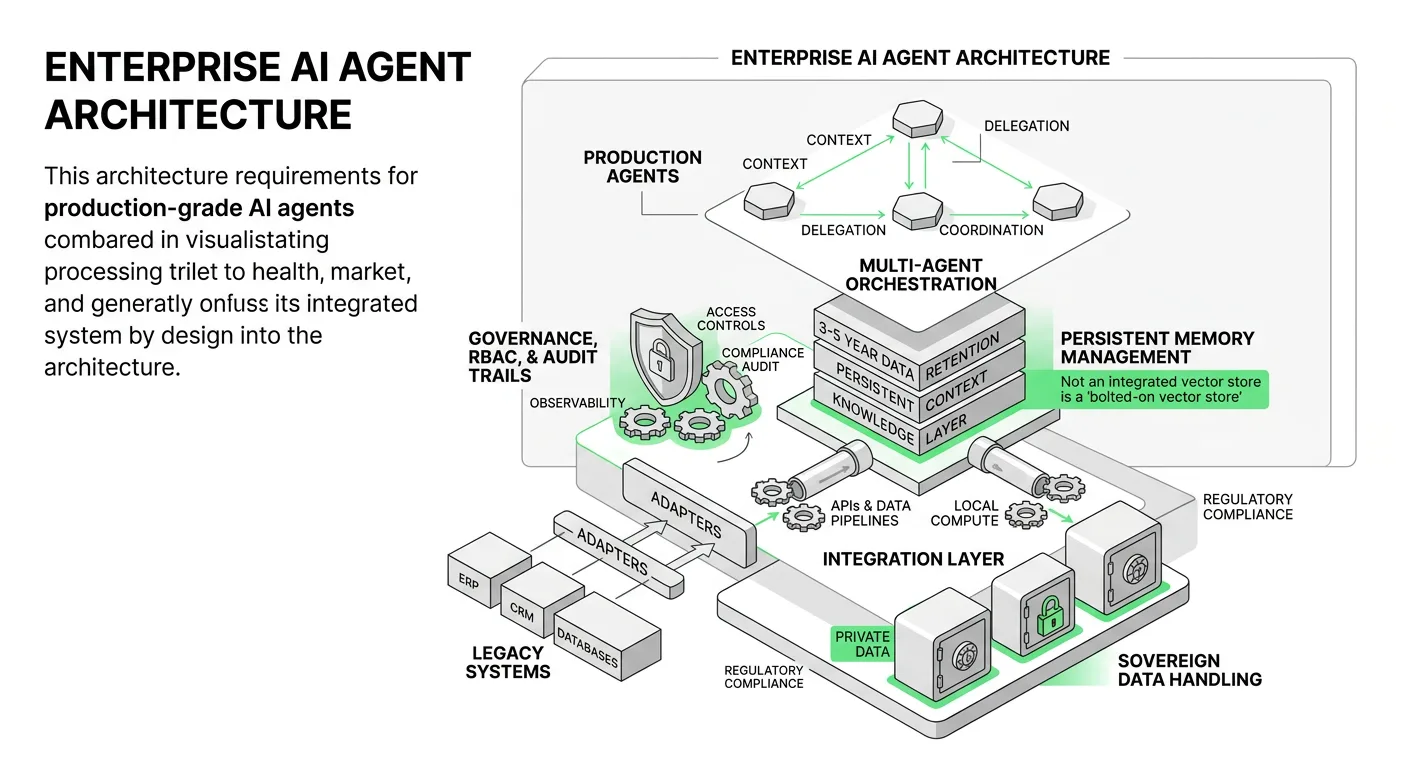
Persistent memory management. Demo agents operate statelessly. Production agents need to retain context across sessions, workflows, and time. Memory architecture is emerging as critical — agents require three to five years of data retention for persistent context. This is orders of magnitude beyond what a standard RAG setup provides, and it requires a purpose-built knowledge layer, not a bolted-on vector store.
Multi-agent orchestration. Real enterprise workflows are not single-agent. They involve orchestrator agents delegating to specialized sub-agents across departments, systems, and data domains. The shift from prompt-response interactions to autonomous action creates fundamentally different infrastructure requirements — agents need persistent memory across conversations, heterogeneous compute for orchestration and inference, and low-latency networking for inter-agent communication.
Governance, RBAC, and audit trails. This is where most projects stall. Governance infrastructure cannot be deferred — agents operating autonomously across enterprise systems require observability, access controls, and audit trails that must be designed into the architecture rather than added later. Retrofitting governance onto an agent system that was built without it is almost always prohibitively expensive and rarely succeeds.
Legacy system integration. Traditional enterprise systems were not designed for agentic interactions. Most agents still rely on APIs and conventional data pipelines to access enterprise systems, which creates bottlenecks and limits autonomous capabilities. Connecting agents to ERPs, CRMs, proprietary databases, and industry-specific platforms requires integration depth that most open-source frameworks do not provide out of the box.
Sovereign data handling. For regulated industries, this is non-negotiable. Every agentic workflow that routes sensitive data through a third-party cloud API creates regulatory exposure. Healthcare data that passes through an external model endpoint may violate HIPAA. Financial records processed via a public LLM API may breach GDPR or sector-specific data residency requirements. The architecture must enforce a data perimeter — not as a preference, but as a compliance requirement.
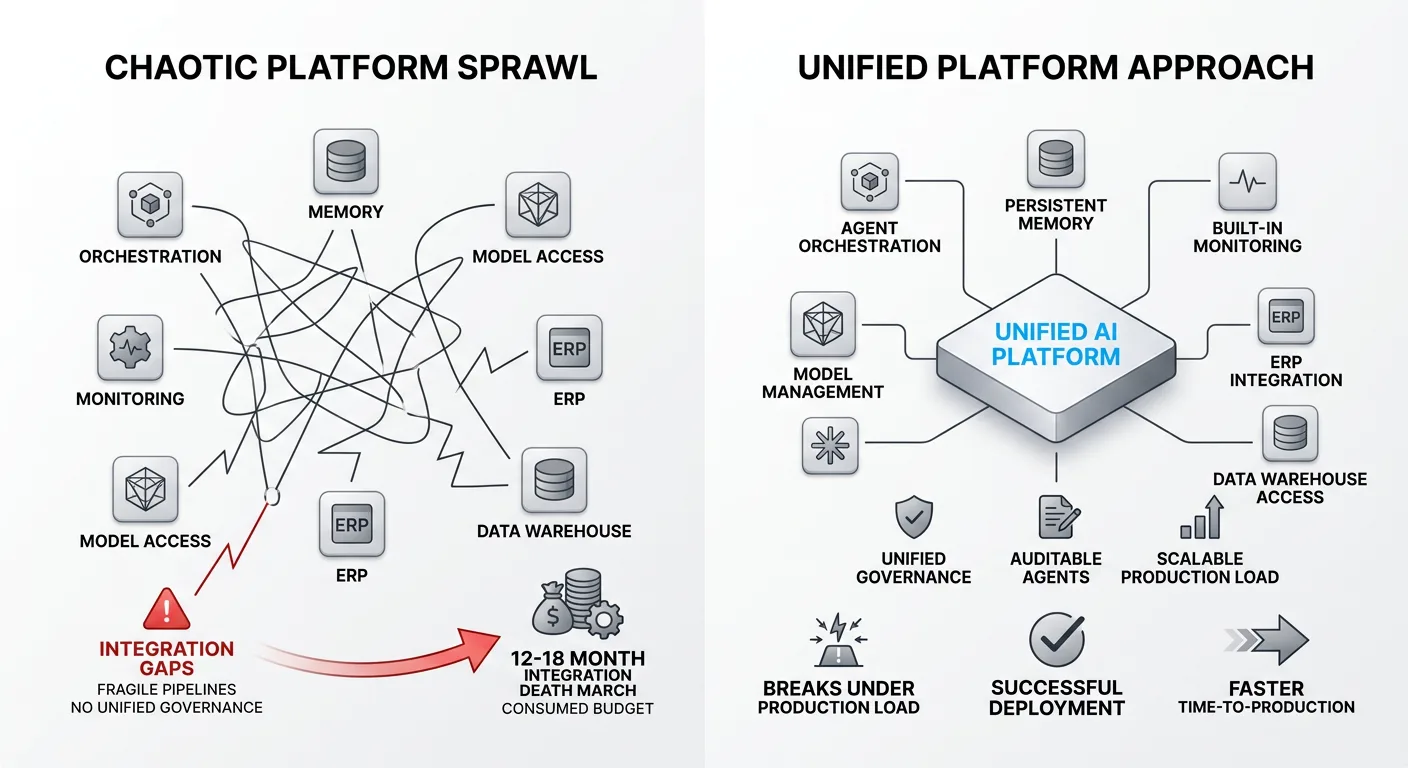
63% of executives cited "platform sprawl" as a growing concern, with many enterprises juggling too many tools with limited interconnectivity. This is the quiet killer of agentic AI at scale. Teams stitch together a framework for orchestration, a separate tool for memory, another for monitoring, a different one for model access, and then discover that none of them integrate cleanly with the ERP or the data warehouse where the real business data actually lives.
The result is fragile pipelines that perform in demos and break under production load. More importantly, they provide no unified governance or observability layer — which means compliance teams cannot audit what the agents actually did, and security teams cannot control what they can access.
42% of enterprises report they need access to eight or more data sources to successfully deploy AI agents. That integration surface area is enormous. Without a platform that handles it natively, enterprises end up spending 12 to 18 months in an integration death march that consumes the budget before the agents ever reach production.
The enterprises that successfully reach production with agentic AI share a consistent pattern: they treat the infrastructure layer as the primary investment, not an afterthought.
Companies deploying agentic AI at scale report average returns on investment of 171%, with U.S. enterprises achieving around 192% — yet only 2% of organizations have deployed agentic AI at full scale, while 61% remain stuck in exploration phases. The gap between those organizations and the majority is not model capability. It is infrastructure maturity.
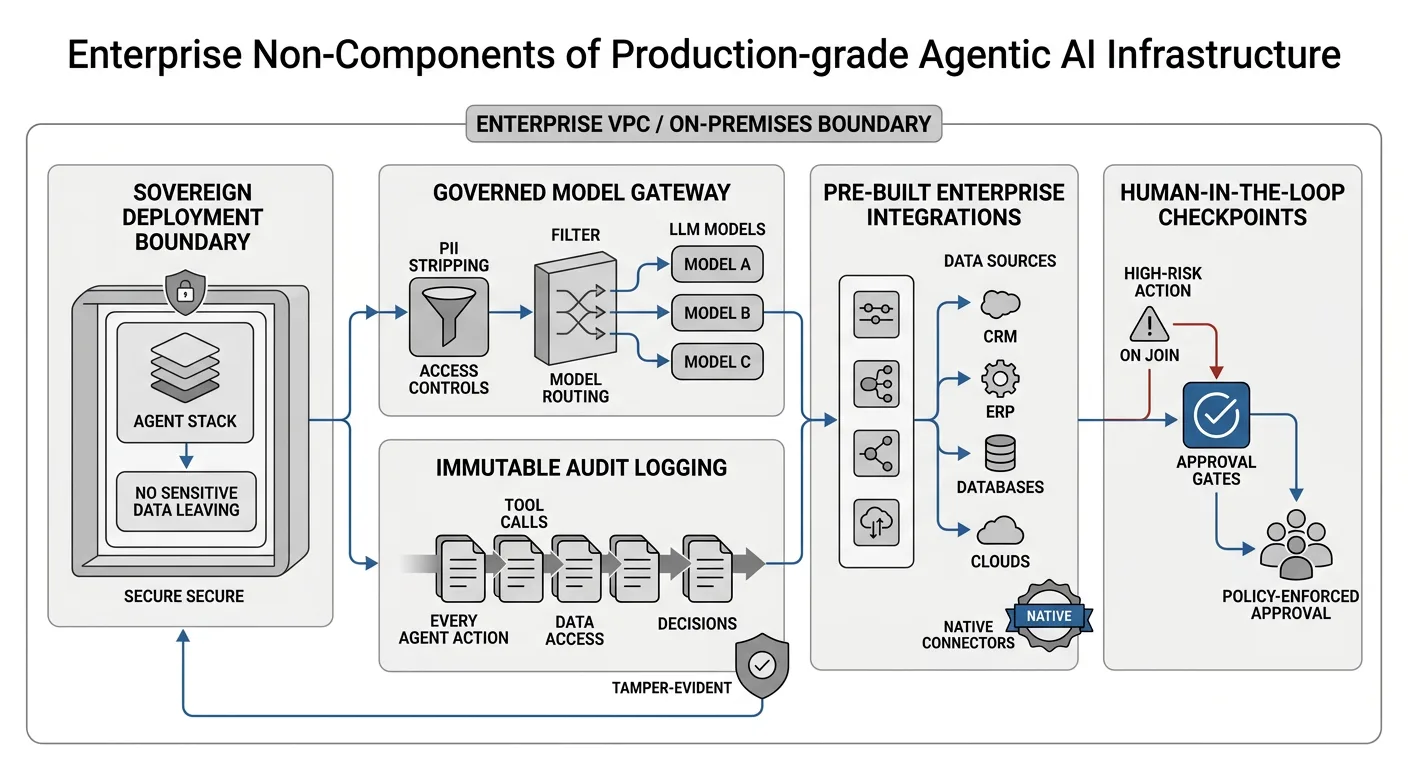
Production-grade agentic AI enterprise infrastructure needs several non-negotiable components working together:
Strategic oversight, ethical governance, and the ability to orchestrate human-AI teams become the most critical human skills as AI agents handle tasks previously performed by human workers. The organizations that thrive will be those that focus less on the technology itself and more on the human systems that surround it.
For enterprises in healthcare, financial services, government, nuclear energy, and manufacturing, the path to production is even more constrained. These organizations cannot adopt a "move fast and iterate" approach when the systems in question are initiating real actions inside core business infrastructure.
Agentic AI introduces new challenges for safety and security. Unlike traditional software, AI models are non-deterministic, so they can behave unpredictably — and their deployment across multi-cloud, multi-agent environments introduces new risks and vulnerabilities. The stakes are high: failures or breaches can lead to severe consequences, from data theft to erroneous decisions at scale, such as automated financial approvals or medical research going wrong.
This is not theoretical. An autonomous agent operating inside a financial institution's trading infrastructure, a hospital's EHR system, or a utility's operational technology network must be governed at the infrastructure level — with controls that are enforced by the platform, not dependent on developers remembering to implement them correctly. Our guide to deploying AI agents in production for regulated industries covers exactly what that governance layer needs to look like in practice.
In these environments, the compliance and security team's ability to sign off on a production deployment is the gating factor. If the platform cannot demonstrate auditability, data sovereignty, and access control enforcement out of the box, the deployment does not move forward — regardless of how capable the underlying model is.
There is a second dimension to the infrastructure challenge that CIOs and CTOs are increasingly focused on: model dependency risk. Enterprises that build agentic workflows tightly coupled to a single LLM provider face compounding risk as model versions change, pricing shifts, or regulatory requirements mandate data residency that public model APIs cannot satisfy.
The gap between experimentation and production often comes down to framework selection — choosing the wrong framework leads to scaling failures, integration nightmares, and abandoned projects. A framework that locks you into a single provider's model API is not an enterprise-grade foundation. Production-ready agentic AI enterprise platforms must support model-agnostic routing, allowing organizations to swap between providers, self-host open-source models, or run different models for different tasks — all through a governed gateway that enforces consistent policy.
This is exactly the problem Shakudo was built to solve. Kaji, Shakudo's autonomous enterprise agent, runs entirely inside the customer's own VPC — meaning sensitive data never leaves the enterprise perimeter. PII stripping is enforced at the model gateway layer before data reaches any LLM. Every agent action is logged in immutable audit trails that compliance teams can actually use.
Rather than handing engineering teams a blank canvas and wishing them luck, Shakudo's AI operating system provides 200+ pre-built integrations covering the enterprise systems that agentic workflows actually need to touch: ERPs, CRMs, proprietary databases, and industry-specific platforms. The persistent knowledge graph memory layer gives agents the long-term context that production workflows require — without forcing teams to build and maintain a custom memory architecture.
Shakudo already operates as the AI infrastructure for organizations in nuclear energy, healthcare, financial services, oil and gas, railway, and manufacturing — industries where the governance and compliance bar is not negotiable. Customers have compressed what were previously six-month procurement and deployment cycles down to same-day delivery, with production AI infrastructure live in days rather than quarters. That timeline compression is not a marketing claim; it is what happens when the infrastructure layer comes pre-built rather than requiring assembly from scratch.
The agentic AI enterprise platform question for most organizations is not whether the technology works. It is whether the infrastructure can support it safely, compliantly, and at scale — inside the enterprise boundary, not outside it.
In just two years, agentic AI has already reached 35% adoption, with another 44% of organizations planning to deploy it soon — but adoption and production deployment are very different things. The problem is not the technology — it is the planning and execution. Too many pilots stall out because organizations have not built the AI systems, guardrails, and culture to move beyond experiments.
The enterprises that will look back on 2025 and 2026 as pivotal years will be the ones that made the infrastructure investment now — sovereign deployment, governed model access, immutable auditability, native enterprise integration — rather than spending another 18 months in the prototype-to-production gap.
If your organization is running agentic AI pilots that have not reached production, the question worth asking is not "which model should we use?" It is "what does our infrastructure actually need to look like?" If you are ready to find out what that looks like with a platform built for regulated, sovereign enterprise deployments, Shakudo is worth a conversation.

Agentic AI has officially crossed from IT experiment to board-level mandate. Gartner projects that 40% of enterprise applications will embed task-specific AI agents by end of 2026, up from less than 5% in 2025. And yet, the distance between a working demo and a production deployment that your compliance team, ops team, and security team will actually sign off on remains one of the most underestimated gaps in enterprise technology today.
The proof is in the numbers. Deloitte's 2025 Emerging Technology Trends study found that while 30% of organizations are exploring agentic options and 38% are piloting solutions, only 14% have solutions ready to be deployed and a mere 11% are actively using these systems in production. That is a staggering funnel collapse — and it is not happening because the models are bad.
The models are good. The demos are compelling. The business case usually makes sense. What kills agentic AI projects is infrastructure — specifically, the absence of the infrastructure layer that transforms a capable prototype into something an enterprise can actually run at scale.
Gartner analyst Anushree Verma put it plainly: "Most agentic AI projects right now are early stage experiments or proof of concepts that are mostly driven by hype and are often misapplied. This can blind organizations to the real cost and complexity of deploying AI agents at scale, stalling projects from moving into production."
Over 40% of agentic AI projects will be canceled by the end of 2027, due to escalating costs, unclear business value, or inadequate risk controls, according to Gartner. The risk is real and accelerating. 75% of DIY AI projects report prolonged development cycles, with many failing to reach production due to unclear governance and ROI challenges — and 78% of CIOs cite security, compliance, and data control as primary barriers to scaling agent-based AI.
These are not model problems. They are infrastructure problems. If your pilots are caught in this cycle, the 9 ways out of AI purgatory are worth understanding before committing to another prototype.
Building a LangChain prototype that can query a database, summarize a document, and draft an email response is genuinely achievable in days. Getting that same workflow to run reliably, securely, and in compliance with HIPAA, SOC 2, or internal data governance policies — inside your own environment, at production load, with full auditability — is a fundamentally different engineering challenge.
Here is what the architecture actually needs to handle:
Persistent memory management. Demo agents operate statelessly. Production agents need to retain context across sessions, workflows, and time. Memory architecture is emerging as critical — agents require three to five years of data retention for persistent context. This is orders of magnitude beyond what a standard RAG setup provides, and it requires a purpose-built knowledge layer, not a bolted-on vector store.
Multi-agent orchestration. Real enterprise workflows are not single-agent. They involve orchestrator agents delegating to specialized sub-agents across departments, systems, and data domains. The shift from prompt-response interactions to autonomous action creates fundamentally different infrastructure requirements — agents need persistent memory across conversations, heterogeneous compute for orchestration and inference, and low-latency networking for inter-agent communication.
Governance, RBAC, and audit trails. This is where most projects stall. Governance infrastructure cannot be deferred — agents operating autonomously across enterprise systems require observability, access controls, and audit trails that must be designed into the architecture rather than added later. Retrofitting governance onto an agent system that was built without it is almost always prohibitively expensive and rarely succeeds.
Legacy system integration. Traditional enterprise systems were not designed for agentic interactions. Most agents still rely on APIs and conventional data pipelines to access enterprise systems, which creates bottlenecks and limits autonomous capabilities. Connecting agents to ERPs, CRMs, proprietary databases, and industry-specific platforms requires integration depth that most open-source frameworks do not provide out of the box.
Sovereign data handling. For regulated industries, this is non-negotiable. Every agentic workflow that routes sensitive data through a third-party cloud API creates regulatory exposure. Healthcare data that passes through an external model endpoint may violate HIPAA. Financial records processed via a public LLM API may breach GDPR or sector-specific data residency requirements. The architecture must enforce a data perimeter — not as a preference, but as a compliance requirement.

63% of executives cited "platform sprawl" as a growing concern, with many enterprises juggling too many tools with limited interconnectivity. This is the quiet killer of agentic AI at scale. Teams stitch together a framework for orchestration, a separate tool for memory, another for monitoring, a different one for model access, and then discover that none of them integrate cleanly with the ERP or the data warehouse where the real business data actually lives.
The result is fragile pipelines that perform in demos and break under production load. More importantly, they provide no unified governance or observability layer — which means compliance teams cannot audit what the agents actually did, and security teams cannot control what they can access.
42% of enterprises report they need access to eight or more data sources to successfully deploy AI agents. That integration surface area is enormous. Without a platform that handles it natively, enterprises end up spending 12 to 18 months in an integration death march that consumes the budget before the agents ever reach production.

The enterprises that successfully reach production with agentic AI share a consistent pattern: they treat the infrastructure layer as the primary investment, not an afterthought.
Companies deploying agentic AI at scale report average returns on investment of 171%, with U.S. enterprises achieving around 192% — yet only 2% of organizations have deployed agentic AI at full scale, while 61% remain stuck in exploration phases. The gap between those organizations and the majority is not model capability. It is infrastructure maturity.
Production-grade agentic AI enterprise infrastructure needs several non-negotiable components working together:
Strategic oversight, ethical governance, and the ability to orchestrate human-AI teams become the most critical human skills as AI agents handle tasks previously performed by human workers. The organizations that thrive will be those that focus less on the technology itself and more on the human systems that surround it.

For enterprises in healthcare, financial services, government, nuclear energy, and manufacturing, the path to production is even more constrained. These organizations cannot adopt a "move fast and iterate" approach when the systems in question are initiating real actions inside core business infrastructure.
Agentic AI introduces new challenges for safety and security. Unlike traditional software, AI models are non-deterministic, so they can behave unpredictably — and their deployment across multi-cloud, multi-agent environments introduces new risks and vulnerabilities. The stakes are high: failures or breaches can lead to severe consequences, from data theft to erroneous decisions at scale, such as automated financial approvals or medical research going wrong.
This is not theoretical. An autonomous agent operating inside a financial institution's trading infrastructure, a hospital's EHR system, or a utility's operational technology network must be governed at the infrastructure level — with controls that are enforced by the platform, not dependent on developers remembering to implement them correctly. Our guide to deploying AI agents in production for regulated industries covers exactly what that governance layer needs to look like in practice.
In these environments, the compliance and security team's ability to sign off on a production deployment is the gating factor. If the platform cannot demonstrate auditability, data sovereignty, and access control enforcement out of the box, the deployment does not move forward — regardless of how capable the underlying model is.
There is a second dimension to the infrastructure challenge that CIOs and CTOs are increasingly focused on: model dependency risk. Enterprises that build agentic workflows tightly coupled to a single LLM provider face compounding risk as model versions change, pricing shifts, or regulatory requirements mandate data residency that public model APIs cannot satisfy.
The gap between experimentation and production often comes down to framework selection — choosing the wrong framework leads to scaling failures, integration nightmares, and abandoned projects. A framework that locks you into a single provider's model API is not an enterprise-grade foundation. Production-ready agentic AI enterprise platforms must support model-agnostic routing, allowing organizations to swap between providers, self-host open-source models, or run different models for different tasks — all through a governed gateway that enforces consistent policy.
This is exactly the problem Shakudo was built to solve. Kaji, Shakudo's autonomous enterprise agent, runs entirely inside the customer's own VPC — meaning sensitive data never leaves the enterprise perimeter. PII stripping is enforced at the model gateway layer before data reaches any LLM. Every agent action is logged in immutable audit trails that compliance teams can actually use.
Rather than handing engineering teams a blank canvas and wishing them luck, Shakudo's AI operating system provides 200+ pre-built integrations covering the enterprise systems that agentic workflows actually need to touch: ERPs, CRMs, proprietary databases, and industry-specific platforms. The persistent knowledge graph memory layer gives agents the long-term context that production workflows require — without forcing teams to build and maintain a custom memory architecture.
Shakudo already operates as the AI infrastructure for organizations in nuclear energy, healthcare, financial services, oil and gas, railway, and manufacturing — industries where the governance and compliance bar is not negotiable. Customers have compressed what were previously six-month procurement and deployment cycles down to same-day delivery, with production AI infrastructure live in days rather than quarters. That timeline compression is not a marketing claim; it is what happens when the infrastructure layer comes pre-built rather than requiring assembly from scratch.
The agentic AI enterprise platform question for most organizations is not whether the technology works. It is whether the infrastructure can support it safely, compliantly, and at scale — inside the enterprise boundary, not outside it.
In just two years, agentic AI has already reached 35% adoption, with another 44% of organizations planning to deploy it soon — but adoption and production deployment are very different things. The problem is not the technology — it is the planning and execution. Too many pilots stall out because organizations have not built the AI systems, guardrails, and culture to move beyond experiments.
The enterprises that will look back on 2025 and 2026 as pivotal years will be the ones that made the infrastructure investment now — sovereign deployment, governed model access, immutable auditability, native enterprise integration — rather than spending another 18 months in the prototype-to-production gap.
If your organization is running agentic AI pilots that have not reached production, the question worth asking is not "which model should we use?" It is "what does our infrastructure actually need to look like?" If you are ready to find out what that looks like with a platform built for regulated, sovereign enterprise deployments, Shakudo is worth a conversation.
Agentic AI has officially crossed from IT experiment to board-level mandate. Gartner projects that 40% of enterprise applications will embed task-specific AI agents by end of 2026, up from less than 5% in 2025. And yet, the distance between a working demo and a production deployment that your compliance team, ops team, and security team will actually sign off on remains one of the most underestimated gaps in enterprise technology today.
The proof is in the numbers. Deloitte's 2025 Emerging Technology Trends study found that while 30% of organizations are exploring agentic options and 38% are piloting solutions, only 14% have solutions ready to be deployed and a mere 11% are actively using these systems in production. That is a staggering funnel collapse — and it is not happening because the models are bad.
The models are good. The demos are compelling. The business case usually makes sense. What kills agentic AI projects is infrastructure — specifically, the absence of the infrastructure layer that transforms a capable prototype into something an enterprise can actually run at scale.
Gartner analyst Anushree Verma put it plainly: "Most agentic AI projects right now are early stage experiments or proof of concepts that are mostly driven by hype and are often misapplied. This can blind organizations to the real cost and complexity of deploying AI agents at scale, stalling projects from moving into production."
Over 40% of agentic AI projects will be canceled by the end of 2027, due to escalating costs, unclear business value, or inadequate risk controls, according to Gartner. The risk is real and accelerating. 75% of DIY AI projects report prolonged development cycles, with many failing to reach production due to unclear governance and ROI challenges — and 78% of CIOs cite security, compliance, and data control as primary barriers to scaling agent-based AI.
These are not model problems. They are infrastructure problems. If your pilots are caught in this cycle, the 9 ways out of AI purgatory are worth understanding before committing to another prototype.
Building a LangChain prototype that can query a database, summarize a document, and draft an email response is genuinely achievable in days. Getting that same workflow to run reliably, securely, and in compliance with HIPAA, SOC 2, or internal data governance policies — inside your own environment, at production load, with full auditability — is a fundamentally different engineering challenge.
Here is what the architecture actually needs to handle:
Persistent memory management. Demo agents operate statelessly. Production agents need to retain context across sessions, workflows, and time. Memory architecture is emerging as critical — agents require three to five years of data retention for persistent context. This is orders of magnitude beyond what a standard RAG setup provides, and it requires a purpose-built knowledge layer, not a bolted-on vector store.
Multi-agent orchestration. Real enterprise workflows are not single-agent. They involve orchestrator agents delegating to specialized sub-agents across departments, systems, and data domains. The shift from prompt-response interactions to autonomous action creates fundamentally different infrastructure requirements — agents need persistent memory across conversations, heterogeneous compute for orchestration and inference, and low-latency networking for inter-agent communication.
Governance, RBAC, and audit trails. This is where most projects stall. Governance infrastructure cannot be deferred — agents operating autonomously across enterprise systems require observability, access controls, and audit trails that must be designed into the architecture rather than added later. Retrofitting governance onto an agent system that was built without it is almost always prohibitively expensive and rarely succeeds.
Legacy system integration. Traditional enterprise systems were not designed for agentic interactions. Most agents still rely on APIs and conventional data pipelines to access enterprise systems, which creates bottlenecks and limits autonomous capabilities. Connecting agents to ERPs, CRMs, proprietary databases, and industry-specific platforms requires integration depth that most open-source frameworks do not provide out of the box.
Sovereign data handling. For regulated industries, this is non-negotiable. Every agentic workflow that routes sensitive data through a third-party cloud API creates regulatory exposure. Healthcare data that passes through an external model endpoint may violate HIPAA. Financial records processed via a public LLM API may breach GDPR or sector-specific data residency requirements. The architecture must enforce a data perimeter — not as a preference, but as a compliance requirement.

63% of executives cited "platform sprawl" as a growing concern, with many enterprises juggling too many tools with limited interconnectivity. This is the quiet killer of agentic AI at scale. Teams stitch together a framework for orchestration, a separate tool for memory, another for monitoring, a different one for model access, and then discover that none of them integrate cleanly with the ERP or the data warehouse where the real business data actually lives.
The result is fragile pipelines that perform in demos and break under production load. More importantly, they provide no unified governance or observability layer — which means compliance teams cannot audit what the agents actually did, and security teams cannot control what they can access.
42% of enterprises report they need access to eight or more data sources to successfully deploy AI agents. That integration surface area is enormous. Without a platform that handles it natively, enterprises end up spending 12 to 18 months in an integration death march that consumes the budget before the agents ever reach production.

The enterprises that successfully reach production with agentic AI share a consistent pattern: they treat the infrastructure layer as the primary investment, not an afterthought.
Companies deploying agentic AI at scale report average returns on investment of 171%, with U.S. enterprises achieving around 192% — yet only 2% of organizations have deployed agentic AI at full scale, while 61% remain stuck in exploration phases. The gap between those organizations and the majority is not model capability. It is infrastructure maturity.
Production-grade agentic AI enterprise infrastructure needs several non-negotiable components working together:
Strategic oversight, ethical governance, and the ability to orchestrate human-AI teams become the most critical human skills as AI agents handle tasks previously performed by human workers. The organizations that thrive will be those that focus less on the technology itself and more on the human systems that surround it.

For enterprises in healthcare, financial services, government, nuclear energy, and manufacturing, the path to production is even more constrained. These organizations cannot adopt a "move fast and iterate" approach when the systems in question are initiating real actions inside core business infrastructure.
Agentic AI introduces new challenges for safety and security. Unlike traditional software, AI models are non-deterministic, so they can behave unpredictably — and their deployment across multi-cloud, multi-agent environments introduces new risks and vulnerabilities. The stakes are high: failures or breaches can lead to severe consequences, from data theft to erroneous decisions at scale, such as automated financial approvals or medical research going wrong.
This is not theoretical. An autonomous agent operating inside a financial institution's trading infrastructure, a hospital's EHR system, or a utility's operational technology network must be governed at the infrastructure level — with controls that are enforced by the platform, not dependent on developers remembering to implement them correctly. Our guide to deploying AI agents in production for regulated industries covers exactly what that governance layer needs to look like in practice.
In these environments, the compliance and security team's ability to sign off on a production deployment is the gating factor. If the platform cannot demonstrate auditability, data sovereignty, and access control enforcement out of the box, the deployment does not move forward — regardless of how capable the underlying model is.
There is a second dimension to the infrastructure challenge that CIOs and CTOs are increasingly focused on: model dependency risk. Enterprises that build agentic workflows tightly coupled to a single LLM provider face compounding risk as model versions change, pricing shifts, or regulatory requirements mandate data residency that public model APIs cannot satisfy.
The gap between experimentation and production often comes down to framework selection — choosing the wrong framework leads to scaling failures, integration nightmares, and abandoned projects. A framework that locks you into a single provider's model API is not an enterprise-grade foundation. Production-ready agentic AI enterprise platforms must support model-agnostic routing, allowing organizations to swap between providers, self-host open-source models, or run different models for different tasks — all through a governed gateway that enforces consistent policy.
This is exactly the problem Shakudo was built to solve. Kaji, Shakudo's autonomous enterprise agent, runs entirely inside the customer's own VPC — meaning sensitive data never leaves the enterprise perimeter. PII stripping is enforced at the model gateway layer before data reaches any LLM. Every agent action is logged in immutable audit trails that compliance teams can actually use.
Rather than handing engineering teams a blank canvas and wishing them luck, Shakudo's AI operating system provides 200+ pre-built integrations covering the enterprise systems that agentic workflows actually need to touch: ERPs, CRMs, proprietary databases, and industry-specific platforms. The persistent knowledge graph memory layer gives agents the long-term context that production workflows require — without forcing teams to build and maintain a custom memory architecture.
Shakudo already operates as the AI infrastructure for organizations in nuclear energy, healthcare, financial services, oil and gas, railway, and manufacturing — industries where the governance and compliance bar is not negotiable. Customers have compressed what were previously six-month procurement and deployment cycles down to same-day delivery, with production AI infrastructure live in days rather than quarters. That timeline compression is not a marketing claim; it is what happens when the infrastructure layer comes pre-built rather than requiring assembly from scratch.
The agentic AI enterprise platform question for most organizations is not whether the technology works. It is whether the infrastructure can support it safely, compliantly, and at scale — inside the enterprise boundary, not outside it.
In just two years, agentic AI has already reached 35% adoption, with another 44% of organizations planning to deploy it soon — but adoption and production deployment are very different things. The problem is not the technology — it is the planning and execution. Too many pilots stall out because organizations have not built the AI systems, guardrails, and culture to move beyond experiments.
The enterprises that will look back on 2025 and 2026 as pivotal years will be the ones that made the infrastructure investment now — sovereign deployment, governed model access, immutable auditability, native enterprise integration — rather than spending another 18 months in the prototype-to-production gap.
If your organization is running agentic AI pilots that have not reached production, the question worth asking is not "which model should we use?" It is "what does our infrastructure actually need to look like?" If you are ready to find out what that looks like with a platform built for regulated, sovereign enterprise deployments, Shakudo is worth a conversation.