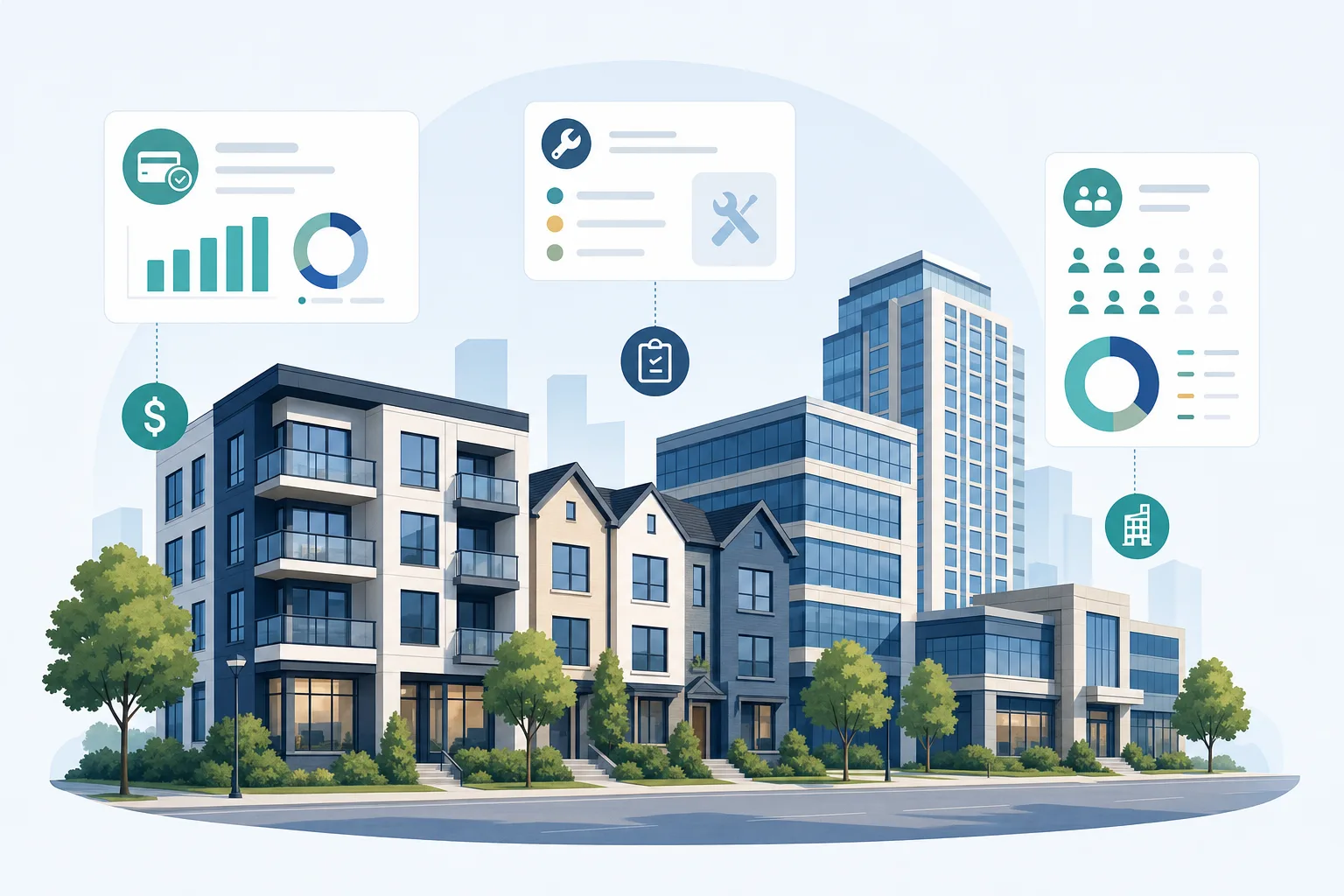







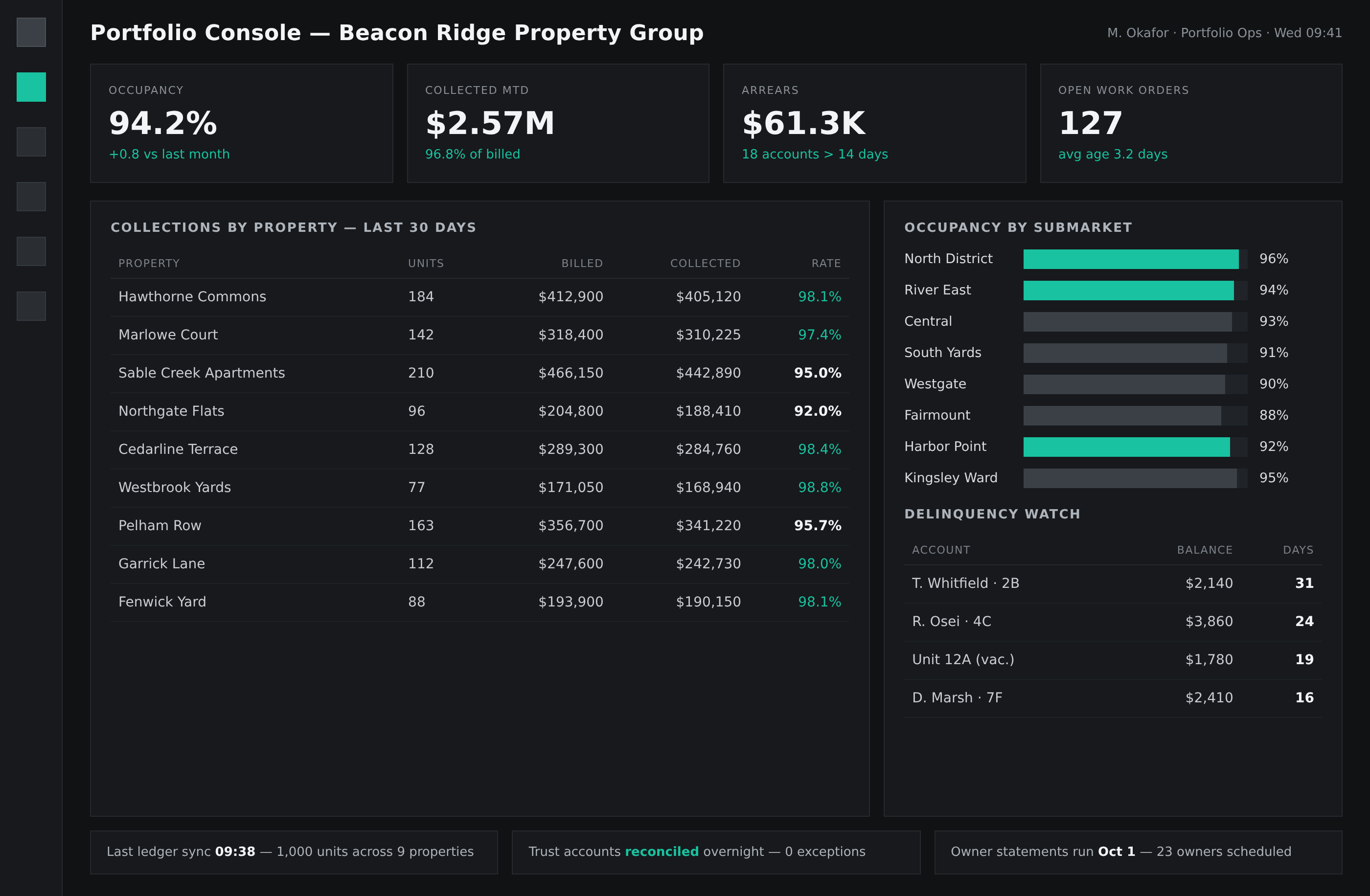
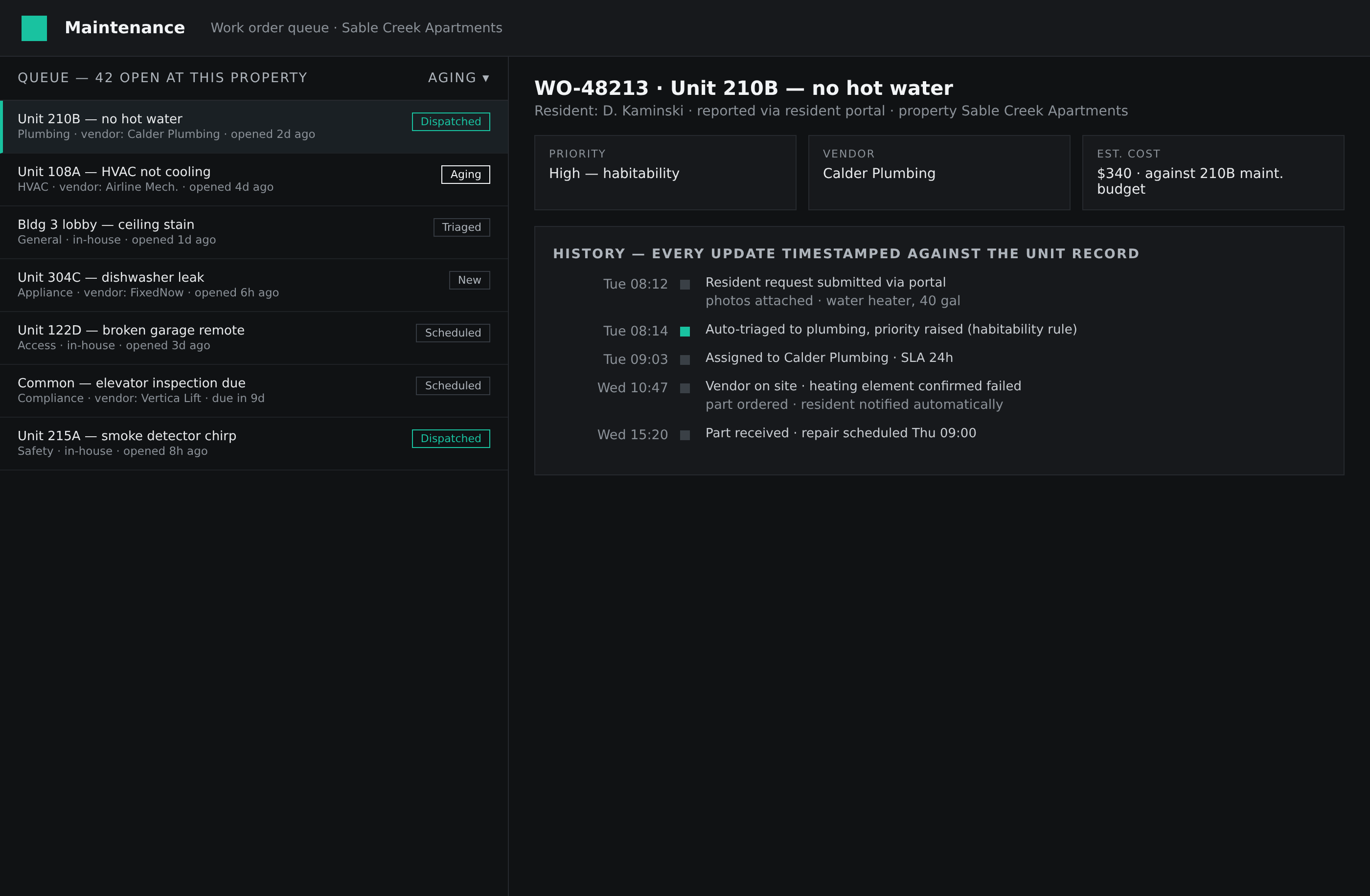
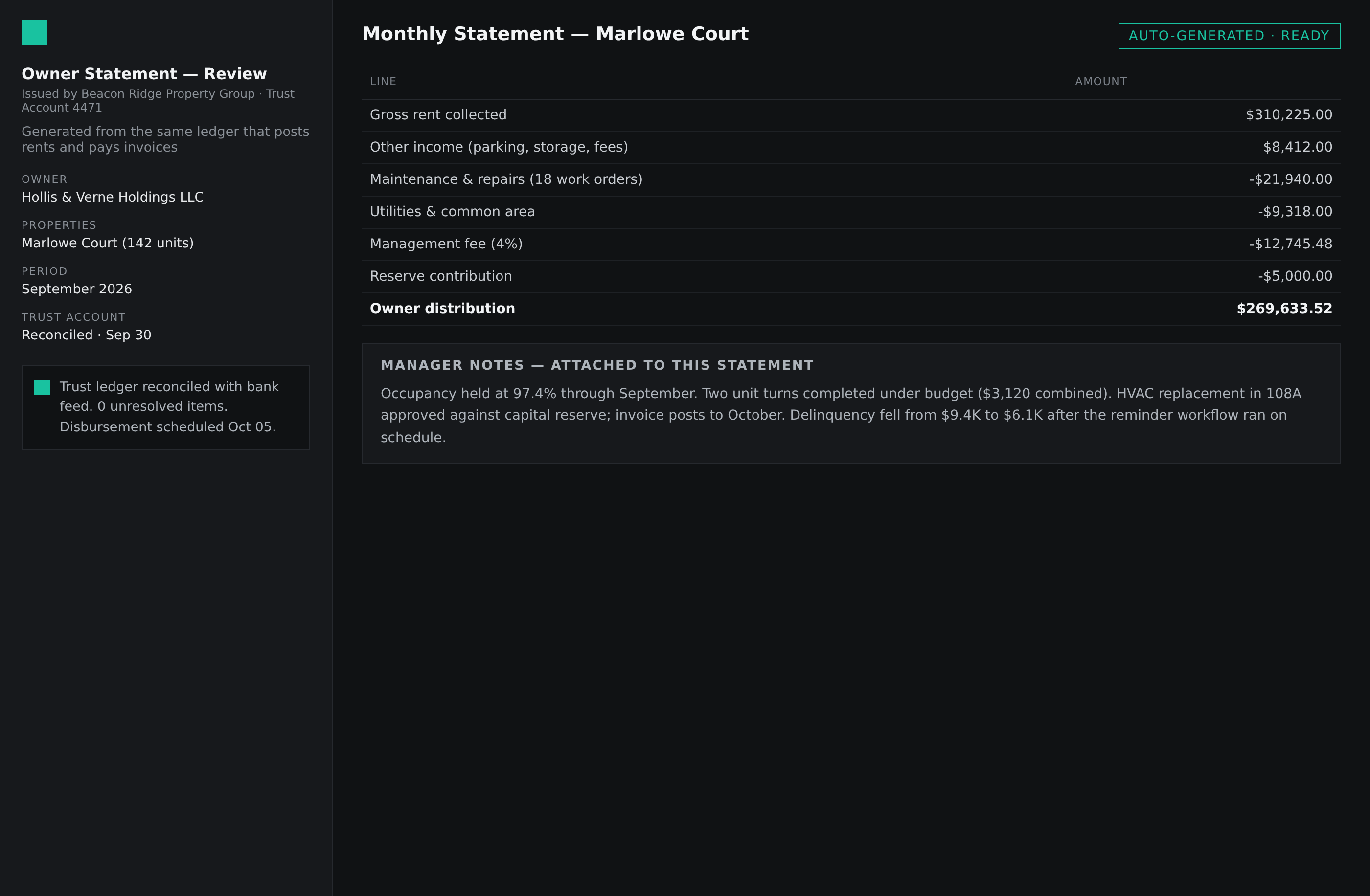
Three screens from a live portfolio: the collections console, the maintenance queue, and the owner statement.
1–2 / 3
Property portfolios lose money in the gap between the units and the ledger. A lease renewal that sits in an inbox turns into a vacancy. A rent arrears list that lives in a spreadsheet turns into a month-end scramble. A work order that never reaches a vendor turns into an angry resident and a repeat repair. Property management operations exists to close that gap: leasing, rent collection, maintenance, and owner accounting on one operating system for the portfolio.
At portfolio scale the gap compounds. Every unit, every building, and every owner statement draws from the same records, but the records live in different places: the leasing CRM, the rent roll, the maintenance inbox, and the accounting system that closes whenever it closes. The teams that fix this run the portfolio as a single system: what happens at a property updates the ledger the same day.
Most portfolio operations run on a stack of disconnected tools: email for leasing, a spreadsheet for the rent roll, a shared inbox for maintenance, and accounting software that reconciles weeks behind. Each handoff loses information. A renewal deadline passes untracked. Late rent is chased by hand, one call at a time. A resident request is logged twice, dispatched never, and closed when someone remembers.
The result is predictable. Occupancy drifts down while arrears drift up, maintenance backlogs stretch into weeks, and owner reports are assembled by hand from whatever data can be found. Managers spend the first week of every month reconstructing what happened across the portfolio. The data existed all along. It just lived in the wrong places.
The platform gives every property in the portfolio a single record. Leases, payments, work orders, and owner accounts all reference the same unit, the same ledger, and the same timeline. It delivers:
Portfolio managers see collections, occupancy, and arrears across the portfolio before they become losses. Property managers see each building's queue without opening five tools. Owners receive statements they can trust because the statement and the ledger are the same record. None of it requires extra administrative headcount.
Shakudo deploys the platform inside the operator's own environment, configured around the portfolio, the lease structures, and the approval workflows already in use. Operational data enters the record through the workflows people already follow: a listing posted once flows through applications and screening to a signed lease, a missed payment raises an arrears case with a follow-up sequence attached, and a resident request routes to the right vendor with a due date.
On the accounting side, every payment, invoice, and owner distribution reconciles against the ledger in real time. The trust account, the vendor bills, and the owner statements draw from the same records, so a question about a number resolves against documented reality instead of a month-old export. Reports, dashboards, and exports feed the tools the team already uses. A first working pipeline, connecting one building's operations to its ledger, is in place within days of deployment.
Off-the-shelf property management software assumes your portfolio fits its shape: its lease types, its fee structures, its reporting formats. When the portfolio does not fit, teams keep the system of record elsewhere and treat the software as another form to fill in.
With an in-house platform, the system is built around the operator's own portfolio and stays under its own data governance. Lease terms, resident records, and owner financials never leave infrastructure the operator controls. The platform is also a real platform: the workflows, ledger models, and reports keep running after the engagement that built it ends, and the in-house team can operate and extend it independently.
The platform serves property operators and managers running portfolios measured in buildings rather than units, where leasing, collections, maintenance, and owner accounting are measured in portfolio terms. Portfolio managers use the portfolio view for collections, occupancy, and arrears. Property managers use the workflows for leasing, rent follow-up, and maintenance dispatch. Accounting teams use the single ledger for trust accounting, vendor bills, and owner statements. It is also the build-versus-buy alternative to per-seat property management software: if your lease structures, fee models, or owner reporting are specific enough that a generic product falls short, an in-house platform is the durable option.
By flagging arrears the day they appear and following up automatically, not at month-end. Each payment updates the ledger in real time, so arrears cases open themselves with a follow-up sequence attached. When the lease terms and payment history live in the same record, the follow-up is accurate and the escalation path is documented.
Every resident request becomes a work order with an owner, a vendor, and a due date from the moment it is logged. Dispatch, vendor updates, and resident notifications happen in the same record, so nothing waits in an inbox. Requests that breach their due date surface in the portfolio queue before residents escalate them.
Owner statements are generated from the same ledger that records every payment, invoice, and distribution. There is no separate reporting process to drift out of sync: when a number changes in the ledger, it changes in the statement. Trust accounting, reserve balances, and distributions all trace back to individual transactions, so an owner question resolves against the underlying record.
Yes. The platform runs on infrastructure the operator controls, whether on-premises or in the operator's own cloud. Lease terms, resident records, and owner financials never leave that environment, and data governance stays under the operator's own policies. That is a core reason operators choose an in-house platform over a SaaS seat.
When the goal is leasing, rent collection, maintenance, and owner accounting on one record, a conversation with Shakudo is the fastest way to see it on your own portfolio data. The platform runs inside the operator's own environment, and a first working pipeline is in place within days. Book a demo and scope property operations for your portfolio.
A property operating platform where leasing workflows, rent collection, maintenance dispatch, and owner reporting draw from the same portfolio records. What happens at a property updates the ledger the same day, so collections, occupancy, and owner statements stay current without the month-end scramble.










"What drew me in is simple. When developers ship production-ready code this quickly, how can I have environments spun up fast enough? Shakudo is how we close that gap."



"Shakudo does not just provide the platform. It is a real partnership. They are always there to help and execute our vision faster and the right way. It is like a co-team working together to achieve our goals."