







Three screens from a live moderation pass: the console, the transcript analysis, and the action queue.
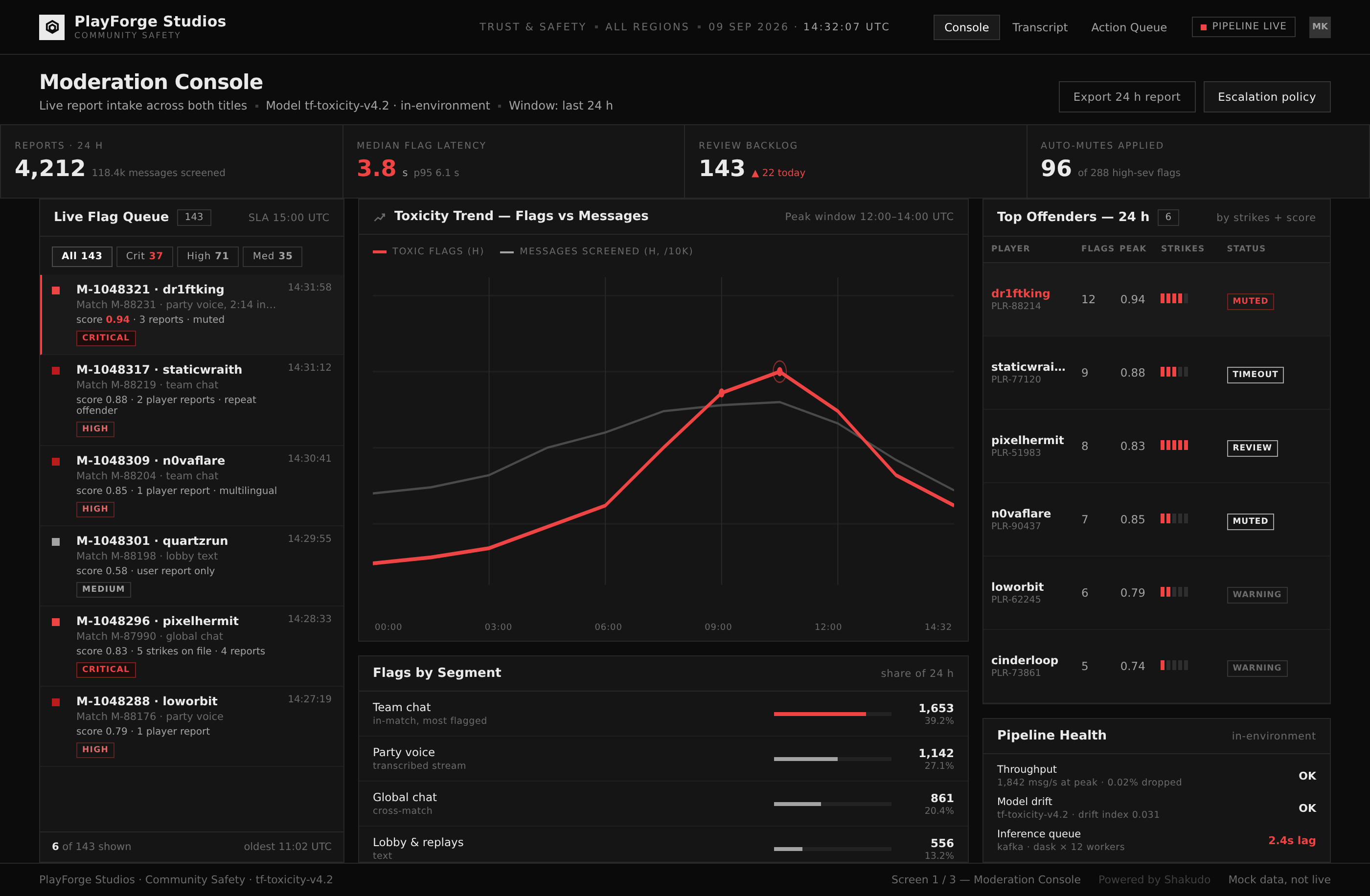
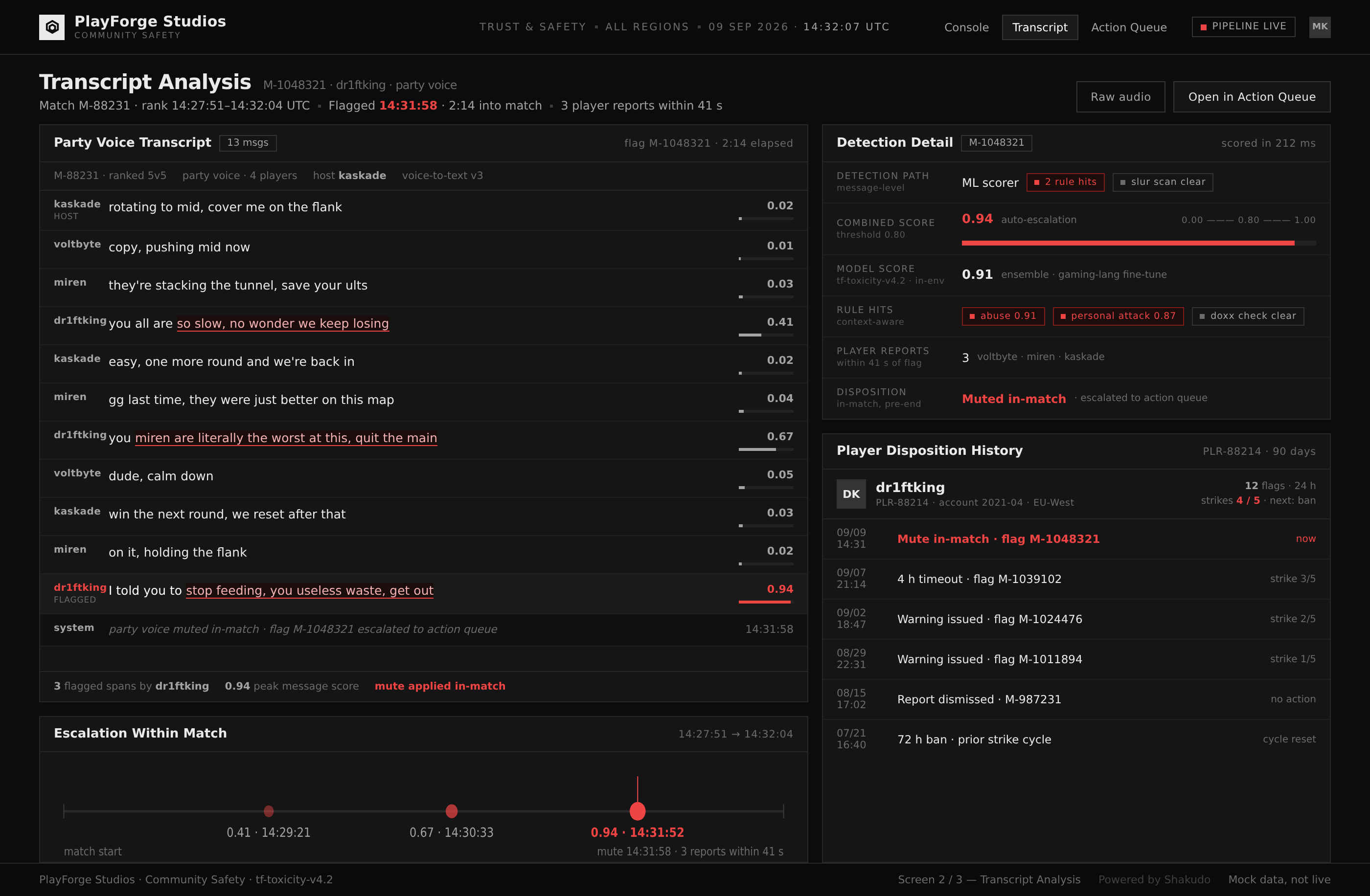
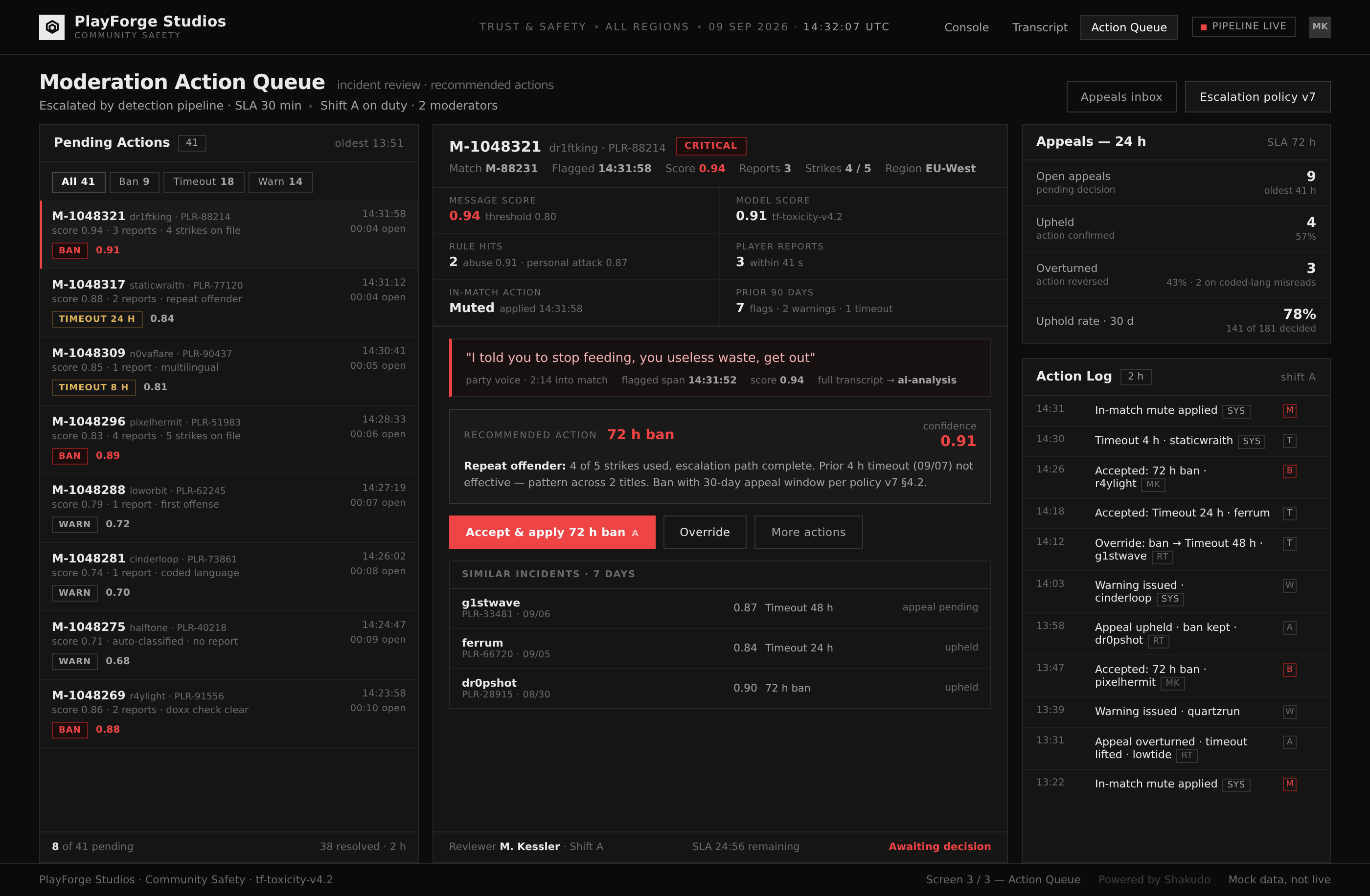
1–2 / 3
Toxic behavior is the reason players leave. A single bad experience in chat can end a subscription before the game itself is ever tested, and the cost compounds: churn, moderation backlogs, brand risk, and for operators in the EU and UK, compliance expectations under the Digital Services Act and the Online Safety Act. A detection pipeline that runs inside the customer's environment addresses the problem where the player data lives.
Every toxic message is a moderation decision someone has to make, and the volume of in-game chat makes manual review impossible at scale. Unchecked, toxic behavior shapes the community: new players see it first, and the window after a player joins is exactly when toxic behavior compounds into churn. For a live-service game, that window is also a compliance window, since the EU and UK regulations place active moderation duties on operators of large platforms. The brand risk is the same in every case: a community that feels unsafe is a community that leaves, and the exit happens before a player ever judges the game.
Shakudo deploys the detection pipeline inside the customer's environment. Player data never leaves the environment, which matters for a business that treats conversation data as a regulated asset. The result is a real platform: detection runs at the scale of peak gaming hours, community-health dashboards make the trend visible to the whole team, and the platform keeps running after the engagement ends. The team owns the pipeline, the models, and the data.
The same in-environment pipeline pattern applies to other high-volume decision problems, such as sales call transcript analysis. In both cases, the pipeline runs where the data lives, so the data never leaves the environment.
The pipeline fits the operators where player volume makes manual moderation impossible: a live-service publisher with in-game text or voice chat, a game studio shipping a community title, an esports or platform operator running player behavior monitoring as part of trust and safety, and any platform operator that needs moderation at the scale of peak gaming hours.
Models trained on gaming-specific language score each message in real time, reading context rather than matching keywords. A coded insult or a multilingual message that a keyword list misses is still flagged, and the flag reaches the moderation workflow while the conversation is still ongoing, before the message shapes the match.
The decision usually comes down to four questions: where does the player data live after ingestion, does the detection hold up at peak-hour throughput, are the models tuned to the community's actual language, and what happens when the vendor leaves, does the studio keep a working platform or lose access to its own moderation? An in-environment pipeline answers the first and last of those in the studio's favor.
Detection works at two levels. Message-level flags catch individual toxic messages in real time, while player-level signals, such as report history, repeat-offender patterns, and behavior across sessions, identify the accounts that need a human review before escalation, mute, or ban.
Detection is one layer of the solution. Pair it with response playbooks so moderators act consistently, community-health dashboards so the trend is visible to the whole team, and design that rewards positive behavior, since punishment-only approaches leave the root cause untouched. The detection pipeline provides the signal that every one of those layers runs on.
When the goal is a moderation system that keeps player data in the studio's own environment, a conversation with Shakudo is the fastest way to see what the pipeline would flag on the game's own chat data.
Shakudo empowers gaming companies to swiftly implement and manage a cutting-edge toxicity detection system using best-in-class AI and data tools.
This solution directly addresses the critical challenge of maintaining a positive player experience, which is key to increasing user engagement and monetization.










"What drew me in is simple. When developers ship production-ready code this quickly, how can I have environments spun up fast enough? Shakudo is how we close that gap."



"Shakudo does not just provide the platform. It is a real partnership. They are always there to help and execute our vision faster and the right way. It is like a co-team working together to achieve our goals."