






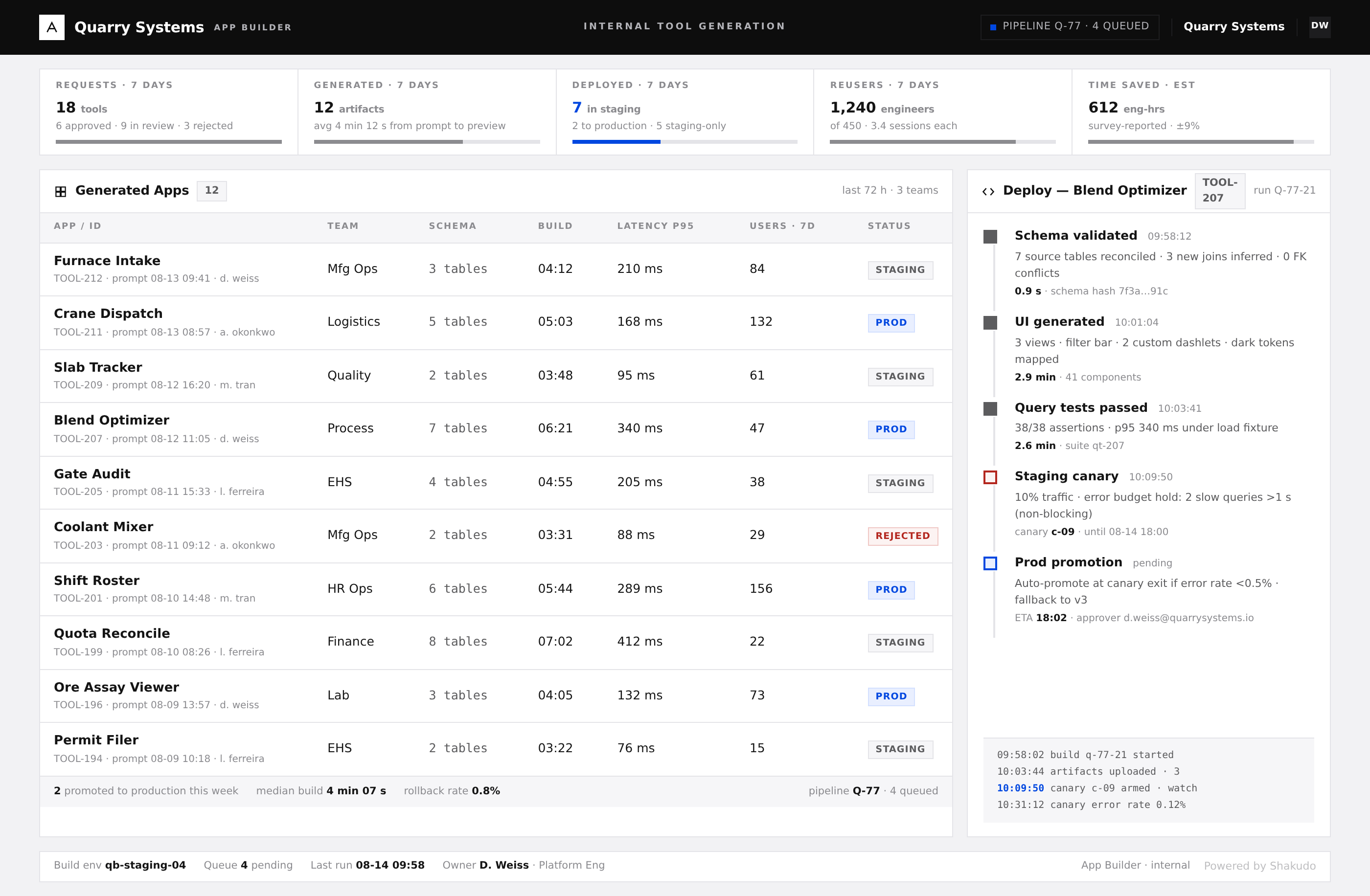
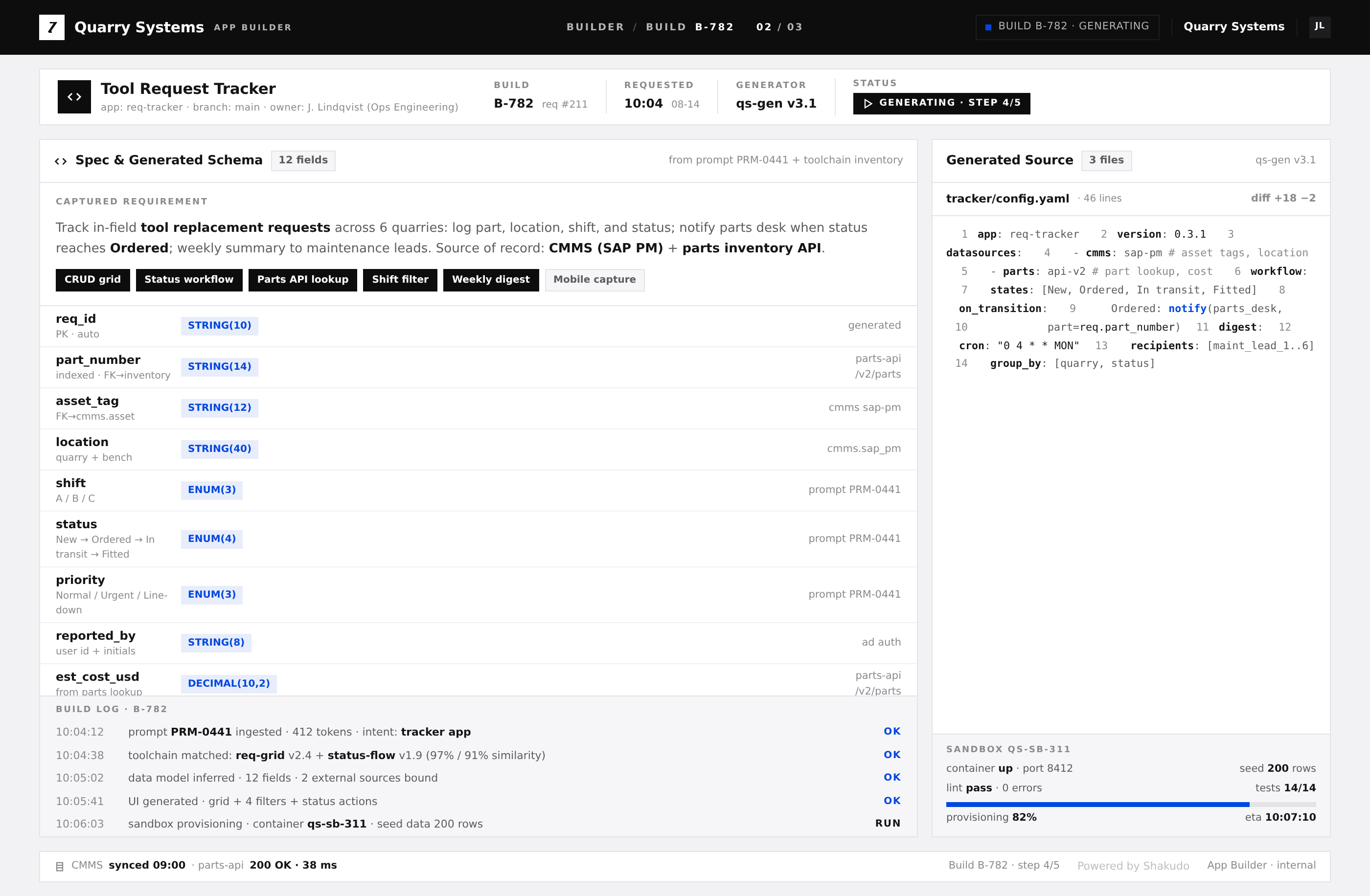
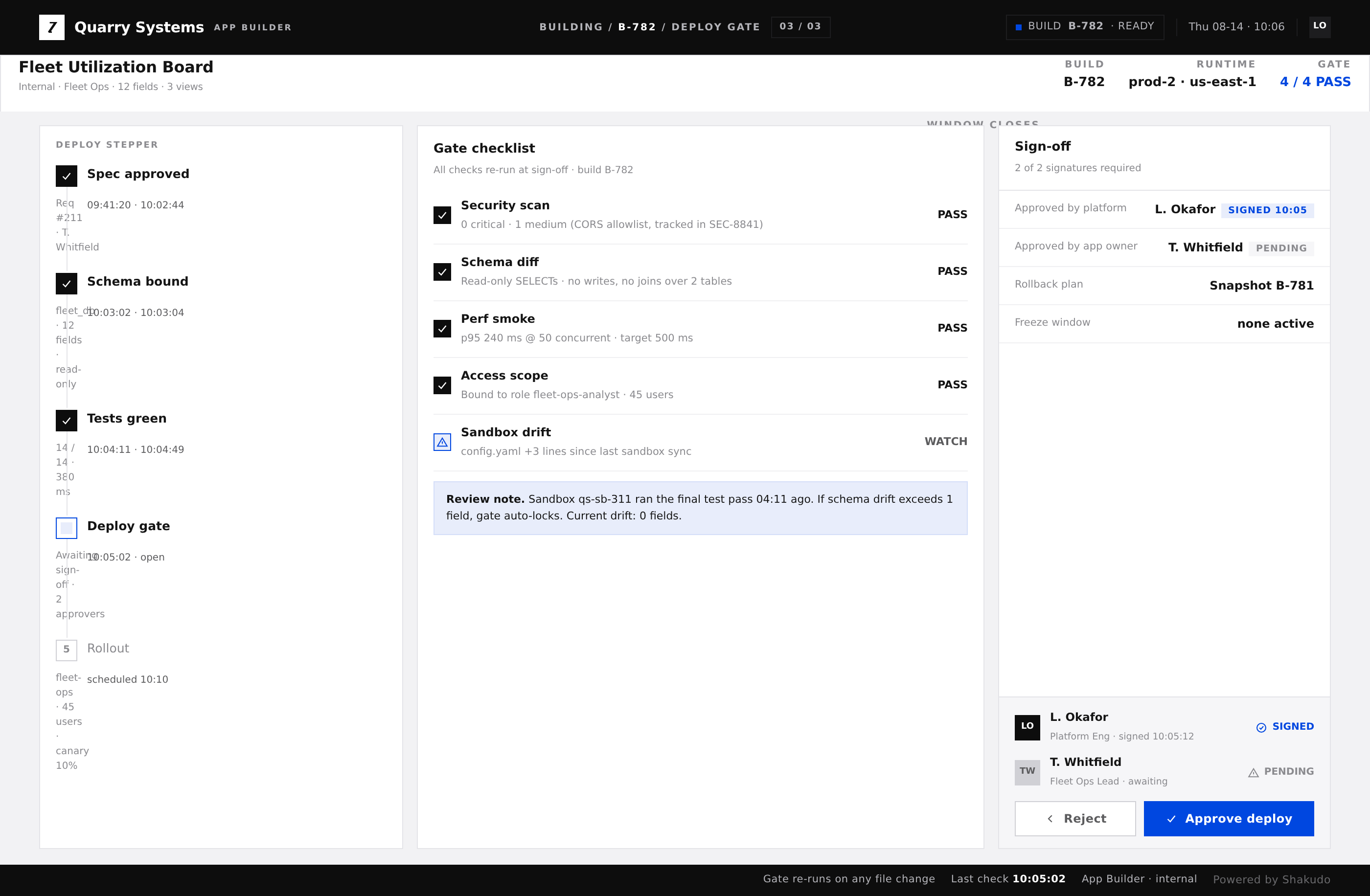
Three screens from a live run: the tool queue, the generated spec, and the review.
1–2 / 3
Engineering teams carry a quiet backlog of internal tool requests: admin dashboards, approval workflows, employee portals, data management interfaces. Every one of them competes with product work, and most take weeks or months to ship. A technology company wanted a faster path from idea to working tool, and by using AI to generate functional web applications from requirements documents, they compressed the build from weeks to minutes.
Internal tools are the backbone of every company that runs operations. Operations teams need admin dashboards, approval workflows, employee portals and data management interfaces, yet building these applications through traditional development cycles takes weeks or months. Engineering teams juggle these requests alongside product work, creating bottlenecks that delay the very operational improvements the tools are meant to deliver.
The problem compounds over time. When teams cannot get the tools they need, they fall back on manual processes, spreadsheets and workarounds. A single internal application that takes three months to build can cost an organization far more in lost productivity during the wait. Enterprise low-code platforms show that technical professionals can develop applications in minutes rather than days when given the right tools. The gap between what teams need and what they can build is where operational efficiency leaks away.
Shakudo builds the pipeline that turns a requirements document into a working internal application. The system reads the specification in natural language, generates a data model, builds a multipage user interface and wires up the workflows the tool needs. What previously required a full development sprint happens in a single afternoon, and the output is structured, extensible code rather than a throwaway mockup.
The technology company in this case started with a structured requirements document outlining the data fields, user roles and approval steps for an internal operations tool. The AI generated a working application with a dashboard, filtered data tables, role-based access controls and email notifications. The team reviewed the output, requested changes and received an updated build within the same day, a rapid feedback loop that let stakeholders test real functionality instead of reviewing static mockups. Platforms offering AI application generation report productivity gains of 10x or more compared to manual development.
The quality of the generated application tracks the clarity of the input. Teams that invest time in describing data models, user roles and workflow steps get functional applications that need minimal rework, and that discipline is the difference between a prototype and a tool that survives production.
Streamlit provides the dashboards where teams review tool usage, approval queues and the operational data the internal tools exist to surface. FastAPI exposes the API layer that connects the generated application to live data sources, and Supabase stores the application data and serves as the integration point for existing databases.
The workflow fits product and engineering organizations whose teams are waiting on internal tools: product managers at a technology company who own a backlog of dashboard and approval workflow requests, operations staff who run on spreadsheets and manual workarounds until the tool is built, and the engineers who have to build those tools without displacing product work. It is built for companies where internal tooling is a recurring bottleneck and where a working, extensible prototype is worth more than a polished mockup.
A functional internal tool prototype can be generated in minutes. Teams describe the application in natural language or provide a requirements document, and the system produces a working web app with data models, user interfaces and basic workflows. Complex applications with multiple integrations take longer but still complete within hours rather than weeks.
Yes. Generated applications connect to databases and APIs through standard integration patterns. The system builds data models and connection logic from the requirements specification, so prototypes work with real data from the start, and teams can test functionality against actual records rather than placeholder data.
AI prototyping works well for admin dashboards, approval workflows, employee directories, data management interfaces and vendor portals. Any internal application with structured data, user roles and defined workflows is a good candidate. The approach handles CRUD operations, filtered views and notification triggers without manual coding.
Yes. The system produces structured, readable code that engineers can review and modify. Teams extend generated applications with custom logic, additional integrations or modified user interfaces as needed, and the generated foundation removes repetitive work so developers focus on business-specific requirements.
When the goal is internal tools that ship in days, a conversation with Shakudo is the fastest way to see it on your own requirements. The pipeline deploys on your own infrastructure, on-prem or in your cloud, with a first working prototype in place within days. Book a demo to try it.
Building internal business tools traditionally takes weeks of engineering time. AI rapid prototyping generates functional web applications from requirements documents in minutes, letting teams iterate quickly without developer bottlenecks.










"What drew me in is simple. When developers ship production-ready code this quickly, how can I have environments spun up fast enough? Shakudo is how we close that gap."



"Shakudo does not just provide the platform. It is a real partnership. They are always there to help and execute our vision faster and the right way. It is like a co-team working together to achieve our goals."