






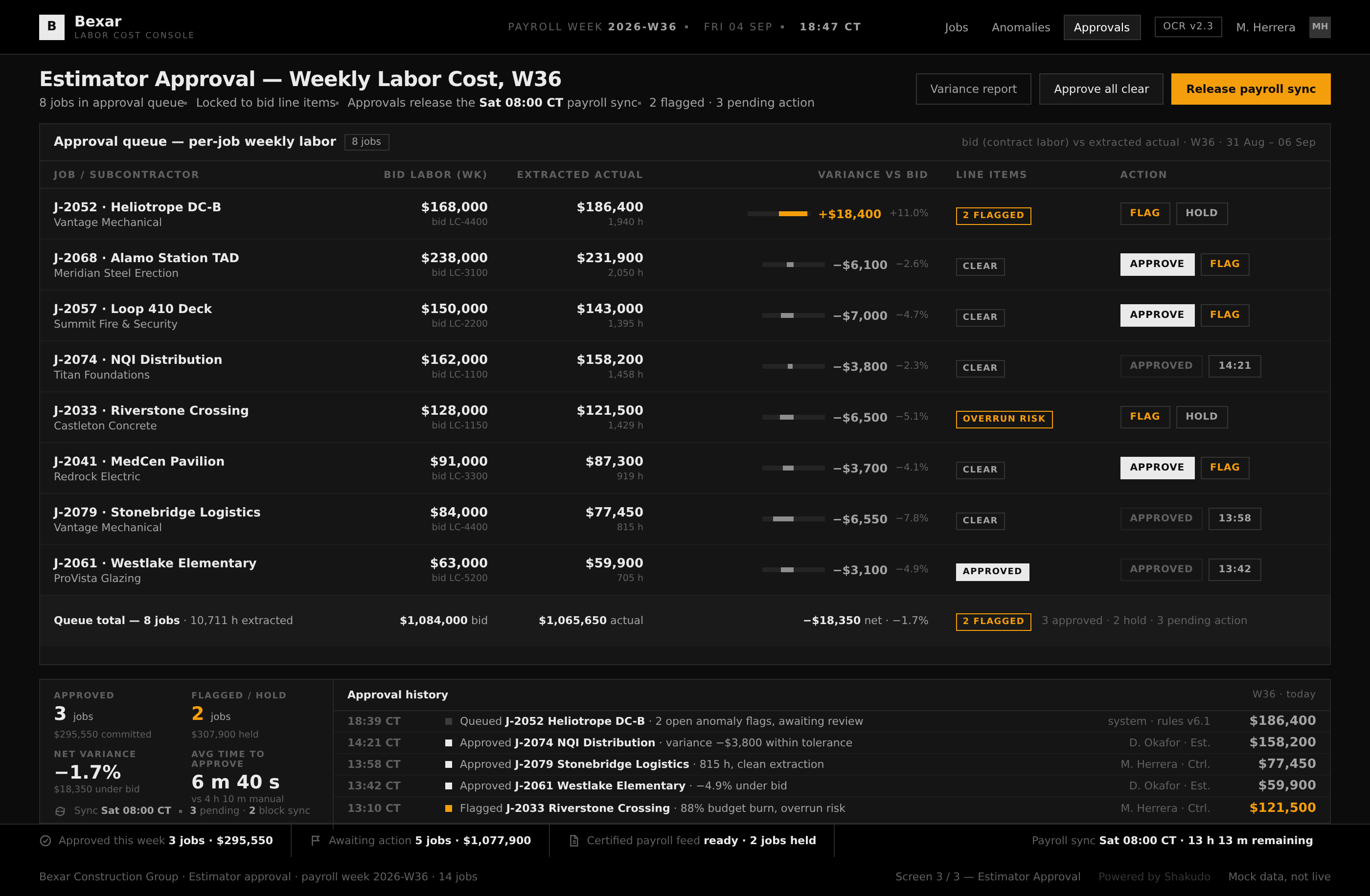
Three screens from a live week: the labor cost console, the anomaly analysis, and the estimator approval.
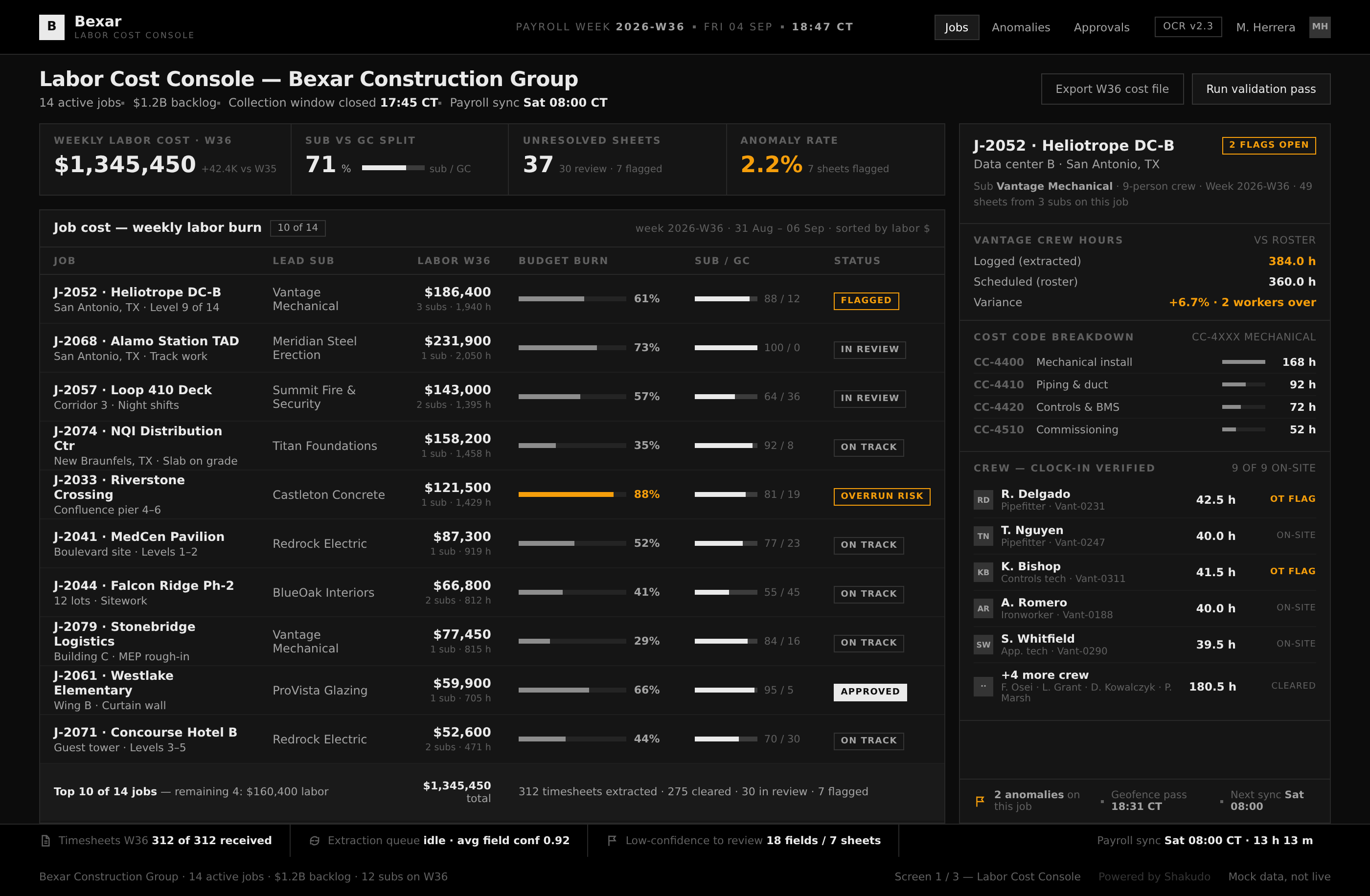
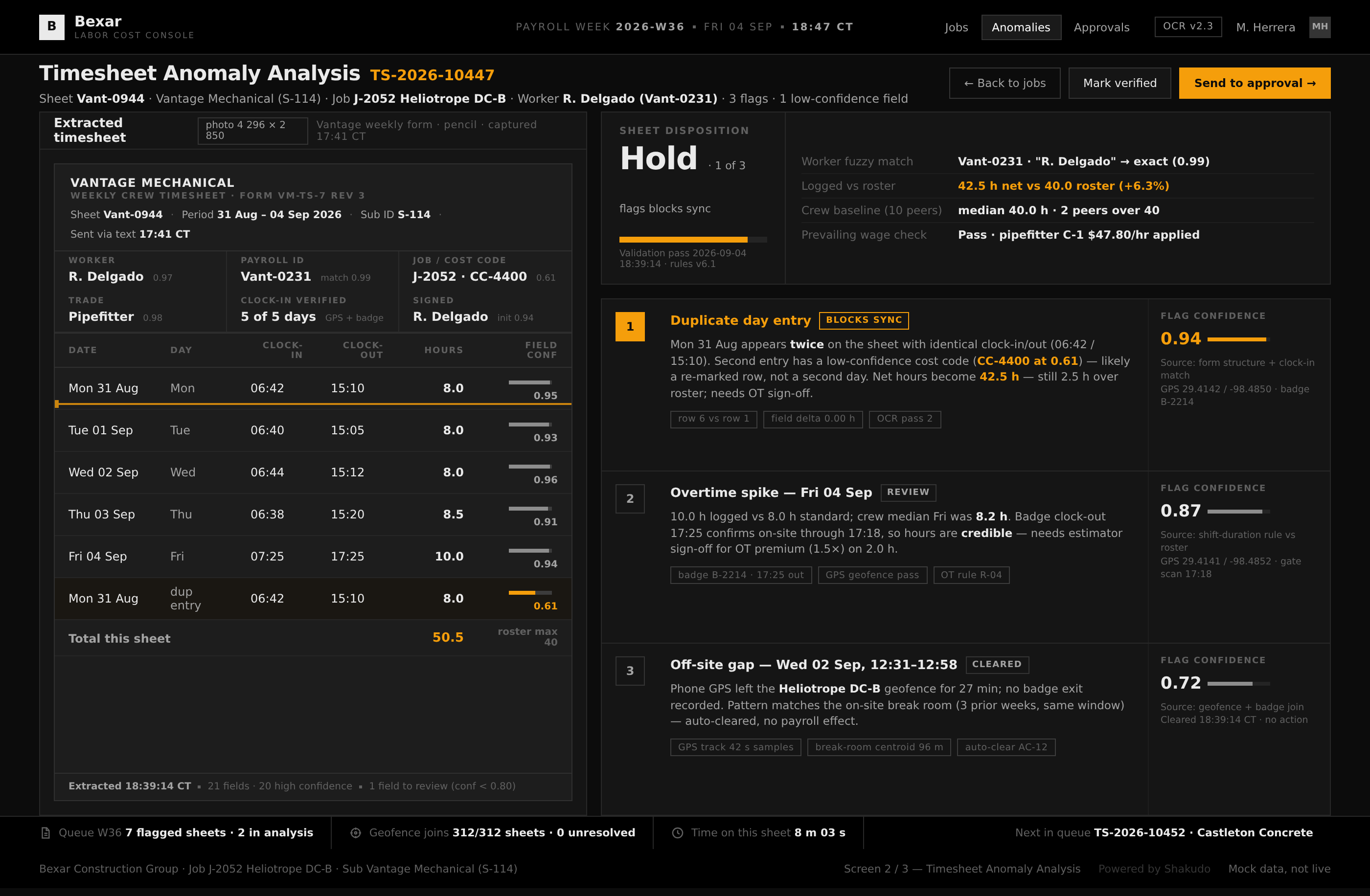
1–2 / 3
Every Friday afternoon, crews submit hundreds of paper timesheets scrawled in pencil, often missing job codes or cost centers. One general contractor reported processing 300 handwritten timesheets every week, a volume that consumed two full-time payroll clerks. An automated extraction and validation pipeline turns that backlog into payroll-ready data in minutes.
Paper timesheets are more than a minor inconvenience. They are a structural bottleneck that delays payroll, inflates administrative overhead, and introduces errors at every stage. When payroll teams transcribe hours manually, mistakes are inevitable. A misread eight can become a three, turning a regular shift into unauthorized overtime. Missing cost codes force follow-up calls that push payroll processing past its deadline.
The problem compounds with subcontractor volume. A single project may involve a dozen subcontractors, each submitting timesheets in a different format with different field structures. Controllers spend entire days normalizing these documents into a consistent project cost framework. One construction firm controller noted that parsing timesheets from 12 subcontractors took a full day of manual work each week. Errors also carry financial risk. Overreported hours mean overpayment. Underreported hours trigger complaints and rework. Without automated validation, discrepancies surface only after payroll runs, when corrections are costly and contentious.
Shakudo builds the pipeline that replaces the manual middle of timesheet processing. Instead of transcription, crews photograph paper timesheets on any phone, and the system reads handwritten names, dates, job codes, and hours into structured digital rows. Extracted hours are checked against project schedules, crew rosters, and expected shift durations, and approved entries flow directly into the payroll system the firm already runs, formatted to match the exact field structure it expects.
The outcomes are measurable. Firms that deploy automated timesheet processing report payroll error rates dropping by 70 percent or more. What took an accountant a full day now takes 20 minutes, and staff hours previously spent on data entry shift to higher-value work like cost analysis and schedule optimization. Payroll cycles shorten because there is no longer a multi-day lag between timesheet collection and check processing.
The pipeline is built around construction realities: varying union rules, prevailing wage rates, and certified payroll requirements, all handled without forcing the firm to change its existing tools or retrain its workforce.
Ollama runs local language model inference, so the name normalization and field interpretation logic processes personnel data on the firm's own infrastructure. Supabase provides the structured storage for extracted timesheet rows and the API that connects the workflow to review and sync steps. Qdrant vectorizes crew rosters and payroll records so fuzzy name matching can resolve variants against payroll IDs. Dify supplies the AI workflow orchestration for the extraction steps that combine language model calls with structured output validation.
The pipeline fits construction firms where subcontractor volume makes manual transcription a structural cost: controllers and payroll clerks at general contractors running a dozen subcontractors per project in different formats, field operations leads collecting hours from crews on basic phones across multiple sites, and accounting teams that must meet certified payroll, prevailing wage, and union reporting requirements on a weekly deadline. It is built for the firm that already runs a commercial construction platform or a general accounting package and wants its timesheets to flow into it automatically.
Yes. Modern OCR models trained on handwriting recognition handle messy penmanship, smudged entries, and non-standard form layouts. The system assigns confidence scores to each extracted field and routes low-confidence values to a human reviewer. This approach catches illegible entries without rejecting the entire timesheet.
The parsing layer normalizes data from any format into a single structured schema. Whether a subcontractor uses a custom PDF, a photo of a carbon copy, or a spreadsheet, the AI maps employee names, hours, job codes, and dates to your project cost structure. Fuzzy matching resolves name variants so records align with your payroll IDs.
Yes. The pipeline writes structured timesheet data to your payroll system through its API or file import path. Extracted rows are formatted to match your system field structure exactly, so no manual mapping is needed. The same data feeds project costing and certified payroll reports without duplicate entry.
Automated extraction typically matches or exceeds manual accuracy while running in minutes instead of days. Firms report payroll error rates falling by 70 percent after deployment. Confidence scoring and automated variance checks catch discrepancies that human transcribers miss, because the system cross-references every entry against schedule data.
When the goal is payroll-ready timesheets in minutes instead of days, a conversation with Shakudo is the fastest way to see it on your own data. The pipeline deploys on your own infrastructure, on-prem or in your cloud, with a first working pipeline in place within days. Book a demo to try it.
AI extracts hours, names, and job codes from paper timesheets using optical character recognition. The system validates logged hours against project schedules and flags discrepancies before payroll runs. Extracted data then syncs directly to payroll and project costing systems, eliminating manual data entry.










"What drew me in is simple. When developers ship production-ready code this quickly, how can I have environments spun up fast enough? Shakudo is how we close that gap."


"Shakudo does not just provide the platform. It is a real partnership. They are always there to help and execute our vision faster and the right way. It is like a co-team working together to achieve our goals."