






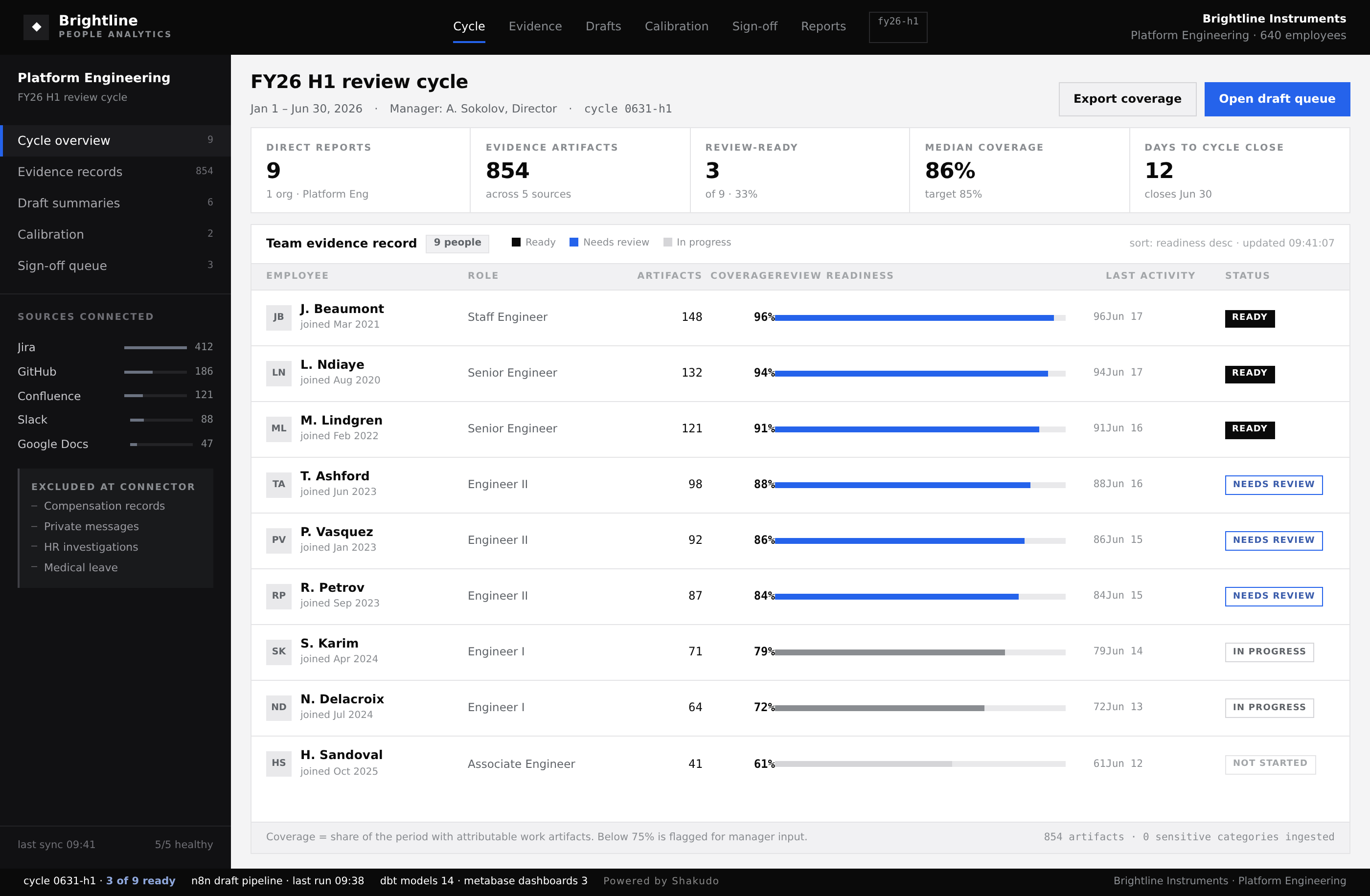
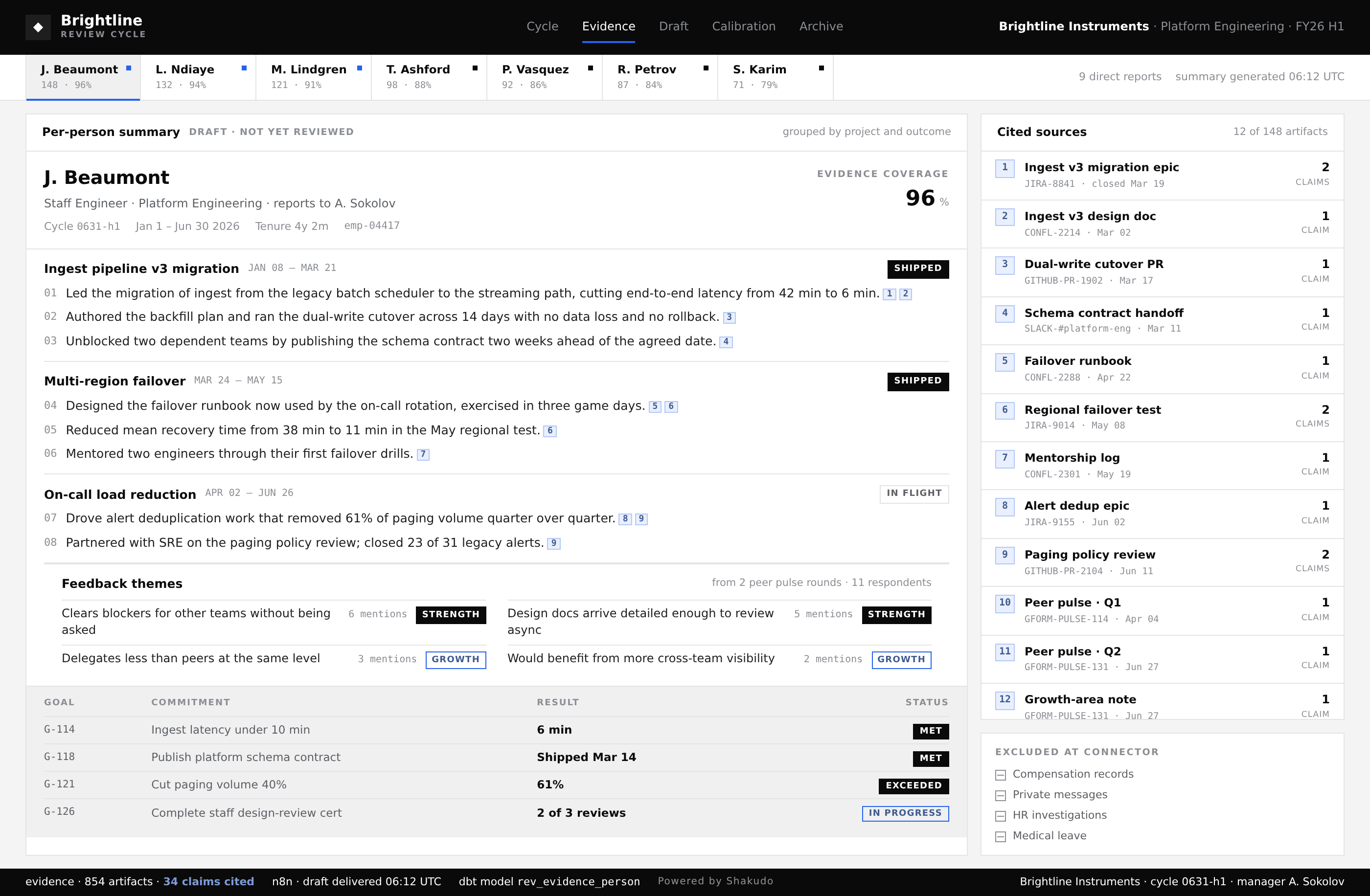
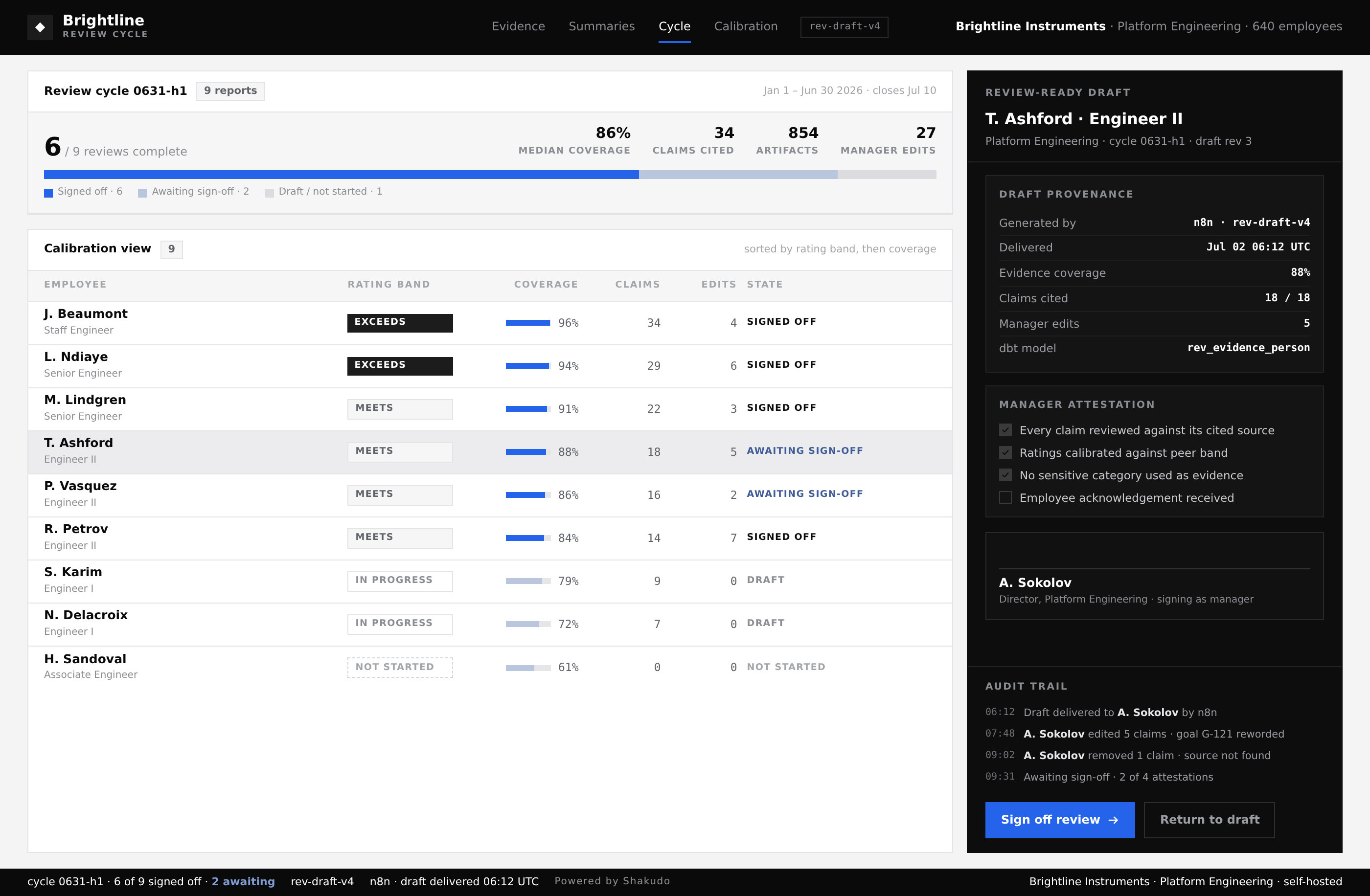
Three screens from a live review cycle: the team evidence record, a per-person summary with citations, and the review-ready draft.
1–2 / 3
Performance reviews depend on memory. A manager with eight direct reports is asked to reconstruct a year of work from fragments: a launch that slipped two quarters, a migration nobody volunteered for, a stretch of unglamorous reliability work that kept a system standing. The evidence exists. It is spread across documents, tickets, code reviews, and chat threads that nobody has time to read again.
Assembling that evidence by hand takes weeks and still produces an incomplete picture. The person who closes the most tickets is not always the person whose work mattered most. Review quality ends up shaped by how well a manager remembers the year rather than by what actually happened.
A typical cycle asks managers to produce written assessments for every direct report inside a two-week window, on top of their normal job. The inputs are everywhere: project trackers, document repositories, code review systems, incident logs, and messaging platforms. Each holds a fragment. None holds the story.
The cost shows up in three places. Time: managers spend evenings reconstructing timelines, and the effort scales with team size. Quality: assessments lean on the most recent or most visible work, so a strong contribution from eight months ago disappears. Defensibility: when an employee disputes a rating, the manager has no structured record to point to, only a recollection. Organizations that run calibration sessions feel this most acutely, because managers arrive with inconsistent evidence and the meeting becomes about reconciling formats instead of evaluating work.
The system builds a per-person evidence record from the tools the organization already uses, then organizes it into review-ready summaries. Managers open a cycle with the work already gathered, attributed, and linked back to its source. It delivers:
The measurable change is preparation time and coverage. Managers stop spending the first week of a cycle gathering material and start it reviewing material. Contributions that would have been forgotten stay in the record because collection runs continuously rather than as a scramble at the end.
Shakudo deploys inside the organization's own environment and connects to the systems that already hold the work record. Connectors pull activity from project trackers, document stores, code review platforms, and messaging tools on a schedule. Each artifact is normalized into a common shape: who produced it, what project it belongs to, when it happened, and what outcome it supported.
From there the pipeline groups artifacts by person and project, summarizes clusters of related work, and preserves a link to every underlying item. Managers see a draft summary with citations rather than an opaque paragraph. They can expand any line to inspect the source, correct a grouping, or add context the systems could not see. Sensitive categories, such as compensation discussions and private messages, are excluded at the connector level before anything is summarized.
A first working pipeline, connecting one team's tracker and code repository into per-person summaries for a single cycle, is in place within days.
Qdrant provides vector search over the artifact corpus, so related work clusters by meaning rather than by keyword. That is what lets a summary connect a design document to the pull requests that implemented it. n8n orchestrates the pipeline: scheduled ingestion, summarization runs, and delivery of draft summaries to managers at the right point in the cycle. Metabase gives HR and people-analytics teams dashboards over cycle progress and coverage without exposing the underlying private content.
The system serves organizations large enough that managers cannot hold a full year of work in their heads, roughly a few hundred employees and up, and where review quality is treated as a retention and fairness issue rather than an administrative chore. HR and people-operations teams use it to run cycles with consistent evidence and shorter preparation windows. Engineering and product managers use the per-person summaries as the starting draft for written assessments. Calibration facilitators use the shared structure to compare contributions across teams.
It fits organizations whose work record is already distributed across several systems, which is nearly all of them. It is a poor fit for teams whose work is genuinely unrecorded, because the system summarizes evidence rather than inventing it.
Preparation shifts from gathering to reviewing. Managers typically spend their first days in a cycle reading assembled summaries and verifying sources rather than reconstructing timelines from scattered tools. Collection runs continuously in the background, so the effort at review time concentrates on judgment instead of archaeology.
No. It assembles evidence and drafts structure. Managers decide ratings, write the assessment, and own the conversation. Every summarized line links back to its source, so a manager can verify a claim, drop a grouping that misrepresents the work, or add context the systems never captured. The output is a starting draft with citations, not a verdict.
It stays inside the organization's own environment, whether on-premises or in the organization's own cloud. Connectors read from existing systems under the access controls already in place, and sensitive categories are excluded before summarization. Nothing is sent to an external service, and the access rules that govern the source systems continue to govern the derived summaries.
Project trackers, document repositories, code review platforms, incident management tools, and messaging platforms are the common sources. Because ingestion runs through configurable connectors, the pipeline reads from what the organization already uses rather than requiring teams to move their work into a new system first.
When the goal is review cycles built on evidence instead of recollection, a conversation with Shakudo is the fastest way to see it on your own data. The platform runs inside your own environment, and a first working pipeline is in place within days. Book a demo and scope performance review preparation for your teams.
An AI performance review preparation system gathers the work artifacts a person actually produced, across documents, tickets, code changes, and messages, then organizes them into a structured summary. Managers review evidence instead of reconstructing a year from memory.










"What drew me in is simple. When developers ship production-ready code this quickly, how can I have environments spun up fast enough? Shakudo is how we close that gap."



"Shakudo does not just provide the platform. It is a real partnership. They are always there to help and execute our vision faster and the right way. It is like a co-team working together to achieve our goals."