







Three screens from a live agent onboarding run: the agency-wide funnel, per-agent licensing and training checks, and the measured time-to-first-sale outcome.
1–2 / 3
Onboarding an independent insurance agent is a race of paper. A new agent has to pass a license check, get appointed with each carrier, finish the product training, and only then can they write their first policy. Every step lives in a different system, every handoff needs a human to notice it, and most agents stall silently in the middle of the pipeline without anyone realizing.
At a distributor onboarding around 100 new agents a week across several carriers, the cost is measurable. The industry norm for time to first sale is roughly 90 days, and a large share of that is not selling at all. It is waiting on a license confirmation, chasing an appointment, and finding out in week six that a training requirement was missed. The agent is still in the pipeline, but the momentum is gone.
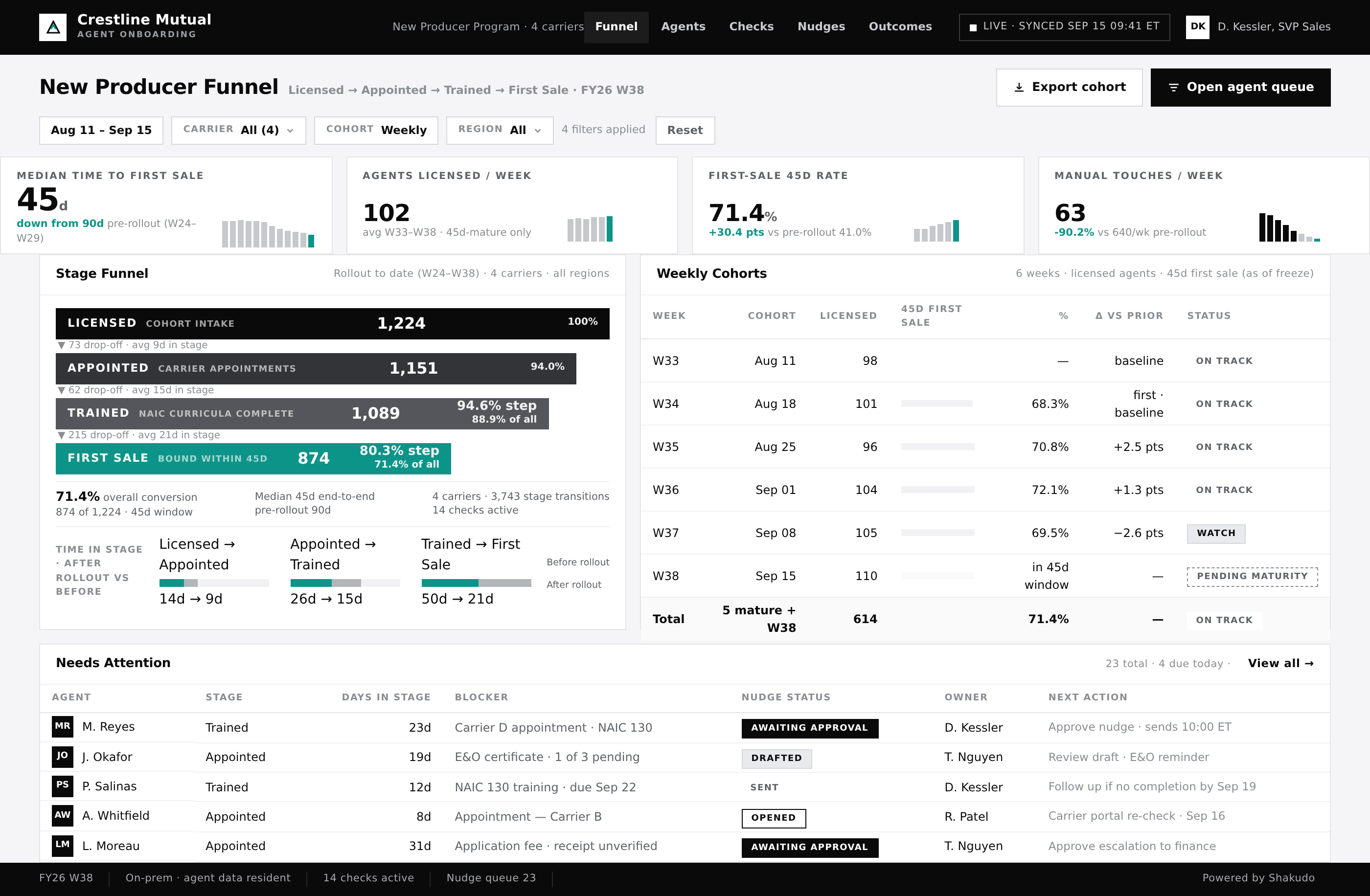
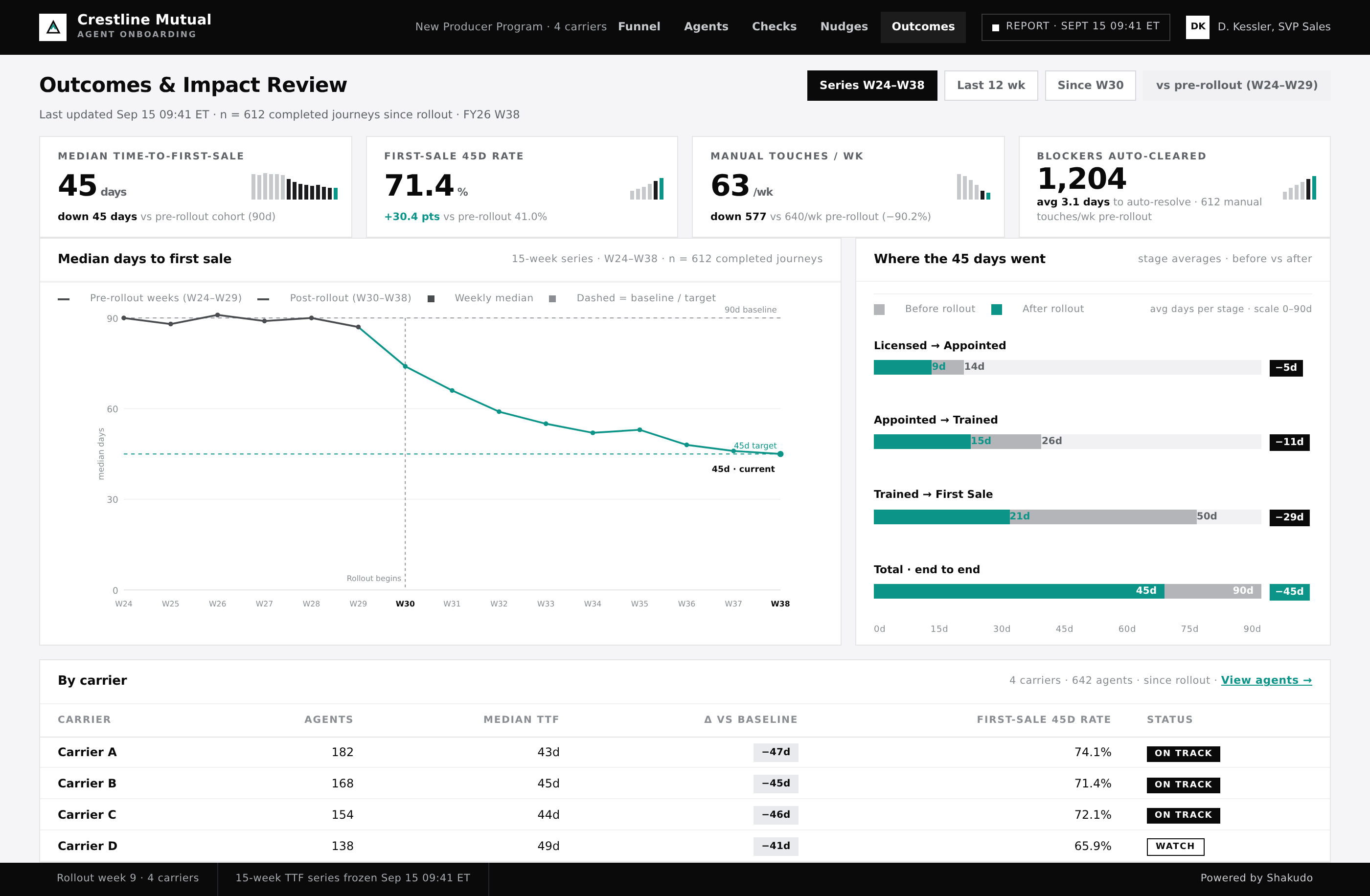
Shakudo Kaji runs the entire pre-sale process as an autonomous workflow. It checks licensing, appointment, and training status directly in Salesforce and Salesforce Marketing Cloud, flags the exact step where each agent is blocked, and sends the nudge that unblocks them, a training reminder, an appointment follow-up, a document request. A live funnel shows every agent from license application to first sale, with days-in-stage and conversion at every step. The target is concrete: time to first sale falls from around 90 days to around 45.
Because the workflows are generated and maintained by Kaji itself, the system adapts when the process changes. A new carrier appointment requirement becomes a new check within the same week, without a developer ticket. The team sees the whole lifecycle in one place for the first time, which is itself the fix for the slowest stalls, the ones nobody was watching.
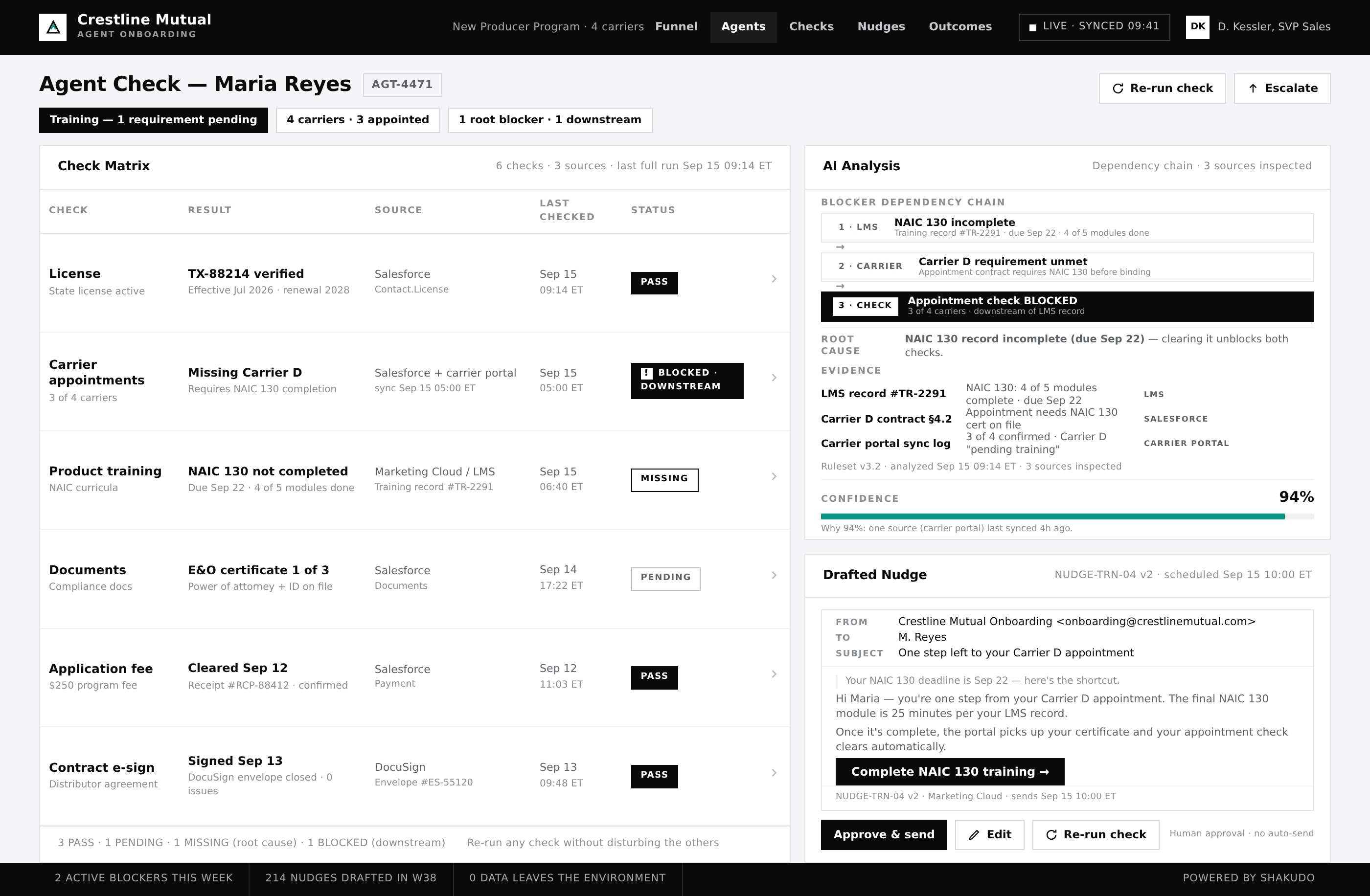
Kaji runs on the agency's own infrastructure, so agent records, carrier data, and email history never leave the environment. The workflows are n8n flows that Kaji generated from the process description and maintains as it evolves. Each agent record carries a status row per step: license, appointment per carrier, product training, with the source system and last sync time. When a check finds a blocker, Kaji drafts the nudge email and routes it through Marketing Cloud, with a human approval gate on anything that leaves the building.
The funnel is the operating view. Stage counts, conversion percentages, and average days-in-stage refresh continuously, and the weekly cohort table shows how each class of 100 agents is moving. When a stage starts to slow, the view shows which agents are in it and what they are blocked on, so the fix is a specific person and a specific step, not a monthly report.
Time to first sale is the KPI, and it moves because the blockers move. License checks that used to take a week of back-and-forth run in hours. Training completions that used to be discovered in a monthly review are caught the day they happen, and the missing product code is requested before the agent stalls. Appointment gaps that sat unnoticed for weeks get a follow-up in the same day. Across a class of 100 agents per week, the eliminated manual touches add up to full person-weeks of pre-sale work that no longer exists.
Sales and channel-operations teams at insurance distributors, agencies, and MGA-style operations that onboard independent agents at volume across multiple carriers. Any organization where new-producer onboarding is tracked in a spreadsheet and the first-sale date is a hope rather than a number.
The pre-sale pipeline that every new agent walks through: license verification, per-carrier appointment, product training completion, and the document and payment steps in between. Each step is a check with a status, a source system, and a last sync time, and each blocked agent gets a targeted nudge for the specific step they are stuck on.
A Salesforce workflow needs a developer to build and maintain each rule, and it stops at what the platform models. Kaji reads the whole process across systems, generates the automations itself, and adapts when the process changes. The funnel view also covers the gaps Salesforce does not track, the waiting states between steps where agents actually stall.
No. Kaji runs on the agency's own infrastructure. Agent records, carrier data, and email history stay in place, which is also what makes it possible to read the data that a cloud AI vendor would not be allowed to see.
For agent onboarding, that means the 90-day pipeline becomes a 45-day pipeline, and the team can see every agent in it. Book a demo and watch the funnel run itself.
Shakudo Kaji runs the pre-sale process for independent insurance agents end to end: license checks, carrier appointments, product training, and targeted nudge emails, tracked in one lifecycle funnel from first application to first sale.










"What drew me in is simple. When developers ship production-ready code this quickly, how can I have environments spun up fast enough? Shakudo is how we close that gap."



"Shakudo does not just provide the platform. It is a real partnership. They are always there to help and execute our vision faster and the right way. It is like a co-team working together to achieve our goals."