






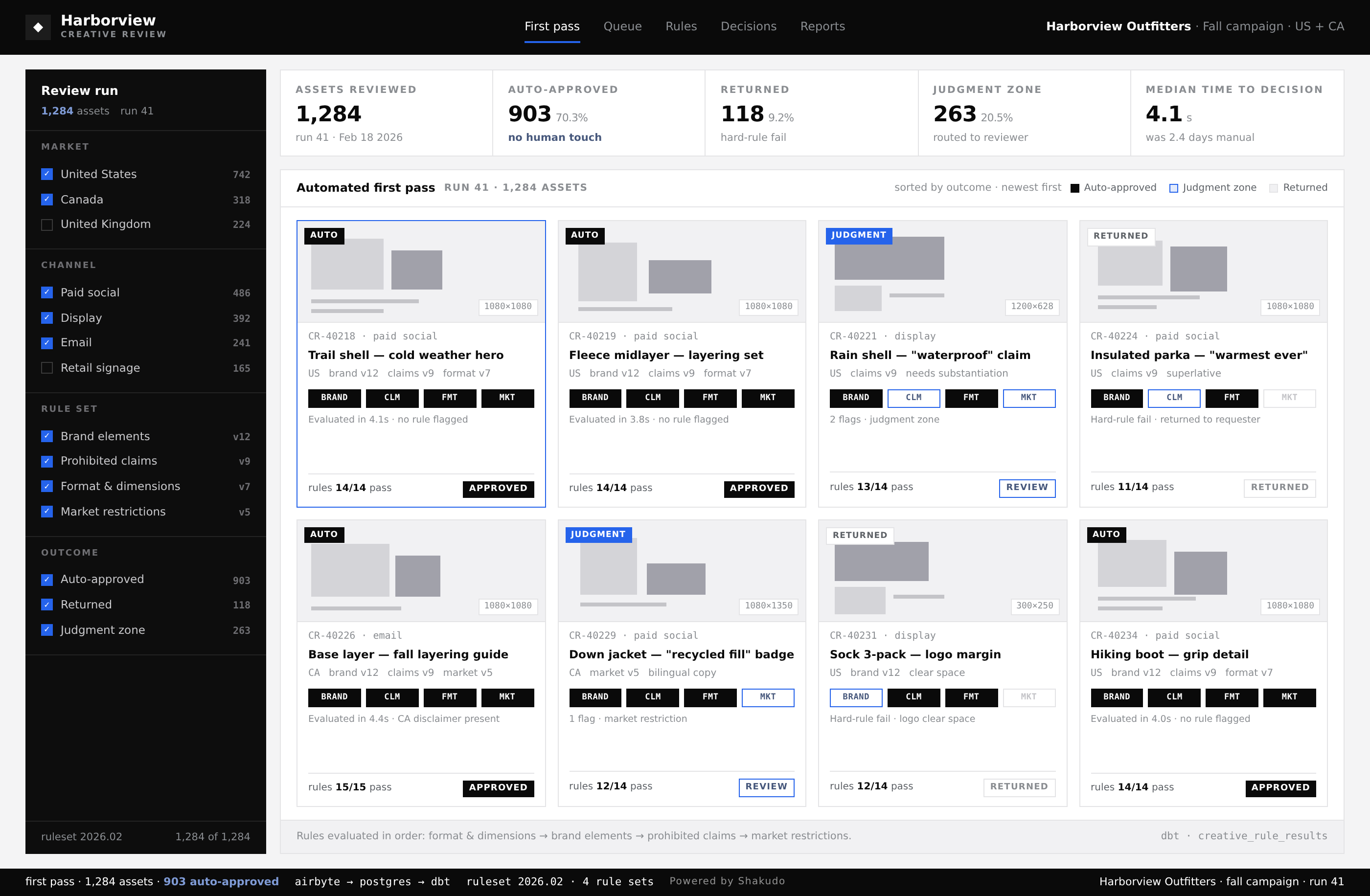
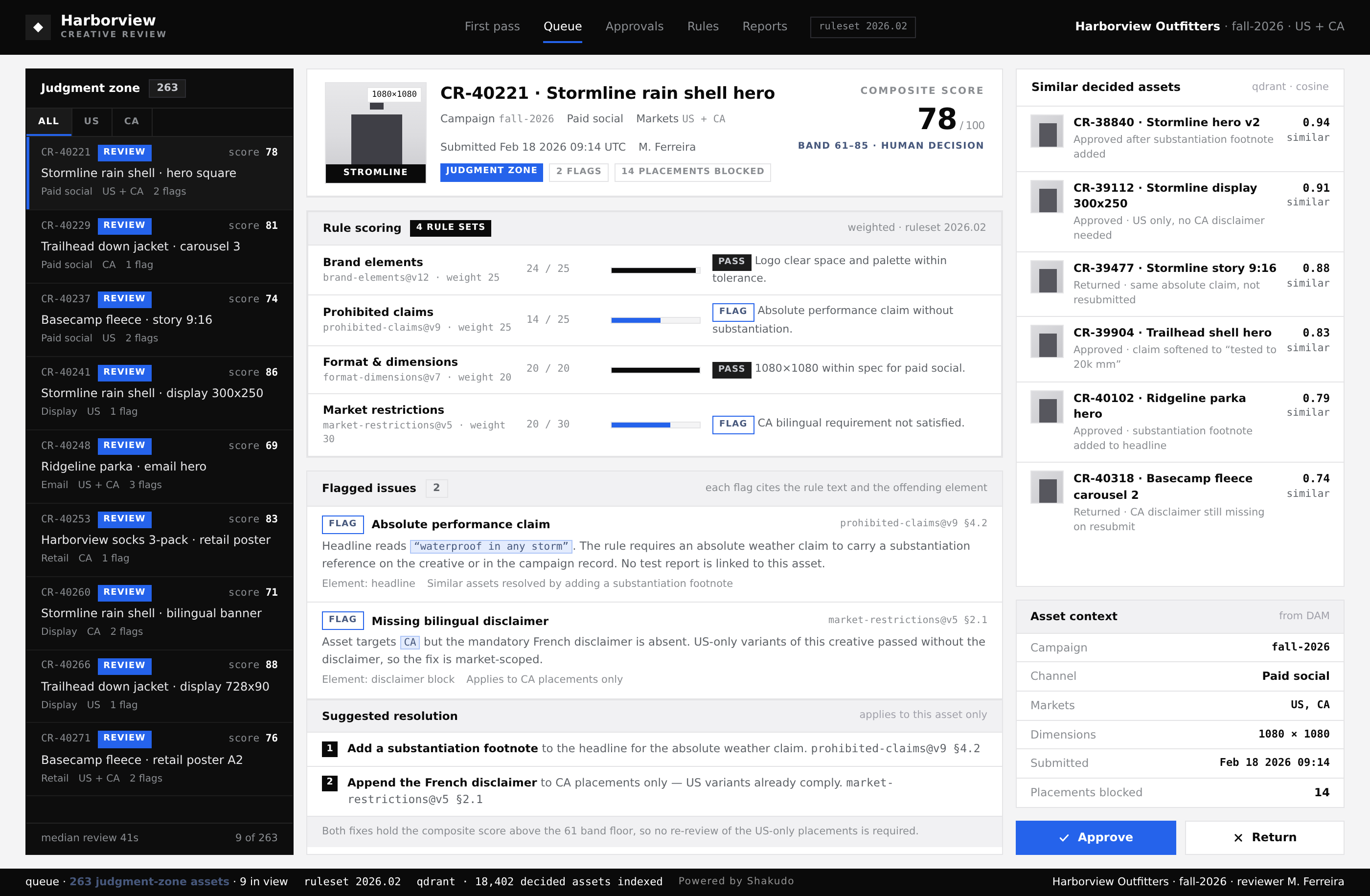
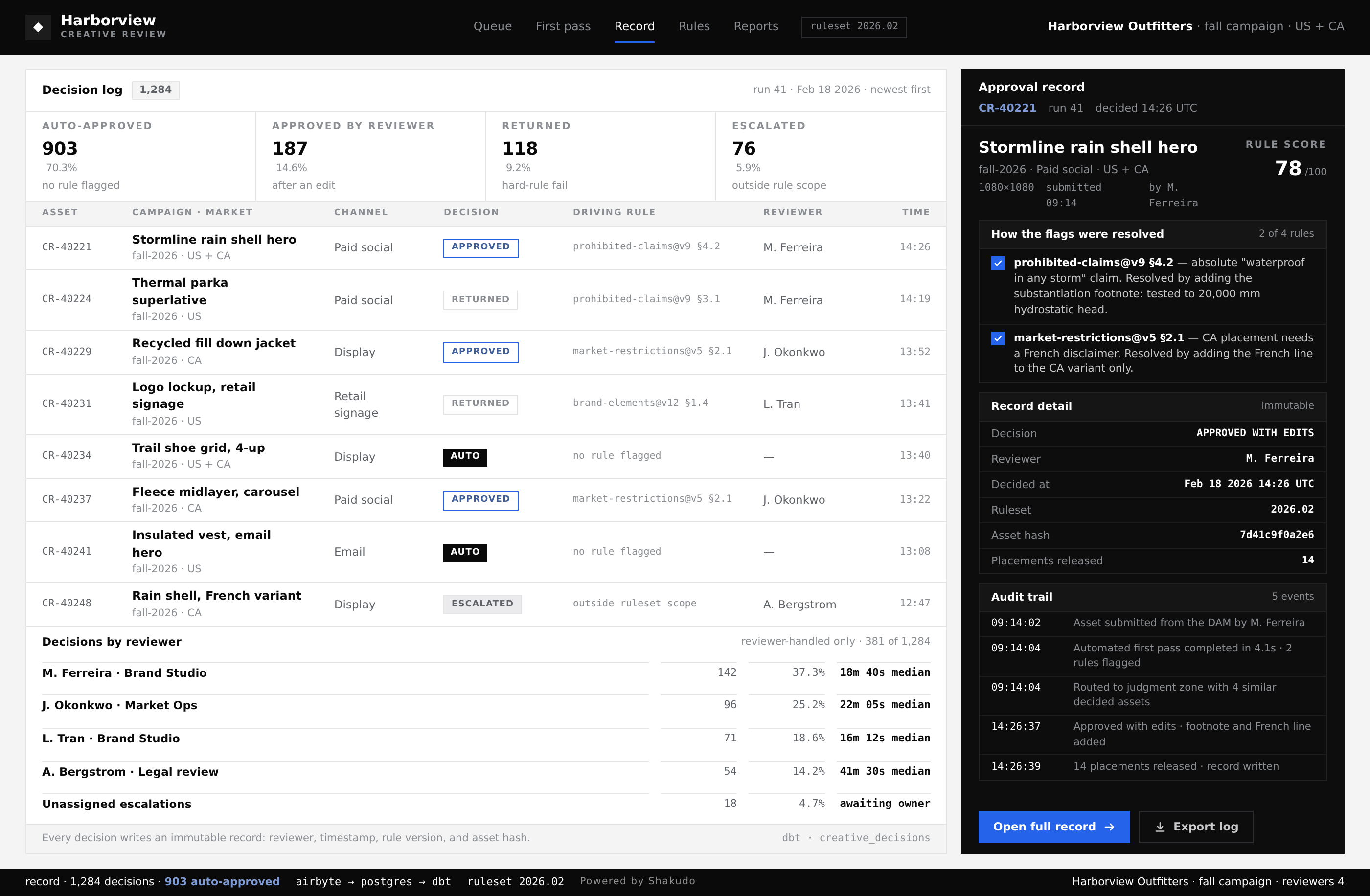
Three screens from a live creative review run: the automated first pass, the reviewer queue, and the approval record.
1–2 / 3
An advertising team producing creative at scale faces a review bottleneck that grows with every campaign. A single product launch can generate thousands of image variants across formats, markets, and channels, and each one needs a brand check, a policy check, and a sign-off before it can run. Reviewers become screeners, and the work that actually needs human judgment waits behind a queue of assets that were never going to be approved.
The cost shows up in two places. Approval takes days when a campaign needed hours, and the review standard drifts between reviewers, markets, and time zones. Automating the first pass fixes both: the rules are applied uniformly to every asset, and reviewers are left with the decisions only a person can make.
A reviewer working through a queue of assets makes a series of fast judgments. Most are straightforward: the logo is present, the claim is approved, the image meets the format spec. A small minority need real thought, such as a borderline health claim or a visual that reads differently in another market. When the queue is long, everything gets the same few seconds, and the hard cases get the same attention as the easy ones.
The downstream effects are familiar to anyone who has run a campaign calendar. Approvals slip and launch dates move. Different markets apply different standards, so the same creative passes in one region and fails in another. When an auditor or a platform asks why an asset ran, the answer lives in a chat thread or a spreadsheet. And the reviewers themselves burn out on work that a rule could have handled.
The platform puts every creative asset through an automated first pass the moment it is uploaded. Brand rules, policy requirements, format specifications, and quality thresholds are evaluated against each asset, and the result is a structured record rather than a note in a thread. It delivers:
Reviewers move from screening to deciding. A campaign that previously waited days for approval clears its automated pass in minutes, and the human review time goes to the assets that carry real risk. Marketing leaders get a consistent standard across regions and a defensible record when a creative decision is questioned.
Shakudo deploys the review pipeline inside the advertiser's own environment, connected to the systems where creative already lives. Assets arrive from the digital asset manager or the campaign platform through an automated connector, and each one is checked against the rule set the team defines: required brand elements, prohibited claims, format and dimension specifications, and any market-specific restrictions.
Assets that pass every check are marked approved with a complete record of what was evaluated. Assets that fail a hard rule are returned with the specific reason. Assets that fall into the judgment zone are routed to a human reviewer with the relevant context attached, so the decision takes seconds rather than minutes of reconstruction. Every outcome feeds a reporting layer that shows approval volume, common failure reasons, and where review time is actually going. A first working pipeline, connecting one campaign's assets to the automated checks, is in place within days.
The pipeline serves marketing and creative operations teams at advertisers and retailers producing creative at a volume that outpaces manual review. Creative operations managers use it to keep approval turnaround predictable during campaign peaks. Brand and compliance reviewers use the queue to focus on judgment calls while the automated pass handles the routine checks. Marketing leaders use the reporting layer to see where review time goes and whether the standard is being applied consistently across markets. It is also the build-versus-buy alternative to per-seat creative review software: if your brand rules, market restrictions, or approval chains are specific enough that a generic product does not fit, an in-house pipeline applies your actual rules.
It handles the first pass, not the decision. Every asset is checked against explicit rules such as required brand elements, prohibited claims, and format specifications. Assets that pass are recorded as approved, assets that break a hard rule are returned with the reason, and everything in between goes to a human with the context attached. Reviewers keep every judgment call.
Yes, and that is usually the point. Rules are defined per market, channel, and campaign type, so a claim that is permitted in one region and restricted in another is evaluated correctly without a reviewer having to remember the difference. The same asset submitted to several markets is checked against each market's rule set in one pass.
Every outcome is stored with the asset, the rule set it was evaluated against, the result, and the reviewer where a human decided. That record answers the question of why a creative ran, which matters when a platform, a regulator, or an internal audit asks. It replaces the chat threads and spreadsheets that usually hold this information.
A first working pipeline, connecting one campaign's assets to the automated checks, is in place within days. The pipeline runs inside the advertiser's own environment and is configured around the brand rules and approval chains already in use, so reviewers work in a queue that matches their existing process rather than a new one to learn.
When the goal is faster creative approval without giving up human judgment, a conversation with Shakudo is the fastest way to see it on your own assets. The pipeline runs inside your own environment, and a first working pipeline is in place within days. Book a demo and scope creative review for your campaigns.
An advertising review workflow where AI performs the first pass on every creative asset, checking brand rules, policy compliance, and quality thresholds before a human reviewer sees it. Reviewers spend their time on judgment calls instead of screening thousands of images by hand.










"What drew me in is simple. When developers ship production-ready code this quickly, how can I have environments spun up fast enough? Shakudo is how we close that gap."



"Shakudo does not just provide the platform. It is a real partnership. They are always there to help and execute our vision faster and the right way. It is like a co-team working together to achieve our goals."