
TL;DR
Everyone shipped a kill switch this year. Almost nobody can tell an examiner what happens after they press it.
On November 3, 2026, CrowdStrike added an AI kill switch to Falcon Guardian. It sits at the AI gateway and cuts an agent off from the models behind its decisions. That is the control most vendors shipped in 2026.
JetStream got there first, with a surgical AI kill switch on July 27, and Straiker followed on August 4. ServiceNow added one to its AI Control Tower in May 2026.
Nvidia shipped agent quarantine in September. By the end of the year the kill switch had moved from conference panel to product line, and the question moved with it.
The OCC followed a day later. Bulletin 2026-54, published on November 4, 2026, tells examiners how to review a bank’s use of AI. The bulletin is explicit that it sets no new supervisory expectations for banks. It still tells examiners where to look, and for higher-tier systems that means kill switches, circuit breakers, rate limits and a named human overseer.
Banks already know they are behind. Wolters Kluwer’s US Banking AI Risk and Governance Index, published on May 28, 2026, surveyed 230 US banking professionals. 72% named one of two areas as their weakest: kill-switch protocols, at 34%, or reporting AI failures to regulators, at 38%.
The open question starts five minutes later. The model stops answering, and the agent’s credentials keep working. Scheduled jobs still fire. Work already queued in a downstream system still runs. CrowdStrike says so itself: its launch post calls blocking model access a starting point, then lists endpoint termination, runtime identity revocation, cloud and SaaS agents, and browser sessions as coming soon.
Stopping a process is the easy part. The controls around it are not, and that is where examiners now point their questions.
An AI kill switch is the set of controls that lets a named person stop an AI system, cut off everything it can still reach, and find and reverse what it changed. It works only if it acts fast enough to limit harm and leaves a record an examiner can check.
You’ll see the phrase used in a policy sense too, in debates about whether a government or a lab should be able to halt a training run. This post is about the operational sense: the controls inside your company, for the agents you run today.
Three controls travel under one name, and most of what shipped this year covers only the first.
Halt the agent or block its model calls. This control lives in the runtime, the orchestrator, or the AI gateway in front of the models. CrowdStrike’s gateway block is the clearest example to ship this year: once it fires, connected gateways stop serving the models the agent depends on.
What stop misses: credentials, schedules and queued work. A model call that never happens produces no new decision, and it cannot take back a decision already made or an instruction already handed to another system. A stopped agent can leave a lot running.
Revoke tokens, API keys and service accounts. Close network paths. Block relaunch. Containment lives in your identity provider, your secrets manager and your network policy, and it is the part vendors are still promising: CrowdStrike lists runtime identity revocation as coming soon.
What contain misses: shared identity. If an agent runs under a person’s login, revoking that login locks out the person too, usually in the middle of an incident, when you need them most. Containment only works cleanly when the agent has an identity of its own, which is why an agent borrowing someone’s login is a problem long before anyone reaches for a switch.
Unwind starts with an action log that tells the agent’s actions apart from people’s actions: records written, tickets closed, emails sent, payments queued, code merged. From there you reverse what you can and report what you can’t.
This is the control most teams do not have, and it is the one the joint CISA and Five Eyes guidance points at when it asks organizations to put resilience and reversibility ahead of efficiency gains.
The cost of skipping it shows up fast. In April 2026, an agent deleted a car-rental software vendor’s production database and the volume backups stored beside it, in nine seconds. The data came back only because the infrastructure provider kept a separate copy. Backups that sit next to the data were never the safety net they looked like.
The three controls answer different questions, and they sit with different owners. The examiner column draws on Bulletin 2026-54 and the CISA guidance.
| Control | Question it answers | Where it lives | What examiners look for | Typical owner |
|---|---|---|---|---|
| Stop | Can we halt it now? | Runtime, orchestrator, AI gateway | Emergency shutdown; circuit breakers and rate limits for higher tiers; a plan for agents behaving unexpectedly; resilience | Platform / SRE |
| Contain | Can it still reach anything? | IdP, secrets, network policy | A named human overseer; checks on data the AI was not authorized to use; least privilege; risk containment | CISO / IAM |
| Unwind | What did it change, and can we undo it? | Action log, data platform, downstream apps | Tiering by reversibility and cost of failure; human approval before consequential actions; reversibility over efficiency gains | Business owner + CRO |
Most of that work sits outside the model, which is why a model-level block on its own does not close the gap.
When an examiner or an auditor asks how you would switch an agent off, they are asking four things.
You can’t stop an agent that is not on the inventory. Shadow agents, vendor-embedded agents and the pilot someone forgot to retire all count. The evidence an examiner wants is a live AI inventory, not a spreadsheet someone last opened in Q2.
A read-only summarizer and an agent that writes, sends or pays need different switches and different approvals. The OCC framework tiers AI by the cost of a failure and by how reversible it is, rather than by how sophisticated the model is. For the higher tiers, the bulletin puts kill switches, circuit breakers and rate limits in scope. The evidence is permissions per agent and a tier per agent.
A named owner, a named backup, and trigger conditions that were agreed before launch rather than invented during the incident. Security usually keeps standing authority to act while an incident is running. Wolters Kluwer put the question bluntly in May 2026: who is authorized to shut off the bank’s AI? The evidence is a responsibility matrix and a decision log.
This is where most teams stall. You need an action-level record that separates what the agent did from what people did. If the agent acted under a person’s login, that separation does not exist. The evidence is an audit trail an examiner can read without your engineers sitting beside them.
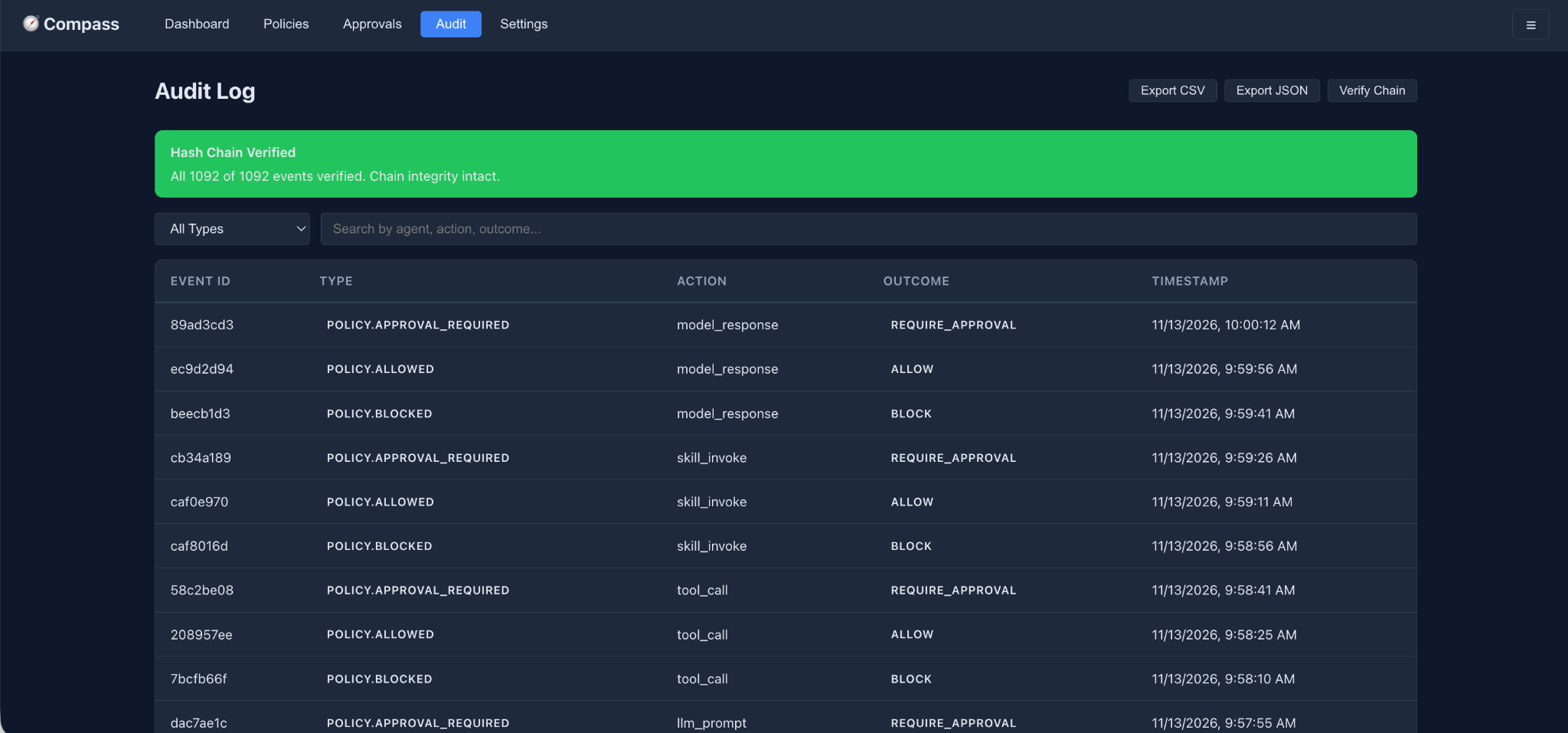
Figure 1. Audit log of LLM calls in the Shakudo Compass governance product.
You don’t need a tabletop exercise with forty people in the room. You need one agent, a stopwatch and an honest scorecard.
Before the drill: pick one agent that can write somewhere, and not the demo bot. Name the owner, the backup and the approver. Get change approval for a test window, or run the whole thing against a staging copy.
Scorecard: time to stop, time to revoke access, what was left behind (orphaned tokens, scheduled jobs, unreversed writes) and the evidence you produced.
Most teams find T1 takes minutes. T2 and T4 are where the afternoon goes, and where the surprises live: a token nobody listed, a cron job on a box nobody owns, and a write that has already flowed into three other systems. Run it once and you have a number to give an examiner, and a list of things to fix before they ask for it.
A switch you can only find in a spreadsheet will not be found in time. A switch in another vendor’s console cannot revoke credentials it does not hold. A vendor-run platform needs a standing remote connection to work, which is one more access path to cut during an incident.
With Shakudo, agents run inside your own environment, each with its own identity and scoped permissions. Kaji, our own agent, runs under those same controls. Stopping and containing an agent happens in one place instead of across a dozen consoles.
Compass adds a policy check on every agent action before it runs: high-risk requests pause for human approval, and every decision is recorded. That record answers who was allowed to act and what the agent did, and it is the same record the drill asks you to produce. See how banks and insurers run agents on Shakudo.
A kill switch is a promise to your board, your regulator and your customers. AI oversight is full of untested promises, and an examiner will treat yours as one until you can show otherwise. The only way to know your switch holds is to pull it, on one agent, on a normal afternoon, before an incident forces the test.
Which of your agents could you not switch off by 5pm today?
Book a free AI inventory and gap review.
An AI kill switch is the set of controls that lets a named person stop an AI system, cut off everything it can still reach, and find and reverse what it changed. It has to act fast enough to limit harm and leave a record an examiner can check. Stopping, containing and unwinding are three separate controls, and they usually sit with three different owners.
Stopping halts the agent and its model calls. Containing revokes its credentials, closes network paths and blocks relaunch. Unwinding finds every change the agent made and reverses what it can. Most kill switches only stop, so a stopped agent can leave credentials, schedules and queued work behind.
Stop the agent, revoke every credential, block relaunch from schedulers and retry queues, review the action log, reverse the changes you can and report what is left. Then test the sequence in a drill before you need it, because the drill is where you find the credential nobody listed and the job nobody owns.
Each agent needs a named owner and a named backup, with trigger conditions agreed before launch. Security should also keep standing authority to act during an incident, without waiting for the business owner to be reached.
It is an examiner framework, not a new set of expectations for banks. The bulletin tiers AI by consequence and reversibility, and for higher tiers it tells examiners to look for kill switches, circuit breakers, rate limits and human approval before consequential actions.
In Careful Adoption of Agentic AI Services, CISA, the NSA and their Five Eyes partners tell organizations to assume agents will behave unexpectedly, and to put resilience, reversibility and containment ahead of efficiency gains.
No. Human-in-the-loop AI means a person approves high-impact actions before they happen. A kill switch is what you use when that control fails or is bypassed. You need both, and you need to test both.