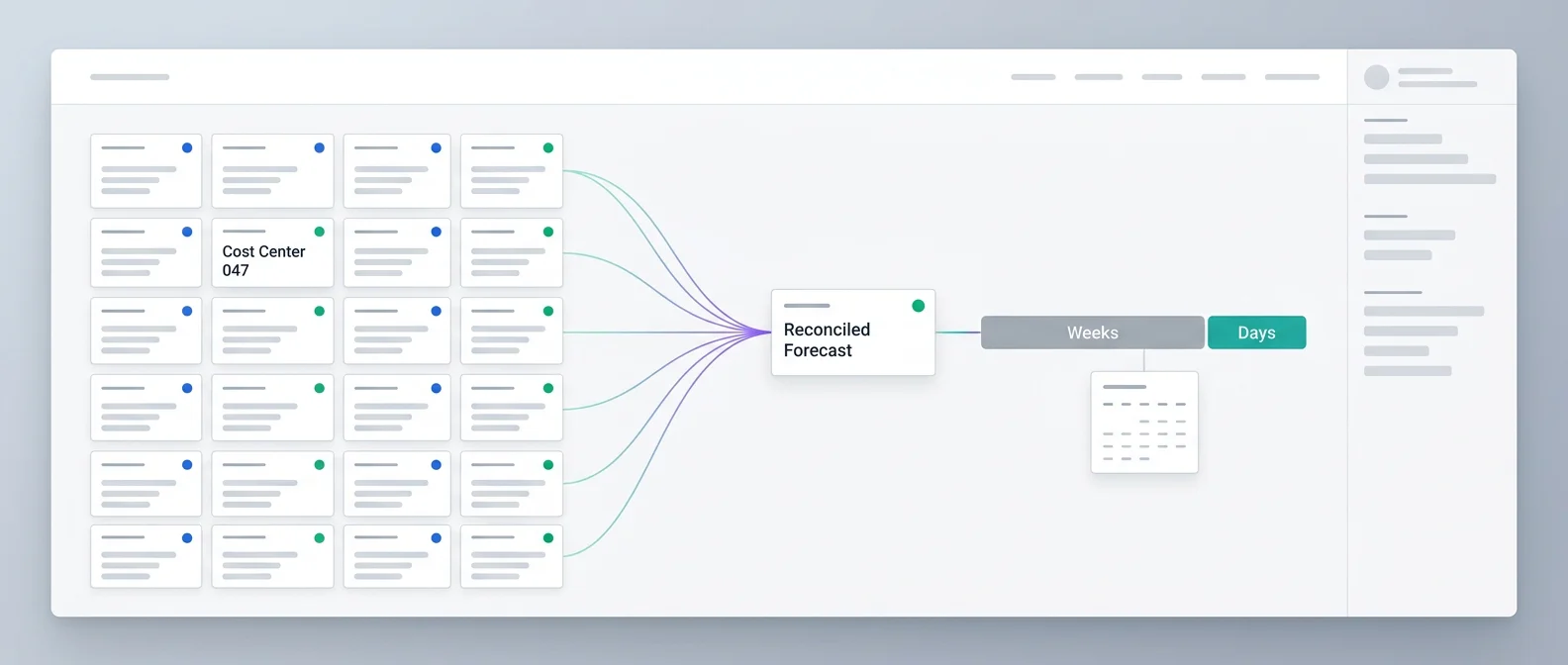







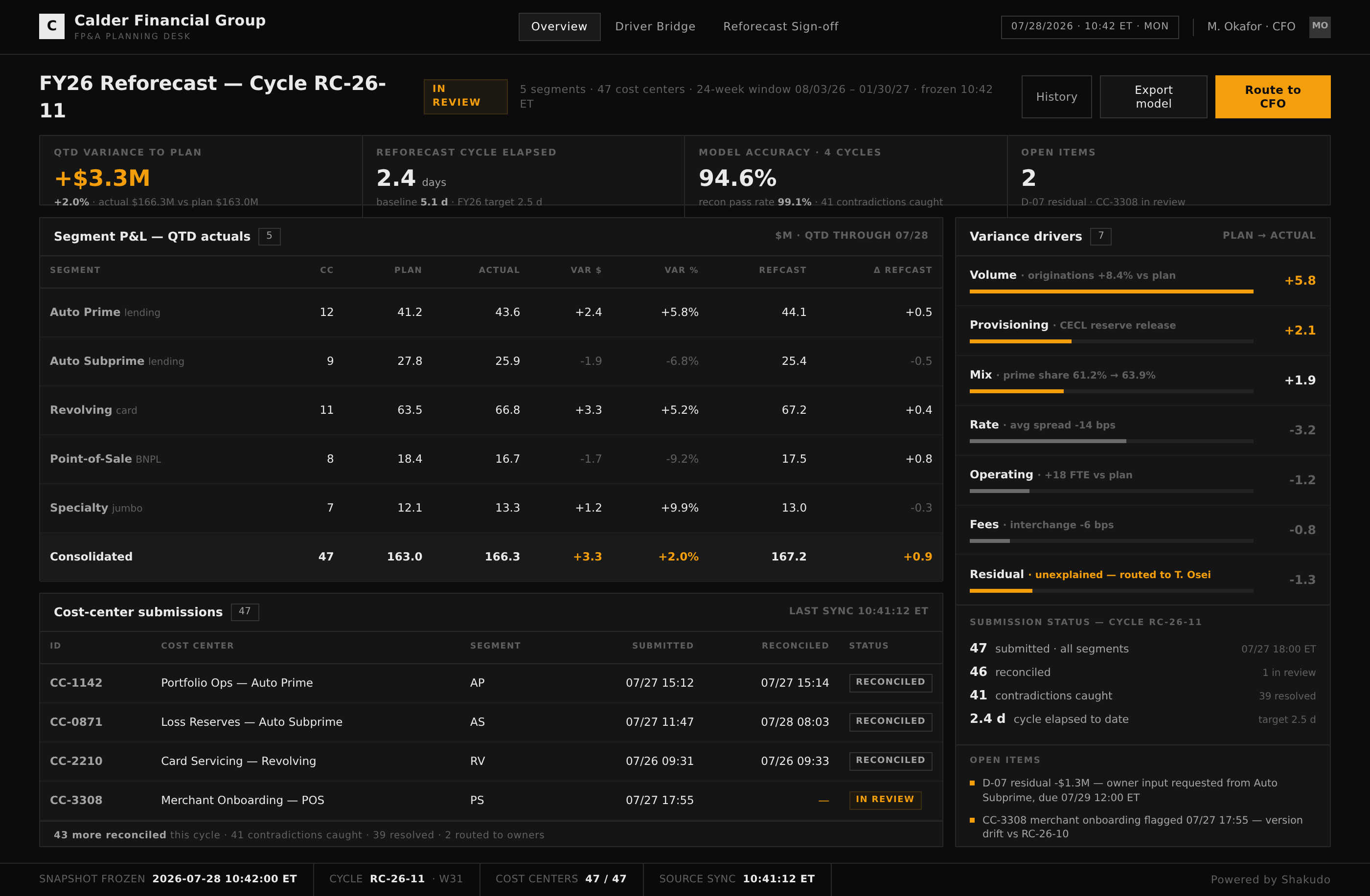
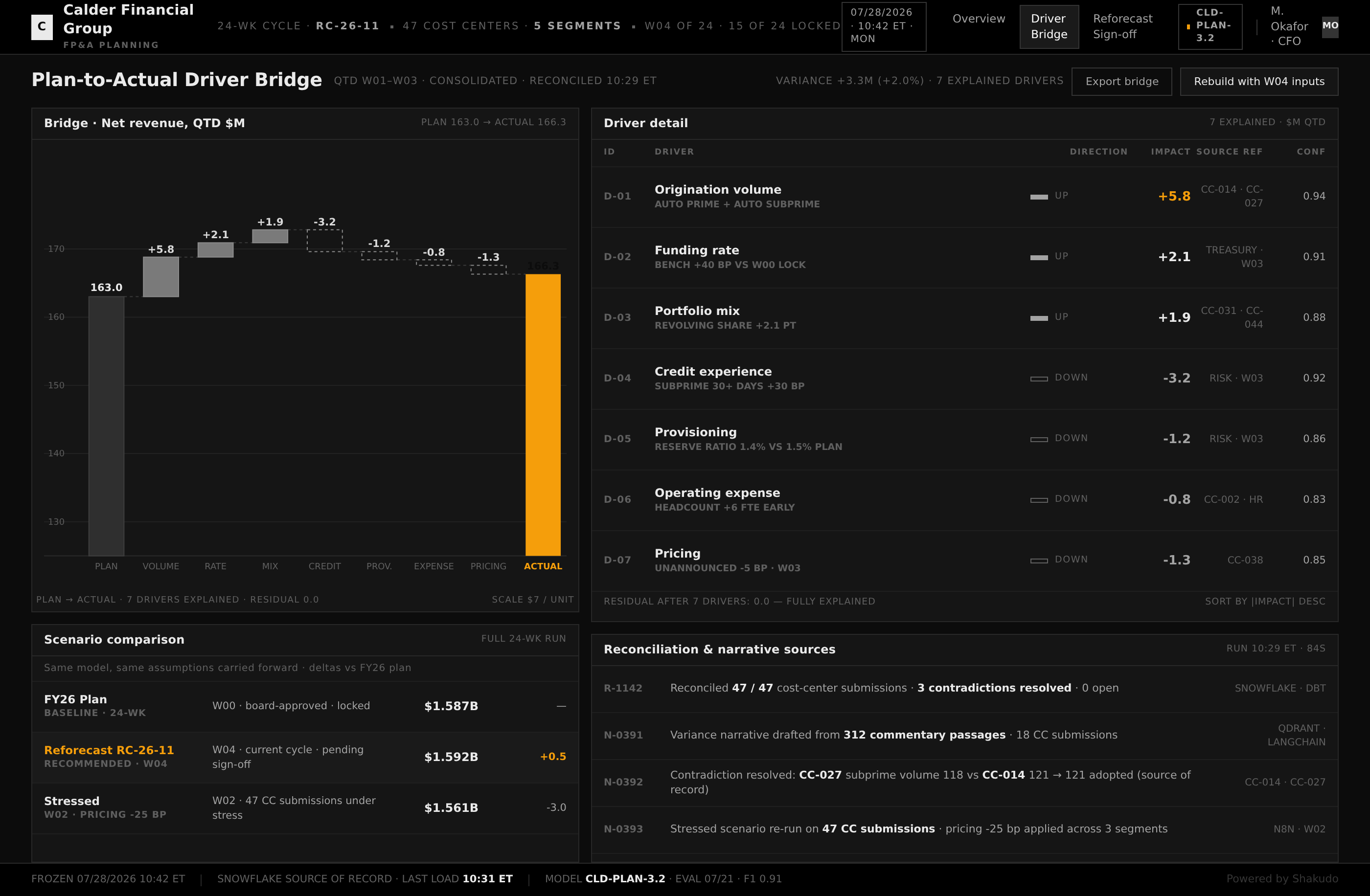
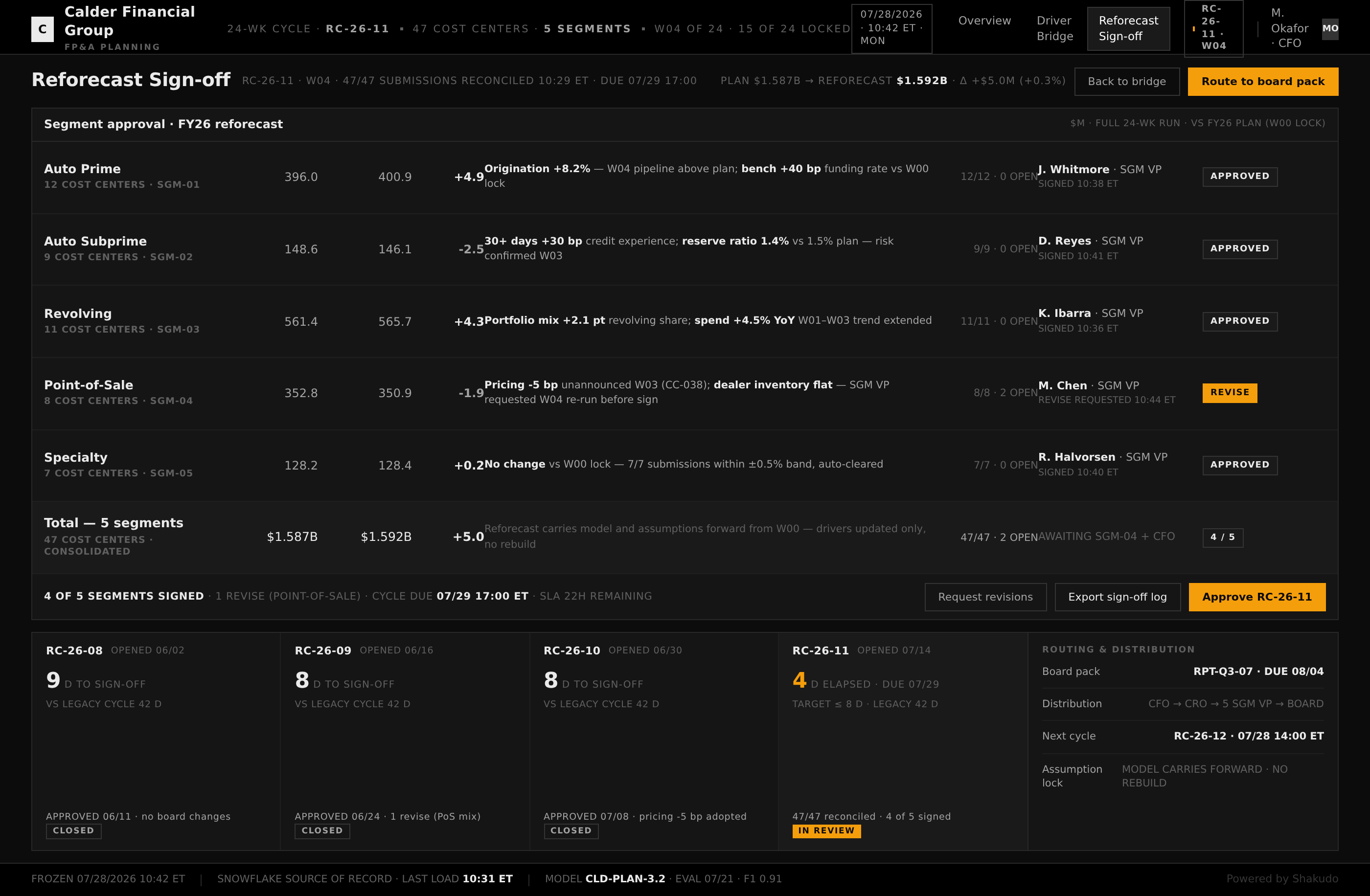
Three screens from a live reforecast: the cycle console, the driver bridge, and the sign-off.
1–2 / 3
Most FP&A teams model the business once a year and defend that financial planning cycle for the next twelve months, even as the business underneath it changes. Budget season shows the cost of that rhythm: three weeks of consolidation, two weeks of review cycles, one week building the board deck, and when the assumptions change, half of it is scrap.
None of that is planning. It is chasing submissions across 47 cost centers, fixing broken templates, reconciling versions that drifted, and rewriting commentary that changed after the last review. Your analysts are doing the data work of the company, running 60 hour weeks through budget season, while the actual analysis waits.
Shakudo deploys an AI that lives inside your finance stack and does that work for you. It reads every cost center submission the moment it lands, catches the assumptions that contradict each other before they reach the board, reconciles the versions automatically, and drafts the variance narrative, so the first version of the model your team reviews is already clean. The same model, the same assumptions, carried forward every cycle instead of rebuilding the whole thing from scratch. The planning cycle falls by half, and the weeks come back for the analysis your team was hired to do: driver models, scenario work, and the numbers that actually change decisions. Canada's Largest Retail Leader and the World's Largest Wine Producer use it to replan faster than their markets move. The result: 47 cost centers, one reconciled forecast, planning cycles cut by 50%, and millions saved a year, mostly in decisions made earlier.
The reason this goes further than a SaaS planning tool is where it runs. This is sovereign AI that you own outright, deployed on your own infrastructure, and your data never leaves your environment. That means it can work with the inputs that are too sensitive to send to a third party: deal pipeline, headcount plans, unannounced pricing, M&A assumptions. Your most sensitive data becomes usable in the forecast instead of staying locked in a spreadsheet, and nothing about your pipeline or your pricing has to be shared for the model to get better. That is the difference between a rolling forecast and a rolling forecast that actually rolls. When reality shifts, a price change, a hiring decision, a deal that closes, finance reforecasts in days and reruns the cycle whenever it matters, instead of waiting for next year's budget.
FP&A and corporate finance teams at companies where the deal pipeline, headcount plans, and pricing history are too sensitive to send to a planning SaaS vendor, and where 47 cost centers (or more) make the manual consolidation a tax on the whole year.
When the business changes, you rerun the same model with the new inputs instead of rebuilding it. The model and assumptions carry forward, so a reforecast is a matter of updating the changed drivers and reviewing the delta, not weeks of consolidation and version chasing.
The model runs on your own infrastructure, and your data never leaves your environment. Deal pipeline, headcount plans, unannounced pricing, and M&A assumptions stay in-house. Nothing about your pipeline or your pricing is shared with any third party for the model to get better.
Yes. The AI reads every submission the moment it lands, catches the assumptions that contradict each other before they reach the board, and reconciles the versions automatically. The result is one reconciled forecast, not 47 spreadsheets with a master copy nobody trusts.
Most planning platforms ask you to move your data to them and rent the tools by the seat. Shakudo does the opposite: the AI deploys inside your stack, you own it outright, and every number stays where it belongs. With Shakudo, you can deploy this within days and cut your planning cycle in half before the next budget season. Book a demo.
Shakudo deploys sovereign AI inside your finance stack to cut FP&A planning cycles in half. The AI reads every cost center submission, reconciles contradictory assumptions, and hands your team a model it can reforecast in days.










"What drew me in is simple. When developers ship production-ready code this quickly, how can I have environments spun up fast enough? Shakudo is how we close that gap."



"Shakudo does not just provide the platform. It is a real partnership. They are always there to help and execute our vision faster and the right way. It is like a co-team working together to achieve our goals."