







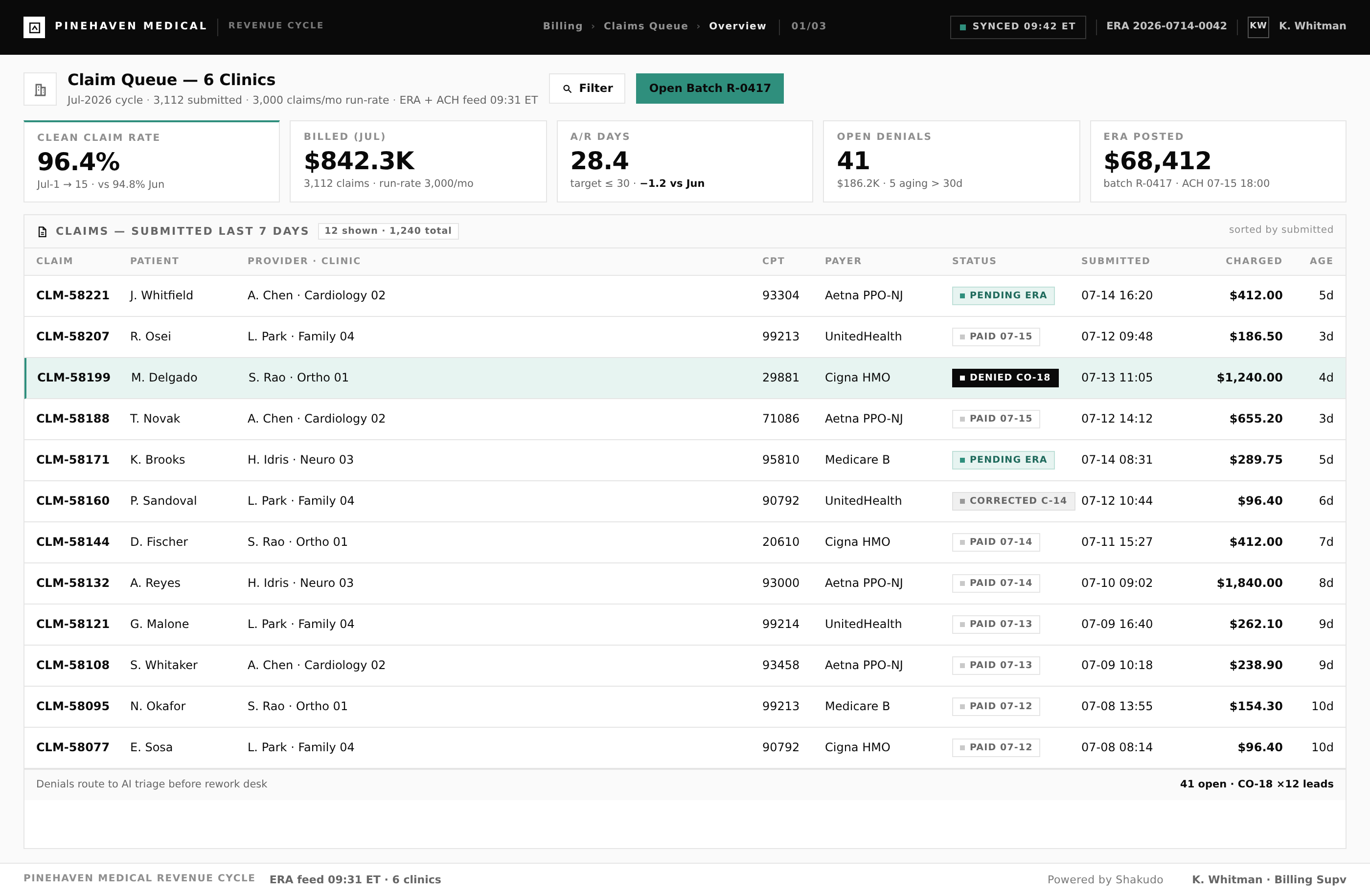
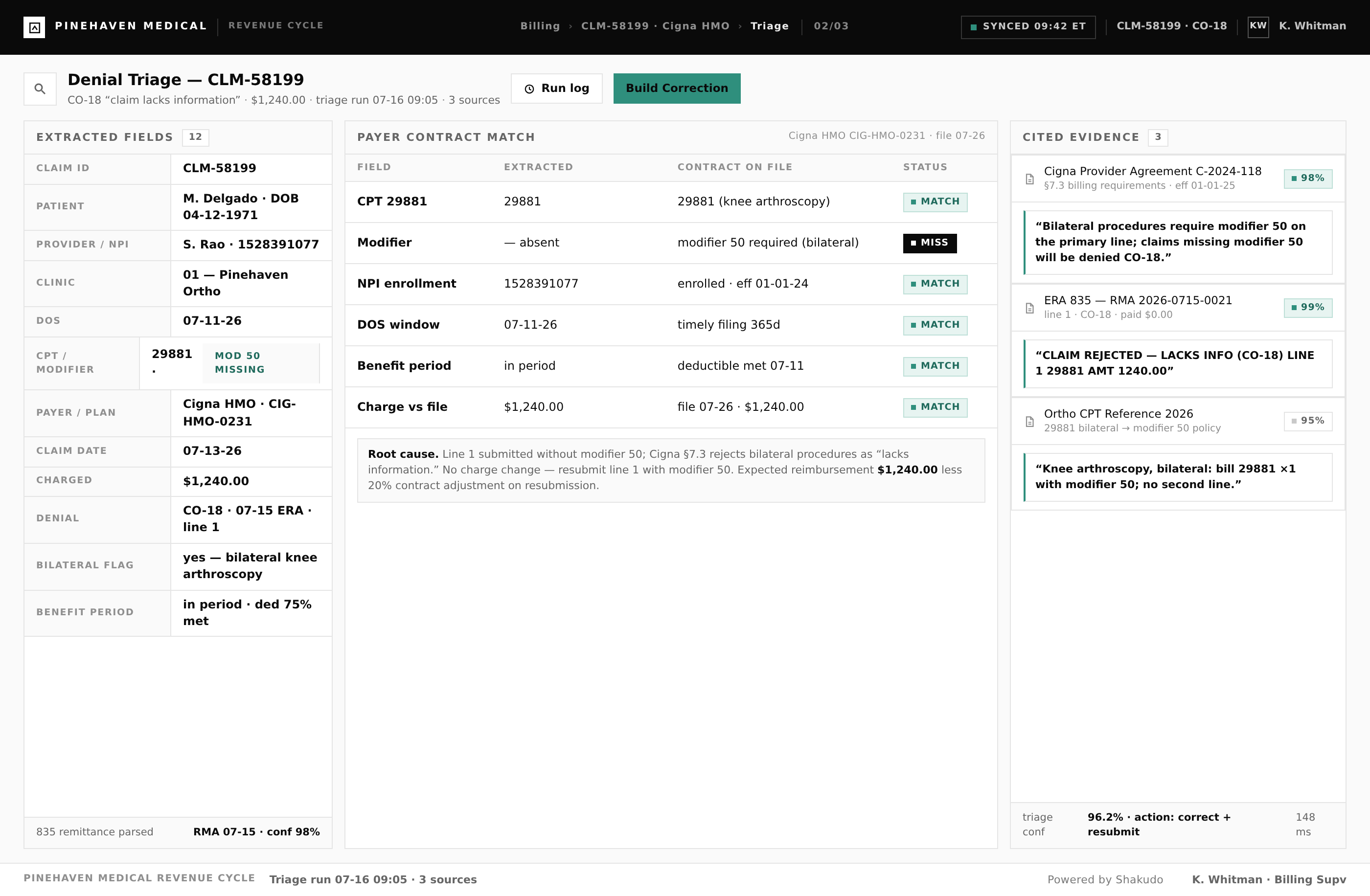
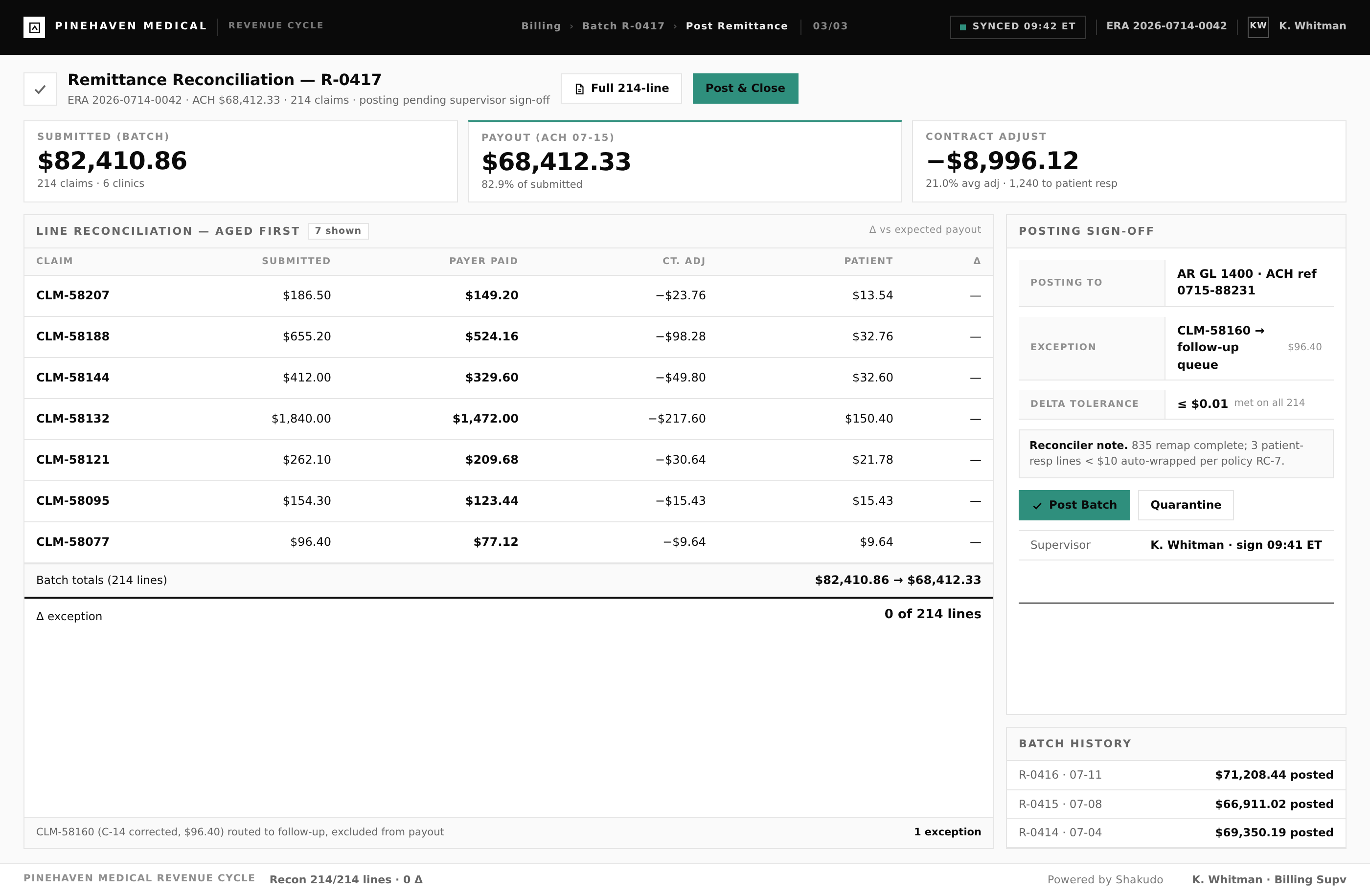
Three screens from a live run: the claim queue, the extracted invoice, and the payout approval.
1–2 / 3
Medical billing drains clinic revenue. Manual charge entry, code lookup, and claim submission cost providers between $8 and $15 per claim, with turnaround times of 24 to 48 hours. Nearly one in five claims gets denied on first submission, often from coding errors or missing documentation. A clinic network processing thousands of claims monthly sees these inefficiencies compound into lost revenue and delayed payments.
Revenue cycle management remains one of the most labor-intensive operations in healthcare. Billing staff transcribe service details from clinical encounters into CMS-1500 or UB-04 claim forms, look up ICD-10 diagnosis codes and CPT procedure codes, verify patient insurance eligibility, and submit claims to payer portals one at a time.
Each manual touch point introduces risk. A transposed digit in a procedure code or a missing modifier can trigger an automatic denial. Industry data shows that 15% to 20% of submitted claims are denied on first submission. Denials require investigation, correction, and resubmission, adding another 7 to 14 days to the payment cycle. Some denied claims are never recovered at all, representing pure revenue loss.
The staffing cost compounds the problem. Medical billing specialists command competitive salaries, and turnover in revenue cycle roles is high. Clinics that rely on offshore billing operations face communication lag and quality control challenges. The result is a billing operation that is expensive, slow, and error-prone.
Shakudo builds an AI billing pipeline that reads medical invoices, superbills, and encounter notes directly. Document extraction pulls out patient demographics, provider details, procedures performed, and diagnoses, converting unstructured paperwork into structured billing data in seconds rather than hours. Coding engines then assign ICD-10 and CPT codes automatically, applying specialty-specific logic trained on millions of claims, checking against national coding edits before submission, and verifying eligibility in real time against payer systems before a claim leaves the clinic.
The outcome is measurable: coding accuracy rates above 95%, end-to-end processing times under 10 seconds per claim, and clean claim forms generated and submitted to the appropriate payer automatically. Clinics that implement this well report denial rate reductions of 30% to 50% and days in accounts receivable dropping by 10 to 20 days. The pipeline also reads electronic remittance advice and explanation of benefits documents, posts payments automatically, and flags underpayments for follow-up.
The pipeline connects to electronic health record platforms, practice management software, and payer portals, and it must meet HIPAA requirements. Patient health information flows through the billing pipeline, so the infrastructure enforces encryption, access controls, and audit logging at every stage.
Change management matters as much as technology. Billing staff shift from building claims to reviewing AI-generated ones, and denial management moves from manual correction to exception handling, where staff focus only on claims the AI flags as high risk. A focused pilot on a single specialty or location launches in 4 to 8 weeks depending on integration complexity, with full rollout across multiple locations and specialties taking 3 to 6 months. Measure denial rates, clean claim rates, and days in accounts receivable before and after, then scale once the metrics validate the approach.
FastAPI exposes the billing pipeline as an API that EHR and practice management integrations call, and Supabase provides the structured store for claims, denials, and payment records that keeps the audit trail intact.
The solution fits clinic networks, hospital groups, and physician practices that process thousands of claims a month and want a denial rate that is controlled by data rather than by how many hands touch each claim. Revenue cycle teams that need coding consistent across specialties, practice managers weighing offshore versus in-house billing, and any provider group that needs HIPAA-compliant infrastructure behind its revenue cycle will use this pipeline.
AI coding engines trained on large claim datasets report accuracy rates above 95%. They apply specialty-specific rules and check claims against national coding edits before submission, and accuracy improves over time as the system learns from denials and corrections, making each subsequent claim cleaner than the last.
Yes. The pipeline maintains payer-specific rule sets and code conversion logic, and it scrubs each claim against hundreds of payer policies before submission, catching requirements that manual processes often miss. This reduces payer-specific denials and accelerates reimbursement across multiple insurance providers.
Compliant deployments encrypt patient data in transit and at rest, enforce role-based access controls, and maintain full audit trails. The infrastructure is configured for HIPAA compliance, including business associate agreements with any cloud providers involved, so protected health information stays secure throughout the billing workflow.
A focused pilot can launch in 4 to 8 weeks, depending on integration complexity with existing EHR and practice management systems. Full rollout across multiple locations and specialties typically takes 3 to 6 months, and starting with a single specialty lets the team validate results before scaling.
When the goal is a billing operation that cuts denials and collects faster on the clinic's own data, a conversation with Shakudo is the fastest way to see it on your own claims. The solution deploys on your own infrastructure, on-prem or in your cloud, and a first working pipeline is in place within days. Book a demo to review the numbers with your team.
AI extracts data from medical invoices, matches procedure codes to insurance requirements, and submits claims automatically. Clinics reduce manual processing time, lower denial rates, and collect payments faster with automated revenue cycle workflows.










"What drew me in is simple. When developers ship production-ready code this quickly, how can I have environments spun up fast enough? Shakudo is how we close that gap."



"Shakudo does not just provide the platform. It is a real partnership. They are always there to help and execute our vision faster and the right way. It is like a co-team working together to achieve our goals."