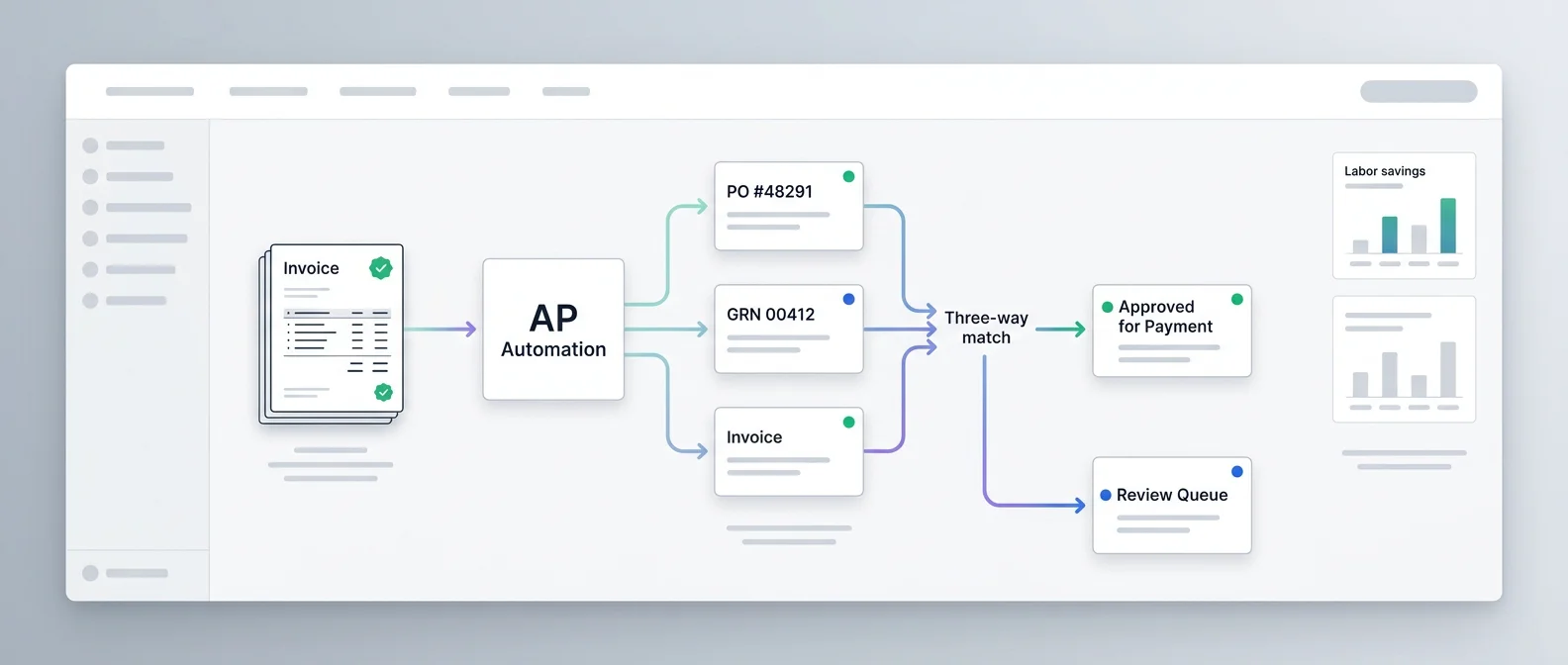







Three screens from a live AP cycle: the invoice queue, the extraction detail, and the three-way approval.
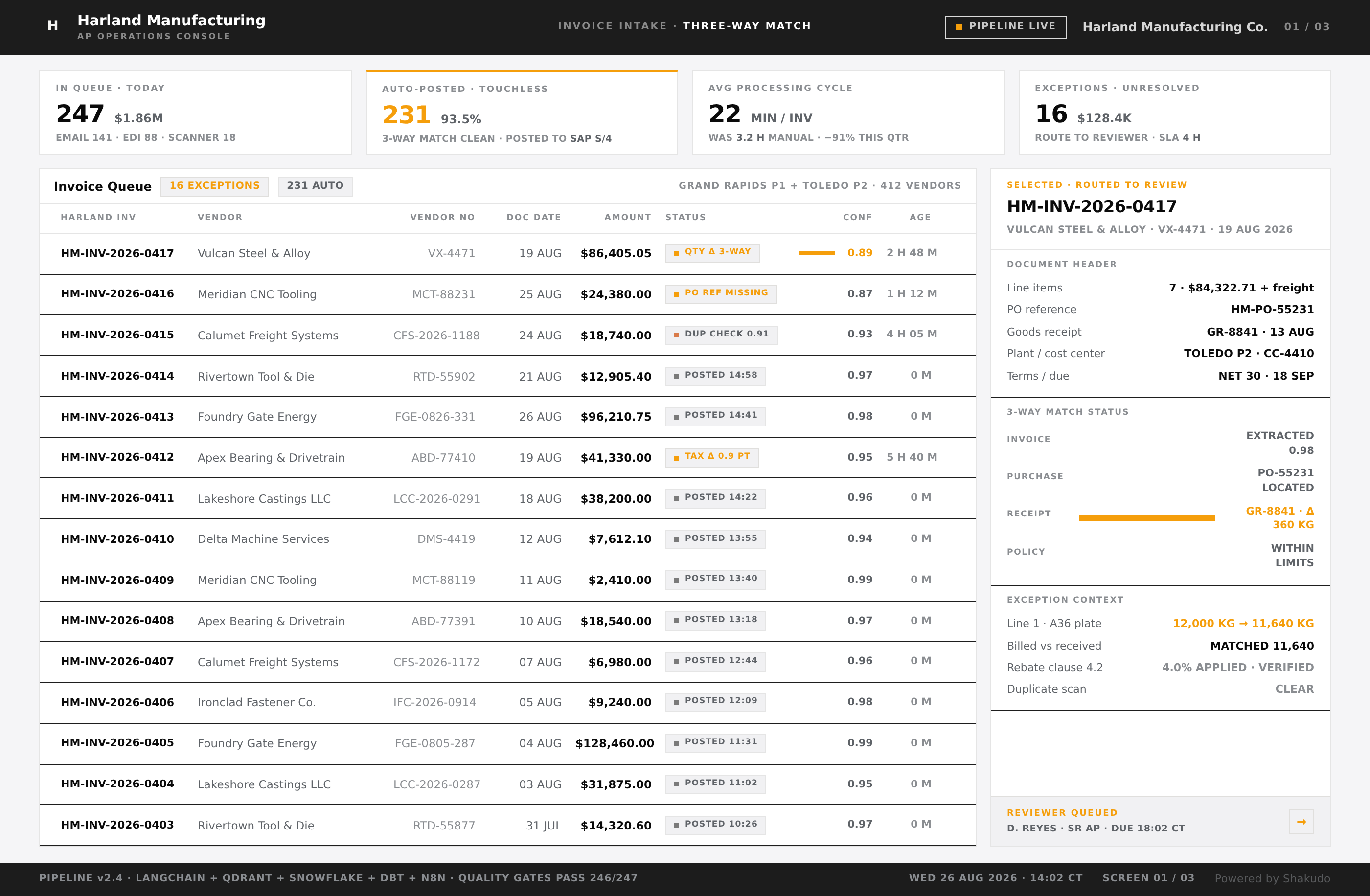
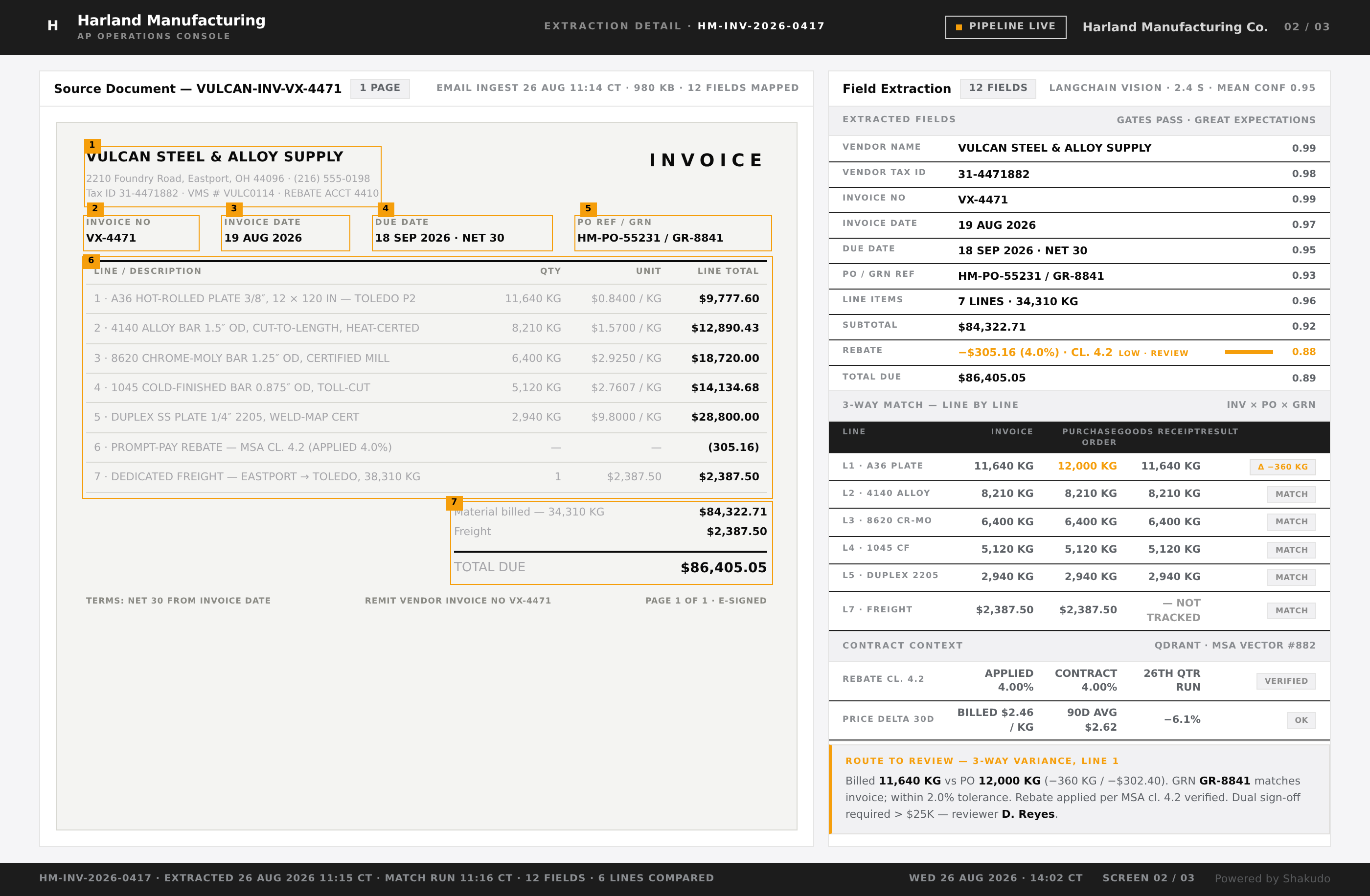
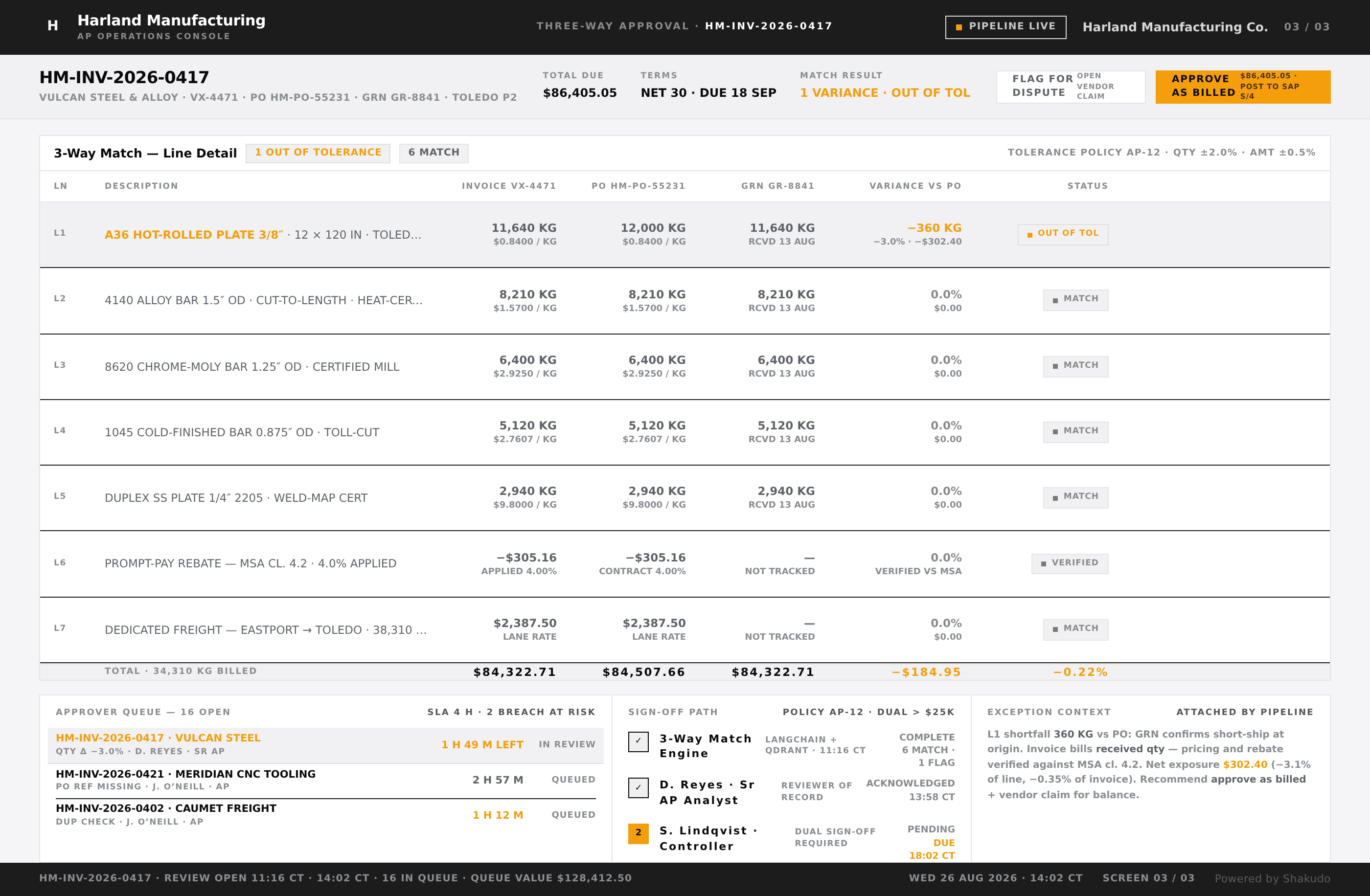
1–2 / 3
Invoice processing costs your accounts payable team about eight minutes per invoice, and each expense report takes just as long. The team keys data by hand, chases receipts, and matches line items across three documents. Industry benchmarks put manual invoice processing at $12 to $16 per invoice, and automated processing drops it to about $3. Sixty-eight percent of companies still key invoice data straight into their ERP by hand, and a single AP employee manages roughly 23,000 invoices a year.
On paper, processing 40,000 invoices with the headcount you have should be impossible. The reason it is, until you automate, is that you are not paying for people. You are paying for rework.
Shakudo's AI invoice processing automation workflow runs on your own infrastructure and handles the full cycle. It ingests each invoice the moment it lands, in PDF, email, or API form, and extracts every line item. Then it runs a touchless three-way match, reconciling the invoice against the purchase order and the receipt. Clean invoices post to the ERP without a human in the loop; only the exceptions route to a reviewer, with the exact mismatch flagged and the context attached. The same pipeline handles expense reports end to end: the AI extracts the receipts, validates them against policy, and books them directly, with no app, no card portal, and no monthly subscription. A Top-10 U.S. bank cut AP effort 85% and cut invoice processing time by 80 to 90%, processing 40,000 invoices a year with the team it already had. The world's largest wine producer, Gallo, eliminated its expense software entirely. The software your team used to log expenses becomes a line item you can delete from the budget.
Because the model sits inside your environment and your data never leaves it, the AI can read the good stuff no SaaS vendor ever gets: master service agreements, rebate terms, disputed line history, vendor pricing history, and the contract behind every purchase order. That is the difference between a tool that compares numbers and one that understands the deal behind them. The model, the workflows, and the audit trail stay under your control, which is the point of sovereign AI: it is not an automation layer bolted onto the same software stack. It replaces the layer.
AP, finance operations, and controller teams at companies processing tens of thousands of invoices a year, and any organization that cannot send purchase orders, contracts, or vendor payment data to a SaaS vendor.
It extracts the line items from the invoice and matches them against the purchase order and the receipt in one pass. When everything reconciles, the invoice posts to the ERP automatically. Only exceptions route to a reviewer, with the exact mismatch and the surrounding context attached, so a human reviews discrepancies instead of every document.
It removes it. The AI extracts the receipts, validates them against policy, and books them directly, so the app, the card portal, and the subscription disappear. Gallo, the world's largest wine producer, eliminated its expense software entirely.
Yes. The model runs on your own infrastructure and your data never leaves your environment. That is why the AI can read contracts, rebate terms, and vendor pricing history at all, and it is why the setup stays defensible when auditors ask who sees what.
Days, not months. You point the pipeline at your invoice inbox and your ERP, and the first touchless matches post quickly. The exception queue shrinks as the model learns your vendor and contract patterns.
Building a pipeline like this yourself, extraction, three-way match, ERP posting, exception handling, is a months-long project staffed by specialists. With Shakudo, you can deploy the full AI invoice processing and expense report automation pipeline within days, on the infrastructure you already own. Book a demo and see how it works.
Shakudo's AI invoice processing automation runs on your own infrastructure and cuts invoice processing time by 80 to 90%. Your data never leaves your environment, so the AI can read the contracts, rebate terms, and vendor history a SaaS tool never gets, and it handles expense reports well enough that the software behind them disappears.










"What drew me in is simple. When developers ship production-ready code this quickly, how can I have environments spun up fast enough? Shakudo is how we close that gap."



"Shakudo does not just provide the platform. It is a real partnership. They are always there to help and execute our vision faster and the right way. It is like a co-team working together to achieve our goals."