






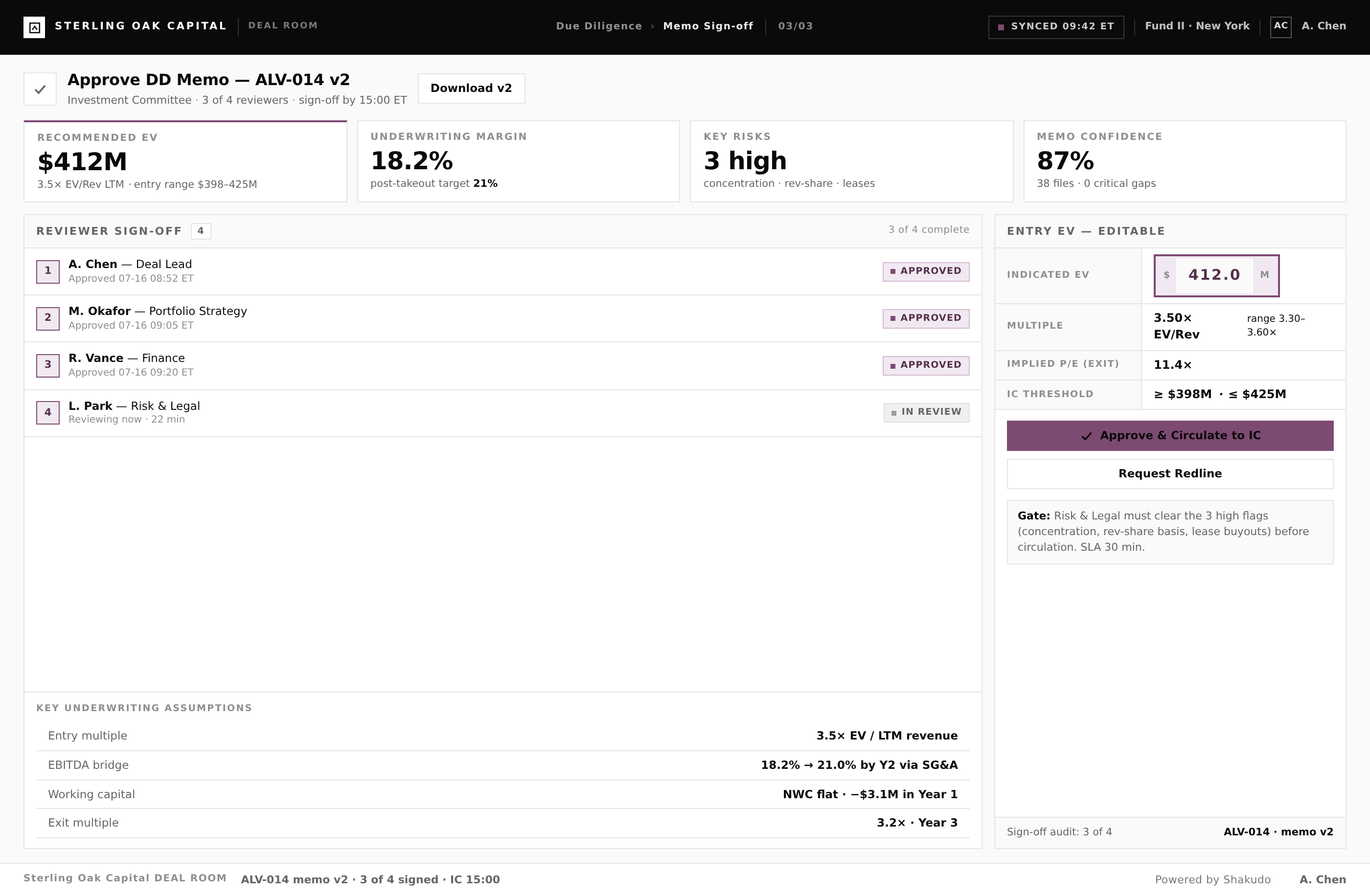
Three screens from a live run: the deal queue, the document analysis, and the risk sign-off.
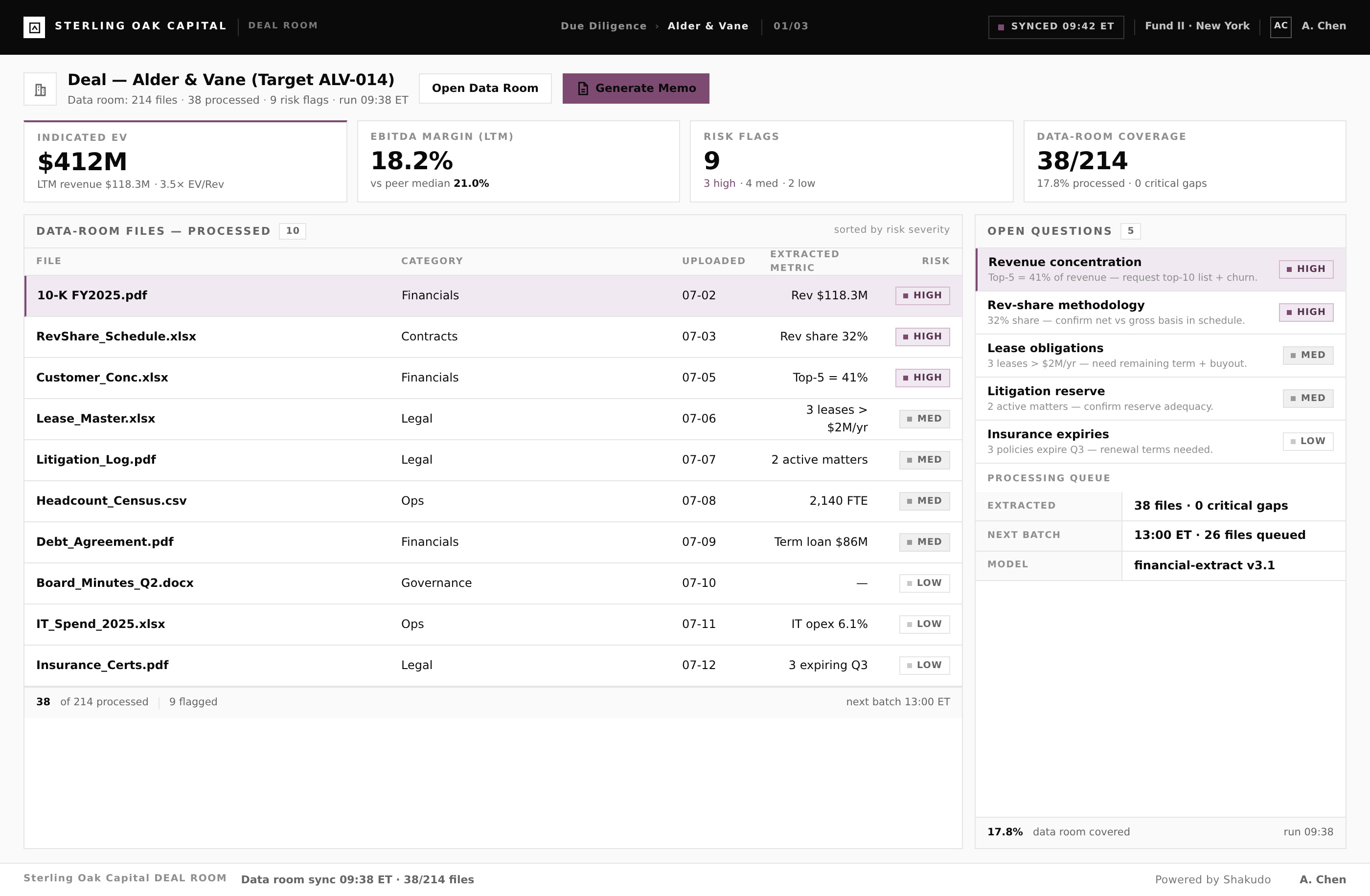
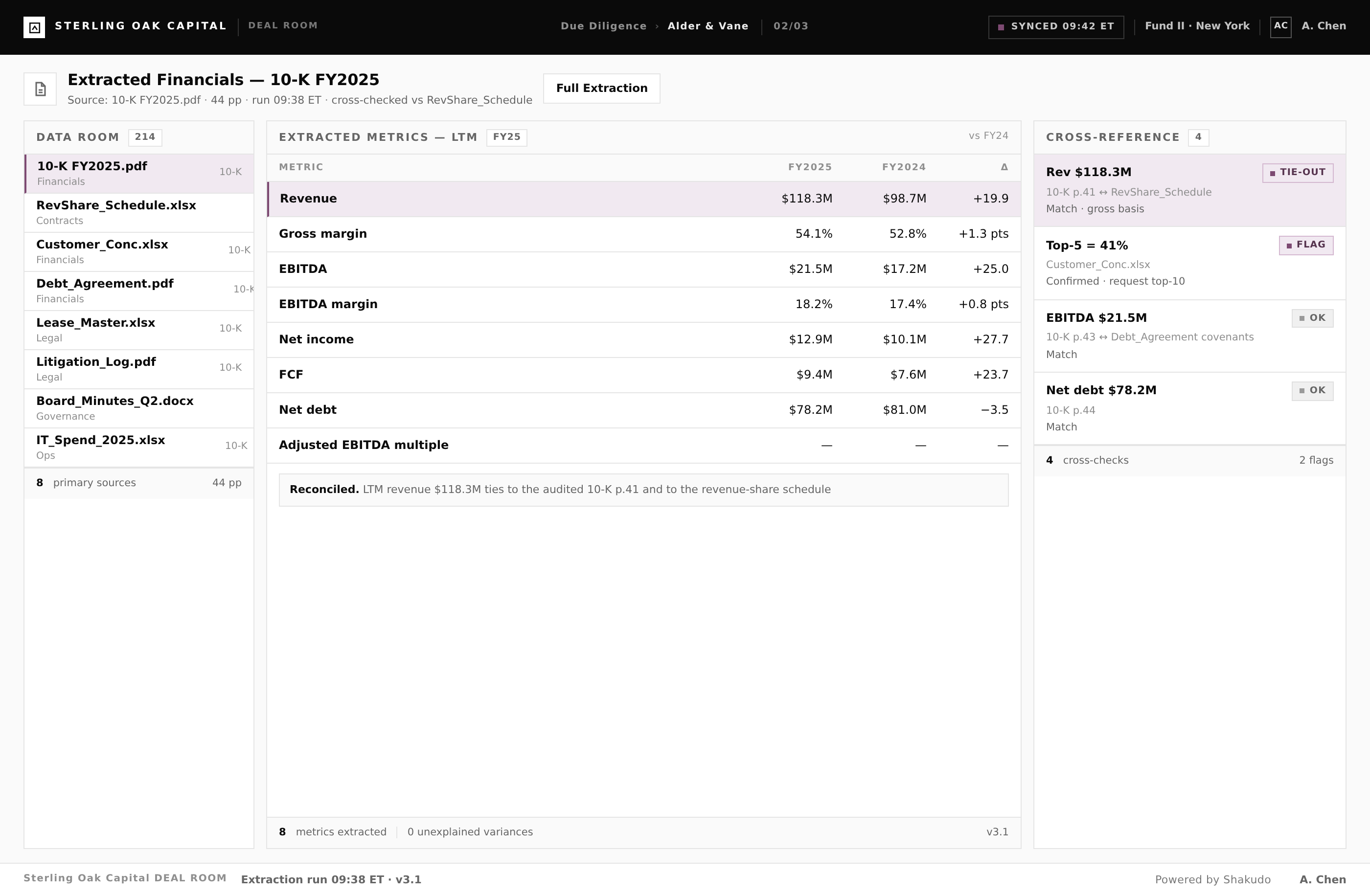
1–2 / 3
Manual financial due diligence drags deals to a halt. Analysts spend two to three weeks on a single target, sifting through data rooms full of trial balances, contracts, and consolidated statements. The work is repetitive, the pressure is high, and critical risk factors get buried under thousands of rows of data. A financial services company that automates this process with AI turns months of manual effort into a matter of minutes, cutting delivery time by up to 60 percent per project.
Due diligence is where deals succeed or fail, yet most firms still run it the way they did twenty years ago. A single M&A transaction can require reviewing thousands of financial documents, comparing figures across reporting periods, and reconciling trial balances against consolidated statements. Human analysts work at a fixed pace. They miss inconsistencies buried deep in the data, and they cannot compare every line item against industry benchmarks in the time available.
The result is risk. Missed contingent liabilities, unrecognized revenue issues, and working capital anomalies surface late in the process or not at all. The cost is not just time. It is deal certainty. A buyer that overpays for a target with hidden problems pays for that mistake long after the deal closes. Manual review also introduces variability. Different analysts produce different report structures, making it hard to compare findings across deals or maintain consistent quality standards.
An AI due diligence agent takes the first pass on every deal. It navigates the virtual data room, extracts and normalizes financial figures, and structures them according to accounting standards like IFRS, GAAP, and HGB, handling trial balances, consolidated statements, and supporting schedules while preserving accounting logic at every step. Risk detection runs in parallel: the AI flags anomalies in earnings quality, net working capital, and net debt, and identifies contingent liabilities and revenue recognition issues that a tired analyst might overlook after ten hours of spreadsheet review. Benchmark comparison happens automatically, so deal teams see not just what the numbers are but how they compare to peers. The output is a standardized due diligence report with a consistent structure across every deal.
The outcomes are measurable. Due diligence delivery time dropped by up to 60 percent per project. Report generation that previously consumed full analyst weeks now completes in under an hour of compute time. The platform handles multiple transactions in parallel without adding headcount, and what took two to three weeks of manual work becomes a draft report ready for human review in minutes. Analysts shift from manual data extraction to reviewing AI-generated findings and focusing on judgment calls that require human expertise.
A financial services company deployed the pipeline in three layers. Financial documents flow from the data room into a processing layer that extracts structured data and loads it into a vector database for retrieval. Large language models then analyze the extracted figures, generate variance explanations, and draft report sections following a standardized template. Risk flags surface earlier in the deal cycle, giving deal teams more time to negotiate price adjustments or walk away from problematic targets, and standardization eliminates the variability that came from different analysts producing different report structures.
This is for the teams in financial services that own the first pass on a deal: M&A advisors and corporate development teams running transactions, buy-side and sell-side deal teams that need consistent report structures across every engagement, and audit and assurance teams standardizing financial analysis across clients. It fits firms where deal volume makes manual review the bottleneck, where multiple transactions run in parallel, and where confidentiality requires the pipeline to stay inside the firm's own infrastructure.
AI achieves high accuracy on structured extraction and consistency checks. It normalizes figures against accounting standards and flags anomalies systematically. Human analysts still review the output for context and judgment. The combination catches more issues than manual review alone while cutting delivery time significantly.
The system processes trial balances, consolidated financial statements, management accounts, contracts, and supporting schedules. It handles multiple accounting frameworks including IFRS, GAAP, and HGB. Extracted data gets normalized into a consistent structure so figures are comparable across periods and reporting standards.
Traditional first-pass due diligence takes two to three weeks per deal. AI can produce a draft due diligence report in minutes after data upload. Full delivery time drops by up to 60 percent, with analysts reviewing rather than generating the initial analysis from scratch.
The pipeline runs in a controlled environment with access controls and encryption. Deal data stays within the firm's infrastructure. AI models process financial documents without exposing them to public services. This satisfies the confidentiality requirements that M&A transactions demand.
When the goal is a due diligence first pass that is consistent, audit-ready, and faster on every deal, a conversation with Shakudo is the fastest way to see it on your own data. The pipeline deploys on your infrastructure, on-prem or in your cloud, a first working pipeline is in place within days, and you can book a demo to watch it run on a real data room.
AI accelerates M&A due diligence by analyzing financial statements, identifying risk factors, and comparing targets against industry benchmarks. The solution generates structured due diligence reports in minutes instead of weeks, giving deal teams faster and more consistent insight across every transaction.










"What drew me in is simple. When developers ship production-ready code this quickly, how can I have environments spun up fast enough? Shakudo is how we close that gap."


"Shakudo does not just provide the platform. It is a real partnership. They are always there to help and execute our vision faster and the right way. It is like a co-team working together to achieve our goals."