
Most enterprise AI work looks good exactly once.
A model can produce a strong summary, draft a convincing report, or recommend the next action in a live meeting. Then the organization asks the real question: can this run again tomorrow, next week, or every time the same trigger appears, with the right tools, permissions, approvals, and oversight?
That is where most AI initiatives start to slow down.
The hard part is rarely the first good answer. The hard part is turning a useful AI workflow into something the organization can trust, reuse, and operate repeatedly. That is the gap AutoKaji is built to close.
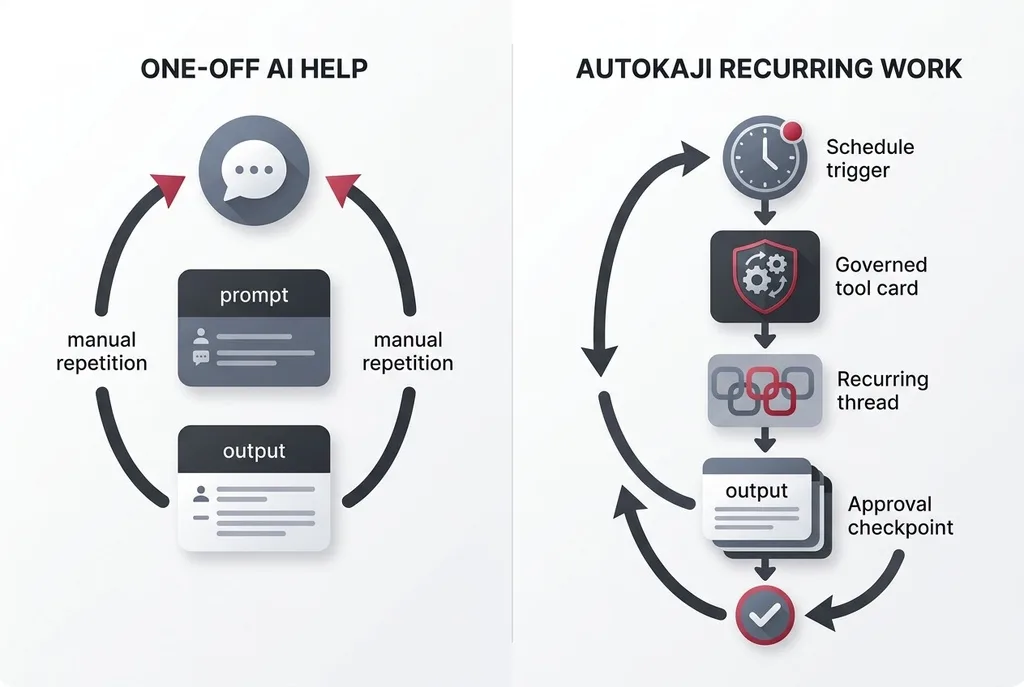
AutoKaji is Shakudo’s recurring AI agent model inside Kaji. It gives teams a way to take a workflow that already creates value and run it again with a schedule or trigger, governed tool access, the right operating context, and space for human review.
AutoKaji is a persistent AI agent configuration for recurring work.
Instead of rebuilding a workflow from scratch every time, a team can define the instructions, wake-up logic, model choice, tool access, and run pattern once, then reuse it. That means a useful workflow does not stay trapped inside one successful chat thread. It becomes operational.
A leadership update can run every Friday afternoon. A marketing monitor can run every morning. A queue review can run when an event happens. A follow-up workflow can continue in a living thread or start fresh each time, depending on how the team wants the work to behave.
That is the important shift. AutoKaji is not just another assistant that waits for the next prompt. It is a way to operationalize recurring AI work inside an enterprise setting.
Most teams already have access to strong AI assistants. They can draft, summarize, brainstorm, and explain. That is useful, but it does not solve the operational problem on its own.
A one-off assistant interaction still leaves open questions:
These are exactly the kinds of concerns that surface in real enterprise guidance on AI governance. NIST’s AI Risk Management Framework emphasizes governance as a cross-cutting function rather than an afterthought. Microsoft’s guidance on governance and security for AI agents across the organization makes the same practical point from an operating perspective: restrict access, enforce permissions, and keep agent behavior aligned with enterprise controls.
That is why recurring AI work is a different category from useful chat.
AutoKaji sits inside the Kaji operating model rather than beside it.
Inside KajiChat, a recurring agent can be triggered on a schedule or from an event. The workflow can reuse the same ongoing thread when continuity matters, or start a fresh run when isolation matters more. It can be configured with the right model, tool access boundaries, and operating instructions for the task.
This matters because recurring workflows are only useful if they fit how enterprise work is actually run.
Some examples:
AutoKaji gives teams that level of control without turning every recurring workflow into a custom engineering project.
AutoKaji is useful because it targets the real source of friction in enterprise AI adoption.
The bottleneck is not that enterprises cannot find a model that writes well. The bottleneck is that most organizations cannot safely operationalize recurring AI work with the right level of repeatability and control.
That is why the value of AutoKaji is operational, not theatrical.
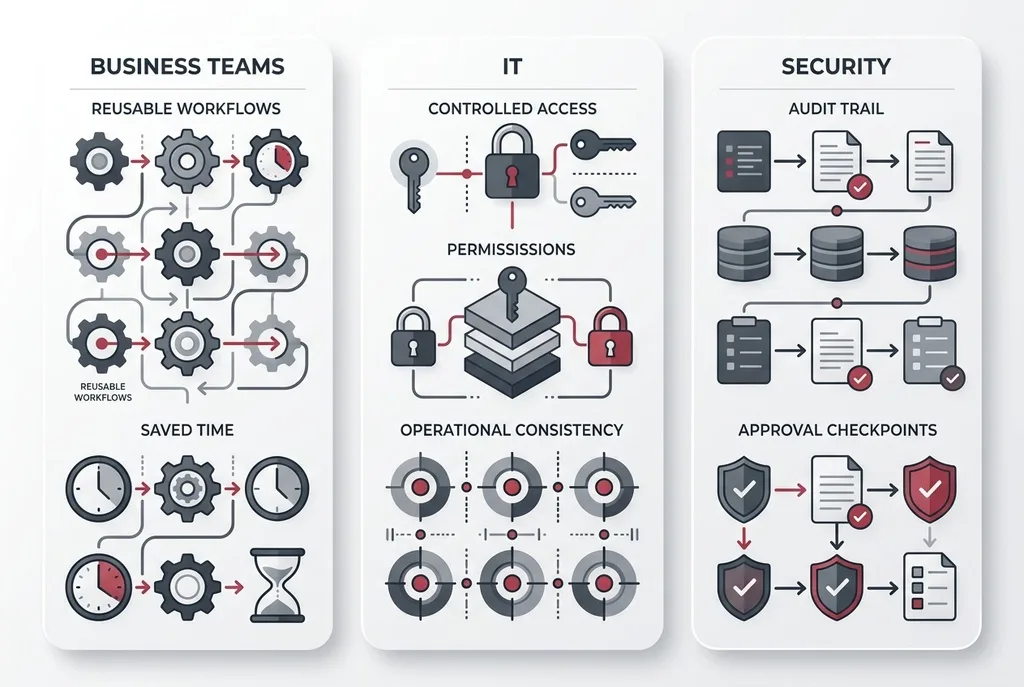
It helps teams get:
This lines up with the broader Shakudo argument that enterprise AI succeeds when governance, infrastructure, and operating workflows are treated as first-class design requirements. That pattern shows up in Shakudo’s writing on AI agents versus copilots, autonomous enterprise AI with Kaji and AI Gateway, and why enterprise AI agents fail in production.
Enterprise buyers do not just evaluate whether an AI workflow is helpful. They evaluate whether the workflow can live inside the organization’s security, approvals, and operating processes.
That is why agent governance matters so much. Microsoft’s discussion of runtime authorization beyond identity is useful here because it frames the problem clearly: agents should not just have an identity, they need controlled runtime authorization decisions and auditable boundaries around what they can do.
AutoKaji is good when the goal is to make recurring AI work fit those realities instead of bypass them.
That means IT is not forced to choose between two bad options:
A recurring agent model with scoped tools, repeatable execution, and a clear operating surface gives IT and security a better control path.
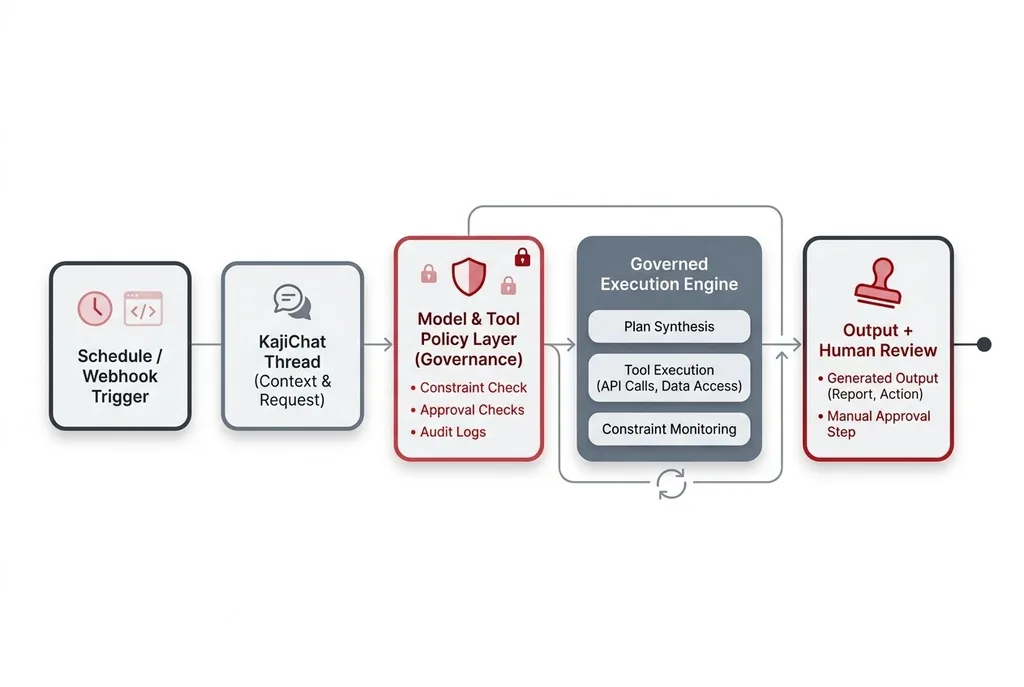
AutoKaji makes the most sense as part of the broader Kaji and Shakudo architecture.
Kaji is the agent layer for work that needs planning, tool use, review, and delivery. AI Gateway is the control plane that helps organizations manage model access, usage, and governance across enterprise environments. Shakudo’s broader security and compliance posture, including its SOC 2 compliance work, supports the same argument: enterprise AI needs a control story, not just a demo story.
AutoKaji extends that architecture into recurring execution.
That means organizations can take a workflow that already works inside Kaji and turn it into something that runs on a schedule or event pattern without giving up the enterprise framing that made the workflow viable in the first place.
AutoKaji is strongest when a workflow is already useful and obviously repetitive.
Some examples:
These are not novelty use cases. They are the kinds of recurring tasks that consume real time every week.
That is one reason Microsoft’s own enterprise guidance on deploying agents increasingly centers on observability, governance, and structured processes rather than just model capability. Its write-up on deploying AI agents across the organization reinforces the same idea: real enterprise value comes when agents fit business processes, approvals, and visibility, not when they only perform well in a controlled demo.
A normal AI assistant is still valuable. It helps in the moment.
AutoKaji is different because it helps teams institutionalize what already works.
That is a better fit for enterprise adoption because organizations do not want to rediscover the same useful workflow manually every week. They want to reuse it, govern it, and improve it.
That difference may sound subtle at first, but it changes the operating model completely.
A one-off assistant interaction creates a result. AutoKaji creates a repeatable pattern for producing results again.
No. It builds on Kaji’s agentic workflow model, but it is meant for recurring work. The value is not simply that it can answer well once. The value is that a useful workflow can run again with the right controls.
Use it when a workflow is already useful and clearly repetitive. Common examples include daily digests, weekly updates, recurring reviews, and event-driven follow-up work.
Because it addresses repeatability, governance, approvals, tool access, and operational fit. Those are the issues that often matter more than raw model cleverness in real enterprise deployments.
Because recurring AI work needs a better control story than ad hoc automation. A governed recurring-agent model helps IT support useful workflows without losing visibility into how they run.
AutoKaji is a better way to run recurring AI work in the enterprise.
It helps organizations take a workflow that already creates value and turn it into something repeatable, governed, and operational. The hard part of enterprise AI is rarely the first impressive answer. The hard part is making that answer part of a workflow the organization can trust again tomorrow.
If your team is already finding useful AI workflows inside Kaji, AutoKaji is the step that makes those workflows reusable.