

Enterprises are deploying AI agents at scale. Teams build them with frameworks like LangChain and CrewAI, wire them into internal APIs, and point them at production databases. The agents work. They complete tasks. And they do it with almost no oversight.
That lack of oversight is the problem. An agent with unrestricted tool access can query any database, call any API, and spend any budget. An agent connected to an unmanaged model endpoint can drift between providers, leak data across compliance boundaries, and run up costs that nobody notices until the monthly bill arrives. When something goes wrong, there is no audit trail. No one can answer which agent did what, when, or why.
These failures are not theoretical. In regulated industries, they are compliance violations. In finance, they are material losses. In healthcare, they are patient safety incidents. The gap between "agent that works in a notebook" and "agent that is safe to run in production" is the gap that an AI agent harness fills.
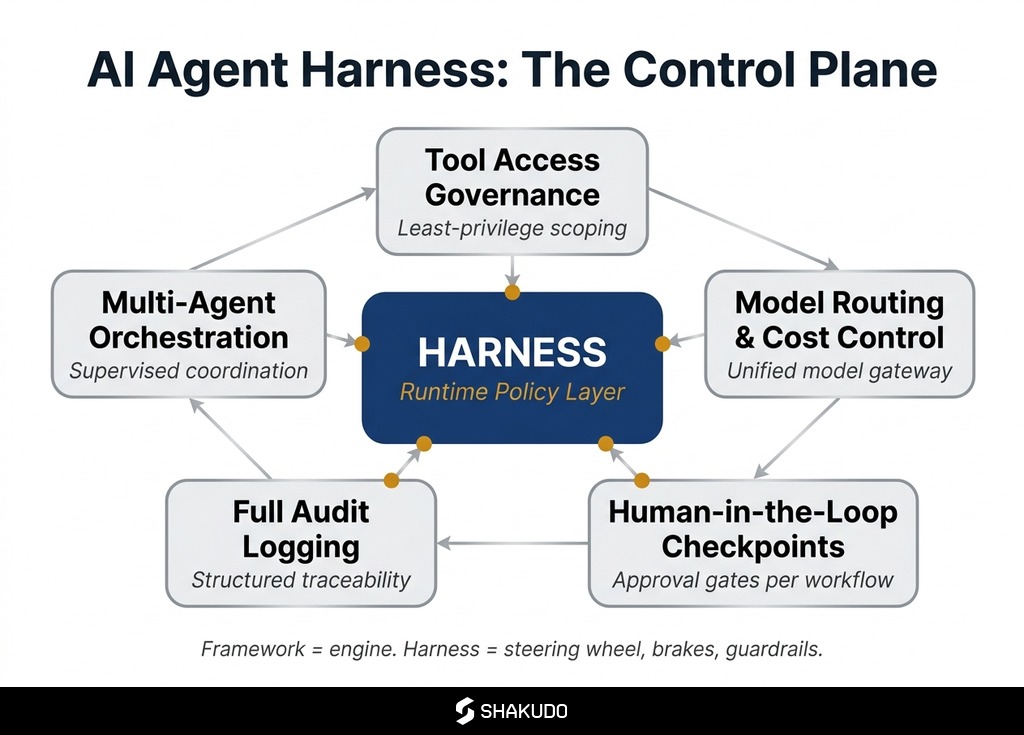
An AI agent harness is the control plane that sits between autonomous agents and the enterprise systems they interact with. It does not build agents. It does not replace frameworks. It wraps around them.
Think of it this way: a framework gives you the engine. A harness gives you the steering wheel, the brakes, the speedometer, and the guardrails. You need both to drive safely.
More precisely, a harness provides the runtime infrastructure that enforces policies on what agents can do, tracks what they have done, and intervenes when they go off course. Without it, every agent is a privileged process with a credit card and a database connection.
The concept draws from software engineering patterns that have been proven over decades. Service meshes govern microservice communication. API gateways govern external traffic. An agent harness governs autonomous AI workflows. The principle is the same: put a policy layer between the actor and the resource.
Agents need tools to do useful work. They need to query databases, call APIs, read documents, and write results. Without governance, every agent gets access to every tool by default. That creates a sprawling attack surface and makes compliance audits impossible.
A harness enforces least-privilege tool access. Each agent gets a scoped set of tools based on its role and the task at hand. A data retrieval agent can query approved tables but cannot write to them. A reporting agent can generate PDFs but cannot access raw customer records. When an agent tries to call a tool outside its scope, the harness blocks the call and logs the attempt.
This is not just a security measure. It is an operational necessity. Teams that run dozens of agents across multiple business functions need to know which agent has access to which system, and they need to be able to revoke that access without redeploying code.
Production agents often use multiple LLM providers. A reasoning task might need GPT-4. A classification task might work fine with a smaller model. A compliance-sensitive task might require an on-premise deployment. Without a routing layer, every agent defaults to whatever model the developer configured at build time.
A harness provides a unified model gateway. It routes each request to the appropriate provider based on task requirements, data sensitivity, and cost constraints. It tracks token usage per agent, per team, per project. It enforces spending caps so a runaway agent cannot burn through a monthly budget in an afternoon.
The Shakudo AI Gateway provides exactly this capability. It sits between your agents and every model provider, applying routing rules, cost limits, and compliance policies at the gateway level rather than relying on each agent to police itself.
Not every agent action should execute without human approval. High-value transactions, sensitive data writes, and external communications all warrant a review step. The challenge is defining where those checkpoints go and enforcing them consistently across every agent in the organization.
A harness lets you define checkpoint policies at the workflow level. You specify which actions require approval, from whom, and under what conditions. When an agent reaches a checkpoint, it pauses and waits. The designated reviewer sees the proposed action, the reasoning behind it, and the data it would affect. They approve, modify, or reject it. The harness enforces the decision and logs the outcome.
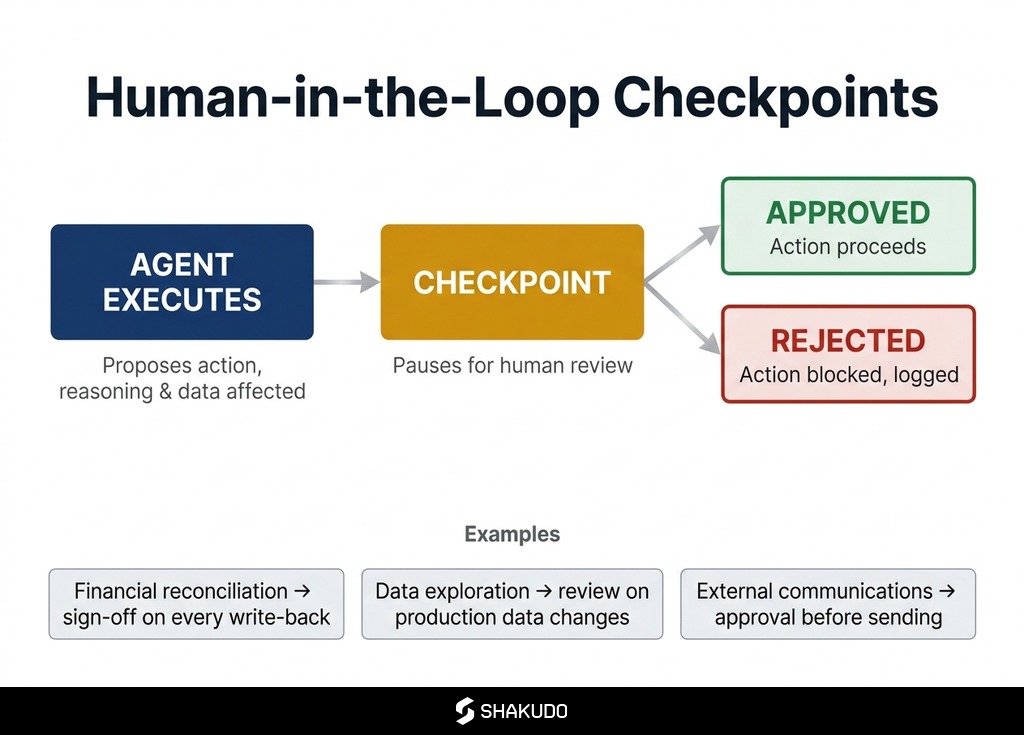
Kaji implements human-in-the-loop checkpoints as a native capability. When Kaji orchestrates an agent workflow, it inserts approval gates based on the task profile. A financial reconciliation task might require sign-off on every write-back. A data exploration task might only require review when the agent proposes an action that modifies production data.
Compliance teams need to answer a simple question: what did this agent do? In a system without a harness, that question requires digging through application logs, database query histories, and API access records across a dozen services. The answer takes days and is never complete.
A harness captures a complete, structured audit trail for every agent action. Each entry records the agent identity, the tool called, the inputs provided, the outputs returned, the model used, the token cost, and the timestamp. It records human approvals and rejections. It records policy violations and blocked actions.
This audit trail is not a nice-to-have. For enterprises in regulated industries like financial services, healthcare, and energy, it is a requirement. Regulators expect the same level of traceability from AI systems that they expect from human operators. A harness makes that traceability automatic.
Real enterprise workflows involve multiple agents working together. A procurement workflow might have one agent that identifies suppliers, another that negotiates terms, and a third that generates the purchase order. Each agent has its own tools, its own model preferences, and its own scope of authority.
Without a harness, multi-agent coordination is ad hoc. Agents communicate through brittle custom integrations. There is no central visibility into the overall workflow state. If one agent fails or goes off course, the entire pipeline can stall or produce incorrect results without anyone noticing.
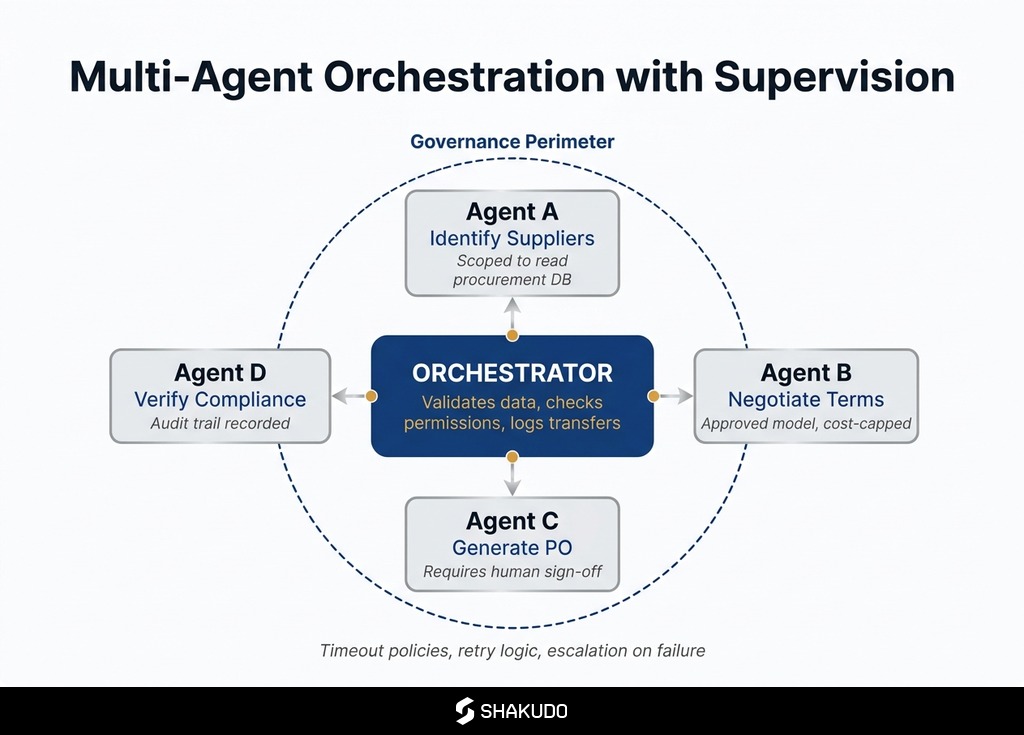
A harness provides a supervised orchestration layer. It coordinates agent handoffs, enforces inter-agent data contracts, and maintains visibility across the entire workflow. When one agent produces output that another agent consumes, the harness validates the data, checks permissions, and logs the transfer. It can also enforce timeout policies, retry logic, and escalation procedures when an agent does not complete its task within the expected window.
Kaji provides this orchestration capability natively. It manages multi-agent workflows with built-in supervision, ensuring that every agent operates within its designated scope and that the overall workflow progresses reliably toward completion.
The distinction matters because most teams reach for a framework when they need a harness, and then wonder why their agents are unmanageable in production.
A framework helps you build an agent. It provides the abstractions for tool definitions, prompt templates, memory management, and reasoning loops. LangChain, CrewAI, and AutoGen are frameworks. They solve the development problem: how do I make an agent that works?
A harness helps you run that agent safely in production. It provides the governance layer around whatever framework you chose. It solves the operations problem: how do I make sure this agent does not break something, leak data, or spend too much money?
Teams that try to build governance from scratch end up with scattered middleware, inconsistent policies, and an audit trail that only covers half the agents. A harness provides these capabilities as a unified layer, consistent across every agent and every workflow.
Running one or two agents without a harness is manageable. Running ten or twenty is not. At scale, the operational overhead of ungoverned agents compounds quickly. Security teams cannot verify access controls. Finance teams cannot track model spend. Compliance teams cannot produce audit reports. Engineering teams cannot debug agent failures because the logs are incomplete and scattered.
A harness solves this by centralizing governance. Instead of each team implementing its own ad hoc controls, the harness provides a single policy layer that applies to every agent in the organization. Security policies are enforced once at the harness level. Cost controls are applied at the gateway. Audit logs flow to a single destination.
The result is that teams can move fast on agent development while the organization maintains the controls it needs. Developers build agents with their preferred framework. The harness ensures those agents run within policy boundaries. Everyone gets what they need.
The value of an agent harness becomes most visible when you look at how different industries deploy autonomous AI. The guardrails, audit trails, and orchestration controls that a harness provides map to different regulatory and operational requirements depending on the vertical.
Banks and insurers run agents for fraud detection, trade reconciliation, and compliance monitoring. These agents touch sensitive financial data and must operate within strict regulatory frameworks. A harness enforces tool access governance so a fraud-scoring agent can read transaction logs but cannot write to the general ledger. Human-in-the-loop checkpoints catch exceptions before they become regulatory findings. Full audit trails satisfy examiners who want to see exactly which agent made which decision and why.
A reconciliation agent that flags exceptions for human review before writing back to the general ledger is a textbook harness use case. The agent does the tedious matching work. The harness ensures it pauses at the right moments and logs every action for the audit team.
Clinical decision-support agents, claims-processing agents, and drug-interaction checkers all handle protected health information. A harness ensures that PHI stays within approved systems and that agents cannot exfiltrate data through unapproved tool calls. Model routing directs sensitive queries to on-premise deployments while routing routine classification tasks to cost-effective cloud models. Audit logging provides the traceability that HIPAA and similar frameworks require.
Consider a clinical triage agent that suggests diagnostic next steps based on patient history. The harness ensures the agent can only access records for patients assigned to the requesting clinician, routes the inference to a compliant model, and logs the recommendation for peer review.
Manufacturers deploy agents for predictive maintenance scheduling, supplier risk assessment, and quality-control flagging. These agents coordinate across operational technology systems, ERP platforms, and external supplier APIs. A harness governs which agent can trigger a maintenance work order versus which can only flag an anomaly for the operations team. Multi-agent orchestration ensures that a supplier-risk agent and a logistics-planning agent share context without stepping on each other's writes to the production schedule.
Grid operators use agents for demand forecasting, outage response coordination, and emissions reporting. These agents interact with SCADA-adjacent systems and regulatory reporting portals. A harness provides the governance layer that prevents an optimization agent from bypassing safety constraints in pursuit of efficiency. Cost controls prevent a forecasting agent from consuming disproportionate compute during peak pricing windows. Audit trails support regulatory filings that require proof of automated decision-making oversight.
Government agencies process permits, analyze policy documents, and manage constituent communications with AI assistance. A harness enforces data-handling rules that prevent agents from mixing classified and unclassified information streams. Human checkpoints ensure that no automated system makes a final determination on benefits eligibility or enforcement actions without a qualified reviewer. Model routing keeps citizen data on approved infrastructure. The audit log becomes a public accountability record.
Kaji and the Shakudo AI Gateway together deliver this harness inside your own VPC. Kaji orchestrates agent workflows with built-in human checkpoints, supervised multi-agent coordination, and complete audit logging. The AI Gateway governs model access, enforces routing policies, and tracks costs at the gateway level. Both run on your infrastructure, with your data staying within your compliance perimeter.


%201.svg)








.png)


