






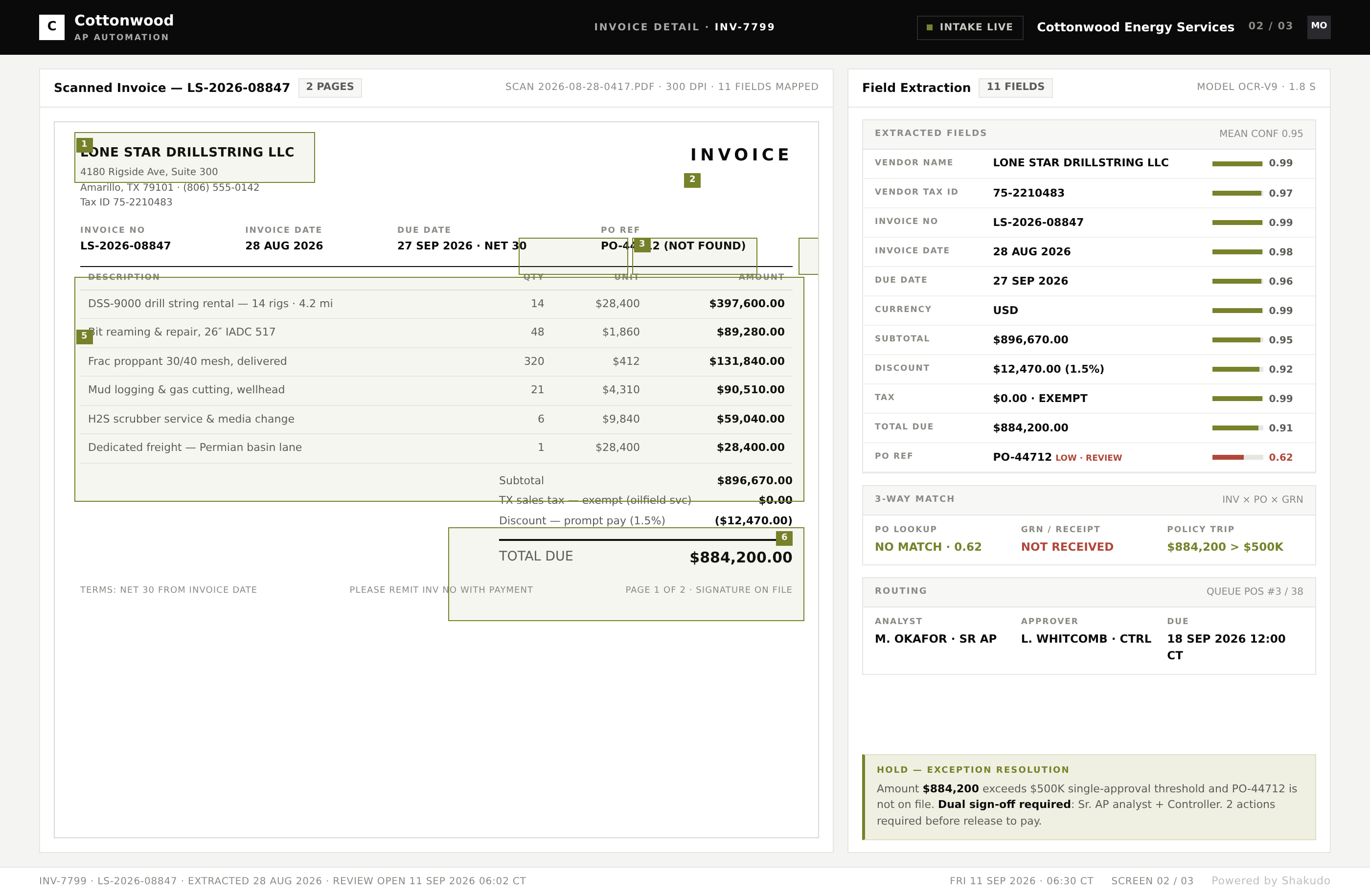
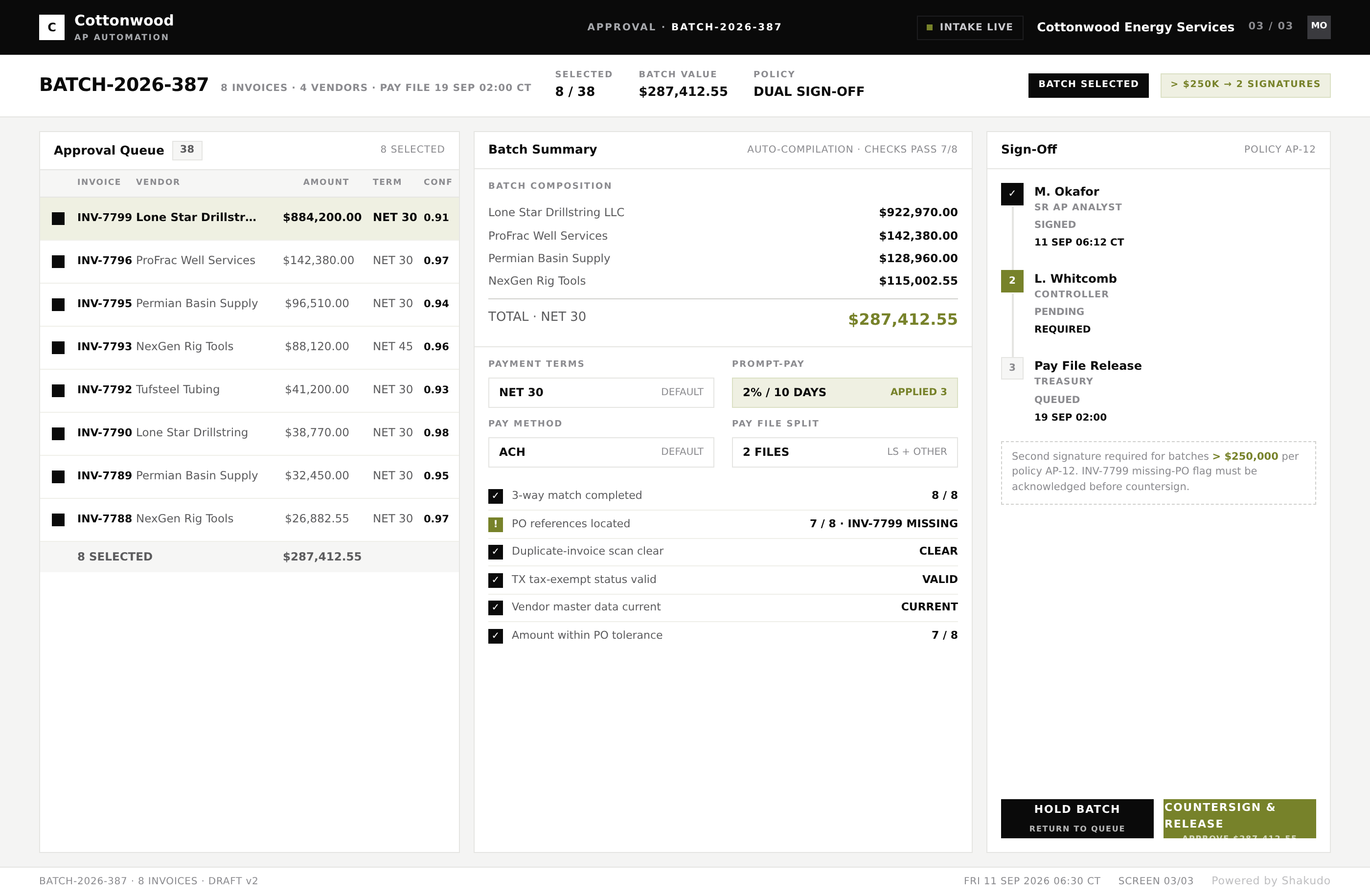
Three screens from a live run: the invoice queue, the extracted data, and the approval.
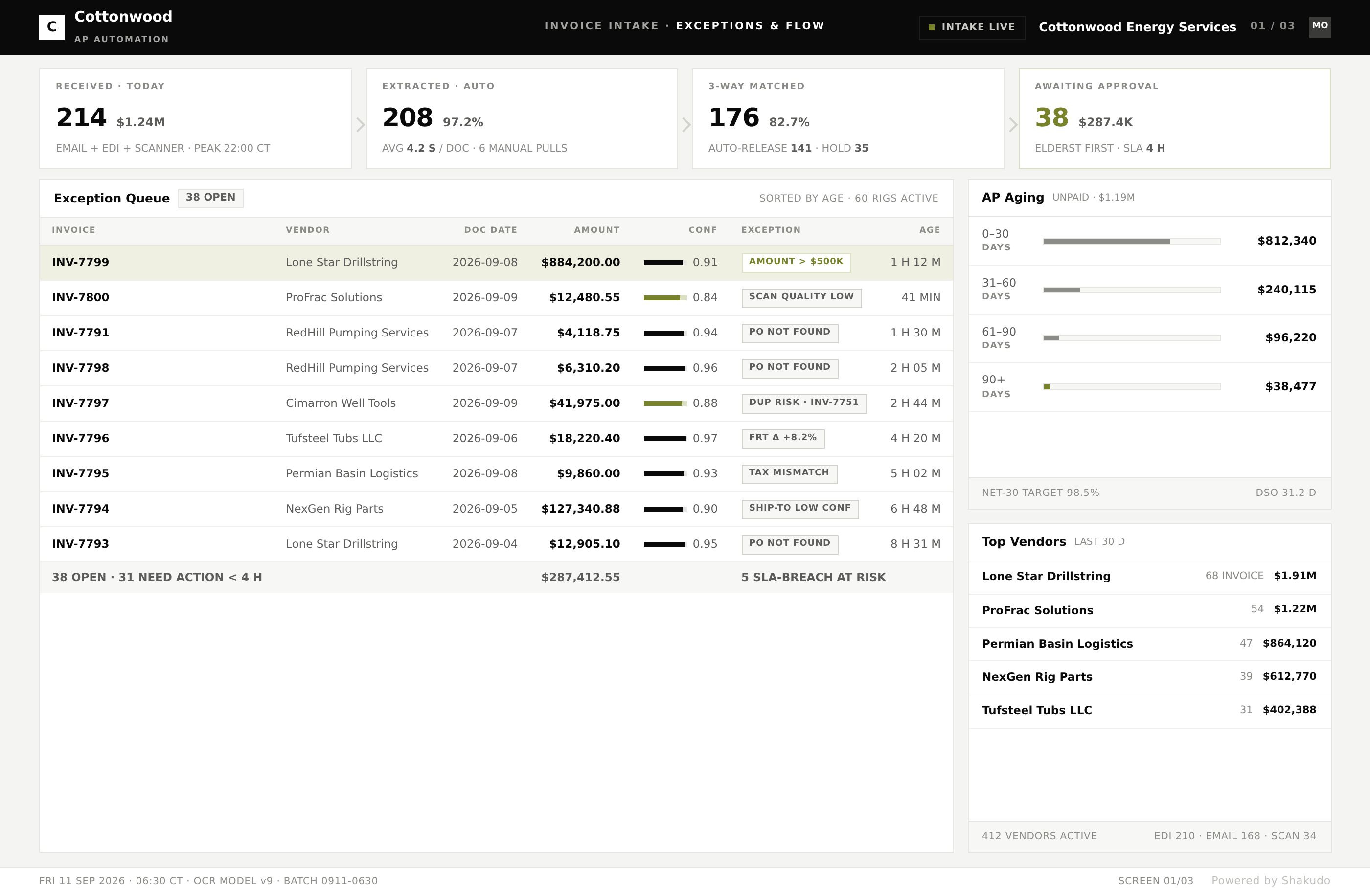
1–2 / 3
Oilfield services companies process thousands of supplier invoices each month, each one arriving in a different format. Manual entry averages $10.89 per invoice and takes 10.9 days end to end, and nearly 39 percent of manually processed invoices contain at least one error.
In oilfield operations, invoices reference multiple wells, AFEs, and joint venture partners, so a single misread line item can send costs to the wrong well and trigger months of reconciliation work.
Oilfield accounts payable carries a level of complexity that generic automation tools were never designed to handle. Invoices arrive with AFE numbers, cost codes, and joint interest references scattered across multi-page field tickets and supplier statements. AP teams must validate each charge against the correct purchase order, allocate costs to the right well or project, and ensure joint venture billing rules are followed. Manual processing costs $12.88 to $19.83 per invoice in complex energy operations.
The errors compound quickly. A misread AFE number sends costs to the wrong well. A quantity mismatch between the field ticket and the invoice goes unnoticed until audit. Overcharges for equipment rentals and service hours slip through because no one has time to cross-reference every line item against contracted rates. Best-in-class AP teams using automation process invoices for $2.78 each, a 74 percent cost reduction, and complete them in 3.1 days instead of 10.9.
Shakudo deploys an AI OCR extraction pipeline that reads supplier invoices directly from PDFs, scanned images, and email attachments, without template setup per vendor. The pipeline extracts every line item from multi-page invoices, not just the lump-sum total, and classification models identify AFE numbers, cost codes, well names, and joint interest references from the extracted text.
The measurable outcomes are a 99.5 percent OCR accuracy on typed documents, error rates below 0.1 percent compared to 39 percent under manual processing, manual document handling cut by up to 80 percent, and processing that took 15 minutes per invoice now running in seconds. Each line item carries a confidence score, and low-confidence extractions are routed for human review rather than silently passing errors into the accounting system. Duplicate invoice numbers are flagged before they enter the payment queue.
Once line items are extracted, the pipeline hands off to matching, where the work becomes deterministic and auditable.
Teams that previously processed 100 invoices per day can handle 400 or more with the same headcount, and best-in-class AP organizations now achieve 35 percent or higher touchless processing rates on routine invoices.
Pinecone stores the supplier, well, and AFE reference context that grounds each extraction in the operator's own history. FastAPI exposes the extraction and matching services to the accounting system, and Streamlit gives the AP team a dashboard to review discrepancies and approve or reject invoices.
Built for accounts payable and cost control teams at oilfield services companies, drilling contractors, and energy operators, where invoices reference AFEs, cost codes, and joint venture partners. It fits AP clerks validating line items against contracted rates, cost accountants allocating charges to wells and projects, and joint venture controllers reconciling working interest billing across partners.
The pipeline belongs in climate and energy operations, where supplier spend is high, vendor formats vary, and reconciliation across working interest owners is a recurring, labor-intensive task.
Modern OCR achieves 99.5 percent accuracy on typed documents, and AI-powered invoice systems push error rates below 0.1 percent. For scanned field tickets and handwritten elements, confidence scoring flags uncertain extractions for human review. The system improves over time as it processes more invoices from your specific suppliers and field operations.
Yes. The extraction pipeline identifies AFE numbers, cost codes, and joint interest references from invoice text. The system applies working interest allocation rules automatically and splits charges across the correct wells and projects. This handles the multi-party validation and cost recovery requirements that generic AP tools cannot manage.
Each extracted line item is matched to its corresponding purchase order by part number, description, and quantity. Unit prices are compared against contracted rates. Variances above a configurable threshold are flagged for review. The system catches overcharges, unauthorized line items, and quantity mismatches before the invoice enters approval routing.
A basic OCR extraction and matching pipeline can be operational in weeks when built on an existing AI platform. Full integration with ERP systems, AFE databases, and joint interest billing tools adds time but follows an incremental path. Each connected component delivers value independently as teams connect more data sources.
When the goal is invoice processing that moves from days to hours, a conversation with Shakudo is the fastest way to see it on your own invoice data. The solution deploys on your own infrastructure, on-prem or in your cloud, and a first working pipeline is in place within days. Book a demo to watch it run on your invoices.
AI OCR reads supplier invoices automatically, extracts line items into structured data, and matches them against purchase orders in oilfield operations. The system flags pricing discrepancies, missing items, and quantity mismatches before payment approval. Teams cut processing time from days to hours while reducing manual data entry costs by up to 80 percent.










"What drew me in is simple. When developers ship production-ready code this quickly, how can I have environments spun up fast enough? Shakudo is how we close that gap."


"Shakudo does not just provide the platform. It is a real partnership. They are always there to help and execute our vision faster and the right way. It is like a co-team working together to achieve our goals."